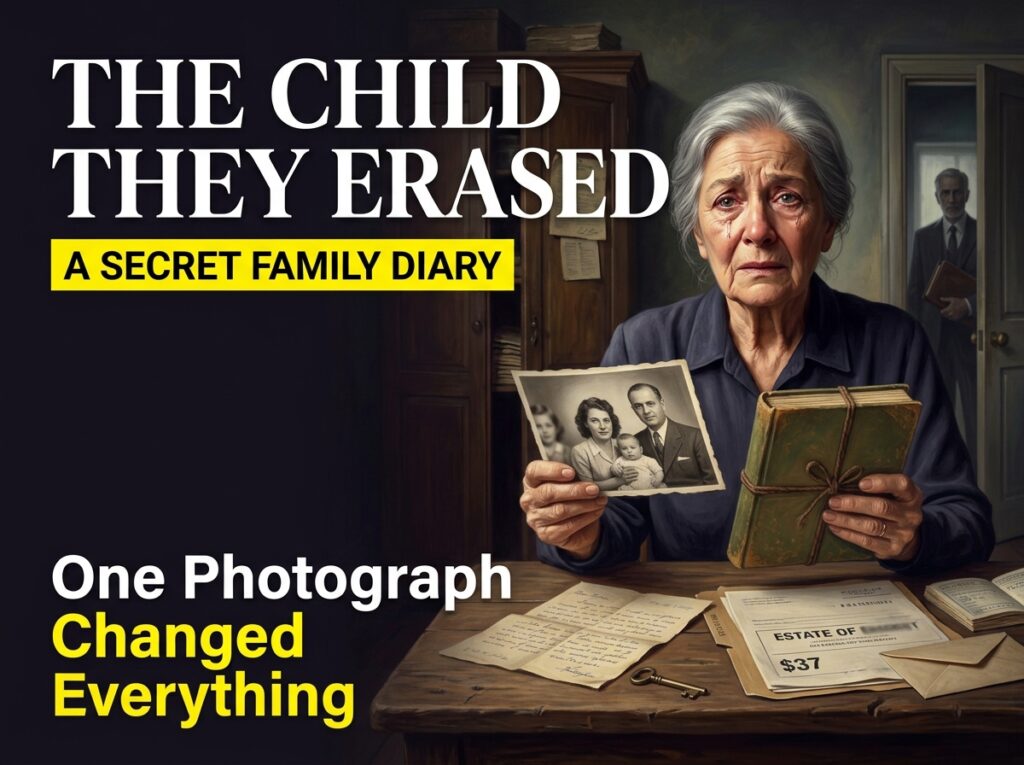
Evelyn, 81 never expected a quiet street after the shops had closed to become the place where everything changed. I thought I understood the people I loved until one ordinary day exposed a detail no one could explain. For years, the lawyer handling the estate had been part of a story that seemed settled, but one detail had never made sense.
There were bills to pay, people depending on me, and memories I didn’t know how to explain. Even $37 seemed less important than the question nobody would answer: why had this been kept secret for so long? I tried to carry on as usual, but the silence around the subject only made it harder to ignore.
Then, in 2009, I found a diary tied with string. At first I assumed it belonged to an old argument or a forgotten promise, but the details did not fit. The photograph showed a second child standing just outside the frame. Suddenly, the story I had been told for years felt incomplete, and I realized that asking the wrong person might make everything worse.
Before anyone could ask more, Grandma pointed to a locked cupboard and said, “The rest is in there.” I had to decide whether to confront the people closest to me or follow the clue quietly before it disappeared.
I remember the evening because the shops had closed early, and the street outside my rented room was unusually quiet.
The bakery downstairs had finished selling its last loaves. The owner was pulling down the metal shutter, and the smell of warm bread still drifted up the narrow staircase. I sat at my small table with a cup of tea, counting the money in my purse.
Thirty-seven dollars.
That was all I had until my next payment arrived.
At eighty-one, I had learned how to make a little money last longer than anyone expected. I knew which groceries could stretch across several meals, which bills could not be delayed, and which relatives would promise to help but forget before the week was over.
I did not complain. I had survived harder times.
What troubled me was not the money. It was the growing feeling that my family had built its history around a story nobody was permitted to question.
For years, I had believed that my parents’ estate had been settled properly. The lawyer, Mr. Whitmore, had handled the paperwork after the deaths in our family. He spoke with confidence, kept his documents neatly arranged, and always reminded us that the important matters had been resolved.
Whenever someone asked about an old photograph, an unfamiliar name, or a missing document, he said the same thing.
“The estate was handled according to the records. There is nothing further to discuss.”
I had accepted that answer because I was tired of arguments.
My older brother, Peter, trusted him. My daughter, Margaret, believed questioning the past would only reopen old wounds. Even my grandson Daniel, who usually asked me about everything, had learned to change the subject whenever the estate was mentioned.
Then I found the diary.
It was inside an old cardboard box that had been left in the back room of the family house. The house had been sold years earlier, but some belongings had been returned to me when the estate was cleared. I had stored the box in my rented room and forgotten about it.
That afternoon, I was searching for an old receipt when I found the diary beneath a stack of envelopes.
It was dark brown, with worn corners and a faded cloth cover. Three pieces of string had been wrapped around it, tied in a careful knot.
There was no name on the front.
I untied the string and opened the first page.
The handwriting belonged to my mother.
I recognized the long strokes and the way she crossed her letters. She had been gone for more than thirty years, but seeing her words made me feel as though she were sitting across the table.
The first entries were ordinary: shopping lists, family visits, notes about the weather, and reminders about appointments.
Then I reached a page dated decades earlier.
A photograph had been tucked between its pages.
It showed my parents standing outside our old family house. My older brother, Peter, stood beside them, wearing a dark jacket. I recognized the garden fence and the pear tree behind him.
But there was something wrong with the picture.
At the far right edge, barely visible beyond the frame, stood a second child.
Only part of the child’s face and one shoulder could be seen. Someone had tried to cut the photograph, but the scissors had stopped before removing the child completely.
On the back, my mother had written:
“One day, Evelyn will ask why the photograph was changed.”
My hands began to shake.
I had never heard of a second child in that photograph.
I turned back to the diary.
A few pages later, my mother had written:
“Whitmore says the matter must remain settled. Peter says it is better not to remember. But a child cannot be made to disappear simply because the adults are frightened.”
I read the sentence several times.
Then I heard a knock at my door.
It was Daniel.
He stepped inside carrying a small paper bag and smiled when he saw the diary.
“Grandma, what have you found?”
I showed him the photograph.
His smile disappeared.
He stared at the child at the edge of the frame, then looked at me.
“Where did you get this?”
“From the box.”
He did not ask which box.
He did not ask whether I had read the diary.
He simply looked at the photograph and whispered, “I thought they had destroyed that.”
I felt the room tilt around me.
“Who is the child, Daniel?”
He opened his mouth, but no words came.
Then he looked toward the hallway as though someone might be listening.
“Grandma,” he said quietly, “you need to be careful about who you ask.”
Part 2 — The Lawyer Who Remembered Too Much
Daniel left before I could ask another question.
He said he needed to make a telephone call, promising to return the next morning. I watched him descend the stairs, the paper bag still sitting untouched on my table.
I had known my grandson since the day he was born. I had held him when he was small, helped him with his schoolwork, and listened to his worries when he was old enough to understand that families could be complicated.
He had never looked at me as he had looked at that photograph.
It was not merely surprise.
It was recognition.
I closed the diary and placed it beneath my pillow. I did not sleep well that night. Every time I closed my eyes, I saw the child’s half-visible face.
The following morning, I called Mr. Whitmore.
His office was near the courthouse, above a row of shops that sold stationery, clothing, and household supplies. I had visited him many times after my parents died. He always offered tea and spoke as though every question had already been answered.
When I told his receptionist that I needed to discuss an old family photograph, she asked me to wait.
A few minutes later, Mr. Whitmore came to the telephone.
“Evelyn,” he said, “is something wrong?”
“I found my mother’s diary.”
Silence.
Then he said, “Where?”
“In an old box.”
“I see.”
“I also found a photograph showing a child our family never mentioned.”
Another pause followed.
“Old photographs can be misleading,” he replied. “People are sometimes standing outside the frame, or photographs may have been altered for ordinary reasons.”
“This one was deliberately cut.”
“I would advise you not to draw conclusions before examining the context.”
“Then help me understand the context.”
He cleared his throat.
“The estate was settled many years ago. If you have found additional documents, you should preserve them. But I cannot discuss confidential matters over the telephone.”
“Can I come to your office?”
“Not today.”
“Tomorrow?”
“I will contact you when I am available.”
He ended the call.
I sat holding the receiver long after the line went silent.
The lawyer had not said he knew nothing about the child.
He had not said the photograph was meaningless.
He had simply refused to speak.
That afternoon, I visited the old family house’s former neighborhood. The house itself had changed owners, but several of our old neighbors still lived on the street.
Mrs. Collins, who had lived next door when I was young, recognized me immediately.
“Evelyn! I haven’t seen you in ages.”
We talked about the neighborhood, the shops, and the people who had moved away. Eventually, I showed her the photograph.
She adjusted her glasses.
“Oh,” she whispered.
“You remember this?”
She looked at the child.
“I remember there was another little one around your house for a time.”
“Who was it?”
She lowered the photograph.
“Your mother asked everyone not to talk about that child.”
“Why?”
“I was never told the full story. I only know that your father used to take a child to the clinic in town, and your mother would become upset whenever someone asked who it was.”
“Was the child a relative?”
Mrs. Collins shook her head.
“I don’t know, dear. I wish I could help you.”
I thanked her and left.
The story was becoming clearer in one sense and more confusing in another. Someone had known about the child. Someone had tried to remove the child from the photograph. And the lawyer who handled the estate appeared to know more than he was willing to say.
That evening, I opened the diary again.
A page dated the year after the photograph had been taken contained a short entry:
“Today, the child asked whether Peter would remember them. I told the child that love does not disappear because adults choose silence.”
Below it was a name.
Anna.
I had never heard that name in our family history.
I copied it onto a separate piece of paper.
Then I turned the page and found another entry:
“Whitmore has agreed to keep the documents until the family is ready. I pray the child will not grow up believing we abandoned them.”
I sat very still.
The lawyer had been involved when the diary was written.
This was no longer simply a family memory.
It was a secret someone had deliberately preserved.
Part 3 — The Locked Cupboard
I returned to the family house’s old neighborhood the following morning and asked Mrs. Collins whether she remembered anything about a locked cupboard in my parents’ home.
She frowned.
“Your mother kept a cupboard in the little room beside the kitchen. She never let the children play near it.”
“I remember that.”
“Your father used to keep papers there. I once saw him carry a small box into that room.”
I asked whether she knew what happened to the cupboard after my parents died.
“I thought it went to the family when the house was cleared.”
It was possible that the cupboard had been moved to a relative’s home or stored with the rest of the estate belongings. I returned to my room and searched the boxes I had kept.
There were old dishes, photographs, letters, and a small wooden chest. I found nothing that looked like the cupboard.
Then I remembered the words Daniel had used.
“I thought they had destroyed that.”
He had not said the photograph.
He had said “that,” as though the photograph were only one part of something he already understood.
I called him.
“Daniel, do you know where the old cupboard is?”
He did not answer immediately.
“Why?”
“Because the diary says the rest of the story is there.”
He sighed.
“Grandma, please don’t do this alone.”
“Then tell me what you know.”
“I can’t explain it over the phone.”
“Come here.”
He arrived an hour later.
He looked exhausted, and I noticed that he kept rubbing his hands together, a habit he had developed when he was a boy.
I placed the diary on the table.
“Start with the truth,” I said.
Daniel sat down.
He told me that he had heard about Anna from his mother when he was a teenager. Margaret had said there had once been a child connected to the family, but the child had been sent away after an argument between my parents and another relative.
She had refused to explain further.
Years later, when Daniel helped clear some of the old estate papers, he saw a reference to a locked cupboard and asked the lawyer about it.
Mr. Whitmore had told him the cupboard had been destroyed and that its contents were no longer relevant.
Daniel had believed him.
Until he saw the photograph.
“Do you know who Anna was?” I asked.
“No.”
“Do you know whether she was my sister?”
He looked down.
“I don’t know, Grandma.”
The answer was painful, but I believed him.
I asked him why he had recognized the photograph.
He explained that a similar photograph had appeared in an envelope among his mother’s belongings. When he asked about it, she had become upset and taken it away.
He had never seen it again.
I thought about my mother’s diary.
“Do you think the cupboard still exists?”
Daniel nodded slowly.
“I think I know where it might be.”
He told me that after the old house was sold, several pieces of furniture had been placed in storage. One storage unit had belonged to Peter, my older brother. When Peter died, the contents were divided among the family, but some items remained boxed because nobody wanted to sort through them.
Daniel believed the cupboard might have been stored there.
I asked why he had not mentioned this before.
“Because Mum told me never to bring it up. She said the cupboard contained things that could hurt people who were still alive.”
I stared at him.
“People who were still alive can decide for themselves whether they want to know the truth.”
He nodded.
We agreed to contact Peter’s family and ask whether the storage unit still existed. We would not remove anything without permission, and we would keep a record of whatever we found.
Before Daniel left, I asked him one more question.
“Do you think Anna is still alive?”
He looked at the photograph.
“I don’t know.”
Neither did I.
But for the first time, we had a name, a photograph, and a possible place to look.
The secret was no longer an invisible shadow hanging over our family.
It had become a question we could investigate.
Part 4 — The Envelope in Storage
Peter’s daughter, Susan, agreed to meet us at the storage facility.
She had inherited the unit after her father’s death and had never fully sorted through its contents. Most of the boxes contained ordinary belongings: tools, old books, broken lamps, and furniture that had not been used in years.
She looked surprised when I explained what we were searching for.
“I remember a cupboard,” she said. “Dad said it belonged to Grandma, but he never wanted to bring it home.”
We moved several boxes and found a tall wooden cupboard covered by an old blanket.
The brass handles were tarnished, and the lock had rusted. A strip of paper was tucked beneath one handle.
On it, my mother’s handwriting read:
“For Evelyn, when the family is ready.”
My eyes filled with tears.
My mother had known that I might one day be the person who found it.
Daniel helped me inspect the cupboard. The door would not open, but Susan found a small key in a box of old household items.
It fit.
Inside were three folders, a photograph album, and a sealed envelope bearing the name Anna.
I sat on a nearby chair.
For a moment, I could not bring myself to touch the envelope.
Then I opened it.
The first page was a letter from my mother, written shortly before she died.
“My dear Evelyn,” it began, “if you are reading this, it means the family has finally allowed the past to be seen. I do not know whether the people who kept this secret will ever agree on what happened, but I know that a child should never be made to carry the shame of an adult’s decision.”
The letter continued.
Anna had been born during a period when my parents were struggling financially. The family was already under pressure, and an argument had erupted about the circumstances surrounding her birth and who would be responsible for her care.
My mother had written that some relatives believed keeping Anna’s existence quiet would protect the family from gossip. Others believed that hiding her would only create greater harm.
My father had wanted the child to remain connected to the family.
But an arrangement had been made, and Anna had been placed with another household for a period while the adults attempted to resolve their disagreement.
The letter did not fully explain the legal circumstances or establish every detail of Anna’s identity. It did, however, make clear that she was not simply a stranger who happened to appear in the photograph.
She had been part of our family’s life.
I turned to the next page.
My mother had written:
“Peter was told that Anna had gone away. He was young, and he believed the adults. I hoped that one day he would understand that the decision was not his fault.”
I looked at Daniel.
“Peter knew about Anna?”
“He may have known something,” Daniel said. “But I don’t think he knew the full story.”
The second folder contained copies of letters between my father and Mr. Whitmore. The lawyer had been asked to preserve certain documents until the family could decide how to handle the matter.
One letter stated that the estate should not be considered fully resolved until the family had reviewed the records connected to Anna.
I read it twice.
If that letter was genuine and relevant to the estate, it could mean that the family had been told the matter was settled even though some documents remained unresolved.
But we could not assume that the letter changed anyone’s legal rights. We would need the complete records and appropriate advice to understand what it meant.
The third folder was empty except for a photograph.
It showed my mother holding a little girl.
On the back, she had written:
“Anna, on the day we promised to remember her.”
I held the photograph against my chest.
For decades, I had believed my family had been built around a simple history: my parents, my brother, and me.
Now I understood that our story had always contained another child.
Someone had simply tried to cut her out of the frame.
Part 5 — The Lawyer’s Last Explanation
I took copies of the documents to Mr. Whitmore’s office.
This time, he agreed to see me.
He looked older than I remembered, with thinning white hair and a careful manner that had always made him seem more certain than he might actually have been.
When I placed my mother’s letter on the desk, he closed his eyes briefly.
“So you found the cupboard,” he said.
“Why did you tell us the estate was settled?”
He folded his hands.
“The estate was processed according to the documents available at the time.”
“But this letter says the matter involving Anna had not been fully resolved.”
“The letter reflects your parents’ wishes. It does not automatically determine the legal status of the estate.”
“Then why was the cupboard kept hidden?”
He sighed.
“Your parents believed the family would eventually discuss the matter. They asked me to preserve certain documents. Over the years, different relatives gave me different instructions. Some wanted the records disclosed. Others wanted them kept private.”
“And you chose silence.”
“I chose to follow the instructions I believed I was permitted to follow.”
I was angry, but I listened.
He explained that he could not simply reveal private records to every family member who asked. Some documents were confidential, and some questions required legal review. He admitted, however, that he should have been clearer about the existence of unresolved historical documents rather than repeatedly telling the family there was nothing further to discuss.
“Did you know who Anna was?” I asked.
“Your mother identified her as a child connected to the family. But the records I held did not provide a complete answer to every question about her identity, her later life, or the arrangements made for her.”
“Do you know whether she is alive?”
“I do not know.”
I looked down at my mother’s letter.
“What about the estate? Is there money connected to her?”
Mr. Whitmore explained that the documents included references to an amount set aside during the original arrangement. But he could not confirm from the papers I had brought whether any money remained, whether it had been distributed, or whether Anna or anyone else had a current legal claim.
The records would need to be reviewed in full.
I asked about the $37 I had seen mentioned in an old note attached to the diary.
He examined it carefully.
“It may be a reference to an expense or a payment made at the time,” he said. “There is nothing here that would justify treating it as evidence of a larger financial entitlement.”
I was disappointed, but I appreciated the distinction.
I had spent days wondering whether the small amount might somehow connect to a much larger secret. It could be a clue, but it was not proof of anything by itself.
Mr. Whitmore agreed to provide a list of the documents he still held and explain the proper process for reviewing them.
Before I left, I asked him one final question.
“Why did my mother write that the family was not ready?”
He looked at me for a long time.
“Because every time someone tried to speak about Anna, the family argued about blame. Your mother believed that if the truth was revealed in anger, people would hear only the accusations and not the child at the center of the story.”
I left his office with copies of the records and a list of unanswered questions.
The lawyer had not solved the mystery.
But he had finally admitted that the story was not as settled as he had allowed us to believe.
Part 6 — The Name Anna
We began searching for Anna through the records that could lawfully be accessed.
I did not want to invade anyone’s privacy or contact a stranger based on a name in an old diary. If Anna was alive, she deserved the right to decide whether she wanted to hear from us.
Susan helped organize the photographs and letters. Daniel compared the dates in the diary with the family records. Margaret agreed to speak with us, although she remained uncomfortable with the subject.
She came to my room on a rainy afternoon and sat beside the window.
“I remember hearing the name Anna when I was young,” she said. “Grandma told me not to repeat it outside the house.”
“Did she tell you who Anna was?”
“She said Anna was a child who had been hurt by a decision the adults made. She didn’t tell me the full story.”
“Why didn’t you ask?”
Margaret looked ashamed.
“Because I thought asking would hurt her.”
I understood that feeling. For years, I had avoided questions for the same reason.
But I had come to understand that silence could hurt people too.
Margaret remembered that Peter had once received a letter from a woman who said she was trying to locate relatives from our family. He had kept the letter for a time, but later told Margaret that the matter had been resolved.
“Do you remember her name?” I asked.
“No. I never saw the letter.”
“Do you know what happened to it?”
Margaret thought for a moment.
“Peter had a box of personal correspondence. Susan may have it.”
We called Susan and asked her to check the papers from Peter’s belongings.
That evening, she found an envelope with a postmark from several years earlier. The sender’s name had been partially obscured, but the first name was readable.
Anna.
Inside was a short letter.
“I have spent many years trying to understand where I came from,” it began. “I was told that the people who raised me were my family, and I am grateful for the life they gave me. But I recently found a photograph that suggests there may be more to my story.”
The writer asked whether anyone remembered a child who had lived near our family house many years earlier.
There was no return address, only a town name and a post office box.
I read the letter several times.
It did not prove the writer was the same Anna mentioned in my mother’s diary. But the timing and the reference to a photograph gave us a reason to investigate further.
We agreed to send a carefully worded letter through the available contact route. We would explain that we had found family documents referring to a person named Anna and ask whether the recipient wished to speak with us.
We would not demand an answer.
We would not claim to know her entire history.
And we would not treat her as a missing piece of property that belonged to us.
She was a person who had her own life, memories, and choices.
Before mailing the letter, I wrote a sentence at the top of my draft:
“We do not expect you to forgive anyone. We only want to offer you the truth we have found, and let you decide what you want to do with it.”
For the first time, I felt that we were approaching the secret in the right way.
Part 7 — The Answer That Arrived Too Late
Weeks passed before we received a reply.
I had nearly convinced myself that the letter had never reached its destination when a plain envelope arrived at the bakery downstairs. The owner brought it up to my room, saying a courier had left it with the morning deliveries.
My hands trembled when I saw the name on the front.
Anna.
The letter inside was short.
The writer confirmed that she had spent years searching for information about her birth family. She had been raised by a couple who loved her, but certain details in her childhood records had never made sense. A photograph she discovered after their deaths had led her to investigate.
She had not known whether our family would welcome contact.
She wrote that she was willing to exchange letters, but she did not want to meet immediately or be pressured to accept a particular version of the past.
I understood.
I wrote back, explaining what we had found: the diary, the photograph showing a second child, my mother’s letter, and the correspondence involving Mr. Whitmore.
I made it clear that we could not answer every question and that some details remained uncertain.
A month later, Anna replied again.
She recognized the photograph.
It was one she had seen in her own childhood. Her adoptive parents had kept a copy, though they had never explained why it showed a woman and a family she did not know.
Anna said that she had always wondered whether the child in the photograph was herself.
The letter did not provide all the answers, but it made the connection much stronger.
She agreed to a telephone call.
When I heard her voice, I felt a strange mixture of familiarity and distance. She was an adult woman with a life of her own, and I was an eighty-one-year-old stranger who had only recently learned that she might have been part of my family.
We spoke carefully.
I told her about my mother and the way she had written about the child. I told her that I could not promise the family had always acted kindly or fairly. I could only share the records we had found.
Anna listened quietly.
Then she asked, “Did they ever talk about me?”
I closed my eyes.
“Yes,” I said. “My mother wrote about you. She wanted the family to remember you, even when other people wanted to keep the matter quiet.”
Anna was silent for a long time.
“That is more than I knew before.”
I wanted to say that everything would be all right, that we could make up for the years of silence, and that the family would welcome her without hesitation.
But I could not promise those things.
Instead, I told her the truth.
“Some people in the family may need time to understand what happened. But you deserve to decide for yourself whether you want contact with us.”
She thanked me.
We did not resolve the past in one telephone call.
We did not immediately become a family in the way people imagine families should be.
But we had finally spoken.
And that was something the adults who came before us had failed to do.
Part 8 — The Family Meeting
I asked the family to meet at my room above the bakery.
Margaret came first, followed by Daniel and Susan. Peter’s old papers were arranged on the table, along with the diary, photographs, and copies of the correspondence.
Mr. Whitmore did not attend, but he had provided the available documents and explained which matters still required formal review.
I told everyone about Anna’s letter and our telephone conversation.
Margaret began to cry.
“I always wondered what happened to her,” she said. “I just never thought we would hear from her.”
Daniel looked at the photograph.
“She was standing right there all along,” he said. “We just kept looking at the people in the middle.”
His words stayed with me.
For years, our family had focused on the people who remained in the house, the people whose names appeared in the estate papers, and the people who had the authority to decide what could be discussed.
The child at the edge of the photograph had been treated as a detail to be removed.
I asked the family what they wanted to do next.
Margaret said she wanted to write Anna a letter of apology, but she worried that doing so might make Anna feel responsible for comforting the people who had kept the secret.
“Then write without asking her to forgive you,” I said. “Tell her what you regret, and let her decide what it means.”
Susan agreed to help organize the records so Anna could receive copies of the documents relevant to her history, subject to the appropriate privacy and legal considerations.
Daniel offered to help with the practical arrangements.
We also agreed to continue the review of the estate documents. The papers contained references to money and an old arrangement, but we could not assume that any funds remained or that Anna had a legal entitlement without proper verification.
The $37 mentioned in the diary remained unexplained. It might have been a small payment, an expense, or a detail connected to an event we still did not understand. We would not turn it into a larger claim without evidence.
For the first time, nobody argued about whether the past should be discussed.
We were finally asking how to discuss it without causing more harm.
At the end of the meeting, Margaret took the photograph and looked at the child near the edge.
“I wish I had known,” she whispered.
I placed my hand over hers.
“We all wish we had known sooner.”
But the truth was more complicated.
Some people had known pieces of the story. Some had chosen silence because they believed it was protective. Others had inherited the silence without understanding why it existed.
We could not change those choices.
We could decide what to do next.
Part 9 — What the Estate Could Not Explain
The review of the estate records took longer than anyone wanted.
The documents established that my parents had asked for certain records concerning Anna to be preserved. They also showed that the family had not maintained a complete, consistent account of what happened.
However, the papers did not establish that Anna was automatically entitled to any specific inheritance or that money mentioned in old notes remained available. Those questions required a fuller examination of the estate history and the applicable legal records.
Mr. Whitmore provided the information he was permitted to provide. Where the records were incomplete, he acknowledged that uncertainty rather than offering a convenient answer.
I found that both frustrating and reassuring.
For years, I had wanted someone to tell me exactly what had happened. I wanted the missing child to be identified, the reason for the secret to be explained, and every person involved to be held accountable.
Instead, I learned that truth sometimes arrives in pieces.
The diary gave us my mother’s perspective.
The photograph showed that a second child had been present.
The letters established that the adults had discussed the child and that a promise had been made to preserve the relevant documents.
Anna’s own letter gave us a person who could speak about her life and the questions she had carried.
But some details remained unknown.
We could not reconstruct every conversation that took place decades earlier. We could not know every reason people had for staying silent. And we could not treat an incomplete estate record as proof of a financial entitlement.
I shared the documents with Anna as agreed.
She thanked me and said she wanted time to think about what they meant. She did not ask for money, and she did not demand that the family immediately accept her in a particular way.
That mattered.
For the first time, the story was no longer being controlled by the people who had hidden it. Anna had the information and the freedom to decide what she wanted to do with it.
Margaret continued writing to her. Daniel kept copies of the documents organized. Susan helped preserve the photographs so that they would not be lost again.
And I stopped trying to force the mystery into a perfect ending.
I had spent eighty-one years believing that a family was strongest when everyone agreed on the same story.
Now I understood that a family could be honest even when people remembered events differently, even when apologies came late, and even when some questions could never be answered completely.
The estate had not given us every answer.
But it had finally stopped being an excuse for silence.
Part 10 — The Child We Never Forgot Again
The quiet street outside my room returned to its ordinary rhythm.
The bakery opened early each morning. People walked to work, delivery vans stopped beside the shops, and the owner downstairs complained whenever the weather made the pavement slippery.
My life did not transform overnight.
I still counted my money carefully. I still had bills to pay. I still depended on family members for some things, and I still had days when my memories seemed clearer than the room around me.
But I no longer felt that the past was a locked door I was forbidden to open.
The diary remained on my table, its string tied loosely around the cover. Beside it lay the photograph showing my parents, my brother, and the child at the edge.
I had once looked at that picture and seen a mistake.
Now I saw a person who had been part of our story, whether or not the adults had known how to acknowledge her.
Anna and I continued exchanging letters.
We did not pretend that decades of separation could be repaired by a few conversations. She had lived a life I knew very little about, and she had her own family, memories, and feelings. I listened when she wanted to talk, and I accepted her silence when she needed time.
One afternoon, she sent me a photograph of herself as a young girl.
She was standing beside the people who had raised her, smiling in front of a small garden.
On the back, she had written:
“This is the family who loved me. I am grateful for them. I also want to understand the people who came before.”
I held the photograph for a long time.
The truth did not require Anna to reject the family that had raised her. It did not require us to pretend that our family had treated her perfectly. Both things could be true: she had been loved, and part of her history had been hidden.
That was the lesson I wished my parents had understood.
A person does not become less loved because their story is complicated.
And a family does not become less worthy because it admits that it made mistakes.
The question of the estate was handled separately through the appropriate process. We did not promise Anna money that the records could not establish was hers. We did not treat the old $37 as evidence of a larger fortune. We preserved the documents and followed the available procedures to clarify what could be clarified.
It was not the dramatic ending I might once have imagined.
There was no single envelope containing every answer. No confession explained every silence. No amount of money could replace the years Anna had spent wondering where she came from.
But there was something real.
There was a diary that had survived.
There was a photograph that had not been completely cut apart.
There were letters showing that my mother had wanted the child to be remembered.
And there was a family that had finally stopped insisting that the story was settled.
One evening, Daniel came to visit and found me looking at the photograph.
“Do you think Grandma knew you would find it?” he asked.
“I think she hoped someone would.”
“Why did she wait so long to tell anyone?”
I considered the question.
“Perhaps she was afraid. Perhaps she thought silence would protect the child. Perhaps she believed there would be a better time.”
“Was there?”
I shook my head.
“The better time was when someone first had the courage to tell the truth.”
Daniel sat beside me.
We remained quiet for a while, listening to the bakery downstairs close for the night.
Then I untied the string around the diary and placed the photograph inside a protective sleeve. I did not want it hidden away again. I wanted the next person who opened the book to understand that the child at the edge of the picture mattered.
The diary had begun as a mystery about a missing person.
It had become a story about the harm that silence can cause when it is mistaken for protection.
At eighty-one, I could not change the decisions made by my parents, my brother, or the lawyer who handled the estate. I could not return the years Anna had lost or answer every question she still carried.
But I could make one promise of my own.
I would never again agree that a person’s existence should be erased simply because their story made other people uncomfortable.
The family photograph remained incomplete in its original form.
The child was still standing at the edge.
But now we knew her name.
Anna.
And from that day forward, we would not cut her out of the frame again.