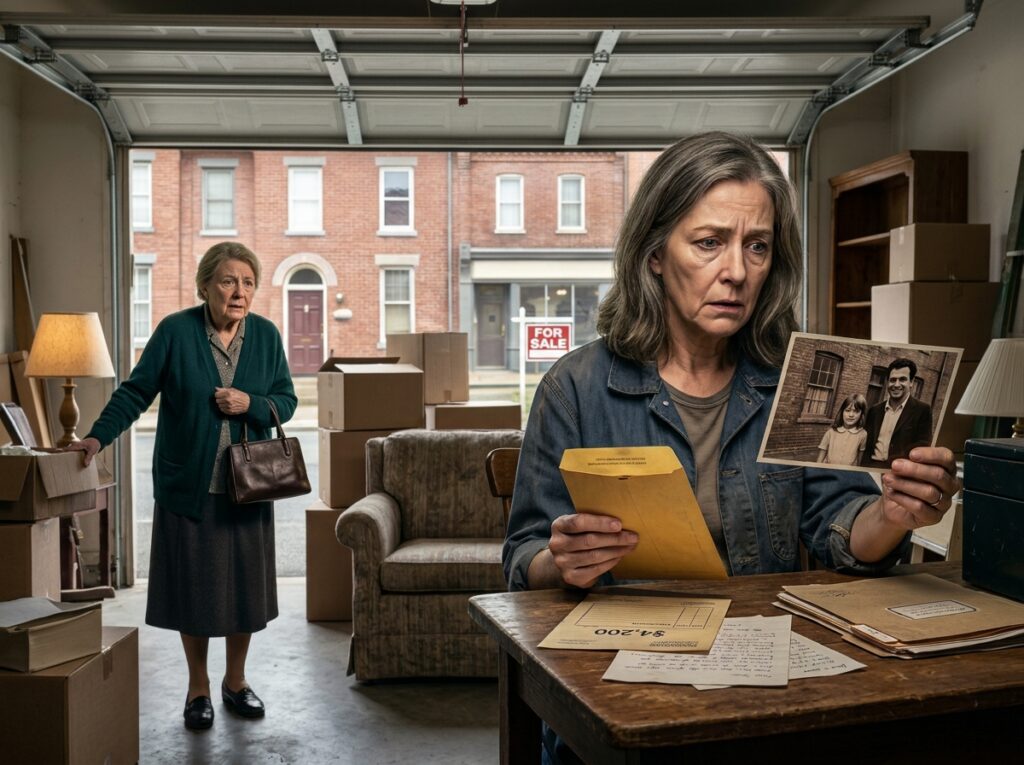
The smell of freshly baked bread was the first thing Ruth noticed every morning.
It drifted through the narrow staircase and slipped beneath the door of her rented room, bringing with it the comforting warmth of a world that seemed to know exactly what it was doing. Downstairs, the bakers began their work before sunrise. Trays clattered, ovens hummed, and the owner occasionally called instructions to someone in the kitchen.
Above it all, Ruth sat at a small wooden table, studying a notebook filled with numbers.
At fifty-eight, she had learned that a person’s life could become an exercise in subtraction.
Rent. Electricity. Groceries. Transportation. Medicine. A little money set aside for emergencies, although emergencies rarely respected the amount she had managed to save.
She drew a line beneath the final figure and sighed.
“I only need to get through the end of the month,” she whispered.
She had said the same thing the previous month.
The room was small, with one narrow window overlooking the street, a wardrobe that leaned slightly to the left, and a bed that creaked whenever she turned. It was not the kind of place she had imagined living in at her age, but it was affordable, and affordability had become more important than pride.
She had moved in with two suitcases, a box of kitchen things, and several folders of old paperwork. The arrangement was supposed to be temporary. She needed somewhere quiet while she sorted out a few practical problems and decided what to do next.
She had not expected to find anything that would change her understanding of the past.
Fourteen years earlier, her younger sister had become the center of a family dispute involving $4,200.
Ruth could still remember how quickly the atmosphere had changed. One week, they had been discussing ordinary family matters. The next, every conversation seemed to lead back to money, responsibility, and accusations nobody wanted to make directly.
Her sister had been accused of withholding information. Some relatives believed she had received money she could not explain. Others insisted that the amount had already been settled.
Ruth had tried to understand both sides.
Eventually, she accepted the explanation offered by the people who sounded most certain.
That decision had not brought peace.
It had merely taught everyone how to avoid the subject.
Her younger sister became quieter. Family gatherings grew uncomfortable. Whenever Ruth tried to ask about the missing details, someone would remind her that the matter was old and that there was no reason to reopen it.
So she stopped asking.
Or at least, she tried.
There had always been one detail she could not reconcile. The dates never seemed to fit the explanation. A payment had supposedly been made before a particular conversation took place. Someone had mentioned a promise, then later denied knowing anything about it.
Ruth had noticed these inconsistencies but told herself that memories became unreliable over time.
People remembered things differently.
That was what she wanted to believe.
On that particular afternoon, she was searching through her paperwork for an old receipt. A payment was due soon, and she needed to confirm a figure before contacting someone about it.
She opened the first folder, sorted through several bills, and moved a stack of letters onto the bed.
Nothing.
She tried another folder.
A folded sheet slipped behind the table and landed near the wall.
Ruth bent to retrieve it.
That was when she noticed the brown envelope.
It had been pushed into the narrow space between the table and the wall, where dust had gathered along the wooden floor. The paper had turned yellow with age. One corner was crushed, and the flap looked as though it had been opened and closed many times.
She pulled it free.
For a moment, she assumed it belonged to the previous tenant. Perhaps someone had forgotten an old receipt or a letter that no longer mattered.
Then she turned it over.
A handwritten number appeared near the flap.
4,200.
Ruth stopped breathing for a moment.
She knew that number.
She had not seen it written down in years, but she remembered it as clearly as if someone had spoken it beside her.
The amount from the family dispute.
She sat down slowly.
The room seemed suddenly unfamiliar. The bakery noises below continued, but Ruth barely heard them.
“That can’t be,” she murmured.
She examined the envelope more carefully. There was no name on the front, no address, and no date she could immediately recognize.
Her fingers trembled slightly as she opened the flap.
Inside lay a folded pay slip and a small photograph.
The pay slip was faded, but some of the writing remained legible. Ruth could make out a date from the period surrounding the family dispute. Beneath it were figures, deductions, and a handwritten mark.
She set it aside and picked up the photograph.
Two people stood outside a building.
One was her younger sister.
The other person was partly turned away from the camera, but something about the posture seemed familiar.
Ruth brought the photograph closer to the window.
She studied the outline of the face, the shape of the shoulders, and the way the two people stood beside one another.
Then she recognized something that made her stomach tighten.
The person in the photograph was someone the family had believed had abandoned them.
Someone whose name had once caused arguments.
Someone Ruth had not expected to see standing beside her sister during the very period when everyone insisted that her sister had been left to manage alone.
Beneath the photograph was a small handwritten note.
Ruth unfolded it.
The writing was hurried, and the paper had weakened along the crease. She could read only a few lines clearly.
But one sentence stood out.
The money was never meant to be a debt.
Ruth read it again.
Then she looked at the pay slip.
Fourteen years of silence suddenly felt less like a closed chapter and more like a door that someone had deliberately kept shut.
She gathered the papers and placed them on the table.
For the first time in years, she wondered whether she had spent fourteen years believing a story that had never been true.
And if the photograph revealed who had been helping her sister, why had nobody wanted Ruth to know?
Part 2
Ruth barely slept that night.
The envelope lay inside the bottom drawer of her wardrobe, hidden beneath folded clothes. She had put it there because she did not know what else to do with it.
She could not explain why the discovery made her feel unsafe. It was only an old envelope, after all. A piece of paper could not reach into the present and harm anyone.
Yet every time footsteps sounded on the staircase, she looked toward the door.
She wondered whether the person who had hidden it knew she had found it.
She wondered whether her sister knew it existed.
Most of all, she wondered whether the family had kept the secret because the truth was painful or because the truth would expose someone who had been lying.
At seven the following morning, Ruth went downstairs for bread.
Mrs. Ellis, the bakery owner, was arranging a tray of rolls behind the counter.
“You look tired,” she observed.
“I didn’t sleep well.”
“Too warm upstairs?”
“No. Just thinking.”
Mrs. Ellis placed a loaf into a paper bag.
“Thinking is free, but it can cost you a whole night’s rest.”
Ruth managed a faint smile.
Mrs. Ellis had a direct way of speaking that Ruth appreciated. She was not a woman who asked questions simply to fill silence. When she wanted to know something, she asked. When someone did not wish to answer, she usually let the matter rest.
Ruth carried the bread upstairs.
She made tea, sat down, and opened her notebook.
For years, she had treated the $4,200 as an unresolved financial question. Now she understood that the money might have been only one part of a much larger arrangement.
The pay slip was especially troubling.
If someone had been earning wages during the period in question, those records might explain where the money came from. If payments had continued for years, they might reveal who had been responsible.
But a pay slip alone could not explain the photograph.
Who had taken it?
Why had the two people met?
And why had someone hidden the envelope in a room above a bakery?
Ruth examined the handwriting on the note.
It was unfamiliar, although the final letter of one word reminded her of a signature she had seen long ago.
She tried to remember where.
Her father had kept old papers in a drawer near the kitchen. Her sister used to help organize them. There had been letters, receipts, and envelopes that nobody wanted to throw away because each seemed connected to some unfinished matter.
Perhaps the note belonged to one of those old conversations.
Perhaps the envelope had been misplaced years earlier.
But the number written on the front seemed too precise to be accidental.
Ruth picked up her phone.
Her younger sister’s name appeared near the top of the contact list.
She could call and ask a simple question.
Have you ever seen an old pay envelope connected to the $4,200?
But she already knew that the question would not remain simple for long.
Her sister would want to know why Ruth was asking. Ruth would explain the photograph. Her sister might become frightened or angry. They might repeat the same arguments they had been having for fourteen years.
Ruth placed the phone down.
She had spent too many years allowing the fear of an argument to decide what she was permitted to know.
This time, she would be careful.
She began by examining the pay slip again. Some of the employer’s name was missing, but enough letters remained to suggest that the business had operated locally.
She wrote down what she could read.
Then she examined the photograph.
The building in the background had a narrow doorway and a pale wall. A sign hung above the entrance, but the letters were too faded to identify.
The two figures stood close together, yet neither appeared to be smiling.
It was not a photograph taken for a family album.
It looked more like a picture someone had taken quickly, perhaps to document a meeting.
Ruth wondered whether the person behind the camera had known that the image would one day become important.
She turned the photograph over.
There was a date written on the back.
It matched the period surrounding the family dispute.
Beneath it were two words, faint but readable.
Keep this.
Ruth felt a chill move through her.
Someone had not merely kept the photograph by accident. Someone had considered it important enough to preserve.
She returned to the pay slip and compared the dates.
The money had been recorded during a period when the family claimed the arrangement had already ended.
That detail mattered.
If the payments continued after the supposed settlement, then the story Ruth had accepted could not be complete.
She needed to speak to someone who could explain the records without being influenced by the family argument.
But before she could decide whom to contact, her phone rang.
The caller was someone she had not spoken to in months.
It was also the person who had doubted her younger sister most strongly fourteen years earlier.
Ruth almost let the call go unanswered.
Then she remembered the photograph.
“Hello?”
The caller did not bother with a greeting.
“I heard you’ve been asking about the old money.”
Ruth straightened in her chair.
“I haven’t asked anyone about anything.”
“Then you’ve found something.”
Her fingers tightened around the phone.
“Who told you?”
“That doesn’t matter. Listen carefully. Whatever you think that photograph proves, don’t confront your sister yet.”
Ruth stared at the envelope.
“Why?”
The caller took a long breath.
“Because I was wrong about her once. And if that envelope is what I think it is, I may have been wrong about someone else, too.”
Part 3
Ruth sat down again.
For fourteen years, she had remembered this person as the loudest voice in the argument. The accusations had been delivered with such confidence that Ruth had eventually mistaken certainty for evidence.
Now the same person was admitting to a mistake.
“What do you mean you were wrong?” Ruth asked.
“I mean I believed your sister had taken money that didn’t belong to her.”
“And now?”
“Now I don’t know whether that was ever true.”
Ruth looked at the faded number on the envelope.
“Four thousand two hundred dollars.”
“Yes.”
“Why did you wait fourteen years to say this?”
The caller fell silent.
When the answer came, it was quieter.
“Because I was convinced I understood what happened. I didn’t want to admit that I might have misunderstood the records.”
Ruth felt anger rising.
“My sister tried to explain herself.”
“I know.”
“No, you don’t. You weren’t the one watching everyone turn away from her.”
“I know I hurt her.”
“Then tell me what you know now.”
The caller explained that, years earlier, several people had believed the $4,200 represented a debt. They assumed that Ruth’s sister had received the money and failed to repay it.
The caller had accepted that explanation without examining the dates carefully.
Later, when other details emerged, the caller began to question the original assumption.
But by then, the family had already settled into its version of events.
“Do you have proof?” Ruth asked.
“Not yet. I remember an old record, but I need to find it.”
“What kind of record?”
“Something that might explain why the payments continued.”
Ruth looked at the pay slip.
“Payments to whom?”
“I can’t say for certain.”
“Then why are you calling me?”
“Because I heard you might have found the envelope, and I don’t want you to make the same mistake I made.”
Ruth was silent for a moment.
She wanted to believe the caller was being honest. She also knew that people sometimes changed their stories when their earlier version became difficult to defend.
“What do you want me to do?”
“Give me one day to check the records. Don’t accuse your sister of hiding anything until we understand what the photograph means.”
Ruth nearly refused.
Her sister had already spent fourteen years being judged. Why should Ruth now give the person who had helped create that situation another opportunity to delay the truth?
But she remembered her sister’s expression whenever the old dispute arose. The hurt had never disappeared. It had simply become something she carried quietly.
“One day,” Ruth said. “After that, I will ask her myself.”
When the call ended, Ruth remained at the table.
She took the photograph from the envelope and studied the two figures once more.
Her sister looked younger in the picture. There was tension in her shoulders, but also something like relief. The person beside her appeared to be listening carefully.
They looked like two people sharing a private conversation.
Not two people arguing over money.
Ruth remembered a family gathering from that period. Her sister had arrived late and left early. Someone had made a comment about money, and her sister had gone silent. Ruth had assumed she was ashamed.
Perhaps she had been afraid of revealing something.
Or perhaps she had been waiting for someone else to speak.
Ruth felt a familiar ache in her chest.
She had always believed that loyalty meant defending the family. But what happened when the family was wrong? What happened when protecting everyone from an uncomfortable truth meant allowing one person to carry all the blame?
She took out her notebook and wrote a question.
What if the money was never the real problem?
The sentence looked almost too simple.
Fourteen years of conflict had revolved around a single amount. Yet the envelope suggested that the money had been part of an arrangement involving work, private help, and a promise.
Perhaps the family had confused a record of support with proof of wrongdoing.
Perhaps someone had deliberately allowed that confusion to continue.
Ruth needed to know which.
That evening, she called her sister.
They spoke about ordinary things at first. Ruth asked whether her sister had been sleeping well. Her sister asked whether the rented room was comfortable.
Their conversation felt cautious, as though both women were approaching a door they remembered being locked.
Finally, Ruth asked, “Do you ever think about what happened fourteen years ago?”
The line went quiet.
“Why are you asking me that now?”
“I’ve been thinking about it.”
“So have I.”
Ruth swallowed.
“If I asked you what really happened, would you tell me?”
Her sister gave a tired laugh.
“I tried to tell you once.”
“When?”
“More than once, Ruth.”
The answer stung.
Ruth remembered fragments of conversations, but she could not recall the exact words. She remembered being tired, worried about bills, and frustrated by explanations that seemed incomplete.
She had wanted a simple answer.
Her sister had not been able to give one.
“Did you take the $4,200?” Ruth asked.
Her sister inhaled sharply.
“Where did you hear that?”
“I found something.”
“What did you find?”
“An old envelope. It has a pay slip and a photograph inside.”
The silence that followed was different from the others.
It was not the silence of someone searching for an excuse.
It was the silence of someone who had just heard a door open in a room they thought had been sealed.
“Oh, Ruth,” her sister whispered.
“You know about it?”
“I know what it might mean.”
“Then tell me.”
“I can’t explain everything over the phone.”
Ruth closed her eyes.
“Why does nobody ever answer a question directly?”
“Because the answer might involve someone who never wanted to be exposed.”
“Who?”
Her sister began to cry.
“I thought that envelope had disappeared.”
Before Ruth could ask another question, the call ended.
She tried calling back twice.
There was no answer.
Ruth sat in the dim light, staring at the photograph.
Her sister had not denied the story.
She had not confirmed it either.
Instead, she had revealed something far more unsettling.
She had expected the envelope to remain hidden.
Part 4
The next afternoon, Ruth met the person who had called her.
They chose a small café several streets away from the bakery. Ruth arrived early and placed the envelope inside her bag, where she could reach it easily.
When the caller entered, Ruth noticed the hesitation before the person approached the table.
For the first time, the confidence she remembered from fourteen years earlier seemed to have disappeared.
“You came,” the caller said.
“You promised answers.”
“I promised to tell you what I found.”
“Then start.”
The caller sat down and placed a thin folder on the table.
“I found a note connected to the old arrangement. It doesn’t explain everything, but it confirms that money was being set aside over time.”
Ruth opened the folder.
The page contained several dates and amounts. Some entries were faded, but the handwriting resembled the writing on the pay slip.
“Who kept this?”
“I don’t know yet.”
“Who made the payments?”
“That is what I’m trying to establish.”
Ruth looked up.
“You called me to say you might have been wrong, but you still don’t know who was responsible?”
“I know more than I did yesterday.”
“That isn’t enough.”
The caller nodded.
“No. It isn’t.”
Ruth placed the pay slip beside the page.
“Look at the dates.”
The caller studied them.
After a moment, the person’s expression changed.
“You see it now,” Ruth said.
“The payments continued after the date we believed the matter was settled.”
“Exactly.”
The caller leaned back.
“I never noticed that before.”
“Because you were too certain you knew what the numbers meant.”
The words were harsh, but Ruth did not take them back.
For years, she had watched her sister struggle under the weight of an accusation that might have been based on a simple mistake.
A mistake repeated often enough could become a family’s history.
The caller looked down at the folder.
“I thought I was protecting everyone.”
“From what?”
“From another argument. From the possibility that the money had been handled improperly.”
“And instead?”
“I helped make the argument worse.”
Ruth looked out the window.
People walked past carrying shopping bags. A bus stopped at the corner. Someone laughed outside a nearby shop.
Ordinary life continued, unaware that Ruth was trying to reconstruct fourteen years of misunderstanding from a few pieces of paper.
“Who is in the photograph?” she asked.
The caller examined it carefully.
“I remember seeing your sister with this person. I thought they were discussing a repayment.”
“Were they?”
“I don’t know.”
“Did you ask?”
“No.”
Ruth let out a slow breath.
“So you saw two people together, assumed you knew why they were meeting, and used that assumption to support an accusation.”
The caller looked ashamed.
“Yes.”
For a moment, neither spoke.
Then the caller pointed to a handwritten mark at the bottom of the pay slip.
“This may be a payroll signature. If we can identify the employer, we might find someone who remembers the arrangement.”
Ruth carefully copied the employer’s name into her notebook.
It was partly obscured, but enough remained to begin a search.
“Why didn’t you do this years ago?” she asked.
“Because I believed the family had already settled the matter.”
“Settled isn’t the same as solved.”
“I understand that now.”
Ruth gathered the papers.
“I will speak to my sister. She deserves to know that you are questioning your own version of events.”
“Please tell her I’m sorry.”
“You can tell her yourself.”
Ruth stood and prepared to leave.
Then the caller spoke again.
“There is something else.”
She turned.
“The person who kept the original record may still be alive. If so, they might remember who arranged the payments.”
“Where can I find them?”
“I have an old address. I need to confirm it.”
Ruth waited.
“Tomorrow,” the caller said. “I will give you the address tomorrow.”
Ruth left the café with more questions than answers.
But one thing had changed.
The person who once doubted her sister most had finally admitted that the accusation might have been built on assumptions.
For the first time, Ruth felt that the past was beginning to loosen its grip.
Then she looked again at the photograph.
Something about the second figure still troubled her.
She knew the face.
Not clearly, but enough to recognize it.
And as she walked back toward the bakery, she realized that the person in the photograph was connected to another family secret—one Ruth had not thought about for many years.
Part 5
That night, Ruth spread the papers across the table.
She began with the pay slip, then compared it with the handwritten note and the photograph. She wrote down every date she could read, followed by every name or initial that appeared in the documents.
The list was incomplete, but a pattern was emerging.
Someone had earned money.
Someone had arranged payments.
Someone had taken a photograph.
And someone had decided that the arrangement should remain private.
Ruth wondered whether those four people were different individuals or whether some of the roles belonged to the same person.
She had no way of knowing yet.
At breakfast, Mrs. Ellis noticed the papers on the table when Ruth came downstairs to refill her tea.
“You’re working on something serious,” the older woman observed.
“Something old.”
“Old things are sometimes harder to sort out than new ones.”
Ruth smiled faintly.
“Do you know anyone who used to keep payroll records?”
Mrs. Ellis considered the question.
“My husband handled accounts for a small local business years ago. He always said that records can tell you what happened, but they can’t always tell you why.”
“That’s exactly my problem.”
“Then you need someone who remembers the people behind the numbers.”
Ruth returned upstairs and continued searching through the information she had collected. Eventually, she found a reference to a former accounts employee who had worked for a business with a name resembling the one on the pay slip.
She wrote down a telephone number.
Before she could call, her phone vibrated.
A message from her younger sister appeared on the screen.
Please don’t speak to anyone else about the envelope until we meet. There is something I should have told you years ago.
Ruth read it twice.
She wanted to call immediately, but she forced herself to wait. Her sister had asked for a conversation, and Ruth was determined to listen this time.
They arranged to meet the following afternoon in a small public garden.
When Ruth arrived, her sister was already sitting on a bench beneath a tree. She looked older than Ruth remembered, though the difference was not simply in her face. There was a weariness in her posture, as if she had spent years carrying something heavy.
Ruth sat beside her.
“You knew the envelope existed,” she said.
“Yes.”
“Why didn’t you tell me?”
“Because I thought it had been destroyed.”
“Who put it in the room?”
“I don’t know.”
Ruth took the envelope from her bag.
Her sister stared at it.
“I haven’t seen that paper in years.”
“What does the $4,200 mean?”
Her sister folded her hands.
“It was the amount everyone argued about. But it wasn’t the amount that mattered most.”
“What mattered?”
“Who was helping me, and why they wanted to remain unknown.”
Ruth felt a chill.
“Someone was giving you money?”
“Someone was helping me. The money was only part of it.”
“Why couldn’t you tell me?”
“Because I had promised not to reveal their identity.”
“To whom?”
Her sister looked away.
“Someone who believed the family would never accept the truth.”
Ruth waited.
Fourteen years of unanswered questions seemed to press against them.
“Did you take the money?” Ruth asked again.
“No. I never stole it.”
“Then why didn’t you prove that?”
“I tried. But the records weren’t all mine, and I couldn’t explain the arrangement without exposing someone who had asked me to keep it private.”
“You could have told me that much.”
“I was afraid you would think I was making excuses.”
Ruth looked down.
“I did think that.”
“I know.”
Her sister’s voice trembled.
“I thought if I stayed quiet, the argument would eventually end. I thought you would stop being pulled into it. I didn’t understand that silence would make you believe the accusations.”
Ruth felt tears gathering in her eyes.
For fourteen years, she had thought her sister’s silence was evidence that she had something to hide.
Now she was beginning to understand that the silence might have been an attempt to protect someone else.
“Who was helping you?” Ruth asked.
Her sister looked at her for a long time.
“The person was someone you believed had turned their back on our family.”
Ruth felt her heart beating faster.
“Tell me the name.”
Her sister opened her mouth.
Before she could answer, someone called from the path.
Both women turned.
The person approaching them was the same individual Ruth had met at the café.
“I found the person who kept the original records,” the visitor said. “And they remember the payments.”
Ruth stood.
“Then let’s hear what they have to say.”
Part 6
The following morning, Ruth and her sister met the former accounts employee at a modest house near the old business district.
The woman introduced herself as Margaret. Her hair was almost entirely white, and she moved carefully as she led them into a sitting room filled with books and old photographs.
“I wasn’t sure anyone would ever ask about those records again,” Margaret said.
Ruth placed the pay slip on the table.
“Do you recognize it?”
Margaret studied the paper.
“Yes. It looks like one of the records from the business where I worked.”
“Can you tell us who made the payments?”
Margaret did not answer immediately.
Instead, she opened a small box and removed a thin ledger.
“I kept some of the old accounts,” she explained. “I don’t remember every detail, but I remember this arrangement because I was asked to keep it separate from the ordinary payroll records.”
Ruth leaned forward.
“Why?”
“I was told it was private.”
“Private in what way?”
“Personal circumstances. Someone wanted to help another person without making the arrangement a public matter.”
Margaret turned several pages.
At last, she found an entry that matched the date on the pay slip.
“There.”
Ruth read the figures.
The amount matched.
So did the dates.
But the initials beside the entry were unfamiliar.
“Who are these?” Ruth asked.
Margaret examined them.
“They belong to the person who authorized the arrangement.”
“Do you remember the name?”
“I remember the name recorded in the ledger. I cannot promise that I understood the full circumstances.”
She pointed to the line.
Ruth read it.
Then she looked at her sister.
Her sister had gone pale.
“That’s impossible,” she whispered.
Ruth looked back at the ledger.
The name belonged to someone the family had believed had abandoned them years earlier.
Someone whose absence had been explained in a way that seemed final.
“How could this person have been helping you?” Ruth asked.
Her sister shook her head.
“I was told they wanted nothing more to do with us.”
“Who told you that?”
“I don’t remember exactly. It was what everyone seemed to believe.”
Margaret closed the ledger carefully.
“The payments were made through the business because the person wanted a clear record. I was instructed to keep the documents safe, but I was not told to share the details with anyone.”
“Did the payments continue for fourteen years?” Ruth asked.
“Not necessarily every month. The records show a series of payments across an extended period. I would need to examine the remaining pages to establish the full timeline.”
Ruth felt both relief and frustration.
They had proof that the payments existed, but the reasons remained uncertain.
“Could we have a copy of this page?”
Margaret agreed.
She made a copy and placed it in a plain envelope.
As Ruth prepared to leave, Margaret spoke again.
“There is one thing I remember clearly. The person who arranged the payments said they were not to be treated as repayment of a debt.”
Ruth stopped.
“Those exact words?”
“Not necessarily those exact words. But that was the meaning.”
Her sister covered her mouth.
For fourteen years, the family had treated the $4,200 as evidence of wrongdoing.
Yet the person who had arranged the payments had specifically said they were not repayment.
Outside the house, Ruth and her sister stood together in the afternoon light.
“I thought they had forgotten us,” her sister said.
“So did I.”
“I thought I had to protect their name.”
Ruth looked at the copy of the ledger.
“And now we need to understand why they helped you.”
Her sister nodded.
They had spent years trying to understand the past through the explanations of other people.
Now they had a record, a name, and a reason to ask direct questions.
But before they could make the call, Ruth’s phone rang.
It was the person from the café.
“I’ve found out why the payments continued after the arrangement was supposed to end,” the caller said.
Ruth stopped walking.
“Why?”
“Because the person making them believed your family would never accept the real reason for helping your sister.”
Ruth looked at her sister.
“What reason?”
The caller hesitated.
“It concerns something that happened long before the $4,200.”
Part 7
Ruth arranged another meeting.
This time, she insisted that her sister come with her. She was no longer willing to carry the investigation alone, and her sister had made it clear that she wanted the truth as much as Ruth did.
They met at the bakery after closing.
The room upstairs was quiet. Ruth had cleared the table and placed the envelope, photograph, pay slip, and copy of the ledger in front of them.
When the visitor arrived, Ruth pointed to the chair.
“Tell us what you found.”
The visitor opened a folder.
“I spoke with someone who knew the family before the dispute. They remembered an old promise and a disagreement that had never been properly resolved.”
“What kind of promise?” Ruth asked.
“I don’t know all the details. But it appears that the person who helped your sister believed they had failed your family years earlier.”
Her sister frowned.
“Failed us how?”
“That is what I haven’t been able to establish.”
Ruth felt impatience rising.
“Then what do you know?”
“I know the money was not intended as repayment of a debt. I know the payments continued after the family believed the matter was settled. And I know the person who arranged them wanted the records kept private.”
“Why?”
“Because they were afraid that revealing the original circumstances would cause another family argument.”
Ruth looked at her sister.
They both understood the irony.
The attempt to prevent an argument had created one that lasted fourteen years.
The visitor handed Ruth a copy of a note.
The writing was faded, but one sentence remained clear.
Don’t let the money become the story. It was never the reason I stayed.
Ruth read it slowly.
“Who wrote this?”
Her sister stared at the paper.
“I have seen that handwriting before.”
“Where?”
“In the envelope. The note inside was written by the same person.”
Ruth looked at the photograph.
The two documents had been kept together for a reason. They were not random pieces of paper that happened to contain the same amount of money.
They belonged to the same story.
Her sister drew a shaky breath.
“The person who helped me didn’t do it because they felt sorry for me. They believed they owed our family something.”
“Something money couldn’t repay,” Ruth said.
Her sister nodded.
The visitor closed the folder.
“I think the original promise came before the financial arrangement. The payments were an attempt to make things right, but the person did not want to explain why.”
Ruth leaned back.
She had spent days imagining that the truth would be simple. Someone had paid the money, someone had hidden it, and someone had lied.
But the truth was turning out to be more complicated.
A promise had been broken.
Someone had tried to repair the damage.
Other people had misunderstood the effort.
And then pride and silence had transformed the misunderstanding into an accusation.
Ruth looked at her sister.
“Do you want to contact this person?”
Her sister nodded.
“Yes. I want to ask why they never told me the whole story.”
Ruth picked up her phone.
The name from the ledger was still written in her notebook. Beside it was an old telephone number Margaret had found among the business records.
Ruth dialed.
The phone rang four times.
Then a voice answered.
“Hello?”
Ruth struggled to speak.
“It’s Ruth. I’m calling about an old pay envelope and a photograph.”
There was a long silence.
Then the voice returned, trembling.
“I wondered when you would find it.”
Ruth closed her eyes.
“Why did you help my sister?”
The answer came quietly.
“Because I made a promise to your family a long time ago. And because I couldn’t bear the thought of letting her face everything alone.”
Ruth felt tears gathering behind her eyes.
“What happened fourteen years ago wasn’t the beginning, was it?”
“No,” the voice said. “It was only when the old mistake finally caught up with us.”
Part 8
The meeting took place two days later.
Ruth insisted that they meet somewhere public, away from the family homes and familiar places where old arguments had taken root.
The bakery seemed appropriate.
It was ordinary, warm, and free from the history that surrounded so many other places in their lives.
Her younger sister arrived first. She sat at the table with her hands folded, looking toward the door every few seconds.
When the visitor appeared, both women stood.
For a moment, nobody spoke.
The person in the photograph was older now. Time had changed the face, but the expression was familiar: a mixture of regret and uncertainty.
“I didn’t know whether either of you would want to see me,” the visitor said.
Ruth gestured toward the chair.
“Please sit down.”
The visitor sat and looked at the papers spread across the table.
“You found everything.”
“Not everything,” Ruth replied. “We found enough to know that the story we were told was incomplete.”
The visitor nodded.
“You’re right.”
Ruth pointed to the pay slip.
“Why did you arrange the payments?”
The visitor took a long breath.
“Because I had made a promise years earlier, and I believed I had failed to keep it. When your sister needed help, I thought I could finally do something useful.”
“What promise?”
The visitor explained that the original arrangement had been personal. It involved a difficult period in the family’s past and a commitment to offer help if circumstances became difficult again.
The promise had not been fulfilled as intended.
Years later, when Ruth’s younger sister struggled financially, the visitor saw an opportunity to make amends.
The money was never intended to be a debt.
It was meant to give Ruth’s sister time to recover, to work, and to regain her independence without having to ask relatives who might judge her.
The pay slips documented the earnings and payments. The photograph recorded one of their meetings. The envelope contained the evidence of an arrangement that had been intended to remain private.
But the visitor had made a serious mistake.
They had assumed that silence would protect the family.
When the $4,200 became the center of an argument, the visitor did not step forward to explain the arrangement. They believed that revealing the original promise would expose private circumstances and cause fresh pain.
They hoped the disagreement would eventually fade.
Instead, the silence allowed suspicion to grow.
Ruth listened without interrupting.
“Why didn’t you tell us?” she finally asked.
“I was ashamed.”
“Of what?”
“Of failing to keep the promise. Of allowing the situation to become worse. I wanted to help without having to explain everything that had happened before.”
“But you let my sister take the blame.”
The visitor lowered their eyes.
“Yes.”
Her sister began to cry.
“I spent years believing that nobody wanted to hear me.”
The visitor looked at her.
“I am sorry.”
“You could have spoken.”
“I should have.”
The apology did not erase the years of confusion. It could not restore the conversations they had avoided or the trust they had lost.
But it was honest.
Ruth looked at the envelope.
For fourteen years, she had believed the $4,200 was the key to understanding what happened.
Now she understood that the money had only been the visible part of a much older wound.
The real story involved promises, guilt, and the belief that hiding the truth could protect people from pain.
It had not.
Instead, the secret had made everyone suspicious of one another.
Ruth turned toward her sister.
“Can you forgive this person?”
Her sister wiped her eyes.
“I don’t know yet.”
The visitor nodded.
“You don’t have to decide today.”
Ruth felt something inside her begin to settle.
For the first time, nobody was demanding an immediate answer. Nobody was insisting that the matter was closed or that the family should stop asking questions.
They were allowing the truth to remain difficult.
That was a beginning.
Part 9
After the meeting, Ruth and her sister walked together through the quiet streets.
They did not speak for several minutes.
The afternoon had turned cool, and shopkeepers were beginning to close their doors. Ruth carried the envelope inside her bag, but it no longer felt like a dangerous object.
It was evidence of a mistake.
A mistake that had lasted fourteen years because too many people had been afraid to admit what they did not know.
Her sister finally broke the silence.
“I thought the person in that photograph had abandoned us.”
“So did I.”
“I kept waiting for someone to explain. Eventually, I stopped asking.”
Ruth looked at her.
“I did the same thing.”
Her sister gave a sad smile.
“Except you believed the explanation.”
The words hurt because they were true.
Ruth had accepted the version of events that made the family conflict easier to manage. She had wanted the argument to end. She had wanted to believe that everyone could move forward without reopening painful memories.
But peace built on an incomplete story was never truly peace.
It was only silence.
“I should have listened to you,” Ruth said.
Her sister looked away.
“I should have found another way to explain.”
They continued walking.
Neither woman tried to make the other feel better. There was no need to turn their regret into another conversation about who had suffered more.
They had both been hurt.
They had both made mistakes.
And they were both finally willing to acknowledge it.
When Ruth returned to the bakery, she placed the envelope inside a clear folder. She added the photograph, the pay slip, and the copies of the records.
Then she opened her notebook.
Beside the amount of $4,200, she wrote a sentence.
The money was never the whole story.
She looked at the words for a long time.
There were still details to clarify. The original promise had not been fully explained, and the visitor had not answered every question about the past.
But Ruth no longer felt that she needed to solve everything in a single afternoon.
The truth could take time.
What mattered was that nobody was pretending the questions did not exist.
Her phone rang.
It was her sister.
“Are you home?” she asked.
“Yes.”
“Can I come over?”
Ruth smiled.
“Of course.”
Her sister arrived half an hour later carrying a small bag of food. They sat at the table and talked about ordinary things before returning to the past.
This time, Ruth did not interrupt.
She listened as her sister described the months surrounding the dispute, the confusion over the payments, and the fear of exposing someone who had helped her when she had nowhere else to turn.
She listened when her sister admitted that she had sometimes resented Ruth for believing the accusations.
She listened when her sister said that she had missed their old relationship but did not know how to rebuild it.
Finally, Ruth spoke.
“I cannot change what I believed fourteen years ago. But I can stop pretending I was right simply because I believed it for so long.”
Her sister’s eyes filled with tears.
“That’s all I wanted you to understand.”
Ruth reached across the table and took her hand.
For the first time in years, the silence between them felt different.
It was not a punishment.
It was not a refusal to answer.
It was simply a moment in which neither woman needed to defend herself.
They still had questions. They still had memories that hurt. They still needed to decide what kind of relationship they could build from the pieces that remained.
But they were no longer standing on opposite sides of an old accusation.
They were sitting at the same table, looking at the same evidence, willing to face the truth together.
Part 10
The following morning, Ruth woke before the bakery began its work.
For a few moments, she lay still and listened to the quiet room.
The bills remained on the table. Her notebook lay open beside the clear folder containing the old envelope. Nothing about her practical circumstances had changed overnight.
She still had rent to pay.
She still had people depending on her.
She still had decisions to make before the end of the month.
But something inside her had shifted.
For years, she had believed that the past was settled because nobody wanted to discuss it anymore. She had treated silence as evidence that the family had reached an understanding.
Now she knew that silence could hide many things.
Fear.
Shame.
Regret.
And sometimes, the mistaken belief that protecting a secret was the same as protecting the people involved.
Ruth took the envelope from the folder.
She examined the yellowed paper, the faded pay slip, and the photograph that had brought everything back into question.
The photograph no longer seemed mysterious in quite the same way.
It showed two people who had tried to manage a difficult situation without involving the rest of the family. Their decision had been made for reasons that were personal, perhaps even compassionate.
But the secrecy had allowed others to draw conclusions without understanding the facts.
Those conclusions had become accusations.
The accusations had become memories.
And the memories had shaped the way the family treated one another for fourteen years.
Ruth placed the photograph back inside the folder.
She would keep the records, not as weapons, but as reminders of how easily a family could become trapped by a story nobody had properly examined.
Later that morning, she called her sister.
They spoke for nearly an hour.
They discussed the past, but they also talked about the future. They talked about visiting one another, sharing meals, and making room for conversations that did not always have to end in agreement.
Before they hung up, her sister asked a question Ruth had been expecting.
“Do you think we can start again?”
Ruth looked toward the window.
Downstairs, the bakery was preparing another day’s bread. A door opened, and the warm scent rose through the staircase.
“Not exactly where we left off,” Ruth said. “Too much has happened for that.”
Her sister remained quiet.
“But we can start from where we are.”
A soft laugh came through the phone, followed by a sound Ruth recognized as a quiet sob.
It was not a perfect ending.
There were no promises that every wound would heal or that the family would suddenly understand one another. Some people might never admit their mistakes. Some memories would remain painful.
But Ruth no longer needed everyone to agree on the past before she could move forward.
She had learned that forgiveness did not mean pretending nothing had happened. Trust could not be restored simply because someone finally admitted the truth.
It had to be rebuilt through actions, conversations, and the willingness to listen when the explanation was uncomfortable.
The $4,200 had mattered.
The envelope had mattered.
The photograph had mattered.
But none of them had been as important as the people who had spent years living with the consequences of an incomplete story.
Ruth closed her notebook.
For the first time since moving into the rented room above the bakery, she felt that she could look toward the end of the month without thinking only about what she might lose.
She could begin to consider what she wanted to rebuild.
That afternoon, she placed the clear folder on a shelf beside her other important papers.
Then she sat at the little table and began making a new list.
Not a list of debts.
Not a list of unanswered questions.
A list of things she wanted to do.
Call her sister more often.
Visit places she had postponed visiting.
Stop allowing old disagreements to decide which conversations she was permitted to have.
And, whenever possible, ask the question she had been afraid to ask.
The room was still small. The bills were still waiting. The future remained uncertain.
But the past no longer felt like a locked door.
It was a story she could finally examine without accepting every word someone else had written.
Ruth thought about the woman she had been fourteen years earlier, sitting in another room, listening to accusations and hoping that silence would keep the family together.
She wished she could tell that woman something.
Being quiet does not always protect the people you love.
Sometimes, the kindest thing you can do is ask another question.
Sometimes, the truth arrives late, carried in a yellowed envelope that someone believed would never be found.
And sometimes, the first step toward healing is admitting that the story you trusted was never complete.
At fifty-eight, Ruth had discovered that the past could not be changed.
But the way she listened to it could.
And that was enough to begin again.