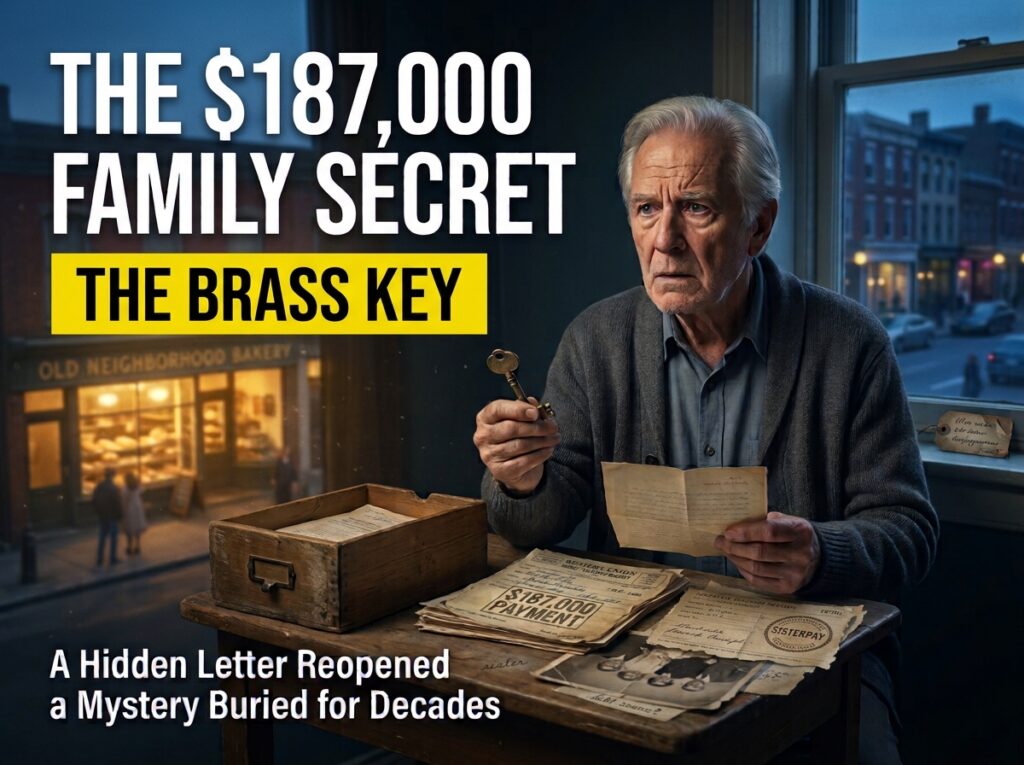
Walter had always believed that old age would bring fewer surprises.
At seventy-nine, he had learned to appreciate small things: a quiet morning, a cup of tea that stayed warm long enough to finish, and the familiar sound of rain tapping against a window. He no longer expected life to unfold according to a plan. He had seen too much of it for that.
Still, he had never imagined that a rented room above a bakery would become the place where so much of his past came rushing back.
The room was modest, with a narrow bed, a small wardrobe, and a table beside the window. Every morning, the smell of fresh bread rose from downstairs, filling the air with warmth. The bakery owner was kind enough to let Walter stay there while he worked through several practical difficulties.
He had bills to pay. There were people who still depended on him, and there were memories he had carried for so long that he had stopped trying to explain them.
Most days, he managed.
He opened his notebook, checked the amounts due, and made a list of what he could afford. He had become skilled at dividing limited resources among competing needs.
But one number continued to trouble him.
$187,000.
It was an amount large enough to change a family’s future, yet the money itself had never frightened him as much as the silence surrounding it.
For decades, people had treated the matter as settled. They spoke as though the important decisions had been made long ago and there was nothing left to discuss.
Walter had accepted that explanation.
He had not always liked it, but he had accepted it.
Then there was his granddaughter.
She had been clearing an old shed, sorting through boxes and belongings that had remained untouched for years. The work was supposed to be ordinary. She wanted to make space, discard what was no longer useful, and discover whether anything inside was worth keeping.
Walter had encouraged her to finish the job.
He had not expected her to uncover anything important.
For years, he had believed the story surrounding the family money was complete. The people involved had moved on, and the questions that once caused arguments had gradually disappeared from ordinary conversation.
Yet one detail had never made sense.
Someone who was supposedly gone decades earlier still seemed to occupy a strange place in the family’s history. Their name appeared in old conversations, then vanished whenever Walter asked for an explanation.
He had learned not to push.
Whenever the subject came up, someone would change the conversation. A relative would suddenly remember an appointment. Another would insist that the past should remain in the past.
Walter had taken those responses as a warning.
At seventy-nine, he did not want to spend his remaining years fighting with people he loved.
But avoiding an argument was not the same as finding peace.
One afternoon, while sorting through a small box of personal papers, Walter remembered a conversation from years earlier. Someone had mentioned that an important document had been misplaced. The comment had seemed insignificant at the time, but now it returned to him with uncomfortable clarity.
He wondered whether the document had ever been found.
He wondered whether his granddaughter might have discovered it while clearing the shed.
Most of all, he wondered why so many people seemed to know more about the old story than he did.
That evening, he sat beside the window and watched the street grow dark.
The bakery downstairs had closed. The last customers had gone, and the room was quiet enough for him to hear the clock ticking above the wardrobe.
He thought about the $187,000.
Then he thought about the person who was supposedly gone.
For the first time in years, he allowed himself to consider the possibility that the family had not simply forgotten the truth.
Perhaps someone had deliberately kept it hidden.
The thought disturbed him, but he could not dismiss it.
The following morning, Walter decided he would ask his granddaughter what she had found in the shed.
Before he could call her, his phone rang.
It was a relative who rarely contacted him without a reason.
“Walter,” the caller said, “I need to ask you something about the old family papers.”
Walter sat straighter.
“What about them?”
“Have you found anything recently? A key, perhaps? Or a letter?”
Walter looked toward the wardrobe, where his own papers were kept.
“No. Why?”
The caller hesitated.
“Because if you find anything like that, you mustn’t show it to everyone.”
Walter felt a cold uneasiness settle over him.
“Why not?”
“Because some things were hidden for a reason.”
The call ended before Walter could ask another question.
He remained still for several seconds.
Then he reached for his notebook and wrote down the caller’s exact words.
Some things were hidden for a reason.
For the first time, Walter wondered whether the family had been protecting a secret—or protecting the people responsible for it.
Part 2
Walter spent the next morning trying to convince himself that the telephone call meant nothing.
People said strange things when they were worried. Perhaps his relative had heard a rumor. Perhaps someone had discovered an old document and feared that it would cause another family disagreement.
There were plenty of ordinary explanations.
Walter repeated them while making tea, but none brought him much comfort.
At midday, he called his granddaughter.
She answered after several rings.
“Grandpa?”
“How is the shed coming along?”
There was a pause.
“All right. It’s taking longer than I thought.”
“Have you found anything unusual?”
“What do you mean?”
“Old papers. Letters. Anything that might belong to the family.”
His granddaughter went quiet.
Walter held the phone more tightly.
“What’s wrong?”
“Nothing. I just found a few things I wasn’t expecting.”
“What things?”
“A box of documents, mostly. Some old photographs. A few pieces of metal that might have belonged to a cabinet.”
Walter felt his pulse quicken.
“Did you find a key?”
Another pause followed.
“Yes.”
He closed his eyes.
“What kind of key?”
“Brass, I think. It’s old and a little tarnished. I haven’t figured out what it opens.”
Walter looked toward the window.
“Have you shown it to anyone?”
“No. Why?”
He struggled to find an answer that would not frighten her.
“Because old things can sometimes be important.”
His granddaughter gave a small laugh.
“Grandpa, it’s just a key.”
“Perhaps.”
“There’s something else,” she said. “I found a letter, too.”
Walter stood.
“What letter?”
“It was inside an envelope. The paper looks really old. The strange thing is, it’s addressed to someone the family says disappeared decades ago.”
Walter felt the room tilt around him.
“Read the name to me.”
She did.
The name belonged to the person whose place in the family story had never made sense.
Walter sat down slowly.
“Don’t throw anything away,” he said.
“I wasn’t planning to.”
“And don’t let anyone take those papers until we’ve had a chance to look at them.”
“Grandpa, you’re scaring me. What’s going on?”
Walter hesitated.
He wanted to tell her that the family had been hiding something for years. But he did not know that for certain, and he would not frighten her with an accusation he could not prove.
“I don’t know yet,” he said. “That’s why we need to be careful.”
They agreed to meet the following day.
After the call, Walter remained at the table, thinking about the brass key and the letter.
A key was meant to open something.
A letter was meant to communicate something.
Why would both objects be hidden in a shed for so long?
And why was the letter addressed to someone who was supposedly gone decades earlier?
Walter remembered the $187,000.
He had never understood why the family treated the amount as a subject that could not be discussed. Whenever he asked whether the money had been distributed, borrowed, or placed somewhere for safekeeping, he received vague answers.
Someone would say that everything had been handled.
Someone else would insist that he was remembering things incorrectly.
Over time, he had learned to remain silent.
But the discovery of the key and letter made silence feel different.
It no longer seemed like a way to protect his family.
It seemed like a way to prevent him from discovering something.
That evening, Walter took a walk through the neighborhood. He passed the shops, crossed the small street near the bakery, and stopped outside a grocery store he had visited for years.
He was thinking about the person named in the letter when someone called his name.
It was a family acquaintance who had not spoken to him in months.
“I heard your granddaughter has been clearing the shed,” the acquaintance said.
Walter stared at the person.
“How did you hear that?”
“People talk.”
“Have you seen what she found?”
The acquaintance shook their head too quickly.
“No. But if she discovers anything old, you should leave it alone.”
Walter felt anger rising.
“Why does everyone keep telling me what I should not do?”
The acquaintance looked uncomfortable.
“Because the past can cause trouble.”
“Only when someone has something to hide.”
The words escaped before Walter could stop them.
The acquaintance’s expression changed.
“Be careful, Walter.”
Then the person walked away.
Walter returned to his room above the bakery with a growing sense that he was no longer investigating an old family mystery.
He was approaching a secret that other people had spent years trying to keep buried.
Part 3
Walter barely slept.
The brass key and the letter occupied his thoughts long after the bakery downstairs had gone quiet. He imagined the key opening a locked drawer, a metal box, or a cabinet that had remained untouched for decades.
He imagined the letter explaining why the family had refused to discuss the missing person.
But every time he tried to construct a complete explanation, another question appeared.
If the person had truly disappeared, why was a letter still addressed to them?
If the family believed the matter was settled, why did the discovery frighten people?
And what connection could the $187,000 possibly have to an old brass key?
The following morning, Walter went to meet his granddaughter.
She was waiting beside the shed with a cardboard box at her feet. The building stood behind an older family property, partly hidden by overgrown shrubs. Its wooden door had swollen with age, and the hinges groaned when she opened it.
Inside were shelves, old tools, broken furniture, and several boxes covered with dust.
“I didn’t know there was so much stuff in here,” she said.
Walter looked around.
“People keep things because they think they’ll need them someday.”
“Then they forget what they kept.”
She smiled, but Walter noticed that she was nervous.
She showed him the brass key.
It was heavier than he expected, with a rounded handle and a narrow shaft. The metal had darkened over time, but there were no obvious markings.
“Do you recognize it?” she asked.
Walter turned it in his hand.
“No.”
She handed him the letter.
The envelope was fragile. The name on the front had been written carefully, and the handwriting looked older than the paper itself.
Walter studied the address.
It referred to a place that had changed considerably over the years. The street still existed, but the building mentioned in the letter had long since disappeared.
He opened the letter carefully.
Inside was a short message. Some of the writing had faded, but he could make out several sentences.
The writer referred to an agreement.
There was a mention of money.
And there was a line that made Walter stop reading.
The key must remain with the family until the matter is settled.
He read the sentence again.
“What does it mean?” his granddaughter asked.
“I don’t know.”
“Does it have something to do with the $187,000?”
Walter looked at her sharply.
“Who told you about that amount?”
She looked surprised.
“Nobody. I heard people mention it when I was younger. I thought it was connected to the old property.”
Walter lowered the letter.
The amount might have been linked to land, an inheritance, or another family arrangement. But he could not assume that the money and the letter belonged to the same story simply because both were surrounded by secrecy.
He examined the remaining lines.
The writer asked the recipient to wait before making a decision. There was a reference to another document, but its location was not specified.
The letter ended without a signature that Walter could clearly identify.
His granddaughter watched him closely.
“Grandpa, do you think someone was hiding something?”
“I think someone wanted this letter to remain important.”
“That’s not the same thing.”
“No,” Walter agreed. “It isn’t.”
He folded the letter and returned it to its envelope.
They searched the remaining boxes, but nothing else seemed connected to the key. There were old receipts, family photographs, and several notebooks containing dates that no longer meant anything to them.
Just as Walter was preparing to leave, he noticed a mark on the inside of the shed door.
It was a small indentation near the frame, almost hidden beneath peeling paint.
He ran his finger across it.
The shape looked as though something metal had been pressed against the wood repeatedly.
“Do you know what was kept here?” he asked.
His granddaughter shook her head.
“No. The shed was always locked when I was little.”
Walter looked at the brass key.
Perhaps it had once opened a cabinet or box inside the shed.
Perhaps the object it belonged to had been removed.
Or perhaps the key had never been meant for the shed at all.
He placed it in his pocket.
Before they left, his granddaughter asked the question he had been avoiding.
“Do you think someone in the family knew this letter was here?”
Walter looked at the old wooden door.
“Yes,” he said. “I think someone knew.”
“And do you think they wanted us to find it?”
Walter could not answer.
On the way back to the bakery, he received a message from the relative who had called him the day before.
We need to speak. There is something you don’t understand about the person named in that letter.
Walter stopped walking.
Before he could reply, another message arrived.
Please don’t let your granddaughter investigate this alone.
Part 4
Walter arranged to meet the relative that afternoon.
They chose a small café near the main road, a place where the tables were close together and the constant movement of customers made private conversations difficult to overhear.
Walter arrived early and placed the letter on the table.
When the relative entered, the person’s eyes went directly to the envelope.
“You found it,” the relative said.
Walter did not invite the person to sit.
“You knew it was there.”
“I knew there might be a letter.”
“Why didn’t you tell me?”
The relative glanced toward the counter.
“Because I wasn’t sure what it would reveal.”
Walter felt his anger sharpen.
“Everyone seems to know something. Everyone has a reason not to speak. Meanwhile, I’m left trying to understand a story that supposedly ended decades ago.”
The relative sat down.
“I never said it was right to keep you in the dark.”
“But you did keep me in the dark.”
The relative lowered their head.
“Yes.”
Walter placed the letter between them.
“Tell me about the person named here.”
The relative took a long breath.
“The family believed that person had left and would never return. There were disagreements about property and money. People took sides, and eventually the subject became too painful to discuss.”
“Was the person dead?”
“I don’t know.”
Walter stared.
“You don’t know?”
“I was young when the story began. I was told the person had gone away and that there was no reason to look for them. Later, when I asked questions, I was told to leave the past alone.”
“Who told you that?”
The relative hesitated.
“Older members of the family.”
Walter looked at the letter again.
The wording did not sound like a message to someone who had permanently disappeared. It sounded like a message to someone expected to return, or at least to receive an explanation.
“What about the $187,000?” he asked.
The relative’s expression changed.
“I don’t know whether that amount is connected to the letter.”
“Then why have people treated it as a secret?”
“Because the money was connected to a family arrangement that was never fully explained to everyone.”
Walter felt a familiar frustration.
“What arrangement?”
“I can’t tell you without checking something first.”
Walter pushed back his chair.
“No. I am finished with people telling me to wait while they decide how much truth I am allowed to hear.”
The relative looked genuinely distressed.
“I understand.”
“Do you?”
“I think someone made a mistake years ago. I think other people repeated that mistake until everyone believed it was the truth.”
Walter paused.
“Then we should find the person who made it.”
The relative nodded slowly.
“There may be an old record. I remember hearing that a document had been kept separately from the rest of the family papers.”
“Where?”
“I don’t know. But I remember that the brass key was mentioned.”
Walter reached into his pocket and placed the key on the table.
The relative went pale.
For several seconds, the person did not move.
“Where did you get that?”
“In the shed.”
The relative touched the key with two fingers, then pulled the hand away.
“I thought it had been lost.”
“What does it open?”
“I don’t know for certain.”
Walter stared at the person.
“You knew about the key, but you don’t know what it opens?”
“I was told that it belonged to something important. I never saw the lock.”
“Who told you?”
The relative looked toward the window.
“Someone who is no longer part of our ordinary family life.”
Walter felt a chill.
The letter was addressed to someone supposedly gone decades earlier. The key had been kept in the shed. The money remained unexplained.
And now another family member was admitting that the key had been known about all along.
Walter picked it up.
“I will find what this opens.”
The relative reached across the table.
“Please be careful. There are people who will not want you to find the rest of the documents.”
Walter withdrew his hand.
“Then they should have told the truth before now.”
He left the café with the key in his pocket and the letter in his bag.
For the first time, he understood that the secret had survived not because nobody remembered it, but because several people had chosen to remember only the parts that suited them.
Part 5
Walter returned to the rented room above the bakery and laid the key beside the letter.
He had spent most of his life believing that family problems could be solved through patience. If people were given enough time, he thought, they would eventually explain themselves.
Now he wondered whether patience had become another word for surrender.
He opened his notebook and wrote down everything he knew.
The brass key had been found in the shed.
The letter was addressed to someone supposedly gone decades earlier.
The family had argued about $187,000.
At least one relative knew that the key existed.
And somebody had warned Walter not to let his granddaughter investigate alone.
The facts did not yet form a complete story, but they suggested that the objects had been kept for a reason.
Walter called his granddaughter.
“I need to ask you something about the shed.”
“Did you figure out what the key opens?”
“Not yet. Did you notice any cabinets, locked boxes, or anything that seemed out of place?”
She thought for a moment.
“There was an old wooden chest behind the broken shelves. I couldn’t move it by myself, so I left it there.”
Walter stood.
“Why didn’t you tell me?”
“I forgot. I was trying to clear the other boxes first.”
“Is the chest still there?”
“Yes.”
Walter asked her not to move it until he arrived.
He took a taxi back to the property.
His granddaughter was waiting beside the shed when he arrived. Together, they shifted the broken shelves and uncovered the wooden chest.
It was smaller than Walter expected, with darkened brass fittings and a heavy lid. A narrow keyhole sat beneath the front edge.
Walter took out the key.
It fitted.
He turned it slowly.
A faint click sounded inside the lock.
His granddaughter gasped.
“You found it!”
Walter lifted the lid.
Inside lay several folded documents, a small cloth pouch, and a notebook bound with a worn leather strap.
The documents were yellowed but carefully folded. The notebook had been placed at the bottom, beneath the other papers.
Walter removed the first document.
It appeared to be a property record.
He read the names, the dates, and the description of the land. Some of the information was familiar, but other details did not match what he had been told.
The second document referred to an agreement involving money.
Walter found the amount near the middle of the page.
$187,000.
His granddaughter leaned closer.
“That’s the amount.”
Walter nodded.
But the document did not look like a simple record of money being paid or inherited. It referred to an arrangement between several people and included a condition that Walter could not immediately understand.
He opened the notebook.
The first pages contained dates and brief entries. Some referred to meetings. Others mentioned letters sent and received. A few entries were so faint that Walter could not read them.
Then he found a name.
It was the name of the person addressed in the letter.
Beside it was a date from decades earlier.
Walter turned the page.
A second name appeared, followed by a short sentence.
If the original agreement is ever questioned, the missing letter must be found.
Walter read the words twice.
The letter in his bag might be the very document the notebook described.
His granddaughter looked frightened.
“Grandpa, what does that mean?”
“I don’t know yet.”
“Should we tell the family?”
Walter thought about the warnings, the hesitation, and the way the relative had reacted to the key.
“Not everyone,” he said. “Not until we understand what these documents say.”
He gathered the papers carefully.
Then he noticed something tucked inside the back cover of the notebook.
A small photograph.
The picture showed several people standing outside a building. One face was familiar from the old family photographs Walter had seen as a child.
Another belonged to someone he had believed had disappeared long ago.
But it was the handwritten note on the back that made his hands tremble.
Keep the key safe. The money is not what they think it is.
Part 6
Walter took the documents back to his room above the bakery.
He wanted a quiet place to examine them without interruptions. His granddaughter agreed to keep the discovery private while they worked out what the papers meant.
For several hours, Walter compared the notebook with the letter and the property record.
The dates suggested that the arrangement had begun long before the family dispute became public knowledge. The $187,000 was mentioned repeatedly, but never in the way he had expected.
It was not described simply as an inheritance.
It was not clearly identified as a debt.
Instead, the documents referred to an agreement that involved several people and a piece of property.
Walter felt a growing uneasiness.
He had assumed that the family had argued about who was entitled to the money. But the records suggested that the real disagreement might have concerned the conditions attached to it.
He called his granddaughter.
“I need you to read something for me.”
She arrived carrying a notebook of her own.
Walter showed her the relevant pages.
She read them slowly.
“It sounds like someone was supposed to receive the money only after something else happened.”
“That’s what I think.”
“What was supposed to happen?”
Walter pointed to a sentence in the old notebook.
The writing referred to the return of a person who had supposedly disappeared decades earlier.
His granddaughter looked up.
“Do you think they were still alive?”
“I don’t know.”
“But why would the agreement depend on their return?”
Walter had no answer.
He examined the property record again. One section appeared to have been amended at a later date, but the signature was difficult to read.
He wondered whether the change had been made legally and whether the family had been told about it.
The $187,000 might have been connected to the value of the property. If so, the disagreement could have involved ownership rather than a simple payment.
But he refused to jump to conclusions.
He had already seen how assumptions could distort a family’s understanding of the past.
He needed someone who could interpret the documents.
The following morning, Walter visited a retired solicitor whose name appeared on an old letter. The solicitor was no longer practicing, but agreed to examine copies of the papers.
After reading them, the older man leaned back in his chair.
“These documents appear to refer to an agreement concerning property and a substantial sum of money,” he said. “But I cannot tell you whether the agreement was legally completed without examining the full record.”
“Does the letter matter?”
“It may. The wording suggests that the recipient was expected to receive information or take some action. But we would need more context.”
Walter placed the brass key on the desk.
“And this?”
The solicitor examined it.
“It may have opened a locked container used to preserve the original documents. The key itself doesn’t tell us who owned the contents.”
Walter nodded.
“Can you tell me who had the right to the $187,000?”
“Not from these pages alone.”
The answer disappointed him, but it was honest.
The solicitor recommended that Walter preserve the original documents and avoid allowing anyone to remove or alter them before the full record could be reviewed.
Walter thanked him and returned to the bakery.
He was beginning to understand why the family had avoided the subject. The money might have been connected to an agreement that could change what people believed about ownership, responsibility, and a person’s place in the family.
But the documents still did not explain why the letter had been addressed to someone supposedly gone decades earlier.
That evening, Walter placed a copy of the notebook beside the letter.
He compared the handwriting on both.
The same unusual shape appeared in the letter’s final line and in one of the notebook entries.
Someone had written both.
And that person had known about the brass key.
Walter was studying the signature when a knock sounded at his door.
His granddaughter stood outside.
Behind her was a visitor Walter had never expected to see.
The visitor held a sealed envelope.
“I believe this belongs with the papers you found,” the person said.
Walter stared at the envelope.
“Where did you get it?”
“From someone who has been waiting a very long time for you to ask the right question.”
Part 7
Walter invited the visitor inside.
The person placed the envelope on the table but kept one hand resting on it.
“I need you to understand something before you open this,” the visitor said. “The documents you found do not tell the whole story.”
Walter looked at the envelope.
“Then why bring it to me?”
“Because someone believes you deserve to know what happened.”
“Who?”
The visitor hesitated.
“I was asked not to reveal the name until you had read the letter.”
Walter disliked the answer, but he understood that the same pattern was repeating itself. People kept withholding information until they decided he was ready to receive it.
At seventy-nine, he had little patience left for such arrangements.
“Either the letter is important enough to show me, or it isn’t,” he said. “I’m not going to spend another week chasing hints.”
The visitor removed the hand.
Walter opened the envelope.
Inside was a letter written in the same hand as the earlier note. It was longer than the first and contained several references to the property, the money, and the person who was supposedly gone.
The writer explained that the brass key had been kept to protect the original agreement. The documents were not meant to disappear; they were meant to remain secure until the family could resolve a disagreement that had begun decades earlier.
But the letter also suggested that someone had deliberately changed the way the agreement was described.
The money had become the focus of the dispute, even though the writer insisted that it was only one part of the arrangement.
Walter read the final paragraph.
If the family has been told that I am gone forever, then someone has misunderstood—or deliberately changed—the truth. The original agreement must be read before any decision is made about the property or the money.
Walter lowered the letter.
His granddaughter looked stunned.
“Does that mean the person was alive when this was written?”
“It means the writer wanted the family to question the story,” Walter replied. “It doesn’t prove what happened afterward.”
The visitor nodded.
“That’s why I brought it.”
Walter studied the envelope.
“Who kept this?”
“Someone who believed the family would eventually be ready to hear the truth.”
“Why now?”
“Because the shed was being cleared, and there was a fear that the documents might be thrown away.”
Walter thought of the brass key, the hidden chest, and the warnings he had received.
Someone had been watching the old papers closely enough to know that they were at risk of being lost.
“Who told you to bring it?”
The visitor finally gave a name.
Walter recognized it immediately.
It belonged to someone who had always been treated as a distant figure in the family’s history, a person whose absence had become an accepted fact.
He felt a deep ache of uncertainty.
“Have you spoken to this person?”
“Yes.”
“And are they alive?”
The visitor hesitated.
“I believe so. But I cannot promise that everything you have been told about them is wrong. I can only tell you that the story is not as simple as the family believed.”
Walter looked at his granddaughter.
She was watching him with wide eyes.
For decades, the family had treated the person’s disappearance as final. The letter challenged that certainty, but it did not establish what had happened afterward.
Walter realized that the next step would require more than reading old papers.
He would have to contact someone who might know the truth.
He would have to confront people who had spent years avoiding the subject.
And he would have to decide whether the possibility of reopening an old wound was worth the chance of finally understanding it.
The visitor stood.
“I should leave you with the letter.”
Walter nodded.
After the door closed, he placed the new letter beside the original documents.
For a long time, he said nothing.
Then he turned to his granddaughter.
“We need to find the person who wrote this.”
She nodded.
“But Grandpa, what if the family was right? What if the person really is gone?”
Walter looked at the letter.
“Then we will find out. But we won’t know by refusing to ask.”
Part 8
Walter began by contacting the people whose names appeared in the old records.
Some did not answer. Others claimed to remember nothing. One relative said that the matter had been settled long ago and refused to discuss it further.
Walter no longer accepted those responses as answers.
He remained polite, but he asked the same questions repeatedly.
Who had made the agreement?
Who had kept the original documents?
Why had the letter been addressed to someone supposedly gone decades earlier?
And what did the $187,000 represent?
Gradually, fragments began to emerge.
The money had been connected to a property arrangement. The agreement involved conditions that had not been clearly explained to every family member. The person named in the letter had played a role in the original arrangement, but the family’s understanding of that role had changed over time.
Some people believed the person had walked away.
Others remembered hearing that the person had been asked to leave.
Nobody seemed able to provide a complete explanation.
Walter wrote down every statement, carefully distinguishing what people remembered from what they could prove.
He did not want to repeat the mistake that had allowed the original dispute to grow.
One afternoon, he visited a relative who had been present when the family first discussed the money.
The relative was reluctant to speak.
“You should leave it alone, Walter,” the person said. “Nothing good will come from reopening this.”
“Then why are you afraid of it?”
“I’m not afraid.”
“Then tell me what happened.”
The relative looked toward the window.
For a long moment, Walter thought the conversation was over.
Then the person spoke.
“I remember the agreement. I remember the money. But I was never shown the final document.”
“Who had it?”
“I thought the person named in the letter had kept it.”
“Then why did everyone say that person was gone?”
The relative shook their head.
“That is what I was told.”
“By whom?”
“I don’t remember.”
Walter felt the old frustration returning.
Everyone remembered the conclusion.
Nobody remembered who had provided the evidence.
He left the house with another name and another question.
Later that evening, his granddaughter called.
“I found something else in the shed.”
Walter sat up.
“What?”
“A small metal plate beneath the chest. It has a number engraved on it.”
“What kind of number?”
She read it to him.
Walter recognized the format from the property documents. It appeared to be a reference number, perhaps linked to a storage record or a registration entry.
“Don’t move anything else,” he said. “I’ll come tomorrow.”
That night, Walter compared the number with the papers.
It appeared beside a short reference in the old notebook. The entry mentioned a separate document held outside the family home.
Walter felt a new possibility forming.
Perhaps the letter and the brass key had not been the only items preserved. Perhaps another record existed somewhere, one that could establish the original terms of the agreement.
The following morning, he returned to the shed with his granddaughter.
They examined the metal plate and searched the surrounding boxes. They found a receipt with the same reference number and a faded note mentioning a storage facility that had once operated nearby.
The facility had since changed ownership.
Walter contacted the current manager, explained that he was researching old family records, and asked whether historical storage documents might still exist.
The manager agreed to check.
Two days later, Walter received a call.
“We found a record connected to that reference number,” the manager said. “It identifies a box that was stored under an old family name.”
Walter gripped the phone.
“Does it say what was inside?”
“Not in detail. But it mentions legal papers and correspondence.”
“Is the box still there?”
There was a pause.
“No. It was collected many years ago.”
Walter felt his hope falter.
“By whom?”
“The record includes a signature, but the name is difficult to read. I can send you a copy.”
He thanked the manager and ended the call.
His granddaughter looked at him.
“Does that mean someone took the papers?”
“Yes.”
“Do we know who?”
“Not yet.”
Walter stared at the old reference number.
Someone had removed another piece of the story years earlier.
And if the records were still in existence, they might be the only evidence capable of explaining what had happened to the $187,000—and why the family had been told that someone was gone.
Part 9
The copy of the storage record arrived the following afternoon.
Walter examined the signature carefully. The handwriting was difficult to read, but he recognized the shape of the final letters from another document in the notebook.
He placed the two papers side by side.
The signatures appeared to belong to the same person.
His granddaughter leaned over the table.
“Who is it?”
Walter shook his head.
“I can’t be certain.”
They compared the dates.
The storage box had been collected shortly after the family began arguing about the $187,000. The timing suggested that someone had removed the documents when the dispute was at its height.
But that did not prove the person had acted dishonestly.
Perhaps the papers had been taken to protect them.
Perhaps they had been removed because someone feared that they would be destroyed.
Or perhaps the documents contained information that could change who was entitled to the property.
Walter refused to decide without evidence.
He contacted the former storage manager, who agreed to speak with him. The manager remembered that the box had been collected by someone who seemed familiar with the arrangement.
“I thought the person was acting on behalf of the family,” the manager explained. “There was nothing unusual about the collection at the time.”
“Did they say where the papers were going?”
“No. They signed the record and left.”
Walter thanked the manager.
He had another lead, but it was not enough to establish what had happened.
That evening, he received a telephone call from the relative who had warned him not to investigate.
“You need to stop looking,” the relative said.
Walter closed his eyes.
“Why?”
“Because you’re upsetting people.”
“People have been upset for decades. That hasn’t stopped them from keeping secrets.”
“You don’t understand what you’re doing.”
“Then explain it to me.”
The relative said nothing.
Walter continued.
“I found the key. I found the letters. I found the record showing that someone collected the original papers. Every time I discover something, another person tells me to stop asking questions.”
“Some things cannot be repaired.”
“That doesn’t mean we should pretend they never happened.”
The relative’s voice softened.
“Walter, please. I don’t want you to be hurt.”
“Then tell me the truth.”
A long silence followed.
Finally, the relative admitted that the family had never been certain about the person’s disappearance. There had been rumors, conflicting accounts, and assumptions that gradually became accepted as fact.
No one had produced a clear record proving exactly what had happened.
Walter felt a deep sadness.
For decades, people had repeated a story without knowing whether it was true.
“Why didn’t anyone investigate?” he asked.
“Because the family wanted to move on.”
“Move on from what?”
The relative did not answer.
Walter ended the call.
He sat beside the window, listening to the bakery’s machines below.
He had spent years believing that the family had settled the matter. Now he understood that the agreement, the money, and the person’s disappearance might all have been connected to an unresolved dispute.
He still did not know whether the $187,000 had been distributed correctly or whether the original agreement had been honored.
He did not know where the missing papers were.
And he did not know whether the person named in the letter was alive.
But he knew one thing.
The family’s silence had not protected anyone from uncertainty. It had simply passed that uncertainty from one generation to the next.
His granddaughter called that evening.
“I found another note inside the chest,” she said.
Walter sat up.
“What does it say?”
She read the words slowly.
If Walter ever finds the key, give him the letter. He has the right to know what happened.
Walter stopped breathing for a moment.
The note was addressed to him.
Someone had anticipated that he might one day discover the key.
Someone had wanted him to receive the letter.
But who had left the instruction—and why had they waited so long?
Part 10
Walter read the note several times before placing it beside the other documents.
For the first time, he began to suspect that the discovery might not have been entirely accidental. Someone had known the key existed. Someone had preserved the letter. Someone had written an instruction specifically for the day Walter found it.
Yet the note did not reveal who had arranged everything.
It did not explain the $187,000.
And it did not prove what had happened to the person whose name appeared on the envelope.
Walter had learned enough to know that the family’s story was incomplete, but not enough to replace it with a new certainty.
He decided that the next step would be to preserve the documents and seek a proper review of the property agreement. The old papers deserved to be examined carefully, without assumptions or pressure from relatives who wanted the matter to disappear.
He also decided to speak openly with his granddaughter.
She had helped uncover the evidence, and she deserved to understand why it mattered.
“I don’t know what the final answer will be,” he told her. “But we won’t throw anything away, and we won’t let anyone tell us what to believe before we have the facts.”
She nodded.
“Do you think the person in the letter wanted us to find it?”
“I think someone wanted the truth to have a chance of being heard.”
“Even after all these years?”
Walter looked at the brass key.
“Especially after all these years.”
He returned to his rented room above the bakery that evening.
The bills were still waiting. The notebook still contained figures that needed to be paid. The practical problems of his life had not disappeared simply because an old mystery had reopened.
But he no longer felt that he had to carry the past in silence.
He placed the key, letters, and copies of the records in a secure folder. He wrote down the names of the people he had contacted and the questions that remained unanswered.
Then he closed the notebook.
At seventy-nine, Walter understood that he might not discover every detail. Some people might never explain their decisions. Some documents might be lost forever. And some memories might remain uncertain, no matter how carefully he examined them.
But uncertainty was not a reason to accept a story that no one could prove.
He thought about his granddaughter, who had begun clearing the shed without realizing that she was opening a chapter the family had avoided for decades.
He thought about the people who had warned him to stop asking questions.
And he thought about the person who had left a note saying that he had the right to know what happened.
For years, he had believed that keeping the peace meant leaving old disagreements alone.
Now he understood that peace could not be built on unanswered questions and forgotten documents.
The truth might be painful.
It might change relationships.
It might reveal mistakes that people had spent their lives trying to hide.
But it also offered something the family had not possessed for a very long time: the possibility of making decisions based on facts rather than assumptions.
Walter looked out the window.
Below him, the bakery was preparing for the next morning. Warm light spilled across the pavement, and the familiar smell of bread drifted through the room.
He thought about the brass key.
It had opened a chest, but the real door it had opened was much older.
Behind it lay years of silence, a mysterious sum of money, and a family story that had never been properly finished.
Walter could not rewrite the past.
He could, however, refuse to let the next generation inherit the same unanswered questions.
He picked up his pen and wrote one final sentence in his notebook:
The truth may arrive late, but it still deserves to be heard.
Then he placed the pen down.
For the first time in many years, he felt ready to face whatever came next.