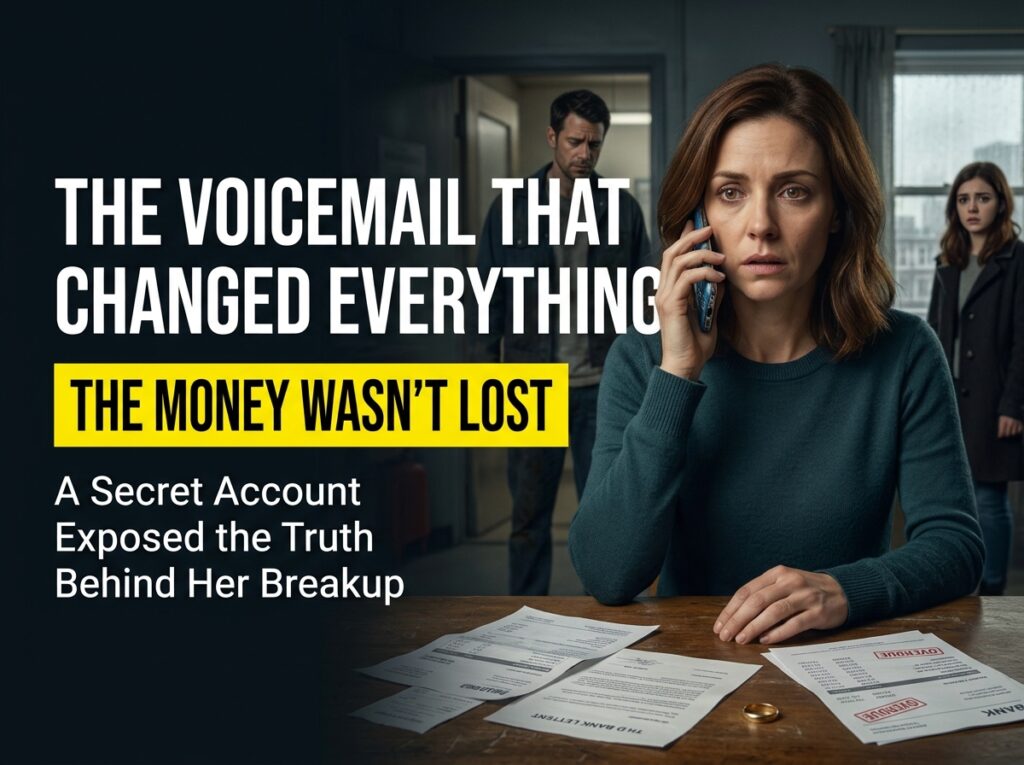
The day I found the voicemail, I was trying to sell a wedding ring.
Not because I had stopped believing in love, although there were days when that would have been easier to admit. I was trying to sell it because the electricity bill was overdue, the rent was coming due again, and my refrigerator contained half a carton of milk, three eggs, and a container of rice I had cooked two nights earlier.
The ring belonged to me.
I had bought it several years before, when money was not plentiful but hope was. I had imagined that one day I would give it to someone I loved, perhaps after we had found a better apartment and stopped arguing about which bills could wait until payday.
That future never arrived.
I carried the ring into a pawnshop on a gray Thursday morning, wrapped in a small piece of tissue paper. The shop smelled of old leather, metal, and the sharp chemical scent of cleaning products. Behind the counter, watches and necklaces sat beneath glass, each item separated from the life it had once belonged to.
The man behind the counter examined my ring.
“Gold?” he asked.
“Yes.”
He weighed it, checked the setting, and named a price.
It was less than I had hoped.
I stared at the ring beneath the bright counter light. For a moment, I imagined taking it home and putting it back in the drawer.
Then I remembered the rent notice.
“All right,” I said.
While the man prepared the paperwork, I noticed an old mobile phone lying beside a cardboard box near the counter. It had a cracked screen and a faded blue case.
Something about it looked familiar.
I leaned closer.
“Where did that phone come from?”
The man followed my gaze.
“Someone brought in a box of old electronics last week. Most of it isn’t worth much.”
I stared at the case.
My sister Anna had owned a phone exactly like that.
Anna was two years younger than me. She had a habit of keeping old things long after everyone else would have thrown them away. Broken chargers, birthday cards, empty perfume bottles, and phones with batteries that barely lasted an hour all found their way into drawers in her apartment.
She used to say that every object had a story, even if she could no longer remember what it was.
For the last several months, Anna had barely answered my calls.
At first, I assumed she was busy. She had been dealing with problems of her own, and we had never been the kind of sisters who needed to speak every day.
But then her messages became shorter.
She stopped returning calls.
When I visited her apartment, the curtains were drawn, and a neighbor told me she had not seen Anna for several days.
I had left messages asking her to contact me.
None had been answered.
I looked at the phone again.
“Could I see that?”
The shopkeeper hesitated.
“It’s part of the electronics lot.”
“I think it might belong to my sister.”
He picked it up and examined the back.
“Do you know the passcode?”
“I don’t know whether it still works.”
He connected it to a charger behind the counter. The screen flickered, went dark, and then lit up again.
My heart began to race.
The lock screen displayed Anna’s name.
I recognized the photograph immediately. It showed her standing beside me at our mother’s birthday dinner, smiling with her eyes half closed because I had made her laugh just as the picture was taken.
“That’s hers,” I whispered.
The shopkeeper asked me to prove that I had a legitimate reason to retrieve it. I explained who Anna was and showed him an old photograph of us together. After checking the details and the paperwork associated with the electronics, he agreed to let me contact the person who had brought the box in.
While we waited, I noticed a notification on the phone.
One saved voicemail.
The date was several months old, from the period when Anna had begun avoiding my calls.
I asked whether the voicemail could be played.
The shopkeeper handed me the phone.
I pressed the notification.
At first, there was only static.
Then a man’s voice came through.
“Tessa, if you’re hearing this, please don’t let them close the account before you find out what happened.”
I stopped breathing.
The message continued.
“The money wasn’t lost. I know what I told you, but I couldn’t explain it while she was still there. You need to check the date on the original agreement.”
A pause followed.
Then the man said my name again.
“Tessa, the account is still open. But the person who can access it isn’t who you think.”
The voicemail ended.
I stared at the screen.
I knew the voice.
It belonged to Daniel, the man I had once planned to marry.
For several seconds, I could not move.
Daniel and I had separated months earlier after our financial problems became impossible to ignore. We had been behind on rent, struggling to pay ordinary bills, and arguing about money that seemed to disappear faster than either of us could earn it.
I had believed that we were simply too poor to keep our relationship together.
I thought he had become ashamed of what he could no longer provide. I thought he had left because he could not face another conversation about overdue notices and empty cupboards.
Now his voice was coming from my missing sister’s old phone, warning me about an account I knew nothing about.
I replayed the voicemail.
Then I replayed it again.
The words did not change.
The money wasn’t lost.
The account was still open.
And someone had apparently made a decision before our breakup that neither Daniel nor Anna had explained to me.
I looked at the wedding ring lying on the counter.
For months, I had been trying to sell pieces of the future I thought I had lost.
Now I wondered whether I had ever understood what had happened to that future in the first place.
I asked the shopkeeper whether I could take the phone home.
He explained that the ownership issue still needed to be resolved with the person who had brought in the box. He gave me the information needed to contact them, and I left my details.
Before I walked out, I asked him to make sure the phone was not reset or sold while the ownership was being clarified.
Then I stepped into the cold afternoon with my hands shaking.
I had come to the pawnshop because I needed money.
I left with a question that was worth far more than the ring.
Why had Daniel recorded a message for me on Anna’s phone?
And what account was he so afraid of losing?
Part 2
I called Daniel as soon as I reached the pavement.
His number was still saved in my contacts, although I had not called him for weeks.
The call rang several times before going to voicemail.
I hung up without leaving a message.
Then I tried again.
This time, he answered.
“Tessa?”
His voice sounded cautious, as if he had been expecting a call but had hoped it would come from someone else.
“I found Anna’s phone.”
There was a pause.
“Where?”
“At a pawnshop.”
“What?”
“Her old phone. The one with the blue case. It has a voicemail from you.”
The silence that followed was so complete that I checked whether the call had disconnected.
Then Daniel said, “What did you hear?”
I felt anger rise in my chest.
“You tell me. You left the message.”
“Tessa, listen to me. I didn’t know whether you’d ever hear it.”
“Why was it on my sister’s phone?”
“I can’t explain everything over the phone.”
I laughed bitterly.
“Of course you can’t.”
“Please don’t hang up.”
“You’ve had months to explain. You left me with overdue bills, no money, and no idea why our plans fell apart. Now I find a message in which you tell me the money wasn’t lost, and you’re asking me to wait again?”
“I know how it sounds.”
“Then tell me what the account is.”
He took a breath.
“It’s an account connected to an agreement I made before we separated.”
“With whom?”
“I need to check the original paperwork.”
“Daniel, I am tired of people telling me they need to check something before they can answer a simple question.”
“I understand.”
“No, you don’t.”
I ended the call.
For several minutes, I stood outside the pawnshop, watching people walk past with shopping bags and coffee cups. Nobody knew that a thirty-second voicemail had changed the way I understood the last six months of my life.
I returned to my apartment and emptied the contents of my handbag onto the table.
My bills lay beside my bank statements. A letter from the landlord warned that my rent was overdue. My electricity provider had offered a payment arrangement, but I had already missed the first installment.
I looked at the figures.
Then I thought about Daniel’s message.
The money wasn’t lost.
I had assumed that the money we had saved together had been spent covering expenses. Daniel had told me that he had used part of it to pay an obligation and that the rest had been needed to keep us afloat.
When I asked for a detailed account, he said he would show me everything once the situation was settled.
It never was.
Eventually, I stopped asking because every conversation ended with the same argument. He would accuse me of not trusting him, and I would remind him that trust did not pay the rent.
The last serious argument happened on a Sunday evening.
I had found another overdue notice tucked beneath the door. Daniel was sitting at the kitchen table, looking at his phone.
“How much do we have left?” I asked.
He did not look up.
“Enough to get through the week.”
“That’s not what I asked.”
He put the phone down.
“Tessa, I can’t keep having this conversation.”
“Neither can I. That’s why I need the numbers.”
He rubbed his face.
“I made a decision that I thought would help us.”
“What decision?”
“I moved some money.”
“Where?”
“Into an account.”
I stared at him.
“What account?”
He looked away.
“I was going to explain.”
“Then explain now.”
He shook his head.
“I can’t.”
I remember feeling as though the room had suddenly become unfamiliar.
We had been together for years. I had trusted him with my fears, my plans, and the details of my life. Yet he was telling me that money we had saved together had been moved somewhere I could not access.
I asked him whether he had opened an account in his own name.
He said it was more complicated than that.
I asked whether anyone else was involved.
He did not answer.
I asked him whether he was trying to leave me.
That was the question that finally made him look at me.
“No,” he said. “That’s not what this is about.”
But he would not explain what it was about.
Two days later, he moved out.
He told me that he needed time to sort things out and that he would contact me when he had the answers.
I waited for a week.
Then two.
Eventually, I stopped expecting him to return.
I had assumed that the account was a temporary arrangement, perhaps somewhere he had moved money to protect it from immediate expenses. I thought he had spent what remained and was ashamed to admit it.
The voicemail suggested that I had been wrong.
I took out my old bank statements and compared them with the dates I remembered from our arguments.
One transfer stood out.
It had occurred shortly before Daniel and I separated.
The amount was large enough to explain why our shared balance had dropped so sharply, but the transaction description did not identify the final destination clearly.
I wrote the date in my notebook.
Then I checked my messages.
A conversation from the same week contained a sentence from Daniel that I had nearly forgotten.
Whatever happens, don’t assume the money is gone.
At the time, I had thought he was trying to reassure me.
Now the sentence seemed like a warning.
I opened my calendar and searched for the date of our final argument.
The transfer had occurred two days earlier.
Daniel had moved the money before we separated.
He had not simply panicked after the relationship ended.
He had made a decision while we were still living together, still sharing bills, and still talking about our future.
I called him again.
This time, he answered immediately.
“I checked the dates,” I said.
He was quiet.
“The transfer happened before we separated. You knew the money had been moved when I was asking you how we were going to pay the rent.”
“Yes.”
The honesty of the answer hurt more than another excuse would have.
“Why didn’t you tell me?”
“I was trying to protect something.”
“What?”
He took a breath.
“Not the money, Tessa. Someone.”
I felt a chill move through me.
“Who?”
Daniel did not answer.
Then he said, “You need to find the original agreement before you decide what I did.”
I stared at the notebook.
For the first time, I wondered whether the missing money had been connected to Anna’s disappearance from my life.
And if it had, I needed to find my sister before another part of the truth disappeared.
Part 3
Anna had always been the person in our family who knew when something was wrong.
When our mother was alive, Anna could tell from the sound of her footsteps whether she was tired or upset. She remembered birthdays without needing reminders and noticed when someone had stopped eating properly.
She was also the person who could disappear into her own thoughts for days.
After our mother died, Anna became increasingly private. She changed jobs twice, moved apartments, and stopped attending family dinners. Whenever I asked whether she was all right, she told me she was managing.
I understood that answer because I had been using it myself.
The last time we had a proper conversation was shortly before Daniel and I separated.
Anna came to our apartment carrying a paper bag of groceries. She had bought bread, vegetables, and a packet of biscuits she knew I liked.
“You look exhausted,” she said.
“I am.”
“Is Daniel working late again?”
I nodded.
She put the groceries on the counter and looked around the kitchen.
“Are you two all right?”
I wanted to tell her everything.
I wanted to explain that we were struggling with rent, that Daniel had stopped discussing our finances, and that I was beginning to feel like a stranger in my own relationship.
Instead, I said, “We’re having a difficult month.”
Anna studied my face.
“Is it only money?”
I looked away.
“I don’t know anymore.”
She came over and hugged me.
“You don’t have to pretend with me.”
For a moment, I nearly cried.
Then Daniel came home, and the conversation ended.
Anna left shortly afterward. At the door, she turned back and looked at me.
“If something doesn’t make sense, don’t let someone convince you that you’re wrong for asking.”
I had smiled weakly.
“I won’t.”
It was a promise I would spend months trying to keep.
After Daniel moved out, Anna became harder to reach.
She answered one message with a short note saying she was busy. When I called, she sometimes let the phone ring until the call ended. Eventually, even her brief replies stopped.
I visited her apartment, but the building manager told me she had moved some belongings out and had not been seen recently.
I was worried, but I was also dealing with my own problems. I told myself that Anna was an adult and that she would contact me when she was ready.
Now I regretted every day I had accepted that explanation without asking more questions.
I searched through my old messages and found one from Anna, sent a week before Daniel left.
If you ever need to check something about the money, don’t rely only on what Daniel tells you. Find the original date.
I remembered reading it while I was at work.
I had replied, What are you talking about?
She had not answered.
At the time, I thought she was referring to a disagreement between Daniel and me. I had been so exhausted by our arguments that I did not want another person telling me what to do.
Now the message seemed connected to the voicemail.
I called Anna’s number.
It rang until the call went to voicemail.
I left a message telling her that I had found her phone and needed to speak with her.
Then I called the pawnshop.
The shopkeeper explained that the person who had brought in the box of electronics had not yet responded to his inquiry. He agreed to keep the phone secure while he tried to establish ownership.
I asked whether the voicemail could be preserved.
He said he would not reset the device and would wait until the ownership issue was resolved.
I thanked him.
That evening, I went through the documents Daniel had left behind when he moved out. I had kept them in a box because I was afraid that throwing them away would mean admitting that our relationship was over.
Most were ordinary papers: utility statements, old receipts, insurance documents, and notes about the repair work he had done on our car.
At the bottom of the box, I found an envelope addressed to Daniel.
It had been opened and resealed.
Inside was a bank letter confirming that an account had been opened several months earlier. The letter did not identify the account’s current balance, and the account details were partly obscured by a fold.
But the date matched the transfer I had found in our statements.
I looked at the name printed near the bottom.
It was not Daniel’s.
It was Anna’s.
I read it several times.
My sister had apparently been connected to an account that Daniel had opened or arranged before our breakup.
The letter did not establish who owned the funds, who had deposited them, or why the account had been created. It only showed that Anna’s name was associated with it.
I sat at the kitchen table, trying to understand what I was looking at.
Had Daniel moved our money into an account belonging to my sister?
Had Anna agreed to help him?
Or had the account been opened for a reason neither of them had explained to me?
I wanted to believe there was an innocent explanation.
But I remembered Anna’s message about checking the original date.
I remembered Daniel’s voicemail warning that the account might be closed.
And I remembered the way he had looked at me when I asked whether someone else was involved.
I placed the bank letter beside the transfer record.
The two dates matched.
Then I noticed a handwritten note in the margin.
Original agreement retained by A.
Anna.
My sister had the original agreement.
And whatever had happened between Daniel and me, she had known enough to warn me about it before we separated.
Part 4
I spent the next morning trying to find Anna.
I called her old workplace, but she had left several months earlier. I contacted a friend whose number I found in an old message, but the friend had not heard from her recently.
I did not want to turn my search into a series of accusations.
Anna might have been dealing with a personal crisis. She might have needed time away from everyone. The fact that her name appeared on a bank letter did not prove that she had done anything wrong.
But I could no longer pretend that her silence was unrelated to the financial mystery.
I returned to the pawnshop that afternoon.
The shopkeeper had not yet heard from the person who had brought in the electronics, but he had located the original intake record. With the appropriate ownership checks still pending, he could not simply hand over the phone. However, he allowed me to provide further information and arranged for the matter to be reviewed.
I gave him Anna’s full name and explained that the phone contained a voicemail from Daniel.
He looked concerned.
“If there’s a message you believe is important, you should preserve the device and avoid trying to bypass its security.”
“I don’t want to bypass anything,” I said. “I just need to know why my sister had it.”
He nodded.
“I’ll do what I can to contact the person who brought it in.”
I left my number again.
On the way home, I stopped at the bank branch named on the letter.
I brought my identification, the statement showing the transfer from our shared account, and the letter associated with Anna.
I explained that I was trying to understand a transaction from an account I had shared with my former partner.
The employee listened carefully.
She explained that the bank could not disclose another person’s private account information simply because I had a copy of a letter. However, she could help me understand the transaction history for the account I had been authorized to access and explain the formal process for raising a concern about an unfamiliar transfer.
I provided the information she requested.
The bank confirmed the date and amount of the transfer from our shared account. It could not tell me the current balance or the full history of the account associated with Anna’s name.
I left with a reference number for my inquiry.
It was not the answer I wanted, but it was an important distinction.
I could verify that the money had left our shared account.
I could not yet establish who had ultimately controlled it or what had happened to it afterward.
That evening, Daniel called.
“Have you found the letter?” he asked.
“Yes.”
“Then you know Anna was involved.”
“I know her name appears on an account letter. That’s not the same as knowing what she agreed to.”
He was quiet.
“You’re right.”
I had expected him to argue.
Instead, he said, “I should never have let you believe the money was gone.”
“Why did you?”
“Because I was afraid of what would happen if you knew where it had gone.”
“Where did it go, Daniel?”
He took a long breath.
“Some of it went into the account. I can’t tell you the full balance without checking the original records.”
“Why was Anna’s name on it?”
“Because the account was arranged to protect something she was responsible for.”
I felt my stomach tighten.
“What was she responsible for?”
He did not answer.
I pressed my hand against the table.
“Daniel, she is my sister. She has stopped answering my calls. I found her old phone in a pawnshop, and your voice is on it telling me the account is still open. You cannot keep telling me that you were protecting someone while refusing to tell me what they needed protection from.”
“I know.”
“Then tell me.”
He sounded close to tears.
“I made a promise before we separated. I thought I could keep it without hurting you. I was wrong.”
“Was the money mine?”
“It came from the account we shared.”
“Then I had a right to know.”
“Yes.”
The answer was immediate.
For the first time, Daniel acknowledged that he had made a decision involving our shared money without giving me the information I needed to understand it.
I asked whether he had intended to take the money for himself.
“No,” he said. “I wasn’t trying to leave with it. I believed it would be returned when the arrangement was complete.”
“Was Anna supposed to return it?”
“Not exactly.”
“What does that mean?”
He paused.
“I can’t explain it properly without the original agreement.”
I closed my eyes.
The phrase had become unbearable.
Every important answer seemed to be locked inside a document that someone else had kept.
I told Daniel that I would not make any more decisions based on his memory alone.
He agreed to provide the records he had and help establish the purpose of the transfer.
Before we ended the call, I asked him one final question.
“Did Anna know we were struggling to pay the rent?”
“Yes.”
“Did she know the money came from our shared account?”
“She knew where it came from.”
I felt tears gather in my eyes.
“Then she knew I was asking questions and chose not to tell me.”
Daniel was silent.
“I think she was afraid,” he finally said.
“Of what?”
He did not answer.
That night, I took the bank letter out of its envelope and examined the handwritten note again.
Original agreement retained by A.
The date was written beside it.
It was the day before Daniel had moved the money.
Anna had kept the agreement before the transfer took place.
Whatever she had agreed to, she had known about the plan before I did.
And if the account was still open, the original agreement might be the only document that could explain why.
Part 5
Three days later, the pawnshop called.
The person who had brought in the box of electronics had responded to the shop’s inquiry. After the necessary checks, the shopkeeper confirmed that the old phone belonged to Anna and that it could be released to an authorized family representative.
I brought identification and the information the shop requested.
When the phone was finally placed in my hands, I felt an unexpected wave of sadness.
It was such an ordinary object.
The blue case was scratched, and a small crack ran across one corner of the screen. There was a faint mark on the back where Anna had once stuck a little silver star.
I remembered buying it for her birthday.
She had laughed when she opened the box.
“You know I never keep anything in good condition,” she had said.
“That’s why I bought you the cheaper model.”
She had thrown a cushion at me.
Now the phone seemed to hold the last part of a conversation she had been trying to have with me.
I did not try to bypass its security or access anything that required permission. I had already heard the voicemail available on the lock screen, and I wanted to preserve the device rather than risk losing the message.
I checked the phone’s exterior and the paperwork, then contacted Anna’s old mobile provider to ask about the appropriate process for recovering account information as the family member holding the device.
The provider explained what documentation might be required and what information could legally be disclosed.
While I waited for further guidance, I returned to the voicemail.
Daniel’s voice sounded more strained each time I heard it.
“The money wasn’t lost.”
“I couldn’t explain it while she was still there.”
“The account is still open.”
I began to wonder whether the message had been recorded for Anna rather than for me.
Perhaps Daniel had expected her to listen to it.
Perhaps he had intended it as a warning in case the agreement went wrong.
But why had he addressed me by name?
And why had Anna kept it on a phone she eventually stopped using?
I wrote down every phrase I could remember.
Then I opened my old messages and searched for the word agreement.
Several results appeared.
Most were conversations about our rent and bills. One message from Anna stood out.
It had arrived the day before the bank transfer.
Please don’t let him convince you that the only choice is to say yes.
I stared at the screen.
I had read the message months earlier and assumed Anna was referring to an argument Daniel and I had been having about our finances.
I had replied, I don’t know what you mean.
She had answered:
I can’t explain it yet. Please just remember that you can say no.
At the time, I had been so overwhelmed that I had asked her to stop sending cryptic messages.
I had not heard from her again until the phone turned up.
Now I wondered whether she had been trying to warn me about the account.
I called Daniel.
He answered, and I read the messages aloud.
“Do you know what she meant?”
He was quiet for several seconds.
“Yes.”
I gripped the phone.
“Then tell me.”
“Anna was worried that you would agree to something because you thought it was the only way to keep our relationship together.”
“What was I being asked to agree to?”
“Not the transfer itself. The arrangement behind it.”
“What arrangement?”
He sighed.
“Anna had a financial obligation that she could not meet on her own. She was afraid that if the situation became public, it would affect someone else in the family. She asked me for help, and I agreed to arrange the money temporarily.”
I felt a chill.
“Why didn’t she ask me?”
“She didn’t want you to feel responsible for solving it.”
“But the money came from our shared account.”
“I know.”
“Then I was already involved whether you told me or not.”
He did not argue.
I asked whether the obligation involved a debt.
“Partly,” he said. “But there was another part that I didn’t understand at the beginning.”
“What was it?”
He hesitated.
“An agreement involving the account. Anna believed that if the money was kept there until a particular date, it would protect something she had promised to return.”
“Protect what?”
“I don’t know the full details. I was told the original agreement would explain it.”
I felt my patience breaking.
“You moved our money because Anna asked you to help with an obligation, but you don’t know what the agreement actually says?”
“I thought I understood it.”
“And you were wrong.”
“Yes.”
The admission came quietly.
I looked at the voicemail transcript I had written.
The message had not said that the money belonged to Anna. It had said the account was still open and that the person authorized to touch it was not who I thought.
Perhaps Daniel had never been the person with control over the money.
Perhaps he had transferred it into an account that Anna could access under a specific agreement.
Or perhaps the message referred to something else entirely.
I could not know without seeing the original document.
I told Daniel that I would contact Anna again and ask her to meet me.
He agreed.
That evening, I sent my sister a message.
I found your phone. I heard Daniel’s voicemail. I know about the account, and I know you kept the original agreement. I’m not calling to accuse you. I need you to tell me what happened.
I waited.
An hour passed.
Then two.
Just before midnight, a reply appeared.
I know. I’ve been trying to decide how to tell you.
My hands trembled.
I typed back:
Please tell me where you are.
The response came several minutes later.
Tomorrow. I will meet you tomorrow. But you need to promise me one thing first.
I stared at the screen.
What? I wrote.
Her answer was short.
Don’t assume the money was ever meant to belong to either of us.
Part 6
Anna chose a small café near the bus station.
I arrived early and sat at a table beside the window. Every time the door opened, I looked up, expecting to see her.
I had imagined this meeting many times since finding the phone. In some versions, I shouted at her for disappearing. In others, I asked why she had allowed me to struggle when she knew there might be money available.
But as I waited, I realized that I was frightened of hearing her answers.
If Anna had deliberately hidden money from me, I would have to reconsider the sister I thought I knew.
If Daniel had knowingly moved our savings without my agreement, I would have to accept that the relationship had ended for reasons more serious than financial pressure.
And if the account had been created for a purpose neither of them could fully explain, then the mystery might be more complicated than a simple act of betrayal.
Anna arrived fifteen minutes late.
She looked thinner than I remembered. Her hair was tied back, and she wore a dark coat that seemed too large for her shoulders. She stopped beside the table before sitting down.
For a moment, neither of us spoke.
Then I said, “I’ve been worried about you.”
Her eyes filled with tears.
“I know.”
“Why did you stop answering my calls?”
She looked at her hands.
“Because I didn’t know how to talk to you without making everything worse.”
“You could have told me you were safe.”
“I should have.”
I wanted to remain angry, but seeing her sitting across from me made the anger difficult to hold.
She was my sister.
We had grown up sharing a bedroom, whispering after our mother told us to go to sleep, and making promises that we would always protect each other.
Now I barely knew what had happened to her.
I placed the bank letter on the table.
“Why is your name on this account?”
Anna stared at it.
Then she took a breath.
“Because Daniel agreed to help me.”
“With what?”
She hesitated.
“An obligation I couldn’t meet.”
“What obligation?”
“Money I owed.”
I waited for her to explain.
She told me that she had borrowed money several months before the transfer, believing she would be able to repay it after a change in her work situation. When that change did not happen, she fell behind.
She had been afraid to tell our family because she did not want to become another person who needed help.
Daniel had learned about the debt when she asked him for advice.
He offered to arrange a temporary transfer into an account connected to an agreement she had entered into with another party.
Anna believed that the arrangement would give her time to resolve the obligation without losing something important.
“What did you promise to return?” I asked.
She looked away.
“Something that wasn’t mine to keep.”
The answer made my stomach tighten.
“Anna, what does that mean?”
She shook her head.
“I need to show you the agreement. I can’t explain it properly without the original.”
I felt a flash of frustration.
“Everyone keeps telling me that. Daniel says he needs the agreement. You say you need the agreement. I have the bank letter and the voicemail, but nobody will tell me what happened.”
Anna reached into her bag and took out a sealed envelope.
“I brought it.”
She placed it on the table but kept one hand resting on top.
“Before you read it, I need you to understand that I never wanted you to lose the money you had saved.”
“Then why did you let Daniel transfer it?”
“Because I believed it would be temporary. He told me the money would be protected until the agreement was settled.”
“Did he tell you that we were struggling to pay rent?”
Anna closed her eyes.
“Yes.”
“Did you know I was asking him where the money had gone?”
“Yes.”
I felt tears rise.
“Then you knew I was frightened, and you still let me believe that the money had disappeared.”
“I thought it would be returned before you needed it.”
“But it wasn’t.”
“No.”
She looked directly at me.
“I was ashamed. I thought if I could resolve my problem quickly, you would never need to know how much trouble I had caused.”
I looked at the envelope.
Her explanation sounded painfully familiar.
Daniel had hidden the transfer because he thought he could resolve the problem before I discovered it.
Anna had hidden her involvement because she thought the money would be returned before I needed to know.
Both had made decisions based on what they believed would happen.
Neither had given me the chance to decide what I was willing to risk.
“Can I read it?” I asked.
Anna nodded.
I opened the envelope and removed several pages.
The first was a formal agreement dated before the transfer. It described a financial arrangement involving an account, a sum of money, and a condition that had to be met before the funds could be released.
I read the document slowly.
The account was not simply a savings account belonging to Anna. It had been established for a specific purpose, and access to the funds depended on the terms of the agreement.
The document named a person authorized to manage the account.
I looked at the name.
It was mine.
I read it again.
My name appeared beside a clause describing the person who could approve the release of the funds.
I looked at Anna.
“Why am I named here?”
She began to cry.
“Because the agreement required someone independent to approve the final release. Daniel said you were the only person we could trust to understand what was happening.”
I felt as though the room had tilted.
“Then why didn’t either of you tell me?”
Anna wiped her face.
“Because I was afraid you would refuse.”
“Did you think I would agree to something without reading it?”
“No. I thought you would ask questions, and I didn’t know how to answer them.”
I looked back at the agreement.
My name did not mean I owned the money. It meant that I had been named as the person authorized to approve a particular action under the agreement.
But I had never knowingly accepted that responsibility.
I turned to the final page.
There was a signature beneath the clause naming me.
It looked like mine.
I could not remember signing it.
And beside the signature was a date that matched the day Daniel had moved the money.
Part 7
I did not accuse Anna of forging my signature.
I wanted to.
The resemblance was so strong that I felt an immediate wave of anger, followed by a deeper fear that I could not explain.
But I had learned enough from the notebook and the old messages to know that resemblance was not proof.
I placed the agreement on the table.
“Did you see me sign this?”
Anna shook her head.
“No.”
“Did Daniel?”
“I don’t know.”
“Then why is my signature here?”
She looked down.
“Daniel told me you had agreed to help with the arrangement. I believed he had discussed it with you.”
I thought about our final argument.
Daniel had admitted moving money into an account, but he had never explained that my name had been included in an agreement. I had asked whether he was leaving me, whether someone else was involved, and whether he had used our savings for himself.
He had answered none of those questions clearly.
Now I understood why he had seemed so afraid of the conversation.
He had made a financial decision that affected our shared savings, and he had apparently allowed someone else to believe I had agreed to take responsibility for part of the arrangement.
“Did you know I was struggling to pay rent?” I asked again.
Anna nodded.
“Then why didn’t you call me?”
“Because I thought you would be furious.”
“I am furious.”
She flinched.
“But I would rather have known the truth than spend months wondering whether Daniel had used me.”
Anna began to cry again.
I wanted to comfort her, but I could not make her distress the center of the conversation. I had spent too long worrying about other people’s feelings while my own life became harder to manage.
I asked her to explain the purpose of the agreement.
She told me that the money was connected to a debt she had taken on while trying to help someone else. The agreement had been designed to hold funds until the obligations were clarified and the parties could determine how the money should be released.
The person who had arranged the agreement believed that a neutral, trusted person should approve the final release.
Daniel had suggested my name.
Anna said she had assumed that he would speak to me before anything was finalized.
He had not.
Instead, he had moved the money and allowed the arrangement to proceed on the assumption that I had agreed.
“Was the account empty when you last checked?” I asked.
“No.”
“How much was in it?”
“I don’t know the current balance.”
“Then why did Daniel say the money wasn’t lost?”
“Because it was still there when he last checked.”
I looked at the bank letter.
The voicemail had been accurate in one important respect: the money had not simply vanished into ordinary expenses. It had been moved into an account connected to a specific agreement.
But the message did not establish that the money was available to me or that it could be withdrawn immediately.
The account remained subject to the agreement.
And the person authorized to approve the release was apparently me.
I felt anger rise again.
“I never agreed to be responsible for this.”
Anna nodded.
“I know.”
“Then how can my name be on the document?”
“I don’t know.”
For once, she did not offer an explanation she could not support.
I asked her who had prepared the agreement.
She gave me the name of the person who had handled the arrangement and the contact details printed on the final page.
I told her that I wanted the document reviewed before anyone attempted to move the funds.
She agreed.
Then I asked why she had kept the original.
“Because I was afraid it would disappear,” she said. “Daniel told me the agreement was important, and I thought if anything went wrong, we would need the original to establish what had been agreed.”
“Did he tell you to hide it from me?”
Anna hesitated.
“He told me not to send it until he had explained everything to you.”
I felt a familiar heaviness settle in my chest.
Daniel had apparently believed that withholding the agreement would protect me from a problem I did not understand.
Anna had accepted his explanation because she was ashamed of her own financial situation.
Neither had considered that hiding the document would make it impossible for me to understand the responsibility attached to my name.
I gathered the pages.
“I am going to have this checked,” I said. “I won’t approve anything until I understand exactly what it means.”
Anna nodded.
“I understand.”
“And you need to stop disappearing whenever something becomes difficult.”
She looked at me through her tears.
“I know.”
We left the café together.
For the first time in months, I was walking beside my sister rather than searching for her.
But the agreement had raised a question that neither of us could answer.
If I had never knowingly accepted the responsibility, how had my signature appeared on the document?
And if the account was still open, what would happen when I refused to authorize the release?
Part 8
The next morning, I contacted the bank and asked about the formal process for reviewing an account agreement that appeared to contain my signature.
I explained that I had discovered the document after a disputed transfer from a shared account. I also explained that I did not remember signing it and had never knowingly agreed to the responsibility described in the agreement.
The bank advised me to preserve the original document and submit a formal inquiry. It could verify certain account records, but it could not determine the authenticity of the signature from a conversation alone.
I followed the instructions.
I also contacted the person named on the agreement as having prepared it.
She introduced herself as Helen and explained that she had handled the paperwork for the arrangement. She agreed to meet with me and Anna so that we could review the documents together.
When we met, Helen brought a file containing copies of the agreement, correspondence, and records of the transfer.
She explained that the account had been established to hold money while a financial obligation involving Anna was resolved.
The money had not been intended as a gift to Anna or as a personal account for Daniel. It was meant to remain separate until the conditions in the agreement were met.
The clause naming me as the person authorized to approve the final release had been included because the parties wanted someone outside the immediate financial arrangement to review the outcome.
I listened carefully.
“Did you meet me before preparing this document?” I asked.
Helen checked her records.
“There is an appointment recorded under your name,” she said. “But I cannot say from the file alone who attended or who signed the page.”
I felt my stomach tighten.
“Then you cannot confirm that I was there?”
“Not without further verification.”
“Can you confirm that I agreed to be the authorized person?”
Helen looked at the document.
“The agreement contains a signature beside that clause. Whether it is yours is a separate question.”
Her answer was careful and fair.
The paperwork showed that someone had signed the document. It did not establish that I had knowingly accepted the role.
Helen explained that the original agreement would need to be examined and compared with reliable signature samples if its authenticity became a formal issue.
She also explained that the account could not simply be emptied because I had discovered it. Any release would need to follow the agreement’s terms and the applicable procedures.
That was the first time anyone had explained the situation without asking me to trust a personal promise.
I asked Helen to identify the remaining conditions.
She pointed to a clause stating that the money could be released only after the underlying obligation had been reconciled and the authorized person had confirmed that the required conditions were satisfied.
The account was not empty.
But the money was not automatically mine.
Nor could I safely approve its release until the disputed signature and the terms of the agreement had been addressed.
I felt a strange mixture of relief and disappointment.
For months, I had imagined that discovering the account would solve our financial problems. I had hoped that the money would be available to cover the bills that had accumulated while Daniel and I were struggling.
Instead, I had found another problem that required patience, evidence, and careful decisions.
Helen asked whether I wanted to proceed with a review of the signature and the transfer records.
I said yes.
Anna agreed to provide the correspondence she had kept, and Daniel agreed to supply the records relating to the transfer from our shared account.
For the first time, the three of us were no longer relying entirely on memory.
We had documents that could be examined and questions that could be answered through a formal process.
After the meeting, Anna and I sat together outside the building.
She looked exhausted.
“I never wanted this to happen,” she said.
“I believe you didn’t want me to suffer.”
She looked up.
“But you still let it happen.”
She nodded.
“Yes.”
I waited for her to continue.
“I was afraid you would think I had ruined your life. I thought if I could settle the debt, everything would go back to normal.”
“Nothing goes back to normal when people hide important things from one another.”
“I know.”
I looked at my sister.
I was still angry, but I could see how fear had narrowed her choices. She had been ashamed of her debt and had believed that secrecy would protect the people she loved.
Daniel had made a similar mistake.
Both had tried to solve a difficult problem without giving me the information I needed to decide whether I wanted to be involved.
Their intentions did not excuse their choices.
But I no longer needed to imagine that they had planned together to destroy my life.
The evidence did not support that conclusion.
What it supported was more ordinary and, in some ways, more painful: people had made decisions under pressure, relied on assumptions, and hidden their uncertainty until the consequences became impossible to ignore.
Anna asked whether I could forgive her.
I looked at her for a long moment.
“I don’t know yet.”
She nodded, accepting the answer.
“But I want us to stop hiding from each other,” I added.
“So do I.”
We sat quietly until the afternoon light began to fade.
Then my phone rang.
It was Daniel.
He said he had found an additional message in his old email account. It had been sent on the morning of our separation and referred to the agreement.
“I think you need to see it,” he said.
I asked him to send me a copy.
A few minutes later, the message arrived.
It contained one sentence:
Do not release the money until Tessa confirms that she understands what she is agreeing to.
I read it twice.
The message had been sent before the transfer was completed.
Someone had explicitly warned Daniel not to release the money until I understood the agreement.
He had moved it anyway.
And now the question was no longer only who had signed my name.
It was why Daniel had proceeded when he knew my understanding had not been confirmed.
Part 9
I met Daniel the following afternoon.
He was waiting outside the repair shop, wearing the same dark jacket he had worn on the day he moved out. He looked nervous when I approached, but he did not try to hug me or pretend that our conversation would be easy.
I showed him the message.
“Why did you move the money after receiving this?”
He read it, then looked away.
“I thought I understood the agreement.”
“But the message says you were not supposed to release the money until I understood what I was agreeing to.”
“I know.”
“Did you speak to me about the agreement?”
“No.”
“Did you explain that my name would be on the account?”
“No.”
“Then how could you believe I understood?”
He rubbed his face.
“I convinced myself that you would agree once I explained it. Anna was frightened, and I believed the situation would get worse if we waited.”
I stared at him.
“So you decided that because you thought I would eventually agree, you could act as though I already had.”
He closed his eyes.
“Yes.”
It was the clearest answer he had given me since the breakup.
I had spent months wondering whether Daniel had moved the money because he wanted to escape our financial problems or because he had planned to leave me.
The evidence now pointed to a different explanation.
He had wanted to help Anna resolve her obligation. He had believed the arrangement would protect the money until the problem was settled. But he had ignored an explicit warning that I needed to understand the agreement before the transfer proceeded.
He had treated my likely approval as though it were actual approval.
And when the arrangement became difficult to explain, he had hidden the details rather than admitting what he had done.
“Did you ever intend to tell me?” I asked.
“Yes.”
“When?”
“When I thought I could explain everything without making it sound as though I’d used you.”
I shook my head.
“You were afraid I would think you’d used me, so you hid the information that would have allowed me to decide for myself.”
He nodded.
“I know how wrong that was.”
I wanted to ask whether he understood how much the silence had cost me.
I wanted him to imagine the overdue notices, the cold room, the food I had skipped to make sure I could pay rent, and the wedding ring I had taken to the pawnshop because I thought our money was gone.
But I knew that listing my suffering would not change what had happened.
Instead, I asked him what he intended to do now.
He said he would provide all the records he had, cooperate with the review, and accept that the account could not be released until the disputed signature and the agreement’s conditions had been addressed.
He would not ask me to approve the release simply because he wanted the money returned.
That mattered.
It did not restore our relationship, but it showed that he was finally willing to accept a boundary he had ignored before.
I asked whether he had forged my signature.
He looked shocked.
“No.”
“Can you prove that?”
He took a breath.
“I can tell you I didn’t write it. But I can’t prove who did. I never saw you sign the document, and I should never have assumed that you had.”
I believed that he was trying to answer honestly, but I did not treat his denial as conclusive evidence.
The signature would need to be examined through the proper process.
The message, however, was clear.
He had known that my understanding had to be confirmed.
He had proceeded without doing so.
And he had allowed me to believe the money had disappeared rather than telling me where it had gone.
I told him that I could not return to the relationship.
He nodded slowly.
“I understand.”
“I still care about you,” I said. “But I can’t build a future with someone who decides what I need to know and then calls it protection.”
He looked down at the pavement.
“I wish I’d understood that sooner.”
“So do I.”
We said goodbye without promising to meet again.
Over the following weeks, the review continued. The transfer records confirmed that the money had been moved into the account described in the agreement. The account was still open, but its balance and the conditions governing its release had to be confirmed through the appropriate channels.
The original document was preserved for examination. No conclusion was reached about the signature simply because it resembled mine.
I was relieved that the money had not vanished in the way I had feared.
But I also understood that its existence did not automatically resolve my financial problems. The funds remained subject to the agreement, and I could not use them to pay my bills merely because my name appeared on the paperwork.
I made a separate plan for my rent and outstanding expenses.
It was slower than I wanted.
It was also mine.
Anna began answering my calls again.
At first, our conversations were awkward. We spoke about practical things, then gradually returned to ordinary topics: work, meals, family memories, and the small frustrations that had once filled our days.
I did not pretend that nothing had happened.
Neither did she.
One evening, she apologized without asking me to forgive her.
“I thought I was protecting you from my mistakes,” she said. “I didn’t understand that hiding them was making them your problem anyway.”
I listened.
“I don’t want us to live like that anymore,” I told her.
“Neither do I.”
We agreed to be more honest, especially when a problem affected both of us.
It was not an instant repair.
Trust returned in small ways: a call answered when promised, a difficult question answered directly, a disagreement that did not end with one of us disappearing.
I began to understand that reconciliation was not a single emotional moment.
It was a series of choices made after the truth was known.
The bank review remained unresolved, but I no longer felt that I had to solve everything in one day.
I knew where the money had gone.
I knew why the account had been created.
I knew that Daniel had proceeded before confirming my understanding, and I knew that neither his intentions nor Anna’s fear erased the consequences.
The remaining questions were specific and could be addressed through the records.
For months, I had been trapped inside one enormous question: Had the people I loved betrayed me?
Now I could ask smaller, more useful questions.
What had been agreed?
What could be proved?
What remained uncertain?
And what decisions could I make without waiting for someone else to tell me what I was allowed to know?
The answers did not restore the life I had imagined with Daniel.
But they gave me a way to move forward.
Then, just as I began to feel that the mystery was finally becoming manageable, the bank contacted me with an update about the original agreement.
The signature had been referred for further review, and the account could not be released until the authorization issue was resolved.
I read the notice carefully.
At the bottom was a final instruction:
The named account holder must confirm the original purpose of the funds before the release process can continue.
I looked at the name printed above the instruction.
It was Anna’s.
She had never been the owner of the money in the way I had first imagined.
But she was the person whose obligation had led to the account being created.
And until she explained the original purpose of the arrangement, the money would remain where it was.
Part 10
Anna came to my apartment the following Sunday.
She brought a bag of groceries and a small box of pastries from a bakery near the bus station. It was the kind of visit we used to have before money, fear, and silence became the subjects we avoided.
I put the kettle on.
For a few minutes, we talked about ordinary things. Anna told me about a new job she was considering, and I told her that I had found a room with better heating and a landlord who answered his phone.
Then she placed a folder on the table.
“I want to show you something,” she said.
I sat opposite her.
Inside the folder were documents related to the original obligation, including correspondence explaining why the account had been established.
Anna told me that she had borrowed money while trying to help someone she cared about. She had believed that the person would repay her quickly, but the repayment never arrived as expected.
When the situation became more serious, she had tried to resolve it privately.
She was ashamed of the debt and afraid that our family would see her as irresponsible. When Daniel offered to help arrange the money, she accepted because she believed it would give her time to settle the obligation.
She had not understood every condition of the agreement.
Neither had Daniel.
They had both believed that the funds could be held temporarily and released when the obligation was resolved. But the agreement required clear authorization from the person named to approve the release.
That person was me.
Anna said she had agreed to the arrangement because Daniel told her he would speak to me before it was finalized.
He had intended to do so.
Then he became frightened that I would refuse, and he proceeded without having the conversation.
The original purpose of the funds had been to secure the arrangement while the obligation was clarified, not to give Anna unrestricted access to the money.
The money had remained in the account, but the authorization problem prevented it from being released.
I listened carefully.
“Why didn’t you tell me all this when you first asked Daniel for help?” I asked.
Anna looked down.
“Because I was ashamed. I thought I could solve it before you found out.”
“And when you realized you couldn’t?”
“I kept waiting for the situation to improve.”
I nodded slowly.
I knew that feeling.
I had spent months telling people that one bad month would not define my future. I had kept working, skipped meals, and sold the wedding ring because I thought I could get through the financial difficulties without admitting how frightened I was.
Anna had done something similar, except that her attempts to solve the problem had involved decisions affecting other people.
We had both tried to protect ourselves from shame.
The difference was that her choices had affected my ability to make informed decisions about our shared money.
I told her that I wanted to help resolve the matter, but I would not approve a release until the agreement had been reviewed and I understood exactly what I was being asked to authorize.
She agreed.
We contacted the appropriate people and provided the documents. The original agreement and signature remained subject to review, and no one treated the account as freely available until the authorization issue had been resolved.
It took time.
There were more questions, more paperwork, and several conversations in which we had to distinguish what we remembered from what the documents actually established.
But we continued.
Eventually, the financial records provided a clearer picture of the transfer and the purpose of the account. The remaining issues were handled through the agreed process rather than through private promises.
I did not suddenly become wealthy.
The money did not appear in my account overnight, and the unpaid bills did not disappear.
But I stopped living as though every unanswered question meant that someone was about to take something else away from me.
I made a realistic payment plan.
I kept my records organized.
I asked for help when I needed it and refused to accept responsibility for obligations I had not knowingly agreed to.
And I learned to say no without apologizing for it.
My relationship with Anna slowly improved.
We still had difficult conversations. Sometimes I felt anger when I remembered how long she had stayed silent. Sometimes she became defensive when I asked about the past.
But we kept talking.
We learned that being sisters did not mean we had to protect each other from every uncomfortable truth.
It meant we had to respect each other’s right to make decisions with the information available.
One afternoon, Anna asked whether I regretted helping her.
I thought about the question.
“No,” I said. “I regret that you thought you had to hide everything from me.”
She nodded.
“I thought you’d see me differently.”
“I do see you differently. But that doesn’t mean I stopped loving you.”
She began to cry.
I reached across the table and held her hand.
We sat together for a while, remembering our mother and the home where we had grown up. We remembered the ordinary days before money became a constant source of fear, when the biggest disagreement between us was who had eaten the last piece of cake.
I realized that I had spent months looking for a villain because I believed that finding one would make the pain easier to understand.
But the truth had not arrived as a simple confession.
It had arrived through a voicemail, a bank letter, an old message, and an agreement that nobody had properly explained.
It had revealed that Daniel had moved our shared money before our breakup. Anna had known about the arrangement and had kept the original agreement. Both had believed they could protect me from the consequences by delaying the explanation.
Their intentions did not erase their responsibility.
But I no longer needed to invent a worse story to justify the hurt I had experienced.
The truth was serious enough.
Daniel had made a financial decision without confirming my consent.
Anna had allowed me to believe the money was gone while she hoped the arrangement would be resolved.
And I had spent months trying to survive without understanding what had happened to the savings we had built together.
All three facts mattered.
I could acknowledge them without deciding that every moment of love we had shared was false.
That evening, I took the old phone from its protective case and placed it in a drawer beside the photographs I had saved from my relationship with Daniel.
I kept the voicemail.
Not because I wanted to listen to it every day, but because it marked the moment when I stopped accepting uncertainty as the price of loving someone.
The message had begun with a warning.
The money wasn’t lost.
At first, I thought those words meant that the account contained the solution to every problem I had faced.
Now I understood that the money had never been the whole story.
What I had lost was the ability to make informed choices about my own life.
What I had needed was not simply an explanation of where the funds had gone, but an honest conversation before decisions were made.
I could not recover the months spent worrying about rent or undo the night Daniel moved out.
I could not make Anna tell me the truth sooner.
But I could decide what happened next.
I could insist on understanding agreements before accepting responsibility.
I could protect my finances without treating every person I loved as an enemy.
I could forgive someone without pretending that their choices had not hurt me.
And I could move forward without waiting for another voicemail to tell me what I was allowed to know.
The wedding ring I had taken to the pawnshop was eventually returned to me after the ownership issue was resolved. I kept it in a small box, not as a promise that Daniel and I would reunite, but as a reminder of the person I had been when I bought it.
I had believed that love could survive almost anything.
Now I believed something more complicated.
Love could survive hardship, mistakes, and even painful truths.
But it could not remain healthy if one person was expected to live without information while the other made all the decisions.
Trust was not the absence of questions.
It was the willingness to answer them honestly.
And sometimes, the most loving thing a person could do was stop deciding what another person was ready to hear and allow them to face the truth for themselves.
I had gone to the pawnshop trying to turn a ring into enough money to get through another difficult week.
I had left with a voicemail that changed how I understood my sister, my former partner, and the breakup I had spent months trying to explain.
The account had not been empty.
The money had not simply vanished.
But the person authorized to approve its release had been standing beside me all along, unaware of the responsibility others had placed in her name.
That person was me.
And when I finally understood what the agreement meant, I made the first decision in months that belonged entirely to me.
I chose not to let anyone else decide what I should know.
I chose to ask questions, read the documents, and make my own judgment.
I chose to rebuild my life with honesty rather than promises.
The truth had not returned the future I once imagined.
It had given me something I needed more.
The freedom to choose my own.