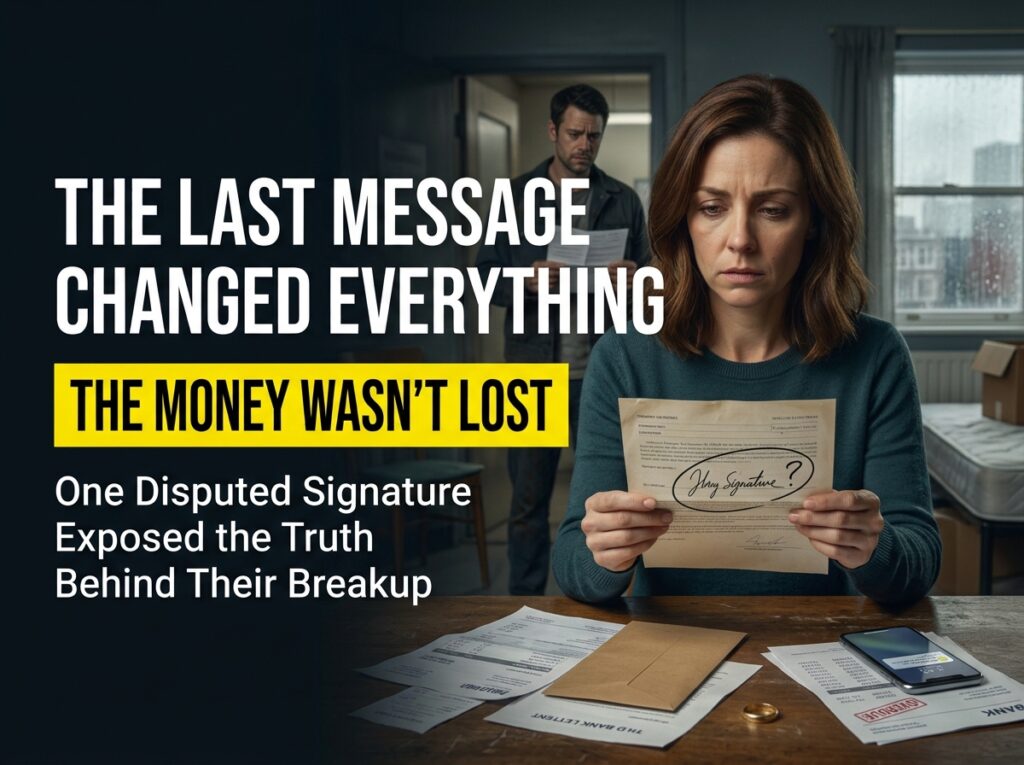
The apartment looked smaller without the furniture.
I had never realized how much space a sofa occupied until the men carrying it down the stairs left behind a pale rectangle on the wall. The coffee table was gone, along with the television stand, the spare dining chairs, and the wooden cabinet we had bought secondhand when we first moved in together.
All that remained were a mattress, two mismatched chairs, a narrow kitchen table, and several boxes stacked beside the bedroom door.
Caleb stood near the window, watching the delivery truck disappear around the corner.
“We’ll get through this,” he said.
He had said those words so often during the previous few months that they had begun to sound like something he was saying to himself rather than to me.
I wanted to believe him.
We had not always struggled this badly. There had been a time when our biggest disagreements concerned ordinary things: whether we should spend our savings on a holiday, whether we needed a larger apartment, and whether buying a used car would be wiser than continuing to repair the old one.
We had made plans.
We had talked about a future in which money was no longer a source of fear. Caleb wanted to build a small business, and I wanted a home where we could invite friends without worrying about whether we could afford dinner afterward.
Then the bills began to accumulate.
At first, we blamed unexpected expenses. A repair cost more than expected. A payment arrived late. One month of struggling became two, and soon we were borrowing money to cover ordinary necessities.
Caleb told me that his income would improve.
I told him we could manage if we were careful.
But the savings we had built together kept shrinking, and neither of us seemed able to explain exactly why.
The night before we sold the furniture, I sat on the mattress with a calculator and a stack of bills.
“How much do we actually owe?” I asked.
Caleb was standing in the kitchen, staring into a cupboard that contained little more than tea bags and a jar of instant coffee.
“We’ll work it out.”
“We’ve been saying that for weeks.”
He closed the cupboard.
“I know.”
“Then let’s do it now.”
He came into the room and sat beside me.
For a while, he studied the figures without speaking. I watched his face, searching for the moment when he would finally tell me something that made sense.
Instead, he said, “I made a mistake.”
My stomach tightened.
“What kind of mistake?”
“One I thought I could fix before you found out.”
I put the calculator down.
“What did you do, Caleb?”
He rubbed his hands together.
“I moved some money. I thought it would help us later.”
“Where did you move it?”
He looked at me.
“I can’t explain it properly yet.”
I felt a familiar wave of frustration.
“You keep saying that. Every time I ask where our money went, you tell me you’ll explain it later.”
“I know.”
“Was it spent?”
“No.”
“Then where is it?”
He looked away.
“I need to find the original paperwork.”
I stared at him, unable to understand why a simple question had become so difficult to answer.
We had shared an apartment, paid bills from the same account, and planned our future around the belief that we were working toward the same things.
Now he was telling me that he had moved money without explaining where it had gone.
“Did you make a decision that affects both of us without asking me?”
He did not answer immediately.
That silence frightened me more than any number on the calculator.
Eventually, he said, “I thought I was protecting us.”
I wanted to ask what that meant, but I was exhausted. I had spent months trying to keep our relationship together while pretending that I was not frightened by the bills, the empty cupboards, and the growing distance between us.
I put the papers into a folder.
“Then tomorrow, we look at everything. Every account, every transfer, every agreement. No more promises that you’ll explain later.”
Caleb nodded.
“All right.”
The following morning, he left before I woke.
He sent a message saying he needed to speak to someone and would be back that evening.
I read it while standing in the nearly empty kitchen.
Then I noticed a sheet of paper beneath the folder on the table.
It looked like an old financial document, creased down the middle and marked with several handwritten figures. I nearly threw it away with the other papers we no longer needed.
But something stopped me.
At the bottom of the page was a signature.
It looked like mine.
I stared at it, trying to remember when I might have signed such a document.
Nothing came to mind.
I read the date.
It was from several weeks before the night Caleb had admitted moving the money.
Suddenly, the furniture we had sold, the bills we could not pay, and the promises Caleb had made began to look like pieces of a story I did not understand.
I took a photograph of the page and placed it in my bag.
For the first time, I wondered whether the financial trouble had begun long before either of us admitted that something was wrong.
And if my signature had been used to authorize a decision I could not remember making, I needed to know who had written it there.
Part 2
I spent the afternoon going through everything we had left.
The apartment was so quiet that I could hear the refrigerator motor starting and stopping in the kitchen. I spread the documents across the table and arranged them by date.
There were utility bills, bank statements, receipts from the repair shop where Caleb sometimes worked, and letters reminding us that payments were overdue.
Most of the paperwork was ordinary.
One statement showed a transfer from our shared account shortly before the financial problems became severe.
I remembered that week clearly.
We had been discussing whether to renew our lease. Caleb had told me that his work was improving and that we would soon be able to rebuild our savings.
I had believed him.
The transfer was larger than any payment we normally made. The description did not explain where the money had gone.
I checked the next statement.
There was no matching return payment.
I wrote down the date and amount.
Then I searched my phone for messages from that week.
A conversation with Caleb appeared.
Don’t worry about the money. I’ve taken care of it.
I remembered reading that sentence while I was at work. I had been relieved because I thought he had finally paid an outstanding bill.
I had not asked for a receipt.
Now I wished I had.
I called him.
He answered after several rings.
“Have you found something?” he asked.
I felt a chill.
“Why would you ask me that?”
He paused.
“Because I left some papers on the table.”
“One of them has my signature.”
The line went quiet.
“Caleb?”
“I’m here.”
“Did I sign that document?”
“I don’t know which one you mean.”
“The one dated several weeks before you moved the money.”
He exhaled.
“Can you send me a photograph?”
I sent it.
A minute passed.
Then another.
Finally, he replied.
“I need to see the original.”
“Why?”
“Because the date is important.”
I gripped the phone.
“Important how?”
“I can’t explain everything over the phone.”
I closed my eyes.
There it was again.
The same refusal. The same promise that an explanation was coming, provided I waited a little longer.
“I’m not asking you to explain everything. I’m asking you whether you know what this document is.”
“I think I do.”
“Then tell me.”
He was silent.
“Caleb, did you use our money based on this document?”
“I moved the money because I believed it was the right thing to do.”
“That isn’t an answer.”
“I know.”
“Did you think I had agreed to it?”
He hesitated.
“Yes.”
I felt my heart begin to pound.
“When?”
“Before the transfer.”
“Did you actually ask me?”
“I thought we had discussed it.”
I stared at the paper on the table.
I remembered dozens of conversations about money, but none in which I had knowingly agreed to the arrangement described by the document.
I asked him to explain what he remembered.
He said that someone had approached him with a financial problem and that he had agreed to help arrange a temporary solution. He believed the money would be returned when certain conditions were met.
I asked who the person was.
He said he would tell me when we met.
I asked whether our money was still there.
He said he believed some of it was.
I asked whether the document had been used to authorize the transfer.
He did not answer.
I ended the call before the conversation could become another argument.
For several minutes, I sat motionless.
I was afraid that the signature meant I had unknowingly accepted responsibility for something that had helped destroy our finances.
But I was equally afraid that the signature had been copied or used without my understanding.
I could not prove either possibility.
I could only investigate.
I called the bank and asked how to raise a concern about a transfer from a shared account and a document bearing a signature I did not remember making.
The employee explained that the bank could help verify the transaction records and advise me about the formal process for reviewing the document. She could not determine whether the signature was genuine simply from my description.
I followed her instructions and made a note of the reference number.
Then I called Caleb again.
This time, he answered immediately.
“I want the original agreement,” I said. “And I want the name of the person you were helping.”
He sounded tired.
“I’ll bring the documents tonight.”
“All of them?”
“All the ones I have.”
“And if you don’t know an answer, say that. Don’t tell me you understand something if you don’t.”
He was quiet for a moment.
“All right.”
Before ending the call, I asked him one final question.
“Did you leave because you thought I would discover what happened?”
His breathing changed.
“No,” he said. “I left because I didn’t know how to face you after what I’d done.”
I stared at the paper.
It was the first time he had admitted that the breakup was connected to his decision.
But it still did not tell me whether he had been trying to protect me, protect someone else, or protect himself.
And when Caleb arrived that evening, he carried a second document that made the situation even more complicated.
Part 3
Caleb arrived just after seven.
He looked as though he had not slept properly in days. His jacket was damp from the rain, and he carried a brown envelope under one arm.
I had prepared two cups of tea, but neither of us touched them.
He placed the envelope on the table.
“I brought what I could find.”
I opened it.
Inside were several pages of financial records, a copy of the agreement, and a handwritten note containing dates and amounts.
The document with my signature was included.
I placed it beside the copy I had photographed earlier.
They appeared identical.
“Where did this come from?” I asked.
“Someone gave it to me when the arrangement was made.”
“Who?”
“Marcus.”
I recognized the name.
Marcus was Caleb’s friend from the repair shop. He had lent Caleb money more than once when we were struggling, and I had always assumed the loans were small amounts that Caleb intended to repay quickly.
I had met Marcus several times. He was friendly, quiet, and rarely spoke about his personal life.
When I asked Caleb how much money Marcus had lent him, he had said the amount was manageable.
Now I wondered whether the money we had lost was connected to those loans.
“How much did you owe Marcus?” I asked.
Caleb looked at the papers.
“I don’t know the final amount.”
“You borrowed money from him without keeping track?”
“I kept track of what I borrowed. The problem is that the agreement involved more than one payment.”
He explained that Marcus had been dealing with a financial obligation of his own. He had asked Caleb for help arranging a temporary transfer, promising that the money would be returned when another payment was received.
Caleb believed he could help without putting us at risk.
He had assumed the arrangement would be completed quickly.
Instead, the expected payment did not arrive.
The money remained tied up, and Caleb became increasingly frightened about telling me what had happened.
“So you used our savings to help Marcus,” I said.
“Yes.”
“Did you tell him the money came from our shared account?”
“Yes.”
“Did he know I hadn’t agreed?”
Caleb looked uncomfortable.
“He believed you had.”
“Why?”
“Because he saw the document.”
I felt anger rise in my chest.
“Did he see me sign it?”
“I don’t know.”
“Did you?”
He shook his head.
I stared at him.
“You moved our money based on a signature you never saw me make?”
“I thought you had signed it when we discussed the arrangement.”
“We never discussed an arrangement like this.”
“I know that now.”
I wanted to shout at him, but his expression stopped me.
He looked genuinely frightened.
That did not excuse what he had done, but it made me realize that he had not necessarily understood the document as well as he had claimed.
I asked whether he had ever received confirmation that the money would be returned.
He showed me a message from Marcus.
The transfer is safe. The payment should clear soon.
The message was dated several days after the money had left our account.
There was no further confirmation.
I asked whether Caleb had contacted Marcus when the payment failed to arrive.
He said he had.
Marcus had told him that the delay was temporary and that the arrangement would be resolved once the original obligation was settled.
Then Marcus had stopped responding regularly.
Caleb had become increasingly desperate.
He had taken extra shifts, sold belongings, and borrowed money to cover our bills. He had convinced himself that if he could keep us afloat long enough, the money would return and I would never need to know how close we had come to losing everything.
Instead, we sold the furniture.
I looked at the papers.
The transfer had been real. The money had left our shared account. But the records did not establish that Marcus had stolen it or that the agreement was fraudulent.
They showed that Caleb had trusted a promise he could not verify and had made a financial decision without ensuring that I understood the risk.
I asked whether he had told Marcus that our relationship was ending.
“Yes.”
“What did he say?”
Caleb hesitated.
“He told me not to involve you until he could explain the arrangement properly.”
I felt a cold wave of anger.
“So he knew I was affected by the transfer, and he still told you to keep me out of it?”
Caleb nodded.
“Yes.”
“Why did you listen?”
“Because I was ashamed. I thought if I admitted what I’d done, you’d never look at me the same way again.”
I looked down at the document.
He had been so afraid of losing my trust that he had made the very decision that destroyed it.
I asked him whether the money was still in an account.
He said Marcus had referred to an account connected to the arrangement, but he had never seen a current statement.
“Then how do you know the money is still there?”
“I don’t.”
I looked up.
“But the message you sent me said you thought it was.”
He nodded.
“I believed it was. I should have checked.”
For the first time, I began to see how much of our financial crisis had been built on assumptions.
Caleb assumed Marcus would repay the money.
Marcus apparently assumed Caleb had my permission.
And I had assumed that Caleb would never risk our shared savings without telling me.
Each assumption had seemed reasonable to the person making it.
Together, they had left us with an empty apartment and no clear explanation of what had happened.
I placed the agreement back in the envelope.
“I want to speak to Marcus.”
Caleb looked worried.
“He may not want to see you.”
“Then he can explain that himself.”
I picked up my phone and opened the last message Marcus had sent Caleb.
The number was still active.
I typed a short message asking him to meet me and explain the transfer.
His reply arrived several minutes later.
I will meet you tomorrow. But please don’t make any decisions until you’ve read the final page.
I looked at Caleb.
“What’s on the final page?”
He shook his head.
“I’ve never seen it.”
Part 4
Marcus chose a small café near the repair shop.
I arrived ten minutes early and sat at a table beside the window. The rain had stopped, but the pavement was still wet, and cars moved slowly through the evening traffic.
I had imagined confronting Marcus many times on the journey there.
I wanted to ask why he had accepted money from our shared account without ensuring that I understood the arrangement. I wanted to know whether he had promised Caleb something he could not deliver.
Most of all, I wanted to know whether the money was still available.
When Marcus arrived, he looked surprised to see me sitting alone.
“Tessa,” he said.
“Sit down.”
He removed his jacket and placed it over the back of the chair.
For a moment, neither of us spoke.
Then I put the agreement on the table.
“Did you know Caleb used our savings to make this transfer?”
Marcus looked at the document.
“Yes.”
“Did you know I hadn’t agreed to it?”
His expression changed.
“I was told you had agreed.”
“By whom?”
“Caleb.”
I felt a familiar tightness in my chest.
“Did you see me sign this?”
“No.”
“Did you ask Caleb whether he had actually discussed it with me?”
Marcus looked down.
“No.”
I waited.
He rubbed his hands together.
“I believed he was telling me the truth.”
“And now?”
“Now I know he was mistaken.”
I wanted to hear an admission that Marcus had deliberately deceived us. It would have made the situation easier to understand.
Instead, he told me that he had believed the arrangement was legitimate because Caleb had presented the signed document and explained that I understood the terms.
Marcus said he had been trying to resolve a financial obligation of his own and believed the temporary transfer would allow him to meet a deadline while waiting for another payment.
He had expected the money to be returned within weeks.
It had not happened.
“Where is the money now?” I asked.
Marcus took a breath.
“I don’t have a current statement with me.”
“Then you don’t know?”
“I know where the transfer was sent. I don’t know the current balance.”
“Has any of it been withdrawn?”
“Some payments were made under the arrangement.”
My stomach tightened.
“Which payments?”
He opened a folder and showed me a list of transactions.
The records indicated that part of the money had been used to cover expenses associated with the arrangement. Other amounts remained unaccounted for in the documents he had brought.
He could not confirm the current balance.
I felt my anger return.
“You’ve had our money for months, and you cannot tell me how much is left?”
“I understand how that sounds.”
“No. I don’t think you do.”
Marcus looked genuinely ashamed.
“I thought I was helping Caleb solve a problem. I didn’t understand how much pressure you were both under.”
“You knew we were struggling.”
“Yes.”
“You knew we were selling furniture.”
He nodded.
“Yes.”
“And you still didn’t contact me.”
He had no answer.
I asked him about the final page.
He opened the folder and removed another document.
It was an acknowledgment connected to the original agreement. It described the conditions under which the money could be released and identified the person whose approval was required.
I read the name.
Mine.
Again.
I felt as though the room had gone quiet around me.
“Why am I named here?”
Marcus explained that the agreement required an independent person to confirm that the conditions had been met before the funds could be released. Caleb had suggested me because I was not directly involved in Marcus’s original obligation.
But Marcus had assumed that I had agreed to take on that role.
I had not.
The signature beneath the clause resembled mine, but I could not remember signing it.
“Who prepared this document?” I asked.
Marcus gave me the name of the person who had handled the arrangement.
“Did you see me sign it?”
“No.”
“Did Caleb?”
“I don’t know.”
I stared at the signature.
The situation was no longer simply about missing money.
My name had been attached to an agreement I did not remember accepting. The document appeared to give me responsibility for approving the release of funds, yet nobody could establish that I had knowingly agreed to that responsibility.
I asked Marcus whether the money could be returned without my approval.
He said the agreement required the conditions to be reviewed first.
I told him I would not authorize anything until the document had been examined and the financial records had been reconciled.
He nodded.
“I understand.”
I gathered my papers and stood.
Before I left, Marcus said, “There is one thing I need you to understand.”
I turned toward him.
“The agreement wasn’t created to take your money. It was created because I believed I could resolve my obligation without causing you or Caleb any harm.”
I looked at him.
“Then why did nobody tell me?”
He lowered his eyes.
“Because we all believed we could fix it before you needed to know.”
I walked out of the café without answering.
Outside, I called Caleb and told him what Marcus had said.
He listened without interrupting.
Then I asked him whether he knew who had signed the document.
He said he did not.
I asked him whether he had any evidence that I had agreed to be responsible for the account.
He said he had none.
For the first time, I believed he understood that the signature was not a minor detail.
It was the reason everyone had proceeded as though I had consented.
And until we established how it had appeared on the document, none of us could safely assume what had happened.
Part 5
The following morning, I contacted the person who had prepared the agreement.
Her name was Helen, and she worked in an office that handled financial documentation and administrative arrangements.
I explained that I had found a document bearing my signature, but I did not remember signing it. I also explained that money from my shared account with Caleb had been transferred under the agreement.
Helen asked me to bring the original document and any related records.
When I arrived, she examined the papers carefully.
She did not immediately claim that the signature was genuine or false.
Instead, she asked questions about the date, the circumstances in which the document had been delivered, and the people who had been present.
I answered as accurately as I could.
Helen checked her records.
“There is an entry showing that the agreement was prepared and sent to Caleb,” she said. “But the file does not establish that you personally attended the appointment.”
“Then how did my signature end up here?”
“I can’t determine that from this record alone.”
I felt a wave of frustration.
“Everyone keeps telling me what they cannot determine.”
“I understand,” she said. “But it would be irresponsible for me to tell you that the signature is yours without verifying it.”
Her answer was reasonable, even if it was not the answer I wanted.
Helen explained that the document had been prepared on the assumption that the named parties had agreed to its terms. The signature was included as confirmation of my role in authorizing the eventual release of the money.
However, the records did not establish who had physically signed the page or whether I had knowingly accepted the responsibility.
She advised me to preserve the original and follow the formal process for having the signature reviewed.
I agreed.
Then I asked her to explain the financial arrangement itself.
She described it as a temporary holding arrangement intended to keep funds available while Marcus’s obligation was resolved. The account was subject to specific conditions, and the money could not simply be withdrawn because one of the parties wanted it returned.
The final page named me as the person expected to confirm that the conditions had been met.
I read the clause again.
It did not say that I owned the money.
It did not say that I owed Marcus anything.
It did, however, place a responsibility on me that I had never knowingly accepted.
I asked Helen whether the money could be released if I refused to approve the document.
She explained that the answer depended on the terms of the agreement and the outcome of the review. My refusal to confirm something I did not understand would not automatically resolve the matter, but it would ensure that the process did not proceed on the assumption that I had consented.
I felt a strange mixture of relief and fear.
At least I was no longer expected to make a decision based solely on Caleb’s memory or Marcus’s assurances.
There was a formal process.
There were records that could be examined.
And I had the right to ask questions before accepting responsibility.
When I left Helen’s office, I called Caleb.
“I’ve had the agreement reviewed,” I told him.
“What did she say?”
“She can’t establish that I signed it. The original needs further examination.”
He was silent.
“Caleb, did you ever see me sign that document?”
“No.”
“Then why did you tell Marcus I had agreed?”
“I thought we had discussed it.”
“We discussed money. We discussed bills. We never discussed me becoming responsible for releasing money from an account I didn’t know existed.”
He exhaled slowly.
“I understand that now.”
I wanted to believe him.
But understanding something after the damage had been done was different from respecting it before making the decision.
I told him that I wanted all remaining records, including every message exchanged with Marcus and the person who prepared the agreement.
He agreed to provide them.
Later that afternoon, he sent me a series of emails and messages.
Most were ordinary conversations about payment dates and the expected return of the money.
One message stood out.
It had been sent by Marcus shortly before the transfer.
Make sure she understands the agreement before you proceed. I don’t want this coming back on any of us.
I read it twice.
Marcus had explicitly warned Caleb to make sure I understood the arrangement.
Caleb had proceeded anyway.
I called him.
“Did you receive this message before the transfer?”
“Yes.”
“Then you knew you were supposed to explain it to me.”
“Yes.”
“Why didn’t you?”
He was quiet for a long time.
Finally, he said, “Because I was afraid you’d say no.”
I closed my eyes.
There it was.
The truth was not that Caleb had misunderstood the importance of my consent.
He had understood that I needed to agree.
He had simply been afraid that I would refuse.
And rather than risk hearing no, he had acted as though the answer had already been yes.
Part 6
I did not speak to Caleb for two days.
I needed time to understand what his admission meant.
For months, I had wondered whether our relationship had ended because we were poor, because we were exhausted, or because Caleb had become ashamed of what he could no longer provide.
Now I knew that the financial crisis had been made worse by a decision he had deliberately kept from me.
He had been afraid of losing my trust.
So he had taken away my chance to make an informed decision.
The irony was painful.
On the third day, I called him and asked him to meet me at the apartment.
He arrived carrying a folder of documents and a small bag containing the last of his belongings.
We sat at the kitchen table.
“I want to understand something,” I said. “When you moved the money, did you believe it was safe?”
“Yes.”
“Did you know the money might not come back quickly?”
“I knew there was a risk.”
“Did you tell me?”
“No.”
“Did you think about what would happen if the payment was delayed?”
“I thought I could cover our expenses until it was returned.”
“With what?”
He looked down.
“I thought I could borrow money if I needed to.”
I felt my chest tighten.
“So you used our savings in an arrangement you didn’t fully understand, then planned to borrow more money if it went wrong.”
He nodded.
“I know how it sounds.”
“It sounds like you were making decisions with our future while leaving me to deal with the consequences.”
He did not argue.
For the first time, I saw him accept the full weight of what had happened without trying to explain it away.
He told me that Marcus had been under pressure to settle his own financial obligation. Caleb had wanted to help because Marcus had helped him before.
He believed the arrangement would be completed quickly.
When the expected payment did not arrive, he became frightened.
He borrowed money to cover expenses, sold belongings, and continued telling me that everything would be all right.
By the time he admitted that he had moved our savings, he had already spent weeks trying to hide the consequences.
“I thought if I could fix it, you’d never need to know,” he said.
“But I did need to know.”
“I understand that.”
“No, Caleb. I don’t think you understood it when it mattered.”
He looked at me with tears in his eyes.
“You’re right.”
The admission did not make the anger disappear.
But it changed the conversation.
I asked whether he intended to return to the relationship.
He hesitated.
“I hoped we could.”
I looked around the empty apartment.
“We can’t go back to the way things were.”
“I know.”
“Do you?”
He nodded.
“I don’t expect you to trust me just because I say I’m sorry.”
For months, I had wanted him to apologize.
Now that he was doing so, I realized that an apology could not restore what had been lost.
It could only acknowledge the damage and begin the work of accepting responsibility.
I told him that I wanted the financial matter resolved, but I would not return to the relationship simply because the money might eventually be recovered.
He accepted that.
Before he left, he gave me a copy of every record he had.
“I should have shown you these before,” he said.
“Yes.”
“I’m sorry.”
I believed that he regretted what he had done.
But I also knew that regret was not the same as change.
After he left, I organized the documents into separate folders: bank statements, messages, the original agreement, and records of the payments made under the arrangement.
I wrote down what was confirmed and what remained uncertain.
The transfer had occurred.
The money had gone into an account connected to the agreement.
Some payments had been made, but the current balance still needed to be verified.
The signature appeared on the document, but its authenticity had not been established.
Caleb had proceeded despite being warned to ensure that I understood the arrangement.
Those were the facts.
I did not need to decide whether Marcus was a thief or whether Caleb had intended to deceive me.
The records did not establish either conclusion.
What they did establish was that I had been denied the information I needed to make a choice.
And that was enough to explain why the relationship could not continue as it had.
That evening, I received a message from Marcus.
He said he had located an additional record relating to the account and wanted me to see it before the review proceeded.
He attached a photograph of a page from the original file.
At the bottom was a sentence I had not seen before.
The funds may be released only after the named person confirms that the original purpose of the transfer has been fulfilled.
I read it carefully.
The agreement had never promised that the money would be returned on a particular date.
It had made the release dependent on a condition.
And nobody had yet established that the condition had been fulfilled.
Part 7
The next week, Marcus and Caleb agreed to attend a meeting with Helen so that the financial records could be reviewed together.
I arrived carrying the original agreement in a protective folder.
I wanted the process documented properly. I did not want another private conversation in which someone promised that everything would be resolved if I simply waited.
Helen began by reviewing the transfer and the account records available to the parties.
She confirmed that the money had been moved from the shared account and placed into the account associated with the arrangement.
She also confirmed that the agreement required the original purpose of the transfer to be fulfilled before the funds could be released.
However, the records did not establish that all the conditions had been met.
Marcus explained that he had expected a payment from another party to settle his obligation. That payment had been delayed, leaving the arrangement incomplete.
Caleb had believed the delay would be brief.
It had not been.
I asked Marcus whether he had ever told Caleb that the money was guaranteed to be returned by a specific date.
He said he had given an estimated date based on the information available to him, but he had not guaranteed it.
I asked Caleb why he had told me the money would be available soon.
He looked uncomfortable.
“Because I believed Marcus.”
“But you knew there was a risk.”
“Yes.”
“And you knew I hadn’t agreed to the transfer.”
He nodded.
“Yes.”
Helen interrupted gently.
“We need to distinguish between the financial arrangement and the question of authorization. The fact that the transfer occurred does not establish that every party properly consented to it.”
I appreciated her explanation.
The three of us had spent months arguing about intentions, but the documents raised separate questions.
Was the money being held for a legitimate purpose?
Had the conditions for its release been fulfilled?
Had I knowingly accepted the responsibility described in the agreement?
Those questions required different evidence.
Helen explained that the signature would need to be reviewed independently. The account records would also need to be reconciled to establish the current balance and determine which payments had been made.
Until then, no one should assume that the funds could be released immediately.
I agreed.
Marcus agreed.
Caleb did not object.
For the first time, the meeting ended without anyone asking me to trust a promise that could not be verified.
Afterward, I walked outside with Caleb.
The sky was gray, and a cold wind moved through the street.
“I know you don’t want to hear this,” he said, “but I never wanted to hurt you.”
I looked at him.
“I believe you didn’t set out to hurt me.”
He seemed relieved.
“But you knew I needed to agree, and you chose not to ask.”
His face fell.
“Yes.”
“That’s what I can’t forget.”
We stood quietly for a moment.
Then he asked whether I thought we might ever try again.
I looked at him and remembered the apartment before we sold the furniture. I remembered the evenings when we cooked together, the plans we made, and the way he used to reach for my hand when we crossed a busy street.
Those memories were real.
So was the fear I had felt when the bills arrived and he refused to explain the missing money.
“I don’t know what the future will look like,” I said. “But I know I can’t promise to return to a relationship that made me feel I had no right to ask questions.”
He nodded.
“I understand.”
I hoped he did.
We said goodbye.
Over the next several weeks, the review continued. The records confirmed some payments and identified others that required further explanation. The account remained subject to the agreement, and the signature issue was not treated as settled merely because the writing looked familiar.
I began rebuilding my finances separately.
I negotiated payment arrangements, found a more affordable room, and made a budget that did not depend on money I could not verify.
It was difficult.
There were nights when I worried about the next bill and mornings when I wished I could return to the life we had before everything became complicated.
But I was no longer waiting for Caleb to tell me that everything would be all right.
I was learning to distinguish hope from a plan.
Hope was believing that the money might eventually be released.
A plan was knowing how I would pay the rent if it wasn’t.
Hope was wishing that Caleb would become more honest.
A plan was refusing to make new financial commitments without clear information.
I still cared about him.
But I was beginning to understand that caring about someone did not require me to surrender control over my own decisions.
One afternoon, Helen called with an update.
The account records had been reconciled further, but a question remained about the person who had signed the authorization.
She told me that a second document had been found in the original file.
It contained a handwritten note dated the day before the transfer.
The note was short.
If she does not agree, the money must remain where it is.
I read the words twice.
Someone had known that my consent was essential.
Someone had understood that I might refuse.
And yet the transfer had gone ahead.
I asked Helen who had written the note.
She said the handwriting had not yet been identified.
But she had found another detail.
The note had been addressed to Caleb.
Part 8
I asked Caleb to meet me the next day.
When I showed him the note, he stared at it for a long time.
“I’ve never seen this before,” he said.
“Did you know someone had written it?”
“No.”
“Then why did you proceed?”
He looked exhausted.
“I thought the agreement had already been approved.”
“By whom?”
“I don’t know.”
I watched his face.
For the first time, I wondered whether Caleb had been relying on information from someone else rather than making the decision entirely on his own.
That did not remove his responsibility. He had known that I needed to understand the agreement, and he had chosen not to ask me.
But the note suggested that someone else had also been involved in the process.
I asked whether Marcus had ever shown him a written authorization.
Caleb said he had received the agreement and believed the signatures had been completed before the money was moved.
“Did you check?”
“No.”
“Why not?”
He looked down.
“Because I wanted to believe it was already handled.”
I thought about the empty apartment and the furniture we had sold.
We had spent months living with the consequences of a decision that none of us had properly examined.
I asked Caleb whether he would cooperate with the review of the note and the signature.
He agreed.
I then contacted Helen and provided the information from our conversation.
She explained that the note would be added to the file and that the authorization issue would need to be examined alongside the original agreement.
The process continued.
In the meantime, I tried to rebuild ordinary routines.
I bought a small secondhand table and two chairs. I filled the kitchen cupboards gradually. I stopped checking my bank balance every few minutes and began reviewing it at set times so that fear would not dictate the entire day.
Sometimes I still thought about the money.
It represented more than the amount we had lost access to. It represented the future Caleb and I had imagined together, the security we had worked toward, and the belief that we were making decisions as partners.
But I was beginning to separate the financial loss from the emotional one.
Even if the money were eventually released, it would not undo the secrecy.
Even if the signature were explained, it would not erase the fact that Caleb had proceeded without confirming my consent.
And even if he apologized a hundred times, I would still need to decide whether I could trust him again.
I did not want to make that decision out of loneliness or fear.
One evening, Anna, my closest friend, came over with groceries and helped me assemble the small table.
She listened as I explained the latest development.
“What do you think happened?” she asked.
“I don’t know.”
“Do you think Caleb is lying?”
I considered the question.
“I think he has hidden things from me. I know he made a decision without asking me. But I don’t know whether he understands every part of the agreement himself.”
She nodded.
“That’s a difficult place to be.”
“It is.”
“Maybe you don’t need to decide what kind of person he is right now. Maybe you only need to decide what you’re willing to do next.”
Her words stayed with me.
I had spent so much time trying to understand Caleb’s intentions that I had forgotten I could make decisions based on what I knew about his actions.
I could cooperate with the financial review without agreeing to resume the relationship.
I could acknowledge his regret without trusting him with my money again.
I could leave the question of the signature to the proper process instead of trying to solve it through an argument.
For the first time, the future felt less like a verdict waiting to be delivered.
It felt like a series of choices I could make for myself.
A week later, Helen called again.
The review had established that the account was still open, but the release conditions had not been confirmed as satisfied. The signature question remained unresolved.
However, the additional note had led to a request for another record from the person who had prepared the agreement.
Helen said she could not tell me what it would show until it arrived.
I thanked her and ended the call.
That evening, I sat at my new table and looked at the two chairs.
The apartment was still modest, and I still had bills to pay.
But it no longer felt like a place where my life was falling apart.
It felt like a place where I could begin again.
Then a message arrived from Marcus.
The original file has been located. There is a final page that none of us received with the first copy.
I stared at the screen.
The final page.
Again.
I called him immediately.
“What does it say?”
He hesitated.
“I haven’t read the whole thing yet.”
“Then why did you message me?”
“Because your name is on it.”
My heart began to race.
“What do you mean?”
He paused.
“The page identifies the person who was supposed to confirm your consent before the money was transferred.”
I gripped the phone.
“Who?”
Marcus took a breath.
“Caleb.”
Part 9
I did not call Caleb immediately.
I wanted to understand the new information before allowing another conversation to turn into an argument.
The final page was delivered to Helen, who added it to the file and arranged for the parties to review it together.
When we met, she explained that the page described the steps required before the transfer could proceed. One person had to explain the arrangement to me, confirm that I understood the conditions, and record my decision.
That person was Caleb.
The page did not establish that he had forged my signature.
It did establish that he was responsible for confirming my consent before the transfer took place.
And he had not done so.
I looked at him across the table.
“You knew this was your responsibility?”
He swallowed.
“I knew I was supposed to explain it to you.”
“Then why did you tell Marcus I had agreed?”
“I thought you would agree once I explained.”
“But you didn’t explain.”
“No.”
“Did you believe the signature was mine?”
He looked at the document.
“I assumed it was.”
“Without seeing me sign it?”
“Yes.”
I felt a deep sadness settle over me.
For months, I had wondered whether Caleb had deliberately used my name to protect himself. I had imagined that he had planned the transfer knowing I would eventually discover it.
The evidence did not establish that.
But it revealed something that hurt almost as much.
Caleb had been so convinced that he knew what I would choose that he had acted without giving me the chance to choose at all.
He had mistaken his expectation for my consent.
Helen explained that the signature would still need to be reviewed independently and that the financial records would need to be reconciled before any release could be considered.
The document did not resolve every question.
It clarified responsibility.
Caleb had been the person required to explain the agreement and confirm my consent.
He had not done so.
I asked him why he had been so afraid of my refusal.
He looked at me with tears in his eyes.
“Because I knew you would ask questions I couldn’t answer.”
“Then you should have waited until you could answer them.”
“I know.”
“You could have told me you didn’t understand the arrangement.”
“I know.”
“You could have said we needed more time.”
He nodded.
“I know.”
I looked down at the papers.
The hardest part was not that Caleb had made a mistake.
It was that he had made the mistake while pretending that he had everything under control.
He had left me to face the bills, the uncertainty, and the fear of losing our home while he tried to protect me from information I needed to know.
“I loved you,” I said quietly. “I wanted us to succeed. If you’d told me the truth, we could have decided together what to do.”
He wiped his eyes.
“I was ashamed.”
“I understand that you were ashamed. But your shame did not give you the right to make the decision for both of us.”
He nodded.
“I know.”
For the first time, I did not feel the need to convince him that I was right.
The records had established the essential point.
I had not been given the opportunity to make an informed decision.
Whatever happened with the money, that was something I could not ignore.
I told Caleb that I wanted the financial process completed, but I was not willing to resume the relationship.
He accepted my decision.
“I hope you can forgive me someday,” he said.
“I hope you learn from this,” I replied.
We left the meeting separately.
In the weeks that followed, the review continued. The account records were examined, the authorization issue remained subject to the appropriate process, and no one treated the disputed signature as proof that I had knowingly agreed.
I continued paying my bills through my own arrangements.
I bought groceries without wondering whether another hidden transaction would leave me unable to pay the electricity bill.
I began making plans that did not depend on Caleb’s promises.
My life was not suddenly easy.
But I was no longer waiting for someone else to explain what I was allowed to know.
One evening, I received a final update from Helen.
The original purpose of the transfer had been clarified enough for the parties to identify the remaining conditions. However, the release still depended on the authorization issue being resolved.
The money was not immediately available.
I felt disappointed, but not devastated.
I had learned that finding the account was only the beginning of the process.
The more important discovery was that I could refuse to approve something I did not understand.
I could insist on clear records.
I could ask questions without apologizing for them.
And I could move forward even while some answers remained uncertain.
Then I noticed a final line in Helen’s message.
A separate statement had been located, written by the person who prepared the agreement.
It described what had happened during the meeting when the paperwork was originally arranged.
I opened the attachment.
The statement began with a date.
It was the day Caleb had told me he was working late.
I read the first paragraph.
Then I stopped.
The statement did not identify who had signed my name.
But it contained a sentence that changed how I understood the night our relationship ended.
Caleb returned to the office after the transfer and asked whether the agreement could be reversed without telling Tessa what had happened.
I read the sentence again.
He had known the transfer was a mistake before we sold the furniture.
He had tried to reverse it.
But he had still chosen not to tell me.
And now I had to decide whether that final piece of information changed anything about the future I wanted for myself.
Part 10
I read the statement several times before putting my phone down.
For months, I had imagined the night Caleb left as the moment everything had ended.
I remembered him standing in the doorway with a bag in his hand, telling me that he needed time to sort things out. I remembered asking whether he was coming back and watching him struggle to answer.
At the time, I thought he was leaving because we were poor.
Later, I wondered whether he had been planning to leave all along.
Now I knew that the financial problem had become serious before our final argument, and Caleb had been trying to reverse the transfer without telling me.
That did not mean he had intended to abandon me.
It did not mean he had stolen the money.
And it did not mean that the signature on the agreement was genuine.
The statement established only that he had asked whether the arrangement could be reversed without my knowledge.
But it explained something I had never understood.
Caleb had known that the decision could not simply be undone.
He had been afraid that telling me would force him to admit how much he had risked.
So he had tried to fix the problem quietly.
When that failed, he had continued hiding the truth.
I thought about the furniture we had sold, the overdue notices, and the nights when I had lain awake calculating how much food we could afford.
I had believed that we were facing the same problem together.
In reality, Caleb had been trying to solve a problem he had created while preventing me from understanding it.
The difference mattered.
I could feel compassion for his fear without accepting his decision.
I could recognize that he had tried to reverse the transfer without pretending that his silence had protected me.
And I could remember the good years without using them as a reason to return to a relationship in which important decisions had been made without my consent.
The financial review continued for some time.
The account remained subject to its terms, and the disputed authorization was handled through the appropriate process. The available records clarified parts of the transfer, but they did not justify treating every unanswered question as proof of wrongdoing.
I stopped trying to solve the mystery through private arguments.
Instead, I kept copies of the documents, followed the review, and made financial decisions based only on money I could verify.
Eventually, I moved into a small apartment with a working heater and enough space for a table, two chairs, and a bookcase.
The first evening there, I cooked a simple meal and sat beside the window.
I had paid the deposit from money I had saved by working extra shifts and cutting unnecessary expenses. There was no guarantee that the next month would be easy, but I knew what I could afford.
For the first time in a long while, I felt calm.
Caleb sent me a message several weeks later.
He apologized again and said he understood why I had chosen not to return to the relationship.
I thanked him for acknowledging it.
We did not become a couple again.
There were still moments when I missed him. I missed the way he made coffee in the morning and the way he used to laugh at his own jokes. I missed the future we had imagined before money became a source of fear.
But I no longer believed that missing someone meant I had made the wrong decision.
Love could remain in the memories without determining what happened next.
I also stopped blaming myself for not discovering the transfer sooner.
I had trusted the person closest to me.
That trust had not been foolish simply because he had made a poor decision.
What mattered was what I learned from the experience.
I learned that shared finances required shared understanding.
I learned that a signature should not be treated as proof of consent when the person whose name appears on the document does not remember agreeing.
And I learned that a promise to explain something later is not a substitute for telling the truth when a decision affects another person’s life.
One afternoon, I packed the last of the papers into a folder and placed it on the shelf.
The apartment was quiet.
There were still unanswered questions about parts of the agreement, but I no longer felt compelled to make every uncertainty disappear before I could live my life.
Some matters required further evidence.
Some mistakes could be acknowledged without being undone.
And some relationships ended not because every feeling had vanished, but because the trust required to continue had been damaged beyond what I was willing to accept.
I had once believed the worst thing we could lose was money.
Then I thought the worst thing was the relationship.
Now I understood that the deepest loss had been the ability to make choices with the truth in front of me.
The money had mattered because it represented our work, our plans, and our security.
The furniture had mattered because selling it had made our financial crisis impossible to ignore.
But the signature had mattered for another reason.
It had made me question whether my own decisions were being represented accurately by the people I trusted.
I could not change what Caleb had done.
I could not force the money to be released before the agreement allowed it.
I could not make the past match the future we had once imagined.
But I could decide how I would live from that point onward.
I would not agree to financial arrangements I did not understand.
I would not accept responsibility simply because someone claimed I had already consented.
And I would not let fear of losing a relationship stop me from asking the questions necessary to protect my future.
The final message had not given me a simple villain or a perfect explanation.
It had shown me a person who had made a serious mistake, tried to conceal it, and eventually had to face the consequences.
It had also shown me that understanding why someone acted as they did was not the same as deciding that their actions were acceptable.
I could wish Caleb well without returning to him.
I could hope that Marcus resolved his own obligation without accepting responsibility for it.
And I could rebuild my life without waiting for the final financial question to be answered.
One evening, I opened the drawer where I had placed the original document.
I looked at the signature one last time.
It still resembled mine.
I still could not remember signing it.
The review had not given me permission to invent an answer, and I would not do so simply because uncertainty was uncomfortable.
I returned the paper to its folder and closed the drawer.
Then I turned off the kitchen light and walked into the living room.
The furniture was modest, but every piece had been chosen with money I understood and decisions I had made myself.
I sat down and listened to the quiet.
For months, I had feared that the truth would hurt more than being broke.
It had hurt.
But not knowing had taken away something more important: my ability to trust my own understanding of my life.
Now I could live with the truth that had been established, acknowledge what remained uncertain, and make decisions based on what I knew.
I had not recovered the future I once planned with Caleb.
I had recovered my right to choose the future I wanted.
And that was enough to begin again.