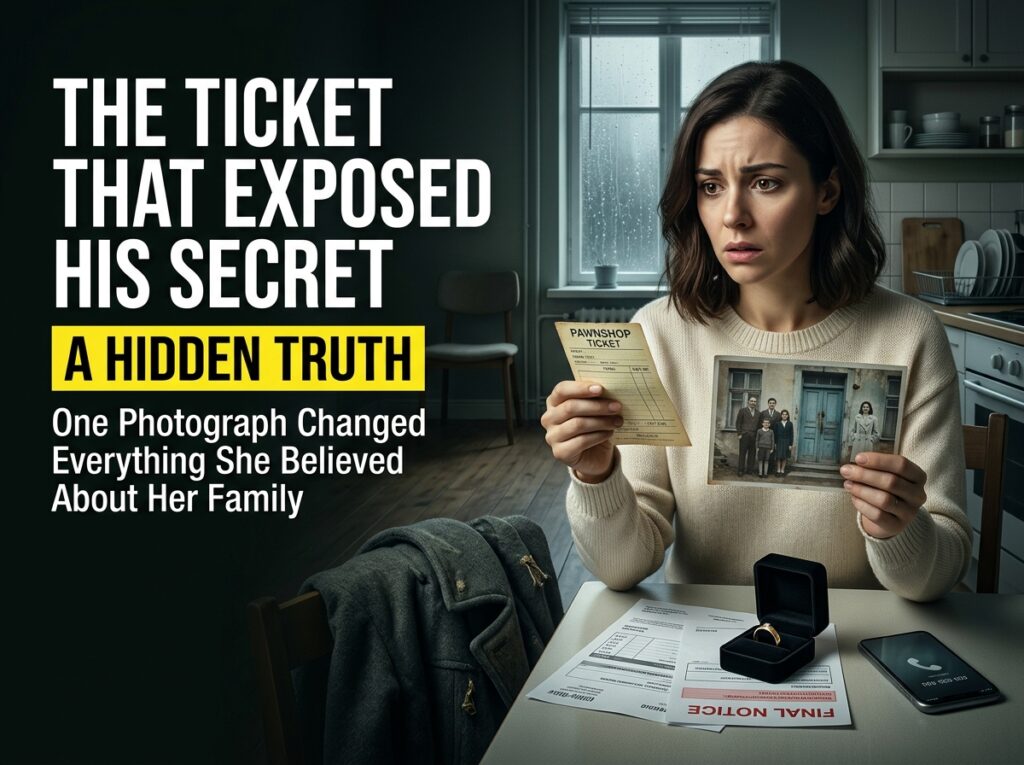
The morning Sofia found the pawnshop ticket, the apartment was cold enough to make her reluctant to leave the thin blanket wrapped around her shoulders.
The heating had stopped working two days earlier. Her landlord had promised to send someone, but Sofia had learned that promises were easy to make when someone else was the person waiting in the cold.
Two unpaid bills lay on the kitchen table. Beside them sat a chipped mug, a half-empty jar of coffee, and an envelope containing the money she had earned during the previous week.
She counted it again.
It was still not enough.
Sofia had become skilled at making small amounts of money last longer than they should. She knew which grocery stores discounted bread in the evening, which bills could wait a few days, and how to prepare dinner from ingredients that seemed too few to make a meal.
She had once imagined a different life.
Not an extravagant one. She had never needed expensive holidays or a house filled with beautiful furniture. She had wanted a home where she and Daniel could sit together after work, talk about their day, and feel certain that whatever happened outside their door, they would face it together.
For a long time, she had believed that was exactly what they were building.
Then Daniel returned her engagement ring.
He came to the apartment on a rainy Thursday evening. Sofia remembered the rain because water dripped from his jacket onto the floor, forming small dark circles beside the kitchen table.
He carried a little velvet box.
At first, she thought he had brought her a gift.
Then he placed the box between them.
“I think you should have this back,” he said.
Sofia stared at him.
“Have what back?”
Daniel opened the box.
The ring caught the light from the kitchen lamp.
For several seconds, neither of them moved.
“Why?” she finally asked.
He rubbed his palms together, avoiding her eyes.
“Things haven’t worked out the way we planned.”
“What things, Daniel? The bills? The rent? Our wedding?”
“All of it.”
She wanted to believe he was simply frightened. They had been struggling financially for months, and she knew he had been working longer hours at the repair shop. Sometimes he returned home so tired that he fell asleep without eating.
But exhaustion did not explain the way he looked at her now.
It was the expression of someone who had already made a decision and come only to deliver it.
“Are you ending our engagement?” she asked.
Daniel swallowed.
“I don’t know how to fix what I’ve done.”
“What have you done?”
He looked toward the window.
“I can’t explain everything tonight.”
Sofia felt something inside her tighten.
“You can return a ring, but you can’t tell me why?”
“I’m sorry.”
She waited for more.
He gave her nothing.
After he left, she put the ring in a kitchen drawer beneath old receipts. She could not wear it, but throwing it away felt like denying that their years together had ever mattered.
For the next several weeks, she tried to continue as usual. She went to work, paid what she could, and answered friends who asked whether she and Daniel were taking a break.
She never knew what to say.
Then, that morning, she began searching an old winter coat Daniel had left behind.
She needed a spare key to the storage cupboard. She remembered him once saying that he had hidden a key inside the lining of his coat, and she hoped he had not taken it when he collected the rest of his belongings.
The first pocket contained two coins and a broken pen.
The second held a faded grocery receipt.
The inside pocket contained a folded piece of paper.
Sofia almost threw it away.
Then she noticed the word printed across the top.
PAWNSHOP.
She unfolded the paper carefully.
The ticket contained a reference number, a date, an item description, and a handwritten name.
The date was three days before Daniel had returned her engagement ring.
Sofia read it twice.
Then she looked toward the kitchen drawer where the ring was hidden.
Had Daniel pawned it before bringing it back?
Had he borrowed money against something else?
And why had he never mentioned any transaction?
She took a photograph of the ticket and slipped it into an envelope.
At the bottom, beneath the printed details, she noticed a name she did not recognize.
Someone had written it in a hurried hand.
Sofia had the uncomfortable feeling that the name was the beginning of a story Daniel had desperately hoped she would never read.
Part 2: The Message He Never Explained
Sofia spent the next hour searching through old messages.
She began with the week Daniel returned the ring, hoping that something in their conversations would explain the pawnshop ticket.
Most of the messages were ordinary.
He had asked her to buy bread. She had reminded him about an overdue electricity bill. He had sent a photograph of a damaged car he was repairing at work.
There were apologies for late nights and promises to discuss their finances on Sunday.
Then she found a message dated the day before the pawnshop ticket was issued.
Daniel had written:
I need to handle something tomorrow. Please trust me for one more day.
Sofia remembered her response.
I have trusted you for months. I need you to tell me what’s happening.
His answer had arrived several minutes later.
You’ll understand soon.
She stared at those three words.
At the time, she had thought he was talking about their money. She believed he had found a solution to their financial problems and wanted to surprise her.
Instead, three days later, he had returned the ring.
She called her closest friend, Nina.
Nina had helped Sofia pack Daniel’s belongings after the breakup. She had sat with her through sleepless nights and listened when Sofia wondered whether she had somehow failed to notice that her relationship was falling apart.
When Sofia mentioned the pawnshop ticket, Nina became unusually quiet.
“What date is printed on it?” she asked.
Sofia told her.
“I remember that week,” Nina said.
“Why?”
“Daniel mentioned meeting someone. He said he was trying to sort out a problem before it became worse.”
“Who was he meeting?”
“He didn’t tell me.”
“Did he mention a pawnshop?”
“No.”
Sofia closed her eyes.
“Did he say anything about a photograph?”
Nina hesitated.
“A photograph?”
“Yes.”
“No. Why?”
Sofia explained that she had found a handwritten name on the ticket and an old message referring to something Daniel intended to handle.
Nina listened without interrupting.
When Sofia finished, her friend said, “You should ask him directly.”
“I did. He told me not to take the ticket to the shop.”
“And what did he say when you asked why?”
“That I didn’t know what I was looking at.”
Nina sighed.
“That doesn’t sound good.”
“No. It doesn’t.”
After the call, Sofia examined the ticket again. The handwritten name appeared to begin with an M, although the final letters were difficult to read.
She searched through her contacts and old family correspondence.
Nothing matched.
Then she remembered an old photograph saved on her phone.
It showed a family gathering outside a building with a distinctive blue door. Daniel stood near the edge of the group, beside a man wearing a dark coat.
Sofia had not looked at the picture in years.
She enlarged it.
The man’s face was partly turned away from the camera. Behind him stood a woman in a pale coat, her features hidden by the shadow of the doorway.
Something about the building felt familiar.
She searched Daniel’s old notebook, which she had kept with his other belongings. Inside were work schedules, phone numbers, and small reminders.
On one page, beside a date from the same week as the pawnshop ticket, he had written:
Thursday. Bring the photograph. Don’t discuss it over the phone.
Beneath the note was an address.
Sofia recognized the street. It was in the older part of town, near a row of small businesses and a pawnshop she had passed many times.
The photograph, the address, and the ticket were connected somehow.
She called Daniel.
He answered after several rings.
“Sofia?”
“I found the ticket in your coat.”
Silence.
“What ticket?”
“The pawnshop ticket.”
She heard him take a sharp breath.
“Where are you?”
“At home. Why?”
“Do you still have it?”
“Yes.”
“Please don’t take it to the shop.”
Sofia stood up.
“Then tell me what it means.”
“I can’t explain it over the phone.”
“You said that before.”
“I know.”
“You returned my ring without explaining why our money was disappearing. Now I’ve found a ticket you clearly recognize, and you’re asking me to stop asking questions.”
Daniel’s voice became strained.
“Because I don’t want you to find the wrong person.”
Sofia stared at the old photograph.
“What person?”
He hesitated.
Then he said something that made her blood run cold.
“Before you do anything else, tell me whether you still have the photograph from your mother’s box.”
Part 3: The Photograph Outside the Blue Door
Sofia did not answer immediately.
She looked at the photograph on her phone, then at the notebook beside it.
“What does my mother’s photograph have to do with a pawnshop ticket?” she asked.
Daniel exhaled.
“I can’t explain everything until I know which copy you have.”
“I have a picture of our family outside a building with a blue door. You were there. There was a man in a dark coat and a woman standing in the doorway.”
“That’s the one.”
“Who is the woman?”
“I don’t know for certain.”
“You’ve seen the photograph. You wrote that you needed to bring it somewhere. You told me not to take the ticket to the pawnshop. How can you not know?”
“Because a photograph can show where someone stood without showing what they were doing there.”
Sofia felt a flash of anger.
“Then why are you so frightened of it?”
Daniel fell silent.
When he spoke again, his voice was quieter.
“Because someone has spent years telling a story about that night, and the photograph may prove part of it was wrong.”
“What story?”
“I can’t tell you until I have the original.”
Sofia ended the call.
She was tired of being asked to trust people who refused to give her a reason.
The next morning, she took the pawnshop ticket to the shop printed on the paper.
The owner examined the reference number and explained that the records were old. He could not disclose private customer information without the appropriate verification, but he could confirm some details from the ticket.
After checking the available record, he returned to the counter.
“The item listed here was a small framed photograph,” he said.
Sofia felt her stomach tighten.
“Not a ring?”
“No. The description doesn’t match jewelry.”
“Was the photograph sold?”
“The record indicates it was redeemed before the deadline.”
“By the person who brought it in?”
“I can’t confirm that from the information available to me.”
Sofia thanked him and stepped outside.
The ticket had nothing to do with the engagement ring.
It concerned the photograph.
She called Daniel again.
“The ticket was for a framed photograph,” she said.
He was quiet for a moment.
“Did they tell you who redeemed it?”
“No.”
“Good.”
“Why is that good?”
“Because the person who redeemed it wasn’t the person who originally brought it in.”
Sofia stopped walking.
“You were there, weren’t you?”
“Yes.”
“Then explain.”
Daniel told her that he had discovered the photograph while helping someone examine an old family dispute. The image appeared to contradict a claim made by one of the people involved.
He had arranged for the photograph to be kept safe while he tried to verify its authenticity.
The pawnshop transaction had been part of that process.
But he had made a payment using money from their shared account without asking Sofia.
“I thought I could replace the money before you noticed,” he admitted. “I believed the photograph would help resolve the dispute, and I thought I could fix everything before it affected us.”
“It already affected us.”
“I know.”
“Why didn’t you tell me?”
“Because I was afraid you’d think I’d lost my mind. We were struggling, and I used money we needed for rent and bills to protect a photograph.”
“You should have let me decide whether that was something we could afford.”
“You’re right.”
For the first time, he did not try to defend himself.
Sofia felt the anger settle into something heavier.
She could understand why Daniel had wanted to correct an old injustice. She could even understand why he had been frightened of the consequences.
But understanding did not make his decisions fair.
“Who is the person in the photograph?” she asked.
“I think it’s someone close to us.”
“Who?”
“I can’t be sure until we find the original.”
“And if we find it?”
“Then we’ll have to ask why that person claimed never to have been there.”
Sofia looked at the address in Daniel’s notebook.
It led to the blue-doored building.
She decided to visit it herself.
The building now housed a small office, but the exterior remained almost unchanged. The blue door had faded, and the narrow window above it was divided into four small panes.
Sofia showed the photograph to the woman who answered.
“Do you recognize this place?” she asked.
The woman studied the image.
“It used to belong to a local organization,” she said. “They held meetings here years ago.”
“Would they have kept records?”
“Possibly. The archives were moved a long time ago.”
Sofia asked for the organization’s name and wrote it down.
Before leaving, she looked again at the photograph.
The building was the same.
The door was the same.
And the woman in the pale coat was standing exactly where Daniel had said she would be.
Sofia had come looking for an explanation of a missing sum of money.
Instead, she had discovered a question about a night nobody wanted to discuss.
And she was beginning to suspect that the answer involved her own family.
Part 4: The Name in the Records
The organization still existed, although its offices had moved across town.
Sofia called and explained that she was researching an old meeting connected to a family photograph. The staff member who answered asked for the approximate date and location.
When Sofia provided the details, the woman said she would check the archive.
Two hours later, she called back.
“We have a record of a meeting at that building,” she explained. “There may also be a signed statement attached to the file. We need to verify the documents before releasing copies.”
Sofia agreed to complete the necessary request.
While she waited, she called her mother’s sister, Claire.
Claire had been close to Sofia’s mother and might remember the gathering.
At first, Claire seemed surprised by the question.
“Why are you asking about that photograph now?”
“Because Daniel found something connected to it.”
“What kind of thing?”
“A pawnshop ticket.”
Claire went quiet.
Sofia had learned to recognize that silence. It was the pause people made when they were deciding whether to tell her something.
“Do you remember the man in the dark coat?” Sofia asked.
“I remember an argument,” Claire said eventually. “Your mother was upset about something. Daniel was talking to a man near the entrance.”
“Do you remember the woman in the pale coat?”
“Not clearly.”
“Could it have been Mum?”
“I don’t know.”
“Was the argument about money?”
“I don’t remember.”
Sofia pressed her fingers against her forehead.
“Why does everyone remember just enough to make me ask another question?”
Claire sounded tired.
“Because it happened a long time ago, and because some people believed it was better not to discuss it.”
“Who believed that?”
“Your mother, for one.”
The answer surprised Sofia.
“Why?”
Claire sighed.
“She said the truth could hurt people who had already suffered enough.”
Sofia thought about the note in Daniel’s notebook.
Bring the photograph. Don’t discuss it over the phone.
She ended the call and searched through her mother’s old letters.
Most were ordinary. There were notes about birthdays, household expenses, and family visits. She had never examined them closely because she had no reason to think they contained anything important.
Then she found a letter dated several years earlier.
One sentence stood out:
The photograph cannot change what happened, but it can change who is believed.
Sofia read it again.
The photograph had not merely been kept as a family memory. It had been treated as evidence.
She placed the letter beside the pawnshop ticket.
Later that afternoon, the organization emailed her a scanned copy of the meeting record. It listed several attendees, including Robert Hale, a former colleague of Sofia’s father.
She remembered Robert from family gatherings. He had been quiet and polite, and after her father’s death, she had heard little about him.
Now his name appeared in the same record as the photograph.
Sofia called him.
“Mr. Hale, my name is Sofia. I found an old photograph of a meeting at the blue-doored building. Your name appears in the records.”
There was a long pause.
“Where did you get that photograph?” he asked.
“It was in my mother’s belongings.”
“I see.”
“Can you tell me what happened that night?”
Robert took a slow breath.
“I can tell you what I remember, but you need to understand something first. The photograph was taken because people disagreed about what had happened. It was never meant to settle every question by itself.”
“What question was everyone arguing about?”
“Whether someone had kept a promise.”
“Who?”
“I can’t tell you that without checking the original statement.”
Sofia felt frustrated.
“Can you at least tell me why Daniel became involved?”
“Because he believed your father had been blamed unfairly.”
Her grip tightened around the phone.
“My father?”
“Yes. The photograph suggested that someone else might have been present when the decision was made.”
“Who was the other person?”
“I don’t know for certain.”
“Then what can you tell me?”
Robert was quiet.
Finally, he said, “I can tell you that the person who removed the photograph from the original file did not want it examined again.”
Sofia looked at the old picture on her table.
“Do you know who removed it?”
“I have a suspicion.”
“Who?”
Robert lowered his voice.
“Someone who promised your family they had never been near that building.”
Part 5: The Payment Daniel Hid
Sofia met Robert the following morning at the archive office.
He arrived carrying a folder containing copies of the original meeting record and a handwritten statement.
The statement had been signed by Robert years earlier. It described a disagreement involving a promise made between several people and a dispute over who had failed to keep it.
The photograph had been attached because it appeared to contradict one person’s account of where they had been that evening.
Robert explained that the original image had later disappeared from the file.
“I tried to keep a copy,” he said. “But the original was more useful because the details were clearer.”
“Did Daniel find it?”
“Eventually.”
“Why did he spend our money trying to protect it?”
Robert looked uncomfortable.
“Because he believed the photograph could clear your father’s name.”
Sofia stared at him.
“What did my father do?”
“According to the story that circulated afterward, he failed to deliver something he had promised. Some people believed he had deliberately broken his word. Others believed the arrangement had changed without his knowledge.”
“And the photograph?”
“It suggested someone else had been present when the decision was made.”
Sofia felt her throat tighten.
Her father had died years earlier. She remembered him as a hardworking man who rarely spoke about family disagreements. She had never known that his reputation had been damaged by an old dispute.
“Why didn’t anyone tell me?”
“Your father didn’t want the disagreement to define his life. After he died, people disagreed about whether reopening it would help anyone.”
“So they let everyone believe he was responsible.”
Robert lowered his eyes.
“Some did.”
Sofia wanted to be angry, but she was beginning to understand how silence could spread through a family. One person withheld a detail to avoid an argument. Another withheld it to protect someone’s reputation. Years later, the silence became a story that nobody remembered how to question.
She asked Robert about the pawnshop ticket.
He explained that he had helped arrange the transaction, but he had not physically brought the photograph to the shop. He had wanted to ensure that the image remained secure while the records were being checked.
“Who took it there?” Sofia asked.
“I don’t know.”
“Daniel says he was there.”
“Then he may know more than I do.”
Sofia returned home and examined the financial records again.
She found a receipt for a payment made from the account she had shared with Daniel. The date was close to the pawnshop transaction, and the description referred to storage and preservation costs.
The amount was substantial.
It explained part of the missing money.
Daniel had not spent it on something for himself. He had used it to protect evidence he believed could correct an old injustice.
But he had done so without her permission.
That evening, she asked him to meet her.
He arrived carrying a folder of bank statements and receipts.
“I should have shown you these before,” he said.
Sofia sat across from him.
“Why didn’t you?”
“Because I thought I could replace the money before you needed it. I believed the photograph would help resolve the dispute, and I convinced myself that I was doing something necessary.”
“You used money we needed for rent.”
“I know.”
“You let me think you were leaving because you didn’t love me anymore.”
Daniel looked down.
“I didn’t know how to explain what I had done without making everything worse.”
“You made everything worse by keeping it secret.”
He nodded.
For once, he did not argue.
Sofia studied him.
She could see that he was ashamed. She could also see that shame had become an excuse he used to avoid difficult conversations.
“Did you return the ring because you thought I deserved someone better?” she asked.
“Partly.”
“That isn’t an answer.”
Daniel took a long breath.
“I returned it because I had broken your trust, and I didn’t believe I had the right to ask you to marry me while hiding what I’d done.”
“You could have told me and let me decide.”
“Yes.”
“Why didn’t you?”
“Because I was afraid you would leave.”
Sofia felt tears gather in her eyes.
“So you left first.”
Daniel looked at her.
“I thought I was protecting you.”
“No. You were protecting yourself from hearing what I might say.”
He did not deny it.
Sofia took the bank statements and placed them in her folder.
She had finally found an explanation for the missing money, but the explanation did not erase the damage.
Before Daniel left, she asked one final question.
“Do you know who took the photograph away from the original record?”
He shook his head.
“No. But I think the person who took it is the same person who later claimed never to have been there.”
Part 6: The Woman in the Pale Coat
The next clue came from Nina.
She called Sofia on a Saturday afternoon and asked whether she could visit.
When she arrived, she brought an old family photograph album.
“My mother had a coat like the one in your picture,” Nina said.
Sofia opened the album.
Several photographs showed Nina’s mother wearing a pale winter coat with a distinctive dark button near the collar.
The resemblance was unmistakable.
“Was your mother at the blue-doored building that night?” Sofia asked.
Nina looked troubled.
“I don’t know. She never mentioned it.”
“Did she know Daniel?”
“They met a few times. My mother knew your family, but I never heard about anything like this.”
Sofia showed her the meeting record.
Nina read the names carefully.
Then she stopped at one line.
“My mother signed this?”
“Yes.”
“Why would she sign a statement about a photograph if she had nothing to do with it?”
Sofia had been asking herself the same question.
They decided to speak to Nina’s mother together.
When they arrived at her house, she welcomed them into the living room and offered tea. She seemed relaxed until Sofia placed the photograph on the table.
The woman’s expression changed.
“Where did you get that?”
“From my mother’s belongings,” Sofia replied. “I found it while investigating a pawnshop ticket connected to Daniel.”
Nina’s mother did not touch the photograph.
“Why are you looking into this now?”
“Because Daniel used money from our shared account to preserve the picture. He believed it could help correct something that happened to my father.”
The woman looked away.
“Your father was a good man.”
“Then why did people blame him for breaking a promise?”
She did not answer.
Sofia pointed to the figure near the blue door.
“Is that you?”
The room seemed to grow smaller.
Nina’s mother looked at her daughter, then at Sofia.
“Yes,” she finally whispered.
Nina sat back.
“You were there?”
“Yes.”
“But you told me you didn’t know anything about that meeting.”
“I told you I didn’t remember the details.”
“You said you had never been near that building.”
The woman closed her eyes.
“I was afraid.”
Sofia felt a cold anger rise.
“Afraid of what?”
“Of what would happen if people knew the truth.”
“What truth?”
Nina’s mother explained that she had attended the meeting because she hoped to help settle the disagreement involving Sofia’s father. She had not understood the full implications of the decision being discussed. Later, when the disagreement grew more serious, she became frightened that her involvement would damage her own family.
She had allowed people to believe she had not been there.
When the photograph resurfaced, she feared it would reopen the dispute.
“So you let my father carry the blame,” Sofia said.
“I never wanted that.”
“But you knew the photograph contradicted the story.”
The woman began to cry.
“I thought the matter would eventually disappear.”
Sofia looked at Nina.
Her friend was staring at her mother as though she were seeing a stranger.
“Did you take the original photograph?” Nina asked.
Her mother shook her head.
“No. I signed the statement because I knew the picture was genuine. I did not remove it from the file.”
“Then who did?” Sofia asked.
“I don’t know.”
“Did you tell Daniel the photograph no longer existed?”
The woman hesitated.
“Yes.”
“Why?”
“Because I wanted him to stop looking for it.”
Sofia stood.
She had come hoping for a complete explanation. Instead, she had learned that Nina’s mother had concealed her presence at the meeting and later tried to discourage Daniel from investigating.
It was enough to explain part of the mystery, but not everything.
As Sofia and Nina prepared to leave, the older woman called after them.
“There is something I should have told you years ago.”
Sofia turned.
“What?”
The woman looked toward a cabinet beside the window.
“Your father wasn’t the person who made the final decision that night.”
She swallowed.
“And the person who did make it has never admitted what happened.”
Part 7: The Statement Nobody Wanted Read
Nina’s mother gave Sofia the name of the organization that had kept the original meeting records.
The same organization had already provided Sofia with copies, but she had not known that another statement existed.
According to Nina’s mother, the statement had been written by someone who attended the meeting and witnessed the final decision.
Sofia returned to the archive office and explained what she had learned.
After checking the records, the staff located a sealed document attached to the original file.
The statement had been signed by Robert Hale.
Sofia read it slowly.
Robert described a disagreement over a promise and explained that Sofia’s father had been blamed for failing to deliver something he had agreed to provide.
However, the statement indicated that another person had made the final decision about what would happen next.
Robert had witnessed the decision but had not wanted to become involved in the dispute.
The photograph, he wrote, showed that the person responsible had been present at the building that night.
It did not prove every detail of what had happened, but it challenged the claim that the person had been somewhere else.
Sofia read the final paragraph.
Robert had asked that the photograph remain attached to the statement because separating the two could allow the story to be misunderstood again.
She understood now why the image had been so important.
Without the statement, it was simply a photograph of people outside a building.
Without the photograph, the statement could be dismissed as one person’s memory of an old disagreement.
Together, they provided evidence that the story told about her father might have been incomplete.
Sofia called Daniel.
“I found Robert’s statement.”
He was silent.
“Does it identify the person who made the decision?” he asked.
“No. It says the person was present and that the photograph contradicts their account.”
“Then we need the original.”
“I know.”
Daniel explained that the original had been transferred to a storage facility after the pawnshop transaction. He had tried to retrieve it, but the account had been closed, and he had been unable to determine where the photograph went.
Sofia told him about the woman in the pale coat.
When she mentioned Nina’s mother, Daniel sounded relieved and troubled at the same time.
“At least we know she was there,” he said.
“But she says she didn’t remove the photograph.”
“Then someone else did.”
“Who?”
“I don’t know.”
Sofia was beginning to understand that the truth might not be as simple as identifying one person who had lied.
Several people had made decisions that allowed the story to continue. Some had been afraid. Some had wanted to protect their reputations. Others had believed that reopening the dispute would hurt families who had already suffered.
But the consequences had fallen on people who had never been given the full story.
Her father had carried the blame.
Daniel had risked their savings trying to correct it.
And Sofia had been left believing that her engagement ended because she was not worth staying for.
She asked Daniel to meet her at the storage facility the next morning.
He agreed.
Before they ended the call, he said, “Sofia, I need you to understand something. I never wanted you to suffer because of this.”
“I believe you.”
“Then why does it sound as though you still hate me?”
Sofia took a breath.
“Because believing you had good intentions doesn’t mean I wasn’t hurt by what you did.”
Daniel said nothing.
She continued.
“I don’t hate you. But I can’t pretend that love gives you permission to make decisions for both of us.”
“I understand.”
“Do you?”
“Yes.”
For the first time, she believed he might.
The next morning, they went to the storage facility together.
The manager checked the reference number and explained that the original photograph had been transferred to another archive several years earlier.
He provided the address and a copy of the inventory record.
Sofia examined the scanned document.
The name of the person who authorized the transfer was partly obscured.
But the visible letters were familiar.
They belonged to someone she had known for years.
Part 8: The Original Photograph
The archive was located in an older office building on the other side of town.
Sofia and Daniel arrived shortly before closing time. They submitted the reference number and waited while a staff member checked the inventory.
The photograph had been preserved in a sealed folder alongside Robert’s statement.
When the archivist returned with the box, Sofia felt her hands begin to shake.
She had seen copies of the image many times, but the original was clearer. The figures stood in sharper focus, and the details of their clothing were easier to distinguish.
She recognized her father.
She recognized Daniel.
She recognized Robert.
And she recognized Nina’s mother standing near the doorway.
But the most important detail was the person beside her.
The photograph showed someone holding a document in one hand, looking directly toward the camera.
Sofia had seen that face many times.
It belonged to a person who had recently assured her that they had never been near the building.
She turned to Daniel.
He had gone pale.
“Do you recognize them?” she whispered.
“Yes.”
“Then why did you never tell me?”
“Because I wasn’t certain until I saw the original.”
The archivist placed a second sheet beside the photograph.
It was the transfer record.
The name of the person who authorized the transfer was now visible on the original copy.
Sofia read it.
The name matched the person in the photograph.
The person who had claimed never to have been there had signed the record that moved the photograph into storage.
She had not simply known about the image.
She had handled it.
Sofia felt a strange numbness spread through her.
For years, she had accepted the story told about the meeting because the people involved had seemed certain of their memories. She had never considered that someone might have known the photograph contradicted the story and deliberately kept it from being examined.
Daniel studied the document.
“This is what I was afraid of,” he said.
Sofia looked at him.
“You knew who it might be.”
“I suspected. I didn’t want to accuse someone without proof.”
“Why didn’t you tell me your suspicion?”
“Because I was afraid you would confront them before we could establish what happened.”
Sofia looked away.
She understood his caution, but she could not ignore the familiar pattern. Once again, he had decided what she should know and when she should know it.
“Daniel, I understand why you wanted to protect the photograph. I understand why you were afraid of the consequences. But I cannot keep being the last person to learn the truth about my own life.”
He nodded.
“You’re right.”
The archivist explained that the photograph and statement would remain together as part of the historical record. They could request certified copies and submit further information if they believed the existing account was incomplete.
Sofia completed the paperwork.
Before leaving, she asked whether the archive contained any correspondence from the person who had authorized the transfer.
The archivist checked the inventory.
“There is one letter,” she said. “It was stored with the transfer documents.”
Sofia’s heart began to race.
The letter was dated shortly after the photograph had been moved.
It explained that the sender wanted the image preserved but did not want it circulated while the dispute remained unresolved.
The final sentence read:
I cannot change what happened that night, but I can prevent the photograph from being used to accuse someone who has already suffered enough.
Sofia read it twice.
The letter did not establish whether the sender had been trying to protect an innocent person or conceal their own involvement.
But it proved that the photograph had been deliberately withheld from public examination.
As Sofia and Daniel left the archive, she realized the mystery had changed.
They no longer needed to prove that the photograph existed.
They needed to understand why someone who had preserved it had also denied being there.
And they needed to discover what had really happened to her father.
Part 9: The Person Who Lied
Sofia did not confront the person in the photograph immediately.
She spent two days organizing the evidence: the pawnshop ticket, the financial records, Robert’s statement, the transfer document, and the letter from the archive.
She wanted to understand the timeline before asking anyone to explain it.
Daniel helped her verify the dates and identify which documents were original records and which were copies.
For the first time, he answered her questions without telling her to wait.
They established that the photograph had been taken during the meeting where the original dispute was discussed. Robert had preserved a statement describing the disagreement. Nina’s mother had attended the meeting and later admitted that she had concealed her presence.
The photograph had subsequently been removed from the original file and transferred to storage.
Daniel had discovered a copy years later and believed it could help correct the account of what happened.
He had used money from their shared account to preserve the evidence, hoping to replace the funds before Sofia discovered the transaction.
The pawnshop ticket related to the framed photograph, not the engagement ring.
And the person who had authorized the transfer was the same person shown in the original image.
The records did not establish every motive or answer every question, but they provided enough information for Sofia to ask for an explanation.
She arranged a meeting with the person who had denied being at the building.
When they arrived, the person seemed surprised to see her.
Sofia placed the photograph on the table.
For a long moment, neither spoke.
Then Sofia asked, “Do you remember this night?”
The person looked at the image.
“Where did you get that?”
“From the archive.”
“You shouldn’t have been looking through those records.”
“Why not?”
“Because the matter was settled years ago.”
“Was it settled, or did everyone simply stop asking questions?”
The person looked away.
Sofia placed the transfer record beside the photograph.
“Your name is on this document. You authorized the transfer.”
“I was trying to preserve the photograph.”
“Then why did you tell me you had never been near the building?”
The silence was long enough to become an answer of its own.
Finally, the person admitted being present at the meeting.
They said they had not wanted to become involved in the dispute and had believed that the safest course was to keep the photograph out of circulation.
Sofia asked what had happened that night.
The explanation was complicated. Several people had made promises, and the final decision had been influenced by information that not everyone possessed. Sofia’s father had been blamed for an outcome he had not controlled entirely.
The photograph did not prove every detail, but it challenged the idea that he alone had been responsible.
“Why didn’t you correct the story?” Sofia asked.
“Because I thought the truth would hurt too many people.”
“Instead, you let people believe something that might not have been true.”
“I know.”
Sofia felt tears gather in her eyes.
Her father had died without knowing that the dispute might one day be reconsidered. Daniel had spent money he could not afford trying to correct it. And Sofia had been left to untangle the consequences of choices made by people who believed silence was kinder than honesty.
She asked one final question.
“Did you know Daniel was using our money to preserve the photograph?”
“No.”
“Did you ask him to do it?”
“No. He chose that himself.”
Sofia nodded slowly.
That distinction mattered.
The old family dispute explained why Daniel had become involved, but it did not excuse his decision to use their shared money without permission.
The person across from her had hidden the truth to protect their own understanding of the past.
Daniel had hidden the truth because he was ashamed of his choices.
Both had caused harm.
Both had believed they were preventing something worse.
And neither had allowed Sofia to decide what she was willing to face.
When she left the meeting, she felt no sudden relief.
The truth had arrived, but it had not restored the years lost to silence.
It had only given her the chance to decide what should happen next.
Part 10: What Love Could Not Hide
The following weeks were difficult.
Sofia worked with Robert and the archive to ensure that the photograph remained attached to the original statement. The documents did not settle every disagreement, but they made it possible to correct the claim that her father alone had been responsible for the disputed decision.
Nina’s mother acknowledged that she had been present at the meeting and had later denied it. The person who authorized the photograph’s transfer also admitted withholding information.
The family did not agree on every detail.
Some believed the records should have remained private. Others felt the truth should have been examined years earlier.
Sofia learned that correcting an old story did not mean everyone would welcome the correction.
But she no longer felt responsible for keeping everyone comfortable.
Daniel continued to cooperate with the financial review. He provided his receipts, explained the payments he had made, and acknowledged that he had used money from their shared account without Sofia’s consent.
Some of the money could not be recovered immediately.
The bills remained.
The apartment remained cold.
And Sofia still had to rebuild the financial security she had lost during the months when she and Daniel were trying to keep their relationship alive.
One evening, Daniel came to return the final documents she had lent him.
He placed them on the kitchen table.
“I know I can’t undo what happened,” he said.
Sofia nodded.
“No, you can’t.”
“I should have told you the truth from the beginning.”
“Yes.”
“I thought if I could solve the problem, I could spare you the worry.”
She looked at him.
“You spared yourself the conversation.”
Daniel lowered his eyes.
“I think you’re right.”
For a moment, Sofia remembered the man who used to bring home bread after a long shift at the repair shop. She remembered their Sunday mornings, the coffee they shared, and the little house they once imagined renting.
Those memories had not become false simply because their relationship had ended badly.
But neither could the memories erase what he had done.
“I did love you,” Daniel said.
Sofia felt the familiar ache in her chest.
“I believe you.”
“Do you think there’s any chance we could start again?”
She looked at the ring box in the kitchen drawer.
For months, she had imagined that the right explanation would make everything return to the way it had been. She had thought that if Daniel could prove he still loved her, the pain of the breakup would finally make sense.
But the truth had shown her something more complicated.
Daniel had loved her, and he had still made decisions that damaged her trust.
He had wanted to correct an old injustice, and he had still used their shared money without asking.
He had been afraid of losing her, and he had still chosen to leave rather than face a difficult conversation.
Love had been present.
So had fear, pride, and shame.
“I don’t know,” she answered honestly. “I can’t promise you anything.”
Daniel nodded.
“I understand.”
“If we ever try again, it can’t be because we’re lonely or because we miss what we had. It would have to be because we can tell each other the truth, even when the truth is uncomfortable.”
“I would want that.”
“Wanting it isn’t the same as doing it.”
“I know.”
Sofia appreciated that he did not ask her to forgive him immediately.
After he left, she took the ring from the drawer.
The gold caught the light from the kitchen lamp.
She remembered the day Daniel had proposed. They had been sitting on a bench in a small park, talking about the future as though it were something they could build simply by believing in it.
She had said yes because she loved him.
She had kept the ring because that love had mattered.
Now she placed it back in its box.
She did not throw it away, and she did not put it on.
She let it remain a reminder of a chapter in her life that had contained both happiness and pain.
The next morning, Sofia opened the curtains and allowed sunlight into the kitchen.
The two unpaid bills were still on the table. She paid one and arranged a payment plan for the other.
She made coffee, ate breakfast, and wrote down the next steps she needed to take to rebuild her savings.
For the first time in months, she did not spend the morning wondering what Daniel was hiding.
She knew what had happened to the money.
She knew why the pawnshop ticket existed.
She knew that the photograph had contradicted a story repeated for years.
And she knew that the truth did not require her to return to a relationship that had left her feeling powerless.
She could forgive Daniel someday without promising to marry him.
She could care about Nina’s mother without pretending the lie had not mattered.
She could remember her father without accepting every story people had told about him.
And she could acknowledge that people sometimes made mistakes while still holding them responsible for the consequences.
A few weeks later, Sofia met Nina for coffee.
Nina was still struggling to understand her mother’s role in the old dispute.
“I don’t know how to look at her now,” Nina admitted.
Sofia stirred her coffee.
“You don’t have to decide everything today.”
“Do you hate her?”
“No,” Sofia said. “But I can’t pretend she didn’t lie.”
Nina nodded.
They sat together quietly, remembering the people they had trusted and the stories they had accepted without question.
Neither of them could change the past.
But they could decide what to do with the truth now that they knew it.
That evening, Sofia returned home and placed the pawnshop ticket, the photograph, and the verified records inside a folder.
She closed it and put it away.
The mystery no longer controlled every thought she had.
She still missed Daniel sometimes. She still wondered whether they might have built a different future if he had told her the truth sooner.
But she no longer believed that love required her to accept silence as proof of devotion.
She had learned that a person could love you and still hurt you.
She had learned that an explanation could make a mistake understandable without making it acceptable.
And she had learned that the truth might change the way you remember the past without deciding what your future must be.
The ring stayed in its box.
The photograph remained with the record.
The bills would be paid one at a time.
And Sofia began to rebuild her life—not because every question had been answered, but because she finally understood that she did not need everyone’s permission to move forward.
For a long time, she had believed the truth would hurt more than being broke.
Now she knew the greater danger had been living without it.