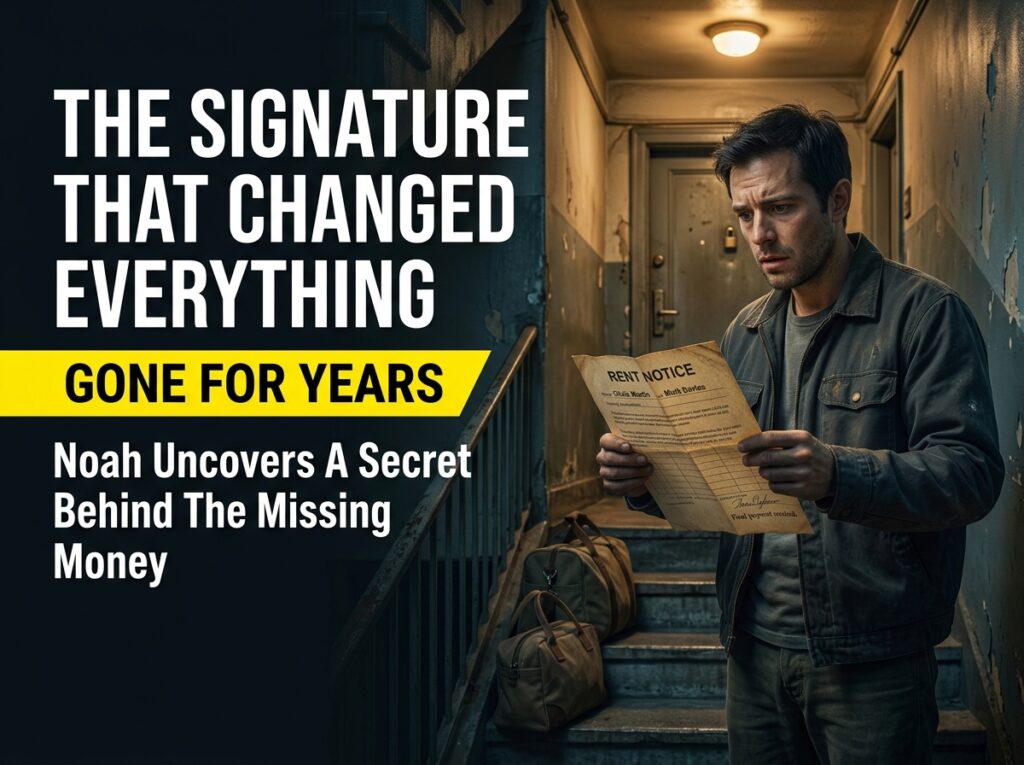
The stairwell smelled of damp concrete, old paint, and the faint trace of someone’s dinner drifting beneath a neighboring door.
Noah sat on the third step from the bottom, his jacket folded beneath him, staring at the locked apartment door.
He had been there for nearly forty minutes.
His phone battery was low. His stomach hurt from skipping dinner, and the two bags beside him contained almost everything he had managed to take when the relationship ended.
He kept telling himself that the situation was temporary.
One bad month would not define his future.
He had repeated those words to his family, to his coworkers, and to anyone who asked why he looked so exhausted. He had said them so often that he almost believed them.
But the apartment door in front of him reminded him of everything he had lost.
It was the place where he and Emily had once planned their future. They had argued about furniture, laughed over burnt dinners, and spent late evenings calculating whether they could afford a better place the following year.
They had not been rich.
They had been happy, or at least Noah had believed they were.
Then the bills began arriving faster than they could pay them.
Emily started worrying about money. Noah promised he would handle it. She asked questions, and he answered with vague reassurances because he did not understand everything himself.
Eventually, she stopped asking.
That silence had frightened him more than their arguments.
The last night they were together, Emily had stood beside the kitchen table holding a stack of overdue notices.
“How much do we owe?” she asked.
Noah had looked at the papers and then at her.
“I’m sorting it out.”
“You said that last week.”
“I know.”
“Then tell me what’s happening.”
He remembered the exhaustion in her face. He remembered wanting to explain but feeling unable to find words that would make the situation sound less terrible.
He had been ashamed of the missing money, the failed promises, and the decisions he had made without telling her.
So he had said the worst possible thing.
“Maybe we need some time apart.”
Emily had stared at him as if he had spoken in a language she no longer understood.
“Is that what you want?”
He had hesitated.
That hesitation had become the moment he replayed most often.
He could have told her the truth. He could have admitted that he was frightened, that he had made mistakes, and that he did not know how to repair the damage.
Instead, he had looked away.
Emily left the apartment that night.
Within days, Noah was the one standing outside a locked door.
He had tried calling her, but she had not answered. He had sent messages explaining that he wanted to talk, but the replies stopped.
He did not know whether she had changed the locks, whether the landlord had intervened, or whether someone else had become involved.
All he knew was that he no longer had a key.
A door opened upstairs.
Noah lifted his head.
An elderly man came down the stairs carrying a small bag of rubbish. He glanced at Noah and the two travel bags.
“Waiting for someone?” the man asked.
“Trying to sort something out.”
The man nodded as though he understood more than Noah had said.
“Sometimes these buildings keep people waiting longer than they should.”
Noah gave a tired smile.
The man continued downstairs.
Noah looked at the paper beside his shoe.
He had found it earlier among the belongings left behind after the separation. At first, he had assumed it was another bill, something he could throw away because he could no longer afford to worry about one more demand for money.
But the paper had a signature at the bottom.
And the moment he recognized the handwriting, everything changed.
He picked it up again.
The signature belonged to someone who had been gone for years.
Someone Noah had not expected to see mentioned in any document connected to his relationship with Emily.
He checked the name again.
There was no mistake.
For the first time that evening, he stopped thinking about the apartment, the overdue rent, and the money he could not recover.
He thought about the past.
And he wondered how a person who had been gone for so long could still be connected to the life he was trying desperately to rebuild.
Part 2
Noah carried the paper to a small café across the street.
It was nearly closing time, but the owner allowed him to sit near the window while he ordered a cup of tea.
He placed the document beneath the yellow light and examined it carefully.
The paper was creased along the middle. A faint coffee stain covered one corner, and the bottom edge had been torn unevenly.
The signature, however, remained clear.
He knew that handwriting.
He had seen it on birthday cards, old letters, and the back of photographs that had once been kept in a box at his mother’s house.
It belonged to his father.
His father had been gone for seven years.
Noah remembered the last conversation they had shared. They had argued about money, although the argument had been about more than money. His father believed Noah was making promises he could not keep. Noah thought his father had stopped believing in him.
Neither had apologized before the final hospital visit.
After the funeral, Noah had avoided the subject. He packed away the photographs and stopped asking questions about the old family documents.
Now his father’s signature appeared on a paper connected to the financial problems that had helped destroy his relationship.
He read the document from beginning to end.
Some of the details were difficult to understand. It appeared to refer to a payment, an outstanding balance, and an agreement involving another person.
The date was several years old.
Noah checked it twice.
The document had been created before he met Emily.
How could it possibly be connected to the money that had disappeared from their shared account?
He took out his phone and searched through old messages.
He found a conversation with Emily from the previous winter.
Did you manage to sort out the paperwork? she had asked.
He had replied:
Almost. I just need one more confirmation.
At the time, he had assumed she was referring to a routine household matter.
Now he wondered whether she had known something about the document.
He searched further.
Several weeks later, Emily had written:
I don’t think we should keep pretending this is simple.
Noah had replied:
It will be fine. I promise.
He remembered typing those words while sitting in a car outside work. He had been trying to reassure her, but he had not possessed enough information to make the promise honestly.
He placed the phone on the table.
The café owner began wiping the counter.
“Everything all right?” she asked.
Noah folded the paper.
“Not really.”
She gave him a sympathetic look but did not ask more.
He appreciated that.
For months, people had told him what he should do. They told him to move on, find another place, get another job, and stop thinking about Emily.
None of them understood that the problem was no longer only the relationship.
There was a missing piece of the past, and it had suddenly appeared in his hands.
He called his older sister, Rachel.
She answered with surprise.
“Noah? What’s wrong?”
“I need to ask you something about Dad.”
The silence on the other end lasted long enough to make him uneasy.
“What about him?”
“Did he ever sign an agreement connected to a loan or a payment arrangement?”
Rachel did not answer immediately.
“Why are you asking?”
“Because I found a document with his signature.”
“Where?”
“In the papers I took from the apartment.”
“Which apartment?”
“Mine. Emily’s. The one we shared.”
Rachel exhaled.
“Don’t do anything with that paper yet.”
Noah sat upright.
“What does that mean?”
“It means I need to see it.”
“Why?”
“Because there are things about Dad’s finances we never discussed after he died.”
Noah felt his throat tighten.
“Rachel, what things?”
“I can’t explain it over the phone.”
He almost laughed at the familiar answer.
Everyone seemed to know something he did not.
He sent her a photograph of the document.
A few minutes later, his phone rang.
Rachel sounded frightened.
“Where did you find this?”
“I told you. Among the things left behind.”
She lowered her voice.
“Noah, listen to me carefully. Do not contact anyone listed on that paper until I see the original.”
“Why?”
“Because if this is the document I think it is, Dad wasn’t the only person who signed it.”
Noah looked down at the page.
There was another signature beneath his father’s.
It was partly obscured by the fold.
He had not noticed it before.
He carefully opened the paper flat.
The second signature belonged to someone he knew.
Someone connected to the apartment.
Someone who had been part of the last argument he and Emily ever had.
Part 3
Noah did not sleep that night.
He returned to the shelter where he had arranged a temporary place to stay and laid the document on the small table beside his bed.
He could not stop looking at the second signature.
Emily’s name appeared beneath his father’s.
He had recognized it immediately, but recognition did not make sense of anything.
Why would Emily have signed a document with his father years before they met?
Had she known his family?
Had she been involved in something that had later affected their finances?
Or was there another explanation?
He called Rachel again the following morning.
“I need you to tell me what you know.”
“I told you I’d come.”
“That’s not enough.”
Rachel sounded exhausted.
“Noah, I am trying to understand this too.”
“You said there were things about Dad’s finances we never discussed. What things?”
She was silent.
Then she said, “Dad lent money to someone before he died. He never told us the whole story.”
“Who?”
“I don’t know for certain.”
“Did you know Emily?”
“Not before you introduced her to us.”
“Then why is her signature on the document?”
Rachel did not answer.
Noah ended the call and began searching through the boxes he had taken from the apartment.
Most contained ordinary belongings: clothes, books, kitchen utensils, and photographs. At the bottom of one box, he found a small envelope addressed to his father.
The envelope had never been opened.
Inside was a handwritten note.
I know you wanted to help. I will make sure the money is returned, but I need more time.
There was no full name, only an initial.
Noah read it again.
He had seen the same initial on the document.
The note was dated six years earlier, shortly before his father’s final illness.
He remembered that period clearly. His father had been worried about something, but whenever Noah asked, he insisted it was nothing.
“You don’t need to carry every problem in the world,” his father had told him.
Noah had taken the words as criticism.
Now he wondered whether his father had been trying to protect him from a problem he could not explain.
He photographed the note and sent it to Rachel.
Her response came almost immediately.
Where did you find that?
In Dad’s old envelope.
Bring it to me. Please.
Noah agreed to meet her at their mother’s house.
Rachel was waiting at the kitchen table when he arrived. She had laid out several old photographs and a notebook.
“I found these after Dad died,” she said.
Noah sat opposite her.
“Why didn’t you show me?”
“Because I didn’t understand them. And because Mum asked me not to reopen the subject.”
Their mother had died three years earlier, leaving behind a collection of family papers that neither sibling had fully sorted.
Rachel opened the notebook.
Several pages contained dates, amounts, and short notes about payments.
Noah recognized some of the figures from the document.
The numbers appeared to track money his father had lent and later expected to be repaid.
“Who was he helping?” Noah asked.
Rachel turned a page.
“There are several names, but one appears more often than the others.”
She pointed to a line near the bottom.
Noah leaned closer.
The name was Daniel.
Emily’s older brother.
Noah remembered meeting Daniel only a handful of times. He had seemed friendly enough, although Emily rarely spoke about her family.
“Why would Dad lend money to Daniel?”
Rachel shook her head.
“I don’t know. But I remember Dad saying he wanted to help someone start over.”
Noah stared at the notebook.
The connection was becoming harder to ignore.
His father had lent money to Daniel.
Emily had signed the document.
And Noah’s own financial problems had begun years later, around the time Emily started asking questions he could not answer.
“Did Emily know about the loan?” he asked.
Rachel looked uncertain.
“She must have known something.”
Noah felt anger rise, followed quickly by guilt.
He had no proof that Emily had intentionally hidden anything. The document established that she had signed it, but it did not explain why or under what circumstances.
He forced himself to slow down.
He would not make another decision based on an assumption.
Rachel closed the notebook.
“There’s someone we should talk to.”
“Who?”
“Daniel.”
Noah looked at her.
“You think he’ll tell us the truth?”
“I think he’s the only person who can explain why his name appears in Dad’s records.”
Rachel wrote down an address.
Noah recognized it as a place Daniel had once mentioned when discussing work.
Before Noah left, Rachel touched his arm.
“Whatever you discover, remember that Dad may have been trying to help someone. We don’t know the whole story yet.”
Noah nodded.
But as he stepped outside, he realized the question had changed.
He was no longer asking who had taken the money.
He was asking why his father had kept the arrangement secret—and why Emily’s signature had been part of it.
Part 4
Daniel lived in a small apartment above a repair shop on the other side of town.
Noah arrived just after midday and stood outside the entrance, wondering whether he should knock.
He had not spoken to Daniel in nearly a year.
The last conversation had taken place after Noah and Emily’s relationship began to unravel. Daniel had told him that family problems were complicated and that Noah should stop asking questions about things he did not understand.
Noah had walked away furious.
Now he stood outside Daniel’s door holding a document that connected all of them.
He knocked.
Footsteps approached.
Daniel opened the door and looked surprised.
“Noah?”
“I need to talk to you.”
Daniel glanced toward the stairwell.
“About what?”
Noah held up the document.
“About my father.”
The expression on Daniel’s face changed.
He stepped back and allowed Noah inside.
The apartment was crowded with tools, boxes, and half-repaired appliances. A kettle sat on the kitchen counter beside a stack of unpaid bills.
Daniel offered him a chair.
Noah remained standing.
“Did Dad lend you money?”
Daniel rubbed his face.
“How did you find out?”
“So he did.”
“Yes.”
“Why?”
Daniel took a long breath.
“I was in trouble.”
“What kind of trouble?”
“My business was failing. I had borrowed money to keep it running, and I was behind on payments. Your father offered to help.”
“How much?”
Daniel told him the amount.
Noah felt his stomach tighten. It was far more than he had expected.
“Did you repay him?”
“Some of it.”
“Some?”
“I made payments for years. Then the business closed, and everything became more difficult.”
Noah placed the document on the table.
“Why did Emily sign this?”
Daniel looked at the paper.
“Because she was helping me.”
Noah stared at him.
“She helped you repay Dad?”
“She helped me manage the paperwork. She was working in an office at the time and understood the documents better than I did.”
“Did she know the loan was from my father?”
“Yes.”
Noah sat down slowly.
The discovery did not answer everything, but it changed the meaning of the signature.
Emily had known about the loan long before she met Noah.
She had signed the document as part of an arrangement connected to her brother.
But why had the document later appeared among their shared belongings?
And how had the old debt become connected to their missing money?
Noah asked Daniel whether he had received payments from Emily during their relationship.
Daniel looked away.
“I don’t want to discuss her finances.”
“Her finances became my problem when money disappeared from our shared account.”
Daniel’s expression hardened.
“I never asked her to take money from you.”
“Then where did it go?”
“I don’t know.”
Noah almost stood up.
“You expect me to believe you don’t know?”
“I expect you to understand that there were years of payments, delays, and arguments. Your father wanted his money returned. I wanted to pay him. Emily wanted to help me. None of us knew how to make the situation right.”
Noah looked at the document again.
“Did Dad ever tell you not to discuss the loan with me?”
Daniel hesitated.
“Yes.”
“Why?”
“He didn’t want you to think he had been foolish.”
The answer hurt in an unexpected way.
Noah had spent years believing his father had hidden nothing important from him.
Now he realized that his father had been capable of keeping secrets, even when he believed he was doing it for the right reasons.
Daniel continued.
“Your father told me he didn’t want the debt to become a family war. He said he would rather lose the money than see his children fighting over it.”
“Then why didn’t he write that down?”
“He did.”
Noah looked up.
Daniel went to a cabinet and removed a thin folder.
Inside was a letter written in his father’s handwriting.
The letter explained that the original loan had been intended as temporary help. It also stated that any remaining balance should be discussed openly rather than passed between family members in secret.
Noah read the final paragraph twice.
His father had written that he did not want the debt to become a burden on the next generation.
Yet that was exactly what appeared to have happened.
“Why didn’t you show me this before?” Noah asked.
“Because I was ashamed. And because I thought Emily would explain it when the time was right.”
“She never did.”
Daniel lowered his head.
“I know.”
Noah placed the letter back in the folder.
He had come looking for someone to blame.
Instead, he had found a story in which several people had made promises, hidden information, and hoped that time would solve what honesty might have resolved sooner.
But one question remained.
If the original loan had existed before his relationship, why had Noah and Emily lost money during the months before their separation?
Daniel looked at him.
“There’s another record you need to find.”
“What record?”
“The account where the repayments were supposed to go.”
Part 5
Noah left Daniel’s apartment with the letter tucked carefully inside his jacket.
For the first time, he understood why his father had kept the loan quiet.
It had begun as an act of kindness. Daniel had been struggling, and his father had wanted to help without humiliating him.
But the arrangement had become complicated.
Payments had been delayed. Documents had been signed. People had made promises they could not keep.
And because everyone wanted to protect someone else, the truth had never been explained clearly.
Noah still did not know how the old debt connected to the missing money.
He returned to Rachel’s house and showed her the letter.
She read it silently.
“Dad really didn’t want this to become our problem,” she said.
“But it did.”
Rachel nodded.
They reviewed the notebook again, comparing the dates with the document Noah had found.
Several payments had been recorded after their father’s death.
The amounts were inconsistent.
Some were small, regular transfers. Others appeared only once.
Noah noticed that the dates of two larger payments matched periods when he and Emily had experienced financial difficulties.
He opened his banking records.
One transfer from their shared account had been made on a date that appeared in the notebook.
The recipient’s name was unfamiliar.
He copied the transaction reference and contacted the bank.
The representative explained that the account had been closed, but the bank could provide historical records after completing its identity verification process.
Noah submitted the required request.
While he waited, he searched through the messages between himself and Emily.
He found one from a night when they had argued about their savings.
I thought we agreed to leave that money alone, he had written.
Emily replied:
I know. I thought I could fix it before you noticed.
At the time, Noah had assumed she was talking about an ordinary expense.
Now the message troubled him.
He searched for the phrase “fix it” and found another conversation.
Daniel said he would repay everything, Emily had written.
Noah’s hands went cold.
He had never seen that message before because it was buried in an old conversation he had not opened since the breakup.
He read the entire exchange.
Emily had been discussing a payment with someone, but the recipient’s name was missing from the saved contact.
The conversation did not establish exactly what money had been transferred or whether it had been used for the original loan.
Still, it proved that Emily had been worried about repayment.
Noah called her.
For a long time, the phone rang without an answer.
Then she picked up.
“Noah?”
“I found the document with your signature.”
Silence.
“I spoke to Daniel,” he continued.
“Then you know about the loan.”
“I know some of it. I don’t know why money disappeared from our account.”
Emily exhaled.
“I was going to tell you.”
“When?”
“When I knew how to fix it.”
“You said that before.”
“I know.”
Noah closed his eyes.
“Did you use our money to pay Daniel’s debt?”
Emily was quiet for so long that he thought the call had dropped.
Finally, she said, “I transferred some money because I believed he was going to repay it. I thought I could restore the balance before you found out.”
Noah felt a wave of anger and sadness.
“How much?”
“I don’t remember the exact total.”
“You don’t remember?”
“I was trying to keep everything together. Daniel was desperate, and I thought the payments would stop the situation from getting worse.”
“Why didn’t you tell me?”
“Because I knew you’d ask me to stop.”
“Yes,” Noah said. “I would have asked you to stop using money that belonged to both of us without my agreement.”
Emily began to cry.
“I was afraid you’d think I cared more about my family than our future.”
Noah looked down at the floor.
He wanted to comfort her.
He also wanted to tell her that fear was not an excuse for making decisions that affected another person.
“Did you know the money was connected to my father?”
“Yes.”
“Then you knew what it meant to me.”
“I know.”
The call ended without a resolution.
Noah sat quietly for several minutes.
He finally understood that Emily had not simply been hiding a mystery from him.
She had been trying to solve a problem she believed she could control.
But the secrecy had taken away his ability to make an informed choice.
He received a message from the bank later that afternoon.
The historical transfer records were ready.
Noah opened the attachment.
The recipient account was linked to a name he recognized from his father’s notebook.
But the account holder was not Daniel.
It belonged to someone who had been helping with the repayments for years.
Someone Noah had never suspected.
Part 6
The account holder’s name was Margaret.
Noah recognized it immediately.
Margaret had been his father’s longtime friend. She had attended family gatherings and occasionally helped his mother with errands. After his father’s death, she had gradually disappeared from their lives.
Noah had assumed she had moved away.
He had not heard from her in nearly five years.
According to the bank records, the transfer from Noah and Emily’s shared account had gone to an account in Margaret’s name.
The transaction did not explain why.
It did not prove whether she had kept the money, forwarded it to someone else, or used it to settle part of the old debt.
But it established that the money had not gone directly to Daniel.
Noah called Rachel.
“Do you remember Margaret?”
“Of course.”
“Did you know she was involved in Dad’s loan?”
Rachel sounded startled.
“No. Why?”
He explained what the bank records showed.
Rachel asked him to send the documents.
After reading them, she said, “I remember Dad mentioning that Margaret helped him keep track of some payments. He trusted her with his paperwork.”
“Why didn’t he tell us?”
“Maybe he thought it was temporary.”
Noah felt the familiar frustration return.
Everything had been temporary until it wasn’t.
He searched his phone contacts and found an old number for Margaret. It was disconnected.
He then looked through his mother’s address book, which Rachel had kept in a drawer.
There was an address beside Margaret’s name.
It was in a neighboring town.
Noah and Rachel drove there the next morning.
The house was small, with a narrow front garden and a mailbox that leaned slightly to one side. A light was on behind the curtains.
Rachel knocked.
After a moment, an elderly woman opened the door.
She looked from Rachel to Noah and immediately recognized them.
“I wondered when one of you would come,” she said.
Noah felt his chest tighten.
“You knew we’d find the records?”
Margaret stepped aside.
“Not exactly. But I knew the money would eventually lead you here.”
They sat in her living room.
Margaret listened as Noah explained the transfer, the document, and the missing payments.
She did not deny that the account belonged to her.
“Your father asked me to help manage the repayments,” she said. “Daniel was struggling, and your father didn’t want the arrangement to become public.”
“Did you receive money from Emily?”
“Yes.”
“Why?”
“She believed she was helping settle the debt. She contacted me after Daniel told her he could no longer keep up with the payments.”
Noah stared at her.
“Did you tell her to use our shared savings?”
“No. I told her not to make any payment without discussing it with you.”
“Then why did she transfer the money?”
Margaret looked troubled.
“She said she had already made the decision. She believed Daniel would repay her before you noticed.”
Noah rubbed his forehead.
It was the same explanation Emily had given him.
Everyone had believed they could repair the damage before anyone else found out.
Margaret continued.
“I kept records of every payment I received. I used the money to cover the installments your father had agreed to help with. I didn’t keep it for myself.”
“Can you prove that?”
“Yes.”
She stood and returned with a folder.
Inside were receipts, bank statements, and a handwritten ledger.
Noah and Rachel reviewed the records.
The amounts matched several entries in their father’s notebook. Some payments had gone toward the old debt. Others had been returned to the people who had contributed to the arrangement.
But one period remained unexplained.
There was a gap between two payments, during which a substantial amount had been transferred from the shared account.
Margaret examined the transaction details.
“This one is different,” she said.
“How?”
“It was not part of the repayment schedule your father and I agreed on.”
“Who asked you to receive it?”
Margaret looked at the date.
Then she closed her eyes.
“I need to check one more record before I answer that.”
Noah felt his patience thinning.
“What record?”
“The letter that accompanied the transfer.”
“Where is it?”
Margaret looked toward a locked cabinet.
“In a box I haven’t opened since your father died.”
She retrieved a key from a drawer.
As she opened the cabinet, Noah realized that the truth might finally be close enough to touch.
But he also understood that every new document could change the story once again.
Part 7
Margaret placed a small cardboard box on the table.
It contained old letters, receipts, and several envelopes bearing Noah’s father’s handwriting.
She searched carefully, separating the papers into small piles.
At last, she found a letter dated several months before the transfer from Noah and Emily’s shared account.
The letter was addressed to Margaret.
Noah read it slowly.
His father had written that the original loan was nearly settled, but that Daniel had asked for additional time to repay the remaining amount.
He had also written that he did not want anyone else to become responsible for the debt.
The final paragraph was underlined.
If another payment arrives from someone who was not part of the original agreement, please return it unless the sender confirms the reason in writing.
Noah looked up.
“Did you return the money from Emily?”
Margaret shook her head.
“I didn’t know it had come from her. The transfer was made through an account I did not recognize, and the reference was unclear.”
“Then what did you do with it?”
“I held it until I could determine where it belonged.”
She opened another ledger and pointed to an entry showing that the money had remained in the account for several weeks before being used to cover a payment connected to the old arrangement.
Noah felt a complicated mixture of relief and anger.
The money had not simply vanished into someone’s pocket.
But Emily had still transferred it without his agreement, and the delay had contributed to their financial trouble.
“Why didn’t you contact the sender?” he asked.
“I tried. I sent a message through the contact information Daniel had provided. I received no reply.”
“Who did you contact?”
Margaret handed him a copy of the message.
The number was unfamiliar, but the date matched a conversation Noah had once seen on Emily’s phone.
He recognized the final four digits.
It was the number Daniel had used when he called Emily during the months before their breakup.
Noah leaned back.
“Daniel knew about this transfer.”
Margaret nodded.
“He told me it was part of the repayment arrangement.”
“But it wasn’t.”
“No. Not originally.”
Noah asked whether Margaret had ever told Daniel that the money should be returned.
“Yes. He said he would speak to Emily.”
“Did he?”
“I don’t know.”
Noah thought about the night he and Emily separated.
She had been standing beside the kitchen table with the overdue notices. He had asked how much they owed, and she had refused to give him a clear answer.
He had interpreted her silence as proof that she no longer wanted to work through their problems together.
Now he could see that she had been carrying a secret of her own.
That did not excuse her choices.
But it explained why she had seemed frightened whenever he asked about the savings.
Rachel turned to Margaret.
“Why did you keep all these records?”
“Because your father believed that kindness should never require dishonesty. He wanted to help Daniel, but he also wanted everyone to know what had been agreed.”
Noah looked at the old letters.
His father had tried to establish boundaries.
The people involved had ignored or misunderstood them.
And the silence had continued long after he was gone.
Margaret handed Noah another envelope.
“This one is different,” she said. “Your father asked me to keep it for you.”
Noah examined the handwriting.
His name was written across the front.
He had never seen the envelope before.
“Why didn’t you send it to me?”
“Your father asked me to wait until the loan was settled. I believed the arrangement had been completed, but after the last transfer, I wasn’t certain.”
Noah carefully opened the envelope.
Inside was a single page.
The letter began with an apology for the argument they had shared shortly before his father’s final illness.
Noah stopped reading.
His eyes filled with tears.
For years, he had carried the memory of their last conversation like a stone in his chest. He had believed his father died thinking he was irresponsible and unwilling to listen.
The letter told a more complicated story.
His father had been worried about the loan, but he had also been worried about Noah’s pride. He wrote that he hoped Noah would learn to ask for help without feeling ashamed and to offer help without hiding the truth.
Near the bottom, his father had written:
Never let someone else’s silence become the reason you stop asking honest questions.
Noah folded the letter carefully.
For the first time since finding the signature, he understood why it mattered so much.
It was not simply evidence of an old debt.
It was a reminder of a conversation he had never been able to finish.
But the letter did not explain the final missing amount.
Margaret looked at him.
“There is one person who may know what happened to it.”
Noah already knew the answer.
Emily.
And this time, he would ask her directly.
Part 8
Noah arranged to meet Emily in a quiet public garden.
He did not want to argue. He wanted to hear her explanation without interruptions, excuses, or assumptions.
When she arrived, she looked tired.
For a moment, neither spoke.
Then Emily sat beside him.
“I heard you found Margaret,” she said.
“Yes.”
“And the letter?”
“I found that too.”
Emily looked down at her hands.
“I wanted to tell you about your father. I didn’t know how.”
“You could have started by telling me about the money.”
She nodded.
“I know.”
Noah explained what he had learned from Margaret and showed Emily the transaction records.
She read them carefully.
“I thought the money was going toward Daniel’s debt,” she said. “He told me Margaret was helping him settle the account.”
“Did you know Margaret had been asked to return payments that came from people outside the original agreement?”
“No.”
“Did you ask her?”
Emily shook her head.
“I trusted Daniel. He said he had arranged everything.”
Noah felt anger rise, but he kept his voice steady.
“You trusted him enough to use our shared savings without telling me.”
Emily closed her eyes.
“Yes.”
“Why?”
“Because I was afraid he would lose everything. He was my brother, and he had helped me when I was younger. I thought if I could give him time, he could fix the problem.”
“And what about us?”
She looked at him.
“I thought I could fix that too.”
Noah waited.
Emily explained that Daniel had promised to repay the money within weeks. She believed she could restore the shared account before Noah noticed the difference.
But the repayment never came.
She made another transfer, hoping to cover the shortfall. Then another bill arrived, and the rent became overdue.
She began hiding the statements because she was ashamed.
When Noah asked questions, she answered vaguely.
When he became suspicious, she told herself she would explain once the situation improved.
Instead, the silence grew.
“I should have told you,” she said.
“Yes.”
“I thought you would see me differently.”
“I do see things differently now.”
Emily’s eyes filled with tears.
“I never wanted to hurt you.”
Noah believed her.
But he had learned that good intentions could still leave damage behind.
He told her about his father’s letter.
She listened without interrupting.
When he finished, she said, “Your father was kinder to me than I deserved.”
“Why?”
“Because he knew I was trying to help Daniel. He never blamed me for the original debt.”
“Did he ever tell you not to become involved?”
“Yes. He told me that helping someone didn’t mean I had to carry their problems alone.”
Noah thought about the letter.
His father had offered the same lesson in different words.
Emily wiped her eyes.
“I should have listened.”
They sat in silence for several minutes.
Then Noah asked the question that had been troubling him most.
“Why did you leave without explaining any of this?”
Emily looked toward the path.
“Because I knew I’d broken your trust. Every time I tried to explain, I imagined you asking why I had made those choices. I didn’t have an answer that made me look better.”
“So you let me believe you didn’t care.”
“I thought you would hate me less if you believed I had simply given up.”
Noah shook his head.
“That made everything worse.”
“I know.”
For the first time, he felt that she understood the cost of her silence.
He did not ask her to return.
She did not ask him to forgive her.
Instead, they agreed to exchange the remaining financial records and cooperate with the process of clarifying the outstanding balance.
It was a small, practical agreement.
It was also the first honest agreement they had made in months.
As Emily stood to leave, she handed Noah a folded sheet of paper.
“I found this among Daniel’s old documents. I think it belongs to you.”
Noah opened it.
The signature at the bottom was his father’s.
But the date was from the year before he died.
And beside the signature was a name Noah had never seen before.
Part 9
Noah took the new document to Rachel.
She read it twice, then searched through the family notebook.
The unfamiliar name appeared in several entries.
It belonged to a former business associate of Daniel’s who had helped arrange the original loan. The records suggested that this person had agreed to contribute toward repayment but had never completed the promised amount.
The document did not establish exactly what had happened to the money.
It did, however, provide a new lead.
Rachel contacted a solicitor to help them understand the paperwork and determine which records could be requested lawfully.
Noah supplied copies of the bank statements, the old agreement, and the correspondence from Margaret.
For the first time, the family was dealing with the problem through documented facts rather than private promises.
The process took several weeks.
Some records confirmed payments that had already been made. Others showed that certain amounts had been disputed for years.
The outstanding balance was not what Noah had first feared, but it was still significant enough to require careful planning.
The most painful discovery was not the total.
It was the realization that much of the conflict could have been avoided if the people involved had explained the arrangement honestly at the beginning.
Noah also learned that the missing money had not all been used for one purpose. Some had gone toward the old debt, some had covered urgent expenses, and some transactions could not be fully reconciled without additional evidence.
He stopped trying to force every detail into a single explanation.
Instead, he made a list of what was known, what remained uncertain, and what needed to happen next.
He worked with the property manager to clarify the apartment’s outstanding bills. He separated his own finances from the old repayment arrangement and kept copies of every communication.
He did not sign anything he did not understand.
He did not accept a verbal promise as proof of a payment.
And he no longer believed that asking questions was a betrayal of someone he loved.
One afternoon, Rachel called with news.
“The solicitor found a record of the final payment,” she said.
Noah sat down.
“Who made it?”
There was a pause.
“It was made by Dad.”
Noah frowned.
“That doesn’t make sense. He was already gone when the account was supposed to be settled.”
“That’s what I thought. But the payment was arranged before he died and processed afterward.”
The record showed that his father had set aside money to cover part of the remaining obligation. The payment had been delayed because the account details were incorrect, then held for review.
It had eventually been applied to the debt.
Noah read the record himself.
The final amount did not resolve every disputed transaction, but it explained why his father’s signature appeared on documents dated after his death.
The signature had been placed on an earlier instruction, not added to a new agreement.
For years, Noah had feared that someone had used his father’s name without permission.
The records now suggested a more ordinary explanation.
His father had tried to settle the debt before he died, but the paperwork had not been completed properly.
The discovery brought relief, but not the kind that erased everything.
Noah still had to rebuild his finances.
He still had to accept that Emily had made choices without him.
And he still had to grieve the years of silence that had separated him from his family.
That evening, he returned to the stairwell outside the apartment.
He stood in front of the locked door one last time.
He did not knock.
He did not wait for Emily to appear.
He simply looked at the place where so many unanswered questions had begun.
Then he turned away.
For the first time, he was not leaving because someone had pushed him out.
He was leaving because he had finally decided where his life would go next.
Part 10
The first morning Noah woke in his new room, he did not reach for his phone to check whether Emily had sent a message.
He opened the curtains instead.
The room was small, with plain walls and a narrow desk, but it was his. No overdue notices lay on the table. No locked apartment door stood between him and the day.
He made coffee, sat down, and opened his notebook.
At the top of the first page, he wrote three things.
What I know.
What I still need to resolve.
What I will not hide from myself again.
The list was not a grand plan for the future. It was a beginning.
Over the next few months, Noah continued working through the financial records with the help of Rachel and the solicitor. The remaining obligations were clarified, and he arranged payments he could realistically afford.
He kept his finances separate from the old family debt.
He also began talking more honestly with the people he trusted.
When his coworkers asked how he was doing, he stopped pretending that everything was fine.
Sometimes he said he was tired.
Sometimes he admitted he was worried.
And sometimes he simply said that he was figuring things out.
The world did not end when he stopped pretending to be invulnerable.
Instead, people began offering the kind of help he had spent years refusing.
Rachel helped him organize the documents. A friend offered him a secondhand desk. His landlord gave him time to settle into the room before asking for the next payment.
Noah learned that accepting help did not mean surrendering control of his life.
It meant allowing other people to stand beside him without asking them to carry every burden.
He kept his father’s letter in the top drawer of his desk.
He read it on difficult evenings, especially when he was tempted to blame himself for everything that had happened.
The letter did not tell him that his father had been perfect.
It reminded him that people could make mistakes while trying to do good, and that kindness without honesty could become another form of confusion.
Noah began to understand his father more clearly.
He had once thought the older man was stubborn and secretive.
Now he recognized the fear behind some of those decisions. His father had wanted to protect the family from embarrassment and conflict, but he had not always understood that silence could create a larger problem.
Noah had repeated the same mistake in his own relationship.
He had promised Emily that he could handle the money, even when he did not know how.
Emily had promised herself she could repair the debt before he noticed.
Daniel had believed he could settle the original loan without involving anyone else.
Each person had tried to postpone a difficult conversation.
The result had been years of confusion.
Noah could not change those decisions.
He could only refuse to repeat them.
He did not reconcile with Emily, although they eventually exchanged a few messages about the remaining paperwork. Their conversations became calmer once they stopped trying to turn every explanation into a judgment about their relationship.
He still remembered the good parts of their life together.
He remembered the dinners they had cooked, the plans they had made, and the evenings when they had laughed until midnight.
Those memories were real.
So was the hurt.
He no longer believed that one erased the other.
One afternoon, Rachel visited him with a small box of photographs from their mother’s house.
Noah looked through them slowly.
There was his father standing beside an old car. His mother was laughing in the background. Rachel was holding a birthday cake with too many candles, and Noah was making a face because he had been told to smile.
He laughed when he saw it.
Then he found a photograph of his father sitting at the kitchen table, writing in the notebook that had started the mystery.
For a moment, Noah wondered what his father had been thinking.
Perhaps he had been worried about the loan.
Perhaps he had been trying to make the numbers balance.
Perhaps he had simply been recording a payment so he would not forget it.
Noah realized he would never know every detail.
And for the first time, that did not feel like a failure.
He placed the photograph beside the letter and closed the box.
The past still mattered, but it no longer had to answer every question before he could move forward.
That evening, he walked through the city as the shops began closing.
He passed the café where he had first examined the document. He passed the bus stop where he had waited for Rachel. Eventually, he reached the street where the old apartment stood.
The stairwell window glowed softly in the evening light.
Noah stopped for a moment.
He remembered the cold steps, the two bags, and the paper he had nearly thrown away.
He remembered believing that the worst thing he had lost was money.
Now he understood that the money had been only one part of the story.
He had lost trust.
He had lost time.
He had lost the belief that the people closest to him would always tell him the truth.
But he had also gained something.
He had learned to ask questions without apologizing for them. He had learned that love did not require him to ignore a warning sign. And he had learned that a person could face an uncomfortable truth without allowing it to define the rest of their life.
Noah continued walking.
He had bills to pay and a future to build. He had memories that would always hurt a little and questions that might never be answered completely.
But he no longer needed to stand outside a locked door waiting for someone else to explain his own life.
He could choose what happened next.
And that was enough to begin again.