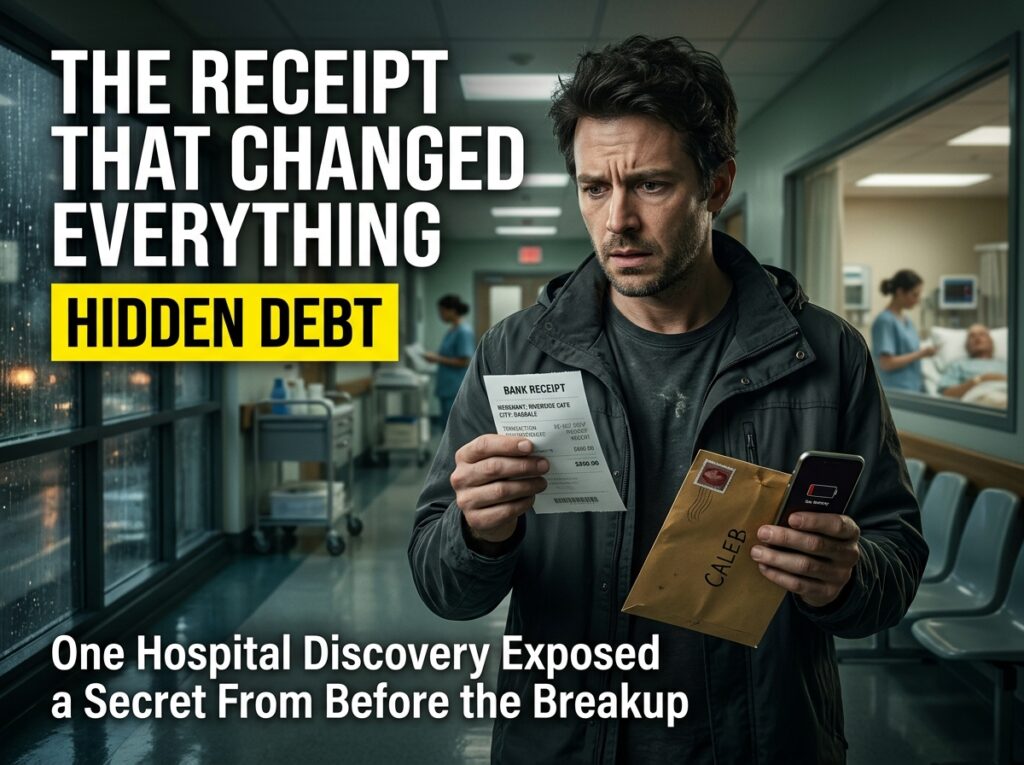
Caleb thought losing his relationship and struggling to pay rent were the worst things that could happen to him. Then a bank receipt from another city appeared in a hospital corridor. One signature, a nearly dead phone, and a second envelope would force him to question everything he believed about the person who left him.
The Hospital Corridor
The phone had one percent battery left when Caleb discovered the receipt.
He was standing in a hospital corridor that smelled of disinfectant and rain-soaked clothing. Outside the tall windows, rain slid down the glass in thin, trembling lines. People moved past him with the distracted urgency of those who had somewhere important to be, while he remained frozen beside a row of plastic chairs.
He had come to the hospital because someone had called him about the woman who had once promised to build a life with him.
He had not expected to find anything connected to money.
He certainly had not expected to find a bank receipt from another city among the belongings she had left behind.
For several seconds, he considered putting it back.
He had spent the last few months trying to convince himself that the past was finished. Their relationship had ended. Their plans had collapsed. The furniture they had bought together was gone, sold piece by piece to cover expenses neither of them had anticipated. He had moved into a smaller room and learned to ignore the embarrassment of telling people he was starting over.
He wanted a life that no longer required him to explain what had happened.
But the receipt carried a date he recognized.
March 14.
He stared at the number until the hospital lights seemed to blur.
March 14 was the day his bank card had been declined at a grocery store. It was the day he had stood at the checkout, apologizing to a tired cashier while the person behind him sighed impatiently. It was the day he had checked his balance and discovered that money he believed was still available had disappeared.
He remembered calling the woman he loved.
He remembered asking whether she had moved anything from their shared savings.
She had said no.
He had believed her.
Now he unfolded the receipt carefully.
The transaction had taken place in a city where neither of them lived. The amount was large enough to matter, and the account reference looked unfamiliar. At the bottom, someone had written a short note in blue ink.
Caleb turned the paper over.
There was a signature.
He recognized the handwriting immediately.
It belonged to the woman who had called him a failure when their relationship ended.
For a moment, anger came easily. It offered him something simple to hold on to. If she had moved the money, then he had finally found an explanation for the months of confusion, the unpaid bills, and the promises that had disappeared.
But the receipt did not prove that she had stolen anything.
It proved only that a transaction had happened.
And that distinction mattered more than he wanted it to.
He placed the receipt on his knee and looked at the old phone beside him. Its screen flickered, then dimmed. He pressed the power button, hoping to find a message that might explain why the receipt had been left among her belongings.
The battery warning appeared again.
One percent.
He had been telling everyone he was managing. He had repeated the sentence so often that it had become a kind of shield.
He was managing the rent.
He was managing the food.
He was managing the loneliness that arrived when he came home to a room where nobody asked how his day had gone.
But the truth was that he was frightened.
He had been frightened for months, ever since the person closest to him made a decision that affected every bill, every promise, and every memory they had shared.
He had thought the worst thing they had lost was money.
Now he was beginning to suspect that they had lost the truth long before the relationship ended.
A nurse stopped beside him.
“Are you waiting for someone?”
Caleb looked up.
“Yes,” he said. “I think I am.”
She glanced at the papers in his hands.
“Do you need help finding a department?”
“No. Thank you.”
She moved on.
Caleb returned to the receipt.
The signature was unmistakable, but something else bothered him. Beneath the transaction details was a reference number that looked familiar. He had seen it before, though he couldn’t remember where.
He searched the old phone for photographs and documents. Most of the files were damaged or too old to be useful. Then he found a photograph of a folded sheet of paper on a kitchen table.
He enlarged the image.
The same reference number appeared near the bottom.
He remembered the table. He remembered the evening. He remembered the argument that had followed.
But he could not remember what the paper had contained.
The phone vibrated once.
A message appeared from an unfamiliar number.
“Did you find the receipt?”
Caleb stared at the screen.
Before he could reply, the phone went black.
He pressed the power button again.
Nothing happened.
The corridor seemed suddenly colder.
Someone knew he had found the receipt.
And whoever had sent that message was waiting to learn what he would do next.
The Month Everything Changed
Caleb had never considered himself a man who needed much.
A small apartment, steady work, food in the refrigerator, and someone to come home to had once seemed like enough. He did not dream of expensive holidays or a house with more rooms than he could afford to furnish. He wanted security, and he believed security was something two people could build together.
For a while, he thought he and his partner were doing exactly that.
They had started with almost nothing. When they first met, she was working irregular hours, and Caleb was repairing equipment in a workshop that paid him just enough to cover his expenses. They learned to cook inexpensive meals, shared bus fares, and laughed about the small inconveniences that seemed enormous at the time.
They promised each other that the difficult years would eventually become a story they could tell with pride.
Then the financial problems began.
At first, they were ordinary. An unexpected repair. A bill that arrived earlier than expected. A week when work was slow.
Caleb never panicked about those things. He believed that as long as they told each other the truth, they could make decisions together.
His partner seemed to agree.
“We’ll get through it,” she would say, squeezing his hand across the kitchen table.
He believed her because he wanted to.
The first time he noticed the missing money, he assumed he had made a mistake. He checked his balance, reviewed his recent purchases, and blamed the confusion on a payment he had forgotten.
When the same thing happened again, he asked her whether she had noticed anything unusual.
She was washing dishes when he brought it up.
“What do you mean?” she asked.
“The account doesn’t look right.”
She kept her back toward him.
“Maybe a bill came out.”
“I checked. There isn’t anything I don’t recognize.”
She turned off the tap.
“Caleb, we’re both tired. We can look at it tomorrow.”
He wanted to insist, but her expression stopped him.
He knew what it felt like to be exhausted by problems that never seemed to end. He did not want another conversation to become an argument.
So he put the statement away.
That was the first time he chose peace over an answer.
The second time, he chose trust.
The third time, he stopped asking.
By then, the relationship was already changing. She spent longer hours away from home and guarded her phone more carefully. When he asked whether something was wrong, she said she was dealing with a personal matter.
He offered to help.
She refused.
“I can handle it,” she said.
He wanted to believe that she could.
Then came the day his card was declined.
Caleb remembered standing in the grocery store with a basket containing bread, eggs, rice, and a few vegetables. The cashier tried the payment again. The machine gave the same answer.
He checked his balance.
The money was gone.
He called his partner from outside the store.
“Did you transfer anything?”
“No.”
“Are you sure?”
“Why are you asking me that?”
“Because there’s money missing.”
“I didn’t touch it.”
He apologized for sounding suspicious.
She told him they would talk when he got home.
But when he returned to the apartment, she was already angry.
“You think I took your money?”
“I didn’t say that.”
“You called me as if I were a thief.”
“I was asking a question.”
“Maybe you should learn to manage your finances before blaming everyone else.”
The words hurt because he was already blaming himself.
He had spent years believing that a good partner should make life easier. Now he wondered whether his inability to solve their problems had made him a burden.
A few weeks later, she left.
There was no dramatic scene, no broken glass, no shouting loud enough for the neighbors to hear. She packed a bag, told him she needed space, and said she could no longer keep pretending that their relationship was working.
He asked whether there was someone else.
She said no.
He asked whether she still loved him.
She looked away.
“I don’t know what I feel anymore.”
He begged her to explain what had changed.
She said she was tired of being afraid of the future.
He wanted to tell her that he was afraid too, but that he had never considered leaving her because of it.
Instead, he watched her walk out.
Afterward, people offered advice.
His friends told him to move on. A coworker said that sometimes relationships ended because two people wanted different things. His family encouraged him to stop searching for explanations and concentrate on rebuilding his life.
They meant well.
Caleb tried to listen.
But every time he opened a bank statement, he remembered the missing money. Every time he saw a receipt, he wondered whether it belonged to something he had never been told about.
He began to understand that a relationship could end in one afternoon while its unanswered questions remained for years.
Now, sitting in the hospital corridor, he looked at the receipt again.
The transaction date was not random.
It had happened before the breakup, before the arguments, before the day she told him she could no longer live with uncertainty.
Someone had made a financial decision while Caleb still believed they were planning a future together.
His phone remained dead.
He placed the receipt in his wallet and stood.
He needed to charge the phone, recover the messages, and discover who had sent the warning.
As he walked toward the hospital reception area, a woman in a gray coat stepped into his path.
“Caleb?”
He stopped.
“Yes?”
She glanced at the wallet in his hand.
“Someone asked me to give you something if you came looking for the receipt.”
She held out a second envelope.
His name was written across the front.
The Envelope With His Name
Caleb did not take the envelope immediately.
He looked at the woman, trying to decide whether he had seen her before. She appeared to be in her forties, with tired eyes and a careful expression. She did not look threatening, but there was something in the way she held the envelope that made him uneasy.
“Who asked you to give me that?”
“I’m not sure I should tell you here.”
“Then tell me somewhere else.”
She glanced toward the reception desk.
“I can’t stay long.”
Caleb reached for the envelope.
The paper was thick, and the flap had been sealed with a strip of clear tape. His name was written in dark blue ink, in handwriting he recognized from the old phone photograph.
“Where did you get this?”
“It was left with a person who knew you might come.”
“Who?”
She shook her head.
“I’m sorry. I was told not to explain anything unless you had the receipt.”
Caleb felt his pulse quicken.
“So someone knew I would find it.”
“Someone hoped you would.”
He turned the envelope over. There was no return address, no date, and no explanation.
“Why didn’t they contact me directly?”
The woman hesitated.
“Perhaps they tried.”
He thought of the unfamiliar message that had appeared before his phone died.
“Did you send me a message?”
“No.”
“Do you know who did?”
“No.”
Her answers were careful, but they were not evasive in the usual way. She seemed genuinely afraid of saying too much.
Caleb looked at the envelope again.
“Can you tell me one thing? Is the person who left this safe?”
The woman’s expression softened.
“I believe so.”
It was not the certainty he wanted.
He asked whether she knew anything about the bank transaction. She shook her head and said the envelope was all she had been asked to deliver.
Before he could ask another question, she stepped away.
“Please read it somewhere private,” she said. “And don’t throw anything away.”
Then she walked toward the elevators.
Caleb watched until the doors closed behind her.
He returned to the corridor and sat beside the window. Rain continued to fall outside, blurring the lights of passing cars. He placed the envelope on his knee and carefully peeled back the tape.
Inside were three sheets of paper.
The first contained a list of dates and amounts. Several matched the transfers he remembered from his old bank statements. Others were unfamiliar.
The second sheet was a photocopy of a financial document, but parts of it had been blacked out.
The third was a handwritten note.
Caleb read it slowly.
“If you have found the receipt, then the money did not disappear in the way you were told. Someone moved it to settle an obligation that existed before you knew about it. I wanted to explain, but every time I tried, the situation became more complicated. Do not accuse anyone until you know who made the final payment.”
There was no signature.
Caleb read the note again.
The phrase “before you knew about it” made his stomach tighten.
An obligation that existed before he knew about it.
Was the money connected to a debt? Had his partner borrowed money without telling him? Had someone else used their savings to cover a financial mistake?
He studied the list.
The earliest date was nearly a year before their relationship ended. The amounts were small at first, then increased. Beside some entries were initials he couldn’t identify.
Near the bottom, a single amount had been circled.
$8,400.
The date beside it matched the bank receipt.
Caleb took out his dead phone, then remembered it would not turn on. He needed a charger before he could compare the information with the old messages.
He walked to the hospital café and asked whether he could use a charging outlet. A staff member pointed him toward a table near the wall.
While the phone charged, he read the documents again.
The photocopied bank record contained a partial account number. It did not match the account he had shared with his partner, but the last four digits looked familiar.
He tried to remember where he had seen them.
A small memory surfaced.
Months earlier, his partner had asked him to sign a document because she said it was necessary to update their household records. He had been tired after work. He had glanced at the first page, asked whether it was important, and signed where she pointed.
He had not asked for a copy.
He had not read the remaining pages.
At the time, he had considered it an ordinary act of trust.
Now he wondered whether his signature had been used to authorize something he never understood.
His phone finally powered on.
He opened the old messages and searched for the date written beside the circled amount.
A conversation appeared.
His partner: I need you to sign something tomorrow.
Caleb: What is it?
His partner: Just paperwork. Nothing to worry about.
Caleb: Can I read it first?
There was no answer.
The next message was from the following morning.
His partner: Thank you. I’ll take care of the rest.
Caleb stared at the screen.
He searched the thread for a photograph or attachment. There was one image, but it had been deleted from the conversation.
He checked the backup.
Nothing.
Then another message appeared, one he had never noticed before.
It was sent from an unfamiliar number and addressed to his partner.
“You said he wouldn’t find out.”
Her reply was short.
“Not if we finish this before March.”
Caleb felt the room tilt around him.
The receipt was dated March 14.
The breakup had happened shortly afterward.
Whatever they had been trying to finish before March had not ended when the relationship did.
It had followed him into the hospital corridor.
And someone had just handed him proof that the secret was larger than the missing money.
The Signature He Could Not Explain
Caleb took the documents home and spread them across the small table beside his bed.
His room was barely large enough for a single bed, a narrow wardrobe, and a desk that wobbled whenever he leaned on it. He had chosen it because the rent was cheaper than anything else he could find. The landlord had agreed to let him pay in two installments, but the next payment was due in four days.
He had told himself that once he understood what had happened, he could finally stop revisiting the past.
Instead, the past seemed to be multiplying.
He examined the photocopied bank document. The visible section contained an account reference, a transaction date, and a signature line.
The signature looked like his.
Not exactly, but close enough to make him uncomfortable.
He placed the paper beside an old work contract and compared the two signatures.
The shape of the C was similar. So was the final stroke of his surname.
But the signature on the bank document was more hurried.
Someone might have copied it from another form.
Or he might have signed it himself and forgotten.
The uncertainty frightened him more than the possibility of theft.
If someone had forged his signature, he needed to know who had done it.
If he had signed the document without understanding it, he needed to know what he had agreed to.
He called his former partner.
She did not answer.
He sent a message.
“I found the receipt and the envelope. I need to know what you signed me up for.”
He waited.
Ten minutes later, a reply appeared.
“You shouldn’t have gone looking.”
Caleb read the sentence several times.
He typed, “What does that mean?”
No answer came.
He called again.
This time, the call was rejected.
He sat back and rubbed his face.
There had been a time when he could recognize her mood from the way she said his name. He knew when she was tired, when she was worried, and when she was pretending to be fine because she didn’t want to burden him.
He had thought that knowing someone so well meant he would recognize when they were hiding something important.
He had been wrong.
He opened the envelope again and searched for a phone number. The only contact information was a branch address printed on the photocopy. It belonged to a bank in another city, nearly three hours away.
He could not afford the trip without risking his rent.
He called the bank instead.
The representative asked him to verify his identity, then explained that she could not discuss an account until the bank confirmed whether he was an authorized party.
Caleb described the receipt and the signature.
The representative advised him to submit copies of the documents and request a review. She explained that the bank would need to establish whether the transaction had been properly authorized.
He thanked her and ended the call.
It was not a solution, but it was a beginning.
He scanned the documents at a nearby shop and sent them to the bank’s review department. He kept the originals in a folder beneath his bed.
Then he returned to the old messages.
He searched for the phrase “before March.”
Several conversations appeared, most of them ordinary. But one exchange caught his attention.
His partner: I don’t think I can keep doing this.
Unknown number: You have to finish what you started.
His partner: I never agreed to this much.
Unknown number: You signed the agreement.
His partner: He doesn’t know.
Unknown number: Then don’t tell him until the payment is made.
Caleb felt sick.
The messages did not explain the entire arrangement, but they confirmed that his partner had been involved in something she did not want him to discover.
He checked the date.
The conversation had taken place four months before the breakup.
He remembered that period. They had been discussing a move to a larger apartment. She had shown him photographs of furniture she liked and asked whether he thought they could afford it.
He had told her they should wait until their savings were stronger.
She had become unusually quiet.
Now he wondered whether she had already been trying to cover a debt.
He called his older brother, Marcus, who had always been practical about money. Marcus listened without interrupting while Caleb described the receipt and the documents.
When Caleb finished, Marcus said, “You need to stop trying to solve this by guessing.”
“I know.”
“Then don’t decide she’s guilty just because the evidence looks bad.”
“She admitted I shouldn’t have found it.”
“That doesn’t tell you what happened.”
Caleb stared at the folder.
“What if she used my signature?”
“Then the bank needs to establish that. What if she signed it with your permission? You still need the paperwork. What if someone else used both of you? You need to know that too.”
Marcus was right.
Caleb had spent months trying to create a story that explained the pain. He wanted one person to blame because that would make the confusion easier to understand.
But the documents were incomplete.
He needed facts.
Before they ended the call, Marcus asked him to send copies of everything.
“I’ll look at the dates,” he said. “Maybe something will stand out.”
Caleb thanked him.
For the first time since finding the receipt, he felt that he was not entirely alone.
Then his phone rang.
The number was unfamiliar.
He answered.
A man’s voice spoke quietly.
“If you’ve opened the second envelope, you need to stop asking questions.”
Caleb stood.
“Who is this?”
“You don’t understand what you’re getting involved in.”
“Then explain it.”
The caller laughed once, without humor.
“You think this is about your relationship. It isn’t.”
The line went dead.
Caleb looked toward the folder beneath his bed.
The second envelope was still sealed.
And for the first time, he wondered whether opening it would reveal the truth—or put him in the middle of something he had never agreed to join.
The Account in Another City
The following morning, Caleb took the bus to the bank branch listed on the receipt.
He had decided that if he waited for someone else to explain the transaction, he might spend another month trapped between suspicion and fear.
The journey took nearly three hours. He sat beside the window, watching unfamiliar streets and fields pass by while he rehearsed the questions he wanted to ask.
Who opened the account?
Who authorized the transfer?
Why had the payment been made in another city?
And why had someone threatened him for looking into it?
When he arrived, the bank was smaller than he expected. It occupied the ground floor of an office building beside a pharmacy and a closed travel agency.
Caleb presented his identification and the documents he had brought.
The clerk examined them carefully.
“I can confirm that this receipt appears to be a transaction record from our institution,” she said. “However, I can’t disclose account details without verifying your authorization.”
“I believe my signature was used.”
“Do you have evidence that it was forged?”
“Not yet.”
“Then I recommend a formal review.”
He explained that the account might have been opened using information connected to a shared financial arrangement.
The clerk asked whether he had ever signed a loan application or an authorization form with his former partner.
He remembered the document from months earlier.
“I might have.”
She nodded.
“That would be important to establish.”
She gave him the forms needed to request copies of documents associated with his name, subject to the bank’s verification process.
Caleb completed them.
Before leaving, he asked about the date on the receipt.
The clerk checked the transaction reference.
“The payment was processed on March 14,” she said. “The original transaction record indicates that it was part of a settlement.”
“A settlement of what?”
“I can’t provide that information without an authorized review.”
He thanked her, collected the paperwork, and stepped outside.
He had traveled three hours for an answer that was still incomplete.
Yet he now knew something he hadn’t known before.
The payment was real.
It had been recorded as a settlement.
And his name was connected to the request for further information.
On the journey home, he called Marcus.
His brother had examined the dates and found something important.
“The transfers began before the first time you noticed the missing money,” Marcus said. “And the amounts don’t match ordinary household expenses.”
“I know.”
“There’s another thing. The receipt you sent me has a reference number that appears on the old photograph you found. That means the two documents are connected.”
Caleb looked at the papers on his lap.
“Can you tell where the money went?”
“Not from these copies. But the dates suggest that some of the later transfers may have been repayments for an earlier obligation.”
“So she borrowed money, then used our savings to repay it?”
“That’s one possibility. Don’t treat it as fact yet.”
Caleb sighed.
“Everyone keeps telling me not to jump to conclusions.”
“Because you want an answer so badly that you’re willing to accept the first one that hurts enough to feel convincing.”
The words stung.
They were also true.
Caleb had spent months replaying the breakup, searching for the moment when he should have realized something was wrong. He had blamed himself for not asking more questions, then blamed his partner for making him feel foolish for asking them.
He had forgotten that uncertainty was not evidence.
When he returned to his room, he found a message from his former partner.
“I didn’t steal from you.”
He stared at the words.
Then another message arrived.
“I know how it looks. I know what you think. But there are things you don’t understand.”
Caleb typed, “Then tell me.”
The typing indicator appeared, disappeared, and returned.
Finally, she sent a voice message.
Her voice sounded exhausted.
“I thought I could fix it before you found out. I thought I could return everything and explain when there was nothing left to worry about. But the amount kept growing, and the person who promised to help me stopped answering.”
Caleb listened twice.
“Who promised to help you?” he replied.
No answer came.
He sent another message.
“Did you use my signature?”
This time, the reply came immediately.
“I need to tell you in person.”
He looked at the unopened envelope beneath his bed.
He had wanted an apology.
He had wanted to hear that the breakup had not been a judgment on his worth, that the missing money had not disappeared because he was incapable of managing his life.
Now he wanted something more important.
He wanted the truth, even if it meant discovering that the person he loved had made a choice he could never forgive.
He agreed to meet her the following evening.
But before he could put his phone down, another message appeared from the unfamiliar number.
“Ask her who made the final payment.”
The Night They Broke Up
They met in a quiet café near the bus station.
Caleb arrived early and chose a table near the window. He ordered tea he barely touched and placed the documents in front of him.
When his former partner arrived, he almost failed to recognize her.
She looked tired, and her hands trembled slightly as she removed her coat. For a moment, neither of them spoke.
Then she sat down.
“You look different,” she said.
“So do you.”
She looked at the folder.
“You found everything.”
“No. I found enough to know that something happened. I still don’t know what.”
She lowered her eyes.
“I didn’t want you to find out this way.”
“How did you want me to find out?”
She had no answer.
Caleb waited.
Finally, she began to explain.
Several months before their breakup, she had agreed to help someone resolve a financial problem. The person had promised that the arrangement would be temporary and that every payment would be returned.
At first, she believed it was a favor between people who trusted each other.
Then the promised repayment failed to arrive.
She borrowed money to cover the shortfall, expecting to replace it when the original funds were returned. When that did not happen, she used money from their shared savings.
She told herself she would repay it before Caleb noticed.
But the situation continued to grow.
“Why didn’t you tell me?” he asked.
“Because I thought I could fix it.”
“You were already using our money.”
“I know.”
“You let me stand in a grocery store with a declined card and believe I had somehow failed to manage my own life.”
She began to cry.
“I know.”
“How long were you planning to keep it from me?”
“Until I could put everything back.”
“And if you couldn’t?”
She wiped her face.
“I don’t know.”
Caleb felt the anger rising again, but beneath it was something more painful: the realization that she had been afraid and had chosen to let him suffer rather than share that fear.
“Did you sign my name?”
She looked at him.
“I didn’t mean to hurt you.”
“That isn’t what I asked.”
She took a breath.
“I signed a form that included your information. I thought it was an authorization for the account we were already using. I should have explained it to you. I should have shown you every page.”
“Did you forge my signature?”
She looked away.
“I don’t know how to answer that without making it sound worse.”
“Then answer it honestly.”
After a long silence, she admitted that she had signed the paperwork herself, believing she was allowed to complete it on his behalf because they shared the financial arrangement.
Caleb felt cold.
“You decided that my name was yours to use.”
“I thought I was protecting us.”
“You were protecting yourself from having to tell me what you had done.”
She did not deny it.
For a while, they sat in silence.
Then Caleb asked the question that had followed him since the hospital.
“Who made the final payment?”
She looked up sharply.
“Where did you see that?”
“In a message.”
Her expression changed.
“I thought that payment had been made by the person who arranged everything.”
“Do you know their name?”
She hesitated.
“I know who introduced me to the agreement. I don’t know who actually sent the final payment.”
“Why not?”
“Because I wasn’t there when it happened.”
Caleb took out the receipt.
She stared at it.
“I thought that was gone.”
“Who told you it was destroyed?”
She looked toward the door.
“I can’t explain everything here.”
“Then where?”
She took a small key from her bag and placed it beside the receipt.
“It opens a storage box at the office where I used to work. I left some papers there because I was afraid someone would find them at home.”
Caleb picked up the key.
“What papers?”
“The original agreement. A copy of the payment request. And a letter from the person who promised to help me.”
“Why didn’t you tell me about this before?”
“Because the letter names someone you know.”
He stared at her.
“Who?”
She shook her head.
“I need you to see it yourself.”
Caleb wanted to refuse. He wanted to tell her that he had heard enough excuses to last a lifetime.
But the documents might establish what had happened.
He agreed to go with her the following day.
Before they left, he asked one final question.
“Did you ever love me?”
She looked at him with an expression that broke something inside him.
“Yes,” she whispered. “But I was so afraid of losing everything that I kept making choices that made losing you more likely.”
Caleb stood.
He believed that she meant it.
He also understood that love did not undo the consequences of her decisions.
As he walked away, his phone vibrated.
The unfamiliar number had sent another message.
“Don’t let her give you the papers alone. Someone else has been waiting for them.”
The Letter Hidden in the Storage Box
The next morning, Caleb met his former partner outside the office building where she had once worked.
She carried a small handbag and kept looking over her shoulder. Caleb had expected her to be defensive, but she seemed frightened.
“Has someone been following you?” he asked.
“I don’t know.”
“Then why do you keep looking behind us?”
She shook her head.
“I thought I saw someone I recognized.”
They entered the building together and walked down a narrow corridor to a row of storage cabinets. She used the key to open one of the boxes.
Inside were several folders, a notebook, and a sealed envelope.
Caleb examined the folders first.
The original agreement was there, along with copies of payment requests and a list of transactions. He could see how the arrangement had begun with a relatively small amount and grown as the promised repayments failed to arrive.
The paperwork also showed that his personal information had been included in a financial application.
He had not knowingly agreed to the full arrangement.
That mattered.
It did not automatically establish wrongdoing, but it explained why the bank had asked to review his authorization.
He photographed the documents and placed the originals carefully back in the folder.
Then he opened the sealed envelope.
The letter inside was dated several months before the breakup.
It had been written by the person who had promised to help his former partner resolve the debt.
The writer claimed that the original obligation had already been settled years earlier, but the payment had been recorded incorrectly. The letter promised that the missing funds would be returned once the records were corrected.
At the bottom was a signature.
Caleb recognized it.
It belonged to someone who had been present in his life for years, someone who had offered advice when he was struggling and who had repeatedly assured him that the financial problem would be resolved.
He read the letter again.
The writer had known about the old obligation.
They had known that money was being transferred.
And they had known that Caleb’s name had been used.
He turned to his former partner.
“Did you know this person was involved?”
“Not at first.”
“When did you find out?”
“When the repayments stopped. I went looking for the original records, and this letter was among the papers they gave me.”
“Why didn’t you go to the bank immediately?”
“Because I was afraid that if I reported it, everything would become public before I understood what had happened.”
Caleb shook his head.
“You were afraid of being embarrassed.”
“Yes.”
“And you let me carry the blame.”
She looked down.
“Yes.”
He had no words left for that.
They copied the remaining documents and returned the originals to the box. Caleb wanted to take everything with him, but his former partner insisted that the records should remain secure until they had obtained advice about how to proceed.
He agreed to preserve copies and seek guidance from the bank.
As they left the building, a man standing near the entrance called her name.
She stopped.
Caleb turned.
The man looked familiar, though Caleb could not immediately place him.
“Have you found what you were looking for?” the man asked.
His former partner said nothing.
The man glanced at the folder in Caleb’s hand.
“I would be careful about what you do with those papers.”
Caleb stepped forward.
“Who are you?”
The man smiled faintly.
“Someone who tried to help.”
“By using my name?”
The smile disappeared.
“You don’t understand the entire arrangement.”
“Then explain it.”
The man looked at Caleb’s former partner.
“Did you tell him about the original payment?”
She shook her head.
“Not yet.”
He turned back to Caleb.
“Then you should ask your family. The debt didn’t begin with your relationship.”
Caleb felt the words strike him like a physical blow.
His family?
“What does my family have to do with this?”
The man stepped away.
“You’ll find out when you open the second envelope.”
Caleb watched him disappear around the corner.
His former partner had gone pale.
“Who is he?” Caleb asked.
She swallowed.
“He’s the person who introduced me to the agreement.”
“And he knows my family?”
She nodded.
“Yes.”
For months, Caleb had believed that the mystery began when the money disappeared.
Now he understood that the financial trouble might have roots much older than his relationship.
And someone had known all along that the missing money was connected to a decision made before he ever met the woman he planned to marry.
The Debt That Began Before Him
Caleb called his brother Marcus that evening and told him what the man had said.
Marcus was quiet for a long time.
“Do you remember the financial trouble Dad had before he died?” he asked.
Caleb frowned.
“Not really. I was young.”
“There was an account he tried to close. He said there had been a mistake with a payment.”
“What kind of mistake?”
“I don’t know. Dad didn’t tell us everything.”
Caleb sat down.
“Did he know the man who arranged the agreement?”
Marcus sighed.
“I think so. That man helped Dad with paperwork years ago. I remember him visiting the house a few times.”
Caleb looked at the folder on the table.
“Why didn’t anyone tell me?”
“Because we thought it had been settled.”
The words were painfully familiar.
Everyone had believed the problem was finished.
Everyone had assumed the money was gone, the account was closed, and the old disagreement no longer mattered.
Yet the same reference number appeared on a receipt from another city decades later.
Caleb asked Marcus whether any old documents remained in the family home.
“There are boxes in the garage,” Marcus said. “I’ll look tomorrow.”
Caleb spent the evening comparing the paperwork with the records he had already collected. He created a timeline showing the first unexplained transaction, the later transfers, the date of the final payment, and the day his relationship ended.
The pattern was becoming clearer.
His former partner had borrowed money to cover an obligation she did not fully understand. She had used their shared savings in an attempt to repay it. The person who promised to help her had provided documents linking the debt to an older financial arrangement.
But the question of who had received the money remained unresolved.
So did the question of why his name had been used.
The following afternoon, Marcus arrived with a cardboard box.
Inside were old bank statements, letters, and several photographs. Most of the paperwork was faded, but one letter contained the same reference number as the receipt.
The letter had been sent to their father many years earlier.
It referred to a payment that was supposed to close an account. The writer stated that the payment had been received, but that the final settlement would not be recognized until the original receipt was produced.
Caleb read the sentence aloud.
Marcus leaned over his shoulder.
“So the account might never have been properly closed.”
“Or someone claimed it wasn’t.”
They continued searching.
At the bottom of the box, they found a small notebook containing their father’s handwritten notes. One page listed dates and amounts. Beside the final entry, their father had written:
“Payment made. Receipt retained. Do not authorize any further transfers.”
Caleb looked at his brother.
“Why would he write that?”
“I don’t know.”
There was a folded sheet tucked inside the notebook.
It contained the name of the bank branch where the original payment had been made.
The branch was in another city.
The same city printed on the receipt Caleb had found in the hospital corridor.
He felt his stomach tighten.
The old transaction and the recent transfer were connected.
But the notebook suggested that their father had already paid the debt years earlier.
If that was true, why had the same obligation appeared again?
Marcus examined the document.
“Maybe someone tried to collect the same debt twice.”
“Or someone used the old account to hide a new transaction.”
They looked at each other.
Neither possibility was comforting.
Caleb photographed the notebook and sent the images to the bank’s review department. He explained that he had discovered older records that might be relevant to the disputed transaction.
Then he called his former partner.
“I found something,” he said.
“So did I.”
“What?”
She hesitated.
“The person who arranged the agreement called me today. He said the original receipt has to be returned before the records can be corrected.”
Caleb stood.
“Returned to whom?”
“He wouldn’t say.”
“Did he threaten you?”
“He said that if I kept the documents, I could make things worse for everyone.”
Caleb looked at the notebook.
“Don’t give him anything.”
“I wasn’t planning to.”
“Good. We need to preserve every record and let the bank investigate.”
She was quiet.
Then she said, “Caleb, there’s something else. The person who made the final payment wasn’t the man who arranged the agreement.”
“Who was it?”
“I don’t know. But I found a second envelope with your name on it.”
Caleb closed his eyes.
“Where?”
“At my mother’s house. It was hidden inside an old box of family papers.”
He felt the same cold fear he had experienced in the hospital corridor.
“Don’t open it alone,” he said.
“Why?”
“Because I think someone has been waiting for us to find it.”
The Second Envelope
They met at Marcus’s house the following morning.
Caleb’s former partner arrived carrying a small cardboard box. She placed it on the table and stepped back as if she were afraid of what it contained.
Inside were old photographs, family letters, and a brown envelope bearing Caleb’s name.
The handwriting matched the note from the first envelope.
Caleb carefully opened it.
Inside was a bank receipt, a copy of an old agreement, and a handwritten letter.
The receipt showed that a payment had been made to settle the original debt. The date was years before Caleb’s relationship began.
The amount matched the figure recorded in his father’s notebook.
He compared the reference number with the one on the hospital receipt.
They were connected.
The old payment had been made, but the account had not been closed properly. The agreement had remained in the records, allowing the obligation to appear unresolved.
The newer transfers had been made under the belief that the old debt still existed.
Caleb read the letter.
It explained that the original payment had been accepted by the person responsible for collecting the money. The receipt had been retained as proof, but the final paperwork had never been completed.
The writer admitted that the family had been told the matter was settled, even though the records remained inconsistent.
The final paragraph was written in a different hand.
“If the account is still being used, the person who made the last payment must explain why.”
Caleb looked at Marcus.
“Who made it?”
Marcus examined the receipt.
The name was visible beneath the transaction details.
It belonged to someone in their family.
Caleb felt his heart pounding.
For years, he had believed the missing money was a problem created by his relationship. He had blamed himself for not managing their finances properly. He had blamed his former partner for hiding the truth. He had wondered whether the entire relationship had been built on a lie.
Now he was looking at evidence that the financial arrangement had begun long before they met.
Someone had paid the old debt once.
Someone had later treated it as though it remained unpaid.
And someone had made a final payment using information connected to Caleb.
He turned to his former partner.
“Did you know this was connected to my family?”
“Not when I signed the agreement.”
“When did you find out?”
“After the breakup. I found the old letter and realized the dates didn’t make sense.”
“Why didn’t you come to me?”
She looked down.
“Because I had already lied to you. I was afraid you would think I had done everything deliberately.”
“You still should have told me.”
“I know.”
For once, Caleb believed that she understood.
Marcus placed the receipts beside each other.
“The bank needs to verify these records,” he said. “We shouldn’t decide what happened based on the handwriting alone.”
Caleb agreed.
They made copies of the documents and contacted the bank’s review department. The representative confirmed that the historical records would need to be examined alongside the recent transactions before anyone could draw a reliable conclusion.
The process would take time.
But now they had something they hadn’t had before: evidence that could be independently checked.
As they gathered the papers, Caleb noticed a final sheet tucked inside the envelope.
It was a brief note.
The handwriting was familiar.
It was his own.
He read the words slowly.
“I never agreed to this. If my name appears on the final payment, someone must explain how it was authorized.”
He felt a chill move through him.
He had written the note months earlier, perhaps after discovering the first unexplained transaction. He had kept it, then forgotten about it during the chaos of the breakup.
The note proved that he had questioned the transaction before he lost the relationship.
He had not simply ignored the warning signs.
He had tried to understand them, but the answers had never come.
His former partner began to cry.
“I should have listened when you first asked about the money.”
Caleb folded the note.
“Yes,” he said quietly. “You should have.”
She waited for him to say something more.
He couldn’t.
There were too many things to decide: whether the relationship could ever be repaired, whether the financial losses could be recovered, and whether the person responsible would finally explain what had happened.
But he no longer needed to invent answers.
The documents would be reviewed. The bank would investigate the transactions. The people involved would have to explain their decisions.
For the first time, Caleb understood that the truth did not need him to guess at it.
It needed him to stop accepting silence in its place.
The Truth Was Worth More Than the Money
The bank’s review took several weeks.
During that time, Caleb continued working and paying what he could toward his rent. He did not recover the missing money immediately, and he did not receive a simple explanation that made every decision understandable.
There were still unanswered questions.
The records showed that the old debt had been paid, but the account had not been properly closed. The later agreement had been based on information that required further examination. The final payment had been made by someone whose authority and intentions needed to be established.
Caleb learned not to confuse a likely explanation with a proven fact.
He also learned that he could continue living while the answers were being investigated.
He began cooking again instead of buying the cheapest food he could find. He called Marcus more often. He stopped telling his family that everything was fine when it wasn’t.
The first change was small.
When his brother asked how he was doing, Caleb admitted that he was worried about money.
Marcus offered to help him organize his expenses.
They sat together one evening and made a plan for the next month. They listed the rent, food, transport, and outstanding bills. They worked out which payments needed attention first and which could be negotiated.
For the first time in months, Caleb felt that he was dealing with the problems in front of him rather than fighting the memories behind him.
His former partner continued cooperating with the bank’s review. She provided the documents she had kept and answered questions about the agreement. She admitted that she had made decisions without Caleb’s consent and that she had tried to hide the consequences.
She also apologized.
Not once, but repeatedly, in different conversations.
Caleb accepted that she was sorry.
He did not confuse forgiveness with returning to the relationship.
They had loved each other, but love had not prevented her from making choices that hurt him. His own desire to avoid conflict had also kept him from asking difficult questions when he first noticed the missing money.
Neither truth erased the other.
One evening, they met at the same café where they had discussed the debt.
She looked at him across the table.
“Do you think we could ever start again?”
Caleb considered the question carefully.
A part of him wanted to say yes. He remembered the good years, the shared meals, the jokes, and the plans they had made. He remembered how safe he had felt when he believed they were working toward the same future.
But he also remembered the grocery store, the declined card, and the months of uncertainty.
“I don’t know,” he said.
She nodded, although her eyes filled with tears.
“I understand.”
“I don’t want to punish you forever,” he continued. “But I can’t pretend that what happened didn’t change me.”
“I know.”
“If we ever have another conversation about our future, it has to begin with honesty. No hidden accounts. No decisions made on my behalf. No promises that depend on me not asking questions.”
She agreed.
They did not make a decision about getting back together.
For now, they parted with respect and the understanding that regret could be sincere without being enough to rebuild what had been lost.
Caleb returned home and placed the original receipt in a folder with the bank’s correspondence.
The paper that had frightened him in the hospital corridor no longer seemed like a threat. It was evidence of something that had happened, something that could be examined and understood.
He thought about the first message he had received.
“Did you find the receipt?”
He still did not know who had sent it.
Perhaps the sender had wanted to warn him. Perhaps they had wanted to frighten him into silence. Perhaps they had simply known that the receipt was the one piece of evidence that could connect the old debt to the newer transactions.
He did not need to invent an answer.
If the person contacted him again, he would preserve the message and add it to the records.
He would not respond out of fear.
He would not accuse anyone without evidence.
And he would not allow another person’s silence to become the measure of his worth.
A month later, the bank confirmed that the disputed records were being handled through its formal review process. Caleb was told that further clarification might be required before the transactions could be fully resolved.
It was not the ending he had imagined.
There was no dramatic confession, no sudden return of every dollar, and no single sentence that explained every year of confusion.
Instead, there was a process.
Documents were checked. Dates were compared. Questions were recorded. The people involved were asked to provide explanations.
It was slow and frustrating, but it was real.
Caleb began to understand that some truths arrived in pieces.
The first piece had been the receipt.
The second had been the envelope.
The third had been the admission that money had been moved to cover an obligation no one had properly explained.
The remaining pieces would have to be discovered in time.
One rainy evening, he returned to the hospital to visit someone from work who had been injured. As he walked through the corridor, he passed the row of plastic chairs where he had first unfolded the receipt.
He stopped for a moment.
The hospital looked exactly as it had that day. The lights were bright, the floors were polished, and people hurried past carrying their own worries.
Caleb remembered how frightened he had been when he believed that a single piece of paper could destroy whatever remained of his life.
Now he knew that the paper had not created the truth.
It had only revealed that the truth was already there.
He took out his phone and checked the battery.
Eighty-two percent.
The small number made him smile.
He thought about the man he had been when he first discovered the missing money: ashamed, angry, and convinced that the end of his relationship proved he had failed at building a life.
He no longer believed that.
He had made mistakes. He had trusted people who had not been honest with him. He had avoided difficult conversations because he feared losing the people he loved.
But he had also asked questions, preserved evidence, and learned to distinguish what he knew from what he feared.
That mattered.
When he stepped outside, the rain had stopped. The pavement reflected the lights of the street, and the air smelled clean after the storm.
He walked toward the bus stop without rushing.
His future was not settled. His finances were still recovering, and the investigation had not answered every question. He did not know whether he would ever rebuild the relationship he had lost.
But he was no longer waiting for someone else to tell him what his life meant.
The receipt had led him to a secret that began before his relationship and continued long after it ended. The second envelope had shown him that the missing money was connected to decisions he had never fully understood.
The truth had hurt.
It had also given him something he had not possessed for months: a place to begin.
Caleb had once believed that the worst thing he could lose was money.
Then he thought it was love.
Now he understood that the most damaging loss was the ability to trust his own understanding of his life.
That was what he was rebuilding.
Not all at once, and not without fear.
But honestly.
And when the next difficult question arrived, he would no longer mistake silence for peace.
Caleb discovers a mysterious bank receipt in a hospital corridor, uncovering hidden debts, a broken relationship, and a financial secret from the past.