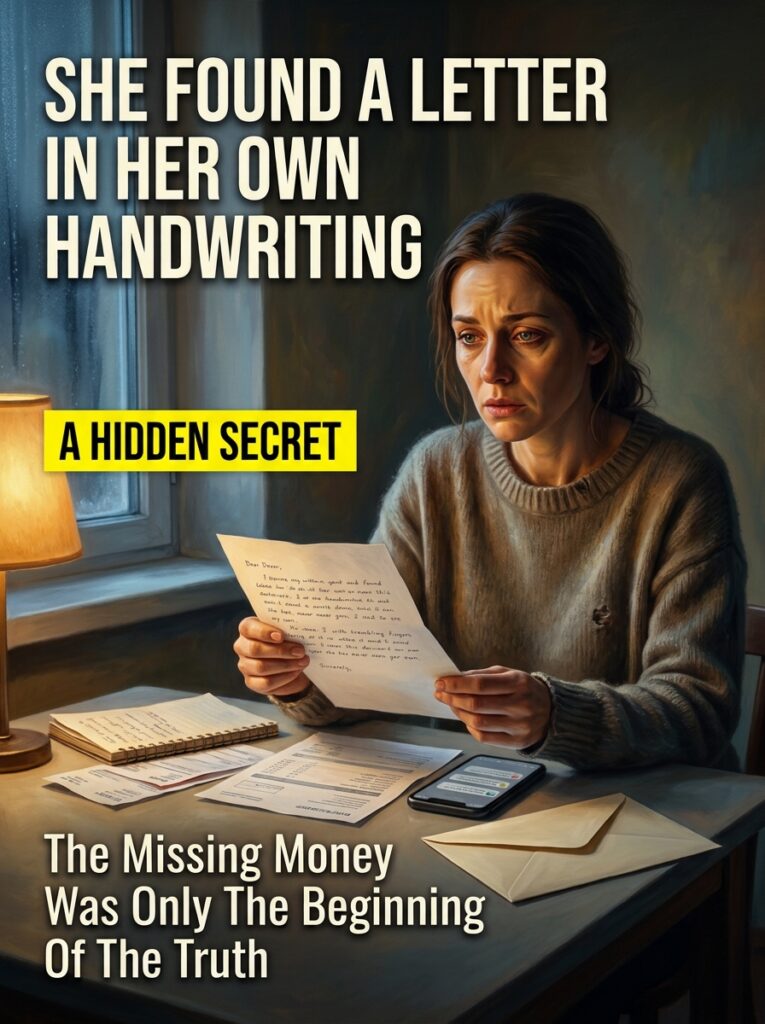
The cold had settled into the apartment long before Maya admitted how frightened she was.
It crept beneath the front door, slipped through the narrow gaps around the windows, and settled into the blankets she had piled over the bed. The heating system had stopped working three days earlier. The electricity was still on, but the warning notice beside the kitchen clock made it clear that the remaining time was running out.
Maya sat at the small kitchen table wearing two sweaters and a pair of wool socks that no longer matched. In front of her lay three bills, a nearly empty wallet, and a notebook in which she had written the same numbers so many times that the paper had begun to tear.
Rent.
Electricity.
Food.
She calculated everything again, hoping she had missed something the previous evening.
She had not.
Her phone vibrated.
A message from her older sister appeared on the screen.
How are you doing? You sounded tired when we spoke yesterday.
Maya stared at it for several seconds before replying.
I’m fine. Just a difficult month. I’ll figure everything out.
She hated how easily the lie came now.
Her sister would have helped if Maya had asked. Their mother would probably have sent whatever money she could spare, even if it meant putting off something she needed herself. But Maya could not bear the thought of explaining how badly things had deteriorated.
For months, she had assured everyone that her relationship was strong, that their financial problems were temporary, and that the two of them were making plans for a better future.
She had believed those promises when she made them.
Now she was no longer certain who had been telling the truth.
The relationship had ended six weeks earlier. Her former partner had left after an argument that began with money and ended with words neither of them could take back.
Maya remembered standing beside the kitchen counter, holding an unpaid electricity notice while asking where the money from their shared account had gone.
Her partner had looked exhausted.
“Can we please talk about something else tonight?”
“We’ve talked about everything else for weeks,” Maya had answered. “We haven’t paid the bills. We keep borrowing money. Every time I ask what’s happening, you tell me it’s temporary.”
“It is temporary.”
“Then show me the numbers.”
Her partner had stared at her as if she had asked for something cruel.
“I thought you trusted me.”
“I do. That’s why I’m asking you to explain.”
The silence that followed had frightened Maya more than any argument.
Eventually, her partner had said, “Maybe we need some time apart.”
Maya had thought the words were spoken in anger.
She had waited for an apology.
It never came.
After the separation, she discovered that the money she believed they had saved together was almost gone. She had assumed their ordinary expenses had consumed it. They had struggled with rent, groceries, transportation, and unexpected costs for months.
But when she reviewed the account, the numbers did not match the explanations she remembered.
Several withdrawals had been made on dates she could not connect to any household expense.
There were transfers she did not recognize.
And there was a payment that appeared to have been made just before the relationship began falling apart.
Maya had asked about it once, shortly before they separated.
Her partner had answered too quickly.
“It was something I had to take care of.”
“What thing?”
“It’s handled now.”
At the time, Maya had been so tired that she let the answer stand.
She regretted that decision every day.
Now she returned to the kitchen table and opened her notebook.
Beside the dates of the unexplained withdrawals, she wrote one question.
Who knew about this?
She stared at the words.
The truth might be painful, but the uncertainty was becoming unbearable.
Her phone vibrated again.
This time, the message came from an unknown number.
You need to stop looking into the money.
Maya read it twice.
A moment later, another message arrived.
Some things were done to protect you.
She felt the room grow colder.
Whoever had sent those messages knew what she was investigating.
And they believed Maya was better off not knowing.
Part 2
Maya did not reply to the unknown number.
Instead, she took screenshots of the messages and saved them in a folder with the financial records. She wanted to ask who had sent them, but she knew that an immediate response might warn the person that she had begun investigating.
For years, Maya had been the person who tried to make difficult situations easier for everyone else.
If her partner was worried, she reassured them. If a bill arrived unexpectedly, she found a way to pay it. If a family member needed help, she rearranged her own plans.
She had believed that love meant standing beside someone when life became difficult.
She had never imagined that the same instinct could make her overlook things she should have questioned.
The following morning, she visited the bank.
She wore her warmest coat and carried a folder containing her identification, account statements, and handwritten notes. The trip cost money she could barely spare, but she needed a clear record of the transactions.
A bank employee listened as Maya explained the problem.
“I’d like to understand these withdrawals,” she said. “I recognize some of them, but not all of them.”
The employee reviewed the dates.
“Some of these appear to be transfers rather than ordinary purchases.”
“Can you tell me where they went?”
“I can explain the information available for accounts you are authorized to access. For certain details, we’ll need to follow our verification process.”
Maya nodded.
She had expected the bank to hand her an answer immediately. Instead, she received a printed summary and instructions for requesting further records.
It was frustrating, but the paperwork gave her something she had not possessed before: a clear sequence of dates.
One transfer had occurred on the same evening her partner claimed to have worked late.
Another had been made two days after Maya received a message saying that the rent had already been paid.
The rent, as she later discovered, had not been paid in full.
She left the bank and sat on a bench outside, studying the pages.
There was a possibility that she had misunderstood the arrangement. Perhaps her partner had been moving money between accounts. Perhaps an unexpected debt had forced them to make decisions without telling her.
Maya wanted that explanation to be true.
She did not want to believe that someone who had shared her bed, her meals, and her plans for the future could deliberately hide something so important.
Yet the dates continued to trouble her.
When she returned to the apartment, she searched through old messages.
At first, she found only ordinary conversations.
A reminder to buy milk.
A photograph of a broken kitchen tap.
A joke about the weather.
A message from her partner promising to come home early.
Then she found a conversation from several months before the breakup.
Maya had written:
Are we still putting money aside for the deposit? I want to make sure we’re on the same page.
Her partner had replied:
Of course. Nothing has changed.
The next message was from Maya.
Good. I don’t want us to struggle like this forever.
Her partner had sent a heart.
Maya remembered the relief she had felt when she read it. They had been sitting together on the sofa that night, talking about moving somewhere warmer, somewhere with better windows and enough room for a small table by the kitchen.
She had believed they were working toward the same future.
But the transfer records suggested that money had already begun leaving the account before that conversation.
She checked the date again.
Then she opened the next message.
It had been sent later that evening.
I handled it. Please don’t ask me about this again.
Maya could not remember what the message referred to.
There was no earlier explanation in the conversation, only a photograph of a shopping list and a question about dinner.
She searched the surrounding messages, hoping to find context.
Nothing.
The following day, she asked her former partner whether they remembered the transfer.
The reply came after several hours.
I told you it was handled.
Maya typed three different responses before sending one.
I need to know what it was for.
The answer arrived almost immediately.
Please leave it alone.
Maya placed the phone on the table.
She had expected anger, perhaps defensiveness. She had even expected another denial.
She had not expected a warning.
That evening, she returned to the unknown number’s messages.
The sender had not contacted her again.
But beneath the original warning was a detail she had overlooked.
The messages had arrived shortly after she requested the bank records.
Someone knew when she had started asking questions.
And someone was watching closely enough to know what she might discover next.
Part 3
For the next two days, Maya tried to continue with her life.
She went to work, bought the cheapest food she could find, and avoided looking at the electricity notice whenever she entered the kitchen. She told herself that she would deal with the mystery when she had enough information to understand it.
But the questions followed her everywhere.
During lunch, she found herself comparing dates on her phone.
On the bus, she reread the messages.
At night, she lay beneath the blankets and tried to remember every conversation about money that had taken place during the final months of the relationship.
She remembered her partner saying they had received unexpected expenses.
She remembered a promise that a difficult payment would be resolved soon.
She remembered asking whether they should cancel their plans to move.
And she remembered the answer.
“Don’t worry. I’ve got it under control.”
At the time, the words had comforted her.
Now they sounded like a door being closed.
On Thursday afternoon, Maya received a call from her older sister, Elena.
“You haven’t called me properly in weeks,” Elena said. “I know you keep saying you’re fine, but you don’t sound fine.”
Maya sat on the edge of the bed.
“I’m just tired.”
“Are you still having trouble with the bills?”
Maya hesitated.
Elena sighed softly.
“You don’t have to protect me from your problems.”
“I’m not trying to.”
“Then tell me what’s happening.”
Maya looked toward the kitchen.
She could tell Elena about the money, the unexplained transfers, and the messages from the unknown number. But once she said everything aloud, the situation would become real in a way she was not ready to face.
“I’m looking into something,” she finally said. “I don’t understand what happened to some of our savings.”
“Your savings with your former partner?”
“Yes.”
“Did they explain it?”
“Not really.”
Elena was quiet for a moment.
“Do you feel safe?”
The question surprised Maya.
“Yes. Why?”
“Because you sound frightened, and I don’t think this is only about money.”
Maya pressed her fingers against her forehead.
“I don’t know what it is about anymore.”
“Come and stay with me for a few days.”
“I can’t leave everything here.”
“You can come back. I’m not asking you to abandon your life. I’m asking you not to carry this alone.”
Maya promised to consider it.
After the call, she returned to the folder and examined the bank summary again.
One transfer had a reference number that appeared in none of the other records. She wrote it down and contacted the bank to ask whether it could help identify the transaction.
The employee explained that the reference alone did not establish who had authorized it or why it had been made. Maya would need the appropriate records before she could draw conclusions.
She understood.
Still, she could not ignore the pattern.
The money had not simply disappeared through ordinary spending. At least some of it had been deliberately transferred.
That evening, she searched an old storage box containing receipts, rental documents, and papers from the time she and her partner had first moved in together.
At the bottom lay a small notebook.
It was one she had used to record household expenses when they were saving for a deposit. The cover was bent, and several pages had come loose from the binding.
Maya opened it.
The first pages contained ordinary calculations: grocery totals, transportation costs, and small amounts set aside each week.
Then she found a page with a list of payments.
The handwriting was her partner’s.
Beside one entry, they had written a date that matched the first unexplained transfer.
Underneath it were three words.
Temporary. Keep separate.
Maya stared at the note.
There was no amount, no explanation, and no indication of what was being kept separate.
She checked the page before it and found nothing unusual.
On the page after it, however, someone had written a name.
Maya recognized it immediately.
It belonged to someone who had once been close to both of them, a person who had helped them when they first moved into the apartment.
She had not spoken to that person in months.
Their friendship had faded during the final year of the relationship, and Maya had assumed it was because everyone had become busy with their own lives.
Now she wondered whether the distance had another explanation.
She turned the notebook over, checking the back cover.
A small folded slip of paper had been tucked beneath it.
When she opened it, she found a phone number and a date.
The date was the night her partner had told her that everything was under control.
And the phone number belonged to the person whose name appeared in the notebook.
Maya sat perfectly still.
She had believed the mystery involved two people: herself and the person she had loved.
Now the evidence suggested that someone else had been involved long before the relationship ended.
She picked up her phone and began typing the number.
Before she could press call, a new message appeared from her former partner.
If you find the letter, please don’t read it alone.
Maya’s fingers went cold.
She looked at the notebook, the number, and the bank records spread across the table.
She had never mentioned a letter.
Part 4
Maya called her former partner immediately.
The phone rang four times before the call went to voicemail.
She tried again.
This time, the call was answered.
“What letter?” she asked.
There was a long silence.
“Maya, where are you?”
“At home. What letter are you talking about?”
“Have you found something in the apartment?”
“I found a notebook and a phone number. I haven’t found a letter.”
Her former partner exhaled.
“Then we need to talk.”
“You keep saying that, but every time I ask a question, you give me another reason not to trust you.”
“I know.”
“Do you? Because I’m sitting here looking at records I should have seen months ago, and now you’re warning me about a letter I didn’t know existed.”
“I wasn’t trying to frighten you.”
“Then tell me what it is.”
Her former partner did not answer.
Maya felt anger rise in her chest.
“You cannot keep deciding which parts of my life I’m allowed to understand.”
“I know,” they repeated. “I should have told you everything before we separated.”
“Why didn’t you?”
“Because I thought I could fix it.”
The answer was so familiar that Maya nearly ended the call.
Instead, she asked, “Fix what?”
“The payment. The debt. Everything connected to it.”
“What debt?”
“I can’t explain the whole thing over the phone.”
Maya closed her eyes.
“Then where can you explain it?”
They arranged to meet the following evening at a small café near the bank. Maya chose the location because it was public and easy to reach.
Before ending the call, she asked one final question.
“Did you write a letter to me?”
“No.”
“Did you ask someone else to write one?”
Another pause.
“No.”
Maya waited.
Her former partner added, “But someone may have written something on your behalf.”
“What does that mean?”
“I don’t know if the letter you’re looking for is the same one I heard about.”
“You heard about a letter?”
“Yes.”
“From whom?”
“I’ll explain tomorrow.”
Maya ended the call before her frustration could turn into another argument.
For the next hour, she searched the apartment again.
She checked the kitchen drawers, the boxes beneath the bed, and the cabinet where they had kept important documents. She found receipts, expired warranties, and an envelope containing photographs from their first year together.
There was no letter.
She even checked the pockets of the winter coat her former partner had left behind.
One pocket contained a bus ticket. Another held a receipt from a pharmacy.
Nothing else.
Maya returned to the kitchen and sat down.
The words from the message remained in her mind.
If you find the letter, please don’t read it alone.
Why would anyone warn her about a letter unless its contents were likely to change something?
And why had someone used her own name, her own handwriting, or both, in a document she had never seen?
She thought about the notebook again.
The handwritten phrase Temporary. Keep separate seemed less like an ordinary reminder and more like a private instruction.
She looked up the phone number from the slip.
The number was no longer active.
There was no easy way to contact its owner.
Maya considered calling Elena, but she did not want to alarm her sister before she understood what was happening.
Instead, she placed the notebook and the slip into the folder with the financial records.
Then she wrote a list of questions for the next evening.
What debt had been paid?
Who had authorized the transfers?
Who knew about the letter?
Why had her partner left without explaining the financial decisions?
And how could a letter bear Maya’s handwriting if she had never seen it?
The last question frightened her most.
She knew her own handwriting. She used it every day at work, on shopping lists, and in the notebook beside her bed.
If someone had copied it, the letter might be an attempt to deceive her.
But if it was genuine, there was another possibility.
Someone might have used a document Maya had written long ago without telling her what it would become.
She remembered signing forms when she and her partner moved into the apartment. She remembered filling out applications and writing notes for people who needed help.
She had never imagined that any of those ordinary acts could become part of a mystery.
Before bed, she checked her phone one last time.
There was a message from the unknown number.
Tomorrow, ask about the original agreement. Not the copy.
Maya sat up.
The sender knew about the meeting.
And they knew exactly which question she needed to ask.
Part 5
The café was nearly empty when Maya arrived.
Rain tapped against the windows, and the smell of fresh coffee filled the small room. She chose a table near the entrance and placed her folder on the chair beside her.
Her former partner arrived ten minutes later.
They looked thinner than Maya remembered. Their coat was damp, and they kept their hands in their pockets as they approached the table.
For a moment, neither of them spoke.
Then her former partner sat down.
“You look tired,” they said.
“So do you.”
They looked at the folder.
“You brought the records.”
“Of course.”
Maya waited for an explanation, but her former partner seemed unable to begin.
Finally, they said, “The money was connected to a debt that existed before we started having problems.”
“Whose debt?”
“Someone else’s.”
“That doesn’t answer my question.”
“I know.”
They rubbed their hands together.
“I was asked to help someone who was in serious trouble. They had a payment due, and they believed they could repay it quickly. I thought helping them would be a temporary arrangement.”
“How did our savings become involved?”
“I used some of the money to cover the payment.”
“Without asking me?”
“Yes.”
The answer was direct, and it hurt more than another excuse would have.
Maya leaned back.
“You told me we were saving for a deposit.”
“We were.”
“You told me the money was still there.”
“I thought I could replace it before you needed it.”
“But you didn’t.”
“No.”
She looked down at her hands.
For months, she had wondered whether she had misunderstood their financial situation. Now she knew that her partner had made a decision without her and had continued allowing her to believe something untrue.
“Why didn’t you tell me when you realized you couldn’t replace it?”
“I was ashamed.”
“That doesn’t explain why you kept lying.”
Her former partner nodded.
“You’re right.”
The admission left Maya with nothing to argue against.
They explained that the original payment had been intended to settle an urgent obligation. The person who received it later disputed the amount, and the agreement became more complicated than anyone had expected.
Rather than admit the mistake, her partner borrowed money and tried to cover the missing amount. Each attempt created another problem.
They had started avoiding calls, delaying bills, and giving Maya explanations that were only partly true.
“I thought if I could get everything back to normal, you would never need to know,” they said.
“But I did need to know. I was making decisions based on information you knew was false.”
“I understand that now.”
Maya looked at them.
“Do you?”
They did not answer immediately.
“I don’t think I understood how much it would hurt you,” they said. “I was focused on the debt. Every day I told myself I only needed a little more time.”
“And every day, I thought we were solving the problem together.”
Her former partner’s eyes filled with tears.
“I’m sorry.”
Maya had imagined hearing those words for weeks.
She had imagined that an apology might bring relief, that it might make the financial loss feel less personal.
Instead, she felt exhausted.
“Who was the person you helped?” she asked.
Her former partner looked toward the window.
“It was someone we both knew.”
“Who?”
“I don’t want to give you a name without explaining what happened.”
Maya almost stood.
Then she remembered the message from the unknown number.
Ask about the original agreement. Not the copy.
“Tell me about the agreement.”
Her former partner reached into their bag and took out a photocopied document.
It contained a list of payments, a brief description of the obligation, and several signatures.
Maya recognized her former partner’s name.
She recognized the name from the notebook.
But the final signature was unfamiliar.
At the bottom of the page was a statement saying that the payment was temporary and would not be treated as a final settlement until the full amount had been confirmed.
Maya read it twice.
“This says the payment wasn’t final.”
“Yes.”
“Then why did you tell me everything was handled?”
“Because I believed the remaining amount would be paid within days.”
“Who told you that?”
“The person who arranged the transaction.”
“Where is the original agreement?”
Her former partner lowered their eyes.
“I don’t have it.”
“Who does?”
“I think the person who received the money kept it.”
Maya placed the photocopy on the table.
The unknown sender’s message made sense now. The copy did not show the full arrangement. There might be other terms, other signatures, or an explanation that changed what the document meant.
She looked at her former partner.
“Who has the original?”
They hesitated.
Then they gave her a name.
Maya recognized it immediately.
It belonged to someone who had once been a close friend, someone who had helped them move into the apartment and had stood beside them during a difficult period.
The same person whose number she had found in the old notebook.
Before Maya could ask another question, her former partner looked at her with sudden alarm.
“There’s something else,” they said. “Something about the night we separated.”
“What?”
“I received a message that evening. I thought it was from you.”
Maya frowned.
“I didn’t send you anything.”
“I know that now.”
“What did it say?”
Her former partner reached for the folder.
“It said you knew everything and wanted me to leave.”
Maya felt her breath catch.
She had never sent such a message.
Someone had made her partner believe she wanted them gone.
And whoever had done it knew enough about their relationship to make the lie believable.
Part 6
Maya walked home through the rain, holding the photocopy beneath her coat.
The conversation had answered some questions, but it had created others.
Her partner had taken money from their shared savings without permission. That was no longer in doubt. But the message that had supposedly come from Maya on the night they separated introduced a new possibility: someone else might have influenced the breakup.
She did not want to use that possibility to excuse her partner’s actions.
Even if another person had sent the message, her partner had still chosen to hide the financial truth.
But the message might explain why the separation had happened so suddenly, why the final argument had felt different from the others, and why her partner had left without trying to repair anything.
When Maya reached home, she opened her old phone.
She had kept it in a drawer because it contained photographs and messages from the early years of the relationship. The battery was almost dead, and the screen occasionally froze, but it still held information she had never transferred to her newer device.
She plugged it in and waited.
When the phone finally opened, she searched the messages from the night they separated.
She found her own messages.
Can we talk when you get home?
I don’t understand what’s happening with the bills.
Please don’t ignore me.
There was no message telling her partner to leave.
She checked the timestamps.
The last message from Maya had been sent before the argument began. After that, the conversation stopped.
She took screenshots of the messages and saved them.
Then she checked the call history.
An unknown number had called her partner shortly before they left the apartment.
Maya did not recognize it.
She compared the number with the one from the notebook, but they were different.
Still, the timing made her uneasy.
She called Elena and told her what had happened.
Her sister listened without interrupting.
“So someone may have sent a message pretending to be you?” Elena asked.
“That’s what my former partner says.”
“Do you believe them?”
“I don’t know.”
“Then don’t decide yet. Find out whether the message exists.”
Maya nodded, even though Elena could not see her.
“I want to find the original agreement, too.”
“Do you know who has it?”
“I think I do.”
“Then be careful. Take someone with you if you feel uncomfortable.”
Maya thanked her and ended the call.
She searched her email for the name of the person who had arranged the transaction. Several old messages appeared, most of them ordinary conversations about moving, household repairs, and shared plans.
One email caught her attention.
It had been sent months before the breakup.
The subject line read: Documents for the arrangement.
The body contained only a short note.
I’ve kept the original safe. Please don’t send another copy until we know what the bank will accept.
Maya checked the sender.
It was the friend whose number she had found in the notebook.
She opened the attachment.
It was a scan of the same agreement her former partner had shown her, but the final page was missing.
The email also contained a reference to a second document.
The signed acknowledgment is separate. Keep it with the original.
Maya printed the email and placed it in the folder.
She now had evidence that the original agreement and a separate acknowledgment existed.
The acknowledgment might confirm who had received the money, whether the debt had been settled, or what had been promised in return.
She contacted the friend and asked to meet.
The reply arrived after several minutes.
I was wondering when you would ask.
Maya read the sentence twice.
It was not a denial.
She asked whether the friend still had the original agreement.
Yes.
And the acknowledgment?
There was no immediate reply.
Maya waited.
Finally, another message appeared.
Bring the notebook you found. I need to show you something before you read those papers.
Maya stared at the screen.
She had not told the friend about the notebook.
She had not told anyone except her former partner that she had found it.
She checked the conversation again, wondering whether she had accidentally mentioned it.
She had not.
The friend sent a final message.
Please come alone. I don’t want another person deciding what you should know.
Maya put the phone down.
She was beginning to understand why the mystery had been so difficult to unravel. Every person involved appeared to possess a different piece of the truth, and each had been making decisions about what Maya should be allowed to see.
She packed the notebook and the printed email into her bag.
Before leaving, she took photographs of every page and saved them to a secure account.
Then she wrote a note to herself.
Do not accept explanations without evidence.
It was a simple instruction.
But for Maya, it marked the beginning of a different way of living.
Part 7
The friend lived in a small house on a quiet street several miles from Maya’s apartment.
When Maya arrived, the front curtains were open, and a light burned in the hallway. She knocked twice.
The door opened almost immediately.
“I knew you would come,” the friend said.
Maya stepped inside.
The living room was crowded with books, boxes, and old household items. A folder lay on the coffee table beside a cup of tea.
The friend looked at the notebook in Maya’s hand.
“You found it where I thought you would.”
“What does that mean?”
“Sit down first.”
Maya remained standing.
“I’ve spent weeks trying to understand what happened to my money. I don’t want another conversation in which someone decides what I can handle.”
The friend nodded.
“That’s fair.”
They sat opposite each other.
The friend explained that the financial arrangement had begun as an attempt to help someone facing an urgent obligation. The original agreement had been intended to document the amount, the repayment terms, and the responsibilities of everyone involved.
But the person who received the money later disputed the terms.
Instead of returning to the bank and resolving the disagreement properly, the people involved had tried to settle it privately.
Maya’s former partner had supplied money from the shared savings.
The friend had kept the paperwork.
And someone had sent messages encouraging the people involved to remain silent until the matter was resolved.
“Who sent the messages?” Maya asked.
“I don’t know who sent all of them.”
“Did you send any?”
The friend looked down.
“One.”
Maya felt a cold pressure in her chest.
“What did you say?”
“I told your former partner that the original agreement needed to remain private until we understood what had happened.”
“Why?”
“I believed that if everyone started accusing each other, the situation would become impossible to resolve.”
“So you told them to hide it from me.”
“I didn’t think it would affect you the way it did.”
“It was my money.”
“I know.”
Maya shook her head.
“Everyone keeps saying that now. Why didn’t anyone remember it when the decisions were being made?”
The friend had no answer.
After a moment, they opened the folder.
Inside were several pages bearing signatures and dates. The first was the original agreement. It included a breakdown of the payment and a statement that the amount would remain provisional until the receiving party confirmed the balance.
The second page was a signed acknowledgment.
It confirmed that the money had been received but did not declare the debt fully settled.
Maya read the document carefully.
The signature belonged to the person who had received the transfer.
She recognized the name from the notebook.
“Why did you keep this?”
“Because I thought the arrangement would be resolved. I wanted the original available if anyone later disputed the terms.”
“But you never told me it existed.”
“No.”
“Did you know my former partner was using our savings?”
“I knew they had contributed money. I didn’t know exactly how much came from your shared account until later.”
“And when you found out?”
The friend looked away.
“I should have told you.”
Maya felt anger rising again, but this time she did not allow it to carry her away from the questions.
“Who sent the message pretending to be me?”
The friend went pale.
“I don’t know that for certain.”
“But you know something.”
The friend hesitated.
“The night you separated, I received a call from someone who said they were trying to prevent a bigger argument. They told me your former partner was planning to leave and that you wanted the separation to happen quietly.”
“Who called?”
“I can’t be sure. The number was blocked.”
“Did you pass that information on?”
The friend nodded.
“I told your former partner that they should give you space.”
Maya stared at them.
“You told them I wanted them to leave?”
“I thought that was what you wanted.”
“Based on what?”
“Based on what I had been told.”
“By whom?”
The friend could not provide a name.
Maya looked at the papers again.
The financial arrangement had been mishandled. Her former partner had hidden the use of their savings. The friend had kept the original records and passed on information without checking whether it was true.
But the person who had sent the message pretending to be Maya remained unidentified.
“Is there anything else?” Maya asked.
The friend closed the folder.
“Yes.”
They reached into a drawer and took out a sealed envelope.
Maya recognized the handwriting on the front immediately.
It was hers.
Her name was written in the same rounded letters she used on birthday cards and shopping lists. The final stroke of the letter M curved slightly upward, just as it did when she wrote quickly.
She had never seen the envelope before.
“What is this?”
The friend placed it on the table.
“It’s the letter everyone has been afraid of.”
Part 8
Maya did not touch the envelope immediately.
She stared at her name, trying to remember whether she had ever written it on a similar envelope. The handwriting looked natural, not copied. Even the small slant in the last letter was familiar.
But the paper itself meant nothing to her.
“Where did you get this?” she asked.
“The person who arranged the payment gave it to me with the original documents.”
“When?”
“Before you and your former partner separated.”
Maya looked up.
“Why didn’t you tell me?”
“Because I was told the letter was supposed to remain with the agreement until the financial matter was resolved.”
“Who told you that?”
“The person who delivered it.”
“Who was that?”
The friend hesitated.
“I thought it was your former partner’s decision. I didn’t understand that you had never seen it.”
Maya felt the room tilt around her.
She had spent years signing forms, writing notes, and leaving reminders for people she trusted. Someone could have taken a genuine piece of her handwriting and placed it on a document without her knowledge.
The envelope might contain a letter she had written in another context. It might contain a message composed by someone else. Or it might be an attempt to make her believe she had agreed to something she never approved.
She wanted to open it.
She also wanted to leave the room.
Instead, she asked for the remaining records.
The friend gave her a copy of the correspondence about the agreement. Several messages described the debt as temporary and emphasized that no final settlement should be declared until the receiving party confirmed the amount.
One message was particularly troubling.
Keep the acknowledgment with the letter. If anyone asks, say the paperwork is incomplete.
Maya read it again.
The message had been sent by the person who arranged the transfer.
She turned to the friend.
“Did you know they wanted people to say the paperwork was incomplete?”
“I thought they meant the bank’s copy was incomplete.”
“Did you ask?”
“No.”
Maya closed the folder.
She was beginning to understand how a series of small decisions had created a larger problem. People had assumed they understood the arrangement. They had accepted explanations without checking them. They had withheld information to avoid conflict, then used the silence as a reason to keep withholding more.
And through it all, Maya had been left to believe that the financial trouble was simply the result of bad luck.
She took the envelope.
“I need to know whether this is really my handwriting.”
The friend nodded.
“I understand.”
Maya placed the envelope in her bag without opening it.
She wanted to examine the contents somewhere she could think clearly, preferably with someone independent who could help her distinguish genuine documents from altered or misleading ones.
Before she left, she asked one more question.
“Did you ever see the message that supposedly came from me on the night we separated?”
The friend shook their head.
“No. I only heard about it afterward.”
“From whom?”
“Your former partner.”
Maya’s thoughts returned to the old phone and the unanswered call.
She now had a reason to investigate the number that had contacted her partner that evening. She also had a reason to ask the bank for a complete record of the transfer and to obtain advice about the letter before treating it as proof of anything.
“Why are you helping me now?” she asked.
The friend looked genuinely ashamed.
“Because I should have helped you before.”
Maya wanted to believe that answer.
But she had learned that intentions were not the same as actions.
She left with the envelope, the original agreement’s copy, and the acknowledgment.
Outside, the rain had stopped. The street smelled of wet pavement, and the evening light fell softly across the houses.
Maya stood beside her car and took out her phone.
There was a message from her former partner.
Did you find it?
She replied:
Yes.
The response arrived seconds later.
Please don’t open it until we can talk.
Maya looked at the envelope.
Then she typed:
You no longer get to decide what I am allowed to know.
She sent the message and put the phone away.
For the first time since the breakup, she felt that she had reclaimed a small part of her life.
But she still did not know who had written the letter, why it carried her handwriting, or what the people involved had believed it would prove.
Part 9
Maya spent the next morning reviewing the documents with Elena.
Her sister had come over early, bringing groceries and a thermos of hot tea. The apartment was still cold, but the two of them sat at the kitchen table with the paperwork spread between them.
Elena listened as Maya explained the financial arrangement and the discovery of the letter.
When Maya finished, her sister asked, “Have you opened it?”
“No.”
“Why not?”
“Because I don’t know whether it’s genuine or what it means.”
Elena nodded.
“Then let’s not assume anything until we understand what we’re looking at.”
Together, they examined the envelope.
The paper was old but not damaged. The handwriting appeared consistent with Maya’s, although Elena pointed out that the envelope alone could not establish who had written the contents.
Maya compared the lettering with several notes from her old notebook.
The similarities were striking.
The same rounded letters.
The same slightly uneven spacing.
The same habit of drawing the tail of the letter y below the line.
It looked like her handwriting.
But she had no memory of writing it.
Elena placed the envelope beside the notebook.
“Could someone have copied your handwriting from one of these?”
“Possibly.”
“Could it have been written on a document you signed without knowing what it would be used for?”
“Possibly.”
“Then we need to find out which.”
Maya agreed.
They decided not to make assumptions about the letter’s authenticity. Instead, Maya would preserve it, keep copies of the records, and seek appropriate advice before relying on the document to establish any financial or personal agreement.
Later that day, she returned to the bank with the acknowledgment and requested guidance on obtaining the complete transaction history.
The bank confirmed that the payment had been processed but could not determine from the receipt alone whether the underlying debt had been fully settled. That depended on the terms of the separate agreement and the records held by the people involved.
Maya left with a clearer understanding of what the financial documents did—and did not—prove.
The money had been transferred.
The payment had been treated as part of an unresolved arrangement.
But the documents did not establish that Maya had personally agreed to use the shared savings for that purpose.
That distinction mattered.
For months, she had blamed herself for not managing their money better. Now she understood that she had been making decisions without access to information that another person had deliberately withheld.
She still had to deal with the consequences, but she no longer believed the entire failure was hers.
That evening, her former partner came to the apartment.
Maya let them in but kept the documents on the table between them.
“I want to know about the letter,” she said.
Her former partner looked at the envelope.
“I’ve never read it.”
“Then why were you afraid I would find it?”
“Because I knew it existed. I was told it could cause more problems if it was opened before the agreement was resolved.”
“Who told you?”
“The person who arranged the payment.”
“Did they tell you I had written it?”
“They said it was connected to you.”
“That isn’t the same thing.”
“I know.”
Maya studied their face.
“Did you believe I had agreed to the transfer?”
“At first, I thought the money would be replaced before you needed it. Later, I was told the paperwork would show that the arrangement was temporary.”
“Did you see the original agreement?”
“Only the copy.”
“Did you read it?”
“Not carefully enough.”
Maya felt anger rise again.
“You took money from our savings, signed onto an arrangement you didn’t understand, and then expected me to trust you when you said everything was fine.”
Her former partner lowered their head.
“Yes.”
“Why?”
“Because I was afraid you would leave if you knew.”
Maya looked at them for a long moment.
“You made that decision for me.”
“I know.”
“You took away my ability to decide whether I wanted to help, whether I wanted to accept the risk, or whether I wanted to walk away.”
“I know.”
The repeated admission did not erase the harm, but it was the first time her former partner had acknowledged the central problem without hiding behind the debt.
Maya opened the folder.
“There’s another question. Someone sent you a message pretending to be me on the night we separated. Who do you think did it?”
Her former partner looked startled.
“I don’t know.”
“Did you see the original message?”
“Yes.”
“Do you still have it?”
“I may have it in my old email.”
“Then find it.”
They agreed to search their records and share anything relevant.
Before leaving, her former partner looked at the envelope.
“Whatever is inside, I want you to know that I never wanted you to lose everything.”
Maya’s voice softened, but she did not look away.
“I believe you may not have wanted that. But you still made choices that put me here.”
Her former partner nodded and left.
Maya sat alone with the envelope.
She could no longer postpone the question forever.
The letter might contain an explanation. It might contain a false claim. It might be a record of something she had forgotten.
Whatever the answer, she would not allow anyone else to tell her what it meant before she had read it herself.
She carefully opened the envelope.
Inside was a single sheet of paper.
The first line was addressed to someone Maya did not recognize.
The second line was unmistakably in her handwriting.
And at the bottom, beneath a short paragraph about the payment, was a date from a period when Maya remembered being far away from the people involved.
She read the page again.
The letter appeared to authorize the use of money from the shared account, but Maya had no memory of agreeing to it.
She turned the paper over.
On the back was a final sentence.
If Maya ever asks what happened, tell her the truth about the night the agreement was signed.
Maya’s hands began to tremble.
She had never seen the letter before.
Yet someone had used her handwriting to create a document that could make it appear she had approved the very decision she had been trying to understand.
Part 10
Maya did not sleep much that night.
The letter lay on the kitchen table, protected inside a clear folder. Elena had stayed with her until late, helping her make copies and write down the circumstances surrounding the discovery.
They had not concluded that the letter was forged. The handwriting resembled Maya’s, but that did not prove who had written the contents, when the document had been created, or whether it accurately reflected an agreement.
Those questions required evidence.
By morning, Maya had made three decisions.
She would preserve the original letter.
She would request the remaining financial records and obtain independent advice about the document.
And she would stop allowing other people’s explanations to become the only version of events she was permitted to hear.
The next few weeks were difficult.
Maya followed up with the bank and gathered every record she could lawfully obtain. She documented the dates of the transfers, saved copies of the messages, and kept a written account of who had given her each document.
The process was slow, but it replaced some of the confusion with facts.
The transfer had been made.
The debt had not been conclusively settled by the payment.
The original agreement contained conditions that were missing from the copy her former partner had shown her.
And the letter appeared to connect Maya to an authorization she did not remember giving.
None of those facts, by itself, explained everything.
But together, they showed why she had been unable to understand her financial situation from the information she had been given.
She also found an old email from the period when the agreement had been signed.
It contained a short exchange about a meeting that Maya had attended while helping someone with a separate matter. The email did not establish that she had approved the financial transfer, but it gave her a possible explanation for how her handwriting might have been obtained.
She remembered signing a blank section on a form that day after being told it was needed to complete routine paperwork.
At the time, she had not thought much about it.
Now she wondered whether someone had copied the signature or used a page from the documents she had signed.
She included the email in the records she was preserving.
When her former partner learned about it, they asked to meet again.
Maya agreed, but she chose a public place and told Elena where she would be.
Her former partner arrived carrying a phone and a small folder.
“I found the message from the night we separated,” they said.
They showed Maya the email.
The message had been sent from an address that resembled hers but was not the address she used. It said that Maya knew about the financial arrangement and wanted the relationship to end before the debt became a bigger problem.
The message had not come from her account.
Maya read it carefully.
“Why did you believe this was from me?”
“Because I was frightened, and it seemed to confirm what I thought you were going to say.”
“You could have called me.”
“I should have.”
“You could have asked me directly.”
“I should have.”
Her former partner looked down.
“I was already ashamed about the money. When I saw the message, I thought you had discovered everything and wanted me gone. I told myself that leaving would be easier than forcing you to face the consequences of my mistake.”
Maya felt sadness settle over her.
The message helped explain the timing of the breakup, but it did not erase the choices that had led to it. Her partner had already hidden the transfer. They had already allowed Maya to believe the savings were intact. They had already chosen silence over honesty.
The false message had pushed them toward a decision they might otherwise have questioned.
But it had not made the decision for them.
“Do you know who sent it?” Maya asked.
“No. The address was created to look like yours. I never verified it.”
“Have you kept the original?”
“Yes.”
Maya asked for a copy.
She would include it with the other records, but she would not accuse anyone without evidence.
For the first time, her former partner seemed to understand that the truth could not be repaired with an apology alone.
“I know I hurt you,” they said. “I wanted to protect you from the debt, but I ended up making you carry the consequences without knowing why.”
Maya looked at them.
“I needed you to trust me enough to tell me the truth. You decided I couldn’t handle it, and then you used that decision to justify hiding everything.”
“I know.”
“I don’t know whether I can forgive you.”
“I understand.”
They sat quietly for a moment.
Maya had once believed that if they could just understand what had happened, they might be able to return to the relationship they had shared. Now she knew that understanding and reconciliation were different things.
She could learn the truth without returning to the past.
She could acknowledge the love they had once shared without pretending the secrecy had not damaged it.
And she could care about her former partner without taking responsibility for every decision they had made.
Before they parted, Maya asked one final question.
“Did you ever read the letter?”
“No. I only knew that someone said it existed.”
“Then neither of us knows who wrote it.”
“Not yet.”
Maya put the copy of the false message into her folder.
The mystery of the letter remained unresolved. The evidence suggested that someone had used her handwriting or copied her signature to create a document she did not remember approving. But she would not treat that possibility as a proven fact until the document could be properly examined.
For now, she had enough information to stop blaming herself for the entire financial disaster.
The next morning, Maya called her landlord and arranged a payment plan. She contacted the electricity company and explained her situation. She accepted help from Elena and began looking for a warmer, less expensive place to live.
The apartment was still cold.
The bills were still waiting.
Her relationship was still over.
But she no longer sat at the kitchen table believing that she had failed because she could not somehow solve a problem whose full details had been hidden from her.
One evening, she opened the notebook where she had recorded her expenses.
On the final page, she wrote:
I cannot control what other people hide from me. I can control whether I ignore the evidence once I find it.
She paused, then added another sentence.
I can love someone without giving them the right to make every decision for me.
She closed the notebook.
The letter remained inside its protective folder, waiting for further examination. The financial records remained incomplete, and Maya knew that there might still be difficult conversations ahead.
She did not pretend that everything would be easy.
But for the first time in months, she felt able to face the future without inventing explanations to make the past less painful.
She had spent so long trying to keep the relationship alive that she had forgotten she was allowed to protect herself, too.
Now she understood that love was not proven by how much hardship someone could endure in silence. Trust was not measured by how many questions someone refused to ask. And forgiveness did not require a person to ignore the evidence of what had happened.
Maya turned off the kitchen light and walked toward the bedroom.
The cold had not disappeared, and neither had her problems.
But she was no longer waiting for someone else to tell her what her life meant.
She would find the remaining answers one at a time.
And whatever the final truth revealed, she would face it as someone who had the right to know, the right to choose, and the right to begin again.