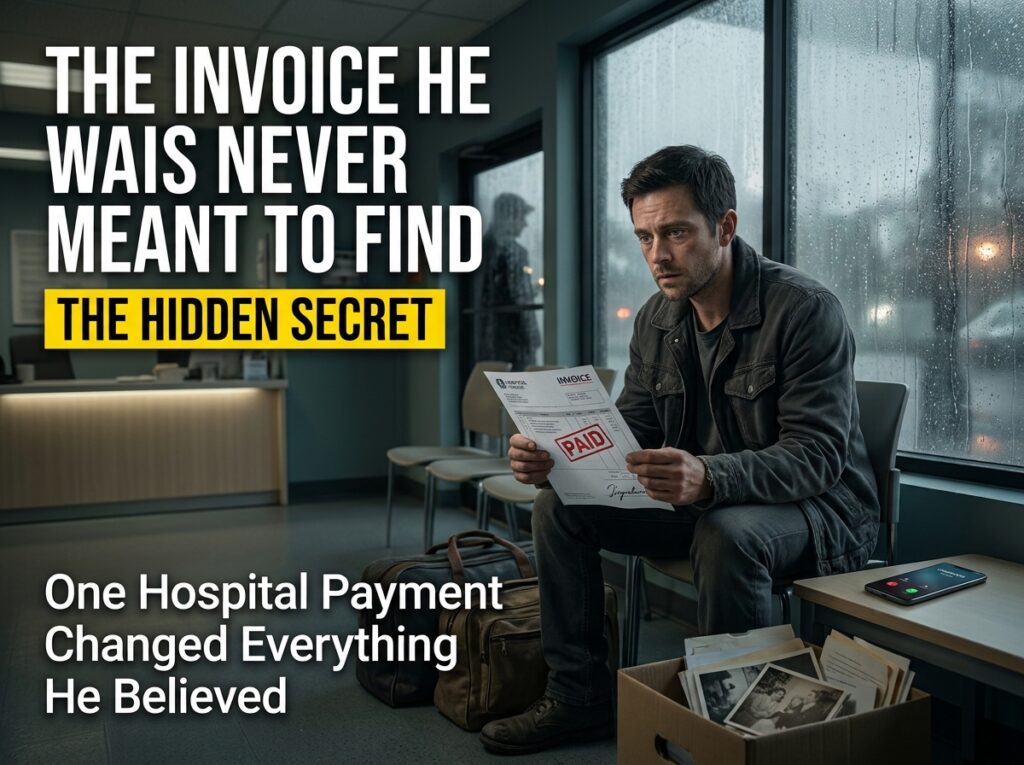
The rain had been falling since early morning, turning the streets outside the shelter into long ribbons of gray water. Every few minutes, a car passed the entrance, sending a thin spray across the pavement. People hurried past with their heads lowered, clutching bags and pulling their coats tightly around themselves.
Sam sat beside a fogged window in the shelter’s waiting room.
His jacket was still damp at the shoulders. A paper cup of coffee rested between his hands, but he had forgotten to drink it. On the chair beside him sat everything he had managed to save from the apartment he once shared with the person he loved.
Two bags. A cardboard box. A folder of documents.
Six months earlier, he would never have imagined that his entire life could fit into so little.
He had believed love could survive almost anything. They had survived unpaid bills, empty cupboards, arguments about rent, and the embarrassment of asking friends to wait another week for money they owed. There had been evenings when they split one meal between them and laughed about it as if they were sharing a secret adventure.
Those memories were still real.
That was what made the present so difficult to accept.
The person who once called Sam their whole world had disappeared from his life without offering a proper explanation. The messages had stopped. The promises had collapsed. The money they had been saving together was gone, and the last conversation they had shared seemed to become less understandable every time he remembered it.
He had told everyone he was managing.
He had told his sister that he was looking for work and that the shelter was temporary. He had told an old colleague that his relationship had ended peacefully. He had even told himself that he could rebuild his life without needing to understand why the other person had left.
But the truth was that he had been searching for answers every night.
The shelter’s coordinator, a middle-aged woman named Helen, approached his chair carrying a clipboard.
“Sam? Have you eaten today?”
“Not yet.”
“There are sandwiches in the kitchen. Please take one before you go anywhere.”
“Thank you. I’ll get one in a minute.”
Helen studied his face.
“You’ve been sitting here for hours.”
“I’m waiting for a call.”
“From someone who knows you’re here?”
Sam hesitated.
“Not exactly.”
Helen seemed to understand that he was not ready to explain.
“All right. But don’t forget to look after yourself while you’re trying to sort everything else out.”
After she left, Sam looked down at the cardboard box.
He had brought it from the apartment because he couldn’t bear the thought of abandoning the few objects that still belonged to their shared life. Inside were old receipts, photographs, letters, household documents, and a collection of small things that had once seemed too ordinary to matter.
He had been meaning to sort through them for weeks.
Each time he tried, a memory stopped him.
A receipt reminded him of their first dinner together. A photograph showed them standing outside a cheap hotel during a weekend they had barely been able to afford. A folded note contained a shopping list written in familiar handwriting.
He had kept everything because he believed that throwing it away would mean accepting the relationship was truly over.
Now, sitting in the shelter, he realized he could no longer afford to keep carrying his past without understanding it.
He pulled the box closer.
The first few papers were ordinary. A receipt from a grocery store. A letter about the electricity bill. A notice concerning the apartment lease.
Then he found a hospital invoice.
At first, he thought it had been included by mistake.
The paper was folded twice and tucked inside the lining of an old envelope. Its edges were soft from being handled, and a small stain had blurred part of the printed heading.
Sam opened it.
The invoice listed hospital services, a patient reference number, and a date from several months earlier. A prominent stamp across the page read PAID.
He stared at the word.
He didn’t recognize the hospital.
He didn’t remember either of them visiting one on that date.
Yet the invoice had been hidden among the documents his former partner had left behind.
Sam turned the paper over.
There was a signature at the bottom.
For several seconds, he couldn’t breathe properly.
He knew the handwriting.
He had seen it on birthday cards, grocery lists, rent envelopes, and the small notes that used to appear beside his breakfast when he worked early shifts.
But he had never seen that signature on a hospital invoice.
He read the date again.
Then he opened his phone and searched through the old messages.
The date fell within the period when the person he loved had begun returning home late, refusing to explain certain expenses, and insisting that everything would be fine.
Sam had accepted those explanations because he trusted them.
Now he wondered whether the invoice had been part of the truth he had never been allowed to see.
He looked toward the waiting-room door.
Outside, the rain continued to fall.
The shelter was full of people who had lost homes, jobs, relationships, or the sense that their lives could still be repaired. Sam had come there believing he had already suffered the worst of his losses.
But the invoice suggested that something had happened before the separation—something serious enough to require a hospital, money, and a signature someone had tried to keep hidden.
He placed the document carefully inside his folder.
Then he noticed something else.
The invoice had been paid in full on a date that came several days before his former partner disappeared.
Sam reached for his phone again.
He needed to know who had paid it.
And he needed to understand why the person who had left him had hidden the evidence.
<h2>Part 2</h2>
Sam waited until the shelter’s evening meal had ended before examining the invoice again.
The waiting room had grown quieter. A television murmured from the far wall, and someone was washing dishes in the kitchen. Helen had turned down the overhead lights, leaving the corners of the room in a soft shadow.
Sam spread the documents across his knees.
He began with the invoice number.
The hospital’s name was printed near the top, partially obscured by the fold. He searched online and found a hospital with the same name on the other side of the city.
He checked the date.
Then he opened his old messages and searched for the word hospital.
Nothing appeared.
He tried doctor, appointment, and emergency.
Again, nothing.
The absence of any reference unsettled him more than he expected. If someone had been seriously ill or injured, why had there been no message? Why had his former partner never asked for help?
He knew the relationship had become strained during those months, but they had still shared a home. They had still eaten together, slept in the same bed, and discussed how to pay their bills.
He could not understand how a hospital visit could have taken place without him knowing.
Unless it had been deliberately hidden.
He looked at the payment details.
The invoice showed that the balance had been settled in one transaction. It did not identify the person who had paid it, but a handwritten reference appeared beside the total.
Sam recognized the final three digits.
They matched the last digits of an account number he had seen on an old bank document.
He searched the folder again.
At the bottom of the box, he found a bank statement that had been folded into quarters. Most of the print had faded, but several transactions remained visible.
One withdrawal appeared on the same date as the hospital invoice.
The amount was close to the total shown on the bill.
Sam placed the documents side by side.
The dates matched.
The amounts were nearly identical.
Someone had withdrawn money and paid a hospital bill shortly before the relationship ended.
And the signature on the invoice belonged to the person who had disappeared.
Sam leaned back in his chair.
He tried to remember that period.
There had been an evening when his former partner came home looking unusually tired. When he asked whether work had been difficult, they said they had spent the afternoon dealing with a family matter.
He had asked if everything was all right.
“Yes,” they had answered. “It’s nothing you need to worry about.”
He remembered accepting that explanation because he was dealing with his own problems. His hours at work had been reduced, and they were behind on two household bills. He had been embarrassed about the money and worried that his partner would eventually become tired of carrying the burden.
Perhaps that was why he had not asked more questions.
He had assumed that if something serious had happened, they would tell him.
Now he understood how easily trust could become a reason to overlook something important.
He opened his message history again and searched for conversations around the invoice date.
One exchange stood out.
He had written, Are we still meeting after work?
The reply had come almost an hour later.
I can’t. Something came up. I’ll explain when I get home.
Sam remembered waiting for that explanation.
It never came.
When his partner returned, they seemed exhausted. They said they had forgotten to buy groceries and went straight to bed.
The following morning, they had been unusually affectionate.
They made coffee for him, packed a sandwich for his shift, and kissed him goodbye at the door.
At the time, he had thought they were simply trying to make up for a difficult evening.
Now the memory felt different.
Had they been hiding something? Had the hospital visit involved a family member, a medical emergency, or a person whose identity Sam had never known?
He wrote the hospital’s name in his notebook.
Then he wrote the invoice date.
Below those details, he added three questions.
Who had received treatment?
Who had paid the bill?
Why had the invoice been hidden?
The questions looked simple on paper.
But each one threatened to change the meaning of the last months of his relationship.
He decided to call the hospital the next morning.
Before closing the folder, he checked the invoice one more time.
A small handwritten number appeared beneath the signature. It was faint, but it seemed to be a phone number rather than an account reference.
Sam copied it into his phone.
He hesitated before calling.
It was late, and he had no idea who would answer.
Still, the number might belong to someone who could explain why the invoice had been kept.
He pressed the call button.
The phone rang three times.
Then a woman answered.
“Hello?”
Sam swallowed.
“I’m sorry to call so late. My name is Sam. I found a hospital invoice among some documents left by someone I used to live with.”
There was a pause.
“What name is on the invoice?” the woman asked.
Sam told her.
The silence that followed was so complete that he checked whether the call had disconnected.
Then the woman spoke again.
“Where did you find that paper?”
“In a box of belongings.”
“Do you still have it?”
“Yes.”
Her voice grew quieter.
“Listen to me carefully. You shouldn’t be asking questions about that invoice until you understand why it was paid.”
Sam sat upright.
“Why? What happened?”
The woman didn’t answer directly.
Instead, she asked, “Have you spoken to the person who left you?”
“No. They stopped answering my calls.”
Another pause.
Then she said something that made his stomach tighten.
“Perhaps they stopped answering because they believed you would never forgive them.”
The call ended before Sam could ask what she meant.
He stared at the phone.
He had expected a wrong number, an administrative office, or perhaps someone who knew nothing about the invoice.
Instead, a stranger had confirmed that the document was connected to a secret someone believed Sam could not forgive.
For the first time, he wondered whether the hidden truth concerned more than a hospital bill.
He looked down at the signature.
The person who had vanished had known what the invoice meant.
And someone else was afraid he would discover it.
<h2>Part 3</h2>
The following morning, Sam called the hospital’s public information line.
He explained that he had found an invoice and wanted to verify whether the document was genuine. He did not ask for a patient’s medical details. He simply wanted to know whether the reference number and payment record could be checked.
The staff member who answered explained that patient information was confidential and that the hospital could not discuss someone else’s treatment without proper authorization.
Sam understood.
He gave the invoice number and asked whether the hospital could confirm that the payment record looked legitimate.
After checking, the staff member confirmed that the reference appeared to correspond to a real invoice. She could not reveal who had received treatment or who had made the payment.
That answer left him with more questions than before.
He thanked her and ended the call.
Then he returned to the number he had copied from the invoice.
He called again.
This time, the woman answered immediately.
“I was hoping you’d call,” she said.
“Who are you?”
“My name is Claire.”
“How do you know about the invoice?”
Claire took a breath.
“I knew the payment had been made. I didn’t know the paper had been left with you.”
“Who was the patient?”
“I can’t tell you that over the phone.”
Sam closed his eyes.
“Everyone keeps telling me what they can’t say. I’m not asking because I want to hurt anyone. I’m asking because the person I loved disappeared, and this invoice was hidden among their belongings.”
“I understand.”
“Then please tell me why they paid it.”
Claire was quiet for a moment.
“Because someone needed help.”
“Who?”
“I can’t give you that answer yet.”
Sam felt frustration rising.
“Do you realize how that sounds? You know something about my life that I don’t. You know why someone I trusted kept secrets from me. And you’re asking me to wait without telling me what I’m waiting for.”
Claire’s voice softened.
“I’m not trying to make this harder. I just need to be sure you understand what you’re asking.”
“What am I asking?”
“You’re asking for the truth about a decision that was made during a very difficult time. Once you know it, you won’t be able to return to believing the things you believed before.”
Sam looked at the shelter’s rain-streaked window.
“I’ve already lost that.”
Claire did not respond immediately.
Then she asked whether he could meet her that afternoon.
She gave him the address of a small community center near the hospital.
Sam agreed.
For the rest of the morning, he struggled to concentrate. He attended a meeting with Helen about temporary accommodation and listened while she explained the process for applying for longer-term support.
He answered her questions, signed the forms, and thanked her.
But his thoughts kept returning to the invoice.
At two o’clock, he took a bus to the community center.
Claire was waiting in a small room beside the reception area. She was in her late forties, with dark hair pulled back and a tired expression that suggested she had not slept well.
When Sam entered, she stood.
“Thank you for coming.”
“Please tell me what happened.”
Claire indicated the chair opposite her.
“First, I want you to know that the person you loved wasn’t the only one carrying a secret.”
Sam sat down.
“What does that mean?”
Claire opened a folder.
She explained that several months earlier, a person close to the couple had experienced a serious medical emergency. The hospital had required payment for certain services, and the money had been arranged quickly.
Sam listened, trying to understand how this could have happened without his knowledge.
“Was my partner the patient?” he asked.
Claire shook her head.
“No.”
“Then who was?”
“I’m not authorized to disclose that person’s medical information.”
Sam felt his patience slipping.
“Then why did you ask me to come?”
“Because I can explain the payment and how it became connected to your relationship.”
She told him that the person who had paid the bill had done so using money they believed they could replace before anyone noticed. The intention had been to prevent a crisis from becoming worse.
But the payment had affected money that had been needed for other obligations.
The missing funds had contributed to the couple’s financial problems.
Sam stared at her.
“So they used our money?”
“Some of the money came from an account connected to your household.”
“Did they have permission?”
Claire hesitated.
“That is something you need to ask them directly.”
The answer felt like another door closing.
Sam asked whether the hospital invoice had been hidden intentionally.
Claire admitted that she believed it had.
“Why?”
“Because the person who paid it was afraid of what would happen if you discovered the truth.”
Sam felt a coldness spread through his chest.
He remembered the empty cupboards, the overdue notices, and the nights when his partner had promised that the next paycheck would make everything easier.
He remembered believing those promises.
Now he wondered how much of their hardship had been caused by a decision made without his knowledge.
“Did they help someone in their family?” he asked.
Claire looked at him but did not answer.
That silence told him he was getting closer to something important.
He asked whether the person who had vanished had been protecting the patient.
Claire said she could not confirm the patient’s identity.
“But I can tell you this,” she added. “The payment was made because someone believed there was no other option. They thought they could repair the financial damage before anyone found out.”
Sam looked down at the invoice.
“Did they repair it?”
Claire did not answer.
He understood that they had not.
Before he left, Claire gave him a copy of a payment confirmation that contained no patient details. It showed that the invoice had been settled and included a reference to the date the payment was made.
Sam recognized the handwriting in the margin.
It was the same handwriting he had seen on the note his former partner had left in a kitchen drawer.
The note had contained a short sentence:
Please don’t let Sam find out until everything is fixed.
He had never understood it.
Now he felt as though the words were written directly across his heart.
The person who had vanished had not simply forgotten to explain a difficult situation.
They had planned to keep him from discovering it.
And the longer they waited, the more their silence had damaged the life they had shared.
<h2>Part 4</h2>
Sam spent the afternoon walking through the city.
He did not know where he was going. He only knew that he could not return to the shelter and sit beside the window as if the discovery had not changed anything.
The hospital invoice had become more than a piece of paper.
It was evidence that someone had made a serious decision, used money connected to their household, and hidden the consequences.
Yet Sam could not decide whether to feel angry or frightened.
He knew the person he loved had always been generous. They would give away their last meal if someone needed it. They had helped friends move apartments, lent money they could barely afford to spare, and spent entire weekends caring for relatives who were unwell.
Sam had admired those qualities.
He had never imagined that generosity could become a secret that threatened their own home.
He stopped outside a small grocery store and looked through the window.
A couple stood near the entrance, arguing softly over a shopping list. The woman pointed at a bag of rice while the man checked his wallet. After a moment, they both laughed.
Sam looked away.
He remembered standing in a similar store with his partner, counting coins to see whether they could afford vegetables after paying the electricity bill.
They had laughed then too.
He wondered whether those moments had been genuine or whether the financial problems had already become a burden his partner was hiding.
He could not know.
That uncertainty was becoming its own kind of pain.
When he returned to the shelter, Helen was waiting near the front desk.
“Someone called for you,” she said.
“Who?”
“They didn’t leave a name. They asked whether you were staying here.”
Sam felt his pulse quicken.
“Did they say anything else?”
“They said they would call again.”
He thanked her and went to the waiting room.
For the next hour, he checked his phone repeatedly.
No call came.
He took out the invoice and examined it again.
This time, he focused on the signature.
The first letter was unusually large. The last name ended with a sharp upward stroke. He remembered seeing that same signature on a birthday card he had kept in his wallet for years.
He searched the cardboard box for the card.
It was still there, folded inside an old photograph album.
Sam placed the two signatures side by side.
They matched.
He could no longer doubt who had paid the bill.
But the patient’s identity remained hidden.
He returned to the messages from the months before the breakup. He looked for any mention of family illness, an emergency, or a sudden expense.
A message from his partner appeared on the screen.
I’m sorry about the money. I’ll make it right.
Sam had replied, We can work it out together. Just tell me what’s happening.
The response had come much later.
I can’t explain it yet. Please trust me.
He remembered those words.
He had trusted them.
He had believed that love meant giving someone time to solve a problem they were not ready to discuss.
Now he understood that trust could not replace information when another person’s choices affected his life.
He opened his bank records and found the transfer that corresponded to the invoice payment.
The amount had been taken from their shared account.
The transaction had left them short of rent that month.
That was why they had received the first overdue notice.
He remembered the argument that followed.
His partner had insisted that an unexpected payment had been deducted automatically. Sam had suggested calling the bank, but they had become defensive.
“Why don’t you trust me?” they had asked.
Sam had felt ashamed.
He had apologized for questioning them.
Now he wished he had insisted on seeing the statement.
Not because he wanted to control their money, but because they had been sharing the consequences of decisions he was not allowed to understand.
Later that evening, he called Claire.
“I need to know whether the patient is still in danger,” he said.
Claire was quiet.
“I can’t discuss their medical condition.”
“Then tell me whether the payment was made to help someone who was close to my partner.”
“I believe it was.”
“Was that person the reason they left me?”
Claire took a long breath.
“I think the payment was part of the reason. But I don’t think it explains everything.”
Sam felt his throat tighten.
“What else is there?”
“I don’t know the whole story. I only know that your former partner believed leaving would prevent the situation from becoming worse.”
“Did they say they wanted to end the relationship?”
Claire hesitated.
“Not in the way you might think.”
Sam gripped the phone.
“What does that mean?”
Before Claire could answer, a sound came from the shelter’s entrance.
Helen called his name.
“Sam? Someone is asking for you.”
He stood.
For one brief moment, he thought the person he had been searching for had finally returned.
But when he reached the entrance, the visitor was a man he had never seen before.
The man held a small envelope.
“Are you Sam?” he asked.
“Yes.”
The man handed him the envelope.
“This was left for you.”
“By whom?”
The man looked toward the street.
“I was told to give it to you if you found the hospital invoice.”
Sam felt the blood drain from his face.
He looked down at the envelope.
His name was written across the front.
And beneath it was a date from the night his partner had disappeared.
<h2>Part 5</h2>
Sam waited until he was alone before opening the envelope.
Inside was a folded sheet of paper and a small photograph.
The photograph showed the entrance to the hospital named on the invoice. A figure stood near the doors, wearing a dark coat and holding a bag.
Sam recognized the coat.
It belonged to the person who had left him.
He turned the photograph over.
A date had been written on the back, followed by a short sentence.
This was the beginning of everything.
Sam read the words several times.
The date matched the day the hospital invoice had been paid.
He unfolded the paper.
The message was written in familiar handwriting.
Sam, if you are reading this, then you have found the invoice. I wanted to explain everything before you discovered it, but I kept waiting for the right moment. Every day I waited made the truth harder to tell.
The message continued.
I know you believe I left because I stopped loving you. That isn’t what happened. I left because I thought I had destroyed the future we were building, and I was too ashamed to let you watch me make it worse.
Sam stopped reading.
He could hear his own breathing.
The letter did not excuse what had happened. It did not explain who had been treated at the hospital or why the payment had been necessary.
But it was the first time his former partner had acknowledged the decision to leave.
He continued.
I used money that wasn’t mine to use without asking you. I told myself I would replace it before you noticed. When I couldn’t, I started hiding more things. I thought I was protecting you from a problem I had created. Instead, I made you carry the consequences without knowing why.
Sam closed his eyes.
The words confirmed what he had feared.
The missing money had not disappeared through a simple bank error.
His partner had made a choice.
And then another.
Each time, they had believed that one more secret would make the previous one easier to repair.
The letter continued.
There is someone whose life was falling apart. I believed that if I didn’t help, something terrible would happen. I thought I could save them and still keep our life together. I was wrong about how much I could carry alone.
Sam’s hands began to shake.
He wanted the next paragraph to identify the patient.
He wanted a name, an explanation, something solid enough to end the uncertainty.
But the letter did not provide one.
Instead, it described the night they separated.
I remember standing in our kitchen while you asked me what was wrong. I wanted to tell you everything. I wanted to ask you to sit beside me and help me find a way through it. But I was afraid you would look at me differently. I was afraid you would realize that the person you trusted had made a decision that could cost us our home.
Sam remembered that evening.
He remembered the dishes beside the sink and the unpaid bills on the table. He remembered asking whether his partner had been hiding something.
They had said they were tired.
Then they had told him the relationship was over.
Sam had spent months believing that the answer was simple: the person he loved had chosen to leave.
The letter suggested something more complicated.
His partner had been frightened and ashamed. They had believed that leaving would keep Sam from becoming involved in the consequences of the payment.
But they had not trusted him enough to let him decide for himself.
The letter ended with a single line.
If you want to know why I couldn’t stay, ask the person who was with me when the hospital called.
Sam stared at the sentence.
He read it again.
The person who was with his partner when the hospital called.
Who had been there?
Claire?
A family member?
Someone whose identity had been concealed because the truth could change the meaning of the payment?
Sam turned the photograph over again.
The hospital entrance was visible in the background. The figure in the coat stood beside another person whose face had been cut off by the edge of the picture.
Only one hand was visible.
It rested on the figure’s shoulder.
Sam examined the photograph under the light.
A ring was visible on that hand.
He recognized it immediately.
It was a plain silver ring with a small dark mark near the edge.
He had seen it on someone who had visited their apartment several times during the last year of the relationship.
Someone who had once told Sam that family problems should never be allowed to destroy a good relationship.
Someone who had disappeared from their lives soon after the breakup.
Sam placed the photograph on the table.
For the first time, he began to suspect that the hospital invoice was connected to a person he had never thought to question.
He needed to speak to that person.
But before he could make the call, his phone rang.
The number was hidden.
Sam answered.
A voice said, “You found the letter.”
He recognized the voice immediately.
It belonged to the person who had vanished.
<h2>Part 6</h2>
For several seconds, Sam could not speak.
He had imagined this moment countless times. He had imagined shouting, demanding an explanation, asking why he had been left with unpaid bills and memories that no longer seemed trustworthy.
But when the familiar voice reached him through the phone, all he could say was the person’s name.
“Where are you?”
“I’m somewhere safe.”
“That isn’t an answer.”
“I know.”
“Why did you leave me?”
There was a long silence.
Then the voice said, “Because I was afraid.”
Sam closed his eyes.
“Of me?”
“No. Of what I had done.”
He asked whether the hospital invoice was real.
The person confirmed that it was.
He asked whether they had used money from their shared account.
Again, the answer was yes.
Sam felt anger rise.
“Why didn’t you tell me?”
“Because I thought I could fix it.”
“You said that before.”
“I know.”
“You kept telling me everything would be fine while I was trying to work out how we were going to pay rent.”
“I know, Sam.”
“Do you understand what that did to me?”
The voice broke.
“I do now.”
Sam stood and walked toward the window.
He wanted to believe the apology, but he had heard too many promises already.
He asked who had been treated at the hospital.
The person hesitated.
“I can’t tell you that over the phone.”
“Then tell me where you are.”
“I’ll meet you tomorrow.”
Sam wanted to refuse.
He wanted to demand an explanation immediately and end the uncertainty before another night passed.
But he understood that he needed more than a hurried conversation.
He needed to see the documents, hear the entire story, and have enough time to ask questions.
“Tomorrow,” he agreed. “And no more secrets.”
“I promise.”
Sam almost laughed at the word.
They ended the call.
He sat down and examined the photograph again.
The silver ring bothered him.
He knew he had seen it before, but he could not remember exactly where. He searched his memory for the person who wore it.
Then he remembered a family dinner several months earlier.
His former partner had introduced him to an older relative who had recently returned to the city. The visitor had been polite but distant. They had asked questions about work and money, then made a remark about how difficult it was to keep a household together when two people were struggling financially.
Sam had thought little of it at the time.
Now he wondered whether that person had been involved in the hospital emergency.
He searched his old photographs and found the family dinner picture.
Several people stood around a table.
Near the edge was the older relative, wearing the same silver ring.
Sam enlarged the photograph.
The person in the hospital picture could have been the same individual.
But he could not be certain.
He called Claire again.
“I need to know who was with my partner when the hospital called.”
Claire was quiet.
“I thought they were going to explain that to you.”
“They haven’t. They said they’ll meet me tomorrow.”
“Then I shouldn’t get ahead of them.”
“Claire, I have spent months trying to understand why someone I loved left without telling me the truth. I found a hospital invoice that was hidden among our belongings. I found a letter that says someone was in danger. I found a photograph of the hospital with another person in it. I need to know whether I’m looking in the right direction.”
Claire took a breath.
“You’re asking about a family matter.”
“Yes.”
“Then I think you should speak to the person who called you.”
Sam gripped the phone.
“Do you know who the patient was?”
“I know who the invoice was connected to.”
“Is that the same thing?”
Claire did not answer.
He realized she was choosing her words carefully.
“Please,” he said. “I’m not trying to expose anyone. I just want to know what happened.”
Claire’s voice softened.
“I believe you. But the person who made the payment has to explain why they did it. It’s not my story to tell.”
Sam ended the call feeling more frustrated than before.
That evening, he barely slept.
He kept imagining the meeting.
Perhaps the patient had been a parent who needed urgent treatment. Perhaps the money had been used to help a sibling. Perhaps the person who disappeared had made the payment out of compassion and then become trapped by the consequences.
He could understand making a difficult choice to help someone.
What he could not understand was why the person he loved had believed that silence was the only way forward.
In the early morning, Helen found him sitting in the waiting room with the photograph in his hand.
“You look exhausted,” she said.
“I didn’t sleep.”
“Are you waiting for someone?”
Sam nodded.
“Someone who owes me the truth.”
Helen sat beside him.
“Sometimes people hide things because they think the truth will hurt someone. But hiding it can cause a different kind of hurt.”
Sam looked at her.
“Do you think people can repair that?”
“Sometimes. But not by pretending the secret never happened.”
He considered her words.
The meeting was scheduled for noon.
At eleven-thirty, Sam gathered the invoice, the letter, and the photograph.
He placed them carefully in a folder.
Then he left the shelter and headed toward the address his former partner had sent him.
He was finally going to hear the explanation he had waited months to receive.
But he did not know whether the truth would bring them closer or make the separation permanent.
<h2>Part 7</h2>
The address led to a small community office near the hospital.
Sam arrived ten minutes early.
He sat in the waiting area, holding the folder on his lap, and watched people come and go through the glass entrance. A nurse crossed the lobby carrying a stack of papers. A man spoke quietly into his phone. Somewhere behind a closed door, a child began to cry.
Every sound made Sam more aware of the hospital invoice in his folder.
At noon, the receptionist called his name.
He followed her down a corridor and entered a private room.
The person he had been searching for stood beside the window.
They looked thinner than he remembered. Their hair was shorter, and there were dark circles beneath their eyes. For a moment, neither of them moved.
Then Sam said, “You left me with nothing.”
The person lowered their head.
“I know.”
“No. I don’t think you do.”
Sam placed the folder on the table.
“I spent months believing that you had stopped loving me. I thought you had decided that our life wasn’t worth saving. I questioned every memory we shared because I couldn’t understand why you had left.”
The person listened without interrupting.
“And all that time,” Sam continued, “you knew there was a hospital invoice. You knew money had been taken from our account. You knew why you were frightened. You let me believe the breakup was about something else.”
“I was ashamed.”
“You keep saying that as if it explains everything.”
“It doesn’t.”
Sam sat down.
“Then tell me the truth.”
The person took the chair opposite him.
They explained that the hospital emergency had involved a close family member who needed immediate treatment. The family had been struggling financially, and there had been no time to arrange the money through ordinary channels.
The person had believed that if they could cover the hospital bill, they could find a way to replace the money before Sam noticed.
They had not expected the costs to become so difficult to manage.
They had borrowed from one source to cover another expense, then made additional payments to prevent the situation from becoming worse.
By the time they realized the problem could not be resolved quickly, the household finances were already in trouble.
Sam listened in silence.
“Why didn’t you tell me the patient was a family member?” he asked.
“Because the situation was complicated, and I had promised not to reveal certain details.”
“To whom?”
The person looked down.
“To my family.”
Sam felt the answer settle heavily between them.
“You were protecting them.”
“I thought I was.”
“And you decided I didn’t deserve to know what was happening in our own home.”
“I didn’t think that.”
“You acted as if you did.”
The person nodded.
Sam could see the regret in their face, but he could not allow regret to replace accountability.
He asked about the night they separated.
The person explained that a call had arrived from the hospital. The family member’s condition had changed, and additional expenses were expected. The person had already used money from the shared account and was terrified that the situation would become impossible to manage.
They had returned home believing they could no longer continue pretending everything was normal.
They had considered telling Sam the truth.
Instead, they had chosen to end the relationship.
“I thought if I left, you wouldn’t have to carry my mistakes,” they said.
Sam looked at them.
“You didn’t leave my mistakes behind. You left me with the consequences of yours.”
The person began to cry.
“I know.”
He asked whether they had ever intended to return.
The answer was not immediate.
“At first, yes. I thought I would settle the debt, explain everything, and ask whether we could try again. But every week that passed made it harder. I thought you would hate me.”
“You gave me every reason to.”
“I know.”
Sam opened the folder and showed the letter.
“Why did you write this?”
“Because I wanted you to understand that I hadn’t left because I stopped loving you.”
“Then why didn’t you send it?”
The person looked away.
“Because I was afraid you’d ask questions I couldn’t answer.”
Sam felt the familiar ache in his chest.
He had wanted to hear that he had mattered, that the relationship had been real, that the person he loved had not simply discarded their shared life.
Now he had that answer.
But it did not restore the trust that had been broken.
He asked who the patient was.
The person closed their eyes.
“My mother.”
Sam sat very still.
He remembered the older relative in the family photograph. He remembered the silver ring, the distant manner, and the way the person had spoken about financial hardship.
He also remembered hearing that the family had been dealing with a medical emergency around the time of the breakup.
His former partner’s mother had been ill.
The hospital invoice had been paid to cover her treatment.
Sam felt grief and anger collide.
He had never known that she was in danger.
He had never been given the chance to help.
The person across from him wiped their eyes.
“I didn’t want you to feel forced to choose between our future and my mother’s care.”
Sam looked at the invoice.
“You made that choice for me anyway.”
The person nodded.
“I know.”
For the first time, Sam understood why the payment had been made.
But one question remained.
“If your mother needed help, why did you leave instead of asking me to help you?”
The person looked directly at him.
“Because I knew you would say yes.”
Sam frowned.
“What?”
“You would have given everything you had. You would have taken extra shifts, sold your belongings, and tried to save us all. I was afraid I would let you destroy your own future trying to repair what I had done.”
Sam felt tears gather in his eyes.
He had spent months believing that his partner had left because their life together was too difficult.
Now he learned that the person had been afraid of his willingness to stay.
It was an explanation he had never imagined.
But it still did not justify the silence.
“You should have trusted me enough to let me decide,” he said.
“I know.”
Sam closed the folder.
He had come looking for an apology or a reason.
He had found both.
But the truth had not made the past disappear.
<h2>Part 8</h2>
Sam left the meeting with the hospital invoice in his folder and a feeling he could not easily name.
He was relieved to understand what had happened.
He was angry that the truth had been hidden from him.
He was sad that the person he loved had believed separation was kinder than honesty.
And he was frightened by how easily the situation could have been different if they had spoken openly before the financial problem became unmanageable.
He walked back toward the shelter.
The rain had stopped, but the streets were still wet. Light reflected from the pavement, and the clouds were beginning to break apart above the rooftops.
He stopped beside a bus shelter and sat down.
For months, he had imagined that the answer to the mystery would bring him peace.
Instead, he discovered that knowing the truth and accepting it were two different things.
His former partner had paid the hospital bill to help their mother. They had hidden the payment because they were ashamed of using shared money without permission. They had left because they believed that staying would force Sam to sacrifice too much.
Those choices had come from fear and love tangled together in a way neither of them knew how to manage.
But the consequences had been real.
Sam had lost his home. He had spent nights wondering whether he had been unlovable or inadequate. He had carried the burden of missing money without understanding why it had disappeared.
He could not simply decide that none of that mattered because the original reason had been compassionate.
He called his sister.
She answered immediately.
“Sam? What’s happened?”
“I found out why they left.”
“Are you okay?”
“I think so.”
He explained the hospital invoice and the family emergency.
His sister listened quietly.
When he finished, she said, “That must have been difficult for them.”
“Yes.”
“And for you.”
Sam looked at the passing traffic.
“Yes.”
His sister reminded him that compassion did not require him to ignore the harm he had experienced.
“You can understand why someone did something and still decide that what they did was wrong,” she said.
Sam felt his shoulders relax slightly.
He had needed to hear that.
For months, he had been trapped between two interpretations of the breakup. Either his partner had been selfish and had never truly loved him, or they had been trying to protect him and therefore had done nothing unforgivable.
He was beginning to understand that neither interpretation was complete.
A person could love someone and still make a terrible decision.
A person could act out of fear and still be responsible for the damage caused by that fear.
And forgiveness did not have to mean returning to the same relationship.
That evening, Sam sat at a table in the shelter and wrote a list of his immediate needs.
He needed stable accommodation.
He needed to find more consistent work.
He needed to organize his finances and stop relying on promises that were not supported by clear plans.
He also needed time.
He could not decide what he wanted from the relationship while every emotion was still raw.
The following day, he met with Helen to discuss longer-term housing support. She helped him complete the remaining forms and referred him to a local service that assisted people who had lost accommodation after a financial crisis.
The process was not quick, but it gave him a direction.
He began applying for work and contacted a former supervisor who had offered him occasional shifts. He accepted the hours available and started saving whatever he could.
Meanwhile, his former partner sent a message asking whether he would consider meeting again.
Sam did not answer immediately.
He remembered the person standing across the table, admitting that they had been afraid he would give too much to help them.
Part of him wanted to reassure them.
Another part wanted to ask why they had trusted their own assumptions more than they trusted him.
He finally wrote:
I need time to understand what happened. I am willing to talk, but I cannot promise that we will return to what we were.
The reply came a few minutes later.
I understand. I’ll give you time.
Sam put the phone away.
It was a small exchange, but it felt different from the conversations they had shared before the breakup.
For the first time, he had stated what he needed without trying to make the other person feel better about it.
And for the first time, they had accepted his boundary without demanding an immediate answer.
He did not know whether that change would last.
But he knew it mattered.
<h2>Part 9</h2>
Several weeks passed before Sam agreed to meet his former partner again.
By then, he had moved into a small rented room through a housing support program. It was not the home he had once imagined building with someone else, but it was safe, clean, and affordable.
He had found additional work at a warehouse and was beginning to put money aside.
The progress was modest.
Still, every payment he made on time reminded him that his future was no longer entirely controlled by the decisions someone else had made.
He met his former partner at a quiet café near the hospital.
They arrived separately and sat across from each other.
For a while, they spoke about ordinary things: work, the weather, and the housing arrangements. Neither seemed ready to discuss the past.
Eventually, Sam placed a copy of the hospital invoice on the table.
“I’ve been thinking about what you told me.”
His former partner nodded.
“I expected you would.”
“I understand why you paid the bill. I understand why you were afraid. But I need you to understand something too.”
“Tell me.”
“When you used our money without asking me, you took away my ability to make a decision. When you hid the truth, you made me question whether I could trust my own memories. And when you left without explaining, you made me believe that our relationship had meant less to you than it did.”
His former partner lowered their eyes.
“I never wanted you to feel that way.”
“But I did.”
“I know.”
Sam paused.
“I don’t want to punish you for helping your mother. I would have wanted her to receive the care she needed. But I also would have wanted to know what was happening.”
His former partner nodded.
“I should have told you.”
“Yes.”
“I kept thinking I could fix it before you noticed. Then I became afraid that if I told you, you would see me as someone who couldn’t be trusted.”
Sam looked at them.
“You became someone I couldn’t trust because you kept hiding things.”
The words hurt both of them.
But neither looked away.
His former partner admitted that the financial problem had been only part of the reason they left. They had also been frightened by the possibility that their relationship would change permanently once the truth came out.
They had believed that if Sam knew how much money had been used, he would no longer see them as the person he had loved.
Instead of allowing him to respond, they had decided what his response would be.
“I thought I was protecting you,” they said. “But I was protecting myself from your disappointment.”
Sam sat quietly.
That was the clearest explanation he had heard.
The decision had not been made because he was incapable of understanding hardship. It had been made because his partner could not bear the thought of being seen making a serious mistake.
Their fear had turned a problem they might have faced together into a secret that destroyed their trust.
“Do you still love me?” his former partner asked.
Sam looked out the window.
He thought about their early years together, the small meals, the shared jokes, and the nights they had spent planning a future neither of them could afford yet.
He also remembered the shelter, the invoice, and the months he had spent wondering why the person he loved had disappeared.
“Part of me does,” he said honestly.
His former partner’s eyes filled with tears.
“But love isn’t the only thing I need from a relationship,” Sam continued. “I need honesty. I need to know that when something affects both of us, we can talk about it before one person decides what the other person can handle.”
“I want that too.”
“I believe you want it now. But I don’t know whether we can rebuild it.”
His former partner nodded.
“I understand.”
They talked for another hour.
There were apologies, difficult questions, and moments when both struggled to find the right words.
Sam learned more about the months surrounding the hospital payment. His partner had tried to help their mother without revealing the full extent of the family’s financial problems. As expenses accumulated, they had made additional decisions that were intended to prevent the situation from becoming worse.
Each decision had seemed temporary.
Together, they had become impossible to hide.
Sam asked whether his partner had ever considered telling him everything before leaving.
“Every day,” came the answer.
“Why didn’t you?”
“Because every day I waited, I became more ashamed.”
Sam understood the pattern now.
The longer the secret remained hidden, the harder honesty became. Eventually, leaving had seemed easier than admitting what had happened.
But easier had not meant kinder.
When they finished speaking, they walked outside together.
At the corner, they stopped.
Neither knew whether to hug.
Finally, Sam offered a small smile.
“I’m glad we talked.”
“So am I.”
They parted without making promises about the future.
Sam walked toward the bus stop alone.
He felt sad, but he did not feel abandoned.
The difference mattered.
He was no longer waiting for someone else to decide what their relationship meant or whether he deserved an explanation.
He had heard the truth.
Now he could decide what to do with it.
<h2>Part 10</h2>
The first thing Sam bought after receiving his next paycheck was a new notebook.
He chose a simple one with a blue cover and thick paper. He placed it on the small table beside his bed and wrote his monthly expenses on the first page.
Rent.
Food.
Transport.
Savings.
He added each amount carefully.
For the first time in months, he was planning a future that did not depend on another person’s promises.
His new life was not easy.
Some mornings, he woke with the old fear that he would lose everything again. He still remembered the apartment he had left, the familiar kitchen, and the person who had once promised they would face every difficulty together.
But he no longer spent hours trying to reconstruct every conversation.
He had learned what happened.
The hospital invoice had been real. The payment had been made to help his partner’s mother. Money had been taken from their shared account without his permission, and the secret had grown until the person he loved believed that leaving was the only way to prevent further damage.
The truth was painful, but it was no longer a mystery.
That distinction allowed him to begin healing.
He continued working, saving money, and looking for a place where he could eventually live more comfortably. He stayed in contact with his sister and accepted help when it was offered.
He also learned to ask questions when something did not make sense.
Not because he wanted to distrust everyone, but because he had discovered that trust should make honest conversations possible, not unnecessary.
Months later, his former partner sent him a message.
They had found an old photograph from their first year together and wanted to know whether he would like a copy.
Sam agreed.
The photograph arrived in an envelope a few days later.
It showed them standing beside a river, laughing at something outside the frame. They looked younger, tired, and completely unaware of the difficulties that would eventually come.
Sam smiled when he saw it.
The photograph reminded him that the relationship had not been entirely false.
There had been genuine happiness. There had been kindness, shared effort, and moments when both had done their best.
The secret did not erase those memories.
Nor did the good memories erase the secret.
He placed the photograph in a drawer rather than displaying it beside his bed.
He wanted to remember the relationship without making it the center of the life he was rebuilding.
One evening, he returned to the shelter to thank Helen.
She was working at the front desk when he entered.
“Sam! Look at you.”
He laughed.
“I finally have somewhere permanent to stay.”
“That’s wonderful.”
He told her about his job and the room he had rented. Helen congratulated him and asked whether he was doing better.
“Yes,” he said. “Not every day. But yes.”
Before he left, he thanked her for the help she had given him during the weeks when he had felt most lost.
Helen waved away the gratitude.
“You did the hard part yourself.”
Sam shook his head.
“I don’t think I could have done it without people helping me.”
She smiled.
“That’s something worth remembering.”
Outside, the evening air was cool.
Sam walked toward the bus stop with his hands in his pockets.
He thought about the person he had loved and the decision that had changed their lives. He no longer needed to decide whether that person had been a hero or a villain.
They had been someone who tried to help a family member, made a serious financial mistake, and became too frightened to tell the truth.
Their intention had been compassionate.
Their actions had still caused harm.
Both things could be true.
Sam understood now that forgiveness was not a demand to forget what had happened. It was not a promise to return to a relationship that no longer felt safe. It was simply the possibility of releasing the anger that kept him tied to the worst moment of his life.
He did not know whether he would ever reconcile with his former partner.
He no longer needed to decide.
If they ever built another relationship, it would have to be different. It would need honesty, shared decisions, and the willingness to face difficult conversations before fear turned them into secrets.
If that future never came, Sam would continue without it.
He had learned that losing someone did not mean losing every possibility of happiness.
The hospital invoice had once seemed like proof that his life had been destroyed by a secret he could not understand.
Now it was a reminder of something else.
He could survive the truth.
He could accept that love did not always prevent people from making harmful choices.
He could care about someone without taking responsibility for every decision they made.
And he could build a future without needing the past to become simple.
When Sam reached his room, he opened the new notebook and turned to the final page.
He wrote one sentence.
I cannot choose what someone hides from me, but I can choose what I do after I discover the truth.
He read it once, then closed the notebook.
Outside, the rain began again, tapping gently against the window.
Sam turned off the light and lay down.
For the first time in a long while, he did not spend the night searching for another message, another receipt, or another clue.
He had the truth.
It had hurt him more than he had expected, but it had also given him something he had been missing for months: the freedom to stop waiting for someone else to explain his life.
Tomorrow, he would go to work.
He would pay his bills.
He would continue making plans, one small decision at a time.
And whatever happened with the person he had loved, he would no longer confuse being abandoned with being unworthy of love.
The secret had changed his life.
But it would not be allowed to define the rest of it.