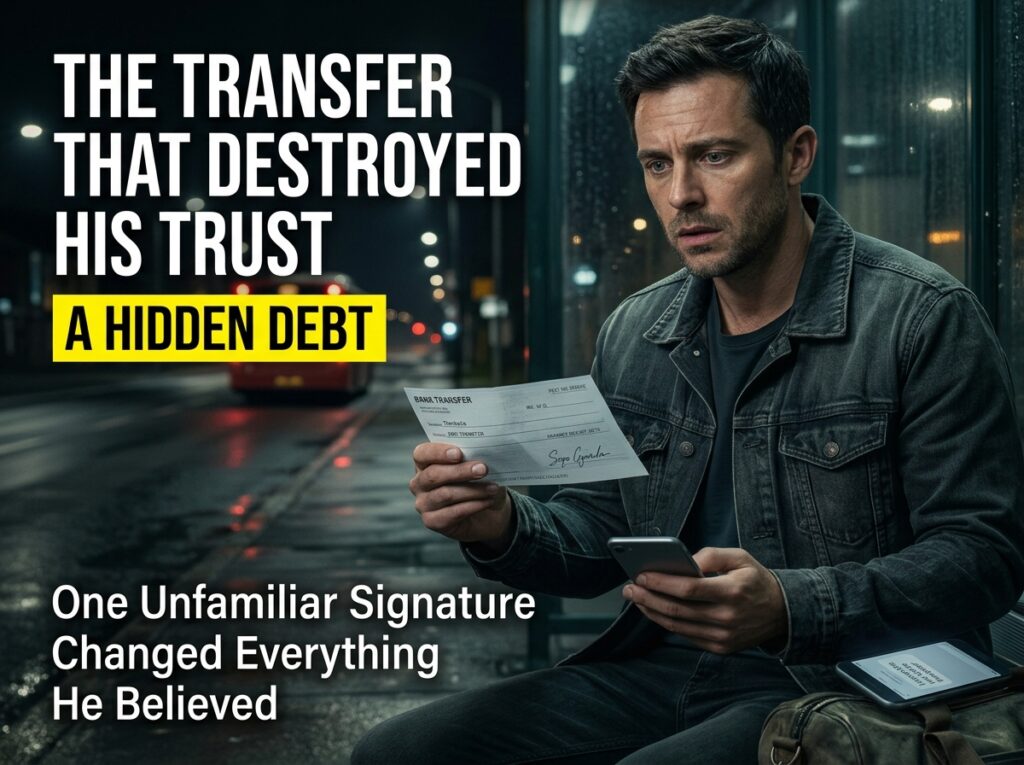
The last bus of the night disappeared around the corner just as Miles reached the stop.
He stood beneath the narrow shelter, watching its red lights shrink into the darkness. The pavement was wet from an earlier shower, and the cold had settled into his clothes after nine hours of work. His shoulders ached, his feet hurt, and his phone battery showed twelve percent.
He had missed the bus by less than a minute.
For most people, that might have been a minor inconvenience. For Miles, it meant waiting nearly an hour for the next service or walking home through streets he would rather avoid at that time of night.
He checked his wallet.
Two small notes and a handful of coins.
He could afford a ride, but doing so would mean having less money for breakfast and the journey to work the following morning. Since the breakup, every small decision had become a calculation.
Miles put the wallet away and sat on the cold metal bench.
Six months earlier, he and his partner had promised that they would never let money become more important than their relationship.
They had made that promise in a tiny kitchen with peeling paint, a refrigerator that rattled through the night, and a table that wobbled whenever either of them leaned on it.
They were not wealthy. Some weeks, they struggled to pay every bill on time. They bought discounted groceries, postponed replacing worn-out shoes, and occasionally ate the same inexpensive meal two evenings in a row.
But they had laughed together.
When the electricity bill arrived, they placed it beside the kettle and promised to work out a solution. When one of them had a difficult day, the other made tea. When the cupboards were nearly empty, they turned dinner into an excuse to sit together longer.
Miles had believed those small acts meant something permanent.
He had believed that if two people continued choosing each other, they could survive almost anything.
Then the arguments began.
At first, they were ordinary disagreements about money. A payment was late. A bill was larger than expected. His partner promised to contribute more the following week, then came home looking exhausted and said something had gone wrong.
Miles accepted the explanations.
He knew his partner had been under pressure. He had been struggling too, and neither of them had much energy left at the end of the day.
But the financial problems continued.
Money disappeared from their shared account. Promises became vague. Conversations that once lasted an hour ended after a few uncomfortable sentences.
Whenever Miles asked what was happening, his partner insisted that everything would be fine.
“Just give me a little more time,” they would say.
He always did.
Until the night they separated.
There had been no dramatic scene, no broken plates, and no shouting that could explain what happened afterward. They had stood in the kitchen with two unpaid bills on the table and an unfinished meal between them.
His partner had looked at him with an expression he could not understand.
“I can’t keep doing this,” they had said.
“Doing what?”
“Living like this.”
“We’ve been through worse.”
“Maybe you have.”
The answer had hurt more than Miles wanted to admit.
He asked whether there was someone else. His partner said no.
He asked whether they had stopped loving him.
There was a long silence.
“I don’t know how to fix things anymore,” they had finally replied.
Miles had wanted to reach across the table, take their hand, and remind them of everything they had survived together.
Instead, he watched them pack a small bag.
They promised they would talk again when things had settled down.
They never explained what that meant.
The first few days after the separation were filled with messages that went unanswered. Miles sent questions, apologies, and requests for a proper conversation. Eventually, the replies stopped altogether.
He tried to convince himself that the relationship had ended because they were both exhausted by poverty.
It was painful, but at least it made sense.
Then he found the transfer slip.
The bus shelter’s fluorescent light flickered above him as he remembered where the paper had come from.
Two days earlier, he had returned to the small storage cupboard he used for his remaining belongings. He had been searching for an employment document when he discovered a folded envelope inside the pocket of an old coat.
The envelope contained several receipts, a faded photograph, and a transfer slip.
At first, he thought it was another household payment.
Then he noticed the signature.
It belonged to someone he did not recognize.
The transfer had been made during the weeks when their finances had begun to collapse. The amount was large enough to explain several missing payments, and the reference number suggested that the money had gone somewhere neither of them had ever discussed.
Miles had spent the following evening checking his old bank records.
The numbers matched.
The date matched.
And the transaction had taken place before his partner announced that the relationship was over.
That was what frightened him most.
If the transfer had happened after the breakup, he might have dismissed it as something connected to their separate lives.
But it had happened while they were still sharing a home, planning meals, and promising each other that they would get through the difficult months together.
Miles looked down the empty road.
He had spent weeks telling himself that losing the relationship was the hardest part.
Now he was beginning to suspect that the relationship had been built around a truth he had never been allowed to see.
His phone vibrated.
A message from an unknown number appeared on the screen.
If you found the transfer slip, don’t throw it away.
Miles read it twice.
A second message arrived.
You need to speak to the person who signed it before you confront your former partner.
He stared at the screen.
The sender had not identified themselves.
But they knew about the transfer slip.
And somehow, they knew he had found it.
<h2>Part 2</h2>
Miles reached his rented room shortly before midnight.
The room was small enough that he could see nearly everything from the doorway. A narrow bed stood against one wall, a secondhand desk occupied the space beneath the window, and a plastic drawer unit held most of the belongings he had managed to keep after the separation.
He placed his bag on the floor and switched on the desk lamp.
The message remained open on his phone.
You need to speak to the person who signed it before you confront your former partner.
He wanted to reply immediately.
Instead, he put the phone aside and took out the transfer slip.
The paper had been folded into quarters. One corner was torn, and a pale line ran across the center where it had been creased for a long time.
Miles smoothed it on the desk.
The document showed a transfer from an account he recognized. The amount had been moved to another account, but the recipient’s name was only partially visible because the printing had faded.
The signature at the bottom was handwritten.
It was unfamiliar, sharp, and unusually deliberate.
Miles had spent years watching his partner sign documents. He knew the way they formed the first letter of their name, how they hurried through the final strokes, and how their signature tilted upward when they were in a good mood.
This was different.
He checked the date again.
Three weeks before the breakup.
He remembered that period clearly.
They had been behind on rent, and the landlord had already sent a warning. Miles had taken additional shifts, sometimes working late into the night, because he wanted to keep their home.
His partner had told him that a payment from work was delayed.
They had promised the money would arrive soon.
When Miles suggested calling the bank to check their account, his partner became defensive.
“Why are you looking at every little thing I do?” they had asked.
“I’m not. I’m trying to understand where the money went.”
“You think I don’t know we’re struggling?”
“That’s not what I said.”
“Then stop treating me like I can’t handle it.”
The argument had ended with Miles apologizing.
He had believed he was being unfair by asking too many questions.
Now he wondered whether that guilt had been convenient for someone who wanted him to stop asking.
He opened his bank records on the computer.
The transfer was visible, but the destination account belonged to a person he did not know. He could see the amount and date, yet the description offered no explanation.
He compared it with the household expenses.
The transfer had occurred shortly before their rent payment was missed.
It also preceded the day his partner had told him that their finances were under control.
Miles sat back.
He did not want to believe that the person he had loved had deliberately taken money from their shared account without telling him. But the records were difficult to explain any other way.
He checked his phone for old messages.
One conversation caught his attention.
Have you sorted out the payment? he had written.
His partner had replied, Almost. Please don’t worry about it.
He had answered, We need to be honest with each other.
The reply came several minutes later.
I am being honest. I just need time.
Miles remembered reading those words and feeling ashamed of his suspicion.
He had wanted to be supportive. He had wanted to prove that he trusted the person he loved.
But trust had become a reason to ignore what he could see.
He opened the conversation again and checked the date.
It was the same day as the transfer.
He searched further.
A week later, his partner had asked whether he could cover the electricity bill because their contribution would be late.
Another message referred to a payment that had supposedly been delayed.
A third mentioned a financial problem that would be resolved soon.
Each explanation had seemed reasonable on its own.
Together, they formed a pattern.
Miles closed the laptop.
He was angry, but beneath the anger was a more difficult feeling: embarrassment.
He had spent months believing he had failed to keep their relationship together. He had blamed his income, his long shifts, and his inability to provide the comfortable life they had once imagined.
He had wondered whether his partner had left because poverty had made him less attractive, less successful, or less worthy of love.
Now he had evidence that something else had been happening.
He could not yet say what it was.
At one in the morning, he replied to the unknown number.
Who are you?
The answer came almost immediately.
Someone who knows why the money was transferred.
Miles typed another question.
Who signed the slip?
The person took longer to respond.
Finally, a message appeared.
I can tell you, but you must promise not to contact them until we have spoken.
Miles stared at the request.
He did not know the sender. He had no reason to trust them. They could be mistaken, or they could be trying to frighten him.
But they had offered something he had been unable to find for months: an explanation.
He replied.
Where do we meet?
The sender gave him the name of a small café near the city center and suggested the following afternoon.
Before Miles could ask anything else, another message arrived.
Bring the original transfer slip. And don’t tell your former partner about this meeting.
Miles placed the paper back inside the envelope.
He was beginning to understand that the missing money was only the beginning of the mystery.
Someone had made the transfer.
Someone had signed the document.
And someone had been watching long enough to know that Miles had finally discovered it.
<h2>Part 3</h2>
The café was nearly empty when Miles arrived the following afternoon.
Rain clouds hung low over the city, and the windows were covered with a thin layer of condensation. A woman stood behind the counter arranging cups while a radio played softly in the kitchen.
Miles chose a table near the back.
He placed the envelope beside his phone and ordered coffee.
For twenty minutes, no one approached him.
He began to wonder whether he had been foolish to come. The unknown sender might have wanted to frighten him into making a mistake. Perhaps the person who signed the transfer slip had no connection to his former partner at all.
Then a man entered the café.
He was in his late forties, dressed in a dark coat, and carried a worn leather folder beneath one arm. He looked around the room before walking directly toward Miles.
“You’re Miles?”
“Yes.”
The man sat down.
“My name is Daniel.”
“Did you send the messages?”
“I did.”
Miles pushed the envelope across the table.
“Then tell me who signed this.”
Daniel looked at the transfer slip but did not touch it.
“Before I do, I need to ask you something. Did your former partner ever tell you that they were helping someone financially?”
“No.”
“Did they mention a loan?”
“No.”
“Or a debt that belonged to someone else?”
Miles shook his head.
Daniel exhaled slowly.
“Then the story is more complicated than I hoped.”
Miles felt his patience slipping.
“I didn’t come here to hear that. I came because money disappeared from our account, we couldn’t pay our bills, and the person I loved left without explaining why. I found this paper, and now someone is telling me that I need to speak to the person who signed it. I want to know what happened.”
Daniel nodded.
“You’re right. You deserve an explanation.”
He opened the leather folder and removed a second document.
It was a copy of a payment record.
The date matched the transfer slip.
So did the amount.
Daniel placed both papers side by side.
“The money was moved to an account connected to a debt,” he said.
“Whose debt?”
“Someone your former partner knew.”
“Someone in their family?”
Daniel hesitated.
“I believe so.”
Miles felt his stomach tighten.
He thought about the family gatherings he had attended during the relationship. There had been an older relative who rarely spoke about money but seemed to know more about the couple’s finances than Miles considered appropriate.
Whenever the conversation turned to rent or bills, that person would make remarks about responsibility and sacrifice.
Miles had assumed they were simply being judgmental.
Now he wondered whether the comments had been connected to something he had never understood.
“Was the money taken to pay a family debt?” he asked.
Daniel looked down at the documents.
“Part of it was.”
Miles waited.
“What was the rest for?”
“That is what you need to understand before you decide what to do next.”
The answer angered him.
“Everyone seems to know pieces of my life except me.”
“I know.”
“Then stop protecting people who made decisions with my money.”
Daniel leaned back.
“I’m not protecting anyone. I’m trying to make sure you understand the full picture before you confront the wrong person.”
Miles stared at him.
“What does that mean?”
Daniel explained that the transfer slip had been created after someone requested an urgent payment. The account receiving the money was not the final destination. It had been used to settle a debt, but another transaction had followed.
Miles asked whether his former partner had authorized the payment.
Daniel said he could not confirm that from the documents alone.
“Then why are you involved?”
“Because I was asked to help trace the payment.”
“By whom?”
Daniel looked toward the window.
“Someone who believes your former partner has been blamed for something they didn’t do alone.”
Miles felt the room grow smaller.
He had spent weeks trying to determine whether his partner had betrayed him. Now a stranger was suggesting that the financial decision might have involved other people.
He asked whether the person who signed the transfer slip was responsible for the missing money.
Daniel shook his head.
“I don’t know yet.”
“Then what do you know?”
“I know the transfer happened. I know it was connected to a debt. And I know that the date is important because it falls before your relationship ended.”
Miles tapped the paper.
“I already knew that.”
“There’s something else.”
Daniel took a folded note from his folder.
The handwriting looked familiar.
Miles leaned forward.
It was the same handwriting he had seen on the shopping lists and small messages his partner used to leave around their apartment.
He read the note.
If Miles asks about the transfer, tell him I was trying to protect him.
The sentence ended there.
No name.
No explanation.
Miles looked up.
“Where did you get this?”
“It was included with the payment records.”
“Who wrote it?”
Daniel did not answer.
Miles felt a chill run through him.
The note suggested that the person responsible had expected him to discover the transfer eventually. They had even left instructions about what he should be told.
He asked Daniel whether his former partner had written it.
“I can’t say.”
“Can you recognize the handwriting?”
“I can.”
“And?”
Daniel closed the folder.
“I think you should speak to your former partner before you decide what the note means.”
Miles stood.
“I’ve been trying to speak to them for months.”
“I know.”
“Then help me find them.”
Daniel hesitated.
Finally, he wrote an address on the back of a café receipt.
“This is where they were staying the last time I heard from them. I can’t promise they’re still there.”
Miles took the receipt.
He looked at the address, then at the transfer slip.
He had come to the café expecting a name.
Instead, he had learned that the payment was connected to a debt, that someone had tried to prepare an explanation, and that his former partner might have been protecting someone.
He folded the receipt and put it in his pocket.
Before he left, Daniel called after him.
“Miles.”
He turned.
“Whatever you find, remember that the person who made the transfer and the person who signed the paper may not be the same person.”
Miles stared at him.
Then he walked out into the rain.
<h2>Part 4</h2>
The address led to a narrow building above a closed repair shop.
Miles stood on the pavement, looking at the dark windows.
The place appeared empty.
He checked the number on the receipt, then compared it with the building entrance. It matched.
He climbed the stairs.
At the top, he found a row of apartment doors, each marked with a small number. The address Daniel had given him corresponded to the last door on the right.
Miles knocked.
No answer.
He knocked again.
A sound came from inside, followed by the scrape of a chair.
The door opened a few inches.
His former partner stood on the other side.
For a moment, neither of them spoke.
Miles had imagined this meeting so many times that he had prepared entire conversations in his head. He had rehearsed the accusations, the questions, and the words he would use if they tried to dismiss his concerns.
Now, standing face to face, he could barely remember any of them.
His former partner looked tired.
Their eyes widened when they saw the envelope in his hand.
“You found it,” they said.
Miles felt a wave of anger.
“You knew I would.”
They stepped back from the doorway.
“Come in.”
He hesitated before entering.
The apartment was small and sparsely furnished. A table stood near the window, and two chairs had been placed opposite each other. There was a kettle on the counter and a stack of unopened letters beside it.
Miles recognized the handwriting on several envelopes.
His former partner had been receiving bills too.
He sat down.
For several seconds, neither of them spoke.
Finally, Miles placed the transfer slip on the table.
“Tell me what this is.”
His former partner looked at the paper.
“It’s a transfer record.”
“I know that. Tell me why money was moved from our account.”
They closed their eyes.
“I was trying to fix something.”
“What?”
“A debt.”
“Whose debt?”
The silence stretched.
Miles leaned forward.
“Please don’t tell me you need more time. I have spent months waiting for an explanation. I lost my home, my savings, and the person I thought I was building a future with. I deserve to know what happened.”
His former partner looked at him.
“I know you do.”
“Then tell me.”
They began slowly.
Several months before the breakup, a person in their family had approached them with a financial problem. The debt had become urgent, and the person was frightened that it would lead to serious consequences.
At first, the request had been small.
A little money to cover an immediate payment.
A promise to repay it within weeks.
His former partner had agreed because they believed the problem would be temporary.
But the debt was larger than they had understood.
When the first payment failed to resolve it, they were asked for more.
They had already used some of their own savings. Then they had borrowed money. Finally, they had transferred funds from the account they shared with Miles.
They had intended to replace the money before he noticed.
But other bills arrived, and the promised repayment did not happen.
The missing money became a secret.
Then the secret became a series of lies.
Miles listened without interrupting.
“Why didn’t you tell me?” he asked.
“Because I thought I could solve it before it affected you.”
“It affected me the moment you used our money.”
“I know.”
“You let me believe we were struggling because we couldn’t earn enough. I worked extra shifts. I skipped meals. I kept telling myself we would get through it if I tried harder.”
His former partner began to cry.
“I never wanted you to do that.”
“But you let me.”
They lowered their head.
Miles felt the anger inside him change into something heavier.
He had wanted to find evidence that his partner had stopped loving him. That explanation would have been painful, but at least it would have been simple.
Instead, he was discovering a chain of choices made under pressure.
His partner had wanted to help someone.
They had believed the problem could be fixed quietly.
They had hidden the truth because they were ashamed.
And eventually, they had left because the consequences had become too difficult to face.
“Who was the debt for?” Miles asked.
His former partner looked toward the window.
“I can’t tell you everything yet.”
He stood.
“Then we’re finished.”
“Please, Miles.”
“No. You don’t get to decide when I deserve the truth.”
They reached for his hand, then stopped before touching him.
“I am trying to explain.”
“Then explain all of it.”
His former partner took a long breath.
“The person who signed the transfer slip was the person who asked me for help.”
Miles felt his heart beating harder.
“Who?”
They looked directly at him.
Before they could answer, a phone rang from the bedroom.
His former partner went pale.
Miles recognized the ringtone.
It was the same sound that had interrupted their final argument months earlier.
They hurried into the bedroom and answered the call.
He could hear only fragments.
“No, I haven’t told him everything.”
A pause.
“I know what you said.”
Another pause.
Then, more quietly, “You promised me this would end.”
Miles stood in the doorway.
His former partner turned and saw him listening.
For a moment, their face showed pure fear.
They ended the call.
Miles looked at them.
“Who was that?”
They opened their mouth, but no words came.
Then they whispered, “The person who signed the transfer slip is not the person you need to confront first.”
<h2>Part 5</h2>
Miles remained by the bedroom door.
He had expected anger, perhaps another argument, or even a final refusal to explain. He had not expected his former partner to look frightened of the person on the other end of the phone.
“Who do I need to confront?” he asked.
His former partner shook their head.
“I can’t tell you without explaining what happened first.”
“Then start at the beginning.”
They returned to the table.
For several minutes, they sat without speaking. The sound of traffic rose from the street below, and somewhere in the building a door slammed.
Finally, his former partner began to explain the family debt.
The person who had asked for help had been dealing with a financial crisis for longer than anyone in the family knew. They had borrowed money to cover earlier obligations and then borrowed again when they could not repay the original debt.
The amounts had grown.
The deadlines had become more urgent.
And the person had become increasingly desperate.
When they approached Miles’s former partner, they had promised that one final payment would settle everything.
They had said the problem was temporary.
They had insisted that no one else needed to know.
His former partner had believed them.
“I thought I was helping someone get through a terrible situation,” they said. “I didn’t understand how far it had gone.”
“So you gave them our money.”
“Yes.”
“Without asking me.”
“Yes.”
“And when the money wasn’t repaid, you kept hiding it.”
They nodded.
Miles looked at the transfer slip.
“Why did this person sign the document?”
“Because they received the transfer.”
“Then why did Daniel say the person who signed it might not be the person who made the transfer?”
His former partner looked startled.
“You spoke to Daniel?”
“Yes.”
They covered their face with their hands.
“Then he knows more than I thought.”
Miles felt a cold sensation move through him.
“What does that mean?”
His former partner explained that the transfer slip recorded the destination of the money, not necessarily the person who initiated it. The signature had been provided as confirmation that the funds had been received.
But the money had not stayed in that account.
A second transaction had followed.
“Where did it go?” Miles asked.
“I don’t know the complete route.”
“You’re telling me you gave away our money and didn’t even know where it ended up?”
“I thought I knew.”
“What did you think?”
His former partner looked at him.
“I thought it was going toward the debt.”
Miles sat back.
For months, he had believed that his partner had made a single terrible decision. Now it seemed that even they might not know the full consequences of what they had done.
He asked whether the debt had been repaid.
“No.”
“How much is still owed?”
“I don’t know.”
“Who does?”
His former partner hesitated.
“The person who signed the transfer slip.”
Miles felt his patience reach its limit.
“Give me their name.”
They stared at him.
Then they spoke it.
Miles recognized the name immediately.
It belonged to a relative who had been present at several family gatherings. The person had always seemed interested in their financial situation and had repeatedly offered advice about how they should manage their money.
Miles remembered one particular evening when the relative had sat at their kitchen table and asked whether they were saving anything.
His partner had answered that they were trying.
The relative had laughed and said that young couples needed to learn how to make sacrifices.
At the time, Miles had thought the comment was merely insensitive.
Now he wondered whether the person had already known that their money was being used to cover a debt.
He asked his former partner whether the relative had approached them directly.
“Yes.”
“Did they pressure you?”
“Not at first.”
“Then what changed?”
“They said the situation was becoming dangerous. They told me that if the debt wasn’t settled, people would start contacting the family.”
Miles stared at them.
“Was that true?”
“I don’t know.”
The answer disturbed him more than any admission could have.
His partner had acted on promises made by someone whose financial situation they did not understand. They had put their own stability at risk, and then his, without verifying what they had been told.
He looked at the stack of unpaid letters on the counter.
“You were so worried about protecting this person that you left me to deal with the consequences.”
His former partner nodded.
“I know.”
“Did you ever think about telling me the truth after we separated?”
“Every day.”
“Then why didn’t you?”
“Because I thought you would come after them. I thought you would confront them, and the whole family would turn against you.”
Miles shook his head.
“You don’t get to protect me by deciding what I can handle.”
“I understand that now.”
He wanted to believe them.
But he remembered the months of silence, the unanswered messages, and the way he had blamed himself for the relationship’s collapse.
He could not forget those things simply because the explanation had finally arrived.
His former partner opened a drawer and removed a small envelope.
“This is the last message I received from the person who asked for the money.”
Miles took it.
Inside was a printed message and a short handwritten note.
The message read:
You agreed to help me. You cannot change your mind now. If Miles finds out, you must tell him that the transfer was your decision and that no one else was involved.
Miles read the words again.
The message did not prove that the relative had planned the financial damage from the beginning.
But it showed that they were trying to control what his former partner would say.
He looked at the handwritten note.
The signature was the same one he had found on the transfer slip.
And beneath it was a sentence that made his hands go cold.
If he asks why you left, tell him you chose to.
<h2>Part 6</h2>
Miles read the sentence several times.
If he asks why you left, tell him you chose to.
It was not simply a request to keep the financial problem secret.
It was an instruction to make the breakup appear to be a personal decision, unrelated to the debt or the transfer.
Miles looked up.
“Did you agree to this?”
His former partner did not answer immediately.
“At first, I thought I could protect everyone by taking responsibility.”
“Everyone except me.”
They flinched.
“I know how that sounds.”
“It sounds like exactly what happened.”
His former partner explained that the relative had insisted the family debt would be settled soon. They had been told that the transfer was necessary to prevent a larger problem, and that revealing the truth would create unnecessary conflict.
They had been frightened.
They had also been ashamed.
Rather than tell Miles what was happening, they had convinced themselves that they could absorb the consequences alone.
When the money failed to return, they began to panic.
The rent was overdue. The household bills were accumulating. Miles was working extra shifts and asking questions that they no longer knew how to answer.
They had felt trapped between telling him the truth and continuing the deception.
Eventually, they chose to leave.
“I thought you would be better off without me,” they said.
Miles stared at them.
“That was never your decision to make.”
“I know.”
“Do you?”
They nodded, crying quietly.
“I know now.”
Miles wanted to ask whether the relative had threatened them. He wanted to know whether there had been pressure beyond the fear of family conflict.
But he also knew that he needed evidence rather than assumptions.
He asked for the messages, payment records, and any documents connected to the debt.
His former partner gathered what they had.
There were several printed statements, a copy of a loan agreement, and messages exchanged with the relative. Some were incomplete, and others referred to conversations that had taken place in person.
Miles studied the dates.
The first request for money had come months before the transfer slip was created.
The relative had promised repayment within a few weeks.
Then another request appeared.
The explanation changed.
A deadline was moved.
A new problem emerged.
Each message seemed to push the final repayment further into the future.
Miles recognized the pattern.
It was similar to the promises his partner had made about their household finances, but the original pressure had come from someone else.
He could see how the situation had developed.
That did not make his partner’s choices acceptable, but it helped him understand how they had become entangled in a problem they were afraid to reveal.
He placed the documents in a neat pile.
“Did you ever tell the relative that you couldn’t pay any more?”
“Yes.”
“What did they say?”
“They told me that if I stopped helping, I would be responsible for what happened next.”
Miles felt anger rising again.
“That isn’t a reasonable thing to say to someone.”
“I know.”
“Did they threaten you?”
His former partner looked down.
“Not directly.”
The distinction mattered.
Miles did not want to assume more than the evidence showed, but he could see that the relative had used guilt and fear to pressure someone who was already struggling.
He asked whether they had told anyone else.
“No.”
“Not even Daniel?”
“I only spoke to him after the breakup, when I was trying to understand where the money had gone.”
Miles remembered Daniel’s warning.
The person who made the transfer and the person who signed the paper might not be the same person.
Now he understood why.
His former partner had initiated the transfer. The relative had received the funds. But someone else might have controlled the next step.
“Who was the money ultimately sent to?” he asked.
“I don’t know.”
“Did you ask?”
“Yes. They said it had gone toward the debt.”
“And you believed them?”
“I wanted to.”
Miles looked at the documents.
He had come searching for a clear answer: someone had taken the money, someone had hidden the truth, and someone had left him to suffer the consequences.
The reality was more complicated.
His former partner had made a decision without permission. The relative had pressured them and accepted the money. The destination of the funds remained uncertain.
There were several people who might have contributed to the financial disaster, but only some of their actions were documented.
Miles decided that he would not make accusations until he understood the records.
He asked his former partner to let him keep copies of the documents.
They agreed.
Before he left, he turned to them.
“I need you to understand something. I can feel sorry for what happened to you without pretending you did nothing wrong.”
They nodded.
“I know.”
“And I can’t promise that we’ll get back together.”
“I understand.”
Miles placed the transfer slip inside his folder.
He had finally learned why the relationship had ended, at least in part.
But the money still had no complete explanation.
And the relative who had signed the transfer slip had yet to answer a single question.
<h2>Part 7</h2>
Daniel agreed to meet Miles again two days later.
This time, Miles brought copies of every document his former partner had provided.
Daniel examined the transfer slip, the loan agreement, and the printed messages.
As he read, his expression grew more serious.
“Where did you get these?”
“From my former partner.”
“Did they explain who initiated the transfer?”
“Yes. They moved the money because a relative said it was needed to settle a debt.”
Daniel looked at the loan agreement.
“That explains part of it.”
“What’s missing?”
Daniel placed the document on the table.
“The original debt was not the same as the amount transferred. There were additional payments and fees, and the records suggest that the money was moved more than once.”
Miles felt his stomach tighten.
“Are you saying someone took the money?”
“I’m saying the records don’t yet show where all of it went.”
“Can you trace it?”
“Possibly, if the relevant financial institution provides the information through the proper process.”
Miles leaned forward.
“Then we need to do that.”
Daniel nodded.
He explained that the next step would be to organize the records chronologically and distinguish what they could prove from what remained uncertain. If the transfer had been unauthorized or misrepresented, Miles might need professional advice about his options.
Miles listened carefully.
He did not want revenge.
He wanted to understand what had happened and prevent the same pattern from continuing.
Together, they reviewed the transactions.
The first payment had gone to the account listed on the transfer slip. A second transaction had followed several days later. A third appeared to have been used to cover another obligation.
The documents did not identify every recipient.
But they established that the money had not simply vanished.
It had moved through a series of accounts.
Miles looked at the dates.
One transaction had occurred on the morning after the relative promised that the debt would be settled.
Another had taken place on the day his former partner asked him to cover the electricity bill.
The final transaction was dated just before the breakup.
He remembered that morning.
His partner had sat at the kitchen table, staring at a cup of coffee.
When Miles asked what was wrong, they said they were worried about work.
He had offered to help.
They had replied that there was nothing he could do.
Now he understood that the financial problem had already become serious enough to affect their relationship.
He felt a mixture of sadness and frustration.
They had been sitting across from each other, sharing the same table, while one of them carried a secret that neither knew how to discuss.
Daniel placed the papers in order.
“There’s something else,” he said.
He showed Miles a message sent by the relative several days before the breakup.
If anyone asks about the transfer, say it was a private family arrangement. Do not mention the debt.
Miles stared at the words.
“Why would they say that?”
“Perhaps they didn’t want the debt discussed. But we shouldn’t assume the reason without more information.”
Miles appreciated the caution.
He had spent too long filling gaps in the story with the worst explanation he could imagine.
Now he wanted to know what could actually be established.
Daniel suggested contacting the relative directly, preferably in a way that preserved a record of the conversation.
Miles considered the idea.
He was not afraid of confrontation, but he did not want another argument that ended with vague promises and no answers.
He wrote a message.
I found the transfer slip and the records connected to it. I know that money was moved from our shared account to help settle a debt. I would like an explanation of where the money went and why the repayment never happened.
He read the message once more before sending it.
The reply came less than ten minutes later.
You don’t understand what you’re getting involved in.
Miles felt his jaw tighten.
He typed another response.
Then explain it to me.
The relative did not answer.
Instead, a phone call arrived from an unknown number.
Miles answered.
A familiar voice spoke immediately.
“You need to stop looking into this.”
He recognized the relative’s voice.
“Why?”
“Because you don’t know the whole situation.”
“Then tell me the whole situation.”
The person sighed.
“Your former partner should never have involved you.”
Miles felt anger rise.
“They involved me when they used money from our shared account.”
“That was their decision.”
“Was it? Or did you ask them to do it?”
Silence.
Miles waited.
Finally, the relative said, “Meet me tomorrow. I’ll explain what happened.”
The call ended.
Miles lowered the phone.
He had spent months searching for someone who could explain the missing money.
Now the person who had signed the transfer slip was finally willing to meet him.
But the message had not sounded like an invitation to clear up a misunderstanding.
It had sounded like a warning.
<h2>Part 8</h2>
Miles chose a public café for the meeting.
He arrived early and sat near the window, where he could see the entrance. He placed the transfer slip and a notebook on the table, then ordered tea.
He had decided not to argue about the relationship.
That conversation belonged to him and his former partner.
This meeting was about the money, the debt, and the decisions that had affected their household.
The relative arrived ten minutes late.
They looked older than Miles remembered. Their hair had thinned, and their coat appeared too large around the shoulders. But their expression was firm, almost irritated.
They sat down without greeting him.
“I don’t know what your former partner told you.”
“They told me they transferred money because you said the debt needed to be paid.”
The relative looked away.
“That isn’t the whole story.”
“Then tell me the rest.”
They ordered coffee.
For several minutes, they spoke about the family, the financial difficulties, and the pressure that had accumulated over the previous year. The relative admitted that they had been struggling with debt and had asked for help.
They said they had believed they could repay the money.
They had not expected the situation to become so difficult.
Miles listened.
“Why did you ask them to use our shared account?”
“I didn’t tell them to use your account.”
“Did you know the money came from it?”
The relative hesitated.
“Yes.”
“Did you know I hadn’t agreed to it?”
They did not answer.
Miles opened his notebook.
“Where did the money go after you received it?”
The relative explained that part had been used to settle the original debt, while another portion had gone toward overdue payments and fees.
Miles asked for the records.
The relative said they did not have everything.
“Then how do you know the debt was settled?”
“It was supposed to be.”
“That isn’t the same thing.”
The relative’s expression hardened.
“You don’t understand how desperate things had become.”
“Maybe I don’t. But I understand what happened when money disappeared from my account and I wasn’t told why.”
The relative looked down at the table.
For the first time, Miles wondered whether they were ashamed.
They admitted that the debt had not been fully settled. Some payments had been made, but new obligations had accumulated. They had continued asking for help because they believed they could eventually recover financially.
They had also asked Miles’s former partner to keep the situation private.
“Why?” Miles asked.
“Because I didn’t want the family to know how bad things were.”
“So you allowed us to struggle instead.”
“I didn’t want to hurt you.”
Miles almost laughed.
He had heard those words too many times.
His former partner had hidden the transfer because they wanted to protect him. The relative had asked for secrecy because they wanted to protect their reputation. Both had made decisions that affected his life without giving him the chance to respond.
He placed the transfer slip on the table.
“Did you sign this?”
The relative looked at the paper.
“Yes.”
“Did you receive the money?”
“Yes.”
“Did you repay it?”
“Not all of it.”
Miles felt a bitter sense of clarity.
The signature was no longer a mystery.
The relative had received the transfer, but the money had been used to cover a series of financial obligations rather than the single debt they had described.
The relative insisted that they had never intended to cause the breakup.
“I didn’t tell them to leave you,” they said.
“Did you tell them that they had to take responsibility for the transfer alone?”
The relative looked away.
“I told them that they had made the decision.”
“They did make the transfer. But you asked for the money and accepted it.”
The relative did not respond.
Miles took a slow breath.
He had come looking for someone to blame.
Instead, he had found a chain of poor decisions, hidden debts, and people who had convinced themselves that silence would prevent a larger disaster.
He could understand why they had been frightened.
But understanding their fear did not make the consequences disappear.
He asked whether the relative intended to repay the money.
They said they wanted to.
Miles asked for a written repayment plan.
The relative hesitated, then agreed to provide one.
It was not a complete solution. There were still unanswered questions about the transactions and the exact amount that remained outstanding.
But it was the first concrete commitment Miles had received.
As the meeting ended, the relative looked at him.
“I never wanted your relationship to end.”
Miles gathered his documents.
“Then you should have told the truth before it became impossible to hide.”
He left the café without waiting for a reply.
Outside, the rain had stopped.
He stood on the pavement for a moment, feeling the cold air against his face.
The missing money had not been the result of a single mysterious transaction.
It had been the consequence of several people making decisions under pressure and then hiding the results.
Miles could not undo those decisions.
But he could stop allowing other people to determine what he was expected to accept.
<h2>Part 9</h2>
The weeks that followed were difficult, but they were different from the months before.
Miles organized his records and kept copies of every message, payment confirmation, and document connected to the transfer. He sought independent advice about the financial arrangements and began working through the practical steps needed to protect his own finances.
He did not assume that the relative’s promise would solve everything.
He wanted a written plan, clear dates, and proof of any repayments.
His former partner cooperated with the process.
They provided additional documents and acknowledged that the transfer had been made without Miles’s agreement. They also admitted that their decision to hide the truth had made the financial damage worse.
For the first time, their conversations were direct.
They discussed what had happened without pretending that the situation could be fixed by a single apology.
One evening, Miles agreed to meet them again.
They sat in a small park near the bus route he used after work. The air was cool, and the streetlights had just come on.
His former partner looked at him.
“Do you hate me?”
Miles thought about the question.
He remembered the nights he had spent searching for answers, the embarrassment of explaining why he could no longer afford certain things, and the loneliness of believing that someone he loved had simply stopped caring.
He also remembered the truth.
His partner had made a serious mistake. They had hidden it, allowed him to suffer the consequences, and left without explaining why.
But they had not stopped loving him in the way he had once feared.
“I don’t hate you,” he said.
His former partner looked relieved, then uncertain.
“But I don’t know if I can trust you again.”
They nodded.
“I understand.”
“Do you? Because trust isn’t something I can give you just because you feel sorry.”
“I know.”
Miles looked toward the road.
“I spent months believing that if I had worked harder, earned more money, or been a better partner, you might have stayed. I thought the breakup meant I wasn’t enough.”
His former partner’s eyes filled with tears.
“You were enough.”
“Then why did you leave?”
They took a long breath.
“Because I was ashamed of what I’d done. I was afraid you would see me differently. And I was afraid that if I told you the truth, you would try to help me fix everything, even if it meant sacrificing your own future.”
Miles listened.
“I thought leaving would protect you,” they continued. “But I also wanted to escape the moment when you would look at me and know I’d made a terrible decision.”
That admission was painful because it sounded honest.
Miles had spent months wondering whether the person he loved had chosen money over him.
Now he understood that fear and shame had played a part in the decision.
But he also understood something else.
A reason was not the same as an excuse.
He could forgive someone for being frightened without pretending that their actions had been harmless.
“I wish you had trusted me enough to tell me,” he said.
“So do I.”
They sat quietly for a while.
His former partner asked whether there was any possibility of rebuilding their relationship.
Miles did not answer immediately.
He still cared about them. He remembered the laughter, the small acts of kindness, and the life they had imagined together.
But he had changed.
He no longer believed that love required him to accept uncertainty indefinitely. He no longer wanted to carry financial burdens without understanding where they came from. And he no longer wanted to mistake silence for protection.
“I can’t promise that we’ll get back together,” he said. “If we ever try again, it would have to be different. We would have to be honest, even when the truth is embarrassing or frightening.”
His former partner nodded.
“I want that.”
“Wanting it isn’t enough. We would have to do it.”
“I understand.”
Miles stood.
He felt sad, but he did not feel the same desperation that had followed him through the previous months.
He had learned why the transfer had happened, who had received the money, and how the secret had contributed to the breakup.
He had also learned that the person he loved could care about him and still make choices that damaged their relationship.
Those truths were difficult to hold together.
But he no longer needed to simplify the past into a story where one person was entirely innocent and another was entirely cruel.
He could acknowledge what had been good.
He could name what had been wrong.
And he could decide what kind of future he wanted.
Before they parted, his former partner asked whether he would keep the photograph from their early years together.
Miles smiled faintly.
“Yes.”
“Why?”
“Because the good memories were real too.”
They looked at each other for a moment.
Then they said goodbye.
Miles walked toward the bus stop alone.
For the first time since the separation, he was not walking away from a conversation with more questions than answers.
He was walking toward a future he had begun to choose for himself.
<h2>Part 10</h2>
Months later, Miles found himself waiting at the same bus stop where the mystery had begun.
The weather was warmer now. The evenings were longer, and the city no longer seemed quite so hostile after dark.
He had finished another late shift and was waiting for the last bus.
His finances were still tight, but he had begun saving regularly. He had found a more stable room and was making plans to move somewhere larger when he could afford it.
The relative had started making repayments, though the process remained slow. Miles continued keeping records and did not rely on promises alone.
His former partner and he were no longer together.
They had spoken occasionally, but neither had tried to force the relationship back into the shape it once had. They were learning to live with what had happened rather than pretending that an apology could erase it.
Sometimes Miles missed them.
He missed the familiar sound of their footsteps in the apartment. He missed sharing a meal after work and hearing someone ask how his day had gone. He missed the comfort of believing that whatever happened outside their home, they would face it together.
But he no longer confused missing someone with needing to return to them.
That was a difficult lesson.
It was also a necessary one.
He had once believed that love meant surviving anything as long as two people stayed together. Now he understood that survival was not the only measure of a relationship.
Honesty mattered.
Responsibility mattered.
The ability to make decisions together mattered.
Without those things, love could become a place where one person carried the consequences of choices they had never been allowed to understand.
Miles reached into his jacket pocket and found the small notebook he now carried.
Inside were his monthly expenses, work schedules, and reminders about payments.
There were no hidden transfers.
No vague promises.
No unexplained amounts he was expected to ignore.
He smiled at the thought.
The transfer slip was still in his folder at home, safely stored with the other documents. He kept it because it reminded him of the moment he had stopped blaming himself for a mystery he had not created alone.
The unfamiliar signature had led him to the truth.
But the truth had done more than explain the missing money.
It had shown him how fear could turn a temporary problem into a lasting wound. It had shown him that people sometimes made harmful decisions while believing they were protecting someone. And it had taught him that understanding another person’s motives did not require him to accept every consequence of their actions.
The bus appeared at the end of the road.
Miles stood and lifted his bag.
As the vehicle approached, his phone vibrated.
A message from his former partner appeared.
I hope you’re doing well. I’ve been thinking about everything that happened. I’m sorry I made you carry a truth you should have known from the beginning.
Miles read it once.
He did not feel the old rush of anger, nor did he feel compelled to answer immediately.
He placed the phone back in his pocket and boarded the bus.
He would respond when he was ready.
Not because he wanted to punish the person who had hurt him, but because he had finally learned that he did not owe anyone an immediate answer simply because they were uncomfortable waiting.
He took a seat beside the window.
The city moved past in a blur of lights, wet roads, and late-night shops.
Miles thought about the person he had been when he first discovered the transfer slip. He had been frightened that the truth would hurt more than being broke. He had believed that knowing what happened might destroy the last good memories he had of the relationship.
Instead, the truth had helped him separate those memories from the choices that followed.
The love had been real.
The financial decisions had been wrong.
The secrecy had caused harm.
And his future did not have to be determined by any of those things.
When the bus reached his stop, Miles stepped into the cool night air.
He walked toward his room with the steady pace of someone who no longer needed to chase an explanation through every old message and forgotten receipt.
He had answers now.
Not every detail had been resolved, and not every loss could be repaired. But he had learned enough to stop living inside the unanswered questions.
He could continue building a life.
He could care about someone without sacrificing his own stability.
He could forgive without promising to return.
And he could remember the person he had loved without allowing their mistakes to define his worth.
At home, he placed his bag beside the door and opened his notebook.
On the final page, he wrote:
Love should give two people the courage to tell the truth, not the permission to hide it.
He paused, then added another sentence.
I can understand why someone hurt me without deciding that I deserved to be hurt.
Miles closed the notebook.
Outside, a bus passed in the distance, carrying strangers toward homes and futures he would never know.
He turned off the light and lay down.
The transfer slip had once seemed like proof that his life had fallen apart because he had not been good enough to keep someone beside him.
Now it reminded him that another person’s secret was not a measure of his worth.
He had lost a relationship.
He had lost money.
He had lost the future he once imagined.
But he had not lost his ability to begin again.
And this time, he would build his life on something stronger than promises.
He would build it on the truth.