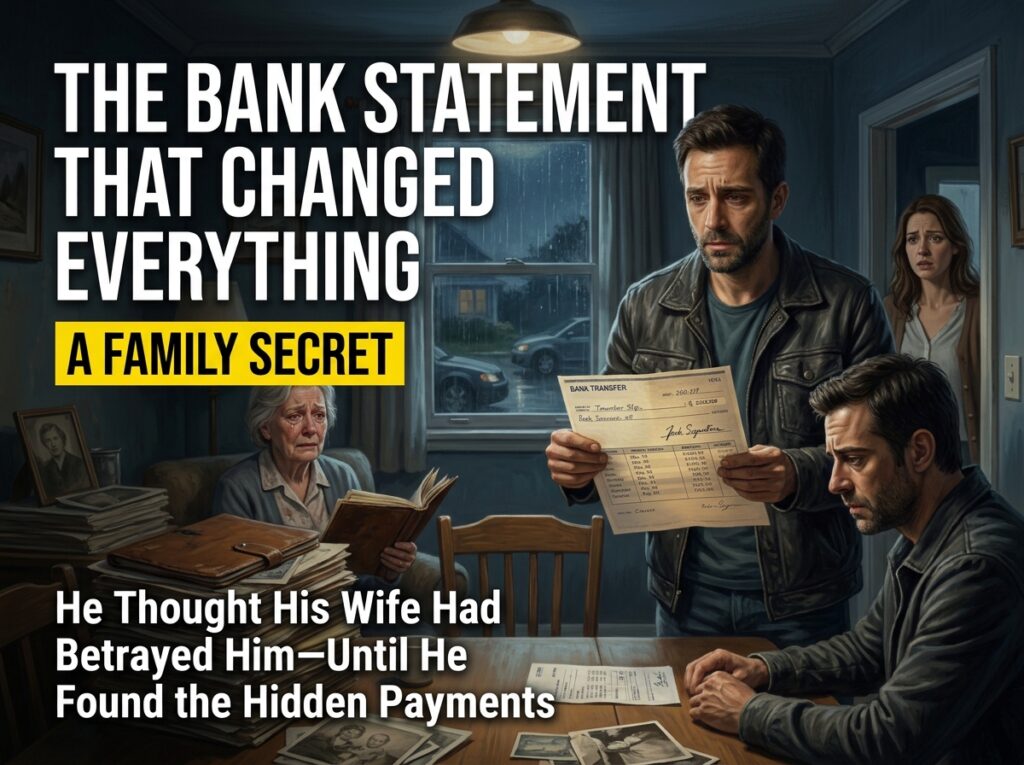
Peter thought the hardest part of losing his wife was learning to survive alone. Then he discovered bank statements showing deposits made every month. Someone had been paying a debt in secret, and the signature on the paper threatened to change everything he believed about their marriage.
Peter did not tell anyone how frightened they were about rent, food, or the possibility of starting over alone. In a dim stairwell outside a locked apartment, an ordinary moment turned into the beginning of a mystery when a bank statement showing deposits made every month appeared among the things left behind by the wife who said their love had run out. After the breakup, I counted every coin and realized the secret seemed to connect our financial trouble to a decision someone had made before the breakup, when I still believed we were planning a life together.
I tried to make sense of it without accusing anyone, because I had already lost enough to know how quickly a conversation could become a goodbye. I nearly threw the paper away before I noticed the signature at the bottom. I checked old messages, dates, and the small details I had ignored while trying to keep us together. Each clue made me question whether the person I loved had been protecting me, using me, or hiding a truth they were too ashamed to say aloud. I was afraid the truth would hurt more than being broke, but not knowing was slowly taking away the last of my peace.
That evening, I went to find the one person who could explain the missing money and the promises that had collapsed with it. They looked at the clue, went pale, and asked me a question that made no sense until I remembered the night we separated. I had come looking for an apology or a reason, but what waited in the final message was far more complicated than either. Then I turned the paper over and saw the name of the person who had paid the debt.
The stairwell smelled of damp concrete, old cooking oil, and the cigarette smoke that drifted through the building whenever someone opened the back door. Peter stood on the third-floor landing with a grocery bag in one hand and the bank statement in the other, staring at the locked apartment door as if it might open and explain why his life had fallen apart.
Three weeks earlier, he had still believed he would grow old with his wife.
Now, he could barely afford groceries.
He placed the bag on the floor and checked his phone. There were no new messages from Anna. The last one she had sent remained at the top of their conversation, a short sentence that had somehow managed to hurt more than all their arguments combined.
I can’t keep doing this anymore, Peter.
He had read those words so many times that he knew exactly where the full stop appeared on the screen.
He had asked her what she meant. He had asked whether there was someone else, whether he had done something unforgivable, whether she needed time away. Anna had answered only once.
I’m sorry. Please don’t make this harder.
Then she stopped responding.
Peter had spent the following days trying to understand how a marriage could end without a proper explanation. They had argued about money, certainly. The rent had increased, his hours at the repair shop had been reduced, and Anna’s part-time work at a medical office had become unpredictable. Every month brought another bill they could not comfortably pay.
But they had faced difficulties before.
When Peter lost his first job, Anna had sat beside him on their kitchen floor and divided their remaining money into envelopes. One was for rent, another for food, and a third for emergencies. There had been almost nothing left for themselves, but they had laughed about it anyway.
“We’ll be all right,” she had told him, pressing an envelope into his hand. “As long as we’re honest with each other, we’ll figure something out.”
He had believed her.
That was why the separation hurt so deeply. It was not simply that Anna had left. It was that the woman who had once promised to face every difficulty beside him had apparently decided he was no longer worth explaining herself to.
Peter bent down to pick up the grocery bag. He had bought bread, rice, eggs, and a small packet of coffee. He had put two items back on the shelf because the total at the checkout had exceeded what he could spend.
He hated thinking that way about every purchase.
He hated checking the balance in his wallet before agreeing to meet someone for coffee. He hated pretending he had already eaten when friends offered him dinner. Most of all, he hated that he could not remember the last time he had slept through an entire night.
He was about to climb the remaining stairs when he noticed a white envelope wedged beneath the metal railing.
At first, he assumed someone had dropped an advertisement. He almost stepped over it. Then he saw his name written across the front.
Peter.
The handwriting was familiar, but he could not immediately place it. He picked up the envelope, turned it over, and discovered that it had not been sealed.
Inside was a bank statement, folded twice.
He unfolded it carefully.
The statement showed a series of deposits, each recorded on the same date of the month. The amounts varied slightly, but the pattern was unmistakable. Someone had been putting money into an account regularly, month after month.
Peter read the first date.
Then the second.
Then the third.
The deposits had begun long before Anna left him.
He checked the account details, hoping to recognize the account holder, but the name was not one he expected. At the bottom of the page, beneath a line of small printed information, someone had signed by hand.
Peter stared at the signature.
His stomach tightened.
He knew that handwriting.
He had seen it on birthday cards, old letters, and the back of photographs kept in his mother’s cupboard.
It belonged to someone who had been part of his life long before Anna.
Someone he had not spoken to in years.
He turned the paper over, searching for an explanation. There was nothing except a short handwritten note.
If Peter ever finds this, he deserves to know what happened.
The stairwell seemed to grow colder.
Peter read the sentence again, then looked toward the apartment door. Anna’s belongings were gone, the rooms beyond that door were silent, and the person who had written the note had apparently known that the statement would eventually reach him.
He put the paper in his coat pocket.
For the first time since Anna had left, he felt something stronger than grief.
He felt afraid of what he might discover.
Because if the deposits had been made for years, someone had known about a debt Peter had never understood—and had been paying it while he and Anna struggled to keep their home.
And if that person had kept the secret from him, there had to be a reason.
Peter did not sleep that night.
He sat at the small table in the room he had rented after leaving the apartment, spreading the bank statement beneath the yellow light of a desk lamp. The room contained a narrow bed, a wardrobe with a broken handle, and a chair that creaked whenever he leaned forward. Rain tapped against the window, and the heating system made a faint knocking sound every few minutes.
He had chosen the room because it was cheap.
He had stayed because he could not afford anything better.
The bank statement lay in front of him like evidence from a crime he did not remember witnessing.
There were deposits from several years earlier, then more recent ones. Some were small enough to look ordinary. Others were large enough to cover a month of rent. Every few months, the amount changed, but the payments never stopped.
Peter wrote the dates on the back of an old receipt.
Then he opened his phone and searched through his messages with Anna.
Their conversation had become a record of everything he had failed to understand. There were photographs of meals they had cooked together, reminders about appointments, jokes about the neighbor who played music too loudly, and arguments about money that had seemed insignificant at the time.
He found a message from four years earlier.
The payment went through. Don’t worry about it.
He remembered receiving it. Anna had been sitting beside him on the sofa while he tried to understand why their electricity bill was higher than expected. He had assumed she was talking about the rent.
Another message, sent six months later, read:
I’ve handled the account. Please don’t ask me about it tonight.
At the time, he had been exhausted after a double shift. He had replied with a simple heart and gone to bed.
Peter felt ashamed as he scrolled through the conversation.
He had not ignored those messages because he did not care about Anna. He had ignored them because he trusted her. He believed that a marriage meant dividing responsibilities according to what each person could manage. If she said she had handled something, he did not demand a full explanation.
Now he wondered whether his trust had allowed a secret to grow.
He called his older brother, Daniel, shortly after seven in the morning.
Daniel answered on the fourth ring.
“Peter? Is everything okay?”
“I need to ask you something.”
“What’s happened?”
“Do you recognize this name?”
Peter read the signature aloud.
For several seconds, Daniel said nothing.
Then he asked, “Where did you get that?”
Peter sat straighter. “So you know who it is?”
“Tell me where you found it first.”
“In the stairwell outside the apartment. It was on a bank statement. There are deposits going back years.”
Daniel exhaled sharply.
“Peter, listen to me. Don’t start calling people until we talk properly.”
“Why?”
“Because you don’t know the whole story.”
“Then tell me.”
“I can’t explain everything over the phone.”
Peter pressed his free hand against his forehead. “Everyone keeps saying that. Anna said she couldn’t explain. Now you’re telling me the same thing. I’m tired of being the last person to know what’s happening in my own life.”
“I understand.”
“No, you don’t. I have bills I can’t pay, a marriage that ended without an explanation, and a bank statement that suggests someone has been paying a debt behind my back. What am I supposed to do with that?”
Daniel was silent again.
Finally, he said, “Meet me at the café near the old bus station. Ten o’clock.”
“Will you tell me the truth?”
“I’ll tell you what I know.”
Peter arrived fifteen minutes early. He ordered coffee he could barely afford and chose a table beside the window. Every time someone entered, he looked up.
Daniel arrived at ten past ten, carrying a worn leather folder.
He looked older than Peter remembered. There were gray strands in his hair, and the lines around his eyes seemed deeper. He sat down without removing his coat.
Peter placed the statement between them.
Daniel looked at it, and the color drained from his face.
“Where did you get this?” he asked.
“I already told you.”
Daniel ran a finger along the edge of the paper.
“These payments started before you and Anna were married,” he said quietly.
“I know.”
“And you never knew about them?”
“No.”
Daniel opened the folder but did not take anything out.
“Then there’s something you need to understand. The debt wasn’t originally Anna’s.”
Peter felt his heart begin to pound.
“Whose was it?”
Daniel looked toward the café door, as though he expected someone to walk in.
Then he leaned forward.
“Before I tell you, I need to know something. Did Anna ever mention a promise your father made before he died?”
Peter stared at him.
Their father had been dead for eleven years. Peter had spent most of his adult life believing he understood the circumstances surrounding his final years.
“What promise?” he asked.
Daniel closed the folder.
“That’s what I was afraid you’d say.”
Peter had not heard anyone mention his father in connection with money for years.
His father, Michael, had been a quiet man who repaired household appliances from a small workshop behind their family home. He believed that a person should pay what they owed, keep their promises, and never make someone else suffer for a mistake they had made themselves.
He had also been a difficult man to understand.
When Peter was young, he sometimes disappeared for an entire afternoon without explaining where he had gone. His mother would say he had business to attend to, and Daniel would change the subject whenever Peter asked questions.
After Michael died, the family sorted through his workshop, donated his old tools, and divided the few belongings that remained. Peter kept a watch that no longer worked. Daniel took a wooden toolbox. Their mother kept the papers.
No one mentioned a debt.
“What promise are you talking about?” Peter asked.
Daniel rubbed his face. “Your father borrowed money from someone. A substantial amount. He believed he could repay it, but things went wrong.”
“What things?”
“I don’t know every detail.”
“You expect me to believe that?”
“I’m telling you what I know.”
Peter pushed the statement toward him. “Then explain the deposits.”
Daniel studied the dates again.
“Your father wasn’t the person making these payments. The deposits began after he died.”
Peter felt the room tilt around him.
“Who started them?”
Daniel did not answer immediately.
“Your mother knew about the debt,” he finally said. “She was afraid it would fall on you. She didn’t want you growing up believing you had inherited your father’s mistakes.”
“But I never inherited a debt.”
“That’s what you were told.”
Peter stared at him. The café’s background noise seemed distant now, reduced to the clatter of cups and the murmur of conversations at other tables.
“How much?”
Daniel hesitated.
“Peter, the original amount was large enough that your mother couldn’t repay it herself. Someone agreed to help.”
“Who?”
“I don’t know whether I should tell you that.”
Peter almost laughed. “You called me here because you wanted me to stop asking questions, didn’t you?”
“No.”
“Then stop deciding what I can handle.”
Daniel opened the leather folder and removed a faded photocopy of a document. The paper had been folded so many times that the creases were nearly torn through.
Peter recognized his father’s handwriting immediately.
The document listed an amount borrowed, several dates, and a repayment arrangement. At the bottom was Michael’s signature.
Beside it was another signature.
The same one Peter had found on the bank statement.
He read the name silently.
It belonged to his mother’s younger sister, Margaret.
Peter had not seen Margaret since he was a teenager. After his father’s funeral, she had argued with his mother in the kitchen. The argument had grown so bitter that Margaret left the house and never returned.
Peter remembered standing in the hallway while his mother cried behind the closed kitchen door.
When he asked what had happened, she told him that adults sometimes disagreed about things children could not understand.
He had accepted the explanation because he had no reason not to.
“Margaret paid the debt?” he asked.
“Some of it, apparently.”
“Why didn’t she tell us?”
Daniel shook his head. “There were reasons.”
“Everyone seems to have reasons.”
Peter studied the document again. The dates did not match what Daniel had said. The earliest payments on the bank statement had been made several years after Michael’s death, but the agreement appeared to have been written much earlier.
There was another problem.
The name of the person who had received the original loan was not visible on the photocopy. The space had been covered by a dark mark, perhaps made by a damaged copier.
“Where did you get this?”
“Your mother gave it to me a long time ago.”
“Why?”
“She asked me to keep it safe.”
Peter stood so abruptly that his chair scraped across the floor.
“You’ve had this all these years?”
Daniel looked down.
“I thought protecting you was the right thing to do.”
“From what? A debt that someone else was paying?”
“From a truth that could have destroyed the family.”
Peter gathered the statement and the photocopy.
“Then maybe the family deserved to know the truth.”
He walked out before Daniel could stop him.
Outside, the rain had begun again. Peter stood beneath the café awning, trying to breathe normally.
Margaret had paid the debt.
His mother had hidden the agreement.
Daniel had known about it.
And Anna, the woman who had left him without an explanation, had apparently been connected to the same mystery.
Peter took out his phone and searched for Margaret’s number.
The number he remembered was no longer in service.
He called his mother instead.
When she answered, he did not bother with a greeting.
“Mom, I need to ask you about Aunt Margaret.”
The silence that followed was so long that he checked whether the call had disconnected.
Then his mother whispered, “Where did you find the papers?”
Peter’s mother lived in a small house on the other side of town, in a neighborhood where the gardens were carefully maintained and the streets became quiet after sunset.
He arrived that afternoon carrying the bank statement and his father’s old agreement.
His mother, Helen, opened the door before he could knock a second time. She wore a cardigan over a house dress and held a dish towel in one hand.
She looked at the papers and closed her eyes.
“I hoped you would never have to see those,” she said.
Peter stepped inside.
“Why?”
“Because some things don’t become better when they’re brought back into the light.”
“Someone has been making payments for years. Anna left me, and now I find out there’s a debt connected to Dad. I deserve to know what’s happening.”
Helen led him to the kitchen.
The room smelled of tea and freshly baked bread. Everything looked exactly as it had when Peter was a child: the wooden table, the faded curtains, the small crack in the tile beside the sink.
For a moment, he remembered coming home from school and finding his mother waiting with a plate of sandwiches. Back then, the world had seemed uncomplicated.
Now even familiar rooms felt like places where important conversations had been deliberately avoided.
Helen sat opposite him.
“Your father borrowed the money because he wanted to help someone,” she began. “He thought the loan would be temporary. He believed he could make everything right before anyone found out.”
“Who was he helping?”
She folded the dish towel.
“I can’t tell you that without explaining what happened afterward.”
“Then explain it.”
Helen looked toward the window.
“Your father made a promise to Margaret. He promised that if anything went wrong, he would protect the person who depended on him. When the debt became impossible to manage, Margaret offered to pay it herself.”
“Why would she do that?”
“Because she loved him.”
Peter frowned.
“She loved Dad?”
“Not in the way you’re thinking. She loved him as family. Your father had helped her when she was young, and she felt she owed him more than money could repay.”
Helen’s voice began to tremble.
“He refused at first. He said he would never allow his mistakes to become her burden. But Margaret insisted. They argued for weeks. Eventually, they reached an agreement.”
Peter tapped the statement.
“She made these deposits?”
“Yes.”
“Then why did you tell everyone she had abandoned us?”
Helen’s face changed.
“I never said she abandoned us.”
“You told me she wanted nothing more to do with the family.”
“I told you she couldn’t come back.”
“That’s not the same thing.”
Helen looked away.
Peter realized that she was not simply remembering a painful event. She was deciding which parts of it she could bear to reveal.
“What happened after Dad died?” he asked.
His mother pressed her hands together.
“Margaret kept paying. She believed your father had left behind a responsibility that needed to be fulfilled. But the person receiving the money demanded more. There were additional charges, fees, and promises that had never been part of the original agreement.”
“Why didn’t she go to the police?”
“She was afraid.”
“Of whom?”
Helen shook her head.
“I don’t know how much she knew. I only know she believed that if she stopped paying, someone would come looking for you.”
Peter felt cold despite the warmth of the kitchen.
“Me?”
“Your father had written your name in one of the papers. Margaret thought it meant you might become responsible for the debt.”
“Was I?”
“No. Not legally, as far as I understood. But Margaret didn’t want to take the risk.”
Peter looked again at the statement.
The payments had continued after he became an adult, after he met Anna, and even after they began struggling to pay their own bills.
Someone had been sacrificing money every month to protect him from a threat he had never known existed.
But the mystery still made no sense.
“How did Anna become involved?”
Helen’s eyes filled with tears.
Peter leaned forward.
“Mom?”
She reached across the table and held his hand.
“Anna came to see me two years ago. She had discovered something about the debt. She said she wanted to help Margaret finish what she had started.”
Peter pulled his hand away.
“Two years ago?”
Helen nodded.
“Anna asked me not to tell you. She believed you would refuse the help if you knew where the money was coming from.”
“She knew about the payments?”
“She knew about some of them.”
Peter struggled to understand what he was hearing.
For two years, while he and Anna planned their future, she had known that someone was paying a debt connected to his father. She had apparently helped manage the secret while allowing him to believe their financial problems were simply the result of bad luck.
“Why would she hide that from me?”
Helen opened her mouth, then closed it again.
“I don’t know.”
Peter stood.
“You’re my mother. You know more than you’re telling me.”
“I know that Margaret was trying to protect you.”
“From what?”
His mother looked at him with an expression he had never seen before: not merely sadness, but fear.
“From the person who originally lent your father the money.”
Peter waited.
Helen finally spoke.
“That person never stopped looking for what they believed your father owed them.”
Peter left his mother’s house with more questions than answers.
He drove to the repair shop where he worked, parked behind the building, and sat with the engine switched off. His phone showed three missed calls from Daniel and one message from Anna.
He had not received a message from her in nearly a month.
For several seconds, he simply stared at her name.
Then he opened the message.
Peter, I know you may have found something that doesn’t make sense. Please don’t assume you know why I left. I wanted to explain, but I couldn’t find a way to do it without hurting you.
There was no date indicating when she had written it. It had arrived only minutes earlier.
Peter typed a response, deleted it, and typed another.
Did you know about the debt?
He sent it.
The message showed as delivered.
He waited.
At the repair shop, the other workers began arriving. A truck reversed into the loading area, and someone called his name from the office. Peter ignored them both.
Finally, Anna replied.
Yes.
One word.
Peter read it until the letters seemed to blur.
He typed again.
How long?
This time, her response took several minutes.
Longer than I should have kept it from you.
He wanted to call her. He wanted to ask why she had let him struggle, why she had watched him count coins for groceries while money was being transferred elsewhere. He wanted to know whether their arguments had been real or whether she had been preparing to leave him all along.
But he remembered how their last conversations had ended.
He could not bear another unanswered question.
Instead, he wrote:
I need the truth. All of it.
Anna replied with an address and a time.
They would meet the following evening at a small café near the river, a place they had visited during the first year of their marriage.
Peter almost refused.
He remembered sitting across from her at that same table, sharing a slice of cake because neither could afford two. Anna had laughed when he tried to make the waiter believe they had ordered separate desserts.
“You always make things more complicated than they need to be,” she had told him.
“And you always find a way to make me smile,” he had answered.
They had walked home holding hands.
Peter wondered whether she remembered that evening as fondly as he did.
The following evening, Anna arrived ten minutes late. She wore a dark coat and carried a small handbag. Her hair was shorter than he remembered, and there were shadows beneath her eyes.
She stopped beside the table when she saw him.
“Thank you for coming,” she said.
Peter did not stand.
“You said you wanted to explain.”
“I do.”
“Then start with the money.”
Anna sat down slowly.
For a while, neither of them spoke. The waiter approached, but Peter shook his head. Anna ordered tea, then wrapped both hands around the cup as if she needed something to hold.
“I found out about the debt when Margaret contacted me,” she began. “She was afraid she couldn’t keep up with the payments. She had been using almost all her savings.”
“Why you?”
“Because she knew I worked with financial records. She wanted someone to help her understand what she still owed.”
“Did you know the debt was connected to my father?”
“Yes.”
“Did you know he had borrowed the money?”
“Not at first. Margaret showed me the agreement.”
Peter leaned back.
“And you decided I shouldn’t know?”
Anna looked down at her tea.
“At first, I thought it was temporary. I thought we could help Margaret settle the account, and then we could tell you everything when it was over.”
“How much did you pay?”
“Some of the money came from my savings. Some came from extra work. I also arranged payments through an account Margaret had access to.”
Peter thought about their unpaid bills.
“You used our money.”
Anna closed her eyes.
“I used some of it.”
“Without asking me.”
“Yes.”
The admission landed between them with a weight that no apology could immediately lift.
Peter had spent weeks wondering whether Anna had been protecting him or using him. Now he knew that she had made a decision that affected their shared finances without his consent.
Whatever her reasons, the betrayal was real.
“Why didn’t you tell me when the bills started piling up?” he asked.
“Because I thought I could fix everything before you noticed.”
“You watched me sell my tools.”
“I know.”
“You watched me work extra shifts until I could barely stand.”
Tears gathered in her eyes.
“I know, Peter.”
“Then why?”
Anna looked at him.
“Because the person demanding the money told me that if we stopped paying, they would come after you.”
Peter’s anger faltered.
“Who told you that?”
She reached into her handbag and took out a folded letter.
“I never told you about the threats,” she whispered. “I didn’t even tell Margaret everything. I thought I could handle it alone.”
Peter took the letter.
The handwriting was unfamiliar, but the final line was unmistakable.
The debt must be settled before the person you are protecting discovers what his father really signed.
Peter looked up.
“What did my father sign?”
Anna shook her head.
“That’s the part I never found out.”
Then she told him something that made him forget every question he had prepared.
“Peter, I didn’t leave because I stopped loving you. I left because someone told me that staying with you would make you the next person they came after.”
Peter read the letter three times before he could speak.
The paper was ordinary, folded into quarters, with no return address. It contained no explicit threat of violence, but its meaning was clear enough. Whoever had written it knew about the debt, knew about Anna’s attempts to manage it, and believed that Peter’s father had signed something that could still be enforced.
“Why didn’t you show this to the police?” Peter asked.
“I considered it.”
“And?”
“Margaret begged me not to. She said the person had documents that could make it look as though your father had knowingly accepted the debt. She was afraid the investigation would expose things about your family that she had spent years trying to protect.”
Peter shook his head.
“That’s not a reason to keep me in the dark.”
“I know.”
“Do you? Because you made decisions about my life without letting me choose anything for myself.”
Anna flinched.
He regretted the sharpness of his voice, but he could not withdraw the words. They were true.
“I thought I was helping,” she said. “Every time another payment came due, I told myself that if I could just get through the next month, things would improve. Then another letter arrived. Another amount appeared. It never ended.”
“How much did you pay?”
Anna gave him a figure.
Peter felt sick. The amount was greater than he had imagined. It explained the empty cupboards, the overdue notices, the arguments about groceries, and the way Anna had begun turning down invitations from friends.
But it did not explain why she had left without telling him the truth.
“What happened the night we separated?” he asked.
Anna stared into her tea.
“I had received another letter. It said the next payment would be due within a week, and if I couldn’t pay it, the person would contact you directly.”
“So you left.”
“I thought if you believed our marriage was over, you would stop being involved in whatever I was doing.”
“You thought abandoning me would protect me?”
“I thought you would be angry enough to stay away.”
Peter let out a bitter laugh.
“You could have trusted me enough to tell me.”
“I was afraid.”
“So was I.”
Anna looked up.
For the first time, he saw that her fear had not disappeared when she left him. It had simply changed shape. She had been carrying it alone, just as he had been carrying his confusion.
“I know I hurt you,” she said. “I’m not asking you to forgive me. I only wanted you to understand why I made the choice I made.”
Peter folded the letter and placed it beside the bank statement.
“Who was the person who sent this?”
“I don’t know their full identity. The letters were signed with initials.”
“Do you still have them?”
“Some.”
“Where?”
Anna hesitated.
“Margaret kept the originals. She said she would give them to me when she had finished checking the account.”
“Then we need to find her.”
Anna looked frightened again.
“I don’t know where she is.”
“What do you mean?”
“She stopped answering my calls about six weeks ago. The last time I saw her, she said she had to travel to settle something. She promised she’d contact me when she returned.”
Peter remembered the handwriting on the bank statement. The note had been written by someone who knew he might discover the account. Perhaps Margaret had left the paper where he would find it deliberately.
“Did she know you were leaving me?”
Anna nodded.
“She begged me not to go. She said we should tell you everything together. But I was terrified that the person behind the debt would act before we could explain.”
Peter looked at the letter again.
The message had made one thing clear: someone had been watching the payments and waiting for the secret to surface.
He could no longer treat the debt as a private family disagreement.
He photographed the letter, saved the image, and asked Anna to forward every message she had received. She sent him copies of several emails, two photographs of handwritten notes, and a scanned document containing the original repayment schedule.
The document showed that the debt had been secured against something.
Peter enlarged the image on his phone.
The wording was difficult to read, but he recognized the address.
It was the address of his childhood home.
The house where his mother still lived.
His father had not merely borrowed money. He had apparently used the family property as security.
Peter stood so quickly that his cup rattled against its saucer.
“Does my mother know about this?”
Anna looked at the screen.
“She told me the house was never supposed to be at risk.”
“That isn’t what the document says.”
“I know.”
Peter felt the old fear returning, stronger this time.
If the debt was secured against the house, the payments might not have been intended simply to repay money. They might have been preventing someone from claiming the property.
He called Daniel.
When his brother answered, Peter asked one question.
“Does Mom know Dad used the house as security for the loan?”
Daniel did not answer immediately.
Then he said, “Peter, you need to come home.”
Peter’s stomach tightened.
“Why?”
“Because someone has been there asking about the property.”
Peter drove to his mother’s house with Anna sitting beside him.
They barely spoke during the journey. Rain streaked the windshield, and the headlights of oncoming cars blurred across the wet road. Peter kept thinking about the document, the payments, and the possibility that his father had placed the family home at risk without telling anyone.
He had spent his childhood believing the house belonged to them.
It was where his mother had measured his height against a kitchen doorframe. It was where Daniel had taught him to ride a bicycle in the driveway. It was where his father had repaired broken radios and told stories about the people who brought them in.
The thought of losing it felt like losing his father all over again.
When they arrived, Daniel was waiting outside. He looked relieved to see them, but his expression changed when he noticed Anna.
“She’s with me,” Peter said. “Whatever happened, she knows more about the debt than we do.”
Daniel stepped aside.
Inside, Helen sat at the kitchen table with a folder in front of her. Several documents had been arranged in neat piles. She looked exhausted.
“Someone came this morning,” she said. “They asked about the loan and whether I still had the original papers.”
“Who?”
“A man who said he represented the person your father borrowed from. He knew details about the agreement that no stranger should have known.”
“Did he threaten you?”
“He said the debt had not been fully settled. He said there could be consequences if I refused to cooperate.”
Peter placed Anna’s letter on the table.
“Did he write this?”
Helen read it, then shook her head.
“I can’t be certain.”
Daniel opened the folder and removed a document Peter had never seen before. It was a copy of the original loan agreement, including the page that had been missing from the earlier photocopy.
The document named the lender.
Peter read the name and felt a chill move through him.
It belonged to a man named Robert Hale, a former business associate of his father. Peter remembered him visiting their home when he was young. Robert had brought expensive gifts, spoken loudly about business, and treated his father with the kind of familiarity that made everyone else in the room uncomfortable.
After Michael’s death, Robert had disappeared from their lives.
Peter had assumed the two men had simply lost contact.
“Why would Dad borrow money from him?” Peter asked.
Daniel explained that their father had invested in a small repair business with Robert. The business had failed, and Robert claimed Michael owed him money. Michael believed the original agreement had been settled, but the paperwork was disputed.
“Your father said Robert changed the terms after the business collapsed,” Daniel said. “He believed he had paid what he owed.”
“Then why did he sign this?”
“We don’t know.”
Peter examined the signature. It looked genuine. The dates were clear, and the property address was correct.
But another line caught his attention.
The agreement stated that the debt would be considered settled once a specific amount had been repaid. The bank statement showed deposits that appeared to match that amount over time.
If the payments had reached the agreed total, why was Robert still demanding money?
Anna leaned over the table.
“Look at the dates,” she said.
Peter followed her finger.
The monthly deposits had continued for years after the original repayment schedule should have ended.
Someone had paid more than the agreement required.
“Why would Margaret keep paying?” Peter asked.
Helen began to cry.
“Because Robert told her the agreement had changed. He claimed your father had signed an additional document before he died.”
“Where is that document?”
“We never saw it.”
Daniel’s jaw tightened.
“He told Margaret that if she stopped paying, he would take the house.”
Peter felt anger rise in his chest.
“So she kept paying because she believed she was protecting us.”
“Yes,” Helen whispered.
“But what about the extra money? If the debt had already been settled, where did it go?”
Nobody answered.
Peter turned to Anna.
“Did you ever see a final balance from the bank?”
“No. Margaret handled the statements. I only saw the payment instructions.”
“Then we need the bank’s records.”
Daniel nodded. “We should speak to a lawyer first.”
Helen reached into the folder and removed a small envelope.
“I kept this because I didn’t know what else to do with it.”
Inside was a photograph of Michael standing beside Robert outside the old repair shop. Both men were smiling, but the photograph had been torn down the middle and taped together again.
On the back, Michael had written a date and a sentence.
If anything happens to me, Margaret knows where the original is.
Peter looked at his mother.
“Where is the original?”
Helen shook her head.
“Your father never told me.”
Anna turned the photograph over again.
“Peter, look at the date.”
It was two weeks before Michael died.
And beneath the date, in a different hand, someone had added four words.
Ask the second witness.
The phrase haunted Peter throughout the following day.
Ask the second witness.
It sounded like an instruction left for someone who would eventually discover that the official account of events was incomplete. But who was the first witness? And why had his father believed a second person would be necessary?
Peter and Daniel began searching through the documents kept in their mother’s house. They found old receipts, business letters, photographs, and a notebook containing Michael’s handwritten accounts. Many pages were damaged by moisture, and several entries had been crossed out.
Near the end of the notebook, Peter discovered a reference to a meeting with Robert Hale.
The entry was brief.
Robert says the figures are wrong. Margaret will bring the records. We must settle this before the end of the month.
Below it was another line.
If he refuses to honor the agreement, I will need someone else to confirm what happened.
Peter showed the notebook to Daniel.
“Do you remember anyone who worked with Dad?”
Daniel thought for a moment.
“There was a man named Samuel. He handled the accounts at the repair shop before it closed.”
“Do you know where he is?”
“I haven’t spoken to him in years, but I might be able to find an old address.”
They spent the afternoon contacting former neighbors and searching through the phone numbers in their mother’s address book. Most of the information was outdated. One person remembered Samuel moving to another town. Another said he had worked at a hardware store after leaving Michael’s business.
Eventually, Daniel found a number that might still belong to him.
Peter called.
An older man answered.
“Hello?”
“Is this Samuel Reed?”
“Who is asking?”
“My name is Peter. My father was Michael.”
There was a long silence.
Then Samuel said, “I’ve wondered when someone would call.”
Peter’s grip tightened around the phone.
“You knew my father?”
“I worked with him for years.”
“I’m trying to understand a debt he had with Robert Hale. I found a note saying you might know what happened.”
Samuel sighed.
“Your father didn’t owe Robert what he claimed. There was an agreement, and it was supposed to end the dispute. But the final paperwork disappeared.”
“Who signed it?”
“Your father and Robert. Margaret witnessed the agreement.”
“Then why didn’t she tell anyone?”
“She tried. Robert said the document was invalid because it hadn’t been registered properly. He threatened to challenge the property arrangement if she kept pushing.”
Peter felt his anger return.
“Do you have a copy?”
“No. But I remember where the original was kept.”
“Where?”
“In a locked cabinet at the old workshop.”
“The workshop was sold years ago.”
“I know. But before it was sold, I removed some of the files and placed them in storage. I couldn’t bear to see your father’s records destroyed.”
Peter looked at Daniel, who was listening beside him.
“Can we meet you?”
Samuel agreed to meet them the following morning.
The next day, Peter and Daniel drove to a small town outside the city. Anna offered to come, but Peter asked her to remain behind. He needed to hear the story from someone who had known his father before the debt had become a secret.
Samuel lived in a modest house with a narrow garden. He greeted them at the door and led them into a sitting room lined with bookshelves.
He was in his seventies, with white hair and careful movements. After offering them tea, he went to a cupboard and returned with a cardboard box.
“I kept what I could,” he said.
Inside were invoices, old business letters, photographs, and several folders. Samuel sorted through them slowly until he found a thin file marked with Michael’s name.
He removed a document and placed it on the table.
Peter recognized his father’s signature.
Robert’s signature was beside it.
Margaret’s appeared beneath theirs.
The agreement stated that the original debt had been settled through a combination of payments and the transfer of business equipment. It also specified that the family home would not be subject to any further claim.
Peter read the document twice.
“This proves the debt was settled.”
“It proves your father believed it was settled,” Samuel replied. “But there was another page.”
“Where is it?”
Samuel opened the folder again.
“I never found it. Your father told me Margaret had taken it somewhere safe.”
Peter felt his hope falter.
“Then we’re back where we started.”
“Not quite,” Samuel said.
He took a second document from the box. It was an old letter written by Robert, dated several months after Michael’s death.
The letter referred to a payment made by an unnamed person. It also mentioned a second witness who had confirmed the original agreement.
At the bottom, Robert had written a name.
Peter read it.
His face went pale.
The second witness was someone he had trusted for most of his life.
Peter could not bring himself to say the name aloud.
He read it again, hoping exhaustion had made him misunderstand the handwriting. But the letters remained clear.
Daniel leaned over his shoulder.
“What is it?”
Peter passed him the letter.
Daniel stared at the name, then looked toward Samuel.
“Are you certain this is genuine?”
Samuel nodded.
“I kept it because I knew it might matter someday. Your father told me that if the agreement was ever challenged, this letter could help establish what had happened.”
Peter felt as if the ground beneath him had shifted.
The name belonged to Daniel.
His own brother had been the second witness.
Daniel stood abruptly.
“I was young,” he said. “I didn’t understand what I was signing.”
Peter looked at him.
“You witnessed the agreement?”
“I was there when Dad met Robert. I remember them arguing. I remember Margaret bringing papers. But I was told I was signing a statement that I had seen them discuss the business accounts.”
“Did you read it?”
“Not properly.”
“You signed something that could affect our home, and you never told me?”
Daniel’s face tightened.
“I didn’t know it would become this.”
Peter wanted to shout, but he could see genuine confusion in his brother’s expression. Daniel had been barely an adult when their father died. He might have signed the document without understanding its consequences.
Still, the secret had been allowed to grow for years.
“Why didn’t you tell Mom?” Peter asked.
“Because Dad asked me not to discuss the business. He said he was handling it.”
“And after he died?”
Daniel looked down.
“Margaret came to me. She said Robert was demanding money again. She told me the agreement had been challenged, and I was afraid my signature would make me responsible for what happened.”
“So you let her keep paying.”
“I thought the payments would end it.”
Peter closed his eyes.
He understood now how fear had spread through the family. His father had borrowed money and believed he could settle it privately. Margaret had continued paying because she feared losing the house. Daniel had stayed silent because he feared being blamed. Helen had hidden the truth because she believed it would protect her children.
And Anna had made her own secret arrangements for the same reason.
Everyone had been trying to protect someone.
In doing so, they had left Peter alone with the consequences.
Samuel placed the original agreement beside Robert’s letter.
“There is still one thing you should know,” he said. “The payments didn’t all go to Robert.”
Peter turned toward him.
“What do you mean?”
“I noticed discrepancies in the accounts. Some deposits were transferred to a separate account. I couldn’t determine who controlled it.”
“Can the bank tell us?”
“If you have the right documents and legal authority, perhaps.”
Peter gathered the papers.
For the first time, they had evidence that the original debt might have been settled. They also had proof that Robert had continued demanding payments and that some money had been diverted elsewhere.
But they still did not know who had received it.
When Peter returned to his mother’s house, Anna was waiting at the kitchen table. She had brought a folder containing copies of the records she had kept.
“I thought you might need these,” she said.
Peter placed Samuel’s documents beside them.
Anna examined the dates, then began comparing the deposits with the records in her folder.
After several minutes, she stopped.
“Peter, look at this.”
She pointed to a transfer recorded on the same date as one of the payments in the bank statement.
The destination account was not Robert’s.
It belonged to a person named in the correspondence as an authorized recipient.
Peter recognized the name.
It was Margaret.
But the transfer record showed that the money had not remained in her account. It had been moved again, only hours later, into a different account.
Anna checked another date.
Then another.
The pattern repeated.
“She was receiving the money,” Peter said.
“Yes,” Anna replied. “But she wasn’t keeping it.”
Peter stared at the records.
“Where was it going?”
Anna enlarged the image of the final transaction.
The account holder’s name was partially obscured, but the last four letters were visible.
She looked at Peter.
“I think I know whose account this was.”
Before she could explain, Peter’s phone rang.
The caller’s number was unfamiliar.
He answered cautiously.
“Hello?”
A woman’s voice spoke on the other end.
“Peter, my name is Margaret. I know you’ve found the documents.”
He stood so quickly that his chair fell backward.
“Where are you?”
“I can’t tell you that yet.”
“Why not? We’ve been searching for you.”
“I know. I’m sorry.”
Peter struggled to control his anger.
“Someone has been threatening my mother. Money has been disappearing for years. Anna left because she thought she was protecting me. You let all of us believe different stories.”
“I know what I’ve done.”
“Then tell me the truth.”
Margaret was silent for a moment.
Then she said, “I can explain the money, Peter. But first, you need to understand why your father made me promise never to tell you.”
The call ended.
Peter stared at the phone.
A message arrived almost immediately.
It contained an address and a final sentence.
Come alone. There is something you must see before you decide whom to blame.
Peter did not go alone.
He considered Margaret’s request, but the years of secrecy had taught him that silence could be as dangerous as an outright lie. He showed the message to Daniel, then called Anna and explained what had happened.
They agreed to meet Margaret together in a public place.
The address led to a small community hall near the edge of town. Margaret was waiting outside, wearing a gray coat and holding a leather handbag. She looked older than Peter remembered, but the moment she saw him, her expression softened.
“Peter,” she whispered.
He stopped a few steps away.
“Why didn’t you come home?”
Margaret looked at Daniel, then at Anna.
“Because I was ashamed.”
“Of what?”
“Of letting this go on for so long.”
She led them into the empty hall. A single table stood near the windows, and a folder rested on top of it. Margaret opened the folder and removed a series of documents.
“The debt was real,” she began. “Your father borrowed the money from Robert to keep the repair business alive. But he believed the business could recover, and he thought he could repay everything before anyone in the family was affected.”
Peter sat down.
“Samuel found the agreement proving the debt was settled.”
“I know. I helped prepare it.”
“Then why did the payments continue?”
Margaret took a shaky breath.
“Because Robert refused to accept the agreement. He claimed your father had made a second promise, one that gave him a right to recover additional money if the business failed.”
“Was that promise real?”
“I never saw a valid document proving it. Your father denied making it. He said Robert was trying to change the terms after the fact.”
Peter thought about the letter, the missing page, and the money that had moved through Margaret’s account.
“Why did you keep paying him?”
“Because he told me that if I stopped, he would challenge the property agreement and force your mother out of the house. I believed him. I thought I could protect the family until I found the missing document.”
“And the extra payments?”
Margaret lowered her eyes.
“Some went to Robert. Some went to an account I controlled because I was trying to save enough money to challenge him legally. I didn’t tell anyone because I was afraid that if Robert discovered what I was doing, he would move before I was ready.”
Peter stared at her.
“So you hid the money to fight him?”
“Yes.”
“Why didn’t you tell us?”
“Because I had already made too many mistakes. I thought I could fix everything myself.”
Margaret opened another envelope.
Inside was a handwritten letter from Michael.
Peter recognized the handwriting immediately.
His father had written it shortly before his death. The letter explained that he had asked Margaret to keep copies of the repayment records and to protect the family home if Robert ever challenged the settlement.
At the bottom, he had written a sentence that Peter read twice.
If I cannot finish this myself, please make sure my children understand that I never intended to leave them a debt.
Peter’s eyes filled with tears.
For years, he had believed his father had left behind an unresolved problem that the family had been forced to carry. Now he understood that Michael had tried to settle it, even if he had failed to protect his family from the consequences.
“What about Anna?” he asked.
Margaret turned toward her.
“I asked Anna to help me organize the financial records. I should never have allowed her to become responsible for the payments. She was trying to protect you, but I let her believe that keeping the secret was the only way.”
Anna looked down.
“I made my own decisions,” she said. “I should have told Peter.”
Margaret nodded.
“Yes. You should have.”
For the first time, no one tried to excuse what had happened.
Daniel admitted that he had remained silent because he feared being blamed for his signature. Helen had hidden the documents because she could not bear the thought of losing her home. Margaret had allowed fear to become a reason for withholding the truth. Anna had made financial decisions without Peter’s consent.
And Peter had trusted everyone so completely that he had never thought to ask what they were hiding.
He did not forgive them all in that room.
Forgiveness, he realized, was not something that could be demanded simply because the truth had finally been spoken. It would take time to rebuild what had been damaged.
But the mystery had changed.
They now had documents showing that the original debt had been settled, evidence of the additional payments, and records suggesting that Robert had continued making demands without a clear legal basis. Margaret agreed to give the documents to a lawyer so the family could establish what remained owed, if anything, and challenge any improper claim against the house.
The money would not return overnight. The months of financial hardship would not disappear. Peter and Anna could not simply return to the life they had shared before the secret came between them.
Yet Peter felt something he had not felt since the day Anna left.
He felt that the future was no longer controlled entirely by a mystery.
As they prepared to leave, Margaret handed him the bank statement he had found in the stairwell.
“I left it where you would find it,” she admitted. “I knew I couldn’t keep asking you to trust people who refused to tell you the truth. I wanted you to start asking questions.”
Peter looked at her.
“You could have come to me.”
“I know.”
“That would have been easier than making all of us suffer.”
Margaret’s eyes filled with tears.
“Yes,” she said. “It would have.”
Outside, the rain had stopped. The pavement glistened beneath the streetlights, and the air smelled clean after the storm.
Daniel walked ahead to bring the car around. Margaret remained by the entrance, holding her handbag with both hands.
Anna stood beside Peter.
“I’m sorry,” she said quietly.
He looked at her.
“I believe you were afraid. I believe you wanted to protect me. But I can’t pretend that what happened didn’t hurt.”
“I don’t expect you to.”
“I need time.”
“I understand.”
Peter looked at the woman he had once promised to love through every difficulty. He still loved her, but love alone could not repair the trust they had broken. If they ever found their way back to each other, it would have to begin with honesty, not another promise to keep the truth hidden.
“Then we start with the truth,” he said. “Even when it’s difficult.”
Anna nodded.
They did not embrace. They did not promise to reunite. They simply stood together beneath the quiet evening sky, acknowledging that the life they had known was gone and that whatever came next would have to be built differently.
Peter slipped the bank statement into his coat pocket.
For weeks, he had believed the worst thing he had lost was money. Then he had thought it was his marriage. Later, he feared that his father’s mistakes had cost the family its home.
Now he understood that the deepest wound had been the silence that allowed fear to pass from one person to another until everyone was carrying a burden they did not understand.
The debt still needed to be resolved. The documents still needed to be examined. The family still had difficult conversations ahead.
But Peter no longer had to search alone.
And when he finally returned to his mother’s house, he did not ask anyone to promise that everything would be all right.
He asked them to tell him the truth.
For the first time in years, they did.
Peter discovers secret bank deposits after his wife leaves him. A hidden family debt, a missing agreement, and a forgotten promise reveal the truth.