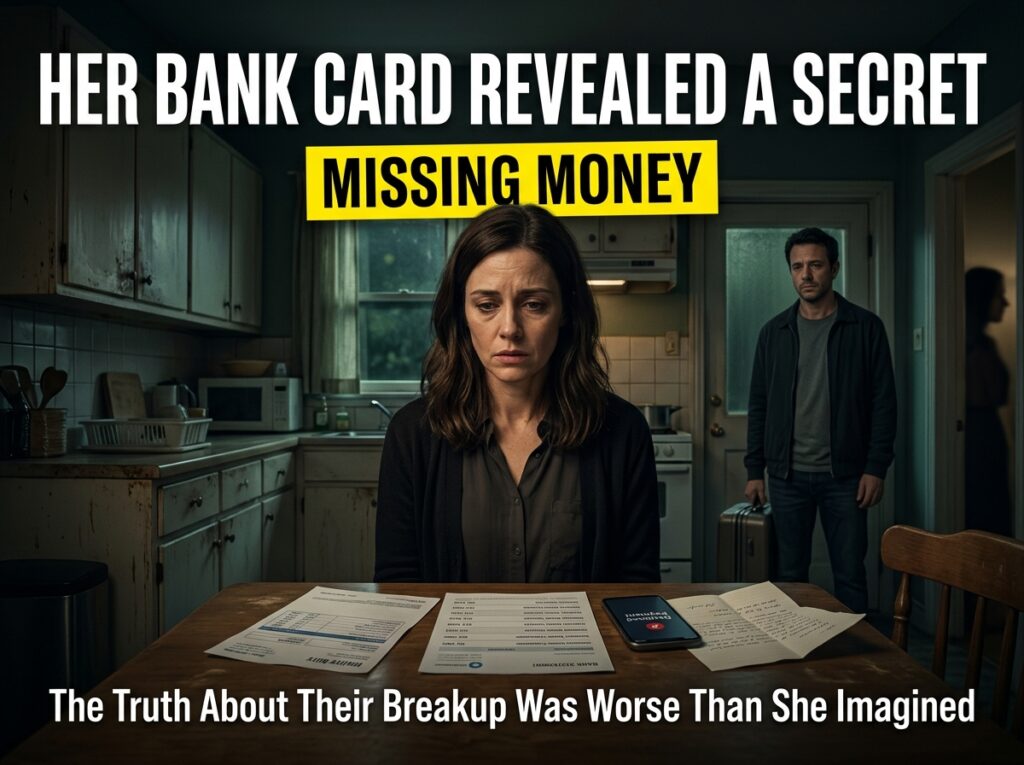
That evening, I went to find the one person who could explain the missing money and the promises that had collapsed with it. They looked at the clue, went pale, and asked me a question that made no sense until I remembered the night we separated. I had come looking for an apology or a reason, but what waited in the final message was far more complicated than either. Then the caller said there was one thing I had never been told about the night we broke up.
The morning my bank card was declined, I was standing in a grocery store holding a carton of milk, a loaf of bread, and a small bag of rice.
The cashier tried the payment again.
I watched her face while the machine processed the transaction. She had the tired, patient expression of someone who had seen the same embarrassment many times before and knew that looking sympathetic could make it worse.
The machine beeped.
“Sorry,” she said gently. “It’s been declined again.”
I stared at the screen.
“That can’t be right. I had money in the account yesterday.”
“Would you like to try another card?”
I shook my head, although I had already checked my wallet. There was no other card I could use.
“Just the bread and rice, please.”
I returned the milk to the refrigerator and handed her the carton of eggs I had picked up without thinking. When I finally left the store, I had spent less than five dollars, yet the walk home felt longer than it ever had before.
I was thirty-four years old, and I had become afraid of ordinary things.
I was afraid to open the mailbox because it might contain another overdue notice. I was afraid to answer calls from unknown numbers because they might be creditors. I was afraid to check my bank balance because the number on the screen seemed to shrink every time I looked at it.
Most of all, I was afraid that the life I had worked so hard to build had been resting on a lie.
Our kitchen was barely large enough for two people to stand in comfortably. The refrigerator hummed loudly, one cupboard door refused to close properly, and a crack ran across the tile beside the sink. I had always thought of it as a temporary place, somewhere we would leave behind once we had saved enough money for a better apartment.
Now the kitchen contained two unpaid bills, a nearly empty bread bag, and a calendar with several dates circled in red.
I placed the groceries on the counter and checked my phone.
There was still no message from Daniel.
Daniel had been my partner for six years. For most of that time, I had believed we understood each other better than anyone else could. We had shared a small apartment, difficult jobs, unexpected expenses, and the quiet rituals that make a place feel like home.
He knew how I took my coffee. I knew he could not sleep if a disagreement remained unresolved. When either of us had a difficult day, the other would usually notice before a word was spoken.
At least, that was what I had believed.
Our relationship had begun to change months before he left. The changes were small enough that I could explain each one separately.
He started taking calls outside.
He became protective of his phone.
He stopped telling me when he would be home late.
When I asked about money, he sometimes answered before I had finished speaking.
“Everything’s handled, Alicia.”
Those three words had become his favorite response.
Everything’s handled.
The rent was late, but everything was handled. The electricity bill had arrived with a warning notice, but everything was handled. The money we had saved for emergencies had disappeared faster than either of us expected, but Daniel insisted that he knew what he was doing.
I wanted to believe him.
I loved him, and I was tired of arguing about money. We had both worked hard to get where we were. I thought that if I could be patient for another month, perhaps things would settle down.
Then, six weeks ago, Daniel packed a suitcase.
He stood near the bedroom door, looking as though he had rehearsed what he intended to say.
“I can’t keep living like this,” he told me.
I asked what he meant.
He looked around the apartment. “The pressure. The arguments. Everything.”
“We can work on it.”
“I don’t think we can.”
I remember the way I held the edge of the dresser because my knees felt weak.
“Is there someone else?”
“No.”
“Then tell me what happened.”
Daniel looked at the floor.
“I’m sorry, Alicia.”
He left without answering my questions.
For several days, I expected him to return. I thought he needed space, and I kept imagining that he would eventually call to explain what had gone wrong.
Instead, the bills continued arriving.
I discovered that payments I thought had been scheduled were missing. A direct debit had failed. Money I remembered setting aside was no longer available. When I tried to reconstruct our finances, I found gaps that made no sense.
The declined card was the moment I could no longer pretend everything was simply a difficult month.
That evening, I spread the bills across the kitchen table and opened my banking app. I wrote down every transaction I did not recognize, every amount that seemed too large, and every date that overlapped with Daniel’s unexplained absences.
The list grew longer.
Then I found a transfer made three days before he left.
The amount was large enough to cover several months of rent.
The recipient’s name meant nothing to me.
I checked the date again, then opened our old messages. That same evening, Daniel had sent me a photograph of himself eating dinner at work. He had written that he would be home late because a colleague needed help.
I had replied that I would save him something to eat.
He had sent a heart.
I stared at the transfer until my phone screen dimmed.
If he had been working late, why had he moved so much money? And if he had a legitimate reason, why had he never mentioned it?
I searched the account for earlier transfers.
There were more.
Some were small. Others were substantial. They had been made over several months, and the recipient details were almost identical.
My hands began to shake.
I had spent weeks wondering why our money had disappeared. Now I had evidence that someone had made a deliberate choice about it.
I opened my contacts and found the number I had avoided calling since the breakup.
Daniel’s name appeared on the screen.
I pressed call.
It rang until the voicemail system answered.
I ended the call without leaving a message.
Then, as I returned to the banking app, a new notification appeared. It was an email from the bank, confirming that a transaction I had disputed had been reviewed.
The bank could not reverse it without additional information.
At the bottom was a note stating that the transfer had been authorized using credentials associated with our shared account.
I read it twice.
The money had not simply vanished.
Someone with access to our financial life had chosen to move it.
And I was beginning to understand that whatever had ended my relationship with Daniel had started long before he packed his suitcase.
The following morning, I went to the bank.
I had barely slept. Every time I closed my eyes, I saw the list of transfers on my phone. I kept trying to remember conversations that might explain them, searching my memory for some agreement I had forgotten making.
There was none.
At the bank, a customer service representative named Claire led me to a small desk near the windows. She listened while I explained the declined card, the missing funds, and the transactions I did not recognize.
“Do you share this account with your former partner?” she asked.
“Yes. We opened it when we moved in together.”
“Was he authorized to make transfers?”
“Yes, but I didn’t know about these.”
Claire studied the screen in front of her.
“I can explain what the records show, but I can’t tell you why the transfers were made. Some of the transactions were authorized using the account’s registered access details.”
“So Daniel made them?”
“I can’t confirm who physically initiated each transaction. I can tell you which credentials were used and when.”
She printed a transaction summary and placed it in front of me.
There were eight transfers over seven months.
The first was small enough that I might have overlooked it. The next was larger. The remaining payments followed a pattern, although the amounts varied.
“Can you tell me who received the money?” I asked.
Claire pointed to the beneficiary details.
“These records identify the destination account, but additional information may be restricted. If you believe the transfers were unauthorized, we can register a formal dispute.”
I nodded.
She explained the process, gave me a reference number, and advised me to secure my personal banking credentials. I changed my password before leaving the building.
Outside, I stood on the pavement and called my older sister, Sophie.
Sophie had never trusted Daniel. She had been polite to him, but she noticed things I had chosen to ignore. Whenever I complained that he had become distant, she asked whether I felt safe telling him what I needed.
I used to find the question insulting.
Now I wished I had answered it honestly.
She picked up immediately.
“Alicia? What’s wrong?”
I told her about the card, the transfers, and the bank visit.
When I finished, she was quiet.
“How much money are we talking about?”
I gave her the total.
“Oh, Alicia.”
The sympathy in her voice nearly made me cry.
“I don’t know what to do,” I admitted. “I keep thinking there must be an explanation. Maybe he was paying something we had agreed to pay. Maybe he thought he was helping someone. But why wouldn’t he tell me?”
“Have you asked him directly?”
“I called. He didn’t answer.”
“Then you need to stop guessing and find out what you can.”
“I don’t want to accuse him of something terrible if I’m wrong.”
“You don’t have to accuse him. You can ask him to explain the transactions.”
I leaned against a wall outside the bank.
“What if he tells me something that changes everything?”
Sophie took a breath.
“Then at least you’ll know what you’re dealing with.”
I returned home and searched through the drawers where we had kept household paperwork. I found insurance documents, old receipts, appliance warranties, and a notebook containing our monthly expenses.
Daniel had written in the notebook for the first few months after we moved in together. His handwriting was neat, and he used different colored pens for rent, food, and savings.
At the bottom of one page, he had written:
Emergency fund — do not touch unless we both agree.
I remembered that conversation.
We had been sitting at the kitchen table, dividing our paychecks between bills and savings. Daniel had insisted that we needed money for unexpected problems. I had laughed because, at the time, we barely had enough to pay the rent.
“One day we’ll thank ourselves,” he had said.
We had built the fund slowly, putting away whatever we could spare. Some months we added only twenty dollars. Other months we managed several hundred.
The balance had once made me feel secure.
Now the account was nearly empty.
I checked the notebook against the bank statements. The first unexplained transfer had occurred two months after Daniel started working extra shifts. At the time, he told me he was saving for a professional course that might lead to a better job.
I had been proud of him.
I had even offered to cover more of the groceries so he could pay for the course.
He had kissed my forehead and said he would never forget how much I supported him.
The memory made me feel foolish.
But I stopped myself from drawing conclusions. I did not yet know whether the money had gone to him, to someone else, or to a legitimate expense he had been afraid to discuss.
I opened our message history and searched for words like transfer, payment, account, and savings.
A message from seven months earlier appeared.
Daniel had written, I’ve moved some money to keep something from getting worse. I’ll explain when I can.
I remembered reading it at work. I had asked what he meant, but he replied that it was nothing I needed to worry about.
At the time, I had accepted his answer.
Now I copied the message into my notes.
There was another message two weeks later.
Please trust me. I’m trying to protect us.
And another, sent shortly before the first large transfer.
Whatever happens, don’t make any decisions until you’ve heard the whole story.
I sat back in my chair.
The messages sounded less like reassurance now and more like warnings.
That evening, I received a call from an unknown number.
I answered cautiously.
“Hello?”
A man asked whether he was speaking to Alicia.
“Yes.”
“My name is Martin. I used to work with Daniel.”
I tightened my grip on the phone.
“How did you get my number?”
“Daniel gave it to me some time ago. I wasn’t sure whether I should call.”
“Why are you calling now?”
There was a pause.
“Because I heard you were asking questions about the money.”
My heart began to race.
“What do you know?”
“I know that Daniel didn’t tell you everything.”
“About the transfers?”
“About the transfers, yes. But also about the night he left.”
I stood up.
“What happened that night?”
Martin took a long breath.
“I can’t explain it properly over the phone. There’s something I need to show you.”
“Then tell me where to meet you.”
He gave me the address of a small café near the railway station.
Before ending the call, he said one more thing.
“Alicia, please bring the messages you found. And don’t contact Daniel until we’ve spoken.”
The call ended.
I stood alone in the kitchen, listening to the refrigerator hum.
For weeks, I had wanted Daniel to explain why he left. I had imagined apologies, arguments, and perhaps an admission that he had been afraid to tell me about the money.
Now a stranger had told me that the night we separated contained a secret I had never been given the chance to understand.
I gathered the bank statements and the notebook.
For the first time since the breakup, I had a reason to believe that the answers might be within reach.
But I was no longer certain that knowing the truth would bring the peace I wanted.
Martin was already seated when I arrived at the café.
He was in his early forties, with short brown hair and a tired expression. I recognized him from a photograph Daniel had once shown me of a company dinner. He had worked with Daniel for several years, although I had met him only once.
He stood when he saw me.
“Alicia. Thank you for coming.”
I placed my bag on the chair beside me.
“You said you knew something about the money.”
“I do.”
“Then please tell me.”
Martin glanced toward the counter. A waitress approached, but he declined to order anything. He seemed uncomfortable, as though he had spent the entire journey deciding whether meeting me had been a mistake.
“I worked with Daniel for five years,” he began. “We weren’t best friends, but we talked quite a lot. He was a good worker. He took responsibility for things that weren’t always his responsibility.”
“That sounds like him.”
“He also had a habit of trying to solve problems alone.”
I thought about the messages I had found.
Please trust me. I’m trying to protect us.
“What kind of problems?” I asked.
Martin folded his hands on the table.
“About eight months ago, someone approached him with a financial problem. It involved a person he cared about. Daniel believed that if he didn’t help, the consequences could be serious.”
“Who was the person?”
“I can’t tell you that yet.”
I felt frustration rise in my chest.
“Everyone seems to know something I don’t. I’m the one who lost the money, and I’m the one who has to ask strangers for answers.”
“I understand why you’re angry.”
“Then stop making me guess.”
Martin looked at me for a long moment.
“Did Daniel ever tell you about a loan he guaranteed?”
I shook my head.
“He said he was saving for a professional course. He never mentioned guaranteeing a loan.”
Martin lowered his voice.
“He didn’t take the loan for himself. He signed as a guarantor for someone else. When that person couldn’t keep up with the repayments, Daniel was contacted.”
“Who was it?”
“Someone from his past.”
“His family?”
Martin hesitated.
“Not exactly.”
I opened my bag and took out the bank statements.
“These are the transfers I found. Do they have anything to do with the loan?”
Martin examined the first page. His expression changed when he saw the dates.
“Yes,” he said quietly. “At least some of them do.”
My stomach tightened.
“How much did Daniel owe?”
“I don’t know the exact final balance. I only know that he was frightened. He thought he could resolve the situation before you discovered what was happening.”
“So he used our savings.”
“Yes.”
The admission hurt, even though I had suspected it.
“Did he know that would leave us unable to pay our bills?”
“He knew it would create problems. He believed he could replace the money before you needed it.”
I thought about the grocery store, the declined card, and the two unpaid bills on my kitchen table.
“He didn’t replace it.”
“No.”
“Why not?”
Martin rubbed his forehead.
“Because the situation became more complicated than he expected. The person he was helping made another decision, and Daniel found himself responsible for more than the original amount.”
I stared at him.
“Who was he helping?”
Martin looked down at his hands.
“I think you should hear that from Daniel.”
I pushed the papers toward him.
“Then why did you ask me to come?”
“Because I know something about the night he left. And I don’t think you should make any decisions about your future with him until you understand it.”
I wanted to tell him that Daniel and I no longer had a future together. But the words caught in my throat.
Martin took a folded sheet of paper from his jacket.
“This is a copy of a message Daniel sent me that evening.”
I unfolded it.
The message was short.
I’ve found out what really happened. I need to tell Alicia, but if I do, it could put her in the middle of everything. I don’t know how to protect her anymore.
I read it again.
“What does he mean by ‘what really happened’?”
Martin shook his head.
“He called me after he sent that message. He was upset. He said he had discovered that someone had been lying to him about the loan.”
“Who?”
“I never found out. He told me he needed to go somewhere before speaking to you.”
“Where did he go?”
Martin hesitated.
“To meet the person who had originally asked him for help.”
I felt cold.
“Was that the night he left me?”
“Yes.”
I remembered the evening clearly. Daniel had arrived home later than usual. He had stood in the kitchen, staring at the unpaid bills. When I asked whether he had paid the rent, he said he had taken care of it.
I had shown him the notice from the landlord.
He had become angry.
“Why do you always assume I’m lying?” he had demanded.
“Because you keep telling me everything is fine when it isn’t!”
He had looked at me as though I had struck him.
Then he had packed his suitcase.
I had believed the argument was about money.
Martin’s message suggested it had been about something else.
“Did he leave because he was ashamed of the debt?” I asked.
“I don’t think that was the whole reason.”
“What else was there?”
Martin looked toward the window.
“Before I tell you, there’s something you need to understand. Daniel didn’t just discover that someone had lied about the money. He discovered that the lie had started before he ever signed the agreement.”
I felt my heart beating faster.
“Who lied to him?”
Martin finally met my eyes.
“Someone who knew you, Alicia. Someone who had been part of your life long before Daniel and I ever worked together.”
I spent the journey home trying to remember everyone who had been close enough to influence Daniel’s decisions.
His family had always seemed ordinary to me. His mother lived in another town, his younger brother had moved abroad, and his father had died when Daniel was a teenager. He rarely spoke about that loss, although I knew it had changed him.
My own family was small. My sister Sophie was the person I trusted most, and my parents lived several hours away. I could not imagine either of them becoming involved in a secret loan.
Yet Martin had been certain.
Someone I knew had helped create the situation that had destroyed our relationship.
When I arrived home, I locked the door and placed the bank statements on the kitchen table. I read every message I had saved, looking for any reference to a person Daniel might have been protecting.
I found a conversation from almost a year earlier.
Daniel had asked whether I still spoke to an old friend named Rebecca.
I had told him that Rebecca and I had lost contact after an argument several years before.
He had replied, That’s probably for the best.
At the time, I had thought he was being dismissive. Now I wondered why he had asked.
Rebecca and I had been close during our early twenties. We had shared a flat for a year, helped each other through difficult relationships, and spent countless evenings discussing our hopes for the future.
Then she borrowed money from me.
It was not an enormous amount, but I had been saving for a training course, and I needed the money back by a specific date. Rebecca promised to repay me. When the deadline passed, she asked for more time.
I agreed.
Weeks became months. Every conversation about repayment ended with an excuse, and eventually I stopped asking. Our friendship deteriorated, and we went our separate ways.
I had not spoken to her in nearly seven years.
I searched her name on social media, but the account I found had not been updated for months. There was no contact number.
I wondered whether she could be the person Martin meant.
It seemed impossible. Rebecca had been part of my past, but she had never met Daniel until years after our friendship ended. Even then, they had only exchanged a few polite words at a gathering.
Why would Daniel guarantee a loan for someone who had once borrowed money from me?
I called Sophie.
“Do you remember Rebecca?” I asked.
“Your old roommate?”
“Yes.”
“What about her?”
I explained what Martin had told me.
Sophie was silent for a moment.
“That’s strange,” she said. “I remember you telling me that Daniel asked about her.”
“You remember that?”
“Of course. You thought he was jealous because you used to be close.”
I had forgotten that conversation.
“Did you ever see them together?”
“Once, I think. At that charity dinner you attended with Daniel. I remember Rebecca saying hello to him outside the venue.”
My mind raced.
The charity dinner had taken place about nine months earlier, shortly before the first unexplained transfer.
“Did she seem surprised to see him?”
“I don’t remember. Why?”
“Because I think Daniel might have been helping her.”
Sophie took a breath.
“Even if he was, that doesn’t explain why he used your shared savings without telling you.”
“I know.”
“Don’t let the possibility of an explanation make you forget what he did.”
Her words stung because they were true.
I could understand fear. I could understand someone making a mistake and becoming too ashamed to admit it. But understanding did not erase the consequences.
After we hung up, I searched through my old photographs until I found the picture from the charity dinner.
Rebecca stood near the entrance, wearing a dark blue dress. Daniel was several feet away, speaking to someone I could not identify. Neither appeared to be looking at the other.
I enlarged the photograph.
At the far edge of the image, another person was visible. Only part of their face appeared, but I recognized the coat.
It belonged to Martin.
I called him again.
He answered immediately.
“I need to ask you something. Were you at the charity dinner last year?”
“Yes.”
“Did you see Rebecca there?”
He paused.
“Yes.”
“Was Daniel helping her?”
Martin exhaled.
“That’s who he was trying to protect.”
My hands tightened around the phone.
“What did she do?”
“She came to Daniel because she was in trouble. She said she had borrowed money from someone and couldn’t repay it. Daniel believed the person was threatening her.”
“Was it true?”
“That’s what he thought at first.”
“And later?”
“Later, he discovered that the story kept changing. The amount was different every time she explained it. The person who supposedly lent her the money denied receiving some of the payments. Daniel began to suspect that he had been given false information.”
I sat down.
“Then why did he keep paying?”
“Because by then, he had signed the guarantee. He was afraid that if he stopped, the lender would pursue him. And he was afraid that if he told you, you would recognize Rebecca and feel responsible for what had happened.”
I felt a wave of anger.
“He thought he could protect me by hiding everything?”
“Yes.”
“He did exactly what Rebecca had done to me years ago. He believed a story without asking enough questions, then used our money to solve a problem he didn’t understand.”
Martin did not disagree.
“Did Daniel ever confront her?”
“Yes. That was the night he left you.”
I closed my eyes.
The argument in our kitchen returned to me: Daniel’s anger, his suitcase, the way he had refused to explain what was happening.
I had thought he was leaving because he no longer loved me.
Perhaps he had been trying to decide whether telling me the truth would make things worse.
But I still did not understand why he had left without saying a word.
“Martin, I need to know what happened that night.”
He was quiet for several seconds.
“I can tell you part of it,” he said. “But there’s something Daniel asked me not to reveal until you had seen the final message.”
“What final message?”
“The one he sent after he left your apartment.”
Martin told me he would send it to me that evening.
Then he ended the call.
I sat alone in the kitchen, surrounded by unpaid bills and old photographs, realizing that Rebecca’s return to our lives had begun long before I knew it.
And if Daniel had discovered that she lied about the money, the question was no longer simply why he had left me.
It was what he had learned about the person he had tried to save.
Martin sent the message at 8:17 that evening.
It arrived as a screenshot of a conversation between him and Daniel, dated the night we separated.
I opened it immediately.
Daniel had written:
I can’t go back and pretend nothing happened. Alicia deserves the truth, but I don’t know how to tell her without making her feel responsible for something that wasn’t her fault.
Martin had replied:
Then tell her exactly what you know. Don’t make the decision for her.
Daniel’s next message was shorter.
If she finds out who started this, she’ll blame herself.
I read those words repeatedly.
Why would I blame myself for a loan Daniel had guaranteed? Why would I be responsible for something Rebecca had done?
I sent Martin a message asking him to explain.
He called instead.
“Daniel believed Rebecca had approached him because she knew he was close to you,” he said. “She told him that she had tried to contact you but was too ashamed to admit what had happened years ago.”
“She never contacted me.”
“I know. Daniel eventually found out that she hadn’t been telling the truth about that, either.”
I leaned against the counter.
“What did she tell him?”
“She said she had borrowed money from a person who was threatening to expose her financial problems to her employer. She claimed that if the debt wasn’t paid quickly, she would lose her job and her home.”
“And Daniel believed her.”
“At first.”
“Why did he sign the guarantee?”
“Because she told him it was a temporary arrangement. She said the money would be repaid within weeks, and he wouldn’t have to contribute anything himself.”
I felt a bitter laugh rise in my throat.
“That sounds familiar.”
Martin understood.
“She made him believe he was helping someone in an emergency. By the time he realized the amount was larger than she had described, he had already signed the documents.”
“How much did she borrow?”
“The original amount was substantial, but the total grew because of additional charges and missed payments. Daniel started transferring money to stop the account from falling further behind.”
“Using our savings.”
“Yes.”
“Did Rebecca ever repay him?”
“Not as far as I know.”
I looked at the bank statement again.
There were transfers to the same account over several months. Daniel had not taken the money for himself. He had been paying an obligation he had accepted without fully understanding it.
That did not make the secret acceptable, but it changed the picture.
“Why did he leave me instead of telling me?” I asked.
Martin hesitated.
“Because he found out something else.”
I waited.
“Rebecca told him that the original loan was connected to a debt you had once owed her.”
I felt my stomach drop.
“That’s impossible.”
“That’s what Daniel said when he first heard it. He told her you had never borrowed money from her.”
“Because I didn’t!”
“I know. But she had documents that appeared to support her story. Daniel was trying to determine whether they were genuine.”
I remembered the money Rebecca had borrowed from me years earlier. I had never considered it a debt I owed her. She had promised to repay me, not the other way around.
“What documents?”
“I haven’t seen them. Daniel told me there were copies of old messages and a signed note. He said the note didn’t look right.”
I closed my eyes.
The old friendship had ended badly, but I had never imagined Rebecca would use it to create a false financial claim.
“Did Daniel believe her?”
“Not after he examined the documents. That’s why he confronted her.”
I pictured Daniel standing in our kitchen, looking at the bills, his suitcase waiting beside the bedroom door.
Perhaps he had been carrying the knowledge that someone he had tried to help had manipulated him. Perhaps he had been ashamed of using our savings. Perhaps he had been afraid that telling me Rebecca was involved would reopen a wound I had spent years trying to forget.
But there was still one question.
“Martin, why did he leave that night? If he knew she had lied, why didn’t he come home and tell me?”
Martin’s voice softened.
“Because Rebecca told him she had already contacted you.”
I stood still.
“She what?”
“She claimed that she had sent you a message explaining the debt and that you had agreed not to discuss it with him.”
“That never happened.”
“I know. Daniel eventually realized that, too.”
My mind raced back through the final weeks of our relationship. Had I received a message from an unknown number? Had I deleted something without reading it? I checked my phone, but there was no trace of Rebecca contacting me.
“Did Daniel tell you that he believed me?”
“Yes. He said he wanted to hear your side before making any decision.”
“Then why didn’t he ask me?”
Martin was silent.
Finally, he said, “He did try to call you that night.”
I remembered the missed call.
It had arrived while I was washing dishes after our argument. I had been too angry to answer, assuming he wanted to repeat the same excuses about money.
When I checked my phone later, I had seen the call but decided not to return it.
I had thought he would call again if it mattered.
He hadn’t.
A painful possibility settled over me.
We had both been waiting for the other person to speak.
Daniel had been ashamed of the financial decisions he had made. I had been angry that he would not explain them. He had believed I might blame myself if he told me about Rebecca. I had believed his silence meant he no longer cared enough to be honest.
And between those assumptions, our relationship had collapsed.
“Can you tell me where he is?” I asked.
Martin said he didn’t know Daniel’s current address, but he had a number that might still work.
Before ending the call, he added, “Alicia, there’s one more thing. Daniel told me that the final message he sent you wasn’t the last message he wrote that night.”
I gripped the phone.
“What do you mean?”
“He said he left something for you. A message he hoped you would read after you knew the truth.”
I looked at the bank statements spread across the table.
“Where is it?”
Martin replied, “That’s what I’ve been trying to find out.”
I spent the next morning searching every place Daniel might have left a message.
I checked the shared email account we had stopped using after the breakup. I searched old cloud folders, downloaded files, and conversations that had been archived years earlier. I even looked through the notes app on my phone, where I sometimes saved shopping lists and reminders.
For a while, I found nothing.
Then I remembered a small notebook Daniel had kept beside his desk.
He used it for passwords, appointment dates, and ideas for work projects. I had seen him write in it shortly before he left, but I had never asked what he was recording.
The notebook was still in the bottom drawer of the desk.
I opened it carefully.
Most of the pages contained ordinary information: telephone numbers, meeting times, and reminders about bills. Near the back, I found a page with three dates written in red ink.
Beside the first date was the amount of the original loan.
Beside the second was the date Daniel had signed the guarantee.
Beside the third was a single word.
Confrontation.
The date matched the night he left.
Underneath it, Daniel had written an address.
I recognized the street. It was the location of a small office building near the railway station, where several financial services companies had their offices.
I called Martin.
“Do you recognize this address?”
He paused.
“Yes. That’s where Daniel met Rebecca that night.”
“Do you know what happened there?”
“I wasn’t present. But Daniel called me afterward. He sounded shaken.”
“What did he say?”
“He told me that Rebecca had admitted something, but he wouldn’t explain it over the phone. He said he needed to speak to you first.”
I felt my throat tighten.
“Did he go home after that?”
“Yes. He went to your apartment.”
I remembered the argument.
Daniel had entered the kitchen with a strange expression, as though he had been preparing to say something important. Then I had shown him the overdue rent notice.
He had become defensive.
I had accused him of hiding money.
He had accused me of assuming the worst.
Neither of us had mentioned Rebecca.
Neither of us had asked what had happened at the office.
I had thought the argument was about our finances. Now I wondered whether Daniel had been trying to find a way to explain something much larger.
I returned to the notebook.
Beneath the address, there was a short sentence.
If she won’t tell me the truth, I’ll have to show Alicia the documents.
I read it twice.
The sentence suggested that Daniel had been preparing to reveal something before our argument even began.
I searched the notebook again and found a folded piece of paper tucked into the back cover. It was a receipt from a document storage service, dated several days before the breakup.
The receipt listed a box number and a collection reference.
I called the company.
The person who answered explained that the storage account had been closed, but the records could be accessed by the registered customer or an authorized representative.
I gave Daniel’s name.
After checking the system, the employee told me that I would need written permission to collect anything.
I thanked her and ended the call.
I was about to put the receipt away when I noticed a handwritten number on the reverse.
It was a telephone number I did not recognize.
I dialed it.
A woman answered.
“Hello?”
“Hi. My name is Alicia. I’m trying to reach Daniel. I found this number in his notebook.”
There was a pause.
“Who is this?”
I repeated my name.
The woman took a breath.
“I’m Rebecca.”
My entire body went rigid.
For several seconds, neither of us spoke.
Then I said, “I’ve been looking for you.”
“I know.”
“Why did you tell Daniel I owed you money?”
Rebecca exhaled.
“I didn’t say it like that.”
“Then explain what you said.”
“I told him that the money between us had never been settled properly.”
“That isn’t true.”
“I know how it looks.”
“How it looks? You borrowed money from me and promised to repay it. I waited for years. I never asked you for anything else.”
Rebecca was silent.
I could hear traffic in the background.
“Did you give Daniel documents claiming I owed you money?”
“Yes.”
“Why?”
“Because I was desperate.”
The answer came so quickly that I almost missed it.
“Desperate for what?”
“I had debts. I was behind on payments. I thought if Daniel helped me, I could get everything under control.”
“So you lied.”
“I was going to pay it back.”
“With what?”
She began to cry.
I felt no satisfaction hearing it.
“You don’t understand what happened,” she said.
“Then tell me.”
“I had been borrowing money from several people. I told myself I could repay everyone once I found a better job. But the amounts kept growing, and I couldn’t keep up. When I contacted Daniel, I thought he would lend me enough to get through the worst of it.”
“Why involve my name?”
“Because I thought he would trust me more if he believed the debt was connected to you.”
I closed my eyes.
“You used my past with you to convince him to give you money.”
“Yes.”
“And when he found out?”
“He said he would tell you everything. He said he was going to stop the payments and report the false documents.”
I gripped the edge of the desk.
“What happened that night?”
Rebecca’s voice broke.
“He asked me to admit what I had done. I told him I was sorry, but I also told him that if he stopped paying, the people I owed would come after me. He said he couldn’t keep sacrificing his life to protect me.”
“And then?”
“He left. I thought he was going to tell you immediately.”
I stared at the notebook.
“Why didn’t he?”
Rebecca took a long breath.
“Because I sent you a message.”
My heart began to pound.
“What message?”
“I told you Daniel had been paying my debts and that he was going to leave you. I wanted you to confront him before he could explain everything.”
I felt sick.
“I never received it.”
“I know. I sent it to an old email address. Later, Daniel told me you hadn’t seen it.”
I remembered the email account I had abandoned years earlier.
The account I had stopped checking after losing access to my old phone.
Rebecca continued speaking, but I barely heard her.
The message had never reached me in a way I would notice. Yet Daniel had believed that I might have seen it, and I had believed his silence meant he no longer loved me.
Two people had made decisions based on assumptions that were never tested.
And Rebecca had known exactly how to exploit the space between them.
“Where is Daniel now?” I asked.
“I don’t know. The last time I spoke to him, he said he had kept copies of everything. He told me that if you ever contacted me, I should stop hiding and tell you the truth.”
“Then you should have done that months ago.”
“Yes,” she whispered.
I ended the call.
My hands were trembling, but my thoughts had become clearer.
Daniel had made serious mistakes. He had used our money without my agreement and hidden the truth when I needed him to be honest. But he had also been manipulated by someone he believed he was helping.
The next question was whether he had left me because he wanted to escape the consequences—or because he believed he had already destroyed the life we shared.
I opened the old email account.
I did not know whether I could recover it.
But I knew that somewhere inside it, there might be the message that had changed everything.
Recovering the old email account took most of the afternoon.
I had to verify my identity, answer security questions, and wait for a confirmation code. By the time I finally gained access, I was exhausted and frightened of what I might find.
The inbox contained thousands of messages.
Most were advertisements, newsletters, and forgotten conversations from years earlier. I searched Rebecca’s name and found three emails, all sent within a few days of the breakup.
The first contained no greeting.
You need to know what Daniel has been doing with your money.
The second included a photograph of a document I had never seen.
The third had been sent late on the night Daniel left.
He is going to tell you a story that makes him look innocent. Don’t believe everything he says. He has been helping me for months, and he knew what he was doing.
I read the message twice.
Rebecca had not simply told Daniel a lie. She had tried to make sure I would distrust him before he could explain himself.
I opened the attached photograph.
It showed a handwritten statement claiming that I had agreed to repay Rebecca for an old debt. The signature at the bottom resembled mine, but the date was wrong, and the wording did not sound like anything I would have written.
I remembered signing a receipt years earlier when Rebecca borrowed money. It had simply confirmed the amount she had taken and the date by which she intended to repay it.
She had apparently used that receipt to create a different story.
I saved the emails and downloaded the attachment.
Then I called Martin.
“I found Rebecca’s messages,” I told him. “She admitted she used a document from our old friendship to convince Daniel I owed her money.”
Martin was quiet.
“That explains why Daniel was so upset.”
“Do you know where he kept the other documents?”
“He mentioned a storage box. He wanted to preserve the original records in case Rebecca tried to change her story.”
I looked at the receipt from the storage company.
“I found the collection reference.”
“Then you may have found what he wanted you to see.”
The storage company confirmed that Daniel had left a sealed envelope in the box before closing his account. It had been transferred to their records office after the account expired.
They could not release it without his permission, but the employee agreed to record my request and contact Daniel using the details on file.
I waited anxiously for the next two days.
During that time, I spoke to a lawyer recommended by Sophie. She explained that the bank transactions needed to be examined carefully, especially because Daniel had been authorized to use the shared account. If money had been transferred without my agreement, there might be options for recovering some of it, but the circumstances and documents would matter.
She also advised me not to confront Rebecca alone or make promises about repayment.
I followed her advice.
For the first time, I stopped trying to solve everything through emotional conversations. I began keeping a clear record of dates, transfers, messages, and statements.
It did not make the situation painless, but it gave me something solid to work with.
On the third day, the storage company called.
They had reached Daniel.
He had authorized the release of the envelope.
I collected it the following morning.
The envelope was plain, with my name written across the front in Daniel’s handwriting.
Inside were copies of the loan agreement, a list of payments, the original receipt Rebecca had used, and a handwritten letter.
I recognized the letter immediately.
Daniel had written it on the night he left.
I unfolded it carefully.
Alicia,
I don’t know whether I will have the courage to give you this in person. I have spent weeks telling myself I can solve everything before you find out, and I have made things worse every time I try.
I signed an agreement because I believed I was helping someone in trouble. I used money from our account because I thought I could replace it before you needed it. I was wrong.
I should have told you the truth the first time you asked. I should have trusted you enough to let you decide what you could handle. Instead, I kept making decisions on your behalf, and now I have put our home, our savings, and our future at risk.
I stopped reading.
My eyes filled with tears.
The letter continued.
I found out that the documents I was given were not what I had been told. I confronted the person who gave them to me. I wanted to come home and explain everything, but I was afraid you would think I had done it because I didn’t care about you.
The truth is that I was ashamed. I thought if I could repair the damage first, I could spare you the fear and disappointment. I see now that I only made you feel alone.
I don’t know what will happen next. I don’t know whether the money can be recovered or whether the people involved will admit what they did. But I want you to know that I never stopped loving you.
I am sorry I made you question that.
There was no demand for forgiveness. No promise that everything would be fixed. No attempt to make the decision for me.
For the first time, Daniel had written something that acknowledged what he had done without blaming the circumstances.
I folded the letter and held it against my chest.
Then I noticed another sheet at the bottom of the envelope.
It was a list of the payments Daniel had made, with notes beside each one.
The final entry was dated the night he left.
Beside it, he had written:
I have to tell Alicia what happened before she hears it from Rebecca.
Below that sentence was a telephone number.
And beneath the number, a name.
Martin had told me that Daniel’s final message contained something he had never explained.
Now I understood why.
The number belonged to the person Daniel had called immediately after leaving our apartment.
It was not Rebecca.
It was someone who had been present when the original agreement was signed.
I called the number that afternoon.
An older man answered. His voice was cautious, and he asked who had given me his contact details.
I explained that I was trying to understand the loan agreement Daniel had signed and that I had found his number among the documents.
He was silent for a long time.
Finally, he said, “My name is Peter. I was the person who prepared the original agreement.”
I sat down.
“Did you know Daniel?”
“I met him once, when he came to ask about the documents. He wanted to know whether the guarantee could be canceled.”
“Could it?”
“That depended on the terms and the circumstances. But when he showed me the paperwork, I noticed inconsistencies.”
“What kind of inconsistencies?”
“The signature on the supporting statement did not match the signature on the original receipt. The dates were also different. I told Daniel that he should not assume the documents were genuine.”
I thought about the photograph Rebecca had sent.
“Did you tell him what to do?”
“I advised him to preserve the records and seek legal advice. I also told him not to make further payments until the situation had been properly reviewed.”
“Did he follow that advice?”
“He said he intended to.”
I looked at the list of transfers.
The final payment had been made on the day we separated.
“Why did he call you that night?”
Peter paused.
“He was upset. He said he had discovered that the person he was trying to help had used a document from someone else’s past to make the debt appear legitimate.”
“That person was Rebecca.”
“I suspected as much.”
“Did Daniel tell you he was leaving me?”
“No. He said he was going to speak to you. He wanted to explain that the money had been moved without your informed agreement and that he intended to take responsibility for the consequences.”
I closed my eyes.
Daniel had planned to tell me the truth.
But he had come home to find me angry, frightened, and convinced that he was hiding something. He had tried to defend himself, and I had demanded answers he was not yet able to give.
Then he had left.
I could not know whether he would have explained everything if I had listened that night. I could only recognize that the opportunity had existed, and both of us had failed to use it.
“Do you know where he is now?” I asked.
Peter gave me an address.
It was a small town about an hour away.
Before ending the call, he added, “Alicia, I think Daniel was trying to do the right thing for the wrong reasons. He believed he could protect you by keeping you out of the situation. But protecting someone without giving them the truth can become another form of control.”
I thanked him.
His words stayed with me long after the call ended.
That evening, I sat at the kitchen table and made a list of what I knew.
Daniel had signed a guarantee without fully understanding the consequences.
He had used our shared money to make payments without my agreement.
Rebecca had provided misleading information and used an old receipt to support her claims.
Daniel had discovered the inconsistencies and intended to confront her.
He had written a letter acknowledging his mistakes.
And on the night he left, he had tried to contact me.
The facts did not erase the hurt. They did, however, separate what I knew from what I had imagined.
I had spent weeks believing Daniel had left because he no longer loved me. I had wondered whether he had another relationship, whether he had secretly planned his departure, and whether the promises we made had ever meant anything to him.
The evidence pointed to a more complicated truth.
He had made a series of damaging decisions because he was ashamed and afraid. He had tried to manage a problem that grew beyond his control. When he finally discovered that Rebecca had misled him, he had struggled to explain what had happened.
None of that excused his silence.
But it meant I had been wrong to assume that his silence proved he did not care.
I called Sophie and told her what I had found.
She listened without interrupting.
When I finished, she said, “What do you want now?”
I looked at Daniel’s letter.
“I want to hear the truth from him.”
“Are you hoping to get back together?”
“I don’t know.”
“That’s fair.”
“I still love him. But I don’t know if I can trust him again.”
“You don’t have to decide that before you speak to him.”
I knew she was right.
For the first time, I was not going to a conversation with a list of accusations or a demand for an immediate answer. I wanted to hear what Daniel had to say, and I wanted the chance to explain what his choices had done to me.
The following morning, I called the number Peter had given me.
Daniel answered.
For several seconds, I could not speak.
Then I said, “I found your letter.”
The silence on the other end was heavy.
“I wondered if you would,” he replied.
“I want to talk.”
“Are you sure?”
“No,” I said honestly. “But I need to.”
He gave me an address and asked whether I could meet him that afternoon.
Before hanging up, he said, “Alicia, there is one thing I need you to know before you come.”
I waited.
“The last message Rebecca sent you was not the only message she sent that night.”
I arrived at the address shortly before three.
Daniel was living in a small rented room above a shop. The stairs were narrow, and the hallway smelled faintly of detergent. When he opened the door, I noticed how tired he looked. He had lost weight, and his hair was longer than I remembered.
For a moment, neither of us moved.
Then he stepped aside.
“Come in.”
The room contained a bed, a desk, two chairs, and several cardboard boxes. A kettle sat beside a stack of books. His clothes were folded neatly on a shelf, and a photograph of us stood face down on the desk.
I sat in the chair nearest the window.
Daniel remained standing.
“I read your letter,” I said.
He nodded.
“I should have given it to you myself.”
“Why didn’t you?”
“Because I was afraid you would never let me explain.”
“You didn’t give me the chance.”
“I know.”
His answer was quiet, without the defensiveness I remembered from our final argument.
I placed the bank statements on the desk.
“I understand why you helped Rebecca. I understand why you thought the loan was temporary. But I don’t understand why you kept transferring money after you knew the documents were wrong.”
Daniel sat down opposite me.
“At first, I believed she was in trouble. She told me that people were threatening to take her home and that she had nowhere else to turn. I thought I could help her get through the worst of it.”
“And then?”
“Then I discovered the amounts didn’t match. I asked for copies of the agreements. She gave me documents that seemed legitimate, but the dates were inconsistent. When I asked questions, she said I was making things worse by refusing to trust her.”
I remembered those words.
They sounded painfully familiar.
“I should have recognized what was happening,” he continued. “I knew how much you had been hurt by her years ago. I should have been more careful. Instead, I thought I could help without involving you.”
“You used our savings.”
“Yes.”
“You told me everything was handled when it wasn’t.”
“Yes.”
“You let me believe we were simply having a difficult month, when you knew there was a debt that could keep growing.”
Daniel lowered his head.
“I was ashamed.”
I looked at him.
“Do you understand what that did to me? Every time you told me not to worry, I believed you. When the bills arrived, I thought I was failing us. I cut back on food, stopped buying things I needed, and worried about rent while you were moving money somewhere else.”
“I know.”
“No, Daniel. You know what happened. You don’t know what it felt like.”
He looked up, and his eyes were wet.
“You’re right.”
I had expected him to defend himself. I had prepared responses to the excuses I thought he would make.
Instead, he listened.
It made me angrier for a moment because I realized how much I had needed that from him months earlier.
“Why did you leave that night?” I asked.
Daniel took a folded sheet of paper from the desk.
“Rebecca sent me a message saying she had already contacted you. She claimed you knew about the loan and had agreed that I should handle the payments. I didn’t believe her completely, but I was confused. I had discovered that she had altered documents, and I was trying to work out how much of what she had told me was true.”
“Why didn’t you ask me?”
“I should have.”
“That isn’t an answer.”
He took a breath.
“I thought you might have been involved without telling me. I was frightened that you would be hurt if I confronted you and found out that you had known something I didn’t. Then I came home and saw the rent notice. You asked me where the money had gone, and I knew I couldn’t give you a simple answer.”
“So you left.”
“I thought I needed to get the documents together before I could explain. I told myself I would come back the next day. I wanted to make sure I wasn’t accusing you of something you hadn’t done.”
I stared at him.
“You thought I was involved?”
“For a short time. Not because I believed you had deliberately deceived me, but because Rebecca had made it seem as though you were connected to the agreement.”
“And when you realized I wasn’t?”
Daniel looked away.
“By then, I had already left. I was ashamed of what I had done to our finances. I didn’t know how to return without admitting that I had made everything worse.”
“You could have called.”
“I tried.”
“I didn’t answer.”
He nodded slowly.
“I know. Martin told me.”
We sat in silence.
I wanted to blame him for not trying harder, but I remembered how quickly I had stopped expecting him to call. I had interpreted his silence as proof that he no longer cared, and I had protected myself by refusing to ask for an explanation.
We had both been afraid of hearing something painful.
So we had allowed our fears to speak for us.
“Do you still love me?” I asked.
Daniel looked at me immediately.
“Yes.”
“Then why did you make me feel as though I was the only person trying to save us?”
His expression crumpled.
“Because I thought solving the problem was the same as protecting you. I believed that if I could pay the money back, everything would return to normal. I didn’t understand that every payment I made without telling you was another decision I was taking away from you.”
I looked down at my hands.
“That’s what hurt the most. It wasn’t only the money. It was that you decided I couldn’t handle the truth.”
“I know.”
“I needed a partner, Daniel. Not someone who decided what I was allowed to know.”
He reached toward me, then stopped before touching my hand.
“I can’t undo what I did. But I want to take responsibility for it.”
“How?”
“I’ve spoken to the bank and a lawyer. I’ve given them the documents. I’m no longer making payments based on Rebecca’s claims. If anything is legally owed, I’ll deal with it properly. And I’ll work out how to repay the money I took from our savings.”
I studied his face.
“Even if we don’t get back together?”
“Even if we don’t.”
For the first time, I believed he understood that an apology did not entitle him to another chance.
He reached into a box beside the desk and removed a sealed envelope.
“I was going to give you this when I came home that night,” he said. “I never got the chance.”
I opened it.
Inside was a printed copy of a message Rebecca had sent him shortly before our final argument.
The message contained an admission that she had used the old receipt to support a false claim. She also acknowledged that she had told Daniel I had agreed to the arrangement when I had not.
At the bottom, she had written:
I thought I could fix everything before either of you found out. I was wrong.
I stared at the words.
Rebecca had been trying to protect herself, just as Daniel had been trying to protect me. Each had convinced themselves that secrecy was temporary, that the damage could be repaired before anyone noticed.
But the consequences had reached all of us.
I folded the message and returned it to the envelope.
“I don’t know what happens next,” I said.
Daniel nodded.
“Neither do I.”
“I can’t promise we’ll get back together.”
“I’m not asking you to.”
“I need time. And I need to know that if we ever try again, you won’t hide something important because you think you’re protecting me.”
“I understand.”
I stood and walked toward the door.
Daniel remained seated.
Before I left, I turned back.
“There was a time when I thought the worst thing you could do was leave me.”
He looked at me.
“Now I think the worst thing was making me believe I was alone while you were still trying to save us.”
Daniel’s eyes filled with tears.
“I am sorry, Alicia.”
I believed him.
But believing an apology was not the same as restoring trust.
I walked down the stairs and stepped into the afternoon sunlight. My heart hurt, but the uncertainty that had consumed me for weeks had begun to loosen its grip.
I finally knew why Daniel had left.
I knew where the money had gone, why he had hidden the truth, and how Rebecca had manipulated both of us.
What I did not yet know was whether the relationship could survive what we had learned about ourselves.
For the first time, I understood that the answer would not come from another secret message or a missing bank statement.
It would come from what we chose to do next.
The following weeks were difficult in ways I had not anticipated.
Once the mystery was no longer a mystery, I had to face the practical consequences. The rent still needed to be paid. The bank dispute required documents and follow-up calls. I had to review every transaction, secure my accounts, and decide which expenses I could postpone.
There was no dramatic moment when everything suddenly became easy.
Instead, progress came through ordinary decisions.
I spoke to the landlord and arranged a payment plan. I created a new budget and opened an account that Daniel could not access. I kept copies of the bank records and shared them with the lawyer helping me understand the disputed transactions.
Sophie visited twice a week, sometimes bringing groceries and sometimes simply sitting at the kitchen table while I worked through the paperwork.
“You don’t have to solve your whole life this month,” she reminded me one evening.
I smiled faintly.
“I know. I just want to stop feeling as though I’m waiting for the next disaster.”
“Then start with what you can control.”
I followed her advice.
For the first time in months, I stopped checking my phone every few minutes to see whether Daniel had sent a message. We spoke occasionally about the financial arrangements, but we did not immediately return to discussing our relationship.
I needed space to understand what I felt without confusing love with fear, or regret with an obligation to forgive.
Daniel kept his word.
He provided the documents requested by the bank and cooperated with the legal review. He stopped making payments based solely on Rebecca’s claims. He also sent me a written plan for repaying the money he had transferred from our shared savings.
He did not ask me to praise him for doing what he should have done from the beginning.
That mattered.
Rebecca eventually contacted me again. She apologized for using our old friendship to mislead Daniel and for allowing her financial problems to affect my life. She admitted that she had been frightened of losing everything and had convinced herself that she could repair the situation before anyone discovered what she had done.
I listened.
I did not tell her that everything was forgiven. I also did not tell her that she was beyond redemption.
I simply made it clear that any further discussion about the money would take place through the appropriate channels.
Our friendship did not return.
Some relationships end not because one conversation goes badly, but because too many choices have made trust impossible to rebuild. I had learned that an apology could be sincere without making the past disappear.
One Sunday afternoon, Daniel asked whether we could meet for coffee.
I agreed.
We chose a quiet café halfway between our homes. When I arrived, he was already waiting at a table near the window. He stood when he saw me, then sat down after I nodded.
For a while, we spoke about ordinary things. His work. My sister. The weather. The small details that once filled our conversations without effort.
Eventually, Daniel placed a folded sheet of paper on the table.
“It’s the latest update from the bank,” he said. “I wanted you to have a copy.”
I read it carefully. The review was still ongoing, but the bank had acknowledged the disputed transactions and explained the next steps.
“Thank you,” I said.
Daniel nodded.
“I know it doesn’t fix everything.”
“No,” I replied. “But it’s a start.”
He looked out of the window.
“I’ve been thinking about what you said. About feeling alone while I was trying to save us.”
I waited.
“I used to think being responsible meant handling problems myself. I thought asking for help meant I had failed. When Rebecca came to me, I saw a chance to fix something without admitting how much I didn’t understand.”
He paused.
“Then I kept making the same mistake. Every time I hid something, I had to hide more to explain the first lie. Eventually, I couldn’t see a way back.”
I thought about the months I had spent making excuses for his behavior. I had also avoided difficult conversations because I feared they would lead to arguments. I had told myself that patience was the same as understanding, and that love meant giving someone time to solve their problems.
I had not realized how easily patience could become silence.
“I made mistakes, too,” I said. “I was so afraid of losing you that I kept accepting answers that didn’t make sense. I should have insisted on understanding what was happening sooner.”
Daniel shook his head.
“You were entitled to trust me.”
“Yes. But I was also entitled to ask questions.”
He nodded.
We sat quietly for a moment.
“I still love you,” he said.
The words hurt because part of me wanted to answer immediately. I wanted to return to the familiar comfort of being loved by someone who knew my habits, my fears, and the small details that made up my life.
But I had learned that love could not carry every responsibility by itself.
“I still care about you,” I told him. “But I can’t promise that we’ll return to the way we were.”
“I understand.”
“If we ever try again, it has to be different. No hidden accounts. No decisions made on the other person’s behalf. No promises that everything is handled when it isn’t.”
Daniel nodded.
“I agree.”
“And if either of us is frightened, we have to say so.”
“I will.”
I looked at him carefully.
I could not know whether he would keep that promise. Trust was no longer something I could grant simply because I wanted to believe in him. It would have to grow through repeated actions, over time.
So I did not agree to return to the relationship.
I agreed that we could continue talking, honestly and without pressure, while we both worked through what had happened.
When we left the café, Daniel walked with me to the corner. We did not hold hands, and neither of us pretended that the separation had been undone.
At the crossing, he stopped.
“Thank you for listening to me.”
I looked at him.
“Thank you for finally telling me the truth.”
We said goodbye.
That evening, I returned to the tiny kitchen. The two unpaid bills were still on the table, but one had been settled, and I had arranged a payment plan for the other. The cupboards were not full, yet there was enough food for the coming days.
I opened my banking app.
For the first time in months, I checked the balance without feeling that I was about to discover another secret.
The number was still smaller than I wanted.
But it was mine to understand, mine to manage, and mine to rebuild.
I placed my phone beside the bills and opened the window. Cool air drifted into the kitchen, carrying the distant sound of traffic and someone’s laughter from the street below.
I thought about the woman I had been on the morning my card was declined. She had believed that losing money meant she had failed, and that losing her relationship meant she had been abandoned because she was not enough.
I wished I could tell her that neither conclusion was true.
Sometimes people make terrible decisions while trying to protect themselves. Sometimes love survives those decisions, and sometimes it does not. Sometimes the truth arrives too late to save what was lost, but early enough to prevent the same mistakes from defining everything that comes afterward.
I had not recovered all the money.
I had not restored my relationship.
I had not erased the hurt.
But I had stopped living inside a question that nobody would answer.
The truth had been painful. It had forced me to acknowledge Daniel’s mistakes, Rebecca’s deception, and my own fear of asking difficult questions. It had shown me that good intentions could still cause harm, and that protecting someone by hiding reality could leave them more vulnerable than honesty ever would.
Most importantly, it had reminded me that I was allowed to make my own decisions.
I could love Daniel without immediately taking him back. I could accept his apology without pretending the damage had disappeared. I could feel sadness for Rebecca without accepting responsibility for the choices she had made.
And I could begin again without knowing exactly what the future would look like.
Before going to bed, I gathered the bank statements and placed them in a folder. I wrote the date on the front and stored it with the other financial records.
Then I turned off the kitchen light.
The apartment was still small. The bills still needed attention. The future remained uncertain.
But I was no longer afraid that one hidden decision could take away my right to understand my own life.
I had spent weeks searching for the missing money, believing that finding it would give me back my peace.
In the end, the most important thing I recovered was the ability to choose what happened next.
And that was a beginning I could finally trust.
Alicia’s bank card is declined, exposing secret transfers, a former friend’s deception, and the painful truth about why Daniel left their relationship.