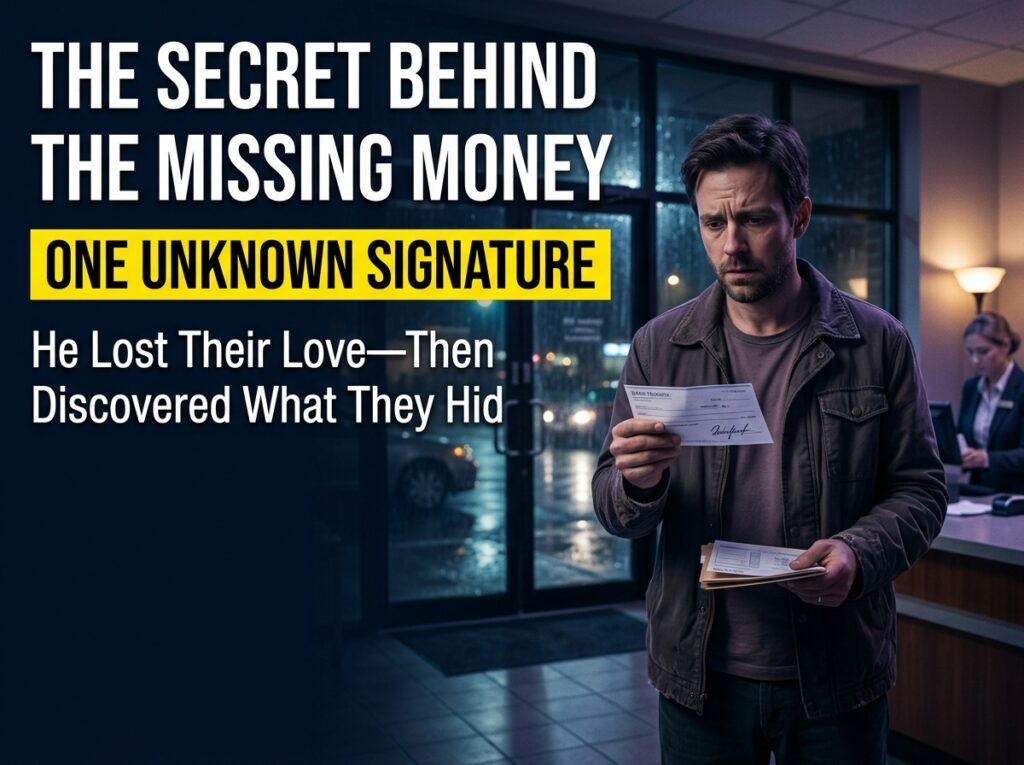
That evening, I went to find the one person who could explain the missing money and the promises that had collapsed with it. They looked at the clue, went pale, and asked me a question that made no sense until I remembered the night we separated. I had come looking for an apology or a reason, but what waited in the final message was far more complicated than either. I read the message twice, because it came from the person sitting across from me.
The bank lobby was almost empty when I discovered the transfer slip.
Outside, evening rain streaked the windows, turning the streetlights into long yellow smears across the wet pavement. A security guard stood beside the entrance, watching the clock as if he had somewhere else to be. Behind the counter, a clerk was stacking papers and preparing to close for the day.
I should have left.
I had already spent most of the afternoon trying to understand why my account balance was lower than I expected. The rent was overdue, two utility bills were waiting on my kitchen table, and I had spent the previous week calculating how many meals I could make from a bag of rice, a few eggs, and whatever remained in the cupboard.
Money had become a language I could no longer speak without feeling ashamed.
For years, my partner and I had promised that being poor would never make us poor in the ways that mattered. We would share what we had, tell each other the truth, and never allow financial trouble to turn us into strangers.
I believed those promises even after our relationship ended.
Perhaps that was my first mistake.
The clerk called my name, and I approached the counter with my identification and a folded statement.
“Is there a problem with my account?” I asked.
She examined the screen.
“Your balance is correct according to our records. Are you questioning a particular transaction?”
“I don’t recognize one of the transfers.”
She turned the monitor slightly, careful not to expose another customer’s information.
“Can you tell me the date?”
I gave it to her.
Her fingers moved across the keyboard. After a moment, she printed a record and slid it toward me.
“Here is the transaction you asked about.”
I scanned the amount first. It was enough to cover several months of rent, groceries, and the bills I had been struggling to pay. Then I looked at the date.
My hands went cold.
The transfer had been made during the final weeks of our relationship, when my partner had still been sitting beside me at the kitchen table, discussing how we would get through another difficult month.
We had talked about cutting expenses. We had postponed a small trip we had planned for years. We had even discussed selling a few things we didn’t need.
Yet someone had moved money without telling me.
“Who authorized this?” I asked.
The clerk studied the record.
“I can explain what the document shows, but I cannot disclose information beyond what you’re authorized to access. If you believe the transaction was unauthorized, I can explain the formal process for disputing it.”
I nodded, although I barely heard her.
At the bottom of the transfer slip was a signature I didn’t recognize.
It wasn’t my handwriting.
It wasn’t the signature my former partner used on birthday cards, rent agreements, or the notes they left beside my coffee cup.
But there was something about the shape of the final letter that seemed familiar.
I stared at it until the clerk gently called my attention back to the counter.
“Sir, are you all right?”
“Yes,” I said automatically.
I folded the paper and placed it in my coat pocket.
Outside, the rain had grown heavier. I stood beneath the bank’s awning, watching cars pass through the intersection, unable to remember why I had come there in the first place.
I had expected to discover a mistake, perhaps a fee or a payment I had forgotten.
Instead, I had found evidence that the last months of my relationship might not have happened the way I remembered them.
When I reached my apartment, the silence greeted me as it always did.
Two bags stood beside the bedroom door. They contained nearly everything I had taken when I left our shared home. A few shirts, a pair of worn shoes, family photographs, and a small wooden box held together with tape.
I had promised myself I would unpack when I felt ready to start again.
Weeks had passed.
I took out the transfer slip and placed it on the kitchen table beside the overdue bills.
Then I opened my phone and searched for the last message my former partner had sent before we stopped speaking.
I need you to trust me about this.
At the time, I had thought those words meant our relationship could still be saved.
Now I wondered what, exactly, I had been asked to trust.
I checked the date of the transfer again.
It was three days before the night we separated.
And suddenly, the conversation I had spent months trying to forget became impossible to ignore.
I didn’t sleep that night.
Every time I closed my eyes, I saw the signature at the bottom of the transfer slip. I tried to convince myself that I was making something ordinary into a mystery because heartbreak had left me searching for explanations.
Perhaps the money had been moved to pay an urgent bill. Perhaps my partner had borrowed it and planned to return it. Perhaps the unfamiliar signature belonged to someone at the bank.
There were explanations that didn’t require betrayal.
I repeated them until morning.
Then I opened my phone.
Our old messages were still there, arranged in a long conversation that began with jokes, photographs of meals, and small promises about the future. I scrolled past the messages from our happiest months, remembering the person I had loved before money became the subject we avoided.
My partner had always been careful with finances. Not wealthy, not particularly organized, but careful. Every expense had a purpose. Every purchase was discussed.
When we first moved in together, we kept a notebook beside the refrigerator. We recorded rent, groceries, electricity, and the money we managed to save.
Whenever one of us worried about the future, the other would open that notebook and show how we were getting through the month.
It was a small ritual, but it made us feel like a team.
The notebook disappeared during our final months together.
I remembered asking about it.
“It’s somewhere in a box,” my partner had said.
I had accepted that answer because there were more urgent things to worry about. The rent had increased. Work had become unpredictable. One unexpected expense seemed to follow another.
We stopped going out.
We stopped talking about the future.
And eventually, we stopped asking each other questions whose answers might hurt.
I searched our messages for the week before the transfer.
Three days before it happened, I had written, The landlord called again. I’ll talk to him tomorrow.
My partner replied, Don’t worry. I’ll take care of it.
The next morning, I had asked whether the rent had been paid.
It’s handled, came the answer.
I remembered feeling relieved. I had been tired after work, and I trusted that the person sharing my life would never let me face a crisis alone.
But when I checked the bank records, I couldn’t find a payment matching the amount we owed.
Instead, there was the transfer.
I looked at the dates until they blurred.
The day after the money moved, my partner had asked whether I could cover groceries for the week. I had said yes, even though it meant postponing another bill.
Two days later, we argued.
The argument itself had seemed insignificant at the time. We were exhausted, worried about money, and frustrated by our inability to fix things. My partner accused me of asking too many questions. I accused them of shutting me out.
Neither of us apologized properly.
That night, we sat on opposite ends of the sofa while the television played to an empty room.
Eventually, my partner stood and said, “Maybe we can’t keep doing this.”
I thought they meant the financial struggle.
I suggested we make a new budget, find extra work, and speak honestly about what we could afford.
Instead, they looked at me with an expression I couldn’t understand.
“I’m tired of pretending everything is fine,” they said.
“So am I.”
“Then maybe we should stop pretending.”
I had believed we were discussing our circumstances.
I hadn’t understood that my partner might already have made a decision about us.
The next morning, I found a small bag packed beside the door. By the evening, the person who had promised to face every difficulty with me had left.
There was no dramatic confession. No explanation that made the separation understandable. Just a few painful sentences and a silence that grew longer each time I reached out.
Now, with the transfer slip on the table, I wondered whether the argument had ever been about money at all.
I searched my messages for the name of the person who might have known about the transaction.
Nothing.
I searched my email.
Nothing.
Then I remembered the notebook.
If my partner had hidden something, perhaps it was still in the boxes we had left behind when we separated.
I stood and looked at my two bags.
There was no way to return to the life we had shared. But there might still be a way to understand it.
I took the transfer slip, placed it in my wallet, and called the one person I had avoided contacting since the breakup.
My former partner answered after four rings.
Neither of us spoke at first.
Finally, I said, “I need to ask you about a bank transfer.”
The silence that followed was so complete that I could hear the faint hum of the refrigerator.
Then came the question I hadn’t expected.
“Where did you find that paper?”
I tightened my grip on the phone.
“At the bank. I was checking my account.”
“You went to the bank?”
“Yes.”
Another silence.
I had imagined this conversation dozens of times. In some versions, my former partner became angry. In others, they admitted everything immediately, apologized, and gave me an explanation that made the past easier to understand.
I had never imagined they would sound frightened.
“What did you see?” they asked.
“A transfer. The date was three days before we separated. The amount was significant, and the signature wasn’t mine.”
“Did you speak to anyone about it?”
“The clerk told me what the record showed. She couldn’t give me information I wasn’t authorized to receive.”
“Good.”
The word came too quickly.
I pulled the phone away from my ear and looked at the screen, wondering whether I had heard correctly.
“Good?” I repeated.
“I mean, you shouldn’t jump to conclusions.”
“I’m trying not to. That’s why I’m calling you.”
My former partner exhaled.
“Not everything is what it looks like.”
“Then tell me what it is.”
“I can’t explain everything over the phone.”
“Why not?”
“Because you don’t know the whole story.”
“Then help me understand it.”
For a moment, I thought they would finally speak. I could almost hear them gathering the courage to say something that had been waiting between us for months.
Instead, they said, “I need time.”
I laughed once, without humor.
“You’ve had months.”
“I know.”
“Do you?”
The question came out sharper than I intended.
I looked around my small kitchen. The bills were still on the table. The cupboard door hung slightly crooked. A damp patch marked the wall near the window where the rain had found its way through a crack in the frame.
I was tired of measuring my life in what I had lost.
“I don’t want another argument,” I said. “I don’t want to accuse you of something you haven’t done. But I need to know why money disappeared when we were struggling to pay rent.”
My former partner said nothing.
“Did you move it?”
“Yes.”
The answer landed harder than I expected.
“Why?”
“I can’t explain that yet.”
“Was it your money?”
“It wasn’t that simple.”
“Whose money was it?”
They began to cry.
I had heard that sound before, usually when life had become too difficult for either of us to manage alone. In the past, I would have tried to comfort them immediately.
This time, I remained silent.
“I never wanted you to find out like this,” they whispered.
“Find out what?”
“I have to go.”
“No. Please don’t do this again.”
“I’m sorry.”
The call ended.
I stood in the kitchen, staring at the phone.
The confession had given me almost nothing. Yes, the transfer had happened. Yes, my former partner knew about it. And no, they still weren’t willing to explain why.
I sat down and opened the bank statement again.
The amount was the same. The date was the same. The signature remained unfamiliar.
I enlarged the image on my phone and examined every letter.
The signature began with a tall, narrow stroke and ended with a small loop that crossed back beneath the name.
I had seen that shape somewhere.
Not on a bank document.
Not on a letter from work.
Somewhere in the life we had shared.
I searched through the photographs stored on my phone. There were pictures of birthday cakes, supermarket receipts, holidays we could barely afford, and the little celebrations we had created out of ordinary days.
Then I found a photograph of our old kitchen table.
The notebook was lying beside a bowl of fruit.
My partner had written a list of expenses on the open page. Beneath the figures was a signature.
I zoomed in.
The final letter curled beneath the name in exactly the same way.
I felt a coldness settle in my stomach.
The handwriting belonged to someone who had once been part of our everyday life. Someone who had sat at our table, eaten our food, and heard us discuss the bills we couldn’t afford.
But the photograph didn’t show enough of the name to identify it.
I searched for other pictures of the notebook. I found one taken several months earlier, when we had been planning a small celebration.
This time, the name was visible.
I read it once.
Then again.
I recognized the person immediately.
And I understood why my former partner had sounded afraid when I told them I had found the transfer slip.
The name belonged to Daniel.
He had been my former partner’s closest friend long before I entered their life. He was the person they called when work went badly, when family problems became overwhelming, and when they needed advice they couldn’t bring themselves to ask anyone else for.
I had known him for years.
Daniel had helped us move into our apartment. He had carried our old sofa up two flights of stairs and laughed when we discovered that it wouldn’t fit through the narrow doorway without being turned sideways.
He had attended our small celebrations and brought groceries when we were both sick. On several occasions, he had offered to lend us money.
We had always declined unless the situation was genuinely urgent.
At least, that was what I remembered.
I looked at the transfer slip again.
If Daniel had authorized the transaction, why had the money been moved without my knowledge? And why had my former partner refused to explain what happened?
I wanted to call him immediately, but I stopped myself.
An unfamiliar signature on a photograph was not proof of wrongdoing. The transaction needed to be understood through proper records, not guesses made while I was hurt.
I called the bank again and asked how to request a detailed review of the transfer. The representative explained what documents I would need and how to submit a dispute if I believed my account had been accessed improperly.
I wrote down the instructions.
For the first time in months, I had something concrete to do.
That afternoon, I searched the boxes I had brought from our old apartment. Most contained clothes, books, and kitchen items we had divided during the separation. At the bottom of the second box, beneath a stack of old photographs, I found the notebook.
Its cover was bent at the corners. A small stain marked the first page.
I sat on the floor and opened it.
The early entries were ordinary. Rent. Groceries. Electricity. Repairs. Small savings for a future we had believed was waiting for us.
Then, several months before the breakup, the entries changed.
There were amounts without explanations. Dates that didn’t correspond to any bills I remembered paying. A few pages had been removed carefully from the binding.
I turned to the final section.
Daniel’s name appeared beside a number, followed by a short note in my former partner’s handwriting.
Temporary arrangement. Keep this separate until everything is settled.
I read the sentence several times.
What arrangement?
I checked the date. It was almost two months before the transfer that had brought me to the bank.
There was another entry a week later.
Do not discuss this until we know what happens next.
My former partner had written those words, not Daniel.
I felt anger rising, but beneath it was something more painful: the realization that the secrecy might have started long before our final argument.
I remembered the evenings when my partner had insisted they were only tired. The sudden phone calls taken in another room. The promises that everything was under control.
I had interpreted those moments as stress.
Perhaps I had been right about the stress but wrong about its cause.
I photographed the pages and placed the notebook in a folder. I wasn’t going to accuse Daniel based on fragments of writing, but I needed to understand whether the transfer was connected to whatever had been recorded there.
I called him.
He answered almost immediately.
“Miles?”
“I need to ask you something about a bank transfer.”
He didn’t respond.
“I found a record from three days before the breakup,” I continued. “Your name appears in our old notebook. I need to know whether you were involved.”
His breathing changed.
“Where are you?”
“At home.”
“Are you alone?”
“Yes.”
“Don’t make any decisions until we talk.”
I closed my eyes.
“Why does everyone keep telling me that?”
“Because there are things you don’t know.”
“Then tell me.”
He was quiet for so long that I thought the call had dropped.
Finally, he said, “I can meet you tomorrow. Bring the notebook and the transfer slip.”
“Why?”
“Because I need to show you something.”
“What?”
His voice became almost a whisper.
“The money wasn’t moved for the reason you think.”
We met the following afternoon in a small café near the bus station.
Daniel arrived carrying a brown envelope. He looked older than I remembered, although only a few months had passed. His hair was untidy, and he kept rubbing his hands together as if he couldn’t get warm.
I placed the notebook and transfer slip on the table.
“Before you explain anything,” I said, “I want to make one thing clear. I don’t want another story that ends with someone asking me to wait.”
He nodded.
“That’s fair.”
“Did you authorize the transfer?”
“No.”
The answer was immediate.
I stared at him.
“Then why is your name in the notebook?”
“Because I was involved in the arrangement. But I didn’t authorize that transfer, and I didn’t take the money.”
“An arrangement for what?”
Daniel looked toward the window.
“I promised your partner I wouldn’t discuss it without permission.”
“They left me with bills I couldn’t pay. They ended our relationship without explaining why. Whatever promise you made, it doesn’t erase what happened to me.”
“I know.”
“Then tell me.”
He opened the envelope but didn’t remove anything yet.
“Do you remember when the electricity was almost disconnected?”
I did.
It had happened during a particularly difficult month. My work hours had been reduced, and my partner had been dealing with a problem I was told was related to a family member. We had fallen behind on several payments.
Daniel had called one evening to ask how we were managing.
I had said we were fine.
The next day, my partner told me that an unexpected payment had been arranged.
I hadn’t asked where the money came from.
I had been too relieved.
Daniel watched my expression.
“You didn’t know what was happening behind the scenes,” he said.
“Then explain it.”
He placed a document on the table.
It was a record of a payment made to an account connected with an outstanding obligation. The amount was similar to the transfer on my slip, but the dates and details needed to be verified.
“I helped arrange this payment,” he said. “Your partner asked me to help because they were trying to settle something before it became a bigger problem.”
“What problem?”
He hesitated.
“I can’t tell you everything from memory. Some of this involves financial records that should be reviewed properly. But I can tell you that the money wasn’t simply taken and spent.”
I looked at the document.
“Why didn’t my partner tell me?”
“Because they were ashamed.”
“Of what?”
Daniel lowered his eyes.
“They believed they could fix everything before you found out.”
I felt a bitter laugh rising in my throat.
“That is what people always say when they decide someone else doesn’t deserve the truth.”
He didn’t argue.
I had expected him to defend my former partner. Instead, he looked as if he had been carrying a weight that had become too heavy to hold alone.
“Did the money belong to us?” I asked.
“Some of the records involve shared expenses. Some involve obligations your partner had before the relationship became serious. I don’t want to give you an answer that turns out to be wrong. That’s why I brought the documents.”
He pushed the envelope closer.
“There are copies of the records I was able to obtain legitimately. You should compare them with your own statements and ask the bank to verify anything that concerns your account.”
I opened the envelope.
Inside were several pages of figures, dates, and notes. One sheet contained a handwritten message.
The handwriting was unmistakably my former partner’s.
If Miles ever asks, tell him I was trying to protect him.
I read the sentence twice.
Then I looked at Daniel.
“Protect me from what?”
He swallowed.
“I don’t know the whole answer.”
“You’re telling me you helped arrange a payment, kept a secret, and still don’t know why?”
“I knew why they asked for help. I didn’t know how far they intended to take the secrecy.”
“Then what are you afraid I’ll discover?”
Daniel leaned forward.
“I’m afraid you’ll think every good thing that happened between you was a lie.”
For a moment, neither of us spoke.
I looked down at the documents. I wanted to find a clear answer in them, a single line that could separate the truth from the months of confusion.
Instead, one detail caught my attention.
The payment referenced an earlier date—one that came before the period when our finances had begun to collapse.
I pointed to it.
“What happened on this date?”
Daniel followed my finger.
His face changed.
“That’s the date your partner first contacted me.”
“About the money?”
He shook his head.
“About something else.”
I waited.
He looked at the message in my hand and finally said, “That’s when they learned the problem couldn’t be solved by paying the bills.”
I left the café with the documents in my bag and a mind full of questions.
Daniel had promised to provide what he could, but he had also made it clear that some parts of the story belonged to people who had not yet spoken. I couldn’t force those people to tell the truth, and I couldn’t build a reliable explanation from hints and half-confessions.
For the first time, I understood that finding an answer might require more patience than I wanted to give.
That evening, I sat at my kitchen table and arranged the papers by date.
The transfer slip came first.
Then the entries from the notebook.
Then the documents Daniel had brought.
I wrote down every amount, every reference number, and every date that appeared in more than one place. Whenever something didn’t match, I marked it for verification.
A pattern slowly emerged.
The financial trouble hadn’t begun with the transfer I had discovered. There had been earlier obligations, payments, and arrangements that I hadn’t known about.
Some entries were connected to shared expenses. Others appeared to relate to something my former partner had been handling privately.
I couldn’t tell whether the money had been moved to cover a debt, repay an earlier payment, or settle an obligation involving another person.
But I could see that the story I had told myself—that our relationship had collapsed simply because we were poor—was incomplete.
The next morning, I visited the bank with my identification and the relevant transaction details. I asked for a formal review of the transfer and an explanation of what information I was legally entitled to access.
The employee explained that certain details would require additional authorization, while other records could be provided through the bank’s normal process.
I submitted the request.
I also asked whether there were any security concerns with my account. The employee explained how to review access, change my credentials, and protect my information while the transaction was investigated.
I followed the instructions before leaving.
I had spent months feeling powerless because I didn’t know what had happened. Taking practical steps didn’t resolve the mystery, but it gave me something the relationship had gradually taken away: a sense that I could make decisions for myself.
That afternoon, I received a message from my former partner.
Daniel told me you met.
I stared at the screen.
Then another message arrived.
Please don’t misunderstand what he showed you.
I typed a reply, deleted it, and started again.
I am trying to understand. You can help me by telling me the truth.
The response took nearly twenty minutes.
I wanted to tell you. I just didn’t know how.
I felt the old anger returning.
You could have started by telling me before we separated.
There was no answer.
I put the phone down and went to make tea. When I returned, a new message was waiting.
Do you remember the last night we were together?
Of course I remembered.
I remembered the cold kitchen, the unfinished meal, and the way my partner had stood near the door with their arms folded tightly across their chest.
I remembered asking whether we could start again in the morning.
I remembered hearing, “I can’t keep asking you to trust me when I can’t explain anything.”
At the time, I had thought the words were an accusation.
Now I wondered whether they had been a confession.
I replied.
Yes.
The next message came almost immediately.
There was something I wanted to show you that night. I had it with me, but I couldn’t bring myself to take it out.
My heart began to beat faster.
What was it?
The typing indicator appeared, disappeared, and appeared again.
Finally, my former partner sent a photograph.
It showed a folded piece of paper on a table.
I recognized the paper immediately.
It was another transfer slip.
The amount was different, and the date was earlier. The signature at the bottom was partly obscured by a fold.
But beside it was a handwritten note.
If this fails, Miles must never be involved.
I read the sentence again.
Then I looked at the date.
It was months before the money I had discovered at the bank.
Someone had been trying to keep me out of something long before our relationship ended.
And I was beginning to suspect that the secret had never been about the money alone.
I called my former partner that evening.
This time, they answered before the first ring had finished.
“I saw the photograph,” I said.
“I thought you would.”
“What does the note mean?”
They took a shaky breath.
“I wrote it.”
“Why?”
“Because I thought I could handle the situation without bringing you into it.”
“What situation?”
There was a long silence.
“I made a decision before we broke up,” they finally said. “It was supposed to solve a problem. Instead, it created another one.”
I waited.
“I thought I was protecting you from the consequences,” they continued. “I thought if I could fix everything quietly, we could go back to the way things were.”
“Did you use our money?”
“I used money that I believed I could replace.”
“That’s not an answer.”
“I know.”
I closed my eyes.
For months, I had imagined betrayal as something simple. Someone had lied, someone had taken money, and someone had walked away.
But the conversation was revealing something more complicated.
My former partner might have acted out of fear rather than cruelty. They might have believed they were helping us. They might even have intended to repay everything.
None of that explained why they had denied me the chance to understand what was happening.
“What were you trying to fix?” I asked.
“I can’t explain it all without showing you the records.”
“Then show me.”
“Not tonight.”
I almost ended the call.
Then I heard a change in their voice.
“Miles, there is one thing you need to understand. I never planned to leave you because we were poor.”
“Then why did you leave?”
“I thought leaving was the only way to stop things from getting worse.”
“For whom?”
They didn’t answer.
I felt the old familiar frustration rising, but I forced myself to breathe before speaking.
“You keep telling me that you wanted to protect me. But you made decisions that affected my life without asking me. You left me to deal with the bills and the questions. You made me believe our relationship had failed because we couldn’t survive being poor.”
“I’m sorry.”
“I don’t know what your apology means anymore.”
They began to cry.
I listened without interrupting.
Once, that sound would have been enough to make me abandon every question and offer comfort. I would have told them that we could work things out, that everyone made mistakes, that love meant forgiving one another.
But love could not mean surrendering the right to know what was happening in my own life.
“I need the complete records,” I said. “And I need you to stop asking me to trust you before you explain anything.”
“I understand.”
“Do you?”
“I think I do now.”
We agreed to meet in two days.
After the call, I sat for a long time beside the window. The rain had stopped, and the street below was quiet. A neighbor walked past carrying groceries. Somewhere in the building, a child laughed.
Ordinary life continued while mine waited for an explanation.
I thought about the promises we had made when we first moved in together. We had believed that honesty meant telling each other when we were afraid, when we had made mistakes, and when we didn’t know how to solve a problem.
Somewhere along the way, my former partner had begun confusing protection with secrecy.
And I had confused patience with understanding.
Neither of us had known how to stop the distance from growing.
The next morning, Daniel sent a message.
I found another document that may help explain the earlier payment. You should see it before you meet.
He attached a photograph of a page containing several dates and a reference number.
At the bottom was a name.
Not my former partner’s.
Not Daniel’s.
Mine.
I stared at the screen, trying to understand why my name would appear on a document connected to a financial decision I had never known about.
Then I noticed the date beside it.
The document had been prepared before we moved in together.
I read the document carefully, looking for an explanation that wouldn’t turn out to be another assumption.
My name appeared beside a reference number and a short notation. It wasn’t a signature, and it didn’t establish that I had authorized anything. Still, it connected me to the story in a way I hadn’t expected.
I contacted the bank again and asked what the reference number represented. The representative explained that the document alone was insufficient to establish ownership or responsibility for the transaction. They advised me to submit it with my existing inquiry so the records could be reviewed together.
I did.
Then I called Daniel.
“Why is my name on this document?”
“I wondered whether you would notice that.”
“Did you know about it before?”
“Yes.”
The admission made my stomach tighten.
“Why didn’t you tell me?”
“Because I didn’t understand the full meaning of it. I knew your partner was trying to settle an old obligation, but I didn’t know why your name appeared on the paperwork.”
“Then why keep it from me?”
“Your partner asked me to wait until they could explain it themselves.”
I looked down at the page.
“Everyone keeps making decisions about what I should know.”
“I know how that sounds.”
“Do you?”
He was quiet.
Then he said, “I should have been more honest about what I knew. I was trying to help someone I cared about, and I convinced myself that staying silent was the kindest thing to do. I see now that it wasn’t fair to you.”
It was the first time anyone involved had acknowledged the damage caused by the secrecy without immediately asking me to excuse it.
I thanked him for sending the document and ended the call.
For the rest of the day, I focused on practical matters. I paid the smallest outstanding bill I could afford, arranged a payment discussion with my landlord, and made a list of the expenses I needed to cover over the next month.
I couldn’t allow the investigation to consume every part of my life.
The financial uncertainty was real. So were the bills. Whatever the final explanation turned out to be, I needed a way to keep moving.
That evening, I received a message confirming that the bank had received my request for a review. They would contact me if they needed additional information.
It wasn’t a solution, but it was progress.
The next day, my former partner arrived carrying a thick folder.
We met in a quiet public place, choosing a table where we could speak without being overheard. For a moment, we simply looked at one another.
They appeared exhausted.
I noticed that they were wearing the same coat they had worn on the night we separated.
“I brought everything I could find,” they said.
I placed the notebook between us.
“Start at the beginning.”
They opened the folder.
The first documents concerned an obligation that existed before our relationship had become serious. The later pages showed payments, notes, and attempts to rearrange what was owed. Some entries matched the dates in the notebook. Others required clarification.
My former partner explained what they remembered, admitting when they were uncertain.
I asked questions.
They answered some immediately and promised to verify others rather than guess.
For the first time, the conversation felt different from the arguments we used to have. Neither of us was pretending that the problem could be solved by saying everything would be fine.
Eventually, we reached the document containing my name.
My former partner stopped speaking.
“This is the part I was afraid to show you,” they said.
“Why?”
“Because it connects the whole thing to something that happened before we lived together.”
I looked at the page.
“What happened?”
They turned to the next sheet, their hands trembling slightly.
“I made a promise about you before you ever knew there was a problem.”
I stared at them, unable to understand.
Then they slid the final page across the table.
It contained a sentence written in their own handwriting.
If Miles ever discovers the original agreement, he will know why I had to leave.
For a moment, I couldn’t speak.
I read the sentence again, then looked up at the person sitting across from me.
“You wrote this?”
“Yes.”
“When?”
“Before we separated.”
“Why would discovering an agreement mean you had to leave?”
My former partner rubbed their forehead.
“I need to explain what I knew then, what I believed, and what I only understood later. I don’t want to make excuses, Miles. I want you to understand how I got there.”
I leaned back.
“Then tell me.”
They began with the months before we moved in together.
At that time, we had been happy in the ordinary, imperfect way people are happy when they believe they have enough time to build a future. We were working, saving what we could, and making plans that seemed modest but important.
There had been a financial problem involving an earlier obligation. My former partner had tried to manage it privately, believing it would be resolved before it affected our shared life.
Daniel had offered help when the situation became difficult.
The notebook entries, the transfer slips, and the later payments were connected to that attempt to keep the problem contained. But the records also showed that the arrangement had become more complicated over time.
Each attempt to fix one part created another question.
Instead of telling me, my former partner had tried to manage everything alone.
“I kept thinking I could make it right before you ever had to know,” they said. “Every time I thought I was close, something else happened.”
“And when the money ran short?”
“I made another decision.”
“Without telling me.”
“Yes.”
I looked at the papers.
“Why did you think leaving would solve anything?”
“Because I thought you would be safer if you weren’t connected to the situation.”
“Safer how?”
They hesitated.
“I was afraid that if the problem became worse, you would suffer because of choices I had made before we were together.”
I felt anger, but beneath it was a sadness I couldn’t easily describe.
They had taken the fear of hurting me and turned it into a reason to keep me ignorant. They had decided that I couldn’t be trusted with the truth, even when the truth directly affected my life.
“You should have told me,” I said.
“I know.”
“You should have given me the chance to decide what I could handle.”
“I know.”
“And when you left, you let me believe you had stopped loving me.”
Their eyes filled with tears.
“I didn’t stop loving you.”
The words hung between us.
For months, I had wanted to hear them. I had imagined that those words would make everything better, that if I could discover my former partner still loved me, the pain of the separation would finally have an explanation.
But hearing them now didn’t erase the months of silence.
Love could explain why someone was afraid.
It could not make secrecy harmless.
I looked at the final page again.
“What was the original agreement?”
My former partner reached into the folder and removed a document with several pages. Some sections were difficult to interpret without professional guidance. The dates and names suggested that the arrangement involved financial responsibilities established before our shared life began.
“I don’t want you to rely on my interpretation alone,” they said. “We should have the relevant records reviewed properly. I brought everything I could find, and I’ll cooperate with the bank’s review.”
I studied their face.
For the first time, they weren’t asking me to accept their explanation simply because we had once loved each other.
They were offering evidence.
That mattered.
But there was still one question I needed answered.
“If you believed leaving would protect me, why did you never tell me that afterward?”
My former partner looked down.
“Because I was ashamed. And every day I waited, it became harder to explain why I had waited so long.”
I understood that feeling more than I wanted to.
Silence had become a habit for both of us. I had avoided asking certain questions because I was afraid of the answers. They had avoided giving answers because they were afraid of what I would do with them.
The difference was that their decisions had affected our finances and my ability to make informed choices.
I gathered the documents into the folder.
“I will have the records checked,” I said. “I won’t promise anything about us. I won’t pretend this conversation has repaired what happened.”
They nodded.
“I understand.”
I stood to leave.
Then my former partner said my name.
I turned.
“There is one more thing. The original agreement wasn’t the reason I left. It was what I learned about it afterward.”
I waited, but they seemed unable to continue.
“What did you learn?”
They opened their mouth.
Then their phone rang.
They glanced at the screen, and all the color drained from their face.
After listening for several seconds, they ended the call.
“They’ve found the original record,” they said.
“Who has?”
“The people reviewing the transaction.”
They looked at me with an expression I couldn’t read.
“And there’s something in it that neither of us expected.”
The following days were difficult, but they were different from the months that had come before.
For once, I wasn’t trying to solve everything through memory, suspicion, or a desperate search for the right words. The documents were being reviewed, and I had a clear record of what I had discovered, what I had requested, and what still needed to be verified.
I spoke with the bank about the next steps. I kept copies of the relevant paperwork and made sure I understood which questions could be answered through their review and which required additional documentation.
Some details took time.
Others were clarified through records that neither my former partner nor Daniel had fully understood when they first became involved.
The financial story was more complicated than a single unexplained transfer. There had been an earlier obligation, attempts to manage it privately, and decisions made out of fear that had affected our shared expenses. Some assumptions I had made were wrong. Some of my former partner’s explanations were incomplete. And some questions required evidence rather than another emotional conversation.
The original agreement helped establish the sequence of events, but it did not erase the harm caused by the secrecy.
That was something I had to learn to accept.
For a long time, I had believed that understanding the reason someone hurt me would automatically make the hurt smaller.
It didn’t.
The truth helped me separate what had happened from what I had feared had happened. It showed me that not every good memory was a lie, and not every promise had been made with the intention of breaking it.
But it also showed me that love could not survive on good intentions alone.
It needed honesty, especially when honesty was uncomfortable.
My former partner and I spoke again after the records had been reviewed. We discussed the practical matters that remained, including the bills and the responsibilities we needed to settle. We agreed not to make promises about reconciliation while we were still learning how to speak openly about the past.
There were moments when I wanted to return to the familiar version of our relationship. I missed the small things: sharing coffee in the morning, hearing about an ordinary day, and knowing that someone would notice if I came home tired.
But missing those things didn’t mean I was ready to rebuild the life we had lost.
I needed to learn how to trust my own judgment again.
Daniel apologized for keeping information from me. I accepted his apology without pretending that his silence had been harmless. He had believed he was protecting someone he cared about, but he had also helped maintain a situation in which I was left to make decisions without understanding the facts.
We could acknowledge that without turning the conversation into another argument.
Slowly, the financial pressure became more manageable. I worked through the outstanding bills, adjusted my budget, and made plans based on what I actually knew rather than what I hoped would happen.
The two bags remained beside the bedroom door for several more weeks.
One morning, I finally unpacked them.
I folded the shirts into a drawer, put the photographs on a shelf, and placed the wooden box on the kitchen table. Inside were a few things I had almost forgotten: an old receipt from a dinner we had shared, a small key that no longer opened anything, and a note written during the first year of our relationship.
It contained a promise about the future.
I read it once, smiled sadly, and put it away.
The note was real. So were the memories behind it.
They didn’t need to become false simply because our relationship had changed.
One evening, I walked past the bank on my way home. The windows were dark, and the streetlights reflected on the pavement. I stopped for a moment, remembering the day I had found the transfer slip and how quickly my world had narrowed to a single unfamiliar signature.
I had believed that the hardest part of losing everything was discovering how little I had left.
I was wrong.
The hardest part was realizing how long I had been living with questions I was afraid to ask.
I had feared that the truth would hurt more than being broke. In some ways, it did. It forced me to reconsider decisions, memories, and promises I had once accepted without hesitation.
But uncertainty had hurt me too.
It had made every silence feel like rejection and every unexplained expense feel like evidence of betrayal. It had kept me waiting for someone else to decide when I deserved an answer.
Now I understood that I could love someone and still ask them to be accountable. I could forgive a mistake without pretending it had never happened. I could care about a person’s fear without allowing that fear to make my decisions for me.
I didn’t know whether my former partner and I would ever build another life together.
That question no longer had to be answered immediately.
What mattered was that I was no longer living inside a mystery I couldn’t name.
When I reached home, I placed the bank documents in a folder and put them in a drawer. The notebook went beside them. I didn’t throw either away, because the past was part of my life, and I no longer needed to destroy evidence of it to move forward.
Then I made dinner.
It was a simple meal, nothing special, but I ate it without calculating how many days I could stretch the ingredients or wondering what another person’s silence might mean.
For the first time in months, I felt the quiet beginning of peace.
I had lost money. I had lost a relationship I once believed would last forever. I had also lost the comforting certainty that love alone could protect people from the consequences of their choices.
But I had not lost my ability to begin again.
And that was enough for one evening.
Miles discovers a mysterious bank transfer after a painful breakup, uncovering hidden financial decisions, broken promises, and a truth that changes everything.