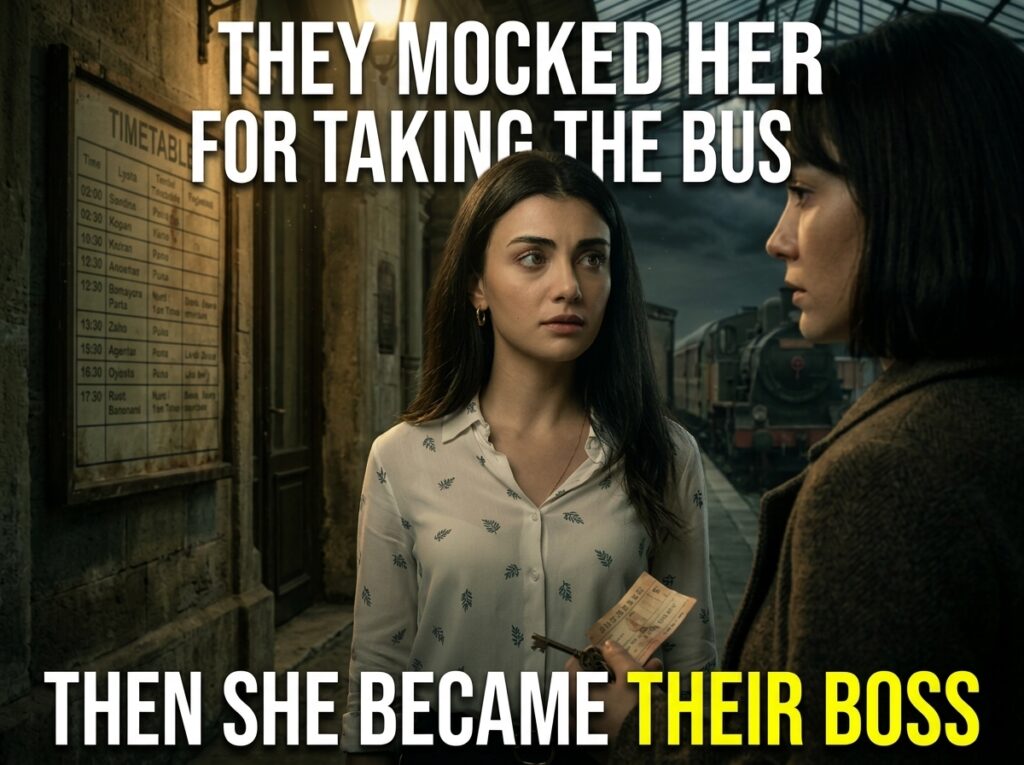
PART 1 — THE WOMAN NOBODY NOTICED
Sophia Miller arrived at Sterling International every morning at 7:45.
She took the same bus, walked the same three blocks, and entered the same glass building through the side entrance reserved for employees.
For six months, she had worked as a junior analyst in the company’s development department.
She was intelligent, punctual, and quiet. She wore simple blouses, carried a secondhand handbag, and brought lunch from home.
To most of her colleagues, she was forgettable.
To Vanessa Reed, she was an easy target.
Vanessa was the daughter of Sterling International’s managing director. She had grown up surrounded by money and had learned early that people often treated wealth as proof of intelligence.
She wore designer clothes, drove an expensive car, and made sure everyone knew how much her handbag cost.
One Monday morning, Vanessa noticed Sophia checking the bus schedule on her telephone.
“Still taking public transportation?” she asked loudly.
Sophia looked up. “Yes.”
“Why don’t you buy a car?”
“I’m saving for something more important.”
Vanessa laughed.
“People who are always saving never seem to get anywhere.”
Two colleagues chuckled.
Sophia returned to her work.
She had learned that arguing with people who enjoyed humiliating others rarely changed their minds.
What Vanessa did not know was that Sophia had been working on a business platform since university. Her software helped small companies identify financial risks before they became serious problems.
She had built the first version on an old laptop while caring for her mother, who had been recovering from a major operation.
For months, she had contacted investors. Most ignored her. A few offered to buy the idea cheaply, assuming she was too inexperienced to understand its value.
Then an investment group called Northbridge Capital requested a meeting.
Sophia expected another rejection.
Instead, the group’s representatives spent three hours examining her work.
At the end of the meeting, their director, Richard Hale, offered to help her develop the platform into a full commercial product.
He also introduced her to his business partner, Margaret Collins, a respected investor who had spent decades supporting technology companies.
Margaret listened carefully as Sophia explained her vision.
“You built all of this yourself?” she asked.
“With help from a few people who believed in me.”
“Then why are you still working at Sterling?”
Sophia hesitated.
“Because I need a stable income. My mother depends on me.”
Margaret studied her.
“Would you be interested in owning a company instead of simply working for one?”
Sophia laughed nervously.
“I don’t think I have enough money for that.”
Margaret smiled.
“Money isn’t always the first thing a business needs.”
Three weeks later, Margaret called with an extraordinary proposal.
Sterling International was struggling. Its founder, an elderly businessman named Arthur Bennett, wanted to retire but feared that the company would be destroyed by executives more interested in their bonuses than its future.
Arthur had discovered Sophia’s work through Northbridge Capital.
He believed her technology could save the company millions.
More importantly, he believed she had the integrity Sterling had lost.
He wanted Sophia to become his business partner.
Sophia thought he was joking.
“I am a junior employee,” she said. “I sit in the same office as people who don’t even know my surname.”
Arthur replied, “That is precisely why I noticed you.”
The proposed agreement would give Sophia a controlling stake in Sterling through a combination of investment, licensing rights to her platform, and a restructuring of the company’s ownership.
The lawyers would need several weeks to complete the documents.
Until then, Arthur asked her to keep the negotiations confidential.
Sophia agreed.
She returned to work the next morning, caught the same bus, and sat at the same desk.
Vanessa passed her with a coffee in hand.
“Another ordinary day for an ordinary girl.”
Sophia smiled politely.
“Have a good morning, Vanessa.”
Vanessa walked away, never imagining that the woman she had mocked might soon become the person responsible for deciding the company’s future.
PART 2 — THREE DAYS THAT CHANGED EVERYTHING
The acquisition documents were signed on a Thursday.
Sophia sat in a conference room overlooking the city while lawyers reviewed the final pages.
Arthur Bennett shook her hand.
“Welcome to Sterling’s future.”
Sophia looked at the documents.
She had spent years trying to build something meaningful. Now she was being given the opportunity to protect a company that employed hundreds of people.
She felt excitement, but also fear.
“What if I make a mistake?” she asked.
Arthur smiled.
“You will. Everyone does. The important question is whether you will learn from it and whether you will remember the people affected by your decisions.”
Sophia thought of her mother, who had taught her that money could solve certain problems but could never determine a person’s worth.
“I won’t forget.”
The following Monday, a black car collected Sophia from her apartment.
She had not requested it. The company had arranged transportation for the new majority owner, and she reluctantly agreed to use it for the first few days.
When the car stopped outside Sterling International, the receptionist hurried forward.
“Good morning, Ms. Miller.”
Sophia smiled.
“Good morning.”
The receptionist looked startled. She had never greeted Sophia so warmly before.
Within minutes, word spread through the building that a major investor had arrived.
Employees gathered near the elevators.
Vanessa came out of her office, holding her telephone.
“What’s happening?”
Her assistant whispered, “The new majority owner is here.”
Vanessa barely looked up.
“Then make sure everything is perfect.”
She walked toward the conference room.
The door opened.
Sophia entered wearing a tailored black suit, carrying a slim folder.
Vanessa stopped so abruptly that the person behind her nearly collided with her.
For several seconds, neither woman spoke.
Then Vanessa laughed.
“Are you kidding? The one who took the bus for six months is now a VIP for three days?”
Sophia placed her folder on the table.
“Good morning, Vanessa.”
Vanessa glanced around, waiting for someone to explain the joke.
Arthur Bennett entered behind Sophia.
“Everyone, please take your seats.”
He stood beside her.
“I would like to introduce Sterling International’s new majority owner and executive chair, Ms. Sophia Miller.”
Silence fell over the room.
Vanessa’s face lost its color.
Sophia looked around at the people who had ignored her, mocked her, or treated her as though she were invisible.
She did not feel triumphant.
She felt strangely sad.
For six months, she had worked beside these people. She had hoped they would judge her by her ideas, her effort, and her character.
Instead, many had judged her by her clothes and the bus she took to work.
Sophia opened her folder.
“Before we discuss the company’s future, I want everyone to understand something. I did not come here to punish people for being wealthy, and I will not reward anyone simply because they suddenly recognize my position.”
Her eyes moved toward Vanessa.
“We are going to build a company where respect is not reserved for people who can afford expensive things.”
Nobody laughed.
For the first time, Vanessa had nothing to say.
PART 3 — THE ENVELOPE ON THE TABLE
Sophia’s first executive meeting lasted two hours.
She presented the company’s financial position, outlined her technology strategy, and proposed a review of departmental performance.
Vanessa sat near the end of the table, repeatedly checking her telephone.
She had expected the new owner to announce sweeping changes or demand immediate loyalty.
Instead, Sophia asked difficult questions.
Why had operating costs increased while customer satisfaction declined?
Why had several promising projects been abandoned?
Why had junior employees submitted ideas that never reached senior management?
One manager blamed the economy.
Another blamed the staff.
Vanessa blamed a former director.
Sophia listened to every explanation.
Then she opened the sealed envelope.
Inside were copies of internal reports, project records, and employee complaints collected during the previous six months.
“I have reviewed the way decisions are made here,” Sophia said. “Some departments are performing well. Others have serious problems that cannot be explained by market conditions alone.”
Vanessa shifted in her chair.
Sophia continued.
“People have reported that promising ideas were dismissed without review, that employees were pressured to work unpaid overtime, and that promotions were sometimes based on personal relationships rather than performance.”
She paused.
“I will not make decisions based on rumors. Every allegation will be investigated fairly. But nobody will be protected from accountability simply because of their family name.”
Vanessa’s father, Richard Reed, sat across from her.
He looked uncomfortable.
“Sophia, I think we should discuss these matters privately.”
“Some matters should be private. The investigation process will be confidential. But our standards must be clear to everyone.”
She turned to the human resources director.
“Please arrange an independent review. Employees must be able to speak without fear of retaliation.”
Then she closed the envelope.
“The purpose is not revenge. The purpose is to understand what happened and fix it.”
After the meeting, Vanessa followed Sophia into the corridor.
“Can we talk?”
“Of course.”
Vanessa lowered her voice.
“You don’t need to embarrass me in front of everyone.”
Sophia looked at her.
“I didn’t mention your name.”
“You knew what you were doing.”
“I knew that the company needed an investigation.”
Vanessa folded her arms.
“Look, I may have made jokes about the bus. Everyone does that sometimes.”
“Perhaps.”
“You can’t seriously be holding a grudge over something so small.”
Sophia considered her words.
“The bus was never the problem, Vanessa. The problem was how you treated someone you believed had nothing to offer you.”
Vanessa looked away.
“I didn’t know who you were.”
“Exactly.”
Sophia walked toward her office.
Vanessa remained in the corridor, realizing that the woman she had dismissed as unimportant was now asking questions that could affect her entire career.
But the investigation would uncover something neither woman expected.
Several of the reports involved a project called Horizon, a project that had been quietly canceled months earlier.
Sophia recognized the name immediately.
It was the project she had proposed during her first month at Sterling.
Someone had taken her research, presented a modified version to the board, and then abandoned it without giving her credit.
The records suggested that Vanessa had been involved.
But one signature appeared repeatedly in the documents.
Richard Reed’s.
Vanessa’s father.
PART 4 — THE MAN WHO KNEW HER SECRET
Richard Reed invited Sophia to his office the following morning.
He was a polished executive in his early fifties, known for his confidence and ability to negotiate difficult deals.
He offered her coffee and gestured toward a chair.
“I understand you’re reviewing the Horizon project.”
“Yes.”
“It was a complicated situation.”
“Could you explain what happened?”
Richard leaned back.
“Your original proposal had potential, but the timing was wrong. We were dealing with financial pressure. I asked the team to adapt the concept.”
“Who approved the changes?”
“I did.”
“Was my contribution acknowledged?”
Richard hesitated.
“Perhaps not as clearly as it should have been.”
Sophia opened her notebook.
“Did you know that the revised proposal contained sections from my original research?”
“Many people contributed to it.”
“Then the records should make that clear.”
Richard’s expression hardened.
“You’re new to executive leadership, Sophia. Sometimes you need to understand the difference between being technically correct and making a business decision.”
Sophia met his gaze.
“And sometimes people use business decisions to avoid taking responsibility.”
He stood.
“I think we’re finished here.”
Sophia closed her notebook.
“For now.”
That afternoon, she received an unexpected visit from Margaret Collins.
Margaret had been the investor who introduced Sophia to Arthur Bennett. She had also served as an adviser to Sterling during its financial restructuring.
“I heard about Horizon,” Margaret said.
Sophia looked up.
“Do you know something?”
Margaret sat down.
“I know that Richard was under pressure to make his department look successful. I also know that Arthur was concerned about how some employees were being treated.”
“Why didn’t anyone intervene?”
“Because the board did not have enough evidence to understand the full picture. And because some people who knew more were afraid of losing their jobs.”
Sophia felt frustrated.
“So everyone knew something was wrong, but nobody spoke?”
“Not everyone. But enough people were afraid to remain silent.”
Margaret handed her a document.
“This is an earlier version of the Horizon proposal. It was sent to Arthur before the project was canceled.”
Sophia studied the pages.
Her original diagrams were there, along with handwritten notes in the margins.
At the bottom was a message from Arthur.
The concept is strong. Please ensure the original author receives proper credit.
Sophia looked up.
“He knew?”
“He suspected that the work had been taken from someone junior. He asked for an internal review, but the process stalled when the company began experiencing financial difficulties.”
“Why didn’t he tell me?”
“Because he didn’t know whether the evidence was sufficient. He wanted to protect the company from making an accusation it could not prove.”
Sophia understood the concern, but she also knew that silence had allowed the situation to continue.
She placed the document on her desk.
“I want the review completed.”
Margaret nodded.
“Good.”
Then she added, “Be careful, Sophia. When people feel threatened, they sometimes try to turn an investigation into a personal conflict.”
Sophia thought of Vanessa.
“I won’t let that happen.”
She did not yet know that the next person to enter her office would be Vanessa herself, carrying a document that could change everything.
PART 5 — VANESSA’S CONFESSION
Vanessa arrived just before the end of the workday.
She looked different without her usual confidence. Her hair was untidy, and she held a folder against her chest.
“I need to tell you something,” she said.
Sophia invited her to sit.
Vanessa placed the folder on the desk.
“It’s about Horizon.”
Sophia waited.
“My father told me to present the revised proposal at a board meeting. He said the original research had been reviewed and approved.”
“Did you know I had created it?”
Vanessa hesitated.
“Yes.”
Sophia felt a wave of disappointment.
“Why didn’t you say anything?”
“Because I wanted the promotion. I thought if I presented the project, my father would finally consider me capable of running a department.”
“And you were willing to take credit for my work?”
Vanessa’s eyes filled.
“I told myself it was only a presentation. I didn’t think the project would be canceled.”
“But you knew where the ideas came from.”
“Yes.”
For a moment, Sophia said nothing.
Vanessa looked at the floor.
“I know you have every reason to hate me.”
“I don’t hate you.”
Vanessa looked up, surprised.
“But I won’t pretend what you did was acceptable.”
“I understand.”
“Why are you telling me now?”
Vanessa swallowed.
“Because I heard my father say he intended to blame the entire project failure on the junior team. He said nobody would believe an employee over an executive.”
She pushed another document across the desk.
“This is an email in which he instructed me to remove your name from the presentation. I kept it because I was afraid he might blame me later.”
Sophia read the message carefully.
It supported the investigation’s concerns.
“Are you prepared to provide this to the independent reviewers?”
Vanessa hesitated.
“If I do, my father could lose his position.”
“If you don’t, other people could be blamed for something they didn’t do.”
Vanessa closed her eyes.
“I know.”
Sophia did not pressure her.
“You need to make your own decision. But you should understand that telling the truth does not erase your part in what happened.”
Vanessa nodded.
“I understand.”
She stood to leave, then stopped.
“Can I ask you something?”
“Yes.”
“Why are you being fair to me? I was horrible to you.”
Sophia looked at her.
“Because fairness should not depend on whether I like someone. And because I don’t want to become the kind of person who uses power to settle personal scores.”
Vanessa’s eyes filled with tears.
For the first time, she seemed to understand that Sophia’s success had not made her cruel.
It had revealed how little she needed to prove herself.
That evening, Vanessa submitted the documents to the independent review team.
The next morning, Richard Reed learned what she had done.
He called his daughter into his office.
“Have you lost your mind?”
Vanessa stood near the door.
“I told them what happened.”
“You’ve destroyed your own future.”
“No, Dad. I told the truth about what happened.”
Richard stared at her.
“You have no idea what this company requires.”
Vanessa took a shaky breath.
“Maybe I don’t. But I know what it feels like to be treated as though someone else can decide whether you deserve respect.”
Richard turned away.
For the first time in her life, Vanessa did not apologize simply to end an argument.
She walked out of his office and returned to her desk.
She had no idea what would happen next.
But she knew she could no longer pretend she had done nothing wrong.
PART 6 — THE TRUTH ABOUT THE NEW OWNER
The independent review continued for several weeks.
It confirmed that Sophia’s research had been used without proper attribution and that several employees had been pressured to support a proposal they did not fully understand.
The review also found that Richard had made decisions that favored his department’s public image over the company’s long-term interests.
The findings were serious, but they were not treated as proof that every decision he had made was dishonest.
The board examined the evidence, interviewed witnesses, and gave the people involved an opportunity to respond.
Richard resigned before the final disciplinary decision was announced.
Vanessa was removed from her management role and required to complete a formal performance and conduct review before she could be considered for another leadership position.
Sophia made it clear that neither outcome was a personal victory.
“We are not here to humiliate anyone,” she told the board. “We are here to protect the company and ensure that employees are treated fairly.”
But another revelation emerged during the investigation.
Arthur Bennett had not chosen Sophia simply because of her technology.
Years earlier, Sophia’s late father, James Miller, had worked as a financial adviser to Arthur’s first company.
James had helped Arthur survive a difficult period when the business was close to bankruptcy. He had refused a large bonus, insisting that the company needed the money to pay its employees.
Arthur had never forgotten that decision.
When he later discovered that James’s daughter was working at Sterling, he became interested in her work.
However, he had not offered her the ownership stake because of her family connection.
He had reviewed her research independently and believed it was valuable.
The connection merely explained why he had paid attention to someone others had overlooked.
Arthur told Sophia the story in his office.
“Your father once told me that a person’s character becomes most visible when nobody is watching,” he said.
Sophia smiled sadly.
“He used to say something similar to me.”
“I thought you should know why I remembered your family.”
She looked out at the city.
“I wish he could have seen this.”
Arthur nodded.
“I think he would have been proud of the work you’ve done.”
Sophia felt tears in her eyes.
Her father had died before seeing her graduate. Her mother had spent years working to support them, often sacrificing her own comfort so Sophia could continue studying.
Sophia had never expected to become wealthy.
She had wanted to build something useful and give her mother a life with fewer worries.
Now she had the opportunity to do both.
She decided that a portion of the company’s profits would support scholarships for students from low-income families who wanted to study technology and business.
She also established a confidential reporting system for employees who experienced harassment or retaliation.
At the launch meeting, she explained the purpose simply.
“Talent does not always arrive wearing expensive clothes. Sometimes it arrives tired, carrying lunch from home, and wondering whether anyone will ever listen.”
Several employees nodded.
Sophia continued.
“I cannot promise that everyone here will become successful. But I can promise that people will have a fair opportunity to contribute, and that respect will not depend on someone’s bank balance.”
For the first time, the applause that followed did not feel like admiration for her wealth.
It felt like recognition of the kind of company she was trying to build.
PART 7 — THE WOMAN WHO LEARNED TO START AGAIN
Vanessa left Sterling for several months.
She moved into a smaller apartment, sold her expensive car, and began working at a nonprofit organization that provided career training for young adults.
At first, she struggled.
She had spent years assuming that success meant being admired. Without her father’s position and the privileges she had taken for granted, she had to learn how to work alongside people who did not care about her surname.
One afternoon, she helped a young woman prepare for a job interview.
The woman wore a simple blouse and carried a folder filled with handwritten notes.
Vanessa recognized the nervousness in her eyes.
“I don’t have much experience,” the woman said. “I’m afraid they won’t take me seriously.”
Vanessa paused.
She remembered Sophia standing in the conference room, calm and composed, while everyone stared at her.
“Tell them what you can do,” Vanessa replied. “Don’t apologize for where you’re starting.”
The young woman smiled.
“Thank you.”
After the session, Vanessa sat alone and thought about how often she had mistaken privilege for achievement.
She had not been born cruel.
But she had learned to use humiliation as a way of making herself feel important.
It was easier to laugh at someone else’s struggles than to confront her own insecurity.
She began writing a letter to Sophia.
The first version was full of explanations.
The second was full of excuses.
She threw both away.
Finally, she wrote a simple apology.
I treated you as though your circumstances made you less worthy of respect. I did it because I believed status made me important, and I was afraid of being seen as ordinary. None of that excuses my behavior. I am sorry.
She mailed the letter without expecting a response.
Two weeks later, Sophia invited her to coffee.
Vanessa arrived early.
“I wasn’t sure you’d come,” she said.
“I wanted to hear what you had to say.”
Vanessa handed her a copy of the letter.
“I know an apology doesn’t undo what happened.”
“No, it doesn’t.”
“I also know I have a lot to learn.”
Sophia stirred her coffee.
“Then keep learning.”
Vanessa looked up.
“Do you think I could ever work at Sterling again?”
Sophia considered the question carefully.
“Possibly. But not because we have resolved our personal issues. Any future role would depend on your qualifications, your conduct, and the company’s needs.”
Vanessa nodded.
“That’s fair.”
Sophia smiled slightly.
“I’m glad you think so.”
For the first time, Vanessa did not interpret the answer as rejection.
She understood that accountability meant accepting consequences without demanding that other people make them disappear.
When they parted, neither woman pretended they had become close friends.
They had simply taken a step toward something healthier than resentment.
Sometimes that was enough.
PART 8 — THE PRICE OF POWER
Sophia’s new responsibilities were more difficult than she had expected.
The company was still recovering from financial problems, and several major clients were threatening to leave.
Employees looked to her for answers.
Investors wanted results.
Journalists wanted to know whether the young woman who had once taken the bus could really lead a major company.
Some praised her as an inspiration.
Others claimed she had been given an unfair advantage.
Sophia learned quickly that success did not eliminate judgment. It simply changed the questions people asked.
One evening, she remained in her office long after everyone else had left.
She was reviewing a proposal to close a struggling department when her telephone rang.
It was her mother.
“Have you eaten?” her mother asked.
Sophia laughed softly.
“Not yet.”
“Then stop working and eat something.”
“I’m trying to finish a report.”
“The report will still be there tomorrow.”
Sophia looked at the papers spread across her desk.
Her mother continued.
“Your father would have wanted you to succeed. But he would never have wanted you to forget how to live.”
Sophia leaned back in her chair.
“I don’t want to disappoint everyone.”
“You cannot make every person happy, Sophia. You can only try to make decisions you can explain honestly.”
The words reminded her of Arthur’s advice.
The next morning, Sophia met with the department’s employees before making a decision.
She explained the financial situation, answered questions, and invited alternative proposals.
The team suggested a restructuring plan that reduced costs without eliminating the department entirely.
It required difficult compromises, but it preserved jobs and gave the company time to evaluate the unit’s performance.
Sophia approved the plan.
Later, an investor criticized her for choosing a slower recovery.
Sophia listened, acknowledged the risks, and explained why she believed the decision was justified.
She did not pretend the plan would certainly succeed.
She simply accepted responsibility for the choice.
That evening, she took the bus home.
The company had offered her a driver, and she used the service when her schedule required it. But she still enjoyed traveling without a schedule of meetings, watching people enter and leave, and remembering the life she had lived before anyone knew her name.
At the next stop, a young man offered his seat to an elderly passenger.
Sophia smiled.
It was an ordinary moment, invisible to almost everyone around her.
But it reminded her that kindness did not require wealth, influence, or a title.
She had gained the power to change a company’s future.
She hoped she would never lose the ability to notice the people standing beside her.
PART 9 — THE RETURN TO THE OFFICE
Six months after the investigation, Vanessa returned to Sterling for an interview.
She had completed additional training and gained experience managing projects at the nonprofit organization.
She wore a simple navy suit and carried a folder containing references and examples of her work.
Sophia was not on the interview panel.
She had insisted that an independent group evaluate Vanessa to avoid any suggestion of favoritism.
After the interview, the panel offered Vanessa a junior project role with clear performance goals and regular reviews.
She accepted.
On her first day back, she entered the building through the main entrance.
The receptionist greeted her politely.
Vanessa thanked her and continued toward the elevator.
She noticed a young employee standing near the bus schedule on her telephone.
The woman looked worried.
“Is everything okay?” Vanessa asked.
“I missed my usual bus. I’m afraid I’ll be late.”
Vanessa checked the time.
“There’s another route that stops two streets away. I can show you.”
The woman smiled gratefully.
“Thank you.”
As they walked toward the exit, Vanessa realized how small the gesture was.
It cost her nothing.
Yet she had once treated people as though their circumstances were evidence of their worth.
She hoped she would never return to that way of thinking.
Later that afternoon, she passed Sophia’s office.
The door was open.
Sophia was reviewing a report with two junior analysts, asking questions and listening to their suggestions.
Vanessa waited until the meeting ended.
“Can I speak to you for a moment?”
“Of course.”
Vanessa stood near the desk.
“I wanted to thank you for allowing me to apply for the position.”
“You earned the opportunity to be considered. What you do with it is up to you.”
Vanessa nodded.
“I know.”
She hesitated.
“I used to think being important meant making sure people noticed me.”
Sophia smiled faintly.
“And now?”
“Now I think it means doing something useful, even when nobody notices.”
Sophia considered her words.
“That’s a good place to start.”
Vanessa returned to her department.
She still had a great deal to learn. Her past mistakes would not disappear, and some colleagues would remain cautious around her.
But she no longer expected respect to be automatic.
She intended to earn it through her work.
As for Sophia, she watched Vanessa leave and returned to her report.
She felt no desire to celebrate the woman’s difficulties or claim responsibility for her transformation.
People had to choose to change for themselves.
Sophia could create fair opportunities and establish clear standards.
She could not make another person become honest.
That choice belonged to them.
PART 10 — THE GIRL WHO NEVER FORGOT THE BUS
One year later, Sterling International announced its strongest financial results in five years.
The company had launched Sophia’s technology platform, expanded its services, and introduced a scholarship program for students who lacked the resources to pursue higher education.
At the annual staff gathering, Arthur Bennett stood beside Sophia and introduced her as the person who had helped guide the company through a difficult period.
Sophia thanked the employees who had contributed to the recovery.
She also acknowledged the mistakes the company had made and the work still required to build a fair workplace.
After the speech, a young analyst approached her.
“Ms. Miller, may I ask you something?”
“Of course.”
“Is it true that you used to take the bus every day?”
Sophia smiled.
“Yes.”
The analyst looked surprised.
“Weren’t you embarrassed?”
Sophia considered the question.
“No. I was trying to get to work.”
The young woman laughed.
“I suppose that makes sense.”
Sophia continued.
“There’s nothing embarrassing about starting with what you have. The embarrassing thing is treating someone badly because you think their circumstances make them less important.”
The analyst nodded thoughtfully.
Later that evening, Sophia left the celebration early.
She had promised her mother dinner.
Instead of taking the company car, she walked to the bus stop.
The city was busy, and the air smelled of rain.
As she waited, she remembered the first time Vanessa had mocked her for traveling by bus.
She remembered the conference room, the envelope, the investigation, and the difficult decisions that followed.
She also remembered that becoming successful had not automatically made her wiser.
She had needed to learn how to use power without becoming arrogant, how to demand accountability without seeking revenge, and how to give people opportunities without pretending that their mistakes did not matter.
The bus arrived.
Sophia stepped aboard and found a seat beside the window.
A few stops later, an elderly woman entered.
Sophia stood and offered her seat.
“Thank you, dear,” the woman said.
Sophia smiled.
It was a small gesture, one that nobody would record in a company report or mention in a newspaper.
But she knew that a person’s character was not defined by the number of people who recognized their name.
It was defined by the choices they made when recognition did not matter.
As the bus moved through the city, Sophia watched the lights pass across the glass.
She thought about the girl she had been six months earlier: tired, hopeful, carrying her lunch in a small container, wondering whether anyone would ever take her work seriously.
She wished she could tell that girl something.
Not that she would become rich.
Not that she would one day own the company.
She would tell her that the bus was never something to be ashamed of.
It was simply the vehicle that carried her toward a future she had not yet imagined.
And the people who laughed at her had never understood the most important truth.
Sophia had not become valuable when she arrived in a limousine.
She had been valuable all along.
The only thing that changed was that everyone finally had to look at her.
THE END