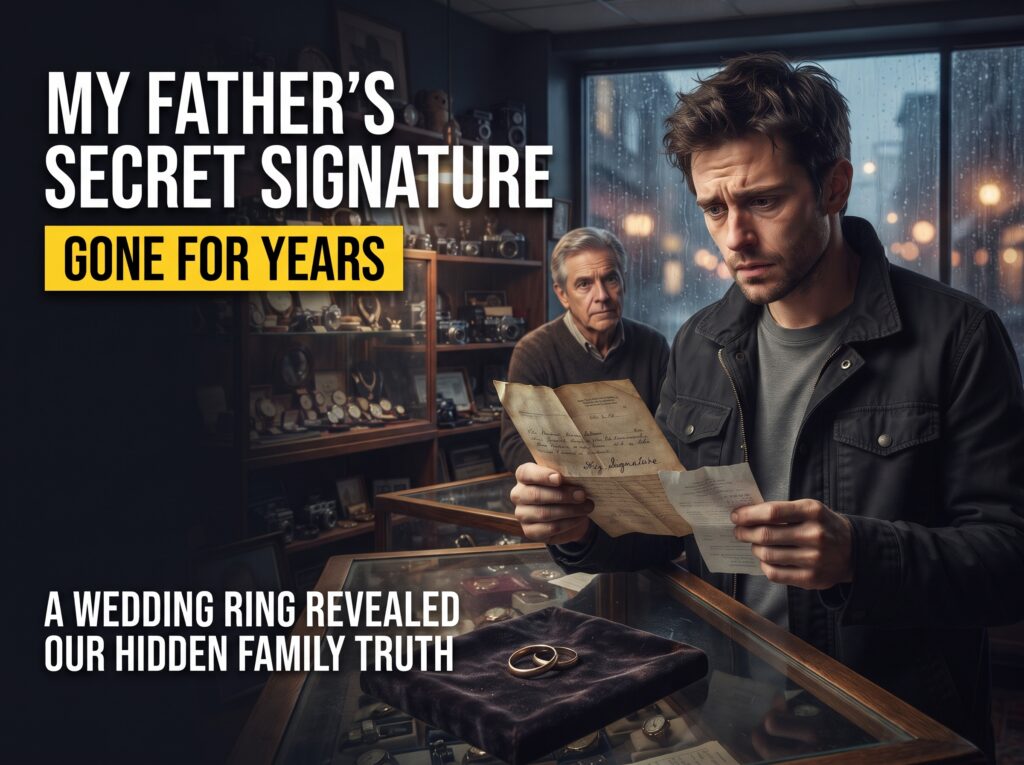
The wedding ring lay beneath the glass counter like a tiny promise that had finally run out of time.
I stood on the customer side of the pawnshop, staring at it while the owner, a gray-haired man named Mr. Bennett, examined the papers I had brought. Outside, rain tapped against the windows, and headlights slid across the wet pavement. Inside, the air smelled of old leather, metal, and the faint sweetness of the coffee Mr. Bennett kept beside his register.
I had not intended to pawn anything that afternoon.
Three days earlier, I had promised myself that I would find another way to pay the rent. I had already sold my spare television, postponed a utility payment, and borrowed enough money from a friend to buy groceries. Every morning, I told myself that one bad month would not define the rest of my life.
But the landlord had given me a deadline, and the person who once promised to face every hardship beside me was no longer there.
My former partner, Claire, had left six weeks earlier.
She had packed two suitcases, taken her winter coat, and walked out of the apartment while I stood in the kitchen holding a mug of coffee that had gone cold.
“We can’t keep living like this, Eli,” she had said.
“I know things are difficult. I’m trying.”
“You’re always trying.”
Those words had hurt more than I admitted. I worked long hours at a repair shop, took occasional weekend jobs, and had stopped buying anything that was not essential. I knew we were struggling, but I had believed we were struggling together.
I had been wrong about at least one of those things.
Now I was standing in a pawnshop, considering whether to sell the last valuable object that belonged to our shared life.
The ring was not mine. It had belonged to my mother, who died when I was twenty-four. She had worn it for nearly forty years, and when she placed it in my hand shortly before her death, she told me to keep it somewhere safe.
“Some things are worth more than what someone will pay for them,” she had whispered.
I had promised her I understood.
For years, I kept the ring in a small wooden box at the back of my bedroom drawer. After Claire and I moved in together, she discovered it while helping me unpack.
“It’s beautiful,” she had said, holding it toward the light.
“It was my mother’s.”
Claire slipped it onto her finger. It was too large, but she smiled as though it fitted perfectly.
“She must have loved it.”
“She did.”
“Then you should never sell it.”
I remembered that conversation now, and the irony almost made me laugh.
Mr. Bennett placed the papers on the counter.
“I can offer you a loan against the ring,” he said. “But I want you to understand that if you don’t repay it within the agreed period, you could lose it.”
“I understand.”
He looked at me carefully.
“Are you sure you want to do this?”
I glanced at the ring.
“No,” I admitted. “But I need the money.”
He did not pressure me. He explained the terms, answered my questions, and gave me time to consider the decision.
I finally nodded.
As he prepared the paperwork, I noticed a thin folder beside the register. Several receipts protruded from its edge, and one had a signature that looked strangely familiar.
I leaned forward.
“Excuse me. Can I see that paper?”
Mr. Bennett followed my gaze.
“Which one?”
“The receipt beside the folder.”
He picked it up and turned it toward me.
The moment I saw the signature, my heart seemed to stop.
It belonged to my father.
My father had been dead for seven years.
I knew his handwriting as well as I knew my own. I had watched him sign birthday cards, school forms, and the documents that settled my mother’s estate. He had a distinctive way of writing the letter E, with a long upper stroke and a short line that curled inward.
The signature on that receipt had the same shape.
“Where did this come from?” I asked.
Mr. Bennett’s expression changed.
“That isn’t your business unless the document concerns you.”
I stared at the paper.
“That’s my father’s signature.”
He slowly lowered it to the counter.
“What was your father’s name?”
I told him.
For several seconds, he said nothing.
Then he looked toward the back room, as though he expected someone to emerge.
“Wait here, Mr. Eli.”
He disappeared behind a door.
I stood beside the counter, forgetting the ring, the rent, and the reason I had come.
My father had been gone for seven years.
And someone had been using his signature.
Part 2
Mr. Bennett returned carrying a larger folder.
He closed the back-room door carefully before placing it on the counter.
“Your father visited this shop several times,” he said.
I shook my head.
“That’s impossible.”
“I understand why you would think that.”
“My father died seven years ago. I arranged his funeral. I helped settle his estate. I know when he died.”
Mr. Bennett nodded.
“I’m not suggesting otherwise. But these records go back further than that, and some of them were brought to me by someone who said they were connected to your family.”
“Who?”
“I can’t give you a name until I know which documents you’re asking about.”
I felt anger rising inside me.
“You’re showing me my dead father’s signature and telling me you can’t explain why?”
“I’m trying to be careful. If there’s a problem with these records, I don’t want to make it worse by giving you information that belongs to someone else.”
I took a breath and forced myself to slow down.
He was right about one thing. I had come looking for answers, but anger would not make the papers speak.
“Can you tell me when the signature was written?”
He opened the folder.
The first receipt was dated almost nine years earlier. Another carried a date from the following year. A third was dated just over seven years ago, only a few months before my father died.
The final document had been signed after his death.
I pointed at it.
“This one. That’s the signature I recognized.”
Mr. Bennett studied the page.
“It was brought here much later. I didn’t witness the signature, so I can’t tell you who wrote it.”
“What was the transaction?”
He turned the document around.
It referred to a payment connected to an item held in the shop. The details were incomplete, and the amount was larger than I expected.
I recognized the reference number from an old document in my mother’s estate papers.
My mouth went dry.
“Can I take a photograph?”
He hesitated before agreeing to let me photograph the portions he was authorized to show me.
I captured the date, the reference number, and the signature.
Then I called my sister, Hannah.
She answered on the fourth ring.
“Eli? What’s wrong?”
“Do you remember the papers we found after Dad died?”
“Which papers?”
“The ones connected to his accounts and the house.”
“Of course. Why?”
“Did you ever see a document with his signature dated after his death?”
She was silent.
“Hannah?”
“I don’t know.”
“You don’t know, or you don’t remember?”
Her voice tightened.
“I remember that there were papers we couldn’t understand. The lawyer said some things needed to be checked. Why are you asking me this now?”
“Because I’ve found a document with Dad’s signature on it. The date is after he died.”
I heard her take a sharp breath.
“Where?”
“At a pawnshop.”
“Don’t do anything with it.”
The urgency in her voice startled me.
“What does that mean?”
“I mean don’t sign anything, don’t give anyone money, and don’t assume you know what you’re looking at.”
“I wasn’t planning to.”
“Good.”
I waited for her to explain, but she said nothing more.
“Hannah, is there something you know?”
“No,” she answered too quickly. “I just don’t want you getting yourself into trouble.”
After we ended the call, I stared at my phone.
My sister had always been cautious, but I had never heard her sound frightened of a piece of paper.
Mr. Bennett returned the folder to its place.
“I can give you the information recorded on your own transaction, but if you believe the signature has been used without authorization, you should seek proper advice. Don’t assume the document is genuine simply because the handwriting looks familiar.”
I thanked him.
Before leaving, I asked one final question.
“Was the person who brought this document a man or a woman?”
He considered it.
“A woman.”
“Did she give you her name?”
“Yes.”
“Can you tell me?”
He looked at me for a long moment.
Then he wrote a name on a scrap of paper and slid it across the counter.
I read it once.
Then again.
It was Claire’s name.
My former partner had brought a document bearing my dead father’s signature to the pawnshop.
And she had never told me.
Part 3
I left the pawnshop without completing the loan.
The ring remained beneath the glass, waiting for a decision I could no longer make while my mind was racing. I walked through the rain toward my car and sat behind the steering wheel without turning the key.
Claire had brought the document.
That fact alone did not prove she had done anything wrong. She might have been trying to correct a mistake, return something, or obtain information. But why had she never mentioned my father’s name? Why had she left me to believe that our financial troubles were simply the result of bad luck?
I opened the photograph on my phone.
The signature looked exactly like his.
I enlarged it, then compared it with an old birthday card I kept in the glove compartment. The card was written in blue ink, with my name at the top and a message beneath it.
Keep your word, even when keeping it costs you something.
I had read those words hundreds of times.
Now I studied the handwriting.
The signature on the receipt resembled my father’s, but resemblance was not proof. Someone could have copied it. Someone could have used an old document as a model. There might even be a legitimate explanation I had not considered.
I needed the original family records.
I drove to my sister’s house.
Hannah opened the door before I could knock a second time. She was wearing an old sweater and holding a dish towel.
“You should have called first.”
“I did call.”
“I mean before coming here.”
I held up my phone.
“Do you recognize this?”
She looked at the photograph.
The color drained from her face.
“Where did you get that?”
“The pawnshop. Claire brought it there.”
Hannah took the phone from me and enlarged the image.
For a moment, she looked as though she might cry.
Then she handed it back.
“You need to leave this alone.”
I stared at her.
“Why?”
“Because you don’t know what it means.”
“Then explain it.”
She turned away and walked into the living room. I followed her.
On the shelf beside the television stood a framed photograph of our father. He was smiling, his sleeves rolled up, with a small toolbox beside his chair. He had spent most of his life repairing things for other people and refusing to admit when he needed help himself.
After our mother died, he became quieter. He worked longer hours and worried constantly about the house.
I had been living in another city when he became ill. I called him regularly, but I had not understood how much he was struggling until Hannah told me he needed help with his bills.
By then, it was too late to ask him everything I wished I had asked.
“Did Dad have debts?” I asked.
Hannah sat down.
“Everyone has obligations.”
“That isn’t an answer.”
“He had a loan connected to the house. He told me it was under control.”
“Did he leave money?”
She looked at the floor.
“There were accounts we didn’t understand.”
“Why didn’t you tell me?”
“Because the lawyer was handling it.”
“What lawyer?”
“The one who helped with the estate.”
I had met the lawyer only twice. He had explained that some records were incomplete and that we might need more time to settle everything.
At the time, I had been grieving and overwhelmed. I had trusted Hannah to handle the practical details because she lived closer to our father.
Now I wondered whether I had trusted her too easily.
I sat opposite her.
“Hannah, I need the truth. Did you know Claire was dealing with Dad’s documents?”
She rubbed her hands together.
“I knew she had asked questions about the estate.”
“When?”
“Before you separated.”
The words landed heavily.
Claire had been asking about my father’s estate while we were still together.
“Why?”
“She said she was trying to help you.”
“Help me with what?”
Hannah did not answer.
I stood up.
“You’re asking me to stop looking, but every person I speak to seems to know something I don’t.”
“I’m trying to protect you.”
“From what?”
She looked up at me.
“From finding out that Dad wasn’t the man you remember.”
I felt as though the room had tilted.
“What are you talking about?”
Hannah opened her mouth, then closed it again.
Finally, she whispered, “There was another document. One we were told not to discuss until the estate was settled.”
“Where is it?”
She looked toward the hallway.
“I don’t know.”
But the hesitation in her voice told me that she remembered exactly where it had been.
Part 4
I did not leave my sister’s house until she agreed to help me search for the missing estate papers.
We began in the small cabinet beneath the television, where she kept old photographs, insurance documents, and the manuals for appliances she had replaced years earlier.
The first folder contained ordinary household records. The second held receipts from the funeral and copies of letters from the estate lawyer.
The third folder was missing.
Hannah said she had not seen it since the year after our father’s death.
I asked whether she had given it to Claire.
“No.”
“Did Claire ever visit Dad’s house?”
“Once or twice.”
“Without me?”
Hannah looked away.
“Yes.”
I waited for her to explain.
“She said she wanted to collect some things you had left there. I thought she was helping you.”
“What things?”
“Your mother’s photographs. A few books. I don’t remember everything.”
“Did she have access to Dad’s bedroom?”
Hannah’s eyes filled with tears.
“Eli, please.”
I felt my anger soften, though it did not disappear.
“I’m not trying to hurt you. I’m trying to understand what happened.”
She sat on the floor beside the cabinet.
“After Dad died, I was frightened that we would lose the house. There were bills I couldn’t explain, and the lawyer kept asking for records we couldn’t find. Claire offered to help because she worked with accounts at her old job.”
I stared at her.
“She worked in accounts?”
“Not as an accountant. She handled paperwork. She said she knew how to organize the records.”
I remembered Claire telling me about her previous job. She had described it as administrative work and had never mentioned handling financial documents for anyone else.
“What did she find?”
Hannah wiped her face.
“She found a payment that Dad had made before he died. It was connected to a loan, but the records didn’t match the balance we were told remained outstanding.”
“How much?”
“I don’t remember the exact amount.”
“Was it a lot?”
“Enough to make a difference.”
I felt a familiar tightness in my chest.
Our father had spent his final years worrying about money. I remembered him sitting at the kitchen table, sorting bills into piles and telling me not to worry.
“I’ve got it under control, son,” he would say.
I had believed him because I wanted him to be all right.
Now I wondered whether he had been trying to protect us from a problem he could no longer solve.
“Why didn’t you tell me about the payment?”
“Because Claire said she needed to verify it first. She said that if we misunderstood the documents, we might accuse the wrong person.”
That sounded reasonable.
It also sounded like the sort of explanation that could keep a family quiet for years.
I asked whether Claire had taken any original papers.
Hannah shook her head.
“Not that I know of.”
“Did she ever mention the pawnshop?”
“No.”
I took out my phone and called Mr. Bennett. I explained that the document might be connected to my father’s estate and asked whether he could preserve the relevant records while I sought professional advice.
He agreed to retain the records he was permitted to keep.
Afterward, I called the estate lawyer’s office and requested a meeting.
The receptionist asked for the estate reference number.
I found it on one of the old letters.
There was a pause.
“I’m sorry,” she said. “That file was closed several years ago.”
“I understand. I need advice about a document that appears to bear my father’s signature after his death.”
She asked me to send a copy through the office’s secure process so the lawyer could determine whether the matter required a new appointment.
I did.
Before I left Hannah’s house, I asked one final question.
“Did Dad ever tell you that he had made a promise to someone?”
She looked at me sharply.
“Why?”
“Because the documents seem connected to a decision he made before he died.”
Hannah was silent.
Then she said, “He told me that if anything happened to him, I had to make sure you never blamed yourself.”
I stared at her.
“Blamed myself for what?”
She shook her head.
“I don’t know. I thought he was talking about his illness.”
I drove home with more questions than answers.
That evening, an email arrived from the estate lawyer’s office.
The message was brief.
They had located a reference to a separate document, but before they could explain its significance, they needed to verify the original records.
The document had been signed by my father.
And according to the date in the file, it had been prepared only days before his death.
Part 5
The estate lawyer, Mr. Collins, agreed to meet me the following morning.
His office was in an old building above a pharmacy. The waiting room smelled of paper and furniture polish, and framed certificates lined the walls.
He greeted me politely and asked me to explain how I had obtained the photograph of the receipt.
I described the pawnshop, Claire’s name, and the conversation with Hannah.
He listened without interrupting.
When I finished, he opened a file on his desk.
“I remember your father’s estate,” he said. “It was a difficult period for your family.”
“Did Dad leave debts?”
“He had financial obligations, yes. But the estate records contained inconsistencies that required investigation.”
“Why wasn’t I told?”
“You were informed that the estate was being settled. At the time, your sister was the primary contact for several practical matters.”
I felt a familiar frustration.
“I was his son. I should have known.”
Mr. Collins folded his hands.
“I understand why you feel that way. But there is a difference between information being withheld and a record requiring verification. I cannot assume that anyone acted improperly simply because the paperwork was incomplete.”
He showed me the reference to the separate document.
It was not the document itself, only an entry in the estate file indicating that an additional statement had been prepared.
The statement concerned a financial obligation and a promise made by my father before his death.
“Who was the promise made to?” I asked.
“The file does not identify the beneficiary in the entry I have here.”
“Could it have been Claire?”
“I cannot establish that from this record.”
I leaned forward.
“Could the document explain the signature at the pawnshop?”
“It might be related. But we need to examine the original before drawing any conclusions.”
He explained the next steps. We would need to compare the relevant dates, establish the origin of the document, and determine whether the signature was authentic. If the records suggested that a document had been improperly created or used, the appropriate authorities or a qualified specialist could investigate.
I agreed.
Before I left, I asked whether my father had ever mentioned a second account.
Mr. Collins paused.
“There was a reference to an account that was not fully documented in the initial estate papers. I cannot tell you whether it was active at the time of his death without reviewing the underlying records.”
My heart began to race.
“An account with money in it?”
“That is not something I can confirm yet.”
I left the office feeling as though I had stepped into a story about my own family that everyone else had read before me.
On the way home, I called Claire.
She answered after several rings.
“Eli?”
“I need to ask you something.”
“All right.”
“Why did you take my father’s document to the pawnshop?”
She went quiet.
“Who told you that?”
“Mr. Bennett showed me the record.”
“I didn’t think he would still have it.”
“Why did you take it there?”
She breathed out slowly.
“I was trying to verify something.”
“What?”
“I can’t explain everything over the phone.”
“You had months to explain it. You left me believing that our financial problems were my fault.”
“I never said they were your fault.”
“You didn’t have to. You watched me work extra shifts and sell my things while you kept this secret.”
“I know.”
Her voice sounded smaller than I remembered.
“Then tell me the truth.”
She was silent for so long that I thought she had ended the call.
Finally, she said, “Your father made a promise to someone. I found evidence of it after he died. I thought I could help you understand what he had done, but the more I learned, the more frightened I became.”
“Why?”
“Because the promise involved money, and because your name appeared in the records.”
I gripped the phone.
“What did my father promise?”
“I don’t know the whole answer.”
“Who was the promise made to?”
She began to cry.
“I think it was made to someone who never wanted you to know they existed.”
The call ended before I could ask another question.
Part 6
For the next two days, I barely slept.
Every time I closed my eyes, I saw the signature at the bottom of the pawnshop receipt. I imagined my father sitting at the kitchen table, writing a promise that would outlive him, while the rest of us carried on believing that we understood his life.
I thought about Claire, too.
She had not simply hidden a financial mistake. She had discovered something connected to my family and tried to investigate it without telling me.
I did not know whether she had been protecting me or protecting herself.
Perhaps she had been doing both.
Mr. Collins contacted me on the third day. He had located another document in the estate archive and asked me to come to his office.
When I arrived, he placed a photocopy on the desk.
It was a statement signed by my father.
The date was several days before his death.
The document referred to money held for another person and included a promise that the funds would be protected until a specific condition had been met.
The person’s name was partially obscured in the copy.
I read the statement twice.
“Was this legally binding?”
“That depends on the original document, the surrounding circumstances, and the applicable law. I don’t want to give you a conclusion before the records have been examined.”
“Was the money still there when he died?”
“The document refers to an account, but we have not yet established its balance at that time.”
“Then where did the money go?”
“We need the account records to answer that.”
I rubbed my forehead.
“How much are we talking about?”
Mr. Collins showed me the figure recorded in the statement.
It was far more than I had imagined.
For several seconds, I could not speak.
I had spent months struggling to pay rent while believing that my family had left behind nothing but debt and a house that needed repairs.
If the document referred to a real account, it could change what we understood about the estate.
But it could also be incomplete, outdated, or connected to obligations I knew nothing about.
I reminded myself not to turn a possibility into a promise.
“Who had access to this account?”
“The records we have do not establish that conclusively.”
“Did Claire?”
“I don’t know.”
“Did Hannah?”
“I don’t know that either.”
I took a photograph of the document with permission and asked for a copy of the reference information.
Before I left, Mr. Collins told me that he had requested additional records.
“One more thing,” he said. “The statement mentions a witness who was present when your father signed it.”
“Who?”
He looked at the file.
“The name is in the original, which we have not yet retrieved.”
I thanked him and walked down the stairs.
Outside, I called Hannah.
She answered immediately.
“Did you know Dad had promised money to someone?”
There was silence.
Then she whispered, “Yes.”
My whole body went still.
“You knew?”
“I knew he had made a promise. I didn’t know how much money was involved.”
“Why didn’t you tell me?”
“Because Dad asked me not to discuss it until the right time.”
“What right time?”
“I don’t know. He said the person would come forward when they were ready.”
I closed my eyes.
“Who was the person?”
Hannah began to cry.
“I never saw their name.”
I was about to ask another question when she said something that changed the direction of the entire investigation.
“Caleb, Dad wasn’t trying to hide money from us.”
“Then what was he doing?”
“He was trying to make sure someone got what they were owed.”
“Who?”
Hannah’s voice broke.
“Someone he believed our family had already hurt.”
Part 7
I returned to my father’s house the following weekend.
Hannah had kept the keys, and she agreed to meet me there. The property had been sitting mostly empty since his death, apart from a few pieces of furniture and the boxes of belongings we had never found the time to sort.
The garden was overgrown. The front gate creaked when I pushed it open, and a damp smell rose from the leaves gathered along the path.
I remembered running through that garden as a child while my father repaired the fence. I remembered my mother calling us inside when dinner was ready.
It was difficult to imagine that a promise connected to this place could have become a secret that followed us for years.
Hannah unlocked the door.
We began with the study.
My father had kept his important papers in a wooden desk beside the window. The desk was still there, though most of the drawers were empty.
I opened the bottom drawer and found a bundle of old letters tied with string.
The first few were ordinary correspondence. One was from the bank, another from a supplier who had repaired the roof, and a third was a birthday card from an old friend.
Then I found a letter dated shortly before my father’s death.
It was addressed to someone whose name had been covered by a strip of paper.
I carefully lifted the edge, but the ink beneath was too faint to read.
The letter began:
I have not forgotten what happened, and I have not forgotten what I promised you.
I read the sentence aloud.
Hannah stood behind me, pale.
“Do you remember this letter?” I asked.
“No.”
I continued reading.
My father wrote that he had spent years trying to correct a mistake. He acknowledged that his silence had caused pain and said he wanted the matter resolved before he died.
The letter did not identify the mistake.
It referred to a payment, a family decision, and a person who had been excluded from something that should have belonged to them.
At the bottom was a date and a signature.
I recognized the handwriting immediately.
It was my father’s.
But the letter contained one sentence that troubled me more than the others.
If I cannot finish this myself, the person who witnessed the agreement knows where the original can be found.
I turned to Hannah.
“Who witnessed it?”
“I don’t know.”
“Did Dad ever mention an old friend who helped him with financial matters?”
She thought for a moment.
“There was a man named Arthur. He visited Dad sometimes, but I was young. I don’t know much about him.”
“Do you remember his last name?”
She shook her head.
I searched the remaining letters and found an old address written on the back of an envelope.
Beneath it was the name Arthur.
The address belonged to a house in a neighboring town.
I photographed the letter and placed it carefully back in the drawer.
Before we left, I looked around the study.
My father had spent years sitting in this room, writing letters and keeping records that the rest of us had never understood. Perhaps he had been ashamed of what had happened. Perhaps he believed that silence would protect the people he loved.
Whatever his reason, he had left the rest of us to discover the truth without him.
I closed the drawer.
On the way to the front door, Hannah stopped beside the old family photographs.
“I wish he had told us,” she said.
“So do I.”
“Do you think he was a bad man?”
I looked at her.
“No. But I think good people can make decisions that hurt others. And sometimes, being sorry isn’t enough. They have to make things right.”
She nodded slowly.
We locked the house and drove away.
That evening, I searched for Arthur’s address.
The house still existed, although the current occupants had a different surname. I found a telephone number for the owner and explained that I was trying to locate someone who had known my father.
The woman on the phone listened carefully.
“Arthur was my grandfather,” she said.
My heart began to beat faster.
“Is he still alive?”
There was a pause.
“No. He passed away several years ago.”
I felt the familiar disappointment of another door closing.
Then she added, “But he left a box of documents with my mother. She always said someone from your family might come looking for them.”
Part 8
The woman, whose name was Rebecca, agreed to meet me at her mother’s house.
She greeted me at the door and led me into a small sitting room filled with family photographs. On a side table stood a framed picture of an elderly man wearing a dark suit.
I recognized the name Arthur from my father’s letter, but I had never seen his face before.
Rebecca’s mother joined us a few minutes later.
She was in her late seventies and moved carefully, leaning on a wooden cane. When I explained why I had come, she studied me with an expression I could not interpret.
“You’re his son,” she said.
“Yes.”
She nodded.
“Arthur said someone would eventually ask about the agreement.”
She went to a cabinet and returned with a small wooden box.
Inside were old letters, receipts, and a sealed envelope bearing my father’s name.
I stared at it.
“May I open it?”
She nodded.
The envelope contained a letter and a copy of a signed statement.
The letter explained that Arthur had witnessed an agreement between my father and another person. The agreement concerned money that had been promised years earlier as compensation for a decision that had damaged someone’s livelihood.
My father had not been able to repay the full amount immediately. He had promised to settle the obligation over time and had kept records of the payments he made.
But the agreement had never been properly completed.
According to the letter, my father had become ill before he could resolve the final portion. He had asked Arthur to preserve the documents until the person entitled to the money could be identified and the arrangement verified.
I read the statement again.
It included the full name of the person who had made the original claim.
I did not recognize the name.
Rebecca’s mother watched me closely.
“Your father believed the matter should have been settled long before his death,” she said. “He carried a great deal of regret.”
“Why didn’t he tell us?”
“I cannot answer that. Arthur believed your father was trying to protect his children from an old dispute.”
“Did Arthur know who received the money?”
“He knew who was supposed to receive it. He did not know whether every payment was made.”
I looked at the receipts.
Some corresponded to the dates in the pawnshop folder. Others referred to transactions that had taken place years earlier.
The records suggested that the pawnshop document was part of a longer effort to settle the obligation.
But one question remained.
Why had Claire become involved?
I asked Rebecca’s mother whether she recognized Claire’s name.
She thought for a moment.
“Arthur’s granddaughter knew someone by that name. I don’t know whether they were friends or whether they met through your family.”
Rebecca looked up.
“Wait. I remember something.”
She went to another room and returned with a notebook.
“My grandfather kept notes about people who contacted him. There might be a reference in here.”
She searched several pages before stopping.
“This name appears beside a note about a woman asking for a copy of the agreement.”
I leaned forward.
“Does it say why?”
Rebecca read the entry.
“It says she wanted to establish whether the obligation had been settled before she made a decision involving someone in your family.”
I felt my stomach tighten.
Claire had not merely found the papers by accident.
She had been trying to verify the agreement before making a decision.
But what decision?
I asked whether there were any records of a payment made after my father’s death.
Rebecca’s mother handed me another envelope.
“This was found among Arthur’s papers. He wanted it kept with the agreement.”
Inside was a bank statement showing that a payment had been made into an account connected to the original obligation.
The date was after my father’s death.
I recognized the reference number.
It matched the receipt at the pawnshop.
For a long time, I could not speak.
The money that had caused so much confusion was connected to an obligation my father had been trying to settle for years.
But the statement raised another question: who had made the payment after he died?
I turned the paper over.
At the bottom was a signature.
It was not my father’s.
It was Claire’s.
Part 9
I returned to the pawnshop with the documents from Arthur’s box.
Mr. Bennett examined the receipt, then compared it with the copy of the bank statement.
“I remember this transaction,” he said. “The person who brought the papers wanted to know whether the original receipt was still available.”
“Was that Claire?”
He nodded.
“She asked whether the records could be preserved. She said they might be needed to establish what had happened to a payment.”
“Did she tell you why she was involved?”
“She said she was trying to correct something that had been misunderstood.”
I placed the letter from my father on the counter.
“This explains the old agreement. But I still don’t understand why Claire used money from our life together without telling me.”
Mr. Bennett looked at me.
“That is something only she can explain.”
He was right.
I called Claire and asked her to meet me.
She agreed to come that evening.
When she arrived, I placed the documents on the table between us.
She looked at the letter, the bank statement, and the old receipt.
Then she covered her mouth with her hand.
“Where did you find these?”
“Arthur’s family kept them.”
She closed her eyes.
“I was hoping someone would preserve the original.”
“Why didn’t you tell me what you were doing?”
She sat down slowly.
“Because I thought I could solve the problem before it reached you.”
I waited.
She explained that she had learned about my father’s old agreement while helping Hannah organize the estate papers. At first, she believed it was a simple matter of locating a missing payment.
But the more records she examined, the more complicated the situation became. Some payments had been recorded under different reference numbers. Others were difficult to trace. The final obligation remained unclear.
She had become convinced that the missing money from our shared savings might be connected to an attempt to settle the debt.
“Did you use our money?” I asked.
She nodded.
“Yes.”
The answer hurt, even though I had suspected it.
“How much?”
She told me the amount.
I looked at the statement again.
“Why didn’t you ask me?”
“Because I knew you were already struggling. I thought I could replace the money before you noticed.”
“And when you couldn’t?”
“I panicked.”
“You let me believe I wasn’t doing enough. You watched me sell my things and worry about the rent.”
Tears filled her eyes.
“I know.”
“Did you ever intend to tell me?”
“Yes. But every day I waited made it harder.”
I looked at the documents.
“Was the payment made to the person my father had promised to repay?”
“That was what I was trying to establish. I found evidence of the old agreement, but I couldn’t confirm whether the entire obligation had been settled. I used money to make a payment while I was trying to verify the remaining balance.”
“Without telling me.”
“Yes.”
I sat back.
For months, I had imagined that the missing money was evidence of betrayal, greed, or a secret life I knew nothing about.
The truth was still painful, but it was different.
Claire had tried to correct an old injustice without understanding the full consequences of her decision. She had used money that was not hers alone to use, then concealed what she had done because she was afraid of losing me.
Her intentions did not erase the damage.
I asked her why she had left.
“Because I couldn’t bear to look at you and know what I had done,” she said. “Every time you told me we would get through it together, I felt worse. You trusted me, and I had broken that trust.”
“You could have told me the truth.”
“I know.”
We sat in silence.
Then I asked the question that had troubled me since the beginning.
“Who was the person my father promised to repay?”
Claire looked down at the letter.
She said the name quietly.
I recognized it immediately.
It belonged to a person my father had once told me was no longer part of our lives.
Someone I had believed had disappeared from our family years before.
Part 10
The name changed the meaning of every document on the table.
I had heard it only a few times while growing up. Whenever it came up, my father would become quiet, and my mother would find a reason to change the subject.
I had assumed the person was an old friend who had moved away.
Now I understood that the name was connected to a financial obligation my father had carried for years.
Claire explained what she had learned from the records.
The original dispute had begun long before she and I met. My father had made a decision that affected another person’s livelihood, and he had promised to compensate that person. He had made payments over time, but the final amount had never been conclusively documented.
When Claire found the agreement, she believed she could help settle the matter. She thought that completing the payment would allow the family to put the old dispute behind us.
Instead, the missing records created uncertainty. She tried to resolve it using our shared savings, convinced that she could replace the money before I discovered the shortfall.
She had been wrong.
The pawnshop receipt was not proof of a hidden fortune or a simple theft. It was evidence of a payment connected to an obligation that had outlived my father.
The signature was genuine on some of the older documents, but the later records required independent verification. We could not assume that every statement was accurate simply because it referred to the same agreement.
I asked Claire whether she knew where the person was now.
She shook her head.
“I tried to find them. I wanted to explain that the payment had been made and ask for confirmation of what remained. But I couldn’t establish whether the contact information I had was current.”
“Why didn’t you tell me about the agreement before using our money?”
“Because I thought you would see it as your responsibility. I thought you would try to fix everything your father had left unresolved.”
I looked at her.
“Maybe I would have helped. Maybe I would have needed time. But I should have been allowed to choose.”
She nodded.
“I know.”
We agreed that the documents needed to be reviewed properly. The estate lawyer would examine the original agreement, verify the payments, and establish whether any obligation remained. We would not make further payments or accept responsibility for anything until the facts were clear.
It was not a dramatic resolution.
There was no sudden fortune waiting to rescue me from overdue bills. No single document restored the money Claire had used. No explanation could return the months we had spent doubting each other.
But the mystery had finally become something we could face honestly.
A week later, I returned to the pawnshop.
I had saved enough to pay the agreed amount and recover my mother’s wedding ring. Mr. Bennett placed it in a small box and slid it across the counter.
I opened the lid.
The ring caught the light.
For a moment, I remembered my mother holding it in her palm and telling me that some things were worth more than what someone would pay for them.
I understood her words differently now.
The ring had value because of the person who wore it, the memories attached to it, and the promises it represented. It was not valuable because it could solve every problem.
I placed it carefully in my pocket.
Claire and I did not immediately return to the relationship we had lost. Trust could not be restored by a single conversation, and I was no longer willing to pretend that love required me to ignore what had happened.
We continued communicating about the documents and the financial consequences. Sometimes our conversations were difficult. Sometimes we remembered the good years and felt the loss of what might have been.
But we stopped hiding the truth from each other.
The old agreement remained a matter to be resolved, and the missing money was still a real problem. Yet I no longer believed that I had to carry every unanswered question alone.
I began to understand my father differently, too.
He had tried to make things right, but he had also allowed silence to surround a decision that affected other people. Whatever his intentions, his failure to explain the agreement had left confusion behind him.
I could respect the good he had done without pretending that every choice had been right.
And I could care about Claire without agreeing to rebuild a relationship on the same terms as before.
Months earlier, I had stood at the pawnshop counter believing that money was the only thing I had left to lose.
Then I found the signature of a man who had been gone for years.
It led me to an old promise, a forgotten obligation, and a truth that my family had never fully understood.
The discovery did not give me an easy future.
It gave me something more useful: the chance to stop living inside an explanation that was never complete.
I still had bills to pay. I still had work to do. I still had decisions to make about the woman I loved and the family history I had uncovered.
But I no longer believed that keeping the peace meant keeping silent.
Sometimes, the hardest thing a family can do is tell the truth about the past.
Sometimes, the most loving decision is to stop protecting people from the consequences of their choices.
And sometimes, the promise that matters most is not the one someone made years ago.
It is the promise you make to yourself when you finally decide that the truth, however painful, deserves to be heard.