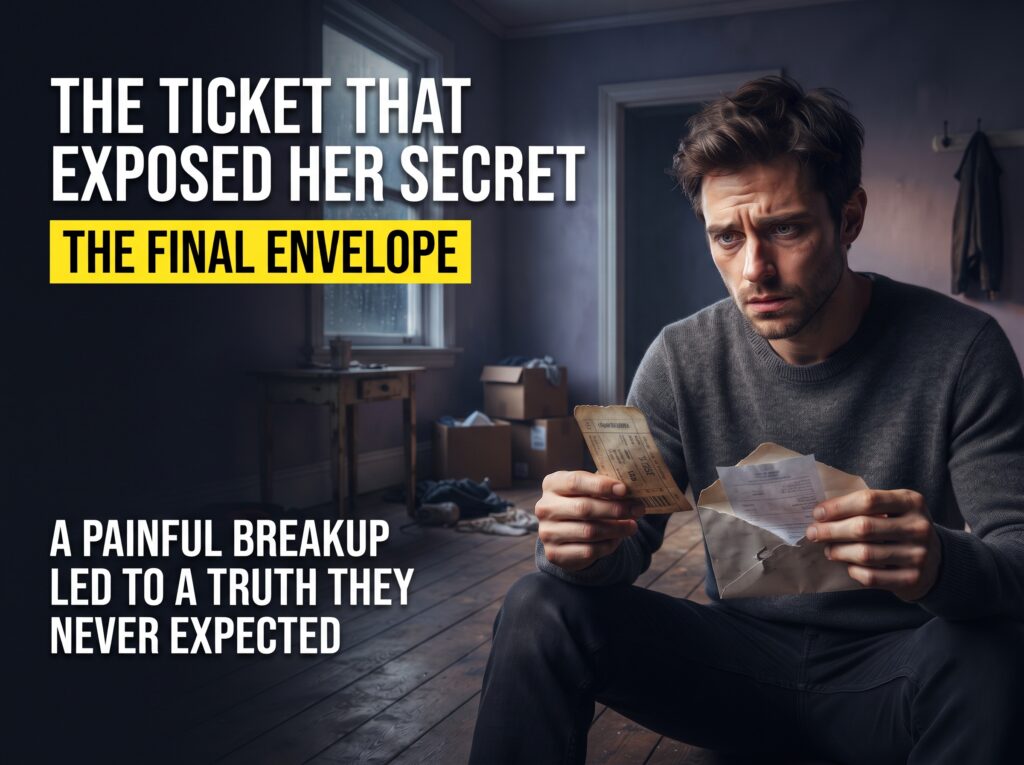
The apartment sounded different after the furniture was gone.
For three years, Nora and I had filled the place with ordinary noises: the refrigerator humming in the kitchen, the washing machine rattling behind the bathroom door, the television playing while we argued about what to cook for dinner. Even our silences had once felt comfortable. We could sit on opposite ends of the sofa, exhausted from work, and still feel that we belonged to the same life.
Now there was only the refrigerator and the occasional car passing outside.
Nora stood in the middle of the living room on the morning she left, holding the last cardboard box against her chest.
“I can’t keep doing this,” she said.
I knew what she meant, but I wanted her to explain it anyway.
“Doing what?”
“Living like tomorrow will fix everything.”
I looked toward the kitchen. Two unpaid bills lay beside a jar containing the coins we had collected for groceries. The cupboard was nearly empty, and the heating had stopped working properly.
“I have another shift next week,” I said. “And the mechanic owes me money for those repairs. When he pays me, we can catch up.”
Nora closed her eyes.
“You said that last month.”
“I know.”
“And the month before.”
“I know, Nora.”
She placed the box on the floor.
“I love you. That’s what makes this so difficult. I keep remembering who we were when we first met, and I keep waiting for us to become those people again.”
I stepped toward her.
“We can.”
She shook her head.
“I don’t know if we can.”
There was a time when those words would have frightened me enough to make me promise anything. That morning, I was too tired to invent another promise I could not guarantee.
I told myself that honesty was better than begging.
Perhaps I was right. Perhaps I simply did not understand how much could be lost in a conversation that lasted less than ten minutes.
Nora picked up the box.
“Please don’t make me feel guilty for leaving,” she said.
“I’m not.”
“I know you’re struggling, and I know you’ve tried. But I can’t be the person who keeps telling you everything will be fine when I don’t believe it anymore.”
I watched her walk toward the door.
At the threshold, she turned around.
“Don’t sell the little wooden table,” she said. “My mother gave it to us.”
I looked at the table beside the window.
“I won’t.”
She nodded, as though she needed to believe that at least one promise between us could survive.
Then she left.
I did not follow her.
For the next several weeks, I survived by selling the things we no longer needed. The television went first, followed by the spare chairs, the coffee table, and the bookshelf we had assembled together on our first weekend in the apartment.
The wooden table remained by the window.
I kept telling my family that I was managing. When my sister called, I said work had been busy. When my father asked whether I needed help, I said I was waiting for a payment. I had spent years assuring everyone that I could take care of myself, and I was ashamed to admit that the person who had promised to share my burdens had left me with more than I could carry.
The money was disappearing faster than I could earn it.
I started counting coins before buying groceries. I stopped answering calls from the landlord unless I had something useful to say. At night, I slept on a mattress on the floor and stared at the ceiling, trying to understand how a life could fall apart while every individual decision still seemed reasonable.
I blamed the rent, the rising prices, my reduced hours, and the repairs I had agreed to do for a friend who never paid me.
I blamed myself most of all.
Then, on a cold Thursday afternoon, I found the bus ticket.
It was tucked into the lining of an old jacket I had almost thrown away. I was searching the pockets for a receipt that might help me return a faulty tool when my fingers caught a folded piece of paper.
The ticket was dated the night Nora left.
I stared at the printed time.
It had been purchased less than an hour before our final conversation.
I turned it over, expecting to find a destination or a note. There was nothing on the back except a faint mark from someone’s pen.
Nora had told me she was going to stay with a friend until she found somewhere to live. She had said she needed time to think.
But the ticket had been purchased before she told me she was leaving.
I sat down on the bare floor.
For the first time since the breakup, I wondered whether the decision had been made long before the argument.
Then I noticed something printed beneath the route information.
The ticket had been paid for in cash.
And beside the transaction number was a reference code I had seen before—on a bank statement I could no longer find.
Part 2
I spent the next morning searching every box in the apartment.
I began with the kitchen because Nora had always kept important papers in a small drawer beneath the cutlery. She disliked filing cabinets and believed that documents were easier to find when they were close to the things they concerned.
Her system had never made sense to me.
Receipts appeared beside spare batteries. Warranty cards were folded into cookbooks. Old birthday cards occupied the same drawer as instruction manuals for appliances we no longer owned.
I had complained about the mess more than once.
Nora would smile and say, “You’ll thank me when we need something.”
I had never thanked her.
Now I pulled out every envelope and unfolded every piece of paper, searching for the reference code printed on the ticket.
Most of what I found was ordinary. Grocery receipts, electricity bills, a handwritten shopping list, and an appointment card from a dentist I had forgotten to visit.
Then I found a bank statement.
The account belonged to both of us.
I had not seen a complete statement in months because we had moved to digital banking and usually checked our balances on our phones. The paper was dated several weeks before Nora left, and several transactions had been circled in blue ink.
I recognized my handwriting on one of them.
The others were marked with small question marks.
There were withdrawals I could not explain.
They were not enormous individually, but together they represented a significant amount of money—money that should have been available when our bills began accumulating.
I read the dates again.
One withdrawal had occurred on the same day Nora told me she could not afford her share of the rent. Another had taken place the morning I borrowed money from my sister to buy groceries.
I felt sick.
Had Nora been taking money from our account while telling me we were broke?
The thought arrived with a sharpness that frightened me. I wanted to reject it immediately. I wanted to remember the woman who had stayed up with me when I was ill, who had brought me food at work, and who had once walked several miles in the rain because she knew I was having a terrible day.
But memories could not explain the figures on the statement.
I checked the transactions through my banking application. The older records were incomplete, and I could not immediately identify the destinations of several transfers.
I took screenshots and wrote down the dates.
Then I opened our old messages.
At first, I searched for conversations about rent. I found dozens.
I’ll pay my half on Friday.
The payment hasn’t arrived yet.
Can you cover the electricity this month? I’ll make it up to you.
Those messages had once seemed like ordinary exchanges between two people having a difficult time.
Now they looked like a pattern.
I searched for the date printed on the bus ticket.
That evening, Nora had sent me a message shortly before we spoke.
We need to talk tonight. Please don’t make plans.
I had replied that I would be home after work.
A few minutes later, she had asked whether I could transfer money to cover an unexpected expense.
I had sent it without asking questions.
Then, less than an hour later, she had stood in the living room and told me she could no longer wait for our circumstances to improve.
I put my phone down.
I could not tell whether the money had been connected to her departure. The ticket might have been purchased by someone else. The withdrawals might have had legitimate explanations. I had no right to turn suspicion into certainty.
Still, I could no longer ignore the possibility that I had misunderstood the last few months of our relationship.
That afternoon, I called Nora.
She did not answer.
I sent a message asking whether she could explain several transactions from our joint account.
She replied almost immediately.
I don’t want to argue about money anymore.
I stared at the screen.
I’m not trying to argue. I just need to understand what happened.
Three dots appeared, disappeared, and appeared again.
Finally, she wrote:
Some things are better left alone.
I read the sentence several times.
It was not an explanation. It was not an apology. It was a request to stop asking.
I wanted to call her again, but I knew how our conversations ended whenever one of us felt cornered. We would defend ourselves, remember old arguments, and eventually say something neither of us could take back.
So I put the phone away.
Before going to bed, I returned to the bank statement and examined the final circled transaction.
It had been made two days before the bus ticket was purchased.
The recipient’s name was missing from the paper copy, but the reference number remained visible.
I entered it into my notes.
Then I found the same number written in the margin of a folded letter.
The letter was addressed to Nora.
And it had never been opened.
Part 3
I recognized the handwriting on the envelope before I recognized the return address.
It belonged to a woman named Margaret, someone Nora had known long before we met. I remembered the name because Nora had mentioned her only a few times, always with an expression that suggested the memories were complicated.
The envelope was old enough that its edges had begun to soften.
My name was not on it.
Neither was the name of the person who had sent it.
Only Nora’s name appeared on the front, written in dark blue ink.
I hesitated before opening it. The letter had been addressed to her, and I had spent the last few weeks telling myself that I would not become someone who searched through another person’s private life simply because I had been hurt.
But the reference number in the margin matched the number on the bank statement.
I needed to know whether the documents were connected.
I opened the envelope carefully.
Inside was a single page.
The writer explained that an earlier arrangement had been misunderstood and that several records had been kept separately. The letter referred to a payment, a promise, and an object that had supposedly been returned years earlier.
The final paragraph was the most troubling.
If you have been told that the original no longer exists, please understand that this is not what I was told. I have kept the record because I was afraid the truth would disappear with the people who knew about it.
There was no clear explanation of what the original document was.
There was no amount of money.
There was no direct accusation.
But the letter suggested that someone had told Nora a particular record no longer existed, while the writer believed it had been preserved.
I read it again.
Then I looked at the postmark.
It had been sent several weeks before our breakup.
I searched the apartment for other letters from Margaret, but I found none. I checked the drawers in the bedroom, the storage box beneath the bed, and the cardboard carton containing our old tax records.
Nothing else appeared.
That evening, I called my sister, Anna.
She answered while she was preparing dinner.
“Are you all right?” she asked.
“I’m not sure.”
“What happened?”
I told her about the ticket, the bank statement, and the letter.
She listened quietly.
When I finished, she asked, “Have you spoken to Nora?”
“I tried.”
“What did she say?”
“She told me to leave it alone.”
Anna sighed.
“I know you want answers, but be careful. You don’t know the full story yet.”
“Do you think she was taking money from me?”
“I think you have some transactions that need explaining. That’s not the same thing as knowing why they happened.”
I leaned against the kitchen counter.
“I keep thinking about the things I ignored. Every time we were short of money, Nora had an explanation. I believed her because I loved her.”
“That doesn’t make you foolish.”
“It makes me feel foolish.”
“There’s a difference.”
I was quiet for a moment.
Anna continued.
“You told me once that you wanted a relationship where you could trust the other person without checking every little thing. That’s a reasonable thing to want. But trust doesn’t mean you have to ignore evidence when something doesn’t make sense.”
I looked at the papers spread across the table.
“What if I find out she did something terrible?”
“Then you’ll have to decide what to do with the truth. But you don’t have to make that decision before you know what happened.”
Her words gave me a little relief.
After the call, I placed the bus ticket, the bank statement, and Margaret’s letter into a folder.
For the first time, I treated them as evidence rather than reminders of a relationship that had failed.
I wrote down every date I could establish and made a list of questions.
Who had purchased the ticket?
Why had money been withdrawn from our account?
What was the original record mentioned in the letter?
And why had Nora been told that it no longer existed?
I was still writing when I noticed a small pencil mark at the bottom of the envelope.
It was a number followed by a name.
The name was unfamiliar.
But the number matched the reference code on the bank statement.
I searched the old messages one more time.
This time, I looked for the name rather than the date.
I found a conversation from months earlier.
Nora had written only one sentence about it.
Please don’t contact them. They have nothing to do with us anymore.
I had never asked who she meant.
Now I wished I had.
Part 4
The next morning, I went to the bank.
I brought identification, the statement, and a list of the transactions I could not explain. The woman at the service desk examined the documents and asked me to describe the problem.
I told her that I was trying to understand several transfers from an account I had shared with my former partner.
She explained that she could help me review the records available to me, but privacy rules limited what she could disclose about another person’s accounts. She also advised me to report any transaction I believed had been made without proper authorization.
I appreciated her caution.
I did not want to accuse Nora of stealing money if the transfers had been legitimate. I wanted the records to establish what had happened.
We reviewed the dates one by one.
Some transactions were ordinary payments. Others corresponded to bills I remembered paying. Two transfers, however, had been made to the same recipient, and neither matched any expense I recognized.
The bank could provide the available details for my own account, but the recipient information was incomplete in the older records.
I asked whether the reference number could identify the destination.
The woman explained that it was an internal reference, not a public code that could be searched independently.
I thanked her and requested copies of the records I was entitled to receive.
On my way out, I sat on a bench outside the building and called Margaret.
The number on the envelope still worked.
A woman answered after several rings.
“Hello?”
“My name is Eli. I’m calling because I found a letter you sent to Nora.”
There was a pause.
“Who is this?”
“I was Nora’s partner.”
Another pause followed, longer than the first.
“Is Nora all right?”
“I don’t know. We separated a few weeks ago.”
“I’m sorry to hear that.”
“I found a letter you sent her about an original record that supposedly no longer existed. I’m trying to understand what you meant.”
Margaret did not answer immediately.
Finally, she said, “I wondered whether that letter would ever reach her.”
“It did. But she never told me about it.”
“Then perhaps you should ask her what she knows.”
“I tried. She told me to leave it alone.”
Margaret sighed.
“I can’t tell you everything over the phone. There are things I should have handled differently myself.”
“What is the original record?”
She lowered her voice.
“It was evidence of an arrangement made years ago. Several people were involved, and each person remembered a different version of what had happened. I kept a copy because I was afraid it would be lost.”
“Was money involved?”
“Yes.”
“Was Nora receiving money?”
“I cannot tell you that without seeing the documents you found. I don’t want to give you the wrong impression.”
I understood her concern.
“Can we meet?”
She hesitated before agreeing to meet at a café near her home.
Before ending the call, she said something that stayed with me.
“Eli, there is one thing you need to understand. The person who told Nora the original no longer existed may have believed that was true. But the person who told me it existed had seen it with their own eyes.”
After we ended the call, I returned to the apartment.
I put the bank records beside the letter and looked at the bus ticket again.
The ticket was a small piece of paper, easy to overlook and almost worthless by itself. Yet it had become the beginning of a chain of questions that stretched far beyond the night Nora left.
I could not prove that she had bought it.
I could not prove that the ticket had anything to do with the missing money.
But I knew the date was not a coincidence I could comfortably ignore.
That evening, another message arrived from Nora.
Please stop contacting people about this.
I read it twice.
Then I replied:
I will stop making assumptions when someone explains what happened. Until then, I need to understand the records connected to our money.
She did not respond.
I put my phone down and returned to Margaret’s letter.
For the first time, I noticed that the final sentence had been underlined.
The truth cannot be settled by pretending the record never existed.
Part 5
Margaret arrived at the café carrying a worn leather handbag and a small notebook.
She was older than I had expected, with silver hair pulled into a loose bun and the careful manner of someone who had spent years choosing her words before speaking.
She recognized me from a photograph Nora had once shown her.
“You look tired,” she said.
“I haven’t been sleeping very well.”
“I imagine not.”
We ordered coffee, but neither of us touched it immediately.
I placed copies of the bank statement and the letter on the table.
Margaret studied the documents without picking them up.
“I recognize the reference number,” she said.
“What does it mean?”
“It relates to an arrangement that was made before Nora and I lost contact. The details were supposed to be kept in a separate file.”
“Who kept the file?”
“Someone who believed the matter was settled.”
“And you didn’t?”
“I believed the matter was unresolved. I had seen a document that indicated another step was required, but I never received confirmation that the step had been completed.”
I leaned forward.
“What was the arrangement?”
Margaret looked toward the window.
“Years ago, a person close to Nora’s family agreed to preserve something of financial value for someone else. The agreement was not handled well. There were misunderstandings, missing records, and promises that were never properly documented.”
“Was Nora involved?”
“Not when the arrangement began.”
“Then why did she receive your letter?”
“Because she found out about it later and wanted to understand what had happened.”
I felt my stomach tighten.
“When?”
“Several months before you separated.”
The same period when the unexplained transfers began.
I asked whether Margaret knew who had made them.
“No. I knew Nora was trying to trace the payments, but I didn’t have access to her bank records.”
“Did she tell you why she was looking?”
Margaret hesitated.
“She said she was trying to correct a mistake before it caused more damage.”
I remembered Nora telling me that we were short of money because her work hours had been reduced. I remembered how often she had asked me to cover expenses and how readily I had agreed.
I also remembered the bus ticket.
“Did you know she was planning to leave me?”
“No.”
“Did she tell you she had bought a ticket?”
Margaret shook her head.
“She never mentioned it to me.”
I looked down at the documents.
The evidence was still incomplete. Margaret could confirm that Nora had been investigating an old arrangement, but she could not explain the transfers or the ticket.
I asked about the original record.
Margaret opened her notebook and found a page marked with a date.
“I wrote down the name of the person who told me it existed. I also wrote down where they said it had been kept.”
She turned the notebook toward me.
The name was the same one I had found on the envelope.
The location was an old storage facility on the edge of town.
“Do you think the document is still there?” I asked.
“I don’t know. The person who kept it moved away, and I haven’t been able to contact them for years.”
“Why didn’t you tell Nora where it was?”
“I did. I sent her the letter because I wanted her to have the information in writing. I didn’t know whether she had received it until you called.”
I felt a strange mixture of hope and dread.
The storage facility might contain nothing. The original could have been destroyed, misplaced, or removed years ago.
But if the document still existed, it might explain why money had moved between accounts and why Nora had been so determined to keep me away from the investigation.
Margaret closed her notebook.
“Before you go looking, promise me something.”
“What?”
“Don’t decide what Nora did before you understand why she did it. People make mistakes when they are frightened. Sometimes they make them worse by trying to hide them.”
I thought about the money, the unanswered messages, and the months I had spent believing that our relationship was simply collapsing under the pressure of poverty.
“I can’t promise to forgive her,” I said.
“I’m not asking you to.”
She took a sip of her coffee.
“I’m asking you to find out what happened before you decide what the truth means.”
When I left the café, I drove straight to the storage facility.
The receptionist checked the address and explained that older records were archived. She could not tell me who had rented the unit without appropriate authorization, but she could confirm that the unit number was associated with a historical file.
She asked me to provide the reference information in writing.
I did.
Then she looked at the screen again.
“There’s something unusual,” she said.
“What?”
“The unit was closed several years ago, but a box associated with the file was transferred to our records archive.”
“Can I see it?”
“Not today. We need to verify who is authorized to request it.”
I left my details.
As I reached the door, she called after me.
“Mr. Eli?”
I turned.
“The archive record says the box was collected once after the unit was closed.”
“By whom?”
She checked the screen.
Then she read the name aloud.
It was Nora’s.
Part 6
I did not call Nora immediately.
I wanted to give myself time to think before asking her why she had collected a box of documents from a storage facility connected to an old financial agreement.
I was learning that the most frightening discoveries were not always the ones that proved someone had lied.
Sometimes they were the ones that made every explanation possible at once.
Nora might have collected the box because she wanted to protect me. She might have been trying to recover evidence of an obligation. She might have taken the documents because they contained information she did not want anyone else to see.
I had no way to know.
The next morning, I returned to the storage facility with the records I had gathered. The manager explained that the archive could not release the box until the ownership and authorization details had been checked.
I provided the information I had and asked for a written explanation of the process.
He agreed.
While I waited, I searched my old messages for the date recorded in the archive file.
I found a conversation with Nora from that afternoon.
She had asked whether I would be home late.
I had replied that I was working overtime.
She had then written:
I need to take care of something. I’ll explain when I get back.
I had answered with a thumbs-up emoji.
At the time, the message had seemed unimportant.
Now I wondered whether she had gone to collect the box.
I called her.
She answered after the fifth ring.
“What?”
“I found the storage facility record.”
Silence.
“It says you collected a box of documents.”
Another silence.
“Why were you there, Nora?”
“I told you not to contact people about this.”
“You didn’t answer my question.”
“I can’t explain it over the phone.”
“Then meet me.”
She breathed out sharply.
“Why can’t you just let this go?”
“Because the money is missing. Because you left without explaining why. Because I found a ticket purchased on the night you ended our relationship. And because every time I discover something new, it turns out you knew about it before I did.”
Her voice softened.
“I never wanted you to get hurt.”
“That doesn’t mean you didn’t hurt me.”
She said nothing.
I waited.
Finally, she agreed to meet me the following afternoon.
We chose a small park near the river, a place we had visited often when money was tight. We used to bring sandwiches and sit on a bench overlooking the water, talking about the future as though time and money were the only obstacles between us and happiness.
When Nora arrived, she looked thinner than I remembered. Her coat was buttoned to the neck, and she kept her hands in her pockets.
She sat at the opposite end of the bench.
I showed her the archive record.
She looked at it for several seconds.
“Yes,” she said. “I collected the box.”
“What was inside?”
“Documents.”
“What documents?”
“Records connected to an arrangement made years ago.”
I waited for her to continue.
She stared at the river.
“I found out about it after I noticed a discrepancy in the account. At first, I thought it was an ordinary mistake. Then I found an old reference number that matched a letter Margaret had sent.”
“Why didn’t you tell me?”
“Because I didn’t know whether the documents were accurate.”
“You could have told me that.”
“I know.”
“Did you use our money?”
She closed her eyes.
“Yes.”
The answer was quiet but unmistakable.
I felt the familiar pain, yet something in me had already begun to accept that the truth would not be simple.
“Why?”
“Because I believed the money was connected to the old agreement, and I thought I could correct the problem before it became worse.”
“You had no right to make that decision alone.”
“I know.”
“Then why did you?”
She finally looked at me.
“Because the person who told me the original record didn’t exist was the same person who had promised to protect it.”
I stared at her.
“Who?”
Nora opened her handbag and took out a sealed envelope.
“I was going to give you this when I had an explanation that made sense.”
“What’s inside?”
“The last document I found.”
She placed it between us.
Before I could open it, she said, “Eli, there’s something you need to understand about the night I left.”
I looked at her.
“The bus ticket wasn’t the reason I left,” she whispered. “It was the last thing I bought before I realized I couldn’t stay.”
Part 7
I opened the envelope after Nora left the park.
Inside was a photocopy of a receipt and a short handwritten note.
The receipt referred to a transaction involving an item that had supposedly been destroyed or returned years earlier. The reference number matched the one on Margaret’s letter and the bank statement.
The note was in Nora’s handwriting.
I found the record. I still don’t know whether the payment was completed, but I know the original was not destroyed. Someone kept it.
I read the words several times.
The receipt was not proof that money remained in an account. It was not proof that Nora had been entitled to use our savings. But it confirmed that the old arrangement had involved a record that someone had claimed no longer existed.
I called Margaret and asked whether she recognized the receipt.
She agreed to meet me again.
When I showed it to her, she became very still.
“I’ve seen this reference before,” she said.
“Does it prove the original existed?”
“It supports what I told you, but the original document would be much stronger evidence.”
“Can you identify the person who kept it?”
Margaret nodded slowly.
“I may be able to.”
She wrote down a telephone number from her notebook and handed it to me.
The number belonged to an elderly man named Robert, who had once worked with the person involved in the agreement.
I called him that evening.
He answered in a tired voice and asked who was speaking.
When I explained my connection to Nora and described the receipt, he became silent.
“Where did you find that?” he asked.
“Among documents connected to an old agreement.”
“Then the record may still be somewhere.”
“Do you know where?”
“I know where it was kept when I last saw it.”
He gave me an address.
Before ending the call, he warned me that the records might not contain the answer I wanted.
“People remember old promises differently,” he said. “A document can tell you what someone agreed to do. It cannot always tell you why they failed to do it.”
The next morning, I visited the address.
It belonged to a small office building that had once housed a family business. The current owner had never heard of the original agreement, but she allowed me to examine a box of archived correspondence that had been left behind when the previous tenant moved out.
Most of the papers were ordinary business records.
Then I found a folder with the reference number from the receipt.
Inside was a copy of the original agreement.
I sat at the desk and read it slowly.
The document described a financial arrangement that had been made years earlier. It named the parties involved, specified the amount originally agreed upon, and recorded the conditions under which the obligation would be considered settled.
One section referred to a separate item of value that had been placed in safekeeping.
The item had not been destroyed.
It had not been sold.
It had been preserved under a separate record, with instructions that it should not be released until the agreement had been verified.
I turned the page.
A second document listed payments made over several years.
Some entries matched the transactions in the records I had found. Others did not.
The final entry was incomplete.
There was a signature beside it, but the date was missing.
I recognized the signature immediately.
It belonged to Nora.
For a long time, I sat without moving.
I now had proof that she had been involved in the agreement, but I still did not know whether she had been trying to settle the debt, recover the missing item, or protect someone from the consequences of an old mistake.
I photographed the pages and contacted the estate lawyer.
He advised me not to remove the original records or make further financial decisions until the documents could be reviewed properly.
I agreed.
On my way home, I called Nora.
She answered immediately.
“I found the original agreement,” I said.
I heard her inhale sharply.
“Where?”
I told her.
For a moment, neither of us spoke.
Then she asked a question I had not expected.
“Did you see the page with the final signature?”
“Yes.”
“Then you know why I couldn’t tell you.”
“No,” I said. “I know you signed it. I still don’t know what you were trying to do.”
She began to cry.
And when she finally spoke, she told me that the person who had kept the original record was someone I had trusted for years.
Part 8
Nora asked me to meet her the following morning.
She chose a café near the bus station, and when I arrived, she was already sitting at a table beside the window.
An untouched cup of tea stood in front of her.
She looked exhausted.
“I should have told you everything,” she said before I had even sat down.
“Yes.”
“I kept thinking that if I could find the original document, I could explain what happened and put the money back before you noticed.”
“I noticed.”
“I know.”
She pressed her hands together.
“I was frightened. I had discovered something that involved people I trusted, and I didn’t know how much of it was true. I thought I could investigate quietly, but every answer led to another question.”
I placed the copy of the agreement on the table.
“Start at the beginning.”
She nodded.
Nora explained that she had first discovered the reference number while organizing old documents. At the time, she believed it related to an ordinary financial arrangement that had been settled years earlier.
Then she found Margaret’s letter.
The letter suggested that the original record still existed, even though someone had told Nora that it had been destroyed.
She began tracing the transactions.
As she did, she found evidence that payments had been made under different reference numbers. She could not determine whether the full obligation had been settled, and the person who should have been able to explain the records refused to discuss them.
“I thought I could find the original and prove what had happened,” she said. “But I needed money to retrieve some of the archived records and travel to the places where they were kept.”
“You used our savings.”
“Yes.”
“Without telling me.”
“Yes.”
I looked out of the window.
The bus station was busy with people carrying bags, checking schedules, and saying goodbye to friends. I wondered whether Nora had stood in the same place on the night she left, holding the ticket I had found in the jacket.
“Why did you buy the ticket before we broke up?” I asked.
She lowered her eyes.
“Because I knew I couldn’t stay that night.”
“Did you already know you were leaving me?”
“I knew I needed to leave the apartment. I didn’t know what I would do after that.”
“Why didn’t you tell me about the investigation?”
“Because I was ashamed. You were working so hard to keep us afloat, and I was using money from our account to chase a problem I couldn’t even explain. Every time I thought about telling you, I imagined you asking why I had trusted strangers with our money when I wouldn’t trust you with the truth.”
I had no immediate answer.
She was right about one thing. I would have been angry.
But anger was not the same as betrayal, and an argument would have been better than months of silence.
“Who did you trust?” I asked.
She looked at the agreement.
“The person who told me the original had been destroyed.”
“Who was it?”
She whispered the name.
I recognized it as the name of someone who had helped my family through difficult times.
Someone I had never imagined could be connected to the missing record.
I leaned back.
“Are you sure?”
“No. That’s why I kept looking.”
I thought about the signature on the document and the incomplete entry in the payment records.
“Then we need to establish what happened before we accuse anyone.”
Nora nodded.
For the first time in months, we were looking at the same problem without pretending that it belonged to only one of us.
We agreed to give the documents to the lawyer and allow the records to be checked independently. We would not make further payments or contact the person named in the agreement until we knew what the evidence supported.
As we stood to leave, Nora touched my arm.
“Eli, I know I hurt you.”
I looked at her.
“I don’t know whether we can repair what happened between us.”
“I understand.”
“But I need you to tell the truth from now on.”
She nodded.
“I will.”
I wanted to believe her.
But as I walked away, I remembered the final line in Margaret’s letter.
The truth cannot be settled by pretending the record never existed.
We had found the record.
Now we had to discover why someone had tried to make it disappear.
Part 9
The lawyer reviewed the agreement and arranged for the original records to be examined.
It took several weeks.
During that time, Nora and I exchanged messages about the documents and the practical matters left unresolved by our separation. We did not pretend that everything was fine. We did not promise to return to the relationship we had once shared.
We were trying to establish what had happened before deciding what could be repaired.
The review confirmed that the agreement had been genuine and that the item described in the separate record had not been destroyed when we were told it had been.
However, the payment history remained incomplete.
Some transactions could be verified. Others required further documentation. The evidence did not support every suspicion we had formed, and it did not answer every question about why the records had been separated.
The lawyer explained that the next step was to identify who had held the item and whether any outstanding obligation remained.
I asked whether Nora’s withdrawals had been necessary.
He could not answer that question. It depended on what she had known at the time, what she had been told, and whether the expenses were genuinely connected to the investigation.
I knew that part of the truth would have to come from Nora herself.
When I met her again, I asked her to show me every record she had kept.
She brought a folder containing bank statements, receipts, copies of emails, and notes from her conversations with Margaret and Robert.
We spread the papers across the table.
For the first time, I could see how she had followed the trail from one reference number to another.
I could also see where she had made assumptions.
Some of the money had gone toward legitimate expenses connected to obtaining copies and tracing records. Other transfers could not be adequately explained by the documents she had preserved.
Nora did not try to hide that fact.
“I should have stopped when I couldn’t verify the next step,” she said.
“Yes.”
“I should have told you.”
“Yes.”
“I thought I could fix it before it affected you.”
I looked at the pile of papers.
“By making a decision that affected both of us without asking?”
She nodded.
“I was wrong.”
It was the first time she had said it without adding an explanation.
I felt some of the anger leave me, though the hurt remained.
We discussed the money that had been taken from our shared account. Nora agreed that the unexplained portion needed to be accounted for separately from any legitimate expenses. We would handle the financial questions through the appropriate process rather than letting our emotions decide what was owed.
Then the lawyer called.
He had received additional information about the item described in the agreement.
It had been kept in a separate archive, under a reference number that matched the receipt I had found in the envelope.
The archive had confirmed that the record still existed.
But the person who had authorized its preservation was not the person we had expected.
The lawyer asked us to come to his office.
When we arrived, he placed a sealed envelope on the desk.
“This was held with the archived record,” he said. “It appears to have been prepared for release once the agreement could be verified.”
Nora stared at the envelope.
“Who wrote it?”
The lawyer examined the front.
“The signature is familiar from the records, but we need to establish the circumstances in which it was written.”
I looked at the envelope.
My name appeared on it.
Beneath my name was a second name—the name of the person who had been involved in the original arrangement.
I felt a chill move through me.
The envelope had been prepared before Nora and I separated.
It had been preserved while we struggled to pay our bills, sold our furniture, and argued about whether love could survive another month of uncertainty.
I reached for it, but the lawyer stopped me gently.
“We should document the envelope and the condition of its contents before opening it.”
I nodded.
The records were photographed, and the envelope was opened in our presence.
Inside was a receipt and a short letter.
I read the receipt first.
It referred to the item that we had both been told no longer existed.
The item had not vanished.
It had been preserved under the original agreement.
And the person who had authorized the final transfer had left instructions that the receipt should be delivered to me once the record was verified.
I looked at Nora.
She was crying silently.
“What does it mean?” I asked.
The lawyer turned to the letter.
“It means we finally have a document that connects the original agreement to the later transactions. But there is one more question we need to answer.”
He pointed to the signature at the bottom.
I recognized it.
So did Nora.
It was the signature of the person who had told her the original no longer existed.
Part 10
The final receipt did not solve every problem.
It did something more important: it established that the record we had spent weeks searching for had survived.
The item described in the original agreement had been preserved, and the transfer had been documented. The paperwork still required professional review to establish whether every obligation had been fulfilled, but the evidence no longer supported the claim that the original had been destroyed.
The person who had told Nora otherwise had been mistaken—or had known more than they admitted.
We could not determine which explanation was correct from the signature alone.
The lawyer advised us to avoid making accusations until the remaining questions could be investigated properly. He explained that the receipt established a connection between the original agreement and the later records, but it did not prove the motive behind every transaction.
I was disappointed that the answer was not simpler.
After months of searching, I wanted one document to explain everything: why Nora had used our savings, why she had bought a bus ticket before telling me she was leaving, and why someone had insisted that an important record no longer existed.
Instead, the receipt gave us a reliable starting point.
It allowed us to separate what we knew from what we suspected.
We knew the original agreement had existed.
We knew the item described in it had been preserved.
We knew that Nora had used money from our shared account while investigating the matter without my knowledge.
We knew that the unexplained transactions required further review.
And we knew that our relationship had suffered because we had stopped trusting each other with difficult truths.
Those facts were painful enough.
I no longer needed to invent a more dramatic explanation to justify how I felt.
Nora and I met once more in the apartment.
By then, almost everything was gone. The wooden table remained beside the window, just as I had promised her it would.
She stood beside it, running her fingers over the worn edge.
“I thought you would have sold this by now,” she said.
“I thought about it.”
“Why didn’t you?”
I considered the question.
“Because you asked me not to. And because I wanted to keep one thing that reminded me of a time when we were happy.”
She nodded.
“I’m sorry I made you feel that everything we had was a lie.”
I sat down on the floor beside the table.
“I don’t think everything was a lie.”
She looked at me.
“I think we loved each other. I think we tried. But I also think we started making decisions alone and calling them sacrifices for the relationship.”
Her eyes filled with tears.
“I thought I was protecting you.”
“I know.”
“And then I was too ashamed to admit what I had done.”
I nodded.
“That’s how the silence grew.”
We talked for a long time.
We discussed the money, the documents, and the mistakes we had made. We did not agree about every detail, and we did not suddenly become the people we had been before the breakup.
But we stopped asking each other to pretend that the damage had not happened.
Nora agreed to continue working through the unexplained transactions with the appropriate professionals. I agreed to keep the verified documents together so the investigation could proceed without losing another piece of the record.
We also agreed that our relationship would not be decided by a single apology.
Trust would have to be rebuilt through actions, if it could be rebuilt at all.
When Nora finally left, she paused at the door.
“Do you think we’ll ever forgive each other?”
I looked at the empty room.
“I think forgiveness is something we can work toward. But I don’t want us to confuse forgiveness with forgetting.”
She nodded.
Then she walked away.
After she left, I folded the final receipt and placed it in the folder with the bus ticket, Margaret’s letter, and the verified agreement.
The ticket no longer looked like proof that Nora had planned to abandon me from the beginning. It was evidence of a decision she had made on a night when she believed she could not stay.
That did not erase the hurt.
It simply gave the hurt a more honest place in the story.
I had spent weeks believing that the truth would destroy whatever remained of my life. I was afraid that if I discovered what Nora had done, I would lose every good memory we had shared.
Instead, I learned that two things could be true at once.
I could love someone and still be hurt by their choices.
I could understand why someone had acted out of fear without excusing the harm they caused.
And I could admit that a relationship had mattered without agreeing to continue it under conditions that no longer felt safe or honest.
The apartment was still nearly empty. The bills had not disappeared. The financial questions were not all resolved, and the future was uncertain.
But I was no longer searching every drawer because I believed that one more discovery would restore the life I had lost.
I was searching for the truth because I deserved to know what had happened.
There was a difference.
I placed the folder beside the wooden table and opened the window. Cool air moved through the room, carrying the distant sound of traffic and the ordinary noise of people going about their lives.
For the first time in months, the silence did not feel like an accusation.
It felt like space.
Space to grieve the relationship.
Space to face the financial consequences.
Space to decide what kind of person I wanted to be after discovering that love, even when genuine, could not protect us from every mistake.
I thought of the promise I had made Nora when she left.
I had promised not to sell the table.
I had kept that promise, but I had learned that keeping a promise was not the same as keeping a relationship alive.
The final receipt had shown me that something we had been told never existed had survived after all.
It had also taught me that the truth could remain hidden for years without becoming less important.
Sometimes it survived in an old envelope.
Sometimes it waited in a forgotten archive.
And sometimes it appeared in the smallest piece of paper, just when someone had almost given up looking.
I did not know whether Nora and I would find our way back to each other.
I did know that I would no longer build my future around explanations that depended on silence.
Because being broke had frightened me, but not knowing had nearly broken something deeper.
I could recover money slowly. I could find another apartment, work more hours, and learn to live with less.
What I could not afford to lose again was my ability to trust my own judgment.
The truth had not given me the ending I wanted.
It had given me the chance to begin again without pretending that the past had never happened.