Part 1 — The Horse That Came Back
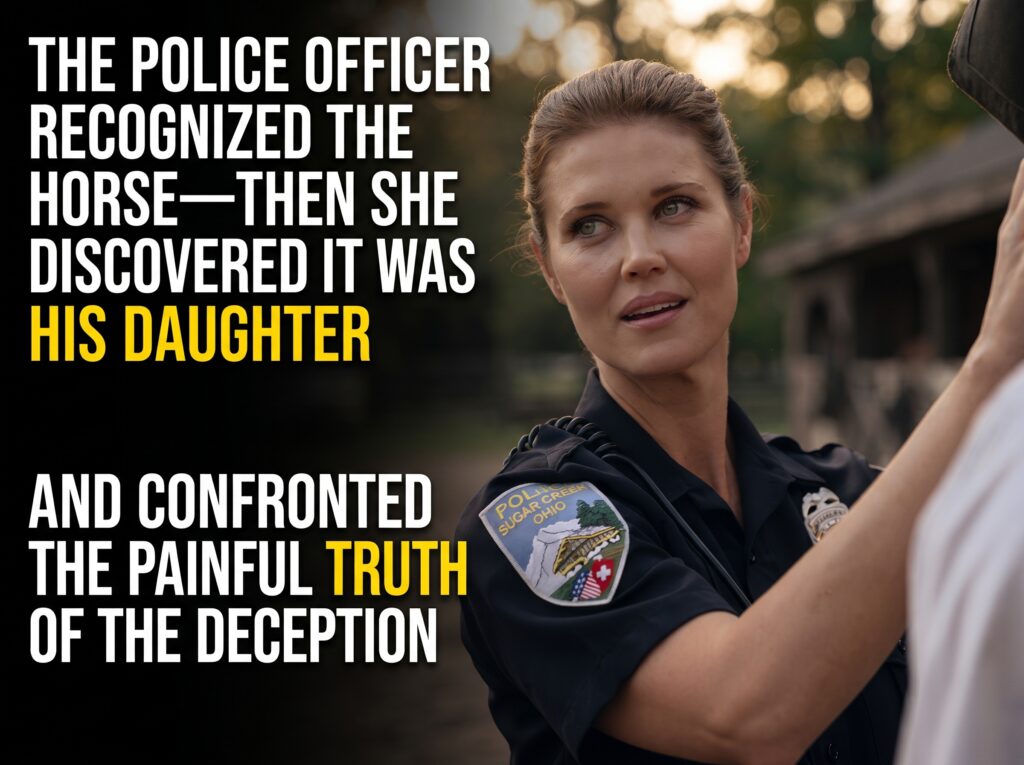
The afternoon sun settled over Sugar Creek, Ohio, as Officer Claire Bennett walked through the annual autumn fair.
Children ran between stalls, vendors called out their prices, and the smell of roasted corn drifted through the crowded grounds. Claire had volunteered to help with traffic and security, expecting a quiet shift before returning to the small house she shared with her father.
Then she saw the horse.
It was a chestnut mare with a white marking on its forehead and a thin scar beneath the saddle. Claire remembered the animal from childhood. Her brother, Daniel, had called it Rosie.
Daniel had died seven years earlier in a road accident outside town. According to the investigation, he had been riding Rosie when a vehicle struck them on a dark country road. Daniel died at the scene, and Rosie supposedly ran into the woods and was never found.
Claire approached the woman holding the reins.
“Beautiful horse,” she said, keeping her voice casual. “What’s her name?”
“Ruby,” the woman replied.
“How long have you had her?”
“About six months.”
Claire looked at the scar again.
“Where did you buy her?”
The woman’s smile faded.
“An estate sale. Why?”
“Whose estate?”
The woman adjusted her grip on the reins.
“I believe the papers said Bennett.”
Claire felt her stomach tighten.
“Bennett?”
“Yes. I don’t know the first name. A man from the auction company handled everything.”
Claire pulled out her notebook.
“Would you mind showing me the ownership papers?”
The woman hesitated before producing a folded document from her bag. Claire examined it carefully. The seller’s name was listed as Robert Bennett.
Her father.
Robert had told her that every belonging connected to Daniel’s accident had been destroyed or sold years ago. He had also insisted that Rosie had died somewhere in the woods.
Claire thanked the woman and returned to the station, where she requested access to the original accident file.
The report was brief. It described wet road conditions, a damaged vehicle, and a deceased rider. Several photographs were missing from the digital record.
One detail caught Claire’s attention: the incident report stated that Daniel had been wearing a silver pendant when he died.
Claire remembered that pendant. Her mother had given it to him for his eighteenth birthday.
But when she had visited the hospital that night, her father told her that the pendant had been lost.
She searched the evidence inventory.
There was no record of it ever being recovered.
Instead, she found an entry for a sealed envelope transferred from the scene to the sheriff’s office. The envelope had never been logged into the public evidence system.
It was signed by Robert Bennett.
Claire stared at the signature.
Her father had retired from the sheriff’s department three years ago. Everyone in town still described him as an honest man who had spent his life protecting others.
She wanted to believe them.
But as she closed the file, she remembered the last conversation she had ever had with Daniel.
He had called her that evening, his voice unusually urgent.
“Claire, I need to tell you something about Dad.”
She had been busy preparing for an examination and promised to call him back.
She never did.
That night, Claire returned home and found her father sitting in his favorite chair.
“Did you sell Rosie?” she asked.
Robert slowly lowered his newspaper.
For a fraction of a second, his expression changed.
Then he smiled.
“Who’s Rosie?”
Claire realized she had just asked the wrong question.
Because her father had not forgotten the horse.
He was pretending he had never known it.
Part 2 — The Locked Drawer
Robert Bennett had spent his life teaching Claire that the truth was the foundation of justice.
When she was a little girl, he had taken her to the sheriff’s office and shown her the evidence room. He told her that every object mattered, every witness deserved to be heard, and every person deserved a fair investigation.
Now, standing in the hallway outside his study, she wondered how much of that lesson he had actually believed.
“Ruby,” Claire said the next morning. “The horse at the fair. The papers say you owned her.”
Robert folded his newspaper.
“People make mistakes when they fill out paperwork.”
“Did you sell her?”
“Claire, I have no idea what you’re talking about.”
“Then why is your name on the ownership document?”
He stood.
“Because I have a lot of old paperwork. You know that.”
He walked past her toward the kitchen, ending the conversation without answering a single question.
Claire waited until he left for his morning walk.
Then she entered the study.
The room smelled of leather, tobacco, and the old cedar desk her father had inherited from his own father. A framed photograph of Daniel stood beside the telephone.
Claire lifted it.
Daniel was twenty-four in the photograph, smiling beneath a baseball cap. He had the same crooked smile their mother used to say could persuade anyone to forgive him.
Behind the frame was a small brass key.
Claire tried it on the locked desk drawer.
It opened.
Inside were old receipts, newspaper clippings, and a leather notebook belonging to her father. Beneath them lay a sealed envelope bearing the date of Daniel’s accident.
Claire opened it with trembling fingers.
Inside was a handwritten note.
Claire, if you’re reading this, something has happened to me. I don’t know whether I can prove what I found, but I need you to understand that the accident wasn’t what it seemed.
Dad has been meeting someone behind the old Miller barn. I followed him last week. I saw the sheriff’s vehicle there, and I heard them arguing about money.
I asked Dad about it. He told me to forget what I’d seen.
I can’t.
If anything happens to me, don’t believe what Dad tells you.
Claire sat down heavily.
Her brother had written the note before his death.
She checked the envelope for a date stamp and found a small notation in the corner: three days before the accident.
Her hands began to shake.
Daniel had suspected their father of something serious. He had tried to tell her, and she had dismissed him.
For seven years, she had blamed herself for not answering his call.
Now she wondered whether answering it would have changed anything.
A floorboard creaked behind her.
Claire turned.
Robert stood in the doorway.
His face was pale.
“Put that back,” he said.
Claire rose slowly.
“You knew he was investigating you.”
“Give me the letter.”
“Why did Daniel write this?”
Robert took a step toward her.
“Your brother was confused. He got involved in things he didn’t understand.”
“What things?”
“Claire, you have no idea what you’re doing.”
“Then explain it.”
He reached for the letter.
She pulled it away.
For several seconds, they stared at each other.
Then Robert said something that frightened her more than any confession could have.
“Whatever you think happened to your brother, you need to leave it alone.”
Claire looked at the man who had raised her.
“Why?”
His voice dropped.
“Because the people responsible for what happened to Daniel are still here.”
Part 3 — The Woman Who Bought Ruby
Claire returned to the fair and found Ruby’s owner, a quiet woman named Hannah Miller.
Hannah was in her early thirties and worked at a small horse rescue outside town. She had dark circles beneath her eyes and the guarded expression of someone who had learned not to trust easily.
Claire introduced herself and showed her the ownership document.
Hannah studied it.
“I didn’t buy Ruby directly from your father,” she explained. “I bought her from a man who claimed he was handling the estate of a deceased relative.”
“Do you remember his name?”
“Frank Dalton.”
Claire recognized the name immediately.
Frank Dalton had once been a deputy in her father’s department. He had resigned shortly after Daniel’s accident and moved away. Claire had not heard from him in years.
“Did he tell you where Ruby came from?”
“He said she belonged to a family that no longer wanted her.”
“Did he mention my brother?”
Hannah looked uncomfortable.
“No. But when I first brought Ruby home, she became frightened whenever someone approached her from the left side. I had a veterinarian examine her. He found an old injury near her shoulder.”
Claire’s mind returned to the accident photographs.
The report had mentioned that Daniel’s horse suffered a severe shoulder injury. The animal had supposedly died shortly afterward.
“Can I see her medical records?”
Hannah nodded.
The veterinarian’s report showed that Ruby had received treatment at a private clinic seven years earlier. The original owner was listed as Daniel Bennett.
Claire felt the world tilt around her.
The horse had survived.
Someone had hidden her.
And someone had lied about what happened after the accident.
Hannah watched Claire carefully.
“Was your brother’s death connected to this horse?”
“I don’t know yet.”
Hannah hesitated.
“There’s something else.”
She led Claire into a small office beside the stable and opened a drawer. Inside was a photograph of a young man standing beside Ruby.
Daniel.
He looked thinner than in the family photographs, but unmistakably alive.
The date on the photograph was six months after his supposed death.
Claire stared at it, unable to speak.
“Where did you get this?”
“It was tucked inside Ruby’s old saddle when I bought her. I thought it was a previous owner’s photograph.”
Claire turned it over.
On the back, Daniel had written:
For the people who helped me when I had nowhere else to go.
Beneath the words was an address.
It belonged to an abandoned farm on the outskirts of Sugar Creek.
Claire felt a strange mixture of hope and terror.
If Daniel had been alive six months after the accident, then the story her father had told her was impossible.
But there was one problem.
The photograph could have been old.
The date could have been altered.
And Claire had spent enough years as a police officer to know that a single piece of evidence could lead in the wrong direction.
She thanked Hannah and took a photograph of the document.
As she walked toward her patrol vehicle, her phone rang.
The number was blocked.
“Officer Bennett,” she answered.
A man’s voice spoke quietly.
“Stop looking for your brother.”
“Who is this?”
“You don’t understand what happened seven years ago.”
“Then tell me.”
The caller was silent for a moment.
Then he said:
“Your father wasn’t the only person at that accident scene.”
The call ended.
Claire stood beside her vehicle, listening to the silence.
For the first time, she considered the possibility that Daniel’s disappearance had involved more than one person—and that one of them might still be watching her.
Part 4 — The Farm Beyond the River
The address on Daniel’s photograph led Claire to an abandoned farm beyond the river.
The property had once belonged to the Miller family, but the farmhouse was boarded up and the surrounding fields had grown wild. A broken fence leaned toward the road, and the barn doors hung crookedly from their hinges.
Claire parked outside and approached cautiously.
She found a rusted padlock on the barn door. It had been broken recently.
Inside, dust covered the old machinery, but footprints crossed the floor.
Someone had been there.
Claire moved toward a small wooden office at the back of the barn. On the desk lay a stack of veterinary bills, a map, and several newspaper clippings about Daniel’s accident.
One clipping had been circled in red.
It contained a statement from Robert Bennett praising the investigation and thanking the community for its support.
Beneath it was a handwritten note:
He made sure nobody asked the right questions.
Claire heard a noise behind her.
She turned quickly.
A man stood near the barn entrance, holding his hands where she could see them.
He was in his late fifties, with a weathered face and a limp.
“You’re Robert’s daughter,” he said.
“Who are you?”
“Frank Dalton.”
Claire reached for her radio.
“Put your hands where I can see them.”
Frank obeyed.
“I didn’t come here to hurt you.”
“Then tell me why you called me.”
He looked at the clippings.
“Because your father has been lying to you for seven years.”
“Did you help him?”
Frank lowered his eyes.
“Yes.”
The admission stunned her.
Frank explained that on the night of the accident, he had been the first deputy to arrive. Daniel had been injured, but he was alive when Frank reached him.
A second vehicle had been parked near the road.
Its driver was Robert Bennett.
“Your father told me Daniel had been driving recklessly,” Frank said. “He said the department would handle everything and that I should stay away from the scene.”
“What happened to Daniel?”
Frank swallowed.
“I don’t know everything. I swear to you, I don’t. But I saw your father put Daniel into his vehicle. He said he was taking him to a hospital.”
“Which hospital?”
“That’s the problem. No hospital recorded an admission.”
Claire felt her pulse racing.
“Why didn’t you report it?”
“Because your father had evidence that I had taken money from a seized-property account. He said he’d make sure I went to prison if I spoke.”
“You took money?”
Frank nodded.
“I made a terrible decision. I was ashamed, and I was afraid. Your father used both against me.”
Claire struggled to reconcile the man standing before her with the story she had believed.
“Why are you telling me now?”
“Because someone has been searching this farm. They took the original records last week. I think your father knows you’re getting close.”
Frank handed her a folded document.
It was a transport record with a hospital name written in the margin.
St. Agnes Medical Center.
The date matched the night Daniel disappeared.
Claire knew the hospital. It had closed five years earlier, but its records had been transferred to a regional archive.
She put the document in her evidence bag.
“You’re going to have to give an official statement.”
“I know.”
“And if you lied to me, I’ll find out.”
Frank nodded.
“I expect you will.”
As Claire turned to leave, he called after her.
“Officer Bennett?”
She stopped.
“Your brother didn’t hate your father. That was the worst part. Daniel kept believing Robert would do the right thing.”
Claire looked back at him.
“Did he?”
Frank’s expression crumpled.
“No.”
Part 5 — The Hospital Record
St. Agnes Medical Center had been closed for years, but its records were preserved in a regional archive.
Claire requested access through the proper channels, disclosing her family connection and asking another officer to oversee the retrieval.
She knew that if she was going to uncover the truth, every step had to be documented. She could not allow her personal grief to compromise the investigation.
Two days later, the archive manager called.
A record matching Daniel’s name had been found.
Claire arrived with her supervising officer and sat at a long table while the manager placed a folder before her.
The admission record was brief.
A young man had been brought in with serious injuries after a road accident. His identity was listed as Daniel Bennett, but the record had been flagged for transfer to another facility.
The transfer section was incomplete.
There was no confirmed discharge destination.
But attached to the file was a handwritten note from a nurse.
Patient conscious. Asked repeatedly whether his sister had been contacted. Accompanying man instructed staff not to call family until the sheriff arrived.
Claire read the note several times.
Her father had taken Daniel to a hospital.
Daniel had been alive.
And someone had deliberately prevented the hospital from contacting the family.
The supervising officer requested the hospital’s original transfer ledger.
It showed that Daniel had been moved before dawn to a private rehabilitation facility in another county. The authorization carried the signature of a doctor who had since died.
Claire searched the facility’s archived records.
The trail ended three months later.
Daniel had been transferred again under a different name.
There was no death certificate.
No documented return home.
No official record explaining where he went.
For the first time, Claire allowed herself to consider something she had once believed impossible.
Her brother might still be alive.
She drove home with copies of the records secured in her bag.
Robert was waiting on the porch.
“Where have you been?”
“Working.”
“Don’t lie to me.”
Claire looked at him steadily.
“I found the hospital records.”
His expression changed.
“You shouldn’t have done that.”
“Daniel was alive after the accident.”
Robert said nothing.
“You took him to St. Agnes. You stopped them from calling us. Then you moved him somewhere else.”
“Claire—”
“Where is he?”
Robert looked toward the road.
For several seconds, he appeared to be searching for words.
Then he said, “Your brother was in danger.”
“From whom?”
“People he had become involved with.”
“Why didn’t you tell me?”
“Because I was trying to keep you safe.”
Claire shook her head.
“That’s what you always say. You call it protection whenever you take away someone else’s choice.”
Robert’s eyes filled with tears.
“I made a promise.”
“To whom?”
He turned away.
Claire stepped closer.
“Is Daniel alive?”
Robert’s shoulders began to tremble.
“I don’t know.”
She stared at him.
“You don’t know?”
“The last time I saw him, he was alive. He was frightened, angry, and in pain. He told me he never wanted to see me again.”
Claire felt her heart break in two.
“Where did you take him?”
Robert looked at her.
“I sent him away because I believed it was the only way to keep him alive.”
“And you let us bury an empty coffin?”
Robert closed his eyes.
Claire had never seen her father cry.
Now tears moved down his face as he whispered:
“I thought if I told you the truth, I would lose both my children.”
Claire looked at him with a mixture of grief and anger.
“You lost us because you chose the lie.”
Part 6 — The Voice on the Telephone
That night, Claire sat alone in her kitchen, listening to the rain.
She had called the regional police department and requested assistance in locating Daniel. The records suggested that he had been moved through several facilities, but the final destination remained unknown.
Her father had refused to give her an address.
He claimed that he had destroyed the last letter he received from Daniel.
Claire did not believe him.
At 11:17 p.m., her phone rang.
The number was blocked.
She answered without speaking.
A man’s voice came through the receiver.
“Claire?”
She froze.
She had not heard that voice in seven years, but she recognized it immediately.
“Daniel?”
A long silence followed.
Then the man whispered, “You shouldn’t have started looking.”
Claire stood so quickly that her chair fell backward.
“Where are you? Are you alive?”
“I’m alive.”
She covered her mouth.
For seven years, she had mourned him. She had carried guilt over the unanswered call, the funeral, and the empty space at every family gathering.
Now his voice had returned, and she could barely form a sentence.
“Daniel, please. Tell me where you are.”
“I can’t.”
“Why not?”
“Because people still think I know what happened that night.”
“What do you know?”
Daniel hesitated.
“I found evidence that Dad had been helping someone steal money from the county’s seized-property account. I confronted him. I thought he’d explain it.”
“And then the accident happened?”
“Yes. But the crash wasn’t what nearly killed me.”
Claire gripped the edge of the counter.
“What do you mean?”
“I was taken to the hospital. I woke up with Dad beside me. He said there were people who would hurt you if I went home.”
“Was that true?”
“I don’t know. I was injured, frightened, and confused. Then I was moved to another facility. By the time I understood what was happening, I was being told that the police had decided I was dead.”
Claire felt sick.
“Who told you that?”
“Different people. Doctors. People who said they were helping me. I didn’t know who to trust.”
“Why didn’t you contact me?”
“I tried once.”
“When?”
“About six months after the accident. I called the house. Dad answered. He told me you’d been told everything and wanted nothing to do with me.”
Claire’s knees weakened.
“He lied.”
“I know that now.”
“Daniel, where are you?”
“I can’t tell you yet. I need you to understand something first. Dad wasn’t the only person who knew I was alive.”
“Who else?”
“The man who was driving the second vehicle.”
Claire remembered Frank’s statement.
“Do you know his name?”
Daniel’s voice grew faint.
“I found out later. It was someone who worked for the county. Someone who had access to the evidence room.”
Before Claire could ask another question, she heard a sound on his end of the call.
Daniel stopped speaking.
“Claire, I have to go.”
“Wait!”
“I’ll contact you again. Don’t confront Dad alone.”
The call ended.
Claire stood motionless in the kitchen.
Her brother was alive.
But he was still afraid.
And the investigation had just revealed another person who might have helped conceal the truth.
The next morning, Claire requested the original evidence-room access logs from the period surrounding Daniel’s accident.
One name appeared repeatedly.
Sheriff’s investigator Martin Cole.
Martin Cole had become the county’s chief investigator after Robert retired.
He was still serving in the department.
And he had been one of the men publicly praised for solving Daniel’s supposed fatal accident.
Part 7 — The Man Everyone Trusted
Martin Cole was waiting in the station when Claire arrived.
He was in his early fifties, impeccably dressed, with silver at his temples and a reputation for solving difficult cases. He had once mentored Claire during her training.
He greeted her with a smile.
“Claire. I heard you’ve been looking into Daniel’s accident.”
She kept her expression neutral.
“It’s an old case with some unresolved records.”
“Old cases can be painful. Sometimes it’s better to let them rest.”
“Is that what you did?”
His smile faded slightly.
“Excuse me?”
“Did you let Daniel’s case rest, or did you make sure nobody asked questions?”
Martin leaned back in his chair.
“Be careful, Officer Bennett. You’re making serious accusations.”
“I’m asking about the evidence-room logs.”
“I don’t remember every file I handled seven years ago.”
“The logs show you accessed the sealed envelope from the accident scene.”
Martin said nothing.
“That envelope was never entered into the evidence inventory. What was inside it?”
He looked toward the office door.
“Your father was under tremendous pressure. Daniel had become involved with people who were dangerous. We believed the family was safer if the matter stayed quiet.”
Claire stared at him.
“You knew Daniel was alive?”
Martin’s silence confirmed it.
“Where is he?”
“I don’t know.”
“You’re lying.”
Martin rose.
“This conversation is over.”
Claire stood, too.
“No. It’s only beginning.”
She left the office and immediately reported the conversation to her supervisor. She also submitted the records she had collected and requested that the case be handled by investigators outside the county.
That afternoon, Frank Dalton gave a formal statement confirming that Robert had removed Daniel from the accident scene and that Martin Cole had helped arrange the subsequent transfer.
The investigation widened.
Financial records revealed that money had been diverted from a seized-property account over several years. Some transactions were connected to businesses that had employed Martin’s relatives.
The records did not establish every person’s role, but they showed that the original investigation had serious gaps.
Claire was removed from direct investigative duties because of her family connection. She cooperated fully with the external investigators, giving them every document she had found.
For the first time, she had to accept that solving the case meant stepping back and allowing others to determine what the evidence proved.
Days passed.
Then a message arrived from an unknown number.
Meet me at the old fairground gate tomorrow at sunset. Come alone.
Claire informed the external investigators and followed their safety instructions.
At sunset, she arrived at the designated place.
A man stood beside the fence, wearing a dark coat.
He turned.
It was Daniel.
He was older, thinner, and carried a faint scar along his jaw. But his eyes were the same.
Claire stopped several feet away.
Neither of them spoke.
Then Daniel smiled sadly.
“You got taller.”
Claire laughed through her tears.
“You’re an idiot.”
“I know.”
She crossed the distance between them and wrapped her arms around him.
For several seconds, they held each other as though the years between them could be undone by the simple act of not letting go.
Then Claire stepped back.
“Why did you stay away?”
Daniel looked toward the empty fairground.
“Because I thought coming home would put you in danger. And because after a while, I was ashamed.”
“Of what?”
“Of believing Dad. Of running away. Of letting you think I was dead.”
Claire wiped her face.
“You didn’t make me think that. They did.”
Daniel nodded.
“I know that now.”
She took his hand.
“Come home.”
He looked at her.
“Not yet. There is one thing I still have to tell you.”
Part 8 — The Night Daniel Disappeared
Daniel sat with Claire in a quiet room at the external investigators’ office, where his statement could be recorded safely.
He told her that on the night of the accident, he had discovered documents suggesting that money from the county’s seized-property account was being diverted.
He had taken copies.
He intended to give them to a state investigator the following morning.
But someone discovered what he was planning.
On the road outside Sugar Creek, another vehicle forced him off the road. The collision injured him badly, but he survived.
Robert arrived shortly afterward.
According to Daniel, his father had been told that the people involved would make sure Daniel never reached the authorities. Robert feared that if Daniel was admitted under his real name, the people responsible would find him before he recovered.
Instead of contacting the proper authorities immediately, Robert took him to a hospital and arranged for his transfer.
He believed he was buying time.
But time became secrecy.
Secrecy became a false death report.
And the longer Robert waited, the more frightened he became of admitting what he had done.
“Did he know who caused the crash?” Claire asked.
Daniel shook his head.
“He suspected Martin. He never showed me proof that Martin was driving the other vehicle.”
“Why did you disappear from the hospital records?”
“Martin had contacts at the facility. Someone changed the paperwork and arranged another transfer. I was told that if I went home, you would be targeted.”
“Was that true?”
“I don’t know. I was afraid to find out.”
Daniel explained that he had eventually recovered in a small town under a different name. He worked where he could, avoided old contacts, and kept the photograph of Ruby because the horse was one of the few things that reminded him of his former life.
When he finally learned that Claire had become a police officer, he wanted to contact her.
But he was still afraid of the people who had concealed the evidence.
“I thought if I stayed away, you’d be safe,” he said.
Claire looked at him.
“You made the same mistake Dad made.”
Daniel lowered his eyes.
“I know.”
“You both decided what was best for me without asking me.”
He nodded.
For a moment, neither spoke.
Then Claire took a breath.
“Did you keep the documents?”
Daniel reached inside his coat and removed a small waterproof envelope.
“I kept copies. The originals disappeared after the crash.”
Inside were photocopies of account transfers, handwritten notes, and a list of dates. The documents suggested that Martin Cole had accessed sealed evidence and that money had been moved through several accounts.
They were not enough to prove every allegation, but they gave investigators a new lead.
Daniel agreed to provide the originals he still possessed and testify about what he remembered.
He also agreed to return to Sugar Creek under his real name.
That evening, Claire took him to their childhood home.
Robert was standing in the garden when they arrived.
He saw Daniel and stopped moving.
For a long time, he simply stared.
Then he whispered, “My son.”
Daniel remained beside Claire.
“Don’t call me that as though nothing happened.”
Robert’s face crumpled.
“I know.”
“You let me disappear.”
“I was afraid.”
“So was I.”
Robert took a trembling step forward.
“I thought I was saving you.”
Daniel’s voice broke.
“You were supposed to be my father. I needed you to tell the truth, even if it cost you everything.”
Robert began to cry.
“I am sorry.”
Daniel looked at him for a long time.
Then he said the words that neither of them had been ready to hear.
“I’m not ready to forgive you.”
Robert nodded.
“I understand.”
And this time, he did not ask his son to change his mind.
Part 9 — The Truth Comes to Light
The investigation continued for several months.
External investigators examined the original accident records, the hospital transfers, the missing evidence, and the financial documents Daniel had preserved.
Martin Cole was placed on administrative leave while the allegations were investigated. Frank Dalton cooperated with investigators and admitted his own misconduct. Robert provided a detailed statement about his decisions after the accident.
The evidence established serious failures in the original investigation and supported further scrutiny of the missing funds. However, investigators could not immediately prove who had caused the collision or establish every detail of Daniel’s disappearance.
Claire learned to live with the uncertainty.
She had spent years believing that justice meant finding one person responsible and watching every question receive a clear answer.
Now she understood that real investigations were rarely so simple.
Some truths could be proven.
Others remained memories, suspicions, or unanswered questions.
But the most important truth was no longer hidden: Daniel had survived, and the official account of his death had been false.
The news spread through Sugar Creek.
People who had attended Daniel’s funeral struggled to understand what had happened. Some apologized to the family. Others accused Robert of betraying the town.
Robert did not defend himself publicly.
He accepted the consequences of his choices and cooperated with the investigation.
One afternoon, Claire found him sitting on the porch with Daniel’s old baseball glove.
“I thought you’d thrown that away,” she said.
“I almost did.”
He turned the glove in his hands.
“Your brother used to leave it everywhere. Under the couch, in the kitchen, once inside the refrigerator.”
Claire laughed softly.
“He said the refrigerator was the safest place in the house.”
“He was wrong about that.”
For a moment, they smiled together.
Then the silence returned.
“Do you think he’ll ever forgive me?” Robert asked.
Claire sat beside him.
“I don’t know.”
Robert nodded.
“I don’t deserve an easy answer.”
“No,” Claire said gently. “You don’t.”
He looked toward the garden.
“I thought being a good father meant protecting my children from the world. I didn’t understand that sometimes I was protecting myself from the truth.”
Claire rested her hands in her lap.
“You can’t change what happened.”
“I know.”
“But you can stop hiding it.”
Robert looked at her.
“That’s what I’m trying to do.”
Claire believed him.
Not because he had earned her complete trust again, but because she could finally see him making a choice that did not depend on a lie.
Weeks later, Daniel visited the horse rescue where Ruby lived.
The mare recognized his voice before he reached the paddock. She walked toward him and pressed her nose against his shoulder.
Daniel closed his eyes.
“Hello, girl.”
Claire stood nearby, watching him stroke the horse’s neck.
For seven years, she had believed that the story ended with a funeral.
Now she understood that the accident had been only the beginning of a much longer story—one about fear, silence, and the damage people could cause when they convinced themselves that a lie was an act of love.
Daniel looked over at her.
“Do you think we’ll ever be a normal family again?”
Claire smiled sadly.
“I don’t think we ever were.”
He laughed.
“Fair enough.”
She reached through the fence and touched Ruby’s mane.
“But we can be an honest one.”
Part 10 — The Ride Home
One year later, the Sugar Creek autumn fair returned.
The same music filled the grounds. Children ran between the stalls, vendors sold hot drinks, and the air smelled of fallen leaves and roasted corn.
Claire stood near the entrance wearing her police uniform.
She had returned to regular duties after cooperating with the external investigation. The case had changed her. She was more careful with evidence, more patient with witnesses, and less willing to accept an easy explanation simply because it came from someone respected.
Across the fairground, Daniel led Ruby beside the riding arena.
He had returned to Sugar Creek permanently and begun volunteering at the horse rescue. He was still rebuilding his life, but he no longer felt that he had to disappear to protect the people he loved.
Robert watched from a bench near the entrance.
He and Daniel had begun speaking again, cautiously. There were still painful conversations ahead, and some wounds might never fully heal.
But Robert no longer demanded forgiveness.
He had learned that trust was not something a person could request simply because they regretted what they had done.
It was something they had to earn.
When Daniel approached, Robert stood.
“She looks healthy,” he said, nodding toward Ruby.
“She is.”
Daniel paused.
“I’ve been thinking about the old farm.”
Robert looked at him.
“What about it?”
“I’d like to help turn it into a place where abandoned horses can recover. Hannah has offered to manage the rescue program.”
Robert was silent for a moment.
Then he nodded.
“I can help with the repairs.”
Daniel studied his father’s face.
“That doesn’t erase anything.”
“I know.”
“And I’m not promising that everything will be fine.”
“I understand.”
Daniel extended his hand.
Robert took it.
The gesture was small, awkward, and incomplete.
But it was honest.
Later that afternoon, Claire joined them near the riding arena. Ruby stood quietly beside Daniel, her chestnut coat glowing in the sunlight.
Claire touched the white marking on the mare’s forehead.
“Do you remember the first time you rode her?”
Daniel smiled.
“You were eight. You cried because she wouldn’t let you climb on.”
“I did not cry.”
“You absolutely cried.”
“I was expressing a reasonable concern about animal safety.”
Daniel laughed.
For the first time in years, the sound seemed to belong to the brother she remembered.
He handed her the reins.
“Want to try again?”
Claire hesitated.
Then she climbed into the saddle.
Daniel walked beside Ruby as they moved slowly around the arena. Robert watched from the fence, his eyes bright with tears.
The scene was ordinary.
No dramatic confession.
No sudden forgiveness.
No magical return to the past.
Just a sister riding a horse, a brother walking beside her, and a father learning to be present without demanding that anyone forget what he had done.
As the sun began to set, Claire looked across the fairground.
She remembered the first moment she had seen Ruby and recognized the scar beneath the saddle. She remembered the fear that followed, the locked drawer, the hospital records, and the years of grief she had carried.
She had thought the truth would destroy her family.
Instead, it had destroyed the lie that had been keeping them apart.
Not everything had been repaired. Not every question had been answered. And forgiveness remained a choice each person would have to make in their own time.
But Daniel was alive.
Ruby had come home.
And Claire no longer had to wonder whether her brother had been forgotten.
As they left the fairground, Daniel turned toward her.
“Claire?”
“Yes?”
“Thank you for not giving up on me.”
She smiled, her eyes filling with tears.
“I should have answered your call seven years ago.”
He shook his head.
“We can’t change that night.”
“No.”
“But we can answer each other now.”
Claire reached over and squeezed his hand.
Together, they walked toward the waiting car, with Ruby following calmly behind them.
For seven years, Claire had believed that her brother’s story ended on a dark road outside town.
Now she knew the truth.
Sometimes the people we love disappear because someone hurts them.
Sometimes they disappear because fear convinces them that leaving is the only way to protect us.
And sometimes, the greatest act of love is not deciding what another person needs.
It is telling the truth, opening the door, and giving them the freedom to choose whether they want to come home.
The End.
The hardest secrets are not always the ones that destroy a family. Sometimes, they are the ones that keep a family from healing.