Part 1:
The rain began just before sunset, tapping against the tall windows of Ashford Manor.
Inside the old house, the fire burned low, casting long shadows across the wooden walls and the portraits of generations who had lived and died beneath its roof.
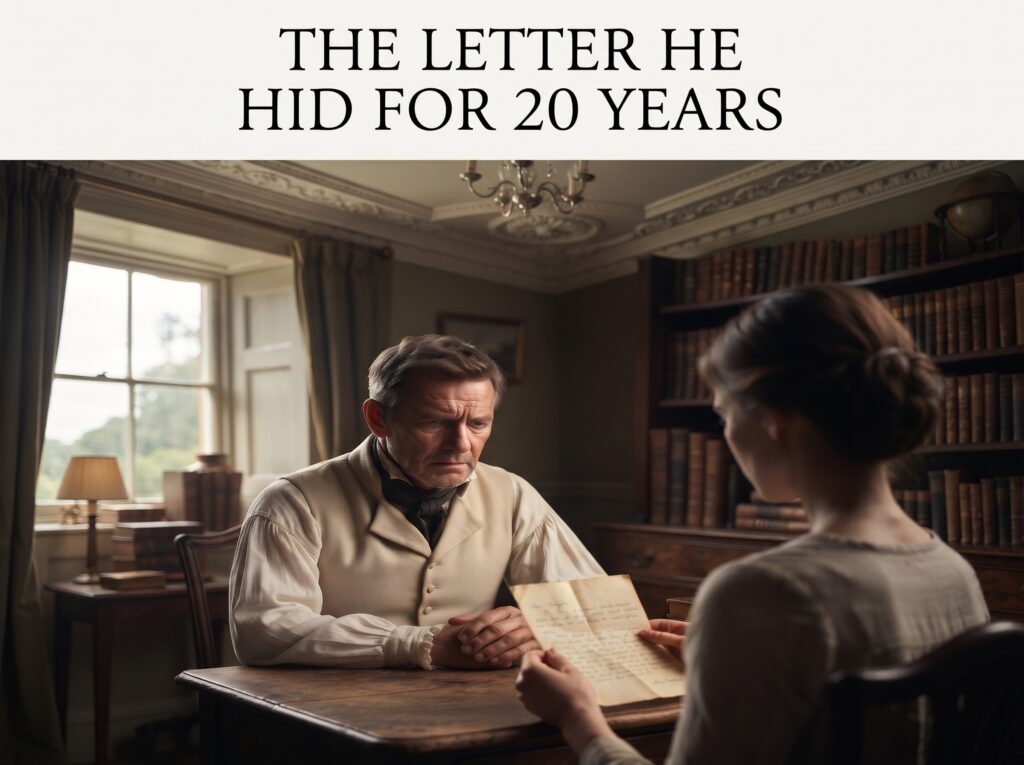
Eleanor Ashford stood beside her father’s desk, holding a sealed envelope.
At thirty-two, she had inherited her mother’s dark eyes, her quiet determination, and the habit of asking questions that made uncomfortable people look away.
Her father, Edward Ashford, sat in his usual chair near the fireplace. His once-dark hair had turned silver, and the years had carved deep lines around his mouth. He wore a cream waistcoat over a white shirt, with a dark neckcloth tied carefully at his throat.
He had always looked like a man who could control everything.
That evening, however, his hands trembled.
“Where did you get that?” he asked.
Eleanor looked down at the envelope.
“It was inside your locked cabinet.”
“You had no right to go through my private papers.”
“I was looking for Mother’s property documents. You told me they were in that cabinet.”
“I told you to look for the documents, not to read personal correspondence.”
“Personal correspondence?” Eleanor repeated. “It’s addressed to me.”
Edward rose from his chair.
“Give it to me.”
She stepped backward.
“No.”
For a moment, neither spoke.
Eleanor had not intended to confront him that evening. She had planned to ask him about the old family accounts, finish her work, and return to her home in the village the following morning.
But the handwriting on the envelope had stopped her.
She recognized it immediately.
Her mother’s handwriting was unmistakable: elegant, slightly slanted, with the final letters of each word curling upward.
Her mother, Margaret, had died when Eleanor was twelve.
For twenty years, Edward had spoken of her with the same carefully rehearsed tenderness.
“She was the heart of this house,” he would say.
“She never wanted you to worry.”
“She left us with beautiful memories. We must be grateful for those.”
But he never explained the final weeks of her life. Whenever Eleanor asked about them, he changed the subject.
When she asked whether her mother had suffered, he told her that illness had taken her quickly.
When she asked whether her mother had wanted to see her before she died, he said that she had been too weak.
And when Eleanor asked why the bedroom at the end of the eastern corridor had remained locked for twenty years, he told her never to concern herself with rooms that belonged to the past.
Now she stood before him with a letter her mother had written three days before her death.
“Did Mother write this?” she asked.
Edward looked away.
“You know she did.”
“Then why have you kept it from me?”
“There are things you don’t understand.”
“Then explain them.”
He approached her slowly.
“Eleanor, listen to me. Whatever you think that letter contains, it cannot change the fact that your mother loved you.”
“I’m not asking whether she loved me. I’m asking why you hid her letter.”
His jaw tightened.
“Because I was trying to protect you.”
The answer made something inside her go cold.
It was the same answer he had given her whenever she had asked a question he did not want to answer.
Protect you.
From what?
From whom?
Eleanor broke the seal.
Edward reached for her hand, but she moved beyond his grasp.
“Don’t,” she warned.
She unfolded the paper.
The letter began with a simple greeting.
My darling Eleanor,
If you are reading this, then I have failed to tell you the truth myself.
Eleanor stopped breathing for a moment.
Her father sat down heavily.
She continued.
There is something about our family that you deserve to know. I have waited too long because I was afraid of what the truth would cost us.
Then came the sentence that changed her life.
Ask your father what happened on the night your brother disappeared.
Eleanor lowered the letter.
“My brother?”
Edward said nothing.
“Father, what brother?”
He closed his eyes.
Outside, thunder rolled over the estate.
Eleanor waited for him to laugh, to explain that the letter referred to someone else’s child, or to tell her that her mother had been confused by medication.
Instead, he whispered four words.
“His name was Thomas.”
Eleanor gripped the letter so tightly that the paper creased beneath her fingers.
“Was?”
Edward looked at her.
For the first time, she saw not anger or authority in his expression, but grief.
“I don’t know what happened to him,” he said.
And Eleanor understood that her father had been waiting twenty years for someone to ask the question he had spent his life trying to escape.
Part 2 — The Brother Who Never Existed
Eleanor did not sleep that night.
She sat in her childhood bedroom, surrounded by the familiar furniture of a life that suddenly felt unfamiliar. Moonlight fell across the old wooden floor, illuminating the shelves where her childhood books still stood.
She remembered her seventh birthday, when her father had given her a silver music box.
She remembered her mother sitting beside her bed, singing softly when she was frightened by storms.
She remembered a summer when the gardener had built a wooden swing beneath the old oak tree.
But she did not remember a brother.
How could a child disappear from a family and leave no memory behind?
At dawn, Eleanor went downstairs.
Edward was already in the breakfast room, staring at a cup of untouched tea.
“I want the whole story,” she said.
He did not look up.
“Not today.”
“Twenty years ago, you decided I wasn’t old enough to know I had a brother. You kept my mother’s letter hidden. You locked an entire room in this house. You don’t get to decide what I can know anymore.”
Edward’s expression hardened.
“You have no idea what you are asking for.”
“Then tell me.”
He rubbed his forehead.
“Thomas was born four years before you. Your mother adored him. He was a quiet boy, always following her through the gardens, always asking questions.”
Eleanor sat opposite him.
“Why don’t I remember him?”
“Because you were very young.”
“How young?”
“Almost three.”
She tried to imagine it.
A small boy holding her hand.
A brother standing beside her mother’s chair.
Someone who had once shared the same nursery, the same meals, the same family name.
“Where did he go?”
Edward stared into his tea.
“It happened during a storm. Thomas was playing near the eastern gardens. The servants thought he had gone inside. Your mother believed he was with me. I believed he was with her.”
“And then?”
“By nightfall, he was gone.”
Eleanor felt a chill travel through her.
“You never found him?”
“We searched the grounds. We searched the village, the roads, the riverbanks. The police questioned everyone who had been at the house. We received no ransom demand, no letter, no proof that he was alive.”
“Did you tell Mother?”
“Your mother was there.”
“Then why did she write that you should explain what happened?”
Edward looked toward the window.
“Because she believed I knew more than I told her.”
Eleanor leaned forward.
“Did you?”
His silence was an answer of its own.
“Father.”
“I made mistakes.”
“What mistakes?”
He pushed his chair back.
“I will not discuss this further.”
“You have spent twenty years refusing to discuss it.”
“And I have spent twenty years living with the consequences!”
His voice rose sharply.
Eleanor fell silent.
For a moment, Edward looked almost ashamed of his outburst. He returned to his chair and lowered his voice.
“Your mother never recovered from losing Thomas. She blamed herself. She blamed me. Eventually, she began to believe that the truth had been deliberately hidden from her.”
“Was it?”
He looked at Eleanor.
“I cannot give you the answers you want.”
“Or you won’t?”
He said nothing.
Eleanor stood.
“Then I’ll find them myself.”
She left the room before he could respond.
At the end of the corridor, the locked eastern door waited beneath a thin layer of dust.
She had passed it hundreds of times as a child.
She had never tried to open it.
Now she noticed something she had never seen before: a small brass keyhole beneath the handle, polished around the edges as though someone had recently touched it.
She returned to the study and searched her father’s desk.
Inside a drawer, beneath old receipts and folded papers, she found a ring of keys.
One was small, brass, and marked with a single letter.
T.
Her fingers tightened around it.
When she returned to the eastern corridor, she could hear her father’s footsteps behind her.
“Eleanor,” he said quietly.
She inserted the key.
It turned.
The lock clicked.
And when she opened the door, she discovered that the room had not been abandoned.
It had been preserved.
Every toy, every book, and every piece of furniture remained exactly where a little boy had left it.
On the bed lay a folded child’s coat.
Beside it rested a wooden horse.
And on the wall, above the fireplace, hung a portrait of a boy with dark eyes and a small, familiar smile.
Eleanor stared at the painting.
The boy looked strangely like her.
Then she noticed the date written beneath it.
The portrait had been painted six months after Thomas disappeared.
Someone had commissioned it long after the family had supposedly accepted that he was gone.
She turned toward her father.
“Why was this room kept exactly as it was?”
Edward stood in the doorway.
His face had gone pale.
“Because,” he said, “I never believed my son was dead.”
Part 3 — The Photograph Behind the Portrait
Eleanor entered the room slowly.
The air smelled of old wood, linen, and the faint sweetness of lavender. Her mother had always used lavender sachets in the wardrobes, and one still rested inside a small drawer beside the bed.
Nothing had been moved.
A toy soldier lay beneath the window. A child’s drawing had been pinned to a corkboard. Beside the fireplace stood a wooden box filled with marbles.
Eleanor picked up the drawing.
It showed a house, two adults, and three children.
She recognized herself in the smallest figure, standing beside a boy with dark hair.
Above the drawing, in uneven handwriting, were the words:
Our family.
She felt tears sting her eyes.
“Why did nobody ever tell me about him?” she asked.
Edward remained at the door.
“Because every time we spoke of Thomas, your mother became inconsolable. After a while, we thought it was better for you not to remember the pain.”
“You didn’t protect me. You erased him.”
Edward lowered his head.
Eleanor turned toward the portrait.
The boy’s eyes were painted with extraordinary care. He looked perhaps six years old, with a serious expression and a small scar near his left eyebrow.
She had seen that scar before.
Not on a living person.
In a photograph.
She hurried to the corridor and returned with an old family album from the cabinet outside the room.
Page after page showed the family’s history: weddings, birthdays, garden parties, and summer picnics.
But several pages had been removed.
The paper edges were ragged.
“Who took these out?”
Edward did not answer.
Eleanor turned to the back of the album, where a photograph had been tucked between two blank pages.
It showed her mother standing beside a young man outside a small cottage. The man was older than the boy in the portrait, perhaps eighteen or nineteen. His hair was dark, and his face was turned slightly away from the camera.
But the scar near his eyebrow was unmistakable.
On the back, someone had written:
Thomas — September 2004.
Eleanor’s hands began to shake.
The date was twelve years after his disappearance.
She looked at her father.
“Who took this photograph?”
Edward stared at it as though it were something he had spent years trying to forget.
“Your mother.”
“Where was it taken?”
“I don’t know.”
“Was Thomas alive in 2004?”
“I believe he was.”
Eleanor’s heart pounded.
“You believe he was? You had a photograph of him and you did nothing?”
“I didn’t have that photograph.”
“Then where did it come from?”
Edward took a slow breath.
“Your mother received it in the post. There was no return address. No letter. Just the photograph.”
“And she never told me?”
“You were a child.”
“You could have searched for him!”
“I did search for him.”
“Then why did you stop?”
Edward looked at the photograph.
“Because I was told that if I continued, someone else would suffer.”
The words hung between them.
Eleanor felt the room grow colder.
“Who told you that?”
Edward looked toward the window.
“I received a letter shortly after the photograph arrived. It said that Thomas was alive, but that he did not wish to return. It warned me not to contact him.”
“Who wrote it?”
“I never learned.”
“Did Mother believe it?”
“No. She thought someone was keeping Thomas away from us.”
“And you?”
Edward’s eyes filled with tears.
“I thought that if I waited, he would come home when he was ready.”
Eleanor looked down at the photograph again.
For twenty years, she had believed that her family was small because fate had been cruel.
Now she understood that someone had made choices, hidden evidence, and allowed silence to grow around the missing child.
“Father,” she said, “if Thomas was alive, then we can still find him.”
Edward shook his head.
“You don’t understand how much time has passed.”
“Then we begin with the photograph.”
She placed it carefully inside her coat.
As she turned to leave, something caught her eye beneath the wooden horse.
A small envelope had been pushed between the floorboards and the wall.
It bore no stamp and no address.
Only one sentence had been written across the front.
For the daughter who will eventually ask.
Eleanor opened it.
Inside was a narrow strip of paper.
If you want to find Thomas, speak to the woman who worked in the house the night he disappeared.
At the bottom was a name.
Margaret Bell.
Eleanor knew the name.
Margaret Bell had been the family’s housekeeper.
And according to her father, she had left Ashford Manor the very morning Thomas disappeared.
Part 4 — The Housekeeper’s Secret
Margaret Bell lived in a small cottage near the edge of the village.
Eleanor remembered her vaguely: a woman with gray hair, gentle hands, and a habit of humming while she worked. Margaret had left the manor when Eleanor was a toddler, and no one had spoken of her in years.
By noon, Eleanor had found the cottage.
The garden was untidy, and ivy climbed the stone walls. A bell hung beside the door.
Eleanor rang it twice.
An elderly woman opened the door.
“Yes?”
“Mrs. Bell?”
The woman studied her face.
Then her expression changed.
“Eleanor Ashford.”
“You remember me?”
“I remember you as a little girl.”
Eleanor took the photograph from her coat.
“I need to ask you about my brother.”
Margaret’s face went pale.
For several seconds, she stood motionless.
Then she opened the door wider.
“Come inside.”
The cottage was warm and smelled of tea and freshly baked bread. Photographs covered one wall, most of them showing children and grandchildren Eleanor did not recognize.
Margaret invited her to sit.
Eleanor placed the photograph on the table.
“Did you know Thomas was alive after he disappeared?”
Margaret looked at it for a long time.
“Yes.”
The word was so quiet that Eleanor almost missed it.
“You knew?”
“I saw him leave.”
Eleanor stared at her.
“Leave where?”
“Ashford Manor.”
“When?”
“The night he disappeared.”
Eleanor’s mind raced.
“Why did nobody say that?”
Margaret folded her hands.
“Because I was told to keep quiet.”
“By my father?”
“Not at first.”
“Then who?”
Margaret looked toward the window.
“Your mother’s brother, Charles.”
Eleanor felt as though the floor had shifted beneath her.
Her mother’s brother had died years earlier. She remembered him as a charming man who visited during holidays and brought expensive gifts.
“Uncle Charles?”
“He was involved in the family’s business. Your grandfather trusted him with the estate accounts, the land, and several properties in the village.”
“What did that have to do with Thomas?”
“Everything.”
Margaret explained that Thomas had overheard an argument between Charles and Edward on the evening of his disappearance.
The men had been discussing money that had vanished from the family accounts. Charles accused Edward of planning to expose him. Edward threatened to report the matter to the authorities.
Thomas, who had been playing in the corridor, heard their voices and entered the study.
He saw Charles holding a bundle of papers.
Charles told him to leave.
Thomas refused.
He said he would tell his mother what he had heard.
Charles became frightened.
He knew that if the child repeated the conversation, his position in the family would be threatened. He also knew that Thomas was observant and unlikely to forget what he had seen.
Later that evening, Margaret found Thomas crying near the servants’ entrance.
“He told me he was afraid,” she said. “He said his uncle had threatened him.”
Eleanor covered her mouth.
“What did you do?”
“I tried to take him to your mother. But before I could, Charles came looking for him.”
Margaret’s eyes filled with tears.
“He told me he was taking Thomas to his father. He said Edward wanted to speak to the boy privately.”
“And you believed him?”
“I had worked in that house for thirty years. I thought I could trust the family.”
Margaret paused.
“By midnight, Thomas was gone.”
Eleanor’s throat tightened.
“Where did Charles take him?”
“I never found out. But the next morning, I received a letter telling me to leave Ashford Manor. It said that if I ever spoke about that night, my own daughter would lose her job and her home.”
“Why didn’t you go to the police?”
“I was frightened. I had a child to protect. And I had no proof.”
Eleanor felt anger rise inside her.
“You let my family believe Thomas was dead.”
Margaret began to cry.
“Yes. And I have regretted it every day since.”
Eleanor wanted to condemn her. She wanted to demand why an adult had allowed a little boy to disappear.
But looking at Margaret’s trembling hands, she saw another truth: fear could make ordinary people participate in terrible things, even when they knew something was wrong.
“Did my father know what happened?”
Margaret hesitated.
“He knew that Charles had taken Thomas away. But he didn’t know where the boy was.”
Eleanor stood.
“Then why did he protect Charles?”
“Because your father believed that exposing him would destroy the estate and leave the family with nothing.”
Eleanor looked at the photograph.
Her brother had not simply vanished.
He had been taken into a web of lies, money, and family pride.
Before she left, Margaret reached into a drawer and produced a small, worn notebook.
“I kept this because I couldn’t bear to throw it away.”
Inside were dates, names, and brief notes about events in the manor.
One entry had been underlined.
November 14 — Charles received a telegram. He said the boy was safe, but Edward must never ask where.
Eleanor read it twice.
“Do you know what the telegram said?”
Margaret shook her head.
“No. But I remember one thing.”
“What?”
“The following morning, Charles left for the railway station carrying a small leather suitcase.”
She paused.
“He returned without it.”
Part 5 — The Money Beneath the Family Name
Eleanor returned to Ashford Manor after dark.
Her father was waiting in the study.
He did not ask where she had been.
He simply looked at the notebook in her hand.
“You spoke to Margaret.”
“Yes.”
Edward closed his eyes.
“What did she tell you?”
“That Uncle Charles took Thomas away. That you knew he had done it. And that you chose to protect the estate instead of telling the truth.”
Edward looked as though she had struck him.
“I didn’t know where Charles had taken him.”
“But you knew Charles had taken him.”
“Yes.”
“And you said nothing.”
Edward stood and walked to the window.
For a long time, he watched the rain moving across the garden.
“When Thomas disappeared, I was desperate,” he said. “Your mother was inconsolable. The police questioned everyone. The newspapers began to report rumors about the family. Our business partners withdrew. The estate was drowning in debt.”
“None of that explains why you stayed silent.”
“No. It doesn’t.”
He turned toward her.
“Charles told me that Thomas was alive. He said the boy had been sent somewhere safe, away from the conflict. He promised that once the financial problems were resolved, Thomas would be returned.”
“Did you believe him?”
“I wanted to.”
“That’s not an answer.”
Edward lowered his head.
“Yes. I believed him because believing him was easier than admitting that I had failed my son.”
Eleanor felt tears rise behind her eyes.
“You could have told Mother.”
“I was afraid she would go after Charles herself. I was afraid she would take you and leave. I was afraid the scandal would destroy everything.”
“So you allowed her to believe her child was dead.”
“I told her that we had exhausted every possibility.”
“You lied to her.”
“Yes.”
The admission seemed to empty him of strength.
Edward returned to his chair.
“Your mother never forgave herself for losing Thomas. She believed she had failed to watch over him. I watched her become a shadow of the woman she had been, and every day I knew that my silence was making her suffering worse.”
Eleanor stared at him.
“Then why didn’t you confess?”
“Because by the time I understood the damage I had caused, I had become a coward.”
The room fell silent.
For the first time, Edward had stopped defending himself.
Eleanor opened Margaret’s notebook and placed it beside the photograph.
“There’s another question. Why was Charles stealing money?”
Edward rubbed his face.
“Our grandfather had established a trust to protect the estate. It was meant to provide for the family and the people who worked on our land. Charles managed the accounts for several years. He moved money through businesses that existed only on paper.”
“How much?”
“A great deal.”
“And Thomas found out?”
“He heard enough to know something was wrong.”
Eleanor looked toward the locked cabinet.
“Are there records?”
Edward hesitated.
“In the cellar.”
He led her down a narrow staircase behind the study.
The cellar was lined with shelves, old furniture, and boxes of documents. At the back stood a small iron safe.
Edward opened it with a key from his pocket.
Inside were ledgers, bank statements, and a bundle of letters tied with faded string.
Eleanor untied the bundle.
The first letter was from Charles.
Edward, the boy knows too much. I will take him away until the matter is settled. Do not involve the police. You have my word that he will be safe.
The letter was dated the day Thomas disappeared.
The next letter had been written three weeks later.
The child is with people who will care for him. If you want him returned, you will agree not to pursue the missing funds.
Eleanor felt sick.
“Charles held his own nephew as leverage.”
Edward nodded.
“And you accepted that arrangement?”
“I thought I could bring Thomas home without putting him in danger.”
“You waited.”
“Yes.”
“How long?”
Edward looked at the floor.
“Months became years.”
Eleanor picked up another document.
It was a bank transfer record bearing Charles’s signature and the name of a private institution in another county.
Attached was a receipt for a room rented near a railway station.
The date matched Margaret’s notebook.
Eleanor’s hands trembled.
“This is evidence.”
“Yes.”
“Then we take it to the authorities.”
Edward looked at her in alarm.
“Eleanor, if these records become public, the entire family will be investigated.”
“Good.”
“You don’t understand. The estate could be lost.”
She stared at him.
“What is an estate worth if we preserve it by sacrificing a child?”
Edward had no answer.
Eleanor gathered the documents.
For twenty years, her father had treated the family name as something sacred.
Now she understood that the name had become a prison, and the walls were built from silence.
She turned toward the stairs.
“I’m going to find my brother.”
Edward followed her.
“Eleanor, please. If Thomas is alive, he may not want anything to do with us.”
“Then he can tell me that himself.”
She paused at the doorway.
“But he deserves the chance to choose.”
Part 6 — The Man Who Answered to Another Name
The railway station mentioned in the documents had been renovated twice since Thomas disappeared.
The old waiting room was now a café, and the small ticket office had become a newsstand. But the town records still listed the businesses that had operated nearby during the previous decades.
Eleanor spent three days following the trail.
She visited the local archives, spoke with retired station workers, and searched through old newspaper notices.
At first, she found nothing.
Then a retired clerk remembered a young boy who had arrived with an older man one winter evening.
“The child was frightened,” the clerk recalled. “He kept asking when he could go home.”
“Do you remember the man’s name?”
“No. But he left the boy with a couple who were traveling north.”
“Did you know where they were going?”
The clerk thought for a moment.
“A village near the coast, perhaps. I remember a ticket for a place called Bellhaven.”
Eleanor found Bellhaven on an old map.
It was a quiet coastal town, several hours away by train.
She traveled there the following morning.
The town had changed, but its old streets remained narrow and winding. Fishing boats lined the harbor, and small shops stood between cottages painted in faded shades of blue and white.
Eleanor began at the town registry.
She asked about a child named Thomas Ashford who might have arrived around twenty years earlier.
The clerk searched the records.
“No Thomas Ashford,” she said.
Eleanor’s heart sank.
Then she remembered something from the documents: Charles had mentioned that the boy would be given a new identity.
She asked whether any adoption or guardianship records from that period had been preserved.
The clerk disappeared into a back room.
An hour later, she returned with a file.
Inside was a record for a boy named Thomas Bell, placed with a couple named Robert and Helen Bell.
The date was six months after Thomas Ashford disappeared.
Eleanor stared at the page.
The surname was different, but the first name remained.
“Are they still living here?”
The clerk checked another record.
“Robert Bell passed away several years ago. Helen moved to a nearby village.”
Eleanor obtained the address and drove there.
Helen Bell was an elderly woman with silver hair and a gentle voice. When Eleanor explained why she had come, Helen invited her inside.
She listened without interrupting.
At the end, she went to a cupboard and returned with a small wooden box.
“We always wondered whether someone would come looking for him,” she said.
Inside were a few childhood photographs, a school report, and a folded drawing.
The drawing showed a large house, a garden, and a woman standing beside two children.
At the top, in a child’s handwriting, were the words:
My first home.
Eleanor touched the paper.
“Did he remember his family?”
Helen nodded.
“Not everything. He was very young. But he used to talk about a woman with dark eyes who sang to him. He said she smelled like lavender.”
Eleanor began to cry.
Their mother had used lavender sachets in the house.
“Where is he now?”
Helen looked at her carefully.
“He lives in Bellhaven. He works at a boat repair shop near the harbor.”
“Does he know his real name?”
“He learned the truth when he was eighteen. Robert and I never wanted to lie to him, but we were told that the family had abandoned him. We didn’t know what had really happened.”
Eleanor felt a fresh wave of anger.
“Who told you that?”
“Charles Ashford. He brought Thomas to us and said the boy’s parents were unable to care for him.”
Helen opened a small notebook.
“Thomas kept this address from the time he left home. He said he might use it one day if he ever wanted answers.”
Eleanor copied the address.
Before she left, Helen took her hand.
“Please understand something. Thomas had a good life here. Robert loved him as his own son. If you find him, don’t ask him to forget the family he had.”
Eleanor nodded.
“I won’t.”
That evening, she stood outside a modest workshop near the harbor.
Through the open door, she saw a man repairing the wooden hull of a small boat.
He was tall, broad-shouldered, and dressed in a faded work shirt. Dark hair fell across his forehead.
When he looked up, Eleanor saw the scar near his left eyebrow.
She forgot every sentence she had rehearsed.
The man wiped his hands on a cloth.
“Can I help you?”
Eleanor struggled to speak.
“My name is Eleanor.”
He nodded politely.
“I’m Thomas.”
She swallowed.
“I think you’re my brother.”
The cloth slipped from his hand.
For a long moment, he stared at her.
Then he said quietly:
“I’ve been waiting twenty years for someone to explain why my family never came looking for me.”
Part 7 — The Truth He Had Been Waiting to Hear
Thomas did not invite Eleanor inside immediately.
He stood in the workshop doorway, studying her face as if searching for a memory he had spent years trying to recover.
“You say you’re my sister,” he said.
“Yes.”
“How do I know you’re telling the truth?”
Eleanor understood the question.
She showed him the photograph of their mother and the portrait from the manor. Then she gave him a copy of the letter his mother had written.
Thomas read it silently.
When he reached the sentence about his disappearance, his expression changed.
He sat down on a wooden stool.
For several minutes, neither spoke.
Finally, he looked up.
“I remember a woman singing.”
Eleanor’s eyes filled with tears.
“Our mother.”
“I remember a garden. A wooden horse. Someone holding my hand.”
“That was probably me.”
He looked at her carefully.
“You were very small.”
“So were you.”
A faint, uncertain smile crossed his face.
Then it disappeared.
“Why did nobody come?”
Eleanor told him everything she had learned: the missing money, Charles’s threats, the letters, the housekeeper’s testimony, and their father’s decision to remain silent.
She did not excuse Edward.
She did not soften the truth.
When she finished, Thomas looked out toward the harbor.
“So my father knew I was alive.”
“Yes.”
“For years?”
“Yes.”
“And he chose the estate.”
Eleanor lowered her eyes.
“I think he chose his fear. But that doesn’t make what he did right.”
Thomas stood and walked toward the open workshop doors.
Outside, the tide was moving slowly beneath the boats.
“Robert and Helen raised me,” he said. “They gave me a home. They taught me to work. They stayed with me when I was ill. They came to every school meeting.”
He turned toward Eleanor.
“They were my parents.”
“I know.”
“I’m not going to abandon them because of a bloodline.”
“I wouldn’t ask you to.”
He looked surprised.
“I came because you deserved to know the truth. What you do with it is your choice.”
Thomas studied her for a long moment.
Then he asked the question she had feared.
“Did our mother really believe I was dead?”
Eleanor took a breath.
“Yes. She believed she had lost you. She never stopped hoping you might return.”
Thomas lowered his head.
“Did she die thinking I was gone?”
Eleanor nodded.
He pressed his hands against the workbench.
For the first time, his composure broke.
He cried quietly, his shoulders shaking as the years of unanswered questions caught up with him.
Eleanor stepped closer but did not touch him until he reached for her.
Then they stood together in the workshop, two strangers bound by a childhood stolen from them.
After a while, Thomas wiped his face.
“I don’t know what I feel about your father.”
“You don’t have to decide today.”
“I don’t know if I can ever forgive him.”
“You don’t have to forgive him to hear what he has to say.”
Thomas looked toward the harbor again.
“Did he ask you to find me?”
“No.”
“Then why did you come?”
Eleanor smiled sadly.
“Because our mother left me a letter. And because if someone had hidden you from me for twenty years, I would want someone to keep looking.”
Thomas said nothing.
But when Eleanor asked whether he would consider visiting Ashford Manor, he did not refuse.
“Not for him,” he said.
“For our mother.”
Eleanor nodded.
“For our mother.”
And for the first time since discovering the letter, she felt that the truth might finally lead somewhere other than pain.
Part 8 — The Father Who Had Lost Everything
Edward was standing in the entrance hall when Eleanor returned to Ashford Manor.
He had received her message that she had found Thomas.
He had not asked for details.
He had simply waited.
When Eleanor entered alone, he looked past her toward the driveway.
“Is he coming?”
“He agreed to visit.”
Edward closed his eyes.
“Thank God.”
Eleanor felt anger rise again.
“You don’t get to say that as though you had nothing to do with his absence.”
Edward nodded slowly.
“You’re right.”
She had expected him to argue, to defend his actions, or to insist that he had done what he thought best.
Instead, he seemed exhausted.
“I have spent twenty years imagining what I would say if he ever came home,” he admitted. “Every version sounded better in my head than it does now.”
“What do you want him to hear?”
“That I am sorry.”
“Sorry for what?”
Edward looked at her.
“For allowing fear to become more important than my children. For believing that protecting the estate was the same as protecting the family. For making your mother suffer. For leaving you to grow up without a brother.”
He swallowed.
“And for being too ashamed to admit that I had failed.”
Eleanor looked at the man who had raised her.
She remembered his firm voice, his carefully polished shoes, his insistence that every family matter remain private.
She had once mistaken his silence for strength.
Now she saw how much weakness it had concealed.
“Father, an apology cannot give Thomas back his childhood.”
“I know.”
“It cannot give Mother back the years she spent grieving.”
“I know.”
“And it cannot make me trust you the way I did before.”
Edward’s eyes filled with tears.
“I know that, too.”
For the first time, Eleanor believed him.
The following afternoon, Thomas arrived.
He stepped into the entrance hall and looked around slowly.
The house seemed smaller than he remembered. The staircase, the windows, and the old paintings stirred fragments of childhood that had never entirely disappeared.
Edward stood at the foot of the stairs.
Neither man moved.
Then Edward spoke.
“Thomas.”
Thomas looked at him.
“Father.”
Edward took one step forward, then stopped.
“I don’t expect you to forgive me.”
“Good.”
The answer was sharp, but Edward accepted it.
“I need you to know that I looked for you.”
Thomas’s expression hardened.
“You looked for me at first. Then you stopped.”
Edward lowered his eyes.
“Yes.”
“You let me grow up believing I had been abandoned.”
“I was told you were safe.”
“And that was enough for you?”
“No,” Edward whispered. “It was simply the excuse I used because I was afraid.”
Thomas looked toward the family portraits.
“Did Mother know?”
“She knew I had hidden something. She suspected Charles had taken you, but I never told her the full truth.”
Thomas closed his eyes.
“She died believing I was gone.”
“Yes.”
For a long moment, the only sound was the clock ticking in the hall.
Then Thomas asked the question that had followed him throughout his life.
“Did you ever love me enough to risk losing everything?”
Edward’s face crumpled.
“I should have.”
Thomas looked away.
Edward did not reach for him.
He did not ask for an embrace or forgiveness.
He simply stood before his son and allowed the truth to remain between them.
That evening, Eleanor found Thomas in the eastern bedroom.
He was standing beside the wooden horse, touching the small toy with the care of someone handling a fragile memory.
“Do you remember anything?” she asked.
“A little.”
He smiled faintly.
“I remember wanting to ride this horse down the stairs. Mother told me I’d break my neck.”
Eleanor laughed softly through her tears.
“She would have been right.”
Thomas looked at the bed.
“I don’t know whether this house can ever feel like home.”
“It doesn’t have to.”
He turned toward her.
“What do you mean?”
“You can decide what it means to you. You don’t owe this place your childhood, your loyalty, or your forgiveness.”
Thomas considered her words.
Then he placed the wooden horse back on the shelf.
“I think I’d like to keep it.”
Eleanor smiled.
“Then it’s yours.”
And for the first time in twenty years, something that belonged to Thomas left the locked room without being taken from him.
Part 9 — The Letter That Revealed the Final Secret
Three days after Thomas’s return, a solicitor arrived at Ashford Manor.
He carried a leather folder and a sealed document bearing the signature of Margaret Ashford, Eleanor and Thomas’s mother.
Edward stared at the document.
“Where did you get that?”
The solicitor explained that Margaret had deposited the papers with his predecessor shortly before her death. The instructions were to release them if either of her children returned to the estate or if evidence concerning Thomas’s disappearance came to light.
Eleanor looked at Thomas.
Their mother had anticipated this moment.
The solicitor opened the folder.
Inside were copies of financial records, letters, and a final statement written in Margaret’s handwriting.
She had discovered evidence that Charles had been moving money out of the family trust. She had also found proof that the trust had been intended to support not only the Ashford family but the workers and tenants who depended on the estate.
Charles had tried to conceal the missing funds by altering records and pressuring Edward to remain silent.
But Margaret had kept copies.
The solicitor placed another document on the table.
It was a statement explaining that the estate’s assets were held under a trust whose terms required an independent accounting if evidence of fraud emerged.
The consequences were serious.
The estate might lose part of its value. Certain properties could be sold to repay the trust. Charles’s financial misconduct could be investigated, even though he was no longer alive.
Edward read the documents in silence.
“This could ruin everything,” he said.
Thomas looked at him.
“No. It could finally reveal what everything was built on.”
The words struck Edward harder than any accusation.
The solicitor continued reading.
Margaret’s final letter was addressed to both her children.
My beloved Eleanor and Thomas,
If you are reading this together, then the silence that divided our family has finally been broken.
I cannot tell you what choices your father made, because I do not know everything that happened after Thomas disappeared. I can only tell you what I witnessed, what I feared, and what I could not prove.
I spent too many years wondering whether I should have been braver. I spent too many nights wishing I had trusted my instincts instead of the people who told me to be quiet.
If there is one thing I want you to understand, it is this: a family is not made honorable by hiding its mistakes. It becomes honorable when its members are willing to face them.
Do not protect our name at the expense of someone else’s life. Do not confuse wealth with goodness, or silence with peace.
If your father has made mistakes, let him answer for them. If you have been hurt, you are allowed to remember that hurt. Forgiveness cannot be demanded, and love should never be used as a chain.
But please, my darlings, do not allow the past to decide every day of your future.
You were born into the same family, but you are not required to repeat its mistakes.
All my love,
Mother.
When the solicitor finished, nobody spoke.
Thomas looked at Eleanor.
She was crying.
He reached across the table and took her hand.
Edward sat motionless, his eyes fixed on the letter.
For years, he had claimed that his silence was an act of protection.
Now Margaret’s words exposed the truth: he had protected a reputation while allowing the people he loved to suffer.
The solicitor explained the next steps. The financial records would need to be reviewed, and the authorities would decide whether further investigation was warranted.
Edward listened.
Then he signed the documents authorizing a full independent audit of the estate.
He also agreed to cooperate with any investigation into Charles’s actions and his own role in concealing information.
It was the first honest decision he had made in decades.
But it came at a cost.
Some properties would have to be sold. The family would lose part of its wealth and influence.
Edward accepted it.
When the solicitor had gone, Thomas stood beside the window.
“I don’t know whether I can forgive you,” he told his father.
Edward nodded.
“You don’t have to.”
“But I don’t want the rest of my life to be controlled by what happened here.”
Edward looked at him.
“Neither do I.”
Thomas turned toward Eleanor.
“Will you come to Bellhaven sometime?”
She smiled through her tears.
“Yes.”
“You should meet the people who raised me.”
“I would like that.”
Thomas hesitated.
“Perhaps, one day, you could meet my children, too.”
Eleanor’s breath caught.
He had children.
A life she knew nothing about.
For a moment, the lost years seemed unbearably large.
Then she realized that there was still time to learn about the life he had built.
She squeezed his hand.
“I’d love to.”
That night, Eleanor returned to her mother’s bedroom.
She opened the wardrobe and found the lavender sachet still tucked inside a drawer.
The scent had almost disappeared.
She held it in her palm and whispered:
“We found him, Mother.”
For the first time in twenty years, the words did not feel like a wish.
They felt like the beginning of an answer.
Part 10 — The Family We Chose to Become
Spring arrived slowly at Ashford Manor.
The rain gave way to softer mornings, and the old garden began to bloom again.
The financial investigation continued. The estate lost some of its properties, and the family name appeared in newspapers for reasons Edward could no longer control.
For the first time, he stopped trying to manage what people thought of him.
He answered questions honestly.
He admitted what he had concealed.
He did not pretend that regret could erase the consequences.
Some people in the village were angry. Others were disappointed. A few never forgave him.
Edward learned to live with that.
Thomas returned to Bellhaven, where his work, his home, and the people who had raised him were waiting. He did not move back to Ashford Manor, and nobody asked him to.
But he began writing to Eleanor.
At first, the letters were brief.
He told her about the weather, the boats he repaired, and the small café near the harbor where he liked to eat breakfast.
Then he began sharing memories.
A song their mother used to sing.
The smell of lavender.
A wooden horse that he remembered carrying through the garden.
Eleanor wrote back with memories of her own.
Sometimes they disagreed about what had happened.
Sometimes they laughed over details neither could fully remember.
Slowly, they began building a relationship from the pieces that remained.
One summer morning, Eleanor traveled to Bellhaven.
Thomas met her at the harbor with a shy smile.
“You came.”
“I said I would.”
He introduced her to his wife, Anna, and their two children.
The younger child, a little girl with dark eyes, approached Eleanor cautiously.
“Are you really Daddy’s sister?”
Eleanor knelt.
“I am.”
“Were you his sister when he was little?”
“Yes.”
The child considered this.
“Then why didn’t you live together?”
Eleanor looked at Thomas.
He gave her a small nod.
So she told the child a simple version of the truth.
“Sometimes adults make mistakes, and sometimes those mistakes keep people apart. But we found each other again.”
The little girl thought about that.
Then she took Eleanor’s hand.
“Would you like to see Daddy’s boat?”
Eleanor smiled.
“I would love to.”
They spent the afternoon beside the water, listening to Thomas tell stories about his childhood in Bellhaven.
It was not the childhood Eleanor had imagined for him.
But it had been a real life, filled with people who loved him.
She began to understand that finding her brother did not mean reclaiming the years that had been stolen.
It meant making room for the years they still had.
Several months later, Thomas returned to Ashford Manor.
He walked through the entrance hall, visited the garden, and stood for a long time beneath the old oak tree.
Edward waited near the steps.
“I wasn’t sure you’d come,” he said.
“Neither was I.”
They stood together in silence.
Then Edward spoke.
“I know I cannot ask you to forgive me.”
Thomas looked at him.
“You can’t.”
Edward nodded.
“But I would like to know whether you might allow me to know you again. Not as the boy I lost, but as the man you became.”
Thomas studied his father’s face.
He saw the age in it, the grief, and the consequences of decisions that could never be undone.
He also saw a man who had finally stopped demanding that the world protect him from his own mistakes.
“I can try,” Thomas said.
Edward’s eyes filled with tears.
“Thank you.”
Thomas held up a hand.
“Don’t thank me yet. Trust takes time.”
“I understand.”
For the first time, they shook hands without pretending that everything was healed.
It was a small gesture.
But it was honest.
That evening, Eleanor brought the old wooden horse into the garden. Thomas placed it on the bench beneath the oak tree, where the three of them sat together as the sun descended.
Edward told them about their mother.
Not the polished version he had repeated for years, but the real woman: stubborn, funny, impatient with dishonesty, and capable of turning an ordinary afternoon into a celebration.
Thomas listened.
Eleanor added stories.
For the first time, their mother’s memory belonged to both children.
When darkness fell, Thomas stood to leave.
Before he reached the door, he turned back.
“Eleanor?”
“Yes?”
“Thank you for looking for me.”
She smiled.
“I wish I hadn’t had to.”
“So do I.”
He paused.
“But I’m glad you did.”
After he left, Eleanor remained beneath the oak tree.
She thought about the letter that had begun everything, the locked bedroom, the hidden photograph, and the years her family had lost.
She had once believed that discovering the truth would repair the past.
It hadn’t.
The past remained what it was: painful, unfair, and impossible to change.
But the truth had given them something the lies never could.
A choice.
Thomas could decide what relationship he wanted with his father. Eleanor could decide what forgiveness meant to her. Edward could accept responsibility without demanding that anyone erase his mistakes.
And their mother’s words could finally become more than a secret hidden in a drawer.
Eleanor returned to the house and placed the letter inside a new frame.
She hung it in the eastern bedroom, beside the portrait of the little boy who had disappeared.
The room was no longer locked.
The windows were open, letting in the evening air.
On the shelf stood the wooden horse’s empty space, waiting for the next time Thomas visited.
Eleanor looked around the room and whispered:
“We remember you now.”
Outside, the old oak tree moved gently in the wind.
For twenty years, the family had mistaken silence for peace and secrecy for protection.
Now, at last, they were learning a different way to live.
Not as the perfect family Edward had tried to preserve.
But as imperfect people who could finally tell one another the truth.
THE END.
Sometimes the truth cannot give us back the years we lost. But it can give us the courage to stop losing the years we still have.