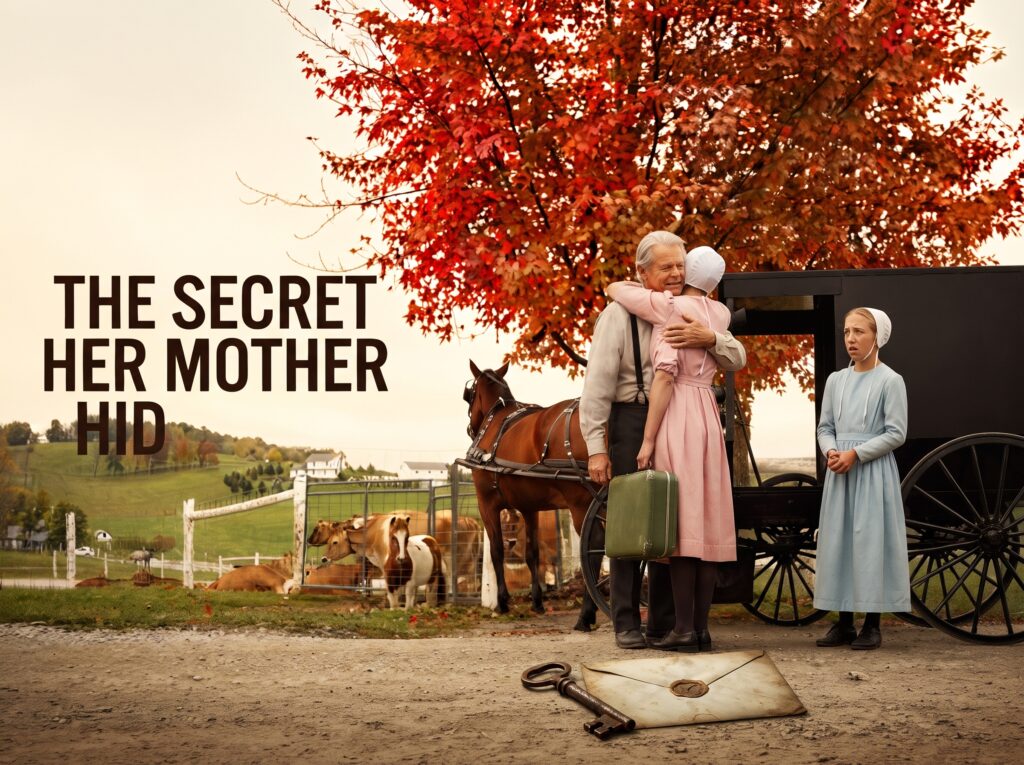
The sound of horses’ hooves carried across the quiet countryside long before the black buggy appeared around the bend.
Samuel Miller stood beneath the red maple tree outside his farmhouse, holding his hat against his chest. His silver hair had thinned considerably over the years, and the shoulders that had once carried heavy sacks of grain now sloped beneath his faded work shirt.
He had been waiting since sunrise.
When the buggy finally stopped beside the white fence, Samuel could not move.
A young woman stepped down, carrying a small green suitcase. She wore a pale pink dress and a white bonnet, much like the clothes she had worn as a girl. But the face beneath the bonnet belonged to someone who had spent fifteen years building a life far from home.
“Father?”
Samuel’s lips trembled.
“Anna.”
For a moment, neither of them moved. Then he crossed the gravel path and wrapped his arms around his youngest daughter.
Anna pressed her face against his shoulder. She had imagined this embrace countless times during the lonely years away, but she had never imagined how fragile her father would feel.
“I thought you would never come back,” he whispered.
Anna closed her eyes.
“You told me it was important.”
“It is.”
He held her a little tighter.
Behind him, the farmhouse looked exactly as she remembered it. White walls, green shutters, a long porch, and flower beds that her mother had once tended with almost religious devotion. Beyond the house stretched the fields where Anna and her older sister had worked beside their father as children.
Nothing seemed to have changed.
And yet everything had.
“Where is Rebecca?” Anna asked.
Samuel’s expression shifted.
“Inside.”
“Does she know I’m coming?”
“She knows.”
“Is she happy about it?”
He looked toward the farmhouse.
“Your sister has never been good at hiding what she feels.”
Anna understood.
Rebecca had been twenty-five when Anna left. She had stayed behind to help their parents maintain the farm, care for their mother during her final illness, and preserve the family traditions that Anna had gradually begun to question.
When their mother died, the sisters had argued.
Rebecca accused Anna of abandoning the family when they needed her most. Anna accused Rebecca of treating their mother’s wishes as if they were laws nobody could challenge.
Their argument had ended with words neither could take back.
Anna left the community three days later.
She had not returned for her mother’s funeral because the burial took place before she received the message informing her of her mother’s death. By the time she arrived at the station, the last train had already departed.
She had spent fifteen years carrying the guilt of that absence.
Her father had written only a handful of letters during those years. The last had arrived eight months earlier, containing a single sentence:
Your mother left something for both of you, and I cannot keep it hidden any longer.
Anna had read those words so many times that the paper had begun to tear along its folds.
Now she stood before the house, wondering whether the secret waiting inside could explain the family she had lost.
The front door opened.
Rebecca appeared on the porch.
She was taller than Anna remembered, though perhaps it was only the way she stood. Her dark hair was pinned beneath a white bonnet, and her pale blue dress was immaculate.
For several seconds, the sisters looked at one another.
Then Rebecca said, “You came.”
Anna nodded.
“Father asked me to.”
“Of course he did.”
“Rebecca—”
“Your room is ready. You can leave your suitcase upstairs.”
There was no greeting, no embrace, and no question about Anna’s journey.
Rebecca turned and disappeared inside.
Samuel sighed.
“Give her time.”
Anna looked at him.
“How much time did she need before I came back?”
He had no answer.
That evening, the family gathered around the long wooden table in the kitchen.
Rebecca served vegetable soup, fresh bread, and roasted potatoes. Samuel offered a quiet prayer before they began eating.
Anna remembered the rhythm of those evenings: the scrape of wooden chairs, the clink of spoons, the low voices discussing weather and crops.
But her mother’s chair remained empty.
Halfway through supper, Samuel put down his spoon.
“There is something I need to tell you both.”
Rebecca’s hand froze above her plate.
“Father, not tonight.”
“Tonight.”
“You said we would discuss it tomorrow.”
“I have waited long enough.”
Rebecca glanced at Anna, and something like fear passed across her face.
Samuel reached into his pocket and placed an old iron key on the table.
It was small, dark with age, and attached to a narrow piece of blue ribbon.
Anna stared at it.
“What’s that for?”
Samuel looked from one daughter to the other.
“Your mother left something beneath this house.”
Rebecca pushed back her chair.
“No.”
“Rebecca.”
“You promised her!”
Samuel’s eyes filled with tears.
“I promised to wait until you were both home.”
“And now she’s home,” Rebecca said bitterly. “So everything changes?”
Anna rose halfway from her chair.
“I don’t know what you’re talking about.”
Rebecca looked at her sister.
“That is exactly the problem, Anna. You never know what happens here because you were never here to see it.”
She walked out of the kitchen.
A moment later, the sound of the staircase creaked beneath her footsteps.
Samuel remained at the table, the key resting between his hands.
Anna sat down slowly.
“What did Mother hide?”
Her father looked toward the ceiling.
“Something that should have been revealed a long time ago.”
He pushed the key toward her.
“Tomorrow morning, both of you must be present when I open the door.”
Then he added, in a voice so quiet Anna almost missed it:
“Because after tomorrow, nothing in this family will ever be the same.”
Part 2 — The Room Beneath the Floor
Anna slept badly.
The bedroom was smaller than she remembered, with a narrow bed beneath the window and a wooden dresser that still carried the faint scratches she and Rebecca had made as children. Her mother had kept the room ready for years, even after Anna stopped answering most of her letters.
On the dresser stood a framed photograph.
Anna was seventeen, Rebecca twenty-three, and their mother sat between them beneath the red maple tree. All three were laughing at something outside the frame.
Anna touched the glass.
“I should have come home,” she whispered.
The words sounded different in the darkness.
For fifteen years, she had told herself she would return when she was ready to face her sister. Then when she had saved enough money. Then when the anger had faded.
Eventually, she stopped making plans.
She had built a modest life working in a bakery in a neighboring town, rented a small apartment, and learned how to manage every problem without asking anyone for help.
But she had never stopped thinking about the farm.
At dawn, she heard footsteps in the hallway.
When she opened her door, Rebecca was standing outside with a folded blanket in her arms.
“I thought you might need this,” her sister said.
Anna blinked in surprise.
“Thank you.”
Rebecca handed it to her.
For a moment, they stood awkwardly, two women who had once shared every secret but now struggled to find a sentence that did not carry the weight of fifteen years.
“Did Mother ever tell you why she wanted me to leave?” Anna asked.
Rebecca’s expression hardened.
“She wanted you to be happy.”
“That’s not what I asked.”
“No. It isn’t.”
Rebecca turned to go.
“Will you be at the barn at nine?” Anna asked.
Rebecca stopped.
“Father wants us there.”
“Do you know what’s inside?”
Rebecca looked at her for a long moment.
“I know what Mother told me.”
Then she walked away.
At nine, the three of them gathered in the old pantry.
Samuel moved a heavy wooden cabinet away from the wall, revealing a narrow door set into the floorboards. Anna had passed over that spot thousands of times as a child without ever noticing it.
Her father knelt and brushed away years of dust.
The iron key fitted the lock perfectly.
When he turned it, the mechanism clicked.
Samuel lifted the door.
A short flight of wooden steps descended into darkness.
Anna stared into the opening.
“There’s a cellar beneath the house?”
“Your grandfather built it,” Samuel explained. “He used it to store tools and preserve food during the winter. Your mother had it closed off when she became ill.”
“Why?”
Samuel did not answer.
He took a lantern from the shelf, lit it, and descended the steps.
Rebecca followed him.
Anna hesitated before stepping down.
The cellar smelled of earth, old timber, and damp stone. Shelves lined the walls, holding empty jars and boxes of household belongings. At the far end stood a small wooden chest.
It was darker than the other furniture, with brass corners and a rusted clasp.
Samuel placed the lantern beside it.
“Your mother kept this here for twenty years.”
Rebecca stood with her arms folded.
“She made me promise never to open it without both of us present.”
Anna looked at her sister.
“Why didn’t you tell me?”
Rebecca’s eyes flashed.
“Because I promised.”
“You could have written.”
“And said what? That our mother had hidden a box beneath the floor and we should wait for you to come home?”
Anna flinched.
Samuel raised a hand.
“Enough. Whatever happened between you, neither of you deserves to carry this secret any longer.”
He opened the chest.
Inside lay a bundle of letters tied with blue ribbon, a thick envelope containing legal documents, a small velvet pouch, and a notebook covered in faded green cloth.
Anna reached for the letters.
The first was addressed to Samuel.
The second bore Rebecca’s name.
The third read:
To my youngest daughter, Anna. Open only when your father and sister are beside you.
Anna’s fingers began to tremble.
She opened the envelope.
Her mother’s handwriting filled the page.
My dear Anna,
If you are reading this, then the time has finally come for your family to know the truth. I have asked your father to wait until you and Rebecca could stand together, because what I am about to reveal may hurt you both.
I need you to understand something before you continue.
I never wanted you to leave.
Anna stopped reading.
Her vision blurred.
Rebecca turned away.
Samuel sat on an old wooden stool and covered his face with both hands.
Anna forced herself to continue.
But I knew you were unhappy. I knew you felt trapped by the life we had chosen, and I feared that if you stayed only because of us, you would grow to resent the very people you loved.
Your sister believed that keeping you here would save our family. I believed that letting you go might save yours.
Neither of us knew how much pain our choices would cause.
Anna lowered the letter.
“Father?”
Samuel looked up.
“What did she mean?”
He swallowed.
“Read the documents first.”
Anna opened the thick envelope.
The top page was a property agreement bearing the signatures of her parents, dated three months before her mother died.
She read the first paragraph.
Then she read it again.
The document stated that the family farm had been placed in a private trust intended to benefit both daughters equally.
But another document, dated two years later, appeared to transfer ownership entirely to Rebecca.
Anna looked up sharply.
“Why does this say Rebecca owns everything?”
Rebecca’s face had gone white.
“I don’t know.”
Anna held up the paper.
“Your signature is here.”
“I didn’t sign that.”
Samuel stood abruptly.
“That is what I have been trying to tell you.”
The cellar seemed to grow colder.
Anna stared at the document, then at her sister.
Someone had changed the ownership of the farm.
Someone had used a legal document that Rebecca claimed never to have signed.
And their mother had hidden the evidence beneath the very house they had grown up in.
Samuel reached into the chest and removed the green notebook.
“There is more,” he said.
His voice shook.
“Much more than either of you can imagine.”
Part 3 — The Sister Who Stayed
Rebecca left the cellar without another word.
Anna heard the pantry door slam overhead, followed by the rapid sound of footsteps crossing the kitchen.
She wanted to follow her.
Instead, she remained beside the open chest, staring at the document that appeared to transfer the farm into Rebecca’s sole ownership.
“Father, what is happening?”
Samuel rubbed his face.
“Your mother discovered the document shortly before she died. She believed someone had used her illness to change the terms of the inheritance.”
“Who?”
“I don’t know.”
“You must have some idea.”
He looked at the lantern.
“I have suspicions. Nothing more.”
Anna’s frustration rose.
“Then why wait fifteen years to tell me?”
“Because I was afraid.”
“Of what?”
“Of losing the little family I had left.”
Anna stared at him.
“You already lost me.”
Samuel closed his eyes.
The words had struck exactly where she intended them to.
Anna regretted them immediately, but she did not take them back.
For years, she had imagined returning home and finding her father unchanged, still sitting at the kitchen table, still believing that obedience was the same as love. She had imagined explaining how lonely she had been and demanding to know why nobody had tried harder to bring her home.
Now she saw an old man who had spent years protecting a secret he barely understood.
It did not erase her pain.
But it made her anger more complicated.
Samuel took the green notebook from the chest.
“Your mother kept records of everything. Farm expenses, land agreements, payments, even conversations she believed were important.”
He opened it to a page marked with a strip of blue ribbon.
“Three months before she died, she wrote that she had discovered a discrepancy in the property papers.”
Anna leaned closer.
The entry was brief.
Someone has changed the agreement. Samuel says we should wait until we understand what happened. I fear that waiting will make it impossible to put things right.
Beneath it was another note.
Rebecca believes Anna left because she no longer loves us. I must find a way to tell her the truth before it is too late.
Anna felt tears rise again.
Her mother had understood the pain between the sisters.
She had known that Rebecca’s anger was not simply anger. It was grief, abandonment, and the exhaustion of being the child who stayed when everything fell apart.
Rebecca had cared for their mother through the worst months of her illness. She had taken over the farm’s daily work, learned to manage the accounts, and sat beside Samuel during sleepless nights when he worried about losing the property.
Anna had been far away, building a different life.
She had sent money when she could. She had written letters, though fewer as the years passed. She had convinced herself that the distance was temporary.
Rebecca had experienced it as a choice.
Anna closed the notebook.
“I need to talk to her.”
Samuel nodded.
“She is in the barn.”
Anna climbed the cellar steps and crossed the yard.
Rebecca stood inside the barn, stacking feed sacks beside the stable wall. Sunlight entered through the gaps between the boards, illuminating dust that floated in the air.
“Rebecca.”
Her sister continued working.
“Please.”
Rebecca set down the sack.
“What do you want me to say?”
“The document. You said you didn’t sign it.”
“I didn’t.”
“Did you know Mother believed someone had changed the agreement?”
Rebecca looked at her.
“No.”
Anna hesitated.
“Why didn’t you tell me about the trust?”
Rebecca gave a bitter laugh.
“Because I didn’t know about it. Father told me that the farm would eventually be mine because I was the one who stayed. I thought that was what Mother wanted.”
“Did you want it?”
Rebecca stared at her.
“Of course I wanted the farm. It was my home. It was where I spent my life. I gave up opportunities to keep it running.”
Anna looked down.
“I know.”
“No, Anna. You don’t.”
Rebecca stepped closer.
“You left before Mother became seriously ill. You weren’t here when she could no longer walk to the garden. You weren’t here when she forgot where she had put her glasses or when she woke in the night calling for you.”
Anna’s throat tightened.
“I didn’t know.”
“You didn’t ask.”
“I wrote to her.”
“Three times in the final year.”
Anna flinched.
Rebecca’s eyes filled with tears.
“I wrote to you every month. I told you she was getting worse. I told you she wanted to see you. You never answered the last four letters.”
Anna could barely breathe.
She had never received those letters.
At least, she did not remember receiving them.
“Where are they?” she whispered.
Rebecca shook her head.
“I don’t know. I sent them to your old address. Father told me you had moved, but he never gave me your new one.”
Anna looked at her sister in disbelief.
“Why would he do that?”
Rebecca turned away.
“That’s what I want to know.”
For a long moment, neither spoke.
Then Rebecca said something that made Anna’s heart ache.
“I was angry because I thought you had chosen to forget us. I didn’t realize there might have been someone helping you forget.”
Anna stared at her.
The possibility settled between them, dark and unwelcome.
Perhaps the distance between the sisters had not grown entirely on its own.
Perhaps someone had made sure it remained.
And if that was true, the person responsible had known exactly how to turn love into resentment.
Part 4 — The Letters That Never Arrived
That afternoon, Anna searched the attic.
She remembered a small wooden desk near the chimney where her mother had kept household papers and family correspondence. When Anna was young, she had been forbidden to touch the desk because it contained important documents.
Now its drawers were almost empty.
She searched the cupboard, the old sewing chest, and the boxes stacked beneath the eaves.
At the bottom of a battered suitcase, she found a bundle of envelopes.
Her name appeared on several.
Some were addressed to her old apartment. Others bore the name of the bakery where she had worked during her first year away.
The handwriting was Rebecca’s.
Anna sat on the floor.
She opened the first envelope.
Anna,
Mother has been asking about you again. She says she dreamed you were sitting beside her bed, reading the stories she loved when you were children.
She doesn’t understand why you haven’t visited. I tell her you’re busy, but I don’t know how much longer I can keep making excuses.
The letter was dated thirteen years earlier.
Anna opened another.
Mother’s condition is getting worse. She asked me to send you her blue shawl because she says it will remind you of home. I am including it in this package.
A third letter was dated two weeks before her mother’s death.
Anna, please come home if you can. Mother is very weak. She wants to see you.
The final envelope contained only a few lines.
She passed peacefully this morning. She asked me to tell you that she loves you and that she never blamed you for leaving.
Anna pressed the paper against her chest.
For fifteen years, she had believed that her mother had died without forgiving her.
She had carried that belief into every new relationship, every birthday, every quiet evening when she wondered what might have happened if she had returned sooner.
Now she discovered that her mother had forgiven her before she died.
The letters had never reached her.
But why?
Anna gathered the envelopes and carried them downstairs.
Samuel was in the kitchen, repairing the handle of a wooden chair.
When he saw the letters, the color drained from his face.
“Where did you find those?”
“The attic.”
He set down his tools.
Anna placed the letters on the table.
“Did you know about these?”
Samuel did not answer immediately.
“Father.”
He lowered himself into a chair.
“Yes.”
Anna stared at him.
“You knew?”
“I found them after your mother died.”
“Why didn’t you send them to me?”
His eyes filled with tears.
“Because I was afraid you would come home.”
Anna could not believe what she was hearing.
“You were afraid I would come home?”
“I was grieving. Rebecca was grieving. The farm was in trouble, and I believed that bringing you back would only reopen the wounds.”
“So you hid my sister’s letters?”
“I thought I was protecting you.”
“You took away my chance to say goodbye to my own mother!”
Her voice echoed through the kitchen.
Samuel bowed his head.
“I know.”
“No, you don’t. You cannot know what it feels like to spend fifteen years believing your mother died thinking you didn’t love her.”
Samuel began to cry.
Anna stood motionless.
She had imagined many reasons for her father’s silence. Pride. Tradition. Disappointment. Fear of change.
She had never imagined that he had deliberately kept her away.
“Why?” she whispered.
Samuel looked at the letters.
“Because your mother had discovered the property papers had been changed. She believed someone was trying to force the family apart. I was afraid that if you returned, the dispute would become worse.”
“Who changed the papers?”
“I don’t know.”
“Then what did hiding the letters accomplish?”
He covered his face.
“Nothing.”
The word came out broken.
Anna felt anger rise again, but beneath it lay something heavier: the realization that her father had been making decisions for everyone because he could not bear to face his own fear.
He had believed that silence would preserve the family.
Instead, it had taken fifteen years from his daughters.
Anna gathered the letters.
“I’m going to find out who changed the papers.”
Samuel looked up.
“Anna, please.”
She paused at the door.
“I came home because you asked me to discover the truth. I’m not leaving until I do.”
Outside, the red maple tree stood in the late afternoon light.
For the first time since her arrival, Anna no longer felt like a daughter waiting for permission to belong.
She felt like someone who had finally been given a reason to fight for the truth.
And she knew where she had to begin.
With the document bearing Rebecca’s forged signature.
Part 5 — The Man Who Knew Their Mother’s Secret
The next morning, Anna walked to the old general store at the edge of town.
She remembered the building from childhood: a narrow wooden shop with a bell above the door, shelves filled with flour and preserves, and a small office at the back where the town’s unofficial business had always seemed to take place.
The owner, Elias Fisher, had known the Miller family for decades.
He was nearly eighty now, with a white beard and a habit of listening longer than he spoke.
When Anna entered, he looked up from the counter.
For a moment, he seemed unable to recognize her.
Then his eyes widened.
“Anna Miller.”
She smiled faintly.
“It’s been a long time.”
“Fifteen years,” he said. “Your mother used to count them.”
Anna felt a knot tighten in her stomach.
“She did?”
Elias nodded.
“She kept a little calendar in her sewing room. Every year, she marked the day you left. She said it was the day she learned that loving a child sometimes meant watching them walk away.”
Anna looked down.
She had not expected the world to remember her absence so clearly.
“I need to ask you something,” she said.
Elias gestured toward the chair beside the counter.
“Sit down.”
Anna explained what they had found beneath the farmhouse. She showed him the property agreement and the document that appeared to transfer ownership to Rebecca.
Elias studied the signatures.
After a long silence, he removed his glasses.
“I wondered when this would come to light.”
Anna’s heart began to race.
“You know something?”
“I know that your mother came here about twenty years ago. She asked me to witness a document establishing a trust for both her daughters.”
“Was the agreement legitimate?”
“Yes. Your mother and father both signed it. I witnessed their signatures myself.”
“Then how could another document transfer the farm to Rebecca?”
Elias looked toward the window.
“Your father brought a different document here two years later. He said your mother had changed her mind.”
“Did she?”
“I never saw her sign it.”
Anna leaned forward.
“Who prepared it?”
Elias hesitated.
“Your uncle, Gideon Miller.”
Anna felt the room tilt slightly.
Gideon was Samuel’s older brother. He had lived several miles away and had helped manage the farm’s accounts after Samuel developed problems with his eyesight.
He had always been a forceful man, quick to offer advice and quicker to criticize anyone who disagreed with him.
Anna remembered him standing in their kitchen when she was a teenager, telling her that a good daughter did not question the decisions of her elders.
She had never liked him.
“Why would Uncle Gideon change the document?”
Elias folded his hands.
“Your father owed him money. The farm had suffered several bad harvests, and Gideon offered to help. In exchange, he demanded control over the property until the debt was repaid.”
“But the debt was repaid?”
“Your mother believed it was. She brought me receipts showing that every payment had been made.”
Anna stared at the papers.
“So the transfer wasn’t just about inheritance.”
“No.”
Elias’s voice grew quieter.
“I believe your uncle wanted the farm for himself.”
Anna felt cold.
“Did Father know?”
“I cannot answer that.”
“Did Rebecca?”
Elias shook his head.
“Your sister was working day and night to keep the farm running. I don’t believe she understood what was happening.”
Anna thanked him and gathered the documents.
Before she reached the door, Elias called her back.
“There is something else.”
He opened a drawer and removed a small envelope.
“Your mother gave me this shortly before she died. She asked me to keep it until both her daughters returned home.”
Anna stared at the envelope.
Her name and Rebecca’s were written across the front.
“Why didn’t you send it?”
“She asked me not to. She said the letter would only make sense when you were both ready to read it together.”
Anna accepted it with trembling fingers.
“Did she tell you what was inside?”
Elias shook his head.
“Only that it concerned the future of the farm—and the future of her daughters.”
Anna walked home with the envelope held tightly against her chest.
For the first time, she had evidence that the mystery beneath the farmhouse extended beyond her father’s silence.
Someone had manipulated the inheritance.
Someone had benefited from the sisters’ separation.
And the person who knew the most about the original agreement was still alive.
Her uncle Gideon.
Part 6 — The Truth About the Inheritance
Gideon Miller arrived at the farm that afternoon.
He drove an old wagon into the yard and stepped down wearing a dark coat and a serious expression. His hair had turned almost completely white, but his eyes remained sharp.
Samuel met him on the porch.
“I wondered when you would come,” his brother said.
Samuel’s face hardened.
“Who told you?”
“People talk, Samuel. Especially when old secrets start coming out of the ground.”
Anna stepped onto the porch.
“Then perhaps you can help us understand the documents.”
Gideon looked at her.
For a moment, something like surprise crossed his face.
Then he smiled.
“Anna. You’ve changed.”
“So has the farm.”
His smile faded.
She held up the disputed document.
“Did you prepare this?”
Gideon glanced at the paper.
“I helped your father with his accounts. I prepared many documents over the years.”
“Did you prepare this one?”
He took the paper and examined it carefully.
“Yes.”
“Did Rebecca sign it?”
“That is what the document says.”
“She says she didn’t.”
Gideon shrugged.
“Memory is unreliable. People forget things, especially when they grow older.”
Anna stepped closer.
“Did Mother sign it?”
He looked at Samuel.
“Your mother understood the family’s circumstances.”
“That isn’t an answer.”
Gideon folded the paper.
“The farm was in trouble. Someone had to make difficult decisions. Your father was overwhelmed, and your mother was ill.”
“Did you forge her signature?”
The question hung in the air.
Samuel closed his eyes.
Gideon stared at Anna.
“You should be careful about making accusations.”
“I am asking a question.”
“And I am telling you that this family survived because I helped it.”
Rebecca appeared in the doorway.
“What does that mean?”
Gideon turned toward her.
“It means that without my help, this farm would have been sold years ago.”
Rebecca looked at the document in his hand.
“Did you tell me the farm would eventually belong to me?”
“I told you what your father wanted.”
“Did you tell me Mother had placed it in a trust for both of us?”
Gideon said nothing.
Rebecca’s face changed.
“You knew.”
“I knew there were several agreements.”
“Several agreements?” Anna repeated. “There was one original agreement. Mother created a trust for both daughters. Then this document appeared.”
Gideon looked toward Samuel.
“Tell them the truth.”
Samuel’s shoulders sagged.
“I borrowed money from Gideon after the second failed harvest. He said he would help us keep the farm if I signed a temporary transfer agreement.”
Anna stared at him.
“You signed it?”
“I believed it was temporary.”
Rebecca looked devastated.
“And you never told me?”
“I was ashamed.”
Gideon interrupted.
“The debt was real. I took a risk when no one else would.”
Samuel shook his head.
“You were repaid.”
“Not entirely.”
“The records show that every payment was made.”
Gideon laughed bitterly.
“Your mother kept records that suited her. She didn’t understand the interest.”
Anna reached into her bag and removed the notebook.
“Then we can check the accounts.”
For the first time, Gideon looked genuinely unsettled.
Rebecca took the notebook and opened it to the pages containing the repayment records.
She read the entries aloud, comparing dates and amounts with the receipts Elias had given Anna.
The numbers matched.
Every payment had been recorded.
Every debt had been settled.
And the date of the disputed transfer came nearly a year after the final payment.
Rebecca looked up.
“You had no right to claim the farm.”
Gideon’s expression hardened.
“I spent years helping this family.”
“That doesn’t make it yours,” Anna said.
He looked at Samuel.
“You will regret turning against your own brother.”
Samuel stood straighter than he had in years.
“You were my brother before you were my creditor. You knew how much this farm meant to my wife. You knew what she wanted for her daughters.”
Gideon said nothing.
Samuel continued.
“And you used my fear to make me sign a document I did not understand.”
For a long moment, the brothers stared at one another.
Then Gideon took off his hat.
“You think this is over?”
“No,” Anna replied. “I think it is finally beginning.”
Gideon turned and walked toward his wagon.
Before he climbed aboard, he looked back at the farmhouse.
“Ask your father what happened to the money your mother left for Anna.”
Then he drove away.
The porch fell silent.
Anna turned toward Samuel.
“What money?”
Her father looked as though he had aged ten years in a single moment.
He sat down on the wooden bench.
“Your mother left you something else,” he whispered.
“Something Gideon believed belonged to him.”
Rebecca sat beside him.
“What are you talking about?”
Samuel looked at both daughters.
“Your mother had a savings account. She intended to use the money to help Anna establish a life outside the community if she ever chose to leave.”
Anna’s eyes widened.
“How much?”
Samuel swallowed.
“Enough to buy a small house and start a business.”
Anna could not speak.
For fifteen years, she had worked long hours, rented small rooms, and saved every dollar she could. She had believed that leaving home meant accepting a life of uncertainty.
All that time, her mother had planned to help her.
But the money had disappeared.
And now Gideon had made it clear that he knew where it had gone.
Part 7 — The Sacrifice Their Mother Made
Samuel spent the evening searching through the old account books.
Rebecca helped him sort the papers, while Anna sat at the kitchen table reading every entry she could find.
At first, the records appeared ordinary. Farm expenses, payments for seed and equipment, household purchases.
Then Anna discovered a series of withdrawals made from her mother’s savings account during the final months of her illness.
The first was small.
The second was larger.
The third had emptied the account almost completely.
Each withdrawal bore Samuel’s signature.
Anna looked at her father.
“Did you take Mother’s money?”
Samuel stared at the page.
“Yes.”
Rebecca stood abruptly.
“Father!”
“Let me explain.”
Anna’s hands trembled.
“You told me there was money for me.”
“There was.”
“Then where did it go?”
Samuel took a long breath.
“When your mother became ill, the medical expenses grew beyond anything we had planned for. The farm was already struggling, and Gideon refused to lend us more money unless I agreed to his conditions.”
“So you used Mother’s savings?”
“I thought I could replace it after the next harvest.”
“But you couldn’t.”
Samuel shook his head.
“The harvest failed. Then the equipment broke. By the time I understood how much we had lost, the money was gone.”
Rebecca sat down slowly.
“Why didn’t you tell us?”
“Because your mother had made that money for Anna. I could not bear to admit that I had taken away the future she had wanted for her.”
Anna looked at the account book.
For years, she had imagined her mother’s last months as a time when the family had slowly accepted her absence.
Now she understood that her mother had been fighting to preserve something for her daughter even as her own life was coming to an end.
“Did Mother know?” Anna asked.
Samuel’s eyes filled with tears.
“She found out near the end.”
Anna’s throat tightened.
“What did she say?”
“She asked me whether I had used the money to keep the family together.”
Samuel looked at his daughters.
“I told her I had.”
He paused.
“She said that keeping a family together meant nothing if we had to lie to one another to do it.”
Rebecca covered her mouth.
Samuel continued.
“She forgave me. But she made me promise that I would restore the money to Anna and that the farm would remain protected for both of you.”
Anna felt tears slipping down her cheeks.
“Did you try to repay it?”
“Every year. I sold equipment, worked extra hours, and put aside whatever I could. But the debt to Gideon kept growing because he controlled the accounts.”
Rebecca looked toward the window.
“He told me the farm was nearly bankrupt. He said we would lose everything unless I signed the management papers he gave me.”
Anna turned toward her.
“What papers?”
Rebecca hurried upstairs and returned with a thick folder.
Inside were documents she had signed over the years, authorizing Gideon to manage the farm’s finances.
Anna examined the signatures.
Some documents were ordinary.
Others gave Gideon broad authority over the property and its accounts.
One contained a clause allowing him to claim the farm if the family failed to meet certain financial obligations.
Rebecca’s face went pale.
“I never understood that part.”
Anna read the clause again.
The wording was complicated, but the meaning was clear: Gideon had arranged the documents so that the family could lose the property even after repaying the original debt.
Samuel bowed his head.
“I thought I could keep him satisfied until I found a way to repay everything.”
“You were trying to protect us,” Rebecca whispered.
“I was trying to protect myself from admitting that I had failed.”
The honesty of the confession left the room silent.
Anna looked at her father.
For years, she had thought the greatest wound in their family was her departure.
Now she understood that the deeper wound had been the belief that love required everyone to carry their burdens alone.
Her father had hidden the debt.
Her mother had hidden her fears.
Rebecca had hidden her loneliness behind anger.
And Anna had hidden her guilt behind distance.
They had all been trying to protect one another.
They had all made the same mistake.
Anna closed the folder.
“We need someone who understands these documents.”
Samuel nodded.
“There’s a lawyer in town. He helped your mother prepare the original trust.”
“Then we’ll see him tomorrow.”
Rebecca looked at her sister.
“Together?”
Anna reached for her hand.
“Together.”
For the first time in fifteen years, Rebecca did not pull away.
Part 8 — The Decision That Could Save the Farm
The lawyer’s office stood above a small pharmacy on Main Street.
His name was Jonathan Reed, and he had known the Miller family since before Anna was born. He was an elderly man with silver-rimmed glasses, a tidy desk, and a reputation for reading every word of a contract before signing his name.
When Anna and Rebecca entered his office with their father, Jonathan rose from his chair.
“Samuel. I wondered when you would come.”
Samuel placed the documents on the desk.
“I should have come years ago.”
Jonathan studied the original trust agreement, the disputed transfer, the repayment records, and the documents Rebecca had signed.
He asked questions for nearly two hours.
Who had witnessed the signatures? Which payments had been made? When had Gideon taken control of the accounts? Had anyone independently verified the debt?
Anna answered what she could. Rebecca supplied dates and farm records. Samuel admitted what he had concealed.
When they finished, Jonathan leaned back.
“The original trust is significant,” he said. “If the signatures are genuine and the later transfer was unauthorized, there may be grounds to challenge the claim to sole ownership.”
Rebecca looked relieved.
“Then we can save the farm?”
“Possibly. But I cannot promise an outcome until the documents are properly examined.”
Anna nodded.
“What about the money Mother left me?”
Jonathan opened another file.
“Your mother discussed that account with me. She intended it to be separate from the farm and reserved for your future. I have a copy of her instructions, but we will need to establish exactly what happened to the funds.”
Samuel lowered his head.
“I used the money.”
Jonathan looked at him.
“Then we will need to account for it honestly.”
“I understand.”
For the first time, Samuel did not try to explain away his actions.
Jonathan arranged for the documents to be reviewed and advised them not to sign anything further until the ownership dispute had been clarified.
Outside the office, Rebecca stood on the pavement, staring at the people passing along the street.
“What happens if we lose?” she asked.
Anna slipped her arm through her sister’s.
“Then we’ll face it.”
“You say that as if it’s easy.”
“It isn’t.”
Rebecca looked at her.
“You could leave again, Anna. You have a job. You have a life elsewhere. I have nowhere else.”
Anna felt the truth of those words.
For Rebecca, the farm was not simply a property to be divided. It was the place where she had grown up, cared for their mother, and built her entire adult life.
For Anna, returning home meant confronting the past.
For Rebecca, losing the farm would mean losing the only home she had ever known.
“I don’t want to take your home away,” Anna said.
Rebecca’s eyes filled with tears.
“Then what do you want?”
“The truth. And a chance for us to decide our future without someone else deciding it for us.”
Rebecca was quiet.
Then she said, “I was jealous of you.”
Anna looked at her in surprise.
“Of me?”
“You left. You saw places I had never seen. You worked for yourself. You made choices I was too frightened to make.”
Rebecca wiped her cheek.
“I told myself you were selfish because it was easier than admitting I was envious of your freedom.”
Anna squeezed her arm.
“I was jealous of you, too.”
Rebecca looked at her.
“Why?”
“Because Mother had you beside her. You had memories I wasn’t there to share. You knew what she said in her final days, and I spent fifteen years imagining she died believing I had abandoned her.”
Rebecca began to cry.
Anna embraced her.
For a long moment, the sisters stood together on the pavement, mourning not only their mother but the years they had lost to misunderstanding.
When they finally separated, Rebecca took Anna’s hand.
“Whatever happens with the farm, I don’t want to lose you again.”
Anna smiled through her tears.
“You won’t have to.”
But as they walked toward the road, neither noticed the man standing across the street.
Gideon had been watching them from the doorway of a hardware store.
He had seen them enter the lawyer’s office.
He had seen them leave together.
And he understood that the sisters were no longer divided.
That evening, a letter arrived at the farmhouse.
It was addressed to Samuel.
Inside was a formal notice demanding repayment of an alleged outstanding debt within thirty days.
The amount was enormous.
Far larger than anything the family remembered owing.
At the bottom of the page was Gideon’s signature.
Samuel read the letter twice.
Then he sat down heavily.
“He is going to take the farm,” he whispered.
Anna took the notice from his hands.
“No,” she said firmly. “He is going to have to prove that we owe him a single penny.”
For the first time, the family had something more powerful than fear.
They had evidence.
And they had each other.
Part 9 — The Night the Truth Came Out
The following weeks were filled with paperwork, interviews, and long conversations with Jonathan Reed.
The original trust agreement was examined. The signatures were compared. The repayment records were verified against receipts from the general store and the local bank.
The evidence revealed a troubling pattern.
Gideon had continued charging interest after the original loan had been repaid. He had also prepared financial statements that made the debt appear larger than it was.
The disputed transfer document contained irregularities that required further examination.
Jonathan explained that the family had a credible basis to challenge Gideon’s claim, although the final outcome would depend on the evidence and the legal process.
Samuel listened quietly.
For years, he had believed that confronting his brother would destroy the family.
Now he understood that refusing to confront him had allowed the damage to continue.
One evening, Samuel asked Anna and Rebecca to meet him in the kitchen.
He placed a small cloth pouch on the table.
Inside were several gold coins, a modest amount of cash, and a folded paper.
“Your mother gave me these shortly before she died,” he said. “She told me to keep them safe until both of you were home.”
Rebecca picked up the paper.
It was a list of expenses their mother had planned to cover with the savings account: Anna’s training, a small business, and a place of her own.
At the bottom, their mother had written:
I want my daughters to have choices. Not because they owe me anything, but because I love them.
Anna pressed the paper to her chest.
Samuel looked at his daughters.
“I cannot give you back the years you lost. I cannot undo the letters I hid or the money I spent. But I can stop hiding from what I did.”
He took a breath.
“I am sorry.”
Rebecca reached for his hand.
Anna sat beside him.
For the first time, their father did not ask them to forgive him quickly. He did not tell them that he had acted for their sake. He simply acknowledged the harm he had caused.
That night, they sat together until the lamps burned low.
They discussed the farm’s future, their mother’s wishes, and what each of them wanted from the years ahead.
Rebecca wanted to continue farming.
Anna wanted to establish a small bakery and reading room on the property, a place where local families could gather and children could read books their parents could not afford.
At first, Rebecca was uncertain.
“Would that mean changing the farm?”
“Only part of it,” Anna explained. “The fields and the farmhouse would remain. We could restore the old carriage shed and use it for the bakery.”
Rebecca considered the idea.
“Mother always wanted somewhere for the children in the community to gather.”
Anna smiled.
“Then perhaps we could make that happen.”
Samuel listened to them plan.
For the first time in years, the farmhouse was filled with the sound of his daughters imagining a future together.
The next morning, Jonathan called.
The review had uncovered additional evidence supporting the original trust agreement. The family’s legal position was stronger than before, and the inflated debt claim appeared inconsistent with the available repayment records.
There would still be more work to do.
But Gideon’s claim was no longer unquestioned.
That afternoon, Gideon arrived at the farm.
He found Samuel waiting on the porch with both daughters beside him.
“You have no idea what you’re doing,” Gideon said.
Samuel stood.
“I know exactly what I’m doing.”
“You are destroying your own brother.”
“No,” Samuel replied. “I am refusing to let you destroy my family.”
Gideon looked at Anna.
“You think you can come back after fifteen years and change everything?”
Anna held his gaze.
“I didn’t change everything. I finally learned what you had changed.”
For a moment, Gideon seemed to have no answer.
Then Rebecca stepped forward.
“This farm belongs to our family according to our mother’s wishes. Whatever the legal process decides, you will no longer control us through fear.”
Gideon looked at his brother.
“You will regret this.”
Samuel shook his head.
“I regret the years I spent being afraid of you.”
Gideon left without another word.
Several months later, after the evidence had been reviewed and the dispute resolved through the legal process, the family’s original trust was recognized. Gideon lost his claim to sole ownership, and the farm remained protected for both sisters according to their mother’s documented wishes.
The resolution did not erase the damage.
But it gave the family the chance to move forward without the threat that had kept them divided.
And for Samuel Miller, that was the first true peace he had felt since his wife died.
Part 10 — The Home Their Mother Imagined
Autumn returned to the valley.
The red maple tree turned crimson, the fields shone beneath the morning frost, and the black buggy once again traveled along the gravel road toward the farmhouse.
But this year, something was different.
The old carriage shed had been restored. Its wooden doors stood open, revealing shelves of freshly baked bread, jars of preserves, and a small reading corner filled with children’s books.
Anna had opened her bakery and reading room.
She called it Mother’s Table.
The name had come from a sentence in one of her mother’s letters:
There should always be a place at our table for someone who has nowhere else to go.
The bakery became a gathering place for the community. Farmers stopped for bread after their morning work. Parents brought their children to read in the afternoons. Elderly neighbors came to sit beside the windows and share stories about the past.
Rebecca continued running the farm.
She managed the fields, cared for the animals, and helped Anna whenever the bakery became too busy. The sisters did not agree on everything, but they had learned to speak honestly when they disagreed.
Their father spent his mornings tending the garden and his evenings sitting on the porch.
He was older now, and his movements had slowed, but something inside him had changed.
He no longer carried every worry alone.
One afternoon, Anna found him beneath the red maple tree, holding the old photograph of his wife.
She sat beside him.
“Do you think Mother would have liked the bakery?”
Samuel smiled.
“She would have complained that you were charging too much for the bread.”
Anna laughed.
“She always said my loaves were too small.”
“She said that because she wanted another slice.”
They laughed together.
Then Samuel’s expression grew serious.
“I wish I had told you the truth sooner.”
Anna rested her hand over his.
“So do I.”
“I thought silence would protect you. I thought if I carried the burden myself, neither of you would have to suffer.”
Anna looked toward the farmhouse.
“But we suffered anyway.”
Samuel nodded.
“Yes.”
He looked at the photograph.
“Your mother understood something I didn’t. She knew that a family cannot survive on love alone. It also needs honesty.”
Anna’s eyes filled with tears.
“I spent fifteen years thinking she died believing I had abandoned her.”
Samuel took her hand.
“She never stopped loving you.”
“I know that now.”
“And I am sorry I made you wait so long to learn it.”
Anna leaned against his shoulder.
For a while, they sat quietly beneath the tree.
That evening, the family gathered around the kitchen table.
Rebecca brought fresh bread from the bakery. Anna served soup, and Samuel offered the prayer.
When they finished eating, Rebecca disappeared upstairs and returned with a small wooden box.
“I found this in Mother’s sewing room,” she said.
She placed it in the center of the table.
Inside were three objects.
A silver thimble.
A faded blue ribbon.
And a letter addressed to My daughters, when they are ready to understand.
Anna opened it carefully.
Her mother’s handwriting was unmistakable.
My dear girls,
If you are reading this together, then perhaps you have finally discovered what I wanted you to understand.
I never expected you to live identical lives. I never believed that staying close to home made one daughter better than the other. I wanted you both to have the freedom to choose your own paths.
Rebecca, thank you for the years you gave to this farm. You carried responsibilities that were sometimes too heavy for your shoulders, and I hope you learn that being dependable does not mean you must always be strong.
Anna, thank you for having the courage to seek a life beyond the place where you were born. I hope you understand that leaving home does not mean leaving love behind.
And to both of you: please do not spend your lives trying to prove which daughter loved this family more.
There is no prize for suffering the longest.
There is only the life you have been given, and the choice to make it kinder than the one that came before.
Anna stopped reading.
Rebecca was crying.
Samuel sat with his head bowed, his hands clasped together.
Anna continued.
If your father has made mistakes, remember that he is a man who has been afraid. If your sister has hurt you, remember that grief can make people speak in ways they do not understand. Forgiveness does not mean pretending the hurt never happened. It means deciding that the hurt will not be the only thing that defines your future.
Keep the farm if it brings you joy. Change it if it helps you grow. Sell it someday if that is what you both truly want.
But never sacrifice your relationship merely to preserve a building.
The house was built to shelter a family.
The family was never meant to become a prisoner of the house.
With all my love,
Mother.
For a long moment, nobody spoke.
Then Rebecca reached across the table and took Anna’s hand.
“I thought you left because you didn’t care about us,” she whispered.
Anna squeezed her fingers.
“I thought you wanted me gone.”
Rebecca shook her head.
“I wanted you to stay.”
“I know.”
“I was angry because I missed you.”
Anna began to cry.
“I missed you, too.”
Their father watched as his daughters embraced across the table.
He did not interrupt them.
He did not ask them to stop crying or remind them of what they had lost.
He simply sat with them, allowing the truth to exist without trying to make it smaller.
Later that night, Anna walked outside.
The stars had appeared above the fields, and the farmhouse windows glowed warmly against the darkness.
She stood beneath the red maple tree, looking toward the road she had traveled fifteen years earlier.
She remembered the frightened young woman who had left with a small suitcase and a heart full of anger.
She wished she could tell that girl something.
She wished she could tell her that leaving did not make her a bad daughter. That her mother had never stopped loving her. That the years of silence were not proof that she had been forgotten.
And she wished she could tell her that one day she would return.
Not because she had failed to build a life elsewhere.
Not because she had run out of choices.
But because she had finally learned that home was not a place she had to earn her way back into.
It was a place where the truth could be spoken, mistakes could be acknowledged, and love could exist without demanding that anyone surrender their future.
Behind her, the farmhouse door opened.
Rebecca stepped onto the porch.
“Anna?”
She turned.
“Yes?”
“Come inside. Father is making tea, and he says he needs help because he has forgotten how much honey Mother used.”
Anna laughed.
“He’s making it too sweet again.”
“Probably.”
Rebecca held out her hand.
Anna took it.
Together, they walked toward the house.
The old wooden door closed behind them, and the light from the kitchen spilled across the porch.
For fifteen years, Anna had believed that the road away from home was the only road she could travel.
Now she understood that life offered something more generous.
Sometimes we leave because we need to discover who we are.
Sometimes we return because we finally understand what we have been carrying.
And sometimes, if we are fortunate, the people we love are still waiting—not to demand that we become who we used to be, but to meet the people we have become.
Beneath the red maple tree, the leaves continued to fall.
The farm remained standing.
But the greatest inheritance the Miller family received was not the land, the house, or the money their mother had hoped to leave behind.
It was the freedom to love one another without fear.
The End.
Some families inherit land. Others inherit silence. But the greatest gift one generation can leave the next is the courage to tell the truth before it is too late.