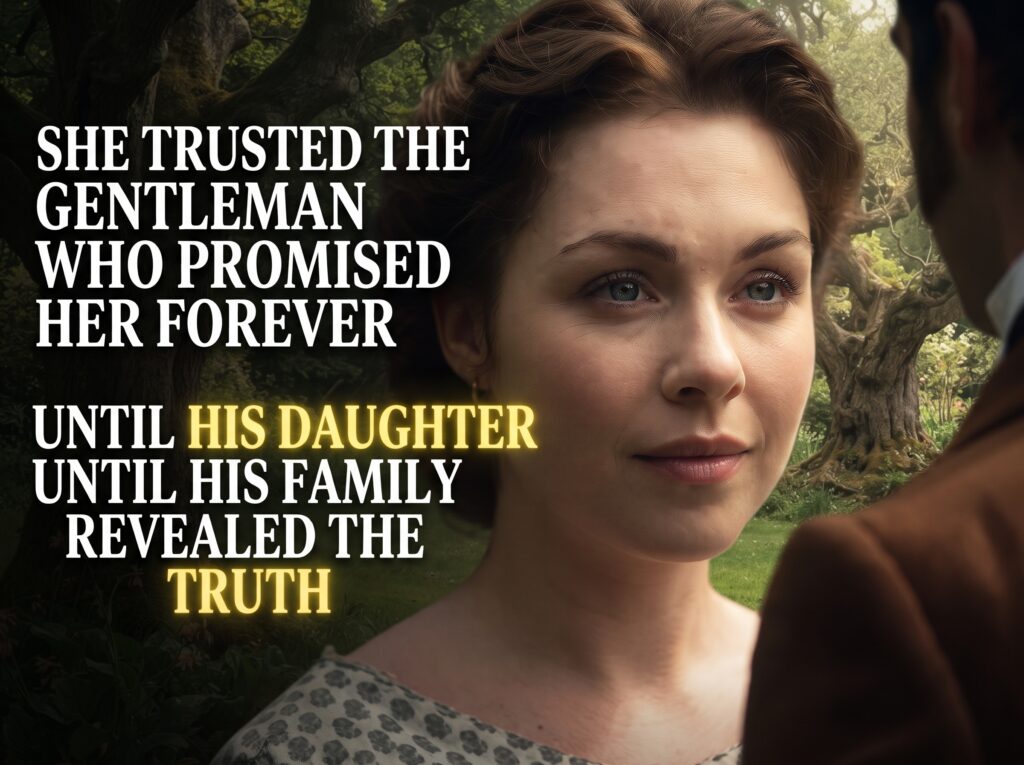
The Whitmore estate had once been among the finest properties in the county.
Its gardens stretched across rolling lawns, its orchards produced enough fruit to supply half the neighboring villages, and its white-stone manor stood proudly above a narrow river. But time had been unkind to the family. Several poor harvests, an unsuccessful investment, and years of mounting debts had reduced the Whitmores to a life of quiet anxiety.
Eleanor knew more about their troubles than her father suspected.
At twenty-four, she had learned to recognize the letters that made him pale, the visits that left him silent, and the evenings when he sat alone in his study long after the candles had burned low.
Her father, Sir Thomas Whitmore, had always insisted that everything was under control.
Yet Eleanor had begun to understand that the future of their home might depend on a marriage she had never wanted.
Her aunt, Lady Margaret, believed a wealthy husband could solve every problem.
“Affection is a pleasant addition to marriage,” she told Eleanor one afternoon, “but security is what allows a woman to sleep peacefully.”
Eleanor looked out the window toward the garden.
“And what if security costs a woman her happiness?”
“Then she must learn to value what she has.”
Eleanor did not answer.
She had spent her life learning what other people expected of her. She had learned to smile when visitors praised her manners, to remain silent when older relatives discussed her future, and to accept that a young woman’s wishes were often treated as insignificant.
Then James Ashford had arrived at Whitmore Manor.
He was the eldest son of the Earl of Ashford, a gentleman with a reputation for intelligence and a stubborn refusal to follow fashionable society’s rules. He had first visited the estate to discuss a matter of land boundaries with Sir Thomas.
Their first conversation had taken place beside the rose garden.
Eleanor had been trying to rescue a small bird trapped beneath a fallen branch when James appeared.
“May I help?” he asked.
“You may hold the branch while I persuade this creature that I am not its enemy.”
He laughed.
“And if it refuses to be persuaded?”
“Then I shall have to become more convincing.”
He held the branch while she carefully freed the bird. When it flew away, Eleanor watched it disappear into the trees.
James looked at her.
“Most people would have called for a servant.”
“Most people would have been wrong.”
That was how their friendship began.
He returned to Whitmore Manor several times during the following weeks. At first, he spoke mostly with Sir Thomas. Gradually, however, he found reasons to walk through the garden with Eleanor, discuss books with her in the library, and accompany her on visits to the village.
He did not treat her as a delicate ornament or a convenient daughter.
He asked her questions.
He listened to the answers.
And when Eleanor expressed an opinion, he never appeared offended simply because it differed from his own.
One afternoon, they sat beneath the old rose arbor.
James was unusually quiet.
“What troubles you?” Eleanor asked.
He turned a fallen rose between his fingers.
“Have you ever wondered what your life would look like if you were free to choose every part of it?”
“Every day.”
“What would you choose?”
Eleanor considered the question.
“A home where nobody was frightened of the next letter arriving. A garden that belonged to me. A small school for village children whose parents cannot afford proper books.”
James smiled.
“You would make a poor fashionable lady.”
“I should be delighted to disappoint fashionable society.”
He laughed, but his expression soon became serious.
“And love?”
Eleanor looked at him.
“What about it?”
“If you could choose that, too, what would you want?”
Her heart began to beat faster.
“I would want a man who tells me the truth, even when the truth is difficult. Someone who sees me as a person rather than a responsibility.”
James put the rose down.
“And if such a man stood before you?”
Eleanor could not speak.
He reached for her hand.
“I have tried to convince myself that my feelings for you would pass. I have tried to imagine returning to London and forgetting these afternoons. But every time I leave this estate, I find myself looking for a reason to return.”
“James…”
“I love you, Eleanor.”
The garden seemed to fall silent around them.
He looked frightened now, as though he had finally said something he could never take back.
“I know our families may have objections. I know there are expectations attached to my name. But I will not ask you to marry me because someone else believes it would be convenient.”
He lifted her hand to his lips.
“I am asking because I cannot imagine a future in which you are not beside me.”
Tears filled Eleanor’s eyes.
For the first time in her life, she felt that the future might belong to her.
“Then do not ask me to imagine one without you,” she whispered.
James kissed her hand.
And beneath the roses, with the evening sunlight falling across the garden, Eleanor believed she had found the one thing her family could never give her.
A choice.
She did not know that the following morning, her father would receive a letter bearing the Ashford family crest.
Nor did she know that James’s father had already begun arranging a future in which Eleanor had never been meant to appear.
Part 2 — The Letter with the Ashford Crest
The letter arrived on a rainy Tuesday morning.
Sir Thomas read it alone in his study. Eleanor noticed the change in him when she entered to deliver his tea.
He was standing beside the fireplace, holding the paper so tightly that its edges had begun to crease.
“Father?”
He looked up quickly.
“Nothing to concern yourself with.”
Eleanor placed the tray on the desk.
“That is what you always say when something concerns me most.”
For a moment, he seemed almost ready to tell her the truth.
Then he folded the letter and placed it inside a drawer.
“Your aunt will be arriving this afternoon. I expect you to join us for dinner.”
“Is that all?”
“Yes.”
But when Eleanor left the room, she heard him lock the drawer.
That evening, Lady Margaret arrived dressed in dark green silk, wearing an expression of unusual satisfaction.
She spoke at length about the Ashford family, their wealth, and the importance of maintaining good relations with the earl.
Eleanor listened without interest until her aunt mentioned a young woman named Miss Charlotte Pembroke.
“She has been visiting the Ashford estate frequently,” Lady Margaret remarked. “A charming girl from an excellent family.”
Eleanor looked up.
“Why are you telling me this?”
“Because you ought to understand the world you are entering.”
“What world is that?”
“The world of people whose marriages affect more than their own happiness.”
Sir Thomas put down his fork.
“Margaret, enough.”
But Lady Margaret continued.
“Lord Ashford has spent years arranging a suitable match for his son. Such arrangements are not easily abandoned.”
Eleanor felt the blood drain from her face.
She waited until dinner ended before seeking her father in the study.
“Is James promised to someone else?”
Sir Thomas turned away.
“I cannot discuss this tonight.”
“Then when?”
He said nothing.
“Father, please. I love him.”
The words escaped before she could stop them.
Her father’s shoulders slumped.
“I know.”
Eleanor stared at him.
“You know?”
“I have seen the way he looks at you. I have seen the way you look at him.”
“Then why are you hiding something from me?”
Sir Thomas sat down slowly.
“Because I hoped the matter would resolve itself before it reached you.”
“What matter?”
He rubbed his forehead.
“Years ago, the Ashford family entered into an agreement with the Pembrokes. It concerned a marriage between James and Charlotte.”
Eleanor felt as though the room had tilted.
“Did James agree to it?”
“He was young. His father signed the agreement on his behalf.”
“But James told me he would never marry someone merely because his family demanded it.”
“Perhaps he believed he could escape the arrangement.”
“Perhaps?”
Her voice trembled.
“Father, does James know about this?”
“I cannot answer that.”
Eleanor stared at him in disbelief.
“You cannot answer, or you will not?”
Sir Thomas closed his eyes.
“I have made mistakes, Eleanor. I have kept things from you because I believed I was protecting you. But there are matters involving the Ashfords that I cannot explain without risking this family’s future.”
Eleanor stepped back.
“What does our future have to do with James’s marriage?”
Her father did not answer.
That night, Eleanor wrote to James, asking him to meet her in the garden the following morning.
He arrived shortly after sunrise.
When he saw her expression, his smile faded.
“What has happened?”
She held out the folded letter her father had finally given her.
James read it once.
Then again.
For several seconds, he did not speak.
“Is it true?” Eleanor asked.
He looked at her.
“The agreement exists.”
“That was not my question.”
James lowered the paper.
“Yes. My father arranged a marriage between Charlotte and me years ago.”
Eleanor felt the tears rise.
“And you never told me.”
“I thought it had become irrelevant.”
“How could it be irrelevant if it could determine our future?”
He reached for her hand, but she stepped away.
“Eleanor, listen to me.”
“No. You listen to me. You promised that you would tell me the truth, even when it was difficult.”
“I know.”
“You made me believe that I could trust you.”
“You can.”
“Then why did I have to learn this from a letter?”
James had no answer.
The silence between them was more painful than any denial could have been.
Finally, he said, “There is another part of this agreement. A part I did not understand until recently.”
Eleanor looked at him.
“What part?”
He swallowed.
“My father has threatened to call in a debt owed by your family unless I honor the arrangement.”
Eleanor stared at him.
For the first time, she understood that the secret might not be about marriage alone.
Her family’s future had been tied to the Ashfords long before she fell in love with James.
And someone had decided that her happiness was a price worth paying.
Part 3 — The Woman Who Had Been Promised His Name
Charlotte Pembroke arrived at Whitmore Manor three days later.
She was beautiful, impeccably dressed, and possessed of the quiet confidence of someone who had never been required to question her place in the world.
Eleanor met her in the drawing room.
“Miss Whitmore,” Charlotte said warmly. “I have heard so much about you.”
Eleanor returned her greeting.
“Have you?”
Charlotte hesitated, then glanced toward the window.
“James speaks of you.”
The remark surprised Eleanor.
“What does he say?”
“That you are intelligent, independent, and rather difficult to persuade once you have made up your mind.”
Despite herself, Eleanor almost smiled.
“That sounds like him.”
Charlotte’s expression softened.
“I believe he admires that about you.”
Eleanor studied her carefully.
There was no triumph in Charlotte’s manner. No smugness, no suggestion that she had come to claim something belonging to another woman.
Instead, she seemed troubled.
“May I ask you something?” Eleanor said.
“Of course.”
“Do you wish to marry James?”
Charlotte looked toward the door.
For several moments, she said nothing.
Then she replied, “I wish to marry someone who chooses me freely.”
Eleanor’s heart ached.
“Then we want the same thing.”
Charlotte nodded.
“Perhaps that is why neither of us is likely to receive it.”
Later that afternoon, the two women walked through the garden together.
Charlotte explained that her father had invested heavily in a business venture connected to the Ashford estate. When the venture failed, the families had negotiated an arrangement intended to protect both households.
The marriage agreement had become part of that arrangement.
“My father believes the marriage will restore our family’s position,” Charlotte said. “Lord Ashford believes it will strengthen his influence.”
“And James?”
“I don’t know what James believes anymore.”
Eleanor stopped beside the rose arbor.
“Has he ever told you that he loves you?”
Charlotte looked at her.
“No.”
“Then why would you accept such an arrangement?”
“Because I have spent my life being told that duty is the same as virtue.”
She gave a sad smile.
“Perhaps we have both been taught to confuse obedience with goodness.”
For the first time, Eleanor felt that Charlotte was not her enemy.
They were two women trapped in the same arrangement, each expected to sacrifice her happiness so that powerful men could preserve their fortunes.
Before leaving, Charlotte turned to Eleanor.
“Whatever happens, do not assume that I want to take him from you.”
Eleanor watched her carriage disappear down the road.
That evening, James came to the garden.
“I heard Charlotte visited.”
“She is kinder than I expected.”
“She is a good woman.”
“Then why must one of us be hurt?”
James looked toward the house.
“Because our fathers believe the arrangement cannot be undone.”
Eleanor folded her hands.
“Can it?”
“I am trying to find a way.”
“Are you?”
He looked at her.
“What does that mean?”
“It means that you have spent weeks telling me what you feel, but I have yet to hear what you intend to do.”
James fell silent.
Eleanor’s voice softened.
“I love you. That has not changed. But I cannot build a life on promises that disappear whenever someone more powerful objects.”
He stepped closer.
“I will not let my father decide whom I marry.”
“Then prove it.”
She walked away before he could answer.
For the first time, James understood that love alone would not persuade Eleanor to wait forever.
If he wanted a future with her, he would have to confront the family that had always controlled his life.
And he would have to do so before the damage became irreversible.
Part 4 — The Debt That Bound Two Families
James traveled to London the following morning.
His father, the Earl of Ashford, received him in a grand study lined with books and portraits of ancestors who had spent generations protecting the family’s wealth and reputation.
The earl barely looked up from his correspondence.
“You are late.”
“I have come to discuss the marriage agreement.”
“Then you have come to discuss a matter already settled.”
James stood before the desk.
“I will not marry Charlotte Pembroke.”
His father slowly removed his spectacles.
“You will do precisely what is required of you.”
“No.”
The earl’s expression hardened.
“Do you imagine that affection gives you the right to dismantle an agreement that protects two families?”
“I imagine that a marriage without consent is a poor foundation for either family.”
“Spare me your romantic philosophy.”
James clenched his hands.
“You are asking me to betray a woman I love.”
“I am asking you to fulfill your responsibilities.”
The earl rose.
“Your grandfather understood that a family is not sustained by sentiment. It is sustained by property, alliances, and the willingness of each generation to make sacrifices.”
James met his gaze.
“Then perhaps each generation has sacrificed enough.”
His father walked to the window.
“The Whitmores owe us a considerable sum. Their estate is vulnerable, and their finances are in disarray. If you abandon the agreement, I will demand immediate repayment.”
James felt sick.
“You would take their home?”
“I would enforce a lawful debt.”
“You know they cannot pay.”
“Then they should have considered that before becoming dependent on our family.”
James stared at him.
For years, he had respected his father’s discipline, even when he disliked his methods. He had believed that beneath the earl’s coldness lay a sense of responsibility toward the people who depended on him.
Now he saw that his father regarded people as pieces on a board.
“I will find another way to settle the debt,” James said.
The earl laughed.
“With what money? Your allowance? Your sentimental promises?”
“I will sell my investment shares.”
“And surrender your financial independence for a woman who may eventually regret choosing you?”
James said nothing.
His father returned to his desk.
“You have one month. Marry Charlotte, and the Whitmore debt will be restructured. Refuse, and I will pursue repayment.”
James left the study with his future uncertain.
Meanwhile, at Whitmore Manor, Eleanor discovered a packet of old letters among her father’s papers.
The letters had been written years earlier by her mother, who had died when Eleanor was a child.
Most concerned ordinary family matters: the garden, the harvest, the health of relatives.
But one letter mentioned the Ashford debt.
Thomas, I cannot accept that our family’s future should depend upon a marriage neither child has freely chosen. If the Ashfords insist upon such terms, we must find another solution, even if it means surrendering some of our comforts.
Eleanor read the letter twice.
Her mother had known about the arrangement.
She had opposed it.
And yet Sir Thomas had allowed the agreement to remain in place.
Eleanor confronted him that evening.
“Why did you never tell me Mother disagreed with this arrangement?”
Sir Thomas looked at the letter in her hand.
“Because I failed to follow her advice.”
“Why?”
He sat down.
“Because I was frightened of losing everything.”
Eleanor felt her anger soften into sorrow.
Her father had not wanted to sell her future. He had wanted to save the estate, preserve the family name, and protect the home where his wife had lived.
But fear had turned his intentions into a prison.
“Father,” she said gently, “if we lose the estate, we will still be a family.”
He looked at her with exhausted eyes.
“I know that now.”
She took his hand.
“Then let us stop making decisions as though the house matters more than the people inside it.”
For the first time, Sir Thomas nodded.
And together they began searching for a solution that would not require Eleanor to surrender her heart.
Part 5 — The Promise James Finally Kept
James returned to Whitmore Manor two weeks later.
He arrived without the usual carriage and servants, carrying only a small leather case and a letter from his solicitor.
Eleanor met him in the garden.
He looked tired, but there was a new determination in his expression.
“I have spoken with my father,” he said.
“And?”
“He has refused to release the marriage agreement.”
Eleanor lowered her eyes.
“I see.”
“But I have found another way.”
James explained that he had arranged to sell several investments and a portion of his personal property. The proceeds would be used to settle the legitimate portion of the Whitmore debt, provided the accounts could be independently verified.
It would cost him much of his personal fortune.
He would also have to surrender his expectation of inheriting some of his father’s private investments.
Eleanor listened without interrupting.
“Why are you telling me this?” she asked.
“Because I want you to understand that I am no longer asking you to trust a promise.”
He handed her the solicitor’s letter.
“I am asking you to judge what I have done.”
Eleanor read the document carefully.
It was not a complete solution. The family’s finances still required attention, and the legal dispute surrounding the marriage agreement remained unresolved.
But James had taken a real step toward freeing both of them from the arrangement.
“You could lose everything,” she whispered.
“I could lose a great deal.”
“And if your father disinherits you?”
“Then I shall have to build a life that belongs to me.”
She looked at him.
“Would you resent me for it?”
“Never.”
“Even if our life were modest? Even if I could not give you the grand estate your family expects?”
James smiled sadly.
“Eleanor, I have spent my life surrounded by rooms I was expected to inherit. I would rather live in a small cottage with you than spend another day pretending that those rooms are worth more than my freedom.”
Tears filled her eyes.
She wanted to embrace him.
She wanted to believe that the worst was over.
But she had learned that the truth was not always revealed in a single dramatic moment.
There were still documents to examine, debts to settle, and two families that might never approve of their decision.
“I love you,” she said. “But I need time.”
James nodded.
“Take all the time you need.”
He did not ask her to promise anything.
He did not demand that she forgive him for the secret he had kept.
Instead, he walked beside her through the garden until the afternoon light began to fade.
At the rose arbor, Eleanor stopped.
“Do you remember what you said to me here?”
James smiled faintly.
“That I would rather lose every acre of my inheritance than live without you.”
“And do you still mean it?”
He looked directly at her.
“More than ever.”
Eleanor reached for his hand.
“Then let us discover whether we can build something stronger than an inheritance.”
He lifted her hand to his lips.
For the first time since the letter arrived, Eleanor felt hope return.
But hope, she was beginning to understand, was not the same as certainty.
And the greatest test of their love had not yet arrived.
Part 6 — Charlotte’s Choice
Charlotte Pembroke received the news of James’s decision with a mixture of relief and fear.
She had never wanted to marry a man who regarded her as an obligation. Yet she knew her father’s financial position was fragile, and she feared that breaking the agreement would leave her family exposed.
She requested a private meeting with Eleanor.
They met at a small cottage belonging to a mutual acquaintance, away from the eyes of their families.
Charlotte arrived carrying a bundle of papers.
“I have something you should see.”
She placed the papers on the table.
They were copies of correspondence between her father and the Earl of Ashford. Several letters discussed the marriage agreement, the debt, and the financial benefits expected from the union.
Eleanor read them in silence.
One passage was particularly troubling.
The earl had written that the marriage would “secure the Whitmore property indirectly through the settlement of outstanding obligations.”
Eleanor looked up.
“Your father knew the estate might be taken?”
Charlotte nodded.
“I believe both fathers knew more than they admitted.”
“Why are you giving me these letters?”
“Because I do not want my future to depend upon another woman’s unhappiness.”
Charlotte’s voice trembled.
“I have been told that a good daughter protects her family, whatever the cost. But I have begun to wonder whether protecting a family means allowing its members to be used.”
Eleanor reached across the table.
“You deserve a choice, too.”
Charlotte smiled sadly.
“I am beginning to believe that.”
She explained that she had consulted an independent solicitor. The original agreement might not be enforceable as a personal promise to marry, although the financial arrangements required careful examination.
The letters could help establish what the families had intended.
More importantly, Charlotte had decided to speak openly to her father.
“I will not marry James,” she said. “And I will not allow him to marry me out of guilt.”
Eleanor felt a wave of gratitude.
“Thank you.”
“Do not thank me yet. My father may never forgive me.”
“Then perhaps he will have to learn that your happiness matters.”
Charlotte laughed softly.
“You sound like my mother.”
Before they parted, Charlotte handed Eleanor one final letter.
“This was sent to my family years ago. I think you should read it.”
It was written by Eleanor’s mother.
The letter expressed concern that the Ashford agreement would place too much power in the hands of the older generation. It urged both families to find a solution that protected their finances without sacrificing their children’s freedom.
At the bottom, her mother had written:
No daughter should have to pay for the fears of her parents with the happiness of her own life.
Eleanor read the sentence several times.
It was as though her mother had reached across the years to remind her that love was not meant to be a transaction.
That evening, Charlotte confronted her father.
The conversation was difficult. He accused her of humiliating the family and threatened to withdraw his support.
Charlotte listened without raising her voice.
“I understand that you are frightened,” she told him. “But I cannot marry someone I do not love merely to protect our name.”
Her father stared at her.
“You would abandon your responsibilities?”
“No. I would fulfill them differently.”
She took his hand.
“I will help you examine the accounts. I will work if I must. I will accept a smaller house, a quieter life, and fewer invitations to fashionable gatherings.”
Her eyes filled with tears.
“But I will not promise my life to a man who has never promised me his heart.”
For a long moment, her father said nothing.
Then he turned away.
He did not give her his blessing.
Not yet.
But for the first time, Charlotte had spoken her own truth without asking permission.
And in doing so, she had helped Eleanor understand that the freedom they both wanted would have to be earned—not through wealth or status, but through courage.
Part 7 — The Secret Her Mother Took to the Grave
The letters Charlotte provided changed everything.
Jonathan Hale, the solicitor assisting Sir Thomas, discovered that the Whitmore debt had been calculated using several questionable charges. Some expenses had been counted twice, while other payments appeared to have been omitted from the records.
The family needed an independent accounting before anyone could know the true amount owed.
But the most surprising discovery came from an old ledger found in the manor’s library.
It belonged to Eleanor’s mother, Margaret Whitmore.
Inside were detailed records of a small investment she had made years earlier, using money inherited from her own family. The investment had been placed in a trust intended to support the Whitmore estate during difficult times.
The records showed that the investment had grown considerably before it was transferred into a separate account.
Eleanor stared at the figures.
“Why did Father never mention this?”
Jonathan studied the ledger.
“He may not have known the full extent of it.”
“Could it help save the estate?”
“Possibly. We must verify the account and establish who is legally entitled to it.”
Eleanor took the ledger home.
That evening, she and her father searched through her mother’s remaining papers.
They found receipts, old correspondence, and a sealed envelope tucked inside a book of pressed flowers.
On the front, her mother had written:
For Eleanor, when she is old enough to understand.
Eleanor opened it with trembling fingers.
Inside was a letter.
My dearest Eleanor,
There may come a time when you believe that your future has already been decided by the choices of others. If that happens, remember that you are not required to accept every burden simply because it has been placed before you.
I have set aside a small inheritance for you. It is not meant to purchase your happiness or secure a particular marriage. It is meant to give you the freedom to make a choice without fear.
If you choose to marry, let it be because you love the man beside you. If you choose to remain unmarried, let that life be worthy of your courage. If you wish to build something of your own, do not allow anyone to convince you that your dreams are selfish.
Your father loves you, but he is frightened of losing the home he has spent his life protecting. One day, you may have to remind him that a home is made by the people who live within it, not by the walls that surround them.
And if you ever find yourself choosing between love and fear, ask yourself which one will allow you to become the woman you were meant to be.
All my love,
Mother.
Eleanor could no longer see the page through her tears.
Her father sat opposite her, looking at the letter as though he had heard his wife’s voice again.
“She knew,” he whispered.
“Knew what?”
“That I would become afraid. She knew I would try to protect you by controlling the circumstances around you.”
Eleanor folded the letter.
“She wanted me to have a choice.”
“Yes.”
“Then that is what I intend to have.”
The investigation continued over the following weeks.
The investment account was verified, and the legal documents confirmed that Eleanor had a legitimate financial interest in it. The funds were not enough to restore the estate to its former grandeur, but they could help settle part of the disputed debt and provide Eleanor with independent security.
For the first time, the Whitmores had a possible way forward that did not depend entirely on James’s inheritance.
When James learned what had happened, he came to see Eleanor.
“I am glad,” he said.
She looked at him carefully.
“You are not disappointed that I may no longer need your help?”
He appeared genuinely surprised.
“Why would I be?”
“Because you have spent so much trying to save my family.”
James took her hand.
“I wanted to help you because I love you. I never wanted you to need me in order to be free.”
Eleanor felt the last of her fear begin to loosen.
She had loved him because he listened to her.
Now she understood that he also respected the possibility that she might choose a future different from the one he imagined.
And that, more than any grand promise, was what made her trust him again.
Part 8 — The Day the Engagement Was Broken
The final meeting took place at the Ashford estate.
The Earl of Ashford sat at the head of a long table, with Sir Thomas, Charlotte’s father, and their respective solicitors gathered around him.
James stood beside Eleanor.
Charlotte sat opposite them.
For years, the older men had treated the marriage agreement as a settled matter. Now the documents were spread before them, and every assumption was being examined.
Jonathan Hale explained the disputed charges and the evidence supporting the original financial arrangements.
The Earl of Ashford listened with growing irritation.
“This has become unnecessarily complicated.”
“It became complicated when the accounts were not properly reconciled,” Jonathan replied.
Charlotte’s father shifted uncomfortably.
Sir Thomas looked at the earl.
“I will repay every legitimate debt. But I will not allow my daughter’s future to be used as security for it.”
The earl turned toward James.
“And you support this?”
“Completely.”
“You would surrender your inheritance for her?”
James glanced at Eleanor.
“I would rather build an honest life without an inheritance than inherit a life built upon dishonesty.”
The room fell silent.
The earl looked at his son as though he had become a stranger.
Charlotte rose.
“I also refuse to marry James.”
Her father started to speak, but she raised her hand.
“I will not be traded between families to settle a financial dispute. I have agreed to help resolve our accounts, and I will honor that commitment. But I will not enter a marriage that neither James nor I has chosen.”
Eleanor stood beside her.
For a moment, the two women looked at one another.
They had begun this ordeal as strangers who might have been forced into rivalry.
Now they stood together, refusing to accept the roles others had written for them.
Sir Thomas addressed the earl.
“The original marriage agreement cannot decide the personal future of either child. Whatever happens to the finances, the choice belongs to them.”
The earl’s face reddened.
“You are all prepared to throw away generations of family duty.”
“No,” Eleanor said quietly. “We are prepared to stop confusing duty with obedience.”
He looked at her sharply.
She continued.
“Your family has given us many things. Your son has given me kindness, honesty, and the freedom to decide what I want. I am grateful for those things.”
She paused.
“But I will not marry him because my family owes yours money. And I will not accept a life in which another person’s signature decides my future.”
James took her hand.
The earl looked at their joined hands for a long time.
Then he turned toward the window.
The meeting ended without a blessing or a reconciliation.
But the marriage agreement was formally abandoned as a personal arrangement, and the families agreed to resolve the outstanding financial questions separately through their solicitors.
Outside, the sky had begun to clear.
Charlotte walked beside Eleanor toward the carriage.
“I never thought I would thank you for helping me lose a marriage,” Charlotte said.
Eleanor smiled.
“I never thought I would be grateful to the woman everyone told me to fear.”
Charlotte laughed.
They embraced before Charlotte climbed into her carriage.
James waited beneath the trees.
When Eleanor approached, he did not immediately reach for her hand.
“How do you feel?” he asked.
She considered the question.
“Frightened. Relieved. A little sad.”
“About what?”
“About how much pain it took for us to reach this moment.”
James nodded.
“I am sorry for the part I played in that.”
Eleanor looked at him.
“I know.”
He took a breath.
“I will not ask you to marry me today. I will not ask you to promise me anything because the obstacles have finally been removed.”
She smiled faintly.
“What will you ask?”
“Whether you would walk with me through the garden.”
Eleanor slipped her hand into his.
“That, Lord Ashford, I believe I can agree to.”
Together they walked beneath the trees, not as two people escaping a family agreement, but as two people finally free to discover what their love could become.
Part 9 — A Love Without an Inheritance
The winter that followed was quieter than anyone expected.
There were no extravagant celebrations, no grand announcement in the London papers, and no sudden restoration of the Whitmore family’s fortunes.
Instead, there was work.
Sir Thomas met with the solicitors to settle the legitimate debts. The accounts were reviewed, the disputed charges were challenged, and an arrangement was reached that allowed the Whitmores to retain their home while making manageable repayments.
The family had to sell a portion of its land.
The decision hurt Sir Thomas deeply, but Eleanor reminded him that her mother’s letter had never demanded that the estate remain untouched.
Some things could be lost without destroying the life that remained.
Eleanor used part of her inheritance to establish a small schoolroom for village children in a building that had once served as a gardener’s cottage.
She filled it with books, maps, writing desks, and a large window overlooking the orchard.
James helped her repair the roof.
He did not arrive with a grand donation or insist upon putting his name above the door. He simply came when she asked, carried timber, repaired broken furniture, and listened to her plans.
One afternoon, Eleanor found him struggling with a shelf that refused to sit straight.
“You are a rather disappointing carpenter,” she observed.
James looked up.
“I was educated to manage an estate.”
“And yet a shelf has defeated you.”
“It appears that my education was incomplete.”
She laughed.
He smiled at the sound.
For a moment, they were simply Eleanor and James, sharing an ordinary afternoon without letters, threats, or family agreements waiting to separate them.
Then his expression became serious.
“There is something I need to ask you.”
She set down the book she was holding.
“What is it?”
“If your father had never been in debt, if our families had never arranged anything, and if I had arrived here without a title or fortune, would you still have loved me?”
Eleanor considered him.
“I cannot answer for the woman I was before I knew you.”
He looked disappointed.
“But I can answer for the woman I am now,” she continued.
She stepped closer.
“I love the man who listened to me when everyone else told me to be quiet. I love the man who learned that a promise means nothing unless it is supported by action. I love the man who was willing to lose his inheritance rather than ask me to surrender my freedom.”
James’s eyes filled with tears.
“And if I had nothing left?”
“Then we would begin with nothing.”
She smiled.
“Though I should warn you that I expect you to repair that shelf before you ask me to marry you.”
He laughed, and the tension between them dissolved.
Several weeks later, James invited Eleanor to walk with him beside the river.
The winter trees stood bare against the pale sky, and the water moved quietly over the stones.
He stopped at the place where the path widened beside a small wooden bridge.
“I have something to ask you,” he said.
Eleanor’s heart began to race.
James took a simple ring from his pocket. It was not the largest or most expensive ring she had ever seen, but it was beautiful in its simplicity.
“I cannot promise you a life without hardship. I cannot promise that my father will approve or that every year will bring good fortune.”
He took her hands.
“But I can promise that I will never again ask you to trust a secret I refuse to explain. I will listen when you disagree with me. I will respect the choices you make, even when they frighten me.”
His voice trembled.
“I love you, Eleanor Whitmore. Not because our families expect it, not because your name is useful to mine, and not because I believe you owe me an answer.”
He knelt before her.
“I love you because every time I imagine the person I want to become, I hope you will be there to see it.”
Tears streamed down Eleanor’s cheeks.
“James Ashford, you have taken an extraordinary amount of time to ask a very simple question.”
He looked up anxiously.
“Is that a yes?”
She laughed through her tears.
“Yes.”
He rose and embraced her.
There was no audience to applaud them, no orchestra, no elaborate declaration.
Only the river, the winter trees, and two people who had finally chosen one another without coercion.
And that was more than enough.
Part 10 — The Garden Where She Chose Forever
Their wedding took place the following spring.
It was a modest ceremony held in the garden at Whitmore Manor, beneath the same rose arbor where James had first confessed his love.
The family had fewer servants than before. The house was quieter, and the grounds no longer stretched as far as they once had.
But the garden was alive with flowers.
Eleanor had spent weeks restoring the rose beds with the help of village children. Charlotte sent a bouquet from her new home, accompanied by a note wishing them happiness.
Sir Thomas walked his daughter down the garden path.
He had grown older during the months of uncertainty, but his face was peaceful.
When they reached James, Sir Thomas paused.
“Take care of her,” he said.
James looked directly at him.
“I will do my best. But I know she is perfectly capable of taking care of herself.”
Sir Thomas laughed softly.
“That is what I was hoping you would say.”
He kissed Eleanor’s forehead and stepped aside.
The ceremony was simple.
James wore a dark suit. Eleanor wore an ivory gown with small embroidered flowers along the sleeves. There were no jewels borrowed from wealthy relatives, no elaborate decorations, and no promises made for the benefit of society.
There were only the vows they had chosen themselves.
When the minister asked whether James would take Eleanor as his wife, he answered without hesitation.
When Eleanor was asked the same question, she looked at James and smiled.
“I choose you,” she said.
Not because she had to.
Not because her family needed her to.
Because she wanted to.
After the ceremony, the guests gathered beneath the trees for a small celebration.
James danced with Eleanor on the lawn. Sir Thomas sat beside Charlotte’s father, and the two men spoke quietly about their families and the mistakes they had made.
The past had not vanished.
But it no longer controlled every conversation.
As evening approached, Eleanor slipped away to the rose arbor.
She found a small letter tucked between the pages of the book she had carried throughout the ceremony.
It was one of her mother’s letters, discovered among the family papers shortly before the wedding.
She opened it beneath the fading sunlight.
My dearest Eleanor,
If you have found the kind of love I hoped for you, then I pray you will remember that love is not proved by the number of sacrifices you make.
It is proved by the freedom you give one another to grow.
There will be days when you disagree, days when you misunderstand each other, and days when the world seems determined to make your choices for you.
On those days, remember the garden.
Remember that roses do not bloom because someone commands them to. They bloom because they are given the conditions in which they can grow.
Give one another honesty. Give one another patience. And never mistake possession for devotion.
If you can do that, my dear, you will have a marriage richer than any fortune I could have left you.
All my love,
Mother.
Eleanor held the letter against her heart.
For a moment, she imagined her mother standing beside the arbor, smiling as she had when Eleanor was a little girl.
She wished she could have been there.
She wished she could have watched Eleanor walk toward the man she loved without fear that the future had already been decided for her.
But perhaps, Eleanor thought, her mother’s greatest gift had been to leave behind the words that helped her find that freedom.
James appeared at the entrance to the garden.
“There you are,” he said. “I have been searching everywhere.”
Eleanor wiped her tears and smiled.
“I was reading a letter from my mother.”
He came to stand beside her.
“Would you like to tell me about it?”
She nodded.
Then she read it aloud.
When she finished, James took her hand.
“She sounds like a remarkable woman.”
“She was.”
He looked at the rose arbor.
“Do you think she would have approved of me?”
Eleanor pretended to consider the question.
“She would have asked whether you knew how to repair a roof, balance an account, and listen when a woman tells you that you are wrong.”
James sighed.
“Then I fear I have much to learn.”
Eleanor laughed and leaned against him.
“Fortunately, you have the rest of your life.”
They stood together as the last sunlight disappeared beyond the orchard.
The manor behind them was smaller than it had once been, and their future was far less certain than the one their families had planned.
But Eleanor no longer measured happiness by the size of a house, the security of an inheritance, or the approval of people who would never have to live with her choices.
She had found something better.
A man who respected her freedom.
A family beginning to understand the cost of its mistakes.
And a future that belonged to her as much as it belonged to anyone else.
As they walked back toward the celebration, James paused beneath the roses.
“One question,” he said.
“What is it?”
“If you could return to the day we first met, knowing everything that would happen, would you still free that little bird beneath the branch?”
Eleanor smiled.
“Of course.”
“Even if it meant meeting me?”
She slipped her hand into his.
“Especially then.”
Together, they returned to the light spilling from the manor windows.
And beneath the roses, where fear had once threatened to decide their future, a different promise had finally taken root.
They would not love one another because the world demanded it. They would love one another because, every day, they were free to choose.
The End.
Sometimes the greatest love story is not about finding the person who promises you forever. It is about finding the person who gives you the freedom to choose it.