The town of Red Hollow stood between a long stretch of dry prairie and a range of mountains that turned purple at sunset. In the spring, wildflowers covered the hills. By autumn, the land grew brown and brittle, and the wind carried dust through every crack in the wooden buildings.
People came to Red Hollow looking for different things.
Some wanted gold. Others wanted land. A few came hoping to escape the lives they had left behind.
Daniel Brooks came looking for his father’s name.
He was thirty years old, with dark hair, a short beard, and eyes that rarely revealed what he was thinking. He had spent most of his childhood moving between ranches, working for men who paid him just enough to keep him alive.
His father, William Brooks, had once owned a prosperous stretch of land outside Red Hollow. Daniel remembered little about the property itself, but he remembered his father’s stories about the creek that ran through it and the orchard his mother had planted near the house.
He also remembered the night two strangers arrived at their small rented cabin.
His father had sent him outside and told him not to return until he heard three knocks on the door.
Daniel had waited until dawn.
When he finally went inside, his father was sitting at the table with his head in his hands.
Everything had changed after that.
Within a year, William was dead, the family had lost its land, and Daniel and his mother had left the county with nothing but a wagon, a few blankets, and a wooden box of family belongings.
His mother never explained what had happened.
She only made him promise that he would never return to Red Hollow until he was old enough to understand why his father had been so afraid.
She died when Daniel was twenty-four.
For six years, he kept his promise.
Then, while sorting through her belongings, he discovered a small envelope hidden beneath the lining of her old traveling case.
Inside was a faded photograph of a farmhouse, a hand-drawn map, and a single sentence written in his father’s handwriting.
If the truth is ever revealed, begin with Samuel Carter.
Daniel arrived in Red Hollow three days later.
He learned that Samuel Carter was a rancher who owned several hundred acres, employed a dozen workers, and was widely respected for helping struggling families through difficult winters.
People spoke of Samuel with admiration.
When Daniel asked about William Brooks, however, their expressions changed.
Some claimed William had been a reckless gambler. Others said he had borrowed money he could not repay. A few insisted that he had abandoned his family after losing everything.
Daniel knew none of those stories matched the father he remembered.
He began asking questions at the general store, the post office, and the small courthouse.
Most people refused to help.
Eventually, a shopkeeper directed him to the saloon near the town square.
“Samuel Carter comes here most evenings,” the shopkeeper said. “If you want answers, ask him yourself.”
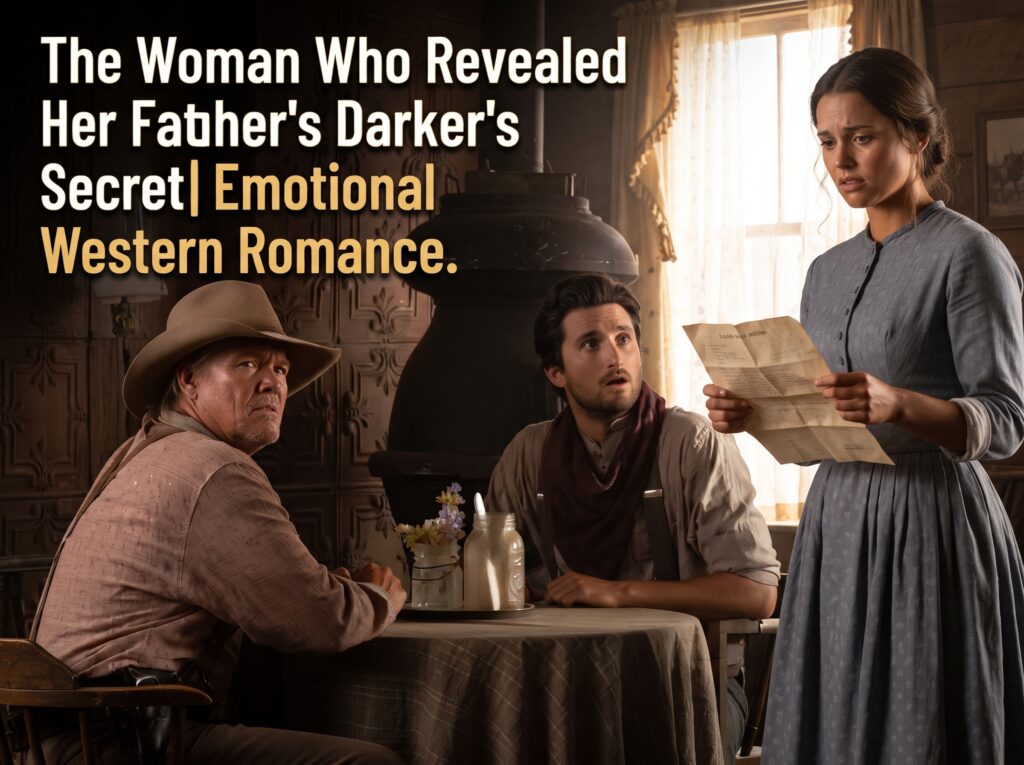
That was how Daniel found himself seated at Samuel’s table on a cold Thursday afternoon.
Samuel was a broad-shouldered man in his late forties, with a weathered face and a pale scar running from his left cheek toward his jaw. He wore a brown coat, a dark vest, and a wide-brimmed hat that rested on the table beside him.
He listened to Daniel’s questions without interrupting.
When Daniel mentioned William Brooks, Samuel’s fingers tightened around his glass.
“That name belongs to the past,” Samuel said.
“It belongs to my father.”
“Your father made choices that cost him his land.”
“Then you won’t mind showing me the records.”
Samuel leaned back.
“Some records are lost. Some were destroyed in a courthouse fire. And some things are best left alone.”
Daniel stared at him.
“My father taught me that a man who tells the truth has nothing to fear.”
Samuel’s expression hardened.
“Your father taught you a great many things, I suspect. Not all of them were useful.”
Before Daniel could reply, the saloon door opened.
A woman stepped inside wearing a faded blue dress beneath a gray traveling cloak. She carried a leather satchel in one hand and wore a determined expression that did not quite conceal her fear.
The conversation around the room gradually faded.
Eleanor Hayes had not lived in Red Hollow for almost a decade.
She was the daughter of the late Thomas Hayes, a wealthy landowner who had once controlled much of the surrounding territory. Her father had been dead for five years, but people still spoke of him carefully.
Eleanor looked directly at Samuel.
Then she noticed Daniel.
For a moment, she seemed startled by the resemblance between him and the man in the photograph she carried inside her satchel.
She walked toward their table.
“Mr. Carter,” she said.
Samuel stood.
“Eleanor. I wasn’t expecting you.”
“I imagine there are many things you haven’t expected.”
She placed the satchel on the table.
Daniel watched her remove a folded document.
“What is this about?” Samuel asked quietly.
Eleanor’s hands trembled, but her voice grew stronger.
“It’s about William Brooks. It’s about the land you took from him. And it’s about the night my father decided that an innocent man should lose everything so that our family could become richer.”
The saloon became completely silent.
Daniel looked from Eleanor to Samuel.
He had traveled hundreds of miles to discover the truth.
Now the truth was sitting directly in front of him.
And judging by Samuel Carter’s expression, the man who had helped destroy his family was finally afraid.
Part 2 — The Daughter of the Man Who Stole Everything
Eleanor had been raised in a large house surrounded by green fields, fine furniture, and servants who spoke softly whenever her father entered a room.
As a child, she believed her family’s wealth came from her father’s intelligence and hard work.
Thomas Hayes had taught her to read account books before she was old enough to understand the numbers. He explained the value of land, the importance of contracts, and the difference between a man who could earn money and one who knew how to keep it.
But he never taught her what happened when money was obtained through dishonesty.
When Eleanor was seventeen, she overheard an argument between her father and Samuel Carter.
She had been walking through the hallway when she heard Samuel say, “You promised that William would receive his share.”
Her father replied, “William has already received more than he deserves.”
“What about his wife and boy?”
“They are not my responsibility.”
Eleanor had stood frozen behind the doorway.
She remembered the sound of a glass breaking.
Then Samuel spoke again.
“You told me this would be temporary.”
“It was temporary until William decided to challenge me. He brought this upon himself.”
Eleanor had never forgotten those words.
For years, she tried to convince herself that she had misunderstood. Her father was strict, but he had always provided for their family. He donated money to the church, paid for repairs to the schoolhouse, and helped farmers who suffered after a poor harvest.
Surely, she thought, a man who did so much good could not have committed such a terrible wrong.
But when she was twenty-two, she found a bundle of letters in her father’s study.
They revealed that William Brooks had invested his savings in a joint land purchase with Thomas Hayes. The property included a creek, grazing fields, and a small orchard.
The original agreement granted William half ownership.
When the land became valuable after a railway survey was announced, Thomas decided he wanted it all.
He persuaded Samuel, who worked as a foreman and trusted intermediary, to help him pressure William into surrendering his claim.
The pressure began with threats.
Then came false accusations of unpaid debts.
Finally, Thomas arranged for William to sign a document that transferred his interest in the property in exchange for money he never received.
Samuel had witnessed the signature.
He had also signed a statement claiming that William had willingly accepted the arrangement.
Eleanor confronted her father.
He told her that business was complicated and that William had been a difficult man.
When she insisted that the documents proved otherwise, he slapped the desk so violently that the inkpot overturned.
“You will never understand what it takes to protect a family,” he shouted.
Eleanor stepped backward.
“And what does it take, Father? To destroy another one?”
He ordered her out of his study.
That night, she heard him burning papers in the fireplace.
She saved what she could.
But she did not go to the authorities.
She was frightened, young, and dependent on the very man whose actions disgusted her.
A year later, she married a schoolteacher named James Hayes, a distant cousin with no connection to her father’s business. They moved to another town, where she tried to build a life that was separate from her family’s reputation.
James knew that something troubled her, but she could never bring herself to explain it.
Then he became ill and died unexpectedly.
Eleanor returned to her father’s house to settle the estate.
That was when she discovered the final document, hidden inside a locked metal box beneath his desk.
It was the original land agreement, complete with William Brooks’s signature, Thomas Hayes’s instructions, and Samuel Carter’s witness statement.
On the reverse side was a short handwritten note.
If anything happens to William, make certain the boy never learns what we did.
Eleanor had spent years wondering whether the note referred to an accident, a threat, or something more sinister.
She could not prove that Thomas had caused William’s death.
But she knew that he had deliberately concealed the truth from William’s son.
After Thomas died, Eleanor found that she could no longer bear the secret.
She sold the house, kept only what she needed, and returned to Red Hollow.
Now she sat across from Daniel Brooks, watching him read the document.
When he finished, he looked up.
“Why did you wait so long?”
Eleanor accepted the question without protest.
“Because I was afraid.”
“Afraid of what?”
“Of losing my father. Of being left with nothing. Of discovering that the man I loved as a child was capable of doing something unforgivable.”
Daniel’s expression remained hard.
“And while you were afraid, my family lost everything.”
“Yes.”
“You had the evidence.”
“Yes.”
“You could have come forward.”
“Yes.”
Each answer made her feel smaller.
Finally, she said, “I cannot give you back the years I wasted. I cannot return your childhood or bring your father back. But I can give you the truth, and I can help you fight for what belongs to your family.”
Daniel folded the document.
“Why should I trust you?”
“You shouldn’t. Not yet.”
She looked him directly in the eyes.
“You should examine the evidence, speak to the witnesses, and decide for yourself. I am not asking you to believe me because I feel guilty.”
For the first time, Daniel saw something in Eleanor that he recognized.
Not innocence.
Courage.
It did not erase what she had done by remaining silent, but it made him willing to hear the rest of her story.
Samuel, who had said nothing throughout the exchange, finally spoke.
“You have no idea what you are starting.”
Eleanor turned toward him.
“No, Samuel. I know exactly what I am ending.”
Part 3 — The Night William Brooks Disappeared
Daniel spent the next several days examining the papers Eleanor had brought.
He visited the courthouse, spoke with an elderly clerk who remembered the original land agreement, and found a retired surveyor who had once measured the boundaries of William’s property.
The evidence was consistent.
William Brooks had owned half the land.
The transfer document had been signed under circumstances that deserved investigation, and the payment described in the agreement had never been properly recorded.
But Daniel wanted to know what had happened on the night his father disappeared from Red Hollow.
The official story was that William had left town after a confrontation with Thomas Hayes. He had supposedly been drinking heavily and had threatened to burn the farmhouse if his claim was challenged.
Daniel’s mother had always insisted that William never drank more than a glass of cider.
The stories did not fit.
Eleanor helped him locate a retired stable worker named Peter Lawson, who had been employed by the Hayes estate during those years.
Peter lived alone in a small cabin beyond the eastern fields.
When Daniel arrived, the old man refused to speak.
“I’ve said nothing for twenty years,” Peter muttered. “I intend to keep it that way.”
Daniel placed a copy of the land agreement on the table.
“This document says my father surrendered his property willingly. Did he?”
Peter looked at the paper for a long time.
“No.”
The answer came so quietly that Daniel almost missed it.
“What happened?”
Peter rubbed his hands together.
“Your father went to the Hayes house to demand the money he was owed. Mr. Hayes told him the matter had been settled. They argued. Samuel Carter was there.”
“What did Samuel do?”
“He tried to calm them down at first. Then Mr. Hayes told him to bring the papers.”
Daniel leaned forward.
“And my father?”
“He refused to sign anything else.”
Peter looked toward the window.
“Mr. Hayes threatened to have him arrested for theft. He said he had witnesses who would swear that your father had taken money from the business.”
“Was that true?”
“No.”
Peter’s voice cracked.
“Your father was an honest man. He had invested his savings and wanted his share. That was all.”
Daniel felt his throat tighten.
“What happened after the argument?”
Peter hesitated.
“Your father left the house. Samuel followed him outside. I saw them speaking near the stable. They were there for several minutes.”
“Did they fight?”
“No. Samuel looked frightened. Your father looked angry, but not violent.”
“Then what?”
“Your father rode away.”
Peter paused.
“That was the last time I saw him.”
Daniel sat back.
“Did you hear that he died?”
“Months later. A traveler brought word that a man matching his description had been found dead near a northern road. Your father’s body was buried before anyone from Red Hollow could identify him.”
Daniel closed his eyes.
He had spent years wondering whether his father had abandoned him.
Now he learned that William had ridden away believing he had no future in the town where he had built his life.
“Why didn’t you tell anyone?”
Peter looked ashamed.
“Mr. Hayes controlled the land, the money, and the men who worked for him. I had a wife and three children. I thought speaking up would cost them everything.”
Daniel stood.
“I understand why you were frightened.”
Peter looked relieved.
“But understanding your fear doesn’t mean the silence was right.”
The old man lowered his head.
“No. It doesn’t.”
Daniel left the cabin with a clearer picture of his father’s final night, but the most important question remained unanswered.
Why had Samuel Carter helped Thomas Hayes destroy William’s reputation?
That evening, Daniel found Samuel outside the ranch house, repairing a broken gate.
“I spoke to Peter Lawson,” Daniel said.
Samuel’s hands stopped moving.
“Then you know what happened.”
“I know that my father refused to sign the papers willingly. I know you were there when he left the Hayes house. And I know you helped create the story that ruined his name.”
Samuel put down his hammer.
“I was a coward.”
The bluntness of the answer surprised Daniel.
Samuel continued.
“I was younger than you are now. I had a wife, a baby daughter, and debts I could barely manage. Thomas Hayes offered me money to witness the transfer. He told me William would receive his payment afterward.”
“Did you believe him?”
“I wanted to.”
“That isn’t the same thing.”
“No,” Samuel admitted. “It isn’t.”
Daniel stepped closer.
“My father trusted you.”
Samuel looked toward the distant hills.
“I know.”
“And you betrayed him.”
“Yes.”
For a long moment, Daniel wanted to strike him.
He wanted Samuel to feel the same helplessness that had followed his family for years.
But he also remembered his mother’s words.
Never let another man’s wrongdoing decide the kind of man you become.
Daniel stepped back.
“I want the truth recorded. I want the land properly examined. And I want whatever compensation the law allows.”
Samuel nodded.
“You deserve that.”
“Then you will help me.”
“I will.”
Daniel looked at him carefully.
“Not because you want forgiveness.”
Samuel’s eyes filled with tears.
“No. Because it is the only decent thing left for me to do.”
Part 4 — The Deed Beneath the Floorboards
Eleanor remembered the old farmhouse from her childhood visits to the property with her father.
It stood beside a narrow creek, with a sagging porch and an orchard of apple trees that had not been properly maintained in years. The land had changed hands several times on paper, but nobody had lived there since William Brooks disappeared.
Daniel insisted on visiting it.
“If my father lost this place,” he told Eleanor, “I want to see what he was trying to save.”
They rode out together early one morning.
The farmhouse stood beneath a gray sky, its windows covered with dust and its front door hanging crookedly from one hinge. Wild grass had grown around the foundation, and the old orchard was nearly swallowed by weeds.
Daniel stepped onto the porch.
For a moment, he could almost imagine his father standing there, greeting him after a long day in the fields.
He pushed the door open.
Inside, the house smelled of damp wood and forgotten years. The fireplace was cracked, the furniture had been removed, and a layer of dust covered the floor.
Eleanor waited near the entrance.
“I am sorry,” she whispered.
Daniel looked around.
“Sorry won’t restore it.”
“I know.”
He moved into the main room and noticed a section of floorboards that appeared newer than the surrounding wood.
He knelt and examined them.
One board shifted beneath his hand.
Using a small tool from his pocket, he carefully lifted it.
Beneath the floor was a narrow space containing a tin box.
Inside lay several receipts, a folded map, and a letter addressed to William Brooks.
The letter was written by a lawyer who had represented William during the original land negotiations.
It stated that the transfer agreement was invalid if the promised payment was not completed. It also identified a boundary marker near the creek that proved William’s ownership extended farther than the later surveys had shown.
Daniel read the letter twice.
“This could change everything.”
Eleanor examined the map.
“The boundary marker is still there. I remember seeing it when I was a child.”
They followed the creek until they found an old stone post partly hidden by brush. Its markings were faint, but the initials matched those on the map.
For the first time, Daniel had physical evidence that could help establish his father’s original claim.
Then Eleanor noticed another paper at the bottom of the box.
It was a receipt for a payment made to a local doctor on the night William left Red Hollow.
The amount was small, but the date was significant.
Daniel looked at her.
“Why would my father need a doctor that night?”
Eleanor shook her head.
“I don’t know.”
They took the receipt to the town physician, now an elderly man living in retirement.
At first, he could not remember the transaction. But when Daniel showed him the date and the name, the doctor went quiet.
“I treated a man that evening,” he said. “He had a cut above his eye and bruising along his ribs.”
“Was it my father?”
“I believe so.”
Daniel’s hands tightened around the paper.
“Who brought him to you?”
The doctor looked toward Eleanor.
“Samuel Carter.”
The room seemed to grow smaller.
Samuel had claimed that William rode away without serious injury.
The doctor remembered something different.
He could not say who had caused the injuries, and he had no evidence that they were connected to William’s death. But his account established that Samuel had helped William after the confrontation and had concealed the visit.
Daniel left the doctor’s house with more questions than answers.
That evening, he confronted Samuel.
“You told me my father left without being harmed.”
Samuel stared at the medical receipt.
“I didn’t say that.”
“You allowed me to believe it.”
Samuel lowered his head.
“Your father was injured when I found him near the stable. I took him to the doctor. He asked me not to tell Thomas Hayes where he had gone.”
“Why didn’t you tell anyone?”
“Because I was afraid Hayes would accuse me of helping William escape with the property records. He had threatened to destroy my family if I crossed him.”
Daniel’s anger rose.
“So you protected yourself.”
“Yes.”
“And left my father to face whatever came next alone.”
Samuel’s voice broke.
“I have regretted that night every day of my life.”
Daniel looked away.
Regret could explain a man’s silence, but it could not undo the years that followed.
Still, the evidence was becoming clearer.
Thomas Hayes had forced William into an unlawful transfer. Samuel had helped him, then tried to assist William privately after the confrontation. And somewhere between that night and the distant road where William died, the truth had been buried.
Daniel decided he would not stop until every remaining piece was found.
Part 5 — The Secret Eleanor Could No Longer Carry
As Daniel pursued the land claim, Eleanor began receiving anonymous letters.
The first arrived at her boardinghouse with no signature.
Leave Red Hollow. You have already caused enough trouble.
The second was more direct.
Your father protected this family for years. Do not destroy his name now.
Eleanor burned neither letter.
She placed them in a drawer and showed them to Daniel.
“Someone knows what we’re doing,” he said.
“I expected that.”
“Are you frightened?”
“Yes.”
Daniel studied her.
“Then why stay?”
Eleanor looked toward the window.
“Because I have spent too much of my life allowing fear to decide what I do.”
She told him about the night she had discovered the original documents, about the years she had remained silent, and about the way her father’s reputation had become a prison she could not escape.
“I used to think that if I admitted what he had done, I would lose every good memory I had of him,” she said.
“And now?”
“Now I understand that he could have loved me and still done something terrible. Both things can be true.”
Daniel was silent.
He had spent years turning his father into a symbol of innocence because it was easier than accepting that the past could contain unanswered questions.
Perhaps he had also done that to protect himself.
“What if the truth changes the way you remember him?” he asked.
Eleanor gave a sad smile.
“It already has.”
She looked at him.
“But I would rather remember him honestly than spend the rest of my life defending a lie.”
Daniel felt something shift between them.
He had regarded Eleanor as a witness, a source of evidence, and the daughter of the man who had stolen his family’s future.
He had not considered how much she had lost by telling the truth.
Her father was gone. Her marriage had ended in grief. Her family’s fortune had become a reminder of wrongdoing rather than a source of pride.
And now she was standing beside the son of the man her father had betrayed, risking what remained of her reputation to make things right.
“Why didn’t you come forward after your father’s death?” Daniel asked gently.
Eleanor lowered her eyes.
“I thought I could forget.”
“Could you?”
“No.”
She took a breath.
“I heard my father’s voice whenever I tried to sleep. I remembered the people who had lost their homes. I thought of your mother, who had to raise you without knowing why everything had been taken from her.”
Her voice trembled.
“And I wondered what kind of person I had become by remaining silent.”
Daniel looked at her for a long time.
“You cannot change the years you lost.”
“I know.”
“But you can decide what you do with the years you have left.”
Eleanor met his gaze.
“That is what I am trying to do.”
For the first time, Daniel reached for her hand.
It was a small gesture, and neither pretended it solved anything.
But Eleanor held his hand, and for a moment they sat together in the quiet room, two people who had inherited a history neither had chosen.
Outside, the wind moved through the streets of Red Hollow.
The anonymous letters remained unanswered.
The land claim was still unresolved.
And neither of them knew that someone was already preparing to destroy the evidence that could finally reveal the truth about William Brooks’s final journey.
Part 6 — The Fire at the Courthouse
The fire began shortly after midnight.
A stable worker spotted smoke rising from the county courthouse and ran to alert the town. By the time the first men arrived with buckets, flames had spread through the records room.
Samuel Carter was among those who rushed to help.
Daniel arrived moments later.
He watched helplessly as smoke poured through the windows where the original land records were stored.
“Where is the deed?” he shouted.
The county clerk, coughing and covered in soot, stumbled outside.
“Some records were moved yesterday. The older property files are in the back room.”
Daniel ran toward the entrance, but Samuel caught his arm.
“The roof is about to fall!”
“My father’s records are inside!”
“And if you die, you will never recover anything!”
Daniel struggled against him.
Then part of the roof collapsed, sending sparks into the night.
They were forced back.
By dawn, the courthouse was badly damaged.
Several documents had been destroyed, but the clerk confirmed that the original land register had been moved to a temporary storage room the previous afternoon. The surviving register included the original ownership entry for William Brooks.
The fire had not erased the claim.
But it had exposed a more troubling possibility.
Someone had known which records mattered.
The sheriff began an investigation.
A witness reported seeing a man leaving the courthouse shortly before the fire began. Another remembered a wagon parked behind the building.
Samuel spoke privately with Daniel.
“I believe this is connected to the land.”
“Who would risk burning the courthouse?”
“Someone who knows the evidence is dangerous.”
Daniel looked toward the damaged building.
“Thomas Hayes is dead.”
Samuel nodded.
“But his business associates are not.”
The investigation revealed that a local investor named Charles Whitmore had purchased several parcels of land from the Hayes estate after Thomas’s death. Those purchases included property that overlapped with William Brooks’s original claim.
If the claim succeeded, Whitmore could lose a valuable investment.
The sheriff questioned him, but Whitmore denied any involvement in the fire.
There was not enough evidence to charge him.
Then a young stable hand came forward with a statement.
He had been paid to move a wagon near the courthouse on the night of the fire. He had not known what the wagon contained, but he recognized the man who hired him as Whitmore’s business agent.
The statement gave the sheriff grounds to investigate further.
Daniel felt a mixture of relief and anger.
For twenty years, powerful men had treated his family as though their rights could be erased whenever those rights became inconvenient.
Now someone had tried to destroy the evidence again.
Eleanor stood beside him outside the courthouse.
“I am sorry,” she said.
Daniel turned toward her.
“You didn’t start the fire.”
“No, but my family created the circumstances that made people believe they could get away with this.”
Daniel looked at her.
“Your father made his choices. You are making yours.”
She lowered her eyes.
“Sometimes I wish I had been braver sooner.”
“Perhaps.”
The honesty of his answer surprised her.
He continued, “But I don’t want to spend the rest of my life deciding who you should have been twenty years ago. I want to see what you do now.”
Eleanor looked at him, tears gathering in her eyes.
That evening, the sheriff announced that the surviving land register would be examined by an independent surveyor.
For the first time, Daniel’s claim had a real chance of being heard.
But the investigation also uncovered a new piece of evidence: a letter written by Thomas Hayes to Charles Whitmore shortly before his death.
It mentioned a payment made to a man who had helped William Brooks leave Red Hollow.
The name was missing from the surviving copy.
And without that name, the mystery of William’s final night remained unsolved.
Part 7 — The Man Who Came Back From the Past
Three days after the courthouse fire, an elderly man arrived in Red Hollow carrying a worn leather case.
He introduced himself as Arthur Bell, a former railway worker who had lived in the northern territories for nearly twenty years.
He asked to speak with Daniel Brooks.
When Daniel entered the boardinghouse parlor, Arthur stood slowly.
“You look like your father,” he said.
Daniel studied him.
“Did you know William?”
“I did. I helped him leave this county.”
Daniel’s heart began to race.
Arthur explained that William had reached the northern road after leaving Samuel at the doctor’s office. He had intended to travel to another settlement, meet a solicitor, and return with legal assistance.
But he had been injured, exhausted, and short of money.
Arthur had found him near a roadside inn.
“I offered him a place on my wagon,” Arthur said. “He was frightened, but he was determined to keep going.”
“Why was he frightened?”
“He believed Thomas Hayes would send men after him. He had papers proving the land transfer was fraudulent.”
Daniel sat down.
“Did he have the papers when you left him?”
“Yes. He kept them inside his coat.”
Arthur opened the leather case and removed a small envelope.
“I have kept this for years. William asked me to deliver it to his wife if anything happened to him.”
Daniel stared at the envelope.
“Why didn’t you deliver it?”
Arthur lowered his head.
“I was injured in a railway accident shortly afterward. I spent months recovering. By the time I returned to the area, I learned that William was dead and his family had left. I searched for his wife, but I could never find her.”
He placed the envelope on the table.
“I should have tried harder.”
Daniel opened it with trembling hands.
Inside was a letter addressed to his mother.
My dearest Margaret,
I am writing because I do not know when I shall be able to return.
Thomas Hayes has taken the land, and Samuel Carter has helped him do it. But I have found evidence that the transfer was never valid. I will not allow our son to grow up believing that his father abandoned him.
If I can reach the solicitor in the north, I believe we can challenge the agreement. I have also learned that the payment recorded in the original contract was never made.
Please tell Daniel that I have not given up on him. Whatever happens, I want him to know that everything I did was an attempt to protect our family.
Your loving husband,
William.
Daniel read the letter twice.
Then he lowered his head.
For thirty years, he had carried the fear that his father might have abandoned him.
Now he knew that William had been trying to return.
He had been trying to save the family, even as the world around him closed in.
Arthur waited quietly.
Finally, Daniel looked up.
“How did my father die?”
Arthur took a long breath.
“He became ill on the journey. His injuries worsened, and he developed a fever. We stopped at a small settlement, but there was no doctor nearby. He died two days later.”
“Was anyone with him?”
“I was.”
Daniel closed his eyes.
“Did he suffer?”
Arthur shook his head.
“Not at the end. He asked me to make certain his family knew he had tried.”
Daniel pressed the letter against his chest.
For the first time in years, the grief he carried was mixed with something gentler.
His father had not disappeared because he stopped loving his family.
He had disappeared because he was fighting to protect them.
That evening, Daniel took the letter to Eleanor.
She read it in silence.
When she finished, she wiped her eyes.
“Your father was brave.”
Daniel looked toward the window.
“He was frightened, too.”
“That doesn’t make him less brave.”
He considered her words.
Then he reached for her hand.
“I think I am beginning to understand that.”
Part 8 — The Trial of Red Hollow
The legal proceedings began in early summer.
Daniel’s solicitor presented the original land register, the surviving partnership agreement, the surveyor’s findings, and William’s final letter.
Samuel testified about the false witness statement he had signed at Thomas Hayes’s request.
Eleanor provided the documents she had preserved from her father’s study.
The court also heard evidence from the retired stable worker, the former doctor, and Arthur Bell.
Charles Whitmore denied knowing that the land had been acquired through an unlawful transfer.
But the letters between Whitmore and Thomas Hayes revealed that Whitmore had been warned about the disputed ownership before purchasing the property.
The evidence was compelling.
The judge ruled that the original transfer could not stand as written and ordered a full reassessment of the property’s ownership and the financial compensation owed to William Brooks’s estate.
It was not a perfect victory.
Some of the original land had been sold to people who had purchased it in good faith. Other parcels had been altered by years of development.
Daniel could not recover every acre his father had owned.
But he recovered the family orchard, the farmhouse, and the land surrounding the creek. He also received compensation for the portion of the property that could not be returned.
When the decision was announced, Daniel stood outside the courthouse in silence.
Eleanor approached him.
“You won.”
He looked toward the courthouse doors.
“We won the right to be heard.”
“Isn’t that enough?”
“For today.”
He turned toward her.
“My father spent his final months trying to make certain that his family would not be forgotten. I wish he could have seen this.”
Eleanor took his hand.
“I think he would have been proud of you.”
Daniel looked at her for a long moment.
Then he kissed her.
It was their first kiss, and it came without promises or expectations.
It was simply a moment of tenderness between two people who had faced the worst parts of their shared history and chosen not to look away.
Samuel watched them from a distance.
Later that evening, he asked Daniel to meet him outside the ranch house.
“I want you to know that I am grateful for what you did in court.”
Daniel frowned.
“I did not do it for you.”
“I know.”
Samuel looked toward the fields.
“I have spent years telling myself that I was protecting my family. But the truth is that I was protecting my own comfort. I let your father suffer because I was afraid of what honesty would cost me.”
He turned toward Daniel.
“I cannot ask you to forgive me.”
Daniel remained silent.
“But I want to make one final offer. I will transfer the remaining disputed land back to your family and contribute the proceeds from the sale of my northern pasture toward the debt.”
Daniel looked at him carefully.
“Why now?”
“Because I finally understand that making amends is not something I can postpone until I feel less ashamed.”
Daniel nodded slowly.
“I accept your offer.”
Samuel’s eyes filled with tears.
“Thank you.”
“But I am not promising forgiveness.”
Samuel bowed his head.
“I understand.”
For the first time, their agreement was not built on threats, fear, or hidden payments.
It was built on the truth.
And that was worth more than either man had expected.
Part 9 — The Choice Eleanor Had to Make
The victory changed Daniel’s future.
He repaired the farmhouse, restored the orchard, and began planning a small business that would combine farming with the sale of timber and handmade furniture.
Eleanor helped him organize the accounts.
She also began teaching reading and arithmetic to children whose families lived beyond the town’s main streets.
For the first time, she felt that her life was no longer defined by her father’s decisions.
But happiness did not erase every difficulty.
Some townspeople still blamed her for the actions of Thomas Hayes. Others believed she had only confessed because the documents were about to be discovered.
One afternoon, a woman approached Eleanor outside the general store.
“You should leave Red Hollow,” she said. “Your family has caused enough suffering.”
Eleanor looked at her calmly.
“My family caused suffering. I cannot change that.”
“Then why should anyone welcome you here?”
“They shouldn’t have to welcome me.”
The woman frowned.
Eleanor continued, “I am not asking anyone to forget what happened. I am trying to make certain it does not happen again.”
The woman walked away without answering.
That evening, Eleanor told Daniel what had happened.
“Perhaps I should leave,” she said. “You have your land back. You no longer need me.”
Daniel put down his pen.
“Is that what you want?”
“I don’t know.”
He waited.
She looked at her hands.
“I have spent my entire life believing that I must pay for my father’s sins. When I finally told the truth, I thought I would feel free. Instead, I feel as though I am standing in the same place, waiting for someone to decide whether I deserve to stay.”
Daniel moved closer.
“You cannot control what everyone thinks of you.”
“I know.”
“And you cannot repair your father’s choices by punishing yourself forever.”
Eleanor looked at him.
“What if I have not done enough?”
“Then keep doing what you believe is right. But do it because it is right, not because you think suffering will make you innocent.”
Her eyes filled with tears.
Daniel took her hands.
“I don’t love you because you are the daughter of Thomas Hayes. I love you because you had the courage to tell the truth when silence would have been easier.”
Eleanor looked at him in disbelief.
“You love me?”
Daniel smiled faintly.
“I have been trying not to say it until I was certain you wanted to hear it.”
She laughed through her tears.
“I have wanted to hear it for a very long time.”
He kissed her gently.
Then Eleanor told him about her husband, James, and the loneliness she had carried after his death. She explained that she had not believed she would ever love anyone again, especially someone whose family had been harmed by her own.
Daniel listened without judgment.
“You don’t have to erase your past to build a future,” he told her.
She leaned against him.
“And you don’t have to forget yours.”
They stood together beneath the evening sky, understanding that love would not remove every painful memory.
It would simply give them a reason to keep moving forward.
Part 10 — The Land That Remembered
One year later, the old farmhouse stood proudly beside the creek.
The porch had been repaired, the roof replaced, and the windows fitted with fresh glass. The orchard had been pruned, and new trees were beginning to grow where the oldest ones had died.
Daniel had opened his workshop in a small building near the house. He repaired wagons, made furniture, and sold timber to nearby ranches.
Eleanor managed the accounts and taught children in a small room overlooking the orchard.
Samuel visited occasionally.
He had sold much of his remaining land to repay the debt, and his life had become quieter. He was no longer the wealthiest rancher in the county, but he had begun to regain the respect of people who valued his willingness to acknowledge his mistakes.
He never demanded forgiveness from Daniel.
Instead, he continued making payments and helping with the restoration of the farmhouse.
Over time, Daniel learned to speak to him without anger.
It did not mean he had forgotten the past.
It meant that the past no longer controlled every conversation they had.
On a warm afternoon in late spring, Daniel and Eleanor walked beside the creek.
The water moved gently over the stones, just as it had when William Brooks owned the land.
Daniel stopped beside an old apple tree.
“My father planted this one,” he said.
Eleanor looked at the twisted branches.
“How do you know?”
“He wrote about it in one of his letters. He said it was the first tree he planted after my mother told him she was expecting me.”
Daniel touched the trunk.
“I used to think that getting this land back would make everything right.”
“And now?”
He smiled.
“Now I think it gives me a chance to do something right with it.”
Eleanor slipped her hand into his.
They continued walking until they reached the stone boundary marker that had helped restore the family claim.
Daniel knelt and brushed away the dirt.
His father’s initials were still visible.
For a moment, he imagined William standing beside him, wearing his old work coat and smiling at the sight of the restored orchard.
“I wish he could have met you,” Daniel said.
Eleanor squeezed his hand.
“I wish I could have met him, too.”
Daniel stood.
“Do you think he would have forgiven your father?”
Eleanor considered the question.
“I don’t know. I think forgiveness would have been difficult for him.”
“Then why do you think he would have wanted me to forgive Samuel?”
“Because your father believed that what happened to him should not decide what kind of man you became.”
Daniel looked toward the farmhouse.
Perhaps that was the most important inheritance William had left him.
Not the land.
Not the orchard.
Not the money that had been taken and eventually returned.
It was the understanding that justice and bitterness were not the same thing.
A person could demand accountability without allowing anger to consume the rest of his life.
A person could forgive without pretending the harm had never happened.
And a person could love someone whose family had caused suffering without becoming responsible for every wrong committed before they met.
Daniel turned toward Eleanor.
“I have one question for you.”
She smiled.
“Only one?”
“At the moment.”
“What is it?”
He took a small ring from his pocket.
“I have spent most of my life trying to recover the home my father lost. But I have learned that a home is not only land, timber, or walls. It is the people who choose to stand beside you when the truth becomes difficult.”
He looked into her eyes.
“Eleanor Hayes, would you build a home with me?”
She stared at the ring, then at the man standing before her.
For years, she had believed her father’s actions had destroyed her chance at happiness.
Now she understood that she could not change the past, but she could choose what came next.
“Yes,” she whispered.
Daniel slipped the ring onto her finger.
She embraced him beside the creek, and the wind moved softly through the orchard above them.
Their wedding took place that autumn in the small town church.
There were no grand displays of wealth, no expensive gifts, and no attempt to pretend their families had never been divided.
Instead, there were friends, neighbors, children from Eleanor’s classroom, and a simple meal prepared by the people who had helped restore the farmhouse.
Samuel attended the ceremony and sat quietly near the back.
Before the service began, he approached Daniel.
“I wish I had done the right thing twenty years ago,” he said.
Daniel looked at him.
“So do I.”
Samuel lowered his head.
“But you did not.”
“No.”
“And now?”
Samuel glanced toward Eleanor, who was standing near the church window.
“Now I can only try to do the right thing for the time I have left.”
Daniel nodded.
“Then keep trying.”
They shook hands.
It was not a perfect reconciliation.
It was something more honest: an acknowledgment of the past and a willingness to live differently.
Years later, Daniel and Eleanor’s children would play beneath the apple trees beside the creek. They would grow up hearing stories about the land, the farmhouse, and the family that had nearly lost everything.
But Daniel would never tell them that their grandfather was a man who had been defeated.
He would tell them that William Brooks had been a man who stood up for what was right, even when the world seemed determined to silence him.
And Eleanor would tell them that the truth could arrive late, that courage sometimes took years to find, and that the mistakes of one generation did not have to become the inheritance of the next.
The land had remembered what the town had tried to forget.
And the family that returned to it learned that the most valuable thing they could leave their children was not a fortune, but a legacy of honesty.
Because land can be stolen, money can disappear, and reputations can be destroyed—but the courage to tell the truth can give a broken family the chance to begin again.
The End.