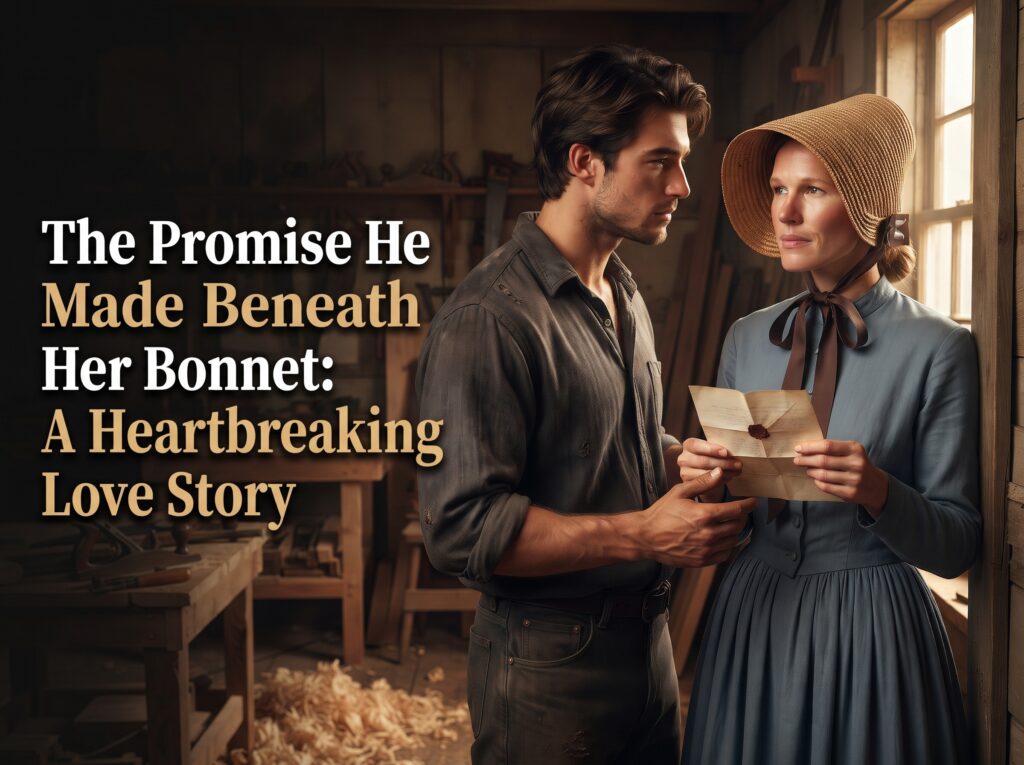
The autumn of 1874 arrived early in the little town of Willow Creek.
Cold winds swept across the open fields, carrying the scent of damp earth and burning wood. Farmers hurried to finish their harvests before the first hard frost, while shopkeepers began covering their windows against the approaching winter.
At the edge of town stood Bennett’s Workshop, a weathered building with a sloping roof and a wide wooden door that rarely closed before sunset.
Clara Bennett had grown up there.
Her father, Samuel Bennett, had built his reputation repairing wagons, making furniture, and restoring homes damaged by storms. He was a respected man who believed that a person’s name was the most valuable thing he could own.
He also believed that daughters should marry men who could provide for them.
Clara had never agreed.
At twenty-three, she was intelligent, stubborn, and far more interested in building a life of her own than becoming the wife of a wealthy landowner. She helped her father keep his accounts, delivered finished furniture to customers, and secretly saved money to open a small school for the children of families who could not afford one.
Her father considered the school an impractical dream.
“Children need food before they need books,” he told her one morning.
“They need both,” Clara replied.
“And who will pay for this grand idea?”
“I shall find a way.”
Samuel shook his head.
“You have your mother’s determination. Unfortunately, she never learned when to stop using it.”
Clara’s expression hardened.
Her mother, Elizabeth, had died when Clara was seventeen. Samuel rarely spoke of her except to criticize her decisions, and Clara had learned that asking questions about the past only made him angry.
That morning, Clara was carrying a basket of fresh bread to the workshop when she heard the sound of hammering from inside.
She pushed open the door.
A stranger stood beside the workbench, removing a damaged wheel from a wooden wagon. He was tall, with dark brown hair, a short beard, and sleeves rolled up to reveal strong forearms marked by years of manual work.
He glanced at her.
“Good morning.”
Clara stopped.
“You’re not one of Father’s usual workers.”
“No, miss. Thomas Reed. Your father hired me yesterday.”
“Without telling me?”
Thomas smiled slightly.
“Perhaps he feared you would ask too many questions.”
“Then he knows me well.”
Thomas laughed.
It was not a loud or careless laugh. It was warm, almost surprised, as though he had not expected the world to offer him anything amusing.
Clara placed the bread on a table.
“What brings you to Willow Creek?”
“Work.”
“That is what people say when they don’t want to answer.”
He looked at her with a hint of amusement.
“And what would you prefer I say?”
“The truth.”
For a moment, something changed in his expression.
Then he lowered his gaze to the wagon wheel.
“I came here because I was told your father was the best carpenter in the county.”
It was a reasonable answer.
Clara decided not to press him.
Over the following weeks, Thomas became an important part of the workshop. He worked diligently, spoke respectfully to customers, and never complained when Samuel gave him difficult tasks.
He also noticed things others overlooked.
He noticed when Clara’s hands became sore from carrying heavy boxes. He noticed that she always set aside the smallest pieces of wood because she hated wasting materials. He noticed that she read books while waiting for customers and that she sometimes looked toward the distant hills as though imagining another life.
One evening, Clara found him repairing a broken chair long after the other workers had gone home.
“You know you are not paid to work through the night,” she said.
Thomas looked up.
“The chair belongs to Mrs. Wilson. She has six children and cannot afford another one.”
Clara smiled.
“Father will be pleased. He has always admired people who work for nothing.”
“I am not working for nothing.”
She tilted her head.
“What are you receiving?”
Thomas considered the question.
“The satisfaction of knowing that someone will have a better evening because I took an extra hour.”
Clara looked at him differently.
She had met wealthy men who spoke endlessly about generosity but complained whenever they were expected to help anyone. Thomas, who owned little more than his tools and a small traveling trunk, seemed to understand kindness without needing to announce it.
That night, Clara walked home thinking about him.
She told herself it was merely admiration.
But the following morning, when she heard his hammer striking wood, she found herself smiling before she even entered the workshop.
And Thomas, who had spent years teaching himself not to want things he could not afford to lose, began to look forward to the sound of her footsteps.
Neither of them understood that their meeting had reopened a story their families had spent nearly twenty years trying to bury.
Part 2 — A Promise Beneath the Bonnet
By the middle of October, Clara had developed a habit of finding reasons to visit the workshop.
Sometimes she brought her father a cup of tea. Sometimes she needed help carrying supplies. On other occasions, she claimed to have misplaced a ledger that was sitting on her desk at home.
Thomas never questioned these excuses.
Instead, he began saving small pieces of polished wood for her. He carved a bird from a scrap of oak, made a miniature wooden book for her schoolroom plans, and repaired the clasp on the old straw bonnet she wore almost every day.
When he returned the bonnet, Clara ran her fingers over the repaired ribbon.
“You could have replaced it.”
“With what money?”
She laughed.
“Most gentlemen would have bought a new one.”
“Most gentlemen would have spent more than they could afford to impress a woman who might not like them anyway.”
Clara looked at him.
“And do you wish to impress me?”
Thomas suddenly found the workbench fascinating.
“I have been trying not to.”
“Why?”
“Because I have learned that wanting something does not mean I have the right to ask for it.”
For once, Clara had no clever response.
She looked down at the bonnet in her hands, feeling a warmth spread through her chest that had nothing to do with the fire burning in the workshop stove.
That afternoon, Thomas accompanied her on a delivery to the neighboring farm. The wagon had to travel along a narrow road bordered by golden fields, and the afternoon sun turned the distant hills the color of honey.
When they reached the farm, the farmer’s young daughter ran toward Clara with a broken wooden horse.
“Miss Bennett! Can you fix him?”
Clara knelt and examined the toy.
“I think we can save him.”
Thomas watched as she promised the child that the horse would be repaired by the following morning.
“You have a way with children,” he said when they were alone again.
“I like that they ask for what they need without pretending they don’t need anything.”
“Perhaps adults should learn from them.”
“Perhaps adults spend too much time being frightened of one another.”
Thomas looked at her.
“Are you frightened of me, Clara?”
She turned toward him.
“No.”
“Why not?”
“Because when I speak, you listen. When you disagree, you explain why. And when you make a mistake, you do not pretend it was someone else’s fault.”
His expression grew serious.
“Those are rather ordinary things to ask of a man.”
“Then why are they so difficult to find?”
He had no answer.
They walked in silence for a while, listening to the wheels move over the road.
Finally, Thomas said, “There is something I should tell you about myself.”
Clara waited.
“I have not always lived as I do now. There was a time when I believed I would inherit a house, land, and enough money to start a business of my own.”
“What happened?”
“My family lost everything.”
“I’m sorry.”
He nodded.
“I was young when it happened. Young enough to believe that adults always knew what they were doing.”
Clara recognized the bitterness in his voice.
“Did someone take what belonged to you?”
Thomas stopped walking.
“Why do you ask?”
“Because you speak as though losing it was not the same as giving it away.”
For a moment, she thought he might tell her everything.
Instead, he looked toward the distant farm.
“There are things I have not yet understood. Until I do, I would rather not accuse anyone.”
Clara respected his answer, though she sensed there was more to the story.
When they returned to town, the sun was beginning to set.
At the entrance to the workshop, Thomas stopped her.
“Clara, may I ask you something?”
“That depends on the question.”
“If I never become wealthy, if I never own a grand house or a large piece of land, would you still be willing to walk beside me?”
Her heart began to race.
“Are you asking whether I would marry a carpenter?”
“I am asking whether you could be happy with a man who might never become anything more than one.”
Clara studied his face.
“I have never wanted a title or a fortune, Thomas. I want a home where the truth is welcome. I want a husband who respects me enough to disagree with me honestly. I want children who grow up knowing that their worth is not measured by what they own.”
She smiled.
“If you can help me build that, I shall consider you a very successful man.”
Thomas stared at her as though she had given him something he had stopped believing existed.
Then he took her hand.
“I cannot promise that life will always be kind to us.”
“I have never expected it to be.”
“But I can promise that I will not deliberately deceive you.”
Clara’s smile faded slightly.
“That is a serious promise.”
“I know.”
She held his hand more tightly.
“Then I shall hold you to it.”
He lifted her fingers to his lips.
And beneath the doorway of Bennett’s Workshop, Clara Bennett fell in love with Thomas Reed.
For several weeks, their happiness seemed almost ordinary.
They walked beside the river on Sundays. Thomas helped Clara plan her schoolroom, and she read aloud to him from books he had never had the opportunity to study. He told her stories about distant towns, difficult jobs, and the long nights he had spent traveling in search of work.
She told him about her mother, about the school she hoped to open, and about the loneliness of living in a house where questions were often treated as acts of disobedience.
They never discussed marriage in front of Samuel.
Clara knew her father would object to Thomas’s lack of wealth, and Thomas seemed reluctant to challenge a man who had given him employment.
But their affection became impossible to hide.
One Sunday evening, Clara found her father watching them through the workshop window.
His face had gone pale.
When Thomas left, Samuel turned toward his daughter.
“How long has this been happening?”
Clara lifted her chin.
“How long has what been happening?”
“Do not play games with me. You are spending every spare moment with that man.”
“His name is Thomas.”
“I know his name.”
“Then use it.”
Samuel struck the desk with his palm.
“You have no idea who he is.”
Clara stared at him.
“Then tell me.”
For a moment, fear crossed her father’s face.
It was not anger.
It was fear so deep that he seemed unable to speak.
Finally, he said, “You will stop seeing him.”
“No.”
“You will do as I say.”
“I am not a child.”
“You are my daughter!”
“And that does not give you the right to decide whom I love.”
Samuel looked at her as though she had struck him.
Clara walked out of the workshop with tears burning in her eyes.
She had never spoken to him that way before.
Yet as she crossed the yard, she understood something that frightened her more than his anger.
Her father had not simply disapproved of Thomas.
He had recognized him.
And whatever he knew about the young carpenter, he was desperate to keep it hidden.
Part 3 — The Letter in the Locked Desk
Three days later, Samuel left town to collect a shipment of timber.
He expected to return before evening, but a damaged bridge forced him to stay overnight at a neighboring settlement.
Clara spent the day working through the workshop accounts.
She had been reviewing the books when she noticed an unfamiliar payment recorded in a ledger from several years earlier. The entry was brief: a substantial sum paid to a man named Walter Pike for the purchase of land.
Clara knew the family had never owned that land.
She searched the other ledgers and found similar entries, each marked with Samuel’s initials.
The amounts were significant enough to have kept their household comfortable for years.
Yet the money had never appeared in the accounts she normally used.
Confused, Clara went to her father’s study to look for the original receipts.
Samuel kept his private papers in a small desk beside the window. The upper drawer was locked, and the key was usually attached to a chain he wore beneath his shirt.
Clara had never opened it.
That afternoon, however, she found a small key on the desk.
She stood looking at it for several minutes.
She knew she should wait for her father.
She knew that opening a locked drawer was an invasion of his privacy.
But she also remembered the expression on his face when she had mentioned Thomas.
She remembered the way he had recognized the name before she finished saying it.
And she remembered Thomas’s words about the inheritance his family had lost.
Clara turned the key.
Inside were several folded documents, an old photograph, and a sealed envelope bearing a name she had not seen in years.
Daniel Reed.
Thomas’s father.
Clara sat down.
The letter was dated eighteen years earlier.
She opened it carefully and began to read.
Mr. Bennett,
I am writing once more regarding the land and funds entrusted to your care. The agreement was made in good faith, and I have waited long enough for you to honor it.
My son is still young, and I do not wish him to grow up believing that every promise made by a respectable man is worthless. Please return what belongs to our family before this matter causes damage that neither of us can repair.
I remain willing to settle this privately, provided the full amount is returned.
Daniel Reed.
Clara read the letter twice.
Her father had been entrusted with money belonging to Thomas’s family.
And the money had apparently never been returned.
She searched the drawer again.
At the bottom lay another envelope, this one bearing Samuel’s handwriting.
It contained a short note.
The boy has returned to the county. I have hired him at the workshop. If he discovers the truth, everything we have worked to protect may be lost.
Clara felt the room grow cold.
The boy.
Thomas.
Her father had known who Thomas was from the beginning.
She sat frozen at the desk until she heard a horse outside.
Thomas had arrived to collect a set of tools.
When Clara appeared in the doorway, he immediately noticed her expression.
“What has happened?”
She held up the letter.
“Tell me the truth.”
Thomas looked at the paper.
All the color left his face.
“Where did you find that?”
“In my father’s desk.”
He closed his eyes.
“Clara…”
“Did you know?”
He did not answer quickly enough.
Her voice broke.
“Did you know that my father had your family’s money?”
“Yes.”
The word was barely audible.
Clara stepped backward.
“How long?”
“Before I came to Willow Creek.”
“Before you met me?”
“Yes.”
She looked at him as though she no longer recognized his face.
“Then our first meeting was a lie.”
“No.”
“You came here because of my father. You knew who I was. You knew what he had done.”
“I came here to find the truth about my family’s inheritance. I did not know that I would meet you.”
“But you knew after you met me.”
“Yes.”
“And you stayed.”
Thomas’s eyes filled with pain.
“Because I fell in love with you.”
Clara shook her head.
“You cannot separate those things as easily as you think.”
“I know.”
“Then why didn’t you tell me?”
He looked down at his hands.
“Because I was afraid that if I told you, you would see me only as the man who had come to expose your father.”
“Was that not what you were?”
“At first, yes.”
The honesty of the answer hurt more than a denial would have.
Thomas took a step toward her.
“I had spent years believing your father had stolen everything my family owned. I came here to prove it. I wanted the land returned, and I wanted the truth recorded so that my father’s name would no longer be associated with failure.”
“And then you met me.”
“Yes.”
“And you decided that loving me was more important than telling me the truth.”
Thomas swallowed.
“I thought I could find a way to settle the matter without hurting you.”
Clara’s eyes filled with tears.
“You decided what I could bear without ever asking me.”
He had no answer.
She handed him the letter.
“I need you to leave.”
“Clara, please.”
“Not because I no longer love you. That is what makes this so difficult. I still love you, and I do not know what to do with that love when I can no longer trust the man who holds it.”
Thomas stood motionless.
Then he placed the letter on the desk and walked out.
Clara watched him leave through the workshop door.
For the first time since they had met, she did not follow him.
That night, Samuel returned home.
Clara was waiting in the study, the documents arranged neatly across the desk.
He stopped when he saw them.
“You opened my private papers.”
“Yes.”
His expression hardened.
“You had no right.”
“Did you have the right to keep another family’s inheritance?”
Samuel stared at her.
Then he sat down heavily.
Clara’s voice trembled.
“Father, what did you do?”
He looked at the old letter from Daniel Reed.
And for the first time in Clara’s life, Samuel Bennett appeared like a man who had run out of excuses.
Part 4 — The Money That Disappeared
Samuel remained silent for so long that Clara began to fear he would refuse to answer her.
At last, he folded his hands.
“Eighteen years ago, Daniel Reed was my closest friend.”
Clara stared at him.
“Your friend?”
“We worked together when I was younger. He was a gifted carpenter, and I was better at business. We decided to purchase a tract of land outside Willow Creek, build a workshop, and expand our trade.”
“What happened?”
Samuel looked toward the window.
“Daniel invested nearly everything he owned. I contributed money I had borrowed from a merchant in town. At first, the business prospered. Then the merchant demanded immediate repayment of his loan, and I could not pay.”
“So you took Daniel’s money?”
“I borrowed it.”
“Did he agree?”
Samuel closed his eyes.
“Not entirely.”
Clara felt a chill move through her.
“That is not borrowing, Father.”
“I believed I could replace the money within a few months. I had customers waiting for orders, and I expected a large payment from a landowner. If I had received it, Daniel would never have known how close we came to ruin.”
“But you didn’t receive it.”
“No.”
“And you never returned the money.”
Samuel’s shoulders sagged.
“No.”
Clara rose from her chair.
“You allowed him to lose his business. You allowed his son to grow up believing his father had failed. And all this time, you presented yourself as a man who would never take what belonged to someone else.”
“I was trying to save my family.”
“You were trying to save yourself.”
The words struck him harder than she intended.
For a moment, Clara regretted saying them. She saw the exhaustion in his face and remembered the nights he had spent repairing furniture by candlelight so that she could have warm clothes and proper books.
But compassion could not change the facts.
“Why didn’t you tell me?” she asked.
“Because I was ashamed.”
Samuel rubbed his face.
“I thought I could repay everything before Daniel was forced to sell the land. Then your mother became ill, and the medical expenses consumed what little I had saved. After she died, I convinced myself that keeping the workshop open was the only way to protect you.”
Clara sat down slowly.
“Did Mother know?”
Samuel did not answer.
“Father, did Mother know?”
“She discovered the truth shortly before she died.”
Clara felt as though the floor had shifted beneath her.
“What did she say?”
“She told me to repay Daniel’s family. She said that no debt was worth the loss of my integrity.”
“Then why didn’t you listen?”
Samuel looked at his daughter with desperate eyes.
“Because I was frightened. I thought if I admitted what I had done, I would lose the workshop, the house, and everything your mother and I had built.”
“And now?”
“Now I understand that I may lose you as well.”
Clara turned away.
She wanted to comfort him. She wanted to believe that the man who had raised her was still the honorable father she remembered.
But she could not ignore the fact that his fear had become someone else’s suffering.
“What happened to Daniel?” she asked.
“He died several years ago.”
“And Thomas?”
“His mother struggled to keep them afloat. They eventually left the county.”
Clara looked at the documents.
“How much money do you owe him?”
Samuel gave her a figure.
It was far more than she had imagined.
“Can you repay it?”
“Not all at once.”
“Then we will have to find a way.”
He stared at her.
“You would help me after what I have done?”
“I will help you make this right. That is not the same as saying what you did was right.”
For the next several hours, they examined the records together.
Some of the original land had been sold. Some funds had been spent keeping the workshop open. Other amounts had been used to settle debts that Samuel had never properly recorded.
The situation was complicated, but not hopeless.
Clara proposed selling a small parcel of the family’s remaining land, reducing unnecessary expenses, and arranging regular payments to Thomas.
Samuel reluctantly agreed.
Before she left the study, Clara turned toward him.
“One more thing.”
He looked up.
“You must tell Thomas everything. Not just the parts that make you look unfortunate. Everything.”
Samuel nodded.
“And if he refuses to forgive me?”
“Then you must accept that forgiveness is his choice, not something you can demand.”
Clara left the room with a heavy heart.
She had spent her life believing that her father was the person who would always protect her from the world’s dishonesty.
Now she understood that sometimes the people who love us most are also the people who hurt us most deeply.
And loving them does not require pretending otherwise.
Part 5 — The Wedding That Never Happened
The wedding was scheduled for the first Saturday of November.
Clara had spent weeks sewing the lace on her dress, preparing the guest list, and imagining how Thomas would look when he saw her walking toward him.
Now the dress hung untouched in her bedroom.
The invitations had already been delivered, and the minister had agreed to perform the ceremony at the small church beside the river.
But Thomas had not returned to the workshop.
He had left town the morning after Clara discovered the letter.
For several days, she heard nothing from him.
Then a note arrived.
Clara,
I have gone to the northern settlement to meet with a solicitor who knew my father. I must understand the full extent of what was taken before I can decide how to proceed.
I will not ask you to wait for me. You deserve the truth, even if it means that our future is no longer together.
Thomas.
Clara read the note until the paper began to soften beneath her fingers.
She wanted to be angry.
She wanted to tell him that leaving without facing her had only made the hurt worse.
But she also understood that Thomas had been carrying his own grief for years. The discovery of the letter had forced him to confront the possibility that the man he loved had been cheated by someone who now employed him.
She could not blame him for needing time.
Still, the days passed painfully.
Neighbors began asking questions.
Mrs. Wilson, who had once asked Clara to repair her son’s wooden horse, came to the house carrying a basket of apples.
“Is the wedding still taking place, dear?”
Clara hesitated.
“I don’t know.”
The older woman placed the basket on the table.
“Sometimes the hardest thing about loving someone is knowing when to wait and when to protect your own heart.”
Clara looked at her.
“How do you know the difference?”
Mrs. Wilson considered the question.
“You watch what the person does when the truth becomes difficult.”
The words stayed with Clara long after the woman had gone.
Two days later, Samuel received a letter from a merchant who had heard about the dispute. The letter accused him of dishonest business practices and threatened to spread the story throughout the county unless he paid an additional sum.
Samuel was furious.
“He has no right to threaten me.”
Clara examined the letter.
“Did you owe him money?”
“That is irrelevant.”
“Then why is he threatening you?”
Samuel fell silent.
Clara recognized the familiar pattern. Whenever the truth became uncomfortable, her father tried to turn the conversation toward the person revealing it.
“This letter is not the real problem,” she said. “The real problem is that we have spent years hiding the truth from the people who deserve to know it.”
Samuel sat heavily in his chair.
“What would you have me do?”
“Tell the truth before someone else tells it for you.”
The next morning, Samuel visited the merchant and demanded an accounting of the disputed payments. He also informed his solicitor of the threat.
For the first time, he began confronting the consequences of his choices instead of hiding from them.
That afternoon, Clara went to the church.
The minister was arranging the benches when she entered.
“I am afraid the wedding may not take place,” she told him.
He looked at her with kindness.
“Then we shall wait until you know what you wish to do.”
Clara swallowed.
“What if I never know?”
“Then you will have to make the best decision you can with the truth you have.”
She sat in the front pew.
Outside, the wind moved through the bare branches beside the churchyard.
Clara thought of Thomas’s promise beneath her bonnet. She remembered the warmth of his hand and the way he had looked at her when she told him she wanted a home built on honesty.
She still loved him.
But love could not erase the fact that he had kept a secret.
And she could not build a marriage by pretending that the secret had never existed.
When she returned home, a second letter was waiting on the table.
This one came from Thomas’s solicitor.
It contained copies of the original partnership agreement, several receipts, and a detailed accounting of the missing money.
At the bottom was a note in Thomas’s handwriting.
I will return to Willow Creek when I have nothing left to hide.
Clara folded the letter carefully.
She did not know whether she would marry Thomas.
But she knew that, when he returned, she would finally hear the whole truth.
And whatever happened after that, she would no longer allow fear to make the decision for her.
Part 6 — A Father’s Greatest Lie
Thomas returned to Willow Creek on a cold November evening.
He did not go to the workshop.
Instead, he went directly to the Bennett house and asked Samuel for a private meeting.
Clara heard their voices from the adjoining room.
At first, the conversation was quiet. Then Samuel raised his voice.
“You have no idea what I have sacrificed to keep this family together.”
Thomas replied, “I know exactly what my father sacrificed. He trusted you.”
“And I made mistakes!”
“You made choices.”
The words fell like a hammer.
Clara stood in the hallway, uncertain whether she should enter.
Then Thomas said something that made her stop breathing.
“Did you know my father was planning to return to Willow Creek the week before he died?”
Silence followed.
Clara slowly opened the door.
Samuel sat behind his desk, his face pale. Thomas stood opposite him, holding a bundle of letters.
“What does he mean?” Clara asked.
Samuel looked at her.
“Clara, this is a matter between Thomas and me.”
“No. It stopped being only between you when you allowed me to fall in love with a man whose family you had betrayed.”
Thomas turned toward her.
“I found these letters in a solicitor’s archive. They show that my father had arranged a meeting with your father. He intended to settle the dispute and recover what remained of his inheritance.”
Clara looked at Samuel.
“Did you meet him?”
“No.”
“Why not?”
Samuel’s hands began to tremble.
“Because I was afraid.”
Thomas stepped closer to the desk.
“My father died before the meeting could take place. Afterward, you told people that he had abandoned the partnership and left the county because he could not manage his finances.”
Samuel looked down.
“I thought it would be easier for everyone.”
“For everyone except us,” Thomas replied.
The room fell silent.
Then Samuel reached into a drawer and removed a small leather-bound notebook.
“This belonged to your father.”
Thomas stared at it.
Samuel placed it on the desk.
“Daniel came to see me the night before he was supposed to travel north. We argued. He told me that he intended to expose the arrangement if I did not repay him.”
Thomas’s face tightened.
“What happened?”
Samuel swallowed.
“We parted angrily. He left my house and rode away. I did not see him again.”
“Did you know he died on the road?”
“Yes.”
“And you never told anyone about the argument?”
“No.”
Thomas looked at the notebook but did not touch it.
“Did you cause his death?”
Samuel’s expression changed.
“No. I swear I did not. I was ashamed of what I had done, but I never harmed your father.”
Thomas studied him.
For years, he had imagined the man who had stolen his family’s future as someone cruel and calculating. He had pictured a deliberate betrayal, followed by years of comfortable living at his family’s expense.
The truth was more complicated.
Samuel had taken money he had no right to take. He had concealed the debt and allowed Daniel’s reputation to suffer. He had also allowed Thomas to grow up without knowing what had happened.
But there was no evidence that he had caused Daniel’s death.
Thomas finally picked up the notebook.
Inside were Daniel’s private accounts, notes about the land, and a final entry written shortly before his death.
Samuel is frightened, but I believe he can still do the right thing. I have decided to give him one final opportunity to repay the money without involving the authorities. If he refuses, I will have no choice but to protect my son.
Thomas closed the notebook.
His father had not died believing that every person was dishonest.
He had died hoping that Samuel would find the courage to make things right.
Thomas looked at the older man.
“My father trusted you until the end.”
Samuel began to cry.
“I know.”
“Then honor that trust now.”
Samuel nodded.
“I will.”
Clara watched the two men, feeling as though the past had finally stepped out of the shadows.
There was no dramatic confession of murder, no hidden villain, and no single revelation that could undo eighteen years of suffering.
There was only a man who had been afraid, a family that had paid for his fear, and a son who had returned to demand the truth.
Thomas turned toward Clara.
“I am sorry,” he said.
She held his gaze.
“For what?”
“For hiding why I came here. For allowing you to believe that I had nothing to conceal. For deciding that I could protect you by keeping you ignorant.”
Clara’s eyes filled with tears.
“Did you ever intend to use me to get the money back?”
“No. But I cannot pretend that I arrived here with a clean heart. I wanted justice, and I was angry. I believed that if I could prove what your father had done, I would finally be able to stop carrying my father’s shame.”
“And now?”
“Now I understand that justice cannot be built on another lie.”
Clara looked down.
She wanted to embrace him.
But she was not ready.
“I need time, Thomas.”
He nodded.
“I understand.”
This time, he did not ask her to forgive him.
He simply left the room, carrying his father’s notebook and the knowledge that the truth had finally been spoken aloud.
For Clara, that was the beginning of healing.
Not because everything was repaired, but because no one was pretending anymore.
Part 7 — The Woman at the Station
The following morning, a woman arrived in Willow Creek on the early train.
She introduced herself as Margaret Ellis, a former clerk who had worked for the merchant who financed Samuel’s original business venture.
She had gray hair, a worn traveling coat, and a small leather case that she held tightly against her side.
She asked for Samuel Bennett.
When Clara told her that her father was at the workshop, the woman looked relieved.
“I have been searching for him for years.”
Clara studied her face.
“Why?”
Margaret opened the case and removed a bundle of documents.
“Because I know what happened to Daniel Reed’s money.”
Clara invited her inside.
Over a cup of tea, Margaret explained that the original partnership had involved more than the purchase of land. Daniel had invested money in a small furniture business, while Samuel had borrowed additional funds from a merchant named Edward Collins.
When the business struggled, Collins demanded repayment.
Samuel had taken part of Daniel’s investment to settle the debt, believing he could replace it before anyone discovered the transaction.
But the business never recovered quickly enough.
Margaret had been responsible for recording the payments, and she had kept copies of the original accounts after leaving Collins’s employment.
“Why did you wait so long?” Clara asked.
“Because I was young, and I was afraid of losing my position. Later, I heard that Daniel had died and that his son had left the county. I convinced myself that the matter was finished.”
She looked down at the papers.
“But when I learned that Thomas Reed had returned, I realized that silence had not made the truth disappear.”
The documents showed that some money had been repaid over the years, though the payments were irregular and poorly recorded. Other amounts remained outstanding.
They also revealed that Collins had charged Samuel excessive interest and had threatened to seize the workshop if the debt was not settled immediately.
Samuel had made a dishonest choice, but he had also been trapped by a merchant who knew how frightened he was.
None of this excused the harm done to Daniel’s family.
It did, however, establish the actual amount owed.
When Thomas arrived, Margaret placed the papers before him.
“I cannot give your father back the years he lost,” she said. “But I can help you discover what was taken from him.”
Thomas examined the records carefully.
For the first time, he had a complete picture of the past.
The evidence allowed the solicitors to calculate the outstanding debt and distinguish legitimate repayments from questionable charges.
It also gave Samuel a practical path toward making restitution.
He agreed to sell a portion of his land and repay Thomas in installments. He would retain the workshop, but he would no longer hide the debt or pretend it had never existed.
Thomas accepted the arrangement only after his solicitor reviewed the documents.
Then he turned toward Clara.
“I think this is what my father wanted,” he said.
“What?”
“For the truth to be known. For what remains to be returned. For the next generation to stop paying for our parents’ mistakes.”
Clara nodded.
“Then perhaps we can finally begin.”
Thomas looked at her with hope, but he did not reach for her hand.
He had learned that wanting forgiveness did not entitle him to receive it.
Clara noticed.
And for the first time since their separation, she wondered whether the man who had hurt her might also be capable of becoming the man she had once believed him to be.
Part 8 — The Price of Forgiveness
Winter settled over Willow Creek.
The trees lost their last leaves, the river grew cold, and the residents of the town began preparing for the holidays.
Clara continued working at the workshop, though she and Thomas rarely spoke alone.
Their conversations were polite and practical.
She asked about deliveries. He explained repairs. They discussed the schoolroom she still hoped to open.
Neither mentioned the wedding.
Samuel began repaying the debt according to the solicitor’s agreement. He sold a small parcel of land, reduced his personal expenses, and made the first payment to Thomas before the end of the year.
It was not enough to restore everything Daniel had lost.
But it was a beginning.
One evening, Clara found Thomas working beside the stove.
He was repairing a small wooden desk intended for the schoolroom.
“You don’t have to do that,” she said.
“I know.”
“Then why are you?”
He looked up.
“Because you still need a desk.”
She almost smiled.
“You could have sent it with one of the other workers.”
“I could have.”
“Thomas, you cannot repair every mistake by building something.”
“I know that, too.”
He put down his tools.
“I suppose I am trying to show you that I can remain in your life without asking you to forget what happened.”
Clara looked at the desk.
The wood had been carefully sanded, and the edges were smooth. He had carved a small bird into one corner, the same design he had once made for her.
She ran her fingers over it.
“I miss you,” she whispered.
Thomas’s face changed.
“I miss you, too.”
“But missing you does not mean I am ready to marry you.”
“I understand.”
She looked at him.
“Do you?”
He nodded slowly.
“I spent so long believing that if I could recover my family’s inheritance, I would finally be able to move forward. I thought the money would give me back the years we lost.”
He glanced at his hands.
“But money cannot do that. Neither can an apology.”
Clara sat beside him.
“What can?”
“Time. Honesty. And accepting that you may decide your future lies somewhere else.”
The answer surprised her.
She had expected him to argue, to insist that their love was stronger than their mistakes, or to promise that he would never hurt her again.
Instead, he acknowledged the uncertainty.
For the first time, Clara felt that he was no longer trying to control the outcome.
She reached for his hand.
“I am not asking you to become a perfect man, Thomas.”
He looked at her.
“I am asking you to become an honest one.”
“I will try.”
“Not only when the truth is convenient.”
“Not only then.”
She squeezed his fingers.
“Then perhaps we can learn how to trust one another again.”
They sat together beside the fire, speaking quietly until the evening grew late.
There was no kiss.
No promise of marriage.
Only a beginning.
And for Clara, that was more valuable than a hundred declarations of love.
Part 9 — The Last Letter Home
In February, Thomas received a package from a solicitor in the northern settlement where his father had once worked.
The package contained several documents that had been stored among Daniel Reed’s personal effects.
One was a letter addressed to Thomas.
His father had written it shortly before leaving on the journey from which he never returned.
Thomas read it alone before bringing it to Clara.
My dear son,
If you are reading this, I hope you have grown into a man who understands that the world is not always fair, but that unfairness does not give us permission to become cruel.
I have spent too many years worrying about what will happen to the money and land I hoped to leave you. Perhaps I have made the mistake of believing that an inheritance is the most important thing a father can give his son.
It is not.
I want you to know how to work honestly. I want you to be kind when you have the power to be unkind. I want you to choose a woman who respects you, and to respect her enough to let her disagree with you.
If I cannot recover the money, then I hope you will build a life that does not depend upon it.
Never let the wrong done to you become the reason you do wrong to someone else.
All my love,
Father.
Thomas finished reading and sat motionless.
For years, he had imagined that recovering his father’s inheritance would somehow restore the family that had been taken from him.
Now he understood that his father had wanted something more enduring.
He wanted his son to live without bitterness.
Thomas brought the letter to Clara that evening.
She read it carefully, then placed it between them.
“Your father was a wise man,” she said.
“He was kinder than I understood.”
“Perhaps we understand our parents differently when we become old enough to see their mistakes.”
Thomas looked at her.
“Do you think you could ever forgive mine?”
Clara took a breath.
“I think forgiveness is something we build, just as we build a home. One day at a time.”
He nodded.
“That seems fair.”
She reached across the table.
“I cannot promise that I will never remember what happened. I cannot promise that there will never be days when I question whether I made the right choice.”
“I would never ask you to promise that.”
“But I can promise that I want to keep trying.”
Thomas held her hand.
For a long moment, neither spoke.
Then Clara smiled through her tears.
“My mother used to say that the truth was like a window. Sometimes opening it lets in cold air, but eventually you realize that you cannot live forever in a room without light.”
Thomas laughed softly.
“Your mother sounds like someone I would have liked to know.”
“You would have argued with her.”
“Why?”
“Because she was almost always right.”
He laughed again.
It was the first time Clara had heard him laugh without sadness since the discovery of the letter.
Outside, the last snow of winter began to fall.
They spent the evening discussing the schoolroom, the workshop, and the future they might build together.
When Thomas left, Clara walked him to the door.
He lifted the brim of her straw bonnet, which she had begun wearing again.
“May I ask you something?”
She smiled.
“That depends on the question.”
“Would you walk with me beside the river on Sunday?”
Clara pretended to consider the invitation.
“Only if you promise not to ask me to marry you.”
“I promise.”
“And only if you bring the book you borrowed.”
“I shall bring two.”
“Then I believe we have an arrangement.”
She watched him walk away into the winter evening.
For the first time, the future did not feel like a decision she had to make immediately.
It felt like a path she was free to explore.
Part 10 — The Home They Built Together
Spring arrived in Willow Creek with a softness that seemed almost miraculous.
The fields turned green, wildflowers appeared beside the roads, and the river began moving freely beneath the wooden bridge.
Clara’s schoolroom opened in April.
It was a small building with six desks, a blackboard, shelves of donated books, and a wide window overlooking the orchard.
Thomas had built the furniture himself.
Samuel paid for the first shipment of books as part of his effort to make amends for the past. He did not ask Clara to thank him, and she did not pretend that his contribution erased what he had done.
But she accepted it as a step toward something better.
On the morning the school opened, children arrived carrying slates, notebooks, and lunch baskets. Some had never attended a formal lesson before.
Clara stood at the door, welcoming each child by name.
Thomas watched from beside the window.
When the last student had entered, he approached her.
“You did it.”
Clara looked around the room.
“We did it.”
He smiled.
“I only built the desks.”
“And the shelves. And the door. And the little wooden bird above the window.”
Thomas glanced toward the carving.
“You noticed that?”
“I notice more than you think.”
He laughed.
For several months, their relationship continued to grow slowly.
They walked beside the river on Sundays, visited the schoolroom after work, and spoke openly about the past. Thomas learned to tell Clara when something frightened him rather than hiding it behind silence. Clara learned that forgiveness did not require her to ignore her own feelings.
They did not return to the wedding plans immediately.
Instead, they built a life that allowed trust to grow at its own pace.
In June, Thomas asked Clara to meet him at the entrance to the workshop.
She arrived wearing her straw bonnet, its brown ribbon freshly repaired.
He was waiting beside a small wooden box.
“What is that?” she asked.
“Something I have been making.”
He opened the box.
Inside was a simple ring.
It was not made from expensive gold. The band was silver, and a small stone caught the afternoon light.
Clara looked at him.
“Thomas…”
“I know I have asked you to trust me before. I know that I broke a promise, and I cannot change that.”
He took a breath.
“But I have learned that love is not proved by saying the right things when everything is easy. It is proved by what we do when the truth becomes difficult.”
He held out the ring.
“I want to marry you, Clara. Not because I need your family’s money. Not because I want to recover my father’s inheritance. And not because I believe that loving me means you owe me a future.”
His voice trembled.
“I want to marry you because you have shown me that a person can be hurt without becoming cruel, and disappointed without surrendering hope.”
He looked into her eyes.
“If you choose me, I will spend the rest of my life trying to be worthy of that choice.”
Clara’s tears began to fall.
She thought of the first day they had met, when she had mistaken his quietness for mystery and his kindness for certainty.
She thought of the letter that had shattered her trust, the difficult conversations that followed, and the long months during which they had learned to speak honestly.
She thought of her mother, who had wanted her daughter to build a life founded on dignity rather than fear.
Then she looked at Thomas.
“Yes,” she whispered.
He stared at her.
“Yes?”
She laughed through her tears.
“Yes, Thomas Reed. I will marry you.”
He slipped the ring onto her finger and embraced her.
There was no grand celebration that evening. They shared supper with Samuel, who apologized once more for what he had done to Daniel’s family.
Thomas accepted the apology without pretending that the past had disappeared.
Then the three of them spoke about the future.
The workshop would continue operating. The debt would continue to be repaid. The schoolroom would need more books, and the children would need desks as they grew older.
There was much to do.
But for the first time, no one needed to hide the truth in order to imagine a better tomorrow.
Their wedding took place in late summer, beneath the trees beside the river.
Clara wore a simple ivory dress and her mother’s small silver brooch. Thomas wore his best dark suit, polished boots, and the expression of a man who could hardly believe his good fortune.
After the ceremony, Clara stood beside him beneath the shade of an old oak.
“Do you remember the question you asked me beneath my bonnet?” she said.
Thomas smiled.
“I asked whether you would choose me if I had nothing but my hands.”
“And I told you that I would choose the man who used them to build something honest.”
He took her hand.
“Do you still believe that?”
Clara looked toward the workshop, the schoolroom, and the children playing in the grass.
“I believe that a home is not built by hands alone.”
She squeezed his fingers.
“It is built by the truth we tell, the mistakes we admit, and the kindness we choose when no one is watching.”
Thomas kissed her.
“And if we have another difficult year?”
“Then we shall face it together.”
“And if we disagree?”
“Then you will listen to me.”
He laughed.
“I should have known there would be conditions.”
“There will always be conditions, Thomas Reed.”
She smiled.
“But I promise to give you the same respect I ask from you.”
They stood together as the sun sank behind the hills.
Neither of them inherited the grand fortune they had once imagined. The workshop remained modest, the schoolroom was small, and their home required constant work.
Yet their life was richer than either had expected.
Thomas recovered part of his father’s inheritance through the repayment agreement. Samuel spent the remainder of his life making honest efforts to repair the harm he had caused. Clara’s school grew slowly, welcoming children whose families had once believed education was beyond their reach.
And the old straw bonnet remained in Clara’s wardrobe for many years.
Its ribbon was worn, and its brim had softened with age. But whenever Clara found it among her things, she remembered the young carpenter who had asked whether she could love him without wealth.
She remembered the mistake that nearly separated them.
And she remembered that the greatest proof of love was never a promise that nothing would go wrong.
It was the willingness to tell the truth when something did.
Years later, when her children asked how she knew their father was the right man for her, Clara would smile and say, “Because when the truth finally came between us, he stopped asking me to believe his promises and began giving me reasons to trust his actions.”
And that was how they built their home.
Not on an inheritance.
Not on a perfect past.
But on the quiet, courageous decision to choose honesty, even when it cost them everything they thought they wanted.
The End.
Sometimes love does not begin when two people meet. Sometimes it truly begins when they discover the worst about each other—and choose to build something honest anyway.