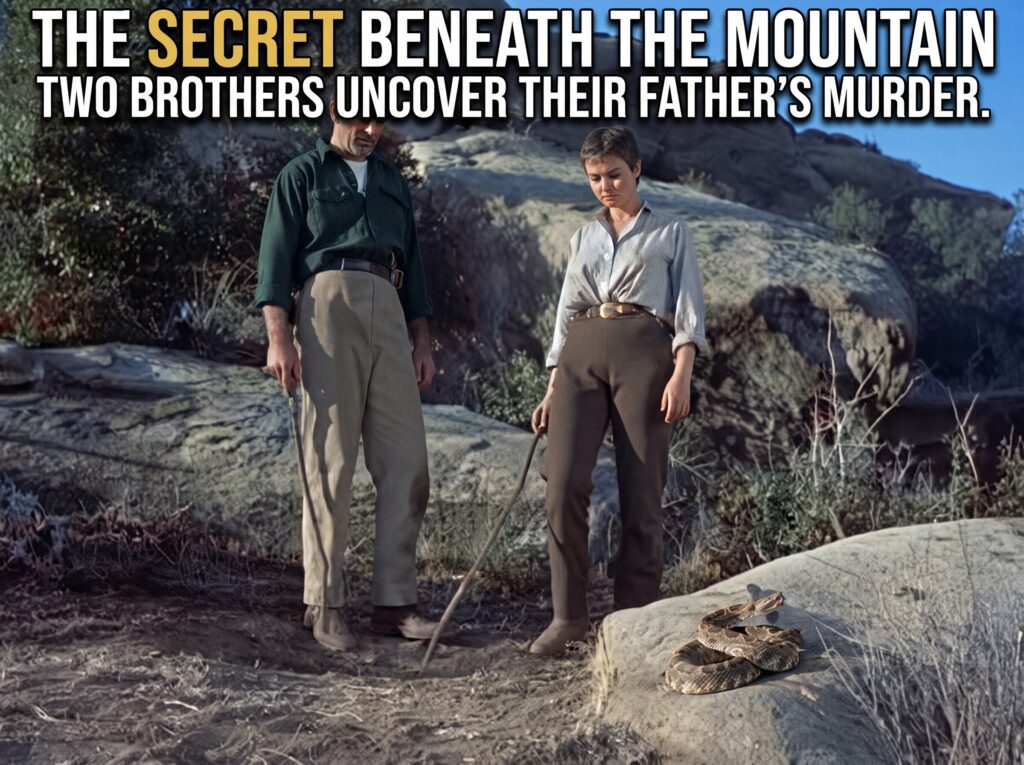
The mountains surrounding Black Ridge had a reputation among the settlers of Red Creek.
People said the peaks swallowed travelers, that sudden storms could trap a man for days, and that strange lights sometimes appeared near the abandoned mines after sunset.
Daniel Mercer had never believed in mountain legends.
At twenty-four, he was practical, stubborn, and determined to build a life that did not depend on the mistakes of his family. He had spent the past two years working as a ranch hand, saving enough money to purchase a small piece of land beyond the river.
His older brother, Samuel, was different.
At thirty-one, Samuel carried himself like a man who had already witnessed too much. He rarely smiled, avoided talking about their childhood, and kept a loaded revolver beneath his coat even when walking through familiar country.
Their father, William Mercer, had died twenty years earlier.
According to the official account, William had been killed during a robbery near the silver mines. His horse had returned to the ranch without him, and a sheriff had eventually declared him dead.
No body had ever been found.
Their mother had refused to discuss the incident. She raised her sons alone, worked herself sick, and died when Daniel was seventeen.
Before her death, she gave Samuel a sealed envelope.
Inside was a rough map of Black Ridge and a note written in their father’s handwriting.
When the mountain gives back what it took, trust your brother—but do not trust the man who wears the silver star.
Samuel had kept the note hidden for seven years.
Only recently had he agreed to show it to Daniel.
“Why now?” Daniel had asked when they left Red Creek.
Samuel tightened the strap of his saddlebag.
“Because I think I know who killed Papa.”
The name he gave was Silas Crowe, a wealthy ranch owner who controlled much of the land surrounding Red Creek. Crowe had arrived in the territory shortly before William disappeared and had purchased several abandoned mining claims for almost nothing.
He now owned a sprawling ranch, a general store, and enough influence to make the local sheriff obey him.
Samuel believed their father had discovered something that Crowe wanted buried.
“What could Papa have found that was worth twenty years of silence?” Daniel asked.
Samuel had no answer.
For three days, they followed the map through narrow valleys, across dry creek beds, and up a steep trail marked by ancient stone cairns.
On the fourth morning, they reached a clearing beneath a towering wall of granite.
That was where Daniel saw the strange bones.
He crouched beside the rock, brushing away the loose dirt.
The remains were unmistakably human.
A corroded belt buckle lay near the ribs. Beside it was a brass medallion engraved with the initials W.M.
Daniel’s hands began to shake.
“Samuel.”
His brother stood motionless behind him.
“That’s Papa’s.”
“I know.”
“How did it get here?”
Samuel looked toward the ridge.
“Because this is where he was murdered.”
Daniel rose abruptly.
“You knew?”
Samuel did not answer.
“You knew our father was buried here, and you brought me anyway?”
“I suspected.”
“You let me believe we were searching for silver.”
Samuel finally met his eyes.
“I brought you because I cannot do this alone.”
Daniel looked back at the bones.
Then he noticed something beneath the edge of the rock: a small metal box, almost completely covered by packed earth.
He pulled it free.
The lid bore a symbol he had seen before on an old document in his mother’s trunk—a black crow perched above a crossed pair of pistols.
Silas Crowe’s personal emblem.
Samuel reached for the box.
Daniel held it back.
“Not until you tell me everything.”
His brother looked exhausted.
“Then we had better find somewhere safe to talk.”
Far below them, a rifle cracked.
A bullet struck the stone beside Daniel’s hand.
Samuel grabbed his brother’s collar and dragged him behind the boulder.
“They found us,” he whispered.
Through a gap in the rocks, Daniel saw three riders climbing the trail.
The man at their head wore a silver sheriff’s star.
And the rider beside him was Silas Crowe.
4. Part 2 — The Man with the Silver Star
The brothers remained hidden until the riders passed the first bend in the trail.
Samuel knew the mountain better than Daniel did. He led them through a narrow passage between two cliffs, then down a steep slope covered in loose stones.
Behind them, men shouted.
A second rifle shot echoed across the valley.
Daniel stumbled, catching himself against a pine tree.
“Who are those men?”
“Silas Crowe and Sheriff Harlan.”
“The sheriff is helping him?”
“He has been helping him for twenty years.”
Daniel stared at his brother.
“How do you know?”
Samuel pulled a folded paper from his coat.
It was an old deposition signed by a former mine worker who had disappeared shortly after William’s death.
The witness claimed that Crowe had arranged an illegal shipment of silver from the abandoned mines. William had discovered the operation and threatened to expose it.
Two days later, William vanished.
The sheriff’s report stated that the mine worker had been killed during a robbery. But the witness had left behind a letter suggesting that both men had been murdered to silence them.
“Where did you get this?” Daniel asked.
“From a man who worked for Crowe.”
“Who?”
Samuel hesitated.
“Our father.”
Daniel looked at him in disbelief.
“What do you mean?”
Samuel explained that William had once worked as a bookkeeper for Crowe’s mining operation. He had discovered that silver was being stolen and that the sheriff was receiving payments to ignore the thefts.
William had copied the records and planned to deliver them to a territorial investigator.
But someone had betrayed him.
Samuel had spent years trying to identify that person.
He had finally found a surviving witness who claimed that William had been lured to Black Ridge by a member of his own household.
Daniel felt the world tilt beneath him.
“You think someone in our family helped kill Papa?”
Samuel nodded.
“Someone knew about the meeting. Someone knew where he would be.”
Daniel thought of their mother, who had spent the rest of her life refusing to discuss William’s disappearance.
“Was it Mama?”
“No.”
Samuel answered too quickly.
Daniel noticed.
“How can you be certain?”
“Because she spent twenty years trying to find out what happened to him.”
“Then who?”
Samuel looked away.
Before he could answer, they heard horses approaching from above.
The brothers hurried toward an abandoned hunting cabin hidden in a narrow valley. Its roof sagged, and the door hung crookedly from one hinge, but it offered shelter from the wind.
Inside, Samuel set the metal box on a rough table.
Daniel examined the lock.
It had been forced once before, then repaired.
He worked a small knife into the seam until the lid finally opened.
Inside lay three objects: a folded map, a brass key, and a photograph of two men standing outside a mining office.
One was their father.
The other was Silas Crowe.
On the back of the photograph, someone had written a date.
The day before William disappeared.
Daniel turned the photograph over again.
Something about the second man’s face bothered him.
He recognized the man standing beside Crowe.
It was not the sheriff.
It was their uncle, Nathan Mercer.
Nathan had died when Daniel was a child.
Or so Daniel had always been told.
5. Part 3 — The Uncle Who Never Died
Daniel had only a few memories of Nathan Mercer.
He remembered a tall man with a crooked smile, a silver pocket watch, and a habit of bringing peppermint sweets whenever he visited the ranch.
His mother had told him Nathan died in a mining accident before Daniel was born.
Yet the photograph proved that Nathan had been alive on the very day William disappeared.
Daniel placed it on the table.
“Sam, why is Uncle Nathan standing beside Crowe?”
Samuel’s face became unreadable.
“Because Nathan worked for him.”
“That doesn’t explain why Mama said he was dead.”
“No.”
Samuel sat down heavily.
“After Papa disappeared, Nathan came to the ranch one night. He told Mama that Papa had been killed and that Crowe would come for us if we asked questions.”
Daniel stared at him.
“You remember that?”
“I was eleven. I was awake when Nathan came through the kitchen.”
“Why didn’t you tell me?”
“Because Mama made me promise never to speak of it.”
Samuel reached into his saddlebag and removed a small leather journal.
The pages were filled with dates, names, and brief notes in their father’s handwriting.
The final entry read:
Nathan knows what Crowe has done. If he has any courage left, he will help me bring the truth to light.
Daniel felt anger rising.
“Did Nathan betray him?”
“I don’t know.”
“You have spent years searching for the truth. Surely you found something.”
Samuel looked toward the cabin window.
“I found a grave.”
He explained that three months earlier, he had visited a small settlement beyond the eastern mountains. An elderly rancher had told him about a man named Nathan who lived alone near an abandoned mission.
The rancher claimed Nathan had returned from Black Ridge with a wounded shoulder and a large amount of money. Within a year, he had disappeared again.
Samuel had followed the trail to the mission and found a grave marked with a wooden cross.
The name on the cross was Nathan Mercer.
But the grave was empty.
Someone had disturbed the earth recently.
Daniel felt a cold shiver.
“Then Uncle Nathan could still be alive.”
“Or someone wants us to believe he is.”
A sudden noise came from outside.
Both brothers reached for their weapons.
A figure appeared in the doorway.
It was an elderly man with a gray beard, a weathered face, and a silver pocket watch hanging from his vest.
He raised both hands.
“Don’t shoot.”
Samuel went pale.
The man looked at Daniel.
“You have your father’s eyes.”
Daniel could barely speak.
“Uncle Nathan?”
The old man nodded.
“I have waited twenty years for someone to find that box.”
Samuel drew his revolver.
“You left Papa to die.”
Nathan lowered his head.
“Yes.”
The answer was so quiet that it took Daniel a moment to understand it.
Nathan stepped inside and shut the door.
“I was a coward. I thought I could protect my brother by keeping silent. Instead, I helped the man who murdered him.”
Samuel’s gun remained raised.
“Tell us everything.”
Nathan looked at the photograph on the table.
“Then you had better listen carefully. Because the man who killed your father is not the only person who will come after you.”
He opened his pocket watch.
Inside the case was a tiny folded note.
It contained the location of a second mine, one that did not appear on any official map.
Nathan pointed to the note.
“Your father discovered that Crowe was hiding something beneath the mountain. Something worth killing for.”
Daniel looked at the bones outside the cabin.
“What was it?”
Nathan’s expression darkened.
“A shipment of stolen silver, and the names of every man who helped him steal it.”
He paused.
“And one of those names belongs to the man who is now trying to become governor of this territory.”
6. Part 4 — The Mine Without a Name
Nathan led the brothers to the second mine before sunset.
The entrance lay behind a curtain of thorn bushes at the base of a narrow ravine. An old timber beam marked the opening, but the mining company’s name had been deliberately scraped away.
Inside, the air smelled of damp earth and rust.
Samuel carried a lantern.
Daniel followed with the brass key from the metal box.
Nathan walked behind them, occasionally stopping to listen.
“Why did you come back now?” Daniel asked.
Nathan did not answer immediately.
“Because Crowe has started buying land again. He believes the evidence your father hid is still somewhere on this mountain. When he learned that you were following the old trail, he knew the secret might finally be exposed.”
They reached a chamber containing several rotting crates.
Most were empty.
One had been sealed with an iron lock.
Daniel inserted the brass key.
The lock opened.
Inside lay bundles of account books wrapped in oilcloth, a leather pouch of silver coins, and a packet of letters tied with faded ribbon.
Samuel opened the first account book.
The pages contained detailed records of shipments, payments, and bribes made to local officials.
Crowe had not merely stolen silver.
He had used the profits to purchase land from families who had been forced into debt, then arranged for their homes to be seized when they could not repay their loans.
The sheriff had falsified property records.
Several local merchants had helped conceal the transactions.
And a powerful politician had received money through a chain of false companies.
Daniel looked up.
“This could bring down half the town.”
“That was your father’s intention,” Nathan said.
Samuel turned another page.
There was a list of names beside the amounts paid to each man.
At the bottom was a final entry.
Nathan Mercer — $2,000.
Samuel stared at his uncle.
“You took the money.”
Nathan closed his eyes.
“Yes.”
Daniel stepped away from him.
“You sold Papa out for two thousand dollars?”
“I believed Crowe would let your father go. I thought the money would buy us time.”
“And when you discovered what happened?”
Nathan’s voice broke.
“I ran.”
Samuel’s hand tightened around the account book.
“For twenty years, we believed our father had been murdered by strangers. You let us live with that lie.”
Nathan did not defend himself.
“I know.”
Outside the mine, a horse whinnied.
Then came the sound of boots on gravel.
Crowe’s voice echoed through the entrance.
“Mr. Mercer! I know you’re in there.”
Samuel extinguished the lantern.
They heard several men entering the mine.
Crowe continued speaking.
“Put down the books, and I will allow you to walk out alive.”
Daniel looked at his brother.
Samuel shook his head.
They had no clear escape route.
Nathan quietly pointed toward a narrow passage at the back of the chamber.
“There is another exit. It leads to the river.”
“Come with us,” Daniel whispered.
Nathan looked toward the entrance.
“Not yet.”
He handed Daniel the packet of letters.
“Take these. Get them to the territorial investigator in Red Creek.”
Samuel grabbed his uncle’s arm.
“We are not leaving you.”
Nathan looked at him with tired eyes.
“You have spent your whole life believing that courage means never running away. Sometimes courage means staying behind long enough to give someone else a chance.”
He pushed them toward the passage.
Daniel hesitated.
Nathan placed a hand on his shoulder.
“Your father loved you both. Don’t let my mistakes become your inheritance.”
The brothers disappeared into the darkness.
Behind them, Nathan stepped into the main chamber and raised his hands.
Crowe’s men surrounded him.
The last thing Daniel heard was his uncle saying:
“You have searched for twenty years, Silas. Now the truth has finally found you.”
Then a gunshot echoed through the mountain.
7. Part 5 — The Price of Silence
Daniel and Samuel emerged beside the river after nightfall.
They were exhausted, bruised, and carrying the only evidence capable of exposing Crowe’s operation.
But Nathan was gone.
Samuel sat on a rock and stared at the dark water.
“He knew he was going to die.”
Daniel opened the packet of letters.
“Maybe not.”
The first letter was addressed to their father. It contained a detailed account of the mining operation and a list of men who had helped Crowe conceal the stolen silver.
The second letter was different.
It was addressed to their mother.
Samuel took it with trembling hands.
Their mother’s handwriting appeared on the envelope, indicating that she had received it decades earlier.
Inside was a confession from Nathan.
He admitted that he had accepted money from Crowe and revealed William’s meeting place. But he also claimed that he had attempted to stop the murder once he realized Crowe intended to kill his brother.
He had arrived too late.
Nathan had buried William beneath the granite outcrop, then removed the evidence that could identify the killers.
He had returned to the ranch and warned their mother to keep the boys away from Black Ridge.
The final paragraph explained why he had never come forward.
Silas threatened to kill your sons if I spoke. I believed that by remaining silent, I could keep them alive. I know now that I have protected no one. I have only allowed evil to continue.
Daniel lowered the letter.
Their mother had known the truth.
She had carried the burden alone because she believed it was the only way to protect her children.
Samuel stood abruptly.
“We have to go back.”
Daniel grabbed his arm.
“And get ourselves killed? Nathan gave us the evidence for a reason.”
“He is our uncle.”
“And Papa was our father. If we fail now, everything they suffered will mean nothing.”
Samuel looked away.
For a long time, neither brother spoke.
Finally, Daniel unfolded the map.
“The river leads to Red Creek. We can reach the investigator before Crowe knows where we’ve gone.”
Samuel shook his head.
“The sheriff will intercept us.”
“Then we avoid the town.”
“There are only two roads across the valley.”
“Then we take the river trail.”
Samuel studied him.
For the first time since their journey began, Daniel saw something like respect in his brother’s expression.
“All right,” Samuel said. “We take the river trail.”
They traveled through the night, keeping to the trees and stopping only when the horses needed water.
Near dawn, they reached a small homestead where an elderly woman gave them food and allowed them to rest.
She recognized the family name.
“William Mercer was a good man,” she said. “He helped my husband when the mining company tried to take our land.”
Daniel asked whether she had ever heard of Silas Crowe.
The woman’s face hardened.
“Everyone in this valley has heard of him. Most are too afraid to speak.”
“Would you testify against him?”
She looked at the brothers.
“If someone finally stands up to him, I will.”
It was the first sign that they might not be alone.
By noon, they had gathered statements from three families who had lost their land through fraudulent debts.
They also found a former mine worker willing to confirm the contents of the account books.
The evidence was becoming stronger.
But when the brothers finally reached the road leading toward Red Creek, they found a notice nailed to a wooden post.
It carried their names.
They were accused of murdering Nathan Mercer and stealing property from Silas Crowe.
The notice offered a reward for their capture.
At the bottom was the sheriff’s signature.
Samuel tore the paper from the post.
“They have made us the criminals.”
Daniel looked toward the distant town.
“Then we will have to let the truth speak louder than they do.”
8. Part 6 — The Town That Refused to Look Away
Red Creek had changed during the years Daniel had been away.
New buildings lined the main street. A second bank had opened beside the general store, and a large wooden platform had been erected outside the courthouse for public speeches.
Silas Crowe’s name appeared on posters announcing his campaign for territorial governor.
The town looked prosperous.
But behind the painted shopfronts were families living in debt, workers afraid to speak, and landowners who had been forced to abandon their farms.
Daniel and Samuel entered the town after dark.
They went first to the office of Judge Elias Whitmore, a former territorial prosecutor who had recently returned to Red Creek.
Whitmore examined the account books and letters for nearly two hours.
When he finished, he removed his spectacles.
“This is enough to begin an investigation. But if Crowe learns that I have these records, he will try to destroy them.”
Samuel leaned forward.
“Can you arrest him?”
“Not without corroborating testimony. The sheriff controls the local jail, and the governor’s office has already received complaints against Crowe that somehow disappeared.”
Daniel placed the statements from the local families on the desk.
“These people are willing to testify.”
Whitmore nodded.
“That will help.”
He paused.
“But we need one thing more: proof that Crowe ordered your father’s murder.”
Samuel handed him the letter from Nathan.
Whitmore read it carefully.
“Your uncle’s confession is valuable, but Crowe will claim it was fabricated.”
“Then we find the man who fired the shot,” Daniel said.
Whitmore looked up.
“There was another witness?”
Samuel nodded.
“A former mine guard named Caleb Turner. He was the last person to see our father alive.”
“Where is he?”
“Somewhere beyond the southern valley. He disappeared after the murder.”
Whitmore placed the documents in a locked drawer.
“Find him. If he confirms the account, I can request a territorial warrant and bring in officers from outside this county.”
Before the brothers left, Whitmore gave them a small badge identifying them as temporary investigators under his authority.
It would not make them invincible, but it might buy them time.
The following morning, Daniel and Samuel began searching for Caleb Turner.
They visited abandoned mining camps, questioned former workers, and followed old employment records to a settlement near the southern border.
At the third camp, a woman recognized the name.
“Caleb lived here for years,” she said. “He left last winter after receiving a letter.”
“What did the letter say?” Daniel asked.
She shook her head.
“He burned it. But he told me that the past had finally caught up with him.”
The woman gave them the name of a town where Caleb might have gone.
Before they could leave, a group of riders entered the camp.
At their head was Sheriff Harlan.
“Daniel Mercer. Samuel Mercer. You are under arrest for murder and theft.”
Daniel reached for his badge.
“We are acting under the authority of Judge Whitmore.”
Harlan laughed.
“Whitmore has no authority here.”
Several riders dismounted.
Samuel moved closer to Daniel.
For a moment, it seemed the brothers would have to fight their way out.
Then the camp’s residents began stepping forward.
One man carried a shovel. Another held a rifle. An elderly farmer stood beside the woman who had spoken to Daniel.
“You won’t take them,” the farmer said.
Harlan stared at the gathering crowd.
“These men are criminals.”
“They brought us evidence of the stolen land,” the farmer replied. “And I have records of my own.”
One by one, the residents began speaking.
They described false debts, threats, missing documents, and payments made to the sheriff.
For the first time in years, the town’s silence began to break.
Harlan realized he could not arrest the brothers without creating a public confrontation.
He mounted his horse.
“This is not over.”
Daniel watched him ride away.
“No,” he said quietly. “It isn’t.”
9. Part 7 — The Witness in the Abandoned Church
Caleb Turner was found living in an abandoned church beyond the southern valley.
He was a thin, gray-haired man with a stiff leg and a permanent tremor in his right hand.
When Daniel introduced himself, Caleb shut the door.
“I told myself this day would never come.”
Samuel stepped forward.
“Our father was William Mercer.”
Caleb closed his eyes.
“I know who you are.”
“Then you know why we’re here.”
The old man remained silent for a long time.
Finally, he allowed them inside.
Caleb explained that he had worked as a guard at Crowe’s mining operation. On the night William disappeared, he had been ordered to stand watch near Black Ridge.
He saw Nathan arrive first.
Then William appeared, carrying a leather satchel.
The two brothers argued.
Nathan begged William to surrender the documents and leave the territory.
William refused.
He believed the records would expose Crowe’s crimes and restore the land taken from local families.
A few minutes later, Crowe arrived with Sheriff Harlan.
Caleb heard gunshots.
When he reached the clearing, William was dead, Nathan was wounded, and Crowe was ordering the sheriff to remove the body.
Caleb had wanted to testify, but Crowe threatened his wife and children.
He fled the territory.
Years later, he learned that his wife had died and his children had moved away. With nothing left to protect, he had returned to the church and waited for the day someone would ask him to speak.
Samuel sat down heavily.
“You watched them kill our father.”
Caleb lowered his head.
“Yes.”
“And you said nothing.”
“I was a coward.”
Samuel’s expression hardened.
“Do you know how many years we spent believing we would never know what happened to him?”
“I do.”
Caleb looked directly at him.
“And I will carry that shame until I die. But I will testify.”
Daniel reached across the table.
“Then you can help us bring the truth into the open.”
Caleb nodded.
Together, they returned to Red Creek and gave their statements to Judge Whitmore.
The judge immediately sent a request for outside officers and a formal warrant.
But Crowe learned about the testimony before the documents could be delivered.
That night, the abandoned church caught fire.
Daniel and Samuel arrived in time to pull Caleb from the building. The old man had suffered smoke inhalation, but he was alive.
As they carried him outside, Caleb caught Daniel’s arm.
“Listen to me.”
Daniel knelt beside him.
“Crowe knows the evidence is enough. He will try to destroy the records before the warrant arrives.”
“Where?”
“The courthouse. He has a man inside who can reach the evidence room.”
Caleb struggled to breathe.
“His name is Deputy Miller.”
Daniel stood.
Samuel had already begun saddling the horses.
They had less than a day to protect the evidence.
And this time, they would not be running from the mountain.
They would be riding straight into the town that had allowed Crowe to rule it through fear.
10. Part 8 — The Night the Records Burned
The courthouse stood at the center of Red Creek, its white columns illuminated by the moon.
Daniel and Samuel approached from the rear, leaving their horses behind a row of trees.
Through a narrow window, they saw Deputy Miller carrying a box of papers toward the basement.
Samuel whispered, “He is destroying the evidence.”
Daniel nodded.
They entered through the side door and followed him down the stairs.
Miller had already opened the records room.
Several account books lay on the floor, and a small fire burned in an iron brazier.
Daniel stepped into the doorway.
“Put the papers down.”
Miller spun around.
For a moment, neither man moved.
Then Miller reached for his revolver.
Samuel struck the weapon from his hand.
The deputy fell against a shelf, scattering documents across the floor.
Daniel stamped out the flames while Samuel restrained Miller.
“Why would you help Crowe?” Daniel demanded.
Miller struggled against his grip.
“He owns half this town.”
“That is not an answer.”
Miller looked at the scattered papers.
“He promised me a position in the territorial government. He said I would never have to worry about money again.”
Daniel felt a bitter anger rise within him.
“People lost their homes because of him.”
Miller lowered his eyes.
“I know.”
The brothers gathered the surviving records and carried them upstairs.
By dawn, Judge Whitmore had received the evidence, Caleb’s sworn statement, and testimony from several families whose land had been stolen.
The territorial officers arrived shortly after sunrise.
Silas Crowe was arrested at his ranch.
Sheriff Harlan was removed from office and charged with corruption, obstruction of justice, and conspiracy.
The investigation revealed that Crowe had spent years manipulating land records, stealing silver, bribing officials, and intimidating witnesses.
The mountain had hidden his crimes, but it had not erased them.
During the trial, Daniel and Samuel sat together in the front row.
Crowe entered the courtroom wearing a dark suit and an expression of injured dignity.
He insisted that the evidence had been fabricated.
He claimed that Nathan had lied, that Caleb was seeking revenge, and that the Mercer brothers wanted the family land for themselves.
But the account books matched the bank records.
The letters matched Crowe’s handwriting.
And the witnesses described the same pattern of threats, payments, and false claims.
When Caleb Turner took the stand, the courtroom fell silent.
He described the night William Mercer was killed.
He explained how Nathan had helped arrange the meeting and how Crowe had ordered the murder.
Then he looked directly at Crowe.
“I stayed silent for twenty years because I was afraid. I will not die carrying that silence any longer.”
The jury found Crowe guilty of murder, fraud, and conspiracy.
The sheriff and Deputy Miller were also convicted of crimes connected to the scheme.
The stolen land was returned to its rightful owners where possible, and the remaining assets were used to compensate the families who had suffered losses.
For the first time in two decades, Red Creek could begin to heal.
But Daniel and Samuel still had one final journey to make.
They needed to return to Black Ridge and give their father the burial he had been denied.
11. Part 9 — The Grave Beneath the Granite
The brothers returned to the mountain in early autumn.
This time, they traveled without fear of being followed.
The trail was quiet, and the air smelled of pine needles and dry earth.
At the granite outcrop, Daniel knelt beside the place where they had first discovered the bones.
Samuel stood nearby, holding the brass medallion.
For a long time, neither brother spoke.
Then Samuel said, “I used to think finding Papa would make everything right.”
Daniel looked up.
“And now?”
“Now I think it only gives us a chance to stop carrying the wrong answers.”
They arranged for their father’s remains to be moved to the family cemetery.
A simple stone was placed above the grave, bearing William Mercer’s name and the dates of his life.
No mention was made of the stolen silver or the murder.
Those details belonged in the court records.
The stone carried a different message:
He stood for what was right, even when the world turned against him.
After the burial, the brothers remained beside the grave until sunset.
Samuel finally spoke about their mother.
“She knew the truth. She spent years afraid that Crowe would come for us.”
Daniel nodded.
“She tried to protect us.”
“I wish I had understood her better.”
“So do I.”
Samuel looked across the cemetery.
“I spent so long blaming everyone that I forgot how much she had sacrificed.”
Daniel placed a hand on his brother’s shoulder.
“We cannot change what happened. But we can decide what we do with what we have left.”
Samuel gave a small, weary smile.
For years, the brothers had been divided by suspicion, silence, and grief.
Now they had the truth.
It did not restore their childhood or bring their parents back.
But it allowed them to stop searching for enemies in every shadow.
Before leaving the cemetery, Daniel placed the brass medallion on their father’s grave.
It had been the first clue that led them to Black Ridge.
Now it could rest with the man who had carried it.
As the brothers walked down the hill, the evening sun fell across the valley.
The mountains looked unchanged.
But Daniel understood that the landscape had never been the true prison.
It was the fear that had kept people silent.
And once that fear was broken, the mountain became simply a mountain again.
12. Part 10 — What the Mountain Gave Back
One year later, Red Creek held a gathering to celebrate the return of the stolen land.
Families who had once been forced from their farms returned to rebuild their homes. The abandoned mine was closed permanently, and a portion of the recovered money was used to establish a fund for workers injured in the mines.
Daniel purchased a small ranch near the river.
He planted apple trees, repaired the fences, and built a modest house with a wide porch where he could watch the sun set over the mountains.
Samuel chose to remain in Red Creek, helping Judge Whitmore organize the property records and ensuring that no family would again lose its land through forged debts.
Their relationship was different now.
They still disagreed sometimes, but neither mistook silence for strength.
Every few weeks, Samuel rode to the ranch for supper.
They talked about their father, their mother, and the years they had lost.
They also talked about the future.
One evening, as the light faded over the valley, Samuel arrived carrying a small wooden box.
“I found this among Nathan’s belongings,” he said.
Daniel opened it.
Inside was a letter from their uncle, written shortly before his death.
It contained no excuses.
Nathan admitted that he had chosen money and fear over loyalty to his brother. He wrote that he had spent the remainder of his life trying to undo the damage he had caused, but that he knew no amount of regret could erase his betrayal.
At the end, he had written a message for Daniel and Samuel.
If you ever find peace, do not waste it trying to punish yourselves for what others have done. Remember your father for his courage, remember your mother for her love, and remember me as a warning that a single act of cowardice can grow into a lifetime of sorrow.
Daniel folded the letter.
“Do you forgive him?” Samuel asked.
Daniel looked toward the mountains.
“I don’t know if forgiveness is something we owe him.”
He paused.
“But I know we don’t have to spend the rest of our lives hating him.”
Samuel nodded.
They sat together until the stars appeared.
The following spring, Daniel planted a tree beside the family cemetery.
Samuel helped him dig the hole, and together they placed a small wooden marker at its base.
It carried no name, only a simple inscription:
Truth may sleep beneath the earth, but it is never truly lost.
Years later, travelers passing through Red Creek would hear stories about the brothers who exposed Silas Crowe’s crimes.
Some would describe them as heroes.
Others would say they were simply men who refused to abandon a question that deserved an answer.
Daniel never corrected the stories.
He knew that the real victory had not been the conviction of a powerful man or the recovery of stolen silver.
It had been the moment when people who had lived in fear finally chose to speak.
And whenever he looked toward Black Ridge, he remembered the morning he had found his father’s medallion beneath the stone.
He remembered the anger, the fear, and the terrible uncertainty.
Most of all, he remembered the lesson his father had left behind:
A secret can bury the truth for twenty years, but it cannot make a lie become history.
The End.