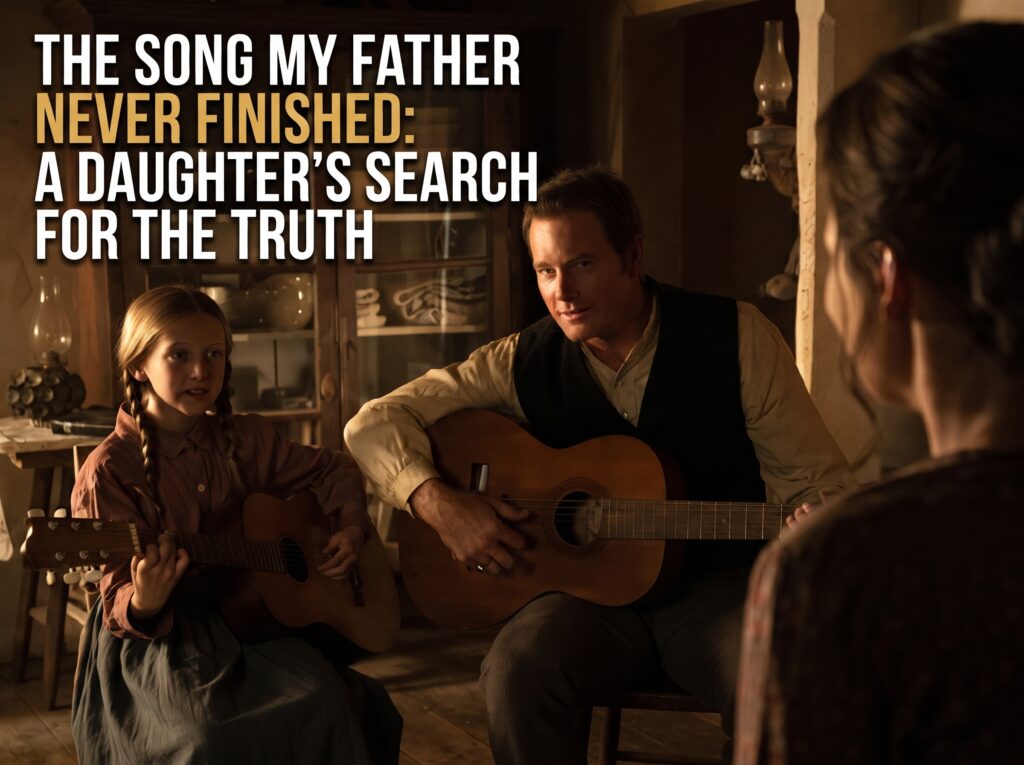
My earliest memories smelled of woodsmoke, fresh bread, and the leather polish Father used on his boots.
Our farmhouse stood beyond the little frontier town of Bellweather, surrounded by tall grass, a crooked wooden fence, and a narrow creek that turned silver whenever the moon rose above the hills.
Father’s name was Thomas Hale.
He was a quiet man who worked hard, spoke little about his past, and never allowed anyone to touch the locked drawer in his bedroom desk. To the people of Bellweather, he was an honest carpenter who had lost his wife and devoted his life to raising his daughter.
To me, he was everything.
Every evening, after supper, he brought his guitar from the cupboard and sat beside the fireplace.
I would climb onto the chair next to him, holding my smaller guitar across my knees.
“Ready, little bird?” he would ask.
“Always.”
He called me his little bird because I loved singing, even though I could never remember all the words.
Our favorite song had no official title. Father called it The River Remembers.
It was a gentle melody, but its final notes sounded strangely sad.
“Why does this song make you look unhappy?” I asked him one evening.
Father stopped playing.
For several seconds, he stared at the fire.
“Because some songs remember things that people try to forget.”
I didn’t understand.
I was seven years old. I believed that every question had an answer and that every sad person could be made happy with a hug.
So I wrapped my arms around his waist.
“Then I’ll play it until you feel better.”
He smiled, but his eyes became wet.
“Promise me something, Clara.”
“What?”
“If someone ever asks you to play this song, don’t change the ending. Not even if they tell you it’s wrong.”
I nodded solemnly.
“I promise.”
He kissed the top of my head and resumed playing.
At the time, I thought it was just another strange thing grown-ups said.
I didn’t know that the melody had been written by my mother.
I didn’t know that she had disappeared on the night I was born.
And I certainly didn’t know that my father had spent seven years teaching me the musical equivalent of a confession.
That evening, someone watched our farmhouse from the darkness beyond the fence.
A man wearing a long brown coat stood beneath the trees, listening to our song.
When Father finished playing, the stranger lowered his head.
Then he whispered a name I had never heard before.
“Elizabeth.”
And he began walking toward our door.
4. Part 2 — The Stranger at the Door
The knock came just after supper.
Father was washing the dishes, and I was sitting on the floor arranging my wooden animals into a line.
Three sharp knocks echoed through the house.
Father froze.
I had never seen him look frightened by a visitor before.
“Stay here,” he said.
He wiped his hands on a towel and crossed the room.
When he opened the door, the stranger stood on the porch, soaked by the rain.
He was tall and thin, with gray hair at his temples and a scar running from his left cheek toward his jaw.
“Thomas Hale,” he said.
Father’s face turned pale.
“You have the wrong house.”
The stranger glanced past him and saw me.
“No,” he replied. “I have the right house. And the right child.”
Father stepped outside and pulled the door almost shut behind him.
“What do you want, Daniel?”
The stranger smiled without humor.
“Seven years of answers.”
“I have nothing for you.”
“You have her.”
I heard those words through the narrow gap in the doorway.
Father’s voice dropped.
“Don’t speak about Clara.”
“Then tell her the truth.”
“There is no truth that would help her.”
Daniel reached inside his coat and removed a folded photograph.
“Your wife would disagree.”
Father grabbed the photograph so quickly that the stranger stepped back.
For a moment, they stood facing each other in the rain.
Then Father whispered, “Where did you get this?”
“From the person who has been searching for your daughter since the night you disappeared with her.”
Father looked toward the house.
I ducked behind the table.
“She doesn’t remember anything,” he said.
“Of course she doesn’t. She was a baby.”
“Then let her live in peace.”
Daniel shook his head.
“You have mistaken silence for peace, Thomas.”
He reached into his pocket again and produced a small silver locket.
I recognized it immediately.
It was identical to the one Father kept inside his locked desk drawer.
The stranger placed it on the porch railing.
“Elizabeth asked me to find her daughter.”
Father stared at the locket.
“Elizabeth is dead.”
“No,” Daniel replied. “She is alive.”
The world seemed to stop.
Father’s hand closed around the wooden railing.
“You’re lying.”
“Then why are you shaking?”
For the first time, Father had no answer.
The stranger stepped away from the door.
“I’ll be staying at the Bellweather Inn. Tomorrow, I’ll return. You can tell Clara the truth yourself, or she can hear it from me.”
He walked into the rain.
Father remained outside long after the stranger disappeared.
When he finally returned, he locked the door, closed the curtains, and checked every window.
Then he sat beside me.
“Clara,” he said quietly, “if anyone comes asking about your mother, you tell them you know nothing.”
I looked at him.
“But I thought Mama was dead.”
Father’s face crumpled for one terrible second.
Then he stood and walked into his bedroom without answering.
That night, I heard him crying behind the locked door.
It was the first time I realized that adults could be afraid of the truth.
5. Part 3 — The Woman in the Photograph
The next morning, I woke before sunrise.
Father was already in the kitchen, packing bread, cheese, and two apples into a leather bag.
“Are we going somewhere?” I asked.
He nearly dropped the knife in his hand.
“Just taking a short trip.”
“Where?”
“To visit an old friend.”
“Can I bring my guitar?”
He looked at the instrument leaning against the wall.
For a moment, I thought he would say no.
Then he nodded.
“Yes, little bird. Bring it.”
We left before the town had fully awakened.
Father avoided the main road and led our horse along the creek toward the northern hills. He kept looking over his shoulder, and every time a rider appeared in the distance, he urged the horse forward.
By midday, we reached an abandoned mill.
Father tied the horse beneath a tree and helped me down.
“Wait here,” he said.
But I followed him inside.
On a table beneath a broken window lay a leather satchel. Father opened it and removed a bundle of letters tied with blue ribbon.
I saw my name written on the first envelope.
For Clara, when she is old enough to understand.
“Is that from Mama?”
Father closed the satchel.
“You shouldn’t be looking at these.”
“Then why did she write to me?”
He stared at the envelope.
“Because she loved you.”
“Where is she?”
He turned away.
I had asked the question a hundred times throughout my childhood. Usually, he answered with the same story: my mother had died after giving birth to me, and there was nothing more to say.
But this time, I had seen the photograph.
I knew there was more.
“Father, is Mama alive?”
His shoulders began to shake.
Before he could answer, a horse approached outside.
Daniel’s voice called from the road.
“Thomas! We need to talk.”
Father grabbed the satchel.
“Stay behind me.”
Daniel entered the mill, his expression changing when he saw the letters.
“You still have them.”
Father’s anger returned.
“You had no right to come here.”
“I have every right. Elizabeth is my sister.”
I looked at him in disbelief.
“You’re my uncle?”
Daniel knelt so that we were at eye level.
“Yes, Clara.”
“Then why have I never met you?”
He glanced at Father.
“Because your father took you away.”
Father stepped forward.
“Enough.”
Daniel ignored him.
“Your mother was accused of stealing money from the Bellweather Land Company. She discovered that the company’s owner was forging property deeds and taking farms from families who couldn’t repay their loans.”
“That isn’t true,” Father said.
Daniel looked at him sharply.
“You helped her investigate.”
“I was trying to protect her.”
“You helped her find the evidence. Then you disappeared with the child and left her to face the accusations alone.”
I felt as if the floor had vanished beneath me.
Father had always told me he was an honest man.
He had never said anything about stolen money, false accusations, or a mother who was still alive.
Daniel placed the photograph on the table.
“Your mother has spent seven years trying to find you.”
I touched the photograph with trembling fingers.
The young woman had soft brown hair, kind eyes, and a smile that looked strangely familiar.
I had her eyes.
I had her smile.
For the first time, I could see myself in someone other than Father.
“Where is she?” I whispered.
Daniel answered gently.
“At home, Clara. Waiting for you.”
6. Part 4 — What My Father Had Hidden
I refused to leave with Daniel until Father explained everything.
He sat on the edge of the mill table, looking older than I had ever seen him.
“Your mother and I met in Bellweather,” he began. “She was a schoolteacher. I repaired wagons and furniture. We had very little money, but we were happy.”
He told me that Elizabeth had discovered irregularities in the accounts of a powerful landowner named Charles Whitlock.
Whitlock was buying farms through a network of false debts and forged signatures. Families who challenged him were threatened, and several witnesses had disappeared.
Elizabeth collected documents proving the fraud.
Father helped her hide copies in places Whitlock would never think to search.
Then someone betrayed them.
Whitlock’s men raided their home, seized their records, and accused Elizabeth of stealing the company’s money.
Father escaped with me, believing that if he remained near her, Whitlock would use the child against her.
“I thought I could return once it was safe,” he said.
“Why didn’t you?”
“Because I was afraid.”
The answer was so simple that it hurt.
I had imagined that my father was a hero who had saved me from some terrible accident.
Instead, I learned that he had made a choice based on fear—and had spent seven years hiding behind it.
“What about Mama?” I asked.
“She was arrested. Her reputation was destroyed. I was told she had died in prison.”
Daniel shook his head.
“That was a lie. She was released after the charges collapsed, but Whitlock had already convinced the town that she was a criminal. She spent years trying to find you.”
Father covered his face with his hands.
“I believed she was dead.”
“You never checked,” Daniel replied.
“I couldn’t risk Clara.”
“You never checked,” Daniel repeated, more quietly this time.
I stood between them, clutching the photograph.
“Did Mama write those letters?”
Father nodded.
“Every year. I received them through a friend.”
My heart pounded.
“You received letters from her and never gave them to me?”
He looked at me, and I saw the shame in his face.
“I thought it would be safer if you forgot her.”
“How could I forget someone I never knew?”
He began to cry.
I wanted to comfort him. I wanted to wrap my arms around him and tell him that everything would be all right.
But I also wanted to scream.
For seven years, I had believed my mother was in heaven.
For seven years, I had prayed that she was watching over me.
And all that time, she had been alive, writing letters to a daughter who never knew she existed.
Daniel placed a hand on my shoulder.
“We should go.”
I looked at Father.
“Are you coming?”
He hesitated.
Then he nodded.
“Yes, little bird.”
We rode toward Bellweather as the sun descended behind the hills.
For the first time, I wondered whether the song Father had taught me was not a memory of my mother’s love.
Perhaps it was an apology he had never found the courage to speak.
7. Part 5 — The Woman Who Never Stopped Waiting
We reached Bellweather two days later.
Daniel led us to a small cottage beyond the church, where white flowers grew beside the front steps. An elderly woman was sweeping the porch when we arrived.
She looked up.
Then she dropped the broom.
“Thomas?”
Father dismounted slowly.
“Margaret.”
The woman stared at him for several seconds before rushing down the steps.
“You fool,” she whispered, striking his chest with both hands. “You absolute fool.”
Then she embraced him.
I had never seen anyone greet Father that way.
Margaret was my mother’s closest friend. She had helped Elizabeth after her release from prison and had kept every letter she wrote to me.
“Your mother is staying at the old schoolhouse,” she told me. “She goes there every afternoon because she thinks you might somehow remember the place.”
I looked at Father.
He couldn’t meet my eyes.
We walked to the schoolhouse just before sunset.
The building stood beside a meadow, with an old bell hanging above its entrance. Inside, sunlight fell across rows of wooden desks and a blackboard covered with children’s handwriting.
A woman stood near the window.
She had brown hair streaked with silver and wore a simple blue dress. Her hands were folded tightly in front of her.
When she turned, I saw the face from the photograph.
She looked at me as though she were afraid that even a breath might make me disappear.
“Clara?”
I couldn’t answer.
She took one cautious step forward.
“I don’t expect you to remember me.”
I stared at her.
“Are you my mother?”
Tears filled her eyes.
“Yes, sweetheart.”
I had imagined this moment many times since seeing the photograph. I thought I would run into her arms, cry against her shoulder, and somehow recover all the years we had lost.
Instead, I stood perfectly still.
She seemed to understand.
“You don’t have to call me Mama yet,” she whispered. “You don’t owe me anything. I only wanted to see you with my own eyes.”
That was what finally broke me.
I ran toward her.
She dropped to her knees and caught me in her arms.
Her dress smelled of lavender and fresh linen. Her hands trembled as she held my face, touching my cheeks and brushing the hair from my forehead.
“I thought I would never see you again,” she whispered.
I clung to her.
“Why didn’t you come for me?”
She closed her eyes.
“I tried, Clara. I tried every day.”
Behind us, Father stood in the doorway.
Mother looked up at him.
For a long moment, neither spoke.
Then she rose slowly.
“You took seven years from us.”
Father lowered his head.
“I know.”
“You let me believe you were dead. You let our daughter believe I was dead.”
“I was afraid.”
Mother’s expression hardened.
“So was I, Thomas. But I never stopped looking.”
Father had no defense.
Mother turned back to me, gently taking my hand.
“Come inside, sweetheart. There are so many things I want to tell you.”
That evening, she made supper while I sat beside her in the kitchen.
She asked about my favorite foods, the songs I liked, and whether Father had taught me to read.
I told her about the farmhouse, the creek, and the guitar.
When I mentioned The River Remembers, she stopped cutting the bread.
“Where did you learn that song?”
“Father taught me.”
Mother sat down.
For the first time since our reunion, her face became frightened.
“Clara, did he teach you every note?”
“Yes.”
She covered her mouth.
Then she began to cry.
Because that song had never been merely a lullaby.
It was a map.
And the last four notes were the key.
8. Part 6 — The Four Notes
Mother waited until Father had left the cottage before explaining the truth.
Years earlier, she had discovered that Charles Whitlock was using forged deeds to steal farms from struggling families. She had copied the company’s records and hidden the originals somewhere Whitlock would never find them.
The records included the names of every person involved in the scheme, along with evidence of bribery, intimidation, and several suspicious deaths.
“I knew I might be arrested,” she told me. “So I needed a way to preserve the evidence even if someone took everything else.”
She had composed The River Remembers as a children’s song.
The melody contained a sequence of musical notes corresponding to the numbers of a locked cabinet at the old Bellweather schoolhouse.
The last four notes indicated the order in which the cabinet’s hidden compartments had to be opened.
“Your father helped me create the code,” she said. “But he was supposed to return the evidence to me before he left town.”
“Why didn’t he?”
Mother looked toward the window.
“Because he believed that running away was the only way to save you.”
I thought about the years Father had spent teaching me the song.
“Did he know what the notes meant?”
“Yes.”
“Then why teach them to me?”
Mother’s expression softened.
“Because he wanted you to remember something he could not say aloud. He loved you too much to tell you the truth, and he was too afraid to face what he had done.”
The next morning, Mother took me to the schoolhouse.
We entered a narrow storage room behind the classroom and moved a cabinet away from the wall.
Beneath it was a small iron door.
Mother inserted a key and turned it.
Inside lay a bundle of papers wrapped in oilcloth.
She opened them carefully.
There were copies of land deeds, financial ledgers, letters signed by Whitlock, and a list of payments made to men who had threatened witnesses.
At the bottom was a sealed envelope bearing my name.
For Clara, when she is old enough to understand.
My hands trembled as I opened it.
The letter was from my mother.
It had been written before my first birthday.
My dearest little girl,
If you are reading this, it means that the world has kept us apart longer than I ever believed possible.
You may hear stories about me. You may be told that I was dishonest, foolish, or unworthy of your love. Please remember that people sometimes tell lies because the truth threatens the lives they have built.
I cannot promise that I will always be beside you. But I can promise that I will never willingly abandon you.
If you ever feel lost, listen for the song we made together. The world may take your home, your name, and even your memories, but it cannot take away the truth you carry inside yourself.
All my love,
Mama.
I pressed the letter against my chest.
Mother wrapped her arms around me.
For the first time, I understood that she had not been waiting for me to remember her.
She had been waiting for me to have the chance to know her.
But our discovery had come too late to remain secret.
When we returned to the cottage, the front door stood open.
Father was nowhere to be found.
On the kitchen table lay a note.
Whitlock knows where the records are. If I don’t return by midnight, take Clara and leave town.
Mother read it twice.
Then she folded the paper.
“No,” she said.
Her voice was quiet, but I had never heard her sound so determined.
“We have spent seven years running from this man.”
She took my hand.
“Not another day.”
9. Part 7 — The Night the Truth Came Home
Whitlock owned the largest house in Bellweather, a mansion built on a hill overlooking the town.
He held a dinner there every autumn, inviting the sheriff, the bank manager, local merchants, and anyone who hoped to gain his favor.
That evening, Mother put on her best dress.
She carried a leather folder beneath her arm.
Daniel met us outside the church with Judge Samuel Reed, a respected magistrate from the neighboring county. He had agreed to examine the evidence and bring independent officers if the documents proved authentic.
We walked to Whitlock’s mansion together.
The house was filled with candlelight, music, and the sound of people laughing.
When we entered the dining room, the conversation stopped.
Whitlock stood at the head of the table, dressed in a black suit. He was a broad-shouldered man with silver hair and a smile that never reached his eyes.
His gaze moved from Mother to me.
Then he saw the folder.
“Elizabeth,” he said. “I thought you had learned your lesson.”
Mother stepped forward.
“I learned that silence protects the guilty.”
Whitlock laughed.
“And what do you intend to do? Accuse me of stealing land? The courts have already rejected your claims.”
“Those courts were presented with forged documents.”
“You have no proof.”
Mother placed the folder on the table.
“I have your original accounts.”
Whitlock’s smile disappeared.
Judge Reed stepped forward.
“I have reviewed several of these records. They appear to contain evidence of serious criminal offenses.”
Whitlock looked toward the sheriff.
“Remove these people.”
The sheriff hesitated.
For the first time, Whitlock appeared uncertain.
Daniel spoke from the doorway.
“The territorial officers are already on their way.”
Whitlock’s face darkened.
He reached for the folder.
Mother pulled it away.
“Don’t.”
His hand froze.
Then a voice came from the hallway.
“Leave her alone.”
Father stood in the doorway.
His shirt was torn, and a bruise darkened one side of his face. Two officers accompanied him.
Whitlock stared at him.
“You should have stayed gone, Thomas.”
Father stepped beside Mother.
“I should never have left.”
For a moment, I thought Mother would turn away from him.
Instead, she looked at him with a sadness deeper than anger.
“Then stand with us now.”
Father nodded.
He turned toward the guests.
“My name is Thomas Hale. Seven years ago, I helped Elizabeth uncover Charles Whitlock’s crimes. When he threatened our family, I ran. I took my daughter away and allowed my wife to suffer alone.”
The room fell silent.
“I told myself I was protecting Clara. But I was also protecting myself from the truth.”
He took a breath.
“I cannot undo what I did. But I will testify to everything I know.”
Whitlock attempted to leave the room.
The officers stopped him.
When he began shouting that the entire town owed him its prosperity, several guests rose from their seats.
One man admitted that Whitlock had forced his family off their land. Another produced letters threatening his business. A third confessed that he had signed false statements because he feared losing his home.
The silence Whitlock had depended on for years finally collapsed.
By midnight, he was in custody.
But as the officers led him away, he turned toward Father.
“You think telling the truth makes you a good man?”
Father looked at him steadily.
“No. It makes me a man who has finally stopped lying.”
For the first time in seven years, Mother took Father’s hand.
Not because everything was forgiven.
But because the truth had finally been spoken.
10. Part 8 — The Man Who Had to Learn to Stay
The investigation lasted for months.
The evidence from the schoolhouse proved that Whitlock had used forged deeds, illegal debts, and bribery to seize dozens of properties. His associates were questioned, the sheriff was removed from office, and families who had lost their homes were given a chance to reclaim them.
Father testified publicly.
He did not ask for sympathy.
He described how he had helped Mother collect the records, how he had fled with me, and how fear had turned his silence into another form of betrayal.
Some people forgave him.
Others did not.
He accepted both responses.
Mother remained cautious. She had spent years learning how to survive without him, and she would not pretend that a single confession could restore their marriage.
Father moved into a small room above his workshop.
Every morning, he repaired furniture and made toys for children whose families had lost their homes.
Every evening, he came to the cottage to see me.
Sometimes Mother invited him to supper.
Sometimes she did not.
He never complained.
One afternoon, I found him sitting on the schoolhouse steps with his guitar.
“Are you leaving again?” I asked.
He looked up quickly.
“No, little bird.”
“How do I know?”
He set the guitar aside.
“You don’t. Not yet.”
His honesty surprised me.
He continued, “I cannot ask you to trust me just because I say the right words. I have to show you, day after day, that I mean them.”
I sat beside him.
“Will you teach me another song?”
His eyes filled with tears.
“If you want me to.”
“I do.”
He smiled.
We played until the sun disappeared behind the church steeple.
Mother watched us from the window.
She did not join us that day, but she did not close the curtains either.
It was a small thing.
Yet I began to understand that forgiveness was not a door that opened all at once.
Sometimes it was a window left unclosed.
Sometimes it was a chair placed at the table.
Sometimes it was a person returning the next morning, even when they had no guarantee they would be welcomed.
Father had spent years believing that love meant protecting me from pain.
Now he was learning that love also meant allowing me to know the truth.
And Mother was learning that she could love the man he had once been without pretending that his choices had never hurt her.
We were not the family we had been before.
We were becoming something different.
Something more honest.
Something that might, with time, become whole.
11. Part 9 — The Last Verse
Spring arrived slowly in Bellweather.
Wildflowers appeared along the creek, the roads dried beneath the sun, and the schoolhouse reopened after years of neglect.
Mother began teaching again.
She invited children from the surrounding farms to attend lessons, and soon the classroom filled with laughter, muddy boots, and the sound of small voices practicing their letters.
I helped her prepare the lessons.
Father repaired the desks and built new benches for the children.
Daniel visited every Sunday, bringing books and stories from the neighboring towns.
For the first time in my life, I saw my family sharing a room without fear.
One evening, Mother asked me to bring my guitar to the schoolhouse.
She was sitting beside the window with a sheet of music on her lap.
“I want to show you something,” she said.
She placed the paper before me.
It was the original manuscript of The River Remembers.
At the bottom, beneath the final notes, was a verse I had never seen.
I began to read it aloud.
When the river carries sorrow,
When the road divides the heart,
Let the truth become tomorrow,
Let forgiveness be the start.
I looked up.
“You wrote this?”
Mother nodded.
“I wrote it for you.”
“Why didn’t Father teach me the words?”
“Because he never knew them.”
She touched the paper.
“I wrote that verse after you were born. I imagined us singing it together when you were old enough to understand what it meant.”
I looked at the notes.
“Will you sing it with me?”
Her eyes filled with tears.
“Yes, sweetheart.”
We began softly.
Mother sang the first verse, and I followed her melody. When we reached the final line, Father appeared in the doorway.
He stopped when he heard the song.
For a moment, he seemed unsure whether he belonged in the room.
Mother looked toward him.
“Come here, Thomas.”
He approached slowly.
She handed him the guitar.
“Play with us.”
His fingers trembled as he found the chords.
We sang the verse again.
This time, Father joined us.
His voice cracked on the final line, and Mother reached for his hand.
I kept singing.
When the song ended, nobody spoke.
Then Father placed the guitar on the table and knelt before me.
“I taught you the melody because I wanted you to remember your mother,” he said. “But I also wanted you to remember me as the man who stayed.”
I touched his cheek.
“You can still be that man.”
He closed his eyes.
Mother sat beside us.
For the first time, I understood that our family did not need to return to the past.
We only needed to stop allowing the past to decide our future.
That evening, we walked home together beneath the spring stars.
Mother held my left hand.
Father held my right.
And for the first time, the space between them did not feel like a wound.
It felt like a beginning.
12. Part 10 — The Song We Kept
Years passed.
The little schoolhouse became a place where children learned to read, write, and question the world around them.
Mother taught them that truth mattered, even when it frightened powerful people.
Father taught them how to build things with their hands and repair what had been broken.
And every Friday evening, I played The River Remembers for anyone who wished to listen.
The song became a tradition in Bellweather.
People gathered on the schoolhouse lawn with blankets, baskets of food, and lanterns. Farmers brought their families. Children danced in the grass. Old men who had once refused to speak about Whitlock’s crimes began telling their stories.
The melody that had once carried a secret became a reminder that no person should have to live in fear of the truth.
My parents never pretended that the lost years could be returned.
Some wounds remained.
There were days when Mother still remembered the loneliness of her search. There were nights when Father sat alone, thinking about the years he had spent hiding from the consequences of his choices.
But they learned to speak about those things.
They learned to disagree without disappearing.
They learned that forgiveness did not require forgetting.
On my sixteenth birthday, Father gave me his old guitar.
The wood was worn smooth where his fingers had rested for years. A small crack ran along the side, repaired with a narrow strip of darker wood.
“I thought you might like this,” he said.
I ran my fingers across the strings.
“I thought this was your favorite guitar.”
“It is.”
“Then why give it to me?”
He smiled.
“Because it was never really mine.”
He showed me a small inscription inside the wooden body, hidden beneath the strings.
For Elizabeth, who taught me that love is a song worth finishing.
I looked at Mother.
She was standing in the doorway, smiling through her tears.
“Did you write that?” I asked Father.
“Many years ago.”
“Why didn’t you show me before?”
He looked at the inscription.
“Because I spent too long believing that the story had ended.”
I hugged him.
That evening, our family gathered beneath the old oak tree behind the schoolhouse.
Mother sat beside Father, and Daniel brought a bottle of cider to share. The children waited in the grass, their faces illuminated by lanterns.
I lifted the guitar.
“Which song should I play?”
Father smiled.
“You know which one.”
I began the opening melody.
The notes drifted across the meadow, past the schoolhouse, and toward the river that had witnessed so many of our family’s sorrows.
When I reached the final four notes, I played them exactly as Father had taught me.
But this time, there was no hidden message.
No secret compartment.
No fear that someone would come to take us away.
There was only music.
Mother reached for Father’s hand.
He held it.
And as the final chord faded into the evening, I understood the truth that had taken our family so many years to learn.
Sometimes, the people who love us make terrible mistakes.
Sometimes, fear persuades them to hide the very truths we need most.
And sometimes, the road back to one another is longer than anyone imagined.
But a song can survive silence.
A family can survive the truth.
And a love that has been wounded can still find a way to begin again.
I looked at my parents, sitting together beneath the old oak tree, and played the final verse one more time.
When the river carries sorrow,
When the road divides the heart,
Let the truth become tomorrow,
Let forgiveness be the start.
For the first time, I did not wonder what the song meant.
I knew.
It was the story of my family.
And at last, we had finished singing it.
THE END