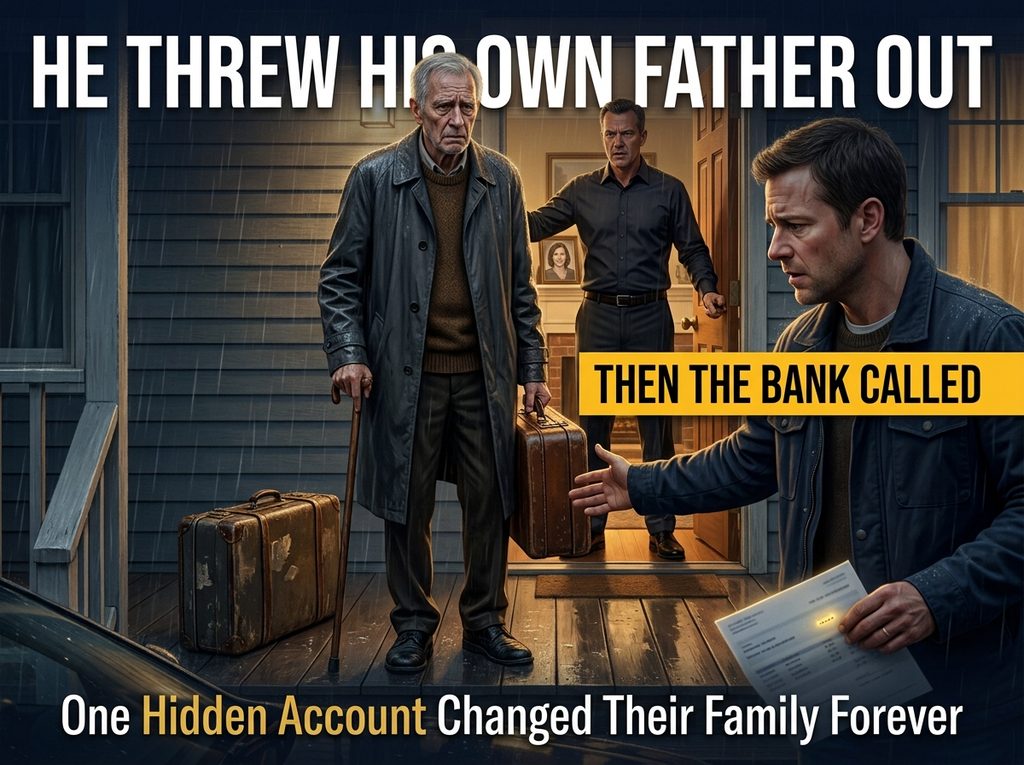
The First National Bank stood in the center of town, between a law office and a small café where Dad used to buy coffee after his morning shift.
I had passed the building hundreds of times without imagining that my father had been keeping a secret inside it for nearly thirty years.
On Thursday morning, I drove him there.
He wore his best suit, a dark navy jacket that had become slightly loose around his shoulders. Emily had ironed his white shirt the night before, and Dad had polished his old black shoes until they shone.
He looked nervous.
“Are you sure you want me to come inside?” I asked as we approached the entrance.
He nodded.
“You need to hear this yourself.”
Inside, a receptionist led us to a private office on the second floor. A woman in her early fifties stood to greet us. She had silver-streaked hair, glasses, and a calm expression that changed when she recognized Dad.
“Mr. Carter,” she said warmly. “It’s been a long time.”
Dad offered his hand.
“Margaret. Thank you for seeing us.”
She shook his hand, then gestured toward two chairs.
“Please sit down. I’ve prepared the documents we discussed.”
She placed a thick folder on the desk.
I watched as she opened it and removed several statements, a collection of old deposit slips, and a document bearing the bank’s official seal.
“Mr. Carter, your account was opened twenty-nine years ago,” she explained. “It has remained active under the terms of the original agreement, with additional deposits made over the years.”
“How much?” I asked.
Margaret glanced at Dad before answering.
“The current balance is approximately two million, four hundred thousand dollars.”
For several seconds, I could not speak.
I had spent years worrying about our mortgage, the cost of our children’s education, and whether we could afford to replace our aging car. My father had spent his life wearing inexpensive clothes, repairing broken household appliances, and refusing to buy anything he considered unnecessary.
And now a bank manager was telling me he possessed a fortune.
“Two million?” I repeated.
“Four hundred thousand,” Margaret clarified gently.
I turned toward Dad.
“How?”
He looked down at his hands.
“Your mother and I saved.”
“Saved what? You worked in a repair shop!”
“That’s right.”
“Your salary was barely enough to pay the bills.”
“Some months, that was true.”
Margaret folded her hands.
“Your father and mother established this account after receiving compensation from the sale of a small parcel of land. Over time, your father made additional deposits. The money was invested conservatively and remained untouched for many years.”
I remembered the small plot of land our parents had owned outside town. Dad had told us they sold it when I was young to cover medical bills and household expenses.
“Mom said the land was sold to pay for her treatment,” I said.
“It was,” Dad replied. “Part of it was.”
I stared at him.
“Part of it?”
He nodded slowly.
“Your mother and I agreed that whatever remained should be protected for the future.”
“Whose future?”
Dad did not answer.
Margaret opened another folder.
“There is one important matter we must discuss. The account includes a beneficiary designation that your father established when the account was opened. He has recently requested that we review the associated documents.”
“Who is the beneficiary?” I asked.
Margaret turned toward Dad.
“Mr. Carter, would you like to explain?”
Dad’s hands tightened around the handle of his walking stick.
“I would rather you showed him.”
Margaret slid a document across the desk.
I looked at the name printed near the bottom.
Eleanor Rose Bennett.
I read it again.
I had never heard of anyone named Eleanor Bennett.
“Who is she?” I asked.
Dad closed his eyes.
“Your mother’s sister.”
I stared at him.
“My mother had a sister?”
“Yes.”
“Why have I never heard of her?”
Dad looked at Margaret, who quietly left the room to give us privacy.
When the door closed, Dad finally spoke.
“Because your mother and her sister stopped speaking before you were born.”
He explained that Eleanor had left home as a young woman after a terrible disagreement with their father. My mother, believing Eleanor had abandoned the family, refused to forgive her.
Years later, when Mom and Dad married, Eleanor had sent a letter asking to reconnect.
Mom never answered.
“Your mother regretted that decision for the rest of her life,” Dad said. “But pride can become a wall that even love struggles to climb.”
I looked again at the document.
“Why would you leave two million dollars to a woman your family hasn’t seen in decades?”
Dad’s face grew pale.
“Because she did something for us that neither of you boys ever knew about.”
Before I could ask what he meant, Margaret returned carrying a second envelope.
“This document was placed in the bank’s custody by your mother,” she said. “Your father requested that it be presented to you today.”
My father’s hands began to tremble.
I opened the envelope.
Inside was a letter addressed to me in my mother’s handwriting.
The first sentence made my heart stop.
My dear Daniel, if you are reading this, then your father has finally told you about the money—and the sister I failed to forgive.
I looked at Dad.
“What did Aunt Eleanor do?”
He lowered his head.
And for the first time, I realized that the money in the account might have been the smallest part of the secret.
<h2>Part 4</h2>
I unfolded my mother’s letter with shaking hands.
The paper was yellowed, and the handwriting was unmistakable. Mom had always written slowly, forming each letter carefully as if she believed the right words could prevent the world from misunderstanding her.
My dear Daniel,
There are things I should have told you when I was alive. I cannot ask your forgiveness for keeping them hidden, but I hope you will understand why your father and I made the choices we did.
I stopped reading.
My mother had been gone for six years. There were days when I still reached for my phone to call her, forgetting that no one would answer.
Seeing her words felt like hearing her voice from another room.
I continued.
When your father and I were young, we were not wealthy. We often had to choose between what we needed and what we wanted. When you became ill as a child, the hospital bills nearly destroyed us financially.
I remembered being five years old and spending several days in a hospital after a severe infection. Dad had slept in a chair beside my bed. Mom had held my hand whenever the nurses came to take blood.
I had never known that the treatment had nearly ruined them.
Eleanor learned what had happened. Without telling anyone, she sold the little house she had bought after leaving home. She used the money to pay the remaining medical bills and help us keep our home.
I stopped breathing for a moment.
My father looked away.
“She sold her house?”
He nodded.
“She did.”
“But why would she do that?”
“Because she loved you.”
I continued reading.
I was too proud to accept her help. When I discovered what she had done, I accused her of interfering in my life. She tried to explain that she wanted nothing in return, but I refused to listen.
The letter described a final argument between the sisters. Eleanor had told Mom that family was supposed to help one another, especially when life became difficult.
Mom had responded that she did not need charity.
Those were the last words they exchanged in person.
Years passed. Eleanor moved away, and Mom refused every opportunity to contact her.
Then, when Dad opened the bank account, he quietly tracked down Eleanor and began returning the money she had given them, adding interest whenever he could.
“She wouldn’t accept it,” Dad said. “Every time I sent something, she returned it.”
“So why is the money still in the account?”
“Because your mother asked me to protect it until the family was ready.”
“Ready for what?”
He looked at me with tired eyes.
“For forgiveness.”
I struggled to understand.
“You saved millions of dollars to repay your wife’s sister?”
“Not only to repay her. The original money was an investment, and it grew over time. I also made deposits from my wages. But the purpose was always the same.”
“To give it back to Eleanor?”
“Yes.”
I sat back in my chair.
For years, I had believed my parents were ordinary people who had managed to survive through hard work and careful spending. I had never imagined they carried a debt of gratitude so large that Dad had spent decades trying to repay it.
“Why didn’t you tell us?” I asked.
“Your mother wanted to reconcile with Eleanor before she died. She wrote letters she never sent. She was afraid her sister would reject her.”
“Did you ever find Eleanor?”
“Yes.”
Dad took a small photograph from his wallet.
It showed two young women standing beside a flowering tree. They looked remarkably alike. One was my mother. The other had the same eyes, the same smile, and the same stubborn tilt of the chin.
“Eleanor sent this to your mother many years ago,” Dad explained. “Your mother kept it beside her bed.”
I stared at the photograph.
“Have you spoken to her recently?”
“Several times.”
My head snapped up.
“What?”
“She knows about the account. She knows your mother died.”
“And you never told us?”
Dad’s expression tightened.
“I wanted to bring the family together before revealing everything. But your mother and I agreed that the money should never become a reason for either of our sons to feel entitled to it.”
Suddenly, I understood why Richard’s name appeared nowhere on the documents.
“Does Richard know about this account?”
“No.”
“Then why did Margaret say the beneficiary documents were being reviewed?”
Dad looked toward the closed office door.
“Because Eleanor contacted the bank after receiving a letter from me. She wants to meet the family.”
My heart began to race.
“When?”
“Tomorrow.”
“Here?”
“No. At your brother’s house.”
I stared at him.
“Why would she want to go there?”
Dad’s voice dropped to a whisper.
“Because your mother left something else behind. Something Eleanor believes belongs to both of you boys.”
He reached into his pocket and removed a small brass key.
It was old, with a number stamped into its head.
“What does it open?”
Dad closed my fingers around it.
“The locked drawer in your mother’s old writing desk.”
I remembered that desk. It still stood in the house Richard had taken over after Mom died.
“What’s inside?”
Dad looked at me.
“The truth about why your brother has been so desperate to control the house.”
<h2>Part 5</h2>
I returned to my childhood home that afternoon.
Richard opened the door wearing an expensive shirt and an expression of irritation.
“What do you want?”
“I need to look through Mom’s writing desk.”
His eyes narrowed.
“Why?”
“There’s something inside it that belongs to Dad.”
Richard folded his arms.
“Whatever belonged to our parents is now part of the estate. You can’t just come in here and take things.”
“I don’t want to take anything. I want to look.”
He studied my face, perhaps searching for a reason to refuse.
Finally, he stepped aside.
“Five minutes.”
The house felt smaller without Dad in it.
Mom’s curtains were still hanging in the living room, but someone had removed her favorite armchair. The books she had kept beside the fireplace were stacked in cardboard boxes, ready to be sold or discarded.
I found the writing desk in the study.
It was made of dark oak, with three drawers and a small brass lock on the bottom compartment. Mom had bought it secondhand when I was a child and spent an entire weekend restoring it.
I tried the key.
The lock clicked open.
Inside lay a bundle of letters tied with a faded blue ribbon, several photographs, and a sealed envelope bearing both my name and Richard’s.
I picked up the envelope.
On the front, Mom had written:
To my sons. Open together, when you are ready to understand.
Richard appeared in the doorway.
“What is that?”
“A letter from Mom.”
“Give it to me.”
“It’s addressed to both of us.”
“I said give it to me.”
I held it away from him.
“Why are you acting like this?”
“Because I know what happens when people start digging through old family business. They find things that should have stayed buried.”
His words sent a chill through me.
“Have you read this letter?”
“No.”
“Then how do you know what’s inside?”
Richard’s face reddened.
“You’re always looking for something to make me the villain.”
I stared at him.
“I didn’t throw Dad out. You did.”
He turned away.
“You’re too young to understand what I’ve been dealing with.”
“We’re only four years apart.”
“Then you should know better than to judge me.”
I opened the envelope.
Inside was a handwritten letter and a document from a local attorney.
The letter began:
My dear boys,
If you are reading this together, I hope you have finally learned that a family can lose everything without losing its love—and can possess everything while having lost what matters most.
I read the next paragraph aloud.
The house you grew up in is not simply a building. Your father and I built our life there with money earned through hard work and sacrifices neither of you fully understood. If one day you inherit it, remember that ownership is not permission to forget the people who made it possible.
Richard snatched the letter from my hands.
“That’s enough.”
“Why?”
“Because this is private.”
“It’s addressed to both of us!”
He crumpled the corner of the page.
Then I noticed the legal document beneath it.
It was a copy of the property’s original deed.
My father’s name was listed as the sole owner.
I read it again.
“Richard, why is Dad’s name still on the deed?”
My brother went completely still.
“I thought Mom left the house to you,” I continued. “You told everyone that the property had been transferred to you after she died.”
He said nothing.
“Did Dad sign anything?”
Richard reached for the document, but I pulled it away.
“Daniel, you don’t know what you’re looking at.”
“Then explain it.”
He rubbed his forehead.
“The house needed repairs. I was managing everything. Dad gave me permission to handle the paperwork.”
“That isn’t what I asked.”
His silence answered more than words could have.
I looked at the legal document again.
There was no transfer of ownership.
No signature from Dad.
No sale.
Nothing that gave Richard the right to treat the house as his own.
“Have you been telling Dad he no longer owns his home?”
Richard’s eyes flashed.
“I’ve been paying the bills!”
“That doesn’t make it yours.”
“You have no idea how much money I’ve spent!”
“Then show me.”
He grabbed the letter from my hand and shoved everything back into the drawer.
“Get out.”
I stared at my brother, shocked by the fear behind his anger.
As I walked toward the door, he called after me.
“Daniel, listen to me. Whatever Dad told you at that bank, don’t believe everything you hear.”
I stopped.
“Why?”
Richard’s voice cracked.
“Because if you keep pulling at this, you’re going to destroy this family.”
I turned to face him.
“No, Richard. The family started breaking the night you threw Dad into the rain.”
I left the house carrying the brass key and a copy of the deed.
But as I drove away, I realized something far more troubling than the hidden money.
Richard had not simply wanted our father out of the house.
He had been trying to establish control over a property that did not legally belong to him.
And now I had to discover why.
<h2>Part 6</h2>
The following afternoon, I returned to the house with Dad and Margaret Ellis.
Richard was waiting in the living room. He looked as though he had not slept.
When he saw Dad, he stood abruptly.
“Father, we need to talk.”
Dad remained beside the doorway.
“Then talk.”
Richard glanced at Margaret.
“Why is a bank manager here?”
“Because there are matters concerning the family account that require clarification,” she answered.
Richard looked at me.
“You told him?”
“I didn’t tell him anything. Dad already knew.”
Dad slowly removed his coat.
“Richard, sit down.”
Something in his voice made my brother obey.
Margaret explained that the bank account belonged to Dad and that the beneficiary designation had been established with Eleanor Bennett’s consent. She also confirmed that the account was separate from the ownership of the family home.
Richard’s face darkened.
“So this money doesn’t belong to either of us?”
“No,” Margaret replied. “It does not.”
“Then why have I been excluded from everything?”
Dad looked at him sadly.
“Because it was never yours to begin with.”
Richard rose again.
“I’ve spent years looking after this family! I’ve handled the bills, the repairs, the paperwork. Daniel comes around whenever he feels like it, and suddenly he’s the good son because he takes you in for a few nights.”
I stepped forward.
“You’re the one who threw him out.”
“I was trying to protect the house!”
“From what?”
Richard’s mouth opened, but no words came.
Dad reached into his pocket and placed a folded document on the table.
“Richard, I need you to tell me the truth.”
My brother stared at the paper.
“What is that?”
“A copy of the loan agreement you signed against the property.”
The room became silent.
I looked at Richard.
“You took out a loan using Dad’s house?”
Richard’s face drained of color.
“It was temporary.”
Dad’s voice trembled.
“How much?”
Richard looked down.
“Three hundred thousand dollars.”
I felt as though the floor had tilted beneath me.
“What did you do with that kind of money?”
“I invested in a business.”
“What business?”
“A property development company. It was supposed to make enough money to pay everything back.”
“And did it?”
Richard said nothing.
Dad closed his eyes.
“How much do you still owe?”
“More than I can manage.”
For the first time, my brother looked less like an angry man and more like a frightened child.
He explained that he had borrowed the money after a business partner persuaded him to invest in several properties. The market changed, the partnership collapsed, and Richard was left with mounting debts.
He had used the family home as security without properly explaining the risks to Dad.
“When the payments became overdue, I thought I could fix everything before anyone found out,” Richard said. “I needed more time.”
“So you threw Dad out because he was costing you money?” I asked.
“No!”
His shout echoed through the room.
“I thought selling the house might solve the problem. I thought if Dad moved somewhere cheaper, I could arrange everything without him getting involved.”
Dad looked at him for a long time.
“You could have told me.”
“I was ashamed.”
“You could have asked for help.”
“I couldn’t face you!”
Dad’s eyes filled with tears.
“So you made me believe I was a burden.”
Richard lowered his head.
“I didn’t mean for it to happen like that.”
“But it did.”
Margaret examined the documents and explained that the bank account and the property were separate matters. The existence of the hidden money did not automatically make it available to Richard, nor did it erase the obligations associated with the loan.
Dad had not agreed to give Richard the account, and he had no intention of using it to conceal what his son had done.
Richard looked at the folder on the table.
“Two million dollars,” he whispered. “You have that much money, and you let me struggle?”
Dad’s expression changed.
“I didn’t know you were struggling to this extent.”
“You could have saved me!”
“Would saving you mean paying your debts without asking why you took such risks? Would it mean pretending that what you did to me was acceptable?”
Richard looked away.
I had never heard my father speak with such firmness.
Dad continued.
“I spent my life trying to teach you that money is something you use to build a life, not something you use to measure one. Somewhere along the way, I failed to make that lesson clear.”
Richard sank into the chair.
For several seconds, nobody spoke.
Then Dad picked up the brass key from the table.
“There is one more thing you need to understand,” he said. “The account was never created to rescue someone who had made a mistake. It was created because someone in this family made a sacrifice without expecting anything in return.”
He turned toward the window.
“Eleanor will be here tomorrow. When she arrives, you will understand why the money was never meant to solve every problem.”
Richard looked up.
“Who is Eleanor?”
Dad’s answer was quiet.
“Your mother’s sister. The woman who helped save this family when we had nothing.”
My brother stared at him in disbelief.
Then he whispered the question none of us had expected.
“If she helped us so much, why did Mother spend her whole life refusing to speak about her?”
Dad looked at the photograph of Mom on the mantel.
“Because sometimes the people we love most are the people we hurt most deeply.”
<h2>Part 7</h2>
Eleanor Bennett arrived the next morning carrying a small leather handbag and a photograph wrapped in tissue paper.
She was seventy-six, with silver hair, careful movements, and eyes that reminded me so strongly of my mother that I had to look away.
Dad stood as she entered.
For several seconds, neither of them spoke.
Then Eleanor reached for his hands.
“Thomas.”
“Eleanor.”
She smiled sadly.
“I wondered whether I would ever see you again.”
Dad’s eyes filled with tears.
“I should have brought you back into our lives years ago.”
“You tried.”
“Not hard enough.”
Eleanor squeezed his hands.
“Neither did I.”
Richard stood near the fireplace, looking uncomfortable.
I introduced myself, although she already knew who I was.
“I’ve seen your photographs,” she said. “Your mother kept them in a little album. She told me about your children in the letters Thomas sent.”
I was startled.
“Mom wrote to you?”
“She wrote many letters. Most of them never reached me until after she died.”
Dad lowered his head.
“I kept them because I hoped you would meet again.”
Eleanor looked toward the photograph of my mother.
“Your mother was a stubborn woman.”
A sad smile crossed her face.
“So was I.”
We sat together in the living room. Emily had prepared tea and a plate of biscuits, but nobody touched them.
Eleanor placed the photograph on the table.
It showed her and my mother as young women, standing beside the same flowering tree I had seen in the bank’s documents.
On the back, Mom had written a sentence.
Two sisters, one heart, even when the world makes us strangers.
Eleanor ran her fingers over the words.
“She wrote this after our last argument,” she said. “Thomas showed it to me years later.”
Dad nodded.
“She never stopped loving you.”
“Nor I her.”
For a moment, the room seemed filled with all the years they had lost.
Then Eleanor turned to Richard.
“You must be the older boy.”
Richard nodded.
“Yes.”
“I remember when your mother told me she was expecting you. She was terrified and excited at the same time. She said she hoped you would grow up brave.”
Richard looked at the floor.
“I don’t think she would be proud of me now.”
Eleanor did not answer immediately.
“Your mother was proud of you,” she said. “But pride isn’t the same as approval. Loving someone doesn’t mean pretending their mistakes don’t matter.”
Richard’s eyes reddened.
“I made a terrible mistake.”
“Then you must decide what to do about it.”
He told her about the loan, the failed investment, and the decision to force Dad from the house. He did not try to excuse himself. For the first time, he seemed to understand how cruel his actions had been.
When he finished, Eleanor folded her hands.
“Do you know why your father created that account?”
“To repay you,” Richard replied.
“That was part of it. But the money was never the real purpose.”
She explained that she had helped my parents during the hardest period of their lives because she could not bear to watch her sister’s family suffer.
She had never expected repayment.
Years later, when Dad began returning the money, she refused to accept it because she considered the matter settled.
But Dad continued saving.
Eventually, Eleanor agreed that the account could remain in place under one condition: it would never be used as a weapon against the family, and it would never become a prize that either son could claim through guilt or pressure.
“I told your father that money has a way of changing the meaning of every conversation,” Eleanor said. “People who once helped one another begin keeping score. People who once loved one another begin asking what they are owed.”
She looked at Richard.
“Your father wanted to make sure that whatever happened to this money, his sons would still know the difference between love and ownership.”
Richard’s shoulders sagged.
“And the beneficiary?”
Eleanor looked at Dad.
He nodded.
She reached into her handbag and removed a sealed envelope.
“The original designation was made decades ago. But the final decision was never supposed to be mine alone.”
She placed the envelope on the table.
Inside was a document signed by both my parents and witnessed by their attorney.
The beneficiary was Eleanor Bennett.
But beneath her name was a second clause.
It stated that if Eleanor chose to decline the inheritance, the money would be placed in a trust for the care and dignity of elderly people who had been abandoned or neglected by their families.
I read the clause twice.
“That’s why you kept the money?” I asked Dad.
He nodded.
“We wanted to make sure it would help someone, even if our family never learned how to help itself.”
Eleanor looked at him with tears in her eyes.
“I never wanted the money, Thomas.”
“I know.”
“I wanted my sister back.”
Dad lowered his head.
“So did she.”
Then Eleanor turned toward Richard.
“And now I have one question for you. If there had been no money in that account, would you have taken your father back into your home?”
Richard opened his mouth.
He looked at Dad, then at the floor.
Finally, he whispered, “I don’t know.”
The honesty of that answer was more painful than any excuse.
Eleanor nodded slowly.
“Then that is where you must begin.”
<h2>Part 8</h2>
After Eleanor left, Richard remained seated beside the fireplace.
Dad stood near the window, watching the afternoon light move across the garden.
I wanted to tell Richard that he had destroyed everything, that no apology could undo the humiliation Dad had endured. But seeing my brother sitting in silence, I realized that anger alone would not repair what had happened.
“Richard,” I said, “you need to make things right with Dad.”
He looked up.
“How?”
“Start by telling the truth.”
Richard rubbed his hands together.
“I’ve spent so long trying to look successful that I don’t know how to admit I’ve failed.”
Dad turned toward him.
“Failure is not the same as dishonesty.”
“I know.”
“Do you?”
Richard swallowed.
“I thought if I lost the house, everyone would see me as a failure. I thought if I kept control of everything, I could fix the debt before anybody knew.”
Dad’s expression softened, but he did not move closer.
“And what happened when you tried to control everything?”
“I lost the thing I was trying to protect.”
Richard began to cry.
It was the first time I had seen my older brother cry since we were children.
“I am sorry, Dad.”
The words hung in the room.
Dad remained silent.
Richard continued.
“I’m sorry I made you feel unwanted. I’m sorry I spoke to you like you were a burden. I’m sorry I let my fear become more important than your dignity.”
He wiped his face.
“I don’t expect you to forgive me.”
Dad slowly approached him.
“Do you remember the day you broke your mother’s favorite vase?”
Richard gave a weak, surprised laugh.
“I was fourteen.”
“You blamed the dog.”
“Yes.”
“But there was no dog in the house.”
“I know.”
Dad sat beside him.
“Your mother knew you had broken it. She waited three days for you to tell the truth. When you finally did, she hugged you before she punished you.”
Richard stared at his hands.
“She said it was better to lose a vase than lose the truth between us.”
Dad nodded.
“That is what I want from you now. Not a perfect son. Not a successful businessman. Just an honest man who understands what he has done.”
Richard’s shoulders shook.
“I don’t know whether I can fix the debt.”
“You must speak to the people you owe. You must be honest about what happened. And you must accept the consequences.”
Dad paused.
“I cannot promise to pay your debts. But I can promise that you don’t have to face the truth alone.”
For a long time, Richard said nothing.
Then he nodded.
The following week, he met with a lawyer to review the loan agreement and determine the proper steps for addressing the debt. He agreed to cooperate fully with the legal process and to stop making decisions about the family property without Dad’s knowledge or consent.
The house remained legally Dad’s.
Richard also agreed to move out, giving Dad the freedom to decide where and how he wanted to live.
But Dad did not immediately return to the house.
He wanted time.
“I need to know that I can walk through those doors without feeling like an unwanted guest,” he told me.
So he stayed with us.
He helped Ben with his school projects, taught Sophie how to repair a loose bicycle chain, and planted tomatoes in our small backyard.
Emily began asking him about his childhood, and for the first time in years, Dad told stories about Mom that made us laugh instead of cry.
One evening, I found him sitting beneath the kitchen light, writing in a notebook.
“What are you writing?”
“Things I should have told your mother.”
I sat beside him.
“She knew you loved her.”
“I hope so.”
He closed the notebook.
“I spent so many years thinking that if I saved enough money, I could make sure my family would never suffer again. But money can’t prevent every kind of suffering.”
“No,” I agreed.
“It can pay for medicine. It can buy food. It can keep a roof over someone’s head. But it cannot make a person feel loved.”
I thought about the night I found him standing in the rain.
“Richard is trying,” I said.
Dad nodded.
“I know.”
“Will you forgive him?”
Dad looked toward the hallway, where Ben was laughing at something on television.
“Forgiveness is not pretending something never happened. It’s deciding whether we can build something better after it has happened.”
Then he turned toward me.
“And you, Daniel? Have you forgiven him?”
I hesitated.
“I don’t know.”
Dad smiled sadly.
“Then don’t rush yourself. A wound doesn’t heal because someone tells it to.”
The following Sunday, Eleanor visited us for lunch.
She brought an old recipe book that had belonged to her mother and spent the afternoon cooking with Emily.
As they worked, I heard Eleanor laugh for the first time.
The sound reminded me of Mom.
After dinner, Eleanor sat beside Dad on the porch.
For nearly an hour, they spoke about their childhood, their parents, and the years they had lost.
When she left, she hugged Dad tightly.
“Your wife would be happy to know we’re speaking again,” she whispered.
Dad held her for a long moment.
“I think she would.”
As I watched them, I began to understand that the hidden account had never been intended to make one person rich.
It had been a bridge between two people who had spent decades wishing they could take back the words that separated them.
But the most difficult part of our family story was not over.
Richard still had to decide what kind of man he wanted to become.
And Dad still had to decide whether the home he had built could ever feel like home again.
<h2>Part 9</h2>
Three months passed.
Dad’s health improved, and he began taking short walks every morning. He still missed Mom, but the sadness no longer seemed to occupy every corner of his life.
Richard, meanwhile, began the difficult work of rebuilding what he had damaged.
He sold his expensive car, moved into a modest apartment, and met regularly with his lawyer and creditors to address the outstanding debt. He stopped pretending that everything was under control.
It was not a quick process.
There were difficult phone calls, humiliating conversations, and days when he returned home exhausted.
But he kept going.
One Saturday morning, he arrived at our house carrying a cardboard box.
“I found something in the attic,” he said.
Dad looked up from the newspaper.
“What is it?”
Richard placed the box on the table.
“Mom’s letters. The ones she wrote to Eleanor.”
Eleanor had told us that many of the letters never reached her. Richard had discovered the box while clearing the attic at the family home.
Inside were dozens of envelopes, some dated more than twenty years earlier.
Dad picked up one of them.
His hands trembled as he recognized Mom’s handwriting.
“She wrote so many,” he whispered.
Richard sat down.
“I read some of them.”
Dad looked at him.
“What did you learn?”
Richard stared at the table.
“That Mom was lonely. That she missed her sister. That she regretted the argument almost immediately, but she didn’t know how to admit she was wrong.”
He swallowed.
“She wrote that she hoped one day Eleanor would forgive her.”
Dad closed his eyes.
For years, he had watched his wife carry the burden of a broken relationship. He had tried to help, but he could not make two stubborn people take the first step toward reconciliation.
Now, after all those years, the letters had finally found their way into the open.
Eleanor arrived that afternoon.
When she saw the box, she covered her mouth with one hand.
“Are these all from your mother?”
Richard nodded.
“I thought you should have them.”
Eleanor sat down and opened the first envelope.
She read silently for several minutes.
Then she began to cry.
Dad placed a hand on her shoulder.
“She loved you.”
Eleanor nodded.
“I know that now.”
She took out another letter.
“This one is dated the year before she died.”
She unfolded it carefully.
My dear Eleanor,
I don’t know whether you will ever read this. I have spent so many years telling myself that I was right that I can barely remember what we argued about. I remember only the silence that followed.
If I could speak to you again, I would tell you that you were right about one thing. Family is not a debt to be repaid. It is a gift to be protected.
I was too proud to accept your kindness. I was even prouder when you refused to let me repay you. But I understand now that we were both trying to protect something precious, and neither of us knew how to ask the other for forgiveness.
I hope you are happy. I hope someone has told you that you are loved. And I hope that one day, when our children are old enough to understand, they will learn that the greatest inheritance we can leave them is not money, but the courage to forgive.
Eleanor pressed the letter against her chest.
For a long time, nobody spoke.
Then Richard stood.
“I need to tell you something,” he said.
He looked at Dad first.
“I used to think that being the older son meant I had to be the one who controlled everything. I thought I was protecting the family by making decisions nobody else wanted to make.”
He turned toward Eleanor.
“And when I learned about the money, I realized how much I had misunderstood. I kept thinking about what I could lose instead of what I had already been given.”
His voice cracked.
“I don’t expect either of you to trust me immediately. But I’m going to spend the rest of my life trying to become someone Mom would have been proud of.”
Dad rose slowly.
He approached Richard and placed both hands on his shoulders.
“You don’t have to spend the rest of your life punishing yourself.”
“But I hurt you.”
“Yes.”
“I made you feel unwanted.”
“Yes.”
Richard lowered his head.
Dad continued.
“And now you must learn to live differently.”
He embraced his son.
Richard broke down against his father’s shoulder.
I stood nearby, fighting tears of my own.
I had spent months believing that the hidden money would be the answer to our family’s problems. I had imagined that the bank account would expose a villain, reward a hero, and restore the balance between right and wrong.
Instead, it had revealed something far more complicated.
My brother had been wrong. My father had been hurt. My mother had carried regret to her grave. Eleanor had spent decades separated from the sister she loved.
No amount of money could undo those years.
But honesty had opened a door that pride had kept shut.
That evening, Dad asked me to take him back to the family home.
“I want to see the garden,” he said.
When we arrived, the old rose bushes were overgrown, and weeds had begun to cover the path. The porch needed repainting, and several flowerpots lay empty beside the steps.
Dad stood quietly for a moment.
Then he walked to the garden and knelt beside the rose bushes.
“Your mother planted these,” he said.
“I remember.”
“She used to say that roses needed patience. If you pulled at them every time they grew slowly, you would damage the roots.”
He touched a small green shoot emerging from the soil.
“I think we all need to remember that.”
I helped him stand.
Before we left, he turned toward the house.
“I am going to come back here,” he said. “Not because I want to prove anything to Richard. Because this is my home, and I want to live in it again.”
For the first time since the night he had been thrown out, my father sounded certain of his place in the world.
But he had one final decision to make.
The money still sat in the bank.
And Eleanor was waiting for his answer.
<h2>Part 10</h2>
Six months after the bank manager’s call, our family gathered in the living room of my childhood home.
Dad had returned to the house after making the necessary arrangements to ensure that his property and finances were properly protected. Richard had moved out, and Dad was free to decide how he wanted to live without anyone treating him as a burden.
Eleanor sat beside the fireplace, holding the photograph of her sister.
Emily brought tea into the room while Sophie and Ben arranged fresh flowers on the table.
For the first time in years, the house felt alive again.
Dad stood near the window.
“I have made a decision about the account,” he announced.
Richard looked up.
Eleanor folded her hands.
Dad continued.
“I have spent almost thirty years believing that if I saved enough money, I could make up for the mistakes our family had made. I thought I could repay Eleanor, protect my children, and leave everyone with something valuable.”
He paused.
“But I have learned that money cannot repair every broken relationship. It cannot buy back lost years. It cannot make someone love you, and it cannot force someone to forgive you.”
He looked at Eleanor.
“You helped us when we had nothing. You never asked for repayment. You never asked for recognition. You simply wanted your sister to be happy.”
Eleanor wiped her eyes.
“She was my sister.”
“And you were hers.”
Dad took a document from the table.
“I have decided that the account will remain dedicated to its original purpose. Eleanor will receive what is rightfully hers under the agreement we made, and the remaining funds will be directed according to the plan we established for elderly people who have been abandoned or neglected by their families.”
Richard lowered his head.
“I think that’s right.”
Dad looked at him.
“Do you?”
Richard nodded.
“Yes. For the first time, I understand why it matters.”
Dad sat beside his older son.
“You cannot change what happened that night. Neither can I. But you can choose what happens next.”
Richard reached into his pocket and took out a small envelope.
Inside was a photograph of Dad, Mom, Richard, and me standing in front of the house on a summer afternoon. Richard had been a teenager, and I was still small enough to sit on Dad’s shoulders.
“I found this in my apartment,” Richard said. “I kept it because I didn’t want to forget who we used to be.”
Dad studied the photograph.
“Families change.”
“I know.”
“People make mistakes.”
“I know.”
“But love should never be used as a weapon.”
Richard’s eyes filled with tears.
“I’m sorry, Dad.”
This time, the apology was not hurried. He did not ask for forgiveness or demand that the past be forgotten.
He simply sat beside the man he had hurt and allowed the silence to remain.
After a while, Dad placed one hand on his son’s shoulder.
“I forgive you.”
Richard began to cry.
“But listen to me,” Dad continued. “Forgiveness does not mean you can go back to treating people the way you did before. You must keep choosing to do better.”
“I will.”
Dad nodded.
“Then we can begin again.”
Eleanor stood and walked toward the photograph on the mantel.
She placed her sister’s picture beside it.
For years, she had imagined what it would feel like to see her sister again. Now, standing in the house where they had once spent so many happy afternoons, she seemed both relieved and heartbroken.
“I wish we had made peace sooner,” she whispered.
Dad joined her.
“Your sister wished for that too.”
Eleanor closed her eyes.
“I hope she knew I forgave her.”
Dad took her hand.
“I believe she did.”
That afternoon, we ate together around the old dining table.
There was no discussion of the account balance, no argument about the house, and no calculation of who had sacrificed more.
Dad told stories about the early days of his marriage. Eleanor remembered things about Mom that we had never heard before. Emily laughed so hard at one story that she nearly spilled her tea.
For a few hours, the years of silence seemed to loosen their grip.
When the children went outside to play, Dad asked Richard and me to stay behind.
“I want you both to remember something,” he said.
We sat across from him.
“When your mother and I were young, we thought success meant having enough money to keep our family safe. Later, we thought it meant giving our children better opportunities than we had. We worked hard because we wanted you to have choices.”
He looked at Richard.
“But we never wanted you to believe that a person’s worth could be measured by what they owned.”
Then he looked at me.
“And we never wanted you to believe that being a good son meant carrying every burden alone.”
I felt tears gather in my eyes.
“I was afraid you would never forgive Richard,” I admitted.
Dad smiled sadly.
“I was afraid of that too.”
“Why?”
“Because anger can feel like justice when someone has hurt us. But if we hold on to it for too long, it begins to take something from us as well.”
Richard stared at the table.
“I don’t deserve how kind you’ve been.”
Dad shook his head.
“This isn’t about what you deserve. It’s about what you do with the chance you’ve been given.”
He reached across the table and placed one hand over each of ours.
“I am seventy-eight years old. I don’t know how many years I have left. But I don’t want to spend them teaching my children how to divide what remains. I want to spend them reminding you that you still have each other.”
Neither Richard nor I could speak.
For the first time, we were not arguing about money, property, or responsibility.
We were simply two sons sitting beside their father.
Later that evening, as the sun disappeared behind the rooftops, I walked with Dad through the garden.
He stopped beside the rose bushes and pointed toward a small flower that had opened among the overgrown branches.
“Your mother would have liked that one,” he said.
I smiled.
“She would have said it needed more sunlight.”
He laughed softly.
“She would have been right.”
We stood together for a while, listening to the birds settling in the trees.
Then Dad turned toward me.
“Daniel, do you know what the greatest thing about that bank account was?”
I thought about the millions of dollars, the documents, and the secret that had remained hidden for decades.
“That it helped us discover the truth?”
Dad shook his head.
“No. The greatest thing was that it showed us what money could never buy.”
“What?”
He looked toward the house, where Richard was helping Emily carry the dishes inside.
“The chance to choose what kind of family we wanted to be.”
I understood then.
The money had not made my father valuable. He had been valuable when he stood in the rain with nothing but two suitcases and a photograph of the woman he loved.
My brother had not become a better man because he had discovered a hidden fortune. He had begun changing when he finally admitted what he had done.
And Eleanor had not found peace because the money was returned. She found it because she could finally speak about her sister without the weight of an unanswered apology.
That night, I drove home with Emily and the children.
Before going to bed, I called Dad to make sure he was comfortable.
“I’m fine,” he said. “I’ve locked the doors, turned off the lights, and made myself a cup of tea.”
“Do you need anything?”
“No, son.”
There was a pause.
Then he added, “Thank you for opening your door that night.”
I swallowed hard.
“You never needed to thank me for that.”
“I know,” he said. “But sometimes people need to hear the words anyway.”
After we ended the call, I stood by the window and looked out at the quiet street.
I thought about the night I had found him standing in the rain. I thought about the bank manager’s call, the hidden money, the letters, and the truth that had nearly torn our family apart before giving us a chance to begin again.
I had once believed that the greatest inheritance a parent could leave a child was financial security.
Now I knew better.
It was the memory of a father who had worked until his hands grew tired, a mother who had loved even when pride kept her silent, and an aunt who had sacrificed her home without expecting anything in return.
It was the lesson that a family could make terrible mistakes and still choose a different future.
And it was the knowledge that when my father stood outside in the rain, the most important decision of my life had not been whether I could afford to take him in.
It had been whether I would let him stand there alone.
I had opened the door.
And that small decision had revealed more about our family than two million dollars ever could.