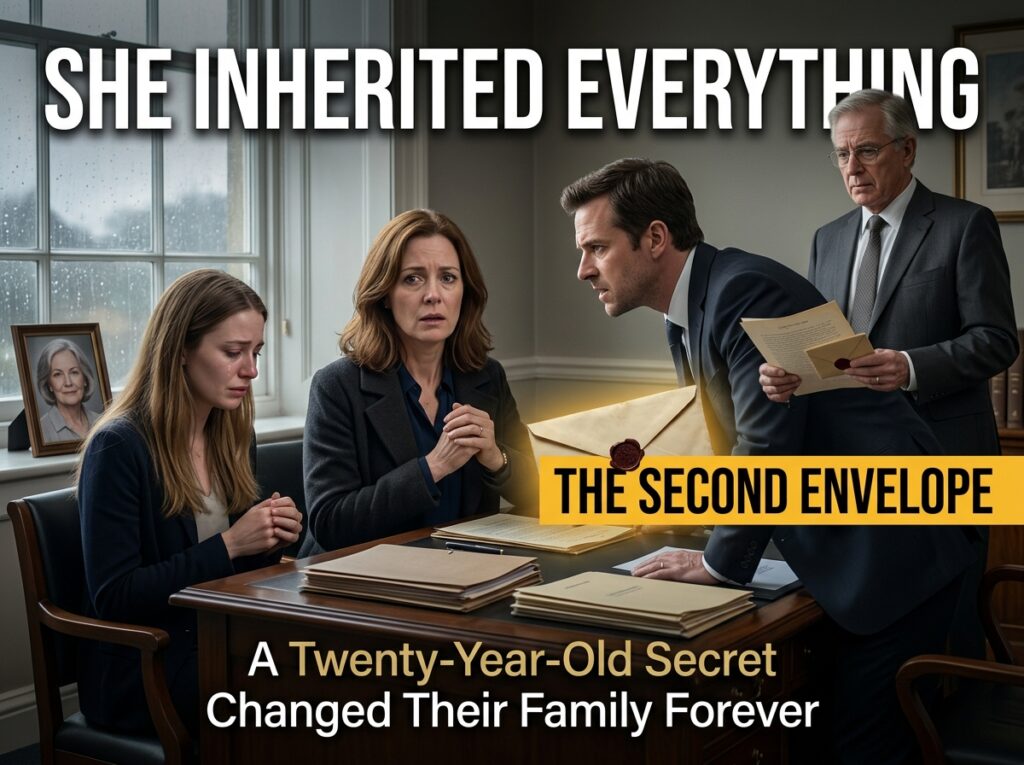
The morning we read our mother’s will, the sky was the color of old silver, and rain tapped against the windows of a law office that smelled faintly of coffee and polished wood.
I remember that detail because everything else about the day seemed unreal.
Our mother, Margaret Whitmore, had been dead for twelve days.
Twelve days since I had stood beside her hospital bed, holding her thin hand while she struggled to breathe. Twelve days since she had looked at me with eyes that seemed to carry a thousand unspoken words. Twelve days since I had promised her that I would take care of my younger sister, Lily, even though I had no idea what that promise would eventually cost me.
Now my brother, Thomas, sat across from me in a leather chair, tapping one polished shoe against the floor.
Lily sat beside him, staring at her hands.
None of us had spoken since arriving.
Our mother’s lawyer, Mr. Bennett, entered carrying a thick folder and a glass of water. He was a careful man in his sixties, with silver hair, narrow glasses, and the kind of expression that suggested he had delivered difficult news many times before.
“Thank you for coming,” he said. “I know this is a difficult time for all of you.”
Thomas gave a short, humorless laugh.
“Let’s get this over with.”
I turned toward him.
“Can you please show some respect?”
He looked at me.
“For Mom? I’ve shown her respect for forty-two years.”
“Then you can manage another ten minutes.”
“Claire,” Lily whispered.
It was the first word she had spoken all morning.
I stopped arguing.
Mr. Bennett opened the folder.
“Your mother prepared her final will approximately eight months before her death. The document was signed and witnessed according to the applicable legal requirements.”
Thomas leaned forward.
“Everything goes equally to the three of us, correct?”
The lawyer adjusted his glasses.
“I would ask you to let me finish before drawing any conclusions.”
Something about his tone made me uneasy.
Mom had always said she wanted her children to be treated fairly. She had repeated it whenever Thomas and I argued over childhood possessions or when Lily complained that we received more attention because we were older.
“Fairness,” she used to say, “doesn’t always mean giving everyone the same thing. It means understanding what each person needs and what each person has done.”
At the time, I thought she was simply trying to end our arguments.
I never imagined those words would return to haunt us.
Mr. Bennett began reading.
Our mother had left a modest amount of money to several charities, personal belongings to close friends, and a few sentimental items to relatives.
Then he reached the section concerning the family home.
“The property at 18 Willow Lane, including the land and all associated rights, is to be transferred to my eldest daughter, Claire Whitmore.”
Thomas stopped tapping his foot.
“What?”
The lawyer continued.
“The remaining savings, investment accounts, and the majority of the estate are likewise bequeathed to Claire, subject to the specific provisions outlined in the will.”
The room fell silent.
I stared at Mr. Bennett.
“That can’t be right.”
He looked at me carefully.
“Those are the terms of your mother’s will.”
Thomas rose so abruptly that his chair scraped across the floor.
“You’re telling me she gave everything to Claire?”
“Not literally everything,” Mr. Bennett replied. “There are several smaller bequests.”
“Don’t play games with me! The house, the savings, the investments—everything that matters goes to her?”
“That is correct.”
Thomas turned toward me.
“What did you do?”
I could barely understand the question.
“Nothing.”
“Don’t lie to me.”
“Thomas, I didn’t even know about this!”
He laughed bitterly.
“Of course you didn’t. You never know anything when there’s money involved.”
I felt my face grow hot.
“Mom made her own decisions.”
“Did she? Or did you spend the last year telling her that I was irresponsible, that I couldn’t be trusted, that Lily needed protection from me?”
Lily’s fingers tightened around one another.
“Please stop,” she whispered.
Thomas ignored her.
“You always wanted to be the favorite, Claire. You always wanted Mom to believe you were the only one who cared about her.”
I stood.
“I was the one who took her to her medical appointments when you were too busy. I was the one who stayed overnight when she couldn’t sleep. I was the one who—”
“You think that makes you better than me?”
“No. I think it makes your accusation unfair.”
His eyes filled with anger.
“Mom was sick. She was vulnerable. You had access to her every day, and now suddenly you’re the sole heir.”
Mr. Bennett raised his hand.
“Please. I understand that emotions are running high, but I must insist that we remain civil.”
Thomas turned away, breathing heavily.
I sat down slowly, feeling as though the room had tilted beneath me.
I had not asked for the house. I had not asked for the savings. I would have given anything to hear Mom complain about the hospital food one more time or ask me whether I had remembered to water her roses.
Yet there I was, being accused of stealing from a woman whose final months I had spent trying to make comfortable.
I looked toward Lily.
She was still silent.
“Lily,” I said gently, “what do you think?”
She lifted her eyes, but she did not answer.
Instead, she looked at the lawyer’s folder as if something inside it frightened her.
Mr. Bennett noticed.
He closed the will and placed it on the desk.
“There is one matter I should mention before we conclude today’s meeting.”
Thomas turned back.
“What now?”
The lawyer opened a second file and began examining the documents inside.
“When your mother’s estate was being prepared, I found a reference to an older legal document that was not included in the materials initially provided to me.”
“What document?” I asked.
“I’m not certain yet. I requested the original archive from storage this morning.”
He removed several papers, checking each one carefully.
Then he stopped.
His expression changed.
“What is it?” Thomas demanded.
Mr. Bennett reached into the folder and drew out a yellowed envelope sealed with dark red wax.
My mother’s handwriting was visible across the front.
Three names had been written beneath the date.
Claire.
Thomas.
Lily.
The lawyer looked at us.
“I believe your mother intended this to be opened only if the three of you disputed the terms of her will.”
Thomas went pale.
Lily began to cry.
And I realized that our mother’s final decision might not have been the beginning of our family conflict.
It might have been the consequence of something that had happened twenty years earlier.
<h2>Part 2</h2>
Mr. Bennett did not open the envelope immediately.
He placed it on the desk between us, where it seemed to occupy more space than the thick folder containing our mother’s will.
Thomas was the first to speak.
“Open it.”
The lawyer looked at him.
“I need to examine the accompanying document first. This envelope was stored inside an older file, and I want to establish how it relates to your mother’s estate.”
“Why are we waiting? You’ve already told us she gave Claire everything. What more could there possibly be?”
“Perhaps an explanation,” I said.
Thomas turned on me.
“You would say that. You’re the one who benefits.”
I wanted to defend myself, but the anger in his face made me hesitate.
I had never seen my brother look at me with such suspicion. When we were children, he had been the one who climbed trees to rescue my favorite cat, who taught me to ride a bicycle, and who once walked three miles through a snowstorm to bring me home when my car broke down.
We had argued as adults, sometimes bitterly, but I had never believed he could truly think I would exploit our mother’s illness.
Now I was no longer sure.
Mr. Bennett examined the envelope.
“It appears to have been sealed many years ago. The paper is consistent with documents from approximately twenty years ago, although I will need to review the archive before confirming its precise date.”
“Twenty years?” Thomas repeated.
Lily covered her mouth.
I looked at her.
“You know something.”
She shook her head quickly.
“No.”
“Lily, please.”
“I said no.”
Her voice was so sharp that I fell silent.
The lawyer returned to the older document. It was a photocopy of a letter dated twenty years earlier, accompanied by a handwritten note from our mother.
I recognized Mom’s writing immediately.
She had used the same dark-blue ink in every birthday card she had ever given me.
Mr. Bennett read the note silently, then looked up.
“I believe this material may relate to a dispute concerning the family property. Before I proceed, I need to ask whether any of you remember a financial difficulty your mother experienced around that time.”
Thomas shook his head.
“Not particularly.”
I searched my memory.
I was twenty-four then, working at a small marketing firm in the city. Thomas had recently married his first wife, and Lily was still in college.
I remembered Mom calling me one evening, asking whether I could come home for dinner.
When I arrived, she had been unusually quiet.
Dad had died years earlier, and Mom had lived alone in the family house ever since. She was proud of managing everything herself, so I had assumed she was simply lonely.
We had eaten roast chicken and potatoes. Afterward, she asked whether I thought people could ever recover from a betrayal.
I had laughed, thinking she was asking about a television program we had watched together.
“That depends on the betrayal,” I had said.
She had looked at me for a long moment.
“Yes,” she replied. “I suppose it does.”
I had forgotten that conversation until now.
“Mom seemed upset about something back then,” I told Mr. Bennett. “But she never explained what it was.”
Thomas folded his arms.
“She was probably worried about money. We all were.”
The lawyer nodded.
“That is possible. The records indicate that a substantial sum was transferred out of an account connected to the family property during that period. However, I do not want to draw conclusions before examining the original documents.”
I stared at him.
“How substantial?”
He turned a page.
“Enough to affect the property’s financial position significantly at the time.”
Thomas sat down.
“Are you suggesting one of us stole from her?”
“I’m suggesting that the documents raise questions that should be answered before any conclusions are reached.”
Lily stood abruptly.
“I need some air.”
She hurried toward the door.
“Lily,” I called.
She stopped but did not turn around.
“Please don’t make me stay here.”
There was something in her voice that made me put down my handbag.
“All right,” I said softly. “Take your time.”
She left the room.
Thomas watched her go.
“She’s always been dramatic.”
I turned toward him.
“She’s grieving.”
“So are we.”
“Then stop treating everyone like an enemy.”
His face hardened.
“You have no idea what I’ve sacrificed for this family.”
Before I could answer, Mr. Bennett placed the older document back into its folder.
“I think we should adjourn for today. I will review the archive and contact you when I have established the relationship between these papers and the will.”
Thomas stood.
“Fine. But I’m not walking away from this.”
He pointed at me.
“If Mom’s decision was influenced by anything you did, I will find out.”
I remained seated until he left.
Then I looked at the sealed envelope.
“Do you think Mom wanted us to fight?” I asked.
Mr. Bennett shook his head.
“No. I think she wanted the truth to be heard before anyone made a decision they could not take back.”
He placed the envelope in a locked drawer.
As I walked toward the door, I noticed a small handwritten date on the back of the older document.
It was the same year I had returned home for that strange dinner.
And beneath the date were four words that made my stomach tighten.
The money was never his.
I read them twice.
Then I realized the mystery was not simply about why Mom had left me the house.
It was about what someone had taken from her twenty years earlier—and why she had waited until her death to reveal it.
I did not sleep that night.
Every time I closed my eyes, I saw the envelope on Mr. Bennett’s desk and heard Thomas accusing me of manipulating our mother. I kept remembering the four words written on the back of the old document.
The money was never his.
Whose money had it been?
And who had taken it?
At six the next morning, I called Lily.
She answered after the fourth ring.
“Claire?”
“Can we have breakfast together?”
There was a long silence.
“I don’t think that’s a good idea.”
“Please. I’m not calling to argue about the will.”
“Then what do you want?”
“I want to know why you looked frightened when the lawyer found that envelope.”
She exhaled shakily.
“I wasn’t frightened.”
“Lily, I know you.”
“No, Claire. You know the version of me you remember from when we were children. You don’t know everything that happened after you moved away.”
Her words stung because they were partly true.
I had left our hometown at twenty-two, eager to build a career and a life of my own. Thomas had stayed close to Mom for a few years before moving into a larger house with his first wife. Lily had remained the youngest, the one we both tried to protect without always asking what she wanted.
I had assumed that distance meant I was missing ordinary family details.
Now I wondered whether I had missed something much bigger.
“Tell me what you can,” I said.
Lily was quiet for so long that I thought she had ended the call.
Then she whispered, “Do you remember the summer Mom almost lost the house?”
I sat up.
“I remember her saying the bank had made a mistake.”
“It wasn’t a mistake.”
My heart began to pound.
“What happened?”
“I can’t explain everything over the phone.”
“Then meet me.”
She agreed to meet at a café near the old railway station.
When I arrived, Lily was already sitting at a table in the corner. She looked exhausted. Her eyes were swollen, and she kept turning a teaspoon between her fingers.
I sat opposite her.
“Start wherever you can.”
She stared at the table.
“Twenty years ago, I was in college. I was struggling with tuition, and Mom was already having financial problems. Thomas offered to help.”
“Help with what?”
“My fees. He said he had found a way to make some money through a business opportunity. He told Mom he could borrow against the house temporarily and repay everything within a few months.”
I remembered Thomas’s ambition. He had always believed he could recognize opportunities before anyone else.
“Did Mom agree?”
“Not at first. She said the house was the only security she had left. But Thomas told her he had already spoken to someone at the bank and that everything would be handled properly.”
I leaned forward.
“What happened to the money?”
Lily’s eyes filled with tears.
“Some of it paid my tuition. Some went toward Thomas’s business. The rest disappeared when the business failed.”
I stared at her.
“Did Mom know?”
“Eventually.”
“And you knew?”
She nodded, crying silently.
“Thomas told me not to say anything. He said he would replace the money before Mom discovered the full amount. He said that if she knew I had accepted the tuition money, she would blame herself for not being able to support me.”
“That doesn’t explain the note.”
Lily wiped her cheeks.
“There was another part.”
I waited.
“Some of the money came from an account Dad had established before he died. Mom had promised to preserve it for the family. Thomas convinced her that using it temporarily was harmless.”
I could barely breathe.
“Did Thomas have permission to take it?”
“Mom believed he did. But the paperwork was never completed properly. When the business failed, he couldn’t return the money.”
“How much?”
“I don’t know exactly. Enough to put the house at risk.”
I thought about the documents Mr. Bennett had shown us.
“Why didn’t Mom tell us?”
“She tried to protect Thomas. She was afraid that if the truth came out, it would destroy his marriage and his future. She also felt guilty because I had benefited from the money.”
“But you were in college. You didn’t make the decision.”
“I knew something was wrong. I knew he was asking Mom to keep secrets. I should have told her everything when I understood what had happened.”
I reached across the table and took her hand.
“You were young, Lily.”
“Old enough to know that Mom was hurting.”
Neither of us spoke for a moment.
Then Lily opened her handbag and removed a small photograph.
It showed Mom standing beside Thomas in front of the family house. They were both smiling, but something about Mom’s expression seemed strained.
“She gave me this shortly before she died,” Lily said. “She told me that one day I might need to remember who Thomas had been before the money changed him.”
I looked at the photograph.
On the back was a handwritten sentence.
Love does not require us to hide the truth.
I felt a coldness settle over me.
“Why didn’t you tell the lawyer yesterday?”
“Because I was afraid.”
“Of Thomas?”
She nodded.
“He told me years ago that if the truth ever came out, I would be responsible for everything. He said I had accepted the money and that I had no right to judge him.”
I squeezed her hand.
“That’s not true.”
“I know that now. But for twenty years, I’ve believed that our family would fall apart if I spoke.”
I looked through the café window at the street outside.
Thomas had accused me of manipulating Mom. Yet Lily had spent two decades carrying guilt for a decision she had not made.
Our family had been built on silence for so long that none of us seemed to know how to speak without hurting someone.
“Will you tell Mr. Bennett what you told me?” I asked.
Lily looked frightened again.
“I don’t know if I can.”
“You don’t have to decide this second.”
She looked at me with desperate eyes.
“But if I tell the truth, Thomas will never forgive me.”
I held her hand more tightly.
“And if you don’t, we may never know why Mom made the decision she did.”
For a long moment, she said nothing.
Then she nodded.
“I’ll tell him.”
As we left the café, my phone vibrated.
It was a message from Thomas.
I know you met Lily. Whatever she told you, remember that she was part of it too.
I read the words twice.
He knew we had spoken.
And suddenly, I understood that my brother was not merely afraid of losing his inheritance.
He was afraid of what would happen when the truth finally came out.
<h2>Part 4</h2>
Mr. Bennett arranged another meeting for the following afternoon.
This time, he asked us to bring any documents we possessed relating to our mother’s finances or the family property.
Thomas arrived first.
He placed a thick envelope on the desk and sat down without greeting either of us.
“I’ve brought everything I could find,” he said.
Mr. Bennett nodded.
“Thank you. We’ll examine the records together.”
Lily entered a few minutes later. She looked pale, but she carried a folder against her chest.
When she sat beside me, I reached for her hand beneath the table.
She squeezed my fingers once.
The lawyer began by explaining what he had found in the archive.
Twenty years earlier, our mother had discovered that a significant amount of money had been transferred from an account associated with the family property. The transfer had been connected to a proposed business investment managed by Thomas.
The original documents were incomplete, and the arrangement had never been properly resolved.
“Your mother did not pursue a formal claim at the time,” Mr. Bennett explained. “Instead, she entered into an informal repayment arrangement with your brother.”
Thomas leaned back.
“That’s right. I told her I’d repay every dollar.”
“Did you?”
“Not all of it.”
“Why not?”
“The business failed. I lost almost everything.”
Mr. Bennett turned a page.
“Did you tell your mother the full extent of the loss?”
Thomas hesitated.
“Eventually.”
“According to these notes, she continued to believe that the remaining amount would be repaid.”
Thomas’s jaw tightened.
“I was trying to fix it.”
I watched him carefully.
“Why didn’t you tell us?”
He looked at me with exhaustion rather than anger.
“Because I thought I could make everything right before anyone had to know.”
“That’s what you told Mom,” Lily whispered.
Thomas turned sharply toward her.
“You have no right to judge me.”
She flinched, but she did not look away.
“I was wrong to stay silent. I know that. But you made me believe that the money was my fault.”
Thomas opened his mouth, then closed it.
Mr. Bennett intervened.
“We need to keep this discussion focused on the documents.”
He removed the yellowed letter we had seen the previous day.
“Your mother’s note suggests that the funds were not simply an ordinary family loan. Part of the money had been intended for a specific purpose under your father’s estate arrangements.”
“What purpose?” I asked.
The lawyer examined the accompanying papers.
“Your father had intended that the money be preserved to protect the family home and provide financial security for his children. Your mother later used part of the available funds to support the household and meet urgent expenses. The precise legal position requires further review, but the documents make clear that she considered the money a responsibility, not a personal entitlement.”
I looked at Thomas.
“Did you know that?”
“I knew Dad wanted us to be secure.”
“That isn’t the same thing.”
“I was trying to build something that would make all of us better off.”
“But you risked the house.”
“I thought the investment would work.”
Mr. Bennett raised his hand.
“Please. We are not here to determine the outcome of a business decision. We are here to understand the documents and your mother’s intentions.”
He turned to Lily.
“Miss Whitmore, you mentioned that you had information relevant to these events. Are you willing to explain what you know?”
Lily’s face drained of color.
Thomas stared at her.
“Don’t do this.”
She closed her eyes.
For twenty years, she had been the quietest person in every room. She had learned to make herself smaller whenever our family argued, hoping that silence would prevent anyone from being hurt.
Now she straightened in her chair.
“I accepted tuition money that came from the family funds,” she said. “I knew Thomas was trying to make the business work. I didn’t know how much money had been taken, and I didn’t understand the legal arrangements. But when Mom became worried, I stayed quiet because Thomas told me everything would be repaid.”
Her voice shook.
“I was afraid of losing my education. I was afraid of disappointing Mom. And I was afraid that if I told the truth, Thomas would blame me.”
Thomas stared at the floor.
Lily continued.
“I am sorry I didn’t speak sooner. But I will not accept responsibility for decisions I did not make.”
The room fell silent.
Mr. Bennett made several notes.
“Thank you for being honest.”
Thomas rose.
“Are you satisfied now? Everyone has had their chance to make me the villain.”
I stood.
“No one needs to make you anything, Thomas. We’re trying to understand what happened.”
“You think you’re better than me because you didn’t make a bad investment?”
“No. I think Mom deserved the truth.”
He looked at me for a long moment.
Then he turned toward the lawyer.
“What does all this have to do with Claire inheriting the house?”
Mr. Bennett removed another page from the folder.
“That is precisely what the second envelope appears to address.”
He placed it beside the sealed envelope.
“The letter was written by your mother after the financial dispute. It contains an explanation of her decisions and references a separate agreement concerning the property.”
Thomas sat down slowly.
“An agreement?”
“Yes.”
The lawyer paused.
“Before I open the envelope, I want each of you to understand that your mother’s will remains subject to the applicable law. A private letter cannot automatically override a valid will or establish ownership by itself. However, it may provide important evidence of her intentions.”
He broke the wax seal.
Inside was a handwritten letter and a folded document bearing our mother’s signature.
I watched his expression as he read the first page.
Then he looked up at Thomas.
“I believe your mother wanted you to understand that the inheritance was not a reward for one child or a punishment for another.”
He placed the letter on the desk.
“She made her decision because she believed something happened twenty years ago that could never be repaired by money alone.”
Thomas looked at me.
For the first time, his anger seemed to give way to fear.
And I knew that whatever our mother had written, it was about to change the way we understood our entire family.
<h2>Part 5</h2>
Mr. Bennett read the letter aloud.
My dear children,
If this letter is being read, then I am no longer here to explain the decisions I made while I was alive. I am sorry that I have left you with questions. I know that grief can make even ordinary disagreements feel unbearable, and I do not want my final wishes to become another reason for you to hurt one another.
I felt my throat tighten.
Mom had always known how easily Thomas and I could turn a disagreement into a competition.
The letter continued.
Twenty years ago, I discovered that money your father had worked his entire life to protect had been used in a business venture that failed. I was frightened, angry, and ashamed. I was frightened because the family home was at risk. I was angry because I had trusted someone I loved. And I was ashamed because I had allowed my fear to keep the truth from the people who deserved to know it.
Thomas stared at the desk.
I chose to protect the family from public humiliation. I believed that if I gave my son time to repay what had been lost, he would eventually make things right. I wanted to believe that love and patience would be enough.
Mom’s handwriting became uneven near the bottom of the page.
I was wrong to believe that silence could repair what honesty had broken.
Lily began crying.
Mr. Bennett paused to let her compose herself.
Then he continued.
Thomas, I loved you when you were a boy who wanted to build a better future for everyone. I loved you when you made mistakes. I loved you when you were too proud to admit that you were frightened. But loving you did not mean I could pretend that your choices had no consequences.
Thomas rubbed his eyes.
Lily, you were young, and I know you carried guilt that was never entirely yours. I hope you will stop punishing yourself for being afraid. You should have spoken, but you were not the person who made the original decision.
Lily covered her face.
Claire, you left home to build your own life, and I was proud of you. I know you sometimes felt that I expected you to be the responsible one. I am sorry if my reliance on you made you believe you had to earn my love by fixing everyone else’s problems.
I could no longer hold back my tears.
I had spent years believing that Mom depended on me because I was the eldest daughter. I had taken her to appointments, handled paperwork, and managed household emergencies. I had thought those responsibilities were simply what a good daughter did.
I had never considered that she might have noticed how often I put my own life aside.
The letter continued.
The house and the savings are being left to Claire because I trust her to preserve the property and make decisions without treating it as a prize. This is not because she is worth more than her brother or sister. It is because I believe she understands that an inheritance is a responsibility, not a victory.
Thomas’s face had gone pale.
I know this decision may feel unfair. I know you may believe that I should have divided everything equally. But equality and fairness are not always the same thing. I have considered the circumstances, the sacrifices each of you has made, and the needs I believe will remain after I am gone.
I cannot make you forgive one another. I cannot make you tell the truth. I cannot make you love each other in the way I hoped you would.
All I can do is leave you the opportunity to choose.
Mr. Bennett lowered the letter.
No one spoke.
Then Thomas asked the question I had been dreading.
“So she gave Claire everything because she thought I couldn’t be trusted?”
The lawyer answered carefully.
“She gave Claire the majority of the estate because she believed Claire would manage it responsibly. The letter explains her reasoning, but the will and the supporting documents must still be assessed according to the applicable legal requirements.”
Thomas shook his head.
“She never forgave me.”
I turned toward him.
“That’s not what she wrote.”
“She trusted you with everything and left me with nothing.”
“She left you her love.”
He laughed bitterly.
“Love doesn’t pay debts.”
“No,” I said. “But neither does pretending nothing happened.”
He stood and walked to the window.
For a moment, I saw the little boy who used to run into Mom’s kitchen after school, calling out that he had done something wonderful and expecting her to be proud.
I wondered whether that boy was still somewhere inside the man standing before us.
Then Thomas turned around.
“I want to contest the will.”
Lily looked up in shock.
“Thomas, please.”
“I have a right to know whether she was influenced by Claire.”
Mr. Bennett folded the letter.
“You are entitled to obtain independent legal advice about your options. However, any challenge would need a proper legal basis and supporting evidence. The fact that you disagree with the distribution is not, by itself, sufficient to invalidate the will.”
Thomas picked up his coat.
“Then I’ll find the evidence.”
He left without looking at either of us.
Lily remained in her chair, crying quietly.
I wanted to run after my brother, but I knew that chasing him would not make him listen.
Instead, I turned toward Mr. Bennett.
“Is there anything else?”
He glanced at the folded document beneath the letter.
“Yes. There is one final matter concerning the family house.”
He opened it carefully.
“This appears to be a written repayment agreement between your mother and Thomas. It was never fully completed, and it may have implications for the estate. I will need to have it reviewed before advising you further.”
I leaned forward.
“What does it say?”
The lawyer studied the final paragraph.
“It states that if the outstanding amount was not repaid, your mother intended the estate to seek appropriate recovery through the proper legal process.”
My heart sank.
Thomas had spent twenty years believing that silence meant the past had been forgiven.
Mom had spent those same years hoping he would make things right.
And now, with the will revealed and the letter finally read, the truth was no longer something our family could simply put away.
<h2>Part 6</h2>
For the next two weeks, our family existed in a strange state of uncertainty.
Mr. Bennett arranged for the will and the older documents to be reviewed. Thomas consulted his own lawyer. Lily began speaking to a counselor about the guilt she had carried for years.
I tried to continue with my ordinary life, but every conversation seemed to lead back to Mom.
Her empty house. Her unopened letters. The rose bushes in the garden that would soon need pruning.
And the decision she had made to leave the majority of her estate to me.
The inheritance was substantial, but it did not feel like a gift.
It felt like a question I had not yet learned how to answer.
One evening, Thomas called.
“I need to talk to you.”
I almost refused.
Then I remembered Mom’s letter.
“Where?”
“The house.”
When I arrived, he was sitting at the kitchen table with a pile of old photographs.
He looked exhausted.
“I found these while going through the cupboards,” he said.
I sat opposite him.
The photographs showed us as children. Thomas with a missing front tooth, Lily wearing a school uniform, and me holding a cake that had collapsed in the middle because I had insisted on baking it myself.
In one picture, Mom stood behind us with her arms around all three children.
Thomas touched the edge of the photograph.
“I used to think she loved you most because you were the one who stayed close.”
I looked at him.
“She loved all of us.”
“I know that now.”
He turned the photograph over.
On the back, Mom had written the date and a sentence.
My three greatest blessings.
Thomas’s eyes filled with tears.
“I was so angry when I read the letter. I thought she had spent the last twenty years judging me.”
“She was hurt.”
“I know.”
He rubbed his face.
“But I also know that I kept waiting for her to tell me everything was forgiven. I wanted her to say that the money didn’t matter, that I could start again without having to face what I’d done.”
I remained silent.
“She never said that,” he continued. “She gave me time, but she never told me the debt had disappeared.”
“Because she wanted you to take responsibility.”
He nodded.
“I think I understand that now.”
For the first time in weeks, my brother looked directly at me without anger.
“Claire, did you know what Mom was planning?”
“No.”
“Did she ever tell you she was going to leave you the house?”
“Never.”
He looked relieved, though I could not tell whether he believed me.
“I thought you had somehow convinced her.”
“I would never have asked her to choose between us.”
“I know.”
The words surprised me.
He continued.
“I don’t know what to do about the will. Part of me still thinks it’s unfair. But another part of me knows that if I had been in her position, I might have made the same decision.”
I looked around the kitchen.
This was where Mom had taught us to make pancakes. Where she had helped Lily with her homework. Where Thomas had once sat at sixteen, crying because his first girlfriend had ended their relationship.
The room was filled with memories none of us could inherit alone.
“I don’t want the house to become another reason we stop speaking,” I said.
Thomas stared at the photographs.
“What are you going to do with it?”
“I haven’t decided.”
“Are you going to sell it?”
“I don’t know.”
He nodded slowly.
Then he asked, “Would you consider letting me buy it?”
I was surprised.
“Why?”
“Because I want to make things right. I don’t want to take it from you. I want to pay a fair price and know that I’m doing something honestly for once.”
I studied him carefully.
“Have you spoken to your lawyer about the outstanding debt?”
“Yes. We’re working through the records. I don’t have the money to buy the house right now, but I want to make a plan.”
I appreciated the honesty.
“Then let’s wait until everything is settled. We don’t need to make another rushed decision.”
He nodded.
Before I left, he handed me a small notebook.
“I found this in Mom’s bedroom. I think you should read it.”
It was a journal she had kept during the last year of her life.
I opened it to a page marked with a folded piece of paper.
The entry was dated three months before her death.
I spoke to Thomas today. He is still frightened of what happened all those years ago. He keeps asking whether I will ever stop seeing him as the boy who made that terrible mistake.
I told him that I have never stopped loving him. But love does not erase responsibility. I hope he understands one day that the truth is not a punishment. It is the beginning of freedom.
I closed the journal.
Thomas watched me.
“She was still trying to help me,” he whispered.
“Yes.”
“And I spent all those years believing she wanted to hurt me.”
I reached across the table.
“You can still choose what happens next.”
He looked at my hand but did not take it.
“Can you forgive me for accusing you?”
I thought about the pain his words had caused, about the sleepless nights and the way he had looked at me as if I were a stranger.
“I can try,” I said. “But I need you to understand that trust takes time.”
He nodded.
“That’s fair.”
When I returned home, I placed Mom’s journal on my bedside table.
For the first time since her death, I felt that I was beginning to understand the decision she had made.
She had not left me the house because I was perfect.
She had left it to me because she believed I could choose what to do with it.
And now the choice was mine.
<h2>Part 7</h2>
Lily came to see me on a Sunday afternoon.
She carried a paper bag filled with groceries and an expression I had learned to recognize from childhood.
She was worried about something but had not yet decided how to say it.
“Are you busy?” she asked.
“Not anymore.”
She placed the bag on the kitchen counter.
“I’ve been thinking about Mom’s letter.”
I made tea while she sat at the table.
“What about it?”
“She said she left you the house because she trusted you to manage it responsibly. But I keep wondering whether she expected you to help Thomas.”
I considered the question.
“I don’t think she wanted me to rescue him from the consequences of his decisions.”
“Then what did she want?”
“Maybe she wanted us to have the freedom to make our own choices.”
Lily looked down.
“I feel terrible about the money.”
“You were young.”
“I was twenty.”
“You were trying to finish college. Thomas told you the money would be repaid.”
“But I knew something was wrong.”
I sat beside her.
“You can regret staying silent without taking responsibility for someone else’s actions.”
She wiped her eyes.
“I wish Mom had told me that.”
“Maybe she was trying to. Look at what she wrote in the letter.”
Lily nodded.
For a while, we talked about our childhood. We remembered Mom’s habit of leaving handwritten notes inside our lunchboxes and the way she would hum while tending the garden.
We laughed about the time Thomas tried to build a treehouse and accidentally nailed the ladder to the wrong side.
For the first time in weeks, we were not discussing the inheritance.
Then Lily reached into her handbag and removed a small envelope.
“I found this in Mom’s sewing box.”
It was addressed to her.
Inside was a short letter.
My sweet Lily,
You have spent too much of your life believing that peace means keeping everyone else happy. It does not. Sometimes peace requires telling the truth, even when the truth makes people uncomfortable.
You were not responsible for your brother’s decisions. You were responsible for your own silence, and you have already carried that burden for too long.
I hope you learn to forgive yourself. Not because everything you did was right, but because you deserve a future that is not controlled by the mistakes of your past.
Lily pressed the letter against her chest.
“I didn’t know she understood.”
“She understood more than we realized.”
Lily took a long breath.
“Claire, I don’t want the money. I don’t want the house. I just want us to be a family again.”
I reached for her hand.
“Then that’s where we start.”
Later that week, I arranged a meeting with Mr. Bennett.
I told him that I wanted to explore a way to preserve the house while ensuring that the estate was handled properly. I also wanted to understand what options existed for resolving the old financial dispute without turning it into an endless battle.
He listened carefully.
“Your mother’s will gives you substantial responsibility,” he said. “But you should not feel obligated to make financial concessions before the legal position is clear. You may wish to obtain independent advice about the property, the estate’s obligations, and any potential repayment claim.”
“I understand.”
“Forgiveness and financial liability are separate matters. You can forgive your brother without agreeing to ignore the debt. Equally, you can seek a fair resolution without treating him as someone who can never change.”
That distinction stayed with me.
I had spent so much time thinking that forgiving Thomas meant pretending he had done nothing wrong.
Now I understood that I could love him, forgive him gradually, and still insist on honesty.
A week later, Thomas called to tell me that he had agreed to cooperate with the review of the old financial records.
He would not dispute the will simply because he disliked its terms.
Instead, he wanted to establish what remained outstanding and work toward a fair resolution.
“I don’t know how long it will take,” he said. “But I’m going to stop hiding from it.”
I believed him.
Not because he had suddenly become a different person, but because he was finally willing to face the truth.
That evening, I returned to Mom’s house and walked through the garden.
The roses were beginning to bloom.
I found myself remembering a conversation we had shared during her final summer.
I had asked her whether she regretted anything.
She had smiled sadly.
“Of course. Everyone does.”
“What do you regret most?”
She had looked toward the house.
“The years I spent believing that silence could protect the people I loved.”
At the time, I had thought she was speaking about something small.
Now I knew better.
I stood among the roses for a long time, listening to the wind move through the branches.
Then I made a decision.
I would not sell the house immediately. I would preserve it while the estate matters were resolved, and I would not allow the inheritance to become a weapon against either of my siblings.
But I would also not pretend the past had disappeared.
If we were going to become a family again, we would have to build that future on something stronger than fear.
We would have to build it on the truth.
<h2>Part 8</h2>
The final estate meeting took place four months after our mother’s death.
By then, the lawyers had reviewed the original will, the older financial documents, and the repayment agreement.
The legal review confirmed that our mother had made the will voluntarily and that the available evidence did not establish a basis to invalidate it. The precise handling of the outstanding financial matter was addressed separately through the estate process.
The house remained part of my inheritance.
Thomas was not entitled to claim ownership simply because he had once managed the family’s affairs.
But the review also made something else clear: the old financial dispute could not be resolved by pretending that a single document explained everything. Some records were incomplete, and the final accounting required careful work.
Mr. Bennett summarized the findings without dramatizing them.
“Your mother’s intentions are clear enough to guide the administration of the estate, but the financial obligations must be handled according to the documents and the law. No one should assume that the inheritance automatically cancels the past debt.”
Thomas nodded.
“I understand.”
For once, he did not argue.
After the meeting, he asked Lily and me to join him for lunch.
We chose a small restaurant near the town square. It was the sort of place Mom had loved, with simple food, wooden tables, and photographs of the town hanging on the walls.
Thomas arrived early.
He had sold his expensive car and was driving an older vehicle. His clothes were still neat, but he no longer seemed determined to look wealthier than he was.
When the waiter left, Thomas placed a folded sheet of paper on the table.
“I want to show you something.”
It was a budget.
He had listed his income, expenses, debts, and a realistic repayment plan developed with professional advice.
“I used to avoid looking at these numbers,” he admitted. “I thought if I didn’t look, I still had time to fix everything.”
Lily studied the page.
“This is a good start.”
Thomas nodded.
“It won’t be easy. But I can finally see what I’m dealing with.”
He looked at me.
“I also want to apologize properly.”
I waited.
“I accused you of manipulating Mom because it was easier than admitting that I had given her reasons to worry. I told myself that if she trusted you more, it meant she loved me less.”
He swallowed.
“I was wrong.”
I felt tears gathering behind my eyes.
“I never wanted her to choose between us.”
“I know that now.”
He looked at Lily.
“And I blamed you for accepting the money, even though I was the one who made the decision to use it. I made you carry my shame because I didn’t want to carry it myself.”
Lily’s eyes filled with tears.
“That hurt me more than you know.”
“I know.”
Thomas took a breath.
“I can’t ask you to forget it. But I hope you will let me earn your trust again.”
Lily reached across the table.
“I want that too.”
I placed my hand over theirs.
For the first time since Mom’s will had been read, the three of us were sitting together without arguing about the house or the money.
We were talking about what had happened and what we could do differently.
After lunch, I walked home alone.
The inheritance had changed my financial circumstances, but it had also placed me in a position I had never wanted: the person who held the most power in a family already wounded by resentment.
I could have used that power to punish Thomas.
I could have reminded him of every cruel word he had spoken and every promise he had broken.
But Mom’s letter had given me a different way to understand the inheritance.
She had not asked me to make everyone happy.
She had asked me to make a responsible decision.
That evening, I sat at the kitchen table and wrote down what mattered most to me.
The house should remain protected while the legal matters were resolved.
The estate should be administered fairly.
Thomas should be held responsible for his decisions, but he should not be denied the opportunity to rebuild his life.
Lily should no longer feel responsible for a mistake she had not made.
And none of us should be forced to choose between love and honesty.
I read the list twice.
Then I placed it inside Mom’s journal.
For the first time, I felt ready to decide what the inheritance would mean.
Not because I had found a perfect answer, but because I had stopped expecting money to solve a problem that required courage.
<h2>Part 9</h2>
The first spring after Mom’s death, we gathered at the family house to tend the garden.
Thomas arrived with a set of pruning shears. Lily brought flowers for the front porch, and I carried a box of Mom’s old gardening tools.
The house looked much as it always had, but the atmosphere was different.
We were no longer avoiding difficult conversations. We were learning how to have them without turning every disagreement into a battle.
Thomas knelt beside the rose bushes.
“Do you remember how Mom used to complain that I cut these too short?”
I laughed.
“She said you treated every plant like a business problem.”
“She wasn’t wrong.”
He carefully trimmed a dead branch.
For a while, we worked in silence.
Then Thomas spoke.
“I’ve been thinking about what she wrote in the letter.”
I set down the gardening tools.
“Which part?”
“The part about responsibility.”
He looked toward the house.
“I used to think responsibility meant fixing everything before anyone discovered I had made a mistake. I thought that if I could repay the money, the rest would disappear.”
“And now?”
“Now I understand that repaying money is only one part of making things right.”
He paused.
“I have to accept that people remember what happened. I have to let them decide whether they trust me. And I have to keep doing the right thing even when nobody is watching.”
I smiled sadly.
“That sounds like something Mom would have said.”
Thomas laughed softly.
“She would probably have told me I was finally paying attention.”
Lily joined us carrying a tray of lemonade.
She had begun volunteering at a local support center and was slowly rebuilding her confidence. She still worried about disappointing people, but she had learned that saying no did not make her selfish.
We spent the afternoon cleaning the garden, repairing a loose fence panel, and sorting through Mom’s remaining belongings.
At the end of the day, we sat on the porch.
I looked at the house and imagined Mom watching us from the kitchen window.
For years, I had believed that her greatest wish was for us to remain close.
Now I understood that she wanted something more difficult.
She wanted us to remain honest with one another, even when honesty threatened the comfort of our relationships.
She wanted us to accept that love did not erase consequences.
And she wanted us to understand that forgiveness was not a prize someone earned by saying the right words. It was a decision that had to be supported by changed behavior.
A few weeks later, Thomas asked me whether I would consider selling him the house in the future.
We discussed the idea carefully, with independent advice and no pressure to decide immediately. He understood that any arrangement would need to be financially realistic and legally sound.
I did not promise him the house.
Instead, I told him that we would revisit the question once the estate and repayment matters were fully resolved.
He accepted that answer.
That meant more to me than any promise he could have made.
One evening, I returned to the house alone and went into Mom’s bedroom.
Her sewing box still sat on the dresser.
Inside, beneath the spools of thread and packets of buttons, I found a small folded note.
It was addressed to all three of us.
My children,
If you have reached this point, then I hope you have learned that the past cannot be changed by arguing about it. You cannot make yesterday kinder by refusing to remember it.
But you can make tomorrow different.
Do not let my house become the place where your love ended. Let it be the place where you learned to speak honestly, forgive carefully, and remember that people are more than the worst thing they have ever done.
I love you all.
I sat on the edge of the bed and cried.
Not because the letter had revealed another secret, but because it had given me permission to stop searching for one perfect answer.
Mom had known that we would struggle.
She had known that her decision would hurt Thomas and that Lily would blame herself.
She had known that I might feel trapped by the responsibility she had left me.
And still, she had trusted us to choose.
I folded the letter and placed it in the sewing box.
Then I turned off the light and walked downstairs.
For the first time, I no longer thought of the house as the prize at the center of our family’s argument.
It was simply the place where our lives had begun.
What we did with it would be our responsibility.
And how we treated one another would be our choice.
<h2>Part 10</h2>
A year after we first sat in Mr. Bennett’s office, the three of us returned to the family house on the anniversary of Mom’s death.
The roses were in bloom.
Lily had brought a photograph of Mom from one of her old albums. Thomas carried a small wooden frame he had made himself, and I brought the letter that had been hidden inside the second envelope.
We placed everything on the mantel.
For a while, we simply stood there.
Then Thomas spoke.
“I used to think the worst thing Mom could do was leave me less money than I expected.”
He looked at the photograph.
“Now I think the worst thing I did was make her afraid that telling the truth would destroy us.”
Lily wiped her eyes.
“She was trying to protect us.”
“Yes,” he said. “But she was also trying to protect me from myself.”
I looked at my brother.
“She wanted you to have the chance to make things right.”
Thomas nodded.
“I know.”
His financial obligations had not disappeared, and rebuilding his life had required difficult choices. He had learned to live within his means, accept advice, and stop treating every setback as a personal humiliation.
He was not suddenly wealthy or successful.
But he was no longer hiding.
Lily had also changed. She spoke more openly about her feelings and no longer believed that keeping the peace meant accepting blame for someone else’s choices.
And I had learned that being the responsible one did not mean carrying every problem alone.
We had not become a perfect family.
There were still moments when old resentments resurfaced. Sometimes Thomas became defensive. Sometimes Lily withdrew when a conversation became difficult. Sometimes I wanted to solve a problem before anyone had finished explaining it.
But we were learning.
After lunch, we sat in the garden beneath the tree where Mom used to read on summer afternoons.
Thomas handed me the wooden frame.
Inside was the photograph of the three of us as children, standing beside our mother.
On the back, he had written a sentence.
The greatest inheritance is the chance to become better than we were yesterday.
I smiled through my tears.
“Mom would have liked that.”
“I hope so.”
Lily leaned against my shoulder.
“Do you ever wish she had divided everything equally?”
The question surprised me.
I thought carefully before answering.
“Sometimes I wish the will hadn’t caused us so much pain. But I don’t wish she had hidden the truth to make us comfortable.”
Lily nodded.
“I think that’s what she wanted us to understand.”
We watched the sunlight move across the garden.
The house remained in my name, and I continued to manage it responsibly. Thomas and I agreed that any future decision about the property would be made openly, with proper advice and no expectation that forgiveness required a financial concession.
The old dispute had not vanished.
But it no longer controlled every conversation.
As the afternoon drew to a close, I walked into the kitchen and stood beside the table where Mom had once taught us to bake bread.
I could almost hear her voice reminding us to measure the flour carefully, to be patient with the dough, and to clean up after ourselves.
I remembered her letter.
Do not let my house become the place where your love ended.
I finally understood why she had left me the majority of her estate.
She had not chosen me because I was the most deserving child.
She had chosen me because she believed I could accept the responsibility without confusing ownership with superiority.
The inheritance had never been proof that I was loved more.
It had been an opportunity to decide what love would look like after she was gone.
When I returned to the garden, Thomas was helping Lily gather the empty flowerpots.
He looked up.
“Claire, would you like us to come back next Sunday? We could finish repairing the fence.”
I smiled.
“Yes. But this time, we’re all working.”
He laughed.
“Fair enough.”
As we prepared to leave, I glanced back at the house.
For a year, I had carried the weight of Mom’s final decision, wondering whether I had been given too much and whether my siblings would ever forgive me for receiving it.
Now I understood that the real inheritance was not the property, the savings, or the things we had spent months arguing about.
It was the truth our mother had finally given us.
It was the chance to stop blaming one another for the past.
And it was the freedom to choose a different future.
My sister had once believed that keeping quiet was the only way to protect our family. My brother had believed that hiding a mistake was the same as correcting it. I had believed that being responsible meant fixing everything myself.
We had all been wrong in different ways.
But we had also been given the chance to change.
As I closed the front door, I remembered the envelope that had waited twenty years to be opened.
Inside it had been no magic solution, no simple answer, and no promise that the people we hurt would forgive us immediately.
There had been only the truth.
And sometimes, the truth is the most difficult inheritance of all.
It asks us to look at the people we love without pretending they have never hurt us. It asks us to accept responsibility without believing we are beyond redemption. And it asks us to choose whether money will divide us or whether we will build something more lasting than wealth.
Our mother could not make that choice for us.
She could only leave us the opportunity.
In the end, we chose to keep speaking, to keep listening, and to keep trying.
Not because the past no longer mattered, but because we finally understood that it did not have to decide everything that came after it.