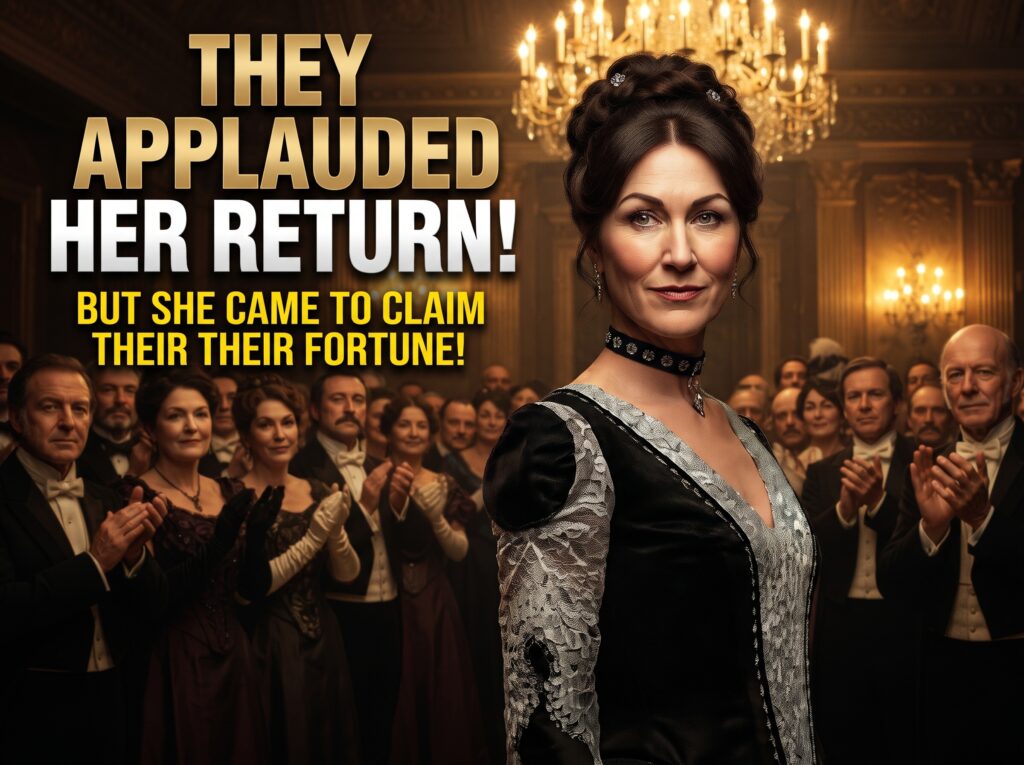
The ballroom of Ashford Manor had never looked more magnificent.
Thousands of tiny reflections shimmered across the polished wooden floor as crystal chandeliers illuminated the enormous room. Golden decorations framed the walls, and expensive flowers filled silver vases arranged along the staircase.
The most influential families in the county had gathered for the annual Ashford Winter Ball.
For generations, the Ashfords had used this evening to demonstrate their wealth, influence, and social importance.
Tonight was no exception.
Lord Charles Ashford stood near the center of the ballroom, accepting congratulations from guests who wanted his attention.
At sixty-eight, Charles remained a commanding presence. His silver hair was carefully arranged, his black evening suit was perfectly tailored, and his expression rarely revealed what he was thinking.
Beside him stood his son, Edward.
Edward was forty-two, handsome, ambitious, and accustomed to receiving whatever he wanted.
His marriage to Victoria Pembroke, the daughter of another wealthy family, had strengthened the Ashford position in society.
Everything appeared perfect.
Until the ballroom doors opened.
A woman entered.
She wore a fitted black evening gown decorated with silver lace. Her dark hair was arranged in an elaborate style, and a jeweled black choker rested around her neck.
She did not hurry.
She did not look frightened.
She simply walked forward as though she belonged there.
A few guests stopped speaking.
Then someone recognized her.
“Eleanor?”
The name traveled through the room.
Edward turned.
For several seconds, he appeared unable to understand what he was seeing.
“That cannot be her,” he whispered.
Victoria followed his gaze.
“Who?”
“Someone who should not be here.”
Across the ballroom, Eleanor Whitmore accepted a glass of water from a passing servant.
She smiled politely.
Twenty years had passed since she had last entered Ashford Manor.
Twenty years since she had been told that her mother was a liar.
Twenty years since Charles Ashford had ordered her to leave the estate and never return.
But Eleanor remembered everything.
She remembered the marble staircase where her mother had once stood.
She remembered the small bedroom overlooking the garden.
She remembered the day her mother had packed a single suitcase and told her that some families were wealthy because they had learned how to hide the truth.
Most importantly, she remembered her mother’s final words.
“One day, Eleanor, someone will try to convince you that you have nothing. Never believe them until you have read the original documents.”
At the time, Eleanor had been seventeen.
She had not understood.
Now she did.
“She has some nerve coming here,” Edward muttered.
Charles said nothing.
His eyes remained fixed on Eleanor.
Then he recognized the necklace around her neck.
It was a small silver pendant shaped like a flower.
His expression changed.
“Where did she get that?”
Edward looked at him.
“What?”
“The necklace.”
“I don’t know.”
Charles placed his glass on a nearby table.
“Find out.”
Meanwhile, Eleanor continued through the crowd.
Several guests approached her.
“Miss Whitmore, what a surprise.”
“We thought you had moved abroad.”
“How wonderful to see you again.”
She answered each greeting with the same calm smile.
But she noticed something.
Nobody asked why she had returned.
They were too busy wondering what she wanted.
Finally, she reached the grand staircase.
At the top stood Charles Ashford.
“Miss Whitmore,” he said coldly.
“Lord Ashford.”
“I wasn’t aware you had received an invitation.”
“I received one.”
“From whom?”
Eleanor looked toward the ballroom.
“Your legal representative.”
Charles frowned.
“My solicitor?”
“Yes.”
“Why would he invite you?”
Eleanor reached into her small evening bag and produced a folded card.
“Perhaps you should ask him.”
Charles took the card.
His face became pale.
The invitation had been signed by Arthur Bellamy, the family’s solicitor.
But beneath the signature was another name.
Margaret Ashford.
Charles’s deceased wife.
He looked back at Eleanor.
“Where did you find this?”
“In my mother’s belongings.”
“That is impossible.”
Eleanor smiled faintly.
“That is what everyone told me.”
Before Charles could respond, the orchestra began another piece.
The guests returned to their conversations.
But Charles no longer heard the music.
He was thinking about the woman standing before him.
And about a secret he had believed was buried forever.
Twenty years earlier, he had made a promise to destroy every document connecting Eleanor’s mother to the Ashford inheritance.
He had apparently missed one.
5. PART 2 — THE FAMILY THAT FORGOT HER NAME
Eleanor had grown up believing that her mother, Catherine Whitmore, was an ordinary woman.
They lived in a modest cottage outside the Ashford estate. Catherine worked as a seamstress, repairing dresses for wealthy families and occasionally helping with household arrangements.
She never complained about their circumstances.
She never spoke badly about the Ashfords.
But whenever Eleanor asked about her father, Catherine became quiet.
“Some questions are better answered when you are older,” she would say.
Eleanor never received that answer.
Catherine died when Eleanor was twenty-one.
Before her death, she gave her daughter a small wooden box.
Inside were several photographs, a silver necklace, and a handwritten letter.
Eleanor kept the box for years without understanding its importance.
The letter contained only a few sentences.
My dearest Eleanor,
If you are reading this, I hope you have finally discovered the courage to seek the truth.
Your grandmother’s name was Margaret Ashford. She loved you before you were born.
There is a document in the possession of the Bellamy family that will explain everything.
Do not trust anyone who asks you to surrender your mother’s name.
Love, Mother.
Eleanor had read those words hundreds of times.
But she had never known where to begin.
Then, six months earlier, an elderly solicitor named Arthur Bellamy had contacted her.
He was nearly eighty and had recently retired.
He explained that his father had served as the Ashford family’s legal representative for decades.
During an examination of old estate documents, Arthur had discovered a sealed envelope bearing Catherine’s name.
“I believe you have been denied something important,” he told Eleanor.
“What?”
“Your inheritance.”
Eleanor thought he was mistaken.
“My mother never owned anything.”
Arthur looked at her sadly.
“Your mother owned more than you can imagine.”
He explained that Margaret Ashford, Charles’s wife, had secretly established a trust for Catherine and her future children.
The trust included land, investment income, and a substantial share in the family estate.
But after Margaret died, the documents disappeared.
Charles had claimed that no such arrangement existed.
Arthur’s father had questioned the claim.
Then, shortly afterward, he had been dismissed.
His private archive remained untouched for decades.
Until Arthur found the original trust agreement.
Eleanor could hardly believe him.
“Are you saying my mother was supposed to inherit part of Ashford Manor?”
“Not just part of the manor,” Arthur replied. “She was supposed to control the estate’s principal family trust.”
Eleanor stared at the document.
“Why didn’t my mother tell me?”
“Perhaps she feared what would happen if she challenged Charles Ashford.”
Arthur placed another paper on the table.
It was a copy of Margaret’s handwritten instructions.
The document clearly stated that Catherine was to receive the trust if Charles attempted to exclude her from the family.
Eleanor read the final paragraph.
Then she looked up.
“Why are you telling me this now?”
Arthur hesitated.
“Because I have discovered something else.”
He opened a second folder.
Inside was a financial report.
Several decades earlier, a large portion of the Ashford fortune had been transferred into an account controlled by a private company.
The company had no legitimate connection to the family.
Its director was Edward Ashford.
Eleanor frowned.
“Edward?”
“Yes. And I believe the money was taken from the very trust that belonged to your mother.”
Suddenly, the mystery became much larger.
This was no longer simply about an inheritance.
It was about a fortune that might have been stolen.
And Eleanor had just walked into the house where the theft had begun.
6. PART 3 — THE ENVELOPE IN THE LIBRARY
The following morning, Eleanor returned to the manor.
This time, she did not wear an evening gown.
She wore a simple dark dress and carried a leather folder.
The housekeeper, Mrs. Collins, opened the door.
For a moment, she stared at Eleanor without speaking.
“Miss Whitmore?”
“Good morning, Mrs. Collins.”
The elderly housekeeper looked around nervously.
“Lord Ashford isn’t expecting visitors.”
“I know. I am here to see Mr. Bellamy.”
Mrs. Collins lowered her voice.
“He’s in the library.”
Eleanor entered.
The library was exactly as she remembered it.
Dark wooden shelves stretched from the floor to the ceiling. A large fireplace stood against the far wall, and the windows overlooked the gardens.
Arthur Bellamy sat beside a writing desk.
He looked troubled.
“You’re early,” he said.
“I couldn’t sleep.”
“Neither could I.”
He opened his briefcase.
“I received a telephone call last night.”
“From whom?”
“Edward Ashford.”
Eleanor sat down.
“What did he want?”
“He asked whether I had discussed the old trust with you.”
“And what did you say?”
“I told him that the truth was no longer mine to conceal.”
Arthur removed a document.
It was a copy of a legal transfer signed twenty-three years earlier.
The paper identified Catherine Whitmore as the intended beneficiary.
But the signature acknowledging receipt was not Catherine’s.
It belonged to Charles Ashford.
Eleanor studied it.
“He signed on her behalf?”
“Without authorization.”
Arthur nodded.
“Your mother never received the funds.”
“How much?”
Arthur looked at her.
“At the time, approximately three million pounds.”
Eleanor swallowed.
“That much?”
“With the estate’s investments and land appreciation, the current value is considerably higher.”
Before she could respond, the library door opened.
Edward walked in.
“What a touching reunion.”
Arthur stood.
“Mr. Ashford.”
Edward ignored him.
“Eleanor. I was beginning to think you had forgotten where you came from.”
“I remember perfectly.”
“Then you should remember that this family has no obligation to you.”
Eleanor closed the folder.
“Perhaps you should read the documents before making that statement.”
Edward laughed.
“Documents?”
He glanced at Arthur.
“Have you been filling her head with stories?”
“Only with evidence,” Arthur replied.
Edward approached the desk.
“Let me make something clear. My father built this family fortune. My grandfather built it before him. We have spent generations protecting this estate.”
Eleanor stood.
“Then you should have no difficulty proving that everything was acquired honestly.”
Edward’s smile disappeared.
“Be careful.”
“I have been careful for twenty years.”
He stepped closer.
“You have no idea what you are dealing with.”
Eleanor looked directly into his eyes.
“Neither do you.”
She collected her folder and walked toward the door.
But before leaving, she turned.
“One more thing, Edward.”
“What?”
“My mother never wanted your money.”
Edward smiled.
“Then what does she want?”
Eleanor paused.
“Her name restored.”
And she left.
Edward remained standing.
Arthur watched him carefully.
Because he knew something Eleanor did not yet know.
The forged transfer was only the beginning.
There was another document.
And that document contained Edward’s signature.
7. PART 4 — THE WOMAN BEHIND THE FAMILY PORTRAIT
That afternoon, Eleanor visited the small church where her mother had been buried.
The cemetery was quiet.
A cold wind moved through the trees, and fallen leaves covered the narrow paths.
She placed white flowers beside Catherine’s grave.
“I found it, Mother,” she whispered.
For years, she had believed that her mother had died without justice.
Now she had proof that Catherine had been cheated.
But the discovery had also raised questions.
Why had Margaret Ashford created the trust?
Why had she protected Catherine?
And why had Charles gone to such lengths to hide it?
Eleanor returned to her cottage and opened the wooden box.
This time, she examined everything carefully.
She removed the photographs one by one.
There was a picture of Catherine as a young woman.
Another showed Catherine standing beside an elegant older lady.
Eleanor recognized the woman immediately.
Margaret Ashford.
But something else caught her attention.
On the back of the photograph was a handwritten message.
To my beloved Catherine. You will always be my daughter, regardless of what the world says.
Eleanor read it again.
Her hands began to shake.
Her mother had not merely been a beneficiary.
She had been Margaret’s daughter.
The Ashford family had hidden a parent-child relationship.
Eleanor searched the box further.
At the bottom, she found a small envelope.
Inside was a birth certificate.
Catherine’s birth record listed Margaret Ashford as her mother.
The father’s name was left blank.
Eleanor sat down.
She had spent her entire life believing that Catherine was a distant relative of the Ashfords.
Instead, she was the granddaughter of the woman who had founded the family trust.
Her own identity had been deliberately erased.
That evening, she telephoned Arthur.
“I found something.”
“What is it?”
“My mother’s birth certificate.”
Arthur became silent.
“Does it identify Margaret?”
“Yes.”
“Then we have confirmation.”
“Why would Charles hide this?”
Arthur took a deep breath.
“Because your grandmother’s will treated Catherine as her legitimate daughter and named her the principal heir.”
Eleanor looked at the document.
“Then Charles knew.”
“He knew from the beginning.”
A long silence followed.
Then Arthur spoke again.
“There is something else. Margaret’s original will contains a clause that could change everything.”
“What clause?”
“If the family deliberately concealed Catherine’s identity, the estate’s controlling trusteeship would pass to Catherine’s descendants.”
Eleanor stared at the wall.
“Which means?”
“It means you may not simply be entitled to compensation.”
Arthur paused.
“You may be entitled to control the entire estate.”
For the first time in twenty years, Eleanor felt something stronger than sadness.
She felt the possibility of justice.
But she also understood that Charles Ashford would never surrender his power willingly.
And she was right.
Because that same evening, Edward discovered the missing birth certificate.
And he immediately telephoned his father.
“We have a serious problem.”
Charles closed his eyes.
“How serious?”
“She knows who Catherine really was.”
Charles slowly placed his glass on the table.
“Then we must stop her.”
8. PART 5 — THE SECRET OF THE ASHFORD FORTUNE
The next morning, Charles summoned Edward to his private office.
The room was filled with family portraits, antique furniture, and expensive paintings.
Edward entered carrying a newspaper.
“She has spoken to the solicitor again.”
Charles did not look up.
“I know.”
“Then we need to act.”
Charles finally raised his eyes.
“Do you think I have spent thirty years protecting this family without preparing for such a possibility?”
He opened a locked cabinet.
Inside were several financial records.
Edward recognized the company names immediately.
His own company appeared on three separate documents.
“What are those?”
“The accounts your grandmother established.”
Edward frowned.
“Those are old records.”
“Not old enough.”
Charles placed a finger on one transfer.
“This money was supposed to remain in the family trust. Your mother discovered that I had moved it.”
Edward looked at him.
“Grandmother discovered?”
“No. Your mother.”
Edward was confused.
Charles continued.
“Margaret had been dead for years. Your mother, Elizabeth, discovered the original documents shortly before she died.”
“Why didn’t she tell me?”
“Because she believed you were too young to understand.”
Edward sat down.
“Then what happened?”
Charles looked toward the window.
“She intended to restore Catherine’s inheritance.”
Edward’s expression changed.
“And you stopped her?”
Charles said nothing.
The silence was enough.
Edward stood.
“Father, are you telling me that our entire position in this family is based on money that was never ours?”
“Watch your language.”
“Is it true?”
Charles walked toward the fireplace.
“Your grandmother was emotional. She made promises she had no right to make.”
“She owned the estate.”
“And I maintained it!”
Charles’s voice rose.
“I protected this family when everyone else wanted to see it destroyed. I paid debts, maintained properties, and saved businesses that would otherwise have collapsed.”
Edward shook his head.
“That doesn’t make the money yours.”
Charles turned sharply.
“You have enjoyed every privilege this family has offered you. Do not pretend you are suddenly innocent.”
Edward looked away.
He knew his father was right about one thing.
He had benefited from the money.
His company had received investments.
His house had been purchased through family funds.
Even his marriage to Victoria had been strengthened by his apparent wealth.
If Eleanor proved the trust had been stolen, everything could disappear.
That evening, Victoria confronted Edward.
“I heard your father arguing with the solicitor.”
Edward poured himself a drink.
“Not now.”
“Edward, I am your wife. I deserve to know what is happening.”
He looked at her.
“There may be a problem with the inheritance.”
Victoria frowned.
“What kind of problem?”
“A woman has appeared claiming that our fortune belongs to her.”
Victoria laughed nervously.
“That is ridiculous.”
“I thought so too.”
He placed a document on the table.
Victoria read it.
Her smile disappeared.
“Is this genuine?”
“Apparently.”
“Then what are you going to do?”
Edward looked at the papers.
“I don’t know.”
Victoria studied him.
For the first time since their marriage, she saw fear in his expression.
And she began to wonder whether the man she had married had ever truly owned anything.
Meanwhile, Eleanor was preparing for the final step.
Arthur had arranged an independent examination of the original documents.
The results were expected within days.
But before the report arrived, Eleanor received an unexpected visitor.
A woman in her late seventies stood outside her cottage.
She introduced herself as Elizabeth Ashford’s former companion.
“My name is Rose Bennett,” she said.
“I knew your grandmother.”
Eleanor invited her inside.
Rose sat at the kitchen table.
Then she placed an old photograph in front of Eleanor.
It showed Margaret holding a baby.
On the back were six words.
My granddaughter, Catherine’s little Eleanor.
Rose looked up.
“Your grandmother knew you existed.”
Eleanor felt tears fill her eyes.
“Did she ever try to find us?”
Rose nodded.
“Many times.”
“Then why didn’t she?”
Rose lowered her eyes.
“Because Charles made certain she never could.”
9. PART 6 — THE LETTER THAT CHANGED EVERYTHING
Rose Bennett returned the following afternoon.
This time, she brought a small leather case.
Inside were letters, photographs, and several handwritten notes.
“I kept these because I knew one day someone would need them,” she explained.
Eleanor opened the first letter.
It was written by Margaret Ashford.
My dearest Catherine,
I have been trying to arrange a meeting with you, but Charles continues to interfere.
I have never stopped loving you.
The money is not what matters. I want my daughter to have the life I should have given her.
Please forgive me for waiting so long.
Eleanor read the letter twice.
Her mother had been loved.
She had not been forgotten.
She had been kept away.
Rose explained that Margaret had become ill shortly after writing it.
Charles had taken control of the family correspondence and prevented letters from reaching Catherine.
“Why did you never speak?” Eleanor asked.
Rose looked ashamed.
“I was frightened. I needed my position. I had a family of my own.”
Eleanor did not blame her.
But she could not ignore the years that had been lost.
“Did my grandmother know I was born?”
Rose nodded.
“She knew. She even arranged for a small trust to be created in your name.”
Eleanor opened another document.
This one was dated shortly before Margaret’s death.
It contained a list of properties.
One of them was Ashford Manor itself.
At the bottom was a clause requiring the estate’s trustees to restore the original inheritance if Catherine’s descendants could establish their identity.
Eleanor looked at Rose.
“Why didn’t Charles destroy this?”
“Because he didn’t know I had it.”
Rose took a deep breath.
“Your grandmother gave it to me for safekeeping.”
Eleanor looked at the old woman.
“Why are you giving it to me now?”
Rose’s eyes filled with tears.
“Because I am tired of carrying the truth alone.”
The following day, Arthur examined the new documents.
His expression grew increasingly serious.
“This is important,” he said.
“Important enough?”
“More than enough to justify an independent legal investigation.”
He turned another page.
Then stopped.
“There’s a problem.”
Eleanor looked at him.
“What?”
“The original trusteeship was transferred to a private company after Margaret died.”
“Whose company?”
Arthur hesitated.
“Edward’s.”
Eleanor felt her stomach tighten.
“How much money passed through it?”
Arthur studied the financial report.
“Approximately twelve million pounds over the years.”
“Where is it now?”
“Some of it remains invested. Some was used to purchase properties. Some was transferred overseas.”
Eleanor closed her eyes.
She had expected injustice.
She had not expected a financial empire built around it.
Arthur leaned forward.
“If we proceed, we must be prepared for a long legal battle.”
Eleanor looked at the photographs of her mother and grandmother.
“I have already waited twenty years.”
“Are you certain?”
“Yes.”
“Because once we begin, there will be no going back.”
Eleanor placed the photographs carefully inside her folder.
“There was never a way back.”
10. PART 7 — THE BETRAYAL INSIDE THE FAMILY
Edward had always believed that money could solve every problem.
When he wanted a business opportunity, his father provided capital.
When he wanted a better house, the family estate helped purchase it.
When he wanted to marry Victoria, Charles arranged introductions and encouraged the alliance.
But now the money was becoming a threat.
Edward visited his father late one evening.
“We need to reach an agreement with Eleanor.”
Charles looked up.
“What kind of agreement?”
“Pay her.”
“How much?”
“Enough to make her disappear.”
Charles laughed bitterly.
“Do you think she came here for a cheque?”
“Everyone has a price.”
“Not everyone.”
Edward became angry.
“Then what do you suggest?”
Charles stood.
“We challenge the documents.”
“What if they’re genuine?”
“Then we challenge the trust.”
“What if we lose?”
Charles stepped closer.
“Then you had better hope I never have to explain how much of the money passed through your company.”
Edward went silent.
He understood the threat.
His father was prepared to sacrifice him.
Meanwhile, Victoria had begun investigating the family’s accounts.
She discovered that several properties listed as Edward’s personal assets had actually been purchased using money from the old Ashford trust.
She also discovered payments made to a former employee who had been instructed to destroy old correspondence.
One payment was signed by Charles.
Another by Edward.
Victoria confronted her husband.
“Did you know?”
Edward looked at the papers.
“Where did you get those?”
“That isn’t the question.”
“Victoria, stay out of this.”
She stepped back.
“You used our marriage to convince everyone that your family was respectable.”
Edward’s expression hardened.
“You have no idea what my father has done for us.”
“Perhaps that is the problem. I am beginning to understand.”
He reached for the papers.
Victoria pulled them away.
“Don’t.”
“Give them to me.”
“No.”
For the first time, Edward realized that his wife might become an enemy.
The following morning, Victoria contacted Arthur Bellamy.
She told him she had evidence that could support Eleanor’s claim.
Arthur agreed to meet her.
When Eleanor heard the news, she was cautious.
“Why would Victoria help us?”
Arthur answered honestly.
“I don’t know. But the documents should speak for themselves.”
Victoria arrived carrying a sealed envelope.
Inside were bank transfers, property records, and a letter from Edward instructing an accountant to move money between several companies.
Eleanor read the letter.
Her hands trembled.
“Is this genuine?”
Victoria nodded.
“I found it in Edward’s private office.”
“Why are you giving it to me?”
Victoria looked down.
“Because I married a man I thought I understood. I cannot continue protecting him if he has stolen another woman’s future.”
Eleanor studied her.
“You may lose everything.”
Victoria gave a sad smile.
“I think I already have.”
11. PART 8 — THE FINAL DISCOVERY
Three days later, Arthur received the independent legal examination.
The signatures on Margaret’s original documents were authentic.
The trust had been legally established.
The transfer signed by Charles had no valid authorization from Catherine.
And the company controlled by Edward had received funds that belonged to the trust.
But one question remained.
Who had the legal authority to control Ashford Manor?
Arthur spent the entire afternoon reviewing the original estate documents.
Then he found the final clause.
It was hidden in an appendix attached to Margaret’s will.
The clause stated that if the Ashford family concealed Catherine’s identity or unlawfully withheld her inheritance, the controlling trusteeship would pass to her descendants.
Eleanor was the only living descendant named in the supporting family records.
Arthur read the paragraph again.
Then he called her.
“Eleanor, I believe we have found the answer.”
“What answer?”
“The one your grandmother wanted you to discover.”
He explained the clause.
Eleanor listened in silence.
“Does this mean I own Ashford Manor?”
“Subject to formal legal proceedings and verification of the estate’s assets, you have a substantial claim to its controlling ownership.”
Eleanor closed her eyes.
For a moment, she imagined her mother standing in the small cottage kitchen.
She imagined Catherine hearing the news.
Then she remembered something.
“My mother never wanted to take the house.”
Arthur paused.
“What do you mean?”
“She wanted the truth. She wanted her name restored. She wanted the people who lied about her to admit what they had done.”
Arthur nodded.
“Then perhaps that should be your first demand.”
Eleanor looked through the window.
The garden outside was covered in autumn leaves.
She had spent years imagining what it would feel like to return to Ashford Manor.
She had imagined anger.
She had imagined revenge.
But now she understood that the greatest victory would not be owning a beautiful house.
It would be ensuring that no one could erase her mother’s name again.
Arthur placed one final document on the table.
It was a notice requesting the family attend a formal meeting to discuss the estate’s legal ownership.
The date was set for the following Saturday.
At Ashford Manor.
Eleanor looked at the paper.
“Will Charles attend?”
Arthur nodded.
“He has already confirmed.”
“And Edward?”
“Yes.”
Eleanor folded the notice.
“Good.”
Arthur studied her.
“What are you planning?”
She smiled faintly.
“I am going to give them the opportunity to tell the truth themselves.”
12. PART 9 — THE NIGHT THE ASHFORD FAMILY LOST EVERYTHING
The ballroom was filled once again.
This time, the guests had gathered for a special family announcement.
Charles Ashford had invited the county’s wealthiest families, business partners, and legal representatives.
He intended to present Edward as the future head of the Ashford estate.
It was supposed to be a celebration.
But Charles had underestimated Eleanor.
At precisely eight o’clock, the doors opened.
Eleanor entered wearing a black evening gown with silver lace.
Her hair was arranged in an elegant updo.
A jeweled black choker rested around her neck.
The room became quiet.
Some guests recognized her from the previous ball.
Others whispered.
Charles stood near the staircase.
Edward was beside him.
Victoria stood several steps away, looking uncomfortable.
Eleanor walked forward.
Charles approached.
“Miss Whitmore. I believe we have already discussed your claims.”
“We have discussed them. We have not resolved them.”
“This is a private family gathering.”
“Then perhaps you should have kept the family’s financial records private.”
Several guests exchanged nervous looks.
Edward stepped forward.
“You are making a scene.”
“No, Edward. I am ending one.”
Arthur Bellamy entered carrying a leather case.
Charles’s expression changed.
“Arthur, what are you doing here?”
“Performing my professional duty.”
Arthur placed the case on a nearby table.
Eleanor addressed the room.
“Twenty years ago, my mother was told that she had no connection to this family. She was accused of inventing stories about an inheritance that never existed.”
She paused.
“Today, I have the original documents proving otherwise.”
Charles shook his head.
“Those documents are disputed.”
“Not anymore.”
Arthur opened the case.
He removed the original trust agreement, the birth certificate, and the independent examination.
“These documents establish Margaret Ashford’s relationship to Catherine Whitmore and the trust created for her benefit.”
A murmur spread through the ballroom.
Edward stepped toward Arthur.
“Those records are confidential.”
Arthur looked at him.
“They are evidence in a matter concerning the estate.”
Eleanor continued.
“My mother was Catherine Ashford by birth. She was denied her inheritance, and the money intended for her was transferred without proper authorization.”
Charles raised his voice.
“Your mother abandoned this family!”
Eleanor looked directly at him.
“She was prevented from returning.”
“That is a lie!”
Then Victoria stepped forward.
“No, Charles. It isn’t.”
Everyone turned.
Victoria held a folder.
“I have copies of the financial transfers. They show that money belonging to the trust was moved through Edward’s company.”
Edward stared at her.
“Victoria, don’t.”
She ignored him.
“I also have correspondence showing that both you and Charles knew about the original trust.”
The room fell silent.
Charles looked toward his son.
Edward said nothing.
Eleanor took a breath.
“I did not come here to destroy this family. I came here because my mother deserved to be remembered.”
She turned toward Charles.
“You had twenty years to tell the truth.”
Charles’s face had become pale.
“And what do you want now?” he asked.
Eleanor looked at the people surrounding them.
“I want the original inheritance restored. I want the stolen assets accounted for. And I want my mother’s name placed where it always belonged.”
Arthur presented the final document.
It contained the estate’s legal findings and the proposed restoration of the trust’s controlling ownership.
Charles stared at the paper.
For the first time in his life, he had no immediate answer.
Edward looked around the ballroom.
The guests who had once admired him were now avoiding his eyes.
His entire world was changing.
Then Charles spoke quietly.
“Your grandmother loved Catherine.”
Eleanor looked at him.
“Then why did you make her suffer?”
Charles lowered his head.
“Because I was afraid.”
“Of what?”
“Of losing everything.”
Eleanor’s expression softened slightly.
“And so you made sure my mother lost everything instead.”
Charles had no answer.
The orchestra remained silent.
Nobody applauded.
Nobody moved.
And the Ashford family finally faced the truth they had spent decades hiding.
13. PART 10 — THE NAME THAT COULD NEVER BE ERASED AGAIN
Six months later, Ashford Manor looked different.
The large entrance gates had been restored.
The gardens were open to the public on certain days, and the old family library had become a small historical archive.
Eleanor had chosen not to live in the manor.
Instead, she established a charitable trust in her mother’s name.
Part of the estate’s income was used to provide education for young women from families who had been denied opportunities because of poverty or social prejudice.
The financial investigation continued.
Several properties were recovered, and the disputed accounts were placed under independent management.
Edward faced legal consequences for his involvement in the unauthorized transfers.
Victoria moved away from the estate.
She and Eleanor remained in occasional contact, although neither pretended that their friendship could erase what had happened.
Charles retired from public life.
He spent his final years in a smaller property outside the county.
One autumn morning, Eleanor received a letter.
It was written in Charles’s handwriting.
Dear Eleanor,
I do not expect forgiveness.
For many years, I convinced myself that protecting the Ashford name justified everything I did.
I was wrong.
Your mother deserved better. So did you.
I cannot return the years that were taken from you, but I hope you will allow the truth to remain in this house.
Charles.
Eleanor read the letter twice.
Then she placed it inside the wooden box that had once belonged to her mother.
She did not forgive him immediately.
Some wounds were too deep for a single apology.
But she no longer needed his permission to move forward.
On the anniversary of Margaret Ashford’s death, Eleanor organized a small ceremony in the manor’s main hall.
A new portrait had been placed above the fireplace.
It showed Margaret holding Catherine as a baby.
Beneath it was a simple inscription:
MARGARET ASHFORD AND HER DAUGHTER, CATHERINE WHITMORE.
For decades, the family had hidden that relationship.
Now it was part of the house’s permanent history.
Rose Bennett attended the ceremony.
She stood beside Eleanor and looked at the portrait.
“Your grandmother would have been proud,” she whispered.
Eleanor smiled.
“I wish she had lived long enough to see this.”
Rose gently took her hand.
“Perhaps she knew you would find the truth.”
After the ceremony, Eleanor walked through the ballroom.
It was the same room where she had once been judged by people who believed they knew her story.
The chandeliers still shone.
The polished floor still reflected the golden light.
But something had changed.
The house no longer represented the power of one family.
It represented the truth of another.
Eleanor stopped near the staircase.
She remembered the first evening she had returned.
The whispers.
The smiles.
The applause.
And the fear in Charles’s eyes when he recognized the necklace.
She touched the silver pendant resting against her chest.
It had belonged to Catherine.
And before Catherine, it had belonged to Margaret.
Three generations of women had carried a secret.
Now the secret was gone.
Eleanor looked toward the portrait.
“Your name is home, Mother,” she whispered.
Then she turned and walked toward the open doors.
Outside, sunlight fell across the garden.
For the first time in many years, she felt no need to look back.
She had not returned to Ashford Manor to become a wealthy woman.
She had returned to give her mother something far more valuable.
A place in the history of the family that had once tried to erase her.
And as the ballroom doors closed behind her, Eleanor understood the lesson her mother had tried to teach her all those years ago.
Money can be stolen. Property can be taken. Families can lie. But the truth, once discovered, does not belong to the people who tried to bury it.
It belongs to the people brave enough to bring it into the light.