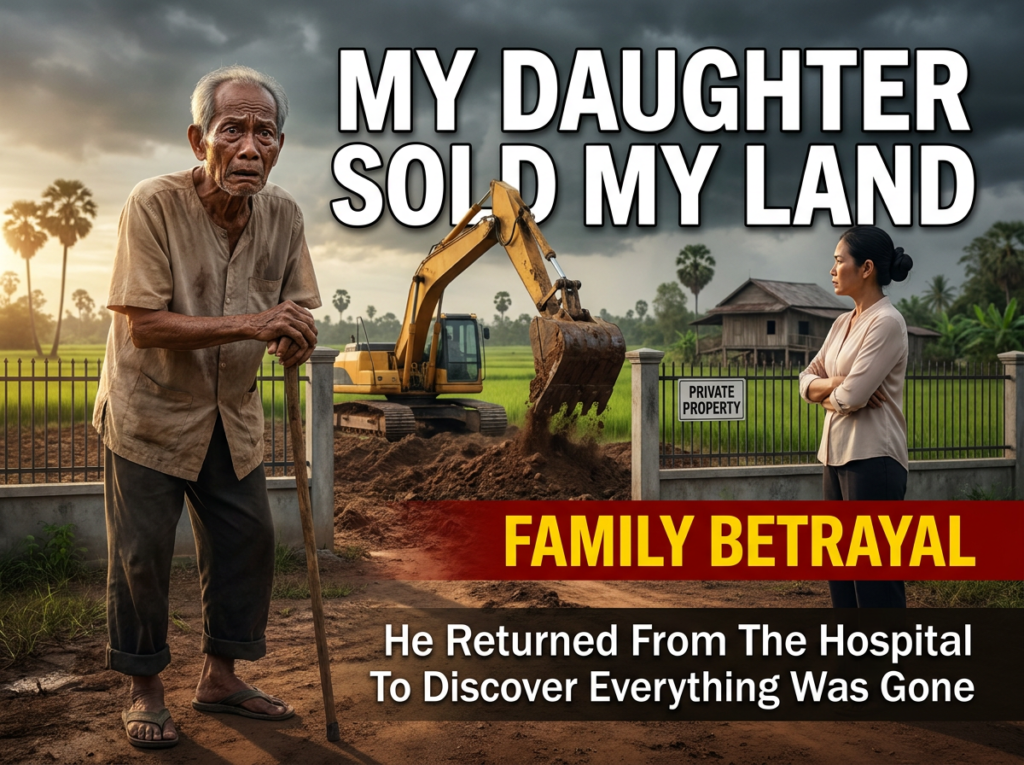
At seventy-nine, Dara returned from months in the hospital to discover that his family’s land had been sold and fenced off by a construction company. His daughter insisted the sale was legal, but a hidden letter from his late wife would change everything he believed about his family.
Dara read his wife’s letter until the words blurred before his eyes.
He had spent thirty-one years believing that his younger brother had abandoned the family out of greed. Now Sopheak was telling him that she had been the one to send Sokha away.
Why?
He turned the page, hoping for an explanation, but the letter ended with a sentence that left him more frightened than before.
The deed beneath this floor is not the whole truth. If Lina has touched our land, you must find Sokha before you decide what justice means.
Dara lowered the letter.
“Why didn’t you tell me?” he whispered.
The room offered no answer.
He folded the paper carefully and placed it beside the deed. His wife had been gone for eleven years, yet she had managed to reopen a wound he had spent a lifetime trying to close.
He remembered the day Sokha left.
It had been 1995, during the rainy season. Dara was forty-eight, already responsible for their aging parents and the fields that fed the family. Sokha was fifteen years younger, restless and impatient with the endless work of village life.
Their father had died the previous year. Before his death, he had told Dara that the family land must never be divided carelessly.
“You are the eldest,” he had said. “Protect the house. Protect your brother. And when I am gone, remember that land is more than soil. It is the promise that your family will have somewhere to return.”
Dara had taken those words as a duty.
Sokha had understood them differently.
He wanted to study surveying in Phnom Penh. He believed that understanding land registration and property law could protect villagers from dishonest officials. Dara thought the idea foolish. Their family needed another pair of hands in the fields, not another young man dreaming of offices and city life.
Their arguments grew worse after Sokha became involved with a woman named Malis.
She came from a poor family whose land had been seized after a dispute with a powerful local businessman. Dara believed she would bring trouble into their household. He accused Sokha of neglecting his responsibilities and choosing a stranger over his own blood.
Sokha answered with words Dara never forgot.
“Sometimes the people who call themselves family are the first to decide that your life belongs to them.”
The next morning, Sokha disappeared.
He left behind a few clothes, an empty bed, and a mother who cried for weeks. Dara searched the neighboring villages, questioned friends, and eventually convinced himself that his brother had run away because he wanted freedom from family obligations.
Then a rumor reached him that Sokha had taken money from their father’s old savings.
Dara never proved it.
He did not need proof. His anger had already made the decision.
When their mother died, Sokha did not attend the funeral. When Dara married Sopheak, his brother sent no congratulations. When their daughter Lina was born, there was no message, no gift, and no explanation.
Years passed. The family learned to live with the empty space where Sokha had been.
Dara had told Lina that her uncle was selfish, unreliable, and unworthy of trust.
She had grown up believing him.
Now Sopheak’s letter lay beside the deed, challenging every memory he had used to justify his hatred.
A knock sounded at the front door.
Dara quickly folded the papers and slipped them beneath his shirt.
“Father?”
Lina stood in the doorway.
She was forty-six, dressed in a pale blouse and dark trousers, her hair pulled into a neat knot. A gold bracelet shone on her wrist. She carried a bag of groceries and wore the familiar expression she used whenever she wanted to make a difficult conversation seem ordinary.
“I heard you came home,” she said. “Why didn’t you call me?”
Dara stared at her.
“You sold my land.”
Lina set the bag on the table.
“Father, please. You have just returned from the hospital. We should talk calmly.”
“Did you sell it?”
She sighed.
“Yes.”
The answer was so simple that it seemed to empty the room of air.
“Without asking me?”
“I had no choice.”
“You always have a choice.”
“Not when the bank threatens to take everything!”
Dara leaned on his walking stick.
“What bank?”
Lina looked away.
For the first time, he noticed how tired she seemed. Dark circles lay beneath her eyes. Her fingers trembled as she arranged the groceries, moving the vegetables from one side of the table to the other.
“My business was failing,” she admitted. “I borrowed money to keep it running. I thought I could repay it before anyone discovered how serious things had become.”
“What business?”
“My distribution company.”
“You told me it was doing well.”
“I didn’t want you to worry.”
“So you used my land instead?”
“I used it as security. I believed the business would recover.”
“And when it didn’t?”
She raised her voice.
“I saved this family from ruin!”
Dara looked at the bracelet on her wrist, then at the groceries she had brought him.
“Did you save the family,” he asked quietly, “or did you save yourself?”
Lina flinched.
“You don’t understand what I went through.”
“Then explain it.”
She opened her mouth, but no words came.
Finally, she said, “The documents were signed. The company bought the property legally. You cannot change that now.”
Dara felt the weight of Sopheak’s letter against his chest.
“Show me the documents.”
“I don’t have them.”
“Where are they?”
“With the company.”
“Then bring them.”
Lina picked up her handbag.
“Father, please don’t make this worse. The sale is finished. If you fight them, you’ll lose whatever money is left. You could lose the house, too.”
She moved toward the door.
“Lina.”
She stopped.
“Did you sign my name?”
Her shoulders stiffened.
For a moment, she did not move at all.
Then she turned, and the expression on her face frightened him more than any admission could have.
“Be careful, Father,” she whispered. “You don’t know who you’re fighting.”
She left before he could answer.
Dara stood in the silence she had abandoned.
He had once carried that child on his shoulders through flooded rice fields. He had sold two buffaloes to pay for her education. He had sat beside her when fever kept her awake through the night.
He had believed that love meant protecting her from the consequences of her mistakes.
Perhaps that was where everything had begun to go wrong.
He returned to Sopheak’s bedroom and lifted the floorboard once more.
This time, he examined the deed carefully.
The official stamp was faded, but the registration number remained legible. Beside it was a handwritten note bearing the date of a transaction he had never known existed.
Part of the land had been transferred long before Lina was born.
And the person who had received it was his estranged brother.
Dara folded the deed and looked toward the darkness outside.
Tomorrow, he would find the retired land registrar who had once taught Sokha how to read property records.
If the man was still alive, he might know why Sopheak had hidden the truth.
And if he did, Dara would finally learn whether his brother had betrayed the family—or whether the family had betrayed him.
The retired land registrar lived in a modest house near the edge of the district town.
Dara remembered him as a stern man with silver hair and a habit of correcting people whenever they confused ownership with possession. His name was Mr. Chan. Decades earlier, he had helped several villagers resolve boundary disputes, and he had once told Dara that the most dangerous lie about land was the belief that the person who worked it must always be the person who owned it.
Dara had disagreed with him then.
He understood the warning now.
The journey took nearly an hour. By the time Dara arrived, the morning heat had settled over the town, and his shirt clung to his back. He climbed the steps slowly and knocked on the door.
An elderly woman answered.
“I’m looking for Mr. Chan.”
“Who is asking?”
“My name is Dara. I used to farm near the old canal.”
She studied him, then nodded.
“My husband remembers you.”
Mr. Chan was sitting beside a window, reading a newspaper. He had grown thinner, but his eyes were still sharp.
When he saw Dara, he lowered the paper.
“I heard your land was sold.”
Dara stopped.
“Everyone knows?”
“In a small district, news travels faster than motorbikes.”
“Then you know my daughter did it.”
“I know what people say. That is not the same as knowing the truth.”
Dara sat opposite him and placed the folded deed on the table.
“I need you to examine this.”
Mr. Chan unfolded the document. At first, his expression remained neutral. Then he leaned closer, adjusting his glasses.
“Where did you find it?”
“Under my wife’s bedroom floor.”
“Does Lina know you have this?”
“I don’t think so.”
Mr. Chan read the registration number aloud, then reached for a notebook. His fingers moved slowly, tracing the figures as he searched through several pages of handwritten records.
After a few minutes, he stopped.
“This transaction was recorded in the old district register.”
“Who owned the land?”
Mr. Chan looked up.
“According to this deed, your father granted your brother a separate interest in the eastern portion of the property.”
Dara gripped his walking stick.
“My father never told me.”
“Perhaps he believed he had already explained it.”
“He told me the land was mine to protect.”
“That does not necessarily mean it was yours alone.”
Dara felt anger rise in him, but he forced himself to remain silent.
Mr. Chan continued reading.
“The transfer appears to have been witnessed and registered. However, I would need to compare the original register with the newer title documents to establish precisely what remains valid.”
“Can you do that?”
“I can help you request the records. But I cannot promise the outcome.”
Dara nodded.
“Tell me about the transaction.”
Mr. Chan leaned back.
“Your brother was young, but he understood land law better than most people twice his age. He was concerned about the family’s property because he believed the boundaries were being altered in the district records.”
“I remember nothing about this.”
“You were not present when the agreement was discussed.”
“Who was?”
“Your father. Your wife. Your brother. And one other person.”
“Who?”
Mr. Chan hesitated.
“Malis.”
The name brought back an old anger.
“She had no right to be involved in my father’s land.”
“Perhaps your father thought differently.”
Dara stood abruptly, then had to steady himself against the table.
Mr. Chan waited until he sat down again.
“Dara, I am going to tell you something that may hurt. You have spent many years believing your brother abandoned you. But I remember him coming to this office after your mother died. He asked whether the transfer had been properly recorded.”
“Why didn’t he come to me?”
“I don’t know. Perhaps he tried. Perhaps he believed you would refuse to listen.”
Dara looked down at his hands.
He remembered the years when he had refused to hear Sokha’s name. Whenever someone mentioned him, Dara changed the subject. When an old friend suggested that the brothers reconcile, he answered that the past was finished.
He had mistaken silence for certainty.
Mr. Chan returned the deed.
“This document may help you, but there is something else you must understand. Even if your daughter forged your signature, the eastern portion may not have been yours to sell in the first place.”
Dara stared at him.
“So I could lose the case?”
“You could discover that part of the land belongs to someone else. Justice does not always give us the answer we want.”
Dara thought of the house, the mango tree, the fields where his family had worked for generations.
“What about the company?”
“If the buyer knew the title was disputed, that matters. If the transfer papers were forged, that matters too. But you will need evidence.”
“Where do I find it?”
Mr. Chan folded his hands.
“Start with the original registration file. Then find your brother.”
Dara shook his head.
“I don’t even know whether he is alive.”
Mr. Chan studied him.
“Then perhaps it is time you stopped assuming the worst.”
Before Dara left, Mr. Chan wrote down the number of a legal aid office in the provincial town. He also agreed to help request copies of the old registration records.
“Do not confront the company yet,” he warned. “And do not let your daughter destroy anything you may need.”
Dara slipped the number into his pocket.
Outside, the town was noisy with traffic and market sellers. A woman balanced baskets of vegetables on a motorbike. Children hurried past in school uniforms. Somewhere, a hammer struck metal in a steady rhythm.
Ordinary life continued.
Dara climbed into a passing vehicle and began the journey home, carrying the deed inside his shirt.
He was halfway through the village when Chenda stepped into the road and waved him down.
“Dara! I have been looking for you.”
“What happened?”
Chenda glanced at the driver, then lowered his voice.
“I remembered something else about the night Lina visited the district office.”
Dara stepped out.
“What?”
“The man from the construction company wasn’t the only person waiting outside.”
“Who else was there?”
“Your daughter’s husband.”
Dara frowned.
“Vannak?”
Chenda nodded.
“He was carrying a second folder. Lina handed him something before she left. I couldn’t see what it was, but they argued.”
“About what?”
“I don’t know. But Vannak looked furious.”
Dara’s stomach tightened.
His son-in-law had always appeared polite, ambitious, and eager to please. He had helped Lina start her business and often spoke about expanding it into other provinces. Dara had admired his confidence, although Sopheak had once told him that a person who measured every relationship in money could eventually mistake love for an investment.
Dara had dismissed the warning.
Now he wondered what else he had refused to see.
“Did you hear anything?” he asked.
Chenda nodded slowly.
“Only one sentence. Vannak said, ‘If the old man comes back, we will all be finished.’”
Dara felt the words settle over him.
Not if he recovers.
Not if he asks questions.
If he comes back.
They had been expecting him to die, or at least to remain helpless.
His own family had planned around his absence.
That evening, Dara waited until the village grew quiet before returning to Sopheak’s bedroom. He examined the deed again, searching for anything he might have missed.
Beneath the official stamp was a small handwritten reference to an attached declaration.
But no declaration had been hidden with the deed.
He searched the envelope, the cloth, and the space beneath the floorboards.
Nothing.
Then he noticed a faint line on the back of his wife’s letter, almost invisible beneath the folds.
He held it near the lamp.
There, in Sopheak’s handwriting, were four words.
Ask Malis’s daughter. First.
Dara read them twice.
Malis had disappeared from the village after Sokha left. People said she had married elsewhere, while others claimed she had died during the years of upheaval.
He had never asked which story was true.
Now he had to find her daughter.
But before he could begin that search, a motorbike stopped outside his house.
Someone knocked hard on the door.
“Dara!” a man’s voice called. “Open up. We need to talk about your land.”
Dara recognized the voice immediately.
It was Sokha, the construction company’s representative.
And he had not come alone.
Dara opened the door but did not step aside.
Sokha stood on the porch in a crisp white shirt, his hair carefully combed, and a leather folder tucked beneath one arm. Two men waited near the motorbike. One of them carried a phone and kept glancing toward the road.
“Good evening, Uncle,” Sokha said.
Dara studied him.
“You are not my nephew.”
The younger man smiled without warmth.
“My name is Sokha. I represent Vannak Development.”
“You have the same name as my brother.”
“A common name.”
“Not in my family.”
The smile disappeared.
Sokha looked past him into the house.
“We should discuss the property privately.”
“There is nothing to discuss.”
“The company has paid for the land. The transfer is complete.”
“Then why have you come here?”
“To prevent misunderstandings. Your daughter has already explained the situation.”
“My daughter explains many things. That does not make them true.”
Sokha opened the folder and removed a photocopy of the transfer agreement.
“Your signature is here. The witnesses are listed. The district office recorded the transaction. If you continue challenging the sale, you could be responsible for legal costs.”
Dara took the paper.
At first glance, the signature resembled his own. The letters leaned in the right direction, and the final stroke curved beneath the name as he had done for decades.
But the pressure was wrong.
Dara had spent his life signing receipts, land-tax documents, and cooperative records with the same blunt, uneven strokes. This signature was too smooth. Whoever had copied it had studied the shape without understanding the hand.
“You have made a mistake,” Dara said.
Sokha’s expression hardened.
“What mistake?”
“I did not sign this.”
“Are you accusing the district office of fraud?”
“I am telling you that my name was written without my permission.”
Sokha closed the folder.
“Then prove it.”
He turned toward the road, signaling to the two men.
“Think carefully, Uncle. You are an old man. You have just returned from the hospital. You should be resting, not fighting people who can make your life very difficult.”
Dara stepped forward.
“Is that a threat?”
“It is advice.”
“Then take my advice in return. Leave my house.”
Sokha stared at him for a long moment.
Finally, he nodded.
“As you wish.”
He walked toward the motorbike, then stopped beside the gate.
“One more thing. The company intends to begin construction soon. If you have any personal belongings left inside the property, remove them before the workers return.”
Dara felt his face grow hot.
“My home is not your storage room.”
“Not anymore.”
The motorbike engine roared to life.
Dara watched the men disappear down the road, then shut the door and leaned against it until his breathing steadied.
He had spent his life believing that age brought wisdom.
Perhaps it brought something else: the knowledge of how easily people could mistake a quiet man for a powerless one.
The following morning, he went to the legal aid office Mr. Chan had recommended. A young lawyer named Ms. Rathana listened as he described the sale, the forged signature, and the deed hidden beneath his wife’s floor.
She did not interrupt.
When he finished, she arranged the documents in front of her and began asking questions.
“Did you ever authorize your daughter to act on your behalf?”
“No.”
“Did you sign a power of attorney?”
“No.”
“Were you conscious and able to make decisions during your hospital treatment?”
“For most of it, yes. But I never agreed to sell anything.”
“Do you have the original deed?”
Dara placed it on the desk.
She examined it carefully.
“This could be important. But we need the current title records, the transfer file, and evidence that the signature is not yours. We should also establish who held legal rights to each portion of the land before the disputed sale.”
“And the company?”
“If it knowingly purchased property using forged documents, that could seriously affect its position. But we must prove what its representatives knew and when they knew it.”
Dara looked at the papers.
“Can you help me?”
“I can help you prepare a case and seek the appropriate legal remedies. I cannot promise that the process will be easy.”
“I have lived long enough to know that easy things rarely matter.”
Ms. Rathana nodded.
“Then we will begin with the records.”
Over the next several days, she helped him submit requests for the old registration file and arrange an independent examination of the disputed signature. Mr. Chan provided a written statement about the earlier transfer. Chenda agreed to describe what he had seen outside the district office.
For the first time since returning home, Dara felt that he was no longer standing alone against a wall of strangers.
Yet the evidence also brought new questions.
The construction company had purchased the property at a price far below the value of the land. Its contract referred to the entire parcel as though no previous division had ever existed. The documents included a declaration claiming that Dara had authorized Lina to act on his behalf.
At the bottom was a signature attributed to a witness who had died years earlier.
Ms. Rathana tapped the page.
“This is troubling.”
“Can we prove it?”
“Perhaps. But I want you to understand something. Even if we establish that the sale was fraudulent, the case may not end with the land being returned entirely to you.”
Dara knew what she meant.
The eastern portion.
Sokha’s name.
His wife’s secret.
That evening, he returned to the village and found Lina waiting on his porch.
She looked as though she had not slept.
“Father, we need to talk.”
He unlocked the door.
“Then come inside.”
She followed him into the living room and sat on the edge of a chair. For a while, neither spoke.
Finally, Lina said, “I heard you went to see a lawyer.”
“Yes.”
“Why are you doing this to me?”
Dara looked at her in disbelief.
“Why am I doing this to you?”
“You are making everything worse. Vannak says the company may sue us. The bank is demanding repayment. If the sale is reversed, we could lose the house we live in.”
“Your house is not my land.”
“Don’t say that.”
“Then tell me the truth.”
Lina pressed her hands together.
“I borrowed money to save my business. At first, it was a small loan. Then the payments became impossible. Vannak said we could use your property as collateral because it would only be temporary.”
“Did you tell him he could use it?”
“I thought we could repay the money before you found out.”
“And when you couldn’t?”
She began to cry.
“I panicked.”
Dara’s anger softened for a moment, but he did not reach for her.
“Did you forge my signature?”
Lina covered her face.
“I didn’t write it myself.”
“That is not what I asked.”
She lowered her hands.
“I gave them copies of your old documents. I thought they could prepare the paperwork. Vannak said it was only to secure the loan.”
“Did you know they would sell the land?”
“No.”
“Did you know the company had already fenced it off?”
“I found out after the agreement was signed.”
Dara watched her carefully.
“Why did you keep lying?”
“Because I was afraid.”
“Of what?”
“Of losing everything.”
He looked toward the window, where the last light was fading over the village.
“You were afraid of losing your money, Lina. Did you ever think about what I would lose?”
She began sobbing.
He wanted to comfort her. Every instinct built over forty-six years of fatherhood urged him to put an arm around her shoulders and tell her that everything would be all right.
But he could not make that promise.
Not anymore.
Instead, he said, “You must tell the lawyer everything you know.”
Lina shook her head.
“Vannak will never forgive me.”
“Then you must decide whether his forgiveness matters more than the truth.”
She stared at him.
For a moment, he thought she might finally confess everything.
Then her phone rang.
She glanced at the screen and went pale.
“Father, please,” she whispered. “Don’t trust anyone. Not even the people who say they are helping you.”
She stood and hurried outside.
Dara watched her leave, wondering whether her warning had been another attempt to frighten him—or the first honest thing she had said since he returned.
Later that night, Ms. Rathana called.
“The registration office has located the original file,” she said. “There is a problem with the documents your daughter submitted.”
“What problem?”
“The file shows that the property had been divided decades ago. The eastern portion was transferred under a separate legal instrument. That transfer was never cancelled.”
Dara gripped the phone.
“To whom?”
There was a pause.
“To Sokha Rith.”
His brother’s full name.
The same name written on the deed beneath the floorboards.
Ms. Rathana continued.
“And there is another document attached to the file. It suggests your wife signed a declaration after the transfer. We need to see the original, but the description is very specific.”
“What does it say?”
“That the land was to be held for the benefit of a person who had been denied recognition by the family.”
Dara went cold.
“Who?”
“The file doesn’t identify that person in the summary. We will have to inspect the full declaration.”
He ended the call and sat in darkness.
A person denied recognition by the family.
Someone Sopheak had tried to protect.
Someone whose name could change the meaning of everything Dara believed about his wife, his brother, and his daughter.
Then, from the street outside, he heard a woman calling his name.
“Dara!”
He opened the door.
An unfamiliar woman stood beneath the porch light, holding a small cloth bag. She was in her fifties, with tired eyes and a face that seemed strangely familiar.
“My name is Malis,” she said.
Dara could not speak.
The woman swallowed.
“I came because I heard you found your wife’s letter.”
She looked down at the bag in her hands.
“And because my daughter has finally decided to tell you who she is.”
Dara stepped aside, allowing Malis to enter.
She moved carefully, as though the house contained memories that might break if she touched them. Her eyes passed over the wooden table, the old family photographs, and the doorway leading to Sopheak’s bedroom.
When she saw the faded photograph of Dara and Sopheak on their wedding day, she stopped.
“She kept it,” Malis whispered.
Dara looked at her.
“Why wouldn’t she?”
Malis gave a sad smile.
“Because I thought she hated me.”
The words settled between them.
Dara offered her a glass of water. She accepted it with both hands, then sat opposite him.
For a while, neither spoke. Outside, a motorbike passed, its headlights sliding across the wall. Somewhere in the village, a baby cried.
Finally, Dara said, “My wife told me you were part of the agreement concerning my father’s land.”
Malis nodded.
“She was.”
“Why?”
“Because your brother wanted to protect someone who had no protection at all.”
“Who?”
Malis looked toward the bedroom.
“My daughter.”
Dara felt the familiar tightness in his chest.
“Your daughter?”
“Her name is Sreyneang.”
He waited.
Malis drew a breath.
“Sokha is her father.”
For a moment, Dara could hear nothing but the buzzing of insects outside the window.
He stared at Malis, searching her face for some sign that she was mistaken.
“Sokha had a child?”
“Yes.”
“Thirty years ago?”
“She was born shortly before he left the village.”
Dara stood so abruptly that his chair scraped across the floor.
“Why did no one tell me?”
Malis looked down.
“Because you had already decided what kind of man Sokha was. And because I was afraid that if you knew about the child, you would make her pay for what you believed her father had done.”
Dara shook his head.
“I would never have harmed a child.”
“You might not have harmed her with your hands,” Malis said softly. “But you could have denied her a place in the family. You could have made her grow up believing she was unwanted.”
He opened his mouth, then closed it.
Malis continued.
“When I became pregnant, Sokha wanted to marry me. Your family rejected the idea. Your father was already ill, and you believed I would bring shame to the household because my family had lost its land. You told Sokha that if he chose me, he should never expect to inherit anything from the family.”
Dara remembered the argument.
He remembered shouting that love could not feed a family, that a man had responsibilities beyond his own desires, that a child born into hardship would only suffer.
He had thought he was protecting his brother.
Now he saw the cruelty hidden beneath his certainty.
“Sokha left because of me,” he murmured.
“Partly,” Malis said. “But he also left because he was trying to protect us. He believed that if he stayed, the conflict would become worse. He found work outside the province and sent money whenever he could.”
“Why didn’t he return?”
Malis’s eyes filled.
“He tried.”
Dara looked at her sharply.
“When?”
“Several times. He came back after your mother died, but you refused to see him. He sent letters. One was returned unopened. Another was delivered to your wife.”
“Sopheak never told me.”
“She was trying to protect everyone. She believed that if she told you the truth before you were ready, you would never forgive your brother. She also feared that your daughter would suffer if the family conflict continued.”
Dara sank into his chair.
The room seemed suddenly too small to contain all the years he had lost.
“What happened to Sokha?”
Malis clasped her hands together.
“He died six years ago.”
Dara closed his eyes.
“How?”
“An illness. He had been working away from home. By the time he sought treatment, it was too late.”
Dara pressed his fingers against his forehead.
Six years.
His brother had been alive for decades after their separation. He had lived, worked, grown old enough to understand his own mistakes, and eventually died without reconciliation.
Dara had been tending rice fields and sitting beneath the same sugar palms, believing his brother did not care whether the family lived or died.
“Did he ever speak about me?”
Malis nodded.
“He kept your photograph.”
Dara looked up.
“What?”
“A photograph from before he left. You were standing beside your father near the eastern boundary. Sokha carried it everywhere.”
Dara’s throat tightened.
“Why?”
“Because he never stopped thinking of you as his brother.”
Dara turned away.
He had imagined that hatred would protect him from grief. Instead, it had preserved the distance between them until there was no longer any way to cross it.
Malis opened the cloth bag.
Inside lay several envelopes, a small photograph, and a folded sheet of paper.
“These belonged to Sokha,” she said. “I kept them because I thought one day someone would need to know the truth.”
Dara picked up the photograph.
A younger Sokha stood beside a woman and a little girl. He was thinner than Dara remembered, but his smile was unmistakable. The child was perhaps three years old, holding one of her father’s fingers.
On the back, Sokha had written a date and a single sentence.
For the day my daughter is finally welcomed home.
Dara’s eyes burned.
“Where is she now?”
Malis hesitated.
“She lives in the provincial town. She works as a schoolteacher.”
“Does she know about the land?”
“She knows that her father left her a document. She doesn’t know what it means.”
“Why hasn’t she come forward?”
“Because she believes your family rejected her before she was even born. She has no wish to take anything from you.”
Dara looked at the deed.
“But the land belongs to her?”
“Not all of it. Sokha held rights to the eastern portion. Before he died, he made arrangements for those rights to pass to his daughter. Your wife helped him establish the legal record.”
Dara remembered the declaration mentioned by Ms. Rathana.
“A person denied recognition by the family.”
Malis nodded.
“Sopheak wanted Sreyneang to have a place where she could belong without begging anyone for acceptance. She believed the land would give her security, but she also hoped that one day you would understand why it mattered.”
Dara looked toward his wife’s bedroom.
He had spent eleven years treating the room as a memorial, preserving her possessions because he could not bear to disturb them.
He had not realized that she had left him a responsibility.
“What does Sreyneang want?” he asked.
Malis gave a small, tired smile.
“Nothing from you. She wants to live quietly and teach her students. She doesn’t even know that the company has fenced off the land.”
Dara lowered his eyes.
“Then she must know.”
Malis studied him.
“Are you sure?”
“No,” he admitted. “But I am certain that she deserves the truth.”
The next morning, Dara and Malis went to the provincial town.
They found Sreyneang at a small school near a busy road. She was thirty, with her father’s eyes and her mother’s quiet manner. When Malis introduced Dara, the young woman stood very still.
“So,” she said at last, “you are my father’s brother.”
Dara nodded.
“Yes.”
“I have seen your photograph.”
He could not meet her gaze.
“Your father kept one of me, too.”
Sreyneang looked surprised.
“He did?”
“He did.”
For a moment, something softened in her face. Then she folded her arms.
“Why are you here?”
Dara had rehearsed several explanations during the journey, but none seemed worthy of the moment.
“I found a deed. It shows that your father held rights to part of our family’s land. I came to tell you because you deserve to know.”
“I don’t want your land.”
“It may not be mine to give.”
She looked at him sharply.
“Then what do you want from me?”
The question was fair.
Dara could not ask her to forgive a man she had never known. He could not demand that she accept a family that had spent decades denying her existence.
“I want to stop the company from taking what does not belong to them,” he said. “And I want to understand what your father was trying to protect.”
Sreyneang looked toward her classroom, where children were gathering their books.
“My father told my mother that land could give people shelter,” she said. “But he also said people sometimes use it as an excuse to hurt each other.”
Dara nodded.
“He was right.”
She studied him for a long time.
“I will look at the documents. I won’t promise anything else.”
It was more than he deserved, and he accepted it.
As they prepared to leave, Sreyneang handed Dara a sealed envelope.
“My mother kept this for years. She said it should be given to you if you ever came looking for my father.”
Dara recognized the handwriting on the front.
Sokha had written his name.
His hands shook as he opened it.
Inside was a short letter.
Dara, if you are reading this, then I have failed to return home while I am still alive. I have no wish to take what belongs to you. I only ask that you look beyond the anger that separated us.
There is something I never told you about the night I left. Father did not ask me to abandon the family. He asked me to protect someone whose life depended on our silence.
Dara stopped reading.
Beneath the letter was a second page, folded into quarters.
It carried the same official stamp as the deed.
And at the bottom, beside the names of the witnesses, was a signature that Dara recognized immediately.
His own.
Dara stared at his signature until the ink seemed to move across the paper.
He had signed hundreds of documents during his life. Most were ordinary records: receipts for seed, cooperative payments, tax forms, and agreements concerning the use of irrigation water.
But this signature was different.
He remembered the day.
It had been shortly before Sokha left, during a period when their father was still alive but too weak to manage the household. Sopheak had brought Dara a paper and told him it concerned the future of the family land.
He had been tired, angry after another argument with his brother, and eager to return to the fields.
He had signed without reading the entire document.
For thirty-one years, he had forgotten it.
Now the memory returned with painful precision: the afternoon rain, the smell of wet wood, Sopheak standing beside the table, and Sokha waiting silently near the door.
“What did I agree to?” Dara whispered.
Sreyneang sat across from him.
“My father never explained the details to me. He only said that you had once helped him, even if you didn’t remember doing it.”
Dara shook his head.
“I remembered nothing.”
“Perhaps you didn’t want to.”
The words were not cruel. That made them harder to bear.
He examined the paper again. It was a declaration acknowledging that Sokha’s portion of the property had been transferred for the benefit of his future child. It also stated that the family would not interfere with that portion, regardless of future inheritance disputes.
Dara had signed as a witness.
His father had signed as the original grantor.
Sopheak had signed as the person responsible for preserving the record.
The declaration did not give Sreyneang the entire property. It established a claim to the eastern section, the same land now fenced off by Vannak Development.
Dara lowered the paper.
“I signed this,” he said. “And then I spent thirty years telling everyone that your father had stolen from us.”
Sreyneang did not answer.
“I don’t expect you to forgive me.”
“Good,” she replied. “Because I haven’t decided what I think of you yet.”
He nodded.
It was an honest answer.
They returned to the legal aid office with the new document. Ms. Rathana examined it alongside the original deed and the records obtained from Mr. Chan.
“This is significant,” she said. “It strengthens the evidence that the land was divided before the disputed sale. It also gives us a clearer basis for challenging the company’s claim to the eastern portion.”
“What about the rest?” Dara asked.
“That depends on the original registration file and the validity of the transfer documents. We may be able to seek an injunction to prevent further construction while the dispute is examined.”
“Can you stop them from building?”
“I can apply for an order. The court will decide whether the evidence justifies it.”
Dara nodded.
“Then apply.”
The following days were filled with paperwork, interviews, and visits to government offices. Mr. Chan helped identify the old registry entries. Chenda gave a written statement describing Lina’s late-night visit and the presence of the company representative. Ms. Rathana requested a review of the disputed signatures and filed an application seeking to prevent further changes to the property while the case was pending.
Sreyneang agreed to join the proceedings as a person with a potential interest in the eastern portion.
She did not do it because she trusted Dara.
She did it because the documents belonged in the open, where no one could quietly erase them again.
Meanwhile, Lina grew increasingly desperate.
She called Dara repeatedly, sometimes crying, sometimes furious.
“You’re destroying my life,” she told him during one call.
“Your choices brought us here.”
“I made a mistake!”
“A mistake is signing the wrong paper. You gave them documents you knew were not yours to use.”
“I thought I could fix it.”
“You cannot fix a lie by building another lie on top of it.”
She fell silent.
Then she said, “Vannak told me that if I cooperated with you, the company would make sure we had nothing left.”
Dara closed his eyes.
“Lina, listen to me. I am not asking you to choose between your husband and your father. I am asking you to choose whether you will tell the truth.”
“What if the truth puts me in prison?”
“Then you must face what you did.”
She hung up.
That evening, Dara found Chenda waiting outside his house.
The old neighbor carried a small plastic bag containing several photographs and a folded receipt.
“I should have given these to you earlier,” he said.
Dara invited him inside.
Chenda spread the photographs on the table. They showed Lina meeting Vannak outside a restaurant, standing beside the construction company representative, and entering the district office with the same folder Dara had heard about.
The receipt came from a private document preparation service. It listed a fee for preparing a property transfer and included a date two weeks before Dara’s discharge from the hospital.
“Where did you get these?” Dara asked.
“My grandson works near the district office. He saw people discussing the sale and took the photographs when he realized something was wrong. He was afraid to become involved, so he kept them.”
Dara examined the pictures.
They did not prove everything, but they established a sequence of meetings that contradicted Lina’s claim that the sale had happened suddenly and without her knowledge.
“Why didn’t you bring them sooner?” he asked.
Chenda lowered his head.
“Because I was afraid of Vannak. He has friends in business and government. I thought that if I stayed quiet, the trouble would pass.”
Dara sighed.
“Fear has cost all of us something.”
Chenda looked at him.
“Will you forgive me?”
Dara thought about the years he had spent refusing to listen to his brother. He thought about the villagers who had watched Lina’s actions unfold and told themselves it was not their concern.
“I cannot promise that I will never be angry,” he said. “But I understand why you were afraid.”
Chenda nodded, tears gathering in his eyes.
The next morning, Ms. Rathana reviewed the photographs and receipt. She added them to the evidence file and asked Chenda to provide a formal statement.
Then she called Dara into her office.
“There is something else,” she said. “The company has responded to our request for information. They claim they purchased the property in good faith and relied on the district records.”
“Can they say that if the documents were forged?”
“They can make the claim. Whether it succeeds is another matter.”
She handed him a copy of the company’s submission.
The purchase agreement included a declaration stating that Dara had personally attended a meeting and confirmed the sale.
He had not.
At the bottom of the declaration was a date.
It was the same date on which Dara had been undergoing a medical procedure in the provincial hospital.
Ms. Rathana pointed to the attached page.
“We have requested the hospital records to confirm your location. If they show you were receiving treatment at that time, it will directly contradict this statement.”
Dara felt a cold wave of anger.
Someone had not merely copied his signature.
They had constructed an entire meeting that had never happened.
“Who signed as the official witness?” he asked.
Ms. Rathana turned the page.
Dara read the name.
Mr. Vichea.
The deputy land official Chenda had seen meeting Lina late at night.
But the final attachment was even more disturbing.
It was a handwritten note, apparently sent from the construction company’s representative to Vannak.
Only one sentence was visible.
The old man must never see the original file.
Dara looked at the lawyer.
“Do they know we have it?”
“I don’t know.”
He folded the page carefully.
For the first time, he understood why Sokha had once feared the district records could be manipulated. The land dispute was not simply a family argument. Someone had been willing to falsify official documents to obtain property that had already been divided.
And the people involved might have been counting on Dara’s age, illness, and silence to keep the truth buried.
Ms. Rathana closed the folder.
“We must prepare for a formal hearing. But before that, I need to ask you something. If the evidence proves that part of the land belongs to Sreyneang, are you willing to acknowledge her claim publicly?”
Dara thought of the family photographs on his wall, the empty place where his brother should have stood, and the daughter who had grown up without knowing her father.
“Yes,” he said.
“Even if it means you cannot recover the entire property?”
He looked out the window.
For most of his life, he had believed justice meant restoring what had been taken from him.
Now he understood that justice might also require admitting what he had never owned.
“Yes,” he repeated.
“I am willing.”
But when he returned home that afternoon, Lina was waiting at the gate.
Her face was pale, and she held a folded document in both hands.
“Father,” she said, “I have to tell you something before the hearing.”
He stepped closer.
“What is it?”
She looked toward the road, then back at him.
“Vannak didn’t just use your land as collateral.”
Her voice broke.
“He borrowed money against it before I ever agreed to the sale.”
Dara stared at her.
“How?”
Lina handed him the document.
At the top was a date from nearly a year earlier.
Below it was a description of the property, a valuation, and a list of conditions for a private loan.
The borrower was Vannak.
The guarantor was Lina.
And the collateral listed was not merely the land.
It was the family home as well.
Dara read the document twice.
The loan had been taken nearly a year before his hospitalization. Vannak had borrowed a substantial sum from a private lender to cover business losses, pledging property he had no authority to offer.
Lina had signed as guarantor.
The document did not prove that the lender had a valid claim to the land, but it revealed the scale of the deception. The construction company had not appeared out of nowhere. The sale was the final stage of a financial crisis that had been hidden from Dara for months.
“Why didn’t you tell me?” he asked.
Lina’s eyes filled.
“I thought I could help Vannak recover the money. He promised the business would improve.”
“And when it didn’t?”
“He said the company would buy the land, repay the lender, and leave enough money for us to start again.”
“Did you believe him?”
“I wanted to.”
Dara looked at her for a long moment.
“Did you know about Sreyneang?”
“No.”
“Did you know the eastern portion had been transferred to your uncle?”
Lina shook her head.
“Father, I swear I didn’t know.”
He believed that she had not known about the hidden deed. He was less certain about everything else.
“Why did you tell the company that I had authorized the sale?”
“Vannak said it was necessary. He said you would never agree to sell, but that you would forgive us once the debt was paid.”
Dara closed his eyes.
“And you accepted that?”
“I thought I was saving my family.”
“Which family, Lina? The one you were born into, or the one you married into?”
She began to cry.
He did not ask her to stop.
For years, he had treated her tears as a signal that he should soften his position. He had believed that a loving father should protect his daughter from shame, even when doing so meant hiding the consequences of her choices.
But love that required silence had become part of the problem.
“Give this document to the lawyer,” he said.
Lina recoiled.
“If I do that, Vannak will know I betrayed him.”
“You are not betraying him by telling the truth.”
“He won’t see it that way.”
Dara’s voice grew tired.
“Then you must decide whether you want to spend the rest of your life protecting his lies.”
She left the document on the table and walked away.
That afternoon, Ms. Rathana reviewed the loan agreement. She explained that the private loan and the disputed land transfer were separate legal issues, although they were connected by the financial arrangements described in the documents.
“The lender may pursue the people who actually guaranteed the loan,” she said. “But a private debt does not automatically give someone ownership of property they had no right to pledge.”
“Can the company still claim it purchased the land in good faith?”
“They can argue that. We will present the evidence suggesting that they knew, or should have known, that the transaction was irregular.”
Dara nodded.
“What happens next?”
“We prepare for the hearing and ask the court to preserve the property while the dispute is resolved.”
The hearing was scheduled for the following week.
Dara spent the days before it walking the boundary of the land with Sreyneang and Ms. Rathana. They stayed outside the company’s fence, following the old markers and comparing them with the descriptions in the deed.
The eastern portion included a narrow strip of rice field, several mature palms, and a small rise where the soil remained dry even during the rainy season. It was not the most valuable part of the property, but it had been the place where Sokha once built a small shelter for storing tools.
Sreyneang stood beside the old marker.
“My father brought me here once,” she said.
Dara looked at her.
“You remember?”
“I was very young. I remember holding his hand. He told me that one day I might come back, and that I should never be ashamed of where I came from.”
She crouched and brushed dirt from the stone.
“I didn’t understand what he meant.”
Dara watched her in silence.
He had walked past that marker thousands of times without considering that it might represent a promise to someone beyond his immediate family.
“What would you do with the land?” he asked.
Sreyneang stood.
“I would leave the rice field alone. I might build a small house one day, but I would not force you out of yours.”
Dara swallowed.
“The house is on the other portion.”
“I know.”
“Even if you had a legal right to ask for more?”
She shook her head.
“I don’t want revenge. I want the truth to be recognized. My father should not have to disappear from the family history just because people found it easier to forget him.”
The words hurt because they were fair.
Dara looked across the fence. Workers had placed wooden stakes in the field, preparing the ground for the company’s project. A red flag fluttered near the ditch his father had dug.
“I am sorry,” he said.
Sreyneang studied him.
“For what?”
“For everything my family made you inherit without your permission.”
She did not answer immediately.
Then she said, “You cannot change the years before I was born. But you can decide what happens now.”
That night, Dara opened Sopheak’s letter again.
He had read it so many times that he could almost remember every sentence. Yet one line continued to trouble him.
The deed beneath this floor is not the whole truth.
He wondered whether his wife had meant the missing declaration, the secret transfer, or something else entirely.
He returned to the bedroom and examined the floorboards. The space beneath the raised board was empty. He checked the wardrobe, the dressing table, and the small wooden chest where Sopheak had kept her sewing materials.
At the bottom of the chest, beneath a bundle of old cloth, he found a photograph.
It showed Sopheak standing beside Sokha and Malis. A baby rested in her arms. On the back, Sopheak had written:
The family we must protect, even when we cannot explain why.
Dara sat on the bed.
He remembered his wife’s quiet determination, the way she could listen to an argument for an hour without raising her voice, then make a decision that no one could persuade her to change.
Perhaps she had understood something he had never learned: that protecting a family sometimes meant protecting people from the family itself.
The next morning, Mr. Chan called.
“I have found the original registration entry,” he said. “It confirms that your father granted Sokha rights to the eastern section. But there is a second note, added later.”
“What does it say?”
“That the portion was to remain protected for Sokha’s descendants. It also records a restriction against selling it without proper authorization from the rightful holder.”
Dara felt a surge of hope.
“Then the company cannot claim that part?”
“Not without answering serious questions about the transfer. But we still need the full file and the court’s decision.”
Dara thanked him and ended the call.
For the first time, he could see a path toward protecting Sreyneang’s inheritance.
But there was still the question of the rest of the land.
And the court would not be asked to decide only who had been hurt. It would have to decide who had legal rights, who had broken the law, and whether those wrongs could be corrected.
The night before the hearing, Lina came to Dara’s house again.
She stood at the door for a long time before knocking.
When he opened it, she looked smaller than he remembered.
“I want to testify,” she said.
Dara studied her face.
“Against Vannak?”
“Yes.”
“You understand what that means?”
“I do.”
“He may leave you.”
She lowered her eyes.
“He may already have left me. I just haven’t admitted it.”
Dara stepped aside.
She entered the house and sat at the table where they had argued days earlier.
“I helped prepare the documents,” she confessed. “I gave them your old signature. I knew you hadn’t agreed to sell. I told myself it was only temporary, that the debt would be repaid before you came home.”
Her voice trembled.
“I was wrong.”
Dara sat opposite her.
“Why are you telling me now?”
“Because I saw the letter from the lender. Vannak has another plan. He intends to say that I acted alone and that he knew nothing about the forged documents.”
Dara felt the last trace of warmth leave his hands.
“Do you have proof?”
Lina nodded.
“I saved messages between us. I thought I might need them if he ever blamed me for the business losses.”
She took out her phone and placed it on the table.
“I will give them to the lawyer.”
Dara looked at his daughter.
He could not tell whether she was finally choosing honesty or simply trying to protect herself. Perhaps the two motives could exist together.
But for the first time, she was offering evidence rather than excuses.
He reached across the table and covered her hand with his.
“I love you,” he said.
Lina began to cry.
“But I will not lie for you.”
She nodded.
“I know.”
“And if the court finds that you broke the law, you must accept the consequences.”
“I will.”
Dara held her hand for a moment longer.
It was not forgiveness.
Not yet.
It was the beginning of something more difficult: the possibility of loving his daughter without protecting her from the truth.
Outside, rain began to fall.
By morning, the ground around the house would be soft again, and the old fields would smell of wet earth.
Dara hoped the court would listen to the evidence.
But as he prepared for bed, he remembered Vannak’s words from the handwritten note.
The old man must never see the original file.
If Vannak had been willing to forge a sale and hide a registration record, what else was he prepared to do to keep the land?
The courtroom was smaller than Dara had imagined.
There were no grand wooden benches or dramatic rows of spectators. The room contained a judge’s desk, several tables, a few chairs, and a ceiling fan that turned with a faint clicking sound.
Yet as Dara entered, leaning on his walking stick, he felt the weight of every year he had lived.
Lina sat on one side of the room with Ms. Rathana. Sreyneang sat nearby, holding a folder of documents. Vannak stood at the opposite table beside his representative, dressed in a dark suit that looked too formal for the humid morning.
When he saw Dara, he offered a brief nod.
Dara did not return it.
The hearing began with a review of the disputed transfer. The company’s representative argued that the purchase had been completed through official channels and that the buyer had relied on the records available at the time.
Ms. Rathana responded with the old deed, the registration entries, the declaration signed decades earlier, and the evidence showing that Dara had been hospitalized on the date of the supposed sale meeting.
She presented Chenda’s statement describing the late-night meeting between Lina, Vichea, and the company representative. She also submitted the photographs and the receipt for document preparation.
Finally, she introduced the lender’s agreement and Lina’s messages concerning the property.
Dara watched the documents pass from one table to another.
Each paper represented a choice someone had made.
Some choices had been made in fear. Others had been made in greed. Some had been made decades earlier by people who believed they were protecting someone from harm.
Now those choices had become evidence.
The judge asked Lina to speak.
She rose slowly.
Her hands shook, but her voice remained steady enough to be heard.
“I knew my father had not agreed to sell the land,” she said. “I gave the company copies of his old documents because I wanted to secure money to repay a debt. I told myself the arrangement would be temporary, but I knew that my father had not given me permission.”
Vannak stared at her.
She continued.
“I did not understand the full legal position of the eastern portion. But I knew that I had no right to sign for my father. I was afraid of losing my business, and I made a decision that harmed my family.”
Her eyes filled with tears.
“I am sorry. But I cannot say that I was innocent.”
The courtroom fell silent.
Dara had imagined hearing his daughter confess would bring relief. Instead, he felt grief for the woman she had become and for the years in which he had taught her, without realizing it, that love could excuse almost anything.
The judge asked whether Lina had evidence of Vannak’s involvement.
She handed over the phone records and messages.
The documents showed that Vannak had discussed the loan, the proposed sale, and the need to complete the transfer before Dara returned home. They did not answer every question, but they contradicted his claim that he had known nothing about the transaction.
When it was Vannak’s turn to speak, he denied wrongdoing.
He argued that Lina had managed the paperwork and that he had trusted her assurances. He claimed the company had purchased the property based on the district records and had no reason to suspect fraud.
Ms. Rathana asked why the transfer agreement listed a meeting with Dara on a date when hospital records showed he had been receiving treatment.
Vannak said he could not remember the details.
She asked why the company had been informed that the eastern portion was free of restrictions when the older registration file contained a separate entry.
He said the company had relied on the documents supplied to it.
Then she showed him the handwritten note.
The old man must never see the original file.
Vannak’s face changed.
“Where did you get that?” he demanded.
The judge instructed him to answer the question.
Vannak claimed he had written the note only to prevent confusion over outdated paperwork. He denied that it referred to any attempt to conceal the land records.
But the explanation sounded weak even to Dara.
The judge ordered the disputed documents to be preserved and requested further examination of the registration file. The court also issued a temporary order preventing the company from carrying out additional construction on the contested land while the legal questions were reviewed.
It was not a final victory.
No one had been ordered to leave the property, and the ownership dispute remained unresolved.
Yet when Dara stepped outside the courtroom, the air felt easier to breathe.
The company could no longer continue as though the land belonged to it beyond question.
Sreyneang walked beside him.
“Are you relieved?” she asked.
“A little.”
“Do you think we will win?”
Dara considered the question.
“I think the truth has finally been given a place to stand. What happens next will depend on the evidence and the law.”
She nodded.
“That is fair.”
Lina approached them near the steps.
Vannak had already left.
“Father,” she said, “I don’t expect you to forgive me.”
Dara looked at her.
“Good. Because forgiveness cannot be demanded.”
She lowered her head.
“I will cooperate with the investigation. I will answer every question honestly.”
“That is what you should do.”
“I know.”
For a moment, they stood together without speaking.
Then Lina looked toward Sreyneang.
“I didn’t know about you,” she said.
Sreyneang’s expression remained guarded.
“But I know what my father did to your family,” Lina continued. “And I know that I helped make it worse. I’m sorry.”
Sreyneang considered her words.
“Your apology matters,” she said. “But it doesn’t erase what happened.”
“I understand.”
“Then let your actions show it.”
Lina nodded.
It was the first conversation between the two women, and it ended without an embrace or a promise of friendship. Neither expected trust to grow simply because the truth had finally been spoken.
Over the following weeks, the case continued.
The signature examination found significant inconsistencies between Dara’s genuine signatures and the one on the disputed transfer. The hospital records confirmed that he had been receiving treatment on the date of the supposed meeting. The original registration file supported the separate claim to the eastern portion.
Mr. Vichea was asked to explain his role in the transaction. The company was required to provide its internal records concerning the purchase. Vannak faced questions about the loan and the communications Lina had submitted.
The investigation was not complete, and no one could yet say what penalties might follow.
But the evidence was becoming harder to dismiss.
Then a new document emerged.
It came from the archive of a local notary who had retired years earlier. The notary’s family had kept boxes of old records, including a sealed declaration signed by Sopheak shortly before her death.
Ms. Rathana contacted Dara immediately.
“This may resolve the question of what your wife intended,” she said. “But I need you to understand that it could also change your own claim.”
Dara went to her office that afternoon.
The declaration was brief. It confirmed that Sopheak had helped preserve Sokha’s rights to the eastern portion and had requested that Sreyneang be recognized as his rightful heir.
But the final paragraph went further.
It stated that the family house and the remaining land were not to be treated as an unrestricted inheritance for Lina alone. Sopheak had wanted the family to preserve a place for the people who had been excluded from it.
Dara read the paragraph slowly.
“She knew this would happen,” he said.
“Perhaps she feared it,” Ms. Rathana replied. “But we should not assume the document predicts the future. It records her wishes and the legal arrangements she helped make.”
Dara nodded.
He understood the distinction.
His wife’s love could explain her choices, but it could not erase the need to establish ownership through proper legal procedures.
Still, the declaration forced him to confront a question he had avoided for years.
If Sopheak had known that the family could become divided by land, why had she left him in the dark?
He took the declaration home and placed it beside her letter.
Then he noticed something he had overlooked before.
At the bottom of the page, Sopheak had written a final line in her own hand.
The person who deserves a home is not always the person who has the strongest voice.
Dara sat in the quiet room.
He thought of Lina, who had believed her desperation gave her the right to take what she needed. He thought of Sokha, who had been pushed away because he chose a woman the family rejected. He thought of Sreyneang, who had grown up without knowing the land had been set aside for her.
And he thought of himself.
He had called the property his inheritance, his responsibility, and his home.
But had he ever asked whether his love for the land had become a way of avoiding the truth about the people connected to it?
That evening, he walked to the eastern boundary.
The temporary order had halted construction. The excavator stood silent, and the workers had removed their tools. Beyond the fence, the rice fields stretched into the fading light.
Dara placed his hand on the old stone marker.
For the first time, he did not see it as a boundary separating his property from the world.
He saw it as the place where his family had made a promise.
A promise he had forgotten.
A promise his wife had kept.
And a promise that would soon require him to surrender something he had spent his entire life believing was his.
The final hearing took place on a morning when rain threatened but never fell.
Dara arrived early, carrying the original deed in a cloth envelope. He had slept poorly. All night, he had thought about Sopheak’s declaration and the possibility that the court would recognize rights that he had spent decades refusing to acknowledge.
He was no longer afraid of losing an argument.
He was afraid of winning for the wrong reasons.
Ms. Rathana met him outside the courtroom.
“The judge has reviewed the additional declaration,” she said. “The evidence concerning the disputed transfer is also substantially stronger now.”
“Will the company return the land?”
“That is what we are asking the court to consider. But there are separate questions about the eastern portion, your own property rights, and the company’s actions. We must address each one carefully.”
Dara nodded.
Inside, Lina sat apart from Vannak. They had not spoken privately since the first hearing. She had moved out of their house and was staying with a relative while the investigation continued.
When Dara looked at her, she lowered her eyes.
He wondered whether he would ever again see the little girl who had once run barefoot across the rice fields, shouting for him to watch as she jumped over irrigation ditches.
That child still existed somewhere inside the woman before him.
But love could not make him blind to what she had done.
The proceedings began with the review of the historical registration records. Mr. Chan’s statement explained the original division of the land and the legal significance of the older deed. The court considered the declaration signed by Dara, his father, and Sopheak, along with the later record protecting Sokha’s interest for the benefit of his descendants.
Then the disputed transfer was examined.
The company’s representative argued that the modern title records had appeared valid and that the buyer had paid money in reliance on them. Ms. Rathana responded that the company had received information suggesting the property had a complicated history and had nevertheless proceeded without resolving the discrepancies.
The handwritten note about keeping the original file from Dara became especially important.
Vannak denied that he had intended to conceal anything unlawful. He claimed he had been worried about a delay that could jeopardize the sale.
The judge asked him why the transaction had been completed while Dara was hospitalized.
Vannak answered that the family had been under financial pressure.
“Financial pressure does not establish authority to sell another person’s property,” the judge replied.
Dara sat still.
The words were simple, but they seemed to reach across every year of his life. His daughter had been under pressure. His son-in-law had been under pressure. His brother had once been under pressure when he had tried to protect the woman he loved.
Pressure explained the choices people made.
It did not make every choice right.
When Sreyneang was asked to confirm her interest in the eastern portion, she stood calmly.
“I am not asking the court to punish anyone on my behalf,” she said. “I am asking that my father’s rights be recognized according to the documents. He was excluded from the family long before I understood why. I don’t want the same thing to happen to his memory.”
Dara lowered his eyes.
She had not asked for revenge, money, or an apology.
She had asked not to be erased.
After the evidence was reviewed, the judge delivered the decision on the immediate property dispute.
The court found sufficient grounds to reject the company’s claim that the contested transfer was unquestionably valid. The evidence showed serious inconsistencies in the documents, including the signature attributed to Dara and the declaration of a meeting that had not occurred. The court ordered the transfer to be set aside pending the completion of the required legal procedures and directed that the property records be corrected in accordance with the verified ownership documents.
The company was not permitted to continue construction on the disputed land.
The decision also recognized that the eastern portion had been subject to an earlier, separate claim that could not lawfully be ignored. Sreyneang’s interest would be processed through the proper registration procedures, with the verified documents serving as the basis for determining her rights.
The court did not settle every financial issue arising from Lina and Vannak’s loans. Those matters remained subject to further proceedings and any separate claims that might be brought.
But the land would not simply pass to the company on the strength of the disputed sale.
Dara sat motionless as the decision was read.
He had imagined that justice would feel like triumph.
Instead, it felt like grief finally being allowed to speak.
Outside the courtroom, reporters and curious onlookers had gathered near the entrance. Dara avoided them, walking slowly toward the road with Sreyneang beside him.
“Your father would have been proud of you,” he said.
She looked at him.
“You didn’t know my father very well.”
Dara accepted the rebuke.
“No,” he admitted. “I didn’t.”
They continued walking.
After a while, Sreyneang said, “You have the house again. What will you do with it?”
Dara looked toward the distant fields.
“I will live there for as long as I can. But the eastern portion belongs in the hands of the person your father intended to protect.”
“Are you sure?”
“I have spent too many years being certain about things I never understood.”
She gave a faint smile.
“That sounds like something my father might have said.”
Dara almost laughed.
“Perhaps I should have listened to him more often.”
They stopped beside a tree near the courthouse entrance.
For the first time, Sreyneang reached for his hand.
It was not a declaration that everything was forgiven. It was simply a gesture between two people who shared a family history neither had chosen.
Dara held her hand gently.
“Would you visit the village?” he asked.
“I might.”
“The house has room.”
“I don’t want to be invited out of pity.”
“You are not.”
She studied him.
“Then invite me because I belong there.”
Dara’s throat tightened.
“You belong there,” he said. “Not because I give you permission. Because the truth was yours before I understood it.”
Sreyneang nodded.
For a moment, the years between them seemed less impossible to cross.
Then her expression grew serious.
“There is something else you should know.”
Dara waited.
“My mother told me that Sopheak visited us after my father died. She came alone. She brought money to help me finish school, but she refused to tell me where it came from. She said it was a debt that should never have existed.”
Dara felt a familiar ache in his chest.
His wife had been helping the family he had rejected.
Quietly.
Without demanding gratitude.
Without trying to make herself look noble.
“She never told me,” he said.
“She may have believed you weren’t ready to hear it.”
Dara looked toward the sky.
For eleven years, he had mourned Sopheak as the woman who had left him alone. Now he was discovering how much of her life had been spent protecting people from the consequences of his anger.
He wondered whether she had been lonely, too.
Whether she had carried her secrets into the night because she believed that love sometimes required silence.
He would never know all the answers.
But he could stop pretending that his grief gave him the right to own her memory.
When Dara returned to the village, the construction company’s gate was still standing, but the workers had begun removing the warning signs. The excavator had been driven away, leaving deep tracks across the soil.
Neighbors came out to greet him.
Some congratulated him. Others offered apologies for having remained silent. A few simply shook his hand without speaking.
Dara accepted their kindness, but he did not feel victorious.
The land had been protected from an unlawful transfer. The truth about Sokha had been acknowledged. Sreyneang’s claim had finally been recognized as something that deserved serious consideration.
Yet the family remained wounded.
Lina still faced the consequences of her choices.
And Vannak’s future remained uncertain.
That evening, Dara sat beneath the old palm tree beside his house.
He could see the eastern fields in the fading light. The land looked tired, scarred by machinery, but not defeated.
For the first time in months, he could imagine planting rice there again.
Then a motorbike stopped outside the gate.
Lina climbed off.
She stood with her helmet in her hands, looking at the house as though she were unsure whether she still had the right to enter.
“Father,” she said, “may I come in?”
Dara looked at his daughter.
“Yes,” he answered. “But we have to talk about what happens next.”
She nodded and followed him inside.
He did not know whether their relationship could be repaired.
But he knew that whatever remained between them would have to be built on something stronger than fear.
It would have to be built on the truth.
Lina sat at the kitchen table while Dara poured two glasses of water.
For years, this had been the place where they discussed ordinary things: the price of rice, the condition of the roof, the health of relatives, and the changing seasons. Now every familiar object seemed to carry the weight of a conversation they should have had long ago.
Lina stared at the glass in front of her.
“I don’t know how to begin,” she said.
“Begin with what you know.”
She nodded.
“Vannak has moved out of the house. He says the company is blaming him for the documents, and the lender is demanding repayment. He says everything would have been fine if you had stayed in the hospital.”
Dara’s expression hardened.
“And what do you believe?”
“I believe I should never have given him your documents.”
She looked up.
“I also believe he knew more than he admitted. He told me that the district office had confirmed the transfer, but he never showed me the original records. When I asked questions, he said I was being foolish.”
“Why did you trust him?”
Lina looked away.
“Because I wanted him to be right. I had already borrowed too much money. I had promised people I could repay them. Every time the business failed to recover, I believed that one more loan would solve everything.”
She paused.
“When the doctors said you might not recover quickly, Vannak told me we had to act before the debts ruined us. I thought that if I sold the land, I could repay the lender and start again. I didn’t think about what it meant to you.”
Dara listened without interrupting.
“I kept telling myself that you were old, that you wouldn’t need the fields for much longer, that I was your only child and would inherit them eventually.”
Her voice broke.
“I turned your love into an excuse.”
Dara looked down at his hands.
That was the most painful thing she had said, because it was true.
He had always told Lina that the family would take care of her. He had given her money when her business struggled. He had defended her when neighbors criticized her decisions. He had believed that a parent should stand beside a child no matter what.
He had never explained the difference between standing beside someone and standing in front of them to block every consequence.
“I helped you believe that love meant there would never be a price for your actions,” he said.
Lina shook her head.
“You didn’t force me to forge your signature.”
“No. That was your choice.”
“I know.”
He looked at her.
“Then we must both learn from it.”
She began to cry, but this time she did not ask him to make the problem disappear. She simply sat with the truth.
After a while, she took a folded document from her handbag.
“I’ve been speaking with the lawyer about the loan. I may have to sell my remaining business equipment and repay what I can. I don’t know whether the lender will accept an arrangement, but I will try.”
Dara examined the paper.
“You should follow the lawyer’s advice. Don’t make another agreement because you are frightened.”
“I won’t.”
“And you must cooperate with the investigation.”
“I will.”
He returned the document.
“I cannot promise to protect you from every consequence, Lina. But I will not abandon you.”
She looked at him, startled.
“You won’t?”
“No. You are my daughter. That remains true. But being your father does not mean I must pretend you did nothing wrong.”
She covered her mouth, struggling to speak.
For the first time, Dara saw the fear beneath her ambition. She had spent years trying to prove that she could build a life greater than the one she had known in the village. When her business began to fail, she had been unable to admit that the dream might be ending.
She had chosen deception because she could not bear the thought of appearing weak.
Dara understood the fear.
He did not excuse the choice.
They sat together until the light faded from the kitchen window.
Before leaving, Lina asked about Sreyneang.
“Will she come here?”
“She said she might.”
“Do you think she will ever forgive us?”
Dara considered the question.
“Forgiveness is not something we can demand from her. We must give her room to decide what she wants.”
Lina nodded.
“I want to meet her properly. Not because of the land. I want her to know that I understand she was part of this family long before I did.”
Dara looked at his daughter carefully.
“Then tell her that yourself when she is ready to hear it.”
Lina left after dark.
Dara watched her walk toward the road, her shoulders bent beneath the weight of the future she had created.
He wanted to call her back.
He wanted to tell her that everything would be forgiven by morning, that the family would return to the way it had been, that the pain could be put away like an old tool in a cupboard.
But the past could not be repaired by pretending it had never happened.
So he let her go.
Over the following weeks, the legal process continued. The land records were reviewed, the disputed transfer remained invalidated pending the required corrections, and the company began negotiating over the consequences of the transaction. The financial dispute involving Lina and Vannak continued separately.
Sreyneang’s claim to the eastern portion moved forward through the proper registration procedures.
She visited the village on a quiet Sunday.
Dara waited for her beside the gate, wearing the clean white shirt he usually reserved for important occasions. He had swept the porch and repaired a loose board on the steps. A pot of jasmine sat near the doorway, and fresh water waited on the table.
When Sreyneang arrived, she carried a small bag and a framed photograph.
It was the photograph of Sokha, Malis, and the little girl.
“I thought you should have a copy,” she said.
Dara accepted it with both hands.
“Thank you.”
They walked through the house together. Sreyneang stopped outside Sopheak’s bedroom, then looked at Dara.
“May I see where she kept the deed?”
He opened the door.
The room remained quiet and simple. Dara had not changed the furniture, but he had placed Sopheak’s letters in a wooden box on the dressing table.
Sreyneang looked at the bed.
“She must have been frightened,” she said.
“Yes.”
“And lonely.”
Dara’s eyes filled.
“Yes.”
Sreyneang touched the edge of the wooden box.
“My mother said Sopheak always worried that the truth would divide the family.”
Dara swallowed.
“She was right.”
“But she also believed that silence could do the same thing.”
He looked at her.
“That, too, was true.”
Sreyneang took one of the letters from the box and read it quietly. When she finished, she returned it to its place.
“I don’t know if I can forgive everyone,” she said. “But I don’t want to spend my life carrying their anger.”
Dara nodded.
“You shouldn’t have to.”
She turned toward him.
“Will you tell me about my father?”
Dara’s breath caught.
For thirty-one years, he had refused to speak about Sokha except to criticize him. Now he was being asked to remember the brother he had once loved.
He sat on the edge of the bed.
“Your father was stubborn,” he began. “He hated waking early, even when the fields needed work. He argued about everything. He believed every problem could be solved if people would simply listen to one another.”
Sreyneang smiled.
“That sounds like my mother.”
Dara laughed softly.
“He was clever, too. Much cleverer than I gave him credit for. He understood things I refused to learn.”
He told her about their childhood, their father’s lessons, the time Sokha had fallen into an irrigation ditch and blamed the buffalo, and the day he had brought home a wounded bird and insisted on nursing it back to health.
He told her about the arguments, too.
He did not make himself innocent.
When he described the day Sokha left, his voice faltered.
“I believed he had betrayed me,” he said. “But I never gave him the chance to explain himself. I allowed my pride to become more important than my brother.”
Sreyneang listened without interrupting.
When he finished, she placed the framed photograph on the table beside Sopheak’s letters.
“I think he would have wanted you to tell these stories.”
“I wish I had told them sooner.”
“So do I.”
They stood together at the window.
Beyond the house, the fields waited for the next planting season. The old palm trees cast long shadows across the earth, and the repaired fence marked the eastern boundary.
Dara knew that land could not bring back the years they had lost.
It could not restore Sokha’s life, erase Lina’s wrongdoing, or remove the pain that Malis and Sreyneang had carried for decades.
But it could become something different from what it had been.
Not a weapon.
Not a reward for loyalty.
Not a measure of who deserved to be loved.
A place where the truth could remain.
Before Sreyneang left, Dara walked with her to the eastern marker.
“This is your father’s land,” he said. “I will help you make sure the records reflect that.”
She looked across the field.
“I may not build anything here for years.”
“You don’t have to.”
“I may decide to keep it as rice land.”
“Then we will plant rice.”
She smiled.
“You say that as though it is simple.”
Dara looked at the earth.
“Planting is simple. Waiting is the difficult part.”
Sreyneang laughed, and for a moment he heard Sokha’s voice in hers.
After she departed, Dara remained beside the marker until the sun lowered behind the trees.
He had returned home expecting to fight for everything he believed was his.
Instead, he had discovered how much of his life had been shaped by what he refused to understand.
The court had helped correct the records.
The truth had exposed the deception.
But the hardest work remained within the family.
He would have to learn to love Lina without excusing her. He would have to remember Sokha without condemning him. He would have to accept Sreyneang without treating her presence as a favor he had granted.
And he would have to forgive himself for the years he could not recover.
That night, he opened Sopheak’s letter one final time.
At the bottom, beneath the lines he had read so often, he noticed a faint sentence written in smaller letters.
It was not a legal instruction.
It was a message addressed only to him.
Dara, when the truth comes, do not ask which person deserves your love. Ask what your love requires you to do.
He folded the letter and placed it in the wooden box.
Outside, rain finally began to fall.
It moved gently across the roof, over the palms, and onto the soil that had held his family’s memories for three generations.
Dara listened to the rain and understood that the land was not asking him to forget the past.
It was asking him to stop repeating it.
The first planting season after the court’s decision arrived with heavy clouds and warm winds.
Dara woke before sunrise, as he had done for most of his life. His body was weaker than it had once been, and he could no longer work the fields from morning until evening. His knees ached when he stood, and he needed his walking stick to cross uneven ground.
But when he stepped onto the porch and smelled the damp earth, he felt something he had not experienced since returning from the hospital.
Peace.
The land was still scarred in places. Deep tire tracks marked the soil where the excavator had passed, and several boundary posts remained tilted from the construction work. The mango tree that had stood beside the kitchen was gone.
Yet new grass had begun growing along the ditch.
Dara watched the first light spread across the rice fields.
For years, he had measured his life by what he could preserve: the house his father had built, the land he had cultivated, the family name he had carried, and the memories of the people he had lost.
He had believed that protecting those things meant keeping them unchanged.
Now he understood that some things could only survive if people were willing to change.
A motorbike approached along the village road.
Sreyneang climbed off and removed her helmet. She carried a basket of rice seedlings and a small bag of food.
“You’re awake early,” she said.
“I have been awake since before the sun.”
“My mother says you have always been impossible to surprise.”
“Your mother knows too much.”
Sreyneang laughed.
It was a small sound, but Dara treasured it.
She had begun visiting the village regularly. Sometimes she came alone. Sometimes Malis accompanied her. They would share meals, discuss the progress of the land registration, and sit beneath the palm trees while Dara told stories about the family.
Slowly, the house was becoming a place where more than one version of the past could be spoken aloud.
Sreyneang set the basket down.
“I thought we could plant something today.”
Dara looked at the seedlings.
“Rice?”
“Rice.”
He smiled.
“Then we should begin before the sun gets too hot.”
They walked toward the field together.
At the eastern boundary, Sreyneang stopped beside the old stone marker. The registration procedures recognizing her interest in the land had progressed, and the relevant records were being updated through the appropriate channels. There were still practical matters to settle, but the disputed sale no longer stood as an unquestioned claim against the property.
Dara had kept his promise.
He had not demanded that Sreyneang surrender her rights in exchange for family acceptance. He had not asked her to give him anything to prove that she belonged.
Instead, he had learned to recognize that belonging was not a gift he could grant.
It was a truth he had to acknowledge.
Sreyneang knelt and placed a seedling in the soft earth.
“My father would have liked this,” she said.
Dara stood beside her.
“He would have complained about the heat.”
She laughed.
“He complained about everything.”
“He did.”
Dara lowered himself carefully beside her and pressed the soil around another seedling.
For a while, they worked without speaking.
Then Sreyneang asked, “Do you ever wish the land had remained entirely yours?”
Dara stopped.
It was a difficult question, but she deserved an honest answer.
“Yes,” he said.
She looked at him.
He continued.
“I wish my brother had lived long enough for us to settle this ourselves. I wish my wife had trusted me enough to tell me the truth while she was alive. I wish my daughter had never believed she needed to deceive me. And I wish the land had never become the reason we hurt one another.”
He pressed the soil around the seedling.
“But wishing does not change what is right.”
Sreyneang considered his words.
“Do you regret giving up your claim to the eastern portion?”
Dara looked toward the palms.
“I regret that I ever believed it was mine alone.”
She nodded.
That was enough.
When they finished planting, they sat beneath the old palm tree and shared the food Sreyneang had brought. The rice was warm, the fish soup fragrant with lemongrass, and the morning air carried the smell of water rising from the fields.
For the first time in many years, Dara did not feel that the past was sitting beside him as an accusation.
It was simply there.
A collection of choices, mistakes, kindnesses, and losses that had brought them to this moment.
Later that afternoon, Lina arrived.
She had changed since the court proceedings began. The gold bracelet was gone, and her clothes were simpler. The business she had struggled to preserve was no longer operating as before, and she was working to resolve the remaining debts through arrangements advised by her legal representatives.
The consequences of the forged transfer had not disappeared.
Neither had the shame.
She stood near the house, watching Dara and Sreyneang talk beneath the palm tree.
When Dara saw her, he rose.
“Come and sit with us.”
Lina hesitated.
“Is that all right?”
Sreyneang looked at her.
“Yes.”
Lina approached slowly and sat on the low wooden bench.
For a while, she watched the rice fields.
Then she turned toward Sreyneang.
“I have something I want to say.”
Sreyneang waited.
“I am sorry for what my actions did to your family. I didn’t know you existed when I gave the company the documents, but that doesn’t make what I did right. I helped put land at risk that I had no right to sell.”
She swallowed.
“I know an apology cannot return the years you lost. I don’t expect you to trust me because I say I am sorry.”
Sreyneang looked down at her hands.
“My father spent his life being treated as someone who did not belong. I grew up wondering whether I had inherited the same rejection.”
Lina’s eyes filled.
“I know.”
“No,” Sreyneang said gently. “You are beginning to understand. That is different.”
Lina nodded.
“You’re right.”
The silence that followed was uncomfortable, but neither woman tried to escape it.
Finally, Sreyneang said, “I don’t want to hate you. I also don’t want to pretend nothing happened. If we are going to become family, we must begin with the truth.”
“I agree.”
“And the land must remain protected according to the legal records. No one should have to fear that it will be sold again behind their back.”
Lina nodded.
“I will never try to take it from you.”
Dara watched them.
There was no embrace. No sudden declaration that every wound had healed. The women did not become close simply because they shared blood and had spoken honestly.
But something had changed.
For the first time, the family was discussing its future without pretending that love required someone to remain silent.
As evening approached, Lina helped clear the dishes. Sreyneang gathered the remaining seedlings. Dara sat on the porch, listening to their voices drift through the house.
He remembered Sopheak sitting in that same place years earlier, watching Lina play in the garden.
He remembered his wife’s quiet warnings, the letter beneath the floor, and the secret she had carried until the end of her life.
He wished he could speak to her.
He would tell her that he finally understood why she had protected Sokha’s daughter. He would tell her that the deed had been found, the fraudulent sale challenged, and the land’s rightful claims brought into the open.
Most of all, he would tell her that he no longer mistook ownership for love.
The land had given his family food, shelter, and memories. But it had never possessed the power to decide who deserved to be loved.
That had always been their responsibility.
Several months later, the registration process for the eastern portion was completed in accordance with the verified documents. Sreyneang became its recognized owner, with her rights recorded separately from the remaining family property.
She chose not to build a large house or sell the land to a developer.
Instead, she continued working as a teacher and arranged for the field to be cultivated. Some of the rice would support her household. Some would be shared with Malis. A portion would be given to families in the village who struggled during the lean season.
The land would continue to grow food.
Dara remained in the old wooden house.
He planted a young mango tree where the previous one had stood. It was a small sapling, barely taller than his waist, and he knew he might never live long enough to sit beneath its full-grown branches.
That no longer troubled him as much as it once would have.
He had spent too much of his life believing that everything important had to remain within his own reach.
Now he could accept that some things were meant to grow for people he might never see.
Lina continued working to resolve her financial obligations. She and Dara did not return to the easy relationship they had once shared, but they began speaking regularly. Sometimes their conversations were uncomfortable. Sometimes they disagreed. There were days when the old anger returned, especially when Dara remembered how easily she had treated his trust as a resource to be spent.
Yet he no longer pretended that loving her required him to forget.
And Lina slowly learned that being forgiven, if forgiveness came, would not mean being declared innocent.
It would mean being given the chance to become someone who no longer needed to lie.
One evening, as the rainy season approached, Dara opened the wooden box containing Sopheak’s letters.
He placed the original deed beside Sokha’s photograph and read his wife’s final message again.
Dara, when the truth comes, do not ask which person deserves your love. Ask what your love requires you to do.
He folded the letter carefully.
Outside, the new mango tree moved gently in the wind.
Beyond it, the rice fields stretched toward the horizon. The eastern boundary was marked clearly now, not by a construction company’s fence, but by the old stone that had stood there for generations.
Dara stepped onto the porch.
He could see Sreyneang walking across the field with Malis. Farther away, Lina was helping a neighbor repair a section of irrigation ditch.
For a moment, the sight of them together seemed almost impossible.
The family had not become perfect. It would never recover all the years that had been lost. Sokha would not return to walk beside his brother, and Sopheak would never know that the secret she had carried was finally understood.
But the people who remained were learning to live differently.
Dara lowered himself onto the bench beneath the porch.
The land was no longer entirely his.
His daughter had betrayed him, but she was beginning to face what she had done. His brother had been rejected, but his daughter was no longer being asked to inherit that rejection. His wife had kept a secret, but the truth had finally emerged from beneath the floorboards.
And Dara, who had once believed that losing land meant losing everything, had discovered something he could never have learned from a deed.
A home was not merely the place where a family kept its possessions.
It was the place where the truth could be spoken without fear, where mistakes could be faced without excuses, and where people could belong without having to beg for permission.
He closed his eyes as the evening breeze moved through the palms.
For the first time in his life, he did not feel the need to defend the land from the world.
He only hoped the family would finally learn to protect one another.
And when the first rain began to fall, Dara smiled.
The earth was ready to begin again.