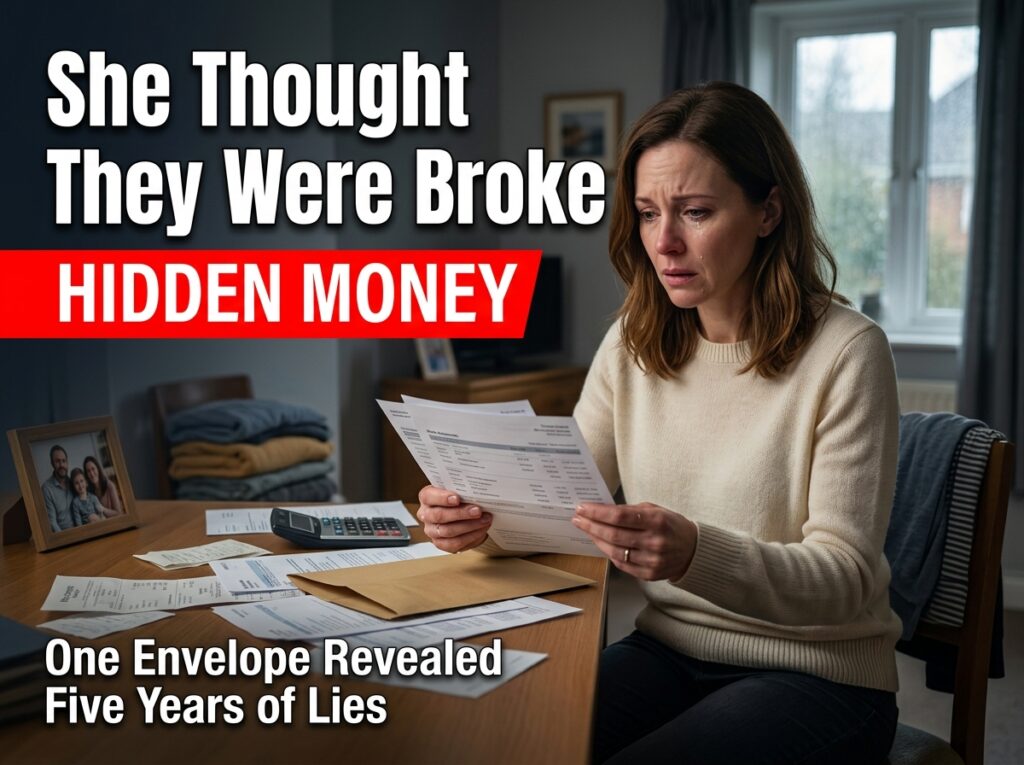
We need to talk tonight. No more excuses.
She pressed send.
Daniel replied almost immediately.
What’s wrong?
Emma stared at the message.
For five years, she had explained away every worry because Daniel always had an answer. The business was struggling. The next contract would solve everything. They needed to sacrifice a little longer.
Tonight, she would not accept another promise.
Come home, she wrote.
Then she placed the phone beside the bank statements and waited.
<h2>Part 3</h2>
Daniel arrived at seven twenty-three.
Emma knew the exact time because she had watched the clock above the kitchen stove for nearly two hours. She had turned the lights on, prepared two cups of tea, and left the brown envelope in the center of the table.
She wanted him to see it before he saw her face.
The front door opened.
“I’m home,” Daniel called.
Emma heard him hang up his coat and put his keys in the bowl beside the entrance. He entered the kitchen with his usual tired expression, but it changed when he noticed the untouched tea and the papers on the table.
“What’s happened?”
“Sit down.”
He looked at her.
“Emma, I’ve had a terrible day. Can this wait until tomorrow?”
“No.”
Something in her voice made him stop.
He pulled out a chair.
Emma pushed the envelope toward him.
“Do you know what these are?”
Daniel looked at the brown paper, and for a moment his expression remained blank.
Then his eyes settled on the name printed on the first statement.
Laura Bennett.
He did not touch the papers.
“Where did you get those?”
“From the bottom drawer of the desk.”
“Why were you going through that drawer?”
The question was so unexpected that Emma almost laughed.
“That’s what you want to ask me?”
“I didn’t say that.”
“You looked at a bank statement showing thousands of dollars in an account belonging to my oldest friend, and your first question was why I was cleaning a drawer?”
Daniel rubbed his forehead.
“Emma, please.”
“No. You don’t get to say please and make this disappear. I want to know why you’ve been sending money to Laura.”
He glanced toward the window.
“How many statements did you find?”
“Enough.”
“Did you call her?”
“Yes.”
His shoulders sank.
“What did she tell you?”
“She told me to ask you.”
Daniel closed his eyes.
For five years, Emma had watched him find ways around difficult questions. He would explain, reassure, apologize, and promise. He could make a frightening situation seem manageable simply by speaking about it as though the solution already existed.
Now he seemed unable to form a sentence.
“Is there another woman?” Emma asked.
He looked up sharply.
“What?”
“Are you having an affair with Laura?”
“No.”
“Look at me and tell me.”
“I’m looking at you.”
“Then answer.”
“No, Emma. I’m not having an affair with Laura.”
She studied his face, searching for the familiar signs of dishonesty. She could not tell whether he was telling the truth, and that frightened her more than anything else.
“Then why is my money in her account?”
Daniel sat back.
“Because I asked her to hold it for me.”
Emma stared at him.
“You asked her to hold your money?”
“Yes.”
“Your money?”
He flinched.
“Money from the business.”
“Which you said was failing.”
“It was.”
“Then where did you get the money to send her?”
He opened his mouth, but no answer came.
Emma pulled out another statement.
“These transfers came from our savings account. This one came from the money I gave you after selling my bracelet. And this one came three days after you told me the bank was threatening to foreclose on the house.”
Daniel looked down.
“You told me we were going to lose everything.”
“I was trying to protect us.”
“From what?”
He rubbed his hands together.
“It’s complicated.”
“Then explain it simply.”
He rose and walked to the sink, placing both hands on the counter.
“The business had debts. I needed to protect some of the money from creditors until I could get everything under control.”
Emma felt a chill spread through her.
“Creditors?”
“The business had outstanding payments.”
“How much?”
“Emma—”
“How much debt do you have?”
He did not answer.
She stood.
“Are we going to lose the house?”
“No.”
“Are you sure?”
He hesitated.
That hesitation frightened her more than a confession would have.
“Daniel.”
“I don’t know.”
Emma sat down slowly.
She had spent five years believing their financial troubles were temporary. She had accepted a smaller life because she believed it was building toward a better one.
Now she wondered whether she had been helping her husband conceal a disaster from the people who had every right to know about it.
“You said you were sending the money to Laura because you needed to protect it,” she said. “But why didn’t you tell me?”
“Because I knew how you’d react.”
“How I would react?”
“You would have worried. You would have wanted to sell the house or contact the bank or ask questions I couldn’t answer yet.”
“So you decided I didn’t deserve to know what was happening to my own life?”
“I thought I could fix it.”
“You let me give you my savings.”
“I was going to replace them.”
“When?”
Daniel looked at her.
“I don’t know.”
Emma felt the tears gathering, but she refused to wipe them away.
“Did Laura know the money came from me?”
He swallowed.
“Yes.”
The answer was quiet.
It was also the worst thing he had said all evening.
Emma turned away.
Her oldest friend had known that Emma was sacrificing everything to keep her marriage afloat. Laura had listened to her worries over coffee. She had watched Emma postpone holidays, sell jewelry, and count grocery expenses.
And she had accepted the money anyway.
“Why?” Emma whispered.
Daniel stepped toward her.
“Please let me explain the rest.”
She looked at him.
“Then start with the truth.”
He took a deep breath.
“Laura didn’t just hold the money. She was helping me keep the business alive.”
Emma frowned.
“How?”
Daniel’s voice dropped.
“She lent me money five years ago, when the business was close to collapse. I used your savings to repay part of what I owed her, but I couldn’t tell you because—”
He stopped.
“Because what?”
“Because the original debt wasn’t just a business debt.”
Emma stared at him.
“Then what was it?”
Daniel looked toward the envelope.
“I owed Laura’s family money long before you and I got married.”
<h2>Part 4</h2>
Emma remained still.
The kitchen seemed smaller than it had an hour earlier. The refrigerator hummed, the rain had stopped, and somewhere outside a dog barked once before falling silent.
“I don’t understand,” she said.
Daniel pulled out his chair again.
“I should have told you years ago.”
“Yes, you should have.”
He nodded.
“Before we got married, I borrowed money from Laura’s father. It was supposed to help me start the business. I had a contract lined up, and I thought I’d repay him within a year.”
“How much?”
“Twenty-five thousand dollars.”
Emma stared at him.
“Twenty-five thousand?”
“It was a lot of money at the time.”
“And you never told me?”
“I paid most of it back.”
“Most?”
Daniel looked down.
“After Laura’s father died, some of the paperwork was unclear. Laura and I discovered that the amount I’d repaid didn’t match the records her father kept.”
“So you owed her family money.”
“Yes.”
“How much?”
“Forty-eight thousand dollars, including interest and other costs.”
Emma struggled to process the number.
“Then why did you tell me your business was failing because of suppliers and unpaid contracts?”
“Because the business was failing.”
“But you never told me about the loan.”
“I thought I could solve everything before you found out.”
“By sending our savings to Laura?”
“At first, I was repaying the loan. Then I needed her to hold money for me when the business account was frozen. I was afraid creditors would take everything.”
Emma pressed her fingertips against her temples.
“Wait. You said the business account was frozen. When?”
“Three years ago.”
“And you didn’t tell me?”
“I thought it would be temporary.”
She looked at him with disbelief.
“For three years, you allowed me to believe we were struggling because you couldn’t earn enough money, when in reality you were hiding debts and moving money between accounts?”
Daniel lowered his head.
“When you say it like that—”
“How else am I supposed to say it?”
He fell silent.
Emma walked to the window. Across the street, the lights in the neighbors’ living room glowed warmly through their curtains. She could see a family gathered around a television, their silhouettes moving in the ordinary rhythm of an evening.
She wondered how many other homes held secrets behind their windows.
“What does Laura have to do with the business now?” she asked.
“She helped me negotiate with one of the creditors. She works in finance, and she understood the paperwork better than I did.”
Emma turned.
“You could have hired an accountant.”
“I couldn’t afford one.”
“You could have told me.”
“I was ashamed.”
The word hung between them.
For the first time that night, Daniel sounded less defensive than exhausted.
“I built the business because I wanted to give us a good life,” he continued. “When the contracts started disappearing, I thought I could recover. Then the debts grew. Every time I thought I’d caught up, another bill arrived. I didn’t know how to tell you that I’d failed.”
Emma felt a painful twist in her chest.
She remembered the early years of their marriage, when Daniel had worked late because he was excited about his projects. She remembered him showing her photographs of renovated kitchens and small houses he had helped build.
She had been proud of him.
She had wanted his business to succeed as much as he did.
But sympathy did not erase what he had done.
“You weren’t alone,” she said. “You had me.”
“I know.”
“No, I don’t think you do. You treated my trust like another account you could draw money from whenever you needed it.”
He winced.
“I never meant to hurt you.”
“Intentions don’t give me back five years.”
Daniel covered his face with both hands.
Emma looked at the bank statements again.
There were still too many unanswered questions.
“How much money is in Laura’s account now?”
“I don’t know the exact amount.”
“Guess.”
“About forty thousand.”
“And the rest?”
“Some went toward the business. Some paid the old debt. Some covered legal fees.”
“Legal fees for what?”
He hesitated.
Emma’s stomach tightened.
“Daniel, what else are you hiding?”
He looked at her, and she saw fear return to his face.
“There is something you need to understand about Laura’s father.”
“What?”
“He didn’t lend me the money because he believed in my business.”
Emma frowned.
“Then why did he lend it to you?”
Daniel’s answer was barely audible.
“Because he was trying to protect Laura.”
<h2>Part 5</h2>
Emma did not sleep that night.
Daniel remained in the guest room after their conversation, leaving the bedroom door half-open as though he expected her to call him back. She did not.
At three in the morning, she sat at the kitchen table with a notebook and the bank statements spread before her.
She wrote down every question she could think of.
Why had Laura’s father lent Daniel the money?
Why had the debt changed from twenty-five thousand to forty-eight thousand dollars?
Why had Daniel been moving money into Laura’s account for five years?
And why had Laura told him to protect the money from creditors?
The last question bothered her most.
If Laura was simply helping an old friend, why had she hidden everything from Emma?
At sunrise, Emma called her bank again and requested copies of the statements associated with her savings account. She also asked how she could revoke any transfer arrangements she had previously authorized.
The representative explained the available procedures and advised her to review the account permissions carefully.
Emma followed the instructions.
She discovered that the monthly transfers she had made to Daniel’s business had continued even during months when he had claimed to receive no payments from clients.
She downloaded the records.
Then she found something stranger.
Three years earlier, a payment of $18,000 had left their joint account. The reference field identified it as a repayment of a private loan.
Emma did not recognize the recipient.
She called Daniel at work.
He answered after the fourth ring.
“Emma?”
“What was the eighteen-thousand-dollar payment from our joint account three years ago?”
Silence.
“I need to check.”
“No. You need to answer.”
“It was part of the repayment arrangement.”
“With Laura?”
“Yes.”
“You told me that payment was for building materials.”
“I was trying to keep the business running.”
“Stop using the business as an explanation for everything.”
She heard him exhale.
“I know how bad this looks.”
“It looks like you’ve been taking money from me under false pretenses.”
“I was going to replace it.”
“You keep saying that. You never explain when.”
He said nothing.
Emma ended the call.
At ten thirty, Laura arrived at the house.
Emma saw her through the front window, standing on the porch with her hands clasped in front of her. She wore a dark green coat and held a paper bag from the bakery they used to visit together after school.
The sight of that familiar bag nearly broke Emma’s resolve.
For years, Laura had brought pastries when Emma was ill, flowers when her father died, and soup when Daniel was working late. Their friendship was built from thousands of small acts of kindness.
How could the same person have helped conceal such a terrible lie?
Emma opened the door but did not step aside.
“You shouldn’t have come.”
“I know.”
“Then why are you here?”
“Because I owe you the truth.”
Emma looked at the paper bag.
“You brought pastries?”
Laura glanced down at it and began to cry.
“I didn’t know what else to bring.”
“Maybe you could have brought five years of honesty.”
Laura lowered her head.
“I deserve that.”
Emma moved aside.
“Come in.”
They sat in the living room. Emma did not offer tea.
Laura placed the bag on the coffee table and folded her hands.
“I want you to know that Daniel and I never had an affair.”
Emma watched her.
“I believe you.”
Laura looked surprised.
“I don’t know why I believe you, but I do. That doesn’t mean I trust you.”
“I understand.”
“Then tell me everything.”
Laura took a shaky breath.
“My father lent Daniel money before you were married. He believed Daniel had talent, and he wanted to help him start his business. At first, the arrangement was simple. Daniel borrowed twenty-five thousand dollars and agreed to repay it within a year.”
“Why did the amount change?”
“Because the original loan was never the whole story.”
Emma leaned forward.
“What does that mean?”
Laura looked toward the window.
“My father had another business. It was connected to the property where Daniel planned to build his first workshop. When the deal fell apart, both men lost money. Daniel believed he owed only the original loan. My father believed Daniel was responsible for additional costs.”
“Who was right?”
“I don’t know. They argued about it for years.”
“And after your father died?”
Laura wiped her cheeks.
“I found the paperwork. Daniel was afraid that the creditors would come after his house and business equipment. He asked me to help him work out what he owed.”
“So you agreed to hold the money.”
“At first.”
“And then?”
Laura stared at her hands.
“Then I made a decision I should never have made.”
Emma waited.
Laura’s voice dropped.
“I told Daniel he could transfer the money into an account in my name while we worked out the debt. I thought it would protect the funds from being seized before we could negotiate a settlement.”
“Did you know the money was coming from my savings?”
“Not at first.”
“When did you find out?”
Laura’s eyes filled again.
“After the second transfer.”
Emma felt the room go cold.
“That was five years ago.”
“Yes.”
“And you let it continue.”
“I thought he would tell you.”
“You thought my husband would confess to something he was deliberately hiding?”
Laura began to cry harder.
“No. I suppose I didn’t.”
Emma stood and walked to the fireplace.
“You were my best friend.”
“I know.”
“You sat with me while I cried about not being able to afford my father’s medical bills. You knew I was using my savings to help Daniel. You watched me sell my bracelet.”
Laura covered her face.
“I know.”
“Then why didn’t you stop him?”
For a long time, Laura could not answer.
Finally, she said, “Because I was afraid of what would happen if I did.”
Emma turned.
“What could possibly have been worse than this?”
Laura looked at her through tears.
“If Daniel had told you the truth five years ago, you would have discovered that the debt wasn’t the only secret your husband was keeping.”
Emma felt her heartbeat quicken.
“What other secret?”
Laura reached into her handbag and removed a folded document.
“I think you should read this before you decide what to do next.”
<h2>Part 6</h2>
The document was a photocopy of a contract dated two months before Emma and Daniel’s wedding.
At the top was the name of Daniel’s business, followed by a list of financial obligations and a description of a property used as collateral.
Emma read it once.
Then she read it again.
The property was their home.
Her home.
The house she had purchased with money inherited from her father and a mortgage she had spent years paying down.
According to the contract, Daniel had used his interest in the property to secure part of his business borrowing.
Emma stared at Laura.
“He couldn’t do that without my permission.”
“He couldn’t use your share of the property without the necessary legal authorization,” Laura replied. “But the contract refers to a different arrangement. Daniel signed an agreement before your marriage concerning the business debt and the funds your father-in-law—”
She stopped.
“My father-in-law?”
Laura swallowed.
“Your father. I’m sorry. I mean the money from your father’s estate.”
Emma’s hands began to tremble.
“My father died before Daniel and I married.”
“Yes.”
“Are you saying Daniel used my inheritance to secure his business loan?”
Laura nodded.
Emma sat down.
Her father had left her enough money to make a down payment on the house. She had used almost all of it because she wanted to build a stable future.
Daniel had been there when she signed the purchase papers. He had held her hand in the lawyer’s office and told her that the house would be the foundation of their life together.
She had believed him.
“Did he forge my signature?”
“I don’t know.”
“Laura.”
“I wasn’t involved in that part of the transaction. I only saw the paperwork later.”
Emma studied the photocopy. There was a signature at the bottom, but the image was too faint to determine whether it was hers.
“Why didn’t you show me this five years ago?”
“Because I thought Daniel would repay the debt before anyone questioned the agreement.”
“And now?”
“Now the creditor has started asking questions again.”
Emma felt dizzy.
“Who is the creditor?”
Laura looked away.
“My father’s estate.”
Emma stared at her.
“Your father has been dead for years.”
“The estate still exists because the debt was never settled. I’m the executor.”
The pieces began to move into place, but the picture they formed was worse than Emma had imagined.
Laura was not merely holding money for Daniel.
She was managing the debt that threatened Emma’s home.
“How much does he owe now?” Emma asked.
“With interest and legal expenses, approximately sixty-two thousand dollars.”
Emma let out a hollow laugh.
“Sixty-two thousand. And he told me we were broke.”
“I know.”
“No, Laura. You know the number. You don’t know what it means to live with someone who makes you feel guilty for buying groceries while hiding thousands of dollars in another account.”
Laura lowered her eyes.
“I never wanted you to suffer.”
“But you allowed it.”
“Yes.”
The admission hung between them.
Emma returned to the contract.
“Why did my husband need to protect the money from creditors if it was being used to repay a debt to you?”
Laura hesitated.
“Because not all the money in the account belonged to Daniel.”
Emma looked up.
“What?”
“Some of it came from me.”
The room fell silent.
Laura explained that, after her father’s death, she had discovered a separate reserve of money her father had set aside for her. It was intended to help her buy a home and provide security if she ever needed it.
When Daniel’s business collapsed, he asked her for another loan.
She agreed, believing he would recover.
But the business never regained its former stability.
Eventually, Daniel began transferring money into the account, sometimes to repay Laura, sometimes to cover expenses, and sometimes because he believed he needed to keep a reserve hidden from creditors.
“How much of the account is actually yours?” Emma asked.
“About twelve thousand dollars.”
“And the rest?”
Laura looked at her.
“Some belongs to Daniel. Some is money he transferred from your accounts. Some was used to cover his debts.”
Emma felt the full weight of the deception.
The account was not a simple secret savings account. It was a tangle of borrowed money, marital savings, disputed debts, and transactions that neither woman could fully verify from the documents in front of them.
“Did you benefit from any of this?” Emma asked.
Laura hesitated.
“I used some of the money to pay legal fees connected to the estate.”
“Were those fees Daniel’s responsibility?”
“Some were.”
“And the rest?”
Laura looked down.
“I don’t know how to separate everything anymore.”
Emma closed her eyes.
For years, she had believed that Laura was the one person who would never take advantage of her.
Now she understood that betrayal did not always begin with greed. Sometimes it began with a small compromise, followed by another, until the people involved became so frightened of the truth that they built their lives around keeping it hidden.
Emma opened her eyes.
“I need copies of every document you have.”
Laura nodded.
“I’ll bring them tomorrow.”
“No. Send them to me today.”
“All right.”
“And don’t contact Daniel about this conversation.”
Laura stood slowly.
“Emma, there’s one more thing.”
Emma’s patience was nearly gone.
“What now?”
Laura took a breath.
“Your husband didn’t start hiding money because his business was failing.”
Emma stared at her.
“Then why?”
Laura’s face crumpled.
“Because he knew the debt could eventually put your house at risk, and he was afraid you would discover that the original loan had been taken out using information he got from your father.”
Emma felt a chill pass through her.
“What information?”
Laura opened her mouth.
Then she whispered the words Emma had never expected to hear.
“Your father didn’t simply leave you money. He left Daniel a warning.”
<h2>Part 7</h2>
Emma barely remembered Laura leaving.
She stood at the front door long after her friend had disappeared down the street, watching the empty pavement and trying to understand how her father could be connected to a debt that had begun before her marriage.
Her father, Michael Carter, had been a careful man. He had worked for the same company for nearly thirty years, paid his bills on time, and kept every receipt in labeled folders.
When he died, Emma had spent weeks sorting through his papers.
There had been bank statements, insurance documents, tax records, and a letter addressed to her. She remembered reading it at the kitchen table of her childhood home, crying so hard that she could barely see the words.
He had written about the importance of choosing people who treated her with respect.
He had written about courage, kindness, and the difference between helping someone and allowing them to destroy themselves.
But he had never mentioned Daniel’s debt.
Emma returned to the spare room and opened the old filing cabinet. Her father’s documents were still stored in two boxes at the bottom.
She searched for the letter.
It was inside a folder marked Personal.
The paper had softened at the folds, but her father’s handwriting remained clear.
She read the familiar opening.
My dearest Emma,
If you are reading this, I am no longer there to answer your questions. I wish I could have given you more time, more advice, and more ordinary days together. But life does not always offer us the time we expect.
Emma swallowed.
The next paragraphs were the same ones she remembered.
Her father had encouraged her to trust herself and never confuse loyalty with silence.
Then she noticed a sentence she had forgotten.
If you ever find yourself protecting someone from the consequences of their own decisions, remember that you cannot build a peaceful life on a foundation of secrets.
Emma lowered the letter.
Had he known?
She searched the remaining papers until she found an envelope containing several photocopies. Most were related to his estate, but one bore the name of Daniel’s business.
The document was a letter from her father to a solicitor.
It had been written six months before his death.
I am concerned that Daniel Reed has entered into a financial arrangement he does not fully understand. He has asked questions about using the family property as security, and I have advised him against proceeding without independent legal advice.
Emma read the sentence several times.
Her father had known Daniel was considering a risky business loan.
But the letter went further.
I do not believe Daniel intends to harm my daughter. However, I fear that his desire to prove himself may lead him to conceal information from her. Please ensure that Emma’s inheritance remains protected and that no agreement is entered into on her behalf without her informed consent.
Emma felt tears sting her eyes.
Her father had tried to protect her.
And Daniel had hidden the warning.
She looked at the date.
Six months before her father died.
She had married Daniel a year later.
Had he known about the letter before their wedding?
Had he married her while already planning to use her inheritance to support his business?
Emma could not answer those questions without speaking to him.
She gathered the documents and placed them in a folder.
Then she called a lawyer recommended by a colleague at work. She explained that she needed independent advice about marital finances, a disputed business debt, and a property agreement she did not remember signing.
The lawyer agreed to review the documents and warned her not to make accusations or sign anything until the facts had been established.
Emma thanked her and ended the call.
For the first time in years, she felt a small measure of control returning.
She did not yet know whether Daniel had forged a signature, misunderstood an agreement, or deliberately used information that had been entrusted to him.
But she knew she could no longer rely on his explanation alone.
That evening, Daniel came home early.
He found Emma sitting at the dining table with her father’s letter, the photocopied contract, and a notebook filled with figures.
He stopped in the doorway.
“What’s all this?”
“Documents.”
“I can see that.”
“Then you can see why I need answers.”
Daniel set down his briefcase.
“Did Laura come here?”
“Yes.”
His face tightened.
“What did she tell you?”
“Enough to know that you have been lying to me for much longer than I realized.”
He pulled out a chair.
“Emma, listen. I never wanted to use your inheritance without your permission.”
“Did you know about my father’s warning?”
Daniel froze.
She pushed the letter toward him.
He read the first few lines, and his expression changed.
“Where did you get this?”
“From my father’s files.”
Daniel slowly put the letter down.
“I never saw this.”
“Then explain why your name appears in a letter written six months before he died.”
He stared at the page.
“I spoke to your father about the business. He knew I needed money. He told me not to risk the house.”
“And you agreed?”
“I said I would be careful.”
“Did you tell him you intended to use my inheritance?”
“No.”
“Did you tell me?”
“No.”
Emma leaned forward.
“Why?”
Daniel’s eyes filled with tears.
“Because I thought I could make enough money to replace it before anyone knew.”
The answer was so familiar that Emma almost laughed.
“That was your plan five years ago. Is that still your plan now?”
Daniel lowered his head.
“No.”
“Then what is the truth?”
He looked at her for a long time.
Finally, he said, “Your father discovered something about the business that I had tried to hide.”
Emma’s heart began to pound.
“What did he discover?”
Daniel’s voice broke.
“That I had already lost most of the original investment before we got married.”
<h2>Part 8</h2>
Emma did not respond immediately.
Daniel sat across from her, his hands clasped so tightly that his knuckles had turned white.
“What do you mean, you had already lost the investment?”
He took a shaky breath.
“Before we got married, I invested money in a construction project with another contractor. The project collapsed. I lost almost everything I’d saved.”
“How much?”
“Thirty thousand dollars.”
Emma stared at him.
“And you borrowed twenty-five thousand from Laura’s father to recover?”
“Yes.”
“So you were already in debt when you asked me to marry you.”
Daniel nodded.
“Why didn’t you tell me?”
“I was ashamed.”
“You keep saying that as though shame explains everything.”
“I know it doesn’t.”
“Did you love me?”
His eyes filled.
“Of course I did.”
“Then why did you let me build a future with you while hiding the truth about your finances?”
“Because I believed I could fix it.”
Emma looked down at her father’s letter.
“You knew my father was worried about the business.”
“Yes.”
“You knew he wanted my inheritance protected.”
“Yes.”
“And you still entered into a financial arrangement that put our home at risk.”
Daniel’s shoulders sagged.
“Yes.”
For a moment, Emma could hear nothing but her own breathing.
The man sitting across from her was still the man she had married. He still had the same scar near his left eyebrow from a childhood bicycle accident. He still rubbed his thumb against his wedding ring when he was nervous.
But she no longer knew whether the memories attached to those familiar details meant what she had always believed they meant.
“Did you ever intend to tell me?” she asked.
“Yes.”
“When?”
He looked away.
“I don’t know.”
Emma nodded slowly.
“Then you never had a plan to tell me. You had a plan to keep the truth hidden until it stopped being dangerous.”
Daniel did not argue.
She opened her notebook.
“I’ve spoken to a lawyer. I’m going to have every account and agreement reviewed independently. Until that happens, I will not transfer another dollar to your business.”
Daniel looked alarmed.
“What about the suppliers?”
“You’ll have to speak to them.”
“The business could collapse.”
“Then we will deal with the facts, not promises.”
He stared at her as though she had become someone he did not recognize.
“You’re going to let everything fall apart?”
Emma felt a fresh wave of anger.
“You let me believe we were one unpaid bill away from losing our home while hiding money in another woman’s account. You made me feel selfish for wanting a little security. You watched me sacrifice my savings without telling me the full truth.”
“I never wanted you to feel selfish.”
“But I did. Every day.”
Daniel covered his face.
“I don’t know how to make this right.”
For the first time, Emma believed him.
He genuinely did not know.
He had spent years treating each new problem as something he could solve privately. Every lie had bought him another month, another payment, another chance to believe he could escape the consequences.
Now the consequences had arrived together.
“What happens next?” he asked.
Emma looked at him.
“That depends on what the documents show and whether you finally tell the truth.”
He nodded slowly.
“There is something else you should know.”
Emma felt exhausted.
“Of course there is.”
Daniel took a folded sheet of paper from his briefcase.
It was a letter from the bank, dated two weeks earlier.
Emma read it carefully.
The bank had requested updated financial information relating to the property used as security for Daniel’s business obligations. It warned that failure to provide the necessary documents could lead to further legal action.
Her hands trembled.
“You received this two weeks ago?”
“Yes.”
“And you said nothing?”
“I was trying to resolve it.”
“By sending money to Laura?”
“Partly.”
Emma placed the letter on the table.
“You told me the mortgage was safe.”
“I thought it was.”
“You thought?”
“I didn’t know what the bank would do.”
She stood and walked to the window.
She could remember the day they bought the house. Daniel had carried her over the threshold as a joke, and she had laughed so hard that she nearly dropped the flowers in her hands.
They had painted the bedroom together. They had argued about the kitchen tiles and spent an entire weekend assembling furniture. The house held their wedding photographs, their first Christmas tree, and the small marks on the doorframe where they had measured the height of Daniel’s niece when she visited.
It was not simply a financial asset.
It was the place where Emma had believed her life was safe.
“Did my father know this could happen?” she asked.
Daniel came to stand a few feet behind her.
“He knew the risk. That’s why he warned me.”
“And you ignored him.”
“Yes.”
Emma closed her eyes.
When she opened them, she saw a familiar car pulling into the driveway.
Laura stepped out, carrying a thick folder.
Daniel turned toward the window.
“What is she doing here?”
“I asked her to bring the documents.”
“Emma, you don’t know what you’re getting into.”
She looked at him.
“Then it’s time I found out.”
The doorbell rang.
Emma walked to the entrance and opened the door.
Laura stood on the porch, pale and trembling.
“I brought everything,” she said.
Emma stepped aside.
“Good. Because tomorrow, we’re taking it all to the lawyer.”
Laura glanced at Daniel.
He looked as though he had seen a ghost.
And when Emma opened the folder, she understood why.
Inside was a document neither of them had expected her to find.
It was a signed agreement between Daniel and Laura, dated three weeks before Emma’s wedding.
At the bottom, beneath the terms of the loan, was a handwritten note.
If Emma ever discovers the arrangement, she must not be told about the second account.
<h2>Part 9</h2>
Emma read the note twice.
Then she placed the document on the table and looked at Daniel.
“What second account?”
He did not answer.
Laura sat down heavily.
“Daniel, you have to tell her.”
He stared at the floor.
“Not like this.”
“How else?” Emma demanded. “You’ve had years to tell me.”
Daniel took a long breath.
“The second account was supposed to be temporary. It was opened to separate the money I owed Laura from the money I needed for the business.”
“Whose name was on it?”
“Mine.”
Emma frowned.
“Then why was it secret?”
“Because it wasn’t disclosed to the bank.”
Laura looked miserable.
“The account was used to receive payments from customers whose contracts were still being disputed. Daniel thought that if the money stayed outside the main business account, he could use it to settle the debts before the creditors made claims.”
Emma felt sick.
“Was that legal?”
“We don’t know,” Laura said. “That’s why you need an independent lawyer and an accountant to review everything.”
“How much money went through it?”
Daniel rubbed his face.
“I can’t give you an exact figure.”
Emma stared at him.
“Of course you can’t.”
He looked up.
“I didn’t keep it hidden because I wanted to live some secret life. I was trying to keep the business from collapsing.”
“Then why did the agreement say I must never know?”
Daniel’s eyes filled with tears.
“Because Laura’s father believed you would leave me if you discovered the debt before the wedding.”
Laura shook her head.
“He was wrong to put that in writing. He believed Daniel was too proud to admit he had failed, and he thought keeping the arrangement quiet would give him time to repay the money.”
“And you both agreed?”
Laura lowered her eyes.
“Yes.”
Emma felt something inside her finally give way.
For years, she had wondered why her father had seemed unusually quiet during the months before her wedding. She remembered him asking Daniel whether he was sure he could afford the life he wanted to build.
She remembered Daniel saying yes.
She remembered her father pulling her aside afterward and telling her that love should never require her to ignore her instincts.
At the time, she had thought he was simply worried about his daughter leaving home.
Now she understood that he had been trying to warn her without forcing her to choose between the man she loved and the truth she deserved.
“Did my father know about the second account?” she asked.
Daniel nodded.
“Yes.”
“Then why didn’t he tell me?”
“Because he believed I would repay the debt. He wanted to give me a chance to put things right.”
Emma closed her eyes.
Her father had given Daniel a chance.
Then he had died, leaving Emma to build a marriage on information she had never been allowed to see.
She opened her eyes and looked at Laura.
“Why did you keep helping him after your father died?”
Laura’s voice trembled.
“Because I was afraid that if I stopped, the debt would become impossible to recover. I told myself I was protecting my father’s estate. Then I told myself I was protecting you from the truth. Eventually, I was protecting myself from admitting what I’d done.”
“Did you ever think about what it was doing to me?”
“Every time I saw you.”
Emma felt tears slide down her cheeks.
“Then why did you keep coming to my house? Why did you sit beside me when I cried about money?”
Laura began to sob.
“Because I loved you, and I was a coward.”
The honesty of the answer hurt more than another excuse would have.
Emma turned toward Daniel.
“How much of our savings is gone?”
He gave her a figure.
She wrote it down.
Then she asked about the business debt, the money in Laura’s account, and the bank’s claim against the property.
For the next hour, they worked through the figures. Some amounts could be verified. Others remained uncertain. Several transactions required professional review before anyone could say whether the money had been used appropriately.
By the end, Emma understood one thing clearly: she could not repair the damage by trusting either of them to explain it.
She needed records, independent advice, and time.
She closed the notebook.
“I will not decide the future of this marriage tonight,” she said. “And I will not decide what happens to our home based on another promise.”
Daniel nodded.
“What do you want me to do?”
“Give the lawyer every document. Every account. Every password and financial record you are legally required to disclose. No more hidden money. No more private arrangements.”
“I will.”
“Don’t promise. Do it.”
He looked at her for a long time.
Then he nodded again.
Laura rose from her chair.
“Emma, I know I don’t deserve your forgiveness. But I want you to know that I will cooperate fully. If money is owed to you, I’ll help establish what belongs to whom.”
Emma looked at the woman who had once been closer to her than anyone else.
“I don’t know if I can ever trust you again.”
Laura wiped her eyes.
“I understand.”
“No, I don’t think you do. Trust isn’t something you get back because you finally tell the truth. It’s something the other person has to decide whether to give you again.”
Laura nodded and left.
Daniel remained in the living room.
Emma walked upstairs, took a small suitcase from the closet, and began packing clothes.
He followed her to the bedroom door.
“Where are you going?”
“To my sister’s house for a few days.”
“Emma, please don’t leave.”
She folded a sweater and placed it in the suitcase.
“I need to think without wondering what you’re hiding.”
He stood silently.
At the doorway, Emma turned toward him.
“I loved you enough to help you through five difficult years. But I cannot spend the next five years paying for decisions you refuse to own.”
She lifted the suitcase.
Daniel did not try to stop her.
As she drove away, the house grew smaller in her rearview mirror.
She felt grief, fear, and an unexpected sense of relief.
The truth had not solved anything.
But at least, for the first time in five years, she was no longer being asked to sacrifice her future to protect someone else’s secret.
<h2>Part 10</h2>
Three months later, Emma sat in a lawyer’s office with a folder of financial records on her lap.
The investigation had taken longer than she expected. Bank statements had to be retrieved, old contracts reviewed, and the disputed debt examined by an independent accountant. Some transactions had clear explanations. Others remained subject to further negotiation.
The process was not dramatic.
There were no sudden confessions in the middle of the night, no single document that magically restored what had been lost.
There were phone calls, spreadsheets, difficult questions, and days when Emma felt too tired to continue.
But there was progress.
The lawyer confirmed that Emma’s personal savings had been used without her fully understanding the transactions involved. The question of responsibility for the disputed business debt required further legal review, and the bank agreed to suspend immediate action against the property while the parties worked toward a documented resolution.
For the first time in years, Emma knew what was happening with her money.
She and Daniel had begun living separately. He had provided the records requested by the lawyer and agreed to cooperate with the financial review. He had also started meeting with an accountant to determine whether the business could continue without further borrowing.
He apologized often.
Sometimes his apologies sounded sincere. Sometimes they sounded like a man who was frightened of losing everything.
Emma no longer tried to decide which feeling was behind each word.
She had learned that remorse was not the same as repair.
Laura also cooperated with the review. She provided the statements from the account in her name and agreed that the ownership of the remaining funds should be determined through documented evidence rather than private promises.
Their friendship remained broken.
Emma could not return to the old habit of calling Laura whenever something hurt. She could not listen to her friend’s voice without remembering the years when both women had shared coffee while one concealed the truth from the other.
Perhaps that would change someday.
Perhaps it would not.
For now, Emma needed distance.
On a cool Saturday morning, she returned to the house to collect some books and winter clothes. The rooms felt familiar but strangely empty. She paused beside the kitchen table, remembering the night she had placed the bank statements in front of Daniel.
It had been the beginning of a painful truth.
But it had also been the beginning of her freedom from uncertainty.
Daniel was waiting in the living room when she came downstairs.
“I’ve made a decision,” he said.
Emma set her bag beside the door.
“About what?”
“The business. I’ve spoken with the accountant. I’m going to sell the equipment that isn’t essential, close the workshop, and use what remains to settle the debts as far as possible.”
She studied him.
“Are you sure?”
“No. But I know I can’t keep asking you to carry the risk.”
He looked older than he had three months earlier. The gray at his temples was more noticeable, and his face had lost the confidence he once wore so easily.
“I should have told you everything before we got married,” he said. “I should have told you when the first loan went wrong. I should have told you when I started transferring the money. Every time I stayed silent, I told myself I was buying time. But I was taking your choices away from you.”
Emma listened without interrupting.
“I don’t expect you to forgive me,” he continued. “I only want you to know that I understand what I did now.”
She believed that he understood more than he had before.
Whether he understood enough, only time would tell.
“Daniel, I loved you,” she said.
His eyes filled with tears.
“I know.”
“I loved you when you were building the business. I loved you when the money became tight. I loved you when I sold my bracelet because I thought we were protecting our future.”
She paused.
“But I needed a husband, not someone who decided which truths I was allowed to know.”
He bowed his head.
“I know.”
Emma took a breath.
“I can’t promise that our marriage will survive this. I can’t promise that forgiveness will come. And I won’t pretend that the money is the only thing you’ve taken from me.”
Daniel looked up.
“What else?”
“My confidence in my own judgment. My sense of safety. The years I spent believing I was failing you because I couldn’t do enough.”
She swallowed.
“I have to learn that those feelings were not proof that I was a bad wife. They were the result of living without the truth.”
Daniel began to cry quietly.
Emma did not reach for him.
It was not because she wanted him to suffer. It was because she had spent too long making his pain her responsibility.
She could care about him without rescuing him.
She could acknowledge his regret without promising reconciliation.
And she could leave the door open to forgiveness without walking through it before she was ready.
When she reached the front door, Daniel spoke again.
“Do you think you’ll ever forgive me?”
Emma turned.
“I don’t know.”
He nodded, accepting the answer.
“But I hope you find peace,” she added. “And I hope you learn to tell the truth even when it costs you something.”
She left the house and drove to her sister’s place, where sunlight fell across the small kitchen table and a pot of tea was waiting.
For the first time in months, she did not think about the mortgage, the hidden accounts, or the amount of money still to be recovered.
She thought about her father.
She thought about the warning he had written in his letter: that she could not build a peaceful life on a foundation of secrets.
She had once believed loyalty meant staying beside someone no matter how much it hurt.
Now she understood that loyalty without honesty could become another name for self-abandonment.
Forgiveness, if it came, would not mean pretending that the betrayal had never happened. It would mean deciding what she could release without surrendering the lessons she had learned.
Emma opened her notebook and wrote one sentence on a clean page.
I can love someone and still refuse to be deceived by them.
Then she closed the notebook.
The future was uncertain. There were still debts to resolve, documents to review, and relationships that might never return to what they had been.
But uncertainty no longer frightened her in the same way.
She would face it with the facts in front of her, with people who respected her right to know the truth, and with the knowledge that her life did not have to remain organized around another person’s secrets.
For five years, she had believed they were broke.
Now she understood that the greatest loss had never been the money.
It had been the trust she had given without reservation—and the belief that love required her to keep giving even when honesty was withheld.
She could not recover every dollar or reclaim every lost year.
But she could choose what happened next.
And this time, the decision belonged to her.