The year was 1816.
In the quiet English countryside, Whitmore Hall stood proudly above acres of farmland, ancient trees, and carefully maintained gardens.
For generations, the Whitmore family had been among the most respected landowners in the county.
But behind its beautiful stone walls, the family was falling apart.
Eleanor Whitmore had lived at the estate since childhood.
She remembered running through the gardens with her younger brother, Thomas, while their father watched from the terrace.
Her father, Lord William Whitmore, had been a kind and generous gentleman.
Unlike many wealthy landowners, he treated servants with respect and believed that a person’s character mattered more than their family name.
Eleanor adored him.
Her mother had died when she was young, and her father had become her entire world.
Unfortunately, William’s younger brother, Richard, was very different.
Richard believed that wealth gave people the right to control others.
He was ambitious, impatient, and obsessed with the family fortune.
Whenever William disagreed with him, Richard reminded his brother that the estate had belonged to their ancestors for generations.
William always gave the same answer.
“An estate is not a kingdom, Richard. It is a responsibility.”
Richard hated those words.
Three months before the events of our story, William died unexpectedly.
His death devastated Eleanor.
But the greatest shock came during the reading of his will.
Richard announced that his brother had left him temporary control of the estate.
He claimed that Eleanor would receive a small annual allowance once the family debts had been settled.
Eleanor questioned the decision.
“My father promised that I would always have a home here.”
Richard looked at her coldly.
“Your father made many promises. Unfortunately, promises do not pay debts.”
“But where are the documents?”
“What documents?”
“The papers concerning the estate.”
Richard stood.
“That is no longer your concern.”
From that day onward, Eleanor’s life changed.
Her personal servants were dismissed.
Her father’s study was locked.
Several family portraits disappeared.
And Richard began selling valuable pieces of furniture.
Eleanor knew something was wrong.
But she had no proof.
One morning, she overheard two servants speaking in the kitchen.
“His lordship has ordered the old stable records destroyed,” one whispered.
“Why?”
“I don’t know. But I heard him mention Captain Harrington.”
Eleanor recognized the name.
Captain James Harrington had been one of her father’s closest friends.
He had visited Whitmore Hall frequently during her childhood.
But she had not seen him for almost ten years.
She wondered why Richard would be afraid of him.
That evening, Eleanor walked through the gardens and stopped beneath the large oak tree where her father had once taught her to ride.
She remembered his final conversation with her.
“If anything ever happens to me, Eleanor, never believe everything you hear about this family.”
At the time, she had thought he was simply giving her fatherly advice.
Now those words frightened her.
And somewhere beyond the estate gates, a horse was approaching.
PART 2 — THE STRANGER ON THE BLACK HORSE
The following afternoon, Eleanor was standing near the entrance when she heard the sound of approaching hooves.
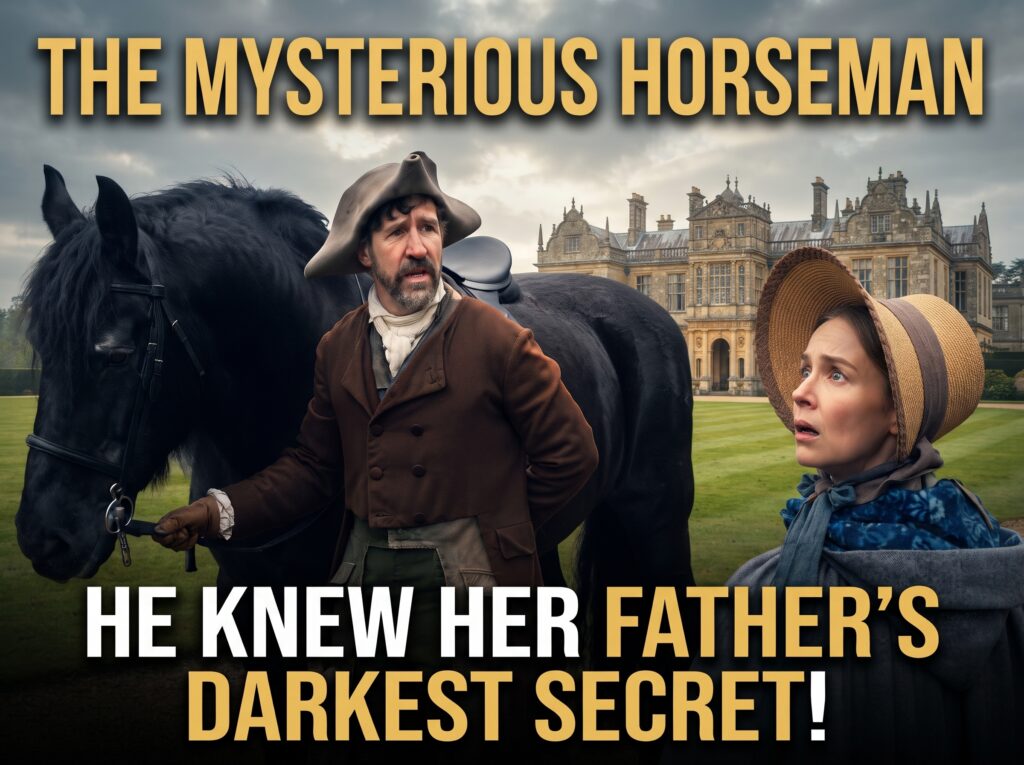
A large black horse appeared on the gravel driveway.
Its rider wore a brown riding coat, a white neckcloth, and a weathered three-cornered hat.
The gentleman looked older than Eleanor remembered.
His beard was streaked with grey, and his expression was serious.
He stopped in front of her.
“Miss Whitmore?”
Eleanor nodded.
“Yes.”
The gentleman removed his hat.
“Captain James Harrington.”
Eleanor’s eyes widened.
“Captain Harrington?”
He smiled faintly.
“It has been a long time.”
Before she could respond, the front door opened.
Richard stepped outside.
“What is the meaning of this?”
James turned toward him.
“Good afternoon, Lord Whitmore.”
“You were not invited.”
“I am aware.”
“Then you should leave.”
James remained seated on his horse.
“I have traveled a considerable distance to deliver a message to Miss Whitmore.”
Richard’s expression hardened.
“Anything concerning this family must come through me.”
James looked at Eleanor.
“Unfortunately, this particular message was entrusted to me by her father.”
Silence fell over the driveway.
Richard stepped forward.
“My brother is dead. Whatever business you had with him is finished.”
James reached inside his coat.
“Not quite.”
He produced an envelope.
The seal was still intact.
Eleanor immediately recognized the handwriting.
It was her father’s.
She reached for the letter, but Richard moved between them.
“Give that to me.”
James pulled the envelope back.
“Lord William instructed me to deliver this personally to his daughter.”
Richard’s voice became louder.
“I am the head of this household.”
James looked directly at him.
“That does not make you the owner of every secret your brother left behind.”
Richard’s face turned red.
He ordered two servants to remove the captain.
But Eleanor stepped forward.
“Please.”
Everyone looked at her.
“Let him speak.”
Richard turned toward her.
“You will go inside immediately.”
“No.”
It was the first time Eleanor had openly defied her uncle.
James watched her with quiet admiration.
He placed the envelope in her hands.
“Your father wanted you to receive this when the time was right.”
Eleanor looked at the seal.
“What does it contain?”
James lowered his voice.
“The truth about your inheritance.”
Richard immediately ordered the servants to escort Eleanor inside.
But before she disappeared through the doorway, James called after her.
“Miss Whitmore, do not open that letter alone. There is something inside that you must understand before your uncle discovers it.”
Eleanor turned.
“What?”
James looked toward Richard.
“Your father was not the only person who knew the truth.”
Then he mounted his horse and rode away.
Richard watched him disappear.
For several seconds, he remained completely silent.
Then he turned to the servants.
“Find out where he is staying.”
PART 3 — THE LETTER HER FATHER HID
Eleanor waited until midnight.
The household had become quiet.
Richard had retired to his private rooms, and the servants had finished their evening duties.
She took the envelope into her bedroom and placed it on the small wooden table.
Her hands trembled.
She carefully broke the seal.
Inside was a handwritten letter and a small photograph of her father standing beside Captain Harrington.
The letter began:
My dearest Eleanor,
If you are reading this, then I am no longer able to protect you myself.
I know your uncle has told you that the estate is burdened by debts. I need you to understand that this is not the truth.
For many years, Richard has attempted to gain control of the Whitmore properties.
He has borrowed money using documents he had no right to sign, concealed financial records, and attempted to alter the terms of my inheritance arrangements.
I have discovered evidence of his actions.
The original documents have been placed in safe hands.
Eleanor stopped reading.
She could hardly believe what she was seeing.
Her father continued:
You are the rightful beneficiary of Whitmore Hall and its associated properties.
I have arranged for Captain Harrington to deliver the original documents when it is safe to do so.
There is another matter I must explain.
Your mother did not die without leaving you something.
Eleanor’s heart began beating faster.
She had always been told that her mother had left no personal belongings.
But her father wrote that her mother had entrusted a small wooden box to someone she deeply trusted.
The letter ended:
Do not trust anyone who tells you that you are powerless. You have more rights than you know.
With all my love,
Father.
Eleanor placed the letter against her chest.
For the first time since her father’s death, she felt hope.
But she still did not know where the original documents were.
The next morning, she found an old servant named Mrs. Collins cleaning the staircase.
Mrs. Collins had worked at Whitmore Hall for almost thirty years.
Eleanor approached her quietly.
“Mrs. Collins, did my mother leave anything behind?”
The elderly woman looked around before answering.
“Your mother had a small wooden box.”
“Where is it?”
“She gave it to me before she died.”
Eleanor was astonished.
“Why?”
Mrs. Collins hesitated.
“She said that one day you might need it.”
“Do you still have it?”
The servant nodded.
“But your uncle ordered me to hand it over.”
“Did you?”
Mrs. Collins looked directly into her eyes.
“No, Miss Eleanor.”
She reached into her apron and produced a small brass key.
“I hid it.”
Eleanor took the key.
And suddenly, the mystery surrounding her mother’s death seemed much larger than she had imagined.
PART 4 — THE SECRET INSIDE THE OLD WOODEN BOX
Mrs. Collins led Eleanor to a small unused room behind the servants’ quarters.
Inside was an old cupboard.
She removed a loose wooden panel and revealed a small box wrapped in faded cloth.
Eleanor recognized it immediately.
Her mother had owned a similar box.
The brass key fitted perfectly.
Inside were several letters, a silver locket, and a folded piece of parchment.
The first letter was addressed to Eleanor.
It had been written shortly before her mother’s death.
My darling girl,
There are things about our family that you are too young to understand.
Your father loves you more than anything in this world.
But not everyone who shares your family name wishes you happiness.
If the day comes when someone attempts to take your home, remember that your father has already made arrangements to protect you.
Eleanor read the letter twice.
Then she unfolded the parchment.
It contained a list of properties, investments, and land titles.
But the most important detail was a reference to a property called Blackthorn Farm.
Eleanor had heard the name before.
Her father had once mentioned it as a place where the family kept important records.
Mrs. Collins leaned closer.
“Miss Eleanor, I remember your mother speaking about that farm.”
“What did she say?”
“She said that a gentleman had hidden something there before he disappeared.”
“Who?”
Mrs. Collins shook her head.
“I never learned his name.”
Eleanor placed the papers back into the box.
Suddenly, footsteps sounded outside.
Mrs. Collins quickly closed the cupboard.
Richard entered the room.
“What are you doing here?”
Eleanor stood.
“I was looking for something that belonged to my mother.”
Richard’s eyes moved toward the cupboard.
“What something?”
“Personal belongings.”
“Your mother has been dead for years. There is nothing here that concerns you.”
He ordered Mrs. Collins to leave.
Then he turned toward Eleanor.
“I have been very patient with you.”
“Why are you afraid of Captain Harrington?”
Richard’s expression changed.
“I am not afraid of anyone.”
“Then why did you try to stop him from delivering my father’s letter?”
Richard stepped closer.
“Because you are young and easily influenced.”
Eleanor held her ground.
“My father trusted him.”
“Your father trusted too many people.”
Richard looked toward the cupboard again.
“Give me whatever you found.”
Eleanor refused.
Richard smiled coldly.
“Then you leave me no choice.”
That evening, Eleanor discovered that her uncle had ordered her belongings packed.
She was to leave Whitmore Hall within forty-eight hours.
PART 5 — THE HORSEMAN’S SECOND SECRET
Eleanor had nowhere to go.
Her uncle had ordered the servants not to assist her, and the small allowance she received had been stopped.
She packed a few dresses, her mother’s silver locket, and the letters from the wooden box.
Before leaving, she went to the stables.
She wanted to say goodbye to the old horses her father had loved.
As she approached the stable entrance, she heard a familiar voice.
“Miss Whitmore.”
Captain Harrington stood beside the black horse.
Eleanor hurried toward him.
“You came back.”
“I promised your father I would not abandon you.”
She showed him the letter.
James read it carefully.
Then he looked at the wooden box.
“Where did you find this?”
“My mother left it with Mrs. Collins.”
James examined the parchment.
His expression became serious.
“Blackthorn Farm.”
“You know the place?”
“I do.”
“What is there?”
James hesitated.
“Your father’s original legal documents.”
Eleanor looked at him.
“Why didn’t you tell me earlier?”
“Because I wanted to be certain that you were ready to hear the whole truth.”
“What truth?”
James took a deep breath.
“Your father and I served together during the war. After returning to England, he discovered that Richard had been secretly borrowing money against the estate.”
“Why didn’t he stop him?”
“He tried. But Richard had powerful friends in London.”
James looked toward the manor.
“Your father knew he could not defeat his brother through ordinary legal channels. So he made arrangements to protect you.”
Eleanor asked the question that had haunted her for months.
“Did my uncle have anything to do with my father’s death?”
James remained silent.
That silence frightened her more than any answer.
“Captain?”
James finally spoke.
“I cannot prove that he did. But I can tell you that your father received several threats during the final weeks of his life.”
Eleanor began crying.
James gently handed her a handkerchief.
“I am sorry.”
“Why did nobody tell me?”
“Because your father wanted to protect you.”
He helped her onto the horse.
They rode away from Whitmore Hall before sunset.
Behind them, Richard watched from an upstairs window.
He immediately called his solicitor.
“Find Harrington.”
“And if I cannot?”
Richard turned toward him.
“Then find the documents before he does.”
PART 6 — THE ABANDONED FARM
Blackthorn Farm stood several miles beyond the village.
It had once been a prosperous property belonging to the Whitmore family.
But years of neglect had left the buildings weathered and the fields overgrown.
Eleanor had never visited the place.
James dismounted and helped her down.
“Your father came here shortly before he died,” he explained.
They entered the old farmhouse.
The rooms were dusty, and the furniture was covered with sheets.
James walked toward a large wooden cabinet.
He examined the wall behind it and discovered a small metal lock.
Eleanor produced the brass key from her mother’s box.
It fitted.
A hidden compartment opened.
Inside were several documents wrapped in oilcloth.
James carefully removed them.
There were original land deeds, banking records, correspondence with lawyers, and a signed inheritance agreement.
Eleanor began reading.
The estate was not bankrupt.
In fact, it was worth considerably more than Richard had claimed.
Her father had also invested in several profitable properties in London.
But the most important document was a legal declaration naming Eleanor as the sole beneficiary of Whitmore Hall and its associated land.
James smiled.
“Your father succeeded.”
Eleanor could hardly speak.
Then she discovered another envelope.
It contained a letter addressed to Captain Harrington.
She handed it to him.
James opened it.
His face changed.
“What is it?”
He folded the paper.
“Something I should have told you earlier.”
“Please.”
James looked at her.
“Your father did not choose me only because I was his friend.”
He took another letter from the envelope.
“Your father asked me to protect you because I was the only person he believed Richard could not intimidate.”
“Why?”
James looked away.
“Because years ago, I was engaged to your mother.”
Eleanor froze.
“What?”
James nodded.
“Before she married your father.”
Eleanor stared at him.
For a moment, the world seemed to stop.
“Did my father know?”
“Yes.”
“Then why did he trust you?”
James’s eyes filled with sadness.
“Because William was my closest friend. And because he knew that your mother’s happiness mattered more to me than my own.”
He continued.
“When your mother chose William, I left England. But I never stopped caring about the family.”
Eleanor looked at him differently now.
The mysterious horseman had not simply returned to deliver documents.
He had returned to fulfill a promise made to the woman he had once loved and the man who had become his closest friend.
But before Eleanor could ask another question, they heard horses outside.
Richard’s men had found them.
PART 7 — THE UNCLE’S FINAL BETRAYAL
James quickly placed the documents inside a leather case.
“Eleanor, take this.”
“What about you?”
“I will deal with them.”
Three men entered the farmhouse.
The first was Richard’s solicitor, Mr. Samuel Grant.
Behind him stood two estate guards.
“Captain Harrington,” Grant said. “You have something that belongs to Lord Whitmore.”
James stood between the men and Eleanor.
“These documents belong to Miss Whitmore.”
Grant laughed.
“She has no legal claim.”
Eleanor stepped forward.
“I have my father’s signed declaration.”
Grant looked at the papers.
His expression changed.
“Give them to me.”
“No.”
The guards moved closer.
James warned them to stop.
But Grant produced a letter.
“Lord Richard has instructed me to inform you that he intends to have Miss Whitmore declared mentally incapable of managing her inheritance.”
Eleanor felt sick.
Her uncle was prepared to destroy her reputation to steal the estate.
James calmly replied.
“Then I suggest you explain why the original documents were hidden from the family solicitor.”
Grant said nothing.
At that moment, another voice came from the doorway.
“Because he knew I would find them.”
Everyone turned.
Mrs. Collins stood outside with a gentleman in a dark coat.
It was Mr. Arthur Pembroke, the family’s former solicitor.
Eleanor recognized him from childhood.
He had attended her father’s funeral.
“Mr. Pembroke?”
The solicitor entered.
“I received a letter from your father before his death. I have been waiting for the proper evidence.”
He examined the documents.
Then he turned toward Grant.
“These are authentic.”
Grant stepped backward.
Mr. Pembroke continued.
“I have also brought the original financial records proving that Lord Richard falsified the estate’s accounts.”
James looked at Eleanor.
For the first time, they had the evidence they needed.
But Mr. Pembroke had one more revelation.
He removed a second document from his case.
“This concerns your father’s final days.”
Eleanor opened it.
It was a statement written by a physician who had treated William.
The physician had recorded that William had suffered severe anxiety after receiving repeated threats from his brother.
But the most troubling entry mentioned a mysterious visitor who had entered William’s bedroom on the night before his death.
The visitor had been identified as Richard.
Eleanor looked at the document.
“Did my uncle cause my father’s death?”
Mr. Pembroke answered carefully.
“We cannot establish that from this statement alone. But we can establish that he deliberately concealed information from the family.”
Eleanor closed her eyes.
The truth was finally coming into the light.
PART 8 — THE DAY THE ESTATE LEARNED THE TRUTH
The following week, a formal hearing was arranged in London.
Richard arrived confidently.
He believed his influence and wealth would protect him.
But when he entered the room, he discovered Eleanor sitting beside Captain Harrington and Mr. Pembroke.
For the first time, his niece did not look frightened.
The hearing began.
Richard’s solicitor argued that William had never intended Eleanor to inherit the entire estate.
But Mr. Pembroke presented the original documents.
He showed the court the signed declaration, the banking records, and the correspondence proving that Richard had concealed the family’s financial position.
Mrs. Collins testified that Richard had ordered her to surrender the wooden box.
James explained the events surrounding William’s final instructions.
Then Eleanor was called to speak.
She stood before the room.
“My father never taught me to hate anyone,” she began.
“He taught me that wealth should be used responsibly, that people should be treated with dignity, and that family should protect one another.”
She looked at Richard.
“But after his death, my uncle told me that I was powerless. He made me believe that my father’s promises meant nothing.”
Her voice trembled.
“I did not come here because I wanted revenge. I came because I wanted the truth.”
The hearing continued for several hours.
Eventually, the court recognized the validity of William’s inheritance arrangement.
Richard’s control over the estate was suspended.
The original property ownership was restored according to the documents.
Further investigation into the financial misconduct was ordered.
Richard left the room without speaking to Eleanor.
Outside, James approached her.
“You did well.”
Eleanor smiled weakly.
“I was terrified.”
“Bravery does not mean being unafraid.”
She looked at him.
“Thank you for keeping your promise.”
James lowered his head.
“I promised your father.”
“And you kept it.”
For the first time since her father’s death, Eleanor felt free.
But she was not prepared for the next discovery.
When Mr. Pembroke returned the documents, he revealed that William had left another personal letter.
This one was addressed to both Eleanor and James.
And its contents would change their understanding of the past forever.
PART 9 — HER FATHER’S LAST WISH
Eleanor and James sat together in the library of Whitmore Hall.
The room had been closed since William’s death.
Dust covered the bookshelves, and the curtains had not been opened for months.
Eleanor broke the seal on the final letter.
My dearest Eleanor and James,
If this letter has reached you, then I hope the truth has finally been restored.
James, you have been a loyal friend. I know that you once loved my wife, and I know that your feelings never entirely disappeared.
I never considered you my rival.
You were the person who helped me become a better man.
Eleanor, your mother often spoke about the kindness James showed her before she met me. She always hoped that the two of you would meet again under happier circumstances.
I cannot tell you what future you should choose. I can only ask that you never allow the bitterness of the past to determine your happiness.
My greatest wish is that you live freely, love honestly, and remember that the family name is worth nothing without kindness.
With all my love,
Your father.
Eleanor placed the letter on the table.
She looked at James.
“He knew everything.”
James nodded.
“He understood more than either of us realized.”
Eleanor stood and walked toward the window.
Outside, the gardens were beginning to recover.
The old oak tree was still standing.
She remembered the day her father had told her never to believe everything she heard about the family.
Now she finally understood.
She turned toward James.
“Will you stay?”
He looked surprised.
“Here?”
“At Whitmore Hall.”
James smiled.
“I have spent many years traveling. Perhaps it is time I stayed somewhere.”
Eleanor laughed softly.
But James’s expression became serious.
“Before I accept, there is something I must tell you.”
“What?”
“I am not a wealthy man. I have no estate, no fortune, and no grand title to offer you.”
Eleanor smiled.
“Neither did I, a few weeks ago.”
James laughed.
For the first time, their relationship was no longer defined by secrets, promises, or the past.
They were simply two people who had found one another at the right moment.
PART 10 — THE HEIRESS OF WHITMORE HALL
Spring arrived at Whitmore Hall.
The estate was slowly restored.
The gardens were replanted, the old stables were repaired, and the servants returned to their duties.
Eleanor decided that her father’s legacy would not simply be a collection of expensive properties.
She wanted the estate to become a place where people could find work, shelter, and security.
She restored the cottages that had been neglected during Richard’s control.
She paid the servants who had been dismissed.
She also established a small fund to support families struggling through difficult winters.
The villagers began speaking about her with affection.
They called her the Lady of Whitmore Hall.
But Eleanor preferred being known simply as Eleanor.
Captain Harrington remained at the estate.
He helped restore the stables and trained the younger servants in caring for the horses.
The magnificent black horse became one of the most recognizable sights in the village.
One afternoon, Eleanor found James standing beside it.
“Still riding?”
“Every day.”
“Where are you going?”
James smiled.
“Nowhere in particular.”
Eleanor looked toward the old manor.
“Then perhaps you should come inside. There is something I want to show you.”
She led him into the library.
Above the fireplace hung a newly restored portrait of her parents.
Beside it was a smaller photograph of Captain Harrington and Lord William.
James looked at it quietly.
“You kept this.”
“It belonged here.”
He smiled.
Eleanor took his hand.
“My father wanted me to have a life beyond the walls of this estate.”
“And do you?”
She nodded.
“I think I am finally beginning to.”
Months later, Eleanor organized a gathering to celebrate the restoration of Whitmore Hall.
The villagers filled the gardens.
Music played beneath the trees, and lanterns illuminated the stone walls.
James arrived wearing his finest brown coat.
Eleanor stood waiting near the entrance.
He approached and removed his hat.
“Good evening, Miss Whitmore.”
“Good evening, Captain Harrington.”
“May I have this dance?”
She smiled.
“Only if you promise not to disappear for another ten years.”
“I believe I can make that promise.”
They joined the dancers.
And as the evening continued, Eleanor looked toward her father’s portrait.
She finally understood the greatest lesson he had tried to teach her.
An inheritance was not simply a house, a title, or a fortune.
It was the responsibility to protect what was good, repair what had been broken, and never allow greed to destroy the people who mattered.
Richard had believed that the estate made him powerful.
But Eleanor discovered that its true value came from the people who had loved her father enough to protect his final wishes.
The black horse stood peacefully outside the stable.
The old manor glowed beneath the evening lights.
And the young woman who had once been ordered to leave her father’s home had become the person who restored everything he had hoped to preserve.
THE END.