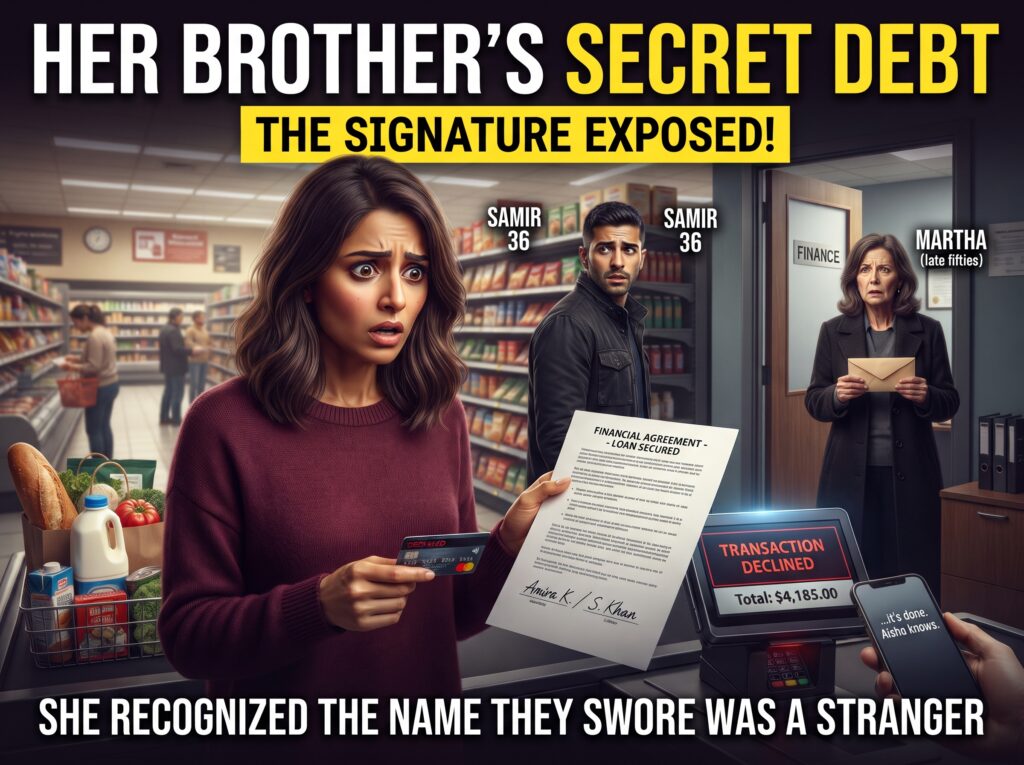
The supermarket checkout was moving slowly, and Aisha could feel the impatience of the people standing behind her.
She had placed only a few necessities on the conveyor belt. A loaf of bread, a carton of milk, a small bag of rice, some vegetables, and a few other things she needed to get through the next several days.
She had calculated the total before reaching the cashier.
It was supposed to be enough.
When the cashier announced the amount, Aisha inserted her card into the machine and waited.
The screen flashed.
DECLINED.
She blinked, removed the card, and tried again.
The same message appeared.
“Would you like to try another card?” the cashier asked politely.
Aisha forced a small smile.
“Just a moment, please.”
She opened her banking application.
The balance was lower than she expected.
She checked again, hoping she had misunderstood the numbers. But the money was gone.
There were people waiting behind her, and she could hear someone quietly sigh.
Aisha felt her cheeks grow warm.
“I’m sorry,” she whispered. “Could you remove a few things?”
The cashier began taking items off the counter.
Aisha watched the groceries disappear one by one.
She kept the rice, the bread, and the milk.
Everything else would have to wait.
Outside, she stood beside the supermarket entrance, looking at the receipt in her hand.
She had promised herself that she would never allow her financial problems to become someone else’s embarrassment.
Yet here she was again, counting coins and wondering how she would pay for the next bill.
For months, she had hidden the unpaid notices from everyone.
Her brother had mocked her for borrowing money.
He had told relatives that she couldn’t manage her finances and that she always expected someone else to rescue her.
Aisha had tried not to respond.
She knew how difficult life had become, but she also knew that people rarely understood the full story behind someone else’s financial problems.
What nobody knew was that she had once trusted her brother enough to lend him money.
It had happened during a difficult period when he claimed that a temporary business problem had left him unable to meet several payments.
He promised to return everything.
He said he only needed a little time.
Aisha believed him.
She had used part of her savings and delayed paying several of her own bills.
When she asked about repayment, he told her that the situation had become complicated.
When she asked again, he became angry.
Eventually, he began telling people that she was the one who had borrowed money from him.
The accusations hurt, but Aisha had no documents proving what had happened.
She remembered the evening he laughed at her in front of their relatives.
“You should learn how to manage money before asking other people for help,” he had said.
Nobody defended her.
She had gone home that evening and cried in the kitchen.
Now, standing outside the supermarket, she wondered how much longer she could continue pretending everything was temporary.
Her phone vibrated.
It was a message from her brother.
I heard you’ve been telling people I owe you money. Stop making up stories.
Aisha stared at the screen.
She had not spoken to him in several days.
She typed a response, then deleted it.
There was no point arguing without evidence.
She put the phone away and walked toward the bus stop.
At home, she placed the remaining groceries on the kitchen table.
Several unpaid notices were stacked beside an old notebook.
She opened the drawer where she kept receipts, bank statements, and messages she had printed during the months when she was still trying to understand where their money had gone.
She had kept everything.
Not because she wanted revenge.
Because some part of her had always believed that one day the truth would matter.
As she moved the papers, a small folded sheet slipped from between two envelopes.
It was a printed message.
She recognized her brother’s number.
But the message wasn’t addressed to her.
It was a conversation between him and someone else.
The final sentence had been underlined.
Make sure she never finds out where the money really went.
Aisha read it twice.
Then she looked at the date.
It was from the same week her brother had first asked her for financial help.
<h2>Part 2</h2>
Aisha sat at the kitchen table until the room became dark.
The printed message lay in front of her.
She had no memory of seeing it before.
Perhaps it had been placed inside the wrong envelope. Perhaps she had printed it during one of the arguments and forgotten about it.
Whatever the explanation, the words were unmistakable.
Make sure she never finds out where the money really went.
She turned the page over.
There was nothing written on the back.
She checked the date again.
It was almost a year earlier, when her brother had first explained that his financial problems were temporary.
He had called her late one evening.
His voice had sounded unusually calm.
“Aisha, I need to ask you something.”
“What happened?”
“It’s nothing serious.”
She remembered how he had paused before explaining that he needed money to settle an urgent payment.
He said he was embarrassed to ask.
He said he had already tried everyone else.
Most importantly, he promised that he would repay her before the end of the following month.
Aisha had asked whether he had spoken to their family.
“No,” he answered. “I don’t want everyone worrying.”
She understood.
Their family had already experienced enough financial difficulties.
She transferred the money the following morning.
A few weeks later, he asked for more.
Then another payment became necessary.
Each time, he explained that the problem would soon be resolved.
Aisha began using her own savings.
She delayed paying her electricity bill.
She reduced her grocery budget.
She even stopped buying medication she had been taking for a minor recurring problem because she wanted to keep enough money available in case her brother needed help.
When she finally asked him to repay her, his attitude changed.
“Why are you suddenly acting like I stole from you?”
“I’m not accusing you.”
“Then stop asking.”
She remembered the disappointment in his voice.
It had made her feel guilty for requesting her own money.
Now the printed conversation suggested that someone had known about the missing funds from the beginning.
Aisha opened her phone and searched through her old messages.
She found the first transfer confirmation.
Then she found another.
And another.
She wrote down every amount in her notebook.
The total was much higher than she had remembered.
She checked her bank statements.
Several payments had been made on dates that corresponded with her brother’s requests.
But there were also withdrawals she couldn’t explain.
One had occurred the day before he told her that he had no money left.
Another had been made just hours after he promised he would repay her.
Aisha leaned back.
Something was wrong.
She called her younger cousin, Daniel, who had sometimes helped her understand banking documents.
“Daniel, can I ask you something?”
“Of course.”
“Do you remember when my brother was having those financial problems?”
“Yes. Why?”
“Did he ever tell you where the money went?”
Daniel hesitated.
“I thought he used it to settle his debts.”
“Which debts?”
“I don’t know. He didn’t explain.”
“Did he mention anyone else?”
There was a pause.
“Why are you asking?”
Aisha looked at the printed message.
“I found something.”
Daniel lowered his voice.
“Maybe you should be careful.”
“Why?”
“I remember him saying that someone had helped him arrange a private payment. He said it wasn’t something the family needed to know.”
Aisha felt her stomach tighten.
“Who arranged it?”
“I don’t remember.”
“Try.”
Daniel remained quiet.
Then he said something that made Aisha stop breathing for a moment.
“He mentioned a person who had promised never to speak about it.”
“Who?”
“I don’t know the name. But I remember him saying that if you ever discovered the truth, you would understand why he couldn’t tell you.”
Aisha looked at the papers.
Her brother had borrowed money from her.
He had mocked her for struggling financially.
He had allowed her to believe that he was simply unable to repay her.
Yet someone else had apparently been involved in arranging the money.
“Daniel, do you still have his old messages?”
“Some of them.”
“Can you check?”
“I’ll look.”
After the call ended, Aisha continued searching.
She found an old photograph of a bank transfer receipt.
The amount matched one of the unexplained withdrawals.
But the recipient’s name had been partly covered.
She enlarged the image.
There were only a few visible letters.
Enough to suggest that it belonged to someone she knew.
Before she could examine it further, another message appeared.
It was from an unknown number.
You should stop looking through your brother’s papers.
Aisha read it.
A second message followed.
He isn’t the only person who will be affected if you discover the truth.
<h2>Part 3</h2>
Aisha did not sleep well that night.
Every time she closed her eyes, she imagined the unknown person standing somewhere outside her apartment, waiting for her to make another mistake.
She knew the message could have been a prank.
It could have been someone trying to frighten her.
But the timing was too precise.
Only a handful of people knew that she had discovered the printed conversation.
She checked the number.
It wasn’t saved in her contacts.
She called it.
The phone rang twice before the call ended.
She tried again.
This time, the number was unavailable.
Aisha placed the phone beside the notebook and opened her laptop.
She began organizing everything.
She created a list of transfers, dates, amounts, and explanations her brother had given.
Some of the explanations contradicted one another.
He had claimed that the first payment was for a business supplier.
Later, he said it had been used to pay an overdue loan.
In another conversation, he told her the money had gone toward an emergency involving someone in the family.
Aisha compared the dates.
None of the explanations matched the bank records.
She remembered a conversation at her mother’s house.
Her brother had been sitting at the dining table, complaining that Aisha never understood how difficult it was to manage responsibilities.
“You have no idea what I’ve been dealing with,” he had said.
Aisha had answered quietly.
“Then tell me.”
He had shaken his head.
“You wouldn’t understand.”
At the time, she had thought he was simply embarrassed.
Now she wondered whether he had been avoiding a question he couldn’t answer.
The next morning, Aisha visited the bank.
She carried her identification, printed statements, and copies of the transactions.
A customer service representative listened carefully.
“I want to understand several payments made from my account,” Aisha explained.
The representative examined the documents.
“These transactions were authorized through your account.”
“I know. I made some of them. But I believe the information I was given about their purpose was false.”
The representative nodded.
“Do you have evidence of that?”
Aisha showed her the messages.
The woman read them without commenting.
“I can explain how to request a formal review. But I can’t disclose information about another person’s private account.”
“Can you tell me whether these payments went to the same recipient?”
The representative studied the transaction numbers.
“Some appear to have a shared reference.”
“What does that mean?”
“It may indicate a linked payment arrangement. You’ll need a formal investigation to establish the details.”
Aisha requested the paperwork.
Before leaving, she asked whether the bank had any record of a separate account connected to the transactions.
The representative typed something into the system.
Her expression became serious.
“There’s an additional reference attached to one of these payments.”
Aisha leaned forward.
“Can I see it?”
The representative printed a document.
At the bottom was a reference code and an address.
It was not her brother’s home address.
It was a commercial address in another part of town.
Aisha recognized the street.
She had passed it many times.
There was an old financial services office there.
The same office her brother had once told her he had never visited.
She folded the document and placed it in her bag.
On the way out, she received a call from Daniel.
“I found something,” he said.
“What?”
“An old conversation. It was between your brother and someone called Martin.”
Aisha stopped walking.
“Who is Martin?”
“I thought you knew him.”
“I don’t.”
Daniel lowered his voice.
“The messages are strange. Your brother was asking him to keep something away from you.”
“Can you send them?”
“I can send screenshots.”
A few moments later, Aisha’s phone vibrated.
She opened the first screenshot.
Her brother had written:
The money has already been arranged. She must not know who signed the agreement.
The reply was short.
What happens if she recognizes the signature?
Her brother answered:
She won’t. She has never met him.
Aisha read the final line again.
Her brother had been discussing a signature.
And someone believed she would never recognize it.
But she knew many people connected to her family.
She wondered who could possibly be important enough to hide behind an agreement, yet familiar enough that one signature might expose everything.
She zoomed in on the date.
The conversation had happened only two days before her brother first asked her for money.
<h2>Part 4</h2>
The commercial address led Aisha to a narrow building between a pharmacy and a small accounting office.
The sign outside had faded.
The business was still operating, but it appeared to have changed ownership.
Aisha entered and approached the reception desk.
A middle-aged man looked up.
“Can I help you?”
“I’m looking for information about an old payment arrangement.”
“Do you have an account number?”
She showed him the reference code.
He studied it.
“Where did you get this?”
“It came from my bank statement.”
The man looked uncomfortable.
“Who was the original customer?”
“My brother.”
“What is his name?”
She told him.
The man typed something into his computer.
Then he stood.
“Please wait.”
He disappeared through a door.
Aisha remained at the desk.
She noticed a framed photograph on the wall.
It showed several people standing outside the office many years earlier.
She recognized one of them.
It was her brother.
He looked younger, but there was no mistaking him.
Standing beside him was another person.
A woman wearing a dark jacket.
Aisha moved closer.
The photograph was slightly faded, but the woman’s face was visible.
She recognized her too.
It was someone who had attended family gatherings for years.
Someone who had once told Aisha that her brother was irresponsible and that she should never lend him money.
Aisha stepped back.
The man returned.
“I’m afraid I can’t provide information about that account.”
“Why?”
“It’s an old arrangement.”
“Was my brother involved?”
The man hesitated.
“I can’t discuss private financial matters.”
“Was the woman in that photograph involved?”
He looked toward the wall.
“Who?”
“The woman standing beside my brother.”
The man’s expression changed.
“Do you know her?”
Aisha nodded.
“She told me she had never met him.”
The man closed the computer screen.
“Perhaps you should speak to your family.”
“I have been trying.”
He looked at her for a moment.
Then he said:
“Some records are no longer available through this office.”
“Where are they?”
“They were transferred.”
“To whom?”
He wrote down a telephone number.
“Ask for the records department. Don’t mention my name.”
Aisha took the paper.
Before leaving, she looked at the photograph again.
Her brother was smiling.
The woman beside him appeared relaxed.
They seemed comfortable together.
Not like strangers.
Not like two people who had never met.
Outside, Aisha called the number.
A recorded message answered.
The office was closed for the day.
She put her phone away.
Her thoughts returned to the message Daniel had found.
She must not know who signed the agreement.
Aisha had spent months believing that her brother had borrowed money, failed to repay it, and then tried to make her look responsible for his problems.
But perhaps the money had been connected to something much larger.
She returned home and searched through her old photographs.
She found the picture from a family celebration.
The same woman was standing behind her brother.
Aisha remembered the occasion.
The woman had arrived late and left before dinner.
Her mother had introduced her as an old acquaintance.
Aisha had barely spoken to her.
But there was something else.
The woman’s name appeared in a message from her brother.
Martin had mentioned it.
Aisha searched her contacts.
She found the number.
She hesitated before calling.
When the woman answered, Aisha spoke carefully.
“Hello. It’s Aisha.”
There was a long silence.
Then the woman said:
“I know.”
Aisha felt her heart beating faster.
“I need to ask you something.”
“About your brother?”
“Yes.”
The woman sighed.
“How much have you found?”
Aisha tightened her grip on the phone.
“Enough to know that you told me you had never met him.”
Another silence followed.
Then the woman whispered:
“Who showed you the photograph?”
Aisha looked at the picture on her screen.
“Why does that matter?”
The woman answered:
“Because if your brother knows you have it, he will destroy the remaining records.”
<h2>Part 5</h2>
Aisha asked the woman to meet her.
At first, she refused.
She said they needed to speak somewhere private and that Aisha should not tell her brother.
Eventually, she agreed to meet at a small café.
Aisha arrived early.
She chose a table near the window and placed the financial documents inside her bag.
When the woman entered, she looked around before approaching.
Her name was Margaret.
Aisha had known her for years, although never closely.
Margaret had attended several family events and occasionally helped Aisha’s mother with paperwork.
She had always seemed dependable.
That was why Aisha had never questioned her.
“Thank you for coming,” Aisha said.
Margaret sat down.
“You shouldn’t have involved yourself in this.”
Aisha almost laughed.
“Someone used my money. Someone lied about my brother’s debts. And now I’m being told not to ask questions.”
Margaret looked at the window.
“I know.”
“Then explain.”
Margaret folded her hands.
“Your brother was in serious trouble.”
“Because of his debts?”
“Yes, but not the kind he told you about.”
“What kind?”
Margaret hesitated.
“He had agreed to guarantee a financial arrangement for someone else.”
Aisha frowned.
“Who?”
“Someone who promised him a return.”
“What return?”
“Money. A lot of money.”
Aisha stared at her.
“Was this a business investment?”
Margaret nodded.
“At first.”
“And what happened?”
“The investment failed.”
Aisha opened her notebook.
“How much did he lose?”
Margaret gave her an amount.
It was larger than anything Aisha had imagined.
Her brother had not simply borrowed money to cover ordinary expenses.
He had become responsible for a financial arrangement that had collapsed.
When the losses appeared, he began asking relatives for help.
He told each person a different story.
Aisha had been told that the money was needed for an urgent business payment.
Their mother had been told it was for a loan settlement.
Another relative had been told it was connected to a temporary emergency.
Margaret explained that the money Aisha had transferred was supposed to cover part of the missing amount.
“But why was my name involved?”
“Your brother thought he could repay you before you discovered anything.”
“He promised me the money was for something else.”
Margaret lowered her eyes.
“I know.”
Aisha felt anger rising.
“Did you help him hide it?”
Margaret didn’t answer immediately.
Then she said:
“I helped him arrange the payments.”
“Under a false name?”
“Yes.”
Aisha looked at her.
“Why?”
“Because he believed the person involved would refuse to accept the money if they knew where it came from.”
“Who was that person?”
Margaret shook her head.
“I can’t tell you.”
Aisha leaned forward.
“You don’t get to decide that anymore.”
Margaret looked frightened.
“Your brother wasn’t the only person who made a mistake.”
“Who else?”
“Someone who trusted him.”
Aisha felt her stomach tighten.
“Did you sign the agreement?”
Margaret looked away.
“No.”
“Then who signed it?”
Margaret reached into her bag and removed a small envelope.
She placed it on the table.
“These are copies of the records I kept.”
Aisha opened it.
Inside were several payment confirmations, a handwritten note, and a photocopy of a document.
The signature was partly visible.
The name had been covered by a black line.
Aisha examined the handwriting.
It looked familiar.
Very familiar.
She compared it with an old birthday card she had received years earlier.
The writing was nearly identical.
She looked up.
“Why did you keep this?”
Margaret’s voice became quieter.
“Because I knew one day someone would ask.”
“Who gave it to you?”
Margaret stared at the envelope.
“Your brother.”
Aisha put the papers away.
Before she could ask another question, Margaret stood.
“You need to understand something. The debt was never the only secret.”
“What else?”
Margaret looked directly at her.
“The person who signed that agreement had a reason for making sure your brother never spoke about it.”
<h2>Part 6</h2>
Aisha spent the next two days studying the documents Margaret had given her.
She compared the handwriting with old letters, birthday cards, and notes kept in a box at her mother’s house.
The signature was still partly hidden.
But the shape of the first letter looked familiar.
She could not identify it with certainty.
She needed the original document.
She called Margaret.
“Can you help me get the complete agreement?”
“No.”
“Why not?”
“Because I don’t have it.”
“Who does?”
“I don’t know.”
Aisha was beginning to recognize a pattern.
Everyone seemed to know something.
Nobody seemed willing to say everything.
She contacted the records department using the number from the financial office.
A man answered.
She explained that she was trying to obtain a copy of an agreement connected to a payment reference.
He requested the original account details.
She provided them.
After a short wait, he told her that the document was stored in an archived file.
“Can I collect it?”
“Not without authorization.”
“Who can authorize it?”
“The original signatories or their legal representatives.”
Aisha asked whether her brother was listed.
The man checked.
“Yes.”
“And the other signatory?”
There was a pause.
“That information is included in the restricted section.”
“Can you tell me whether the person is alive?”
“I’m sorry. I can’t.”
Aisha thanked him and ended the call.
She returned to the messages on her phone.
The conversation between her brother and Martin contained another clue.
She had overlooked it earlier.
Martin had written:
If the agreement becomes public, everyone will know why she was involved.
Her brother had replied:
She already knows enough.
Aisha wondered whether “she” meant Margaret.
Or someone else.
She called Daniel.
“Do you remember anything else about Martin?”
“Not really.”
“Did he ever meet my brother?”
Daniel hesitated.
“I think so.”
“Where?”
“At a family event. Maybe at your mother’s house.”
Aisha checked the photographs again.
There were several pictures from birthdays and holidays.
In one, her brother was standing beside a man near the garden.
The man was partly turned away.
Aisha enlarged the image.
She couldn’t identify him.
But the man was wearing a distinctive watch.
She remembered seeing it somewhere else.
Then she found another photograph.
This time, the man was standing beside Margaret.
The watch was identical.
Aisha called Margaret.
“Did Martin work with you?”
Margaret was silent.
“Answer me.”
“Yes.”
“Was he involved in the payments?”
“Yes.”
“Why did you tell me he wasn’t?”
“I never said that.”
“You let me believe he had nothing to do with it.”
Margaret sighed.
“Because I didn’t want you to become involved.”
Aisha felt exhausted.
“Everyone says that. But I am already involved.”
Margaret finally explained that Martin had been responsible for organizing the original arrangement.
He had introduced her brother to the person who provided the financial agreement.
When the arrangement failed, Martin helped organize several repayments.
But there was a condition.
The payments had to be made without revealing the identity of the person who originally signed the agreement.
Aisha asked why.
Margaret replied:
“Because that person was connected to your family.”
The sentence stayed with Aisha.
Connected to her family.
She remembered the woman in the photograph.
She remembered the old birthday cards.
She remembered a relative who had once told her that her brother was not someone she should trust with money.
She began to wonder whether the person who signed the agreement had been present during the very conversations in which her brother mocked her.
Before she could ask more, Margaret ended the call.
Aisha opened the last document in the envelope.
It contained a list of payments.
The final entry was marked with a handwritten note:
Outstanding amount — to be settled after confirmation from original signatory.
At the bottom was another signature.
This one was complete.
Aisha recognized the surname.
It belonged to someone who had been part of her life for many years.
<h2>Part 7</h2>
Aisha returned to her mother’s house.
She hadn’t planned to tell her mother about the documents.
But she needed someone who could help her understand the names appearing in the records.
Her mother was in the kitchen when she arrived.
She looked surprised.
“Is everything all right?”
“I need to ask you something about my brother.”
Her mother put down the cup she was holding.
“What has he done now?”
Aisha placed the printed conversation on the table.
Her mother read it.
Then she looked up.
“Where did you get this?”
“From my old paperwork.”
Her mother remained quiet.
Aisha showed her the payment records.
She pointed to the signature.
“Do you recognize this?”
Her mother examined it.
For a moment, she seemed confused.
Then her expression changed.
“Where did you find that?”
“In an envelope from Margaret.”
Her mother sat down.
Aisha pulled out a chair opposite her.
“Please don’t tell me to stop asking questions.”
Her mother closed her eyes.
“I was hoping this would never happen.”
Aisha felt her heart sink.
“You know about it.”
Her mother shook her head.
“I know something happened. I don’t know everything.”
“Then tell me what you know.”
Her mother explained that several years earlier, Aisha’s brother had approached her about a financial problem.
He claimed that he had entered into an agreement with someone he trusted.
When the arrangement failed, he became frightened.
He said that people were demanding repayment.
Her mother had offered to help, but he refused to explain the full situation.
He said the matter involved a private agreement and that revealing it would damage someone’s reputation.
Aisha listened.
“Did he ask you to sign anything?”
“No.”
“Did he ask you to hide money?”
Her mother looked uncomfortable.
“He asked me to keep some papers safe.”
“Which papers?”
“I don’t remember.”
“Where are they?”
Her mother stood and walked toward the living room.
She returned carrying an old storage box.
Inside were photographs, letters, and several envelopes.
Aisha began sorting through them.
Most of the papers were ordinary family documents.
Then she found a small envelope with her brother’s handwriting.
It was sealed.
Her mother watched as she opened it.
Inside was a note.
If anything happens, make sure she never learns who helped me.
There was no name.
Only a date.
Aisha checked the date against her financial records.
It matched the week of the first payment.
She looked at her mother.
“Who is ‘she’?”
Her mother didn’t answer.
“Is it me?”
Her mother shook her head.
“Then who?”
Her mother sat down again.
“I think it refers to the person who signed the original agreement.”
“Do you know who that is?”
Her mother looked toward the window.
“I suspected.”
“Who?”
Before her mother could answer, a car stopped outside.
Aisha looked through the window.
Her brother had arrived.
He entered without knocking.
“What are you doing here?”
Aisha stood.
“I found the documents.”
His expression changed.
“What documents?”
“The agreement.”
He looked at their mother.
“You gave them to her?”
Their mother shook her head.
“I didn’t know what was inside.”
Aisha placed the papers on the table.
“Why did you tell everyone I was borrowing money from you?”
Her brother looked at the documents.
“Because you don’t understand what happened.”
“Then explain it.”
He rubbed his forehead.
“I was trying to fix something.”
“With my money?”
“I was going to repay you.”
“When?”
He didn’t answer.
Aisha pointed to the signature.
“Who signed this?”
Her brother stared at it.
For the first time, he looked genuinely afraid.
Then he whispered:
“You shouldn’t have found that.”
<h2>Part 8</h2>
Aisha’s brother walked toward the table and picked up the document.
He studied the signature, then placed it back down.
“Where did you get this?”
“Margaret.”
His expression hardened.
“She’s been talking to you?”
“Yes.”
“She had no right.”
“Neither did you.”
Their mother moved between them.
“Both of you need to calm down.”
Aisha remained standing.
“I want to know why you borrowed money from me and then told everyone I was the one who couldn’t manage her finances.”
Her brother looked exhausted.
“I never wanted things to happen like this.”
“That doesn’t answer my question.”
He sat down.
For several seconds, he stared at the floor.
Then he admitted that he had entered into an agreement with someone who promised to help him expand a small business.
He had believed the opportunity was legitimate.
He had borrowed money from several people to cover the initial costs.
When the arrangement collapsed, he was unable to repay everyone.
He became desperate.
Instead of admitting what had happened, he began hiding the details.
He told Aisha that he needed money for household expenses.
He told their mother that the debt was temporary.
He told relatives that Aisha had been demanding repayment unfairly.
The lies became easier than the truth.
But Aisha still wanted to know about the signature.
“Who signed the agreement?”
Her brother shook his head.
“I can’t tell you.”
“You can.”
“No. You don’t understand what it would mean.”
“Then explain it.”
He looked toward their mother.
She was crying quietly.
Aisha realized that her mother already knew something.
Perhaps not everything, but enough to be afraid.
Her brother continued.
“The person who signed the agreement wasn’t supposed to be involved in the business.”
“Then why were they involved?”
“Because they wanted to protect someone.”
“Who?”
He looked at Aisha.
For a moment, she thought he was going to answer.
Instead, he said:
“You need to stop.”
Aisha shook her head.
“I have lost money, my savings, and the trust I had in you. You don’t get to decide when I stop asking.”
He stood.
“I didn’t know you were going to discover all this.”
“That’s because you thought I would keep believing your lies.”
He reached for the documents.
Aisha pulled them away.
“Don’t.”
Her brother stared at her.
Then he lowered his voice.
“There are things you don’t know about the person who signed that agreement.”
Aisha felt a chill.
“What things?”
“That person has been protecting this family for years.”
“From what?”
He looked at their mother again.
Their mother began crying harder.
Aisha turned toward her.
“Mom?”
Her mother covered her face.
“I wanted to tell you.”
“Tell me what?”
Her mother slowly lowered her hands.
“The person who signed that agreement was the same person who helped us when your father was alive.”
Aisha frowned.
She had never heard this story.
Her father had died years earlier.
The family had struggled after his death, but her mother had always said that they managed without anyone’s help.
“Who helped us?”
Her mother opened her mouth.
Before she could answer, her brother’s phone rang.
He looked at the screen.
His face went pale.
He answered.
“Yes?”
A voice spoke loudly enough for Aisha to hear only a few words.
Her brother listened without responding.
Then he said:
“I told you she wouldn’t find it.”
He ended the call.
Aisha stared at him.
“Who was that?”
He put the phone away.
“The person you should have asked before you started blaming me.”
<h2>Part 9</h2>
Aisha left her mother’s house with the documents.
She knew she needed to stop relying on fragments of conversations.
She needed the original agreement.
The following morning, she contacted the records department again.
This time, she explained that she was prepared to submit a formal request supported by her bank statements and the messages she had discovered.
The representative told her that the request could take several days.
Aisha agreed.
While waiting, she called Daniel.
“Do you remember the person my brother said had helped the family?”
Daniel paused.
“Are you talking about the person from before your father died?”
“What person?”
“I remember your mother mentioning someone who helped pay a major family bill.”
“Who?”
“I don’t know. Your brother once said that person had done more for the family than anyone realized.”
Aisha thought about her mother’s words.
The person who had protected the family for years.
The person who had signed the agreement.
The person her brother believed she should have asked before blaming him.
“Did you ever meet this person?”
“Maybe.”
“Where?”
“At your mother’s house. A long time ago.”
Aisha searched her memories.
She remembered several visitors from those years.
An old family friend.
A business acquaintance.
A woman who had helped her mother after her father’s funeral.
A man who had occasionally brought documents for her brother.
But none of them seemed connected to the signature.
She opened the photograph of the old financial office.
The woman standing beside her brother was Margaret.
But another person appeared near the edge of the photograph.
Only part of the face was visible.
Aisha enlarged the image.
She recognized the clothing.
It was a dark jacket with a small silver button.
She remembered seeing it in a family photograph taken at a wedding.
She searched through her albums.
After several minutes, she found the picture.
The same jacket was being worn by someone standing beside her mother.
Aisha felt her breathing become shallow.
She had seen this person many times.
She had trusted them.
And they had repeatedly told her that they had never met her brother.
Aisha looked at the photograph again.
There was no doubt that the two people were standing together.
She checked the date.
It was taken on the same day as the financial office photograph.
She called Margaret.
“I found another photograph.”
Margaret didn’t answer.
“I know who was standing beside my brother.”
A long silence followed.
Then Margaret said:
“Don’t confront that person yet.”
“Why?”
“Because the signature is only one part of the agreement.”
“What is the other part?”
Margaret’s voice became unsteady.
“The original agreement included a statement about the person who would receive the money if your brother failed to repay it.”
Aisha looked at the bank records.
“Who was supposed to receive it?”
Margaret hesitated.
Then she answered:
“You.”
Aisha felt confused.
“Me?”
“Yes.”
“Why would I receive the money?”
“Because your brother used your name as part of the arrangement.”
Aisha stood.
“He had no permission to do that.”
“I know.”
“Did he sign anything using my name?”
Margaret didn’t respond.
Aisha repeated the question.
“Did he?”
Margaret finally said:
“I believe he did.”
Aisha looked at the documents spread across her kitchen table.
She had thought she was investigating a debt.
But the truth was beginning to suggest that someone had used her identity to create an agreement she had never known existed.
And the person responsible might be someone she had trusted for years.
Her phone vibrated.
A message arrived from an unknown number.
It contained a photograph of a document.
At the bottom was a signature.
Aisha immediately recognized it.
The signature belonged to the person who had repeatedly told her they had never met her brother.
<h2>Part 10</h2>
Aisha stared at the photograph for a long time.
The signature was clear.
There was no need to enlarge it.
She knew the handwriting.
She had seen it on birthday cards, family documents, and handwritten notes.
It belonged to someone who had been close enough to her family to know their private problems.
Someone who had offered advice when Aisha was struggling.
Someone who had once told her that her brother was irresponsible and that she should never lend him money.
And yet, according to the document, that same person had signed an agreement with him.
Aisha felt a mixture of anger and disbelief.
She called the unknown number.
It rang.
A man answered.
“Did you receive it?” he asked.
“Who are you?”
“Someone who knows what happened.”
“Why did you send me this?”
“Because you deserve to know the truth.”
Aisha looked at the signature again.
“Who gave you this document?”
The man paused.
“Someone who doesn’t want your brother to destroy the remaining evidence.”
“Is my brother involved?”
“Yes.”
“Did he use my name?”
“That is what the original agreement appears to show.”
Aisha closed her eyes.
For months, she had carried unpaid bills and blamed herself for not being able to manage her finances.
She had gone without groceries.
She had listened to relatives criticize her.
She had allowed her brother to describe her as someone who borrowed money and refused to repay it.
All the while, there had been an agreement she had never seen.
A signature she had never questioned.
And a secret that connected people who claimed they had never met.
“Where is the original document?” she asked.
The man told her it was being kept in a locked drawer.
Aisha immediately remembered the person she had planned to confront.
The person who had promised to explain everything.
The person who had looked frightened when she showed the first piece of evidence.
“Who has the drawer?”
The man didn’t answer.
Instead, he said:
“You need to speak to the person who signed the agreement.”
Aisha felt her hands trembling.
“I know who signed it.”
“Then you already understand why this is dangerous.”
The call ended.
Aisha sat alone at the kitchen table.
She looked at the old bills.
The printed messages.
The bank statements.
The photographs.
For months, she had believed that her brother’s dishonesty was the entire problem.
Now she understood that his secret might have been only one piece of something much larger.
She gathered the documents and placed them inside a folder.
She would no longer accept another vague explanation.
She would no longer apologize for asking about money that had come from her own savings.
And she would no longer allow anyone to convince her that the truth was something she had no right to know.
That evening, she went to confront the one person who could explain the agreement.
They opened the door and immediately looked uncomfortable.
Aisha placed the photograph on the table.
“Tell me why your signature is on this document.”
The person stared at it.
For several seconds, there was no response.
Then they looked toward the hallway.
Aisha noticed the movement.
“Are you expecting someone?”
They didn’t answer.
She placed the bank receipt beside the photograph.
“Did you know my brother was using my money?”
The person slowly reached for a locked drawer.
“You need to sit down.”
Aisha remained standing.
“I have been sitting down and listening to excuses for months. I want the truth.”
The drawer opened.
Inside were several envelopes and a thick folder.
The person removed one document and placed it in front of her.
Aisha looked at the signature.
It was the same one.
There was no mistake.
She looked up.
“Why did you tell me you had never met him?”
The person’s eyes filled with tears.
Before they could answer, another envelope slipped from the folder.
It contained a second document.
Aisha unfolded it.
The first page showed her name.
The second showed her brother’s.
And at the bottom was the same signature she had just recognized.
She looked at the person standing across from her.
For the first time, they didn’t try to deny anything.
They only whispered:
“You were never supposed to find out what we agreed to.”
Aisha looked down at the document.
She had finally discovered the signature.
But she still didn’t know what the agreement had been designed to protect, or why so many people had been willing to let her suffer rather than tell her the truth.
And now, with the original documents in front of her, she understood that the money her brother owed was only the beginning.