The rain had been falling since morning.
Margaret Whitmore stood beside the fireplace in her modest country house, watching the flames struggle against the damp evening air.
At forty-two, she had learned not to expect much from life.
Her husband, Thomas, had disappeared twenty years earlier. Her daughter, whom she had been told died shortly after birth, had become a memory she carried silently.
The village had changed since then, but Margaret had not forgotten the day everything fell apart.
She remembered the smell of the hospital room, the cold hands of the midwife, and the words spoken by her husband’s mother.
“Your baby did not survive.”
Margaret had screamed until her throat hurt.
Thomas had disappeared three days later.
Some said he could not bear the grief. Others whispered that he had found another woman.
Margaret never knew which story was true.
She only knew that she had been left alone.
A sudden knock interrupted her thoughts.
She opened the door.
A man stood beneath the porch roof.
His coat was soaked. His face was older, his hair darker than she remembered but touched with grey.
For several seconds, neither spoke.
Then Margaret stepped backward.
“Thomas?”
He nodded.
“Hello, Margaret.”
She stared at him as though he were a ghost.
“Twenty years,” she whispered. “Twenty years, and that’s all you can say?”
Thomas removed his hat.
“I deserve your anger.”
“You deserve much worse.”
He looked down at the small leather envelope in his hand.
“I came because I need to tell you the truth.”
Margaret laughed bitterly.
“The truth? You disappeared. You left me with nothing. What truth could possibly change that?”
Thomas looked directly into her eyes.
“Our daughter is alive.”
Margaret stopped breathing.
“No.”
“Margaret—”
“No! Don’t you dare say that!”
He stepped forward, but she raised her hand.
“You will explain every word. And if you’re lying, I will never forgive you.”
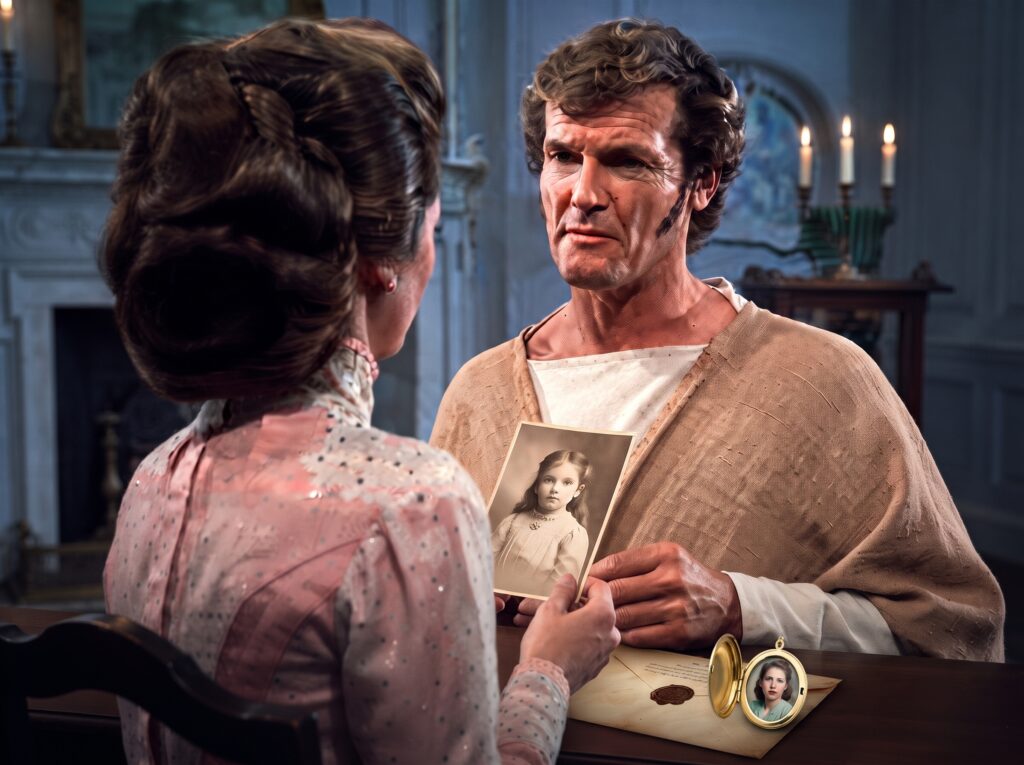
Thomas placed the envelope on the table.
Inside was an old photograph of a young girl.
On the back were three words.
For my mother.
Margaret recognized the handwriting immediately.
It was Thomas’s.
But the date written beneath it was from only three months earlier.
Their daughter had been alive all this time.
PART 2 — THE WOMAN WHO KNEW TOO MUCH
Margaret sat beside the table, unable to take her eyes from the photograph.
The girl appeared to be about nineteen years old.
She had dark hair, bright eyes, and a small mark beneath her left eyebrow.
Margaret touched the photograph.
“Who is she?”
“Our daughter,” Thomas replied.
“What is her name?”
“Elizabeth.”
Margaret looked up.
“Why didn’t you tell me?”
Thomas struggled to answer.
“Because I didn’t know where you were.”
“Don’t lie to me.”
“I’m not.”
“You had twenty years!”
Thomas walked toward the window.
“Your mother-in-law told me the child had died. I believed her. Then, years later, I discovered records that didn’t match.”
Margaret remembered Eleanor Whitmore, her former mother-in-law.
Eleanor had been a powerful woman who controlled the family’s money, servants, and reputation.
She had never approved of Margaret.
To Eleanor, Margaret had been an unsuitable bride for her only son.
“Your mother knew?” Margaret asked.
Thomas nodded.
“I found a letter in her private study after she died.”
“What did it say?”
Thomas opened the envelope and removed a folded sheet.
The paper was old and yellow.
Margaret began reading.
My dearest son,
I did what I believed was necessary to protect this family. The child was taken away because your wife could never give her the future she deserved. I arranged for her to be raised by another family.
Margaret’s hands began shaking.
“She gave our baby away?”
Thomas nodded.
“And she made me believe she had died.”
Margaret rose suddenly.
“Where is she now?”
“Living in a town called Ashbourne.”
“Take me there.”
Thomas hesitated.
“There’s something else.”
Margaret turned.
“What?”
“Elizabeth believes her adoptive parents are her real parents. She doesn’t know anything about us.”
Margaret looked again at the photograph.
“Then we must tell her.”
Thomas lowered his voice.
“Not yet. We need to understand why my mother chose that family.”
Margaret frowned.
“Why would that matter?”
Thomas looked at her.
“Because the family who raised Elizabeth received a considerable amount of money from my mother.”
Margaret felt the room grow colder.
“How much?”
Thomas answered quietly.
“Enough to keep them silent for twenty years.”
PART 3 — THE FIRST LETTER
The following morning, Margaret and Thomas traveled to Ashbourne.
It was a quiet market town surrounded by green fields and old stone buildings.
Thomas carried a small leather suitcase containing the documents he had discovered.
Margaret carried the photograph.
She had not slept.
Every time she closed her eyes, she imagined the little girl she had lost growing into a woman she had never met.
When they reached the address, Margaret saw a modest house with white curtains and a garden full of roses.
A woman in her late sixties answered the door.
Her name was Clara Bennett.
Thomas introduced himself.
Clara’s expression changed immediately.
“I wondered when you would come.”
Margaret stepped forward.
“Where is my daughter?”
Clara looked at her for a long moment.
Then she opened the door wider.
“Please come inside.”
The house was warm and comfortable. Family photographs covered the walls.
One photograph showed Elizabeth as a little girl.
Another showed her standing beside Clara’s husband.
Margaret felt a sharp pain in her chest.
She had missed every birthday, every school performance, every childhood illness.
Clara placed tea on the table.
“I was told the baby had no living mother,” she said.
Margaret stared at her.
“Who told you that?”
“Mrs. Whitmore.”
“Eleanor?”
Clara nodded.
“She said your husband was too devastated to raise the child. She told us you had abandoned her.”
Margaret closed her eyes.
The cruelty was almost impossible to understand.
“Why didn’t you contact us?”
Clara reached into a drawer.
“I tried.”
She produced a bundle of letters.
Every envelope was addressed to the Whitmore estate.
Every one had been returned unopened.
Margaret picked one up.
Her name was written on the front.
She opened it.
Inside was a short note.
Mrs. Whitmore,
Your daughter is growing well. She has your eyes. I believe she should know the truth one day.
Margaret began crying.
Clara looked away.
“I was afraid of your former mother-in-law. She threatened to ruin my husband’s business if we ever revealed the arrangement.”
Thomas stood up.
“Where is Elizabeth now?”
“She is working at the estate of Lord Ashcombe.”
Margaret wiped her tears.
“Then we will find her.”
But before they could leave, Clara spoke again.
“There is one more thing you should know.”
She handed Margaret a second envelope.
“This was left for Elizabeth. It was written by your mother-in-law shortly before she died.”
Margaret opened it.
And the first sentence made her blood run cold.
If Elizabeth ever learns who her father truly is, the Whitmore family fortune will belong to her.
PART 4 — THE PRICE OF SILENCE
Thomas read the letter twice.
His face grew pale.
“What does it mean?” Margaret asked.
He sat down slowly.
“My mother changed the inheritance arrangements shortly before her death.”
“To give Elizabeth the fortune?”
“Yes. But only if she could prove her identity.”
Margaret looked confused.
“Then why did nobody tell us?”
Thomas turned another page.
There was a list of names and financial arrangements.
One name appeared repeatedly.
Lord Ashcombe.
Margaret recognized it.
He was one of the wealthiest landowners in the region.
“Why is he connected to this?”
Thomas shook his head.
“I don’t know.”
Clara finally spoke.
“Elizabeth has worked for him for almost two years. He treats her like family.”
Thomas looked up.
“Does he know who she is?”
Clara hesitated.
“I believe he does.”
Margaret stood.
“Then he has been hiding our daughter from us too?”
“Not necessarily,” Clara replied. “He may be protecting her.”
Margaret could not accept that explanation.
For twenty years, people had made decisions about her child without asking her.
She would not allow it to happen again.
Thomas reached for her hand.
“Margaret, listen to me. We cannot rush this.”
She pulled away.
“You have already wasted twenty years.”
Thomas said nothing.
That evening, they rented rooms at a small inn.
Margaret sat beside the window, staring at the rain.
Thomas entered carrying a cup of tea.
“I know you don’t trust me.”
“That would be an understatement.”
He sat opposite her.
“After my mother told me the baby had died, I confronted her. She said you had been responsible for the child’s death.”
Margaret turned sharply.
“What?”
“She showed me a document. It claimed you had refused medical treatment.”
Margaret shook her head.
“I never saw that document.”
“I know that now.”
He reached into his coat and produced another folded paper.
“I found it among her possessions.”
Margaret opened it.
It was a medical report.
The signature at the bottom was not hers.
Someone had forged her name.
She looked at Thomas.
“Your mother did not just steal our daughter.”
Thomas nodded.
“She tried to make us hate each other.”
And suddenly Margaret understood.
Their separation had not been an accident.
It had been carefully planned.
PART 5 — THE DAUGHTER IN THE GARDEN
Three days later, Margaret finally saw Elizabeth.
The young woman was standing in the garden of Lord Ashcombe’s estate, arranging flowers beside a stone fountain.
She wore a simple blue dress and a white apron.
Her dark hair was tied back.
Margaret stopped at the garden gate.
For a moment, she could not move.
Elizabeth turned.
“May I help you?”
Margaret tried to speak.
Nothing came out.
Thomas stood behind her.
“Elizabeth,” he said gently.
The young woman looked at him.
“Yes?”
“My name is Thomas Whitmore.”
Elizabeth frowned.
“Should I know you?”
Thomas swallowed.
“Your mother was a woman named Margaret.”
Elizabeth looked between them.
“I don’t understand.”
Margaret finally stepped forward.
“My name is Margaret.”
Elizabeth’s expression changed.
“Why are you telling me this?”
Margaret held out the photograph.
“Because I believe I am your mother.”
Elizabeth stared at it.
The photograph showed her as a baby.
She had seen it once before, inside Clara’s locked drawer.
“Where did you get that?”
“It belonged to me.”
Elizabeth shook her head.
“No. My parents are Clara and George Bennett.”
Margaret nodded through her tears.
“They raised you. They loved you. But I gave birth to you.”
Elizabeth backed away.
“This is impossible.”
Thomas tried to explain.
“Your grandmother arranged everything. She told us you had died.”
Elizabeth looked at him.
“My grandmother?”
“Yes.”
The young woman’s face became pale.
Then a voice came from behind them.
“That is enough.”
Lord Ashcombe stood at the garden entrance.
He was an imposing man in his sixties, dressed in an expensive dark coat.
He looked at Elizabeth.
Then at Thomas.
“I warned you never to bring this matter here.”
Margaret stepped forward.
“You know the truth?”
Lord Ashcombe remained silent.
Elizabeth’s voice trembled.
“Please tell me what is happening.”
The old lord looked at her.
Then he said something that changed everything.
“Your grandmother did not send you away because she wanted to protect you.”
He paused.
“She sent you away because she knew what your father had done.”
Thomas’s face lost all color.
PART 6 — THE SECRET OF THE WHITMORE FAMILY
Inside Lord Ashcombe’s study, the truth began to emerge.
Elizabeth sat beside Margaret, still struggling to understand what she had heard.
Thomas stood near the fireplace.
Lord Ashcombe opened an old wooden cabinet.
He removed a document tied with a faded ribbon.
“Your grandmother was not the only person who knew about the child,” he explained. “I was involved in the original arrangement.”
Thomas looked furious.
“You helped her?”
“I helped prevent a scandal.”
Margaret interrupted.
“What scandal?”
Lord Ashcombe looked toward Elizabeth.
“Your grandmother discovered that Thomas was not the rightful heir to the Whitmore estate.”
Silence filled the room.
Thomas stared at him.
“That is impossible.”
Lord Ashcombe opened the document.
“Your father was not your biological father, Thomas. You were adopted.”
Thomas looked as though the floor had disappeared beneath him.
“What?”
“Your mother concealed the truth for decades.”
Elizabeth turned to Margaret.
“What does that have to do with me?”
Lord Ashcombe continued.
“The Whitmore estate was left to the biological descendants of the original family. Your grandmother feared that if Thomas’s adoption became public, the fortune would be taken away.”
Thomas shook his head.
“So she stole my daughter to protect the inheritance?”
“Yes.”
Margaret looked at the document.
“Why would giving the child away protect anything?”
Lord Ashcombe answered.
“Because Elizabeth was the only legitimate biological descendant of the original Whitmore family.”
Thomas slowly sat down.
His mother had spent twenty years hiding the person who was entitled to everything.
Margaret looked at her daughter.
“Elizabeth, you were never unwanted.”
Elizabeth’s eyes filled with tears.
“I spent my whole life wondering why I looked different from my parents.”
Margaret reached for her hand.
“You were loved before you were even born.”
But Thomas had one more question.
“Who was my real father?”
Lord Ashcombe closed the document.
“That is the secret your mother never wanted you to discover.”
PART 7 — THE LETTER THAT DESTROYED EVERYTHING
The following morning, Lord Ashcombe arranged a meeting with the family solicitor.
An elderly man named Henry Collins arrived carrying a black leather case.
He placed several documents on the table.
“The Whitmore estate was originally owned by Edward Whitmore,” he explained. “He had one legitimate son, whose descendants were entitled to inherit.”
Thomas leaned forward.
“And my mother?”
“She was Edward’s granddaughter.”
Thomas frowned.
“Then why was I adopted?”
Henry removed a letter.
“Because your biological father was Edward’s grandson.”
The room became silent.
Thomas looked at the letter.
His father had died when Thomas was an infant.
His mother had hidden his identity to protect the family from a scandal involving an unrecognized marriage.
The solicitor continued.
“Your mother believed that if the truth emerged, the family estate would be challenged.”
Margaret asked:
“Then why did she need to take Elizabeth away?”
Henry looked at Elizabeth.
“Because the original inheritance agreement gave the estate to the first legitimate child of Thomas’s bloodline.”
Thomas stared at him.
“Elizabeth.”
“Correct.”
The entire deception finally made sense.
Eleanor had believed that by separating the child from her parents, she could control the inheritance and prevent the truth from becoming public.
But she had made one mistake.
She had left evidence.
And that evidence was now in the hands of the people she had tried to destroy.
Elizabeth turned to Thomas.
“Did you know any of this?”
“No,” he whispered.
“Then why did you stay away for so long?”
Thomas lowered his head.
“Because I believed the lie.”
Elizabeth looked toward Margaret.
“And you?”
Margaret took her daughter’s hand.
“I never stopped looking for you. I simply had no idea where to look.”
For the first time, Elizabeth allowed herself to cry.
But Henry was not finished.
He opened one final envelope.
“Mrs. Whitmore left instructions that this document must be read only when both parents and their daughter were present.”
He unfolded the paper.
And the words inside revealed that Eleanor had left Elizabeth something far more valuable than the family estate.
She had left her the truth about her own birth.
PART 8 — THE MISSING INHERITANCE
The solicitor explained that the Whitmore estate included several farms, a country mansion, and substantial investments.
But there was a condition.
Elizabeth had to choose whether to accept the inheritance.
If she refused, the property would pass to a distant relative.
If she accepted, she would become the legal owner.
Elizabeth looked overwhelmed.
“I don’t want a fortune.”
Henry nodded.
“That is understandable.”
“I want to know why everyone made decisions about my life without asking me.”
Margaret squeezed her hand.
“That is the most important question.”
Thomas walked toward the window.
“I would give everything away if it meant I could have those twenty years back.”
Elizabeth looked at him.
“Can you?”
He shook his head.
“No.”
“Then don’t promise me things you cannot give.”
The words hurt him, but he accepted them.
Meanwhile, Lord Ashcombe revealed another secret.
Eleanor had secretly transferred part of the Whitmore fortune into an account under Elizabeth’s name.
The account had remained untouched for two decades.
Its value had grown enormously.
Margaret was astonished.
“Why would she do that?”
Lord Ashcombe answered:
“Perhaps because, despite everything, she knew Elizabeth was the rightful heir.”
Elizabeth looked at the documents.
Then she noticed a signature.
It was not Eleanor’s.
It belonged to Clara Bennett.
Margaret frowned.
“Why is Clara’s name here?”
Henry checked the document.
His expression changed.
“Because Clara was appointed as Elizabeth’s legal guardian in the original agreement.”
Thomas looked up.
“Then she knew the inheritance was waiting for Elizabeth?”
“Yes.”
Elizabeth stood.
“Clara raised me. She never told me any of this.”
Margaret looked at her daughter.
“Perhaps she was afraid.”
Elizabeth turned toward the door.
“I need to speak to her.”
She left the room before anyone could stop her.
PART 9 — THE FINAL CONFRONTATION
Elizabeth returned to Clara’s house that evening.
Her adoptive mother opened the door.
For a long moment, neither woman spoke.
Then Elizabeth placed the inheritance documents on the table.
“Why didn’t you tell me?”
Clara looked down.
“I wanted to.”
“When?”
Clara began crying.
“When you were old enough. Then when you were older. Then when I thought you would leave us.”
Elizabeth’s voice broke.
“You let me believe I was your biological daughter.”
“You were my daughter in every way that mattered.”
“But you knew I had another mother.”
Clara nodded.
“I did.”
Elizabeth looked at her.
“Did you know she was alive?”
Clara could not answer.
That silence was enough.
Elizabeth stepped backward.
“You knew.”
Clara finally spoke.
“Eleanor threatened us. She said that if we contacted Margaret or Thomas, she would destroy your future.”
Elizabeth wiped her tears.
“What about the money?”
Clara lowered her eyes.
“We never touched it.”
“Why?”
“Because your grandmother made us promise that it would belong to you when you were old enough to understand.”
Elizabeth looked at the old photographs on the wall.
She saw herself as a little girl, standing between Clara and George.
She remembered their love, their kindness, and the sacrifices they had made.
She also remembered the years of unanswered questions.
“Why didn’t you trust me with the truth?”
Clara began sobbing.
“Because I was afraid of losing you.”
Elizabeth took a long breath.
“I am not asking you to stop being my mother.”
Clara looked up.
“But I cannot pretend that nothing happened.”
They embraced.
It was not a perfect reconciliation.
There were too many years of silence for that.
But it was the beginning of something honest.
Later that evening, Elizabeth returned to Margaret.
And for the first time in twenty years, mother and daughter sat together without a stranger standing between them.
PART 10 — THE FAMILY THAT FINALLY FOUND ITS WAY HOME
Spring arrived at the Whitmore estate.
The gardens were filled with flowers, and the old mansion had been opened for restoration.
Elizabeth had accepted the inheritance.
But she made one important decision.
She would not use the fortune to live like the people who had destroyed her childhood.
Instead, she established a school and a home for children who had been separated from their families.
Margaret helped organize the project.
Clara became one of its first volunteers.
Thomas spent his days repairing the old estate and learning how to be a father to a daughter who had grown up without him.
Their relationship was not easy.
Elizabeth still carried questions.
Sometimes she became angry. Sometimes she withdrew.
Thomas never demanded forgiveness.
He understood that love could not erase the past.
One afternoon, Margaret found him standing beside the garden fountain.
“You look happier,” she said.
Thomas smiled faintly.
“I have more than I deserve.”
Margaret looked toward the mansion.
“Do you ever wonder what would have happened if your mother had told the truth?”
“Every day.”
“Would we have stayed together?”
Thomas took her hand.
“I don’t know.”
Margaret nodded.
“Neither do I.”
They stood silently for a moment.
Then Thomas reached into his coat and produced a small silver locket.
“I found this among my mother’s things.”
Margaret opened it.
Inside was a tiny photograph of Elizabeth as a newborn.
On the other side was a handwritten message.
One day, let her know she was loved.
Margaret began to cry.
For twenty years, she had believed her daughter had been forgotten.
Now she understood that even within a family built on lies, someone had left behind a small piece of truth.
Across the garden, Elizabeth was laughing with Clara as they planted roses.
Margaret watched them.
She had lost twenty years.
She could never recover the birthdays, the childhood memories, or the first words.
But she could choose what happened next.
Thomas stood beside her.
“Do you think she will ever forgive us?”
Margaret looked at their daughter.
“Forgiveness isn’t something we can demand.”
She paused.
“It’s something we must earn.”
Elizabeth noticed them watching and walked toward them.
“Mother?”
Margaret turned.
“Yes, darling?”
Elizabeth smiled.
“Would you help me choose flowers for the new school garden?”
Margaret’s eyes filled with tears.
“Of course.”
And as the three of them walked together through the garden, Margaret realized something she had spent twenty years believing was impossible.
Sometimes a family is not destroyed by the truth.
Sometimes it is destroyed by the people who are afraid to tell it.
And sometimes, even after twenty years of silence, the truth can bring everyone home.
THE END.