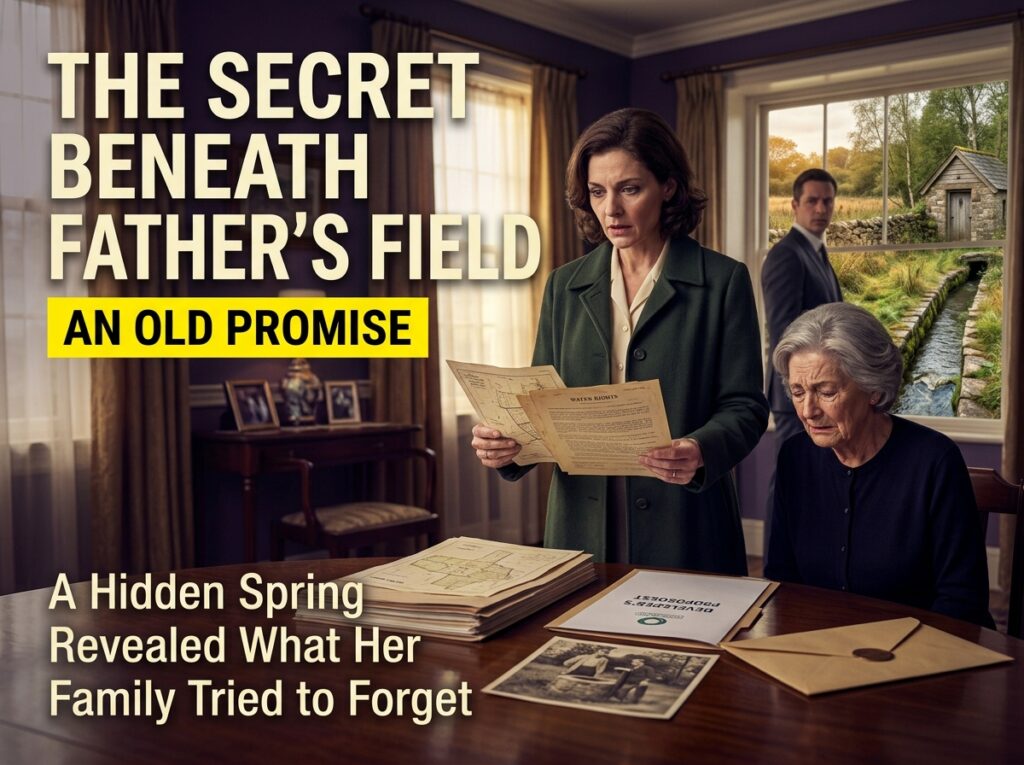
A developer offered me a fortune for my late father’s abandoned field, and I thought the money would finally end our family’s arguments. Then a surveyor discovered a spring promised to the village decades ago—and when I placed the documents on the table, my oldest relative began to cry.
We had been arguing about small things for weeks: a misplaced envelope, an unpaid bill, a phone call that ended when I entered the room. I ignored every warning because I wanted peace. A developer offered me a fortune for my father’s abandoned field, but the surveyor discovered the land contained a spring promised to the village. By the time I reached the final page, I understood why nobody had wanted me to ask questions. It was not just about money; it was about who had been allowed to tell our family story. At the family meeting, I placed the papers on the table. My oldest relative began to cry before I had said a single word.
The first sign that something was wrong was an envelope that disappeared from the kitchen drawer.
It was a plain brown envelope containing an old property tax notice, a receipt from the local council, and a handwritten note my father had left behind. Nothing about it seemed particularly important at the time. I had been sorting through his papers for weeks, and the house was full of documents that belonged to a life I was only beginning to understand.
Still, when I asked my older brother, Michael, whether he had seen it, he stopped stirring his coffee.
“What envelope?”
“The brown one. It was in the drawer beside the telephone.”
“I haven’t touched anything in that drawer.”
My sister, Helen, looked up from her phone.
“Why would Michael take your envelope?”
“I didn’t say he took it,” I replied. “I asked whether he’d seen it.”
Michael set down his spoon.
“You’ve been asking a lot of questions lately.”
It was such a small remark that I nearly ignored it. We had all been tired since our father died, and grief had made even ordinary conversations feel like negotiations. Our father, Arthur Bennett, had been a quiet man who rarely explained himself. He could spend an entire afternoon repairing a gate and say nothing about what troubled him.
After his funeral, we discovered that his silence had left behind more than memories.
There were unpaid bills, old tax records, a house that needed repairs, and a field beyond the village that nobody had properly maintained in years. The field had belonged to our family for generations. It lay beyond the old stone wall, past a narrow lane lined with hawthorn bushes, where the ground dipped toward a cluster of trees.
As children, we had called it the forgotten field.
Our father rarely took us there. He would walk to the boundary on certain mornings, stand with his hands in his coat pockets, and return before lunch. If we asked what he had been doing, he would say he was checking the land.
Checking what, he never explained.
After his death, Michael insisted the field was costing us money.
“The taxes keep coming,” he said at our first family meeting. “The weeds are taking over. The wall needs repairing. We should sell it and be done with it.”
Helen agreed that something needed to change.
I hesitated.
“Dad never wanted to sell it.”
“Dad isn’t here anymore,” Michael replied.
The words silenced the room.
I knew he was right about one thing: our father was gone, and we could not make every decision according to what we imagined he might have wanted. But the field had been his responsibility for most of his life. Selling it without understanding why he had kept it seemed wrong.
Then a developer named Richard Cole contacted us.
His company wanted to purchase the land as part of a larger development project outside the village. He offered a sum so large that I read the proposal three times before I believed it.
The money could clear the outstanding bills, repair the family house, and leave enough for each of us to make a fresh start.
Michael called it an answer to prayer.
Helen said we would be foolish to refuse.
I told myself that perhaps selling the field was the sensible thing to do. My father had kept it for reasons I did not understand, but sentiment could not pay the bills forever.
For several weeks, the family argued over small things. An envelope went missing. A bill appeared on the wrong side of the desk. Michael ended a telephone call whenever I entered the room. Helen began asking whether I had made copies of the documents, then insisted she was only trying to keep everything organized.
I noticed these things.
I simply chose not to interpret them as warnings.
I wanted peace. I wanted the three of us to finish our father’s affairs without turning grief into a permanent family war.
Then the surveyor arrived.
His name was Samuel Reed, a careful, soft-spoken man who walked the boundaries with a measuring instrument and a notebook. I accompanied him because Michael was busy and Helen said she had an appointment.
We crossed the field together beneath a pale morning sky. The grass reached our knees in places, and old fence posts leaned at uneven angles. Near the far end, Samuel stopped beside a patch of ground shaded by alder trees.
“Has this area always been wet?” he asked.
“I think so. Dad used to come here sometimes.”
Samuel knelt and brushed aside a layer of leaves.
There was a narrow channel beneath them, cut into the earth and lined with stones. It disappeared under the roots before emerging farther downhill.
He studied it for a long time.
“Do you know there’s a spring here?”
I stared at him.
“A spring?”
“An underground source of water, judging by the flow. It may have been redirected at some point, but the water is still moving.”
He took several photographs and made a note on his survey plan.
“Does that affect the sale?” I asked.
“It could. I need to investigate the legal records before I can tell you exactly how.”
For the first time, I looked at the field differently.
The neglected grass, the stone channel, the trees my father had refused to cut down—all of it suddenly seemed connected.
That evening, I found another envelope in the desk.
It was not the brown envelope I had lost. This one was white, sealed, and addressed in my father’s handwriting.
On the front, he had written only four words.
Read this before selling.
I sat at the kitchen table with the envelope in front of me for nearly twenty minutes before opening it.
My father’s handwriting was unmistakable. He wrote in narrow, careful letters, leaving wide spaces between his words. Even when he was writing a shopping list, he made every line look deliberate.
Inside was a single page.
If you are reading this, someone has finally begun asking questions about the field.
I stopped there.
The sentence seemed to have been written directly to me, although the letter could have been sitting in the desk for years.
There are things about the land that I should have explained long ago. I believed I was protecting the family by keeping certain matters private. I now understand that silence can protect the wrong people.
I read the paragraph twice.
The letter did not mention Michael or Helen. It did not explain the spring. It referred instead to an agreement made by our grandfather, Thomas Bennett, and a group of villagers whose names appeared in an old ledger.
Do not sign anything until you have seen the original record of the water agreement. The copy in the council office may be incomplete.
At the bottom was an address for the village archive and the name of a retired clerk, Margaret Ellis.
My father had died without telling me any of this.
I folded the letter and slipped it into my handbag.
The next morning, I called Michael.
“Have you ever heard Dad mention a water agreement connected to the field?”
There was a pause.
“Why?”
“I found a letter.”
“What letter?”
“One Dad left behind.”
Michael sighed.
“You’re making this more complicated than it needs to be.”
“Did you know about the spring?”
“I knew the field was damp. Everyone knows that.”
“Did you know it might be protected by an old agreement?”
“No.”
His answer came too quickly.
I told myself I was imagining the hesitation. Then he asked me to send him a photograph of the letter, and when I refused to do so before speaking with the council, his voice hardened.
“It’s a family asset. You can’t make decisions on your own.”
“I’m not making a decision. I’m trying to understand what Dad meant.”
“We’ve already agreed to sell.”
“We agreed to consider the offer.”
“It’s the same thing.”
“No, Michael. It isn’t.”
He ended the call.
I spent the afternoon at the village archive, a small room behind the council offices that smelled of paper and furniture polish. Margaret Ellis had retired years earlier, but the clerk on duty recognized her name and helped me find an address.
When I visited Margaret’s house, she answered the door wearing a knitted cardigan and holding a pair of reading glasses.
She looked at my face for several seconds.
“You’re Arthur’s daughter.”
“Yes. My name is Clara.”
“I wondered when one of you would come.”
The words unsettled me.
“Come inside,” she said. “Your father asked me to keep something safe. I never expected him to wait so long before telling you.”
She led me to a small sitting room where shelves of books covered two walls. On the table lay a cloth-bound ledger, its corners worn smooth by years of handling.
Margaret placed it between us.
“This is the original water agreement,” she said.
The first pages contained signatures, dates, and descriptions of land boundaries. I recognized my grandfather’s name on the third page. Beneath it were the names of several villagers who had lived long before I was born.
The agreement stated that the spring on Bennett land was to remain accessible for the village’s essential water needs. The family retained ownership of the field, but the water source could not be blocked, diverted for private commercial use, or destroyed without following the agreement’s conditions.
In exchange, the village had contributed labor and materials to maintain the stone channel and the access path.
I looked up.
“So the spring belongs to the village?”
“Not exactly,” Margaret said. “The land belongs to your family. The agreement gives the village certain rights concerning the water. The distinction matters.”
She turned several pages.
There was a later entry, written in my father’s handwriting.
It recorded a meeting held decades after the original agreement. The family had reaffirmed its commitment to maintaining the spring and preserving access to it.
My father’s signature appeared at the bottom.
“He knew,” I whispered.
Margaret nodded.
“He knew what the agreement meant. He also knew that the spring had become important again because the village’s newer water system was unreliable.”
“Why didn’t he tell us?”
“That is a question you should ask him, if you believe in such things. As for the living, I think your father feared that once the land became valuable, the agreement would become a source of conflict.”
I thought of the developer’s offer.
“Has Richard Cole seen this?”
“Not to my knowledge.”
“Could the sale go ahead without the agreement being considered?”
Margaret closed the ledger.
“Any responsible survey and legal review should identify it. But the record must be found, authenticated, and understood. If the wrong version is used, people may make decisions on an incomplete picture.”
She slid a photocopy across the table.
At the bottom of the page was a handwritten note.
The agreement remains binding upon the land and any successor owner, subject to the terms of the original instrument.
I felt a knot forming in my stomach.
The offer that had seemed like a simple solution now looked like the beginning of something far more complicated.
As I stood to leave, Margaret touched my arm.
“Clara, there is something else you need to know. Your father came to see me two months before he died.”
“What did he say?”
“He asked whether the original agreement contained an additional page.”
I stared at her.
“Did it?”
Margaret’s expression changed.
“That is precisely what I have been trying to establish.”
She opened the ledger again and turned to the final section.
One page had been cut cleanly from the binding.
And beneath the torn edge, in my father’s handwriting, were the words:
Supplementary promise—see attached schedule.
I returned to the archive the following morning, carrying my father’s letter and the photocopy Margaret had given me.
The council clerk, Peter Lawson, listened as I explained the missing page. He checked the ledger’s accession record, then searched several boxes of loose documents stored in a cabinet.
“There are references to a supplementary schedule,” he said. “But the schedule itself isn’t in this file.”
“Could it have been removed recently?”
“Possibly, though the binding suggests the page has been missing for quite some time.”
I thought of the brown envelope that had disappeared from our kitchen drawer.
“What would the schedule have contained?”
“Potentially, more precise details about access, maintenance, or the parties’ responsibilities. We can’t assume its contents without finding it.”
He examined my father’s letter.
“Did Arthur tell you where he believed it was?”
“No.”
Peter made a copy of the relevant records and gave me the contact details for the council’s legal adviser.
By lunchtime, I had learned enough to know that the proposed sale required a careful review. The developer could not simply be told that a spring existed and then be expected to abandon the project. The agreement’s terms, the rights attached to the land, and the potential effects of the development all needed to be assessed.
But I also understood why my father had been worried.
A new development would increase demand for water. If the spring could be incorporated into a private water system, its commercial value might be substantial. Even if the developer never intended to use it that way, the existence of the agreement could affect the land’s value and the design of the project.
That afternoon, Richard Cole called me.
“I understand the surveyor has discovered a spring on the property,” he said.
“He has.”
“We’re reviewing the implications. My company is committed to complying with all relevant legal obligations.”
“Have you seen the water agreement?”
“We’ve requested the records available through the council.”
“There may be a supplementary page missing from the original ledger.”
He paused.
“That would be something our legal team would need to examine.”
“I won’t sign the sale agreement until the complete record is found.”
“I understand your caution, Clara. But I should point out that the offer was made on the basis of the property’s current condition. Delays could affect the terms.”
“Then the terms can wait.”
After we ended the call, I sat at the kitchen table and stared at the family calendar. My father had marked ordinary appointments in blue ink: a doctor’s visit, a meeting with the gardener, a reminder to collect medicine.
Two weeks before he died, he had written Margaret—water records on a Thursday.
Margaret Ellis had told me that he visited her two months before his death. The date on the calendar was later.
Had he been trying to recover the missing page?
I checked his desk again. The brown envelope still had not reappeared, but the drawer contained an old notebook with a list of council telephone numbers. Beside Margaret’s name, my father had written another name: Peter Lawson.
At the bottom was a phrase I had never noticed.
Ask about the old pump house.
The pump house stood at the edge of the field, partly hidden behind the alder trees. It was a small stone structure with a sloping roof and a rusted metal door. As children, we had been warned not to play there because the floor was uneven and the old equipment could be dangerous.
I went there the next morning with Samuel Reed, the surveyor.
He examined the building from the outside before trying the handle.
“It’s locked,” he said. “And the roof needs attention.”
“Could there be records inside?”
“It’s possible, but we shouldn’t force entry. Let’s ask the council whether they have a key or any record of the building’s ownership.”
We walked around the structure. Near the rear wall, Samuel noticed a small stone marker embedded in the ground. It bore the initials T.B. and a date from more than seventy years earlier.
“My grandfather,” I said.
Samuel crouched beside it.
“This could mark a boundary or a maintenance point. I’ll photograph it and include it in the survey.”
He took several measurements, then looked toward the spring.
“The water channel appears to have been maintained much more recently than the building itself.”
“By whom?”
“I can’t say yet.”
I returned home with more questions than answers.
That evening, Michael arrived carrying a folder.
“We need to finalize the developer’s offer,” he announced.
“Not until the water agreement is properly reviewed.”
“You’re letting an old document destroy an opportunity for the family.”
“An old document that protects a village’s water supply.”
“That’s not our responsibility.”
“It became our responsibility when Grandfather signed the agreement.”
Michael dropped the folder onto the table.
“Do you have any idea how much money we’re talking about?”
“Yes.”
“Then stop pretending this is simple. We have bills, repairs, and a property that nobody wants to maintain.”
I opened my father’s letter and placed it between us.
“He knew about the agreement. He specifically asked us not to sell before finding the original record.”
Michael stared at the page.
For a moment, his expression seemed almost frightened.
Then he looked away.
“Dad was old,” he said. “He worried about things that no longer mattered.”
I wanted to believe that was all it was. I wanted to believe Michael was simply impatient, tired of the paperwork and frightened of the family’s financial future.
But as he collected his folder, I noticed a second document beneath it.
It was a photocopy of the water agreement.
Someone had circled the paragraph concerning commercial use.
And beside it, in red ink, were the words:
Potential compensation claim.
I asked Michael where he had obtained the photocopy.
He closed the folder before I could examine it more closely.
“From the developer’s representative.”
“Why has someone written ‘potential compensation claim’ beside the agreement?”
“Because there may be compensation if the sale is delayed or the project has to be redesigned.”
“Who would receive it?”
“The family, obviously.”
“Even if the money relates to the village’s water rights?”
Michael’s face tightened.
“You don’t know anything about development agreements. There are legal ways to settle these matters.”
“Then why are we discussing compensation before the original schedule has been found?”
“Because the developer wants certainty.”
“And I want the truth.”
He gathered the papers and stood.
“You always do this. You find one small problem and turn it into a reason to stop everything.”
I looked at him.
“This isn’t a small problem.”
He left without saying goodbye.
The following day, Helen came to the house. She had been trying to contact Michael about the sale but had received no answer. When I showed her the photocopy, she became quiet.
“I thought this was only about the price,” she said.
“So did I.”
She sat down and read the agreement carefully.
“Our grandfather made this promise. Dad maintained it. If we sell the land, we need to know what obligations go with it.”
“Michael thinks the developer will compensate us if the project is delayed.”
“Compensate us for what?”
“That is what I want to know.”
Helen turned the page over, searching for a reference number.
“This isn’t a complete copy.”
“How can you tell?”
“The final paragraph refers to an attached schedule. It isn’t here.”
I felt a chill.
The missing schedule had become the center of everything. My father had written about it. The archive ledger referred to it. And someone had already begun calculating what the family might gain from the agreement before the full document had been found.
I called Richard Cole and requested a meeting with his legal representative.
He agreed to meet us at the development company’s local office.
The next morning, Helen and I sat across from Richard and a solicitor named James Porter. Richard appeared calm and professional. He explained that the company wanted to build homes and small commercial units on land surrounding the village. The Bennett field was a key part of the proposed access route and drainage plan.
“We are not trying to deprive anyone of water,” Richard said. “We need to understand the restrictions so that we can design the project responsibly.”
“Then why is someone calculating a compensation claim?” Helen asked.
James Porter glanced at Richard before answering.
“That notation was not made by our legal team. We received the copy from an intermediary who claimed to represent the family’s interests.”
“Who?” I asked.
“I would need to check the file.”
Richard looked uncomfortable.
“We have dealt with several people regarding the property. I assumed they were coordinating with your family.”
“Who authorized them?”
He did not answer directly.
Instead, he opened a map showing the proposed development. A road crossed the lower portion of the field, and a drainage line ran near the spring.
Samuel Reed had marked the water source on his survey plan, but the developer’s map showed the area as a general drainage zone.
“That isn’t accurate,” I said.
Richard leaned forward.
“Which part?”
“The spring. The stone channel. The access path.”
“We haven’t completed the technical review.”
“Then the map shouldn’t be treated as final.”
James Porter made a note.
Richard explained that the company would commission an independent assessment of the spring and the agreement’s legal status. He also agreed not to proceed with any purchase until the review was complete.
It was a sensible decision, but it did not explain the missing document or the person who had been circulating incomplete copies.
After the meeting, Helen and I visited the old pump house again. The council had located a key in its maintenance records and authorized us to inspect the building with a representative present.
Inside, the air smelled of damp stone and rust. Old pipes ran along one wall, and a metal control wheel hung above a concrete channel. Dust covered a workbench beneath a small window.
There were no obvious papers.
Samuel examined the structure while the council representative checked the equipment. Near the back wall, Helen found a wooden cupboard with a warped door.
Inside were maintenance logs, several invoices, and a bundle of envelopes tied with string.
The top envelope was addressed to my grandfather.
The second was addressed to my father.
The third had no name at all.
I opened it carefully.
Inside was a single sheet bearing the heading Supplementary Schedule to the Bennett Water Agreement.
My hands began to shake.
The missing page had been found.
But before I could read beyond the first paragraph, the council representative stepped closer.
“Miss Bennett, I think you should see the date on that document.”
At the bottom of the page was a date that came several years after the original agreement.
And beside it was a signature that did not belong to my grandfather.
It belonged to my father.
The supplementary schedule contained three pages, not one.
The first described the spring’s location and the stone channel that carried water toward the village. The second outlined maintenance responsibilities and restricted changes that could reduce the water supply. The third recorded a later agreement between the family and the village council.
My father’s signature appeared on all three.
The document stated that the family would preserve the spring’s flow and provide reasonable access for inspection and maintenance. It also required consultation with the council before any development that could affect the source or its channel.
At the bottom was a sentence written in darker ink.
No transfer of the land shall be understood to cancel the water agreement or the village’s established rights.
Helen read it aloud.
Neither of us spoke for a moment.
“This changes the sale,” she finally said.
“It certainly changes what we need to ask,” Samuel replied. “The legal effect must be assessed properly, but this is a significant record.”
The council representative photographed the documents and prepared a record of where they had been found. We did not remove the originals. They belonged in the official archive, where they could be preserved and examined.
I made a note of every detail before we left.
That evening, I placed copies of the documents on the kitchen table and called a family meeting.
Michael did not answer. Helen said she would come. Our aunt Margaret, my father’s older sister and the oldest surviving member of the Bennett family, agreed to attend the following afternoon.
Aunt Margaret was eighty-nine. She lived in a small cottage at the other end of the village and rarely visited the family house anymore. Since our father’s death, she had been polite but distant, as though there were conversations she could no longer bear to have.
When I told her we had found the supplementary schedule, she went silent.
“Where was it?” she asked.
“In the old pump house.”
Another pause.
“Then Arthur finally left it where it belonged.”
“What do you mean?”
“I’ll explain tomorrow.”
She ended the call before I could ask another question.
I spent the evening comparing the dates on the schedule with the records in my father’s notebook. The later agreement had been signed more than twenty years earlier, when the village’s water system was under strain after a long dry summer.
My father had been in his early fifties. Michael and I were adults by then, and Helen had recently married. I remembered the summer vaguely: water restrictions, dry gardens, and neighbors carrying buckets from a public tap near the church.
I did not remember my father spending weeks at the field.
But the maintenance records showed that he had visited the pump house repeatedly.
There were invoices for pipe repairs, stonework, and replacement valves. Some had been paid from the family account. Others were marked as contributions from the village.
My father had not been neglecting the field.
He had been maintaining a responsibility we knew almost nothing about.
The next morning, I called Michael again.
“We found the supplementary schedule,” I said when he answered.
He did not ask what it contained.
Instead, he said, “Where?”
“In the pump house.”
A long silence followed.
“Did you read it?”
“Yes.”
“What does it say?”
“That the water agreement continues to apply to the land, including after a transfer, according to its terms.”
He exhaled sharply.
“So the developer can still buy the property.”
“Possibly, but the agreement must be respected. We need a full legal review.”
“What about the compensation?”
“Which compensation?”
“The money for the restrictions.”
I felt a sudden wave of disappointment.
“Michael, why is that the first thing you want to know?”
“Because we need to understand what the land is worth.”
“We need to understand what Dad promised.”
“Those aren’t separate questions.”
“They are when you treat a village’s water supply as a price adjustment.”
He said nothing.
I asked him to attend the family meeting.
“I’ll be there,” he replied.
When I arrived at the ancestral house the following afternoon, the documents were arranged in neat piles on the dining table. Helen sat beside the window. Michael stood near the fireplace, checking his phone. Aunt Margaret arrived last, leaning on a wooden cane.
She removed her coat and looked at the papers.
Then she looked at me.
“Before you begin,” she said, “there is something I should have told you years ago.”
She sat down slowly.
And for the first time in my life, I saw my aunt look afraid of a family conversation.
Aunt Margaret asked us to close the curtains.
It was an odd request on a bright afternoon, but I did as she asked. She wanted privacy, she explained, because what she was about to tell us concerned people who were no longer alive to defend themselves.
Michael folded his arms.
“Can we get to the point?”
Aunt Margaret looked at him with tired eyes.
“You have spent your whole life wanting to get to the point, Michael. Sometimes the point is buried beneath everything you refuse to hear.”
He looked away.
She began with our grandfather, Thomas Bennett, who had inherited the field from his own father. The land had never been especially profitable. It was too wet for some crops and too uneven for others, but the spring made it valuable to the village.
During a severe drought, families had struggled to obtain clean water. The public supply was unreliable, and the nearest alternative required a long walk. Our grandfather allowed villagers to collect water from the spring while a proper system was repaired.
At first, he considered it a temporary arrangement.
But as the drought continued, he realized that the spring was more than a convenient source. It was a lifeline.
“He could have charged people for access,” Aunt Margaret said. “There were men who told him he should. They said the water was on private land and that nobody would blame him for making a profit.”
“What did Grandfather say?” Helen asked.
“He said that ownership gave him responsibilities, not just rights.”
Aunt Margaret paused to drink some water.
The village council and our grandfather eventually formalized the arrangement. The family retained the field, but the spring and its channel were protected by a written agreement. In return, the village helped maintain the watercourse and the access path.
Years later, when our father inherited the land, he continued the arrangement.
“He never told us,” I said.
“He told me,” Aunt Margaret replied. “He asked me to help him preserve the records because he feared someone might eventually try to separate the field from the promise.”
Michael shifted his weight.
“Who would do that?”
Aunt Margaret looked at the documents.
“Someone who saw the value of the land and ignored the reason it had been protected.”
The room fell silent.
She explained that the family had received several offers for the field over the years. Most had been modest. A few had come from businesses interested in the spring’s potential use. Our father refused them all.
Then, about twenty years earlier, a company had proposed a larger development. Its representatives argued that the water agreement was outdated and that the village could be compensated for any inconvenience.
Our father rejected the proposal.
The company withdrew, but the dispute had left him worried. He began keeping duplicate records in different places, including the pump house.
“Why did he hide the schedule?” I asked.
“He didn’t hide it from you,” she said. “He was trying to make sure it couldn’t disappear if someone decided it was inconvenient.”
I looked at the missing page, now safely recorded by the council.
“Did he know someone was trying to obtain the land again?”
“I believe he suspected it. But I don’t know what evidence he had.”
Michael stepped away from the fireplace.
“This is all very moving, Aunt Margaret, but the agreement doesn’t mean we have to keep the field forever. If a developer can work around it, selling may still be the best option.”
“No one has said otherwise,” she replied. “But the decision must be made with the full facts.”
He turned toward me.
“Clara, are you planning to reject the offer?”
“I’m planning to find out exactly what the offer means.”
“You’re risking a fortune because of an old promise.”
“I’m refusing to sell something before I understand what we’re selling.”
Michael shook his head.
“You always think there’s a hidden meaning behind everything.”
“Someone removed a page from the archive. Someone circulated an incomplete agreement. And someone wrote ‘potential compensation claim’ beside a paragraph about village water rights. Don’t tell me there is nothing to investigate.”
His face flushed.
“I didn’t remove anything.”
“I didn’t accuse you of doing so.”
“You’re looking at me as though I did.”
“I’m looking at the documents.”
For several seconds, nobody spoke.
Then Aunt Margaret began to cry.
It was not a dramatic outburst. Her face simply crumpled, and she pressed a handkerchief against her mouth as if she were trying to hold something back.
I moved toward her.
“What’s wrong?”
She shook her head.
“I should have spoken sooner.”
“About what?”
She looked at the supplementary schedule.
“Your father didn’t only maintain the spring. He tried to repair something our family had broken long before any of you were born.”
I sat beside her.
“What did we break?”
Aunt Margaret wiped her eyes.
“The truth about the promise.”
She reached into her handbag and removed a small envelope, its edges softened by years of handling.
“I kept this because Arthur asked me to. He said that if the family ever came together to discuss selling the field, I should bring it.”
She placed it on the table.
My father’s name was written across the front.
Inside was a letter dated several months before his death.
And the first sentence read:
Margaret, if they have reached this point, they have finally found the agreement, but they may still misunderstand why it matters.
My father’s letter was longer than the one I had found in his desk.
It described the years after the original agreement, when the village had gradually improved its water system and fewer people needed to visit the spring. Some families moved away. Others connected their homes to the newer supply. The spring became quieter, and the field returned to the neglect we remembered from childhood.
But the agreement had never been formally dissolved.
My father wrote that he had once considered asking the council to review it. He believed the old terms might need clarification because the village had changed. He wanted to know whether the access arrangements could be modernized without weakening the protection of the water source.
Then he described a meeting with several villagers.
They had asked him not to abandon the agreement.
One elderly man explained that the spring remained important during interruptions to the public supply. Another reminded him that the village had contributed labor and materials for generations. Their families had treated the promise as something dependable, even when they no longer thought about it every day.
My father wrote that he had left the meeting ashamed.
He had inherited a promise that other people had continued to honor, yet he had allowed himself to think of it only as an old legal burden.
I realized that the field was not simply something our family owned, he wrote. It was something our family had been trusted to care for.
I read the sentence aloud.
Helen covered her mouth.
Aunt Margaret closed her eyes.
Michael remained standing.
“It’s a letter,” he said eventually. “It doesn’t settle the legal question.”
“No,” I replied. “But it explains why Dad kept the agreement.”
My father continued.
He admitted that he had considered selling the field when our mother was ill and the family’s expenses increased. A buyer had offered enough money to solve several immediate problems. He had been tempted, and for a time he had asked a solicitor whether the agreement could be removed from the title.
The answer had been complicated. The water rights could not simply be ignored, and any change would require a careful legal process involving the parties whose interests were affected.
My father withdrew from the proposed sale.
He never told us how close he had come to accepting it.
I did not refuse because money was unimportant, he wrote. I refused because I finally understood that a promise can become more important when keeping it costs you something.
I stopped reading.
All my life, I had believed my father kept the field because he was sentimental. I imagined he could not bear to part with land that had belonged to his own father.
But the letter revealed a man who had struggled with the same temptation we now faced. He had needed the money. He had considered the sale. He had asked questions.
Then he had decided that the decision belonged to more people than himself.
Aunt Margaret leaned toward me.
“Arthur told me he was afraid that one day the family would see the field as a burden rather than a responsibility.”
I looked at Michael.
He had sat down at last, his hands clasped between his knees.
“Did Dad know the developer would return?” he asked.
“I don’t know,” Aunt Margaret replied. “But he knew the land would become valuable if development reached this part of the village.”
Michael rubbed his forehead.
“Why didn’t he tell us? We could have planned for the bills. We could have discussed the field years ago.”
“You could have,” I said. “We all could have.”
The words sounded harsher than I intended, but they were true.
We had spent weeks arguing about envelopes, unpaid bills, and telephone calls because none of us had been willing to say what we were really afraid of. Michael feared losing the business and the financial security he had built his identity around. Helen feared another family rupture. I feared that if I challenged either of them, we would lose whatever remained of our relationship.
Our father had feared that money would erase a promise.
Each of us had been trying to protect something, and each had mistaken silence for protection.
Aunt Margaret passed me a second sheet.
It was a list of names from the village, along with dates when people had helped maintain the spring. Some names belonged to people I remembered. Others were names from the past, relatives of neighbors who still lived nearby.
Beside each entry was a small note describing the work performed.
One family had repaired the stone channel. Another had cleared the access path. A third had provided timber for a cover over the pump mechanism.
At the bottom, my father had written:
The village remembers even when we forget.
I understood then why Aunt Margaret had begun to cry.
The documents did not merely describe a legal arrangement. They recorded generations of people who had trusted one another to preserve something useful, even when there had been no immediate reward.
And our family had nearly sold the land without understanding the promise attached to it.
I looked at Michael.
“Will you agree to delay the sale until the full review is complete?”
He did not answer immediately.
Then he nodded once.
“Yes.”
It was not an apology. It was not a promise to abandon the developer’s offer.
But it was the first time since our father died that Michael had agreed to wait for the truth before demanding an outcome.
The legal review took several weeks.
The council arranged for the original agreement and supplementary schedule to be examined by its solicitor. Samuel Reed completed the survey, documenting the spring, the stone channel, the pump house, and the access path. The developer commissioned its own assessment of the land and the restrictions that applied.
Richard Cole remained involved, but the tone of his communications changed. He no longer spoke as though the sale were a simple matter of agreeing on a price. His company asked detailed questions about the water flow, the rights of access, and whether the development could proceed without damaging the source.
The answer was not immediate.
Some proposed designs could be changed. Others would require more extensive work. The spring’s precise contribution to the village’s water needs had to be assessed, and the council needed to determine what maintenance would be required in the future.
Meanwhile, the family had to decide whether to continue negotiating or withdraw from the sale entirely.
Michael wanted to keep the offer alive.
“If we walk away now, we lose the money,” he said during one meeting.
“If we proceed without understanding the agreement, we could create a legal dispute that costs even more,” Helen replied.
Michael turned toward me.
“What do you want?”
“I want the village’s rights protected, the legal position clarified, and a decision we can defend without hiding anything.”
“That doesn’t tell me whether you want to sell.”
“Because I don’t know yet.”
He shook his head, but he did not argue further.
A week later, Richard Cole invited us to a meeting with his technical team. He presented a revised plan that kept the spring and the access channel outside the main construction area. The proposed road would be moved, and the drainage system would be redesigned to reduce the risk of affecting the water source.
The changes were possible, but expensive.
Richard did not hide that fact.
“The revised plan reduces the developable area,” he said. “It also requires a long-term maintenance arrangement. We need to understand whether the project remains commercially viable.”
“And the village?” I asked.
“The council would need to approve the relevant arrangements. We would not proceed without the necessary permissions.”
I studied the map.
The spring remained in a protected area at the edge of the field. A narrow route allowed access for inspection and maintenance. The plan did not guarantee that every concern had been resolved, but it showed that the company was beginning to treat the agreement as a real obligation rather than an inconvenience.
Helen asked about compensation and the land’s valuation.
Richard explained that the price would need to reflect the restrictions and the costs of the revised design. He would not promise that the original offer could remain unchanged.
Michael looked disappointed.
“How much lower?” he asked.
“We don’t know yet,” Richard replied. “We need the legal and technical reviews completed.”
For a moment, I saw the familiar frustration return to my brother’s face.
Then he took a breath.
“Fine,” he said. “Let’s finish the reviews first.”
It was a small change, but I noticed it.
After the meeting, I visited the field alone.
The grass had been cut around the spring, and the old stone channel was visible again. Water moved through it in a thin, steady stream. The sound was quiet enough that I had to stand still to hear it.
I thought of my father walking to this place on mornings when we believed he had nothing to do. Perhaps he had been checking the flow. Perhaps he had been making sure the stones had not shifted or the channel had not become blocked.
He had done work that nobody noticed because the point of the work was to prevent a problem.
I knelt beside the water and touched the surface.
For years, I had assumed that family history was made from the events everyone remembered: weddings, funerals, arguments, and celebrations. Now I understood that much of it was made from small acts that went unnoticed until someone stopped performing them.
A repaired channel. A kept promise. A record placed somewhere safe.
My father had not been perfect. He had withheld information that might have saved us weeks of confusion and conflict. But he had tried to leave behind something more lasting than the money we might receive from selling the field.
That evening, I called Aunt Margaret.
“I think I understand why you cried at the meeting,” I told her.
She was quiet for a moment.
“I cried because Arthur had spent so many years trying to protect the promise, and we had almost lost it before we understood what it was.”
“I wish he had told us.”
“So do I.”
“Do you think he knew how much we would argue?”
Aunt Margaret gave a tired laugh.
“Your father knew his children. He probably expected an argument. I doubt he expected you to find everything quite so quickly.”
We spoke for another half hour, sharing memories of my father that had nothing to do with the field. When I hung up, I felt closer to her than I had in years.
But the next morning, an email arrived from the council solicitor.
The review had uncovered an inconsistency in an older property record.
The original water agreement and supplementary schedule appeared authentic, but a later document referred to a boundary adjustment that was not reflected in the current land map.
The solicitor wanted to meet with the family.
Because if the boundary had been changed, it could affect more than the proposed sale.
It could affect the very route through which the spring reached the village.
The family meeting took place in the council chamber on a rainy Thursday afternoon.
Michael arrived with a folder of financial statements. Helen brought copies of the original agreement. I carried my father’s letters and the notes I had made during the survey.
Aunt Margaret sat near the window, wrapped in a dark blue coat. She had insisted on attending even though the journey tired her.
The council solicitor, David Harris, began by explaining the inconsistency.
An old boundary record appeared to show that a narrow strip of land near the spring had been reassigned decades earlier. The record was incomplete, and the available map did not clearly establish whether the adjustment had been legally finalized.
If the strip remained part of the Bennett field, the water agreement applied in one way. If ownership had been changed, the legal position could be more complicated.
“Can this be resolved?” I asked.
“Yes,” David replied. “But we need to examine the original transfer records and determine whether the change was completed correctly.”
Michael opened his folder.
“How long will that take?”
“I can’t give you a reliable date.”
“Could we sell the rest of the field while the boundary is investigated?”
“Possibly, depending on the legal advice and the proposed arrangement. But we should not make assumptions before the records are reviewed.”
Michael leaned back in his chair.
“We could be waiting forever.”
Aunt Margaret looked at him.
“Do you remember the summer when the village ran short of water?”
He frowned.
“Not really.”
“You were a boy. Your grandfather carried buckets to the neighbors’ houses. Your father helped repair the channel. People came from all over the village to keep the spring flowing.”
“What has that got to do with a boundary map?”
“Everything,” she said. “The strip of land you’re impatient to sell may be the reason the spring still reaches the village.”
Michael fell silent.
David Harris explained that the next step was to compare the older survey, the original agreement, and the later boundary record. The council would also arrange for an independent specialist to inspect the channel.
No one could promise that the sale would proceed, or that the original offer would remain available.
For the first time, I saw Michael accept that uncertainty without immediately turning it into an argument.
After the meeting, he walked beside me through the council courtyard.
“I know you think I only care about the money,” he said.
“I think you’ve been frightened for a long time.”
He looked at me.
“I’m frightened now.”
“Of what?”
“Of losing the business. Of having to tell people I’ve failed. Of everyone deciding that Dad was right about me.”
I stopped walking.
“Dad never said you were a failure.”
“He didn’t need to. I knew what he thought when the business started going wrong.”
“Did he tell you that?”
“No.”
“Then you don’t know what he thought. You know what you feared he thought.”
Michael looked down at the wet paving stones.
For a moment, he seemed younger than he had in years.
“I kept telling myself that selling the field would fix everything,” he said. “I didn’t want to admit that the business might not recover even with the money.”
I placed a hand on his arm.
“You could have told us.”
“I know.”
“Why didn’t you?”
“Because I thought asking for help would mean admitting I’d failed.”
I understood that fear more than I wanted to. I had avoided asking questions because I feared the answers would destroy the peace between us. Michael had avoided admitting his difficulties because he feared losing our respect.
We had both chosen silence and called it protection.
The difference was that his silence had begun to determine what happened to the land and the family documents.
“I can’t promise the sale will happen,” I said. “I can’t promise the money will solve everything. But we can stop making decisions based on things we’re afraid to say.”
He nodded.
“I’ll try.”
The following week, the specialist’s report confirmed that the spring remained active and that the stone channel still carried water toward the village. The boundary records required further examination, but there was no justification for treating the spring as an ordinary feature that could be removed without consultation.
Richard Cole requested a revised meeting.
His company remained interested in the land, but the development plan would depend on the final legal findings and the cost of preserving the water source. The original offer could not be guaranteed.
Michael read the update at the kitchen table.
For a long time, he said nothing.
Then he folded the letter and placed it beside my father’s notebook.
“I suppose we have to decide what we’re willing to lose,” he said.
I looked toward the window, where the old field lay beyond the garden wall.
“Maybe the question is what we’re willing to protect.”
He did not answer.
But the next morning, he accompanied me to the field.
We walked along the stone channel together, carefully stepping around the wet ground. Michael stopped beside the alder trees and watched the water moving between the stones.
“I never knew it was still flowing,” he said.
“Neither did I.”
He crouched and cleared a small branch that had caught against the edge of the channel.
The gesture was modest. It did not resolve the property dispute or erase the weeks of suspicion. It did not guarantee that the family would receive the developer’s money.
But as I watched him stand and brush the dirt from his hands, I realized that we had finally begun to approach the field as something other than a price on a page.
Then my phone rang.
It was David Harris, the council solicitor.
He had found the original boundary transfer.
And he wanted us to come in immediately, because the document contained a handwritten clause that neither the developer nor our family had seen before.
The original boundary transfer was stored in a county archive, inside a file that had not been requested for decades.
David Harris showed us a certified copy at his office. The document recorded a narrow adjustment to the boundary near the spring, but it did not remove the water agreement. Instead, a handwritten clause preserved the channel and access route regardless of the precise boundary.
The clause had been signed by our grandfather and acknowledged by the village council.
It was not a secret loophole or a hidden fortune. It was a practical safeguard written by people who understood that land boundaries could change while a community’s need for water remained.
The legal review confirmed that the agreement continued to require proper consideration in any proposed sale. The developer could proceed only if the relevant rights and obligations were respected and the necessary approvals were obtained.
Richard Cole reviewed the findings and returned with a revised proposal. The price was lower than the original offer because the protected spring and its access route limited the development. The company would also have to redesign part of the project and accept the conditions required by the agreement.
There was no pressure to accept immediately.
For the first time, we had enough information to make a genuine decision.
We gathered at the ancestral house one final time to discuss the offer.
Michael sat opposite me, his hands resting on the table. Helen had brought tea, and Aunt Margaret occupied her usual chair beside the window. The documents lay between us in separate folders: the original agreement, the supplementary schedule, the boundary transfer, the survey report, and the developer’s revised proposal.
I looked at the papers and thought of the brown envelope that had started the arguments.
We had spent weeks accusing one another of small betrayals because we were afraid to face the larger questions. We had treated missing paperwork as an inconvenience, a wet patch in a field as a minor detail, and an old promise as a burden left behind by a man who could no longer explain himself.
Now the documents told a different story.
They showed that our grandfather had agreed to preserve the spring during a drought. They showed that our father had maintained that promise long after the original emergency had passed. They showed that the village had continued to rely on the arrangement and that the land’s value could not be separated from its responsibilities.
I looked at Michael.
“What do you think we should do?”
He glanced toward Aunt Margaret before answering.
“I still think the money could help us. But I don’t want us to sell something without understanding what it means anymore.”
Helen nodded.
“We should make sure the spring is protected first. If the development can be done responsibly, we can consider the revised offer. If it can’t, we walk away.”
Aunt Margaret watched us quietly.
“And what would your father say?” she asked.
No one answered immediately.
Then I realized that we had spent too much time trying to guess what our father would have wanted. We had treated his wishes as a puzzle that could settle every argument, when what he had really left us was a responsibility to think carefully and act honestly.
“We can’t know exactly what Dad would say,” I replied. “But we know what he did. He maintained the agreement, kept the records, and asked us to find the truth before selling.”
Aunt Margaret’s eyes filled with tears.
“Yes,” she whispered. “That’s what he did.”
We agreed not to sign the sale until the council had formally confirmed the necessary protections and the developer had accepted them in writing. We also agreed that no family member would negotiate privately or circulate incomplete documents again.
It was not a perfect resolution. The revised offer might still fail. The money would not automatically repair every family problem. Michael would have to face his business difficulties, and we would have to rebuild trust through actions rather than promises.
But we finally had a shared understanding of what the field meant.
After the meeting, Aunt Margaret asked me to walk with her to the garden.
She moved slowly, leaning on my arm. At the old stone wall, she stopped and looked across the land.
“I cried because I remembered your father as a young man,” she said.
I waited.
“He was not always certain about what was right. He struggled with the same things you have struggled with. He wanted security. He wanted to provide for his family. There were times when he wondered whether keeping the promise was worth the cost.”
“Why didn’t he tell us?”
“Perhaps he thought he had to carry the burden alone. Perhaps he feared that if he explained the difficulties, someone would persuade him to give up.”
She looked at me.
“He should have trusted you with the truth.”
I felt a lump in my throat.
“I wish he had.”
“So do I.”
We stood quietly for a while.
Below us, the field stretched toward the trees. The grass had begun to grow again around the edges of the cleared channel. The water continued its journey toward the village, indifferent to the arguments, the documents, and the price someone might be willing to pay for the land.
I thought about my father walking here alone, checking the stones and the pipes while the rest of us assumed he was simply revisiting an old piece of property.
I wished I could ask him what he had felt when he decided to preserve the agreement. I wished I could tell him that we had finally found the records and understood why they mattered.
But grief did not offer explanations on demand.
It offered memories, and the opportunity to do something differently with what remained.
In the weeks that followed, the council finalized the review of the agreement and established a process for protecting the spring during any future development. The developer continued discussions under the revised conditions, but the family made no commitment until every requirement had been clearly documented.
Michael began addressing his financial problems directly. He stopped treating the sale as an inevitable rescue and started discussing practical alternatives. Helen helped organize the family’s records, and I created a complete archive of the documents connected to the field.
Aunt Margaret visited more often.
One afternoon, she brought a photograph of our grandfather standing beside the pump house. He was young, with his sleeves rolled up and mud on his trousers. Behind him, several villagers were repairing the stone channel.
On the back, someone had written a date and a sentence.
We keep the water flowing because one day we may need it ourselves.
I placed the photograph beside the supplementary schedule.
For years, I had believed our family’s story was about ownership: who inherited the house, who controlled the money, who had the right to decide what happened to the field.
Now I understood that ownership was only one part of the story.
The deeper question was what we owed to the people who had trusted us, and whether we were willing to honor those obligations when doing so became inconvenient.
My father had not left us a simple answer. He had left us documents, unfinished conversations, and a promise that required us to become more honest with one another.
Perhaps that was why he had written, The village remembers even when we forget.
The land had held the evidence for generations. We were the ones who had needed time to understand it.
On a clear morning in early spring, I walked to the pump house alone. The door had been repaired, the records safely preserved, and the access path cleared. I stood beside the channel and listened to the water.
For the first time, the field no longer felt abandoned.
It felt entrusted.
I thought of the fortune the developer had offered us. It had been real money, enough to change our lives. Refusing it without consideration would not necessarily have been wise, just as accepting it without investigation would not have been responsible.
The important thing was that we now had the truth needed to choose.
When I returned home, Michael was waiting in the kitchen. He had brought the brown envelope that had disappeared weeks earlier.
“I found it in my briefcase,” he said. “I must have put it there when I was collecting the property papers. I should have told you as soon as I found it.”
I took the envelope from him.
It contained the old tax notice, the council receipt, and my father’s handwritten note. Nothing had been destroyed, but the weeks of suspicion had changed how we saw one another.
“Thank you for bringing it back,” I said.
Michael looked at me.
“I can’t undo the way I’ve behaved.”
“No,” I replied. “But you can choose what you do next.”
He nodded.
We stood together at the kitchen window, looking toward the land beyond the wall.
Neither of us spoke for a while.
Then Michael asked whether I thought the family would ever be the same again.
I considered the question.
“No,” I said. “But perhaps we can become something better than what we were.”
He looked at me, and for the first time in weeks, I saw no argument waiting behind his eyes.
We had not solved every problem. We had not recovered every lost year or repaired every hurt. But we had stopped pretending that peace meant silence, and we had begun to understand that the truth was not something to fear simply because it might change what we believed.
The field remained part of our family history. The spring continued to serve the village, protected by the agreement our grandfather had made and our father had preserved. The future of the land would be decided with care rather than desperation.
And the promise would no longer depend on one quiet man carrying its meaning alone.
I used to think the most valuable thing my father had left us was the land itself.
I was wrong.
He had left us a choice: to inherit the property without understanding it, or to discover the responsibility that made it worth protecting.
The fortune had brought us to the table.
The truth had finally given us a reason to stay there together.