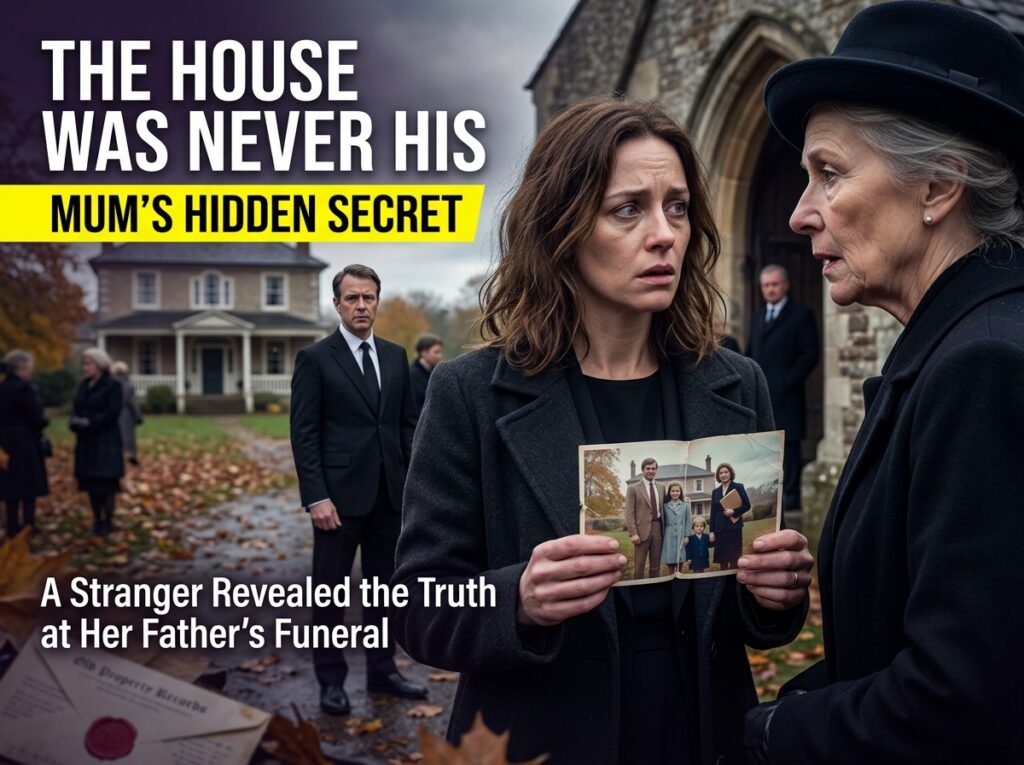
I worked two jobs to keep my children safe, believing our family home would always be their security. Then, at my father’s funeral, a stranger handed me a photograph and whispered, “The house was never meant for your brother.” The next morning, a records clerk discovered something that made him ask who else knew.
For most of my adult life, I worked two jobs and kept every receipt because I never wanted my children to know the fear of losing a home.
I knew the price of electricity, the exact amount needed for groceries each week, and how many hours I could work before exhaustion made my hands tremble. I knew which bills could wait three days and which ones could not. I knew how to smile at breakfast after spending half the night worrying about money.
What I did not know was how little I understood about my own family.
My father’s funeral took place on a gray Thursday morning in October. Rain had fallen during the night, leaving the churchyard slick and shining. The air smelled of wet leaves, damp coats, and the flowers people had brought to remember a man who had rarely spoken about his feelings but had always been generous with practical help.
My father, Edward Bennett, had been a difficult man to understand.
He could spend hours repairing a neighbor’s fence without accepting payment, yet refuse to explain why he had made a decision that affected his own children. He believed in hard work, keeping promises, and never borrowing what you could earn yourself. He was proud of our family home, an old two-story house with a broad front porch, pale stone walls, and a garden my mother had planted before she died.
To him, that house was more than a building.
It was where he had raised us, where we had celebrated birthdays, where my mother had read stories to us beside the fireplace, and where every important family photograph had been taken.
My older brother, Daniel, believed the house was his future.
He had never said those exact words, but his behavior had made his expectations clear for years. He lived comfortably enough, though his business had experienced several difficult periods. Whenever money became tight, he spoke about the house as if its sale or transfer were simply a matter of time.
I was different.
I had spent most of my adult life working as a bookkeeper during the day and cleaning offices several evenings a week. I raised my two children, Emma and Lucas, without expecting my father or brother to rescue me. I paid my rent, saved what I could, and kept receipts in labeled envelopes because I had once watched a landlord threaten to evict a family who could not prove they had paid.
That experience had stayed with me.
I never wanted my children to feel that their home could disappear because somebody else had misplaced a document or changed their mind.
When my father died, I thought I understood what would happen next. There would be paperwork, funeral expenses, and conversations about his estate. Daniel would probably want the house. I would ask for a fair arrangement and try to prevent an argument.
I expected grief.
I did not expect a stranger.
After the service, people gathered outside the church. My brother stood beside the family car, accepting condolences with the solemn expression he used whenever he wanted people to see him as the responsible son. His wife, Vanessa, remained close to him, her black coat buttoned to the throat.
I stood near the church steps, thanking people who had known my father for years.
That was when an unfamiliar woman approached me.
She appeared to be in her late sixties. Her silver hair was neatly pinned beneath a dark hat, and she held a small black handbag in both hands. I had never seen her at a family gathering, though something about her face seemed strangely familiar.
“Are you Claire?” she asked.
“Yes.”
“Edward’s daughter?”
I nodded.
Her eyes moved toward the graveyard, where the last of the mourners were beginning to leave.
“I knew your father a very long time ago,” she said.
I waited for her to offer her name, but she did not.
Instead, she reached into her handbag and removed an old photograph.
It showed my father standing on the front porch of our family home. He looked younger than I had ever known him, perhaps in his early thirties. Beside him stood my mother, smiling at the camera, with one hand resting on the shoulder of a little girl.
The girl was me.
I recognized the dress I was wearing. My mother had told me about it when I was small. She had sewn it herself from a piece of pale-blue fabric she found at a market.
But there was someone else in the photograph.
A woman stood beside my mother, holding a folder against her chest. I had never seen her before, and yet she was wearing a ring that looked almost identical to the one my mother had kept in a small wooden box beside her bed.
“Who is she?” I asked.
The stranger studied my face.
“Someone who should have been remembered.”
I looked at the photograph again.
“Why are you giving this to me?”
She stepped closer, lowering her voice so the other mourners could not hear.
“Because you need to understand something before your brother takes what was never meant for him.”
My stomach tightened.
“What do you mean?”
She looked directly into my eyes.
“The house was never meant for your brother.”
For a moment, I could not speak.
Daniel had spent years talking about the house as if it belonged to him already. He had discussed renovations, property values, and possible buyers. When our father became ill, Daniel began telling relatives that he would take responsibility for the property after the funeral.
I had assumed Dad had made some private arrangement with him.
But the stranger’s words suggested something else.
“Who are you?” I demanded.
She opened her mouth, then closed it again.
“My name is Ruth,” she said finally. “Please don’t ask me to explain everything here. Go to the records office tomorrow. Ask for the original property file and the document connected to your mother’s name.”
“My mother died years ago.”
“I know.”
“Then why would her name be on a property document?”
Ruth’s eyes filled with tears.
“Because your mother never stopped trying to protect you.”
Before I could ask another question, she pressed the photograph into my hand and walked toward the road.
I watched her disappear behind a row of parked cars.
Then I heard Daniel calling my name.
“Claire! What are you doing over there?”
I slipped the photograph into my handbag.
“Nothing.”
He looked at me suspiciously.
“Who was that woman?”
“You know her?”
“No. That’s why I’m asking.”
I shook my head.
“She knew Dad.”
Daniel glanced toward the road, then back at me.
“People always appear at funerals with stories. Don’t let anyone fill your head with nonsense.”
He said it lightly, almost kindly.
But his eyes stayed on my handbag.
That evening, after the children had gone to bed, I placed the photograph on the kitchen table and studied it beneath the light.
My mother stood beside my father. The unfamiliar woman held a folder. I was smiling at the camera, unaware that the adults around me might have been discussing something that would shape my entire life.
I turned the photograph over.
There was a date written in faded blue ink and a short sentence in my mother’s handwriting.
For Claire, when the time is right.
I read the words several times.
Then I noticed a second line beneath them.
The original belongs where no one thinks to look.
I barely slept that night.
Because for the first time since my father died, I wondered whether the family home I had spent my entire life trying to protect had never been intended for Daniel at all.
And I wondered what else my parents had kept from me.
The next morning, I left home before sunrise.
I told my children I needed to handle some paperwork connected to their grandfather’s estate. Emma, who was sixteen, looked up from her cereal bowl with the sharp expression she had inherited from my mother.
“Is Uncle Daniel making trouble again?”
“Why would you ask that?”
“Because he keeps calling you, and every time you answer, you look upset afterward.”
I forced a smile.
“Your uncle and I are trying to sort out some family matters.”
“Is he going to take Grandad’s house?”
The question hurt more than I expected.
For years, I had worked to ensure my children never experienced the insecurity I had known. I wanted them to believe that adults could disagree without making the people they loved feel unsafe.
“I don’t know yet,” I admitted. “But I promise you that I won’t make any important decisions without understanding what they mean.”
Emma nodded, though I could see that she wanted a more definite answer.
Lucas, my younger child, came into the kitchen carrying his schoolbag.
“Can we still visit the garden?” he asked.
“Of course.”
“Even if Uncle Daniel sells the house?”
I crouched beside him.
“I’ll do everything I can to make sure we don’t lose the memories we have there.”
It was the only promise I could honestly make.
The records office occupied the ground floor of an old municipal building near the town center. I had visited it years earlier to obtain a copy of my marriage certificate, but I had never needed to examine property records.
Inside, the waiting area was almost empty. A woman behind the reception desk directed me to a counter where a clerk named Peter Lawson was reviewing a stack of files.
“I need to inspect the original property records for my late father, Edward Bennett,” I explained. “The property is our family home at number fourteen, Willow Lane.”
Peter typed the address into his computer.
“Are you an executor of the estate?”
“No. I’m his daughter.”
“Do you have authorization to access the file?”
I hesitated.
“I have a family photograph and a note from my mother referring to an original property document. I believe there may be something connected to her name.”
Peter looked at me more carefully.
“Your mother’s name?”
“Margaret Bennett.”
He typed again, then frowned.
“That property has an older registration history. Some of the original documents are held in the archive rather than the current electronic file.”
“Can I see them?”
“Possibly. I’ll need to check the access rules.”
He disappeared through a door behind the counter.
I sat in a plastic chair and unfolded the photograph. My mother’s handwriting seemed more urgent in daylight.
For Claire, when the time is right.
I had always believed my mother had wanted Daniel and me to inherit equally. She had spoken often about fairness, especially when we argued as children. If Daniel received a larger piece of cake, she cut mine to match. If I received a new coat, she made sure he had something of similar value.
She never suggested that the house belonged more to one child than the other.
But perhaps fairness had meant something different to her.
Peter returned carrying a thin folder.
“I found a reference to a historical declaration involving Margaret Bennett,” he said. “The document isn’t in the ordinary property file. It’s listed under a separate registration entry.”
“Can I read it?”
“I need to verify the status first.”
He checked another screen, then took the folder into a small office.
I waited nearly twenty minutes.
When he returned, he had a different expression.
“Miss Bennett, do you know whether anyone else in your family has requested these records recently?”
“No. Why?”
He placed the folder on the counter but kept his hand on it.
“There is a note attached to the file indicating that a copy was requested several weeks ago.”
“By whom?”
“The request was made through a representative. I can’t disclose personal information without checking the relevant rules, but I can tell you the file was not completed.”
“Why not?”
“Because the representative did not provide all the required supporting documents.”
I felt a chill.
Several weeks ago, Daniel had begun asking our father for paperwork connected to the house. He claimed he needed to organize the estate, but Dad had refused to discuss the matter while he was still receiving treatment.
Had Daniel already been searching for these records?
Peter opened the folder and showed me the first page. It contained the property’s address, an old registration number, and a reference to a declaration signed by my mother.
The wording was formal, but one sentence stood out.
The property is to be retained for the benefit and security of Claire Bennett and her dependent children, subject to the conditions set out in the accompanying instrument.
I read it again.
Then a third time.
“My mother signed this?”
“The record indicates that she did.”
“Why have I never heard of it?”
“I can’t answer that.”
I turned the page.
There was a reference to an additional instrument, but the document itself was missing from the folder.
“Where is the rest?”
Peter examined the file.
“The record suggests that it was submitted with the original declaration. I will need to check the archive.”
He closed the folder.
I reached toward it, but he moved it slightly away.
“I’m sorry, Miss Bennett. I need to establish exactly what can be released and whether any restrictions apply.”
“I’m her daughter.”
“I understand. I’m not questioning that.”
He looked toward the office door before continuing.
“But I need to ask you something. Has anyone else in your family been told that you’ve found this record?”
“No.”
Peter hesitated.
Then he lowered his voice.
“Please don’t mention the missing instrument to anyone until I have completed the archive check.”
“Why?”
“Because if this document is what I suspect it may be, someone may already have a reason to prevent it from being found.”
I felt the room grow strangely quiet.
“What are you saying?”
He slid the folder back into a drawer and locked it.
“I’m saying that you should be careful about who you trust with this information.”
I left the records office carrying nothing but a photocopy of the registration reference and a growing sense of dread.
Outside, my phone rang.
It was Daniel.
“Where are you?” he demanded.
“At the town center.”
“What are you doing there?”
“Running errands.”
“Which errands?”
I stared at the municipal building behind me.
“Why?”
He took a breath.
“Because someone from the records office just called me asking about a document connected to Mum.”
My fingers tightened around the phone.
“How do you know that?”
“Because they have my contact details.”
I had never given them his number.
Neither had Peter asked me for it.
Daniel’s voice hardened.
“Claire, whatever you think you’ve found, don’t make a mess of this family.”
Then he ended the call.
I returned to the records office that afternoon, but Peter was no longer at the counter.
A different clerk informed me that he had been called into a meeting and would not be available until the following week.
I left my telephone number and asked for a copy of the declaration as soon as it could be released.
On the way home, I stopped at a small café near the bus station and examined the photocopy Peter had given me. The registration reference was clearly visible, but the details beneath it were incomplete.
My mother’s name appeared alongside a date from more than twenty years earlier.
At that time, I had been struggling to raise Emma as a toddler. I worked long hours and rented a small apartment that had a leaking ceiling and unreliable heating. My mother often brought groceries when she visited, although she always pretended she had bought too much for herself.
I remembered one afternoon when she sat at my kitchen table, watching me sort receipts into envelopes.
“You shouldn’t have to work yourself sick just to feel safe,” she had said.
“I don’t have a choice.”
“There’s always a choice, Claire. Sometimes we simply can’t see it yet.”
I had assumed she was talking about my job.
Now I wondered whether she had been talking about the house.
When I arrived home, I found Daniel waiting in his car outside my building.
He stepped out as soon as he saw me.
“We need to talk.”
“About what?”
“The property records.”
I kept walking toward the entrance.
“There’s nothing to discuss until I understand what the documents mean.”
“You’re making this sound like a mystery.”
“Then why are you so worried about it?”
His jaw tightened.
“Because Dad’s estate needs to be settled. The longer we delay, the more difficult it becomes.”
“I’m not delaying anything. I’m asking questions.”
“You’ve always been good at that,” he said bitterly. “You ask questions, and then everyone else has to clean up the mess.”
I turned toward him.
“Is that what you think I did when I raised my children alone? Made a mess?”
He looked away.
“That’s not what I meant.”
“Then tell me what you meant.”
For a moment, I thought he might apologize.
Instead, he said, “Mum and Dad made their decisions years ago. We can’t change the past.”
“Perhaps not. But we can stop pretending it never happened.”
He stared at me.
Then he reached into his jacket and removed a folded sheet of paper.
“This is the current property information. Dad’s name is on the registration. There’s no reason to make things complicated.”
I glanced at the document.
It showed the address and the current registered owner, but it said nothing about my mother’s declaration.
“Where did you get this?”
“From the solicitor.”
“Which solicitor?”
“The one handling the estate.”
“I haven’t received any correspondence from a solicitor.”
“Because I’m the one coordinating it.”
That was the first time he had admitted it so directly.
“You’re coordinating Dad’s estate without telling me?”
“Someone has to.”
“I am his daughter too.”
“And I have been here dealing with everything while you’ve been working two jobs and worrying about your own life.”
The words landed like a slap.
I thought of the years I had spent cleaning offices after my regular shift, returning home with aching shoulders, and putting money aside for my children’s future. I had never asked Daniel to support me. I had never expected him to carry my responsibilities.
But I had also never imagined he would use those years to suggest that I had somehow forfeited my place in our family.
“I never asked you to do everything alone,” I said.
“You didn’t need to. Dad trusted me.”
“Did he tell you that?”
Daniel hesitated.
“He told me enough.”
“What exactly did he tell you?”
He folded the paper and put it back into his jacket.
“Stop this, Claire. Whatever Mum wrote, whatever you think you found, it doesn’t change the fact that Dad owned the house when he died.”
“Then the documents should be able to explain themselves.”
He shook his head.
“You’re going to regret this.”
He walked back to his car and drove away.
That night, I took the photograph out again.
I examined my mother’s ring, the folder in the stranger’s hands, and the small details around the porch. A flowerpot stood beside the front door. The curtains were different from the ones I remembered. On the wall behind my father was a framed picture I had never noticed in any other family photograph.
I enlarged the image with my phone.
The framed picture appeared to show a younger woman standing beside a little girl.
I could not identify either of them.
On the back of the photograph, beneath my mother’s message, there was a faint mark that looked like an initial.
R.
Ruth.
The woman at the funeral had not simply found an old photograph. She had kept something connected to my mother’s private history.
I called the number of a local solicitor I had used years earlier for a tenancy dispute. The receptionist explained that the firm could not advise me until it had checked whether any conflict of interest existed.
When I mentioned my father’s name, she asked me to wait.
A few minutes later, a solicitor named Helen Marsh came on the line.
“Miss Bennett, I can arrange an appointment, but I need to ask whether your brother is represented by anyone at our firm.”
“I don’t know.”
“Has he mentioned the name Robert Hayes?”
I thought carefully.
“No.”
Helen paused.
“Then please bring every document you have. Do not sign anything connected with the property until you have received independent advice.”
“Why?”
“Because the registration reference you described may relate to a beneficial interest in the property. If that is the case, the current title may not tell the whole story.”
I sat down slowly.
“A beneficial interest?”
“It means that someone may have rights connected to the property even if their name does not appear as the registered owner. I cannot tell you whether that applies here without seeing the documents.”
I thanked her and ended the call.
For the first time, I had a possible explanation for my mother’s declaration.
The house might legally have been registered in my father’s name while being intended for my benefit.
But if that was true, why had nobody told me?
And why had Daniel begun searching for the same records before my father’s funeral?
The next morning, I received an envelope through my letterbox.
It contained no return address.
Inside was a photocopy of an old letter signed by my mother.
At the top, she had written:
If anything happens to me, Claire must be told the truth about the house.
Beneath that sentence was a second line.
Edward promised he would never let Daniel change the arrangement.
I read my mother’s letter standing beside the kitchen counter.
The paper was old enough that the edges had begun to yellow, but the handwriting remained clear. It was the same handwriting I had seen on birthday cards, shopping lists, and notes she used to leave beside my schoolbag.
The letter was addressed to my father.
It explained that she wanted the house to remain a secure home for me and my children. She knew I had struggled financially, and she worried that I would spend the rest of my life working simply to avoid losing a roof over my head.
She also knew Daniel had begun discussing the property’s future as if he expected to inherit it outright.
My mother did not accuse him of being cruel. She described him as ambitious, impatient, and sometimes too certain that the world would eventually give him what he wanted.
Daniel believes that security means owning something outright, she wrote. Claire understands that security means knowing she cannot be forced to start again every time someone else changes their mind.
I sat down.
My mother had understood me better than I had realized.
She knew about the receipts I kept, the money I hid in savings accounts, and the way I checked every bill twice before paying it. She knew I had been frightened of losing my home long before I admitted it aloud.
The letter continued.
I do not want the children to fight over this house. I want them to understand that it was built by both of us and that its purpose is not to reward one child at the expense of the other.
At the bottom, she had written a date and signed her name.
There was no explanation of the legal arrangement, only a reference to an attached document.
The attachment was missing.
I called Helen Marsh immediately and arranged to see her that afternoon.
Her office was on the second floor of a narrow building above a pharmacy. The waiting room contained two chairs, a small table, and a framed certificate. Helen was in her early fifties, with short brown hair and a direct, reassuring manner.
She read the letter without interrupting.
“Do you know who sent this to you?” she asked.
“No.”
“Has your brother seen it?”
“I don’t think so.”
She placed the page carefully on the desk.
“This letter suggests your mother intended to establish some form of protection for you. But intention alone does not tell us what was legally created. We need the original declaration, any trust instrument or transfer document, and the current title records.”
“Can someone own a house without their name being on the title?”
“Yes, depending on the circumstances and the legal arrangement. But we must distinguish between a promise, a beneficial interest, a trust, and legal ownership. They are not interchangeable.”
She explained that my mother might have made a formal arrangement to ensure the house remained available for me and my children. The property could have remained registered in my father’s name while he held it under specific conditions.
If the arrangement had been validly created, my father’s death might not automatically give Daniel the right to claim the house.
But Helen was careful not to promise an outcome.
“We need evidence,” she said. “And until we have it, you should avoid signing any transfer, sale agreement, or estate document that could affect your position.”
I told her about the stranger at the funeral.
“Her name was Ruth.”
Helen looked up.
“Ruth what?”
“I don’t know.”
“Did she say how she knew your parents?”
“She said she knew my father a long time ago.”
Helen made a note.
“Try to find her. She may be a witness to the original arrangement.”
I showed her the photograph.
She examined it closely, then turned it over to read my mother’s handwriting.
“This photograph may help establish a timeline, but it is not proof of ownership. Still, we should preserve it.”
She placed it in a clear protective sleeve.
Before I left, Helen asked whether Daniel had mentioned a solicitor named Robert Hayes.
I shook my head.
“Why does everyone keep asking me that?”
“Because Robert Hayes has been acting for your brother in a matter connected to your father’s estate. I cannot tell you more about his instructions, but you should know that your brother may already have received legal advice concerning the property.”
My stomach tightened.
“Can he do that without telling me?”
“He can seek his own advice. Whether he can complete a transaction without taking your rights into account is a different question.”
I returned home with a list of records to request and a warning not to trust any document merely because it looked official.
That evening, Daniel called.
“Have you been speaking to a solicitor?”
I froze.
“Who told you that?”
“Does it matter?”
“It matters if you’re asking me questions about my private conversations.”
He sighed.
“Claire, I know you’ve been upset since the funeral. But you need to understand that Dad’s affairs are complicated.”
“Then why are you trying to settle them without me?”
“I’m not excluding you.”
“You haven’t shown me the will. You haven’t told me who is handling the estate. And you’ve been requesting property records connected to Mum.”
Silence.
Then he said, “Where did you hear that?”
I closed my eyes.
The question told me more than any denial could have.
“Why did you request those records, Daniel?”
“I was trying to establish what Dad owned.”
“Did you know Mum had made a declaration concerning the house?”
“No.”
“Did you know she wrote to Dad asking him to protect me?”
Another pause.
“You’re twisting things.”
“Then explain them.”
He lowered his voice.
“Come to the house tomorrow. We’ll talk properly.”
“Will you bring the will and the property documents?”
“We’ll discuss everything.”
“Daniel, I need a yes or no.”
He ended the call.
The next morning, I went to the family home.
The front gate was open, and a removal van stood near the driveway. Two men were carrying boxes from the garage.
Daniel met me at the door.
“What is happening?” I asked.
“I’m clearing some things.”
“Dad has been dead for less than a week.”
“Someone has to start.”
I stepped inside.
On the hall table lay a stack of folders, one of which bore the name of a solicitor’s office.
Robert Hayes.
Before I could reach for it, Daniel picked it up.
“You shouldn’t be here without arranging it first,” he said.
I stared at him.
“This is the house where I grew up.”
“And it’s a property that needs to be administered.”
“Then stop treating it as though it already belongs to you.”
His expression hardened.
“You don’t understand what’s at stake.”
I thought of my mother’s letter.
“Then tell me.”
For a moment, Daniel looked as though he might finally speak.
Instead, he opened the front door.
“Go home, Claire.”
I walked down the path with my hands trembling.
As I reached the gate, my phone vibrated.
It was a message from Helen Marsh.
The records office has located a reference to the missing instrument. It was withdrawn from the archive years ago by someone who claimed authority to collect it.
Below that was a name.
Daniel Bennett.
I called Helen immediately.
“Are you certain the record says Daniel?”
“The archive register contains his name,” she replied. “But we need to establish exactly what was collected and under what authority. The entry alone does not prove wrongdoing.”
“Why would he remove a document connected to Mum’s declaration?”
“That is what we need to discover.”
Helen advised me not to confront Daniel until we had obtained the full withdrawal record. If the document had been collected legitimately, there might be an explanation. If it had been removed without proper authority, that would raise different questions.
I agreed, though it was difficult to remain calm.
For years, I had believed Daniel’s confidence came from being the older child. He spoke first at family gatherings, answered questions directed at our father, and volunteered to handle matters whenever money or property was involved.
I had assumed he was trying to help.
Now I wondered whether he had been preparing for something I knew nothing about.
I began searching through the boxes of receipts and letters I had kept over the years. My mother had given me several small collections of family papers when I moved into my first apartment. I had stored them in a plastic container beneath my bed, believing they were sentimental rather than important.
Inside were birthday cards, school reports, photographs, and a few envelopes marked with dates.
Near the bottom, I found a letter from my father.
It had been written shortly after my mother’s death.
Claire, your mother worried about you more than she ever admitted. She wanted you to have somewhere safe to return to if life became difficult. I promised her I would honor that wish.
I pressed the paper against the table.
The letter did not mention Daniel or the legal details, but it confirmed that my father had known about my mother’s intentions.
Why had he never told me?
Perhaps he thought the arrangement would remain secure without explanation. Perhaps he had been trying to avoid conflict with Daniel. Or perhaps he had believed that telling me would make me feel as though I needed something from the family.
Whatever his reason, his silence had left me vulnerable to uncertainty.
I took the letter to Helen.
She read it and placed it beside the photograph.
“These documents help establish the background,” she said. “But the missing instrument remains essential.”
“Can we demand that Daniel return it?”
“We can ask for information about its location. If necessary, we can explore formal procedures to obtain the record. First, I want the archive’s full file.”
She drafted a request for the withdrawal register, including the date, the identity of the person who collected the document, and any authorization recorded at the time.
While we waited, I tried to keep my life normal.
I went to work, prepared meals, and helped Lucas with his schoolwork. Emma noticed that I checked my phone constantly.
“Is Uncle Daniel still arguing with you?”
“We’re trying to sort something out.”
“Does it have to do with the house?”
I nodded.
She sat beside me at the kitchen table.
“Mum, if we lose our apartment, what happens to us?”
I put down my pen.
“We aren’t losing our apartment.”
“But you’re worried.”
I wanted to tell her everything. I wanted to explain the photograph, the missing document, and the possibility that her grandmother had made arrangements to protect our future.
Instead, I took her hand.
“I’m worried because I don’t know the whole truth yet. But I’m finding it out, and I’m getting proper advice. You don’t need to carry this for me.”
Emma squeezed my fingers.
“You always tell us that keeping records matters.”
“It does.”
“Then maybe the truth is in one of your records.”
I smiled despite myself.
“Perhaps it is.”
That evening, I searched the container again. I found a small notebook my mother had used to record household expenses. Most pages contained ordinary entries: groceries, heating, repairs, school supplies.
Near the middle, a page had been folded over.
Beneath it was a list of dates and initials.
The first entry referred to a meeting with a solicitor. The second referred to a document deposited at the records office. The third contained the initials R.H.
Robert Hayes.
Beside the initials, my mother had written:
Do not let Daniel collect the original without independent confirmation.
My hands went cold.
The note had been written years before my father died.
I photographed the page and sent it to Helen.
Her reply came within minutes.
Please keep the original safe. This may be important.
The following day, Helen received the archive’s response.
The withdrawal register confirmed that Daniel had collected a document from the archive several years earlier. The entry described it as an original instrument associated with Margaret Bennett’s property declaration.
But the signature authorizing the collection was not my mother’s.
It was my father’s.
That complicated everything.
Daniel might have been acting on my father’s instructions. The record did not prove he had stolen the document or intended to conceal it. Yet the question remained: why had the original never been returned, and why had Daniel failed to mention it when discussing the estate?
Helen arranged a formal request for the document’s return.
We also contacted Robert Hayes’s office to establish whether the original was still in his possession.
The receptionist promised to pass the request to him.
Two days later, Robert called me directly.
“Miss Bennett,” he said, “I understand you are asking questions about a document your brother collected on your father’s instructions.”
“I am.”
“Your brother has asked me to advise him concerning the estate.”
“Does he have the original document?”
“I cannot discuss my client’s papers without proper authorization.”
“Then can you confirm whether you have seen it?”
Robert paused.
“I can tell you that the document’s status is being reviewed.”
“That isn’t an answer.”
“No,” he admitted. “It isn’t.”
I asked whether he knew about my mother’s letter.
He said he did not.
Then he made a statement that changed the direction of the investigation.
“Miss Bennett, there is one reason I am concerned. The copy your brother supplied to me does not appear to contain all the pages referenced in the registration record.”
I sat very still.
“What does it contain?”
“The declaration’s cover page and a summary of its terms.”
“And the missing pages?”
“I have not seen them.”
I thought of Peter Lawson’s warning at the records office.
Someone might already have a reason to prevent the original from being found.
But now I had a more troubling possibility.
Perhaps Daniel had never possessed the complete document.
Perhaps someone had given him an incomplete version and allowed him to believe it was enough.
And if that was true, the question was no longer only what my brother knew.
It was who had been guiding him.
Robert Hayes agreed to meet Helen Marsh and me at his office.
He was a serious-looking man in his early sixties, with silver hair and a habit of adjusting his glasses before answering difficult questions. He had represented my father in several matters over the years, though I had never met him.
When we entered his office, he placed a folder on the desk.
“I want to be clear,” he began. “I am not here to take sides between you and your brother. My responsibility is to advise my client within the law. However, I have concerns about the completeness of the information I was given.”
Helen nodded.
“Can you show us the copy Daniel supplied?”
Robert opened the folder.
The document contained a summary of my mother’s declaration and a description of the property. It referred to an attached instrument that set out the conditions under which the house was to be retained.
The attachment was absent.
“Did Daniel tell you that the document was incomplete?” I asked.
“He told me this was the record he had obtained from the archive.”
“Did you ask for the original?”
“Yes. He said he would locate it.”
“When?”
“Several weeks ago.”
I looked at Helen.
The timing matched Daniel’s recent efforts to settle the estate.
Robert continued.
“My initial understanding was that your father had remained the legal owner of the property and that the estate would determine what happened next. The declaration appeared to be a historical document whose effect required further review.”
“Did you know my mother intended the house to protect me and my children?”
“Not until I received the letter your brother forwarded.”
I stared at him.
“Daniel has a copy of Mum’s letter?”
“Yes.”
“Where did he get it?”
“He said he found it among your father’s papers.”
I felt a wave of anger.
Daniel had possessed a letter in which my mother explicitly stated that I should be protected, yet he had continued discussing the house as though its future had already been decided.
“Why didn’t he show it to me?”
Robert looked uncomfortable.
“You would need to ask him that.”
Helen asked whether the incomplete declaration could be used to transfer the property.
“Not responsibly without resolving the missing attachment,” Robert replied. “I advised my client that the position needed to be clarified before any transaction proceeded.”
“Did Daniel accept that advice?”
“He expressed frustration with the delay.”
I could imagine his reaction.
Robert then removed a sheet from the folder.
“This is the most important point. The copy I received contains a reference to a named beneficiary, but the relevant line is incomplete. It appears that the document was prepared to protect someone connected to the family, but I cannot establish the precise terms without the original.”
He placed the page between us.
The beneficiary’s name had been obscured by a fold in the photocopy.
I leaned forward.
“Can you tell whose name it is?”
“Not from this copy.”
Helen studied the page.
“Could it be Claire?”
“Possibly. It could also refer to another person. We should not draw conclusions until the original is recovered.”
I felt both hope and frustration.
Every document seemed to bring us closer to the truth while withholding the one detail that mattered most.
After the meeting, Helen and I returned to the records office. Peter Lawson had completed his archive check and agreed to meet us.
He explained that the missing instrument had been collected under my father’s written authorization. The archive register included a note that the document was to be returned after a legal review.
It had never been returned.
“Was there a deadline?” Helen asked.
“The note requested its return within thirty days.”
“And was anyone contacted when it wasn’t returned?”
Peter examined the file.
“There is a record of a letter sent to the person who collected it.”
“Daniel?”
“Yes.”
“Was there a response?”
“No response is recorded.”
I thought of the years that had passed.
Daniel had collected the document on our father’s instructions, failed to return it, and never told me it existed. Yet the evidence still did not prove why.
Perhaps he had misplaced it. Perhaps he had believed it was unimportant. Perhaps someone had convinced him that keeping it would help him secure the house.
I could not know.
Peter made a certified copy of the withdrawal entry and explained the procedure for requesting further information. Helen asked him to preserve the archive records in case they were needed later.
As we prepared to leave, Peter stopped me.
“Miss Bennett, I remember your father.”
I looked at him in surprise.
“He came here several times when your mother was alive. He was very careful about paperwork. He always asked for a receipt and checked the reference number before leaving.”
“That sounds like him.”
Peter glanced at the file.
“I remember one conversation in particular. He said that if the original declaration ever went missing, the person who needed it most would probably be the last person to know it existed.”
My throat tightened.
“Did he say who that person was?”
“No. But he seemed worried.”
I thanked Peter and left the building with Helen.
Outside, she stopped beside the pavement.
“We now have enough evidence to insist on a full accounting of the missing document,” she said. “But we still need to find it.”
I called Daniel.
He answered after several rings.
“Where is Mum’s original declaration?”
Silence.
Then he said, “I don’t know what you’re talking about.”
“The document you collected from the records office.”
“I collected something for Dad years ago. I don’t remember every piece of paper.”
“The archive has a record.”
His voice changed.
“Why are you digging through records from years ago?”
“Because the house may have been placed under an arrangement that protects me and my children.”
“You don’t know that.”
“Neither do you, because you haven’t found the original.”
He said nothing.
I asked him to meet me with every document he had received from our father.
“No,” he replied.
“Why not?”
“Because I don’t trust what you’re trying to do.”
I closed my eyes.
“I’m trying to find out what Mum wanted.”
“Then ask her.”
The words were cruel, and I heard the moment he realized it.
He lowered his voice.
“Claire, I didn’t mean—”
I ended the call.
That evening, a message arrived from an unknown number.
Stop looking for the original. Some truths will only hurt the people you say you want to protect.
I read it several times.
Then I forwarded it to Helen.
For the first time, we had evidence that someone was actively trying to discourage me from continuing the search.
But the message contained no name, and I refused to assume Daniel had sent it.
I placed my phone beside my mother’s photograph and looked at her face.
She had known something about the house that I was only beginning to understand.
And somewhere, hidden among the records my family had kept or lost, was the document that could finally explain what she had done.
Helen advised me not to respond to the anonymous message.
Instead, she requested a formal meeting with Daniel and Robert Hayes to discuss the missing declaration, the estate administration, and the evidence that had been recovered.
Daniel initially refused.
He changed his mind after Robert explained that the estate could not be settled responsibly while a potentially relevant property instrument remained unaccounted for.
The meeting took place in Robert’s office.
Daniel arrived ten minutes late, carrying a thick envelope. He looked tired, and the confidence he usually displayed had been replaced by an expression I could not read.
Robert began by summarizing the evidence.
The archive confirmed that an original instrument had been collected under our father’s authorization. The document had not been returned. My mother’s letter referred to an arrangement intended to protect me and my children. The copy Daniel had supplied was incomplete.
Daniel listened without interrupting.
When Robert finished, Helen asked him directly whether he still had the original.
He stared at the table.
“No.”
“Do you know where it is?”
“I thought I did.”
I leaned forward.
“What does that mean?”
Daniel opened the envelope and removed several papers.
“Dad gave me a folder years ago. He said it contained documents I might need if anything happened to him. I took the original declaration to a solicitor for advice, but I don’t remember what happened after that.”
“You never returned it to the archive,” Helen said.
“I thought the solicitor had handled it.”
“Which solicitor?”
Daniel looked toward Robert.
“It wasn’t you.”
Robert shook his head.
Daniel named another firm, one that had since closed.
Helen made a note.
“Did you receive any correspondence about the missing document?”
“I received a letter from the archive. I thought it was a routine reminder. I was dealing with the business at the time, and I didn’t understand how important the paper was.”
I wanted to believe him.
But there was still the matter of my mother’s letter.
“Why did you never tell me Mum wanted the house to protect my children?”
Daniel’s face tightened.
“Because I didn’t know what the arrangement actually meant.”
“You had the letter.”
“Yes.”
“You had the declaration.”
“An incomplete copy.”
“You knew enough to understand that Mum had made plans.”
He looked at me.
“I knew she wanted you to be safe. I didn’t know she had created a legal arrangement that might affect the property.”
“Then why did you keep telling everyone the house would be yours?”
His answer came quietly.
“Because Dad told me he wanted me to manage it.”
“Manage it isn’t the same as own it.”
“I know that now.”
For a moment, the room was silent.
Daniel explained that our father had asked him to handle repairs, insurance, and several financial matters connected to the house. Daniel had taken those responsibilities as evidence that he would eventually inherit the property. When the business began struggling, he started thinking of the house as a way to secure his future.
He admitted that he had discussed selling it with a property agent before our father died.
“You did what?” I asked.
“Nothing was signed. I wanted to know its value.”
“Without telling me?”
“I was trying to understand our options.”
“You were planning your future around a house you didn’t own.”
He lowered his head.
“Yes.”
It was the first honest answer he had given me in weeks.
Helen reminded us that the legal question remained unresolved. The missing original needed to be located, and the terms of any arrangement had to be verified before anyone could make claims about ownership or inheritance.
Daniel agreed to provide the contact details of the former solicitor’s firm and authorize the release of any surviving records.
As we stood to leave, he turned toward me.
“Claire, I need you to understand something.”
I waited.
“I never wanted you and the children to be homeless.”
“Then why did you never ask what Mum wanted?”
“Because I thought I knew.”
He rubbed his face.
“I thought Dad would leave the house to me. He was always asking me to look after it. When Mum’s letter appeared, I thought it was an old expression of her wishes, not a legal document that could change everything.”
“Did you think about asking me?”
He did not answer.
That silence was more painful than any argument.
For years, Daniel had assumed his expectations were more important than my security. He had not needed to hate me or deliberately plan my downfall. He had only needed to believe that what he wanted was what our parents must have intended.
I understood then that family deception did not always begin with a dramatic lie.
Sometimes it began with an assumption that nobody challenged.
Over the following week, Helen contacted the former solicitor’s practice, which had transferred its remaining files to another firm when it closed. The new firm located a box containing old correspondence associated with my parents.
Several documents were missing, but one letter had survived.
It was written by my mother to the original solicitor.
Please ensure that Claire receives independent confirmation of her rights. Edward believes he can explain the arrangement when the time comes, but I am afraid he will postpone the conversation until it is too late.
A second paragraph referred to an attached instrument and a sealed envelope.
The solicitor’s file recorded that the envelope had been returned to my father for safekeeping.
No one knew where he had placed it.
I read the letter in Helen’s office.
“Could the envelope still be in the house?” I asked.
“It’s possible.”
“Daniel has been clearing the property.”
Helen nodded.
“Then we need to ask him whether he has found anything matching this description.”
I called my brother.
He answered immediately.
“I found something,” he said before I could speak.
My heart began to race.
“What did you find?”
“A small metal box in Dad’s study. It was behind the bottom drawer of the desk.”
“What’s inside?”
“I haven’t opened it.”
“Why not?”
He hesitated.
“Because it’s addressed to you.”
I closed my eyes.
For years, my father had kept a secret that my mother feared would remain hidden.
Now, after all the missing records, incomplete copies, and painful conversations, the next piece of the truth was waiting in a box that had been hidden inside the house.
Daniel brought the metal box to Helen Marsh’s office the following morning.
It was small enough to fit in both hands, with a dark surface and a simple brass lock. There was no key attached, but the lock had already been opened. Daniel explained that he had found it behind the desk drawer while clearing the study.
My name was written on a paper label fixed to the lid.
Beneath it, in my father’s handwriting, were the words:
Only to be opened when the original declaration has been found.
Helen looked at me.
“Do you want to open it here?”
I nodded.
Inside was a sealed envelope, a small key, and a folded sheet of paper.
The envelope was addressed to me in my mother’s handwriting.
My hands trembled as I lifted it.
I had not seen her writing on an envelope in years. The sight brought back memories of school lunches wrapped in paper bags, birthday cards tucked beneath my pillow, and notes she used to leave when I worked late.
Helen suggested that we photograph the contents before examining them. Once that was done, I opened the envelope.
The letter was dated several months before my mother’s death.
My dearest Claire,
If you are reading this, it means that your father has finally decided to show you what we arranged. I wish I could be there to explain it myself, but I want you to understand why I made this decision.
I know how hard you work. I know how carefully you count every coin and how frightened you become whenever someone threatens the security you have built for your children. I have watched you try to carry every responsibility without asking for help.
Your father and I want you to know that you do not have to earn the right to feel safe.
I stopped reading.
The words blurred before my eyes.
Helen passed me a tissue, and Daniel looked away.
I continued.
The house is not a prize. It is not a reward for being the better child, and it is not a punishment for your brother. It is a place where you and your children should always have a chance to begin again.
Your father agreed to the arrangement because he understood that your circumstances were different from Daniel’s. He has his own plans and ambitions. You have spent years making sure your children never feel the insecurity you once experienced.
We do not want you to feel indebted to us. We want you to know that your home is not something you must beg another person to preserve.
I pressed the letter against my chest.
For years, I had believed my mother worried about me because she thought I was not strong enough to manage my life. Now I understood that she had recognized the burden I carried and wanted to give me something I could not provide through hard work alone: security that did not depend on my ability to keep earning.
The letter continued.
The legal document is enclosed with the original declaration. Please keep it safe and obtain independent advice. Your father may be reluctant to explain everything because he fears an argument with Daniel. I have asked him not to let that fear prevent him from honoring our agreement.
If your brother is upset, remember that he is not losing something that was promised to him. He is learning that our family made arrangements he did not fully understand.
At the bottom, my mother had written:
You have always believed that keeping a family together means making yourself smaller so nobody else becomes angry. It does not. A family is only truly together when everyone is allowed to tell the truth.
I began to cry.
Not because the letter promised me a house. It did not settle the legal question by itself. But it revealed that my mother had understood the quiet fear beneath my independence, and she had wanted to protect me without making me feel ashamed of needing help.
Helen waited until I was ready to continue.
The folded sheet contained a description of the missing instrument and its registration number. The small key opened a narrow compartment inside the box. Within it was a second envelope containing a certified copy of the declaration.
But the original was still missing.
The certified copy described a formal arrangement intended to preserve the house for my benefit and that of my dependent children. It referenced conditions concerning occupation, maintenance, and the circumstances under which the property could be sold or transferred.
The precise legal effect required review.
Helen read the document carefully and made several notes.
“This is significant evidence,” she said. “We now have the declaration’s terms, a certified copy, your mother’s letter, and the archive record. But I still want the original or confirmation from the relevant authority that this copy accurately reflects the registered instrument.”
“Does it mean the house is mine?” I asked.
“I cannot responsibly give you a final answer yet. It may establish rights that the estate must respect. We need to verify the registration and interpret the conditions.”
I nodded.
For the first time, I was able to accept that the truth might take time.
Daniel sat quietly throughout the review.
When Helen finished, he asked to speak with me privately.
We stepped into the corridor.
“I didn’t know the arrangement was this detailed,” he said.
“You had years to ask.”
“I know.”
“You had Mum’s letter.”
“I know.”
“You let me believe that you would decide what happened to the house.”
His eyes filled with tears.
“I thought if I admitted I didn’t know, I would lose control of everything.”
I looked at him for a long moment.
“You were willing to risk my security because you were afraid of losing your own.”
He lowered his head.
“Yes.”
The admission hurt, but it also stripped away the confusion that had surrounded our arguments.
Daniel had not understood the full legal arrangement. He had not necessarily set out to destroy my future. But he had placed his expectations above my right to know the truth, and he had allowed his fear to guide decisions that affected both of us.
“I can’t pretend this hasn’t changed how I see you,” I said.
“I don’t expect you to.”
“Then don’t ask me to forget it.”
“I won’t.”
We stood in silence.
Finally, Daniel reached into his pocket and removed a small key ring.
“There is one more place Dad kept documents,” he said. “The old filing cabinet in the garage. I haven’t searched it properly.”
I looked at him.
“Why are you telling me now?”
“Because I don’t want to make another decision without you.”
It was a small sentence, but it was the first time he had treated me as an equal participant in the family’s future.
We returned to Helen’s office and agreed that the filing cabinet would be searched together, with a record made of anything we found.
The original declaration was still missing.
But for the first time, I felt that we were looking for it together rather than competing to control it.
The filing cabinet stood beneath a shelf of old tools in the family garage.
My father had used it to store insurance policies, repair invoices, property records, and manuals for equipment he had kept long after replacing it. Daniel unlocked the cabinet while Helen’s assistant recorded the contents.
The first drawer contained ordinary paperwork.
The second held tax records and receipts.
The third was jammed.
Daniel pulled it twice before it opened with a sharp metallic sound.
Inside were several envelopes, a notebook, and a folder marked Property—Original Documents.
I felt my heartbeat quicken.
We removed the folder carefully and placed it on the workbench.
The first page was a list of registration numbers. The second was a letter from my father to the solicitor who had prepared the declaration. The third was a receipt confirming that the original instrument had been returned to him for safekeeping.
Beneath the receipt was an envelope sealed with red wax.
My name was written across it.
The date was from the year my mother died.
Helen examined the envelope before allowing me to open it. The seal had cracked slightly with age, but the contents appeared intact.
Inside was a short letter from my father and a document attached with a paper clip.
I read my father’s letter first.
Claire,
Your mother wanted me to explain this arrangement to you while she was still alive. I told myself there would be time later, after you had settled into your new job and the children were older. Then later became another year, and another, until I realized that my silence was becoming a failure of its own.
I am sorry.
I stopped.
My father had rarely apologized. He was the sort of man who repaired a broken chair without mentioning that he had damaged it in the first place. When he made a mistake, he tried to correct it through action rather than words.
Seeing the apology in his handwriting made the years of silence feel suddenly real.
I continued.
The house was registered in my name because it was simpler to manage the property and its expenses. But your mother and I created an arrangement to protect your ability to live there with your children if circumstances ever made that necessary.
We did not intend to punish Daniel or deny him a future. We wanted to make sure that the person who had spent years worrying about losing a home would not be left entirely dependent on someone else’s generosity.
I should have told you. I should have explained the arrangement to both of you. Instead, I kept postponing the conversation because I feared it would cause conflict.
That was my mistake, and I ask you not to repeat it.
I had to put the letter down.
My father had understood the problem. He had known that silence would not preserve peace forever. He had simply failed to act before death removed his opportunity.
The attached document was the original declaration.
Helen compared its reference numbers and wording with the certified copy. She checked the signatures, the dates, and the registration details.
“This appears to be the original instrument,” she said. “We’ll need formal verification, but it is consistent with the other records.”
She read the key provisions aloud.
The arrangement had been created to protect my beneficial interest in the property and provide security for my dependent children, subject to specific conditions. It also addressed the responsibilities associated with maintenance, insurance, and any future transfer.
It did not simply declare that I owned the entire house outright. It established a legal arrangement that required careful interpretation, including how the property would be managed after my father’s death.
But it was enough to show that Daniel could not simply assume the house belonged to him.
For a long time, nobody spoke.
Then Daniel sat down on an overturned crate.
“I thought Dad had chosen me,” he said.
I looked at him.
“Why?”
“Because he asked me to handle the property. He trusted me with the bills. He asked me to arrange repairs. Whenever someone needed information about the house, he called me.”
“He trusted you with responsibilities,” I said. “That doesn’t mean he promised you everything.”
“I know that now.”
He stared at the floor.
“I wanted the house because I thought it would solve my problems. The business was struggling, and I was afraid of losing everything I’d built. I convinced myself that if I inherited the property, I could start again.”
“You could have told us.”
“I was ashamed.”
“So you made me feel as though I had no right to ask questions.”
He nodded.
“I did.”
The honesty did not erase the damage, but it gave us something we had lacked for weeks: a clear account of what had happened.
Daniel admitted that he had requested the earlier records because he wanted to understand the estate’s value. When he found the incomplete copy, he assumed the declaration was old paperwork that no longer affected the property. He had not returned the original because he believed the solicitor would handle it, then lost track of the matter when the firm closed.
He had also withheld my mother’s letter because he feared it would complicate his plans.
He did not claim that his behavior had been right.
“I wanted to believe the house would be mine,” he said. “So I avoided anything that suggested otherwise.”
I thought of the receipts I had kept for years, each one a small record proving that I had paid what I owed. My brother had kept a different kind of record: a private story about what he believed he deserved.
Neither story could change the documents.
Helen collected the original declaration and prepared a formal inventory. The papers would be submitted for verification, and the estate’s solicitor would need to take the arrangement into account before making any decision about the property.
The next few weeks involved more meetings, letters, and legal checks. The process was not immediate, and the house did not become mine overnight. The estate still had obligations to settle, and the terms of the declaration had to be applied correctly.
But the central uncertainty was finally resolved.
My mother’s arrangement was genuine, my father’s records supported it, and Daniel no longer had a reasonable basis for claiming that the house automatically belonged to him.
One evening, he came to my apartment without calling first.
He stood at the doorway holding a small paper bag.
“I brought something for the children,” he said.
Emma accepted it cautiously. Inside were two books and a box of chocolates.
Daniel looked toward the kitchen.
“Can we talk?”
I invited him inside.
He sat at the table where I had spent years sorting receipts and paying bills.
“I know an apology doesn’t fix everything,” he began. “But I am sorry for the way I’ve treated you. I kept telling myself that I was protecting the family by handling things myself. The truth is, I was protecting my own plans.”
I watched him carefully.
“Why are you telling me this now?”
“Because I don’t want the next decision to be another secret.”
He explained that he had spoken to Robert Hayes about the estate and had agreed to cooperate with the formal process. He would no longer represent the house as an asset he expected to inherit outright.
“I can’t promise we’ll never argue again,” he said. “But I won’t make decisions about your home without including you.”
I believed that he meant it.
Trust, however, would take longer than a single conversation to rebuild.
After he left, I sat at the kitchen table and looked at the receipts stacked beside my notebook.
For most of my adult life, I had believed security came from never making a mistake, never missing a payment, and never depending on anyone else.
My mother and father had tried to give me something different.
They had tried to create a place where my children and I could feel safe without having to prove every day that we deserved it.
The house was not merely an inheritance.
It was a promise that had survived years of silence, confusion, and fear.
And now that I finally knew the truth, I had to decide what kind of future I wanted to build from it.
The legal process took several more months, but the uncertainty that had consumed my life after my father’s funeral gradually began to lift.
Helen Marsh worked with the estate’s solicitor to ensure that the declaration was properly recorded and that the arrangement’s terms were respected. The property records were reviewed, the missing instrument was accounted for, and the estate was administered with the relevant rights taken into consideration.
The final legal position was more complicated than a simple statement that the house belonged entirely to one child. The declaration protected my interest and established conditions governing the property’s use and management. Those conditions had to be honored before any decision about a sale or transfer could be made.
Daniel accepted that reality.
He did not receive the house he had expected, but neither was he abandoned. He retained his own responsibilities and had to confront the financial problems he had hoped the property would solve. Over time, he began making decisions based on what he could afford rather than what he believed he would eventually inherit.
We did not become close overnight.
There were still awkward family gatherings, conversations that ended too quickly, and moments when I remembered the way he had spoken to me outside my apartment. Forgiveness did not mean pretending those moments had never happened.
But we began to speak more honestly.
When Daniel needed help understanding a financial document, he asked. When I needed information about the house, he shared what he knew. We learned to distinguish between helping one another and controlling one another.
That distinction changed our relationship more than either of us expected.
Several months after the funeral, I took Emma and Lucas to the family home.
The garden had become overgrown during the weeks when nobody knew what would happen to the property. The roses my mother had planted were still alive, though some needed pruning. The wooden gate creaked when I opened it, and the front porch looked smaller than it had in my childhood memories.
Lucas ran toward the garden.
“Can we plant something here?”
I smiled.
“What would you like to plant?”
“Sunflowers.”
Emma stood beside me, looking at the house.
“Does this mean we can stay?”
I put my arm around her shoulders.
“It means we have a protected place in our family’s future, and we know what needs to happen to preserve it. We’ll still have responsibilities, but nobody gets to make decisions about it by pretending the truth doesn’t exist.”
She nodded slowly.
“I think Grandma would have liked that.”
I looked toward the front window.
“I think she would have.”
Inside, I found the small wooden box where my mother had kept her ring. The ring was still there, wrapped in a piece of soft cloth. I carried it to the living room and placed it beside the family photograph Ruth had given me.
The photograph had become more than a clue in a property dispute.
It was a reminder that people could leave behind important truths without explaining them properly, and that finding those truths sometimes required asking questions others would rather avoid.
I still did not know everything about Ruth.
Helen had helped me locate her through the information I could provide, but by the time we established a reliable address, Ruth had moved away from the area. I wrote to her, thanking her for bringing the photograph to me and explaining that it had helped us uncover my mother’s declaration.
She replied several weeks later.
Her letter was brief.
She explained that she had been a close friend of my mother and had known about the arrangement from the beginning. My mother had asked her to keep the photograph safe in case the family ever needed a reminder of the promise behind the house.
Ruth had waited for years because she believed my father would explain the arrangement himself. After his death, she realized that the documents might remain hidden unless someone spoke.
She had not wanted to create conflict.
She had wanted to prevent silence from deciding our future.
I placed her letter with my mother’s papers.
Then I returned to the garden, where Lucas was digging a small hole for the first sunflower seed.
“Is this deep enough?” he asked.
I knelt beside him.
“A little deeper.”
He pushed the soil aside with his small shovel.
“Will it grow?”
“If we look after it.”
He considered that answer seriously.
“Every day?”
“Not every minute,” I said, laughing softly. “But regularly. We give it water, make sure it gets light, and let it grow.”
Emma joined us, holding the packet of seeds.
For a moment, I saw my mother standing where Emma stood, smiling at the children and telling them not to pull flowers out before their roots had taken hold.
I had spent so many years working to protect my family that I had forgotten security was not only about money or property.
It was also about knowing the truth.
It was about being able to ask questions without being punished for asking them. It was about making decisions with the people affected by them. It was about refusing to confuse silence with peace.
My parents had made mistakes. My father had delayed a difficult conversation until he could no longer have it. My mother had trusted that the documents and the people around her would protect her intentions. Daniel had allowed his expectations to become more important than the truth.
And I had spent years trying to keep everyone comfortable, even when that meant ignoring my own questions.
None of us had handled everything perfectly.
But the documents had given us a chance to correct what could still be corrected.
That evening, I returned to my apartment with the photograph tucked safely inside my bag. I placed it on the kitchen table beside my familiar envelopes of receipts.
For the first time, I did not feel the same need to check every paper three times.
I still worked hard. I still saved money. I still wanted my children to understand the value of responsibility.
But I no longer believed that security depended entirely on never needing anyone.
Sometimes security came from a promise made by people who understood that life could become difficult. Sometimes it came from records carefully preserved. Sometimes it came from a stranger who refused to let an important truth disappear.
And sometimes it came from finding the courage to ask a question, even when the answer might change everything.
A year after my father’s funeral, Daniel and I visited the house together.
We stood on the porch where our parents had been photographed decades earlier. The garden was in better condition, and the sunflowers Lucas had planted had grown tall beside the fence.
Daniel looked at the front door.
“I used to think Dad was choosing me whenever he asked me to look after this place,” he said.
“What do you think now?”
He took a long breath.
“I think he was asking me to take responsibility. I just assumed responsibility meant ownership.”
I looked at him.
“That was the mistake.”
He nodded.
“I wish I’d understood sooner.”
“So do I.”
We stood quietly for a while.
Then he handed me a small envelope.
Inside was a new photograph of the house, taken from the garden. On the back, he had written:
For Claire and the children. May this always be a place where the truth can be told.
I read the words twice.
I could not know whether Daniel would always live by them. Trust was not restored simply because someone finally understood what had gone wrong.
But the gesture mattered.
I placed the photograph beside the old one my mother had left behind.
The two images showed the same house in different years. In the first, my parents stood on the porch, carrying a secret they believed would protect their daughter. In the second, the house stood quietly beneath an open sky, its future no longer controlled by assumptions nobody had questioned.
I thought of the woman who had approached me at the funeral and the words she had whispered.
The house was never meant for your brother.
At first, I had heard those words as a warning about inheritance.
Now I understood that they meant something deeper.
The house had never been intended as a prize for the child who asked for it most confidently. It had been intended as security for a daughter who spent her life believing she had to earn the right to feel safe.
My parents had not wanted me to win a competition against my brother.
They had wanted me to know that I mattered, even when I was tired, even when money was tight, and even when I could not protect everyone from every difficulty.
That was the truth hidden inside the property records.
The house was important, but it was not the whole inheritance.
The real inheritance was the lesson my parents had tried to leave behind: that love without honesty can become confusion, that silence can allow fear to make decisions, and that a family cannot protect itself by pretending difficult truths do not exist.
I had worked two jobs for most of my adult life because I never wanted my children to know the fear of losing a home.
I could not promise them that life would always be easy. I could not promise that money would never become a problem or that the people we loved would never disappoint us.
But I could promise them something I had learned the hard way.
I would not hide the truth from them simply because it was uncomfortable.
I would not allow someone else’s expectations to determine their future without giving them a voice.
And I would never make them believe they had to struggle alone to deserve a safe place in the world.
As I walked back toward the garden, the afternoon light fell across the porch, illuminating the place where my parents had once stood.
For years, I had believed that keeping a family together meant making sacrifices quietly and asking for as little as possible.
Now I understood that some sacrifices preserve love, while others only preserve appearances.
The difference is whether the people we are trying to protect are allowed to know the truth.
My mother had left me a document. My father had left me an apology. My brother had left me a lesson I never wanted to learn.
Together, they gave me something more valuable than the certainty of an inheritance.
They gave me the courage to stop confusing silence with peace.
And when I finally closed the front door behind me that evening, I did not feel as though I was holding on to a house that might disappear.
I felt as though I had finally understood why it had been protected in the first place.