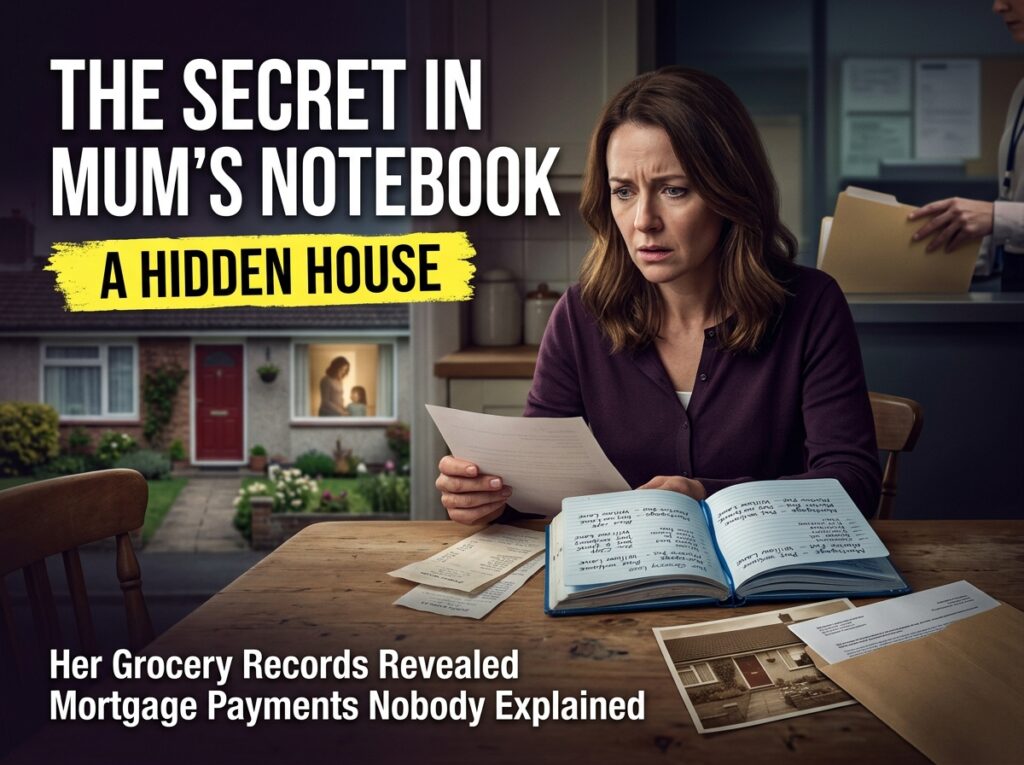
The first time I noticed the numbers, I thought my mother had made a mistake.
She had been gone for six weeks, and I was sitting at her kitchen table with three cardboard boxes beside me, trying to decide what to keep and what to give away. Rain tapped against the window above the sink. The kettle had gone cold, and the house smelled faintly of furniture polish and the lavender soap she had used for as long as I could remember.
My mother, Margaret Ellis, had never trusted modern banking.
She kept paper receipts in envelopes, wrote appointments on a wall calendar, and recorded every grocery purchase in a small blue notebook. Even when she was ill, she continued adding figures in the margins of her shopping lists.
I used to tease her about it.
“Mum, you know the supermarket gives you a receipt, don’t you?”
“And the receipt can be lost,” she would reply.
“What happens if the notebook gets lost?”
She would tap the blue cover.
“Then I hope the person who finds it knows what they’re looking at.”
I had laughed at the time.
Now, with her chair empty and her handwriting the closest thing I had left to her voice, I could barely look at the notebook without feeling a familiar ache in my chest.
My husband, Paul, had offered to help me sort through her belongings, but he had become increasingly impatient whenever I mentioned the paperwork.
“Keep the photographs,” he had said. “Give the clothes to charity. We don’t need to turn this into a six-month project.”
He wasn’t entirely wrong. I had a full-time job, two children, and a house of my own to manage. My brother, David, also had responsibilities, although he had always been better at making excuses than offering help.
Still, I wanted to understand my mother’s life before I packed it into boxes.
That afternoon, I opened the blue notebook to a page dated almost nine years earlier.
The entries were ordinary.
Bread. Milk. Potatoes. Apples. Tea.
At the bottom of the page, however, my mother had written a number that didn’t belong among the grocery totals.
£684.20.
Beside it was a short notation: House payment — 14th.
I frowned.
My mother had lived in the same modest home for more than thirty years. She had paid off her mortgage long before I married Paul. Her pension was small, but her expenses were predictable, and she had always been careful with money.
Why would she have been making house payments?
I turned the page.
There it was again.
£684.20.
And again on the following month.
The dates were different, but the amount remained almost identical.
I found a calculator on my phone and added the figures from the next several pages. The total was far beyond anything my mother could have casually spent on groceries.
At first, I assumed she had been helping David.
He had started a small construction business years earlier, and it had experienced several financial difficulties. Mum often gave him money, though she insisted it was only temporary assistance.
But the dates didn’t match the periods when he had asked for help.
I called him.
“David, did Mum ever lend you money for a house?”
He didn’t answer immediately.
“Why are you asking?”
“I’m sorting through her papers. I found some payments in her grocery notebook.”
“What kind of payments?”
“Regular amounts marked ‘house payment.’”
“Probably her own bills.”
“Her mortgage was paid off years ago.”
“Then you must be reading it wrong.”
I looked at the notebook.
“I’m not reading it wrong.”
He sighed impatiently.
“Claire, Mum wrote all kinds of things in those books. Don’t invent a mystery because you’re upset.”
“I’m not inventing anything. I’m asking a question.”
“Then stop asking me and finish clearing the house.”
He hung up.
I sat motionless for several seconds, staring at the phone.
David had always been dismissive when he didn’t want to discuss something. But this time, there was something in his voice that unsettled me. He hadn’t asked what the payments were for. He hadn’t wondered whether Mum had been struggling financially.
He had simply told me to stop looking.
I returned to the notebook and examined the margins more closely.
Beside several payments, my mother had written the same two letters.
W.L.
Willow Lane.
I knew the name.
Willow Lane was in a neighboring town, about forty minutes from our home. I had driven through it occasionally, but I couldn’t remember my mother ever taking me there.
I searched the property listings online and found several streets with similar names. None of them meant anything to me.
Then I found a receipt tucked between two pages.
It was from a building supply company, dated seven years earlier. The address printed on it was fourteen Willow Lane.
The receipt listed paint, timber, replacement window locks, and several bags of plaster.
At the bottom, in my mother’s handwriting, was a note.
Keep the original. Do not discuss with David.
I read it twice.
My mother had not simply been recording payments. She had been buying supplies for a property, and she had specifically instructed herself not to discuss it with my brother.
I looked toward the kitchen window.
For the first time, I wondered whether my mother had been keeping a second life hidden from us.
And if she had, why had she trusted me with the notebook without ever explaining what it meant?
I gathered the receipts, placed them in a separate envelope, and carried the notebook upstairs.
That night, I asked Paul whether he had ever heard of fourteen Willow Lane.
He stopped scrolling through his phone.
“Why?”
“I found receipts in Mum’s papers.”
“What sort of receipts?”
“Building supplies. Mortgage payments. Things connected to a house.”
Paul put his phone down.
“Claire, don’t start.”
“Start what?”
“Turning your mother’s death into a family investigation.”
I stared at him.
“I haven’t accused anyone of anything.”
“You don’t need to. David is already dealing with enough.”
“Why are you defending him?”
Paul looked away.
“I am not defending him. I’m telling you that grief makes people look for explanations where there aren’t any.”
I wanted to believe him.
I wanted to put the notebook away, sleep through the night, and return to the ordinary problems of my life.
But when I opened it again before bed, I found a final entry beneath a grocery list.
Mortgage balance confirmed. Keep paying until the children are safe.
My mother had underlined the last four words.
And suddenly, the question was no longer why she had paid a mortgage on a house we never visited.
It was which children she had been trying to protect.
<h2>Part 2</h2>
For the next three days, I tried to forget about Willow Lane.
I went to work, answered emails, prepared dinner, and helped my daughter, Sophie, study for an examination. I even took the blue notebook out of my bag and placed it in the bottom drawer of my desk, hoping that putting it out of sight would make the questions disappear.
It didn’t work.
Every time I closed my eyes, I saw my mother’s handwriting.
Keep paying until the children are safe.
Which children?
My brother had two children of his own, both teenagers. I had Sophie and my younger son, Ben. Mum loved all four grandchildren, but she had never suggested that she was paying a mortgage to protect any of them.
On Friday evening, I drove to my mother’s house to finish sorting the remaining paperwork.
David was already there.
He stood in the hallway holding a cardboard box filled with old photographs.
“You should have told me you were coming,” he said.
“I didn’t realize I needed permission.”
“I’m trying to get this place cleared.”
“So am I.”
He carried the box into the living room and placed it beside the fireplace.
“What have you found?” he asked.
The question sounded casual, but his eyes moved toward the bag over my shoulder.
“Photographs. Receipts. Mum’s old notebook.”
He stopped moving.
“What notebook?”
“The blue one she kept in the kitchen.”
“Oh.”
His expression changed so quickly that I almost missed it.
“What about it?”
“Nothing. Just shopping lists.”
“Then why are you carrying it around?”
“Because it’s Mum’s.”
He looked at me for a moment before turning away.
“Fine. Keep whatever you want. But don’t take anything that belongs to the estate without telling me.”
I stared at him.
“Since when are you in charge of the estate?”
“Someone has to organize things.”
“That doesn’t answer my question.”
He ignored me and began opening cupboards.
I followed him into the kitchen.
“David, did Mum own another property?”
“No.”
“Are you certain?”
He slammed a cupboard door.
“What is wrong with you?”
“I’m asking because I found receipts for a house on Willow Lane.”
He went still.
For several seconds, the only sound was the ticking clock above the refrigerator.
Then he laughed, but it was a strained, humorless sound.
“Willow Lane? That’s ridiculous.”
“Why?”
“Because Mum never had the money for another house.”
“She was making regular mortgage payments.”
“Then someone else was paying them.”
“Why would she keep the records in her grocery notebook?”
“Ask her.”
The words came out before he seemed to realize what he had said.
I felt the air leave my lungs.
“That’s a cruel thing to say.”
He rubbed his forehead.
“I didn’t mean it like that.”
“Then tell me what you meant.”
He picked up his coat.
“I mean that you’re upset, and you’re looking for something to blame. We all miss her, Claire. You’re not the only person who lost a mother.”
He walked past me.
At the door, he turned back.
“Please don’t involve strangers in family matters.”
I hadn’t mentioned strangers.
I hadn’t told him about the building supply receipt, the mortgage figures, or the fact that I was considering visiting the property.
Yet he seemed to know exactly what I was thinking.
After he left, I searched the kitchen drawers for more papers. I found a small envelope behind the recipe cards, addressed to my mother in unfamiliar handwriting.
There was no stamp, suggesting someone had delivered it personally.
Inside was a brief note.
The payment arrived. The repairs are holding. No one has asked about the property. We will continue as agreed.
The signature was simply an initial: R.
I turned the note over.
On the back was a telephone number.
I copied it into my phone, but before I could call, Paul rang.
“Where are you?”
“At Mum’s.”
“David called me. He says you’re asking questions about some house.”
I closed my eyes.
“Why did he call you?”
“Because he’s worried about you.”
“Then he could have spoken to me.”
“He says you’ve become obsessed with the notebook.”
“Have you seen the payments, Paul?”
“No.”
“Then how can you know there’s nothing to investigate?”
He exhaled sharply.
“Claire, listen to me. Your mother was a private woman. She may have had reasons for keeping certain things to herself.”
“Exactly. So why are you telling me not to find out what they were?”
Silence followed.
When he spoke again, his voice was quieter.
“Because sometimes finding the truth doesn’t make anything better.”
I stared at the note in my hand.
“That isn’t your decision to make.”
I ended the call before he could answer.
The following morning, I dialed the number from the note.
A woman answered.
“Hello?”
“I’m sorry to bother you. My name is Claire Ellis. I’m calling about a property on Willow Lane. I found a note addressed to my late mother, Margaret.”
The woman said nothing.
“Are you still there?”
“Yes,” she replied finally.
“Did you know my mother?”
A long pause followed.
“I knew her very well.”
“Can you tell me about the house?”
The woman’s breathing became audible.
“Who gave you my number?”
“I found it in her papers.”
“Has your brother seen those papers?”
I felt my heart begin to race.
“Why does everyone keep asking me that?”
“Because your mother was afraid of what would happen if the wrong person discovered the arrangement.”
“What arrangement?”
The woman hesitated.
“My name is Ruth Carter. I worked with your mother for several years. I can’t explain everything over the telephone.”
“Then tell me where to meet you.”
“Not yet.”
“Why not?”
“Because before you go to Willow Lane, you need to understand that the property was never supposed to be a secret forever. It was supposed to remain private until the people it was protecting were ready.”
“Ready for what?”
Ruth lowered her voice.
“To know who really owns the future of that house.”
The line went dead.
I stood in my mother’s kitchen with the telephone pressed against my ear.
I had started with a grocery notebook.
Now I had a hidden property, an unexplained mortgage, a brother who was frightened of my questions, and a woman who knew exactly why my mother had been keeping secrets.
That afternoon, I drove to Willow Lane.
I found number fourteen at the end of a quiet residential street lined with old trees. The house was modest but well maintained, with a red front door, white window frames, and a narrow garden enclosed by a wooden fence.
It looked nothing like the kind of property someone would buy to make a fortune.
But it was exactly the sort of place a family might need if they had nowhere else to go.
I parked across the road.
A light was on in the front room.
Someone was living there.
As I watched, the front curtain moved.
A young woman appeared at the window, holding the hand of a little boy.
She looked toward my car, then quickly stepped away from the glass.
I reached for my phone.
Before I could dial Ruth’s number again, a message appeared from an unknown number.
Please leave the street. You don’t understand who you might put at risk.
I looked back at the house.
The woman had disappeared from the window.
And for the first time, I understood that my mother’s secret might not be about money at all.
It might be about people.
<h2>Part 3</h2>
I did not leave immediately.
I stayed across the road for another ten minutes, watching number fourteen Willow Lane and wondering who lived behind its curtains.
The young woman I had seen looked frightened. The little boy beside her could not have been older than five. There was something painfully familiar about the way she held his hand, as if she were reassuring him while trying to reassure herself.
I thought of my mother.
Had she visited this house? Had she met the woman and her child? Had she been paying their mortgage?
If so, why had she never mentioned them?
I drove home without approaching the property. The warning message had frightened me, but it had also convinced me that someone knew I had begun investigating.
When I arrived, Paul was waiting in the living room.
He stood as soon as I entered.
“Where have you been?”
“Out.”
“David called again.”
“Then he must be having a very busy day.”
“Claire, this isn’t funny.”
“I’m not laughing.”
Paul looked toward the kitchen, where I had left the notebook on the table.
“Did you go to Willow Lane?”
I stopped.
“How do you know about Willow Lane?”
He rubbed his face.
“David mentioned it.”
“David doesn’t know I went there.”
The silence that followed was answer enough.
I placed my handbag on the chair.
“Paul, what is happening?”
He sat down slowly.
“I don’t know everything.”
“But you know something.”
He looked at the floor.
“Your mother spoke to me about the house several years ago.”
My heart began pounding.
“What did she tell you?”
“That she was helping someone. She said it was private, and she asked me not to discuss it with you unless she gave me permission.”
“Why would she tell you and not her own daughter?”
“She was afraid you would feel responsible.”
“For what?”
He hesitated.
“For the people living there.”
I sat opposite him.
“Who are they?”
“I don’t know their names.”
“Have you ever been to the house?”
“No.”
“Then how can you know that?”
He looked up at me.
“Because your mother told me that the arrangement involved a family who needed somewhere safe to live. She had been helping them financially, but she wanted the support to continue without drawing attention to them.”
“Why didn’t you tell me after she died?”
“Because I promised her I wouldn’t.”
“She’s dead, Paul.”
“I know.”
“Then why are you still protecting a secret that nobody has explained to me?”
He closed his eyes.
“Because I didn’t know what would happen if I broke that promise.”
I felt anger rise through my grief.
“You let me think I was losing my mind. You watched me question myself while you knew there was a house involved.”
“I didn’t know about the mortgage payments.”
“But you knew enough to tell me to stop asking questions.”
He had no answer.
I stood and walked to the window.
For weeks, I had believed Paul was simply trying to keep the peace between me and David. Now I wondered whether his silence had been part of the very thing that was destroying that peace.
“Did Mum say who the family was?”
“No.”
“Did she tell you why they needed help?”
“No.”
“Did she tell you whether the house belonged to her?”
“She said it was connected to a promise she had made.”
I turned around.
“What promise?”
Paul shook his head.
“I don’t know.”
I wanted to believe him, but I could not ignore the fact that he had kept information from me for years.
“I’m going to find out,” I said.
“Claire—”
“I’m not asking permission.”
I took the blue notebook upstairs and locked it in my desk.
That evening, I called Ruth again.
This time, she answered immediately.
“Did you go to the house?” she asked.
“Yes.”
“Did you approach anyone?”
“No.”
“Good.”
“Ruth, I need answers. My husband knew about the arrangement. My brother knows about the property. Someone sent me a message warning me to leave. What exactly was my mother involved in?”
Ruth was quiet for several seconds.
“Your mother helped a woman who had nowhere else to go,” she said finally. “That is all I can tell you tonight.”
“Why would helping someone require a secret mortgage?”
“Because the person she helped was afraid.”
“Afraid of whom?”
“I cannot answer that without speaking to her.”
“Then let me speak to her.”
“Not yet.”
I was beginning to hate those two words.
“Why does everyone decide what I am allowed to know?”
“Because your mother believed that telling the truth at the wrong time could put someone in danger.”
“And now?”
“Now I think the time has come. But the woman at Willow Lane must make that decision herself.”
I leaned against the kitchen counter.
“Can I meet you?”
“Yes. Tomorrow afternoon. There is a café near the old railway station. I will be sitting by the window.”
“Will you tell me everything?”
“I will tell you what I know.”
The following afternoon, Ruth arrived carrying a thick envelope.
She was older than I had imagined, with silver hair, careful movements, and eyes that seemed to carry years of worry. When I introduced myself, she held my hands for a moment.
“You have your mother’s eyes,” she said.
I felt tears rise unexpectedly.
“You knew her well?”
“She was my closest friend.”
Ruth sat opposite me and placed the envelope between us.
Inside were photocopies of bank statements, letters, and several pages from a legal file.
The documents showed regular payments connected to the mortgage on fourteen Willow Lane. Some had been made directly from my mother’s account. Others had come from a separate account whose purpose I did not understand.
I studied the dates.
The payments had begun nearly twelve years earlier.
“Who was she helping?” I asked.
Ruth folded her hands.
“A woman named Anna and her young daughter.”
“Why couldn’t they pay their own mortgage?”
“They had lost nearly everything. Anna’s husband had borrowed money against their home, and when his business collapsed, the debts became impossible to manage. She was left with a child, a mountain of bills, and no reliable place to go.”
“Why didn’t she sell the house?”
“Because the house was the only thing that could give her daughter a stable future. Your mother believed that if Anna could keep it, she would have time to rebuild her life.”
I looked at the statements again.
“So Mum paid the mortgage.”
“Yes. She also helped with repairs, insurance, and essential expenses.”
“Out of her pension?”
“Partly. She had savings your father left her, and she managed her money carefully. She gave up several comforts to make the payments.”
I thought of the grocery notebook, the repeated figures, and the small sums she had crossed out whenever she decided she could manage without something.
“Why didn’t she tell me?”
Ruth’s expression softened.
“Because she knew you would try to help her pay for it. She did not want you to sacrifice your own children’s security for a promise she had made.”
I looked down at the envelope.
My mother had protected Anna’s family by keeping them hidden from ours. In doing so, she had also hidden an important part of herself from me.
“Who owns the house now?”
“That is complicated,” Ruth replied. “The mortgage records show one thing, and the legal documents may show another. Your mother helped establish an arrangement intended to keep Anna and her daughter safe, but I don’t know every detail.”
“Then why did the records clerk close the folder when I showed him the document?”
Ruth’s face changed.
“What document?”
I described the papers I had found among the notebook’s receipts, including a reference number that appeared to connect my mother’s payments to the property.
Ruth leaned forward.
“Did you give the clerk the original?”
“No. I showed him a document I found in Mum’s papers.”
“Do you still have it?”
“Yes.”
She looked toward the café door.
“Then you must speak to an independent solicitor before you show it to anyone else.”
“Why?”
“Because that document may establish who has the right to make decisions about the house. And if it does, the people who have been benefiting from the arrangement may not be the only ones who have something to lose.”
I stared at her.
“What do you mean?”
Ruth opened the envelope and removed a letter dated eleven years earlier.
My mother’s handwriting appeared at the top.
Anna must never be forced to leave because of a debt she did not create.
Beneath it was a second sentence.
If the family ever discovers the house, Claire must be told why the original agreement was made.
I read the words again.
The family.
My family.
My mother had anticipated that we might discover the house one day.
But she had also anticipated that I would be the one who needed to understand it.
And that meant the truth had been waiting for me long before I ever opened the blue notebook.
<h2>Part 4</h2>
Ruth agreed to introduce me to Anna, but she insisted that I speak with a solicitor first.
I contacted Helen Marsh, a property solicitor recommended by a colleague. I explained that my late mother had made mortgage payments on a property occupied by another family and that I had discovered documents suggesting a separate legal arrangement.
Helen listened carefully.
“Do you know whether your mother was the registered owner?” she asked.
“No.”
“Was she a guarantor on the mortgage?”
“I don’t know.”
“Did she make payments under a written agreement?”
“I found a reference to an original agreement, but I haven’t seen the complete document.”
Helen explained that paying a mortgage did not automatically make someone the owner of a property. Nor did helping another person with payments necessarily create a legal right to control the house.
The documents would need to be examined to establish whether my mother had been a lender, a beneficial owner, a trustee, a guarantor, or simply someone who had chosen to help.
“You must be careful not to assume that the payments mean what you think they mean,” Helen said. “The legal arrangement matters more than the handwriting in a notebook.”
I appreciated her honesty.
For weeks, I had been trying to turn fragments into answers. Now I understood that the figures were only the beginning.
I brought her the receipts, the notebook, Ruth’s copies, and the document reference from the records office.
Helen studied the material for nearly an hour.
“The payments appear consistent with a long-term mortgage arrangement,” she said. “But this reference is particularly interesting. It points to a separate instrument registered against the property.”
“Can you obtain it?”
“I can request the official record. If the original document has been deposited in the archive, we may also be able to establish who has authority to access it.”
“Will it tell us who owns the house?”
“It should clarify the registered position and may reveal additional rights or obligations. But I cannot promise that it will answer every question.”
I left her office feeling more hopeful than I had in weeks.
The next day, Ruth took me to fourteen Willow Lane.
Anna opened the door cautiously. She was in her early thirties, with dark hair tied loosely at the back of her head. Her daughter stood behind her, holding a stuffed rabbit by one ear.
For a moment, none of us spoke.
Then Ruth said, “Anna, this is Claire. She is Margaret’s daughter.”
Anna’s face went pale.
“You found the notebook?”
“Yes,” I replied.
She looked at the floor.
“I’m sorry.”
The apology confused me.
“Why are you sorry?”
“Because your mother gave so much to us. She never asked for anything in return, and now her family is suffering because of what she did.”
I stepped inside.
The house was small but clean. There were children’s drawings on the refrigerator, a stack of schoolbooks on the dining table, and a framed photograph of a woman I assumed was Anna’s mother.
Nothing about the place suggested wealth or secrecy.
It looked like a home someone had fought hard to keep.
Anna’s daughter, Lily, watched me from behind the sofa.
“Are you going to make us leave?” she asked.
The question broke my heart.
I knelt so we were at the same height.
“No, sweetheart. I haven’t come to make anyone leave.”
She looked at her mother.
“Promise?”
“I promise I won’t make a decision about your home without understanding the truth.”
Anna’s eyes filled with tears.
We sat around the dining table while Ruth explained the arrangement as she understood it. Years earlier, Anna had been married to a man named Michael. He had operated a small business that failed after several large debts went unpaid. Without Anna’s knowledge, he had used their house as security for borrowing.
When the debts came due, the lender began legal proceedings.
Michael left the family, and Anna was faced with losing the home where Lily had been born.
My mother had met Anna through a community support group. She had offered to help with food and essential bills, but when she learned that the mortgage payments were falling behind, she began contributing toward them.
At first, the arrangement was meant to last a few months.
Then a few months became a year.
My mother helped Anna find work, negotiated payment schedules where she could, and paid for repairs that would otherwise have made the house unsafe.
“She saved us,” Anna said quietly.
I looked at the notebook.
“She never told us.”
“Your mother didn’t want praise. She said that people who help others shouldn’t need an audience.”
I thought of all the times Mum had given me money for groceries while pretending she had received a discount at the supermarket.
Perhaps some of those small gifts had been genuine generosity.
Perhaps others had been part of the larger promise she was trying to keep.
“Why didn’t you tell me after she died?” I asked.
Anna wiped her eyes.
“Because I didn’t know how. Your mother asked me to keep the arrangement private until the legal position was settled. She said she would explain everything to you herself.”
“And then she became ill.”
Anna nodded.
“She told me she had written everything down. She said that if you ever found the notebook, I should let you ask the questions in your own time.”
I looked around the room.
“Does Lily know why my mother helped you?”
“She knows that Margaret was kind to us. She doesn’t know about the mortgage.”
Lily had moved closer, listening.
“Was Margaret your grandma?” she asked.
“No,” Anna said gently. “She was a very special friend.”
Lily considered this.
“Can friends be family?”
I smiled sadly.
“Sometimes they can be the people who help a family survive.”
After the visit, Helen submitted the formal request for the property records.
Three days later, she received a response confirming that an instrument connected to the house existed in the archive.
The records office asked us to attend in person to verify our identities and clarify the purpose of the request.
I went alone.
At the counter, the clerk examined my identification, compared the document reference with the archive entry, and disappeared into the back office.
When he returned, he carried a folder.
He read the first page, then the second.
His expression changed.
He closed the folder and looked at me.
“Mrs. Ellis, does anyone else know you have requested this document?”
I thought of David, Paul, Ruth, Anna, and the unknown person who had sent the warning message.
“Why do you ask?”
He lowered his voice.
“Because the instrument contains information that could affect more than one person’s interests in this property.”
He looked toward the locked archive room.
“I need to consult the senior registrar before I can release it.”
My mouth went dry.
“Is something wrong?”
“I can’t say that yet.”
He returned the folder to a locked cabinet.
“Please wait for formal confirmation before discussing the contents with anyone.”
As I left the office, my phone began ringing.
David.
I answered.
“Claire, where are you?”
“At the records office.”
He swore under his breath.
“Don’t sign anything.”
“I haven’t been asked to sign anything.”
“Then listen to me. You don’t understand what Mum agreed to.”
I stopped walking.
“What did she agree to, David?”
He was silent.
“David?”
Finally, he said, “Come and see me. There’s something you need to know about the mortgage.”
<h2>Part 5</h2>
David insisted that we meet at a small restaurant near his office.
When I arrived, he was sitting at a table in the corner with two cups of coffee in front of him. He looked older than I remembered, his shoulders rounded and his eyes shadowed by exhaustion.
I sat opposite him.
“Tell me what you know.”
He pushed one cup toward me.
“Do you remember when Dad died?”
“Of course.”
“He left some debts.”
I frowned.
“Mum paid them.”
“Some of them. Not all.”
He rubbed his hands together.
“There was a loan connected to a property. Dad had helped someone years earlier, and Mum continued making payments after he died.”
I stared at him.
“Was that Anna’s house?”
He nodded reluctantly.
“How do you know?”
“Because I found the paperwork after Dad died. Mum asked me to help her organize the accounts. She made me promise not to discuss it with anyone.”
“You knew about Willow Lane?”
“I knew about the payments. I didn’t know Anna was still living there until recently.”
“Then why did you tell me Mum never owned another property?”
“Because I thought the arrangement was just a private loan.”
“You told me to stop asking questions.”
“I didn’t want you to uncover something you weren’t supposed to see.”
I felt anger rising.
“Who decided what I was supposed to see?”
David looked away.
“Mum.”
I stared at him.
“She wanted me to find the truth eventually, didn’t she?”
He did not answer.
“David, did you know about the registered instrument?”
“No. I knew there was a legal document, but I never saw the original. Mum said the arrangement was complicated and that a solicitor was handling it.”
“Then why are you so frightened of me finding it?”
He looked up sharply.
“Because if the arrangement is what I think it is, the house might not be the only thing affected.”
“What else?”
He hesitated.
“Money.”
I waited.
“Dad had an account that he never told us about. It wasn’t a large fortune, but it was enough to cover the payments for several years. When he died, the account was closed.”
“Who closed it?”
“I did.”
The words seemed to echo across the table.
“You closed Dad’s account?”
“I was helping Mum settle his affairs.”
“Did you tell her?”
“Yes.”
“Did you tell the solicitor?”
“I thought the account was part of the estate.”
I leaned forward.
“Did you transfer the money?”
David looked at his hands.
“Some of it.”
My stomach tightened.
“Where did it go?”
“To pay the outstanding debts connected to the house.”
“Anna’s house?”
He nodded.
“Then why didn’t you tell me?”
“Because I didn’t want you to think I’d taken money from the family.”
“Had you?”
He flinched.
“I used the money to keep the mortgage current. Mum had asked me to make sure the payments didn’t stop.”
“Then why are you hiding it?”
“Because I used some of my own money too, and I don’t know whether I can prove everything.”
For a moment, I did not know what to say.
My brother had been concealing the payments, but the reason might not have been greed. He had been trying to continue an arrangement he barely understood, while fearing that any mistake would expose him to accusations of mishandling our father’s estate.
That did not excuse his behavior.
But it changed the shape of the problem.
“David, if you made mistakes with the account, we need to establish exactly what happened.”
“I know.”
“Then we tell the solicitor.”
He looked frightened.
“What if they think I stole it?”
“Then we show them the records and explain the payments.”
“What if I can’t prove all of them?”
“We don’t hide that either.”
He stared at me for a long time.
“You sound like Mum.”
I felt a lump form in my throat.
“She would have wanted the truth.”
“She would have wanted us to protect Anna.”
“And she would have wanted us to stop treating each other like enemies.”
He nodded slowly.
For the first time since I had discovered the notebook, David seemed willing to help me find the truth rather than prevent me from finding it.
We agreed to gather every record connected to the mortgage and provide them to Helen.
That evening, Paul and I had another difficult conversation.
I told him about Anna, the payments, and David’s account of the money.
Paul listened quietly.
When I finished, he said, “Your mother asked me to protect the arrangement because she thought David would be blamed if people misunderstood what he had done.”
“Did she tell you about the legal document?”
“She mentioned an agreement, but I never saw it.”
“Why didn’t you tell me?”
“Because she was afraid the family would fight over the house before Anna was secure.”
I looked at him.
“And you thought keeping me in the dark was the best way to prevent a fight?”
“I thought I was respecting her wishes.”
“You were respecting a promise to a dead woman while your living wife was questioning her own judgment.”
Paul lowered his head.
“I know.”
The anger in me softened, though it did not disappear.
“What else haven’t you told me?”
“Nothing.”
I waited.
He took my hand.
“I should have trusted you enough to let you make your own decisions. I was afraid that if I told you, you’d feel responsible for solving everything. I didn’t want you to carry another burden.”
“But you made me carry the uncertainty instead.”
He nodded.
“I am sorry.”
We sat together in silence.
It was the first apology that had not been followed by an excuse.
The next morning, Helen contacted the records office. The senior registrar had completed the preliminary review and agreed to release a certified copy of the instrument to an authorized solicitor.
Helen received it that afternoon.
She called me immediately.
“Claire, the document is significant,” she said. “It confirms that your mother established a formal arrangement connected to the property.”
“What kind of arrangement?”
“A trust-like arrangement intended to preserve the house for Anna and her daughter, with specific provisions about payments, occupation, and the eventual handling of the property.”
“Does that mean Mum owned the house?”
“Not necessarily in the ordinary sense. The arrangement distinguishes between the registered title, the financial obligations, and the rights of the people it was designed to protect.”
I took a slow breath.
“Then why were the mortgage payments recorded under Mum’s name?”
“Because she had undertaken financial responsibilities under the arrangement. We need to examine the complete terms and the account history before we can determine whether all obligations were properly fulfilled.”
Helen paused.
“There is another issue.”
“What is it?”
“The document contains a reference to a separate financial account established to support the property. The account should have been reviewed when your father died.”
I remembered David’s confession.
“Dad’s account?”
“Possibly. I need the bank records to establish whether it is the same account.”
For a moment, I could not speak.
The grocery notebook had led to a mortgage, the mortgage had led to a hidden arrangement, and the arrangement had now led to an account nobody in the family had properly explained.
I asked Helen what would happen next.
“We need to reconcile the payments and establish whether any money remains outstanding. We also need to make sure Anna’s rights are protected while the review takes place.”
“And David?”
“If he handled funds connected to the arrangement, he will need to provide a full accounting. That doesn’t automatically mean he did anything wrong.”
I thanked her and ended the call.
I thought of my mother’s small notebook and the figures she had written so carefully.
She had believed that numbers could preserve the truth when people were too frightened to speak.
Now those numbers were telling a story none of us had been ready to hear.
<h2>Part 6</h2>
The bank records arrived two weeks later.
Helen asked David to attend a meeting with her, an accountant, and the solicitor responsible for the property arrangement. I went with him because I wanted the truth to emerge without another round of accusations.
David looked nervous as we entered the conference room.
“I don’t want anyone thinking I took money for myself,” he said.
Helen placed a folder on the table.
“Then the best approach is to provide a complete and accurate account. We are here to establish what happened, not to reach conclusions before reviewing the evidence.”
The accountant began by comparing the payments recorded in my mother’s notebook with the bank statements.
Month after month, the figures matched.
The payments had gone toward the mortgage on fourteen Willow Lane, along with occasional expenses for insurance and necessary repairs. Several withdrawals from my father’s account had also been used to maintain the arrangement.
David had transferred some of the money himself.
The records showed that he had made payments to the mortgage provider and paid invoices for repairs. There were gaps, but they were consistent with periods when he had used his own money or when Anna had managed to make payments herself.
The accountant looked up.
“Do you have records explaining these three transfers?”
David nodded and produced a bundle of receipts.
“I kept them because Mum told me to.”
The accountant examined them.
“These appear to correspond with the repair invoices.”
David’s shoulders relaxed slightly.
I felt a mixture of relief and sadness.
My brother had been so afraid of being accused that he had allowed secrecy to make everything look worse than it was.
But the review was not finished.
One transfer remained unexplained.
It was larger than the others and had been made shortly after my father’s death.
David stared at the entry.
“I don’t remember that one.”
Helen asked whether the money had gone to the mortgage provider.
“No.”
“Do you recognize the recipient?”
He leaned closer to the page.
Then his face changed.
“That’s the solicitor’s client account.”
Helen examined the reference.
“Which solicitor?”
“Robert Hayes. He handled some of Dad’s affairs.”
The room fell silent.
Helen made a note and asked for authorization to contact the firm.
David looked at me.
“I thought the money was being held to cover the outstanding legal costs.”
“Was it?” I asked.
“I don’t know.”
The accountant explained that a transfer to a solicitor’s client account did not necessarily indicate wrongdoing. It might have been a legitimate payment connected to the estate, a deposit, or money held pending a transaction. The supporting records were needed before any conclusion could be reached.
Helen agreed to request the relevant ledger and correspondence.
After the meeting, David walked beside me toward the car park.
“I should have told you about the account,” he said.
“Yes.”
“I thought I could sort it out before anyone noticed.”
“Why?”
“Because I didn’t want Mum’s last promise to become another family argument.”
I stopped beside the car.
“You keep saying you wanted to protect the family. But protecting the family cannot mean deciding what everyone else is allowed to know.”
He looked down.
“I understand that now.”
I wanted to be angry with him. Part of me still was.
But I could also see how our family had taught itself to confuse secrecy with loyalty. My mother had hidden her generosity because she feared conflict. My father had delayed explaining the arrangement because he feared upsetting David. David had withheld information because he feared being blamed. Paul had remained silent because he believed he was protecting my mother’s wishes.
Each person had been trying to prevent pain.
Together, we had created it.
A week later, Helen received a response from Robert Hayes’s firm.
The transfer had been placed in a client account during the administration of my father’s estate. It was intended to cover a property-related liability while the legal arrangement was reviewed. However, the correspondence did not clearly explain why the money had not been returned to the account designated for the property.
Robert agreed to meet with us.
He was visibly uncomfortable when Helen placed the bank statement before him.
“I remember this matter,” he said. “Your father was concerned about the mortgage and wanted to ensure the property remained secure after his death.”
“Why was the money transferred here?” Helen asked.
“Because the exact liability was uncertain. The funds were held pending confirmation of the amount required.”
“Was that confirmation ever received?”
Robert searched through his file.
“I cannot see it here.”
“Was the money returned?”
He continued examining the records.
“No.”
I felt my heart begin to race.
“Then where is it?”
Robert looked up.
“I will need to reconcile the client ledger with the archived records. I cannot give you an answer without doing that.”
Helen requested a complete accounting and a written explanation of the transfer.
We left the meeting with more questions than answers.
That evening, Anna called me.
“Someone came to the house today,” she said.
“Who?”
“A man who said he was checking the property records. He asked whether we had plans to leave.”
My stomach tightened.
“What did you tell him?”
“That we had no intention of leaving, but we were waiting for the legal review to finish.”
“Did he give you his name?”
“He said he was working for a company interested in the property.”
I closed my eyes.
“Did he leave any documents?”
“No. But he told me that if the mortgage arrangement was invalid, we might have to move.”
I asked her to write down everything she remembered and send it to Helen.
The next morning, Helen confirmed that no sale or transfer had been authorized. She advised Anna not to sign anything or agree to leave the property without independent advice.
Then she gave me another piece of information.
The property had been valued recently by a company acting on behalf of an unnamed prospective buyer.
The valuation had been requested before my father died.
I stared at the report.
“Who ordered it?”
Helen turned to the final page.
The request had been submitted by a representative connected to David’s former business.
I called my brother.
He answered immediately.
“Did you arrange for someone to value Anna’s house?”
Silence.
“David?”
“I didn’t arrange a sale,” he said. “I asked what the property might be worth because I was trying to understand the financial arrangement.”
“Why didn’t you tell me?”
“Because I didn’t know what the house was legally worth to the trust.”
“You let someone visit Anna and suggest she might have to leave.”
“I didn’t know they would do that.”
I believed he might be telling the truth.
But the consequences were real, regardless of his intentions.
I told him that no further inquiries should be made without Helen’s involvement.
He agreed.
That night, I opened the blue notebook and turned to the first page containing the mortgage figures.
At the bottom, my mother had written a sentence I had overlooked.
The house must remain safe, even if the family misunderstands why.
For the first time, I understood how deeply she had feared this exact situation.
She had not simply been protecting Anna from financial hardship.
She had been trying to protect the arrangement itself from the people who might mistake it for an opportunity.
And now we had to find out whether the promise she had made could survive the very family she had hoped would understand it.
<h2>Part 7</h2>
The following week, Helen received the complete client ledger from Robert Hayes’s firm.
The unexplained transfer had not disappeared, but the records showed that most of the money remained in the account. A portion had been used to cover legitimate legal expenses connected to my father’s estate. The balance had been held while the firm waited for confirmation of the property’s status.
The accountant recommended a formal reconciliation before the money was returned to the appropriate account.
It was not the dramatic discovery I had feared.
There was no evidence that David had taken the funds for personal use. There was also no evidence that Robert had deliberately diverted them. The problem was that the account had remained unresolved for years because each person involved believed someone else was handling it.
My mother had died.
My father had died.
The solicitor who originally prepared the arrangement had retired.
And everyone who remained had been too afraid of misunderstanding the documents to ask the questions that mattered.
Helen arranged a meeting with Anna and Ruth to review the property arrangement and explain what it meant for the future.
Anna arrived carrying a folder of her own.
Inside were receipts, insurance records, and letters from my mother. She had kept every document Margaret gave her, even the smallest notes.
“I thought these might help,” she said.
Helen examined the letters carefully.
Several confirmed that my mother had intended the property to remain a stable home for Anna and Lily. Others described the financial support as temporary assistance that would continue until the arrangement could be formally reviewed.
One letter, however, was different.
It had been written shortly before my mother’s final illness.
Anna, I know you are worried about what will happen when I am gone. I cannot promise that every difficulty will disappear, but I have made arrangements to ensure that you and Lily will not be left without a voice in decisions about the house.
Claire may one day discover the payments. If she does, please let her see the whole picture before anyone asks her to choose sides.
Anna wiped her eyes.
“She told me that she trusted you,” she said.
I looked at the letter.
“She didn’t tell me anything.”
“She was afraid you would feel obligated to rescue us.”
“But I would have wanted to know.”
“I know that now.”
Ruth reached across the table and touched my hand.
“Your mother was wrong about one thing,” she said.
“What?”
“She thought that keeping you out of the arrangement would spare you pain. She didn’t realize that the silence would make you feel excluded from your own family.”
I nodded.
For months, I had believed I was investigating a financial mystery. In reality, I was uncovering the cost of a decision made out of love but carried out without enough honesty.
Helen explained that the trust-like arrangement gave Anna and Lily specific protections, but its exact terms governed what could happen next. The mortgage needed to be reconciled, the remaining funds accounted for, and the property records updated where necessary.
Anna would not be forced to leave simply because the family had discovered the arrangement.
That assurance brought her to tears.
Lily, who had been sitting quietly beside her mother, looked at me.
“Does that mean I can stay in my room?”
I smiled.
“Yes. The legal work is still being completed, but nobody has the right to make you leave just because they’ve found out about the house.”
She hugged her stuffed rabbit.
“Good. My window gets the morning sun.”
The simplicity of her relief was almost unbearable.
For me, the house had represented a mystery.
For Anna, it represented years of uncertainty.
For Lily, it was the place where she slept, kept her books, and watched the morning light move across her bedroom wall.
I thought of all the people who had discussed the property in terms of mortgages, accounts, debts, and ownership without considering what it meant to the child living inside it.
My mother had understood that difference.
She had also understood that good intentions were not enough. The arrangement needed to be legally sound, properly documented, and transparent enough to survive after she was gone.
That afternoon, David asked to speak with me.
We met in the garden behind our mother’s house.
“I’ve been thinking about what you said,” he began. “About the way we treated the truth.”
I waited.
“I don’t think I was trying to hurt anyone. But I know I made things worse by refusing to talk.”
“You did.”
“I kept thinking that if I could solve the money problem first, nobody would need to know about it.”
“And if you couldn’t solve it?”
He looked away.
“Then I would have had to admit that I didn’t understand the arrangement.”
I sat on the garden bench.
“You don’t have to understand everything before you tell the truth. You just have to be honest about what you know and what you don’t.”
He nodded.
“I should have trusted you.”
“Yes.”
He took a long breath.
“I also need to tell you something else. Before Mum died, she asked me to make sure you received the notebook if anything happened to her.”
I stared at him.
“What?”
“She told me it contained the records you would need. She said you would recognize the handwriting and know what to do.”
“Then why did you tell me to stop looking?”
“Because I didn’t think she meant for you to investigate the property. I thought she wanted you to find the financial records, not the arrangement.”
I shook my head.
“That makes no sense.”
“I know. I think I was afraid of what I might discover about my own decisions.”
He sat beside me.
“For years, I believed Mum trusted me more because she asked me to handle the accounts. I thought I was the person responsible for protecting everything she had built. When you found the notebook, I felt as though you were questioning whether I had done my job.”
“Because I was.”
He gave a sad smile.
“I deserved that.”
For the first time, I saw my brother not as an opponent but as someone who had allowed pride and fear to make him dishonest.
That did not erase what he had done.
But it meant we could begin to speak without pretending we were both innocent of mistakes.
Before we left the garden, David asked whether I would help him explain the situation to his children.
“They’ve heard enough rumors,” he said. “I want them to understand what actually happened.”
I agreed.
We would tell them that their grandmother had helped another family keep its home, that the money had been handled imperfectly, and that the legal process was correcting the mistakes.
We would not turn Anna into a villain or pretend that every question had been answered.
We would tell the truth.
And for the first time, that felt like a better way to protect the family than keeping another secret.
<h2>Part 8</h2>
The final review of the property arrangement began in early spring.
Helen coordinated the remaining work with the bank, the estate’s solicitor, and the firm holding the client account. The mortgage figures were reconciled against my mother’s notebook, and the outstanding balance was confirmed.
The money held in the client account was allocated according to the verified obligations. The property records were updated where required, and Anna received formal confirmation of the protections established under the arrangement.
It was not a sudden victory.
There were no dramatic courtroom speeches or unexpected fortunes. There was only a long process of examining records, correcting errors, and making sure the people involved understood their responsibilities.
But that ordinary work mattered more than I had expected.
For the first time in years, Anna could plan for the future without wondering whether a hidden debt would force her and Lily to leave their home.
David was required to provide a complete accounting of the funds he had handled. The records showed that he had used the money primarily for the intended payments, though some documentation had been incomplete. He cooperated with the review and agreed to follow the formal procedures for any remaining financial matters.
He also withdrew his earlier inquiries about selling the property.
When Helen explained that the house could not simply be treated as an ordinary estate asset, David did not argue.
He signed the acknowledgment confirming that he understood the arrangement and would not make further representations about the property without legal advice.
Afterward, he called me.
“It’s done,” he said.
“What’s done?”
“The acknowledgment. I’ve accepted the arrangement.”
I sat down at my kitchen table.
“How do you feel?”
“Embarrassed.”
“That’s understandable.”
“I spent so much time trying to prove I was the responsible one that I forgot to ask whether I was doing the right thing.”
I did not know how to answer.
He continued.
“I want to apologize to Anna. Not because Helen says I should, but because I think I owe her one.”
“I think that would mean a lot.”
“And I want to apologize to you.”
“You already have.”
“I know. But I don’t think I understood how frightened you were when you first found the notebook. I treated your questions like accusations because I was afraid of what the answers might reveal.”
I looked toward the drawer where I had stored the blue notebook.
“You can’t undo that.”
“No. But I can stop repeating it.”
We spoke for another ten minutes.
It was the first conversation we had shared in years that did not revolve around defending ourselves.
A few days later, David visited Anna and Lily with me. He brought a small box of art supplies for Lily and apologized for the uncertainty his actions had caused.
Anna accepted his apology cautiously.
“I don’t need you to feel guilty forever,” she told him. “I just need everyone to remember that this is our home.”
David nodded.
“I understand.”
Lily showed him a drawing she had made of the house. It had a red door, a blue sky, and four stick figures standing in the garden.
“That’s Mum,” she explained, pointing to one figure. “That’s me. That’s Margaret. And that’s Claire.”
David smiled.
“Where am I?”
Lily looked at the paper.
“You weren’t here yet.”
The room fell silent for a moment, then Anna laughed softly.
It was not a cruel joke. Lily was simply drawing the people she associated with the house and the promise that had kept her family safe.
I watched David study the picture.
Perhaps he finally understood that the property had never been an opportunity waiting for him to claim. It was a responsibility built around people whose lives could not be reduced to numbers on a balance sheet.
Before we left, Anna gave me a small envelope.
“I think your mother wanted you to have this,” she said.
Inside was a photograph of Margaret standing in the garden at Willow Lane. She was holding a young Lily in her arms, smiling at something outside the frame.
On the back, she had written:
Some homes are built with money. Others are built with the promises we keep.
I held the photograph for a long time.
My mother had spent years visiting a house I had never seen, making payments I had never understood, and helping a family I had never met.
She had done it quietly because she believed that generosity did not need recognition.
But she had also left behind a complicated arrangement that almost collapsed under the weight of silence.
I thought about that as I drove home.
Love had motivated my mother’s decision. Fear had shaped the way she carried it out. And the absence of a full explanation had allowed the rest of us to imagine the worst.
I could not change the past.
But I could change what happened next.
That evening, I sat with Sophie and Ben at the kitchen table and explained, in age-appropriate terms, what I had discovered.
I told them their grandmother had helped another family keep its home. I explained that the paperwork had been difficult to understand and that several adults had made mistakes by not communicating clearly.
Sophie listened thoughtfully.
“Why didn’t Grandma just tell you?”
“Because she was worried about what might happen if everyone knew.”
“Did it work?”
I thought carefully.
“It helped the family she wanted to protect, but it also caused confusion and hurt the people she loved. She meant well, but she should have explained the arrangement properly.”
Ben looked at the photograph of my mother and Lily.
“Do you think Grandma was happy?”
The question caught me off guard.
“I think she was happy when she could help someone. But I also think she worried about what would happen after she was gone.”
Sophie reached for the photograph.
“Then maybe the best thing we can do is not hide things from each other.”
I smiled.
“Yes. I think that would make her happy.”
Later that night, I placed the photograph beside the blue notebook.
For the first time, the notebook no longer felt like evidence in a mystery.
It felt like a record of a life I had only partly understood.
My mother had written down the price of bread, the cost of electricity, and the amount she paid toward a mortgage on a house we never visited. But between those ordinary figures, she had recorded something far more important: the cost of keeping a promise.
And I finally understood why she had kept every receipt.
She had wanted to make sure that when the time came, someone could follow the numbers back to the truth.
<h2>Part 9</h2>
Several months after the review concluded, I returned to Willow Lane alone.
Anna had invited me to see the garden, where Lily had planted flowers beside the fence. The mortgage arrangement had been clarified, the records were in order, and the family had a clearer understanding of what the future would require.
I parked outside the house and walked toward the gate.
The front door was open.
Lily came running down the path, holding a piece of paper.
“Claire! Look what I made!”
It was another drawing of the house. This time, the garden was filled with flowers, and a large yellow sun hung above the roof.
“You’ve made the garden much bigger,” I said.
“Because there’s more room for flowers.”
I smiled.
“That’s a good reason.”
Anna appeared in the doorway.
“She’s been waiting all morning to show you.”
I followed them inside.
The house felt different now. Not because the furniture had changed or the rooms had been renovated, but because nobody seemed afraid to speak about the future.
Anna had started saving small amounts of money each month. She was working regular hours and had begun taking a course that would help her find better employment.
“I still worry sometimes,” she admitted as we sat in the kitchen. “But at least now I know what the agreement says. I know what I need to do, and I know who to contact if something changes.”
“That was what Mum wanted.”
Anna nodded.
“I wish she could have seen this.”
“So do I.”
She reached into a drawer and removed a small notebook.
It was not the same as my mother’s blue grocery book, but its pages contained similar lists of expenses, payments, and dates.
“I started keeping records because of Margaret,” Anna said. “She told me that keeping track of money wasn’t about being afraid. It was about knowing where you stood.”
I looked at the notebook.
My mother had passed that lesson to Anna, and now Anna was passing it to Lily.
Some inheritances were not property or money.
They were habits that helped people survive.
Before I left, Anna asked me whether I had found any other documents in my mother’s belongings.
I shook my head.
“Nothing else connected to the house.”
“Then perhaps the notebook was all she meant you to find.”
“Perhaps.”
I thought about the final entries, the receipts, and the notes in the margins. The notebook had not contained every answer, but it had given me a place to begin.
If I had ignored it, Anna might still have been living under uncertainty. David might have continued believing that the property could be sold to resolve a financial problem. The missing account records might never have been reconciled.
One small discovery had forced all of us to confront the truth.
And the truth had not destroyed the family.
It had revealed where the family needed to change.
On the drive home, I stopped at the cemetery where my mother was buried.
The afternoon was bright, and the grass had grown thick around the headstones. I carried a small bunch of white flowers and placed them beside her name.
For several minutes, I said nothing.
Then I told her about Anna’s garden, Lily’s drawings, and David’s apology. I told her that the records had been reviewed and the arrangement had been clarified.
I told her that the house was safe.
And then I told her what I had been too frightened to admit while she was alive.
“I wish you had trusted me with the truth.”
The words came out quietly.
“I would have helped you. I might have been worried, and I might have asked too many questions, but I would have helped you.”
I wiped my eyes.
“I understand why you were afraid. You didn’t want me to carry another burden. But you made me carry something worse because I didn’t know what I was carrying.”
The wind moved gently through the trees.
I thought of all the conversations we had never had, all the questions I had postponed because I did not want to upset her, and all the things she had hidden because she did not want to upset me.
We had both been trying to protect each other.
Neither of us had understood that protection without honesty could become its own kind of loneliness.
I placed my hand on the headstone.
“I’ll look after the promise, Mum. But I won’t keep it by hiding the truth.”
I stood there until the flowers settled and the wind grew still.
When I returned home, Paul was waiting with dinner.
He had begun asking more questions about the investigation, not to control what I knew but to understand what I was feeling. We were still working through the damage caused by his silence, but our conversations had become more honest.
He asked whether I had visited Anna.
“Yes.”
“How is she?”
“Better. She has a plan now.”
He nodded.
“And you?”
I considered the question.
For months, I had felt as though I were standing in the middle of a room where every wall concealed another door. Each answer had led to another document, another secret, another uncomfortable conversation.
Now the doors had stopped appearing.
There were still things I did not know about my mother’s life. There always would be. No amount of paperwork could recover every thought she had kept to herself.
But I no longer needed every mystery to be solved before I could feel secure.
“I’m getting there,” I said.
Paul reached across the table and took my hand.
“I should have trusted you.”
“Yes,” I replied. “You should have.”
He did not defend himself.
That mattered.
We could not undo the weeks when I had questioned my own judgment or the nights when I had wondered whether my family was hiding something terrible. But we could decide how we would treat each other from that point forward.
We agreed that important financial decisions would be discussed openly. We would not make promises on behalf of another person without telling them. And we would not confuse privacy with secrecy when other people’s futures were involved.
It was not a perfect solution.
It was a beginning.
A few days later, I received a final letter from Helen confirming that the outstanding property records had been reconciled and that the necessary documents had been placed with the relevant files.
I read the letter twice, then placed it beside the blue notebook.
The figures had finally been explained.
The mortgage had a purpose.
The house had a history.
And my mother’s secret had become something the family could understand rather than something we needed to fear.
But the most important change had happened somewhere beyond the paperwork.
We had stopped treating questions as threats.
We had stopped treating silence as proof of loyalty.
And we had begun to understand that protecting someone did not mean deciding what they were allowed to know.
For most of my adult life, I had kept every receipt because I was afraid of losing a home.
Now I kept the notebook for a different reason.
It reminded me that the truth often begins with a detail everyone else overlooks.
A number in a margin.
A name on an envelope.
A question someone is too frightened to answer.
And sometimes, if we have the courage to follow those details, they lead us not toward the destruction of a family, but toward the possibility of making it honest again.
<h2>Part 10</h2>
A year after I found the blue notebook, I took it out of the drawer and opened it to the first page containing the mortgage payments.
The paper had softened along the edges. My mother’s handwriting was still as neat as ever, each number carefully placed beside the name of a grocery item.
I ran my finger down the column.
Bread. Milk. Apples. Tea.
Then the amount that had started everything.
£684.20.
I smiled faintly.
It was an ordinary number, the kind that could easily disappear among household expenses. Yet it had opened a door into a part of my mother’s life I had never known.
It had led me to a house on Willow Lane, to Anna and Lily, to a missing document, and to a family secret that had changed the way I understood loyalty.
More importantly, it had forced me to recognize something about myself.
I had spent years believing that peace meant keeping everyone comfortable. If David was angry, I tried to calm him down. If Paul avoided a difficult conversation, I waited for a better moment. If my mother worried about something, I reassured her that everything would be fine.
I thought I was being kind.
Sometimes I was.
But sometimes I was simply afraid of what would happen if I insisted on the truth.
The discovery of the notebook had shown me that silence did not prevent conflict. It only delayed it until the consequences became harder to manage.
I had learned that from my mother, though I knew she would never have wanted me to learn it through pain.
The following Sunday, our family gathered for lunch.
David arrived with his children. Paul helped prepare the food, while Sophie and Ben set the table. The atmosphere was not perfect, but it was warmer than it had been in months.
At one point, David asked whether I still had the notebook.
I nodded.
“Do you think you’ll ever throw it away?”
“No.”
He smiled.
“Even though it gave you so much trouble?”
“Especially because it gave me trouble.”
He considered that answer.
“I’ve been thinking about Mum a lot lately,” he said. “I keep wondering why she trusted me with some things but not others.”
I put down my fork.
“Maybe she didn’t know how to explain everything. Maybe she thought she was protecting us.”
“Do you think she knew we’d fight?”
“I think she knew we might disagree. But I don’t think she understood how much worse things would become if we didn’t talk.”
David nodded.
“I wish I’d asked more questions while she was alive.”
“So do I.”
For a moment, we sat quietly.
Then his daughter asked whether anyone wanted more potatoes, and the conversation moved on.
It was a small moment, but I noticed something different about it.
Nobody had rushed to fill the silence with an excuse. Nobody had turned the conversation into an argument. We had allowed ourselves to acknowledge regret without letting it control the rest of the afternoon.
Perhaps that was what healing looked like.
Not forgetting what had happened, but learning to live with the truth without using it to hurt one another.
After lunch, David helped me carry the dishes into the kitchen.
“I’ve started keeping better records at the business,” he said.
“That’s good.”
“And I’ve stopped assuming that because I handle something, I have the right to decide everything about it.”
I looked at him.
“That’s even better.”
He laughed softly.
“I suppose Mum was trying to teach us that all along.”
I thought about the grocery notebook, the house, and the arrangement she had made to protect Anna and Lily.
“Yes,” I said. “I think she was.”
Later that afternoon, I drove to Willow Lane with Sophie and Ben.
Anna was waiting in the garden, and Lily came running toward us with a basket of flowers she had picked from beside the fence.
“Look what we’ve grown!”
The flowers were small and uneven, but Lily was proud of them.
Sophie helped her arrange them in a glass jar. Ben ran around the garden, looking for ladybirds. Anna stood beside me, watching the children.
“Margaret would have loved this,” she said.
I nodded.
“She would have.”
We sat together on the garden bench while the children played.
Anna told me about her new job, the course she had begun, and the savings account she had opened for Lily. She was making plans that would have seemed impossible during the years when the mortgage threatened to overwhelm her.
“I still think about what would have happened if your mother hadn’t helped us,” she admitted.
“So do I.”
“She never made me feel ashamed. Even when I couldn’t pay anything toward the house, she treated me as though I still had something valuable to contribute.”
“What did she say?”
Anna smiled.
“She said that needing help doesn’t make a person worthless. It only means they are going through something they cannot manage alone.”
I looked toward the children.
My mother had spent her final years trying to give Anna and Lily the security she believed they deserved. In the process, she had left her own family with a complicated inheritance of questions, misunderstandings, and incomplete records.
But perhaps that was the part of her story I needed to remember most clearly.
She had not been perfect.
She had made a promise and tried to keep it. She had made sacrifices without asking for recognition. She had also kept too much to herself, believing that secrecy would protect the people she loved.
Her intentions had been generous, but her silence had consequences.
I could honor what she had done without pretending she had done everything right.
That evening, I returned home and placed the blue notebook on the shelf beside my mother’s photograph.
I no longer needed to study every page to prove that I had not imagined the payments. The records had been examined, the arrangement clarified, and the people involved had been given the information they needed to make informed decisions.
The notebook could finally rest.
Before going to bed, I wrote a sentence on a piece of paper and tucked it inside the cover.
The truth should never have to wait until someone is gone.
I did not write it because I blamed my mother.
I wrote it because I wanted to remember what the experience had taught me.
Families are not protected by pretending that difficult things do not exist. They are protected when people are willing to ask questions, explain their decisions, admit their mistakes, and listen even when the answers are uncomfortable.
A home is not simply a building with a mortgage attached to it. It is the place where people should be able to feel secure enough to tell the truth.
My mother had helped preserve a home for a woman and her child.
In the end, the discovery of that home also helped me understand what my own family needed.
We needed fewer promises made in secret.
We needed fewer decisions made out of fear.
And we needed the courage to trust one another with the truth, even when it was complicated.
I had started with a grocery notebook because I wanted to understand my mother’s final years.
I finished with a lesson that would stay with me for the rest of my life.
Sometimes the smallest detail reveals the largest secret.
Sometimes the person who seems to be hiding something is trying to protect someone vulnerable.
And sometimes, the greatest act of love is not keeping a promise quietly, but making sure the people who depend on it understand exactly what that promise means.
My mother had recorded every payment because she believed the numbers mattered.
She was right.
But the numbers were never the whole story.
The real story was the woman who had chosen to help a stranger, the child whose future depended on that kindness, and the family that had to learn how to face the truth without tearing itself apart.
I closed the drawer, switched off the light, and stood for a moment in the quiet hallway.
For the first time since my mother’s death, I felt that I had put something down.
Not the notebook.
Not the memories.
The burden of wondering what everyone else knew that I did not.
The house on Willow Lane was no longer a mystery. It was a home with a history, a legal arrangement, and people who understood their rights and responsibilities.
And my mother’s secret was no longer something that divided us.
It had become a reminder of the difference between protecting someone and keeping them in the dark.
I would never know every reason my mother had for the choices she made. I would never be able to ask her the questions I should have asked while she was alive.
But I could carry forward the part of her legacy that mattered most.
I could help when someone needed help.
I could keep my promises.
And I could tell the truth.
Because a family may survive a secret for years, but it cannot build a peaceful future on silence forever.
The numbers in the grocery notebook had finally added up.
And for the first time, so did the truth.
A daughter discovers mortgage payments in her late mother’s grocery notebook and uncovers a hidden house, a secret family arrangement, and a promise.
late-mothers-grocery-notebook-hidden-house-secret
late mother’s secret, grocery notebook mystery, hidden mortgage payments, house on Willow Lane, family secrets story, hidden property arrangement, mother helping a stranger, mortgage mystery, family financial secrets, secret house discovery, property records mystery, family betrayal and trust, emotional family drama, hidden legal documents, mother’s final promise, protecting a family home, secret mortgage payments, inheritance and family secrets, daughter discovers the truth, emotional storytelling
Family Secrets, Hidden Money & Emotional Drama
Family Secrets, Hidden House, Mortgage Mystery, Grocery Notebook, Mother’s Secret, Family Conflict, Property Records, Financial Secrets, Emotional Family Story, Trust and Betrayal
My late mother recorded every grocery purchase in a little blue notebook. I thought it was just one of her habits—until I noticed that the numbers in the margins matched the mortgage payments on a house our family had never visited.
When I asked my brother about it, he told me to stop looking.
Then I discovered a receipt marked with an unfamiliar address, a mysterious woman who knew my mother, and a property record that made a clerk close the folder and ask whether anyone else knew what I had found.
Who was my mother protecting? Why had my family kept the house a secret? And what would happen when the truth finally came out?
Read the full story to discover the promise hidden behind the numbers.
A late mother’s grocery notebook leads her daughter to a mysterious house on Willow Lane, where unexplained mortgage payments reveal a hidden family arrangement. As a brother grows defensive and a records clerk raises alarming questions, the daughter discovers that the secret may be about far more than money. An emotional story of family loyalty, hidden documents, unexpected kindness, and the importance of telling the truth.