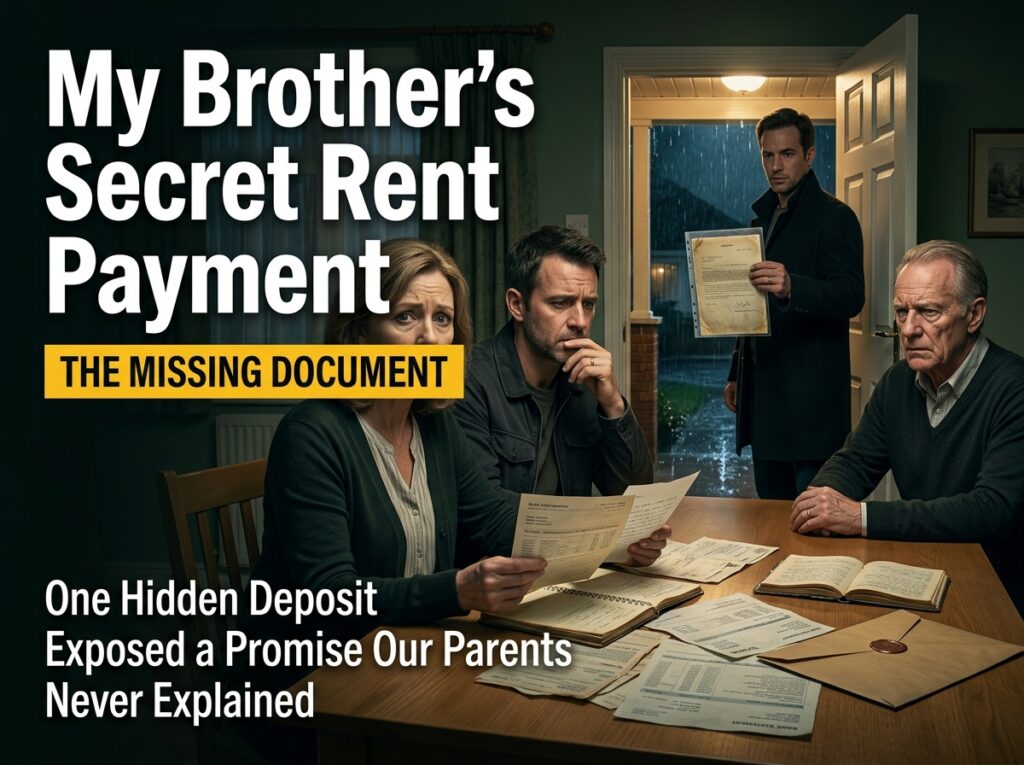
My brother Daniel announced that he was moving overseas on a Sunday evening, just as our family was finishing dinner.
He delivered the news casually, as though he were telling us he had changed jobs or bought a new car. He had accepted an opportunity abroad, he said, and would be leaving within three weeks. There was a small apartment waiting for him, a promising position, and an opportunity to begin again.
Our mother had been dead for six years. Our father had followed her two years later. Since then, Daniel and I had tried to maintain the appearance of a family that had survived its losses without falling apart.
We were not especially close, but we called each other on birthdays, visited during holidays, and divided the responsibilities associated with our parents’ estate. We had disagreements, naturally. Every family does. But I had never imagined that my brother might be hiding something substantial from me.
“Overseas?” I asked, putting down my fork.
Daniel nodded. “The opportunity came unexpectedly. I couldn’t refuse.”
“When are you leaving?”
“Three weeks, perhaps sooner.”
“What about your apartment?”
“I’ve taken care of everything.”
He smiled when he said it, but his eyes moved toward the window.
I noticed the movement and assumed he was nervous about leaving home. Daniel had always been the restless one. Even when we were children, he talked about traveling to distant places and living somewhere nobody knew his name.
I wished him luck.
That should have been the end of the conversation.
Three days later, I received a telephone call from a man named Peter, the landlord of Daniel’s apartment.
I had met Peter only twice. He was an ordinary, practical man who kept careful records and disliked unnecessary complications. He called because Daniel had listed me as an emergency contact when he signed the lease.
“Your brother mentioned that he was leaving the country,” Peter said.
“Yes. He’s moving overseas.”
“Then I suppose he won’t need the apartment anymore.”
“I imagine he’ll be arranging to end the lease.”
Peter hesitated.
“That’s the strange part. He has already paid the rent for another year.”
I thought I had misunderstood.
“Another year?”
“Yes. The payment arrived last week. Twelve months in advance.”
“That doesn’t sound right.”
“That’s why I called you. Daniel told me he was leaving permanently, but the rent has been paid through next year. I thought perhaps you knew something I didn’t.”
I assured Peter that I would speak with my brother.
After we ended the call, I remained at my desk, staring at the telephone.
Daniel had told us he was leaving because he wanted a fresh start. Why would someone preparing to settle overseas pay for an apartment he would no longer occupy?
Perhaps he intended to return. Perhaps he had made arrangements I did not know about. Perhaps there was an entirely ordinary explanation.
I wanted to believe one of those possibilities.
That evening, I called him.
“Peter contacted me,” I said.
“Peter?”
“Your landlord. He says you’ve paid rent for another year.”
Daniel was silent for a moment.
“I took care of the lease.”
“Why pay for twelve months if you’re moving overseas?”
“I had my reasons.”
“What reasons?”
“It’s complicated.”
“Then explain it.”
“There’s nothing to explain. I paid the rent, and the apartment is mine until the lease expires.”
“That’s not what I’m asking. You told us you’re leaving permanently.”
“I don’t remember saying permanently.”
“You said you were starting a new life overseas.”
“And I am.”
His voice had become sharp. I could almost picture him pacing around his apartment, running a hand through his hair the way he did whenever a conversation became uncomfortable.
“Listen,” he said, “I have enough to organize before I leave. Please don’t turn this into an investigation.”
I was taken aback.
“I asked you a question.”
“And I’ve answered it.”
He ended the call.
For the first time, I wondered whether the rent payment was connected to something larger.
I thought about our parents’ estate, the documents we had signed after their deaths, and the small discrepancies I had noticed in the financial records. At the time, those discrepancies had seemed insignificant. A date that did not match another document. A payment listed under an unfamiliar reference number. A letter that appeared to belong to a different file.
Daniel had always insisted that our parents’ affairs were settled.
I had accepted his assurances because I wanted to believe him.
Now I wondered whether I had been too trusting.
The following morning, I called Peter again and asked whether he could confirm the payment date and amount.
“I can send you a copy of the receipt,” he said. “Your brother paid from an account I hadn’t seen before.”
“What account?”
“I can’t tell you more than what’s on the receipt. But the payment reference is unusual.”
When the receipt arrived, I studied it carefully.
The account details were unfamiliar, but the reference number looked strangely familiar.
I searched my files.
After nearly an hour, I found an old bank statement belonging to our late father.
The same reference number appeared beside a deposit made shortly before he died.
And beside that deposit, in my father’s handwriting, were three words:
Do not spend.
<h2>Part 2</h2>
I spent the next morning trying to understand what my father’s note meant.
The bank statement was eight years old. It belonged to an account that I had assumed was part of our parents’ ordinary savings. After their deaths, Daniel had handled most of the paperwork because he lived closer to the bank and had more flexible working hours.
I had helped where necessary, but I had not examined every transaction.
There had been no reason to suspect anything. Our parents had lived modestly, and neither had owned an expensive business or accumulated substantial investments. Their estate consisted mainly of their house, a small savings account, and personal belongings.
At least, that was what Daniel had told me.
I placed the statement beside Peter’s receipt.
The numbers were not identical, but the reference format was the same. Both documents included an unusual sequence of letters followed by six digits.
I called the bank.
The representative explained that the original account had been closed after the estate was settled. She could not disclose additional information without the appropriate authorization, but she suggested requesting archived statements through the estate administration process.
I thanked her and ended the call.
Then I called Daniel.
He did not answer.
I tried again that evening. His phone rang several times before going to voicemail.
I left a message asking him to call me because I had found something connected to our father’s old account.
He called back twenty minutes later.
“What did you find?” he asked.
There was no greeting.
“A bank statement. There’s a note from Dad beside a deposit. It says the money must not be spent.”
“Where did you find that?”
“In his papers.”
“You should have left those documents alone.”
His response frightened me more than I wanted to admit.
“Why?”
“Because they’re old records. You don’t understand what you’re looking at.”
“Then help me understand.”
He sighed.
“Some money was set aside for a family matter. It was handled years ago.”
“What family matter?”
“Something Dad and I discussed.”
“Why didn’t he discuss it with me?”
“Because you weren’t involved.”
I stared at the wall.
“If it was family money, why wasn’t I involved?”
“Because it had nothing to do with you.”
The words hurt more than I expected.
Daniel and I had grown up in the same house. We had shared the same childhood memories, the same losses, and the same responsibility to our parents. Yet he was telling me that there had been an important financial arrangement I had never been allowed to know about.
“Did you use that money to pay your rent?”
“No.”
“Then why does the payment reference match?”
He did not answer immediately.
Finally, he said, “I need you to stop looking into this.”
“That isn’t an explanation.”
“It’s the only answer you’re getting.”
He ended the call.
I sat alone for several minutes, remembering our father’s final months.
He had become increasingly protective of his paperwork after our mother died. He kept certain documents in a locked drawer and insisted that neither Daniel nor I should throw anything away until he had reviewed it.
At the time, I assumed he was worried about losing important records.
Now I wondered whether he had been trying to preserve evidence of something that he expected us to discover eventually.
I searched his old filing cabinet.
Most of the contents were ordinary: insurance policies, property tax receipts, utility bills, and letters from friends. At the bottom, however, I found a thin folder marked with the same reference number that appeared on the bank statement.
Inside were copies of deposits, a handwritten list of dates, and an envelope addressed to both my brother and me.
The envelope had never been opened.
On the front, our father had written:
For the day when one of you asks the right question.
My hands trembled as I opened it.
There was a single page inside.
Our father explained that a sum of money had been placed aside years earlier. It was not intended for either of his children to spend freely. The money was meant to remain untouched until a particular person came forward and confirmed an agreement made before our parents died.
He did not identify the person.
Instead, he wrote that the original agreement had been placed somewhere safe and that copies of the relevant financial records had been separated to prevent anyone from changing the story.
The final paragraph contained a warning.
If the account is ever used without the proper authorization, do not accept the first explanation you are given. Follow the dates, check the signatures, and find the original document.
I read the letter twice.
Then I noticed the date.
Our father had written it only four months before his death.
This was not an old family arrangement he had forgotten to explain. He had been thinking about it near the end of his life.
I returned to the bank statement and compared the dates with the papers in the folder. The first deposit had been made decades earlier. The most recent entry was dated just weeks before Daniel announced his departure.
Someone had continued funding the account.
And someone had now used a connected reference to pay my brother’s rent.
I called Peter and asked him to preserve the original payment receipt.
Then I contacted the bank again to request the archived account history through the proper estate procedures.
I had wanted a simple answer, not a legal battle.
But the more I looked, the more I understood that the question was no longer why my brother had paid his rent in advance.
The question was why a payment linked to our father’s restricted money had appeared in a transaction that Daniel insisted had nothing to do with him.
That evening, I found a second envelope hidden behind the filing cabinet.
It contained a list of transactions and a note in my mother’s handwriting.
The note was brief.
If Daniel asks about the money, remind him that the promise belongs to all of us.
<h2>Part 3</h2>
My mother’s note made it impossible to believe that the arrangement had been a private agreement between my father and Daniel.
She had known about it. More importantly, she had believed that the promise involved the whole family.
I spent the following day sorting every document I could find. I arranged the papers by date and created a list of the transactions, account references, and names mentioned in the surviving correspondence.
The pattern was complicated, but it was not random.
Several deposits had been made at the beginning of each year. Others appeared after major events in our family’s history, including the sale of a small property and the settlement of our parents’ estate.
Some payments were followed by withdrawals. Others remained untouched for years.
The most recent transactions were different. They appeared to have been moved through several accounts before reaching their destinations.
I did not know enough about banking to interpret every detail, so I arranged a meeting with an independent financial adviser named Susan Miller.
Susan listened as I explained the situation.
“First, we need to separate what you know from what you suspect,” she said. “A matching reference number can establish a connection, but it doesn’t automatically prove that money was transferred from one account to another.”
She examined the documents.
“However, these repeated entries are unusual. And the handwritten instructions suggest that at least one account may have been subject to a restriction or private agreement.”
“Can we find out who controlled it?”
“Possibly, through the appropriate legal process. We need the account history and the original authorization documents.”
I explained that the bank had already confirmed the account was closed.
“Closed accounts still have records,” Susan said. “The difficulty is obtaining them and establishing which records relate to the agreement.”
She advised me to preserve the documents and avoid confronting Daniel until I understood the transactions better.
I followed her advice.
Over the next week, I contacted the solicitor who had handled our parents’ estate. The original solicitor had retired, but his former assistant, Margaret Ellis, still worked at the same firm.
When I explained that I had found a letter concerning a restricted account, she asked me to send copies.
Her reply came the following afternoon.
These papers appear to relate to an arrangement that was not included in the estate summary we hold. Please come to the office so we can discuss the next steps.
I visited her the next morning.
Margaret led me into a small meeting room and placed a folder on the table.
“This is the surviving file from your parents’ estate,” she said. “The official summary states that all known assets were distributed according to the instructions provided at the time.”
“Who provided those instructions?”
“Your father, through his solicitor.”
“Was my brother involved?”
“He attended one meeting, but the instructions were signed by your father.”
She showed me the summary.
The document listed the house, savings, and personal possessions. There was no mention of the restricted account.
“Could the account have been overlooked?”
“It is possible, but the references in your documents suggest that someone knew about it.”
“Was there another beneficiary?”
Margaret hesitated.
“There is a reference to a third party in the correspondence. The person’s name is not included in the summary.”
“Why not?”
“The supporting document was not attached to the final estate file.”
I felt the same cold sensation I had experienced when Peter told me about the rent.
“Was it removed?”
“I can’t say. The file is incomplete.”
Margaret searched a database and located a note from the original solicitor. It referred to a sealed agreement that had been held separately from the estate papers.
The note included a date and a storage reference.
I wrote both down.
“Can we request it?”
“We can ask the records custodian to locate it. But because the agreement may involve another person’s financial rights, we will need to establish the legal basis for access.”
I agreed.
As I left the office, Margaret handed me a copy of the original estate inventory.
At the bottom of the final page, a handwritten annotation had been added after the document was typed.
It read:
Do not release the reserved funds until the named person comes forward.
There was no name beside it.
But the handwriting was unmistakably my mother’s.
<h2>Part 4</h2>
The storage reference led to an archive maintained by the firm that had originally handled our parents’ affairs.
The records custodian confirmed that a sealed package existed under the reference. However, the package had been transferred between offices several times, and its contents had never been entered into the digital index.
A formal request was required.
While Margaret Ellis prepared the paperwork, I decided to investigate Daniel’s apartment payment more carefully.
Peter agreed to provide a copy of the receipt and a statement confirming when the rent had been paid. He also explained that Daniel had asked him to keep the payment confidential.
“Did he say why?” I asked.
“He told me he didn’t want his family interfering with his personal affairs.”
“Did he seem worried?”
Peter thought about it.
“Not worried exactly. More like someone trying to finish a task before a deadline.”
That phrase stayed with me.
A deadline.
I asked whether Daniel had given him any instructions about what should happen if he failed to return.
Peter said Daniel had requested that the apartment remain available for the full year, even if he did not live there.
“Did he say who might use it?”
“No. He only said that the apartment must not be rented to anyone else.”
I thanked him and returned home.
The next step was to compare the payment receipt with the account history from our father’s papers. I noticed that the reference number contained a sequence that appeared in several older transactions.
Each time, the payment had been followed by a handwritten date in my father’s notebook.
Those dates were separated by months or years, but they all corresponded to moments when our family had faced a major change.
The sale of our grandparents’ land.
My mother’s hospitalization.
Daniel’s first business venture.
Our father’s final illness.
It was as though the account had been used to maintain a promise that had survived every crisis in our family.
I wondered whether the money was intended for someone who had been excluded from the estate, or whether it was connected to a debt that our parents had never explained.
The documents did not provide a clear answer.
I returned to the filing cabinet and examined the envelope containing my mother’s note.
Under a bright desk lamp, I noticed faint writing on the reverse side.
The words had been almost erased, but I could still make them out.
The person who comes forward must bring the original.
I called Margaret Ellis immediately.
“Does the sealed agreement have an original signature?”
“Most likely.”
“Could the person named in it be required to present another document?”
“Yes. Some private agreements include conditions that must be satisfied before funds can be released.”
“Would that explain why the account remained open for so long?”
“It might. But we cannot establish that until the package is located.”
She promised to contact the custodian again.
That evening, Daniel called me unexpectedly.
“I hear you’ve been contacting the solicitor,” he said.
I wondered who had told him.
“Yes.”
“Why?”
“Because I found documents our parents left behind.”
“You were told not to investigate this.”
“No. You told me not to investigate it.”
He was silent.
Then he said, “You don’t know what you’re risking.”
“Tell me what I’m risking.”
“You could destroy the family over something that was supposed to remain private.”
“Then explain the money.”
“I can’t.”
“Why not?”
“Because the promise wasn’t mine to break.”
I felt a chill.
“Whose promise was it?”
He ended the call.
I sat in silence, thinking about his words.
The promise wasn’t mine to break.
That sounded less like a denial than an admission that he knew the purpose of the account.
I called Peter again and asked whether Daniel had mentioned a specific date connected to the apartment.
Peter checked his records.
“He paid the rent on the same day he received a transfer from another account,” he said.
“What date?”
I wrote it down.
It matched the date of the most recent deposit in our father’s old account records.
For the first time, the connection seemed more than coincidental.
Daniel had received money from a source connected to our parents’ restricted account, then used it to pay for a year of rent he claimed he would never need.
But why?
I returned to the documents and found one final entry in my father’s notebook.
It was dated three weeks before he died.
The money must remain available. The person will come when the time is right.
Beneath the sentence was a small mark I had never noticed before.
A name had been written there, then crossed out so heavily that only the first letter remained.
It was an M.
<h2>Part 5</h2>
I could think of several people whose names began with M, but none of them seemed to fit the circumstances.
Margaret Ellis was the solicitor’s former assistant. Martin, an old family friend, had helped my father with practical matters during his final years. Michael, our cousin, had lived overseas for a long time.
And then there was the possibility that the letter stood for a surname rather than a first name.
I wrote each possibility in my notebook and refused to treat any of them as a conclusion.
The following morning, Margaret Ellis called.
“The archive has located the sealed package,” she said. “But there is a problem.”
“What problem?”
“The seal is intact, but the outer label has been replaced. The original reference number appears beneath it.”
“Can we open it?”
“Not until the custodian confirms the chain of custody. We need to make sure the package has not been substituted or altered.”
I understood the concern. If the agreement was going to be used to establish someone’s financial rights, its authenticity mattered.
Margaret arranged for an independent records specialist to inspect the package.
While we waited, I contacted Martin, an old friend of my parents who had attended our family gatherings for years.
I asked him whether he remembered a person who had been connected to our parents’ financial affairs but had disappeared from family discussions.
He did not answer immediately.
“Why are you asking?”
“Because I’ve found a restricted account and a reference to someone who was supposed to come forward before the money could be spent.”
Martin sighed.
“I hoped that arrangement had been resolved.”
“Do you know who the person was?”
“I know who your parents were trying to protect. I don’t know whether that person is the same one named in the original agreement.”
“Can you tell me anything?”
He agreed to meet me at a small café.
When I arrived, he had brought an old photograph. It showed our parents standing beside another couple outside a house I did not recognize.
A young woman stood between them.
On the back, my mother had written a date and the words before everything changed.
“Who is she?” I asked.
“Her name was Miriam,” Martin replied. “She was close to your mother.”
“What happened to her?”
“She left town after a disagreement over money and property. Your parents never explained the details.”
“Was she the person the account was meant for?”
“I don’t know. But I remember your father saying that a promise had been made and that the money could not be released until the person it concerned came forward.”
I studied the photograph.
Miriam looked younger than I was now. She had a serious expression and one hand resting on the shoulder of a small child.
“Did she have a family?”
“Yes.”
“Where are they now?”
Martin shook his head.
“I haven’t seen her in years.”
He told me that Miriam had once been involved in a family property arrangement. The disagreement had become bitter, and several relatives had stopped speaking to her.
My parents had tried to help, but whatever they had done had not been enough to bring everyone together.
“Your father felt guilty about it,” Martin said. “He believed he had allowed a private dispute to become something much worse.”
I asked whether my brother had known Miriam.
“Daniel was young when she left. But he may have remembered more than he admitted.”
I returned home with the photograph.
For the first time, I wondered whether Daniel’s planned move overseas had anything to do with the person my parents had been waiting for.
Perhaps he was leaving because he feared what would happen when the agreement was finally opened.
Perhaps the apartment was not a place for him to return to, but a place he intended to keep available for someone else.
I called him again.
“Do you remember Miriam?”
He did not speak for several seconds.
“Who told you that name?”
“Martin.”
“Then Martin should have kept his mouth shut.”
“Was she connected to the account?”
“Stop asking questions.”
“Daniel, our parents left instructions. Someone has been paying money into an account for years. If you know who was meant to receive it, tell me.”
His voice dropped.
“The money was never meant for me.”
“Then why are you using it?”
“I didn’t say I was using it.”
“You paid a year’s rent with money connected to the account.”
“I paid the rent because I was asked to keep the apartment available.”
“By whom?”
He ended the call.
I stared at the telephone.
Daniel had finally admitted that the payment was connected to an arrangement someone else had made.
But he still refused to tell me who had given him the instructions.
<h2>Part 6</h2>
The records specialist completed the inspection three days later.
The outer label had been replaced, but the seal appeared consistent with the archive’s documentation. The package was opened in the presence of Margaret Ellis, the records custodian, and an independent witness.
Inside were several documents wrapped in protective paper.
The first was a financial agreement signed by our parents and another party. It described a restricted sum of money and specified that it could not be spent until a named person presented the original document.
The second was a payment schedule.
The third was a handwritten letter from my father.
The name on the agreement had been obscured by a strip of paper attached to the original page. However, the paper had been placed over the writing rather than incorporated into the document itself.
The specialist photographed the page before examining it further.
Margaret Ellis read the agreement carefully.
“This is not a simple savings arrangement,” she said. “It appears to be connected to an obligation that survived the original agreement.”
“What obligation?”
“The exact terms need legal review. But the document makes clear that the money was restricted. It was not freely available to either child.”
I thought about Daniel’s rent payment.
“Could someone have used the funds without authorization?”
“Possibly. We need the bank records to establish what happened.”
The handwritten letter contained a message from my father.
He explained that the money had been preserved because the person named in the agreement had never received the full explanation of what happened years earlier.
He did not identify the person in the surviving copy.
Instead, he wrote that the original agreement should be presented only when the person came forward voluntarily.
The final paragraph was addressed to whoever eventually found the papers.
Do not mistake the person who carries the money for the person who owns it. Do not mistake silence for consent. And do not release what has been promised until the original is presented.
I read the words several times.
The letter explained why Daniel might have been instructed to keep the apartment available, but it did not establish who would use it or why.
Margaret Ellis arranged for the documents to be examined by a solicitor with experience in historical financial agreements.
The solicitor warned us that the wording was unusual and that the surviving copy might not be sufficient to determine ownership. The original beneficiary declaration and the associated account records would still be needed.
We began preparing formal requests to the bank.
Then an unexpected letter arrived at my home.
It had no return address.
Inside was a photocopy of a bank transfer made shortly before our father died. The amount was substantial, and the reference number matched the restricted account.
On the reverse side, someone had written:
Your brother was not the first person asked to protect the money.
I immediately called Martin.
He recognized the reference number but could not identify the sender.
“Someone is trying to tell you something,” he said. “But that doesn’t mean the message is accurate.”
“I know.”
“Don’t confront Daniel yet. Find out where the transfer went.”
I took the letter to the solicitor.
She agreed that the payment should be traced through the proper channels. The transfer had been made to an account held by a third party, but the surviving copy did not show the account holder’s name.
The date was significant.
It fell only days after my father had written the letter instructing us not to spend the money.
If the transfer had been authorized, why had he written that warning?
If it had not been authorized, why had the account continued operating?
The solicitor requested the original transaction record.
While we waited, I searched my father’s personal papers again.
Behind a stack of old insurance documents, I found a small card bearing a handwritten address.
It was an address in the same city where Daniel’s apartment was located.
Beneath the address, my father had written:
When the time comes, take the original here.
I recognized the street name.
It was only a few blocks from Daniel’s building.
<h2>Part 7</h2>
I went to the address the next morning.
It belonged to a modest office above a small bookshop. The sign beside the entrance was old and faded, and the windows were covered by pale curtains.
I climbed the stairs and knocked.
A woman in her late sixties opened the door.
She looked at me for several seconds before asking my name.
When I told her, her expression changed.
“I wondered whether you would ever come,” she said.
Her name was Miriam.
I recognized her immediately from the photograph Martin had shown me.
She invited me inside and asked whether I had brought the original agreement.
I told her that the agreement had been found in an archive but was still being examined.
She nodded.
“Then the time has finally come.”
I asked her to explain.
Miriam told me that decades earlier, she had entered into a financial arrangement with my parents after a family property dispute threatened her future. She had trusted them to preserve the money until the conditions of the agreement could be fulfilled.
But the agreement had never been completed.
She had been told that the necessary documents were missing and that the money could not be released. Over the years, she had asked several times for an explanation. Each time, she received a different answer.
Eventually, she stopped asking.
“I had a child to raise,” she said. “I couldn’t spend every year fighting over something I could not prove belonged to me.”
“Did my parents know what had happened?”
“They knew that the arrangement had failed. I believe your mother wanted to correct it. Your father wanted to protect everyone from the consequences.”
“And Daniel?”
Miriam looked away.
“Your brother contacted me last year. He told me that he had found evidence that the account still existed.”
“Why didn’t he tell me?”
“Because he believed your family would turn against him if he revealed what he knew.”
I felt a mixture of anger and sadness.
“Did he pay the rent to keep the apartment available for you?”
Miriam nodded.
“He said I could stay there if I needed somewhere to go while the matter was being resolved. He wanted me to have a place where nobody would ask questions.”
That explained the rent payment, but it did not explain why Daniel had concealed it.
“Why is the money still restricted?”
“Because the original agreement requires the person named in it to come forward with the original document. Until that happens, the funds cannot be released under the terms my parents and yours agreed to.”
“Did you know the original was in the archive?”
“No. I thought it had been destroyed.”
She showed me a folder containing old correspondence. Several letters documented her attempts to recover the money. Others showed that she had been told the account had been closed, even though the records indicated that deposits continued.
One letter was particularly troubling.
It stated that the family had agreed to settle the matter privately and that no further payment was required.
Miriam had never signed it.
“Someone made it appear that you had accepted the settlement,” I said.
“Yes.”
“Do you know who?”
“I have my suspicions, but I will not accuse anyone without proof.”
I respected her answer.
Before I left, Miriam gave me a copy of the last letter she had received from my father.
He apologized for failing to resolve the matter and promised that the original agreement would be preserved.
He also wrote that the money should remain untouched until she came forward.
The letter was dated shortly before his death.
I returned home with a clearer understanding of why Daniel had paid the rent in advance. He had been trying to protect Miriam while keeping the restricted money available.
But there were still unanswered questions.
Who had moved the money?
Who had created the false settlement letter?
And why had the account continued to receive deposits after our parents’ deaths?
That evening, Daniel called.
“Have you spoken to Miriam?” he asked.
“Yes.”
He sighed with relief.
“Then you understand why I couldn’t tell you.”
“I understand why you wanted to protect her. I don’t understand why you thought lying to me was the only way.”
“I was afraid.”
“Of what?”
“Of what you would discover about our family.”
He paused.
“There is another document. It is the reason I announced that I was leaving overseas.”
<h2>Part 8</h2>
Daniel agreed to meet me the following morning.
He arrived carrying a small leather folder that I had never seen before. He looked tired, and the confidence he usually displayed had disappeared.
“I should have told you everything from the beginning,” he said.
“Yes, you should have.”
He opened the folder.
Inside were copies of account statements, correspondence, and a handwritten note from our mother.
The note instructed Daniel to keep a particular apartment available until Miriam could safely return and present the original agreement.
The apartment had not been chosen randomly. It belonged to a building our parents had once considered purchasing, and its location was convenient for Miriam’s work.
The arrangement was intended to provide temporary accommodation while the financial dispute was resolved.
“Why did you tell us you were moving overseas?” I asked.
“Because I needed time to organize everything without the family asking questions. I had planned to travel, but I had not decided whether I would leave permanently.”
“So the announcement was partly a distraction.”
Daniel nodded.
“I thought I could finish the arrangements before anyone became suspicious.”
“Instead, Peter called me.”
“I know.”
He explained that he had received a payment from an account he believed was connected to the restricted funds. He had used it to pay the rent in advance because he wanted to ensure that the apartment remained available for Miriam.
He had not spent the money on himself, but he had failed to establish whether the transfer was authorized.
That distinction mattered.
“I thought Dad had arranged it,” he said. “I assumed the money was being released according to the agreement.”
“Then why did you tell me it had nothing to do with you?”
“Because I was afraid that if you started asking questions, the family would try to stop Miriam from coming forward.”
“Who would stop her?”
Daniel hesitated.
“I don’t know who changed the documents. But I know someone in the family has been telling people that the money was already settled.”
He handed me a letter.
It had been written by our mother and addressed to Daniel. She explained that the account was intended to protect Miriam’s rights, not to benefit our family. She warned him that the money must not be used without the proper authorization.
The final sentence was underlined.
If the original beneficiary comes forward, help her. Do not ask her to forgive anyone before she has been given the truth.
I felt tears rising in my eyes.
Our mother had understood the danger of turning a financial arrangement into a family secret. She had tried to leave instructions that would prevent the same mistakes from being repeated.
Yet the instructions had been ignored or misunderstood.
“Who gave you the money for the rent?” I asked.
Daniel showed me the transfer record.
The payment had originated from an account associated with an old family business. That business had closed years earlier, but its account had apparently remained active under a different administrative arrangement.
The account holder’s name was not visible on the copy.
We agreed to provide the document to the solicitor.
Before leaving, Daniel apologized.
“I thought I was protecting Miriam,” he said. “But I was also protecting myself from having to explain why I had kept everything secret.”
I accepted his apology, but I told him that trust would take time to rebuild.
He nodded.
“I understand.”
That afternoon, the solicitor contacted us with an update.
The bank had located an archived record associated with the old family business account. It showed that several deposits had been made by the same person over many years.
The records were incomplete, but the payment pattern suggested that the account had been used to maintain the restricted funds.
One deposit had been made only a few days before Daniel paid the rent.
The account’s authorization documents contained a signature that the bank could not immediately verify.
The solicitor asked us to attend a meeting the following week.
Before ending the call, she added one important detail.
“The person who authorized the most recent deposit is still alive.”
<h2>Part 9</h2>
The meeting took place in the solicitor’s office on a rainy afternoon.
Daniel and I arrived together. Miriam joined us by video call, while Margaret Ellis attended with the surviving estate documents.
The solicitor laid out the account records and explained what they established.
The restricted funds had been maintained through a series of deposits and transfers. Some transactions could be traced to the old family business account. Others had passed through accounts whose ownership remained uncertain.
The original agreement clearly stated that the money was intended for Miriam and could not be released until the specified condition was satisfied.
However, the surviving records did not yet establish whether all the money remained available or whether unauthorized withdrawals had occurred.
“We must be careful,” the solicitor said. “We have evidence of an arrangement, evidence of irregular documentation, and a beneficiary who was not properly informed. But responsibility for each transaction must be established separately.”
She showed us the authorization associated with the latest deposit.
The signature was not my father’s.
It belonged to a living relative who had attended our family’s gatherings for years.
My uncle Robert.
He had been close to our parents and had helped manage the family business before it closed. After our father’s death, he had continued advising Daniel on several financial matters.
I could hardly believe it.
“Why would Robert authorize the deposits?” I asked.
“We don’t yet know,” the solicitor replied. “He may have been maintaining the arrangement, or he may have been involved in transactions that require further examination. We cannot draw a conclusion from one signature.”
Daniel looked devastated.
“Uncle Robert told me the money was being preserved.”
“Did he tell you that Miriam was the intended beneficiary?”
“No. He said it was an old family obligation.”
I thought about the false settlement letter, the altered records, and the payments that had continued long after our parents died.
It was possible that Robert had been trying to preserve the money. It was also possible that he had benefited from the confusion.
The evidence did not yet tell us which explanation was correct.
We agreed to arrange a family meeting so Robert could respond to the documents.
He arrived at our house two evenings later.
When I placed the records in front of him, he looked at them without speaking.
Then he asked, “Where did you find the original agreement?”
“In the archive.”
He closed his eyes.
“I told your father this would happen.”
“What would happen?”
“That the family would eventually discover the money and begin accusing one another.”
“Then why didn’t you explain the arrangement?”
“Because your father asked me to preserve it until Miriam came forward.”
“Did you authorize the recent deposit?”
“Yes.”
“Why?”
“Because the account needed to remain active while the agreement was being reviewed.”
“Why didn’t you tell Daniel?”
Robert looked at my brother.
“I told him what he needed to know to keep Miriam safe.”
“That isn’t the same as telling him the truth,” I said.
“No,” Robert admitted. “It isn’t.”
He explained that he had helped maintain the funds after our parents died. He believed the money should remain available for Miriam, but he had been afraid that revealing the arrangement would reopen the property dispute and expose mistakes made by several relatives.
He had allowed the documents to remain incomplete because he believed that keeping the money safe was more important than explaining its history.
When the solicitor asked about the altered settlement letter, however, Robert could not provide a satisfactory answer.
He insisted that he had not written it, but he acknowledged that he had known it existed.
“Who wrote it?” I asked.
Robert looked toward the window.
“I don’t know.”
“Then who does?”
He remained silent.
At that moment, the doorbell rang.
Everyone turned toward the hallway.
A stranger stood outside holding a document in a clear protective sleeve.
He introduced himself as a former employee of the family business.
“I was told that you were finally asking questions about the account,” he said.
He held out the document.
“This is the original authorization that was removed from the file. It shows who instructed the bank to change the beneficiary records.”
<h2>Part 10</h2>
The stranger’s name was Edward Lewis.
He had worked in the family business for several years before leaving to care for his elderly mother. He explained that he had kept a copy of the authorization because he had been asked to process the original transfer.
At the time, he had believed the instructions were legitimate.
Later, when he learned that Miriam had never received the money, he began to question what he had been told.
He had tried to raise the issue with the people responsible for the account, but he was warned that the matter had already been settled.
Edward kept the copy.
He had waited because he feared losing his job and because he could not be certain that the document would be enough to prove what had happened.
Now, after hearing that the original agreement had been found, he had decided to come forward.
The solicitor examined the authorization and arranged for it to be authenticated.
The document was important, but its significance could not be fully established until it had been compared with the bank’s records and the other surviving papers.
We agreed that no further money would be transferred until the review was complete.
Miriam was formally included in the process, and the family agreed to cooperate with the investigation.
The following months were difficult.
There were arguments about the old property, disagreements over what our parents had intended, and painful conversations about why some relatives had remained silent.
Robert provided additional records, although several questions remained unanswered. Daniel admitted that he had allowed his fear to make decisions for him. Edward gave a formal statement describing the instructions he had received years earlier.
The bank continued tracing the deposits and withdrawals.
Not every mystery was resolved immediately. Some records had been lost, and others required further examination. We could not recover the years Miriam had spent believing that her claim had been forgotten.
But the truth was no longer hidden behind a statement that the matter had been settled.
Miriam received copies of the agreement and the financial records. She was given the opportunity to have her claim assessed properly, with independent legal advice and access to the evidence that had previously been withheld.
Daniel apologized to her in person.
“I thought keeping the money safe was enough,” he said. “I didn’t understand that you also deserved to know what was happening.”
Miriam listened quietly.
“Keeping a promise is not only about protecting something,” she replied. “It is also about being honest with the person the promise was made to.”
She did not immediately forgive him, but she agreed to continue speaking with him.
That was a beginning.
For my part, I began to understand why our parents had left so many separate documents. They had wanted the money protected, but they had also wanted the original agreement preserved. They had understood that a family could forget its promises when the people responsible for remembering them were gone.
Their mistake was believing that future generations would somehow understand what had never been explained.
The apartment remained available while the arrangements were reviewed. Daniel eventually abandoned his plan to leave overseas immediately. He found work closer to home and began helping Miriam organize the remaining documents.
We did not suddenly become the close family we had been when we were children. Too many years had passed, and too many things had been left unsaid.
But we began speaking honestly.
When I thought back to the phone call from Peter, I realized how easily I could have dismissed the entire matter. I could have accepted Daniel’s explanation, congratulated him on his new life, and left the old bank statements in the filing cabinet.
The money might have remained hidden for another generation.
Instead, a landlord’s ordinary question had forced me to look more closely at the records our parents had left behind.
And those records had led us to a promise that someone had been waiting decades to fulfill.
One evening, I visited my parents’ grave and placed a copy of their original letter beside the flowers.
I did not know whether they would have approved of everything that had happened. I knew only that they had wanted the money preserved until the right person came forward.
That person had finally been heard.
I returned home and opened the old filing cabinet one last time. I removed the papers connected to the account, placed them in a clearly labeled folder, and added a note explaining where the original agreement was being kept.
Then I wrote a sentence for whoever might read the file in the future.
The money was never the whole secret. The secret was the promise attached to it, and the years we spent pretending that silence was the same as keeping it.
I closed the drawer.
For the first time since Daniel announced his departure, I felt that I could breathe without wondering what another document might reveal.
Our family still had questions to answer, and the financial review was not finished. But we had stopped treating the past as something that belonged only to the people who had created it.
The truth belonged to the people who had been affected by it, too.
And sometimes, the most important thing a family can leave behind is not a fortune, a house, or an inheritance.
It is the courage to tell the next generation what really happened.