The envelope was waiting for me beside the flowers when I returned home from my retirement party.
I had spent thirty-six years working for the same company, arriving before most of my colleagues and leaving long after the lights in the neighboring offices had gone dark. I had believed that retirement would feel like a door opening onto a peaceful new life.
Instead, as I stood in my quiet kitchen that evening, I found myself holding a brown envelope that seemed to have been waiting for me longer than I had been waiting for retirement.
My former colleague, Arthur Bell, had given it to me before leaving the celebration.
“Don’t open this in front of everyone,” he had said.
Arthur had worked beside me for nearly twenty years. He was not a man who enjoyed drama, and I had never known him to exaggerate a problem. When he asked me to promise that I would examine the papers carefully, I had assumed they concerned an old workplace matter.
Then he added something I could not forget.
“These payments were made in your name. And I don’t think you were ever supposed to discover them this way.”
I had asked him what he meant.
He glanced toward the other guests, lowered his voice, and said, “Your family knows more about this than you do.”
Before I could ask another question, someone called Arthur away. He left me with the envelope and a promise that we would speak again.
I waited until I was home to open it.
Inside were photocopies of bank transactions, payment confirmations, and several pages of handwritten notes. The documents covered a period of years. Some carried my full name. Others contained reference numbers that meant nothing to me.
I read the first page twice.
A payment had been recorded in my name on a date when I was still working at the company. Another appeared several years later. The amounts were different, and the listed purposes varied, but the transactions shared an unusual detail: each one referred to an account or authorization I did not recognize.
I had never knowingly received the money.
I had never signed the documents.
And I had certainly never authorized anyone to make payments in my name.
My first thought was that Arthur had made a mistake. Perhaps the records belonged to someone with a similar name. Perhaps the payments were part of an administrative process I had forgotten.
I wanted an ordinary explanation because ordinary explanations did not require me to reconsider my entire life.
I put the documents back into the envelope and made myself a cup of tea.
For years, I had been the dependable member of my family. When our parents needed help, I helped. When relatives argued, I tried to keep the peace. When someone made a questionable decision, I often chose silence rather than risk another family dispute.
I had considered that patience a virtue.
Now I wondered whether my willingness to avoid conflict had made me easy to deceive.
I returned to the table and examined the documents more closely.
One payment had been recorded on a date that carried personal significance. Another appeared shortly before a major change in our family’s circumstances. A third contained a reference to an address I had not visited in decades.
The dates could not all be coincidences.
I called Arthur.
He answered on the fourth ring.
“You opened the envelope,” he said.
It was not a question.
“Yes. Arthur, what are these payments?”
“I hoped you would recognize something.”
“I don’t recognize any of them.”
“Then you need to start asking questions.”
“Who made the payments?”
“I can’t tell you everything over the telephone.”
“Why not?”
“Because someone has been making sure the records never reach you.”
My fingers tightened around the receiver.
“Who?”
Arthur was silent for several seconds.
“Start with the oldest people in town,” he said. “The ones who knew your parents before the family business changed hands. Ask them what they remember about the name that disappeared.”
“What name?”
He took a breath.
“Your family will tell you that the person never existed in the way the old records suggest. Don’t accept that answer.”
Before I could press him further, he ended the call.
I remained at the kitchen table until the tea went cold.
I had retired that afternoon believing that the hardest part of my working life was behind me. I had imagined quiet mornings, long walks, and time to revisit the things I had postponed for years.
Instead, I was staring at financial records bearing my name, trying to understand why someone had apparently used it without my knowledge.
I opened my notebook and wrote down the dates, the reference numbers, and Arthur’s warning.
At the bottom of the page, I added one question.
Who had been using my name, and why had my family worked so hard to keep me from finding out?
<h2>Part 2</h2>
The oldest person in town who had known my parents was a retired shopkeeper named Walter Harris.
He lived in a small house on the edge of the old market district, where he had operated a grocery shop for nearly fifty years. My mother had bought vegetables from him when I was a child, and my father had occasionally stopped by to discuss local matters.
Walter remembered our family well.
When I arrived at his house the following morning, he was sitting beside an open window, sorting old photographs.
He looked pleased to see me until I mentioned the payments.
Then his expression changed.
“Where did you get those papers?” he asked.
“An old colleague gave them to me.”
“Arthur?”
I nodded.
Walter put down the photograph in his hand.
“I wondered when someone would finally ask.”
My heart began to beat faster.
“You know what they mean?”
“I know that your parents were involved in something they never explained publicly.”
“What was it?”
He looked toward the window, as though checking whether someone might be listening.
“Your family was different before the trouble started. There was another person who used to visit your parents. Someone who was treated almost like family.”
“Who?”
Walter shook his head.
“I shouldn’t be the one to tell you.”
“Why not? If the payments were made in my name, I have a right to understand.”
“That may be true. But there were reasons people stopped talking about it.”
“What reasons?”
He stood, walked to a cupboard, and removed a small box of photographs.
He searched through them until he found one showing my parents standing outside a building I recognized as the old family office.
A third person stood beside them.
The photograph had faded, and the edges were damaged. I could not clearly make out the person’s face, but the handwriting on the back was still legible.
It contained a name.
I recognized the surname immediately, although I had not heard it spoken aloud in years.
“Who is this?” I asked.
Walter took the photograph from me.
“Someone your family once trusted.”
“What happened?”
“That is the question you should be asking your relatives.”
I felt frustration rising inside me.
“Everyone keeps telling me to ask someone else. I need an answer.”
Walter looked at me with an expression that was almost pity.
“Then understand this first. Some people were paid to remain silent. Others remained silent because they believed they were protecting someone. And a few were afraid that the truth would destroy the only lives they had left.”
“Are you saying someone was paid to keep quiet?”
“I’m saying you should examine the payment dates before you decide what happened.”
He handed the photograph back.
Before I left, he gave me the name of another person who might remember the original arrangement: Eleanor Price, a retired clerk who had worked at the town records office.
Eleanor lived in a residential neighborhood several miles away. When I telephoned her, she agreed to see me, but only after I explained that the matter involved old family financial records.
She received me in a sitting room crowded with books and framed photographs.
I showed her the documents.
She examined them slowly, moving her finger along the dates.
“This reference number,” she said, “was used by the old office before the records were computerized.”
“Can you identify the account?”
“Not from this copy. But I remember the reference system.”
She went to a desk and opened a small notebook.
“Your family wasn’t the only one connected to those records. There was another name attached to the original file.”
She wrote it down.
It was the same name Walter had shown me.
I asked what had happened to the person.
Eleanor closed the notebook.
“Officially, the file was closed. The person associated with it was no longer listed as a beneficiary or participant in the arrangement.”
“Who removed the name?”
“I don’t know.”
“Was the person dead?”
“No.”
The answer stunned me.
“Then why did the name disappear?”
Eleanor looked directly at me.
“That is what your family never wanted anyone to investigate.”
She explained that a number of old records had been transferred to a separate archive when the office reorganized. Some files were properly indexed. Others were listed under temporary references, and a small number appeared to have been removed from the ordinary register.
She could not prove that my family’s documents were among the missing files, but she remembered the confusion surrounding the old arrangement.
Before I left, she gave me the reference number for the archive.
I wrote it down carefully.
When I returned home, I spread the documents across the table and arranged them by date.
The payments were not random.
They formed a pattern.
Each one appeared near an event that had changed the course of our family’s life.
And the oldest payment contained a reference to the year the missing name had vanished from the official records.
I looked at the photograph again.
For the first time, I understood that the question was not simply who had used my name.
It was why someone had needed my name in the first place.
<h2>Part 3</h2>
I visited the town records office the following morning.
The building had changed considerably since my childhood. The old wooden counter had been replaced by a reception desk, and the rooms where paper files once filled every wall now contained computers and locked storage cabinets.
A clerk named Simon listened while I explained that I was searching for a historical financial file.
He examined the reference number Eleanor had given me.
“That series belongs to the old registry,” he said. “Some of those records are held in the municipal archive.”
“Can I see them?”
“Possibly. We’ll need to establish which file you’re entitled to access.”
I showed him the payment copies and explained that the transactions had been made in my name.
Simon became more cautious.
“These documents may involve private financial information. I can help you locate the records, but I can’t disclose protected information without the appropriate authorization.”
I understood. I did not want anyone to break the rules on my behalf. If the documents were genuine, they needed to be obtained properly.
I completed the request forms and provided copies of the papers.
Simon entered the reference number into the system.
After a few minutes, he leaned back in his chair.
“That’s unusual.”
“What is?”
“The original file is listed as transferred, but the destination field is blank.”
“Does that mean it was lost?”
“Not necessarily. It could have been transferred under a different number. But there should be a record of where it went.”
“Can we find that record?”
“I’ll submit an archive inquiry.”
He printed a receipt confirming my request.
As I was leaving, he called me back.
“One more thing. The old register contains a note indicating that a related file was restricted by instruction.”
“Whose instruction?”
“The digital entry doesn’t say. The original note may still exist.”
I asked him to include it in the inquiry.
On my way home, I stopped at a café near the market and called my sister, Claire.
I had not yet told her about the payments. She was the person I usually contacted when something important happened, and I hoped she might remember the name Walter and Eleanor had mentioned.
“Do you remember someone named Miriam?” I asked.
There was a pause.
“Why are you asking about Miriam?”
The speed of her response made me sit up straighter.
“You remember her?”
“I remember hearing the name.”
“From whom?”
“From our parents, years ago. I don’t remember the details.”
“What did they say?”
Claire sighed.
“That she had been involved in a family disagreement. I thought it was an old property matter.”
“Was she related to us?”
“I don’t know.”
“Did our parents ever say why they stopped seeing her?”
“No. Why are you asking all these questions?”
I told her about the envelope and the payments.
She listened without interrupting.
When I finished, she said, “You should be careful.”
“Why?”
“Because some things were left alone for a reason.”
“That is exactly what everyone keeps telling me. Nobody will explain what the reason was.”
“Maybe they were trying to protect you.”
“From what?”
She had no answer.
Before we ended the call, I asked whether she knew anything about the old family office.
She said she did not, but I could hear that she was uncomfortable.
Later that afternoon, Arthur called again.
“Have you spoken to the records office?” he asked.
“Yes. The original file appears to have been transferred, but the destination is missing.”
“Then you are getting closer.”
“Arthur, what do you know about Miriam?”
He was silent for a long time.
“Your parents believed she had been treated unfairly.”
“By whom?”
“I don’t know everything. I only know that the payments were supposed to correct something that happened years ago.”
“Why were they made in my name?”
“Because your father believed you would eventually be the one who could reopen the file.”
I gripped the telephone.
“What does that mean?”
“He left instructions.”
“What instructions?”
Arthur lowered his voice.
“The final page names you. It says that you are the only person permitted to uncover the truth.”
I thought of the envelope on my table.
There had been no final page in the copies Arthur gave me.
“Where is it?” I asked.
“I don’t have it.”
“Then who does?”
“I believe it was kept with the original agreement.”
I thanked him and ended the call.
That evening, I returned to the documents and checked every page.
Arthur was right. The copies ended abruptly, with no explanation of who had authorized the payments or why the original file had been restricted.
I had been given enough information to begin asking questions, but not enough to answer them.
The missing final page was no longer just another piece of paper.
It was the key to understanding why my family had kept the past hidden.
<h2>Part 4</h2>
The archive inquiry took several days.
During that time, I began contacting other people who had known my parents. Some remembered Miriam clearly. Others recalled only fragments of a disagreement involving money, property, and an agreement that had never been completed.
One elderly man, Thomas Reed, refused to discuss the matter at all.
When I mentioned the payments, he stood up and walked toward his front door.
“I have nothing to say about that family,” he told me.
“Did you know Miriam?”
He opened the door.
“You should stop asking questions.”
“Why?”
“Because the people who tried to settle this before you were never given a proper answer.”
He would say nothing more.
His reaction troubled me. It was one thing for people to forget an old dispute. It was another for them to react as though even discussing it might bring consequences.
I returned home and reviewed the dates again.
The earliest payment had been made decades earlier. Later transactions appeared at regular intervals, sometimes months apart, sometimes separated by years. Several were recorded under slightly different descriptions, but the reference numbers linked them to the same arrangement.
The payments had continued even after the family business closed.
That detail seemed particularly important.
If the original arrangement had ended, why had money continued to move?
I took the documents to an independent solicitor named Helen Grant.
Helen listened carefully and explained that the papers suggested a historical financial agreement, but they did not yet establish the legal ownership of the money.
“We need the original documents,” she said. “Copies can help us identify the issue, but we must verify the signatures, the authority for the transactions, and the conditions attached to the payments.”
“Can someone legally remove a beneficiary from a record?”
“That depends on the agreement and the circumstances. Some changes require the consent of the affected person. Others require formal procedures. We cannot assume the change was valid or invalid until we examine the original.”
She recommended that I preserve all the documents, avoid accusing anyone publicly, and request the missing records through the proper channels.
I agreed.
Helen then asked me a question I had not considered.
“Who knew that you had received these copies?”
“Arthur, my sister, and the people I have contacted.”
“Have you told your brother?”
“Not yet.”
“Has anyone else in your family asked about your investigation?”
I thought about Claire’s warning and the strange reaction of Thomas Reed.
“Not directly.”
Helen made a note.
“Keep a record of every conversation. If someone contacts you about the documents, write down what they say and when.”
I returned home and followed her advice.
The next day, a letter arrived from the municipal archive.
The records office had located an index entry connected to the missing file. It had been moved to a separate storage facility under a temporary reference, then marked for restricted access.
The entry included a date and the name of the official who had authorized the restriction.
I recognized the surname.
It belonged to a man who had been close to my father.
He had attended family gatherings for years. He had advised relatives on business matters and had been regarded as someone who could be trusted to keep private information confidential.
I did not know whether he had acted improperly. The restriction might have been legitimate. But I could no longer ignore the connection.
I called Helen.
She advised me to request the underlying authorization record.
“Do not confront him yet,” she said. “First establish what the document actually says.”
I submitted the request.
That evening, I found another note in the envelope Arthur had given me. It had been folded between two payment copies and was almost impossible to see.
The handwriting was my father’s.
If you reach this point, do not stop at the person whose name appears first. Find out who benefited when the truth disappeared.
I read it again.
My father had anticipated that someone might discover the payments. He had also anticipated that the first person named in the records might not be the person who had arranged everything.
I placed the note beside the photograph of Miriam.
For years, I had believed that our family history was a collection of ordinary disagreements and old misunderstandings.
Now I was beginning to see that someone had deliberately shaped the story we were allowed to remember.
<h2>Part 5</h2>
The archive eventually located a box containing several related files.
Helen Grant accompanied me when we went to examine them. The records custodian explained that the documents could be reviewed under supervision, but some pages required additional authorization before copies could be released.
The first file contained correspondence about the original financial arrangement.
The second contained payment schedules and transaction references.
The third was incomplete.
Its cover indicated that it had once contained an original agreement, an authorization page, and a beneficiary declaration.
The declaration was missing.
I asked the custodian whether the missing page had ever been returned.
“The register says it was removed for safekeeping,” he replied.
“Who removed it?”
“The entry doesn’t identify the person.”
“Was there a receipt?”
He checked the register.
“There should have been one, but I can’t find it in this file.”
Helen examined the remaining documents.
“These records confirm that a separate agreement existed,” she said. “They also confirm that the payments were connected to it. But the missing declaration is essential to determining exactly who had the right to receive the money.”
One document contained a reference to Miriam’s name, followed by a handwritten note stating that the arrangement remained unresolved.
Another referred to a person who had agreed to act as a custodian of the funds.
The name was partially obscured by damage to the paper.
Helen requested high-resolution copies so the writing could be examined by a specialist.
While we waited, I continued speaking to people who had known my parents.
A retired accountant named Peter Lawson remembered that my father had once asked him to review a series of payments.
“He wanted to make sure the money was being recorded correctly,” Peter said. “He was worried that the paperwork didn’t tell the whole story.”
“Did he tell you who the money belonged to?”
“No. He said the arrangement was private.”
“Did you ever see Miriam?”
Peter nodded.
“She came to the office once. Your father met her alone. Afterward, he looked as though he’d been carrying something heavy for years.”
“Did they argue?”
“I don’t know. I was not in the room.”
Peter remembered another detail. Several months after that meeting, my father had asked him to preserve copies of certain financial records separately from the ordinary business files.
“Why separately?”
“He said that if the business ever closed, the documents needed to remain available to the person named in the agreement.”
I felt a chill.
“Did he name that person?”
Peter shook his head.
“No. But he said the person would know when the time came.”
When I told Helen what Peter had said, she added the information to her notes.
The separate records were becoming increasingly important. They suggested that my father had anticipated the possibility that the ordinary files might become inaccessible or incomplete.
Yet the person who was supposed to receive the documents had apparently never been given them.
I began to understand why the payments had been recorded in my name. My father might have intended me to act as a custodian or investigator, rather than as the person who owned the money.
But that was only a possibility.
The original declaration was still missing.
A few days later, the handwriting specialist contacted Helen. The damaged name in the archive file could not be established with certainty, but the surviving letters were consistent with the surname in Walter’s photograph.
The same name had appeared in the earliest payment records.
It had disappeared from the official register years later.
And now it was appearing again.
I called Arthur.
“Did you know the name had been removed from the records?”
“Yes,” he said quietly.
“Why didn’t you tell me?”
“Because I didn’t know who had removed it, and I didn’t want you to accuse the wrong person.”
“Do you know who benefited?”
“I have an idea. But an idea isn’t proof.”
I asked him whether he had the missing final page.
“No,” he replied. “But I know where your father said it should eventually lead.”
“Where?”
He gave me an address and told me to wait until Helen had reviewed the archive documents before going there.
“One more thing,” he added. “The final page includes a warning. Someone may try to stop you from completing the investigation.”
<h2>Part 6</h2>
Helen examined the archive copies before allowing me to visit the address Arthur had provided.
She confirmed that the location was associated with a former office used by the family business. The building had since changed ownership, but a small records room remained in the rear section.
We contacted the current owner and arranged a supervised visit.
The room contained filing cabinets, old shelves, and several boxes of papers left behind during the business’s closure.
Most of the documents were ordinary administrative records. Some concerned property transactions, while others related to payroll and payments made to former employees.
We searched the boxes by reference number.
After several hours, we found a ledger that appeared to match the payment schedule in Arthur’s envelope.
The entries were handwritten. Each included a date, an amount, and a short description.
The earliest entries referred to the original agreement. Later entries used abbreviated descriptions, as though the person recording them expected the meaning to remain understood.
The last section of the ledger contained a note in my father’s handwriting.
The record must be preserved until the named person comes forward.
Beneath it was a reference to a separate envelope.
The envelope was not in the box.
We searched the surrounding shelves and examined the inventory sheets, but there was no record of its final location.
Helen photographed the ledger and added it to the evidence file.
“This helps establish that the payments continued over a long period,” she said. “But we still need the authorization and beneficiary declaration.”
I thought about Arthur’s warning.
“Could someone have removed the envelope deliberately?”
“Yes. But it may also have been transferred to another location. We need more evidence before drawing a conclusion.”
When I returned home, I found a message from Claire.
She wanted to know why I had been visiting the old office and whether I had discovered anything about the payments.
I called her.
“How did you know I was there?”
“Someone saw you.”
“Who?”
“That doesn’t matter. People are talking.”
“What are they saying?”
“That you’re reopening something our parents wanted closed.”
“Did they tell you why it was closed?”
“No.”
“Then why are you defending their decision?”
Claire sounded exhausted.
“Because I don’t want our family to fall apart.”
“Neither do I. But I can’t protect our family by pretending that these records don’t exist.”
She began to cry.
“I know you think I am hiding something,” she said. “I’m not. I just remember how our parents looked whenever Miriam’s name came up. They were frightened.”
“Of Miriam?”
“I don’t know.”
Her answer left me more unsettled than before.
After the call, I reviewed the payment schedule again.
The transactions had continued after the original business closed. Someone had maintained the arrangement, but the money’s intended recipient had remained absent from the official records.
If the person had been excluded without consent, the arrangement might have been used to deny them something they were owed.
If the money had been preserved in good faith, then someone had failed to explain why it remained untouched.
Either way, silence had allowed the confusion to continue.
The following morning, Helen received a response from the records custodian. A second inventory had been found in an old storage register. It referred to an envelope removed from the records room and delivered to a person authorized to preserve restricted documents.
The recipient’s signature was visible.
It belonged to someone still living.
Someone who had attended our family gatherings for years.
Helen would not tell me to accuse that person. Instead, she asked me to consider whether they might have preserved the document for a legitimate reason.
I agreed to meet them only after the solicitor had contacted them formally.
But before the meeting could be arranged, I received a handwritten note through the mail.
It contained a meeting place and a time.
At the bottom, the writer had added:
Come alone. The family will try to stop you from learning what happened.
<h2>Part 7</h2>
I showed the note to Helen immediately.
She advised me not to attend an unknown meeting alone. If the person had important evidence, they could provide it through the solicitor or arrange a meeting in a safe, public setting.
I agreed.
We contacted the person named in the archive inventory and requested a formal meeting. The reply came two days later.
They refused to attend.
Instead, they sent a short letter explaining that they had been asked to preserve the missing document and had believed that they were acting in accordance with my father’s wishes.
They did not identify the person who had given them the instructions.
The letter also stated that the document had been passed to another custodian several years earlier.
Helen requested the name of the next custodian.
No answer came.
By then, word of my investigation had spread through the family. Relatives who had rarely called me began asking questions. Some wanted to know whether I had discovered anything valuable. Others insisted that I was disturbing a matter that had been settled long ago.
One cousin told me that our parents had wanted peace.
Another said that reopening the records would only cause pain.
I reminded them that peace built on incomplete information was not the same as a fair resolution.
Nobody seemed willing to discuss the missing beneficiary.
I began to understand how the secret had survived. No single person needed to control every document. Each person only had to know a small part of the story and believe that someone else was responsible for keeping it hidden.
The oldest relatives remembered the original dispute. The former employees remembered the payments. The records office remembered the restricted file. The family remembered only the official explanation.
The pieces had been separated, and the truth had become difficult to reconstruct.
Then Arthur called again.
“I have something you need to see,” he said.
We met at a quiet café near the old market.
Arthur brought a copy of a letter my father had written shortly before his death. The letter had been kept among Arthur’s private papers because my father had asked him to preserve it if the official file could not be located.
The letter explained that the missing document was not simply a receipt or a statement of account.
It was a declaration of authority.
It identified the person who could reopen the arrangement and request a complete review of the payments.
My name appeared on the last page.
I read the sentence slowly.
Only this person may authorize the recovery of the original records and bring the unresolved agreement before an independent reviewer.
I looked at Arthur.
“Why me?”
“Your father believed you would ask questions rather than accept an easy answer.”
“Did he know what would happen?”
“He knew the family would resist. He didn’t know exactly how.”
The letter also named a meeting place and included a warning that someone might attempt to prevent the investigation from reaching its conclusion.
It did not explain who that person was.
Nor did it prove that anyone had acted illegally.
But it established that my father had anticipated the possibility that the original agreement would be hidden or disputed.
I asked Arthur why he had waited until my retirement to give me the documents.
He lowered his eyes.
“Because your father asked me to wait until you were no longer dependent on the company or the people connected to it. He wanted you to have the freedom to decide what to do.”
I thought about the thirty-six years I had spent working, the promotions I had declined, and the opportunities I had postponed to keep my family stable.
I had believed that retirement would finally give me time to live for myself.
Instead, I had inherited a responsibility that had been waiting for decades.
Arthur placed the letter back in its envelope.
“The next step is yours,” he said. “But don’t confuse being named in the document with being responsible for every mistake that came before it.”
I thanked him.
When I returned home, I found a message from Claire.
She wanted a family meeting.
She said everyone needed to hear what I had discovered.
<h2>Part 8</h2>
We gathered at my house the following Sunday.
Claire arrived first, carrying a folder of her own. My brother came next, followed by two cousins and an uncle who had rarely spoken about the old family business.
The atmosphere was tense before anyone sat down.
I placed the payment records, the archive inventory, and my father’s letter on the table.
“I want everyone to understand something,” I began. “I am not accusing anyone of stealing money. I am asking why payments were made in my name, why a beneficiary’s name disappeared from the records, and why the original agreement has never been produced.”
My uncle folded his arms.
“Your father wanted this matter left alone.”
“Then why did he leave instructions for me to investigate it?”
Nobody answered.
I explained what Walter, Eleanor, and the former accountant had told me. I described the old ledger, the missing envelope, and the declaration naming me as the person authorized to reopen the arrangement.
Claire listened without interrupting.
When I finished, she opened her folder.
“I found something,” she said.
She had located an old letter among our mother’s personal belongings. It had been written years earlier and addressed to a person whose name had been crossed out on the surviving copy.
The letter did not establish who had removed the name, but it confirmed that our mother had been trying to arrange a meeting with Miriam.
The letter also contained an apology.
Our mother wrote that she regretted allowing the dispute to remain unresolved and feared that the family had begun to treat silence as a permanent solution.
Claire looked at me.
“I didn’t know what it meant when I found it,” she said. “I was afraid that telling you would make everything worse.”
“Why didn’t you show it to me?”
“Because I was afraid of what it would reveal about our parents.”
I understood her fear. I had felt it myself.
For years, I had wanted to remember our parents as people who always knew the right thing to do. The documents were forcing me to accept that they had made mistakes, delayed difficult decisions, and sometimes chosen secrecy when honesty might have been better.
That did not erase the love they had shown us.
But it changed the way I understood their choices.
My uncle finally spoke.
“The payments were supposed to preserve the arrangement. Your father asked several of us to make sure the money remained available.”
“Then why was the beneficiary removed from the records?”
“I don’t know who removed the name.”
“Who had access to the original documents?”
He looked toward the window.
“Several people.”
“Who received the missing envelope?”
He did not answer.
I placed the archive inventory in front of him.
“Your signature appears here.”
He studied the page.
“I was asked to keep a document safe,” he said. “I did not know that it would disappear from the official file.”
“Where is it now?”
“I gave it to someone I trusted.”
“Who?”
He shook his head.
“I need to speak to that person first.”
The room fell silent.
I told him that the investigation would continue through the solicitor and that no one needed to make accusations without evidence. But the family could no longer insist that the matter was settled when the central document was still missing.
One by one, the relatives agreed to provide copies of whatever records they possessed.
For a moment, I believed we had made progress.
Then my uncle stood.
“I think we have said enough for today.”
The others began collecting their belongings.
Claire closed her folder.
I watched them move toward the hallway, wondering whether our family meeting had accomplished anything beyond making everyone uncomfortable.
Then the doorbell rang.
Everyone stopped.
I walked toward the front door.
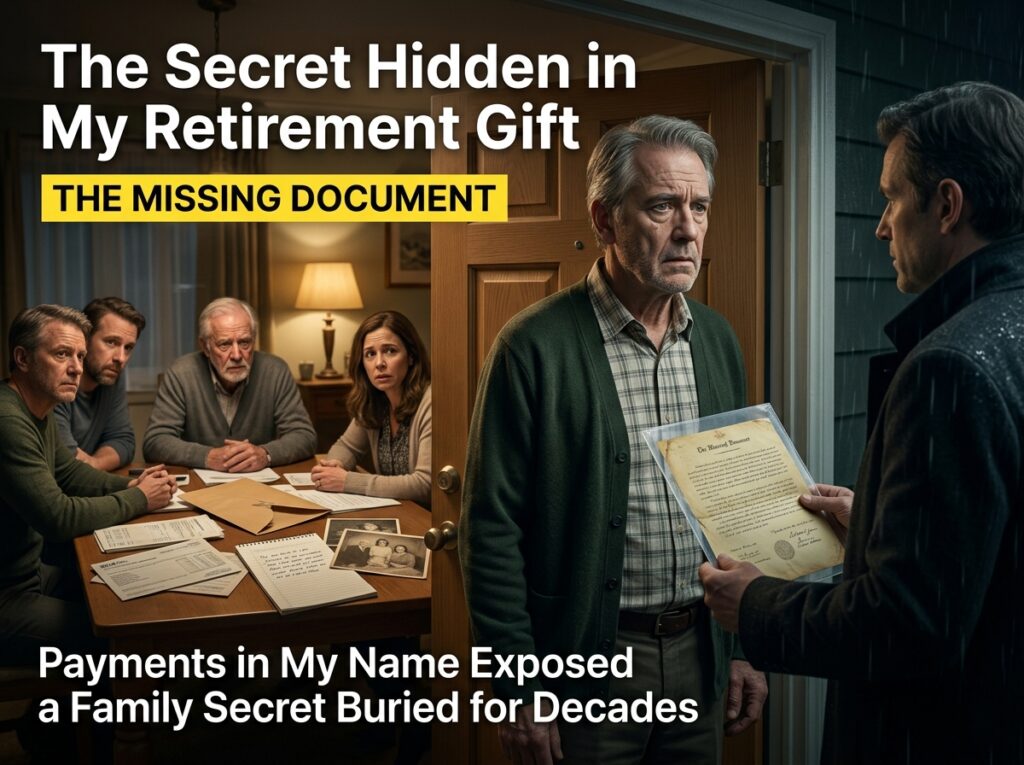
Outside stood a stranger holding a document inside a clear protective sleeve.
He looked at the people gathered behind me.
“Are you the person named in the final declaration?” he asked.
“Yes.”
He held out the document.
“Then I believe this belongs to you.”
<h2>Part 9</h2>
I did not take the document immediately.
After weeks of missing files, contradictory explanations, and warnings from people who insisted that I stop asking questions, I had learned to be cautious.
“Who are you?” I asked.
“My name is Edward Lewis. I worked with the old family business before it closed.”
The name meant nothing to me, but my uncle’s expression changed as soon as he heard it.
“Edward?” he said.
The stranger nodded.
“I was hoping we wouldn’t have to do this in front of everyone.”
“Why didn’t you contact me earlier?” my uncle asked.
“Because I wasn’t sure who I could trust.”
Edward explained that he had kept a copy of a document connected to the original financial arrangement. He had received it while working in the office and had been instructed to preserve it separately from the ordinary records.
At the time, he had assumed the arrangement was legitimate and that the document would eventually be returned to the official file.
But years passed, and the file remained incomplete.
When Edward learned that the old records were being examined again, he decided to come forward.
“Why now?” I asked.
“Because I heard that the person named in the declaration had finally received the payment records.”
He looked at the envelope on my table.
“I recognized the reference numbers. I realized that the investigation had reached the point where the missing document mattered.”
I invited him inside.
Helen Grant arrived shortly afterward, having agreed to attend once I told her that a potential witness had appeared. She examined the document without removing it from its protective sleeve.
“This needs to be authenticated,” she said. “We cannot assume that a copy is genuine simply because it resembles the other records.”
Edward agreed to provide a formal statement and explain how he had obtained it.
The document appeared to be an authorization connected to the original agreement. It included a signature, a date, and a reference to the beneficiary declaration.
The name was visible.
But Helen cautioned everyone against drawing conclusions until the signature and document history had been examined.
My uncle sat quietly.
I turned toward him.
“Is this the document you were asked to preserve?”
He looked at it for a long time.
“It may be.”
“Do you recognize the signature?”
“I recognize the handwriting.”
“Whose is it?”
He did not answer immediately.
Edward spoke instead.
“The document was signed by someone who had authority to manage the arrangement. But the instructions I received were clear: the original beneficiary was not to be removed without the required authorization.”
Helen raised her hand.
“Let’s establish the facts first. We need the original agreement, the payment records, and the declaration. We also need to determine whether any changes were authorized.”
I understood that the document did not yet provide every answer. It did, however, give us a new way to test the explanations we had been given.
For the first time, we had evidence that could be compared with the official records rather than relying on memory alone.
Edward agreed to meet with the solicitor the following day.
Before he left, he turned toward me.
“There’s something else you should know.”
“What?”
“The person who gave me the document said it was not the only copy. Another version was kept somewhere else, and it contained an additional page.”
My uncle looked up sharply.
“That isn’t possible.”
Edward met his eyes.
“Then why were you so afraid of the first one?”
Nobody spoke.
I realized that we had not reached the end of the investigation. We had only uncovered another layer of the arrangement.
The missing document could establish who had authorized the original transaction, but the additional page might explain why the beneficiary’s name had been removed and who had benefited from the change.
Helen asked Edward whether he knew where the second version was kept.
He shook his head.
“No. But I know who last asked me to look for it.”
He placed a small card on the table.
The name written on it belonged to someone who had been sitting in my house throughout the entire family meeting.
<h2>Part 10</h2>
The name on the card belonged to my uncle Robert.
For several seconds, I could not speak.
Robert had spent the meeting insisting that he did not know who had removed the beneficiary’s name. He had acknowledged receiving a document for safekeeping but claimed that he had passed it to someone else.
Now Edward was saying that Robert had asked him to look for a second version.
Robert stared at the card.
“I was trying to locate the missing page,” he said at last. “I didn’t know where it had gone.”
“Why didn’t you tell us that?” I asked.
“Because I didn’t know what the page contained.”
“Then why did you ask Edward to find it?”
“Because I wanted the records completed.”
His explanation might have been true. It might also have concealed something more complicated. We had no right to decide which without examining the evidence.
Helen made arrangements for the document to be authenticated and for the relevant financial records to be reviewed independently.
Over the following weeks, Edward provided a statement describing his work with the old business and the circumstances in which he had retained the document. Robert supplied the correspondence he still possessed. Other relatives came forward with letters and receipts that had been stored away for years.
The pieces began to form a clearer picture.
The payments had been connected to a financial arrangement intended to protect the rights of someone whose name had gradually disappeared from the official records. My parents had tried to preserve the arrangement, but their instructions had not been properly completed. Several relatives had continued handling the records without ensuring that the intended beneficiary received the information or the opportunity to make a claim.
The review also revealed inconsistencies that required further investigation. Some transactions had been recorded under different descriptions, and the authorization for at least one change could not initially be verified.
The solicitor advised that these issues be handled through the appropriate legal process rather than settled through family accusations.
I agreed.
Miriam was contacted through the details we had recovered, and she was invited to participate in the review. For the first time, she received copies of the surviving agreement and the payment records.
She did not celebrate.
Instead, she sat quietly while Helen explained what the documents established and what remained uncertain.
“I spent years thinking everyone had forgotten,” Miriam said. “I never imagined that the truth would still be buried in a filing cabinet.”
I apologized for the way our family had allowed the silence to continue.
She shook her head.
“You didn’t create all of this. But now that you know, you have a choice about what happens next.”
Her words stayed with me.
The review did not instantly repair the past. It could not return the years during which the arrangement had remained unresolved, and it could not guarantee that every missing payment would be recovered.
But the official record was being corrected, the beneficiary’s claim was finally being heard, and the people involved could no longer pretend that the matter had never existed.
Daniel and Claire both apologized for the times they had discouraged me from asking questions. Robert agreed to cooperate with the investigation, although trust between us remained damaged.
We began meeting less often as a family, but our conversations became more honest.
One evening, after another meeting with the solicitor, I returned home and placed Arthur’s original envelope beside my father’s old notebook.
I thought about the retirement party where I had received the papers. I had imagined that my working life was ending and that the next chapter would be simple.
Instead, I had been given a responsibility that required me to examine the very people I had spent my life trying to protect.
I no longer believed that loyalty meant accepting every explanation without question.
Sometimes loyalty meant refusing to let a person’s name disappear simply because remembering it was inconvenient.
I opened my notebook to the first page, where I had written the question that began the investigation.
Who had been using my name, and why had my family worked so hard to keep me from finding out?
Beneath it, I wrote a new sentence.
The truth must be preserved, even when the people who once protected the secret are no longer able to explain it.
I closed the notebook.
My retirement had not become the peaceful beginning I expected. It had become the beginning of an unfinished family reckoning.
But for the first time in decades, the missing name had been spoken aloud, the documents were being examined, and the person who had waited longest for an answer was finally being heard.
That was not the same as justice being complete.
It was the first honest step toward it.