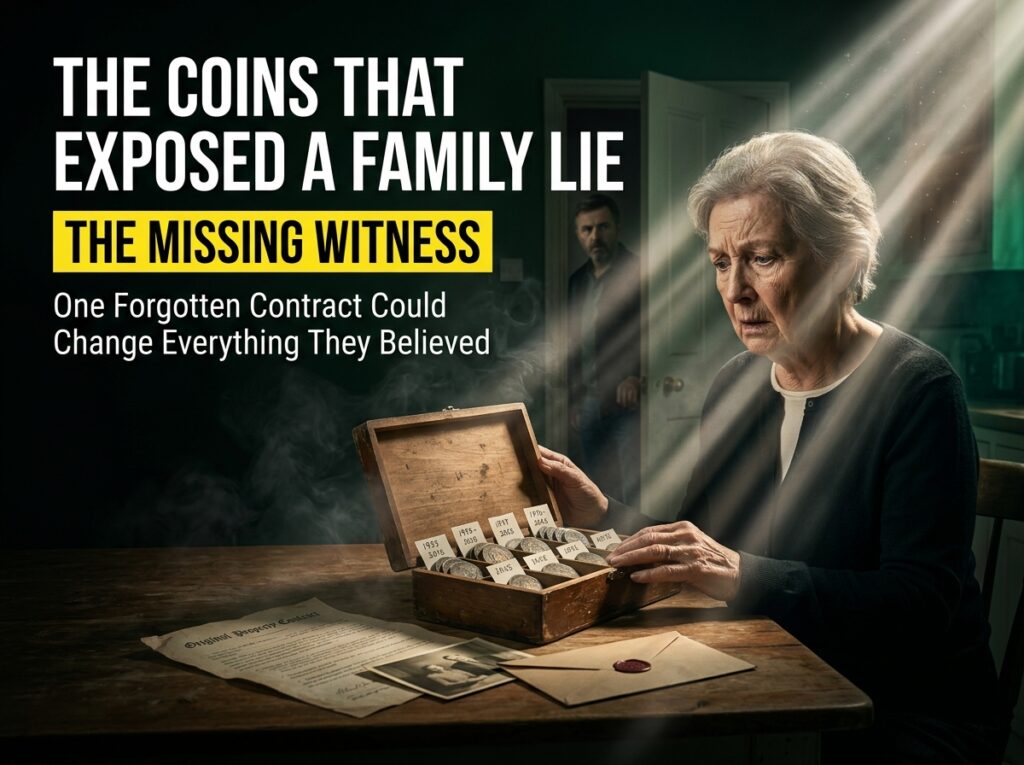
The box arrived on a rainy Thursday afternoon, three weeks after my aunt’s funeral.
I had spent most of the morning sorting through the things she had left behind: old photographs, handwritten recipes, yellowing envelopes, and the little objects people keep for reasons they can no longer explain. Her house had always been full of such things. Nothing seemed expensive, but everything seemed to belong to a memory.
I was standing in the kitchen when Margaret, my aunt’s longtime housekeeper, appeared at the back door carrying a small wooden box.
“I found this in the cupboard beneath the stairs,” she said. “I think it belongs with the things you’re sorting.”
The box was about the size of a hardcover book. Its corners were worn, and a brass clasp held the lid shut. Margaret placed it on the kitchen table without sitting down.
“What’s inside?” I asked.
“Coins. Old ones.”
She spoke as if she were returning a handful of buttons.
“Are they valuable?”
Margaret shook her head. “I wouldn’t know. Your aunt always said they weren’t worth anything. I thought perhaps you should have them before the house is cleared.”
I opened the clasp.
Inside lay several rows of coins wrapped in faded paper. Some were copper-colored, others dull silver. They had different sizes and designs, and each one carried a date written in small black ink on a narrow paper label.
I picked up the first coin.
The next label read 1981. Another said 1986. Several dates were written in the same careful handwriting, while others appeared to have been added much later.
“Why would someone label coins like this?” I asked.
Margaret glanced toward the window.
“I wondered the same thing.”
“You knew about this box?”
“Not until I found it.”
“Did my aunt ever mention it?”
Margaret hesitated. “She told me once that certain things should never be thrown away just because people have forgotten why they matter.”
That sounded exactly like my aunt. She had been a woman who saved everything, from grocery receipts to the ribbon tied around a birthday present. She believed that one day, if you were patient enough, the smallest piece of paper might explain something everyone else had misunderstood.
Still, I could not see why these coins deserved such care.
“Perhaps they belonged to your uncle,” Margaret said.
My aunt’s husband had died many years earlier. His name was Daniel, and the family rarely spoke about him without eventually changing the subject. I knew that he had once been involved in a property dispute with his own relatives, but I had never been given a complete explanation.
“Did he collect coins?” I asked.
“Not that I remember.”
Margaret touched the edge of the box.
“Keep them together. Please.”
Her request surprised me.
“Of course.”
She nodded and began collecting the empty tea cups from the counter. Before leaving, she stopped beside the kitchen doorway.
“One more thing,” she said. “If anyone asks about that box, tell them you haven’t had time to examine it.”
I looked up.
“Why would anyone ask?”
For the first time, Margaret appeared genuinely afraid.
“I hope they won’t.”
After she left, I carried the box to the study and placed it beside the documents I had been organizing. I intended to examine it properly after finishing the more urgent work: arranging the house sale, contacting the solicitor, and deciding which family possessions should be kept.
My aunt had left no clear instructions about the old property records. The family had spent years arguing over what she owned, what she had promised to whom, and whether certain pieces of land had been transferred before her death. Everyone had a different version of the history.
My cousin Robert insisted that the estate had already been settled. My cousin Helen said there were documents no one had ever seen. Both had urged me not to make matters more difficult by reopening old disputes.
I had listened because I wanted peace.
Now, sitting alone in the study, I looked again at the dates on the coins.
The oldest was from 1964.
The newest was from 2004.
There were no dates after that, and the intervals between them seemed deliberate. Some years were missing entirely. Others appeared more than once.
I began arranging the coins chronologically on the desk.
At first, I saw no pattern. Then I noticed that several coins bore dates matching entries in an old notebook my aunt had kept in the same cupboard.
The notebook contained brief records of family expenses, property repairs, and payments made to people whose names I barely recognized.
One entry, dated 1986, had been underlined twice.
Beside it, my aunt had written three words:
“Witness still missing.”
I read the words again.
Then I heard the front door open downstairs.
Someone had entered the house.
I assumed Margaret had returned for something she had forgotten, but the footsteps were heavier than hers. They crossed the hallway and stopped outside the study.
A knock sounded against the door.
“Are you there?” Robert called.
I closed the notebook.
“Yes.”
He entered without waiting for an invitation. His gaze moved across the desk, then stopped at the open wooden box.
“What’s that?”
“Some old coins Margaret found.”
Robert walked closer.
“Where did you find them?”
“Under the stairs.”
“Did she tell you anything else?”
The question came too quickly.
I looked at him carefully. Robert had attended the funeral, helped organize the reception, and spent the past three weeks insisting that everything connected with the estate should be handled as quickly as possible. He had always been practical, sometimes to the point of coldness.
Now, however, he seemed less interested in the estate papers than in the little wooden box.
“Nothing important,” I replied.
He stared at the coins for another moment.
“Good,” he said. “Those things are worthless. Don’t waste your time on them.”
Then he reached toward the box.
I moved it away before his fingers touched the lid.
Robert looked at me, and something changed in his expression.
It was only a second, but I saw it: not disappointment, not irritation, but fear.
He straightened his jacket.
“I’m only trying to help,” he said. “There are more important matters to settle.”
After he left, I locked the study door.
I returned to the desk and examined the notebook again. The entry about the missing witness was followed by a small number written in the margin.
Two.
I had no idea what it meant.
But when I lifted the notebook to check the pages beneath it, I discovered a thin envelope tucked inside the back cover.
My aunt had written a single word on the front.
“Contract.”
Inside was a folded sheet bearing the date 1986.
And at the bottom, in handwriting I recognized from the coin labels, were the initials of someone my family had spent decades blaming for the loss of our inheritance.
Part 2
I did not open the envelope immediately.
For several minutes, I sat with it between my hands, listening to the rain tap against the study windows. I knew the name written beside the initials, although I had not heard anyone say it aloud in years.
Thomas Bell.
When I was a child, Thomas had been described as a dishonest man who had betrayed my aunt’s family. According to the story repeated at every family gathering, he had been responsible for the loss of a valuable piece of land. My aunt had supposedly spent years trying to recover it, while the rest of the family had eventually accepted that the matter was finished.
Thomas had disappeared from our lives shortly afterward.
Some relatives said he had moved away. Others claimed he had been forced to leave town. Robert once told me that Thomas had taken advantage of my aunt when she was young and frightened.
But no one had ever shown me proof.
I unfolded the paper.
It was not the original contract, only a partial copy. Several lines had faded, and the bottom corner had been torn away. The document referred to a property transfer, a financial agreement, and an amount of money that had been paid into a holding account.
The names were familiar.
My aunt’s name appeared first. Beneath it was the name of her brother, Edward, who had died before I was born. Thomas Bell was listed as a witness.
A fourth name had been obscured by a dark stain.
The contract contained a paragraph about a condition that had to be satisfied before ownership could be transferred permanently. I read it twice, but the damaged copy ended before the full clause was visible.
Only one sentence remained clear:
“No transfer shall be considered final until the missing witness has confirmed the original agreement in person.”
I leaned back.
A missing witness.
The same words my aunt had written in her notebook.
I took the paper downstairs and called Margaret.
She answered after the third ring.
“Did you find something?” she asked.
Her voice was so tense that I almost put the phone down.
“Yes. A contract. It mentions Thomas Bell.”
There was a long silence.
“Where did you find that name?”
“In my aunt’s notebook.”
Margaret breathed out slowly.
“Your aunt never stopped looking for him.”
“Why?”
“Because she believed the family had blamed the wrong person.”
The answer left me speechless.
“What do you mean?”
“I can’t explain everything over the phone,” Margaret said. “Not until I know what papers you have.”
“Margaret, please. I need to understand.”
“I know. But you must be careful about who you tell.”
“Robert already saw the coins.”
Another silence followed.
“Oh,” she whispered.
“What does that mean?”
“It means he may come back.”
I looked toward the study doorway.
“Why would he care about some old coins?”
“They are not valuable because of the metal,” Margaret said. “Your aunt kept them because each date meant something. Every time money moved, she marked the year. She said the coins helped her remember the order of events.”
“Money moving where?”
“I don’t know every detail. Your aunt handled most of the paperwork herself. But I know the property was not lost in the way your family was told.”
I pressed my free hand against the desk.
“Then what really happened?”
Margaret lowered her voice.
“Find the complete contract. The copy you have is not enough.”
“Where is the original?”
“I don’t know.”
She sounded as though she wanted to say more, but she stopped herself.
“Whatever you do,” she added, “don’t sign anything Robert gives you.”
The call ended shortly afterward.
I returned to the study and examined the box more carefully. Beneath the last row of coins, I discovered a piece of folded cloth. When I removed it, a narrow strip of paper fell onto the desk.
It contained a list of dates and amounts.
The earliest entry matched the year on the oldest coin. Beside several later entries were initials that appeared throughout my aunt’s notebook. I recognized Robert’s initials among them.
My hands began to tremble.
Perhaps the entries had an innocent explanation. Perhaps Robert had helped my aunt with expenses, and she had simply recorded the payments. I did not want to accuse a relative based on a handful of coins and an incomplete document.
But I could no longer ignore the questions.
I photographed the paper, placed it inside a folder, and locked everything in the study cabinet.
The following morning, Robert called.
He did not ask about the funeral arrangements or the house sale. He asked whether I had found any additional papers.
“I’ve been sorting through boxes,” I said.
“Anything connected to the old property?”
“Why?”
“Because there are legal matters that could become complicated if you misunderstand them.”
I waited.
He continued, “The estate needs to be settled. If you discover something that looks important, show it to me before contacting anyone.”
“Why you?”
“Because I know the history.”
I thought of the incomplete contract.
“Do you know Thomas Bell?”
Robert became quiet.
“Where did you hear that name?”
The question sounded almost identical to Margaret’s.
“I found it in an old document.”
“You shouldn’t be looking at those papers.”
“They belonged to my aunt.”
“And now they’re part of an estate that needs to be settled properly.”
I asked him what had happened to the land in 1986.
He said he had no time to discuss old family stories and ended the call.
That afternoon, I visited the solicitor who had been handling the estate. She confirmed that the property records were incomplete, but she could not explain why the transfer had never been finalized in the way the family believed.
“There are references to an original agreement,” she told me. “Unfortunately, the file contains only copies.”
“Could the missing witness still be alive?”
“Possibly. But we would need reliable evidence before taking any action.”
I showed her the partial contract.
She read it slowly, then looked at me.
“This clause is important. If the full agreement contains the same condition, the absence of the witness may be legally significant.”
“What should I do?”
“Find the complete document. And don’t alter, sign, or distribute anything until we understand what it says.”
When I returned home, a car was parked across the road.
I could not see who was inside.
I went upstairs, checked the cabinet, and found everything exactly where I had left it. Still, the feeling that someone was watching me followed me through the evening.
At nine o’clock, my phone rang.
It was Helen.
“I heard you have been asking questions about the property,” she said.
“Who told you?”
“That doesn’t matter. Robert is worried about you.”
“Why?”
“Because you’re opening wounds that should have stayed closed.”
I asked her whether she knew Thomas Bell.
She did not answer directly.
Instead, she said, “If you find the original contract, don’t assume the person named in it was the one who did something wrong.”
Then she hung up.
I stood in the silent kitchen, staring at the telephone.
For the first time, I understood that my family was not merely afraid of losing money.
They were afraid of what the documents might prove.
And somewhere in the town, a missing witness was still connected to a story everyone had agreed to bury.
Part 3
The next morning, I returned to my aunt’s house before anyone else could arrive.
I had decided to begin with the simplest question: why had she kept coins instead of ordinary financial records?
The box was still in the study cabinet. I spread its contents across the desk and placed the handwritten list beside the notebook. When I compared the dates, a pattern began to emerge.
The coins did not represent every year. They marked specific events.
A payment had been made in 1964. Another appeared in 1971. Several more followed the property dispute in 1986, and the last dated coin corresponded to a transaction recorded in 2004.
My aunt had not been collecting coins.
She had been keeping a private calendar.
I arranged the labels in order and copied each date into a new notebook. Beside the dates, I wrote the amounts from the paper list. Some entries were small, while others represented sums that would have mattered greatly to an ordinary family.
The records did not prove where the money had gone. But they suggested that the property dispute had continued long after everyone claimed it was over.
I called the solicitor and explained what I had found.
She asked me to bring the papers to her office.
“Do not separate the labels from the coins,” she warned. “If they form part of a record, we need to preserve how they were stored.”
At her office, she examined each item carefully. She made copies, photographed the handwriting, and compared the partial contract with the property documents already in the estate file.
After an hour, she placed her pen on the desk.
“I think your aunt was documenting a series of payments connected to an agreement that was never fully completed.”
“Does that mean the property still belonged to her?”
“Not necessarily. Ownership depends on the full contract, the registered title, and the law applicable at the time. But this clause means we cannot assume the matter was settled simply because later records say it was.”
“What about the missing witness?”
“That person may have been required to confirm that the original agreement was genuine and voluntary. We need to establish who the witness was and why the confirmation never occurred.”
I showed her the initials I had found beside the dates.
She examined them without comment.
“Do you recognize these?” I asked.
“I recognize one set from the estate correspondence. But I cannot tell you more without checking the original files.”
She advised me to request the archived property records and any surviving banking documents connected with the holding account.
Before I left, she gave me a list of offices to contact.
I spent the afternoon moving between them.
At the property registry, an employee searched the old index books and found the original parcel number. The official history showed that the land had changed hands, but one entry did not match the date written on my aunt’s contract.
The transfer had been recorded several months before the date on the supporting document.
“Could that be a clerical mistake?” I asked.
“It could,” the employee replied. “But the file also references an attachment that is not here.”
“What attachment?”
“A witness statement.”
I felt my stomach tighten.
“Can you tell me who filed it?”
“The record says it was submitted with the original contract. The attachment itself is missing.”
I asked whether anyone had requested it in the past.
The employee checked the register.
“Several inquiries were made over the years. Most were closed because the applicant couldn’t establish sufficient grounds to reopen the file.”
“Who made the inquiries?”
He turned the page toward me.
My aunt’s name appeared more than once.
The final request had been made shortly before her death.
She had been searching until the end.
I took photographs of the register entries and returned to the solicitor. She listened as I described the missing attachment and the inconsistent dates.
“This gives us a clearer direction,” she said. “We should formally request the archived file and ask the registry to preserve any related records.”
“Will they do that?”
“If we submit the request properly, yes. But it may take time.”
Time was exactly what I feared I did not have.
That evening, I visited Margaret.
She lived in a small house at the edge of town, where she had spent years caring for her own garden after finishing work at my aunt’s home. She welcomed me into the kitchen and made tea, but her eyes kept returning to the folder beneath my arm.
“I found the registry entry,” I told her. “There was a missing witness statement.”
Margaret sat down slowly.
“Your aunt told me that one day someone would discover it.”
“Did she tell you who the witness was?”
“No. She said the person had been hurt badly enough to disappear, and that forcing them to return before they were ready would only make things worse.”
“Then why keep looking?”
“Because your aunt believed the person had been blamed for something they had not done.”
I asked her whether she knew where Thomas Bell had gone.
Margaret looked toward the window.
“He didn’t leave town willingly.”
“What happened?”
“He lost his home, his reputation, and most of the people who had trusted him. After that, he stopped coming around.”
“Did my aunt help him?”
“She tried. But by then, other people had taken control of the story.”
I waited for her to continue.
Instead, Margaret asked, “Have you spoken to Robert?”
“Yes.”
“And did he ask you to stop?”
I nodded.
She closed her eyes briefly.
“Then the old fear is still alive.”
“What fear?”
Margaret reached into a drawer and removed a small envelope. It was sealed, and my aunt’s handwriting appeared on the front.
“I was told to give you this only if you found the contract and began asking about the witness,” she said.
My hands went cold.
“Why didn’t you give it to me with the coins?”
“Because I needed to know whether you were truly looking for the truth or merely trying to settle the estate.”
I opened the envelope.
Inside was a short note and a key.
The note contained an address for a storage room at the old railway station. Beneath it, my aunt had written:
“The original was never destroyed. Look where the records were kept before the registry was built.”
I looked up.
“What records?”
Margaret’s face had gone pale.
“The old municipal archive,” she whispered. “It closed decades ago.”
“Where is it now?”
She did not answer.
Then, from somewhere outside, a car door slammed.
Margaret moved to the curtain and looked through a narrow gap.
“Someone followed you,” she said.
When I turned back toward the table, the key was gone.
Part 4
For several seconds, I could not move.
The envelope lay open beside my tea. The note was still there, but the small brass key had disappeared.
I searched beneath the table and around the chairs, certain I must have dropped it. Margaret joined me, moving her hands across the floorboards with increasing desperation.
“It was right here,” I said.
“I know.”
“Did someone come inside?”
“No one entered the kitchen.”
I looked toward the front door. It remained locked.
Then Margaret remembered the open window above the sink. She crossed the room and examined the latch.
“It was closed when you arrived,” she said.
A cold feeling settled in my stomach.
Someone had entered the house while we were distracted.
I called the solicitor and explained what had happened. She told me not to confront anyone and advised me to document the missing key, secure the remaining papers, and report the incident if I believed a theft had occurred.
Before leaving Margaret’s house, I photographed the note and made two copies. One went into my bag. The other stayed with the solicitor.
The address led to a disused storage building beside the old railway station. I visited the following morning with the solicitor’s permission and a registry employee who knew the local archives.
The building had been closed for years, but the municipal council still held records of its former contents. After checking the old inventory, the employee found a reference to a locked cabinet transferred from the original archive when the new registry opened.
The cabinet had never been formally emptied.
It was stored in a secured room behind a row of metal shelves.
We obtained permission to inspect it.
Inside were boxes of correspondence, property maps, and several bundles of documents tied with faded string. The labels had become difficult to read, but one box carried the year 1986.
My heart began to beat faster.
The solicitor opened it carefully.
Most of the papers concerned ordinary transactions. Then, beneath a stack of tax notices, we found a thin folder marked with the property number from my aunt’s contract.
The first page was a copy of the original agreement.
Unlike the document I had found at home, this version was complete.
The property had been placed into a temporary holding arrangement after a dispute over unpaid debts. The agreement named my aunt, her brother Edward, and Thomas Bell. It also referred to a fourth person whose identity had been removed from the public copy.
The final clause was unmistakable.
No permanent transfer of the property or release of the associated funds could take effect until the missing witness appeared before an authorized officer and confirmed that the original agreement had been signed voluntarily by every party.
If the witness could not be located, the matter was to remain unresolved.
I read the paragraph several times.
“Then how was the transfer registered?” I asked.
The solicitor compared the dates.
“Someone appears to have submitted a later document claiming the condition had been satisfied.”
“Was it?”
“We don’t know yet.”
The folder contained no witness statement. But it did contain a receipt for a deposit made shortly before the transfer was recorded.
The signature on the receipt was the same as the unusual signature I had seen in the registry.
The solicitor placed the documents side by side.
“Someone may have used this receipt to support a transfer that should not have proceeded,” she said. “But we must establish whether the signature is genuine and whether the missing witness ever gave consent.”
At the bottom of the folder was a reference number for a bank account.
The amount deposited was larger than any sum recorded in my aunt’s notebook. It had been placed in a holding account and was supposed to remain there until the agreement was completed.
I asked whether the account could still exist.
“It is possible that the account was closed, transferred, or absorbed into another arrangement. We need the bank’s records.”
The employee copied the reference number and recorded the location of the file.
Before we left, I checked the folder one more time.
A small slip of paper had been folded inside its back cover.
It carried a name.
Helen.
My cousin Helen had been present at my aunt’s funeral. She had sat beside me while the family discussed the estate, and she had repeatedly insisted that no one could change what happened in 1986.
I had assumed she was merely tired of the dispute.
Now I wondered what she had known.
I called her from outside the archive.
“Did you ever hear of a holding account connected to the old property?”
She did not answer immediately.
“Why are you asking me that?”
“Because your name appears in a document.”
“I don’t know anything about it.”
“Then you won’t mind looking at the copy.”
“I said I don’t know anything.”
Her voice was sharp enough to make me pull the phone away from my ear.
I told her I would send the document through the solicitor.
“No,” she said quickly. “Don’t send anything to anyone until you understand what it means.”
The call ended.
The solicitor had heard enough to understand my concern.
“We cannot conclude that Helen was involved simply because her name appears on a slip of paper,” she said. “It could refer to another person or an unrelated event.”
I agreed, though I no longer trusted my own assumptions.
That afternoon, the bank confirmed that the reference number belonged to an old holding account. The account had been closed, but the bank still retained a summary of its transactions.
The employee handling our request explained that the records would need to be reviewed by the legal department.
Then he paused.
“There is something unusual about this file,” he said.
“What?”
“The account was not closed when the property transfer was registered. It remained active for years afterward.”
I looked at the solicitor.
“How many years?”
The employee checked the screen.
“Until 2004.”
The date matched the newest coin in my aunt’s box.
I felt the room tilt around me.
For eighteen years after the supposed settlement, someone had continued to move money through an account connected to the property.
And my aunt had been recording the dates.
Part 5
The bank’s records arrived four days later.
By then, Robert had called me six times, Helen had stopped answering my messages, and Margaret had admitted that my aunt had spent much of the final decade of her life waiting for someone to uncover the truth.
The statement was only a summary. It listed deposits, withdrawals, and internal transfers, but it did not explain why the money had moved. Still, the dates matched the coins with unsettling precision.
Each coin represented a transaction.
Some marked deposits. Others corresponded to withdrawals or transfers between accounts. My aunt had written the dates on the labels so that the financial records could be reconstructed even if the original statements disappeared.
I understood then why Margaret had insisted that the coins were not valuable.
Their worth was not in the metal.
They were a record of something someone had tried to erase.
The solicitor compared the bank statement with the contract and the property registry. She found a series of transfers made shortly after the property had supposedly changed ownership.
The money did not go directly to my aunt.
It moved through several accounts, some of which had been closed for years.
One payment was made to a company that no longer existed. Another went to an account registered under a name that had been removed from the public property file.
The final transfer in the series was dated 2004.
Its reference number included the initials T.B.
“Thomas Bell,” I said.
“Possibly,” the solicitor replied. “We cannot assume that from initials alone.”
I asked whether the bank could identify the recipient.
“They may be able to establish the account holder from the archived records. But the account may have been held in trust, and that would complicate the inquiry.”
I looked at the amount.
It was enough to explain why the property had mattered so much to the family. It was also enough to make the dispute more than an argument over a forgotten piece of land.
“Could someone have taken the money without completing the contract?”
“Yes. But we need proof of who authorized the transfers and whether the agreement allowed them.”
She placed the documents into a folder.
“We should request the original account-opening form, the closure instructions, and any signature verification records. If the account was tied to a condition in the contract, those records could be essential.”
I agreed.
While we waited, I returned to the coins.
The labels were written in two different hands. My aunt had written most of them, but a smaller number carried the neat, slanted writing I had seen on the receipt from 1986.
I showed the solicitor.
She compared the handwriting with the signatures on the contract.
“They may have been written by the same person,” she said. “But a proper examination would be needed before drawing a firm conclusion.”
“Could it be Thomas?”
“Possibly.”
I thought of the family stories I had heard as a child. Thomas had been described as a thief, a liar, and a man who had betrayed my aunt when she needed him most. But if he had continued making payments after the property transfer, why had the family never mentioned them?
I began to wonder whether he had been trying to recover the money or preserve the agreement.
Then Margaret called.
“I think I know where Thomas went,” she said.
I asked her to tell me.
“He worked for a time at a repair shop outside town. Later, he lived in a small house near the river. Your aunt visited him once, many years ago.”
“Why didn’t she bring him back?”
“Because he refused to return.”
“Did he tell her why?”
Margaret hesitated.
“He said the family would never believe him while the documents remained in other people’s hands.”
I asked whether he was still alive.
“I don’t know.”
“Did my aunt leave any way to contact him?”
“There was a letter. She kept it in a drawer in the old sewing room.”
I searched the room that evening. The drawer contained old thread, spare buttons, and a bundle of birthday cards. At the back was a letter addressed to Thomas Bell.
It had never been posted.
My aunt had written that the original agreement still existed somewhere in the archives, and that the coins could prove the dates of the transactions. She asked him to contact her if he was willing to confirm what had happened.
The letter was dated less than a year before her death.
On the reverse side, in different handwriting, was a short reply:
“Not until the witness is safe.”
I read the words aloud.
Whoever had written them knew about the missing witness. They also believed that the person was in danger.
I brought the letter to the solicitor the following morning.
She examined the paper, the date, and the handwriting. Then she placed it beside the original contract.
“This could be the connection we need,” she said. “But we must verify who wrote the reply and what they meant by keeping the witness safe.”
I asked whether the witness could still be alive.
“It’s possible. The contract doesn’t give us an age or a date of birth. We need to identify the person before we can determine what happened.”
The solicitor requested further records from the bank and the property registry.
I began searching public directories for Thomas Bell.
There were several people with that name, but only one had an address associated with the repair shop Margaret remembered. The address led to a small business that had closed years earlier.
A neighboring shopkeeper recalled a quiet man who used to work there.
“He left suddenly,” the shopkeeper told me. “People said he was tired of being blamed for things he hadn’t done.”
“Do you know where he went?”
The shopkeeper shook his head.
“But I remember his sister. She used to come by with envelopes for him.”
“What was her name?”
The man thought for a moment.
“Eleanor.”
I had never heard that name in connection with the dispute.
When I returned home, there was a message waiting on my phone from an unknown number.
It contained no greeting, no explanation, and no signature.
Only one sentence:
“You are looking for the wrong person.”
I read it again.
Then another message arrived.
“Ask who benefited when Thomas disappeared.”
Part 6
I spent the next morning trying to identify the sender.
The number was unlisted, and calling it returned an automated message saying the subscriber could not be reached. I showed the messages to the solicitor, who advised me not to respond.
“Someone may be trying to mislead you,” she said. “Until we know who sent them, treat them as unverified information.”
But the question remained.
Who had benefited when Thomas disappeared?
I went back through the property records. The transfer had placed the land under the control of a company that had been dissolved several years later. Its registered director was a man named Arthur Reed.
Arthur had been my aunt’s accountant.
He had attended family gatherings for decades, sat at the end of the dining table, and explained financial matters in a calm voice that made everyone else feel foolish for asking questions. When I was young, I had thought of him as a trusted family friend.
I remembered him telling my aunt that the property dispute had been settled and that she should stop worrying about Thomas.
The company records showed that Arthur had signed several documents connected with the transfer.
I took the copies to the solicitor.
“Does this mean he took the land?”
“Not by itself,” she replied. “It means he was involved in the transaction. We need to know whether he acted under proper authority and whether the missing witness confirmed the agreement.”
I asked whether Arthur was still alive.
“He appears to be.”
I found his address in the public directory and called the number listed beside it.
A woman answered.
When I asked to speak to Arthur, she said he was unavailable.
“May I tell him who is calling?”
I gave my name.
There was a pause.
“He knows about the documents,” she said.
My heart began to pound.
“Then he can explain them.”
“I don’t think he will.”
“Why not?”
The woman lowered her voice.
“Because he has spent thirty years believing that if he stayed silent, the past would remain buried.”
The line went dead.
I sat at the kitchen table for a long time, thinking about my aunt, Thomas, and the person who had written the warning.
Later that day, Margaret came to see me.
She carried a small photograph inside a folded handkerchief.
“This was taken shortly before the property dispute,” she said. “Your aunt kept it hidden because she was afraid someone would recognize the person standing beside Thomas.”
I unfolded the handkerchief.
The photograph showed four people outside a small house. Thomas stood near the gate. My aunt was beside him, younger than I had ever known her. A third person, a man I recognized as Arthur, stood slightly behind them.
The fourth person was a young woman.
Her face was partly obscured by the shadow of a tree, but I could see that she was holding a folder.
On the back of the photograph, my aunt had written:
“Before the transfer. Before the lie.”
“Who is the woman?” I asked.
Margaret shook her head.
“I never knew her name.”
I looked again at the photograph.
The woman appeared to be in her twenties. If she had been alive today, she would have been old enough to remember the events of 1986.
Could she have been the missing witness?
I showed the photograph to the solicitor. She arranged for a copy to be sent to the archive team, hoping the image might be recognized by someone familiar with the old records.
Two days later, the bank provided a new document: a copy of the original account-opening form.
The form had been signed by Arthur Reed and witnessed by a woman whose name had been partially obscured by a fold in the paper.
The visible letters appeared to read E. Bell.
Eleanor Bell.
The same name the shopkeeper had remembered.
I searched the public records again and found an address associated with a woman of that name. It belonged to a residential care home on the other side of town.
I called the home and explained that I was trying to contact a relative of Thomas Bell about a historical property matter.
The administrator asked me to provide the person’s full name and the reason for my inquiry. After I supplied the details, she told me that Eleanor Bell was a resident but would need to decide whether she wished to speak with me.
I left my number.
An hour later, the administrator called back.
“Ms. Bell says she remembers the property,” she told me. “She also says she will meet you, but only if you come alone.”
I agreed to visit the following morning.
Before I left, the solicitor gave me copies of the relevant documents and reminded me not to ask Eleanor to sign anything.
“She may have been a witness,” she said. “She may also have been a victim. Let her tell you what she remembers in her own words.”
The care home was quiet, with pale curtains and small gardens outside the windows. Eleanor sat in a chair beside a bookcase, her hands folded in her lap.
She was an elderly woman with silver hair and sharp, watchful eyes.
When I introduced myself, she studied my face.
“You have your aunt’s eyes,” she said.
I placed the photograph on the table.
She looked at it for a long time.
Then she touched the image of the young woman.
“That was me.”
I asked whether she had been the missing witness.
Eleanor closed her eyes.
“Yes,” she whispered. “And I have waited thirty years for someone to ask me what really happened.”
Part 7
Eleanor did not begin with the contract.
She began with Thomas.
“He was my brother,” she said. “He wasn’t a perfect man, but he wasn’t the thief they made him out to be.”
She told me that in 1986, my aunt’s family had been struggling to keep the property after a series of financial problems. The land had been used as security for a loan, and a disagreement over the debt had placed ownership at risk.
Thomas had offered to help negotiate an agreement that would protect the family while allowing the debt to be repaid over time.
Arthur Reed had been involved in the financial arrangements. He presented himself as the person who could keep the family from losing everything.
At first, everyone trusted him.
“He said he had found a way to save the property,” Eleanor explained. “But he needed all the parties to sign a temporary agreement. The land would be held until the debt was settled, and the money would remain in an account until the original terms were confirmed.”
“Was that what the contract said?”
“Yes. I was there when it was explained.”
“Then why was your signature missing?”
Eleanor looked toward the window.
“Because I refused to sign the statement Arthur brought me afterward.”
She explained that the original agreement had required her to confirm that every party had understood and voluntarily accepted the terms. But when she reviewed the later document, she discovered that it described a different arrangement.
The new version claimed that Thomas had agreed to transfer the land permanently and had accepted payment in full.
That was not what had happened.
“I told Arthur the statement was false,” Eleanor said. “He told me I had misunderstood. When I refused to sign, he said the family would lose the property because of me.”
“Did you tell my aunt?”
“I tried.”
Eleanor’s voice trembled.
“Your aunt believed me at first. But Arthur had already prepared the records, and he had a way of making every objection sound unreasonable. He told her that Thomas was trying to change the agreement after accepting the money.”
“What about the account?”
“The money was supposed to stay there until the agreement was completed. But Arthur had arranged for it to be moved before the witness condition was satisfied.”
I thought of the bank statement and the coins.
“Was Thomas responsible for the later transfers?”
“No,” she said firmly. “He kept asking for the account to be examined. He wanted the original agreement brought before an independent officer. But the family refused to listen.”
Eleanor described the weeks that followed. Thomas was accused of dishonesty, and the family stopped inviting him to gatherings. Arthur told people that Thomas had tried to steal the property and had disappeared when confronted with the evidence.
The truth, Eleanor said, was that Thomas had left because he could no longer bear the accusations.
“He told me he would not return until someone was willing to read the original contract.”
“Did my aunt believe him?”
“She wanted to. But she was frightened. She had children to protect, debts to manage, and relatives telling her that reopening the dispute would destroy the family.”
Eleanor took a breath.
“She asked me to sign a statement saying that the original transfer had been voluntary. I refused. I couldn’t lie, even for her.”
I understood then why the contract had remained unresolved.
Without Eleanor’s confirmation, the transfer could not be treated as final under the agreement. But someone had filed documents suggesting that the condition had been satisfied.
“Did you report Arthur?” I asked.
“I tried to speak to the solicitor handling the transaction. Before I could meet him, a letter arrived saying the file had been closed. The family had accepted the transfer, and I was warned that further accusations could lead to legal action against me.”
“Who sent the letter?”
“Arthur.”
I looked at the photograph again.
“Why didn’t you come forward later?”
Eleanor’s expression changed.
“Because someone came to my house and told me that if I spoke, Thomas would be blamed for everything. They said he would be arrested, his remaining money would be taken, and his name would be destroyed completely.”
“Who said that?”
She hesitated.
“I never saw the person’s face clearly. But I recognized the voice.”
“Whose voice?”
Eleanor looked at me.
“Your aunt’s brother, Edward.”
The name seemed to drain the air from the room.
Edward had died long before I was born. My family had always described him as a man who had worked hard to protect the estate. According to the stories, he had been devastated when the land was lost and had spent his final years trying to repair the damage.
Now Eleanor was telling me that he had helped keep the witness silent.
“Why would he do that?” I asked.
“Because he believed Arthur had already transferred the money. He thought the family would be ruined if the truth came out. He told himself that protecting the family meant protecting the lie.”
I could barely speak.
“Did my aunt know?”
“She knew something was wrong. But she never learned the full story. She kept the coins because she wanted to reconstruct the payments. She thought the dates would eventually prove that the money had continued moving after the supposed settlement.”
“Why didn’t she come to you?”
“She did, once. She asked me to confirm the original agreement. I told her I would do so if the records could be protected and Thomas was given a chance to speak.”
“What happened?”
“Your aunt said she needed time.”
Eleanor looked down at her hands.
“She never came back.”
I thought of the letter hidden in the sewing room, the notebook, and the dates carefully written on every coin.
My aunt had been trying to find Eleanor for years.
“Do you still have the original witness statement?” I asked.
Eleanor nodded.
“I kept my copy.”
My heart began to race.
“Where is it?”
She looked at the door.
“Not here. I gave it to someone I trusted years ago. I asked them to keep it safe until a member of your family came looking for the truth.”
“Who?”
Eleanor did not answer immediately.
Then she said a name that made me feel as though the floor had shifted beneath me.
“Margaret.”
Part 8
I returned to Margaret’s house that afternoon.
She opened the door before I knocked a second time. When she saw my expression, she stepped aside without asking why I had come.
“You spoke to Eleanor,” she said.
It was not a question.
“Yes. She says you have the original witness statement.”
Margaret closed the door.
For several moments, she stood silently in the hallway. Then she led me to the kitchen, where the wooden table had been cleared of everything except a cup of tea and a small envelope.
“I promised your aunt I would protect it,” she said. “She believed that one day someone would be brave enough to ask the right questions.”
“Why didn’t you tell me earlier?”
“Because I didn’t know whether you wanted the truth or simply wanted the estate settled. Those are not always the same thing.”
She placed the envelope in front of me.
It was old, but the seal remained intact.
Inside was a signed statement written by Eleanor in 1986. She described the original agreement, the condition attached to the transfer, and her refusal to confirm the later document because its terms did not match what she had witnessed.
The statement also identified the people present when the contract was signed.
Thomas Bell.
My aunt.
Edward.
Arthur Reed.
And Eleanor herself.
At the bottom, Eleanor had written that she believed the holding account had been used to move money before the agreement was complete.
The statement was supported by a copy of the original contract and a receipt bearing the same reference number as the bank records.
I read every line carefully.
“Why did you keep this instead of giving it to the solicitor?”
“Your aunt was afraid the statement would disappear if it entered the same system that had already lost the original file,” Margaret replied. “She wanted a copy kept somewhere safe.”
“Did she know Edward had threatened Eleanor?”
“I don’t think she knew the full extent of it. She knew the family had been warned not to reopen the dispute, and she suspected Arthur was involved in the missing records. But she never had enough evidence to prove it.”
I placed the statement on the table.
“Why did the coins stop in 2004?”
Margaret looked at me.
“Because that was the year your aunt received a letter saying the holding account had been closed.”
“Who sent it?”
“Arthur’s office.”
“Did she believe it?”
“No. She thought the money had been moved elsewhere. That’s why she kept checking the dates.”
I remembered the bank statement showing that the account had been active until 2004. The final coin matched the last recorded transaction.
The evidence was beginning to fit together, but the solicitor had warned me that a coherent story was not the same as proof. We needed to verify the documents and establish what had happened to the money.
I called her and arranged a meeting.
She examined the witness statement, compared it with the contract, and checked the bank references. The handwriting and dates were consistent with the other records, although she explained that formal verification would still be required.
“This is significant,” she said. “It gives us evidence that the condition in the contract may never have been satisfied. It also raises questions about the authority for the later transfer.”
“Can we reopen the case?”
“We can request a formal review. The outcome will depend on the complete records, the applicable law, and whether any claims remain available.”
I asked what would happen if the transfer had been invalid.
“That would need to be determined by the appropriate authority. We cannot promise that the property or money can be recovered. But we can ensure the evidence is examined.”
For the first time, I felt that the family story might finally be challenged by something stronger than memory.
Then Robert arrived at my house.
He had not called first.
He stood in the doorway holding a folder, his expression controlled.
“I heard you’ve been visiting people,” he said.
I did not invite him inside.
“Who told you?”
“People talk.”
“Have you been asking Margaret about the coins?”
He looked past me toward the hallway.
“I came because I want to stop this before it becomes a disaster.”
“What disaster?”
“The kind that destroys families.”
I asked him whether he knew about the holding account.
He sighed.
“You don’t understand what you’re doing.”
“Then explain it.”
Robert placed his folder on the table.
Inside were copies of the estate papers and a document stating that the property dispute had been settled. He pointed to the signatures and told me that the family had accepted the arrangement decades earlier.
I showed him Eleanor’s statement.
He stared at it.
For a moment, I thought he might deny recognizing it. Instead, he sat down and pressed both hands against his forehead.
“Where did you get this?”
“From someone who kept it safe.”
He read the first page, then the second.
“You should never have brought this into the family,” he whispered.
“Why?”
“Because the truth will hurt people who are still alive.”
“People have already been hurt.”
Robert looked at the signature at the bottom of the page.
Then he said something I had not expected.
“Arthur wasn’t the only person who knew.”
I waited.
Robert lifted his eyes.
“My father knew about the missing witness. He helped keep the agreement from being challenged.”
I felt a deep, painful stillness settle over me.
“Your father?”
He nodded.
“Edward believed he was protecting us. He thought the family would lose everything if the transfer was questioned. He told himself that Thomas had already accepted the money, even though he knew the account had never been properly settled.”
“Did he know about the later payments?”
Robert looked away.
“I don’t know how much he knew.”
“Then why are you trying to stop me?”
He stood and pushed the folder toward me.
“Because there is another document. If you find it, you will understand why the family chose silence.”
“Where is it?”
Robert hesitated.
Then he gave me an address.
“The old office where Arthur kept his accounts.”
He moved toward the door.
“Don’t go there alone,” he said. “And whatever you do, don’t assume that the person who appears guilty is the person who made the decision.”
Before I could ask what he meant, he left.
I looked down at the address.
For years, I had believed the family dispute began and ended with Thomas Bell.
Now I understood that the missing witness had been only one part of a much larger secret.
And the next document might reveal who had truly benefited from the lie.
Part 9
The old office stood on a narrow street near the edge of town.
Its sign had been removed, and the windows were covered with dust. A small plaque beside the door carried Arthur Reed’s name, but the building had been empty for years.
I took the address to the solicitor before visiting.
She advised me not to enter without permission and contacted the property owner to ask whether any records remained inside. After several calls, we learned that the building had been cleared, but a locked filing cabinet had been transferred to a storage facility when Arthur retired.
The owner agreed to arrange access.
Inside the storage facility, the cabinet stood against a concrete wall. Its drawers contained old account books, tax files, and correspondence from the period of the property dispute.
The solicitor examined the inventory before allowing me to search.
We found several letters addressed to Arthur, along with copies of the holding-account statements. Most were ordinary financial correspondence, but one folder had been marked with the property number.
It contained a draft agreement that differed from the version filed in the registry.
The original terms required Eleanor to confirm the transaction. The later draft removed that condition and stated that all parties had accepted the transfer.
At the bottom was a handwritten note:
“Do not submit until the witness has been dealt with.”
I read the sentence twice.
The solicitor photographed it and placed the document in a protective sleeve.
“This is important,” she said. “But we need to establish who wrote the note and what ‘dealt with’ meant in this context. We cannot assume it proves a particular crime.”
I understood. The words were alarming, but the truth had to be established carefully.
The folder contained another document: a ledger of payments made after the property transfer.
Several entries matched the dates in my aunt’s notebook. The amounts corresponded to deposits recorded in the holding account, and each payment carried a reference number.
The final page included a list of beneficiaries.
One name had been crossed out.
Thomas Bell.
Beside it was a handwritten instruction to redirect the money to an account controlled by Arthur’s company.
The solicitor studied the page in silence.
“This could explain why the account continued to move funds after the property transfer,” she said. “We need the bank to verify the transactions and determine who had authority to redirect them.”
I looked at the crossed-out name.
Thomas had not merely lost the property. He may also have been denied money that the agreement was supposed to protect.
I asked whether the account still held any funds.
“We cannot know until the bank completes its review. The records may show that the money was transferred elsewhere or spent. But this gives us a trail to follow.”
As we prepared to leave, I noticed a small envelope tucked into the back of the ledger.
It had my aunt’s name written on it.
Inside was a letter dated shortly before her death.
She had written that she finally understood why the contract had never been completed. The money had been moved, but the witness condition had remained unsatisfied. She believed that someone had continued collecting payments while the family accepted the story that Thomas had stolen everything.
The letter ended with a sentence that made my hands shake:
“If the truth is ever found, do not let the family decide who deserves to hear it.”
I brought the letter to the solicitor.
She read it, then looked at me.
“Your aunt wanted the records examined independently. That is what we must do.”
We submitted a formal request for the bank’s complete archived records and asked the property registry to preserve the original transfer file. The solicitor also arranged for the handwriting and signatures to be examined.
For several days, there was no news.
Then the bank confirmed that some of the payments had been redirected through Arthur’s company. It could not yet establish the final destination of every amount, but the records contradicted the family’s claim that the dispute had been settled in full.
The property registry agreed to review the transfer because the supporting witness statement appeared to be missing and the surviving documents contained conflicting dates.
I called Robert and told him what we had found.
He asked me to meet him at the house.
When I arrived, Helen was already there. She sat beside the window with her hands folded tightly in her lap.
Robert placed a copy of the ledger on the table.
“We need to talk about what happens next,” he said.
I told them the solicitor would continue with the formal review.
Helen shook her head.
“You don’t understand what this will do to the family.”
“I understand that someone was blamed for something he may not have done.”
“Thomas made choices too,” she replied. “He left. He let everyone believe he was guilty.”
“Perhaps because no one would listen.”
Helen looked toward Robert.
He remained silent.
I asked whether either of them knew who had written the note in Arthur’s folder.
Neither answered.
Then Helen spoke.
“Your aunt knew more than she ever admitted.”
“What did she know?”
“She knew the transfer was wrong. She knew the money had moved. But she also knew that correcting the records would expose what Edward had done.”
“Why did she keep the evidence?”
“Because she couldn’t live with the lie anymore.”
The room fell silent.
I asked Helen whether she had ever spoken to Eleanor.
She shook her head.
“Edward told us she was unreliable. He said she had changed her story because Thomas had promised her money.”
“Did you believe him?”
“I was young. I believed what the adults told me.”
I looked at Robert.
“And you?”
He stared at the table.
“I believed it because it was easier than questioning my father.”
For the first time, I saw the shame beneath his resistance.
The family had inherited more than a property dispute. We had inherited a story designed to protect the people who had made decisions and silence the people who had been hurt.
I told them that the solicitor would arrange an independent meeting with Eleanor, the registry, and anyone who wished to provide evidence.
Helen agreed to attend.
Robert said nothing.
As we stood to leave, the doorbell rang.
A man stood outside holding a large envelope.
He was older than I expected, with silver hair and a face marked by years of hard work. He introduced himself as Thomas Bell.
For a moment, no one spoke.
Then he looked at the ledger on the table.
“I heard you found the original contract,” he said.
I nodded.
Thomas placed the envelope beside it.
“I have the document that explains why the money was never meant to belong to Arthur.”
He opened the envelope.
Inside was a letter signed by Eleanor, dated 1986, and a receipt showing that the original debt had been repaid before the disputed transfer.
Thomas looked directly at me.
“Before you decide what to do with the truth,” he said, “you need to understand what your aunt was trying to protect.”
Part 10
Thomas sat down slowly, as if he had carried the weight of the journey for many years.
He explained that the land had originally belonged to my aunt’s family, but a financial crisis had placed it at risk. Thomas had helped arrange a loan through a local lender, and his family had provided money to prevent the property from being sold.
The agreement was supposed to protect everyone involved. The debt would be repaid, the property would remain in temporary holding, and the money would be released only after Eleanor confirmed that the terms had been honored.
But Arthur had changed the paperwork.
He had used the later draft to make it appear that the property had been transferred permanently and that Thomas had accepted a final payment. The holding account was then used to move funds through a series of transactions that concealed where the money had gone.
Thomas had tried to challenge the transfer. When Eleanor refused to sign the false statement, Arthur and Edward convinced the family that Thomas was responsible for the dispute.
“They told everyone I had taken the money,” Thomas said. “They said I was trying to claim the land twice.”
“Why didn’t you fight them in court?” I asked.
“I tried to find a solicitor who would take the case. But the records had already been filed, and the people who might have testified were afraid. I had very little money left. Every time I challenged the story, someone produced another document claiming the matter had been settled.”
He looked at the contract.
“I could not prove what had happened without the original.”
I asked why he had never returned to see my aunt.
His face softened.
“Because she was caught between the truth and the people she loved. I knew she suspected something was wrong, but she could not bring herself to accuse her brother. I thought that if I returned, the family would blame her for helping me.”
He had chosen to stay away rather than force her into a public confrontation.
It was not the decision I would have made, but I could understand the pain behind it.
Thomas gave the solicitor permission to examine his documents. His receipt matched the original loan records, and the dates supported Eleanor’s account. The independent review would determine the legal consequences, but the evidence now told a consistent story.
The following weeks were difficult.
The family gathered for a formal meeting arranged by the solicitor. Eleanor attended, bringing her original witness statement. Thomas provided the receipt and his correspondence. Margaret brought the letter my aunt had written before her death.
Robert and Helen sat opposite them.
At first, no one spoke.
Then Eleanor explained what she had witnessed in 1986. She described the agreement, the altered draft, and her refusal to sign a statement she believed was false.
Thomas spoke about the accusations that had followed him and the years he had spent trying to clear his name.
The solicitor presented the bank records and the property documents. She explained which details had been verified, which remained uncertain, and why the transfer required further legal examination.
No one could undo the years of silence.
No one could return the time Thomas had lost or erase the shame Eleanor had carried.
But the family could no longer pretend that the original story was unquestionable.
Robert eventually stood.
“My father told me he was protecting the family,” he said. “I believed him because I wanted to believe that he had done the right thing.”
He looked at Thomas.
“I am sorry.”
Thomas did not answer immediately.
Then he said, “An apology cannot give me back thirty years. But it is better than another lie.”
Helen began to cry.
She admitted that she had helped repeat the family story because it was easier to accept the version everyone agreed upon. She had never seen the original contract, but she had treated the accusations as facts.
“I thought I was protecting my family,” she said.
“You were protecting a story,” Eleanor replied gently. “Those are not always the same thing.”
The solicitor explained that the review would continue. The family would not be able to decide privately who owned the property or how the funds should be distributed. The relevant authorities would have to determine the legal position using the verified records.
Some money might never be recovered. Some questions might remain unanswered. The truth could correct the public record, but it could not make the past fair.
I accepted that.
For years, I had thought inheritance meant receiving something that belonged to the people who came before us. I had imagined houses, land, savings, and objects passed from one generation to another.
Now I understood that we also inherit silences, accusations, and the consequences of decisions made by people who are no longer alive to explain themselves.
The coins remained with me while the review continued.
I kept them in their original box, each label preserved beside the date it recorded. They were not valuable because of their age or metal. They were valuable because they had helped restore a sequence of events that others had tried to erase.
Months later, the official review confirmed that the surviving records did not support the family’s long-standing claim that Thomas had stolen the property. The transfer had been based on documents that required further legal correction, and the authorities began the process of determining the proper ownership and financial consequences.
It was not a perfect ending.
There was no sudden fortune, no magical return of every lost payment, and no single conversation that repaired decades of damage.
But Thomas’s name was no longer treated as proof of betrayal. Eleanor’s statement was formally preserved, and the missing witness was finally acknowledged in the record.
Robert began visiting Thomas occasionally. Their conversations were awkward at first, full of pauses and unfinished sentences. Trust did not return quickly, and it did not need to. It had to be rebuilt honestly.
Helen helped Margaret organize the remaining documents. She stopped repeating the old story and began telling younger relatives what the records actually showed, including the parts that embarrassed the family.
One afternoon, I returned to my aunt’s house and sat in the study where I had first opened the box.
The room was almost empty now. The furniture had been moved, the shelves cleared, and the curtains taken down. Only the desk remained.
I placed the wooden box on it.
For a long time, I thought about my aunt’s final years. She had been unable to prove everything she suspected, but she had refused to destroy the evidence. She had preserved the coins, the notebook, the letters, and the contract because she believed that one day someone would understand what they meant.
I wished she had lived long enough to see the truth acknowledged.
I wished she had been braver when Thomas needed her, and that the people around her had chosen honesty before fear.
But I also understood that the past could not be changed by wishing.
The only thing we could change was what we did with it now.
I closed the box and carried it to the shelf where I kept the family photographs.
Beside it, I placed a copy of Eleanor’s witness statement and the original contract.
Then I wrote a small label for the box.
Not “Old Coins.”
Not “Worthless Objects.”
I wrote:
“The Record We Almost Lost.”
Before leaving the house, I looked once more at the empty study.
For years, my family had believed that silence protected us. We had treated questions as threats and accepted the easiest explanation because the truth seemed too painful to face.
But silence had not protected us. It had allowed one person’s accusation to become an entire family’s history.
The coins had changed that—not because they were rare, but because someone had been patient enough to record the dates and someone else had finally been willing to read them.
I locked the front door and walked into the afternoon light.
The inheritance was still being resolved. The legal process would take time, and the relationships damaged by the dispute would need longer still.
Yet something important had already changed.
For the first time in decades, the truth no longer belonged to the person who spoke the loudest.
It belonged to the evidence, to the people who had been hurt, and to everyone willing to listen.
And that, I realized, was the inheritance my aunt had truly wanted us to receive.