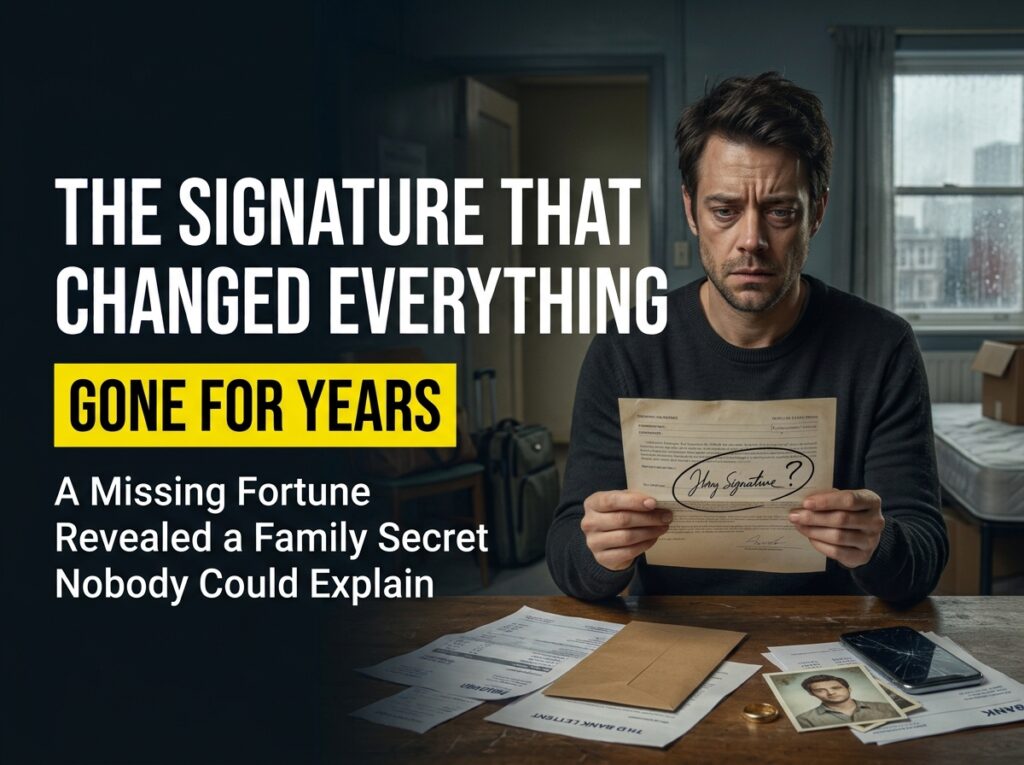
The kitchen was the smallest room in the apartment, yet it was where every important conversation seemed to end.
Two unpaid bills lay on the table beneath a chipped ceramic mug. One was for electricity. The other was a reminder that the rent was overdue. Beside them sat a calculator, a half-empty jar of instant coffee, and a notebook filled with figures that no longer added up.
Eli stood at the sink, staring through the window at the narrow alley behind the building.
“We’ll find a way,” Eli said.
I was sitting on the floor beside two bags, trying to decide which clothes I could take and which things I would have to leave behind.
“You’ve been saying that for months.”
Eli turned around.
“I know.”
“Then tell me something different. Tell me where the money went.”
For a moment, neither of us moved.
We had been together long enough to understand each other’s silences. I knew when Eli was angry, when Eli was tired, and when a problem had become too frightening to discuss. Usually, I could recognize the difference between a silence that meant nothing and one that concealed something important.
This time, I could not.
“I didn’t spend it the way you think,” Eli finally said.
“Then how did you spend it?”
“I moved it.”
“Where?”
Eli looked toward the table.
“I thought it would be safe.”
The answer made my stomach tighten.
Our savings had not been enormous, but they represented years of small sacrifices. We had skipped holidays, postponed replacing broken appliances, and put off buying things we wanted because we believed that eventually we would have enough to stop worrying about every expense.
We had built that money together.
At least, that was what I had believed.
“When did you move it?” I asked.
“Before everything fell apart.”
“How much?”
Eli hesitated.
“Enough to hurt us.”
I stood up.
“That’s not an amount.”
“I know.”
“Is it still there?”
Eli pressed both hands against the edge of the sink.
“I believe it is.”
I stared at Eli, waiting for an explanation that never came.
For weeks, I had tried to convince myself that our problems were temporary. A few payments had arrived late. Work had become unpredictable. Then an unexpected expense had forced us to use money we had intended to save.
Those things happened to people all the time.
But the numbers had continued getting worse, and whenever I asked for a complete account of our finances, Eli promised to show me everything later.
Later never came.
I had begun to suspect that our financial trouble was not simply the result of bad luck. Something had happened before the first overdue bill arrived, and Eli had been trying to keep it hidden.
“Did you make a decision that affected both of us without asking me?”
Eli’s expression changed.
“I thought I was doing what was best.”
“For whom?”
“For us.”
“Then why does it feel as though I’m the last person to know anything?”
Eli opened their mouth, but no answer followed.
I looked at the two bags beside the table. I had packed them that morning after another argument ended with Eli leaving the apartment and returning hours later without explaining where they had been.
I was tired of asking the same questions.
I was tired of hearing that everything would be fine when neither of us could pay the bills.
Most of all, I was tired of feeling guilty for wanting to understand what was happening to my own life.
“I can’t stay here like this,” I said.
Eli looked at the bags.
“Are you leaving?”
“I don’t know what else to do.”
“Please don’t make a decision while we’re both upset.”
I almost laughed.
“You’ve already made decisions without me. I’m the one trying to understand them afterward.”
Eli looked away.
That was when I knew I could not remain in the apartment another night pretending that love alone would make the missing money reappear.
I lifted the first bag.
Eli stepped forward as though intending to stop me, then let their hands fall.
“Where will you go?”
“I’ll find somewhere.”
“You don’t have to leave.”
I looked at the unpaid bills.
“Then tell me the truth.”
Eli said nothing.
I carried my bags to the door.
Before leaving, I turned back once, hoping that the person I loved would finally say something that made staying possible.
Instead, Eli whispered, “I never wanted you to get hurt.”
I wanted to believe that.
But good intentions could not pay the rent, explain the transfer, or tell me why Eli had been hiding something so important.
I left without knowing whether I would return.
Three days later, while sorting through the papers I had taken with me, I found a document folded inside an old envelope.
At first, I thought it was another bill.
Then I noticed the signature at the bottom.
My hands went cold.
The signature belonged to someone who had been gone for years.
Someone whose name we had not spoken aloud in a very long time.
And someone who, according to everything I had been told, could not possibly have been involved in the missing money.
Part 2
I read the signature again.
Then I checked the date printed at the top of the page.
It was several weeks before the first overdue bill, before Eli began working late, before our conversations turned into arguments about money, and before I packed my belongings into two bags.
The document contained a short list of figures, a reference number, and a sentence about funds being held until certain conditions were met.
There was no explanation of the original purpose of the arrangement.
There was only the signature.
I recognized it because I had seen it hundreds of times before.
It belonged to Daniel, my older brother.
Daniel had been gone for years.
Our family rarely discussed him anymore. When someone mentioned his name, the conversation usually ended with a familiar explanation: he had left after a serious disagreement, and nobody had heard from him since.
I had been younger when he disappeared from our lives. I remembered arguments behind closed doors, a suitcase beside the front door, and my mother crying in the kitchen after everyone else had gone to bed.
But I did not know the complete story.
Over time, I had accepted the version of events that everyone repeated.
Daniel had made mistakes. He had hurt people. He had chosen to leave.
Eventually, I stopped asking questions.
Now his signature was on a document connected to the money Eli had moved.
I called Eli.
The phone rang until voicemail answered.
I tried again an hour later.
This time, Eli picked up.
“Have you found something?” Eli asked.
The question surprised me.
“Why would you ask that?”
A pause followed.
“I don’t know. You sound different.”
I looked at the document.
“I found a paper with Daniel’s signature.”
Silence.
“Eli?”
“I’m here.”
“Do you know why his name is on a financial agreement?”
Eli took a breath.
“Where did you find it?”
“In the envelope you left with the other documents.”
“I didn’t know you had that.”
“Did you know Daniel was involved?”
Eli did not answer.
I felt my anger rising.
“You told me the money was moved because you were trying to help someone. You never told me that person might be my brother.”
“I didn’t know whether it was really him.”
“What does that mean?”
“The signature appeared on the document. That doesn’t prove Daniel personally signed it.”
I stared at the page.
It was the first reasonable explanation I had heard since finding it.
A signature could be copied. A document could be prepared incorrectly. Someone might have used Daniel’s name without his knowledge.
But Eli’s reaction told me there was more to the story.
“What did you know before the money was moved?” I asked.
“I knew someone had arranged a temporary transfer.”
“Who arranged it?”
“A person who said they could help resolve an old financial problem.”
“Did they mention Daniel?”
“Not at first.”
“And later?”
Eli sighed.
“Later, I saw the paperwork.”
“Before or after the transfer?”
“Before.”
I closed my eyes.
“So you saw my brother’s name before you moved our money.”
“I saw the name. I didn’t know what it meant.”
“Why didn’t you tell me?”
“Because I thought I could find out whether it was really him before upsetting you.”
I looked down at the document.
“Did you think I wouldn’t want to know that someone might be using my brother’s name?”
“I knew you would want answers.”
“Then why did you keep it from me?”
Eli’s voice became quieter.
“Because I was afraid of what the answers might mean.”
I wanted to end the call.
Instead, I asked for the name of the person who had arranged the transfer.
Eli told me it was Marcus, a friend from the repair shop who had offered financial help when our situation became difficult.
I knew Marcus by sight. He had visited our apartment several times and had always seemed friendly. Eli said he understood financial arrangements better than either of us and believed he could help protect our savings while an outstanding obligation was resolved.
I had never known that the arrangement involved Daniel.
“Do you have Marcus’s contact details?” I asked.
“Yes.”
“Send them to me.”
“Please don’t contact him until we talk.”
I felt something inside me harden.
“We’ve talked. You haven’t answered my questions.”
“I’m trying to protect you.”
“From what?”
Eli was silent.
I ended the call.
That evening, I searched through old family photographs. I found one of Daniel standing beside me outside our childhood home. He was smiling, one hand resting on my shoulder, his hair blown across his forehead by the wind.
I had not looked at the photograph in years.
I remembered how he used to wait outside school when it rained, how he would save the last piece of cake for me, and how he once promised that no matter what happened, I could always call him.
Then came the argument that changed everything.
I remembered my mother’s voice rising in the living room. I remembered Daniel saying that nobody had listened to him. I remembered the front door closing.
Afterward, everyone told me to leave the past alone.
I had obeyed because I wanted our family to stop hurting.
Now I wondered whether silence had protected anyone at all.
I placed the photograph beside the document.
The signature looked familiar.
But familiarity was not proof.
I needed to know who had created the agreement, where the money had gone, and why Daniel’s name had appeared after so many years.
The next morning, I sent Marcus a message asking to meet.
His reply arrived almost immediately.
I can meet you this afternoon. But before we discuss the money, there’s something you need to know about Daniel.
Part 3
Marcus chose a small café near the repair shop.
I arrived early and sat beside the window, keeping the document inside my bag. The morning was cold, and the café smelled of coffee and toasted bread. People moved past outside, carrying shopping bags and talking on their phones, unaware that I was about to ask questions that could change everything I believed about my family.
Marcus arrived carrying a brown folder.
He looked surprised when he saw me.
“I thought Eli would come with you.”
“Eli has had plenty of opportunities to explain.”
Marcus sat down.
For several seconds, he studied the table instead of looking at me.
“Did you know my brother?” I asked.
He hesitated.
“I knew someone who used that name.”
“That isn’t what I asked.”
“I understand.”
“Then answer me.”
Marcus opened the folder and removed a copy of the agreement.
The same signature appeared at the bottom.
He explained that Eli had approached him after our financial difficulties became serious. Eli wanted to know whether there was a way to protect part of our savings while resolving a separate obligation involving money that had been promised to someone else.
Marcus said he had been helping a person who claimed to have access to an arrangement connected to Daniel.
The person had presented documents containing Daniel’s name and signature.
Marcus had not met Daniel in person.
He had believed the documents were legitimate because the information appeared consistent with details he had been given.
I stared at him.
“So you moved money based on documents connected to a man you had never met.”
“I didn’t move the money myself. Eli authorized the transfer.”
“Because you told Eli it was safe.”
“Because I believed it could be resolved.”
“Did you tell Eli that you had never met Daniel?”
Marcus looked uncomfortable.
“I told Eli I couldn’t personally confirm his identity.”
“Did you tell me?”
“No.”
“Did you think I had a right to know that my brother’s name was being used?”
“Yes.”
“Then why didn’t you contact me?”
He lowered his eyes.
“I was afraid that if the arrangement became a family dispute, the person who had promised to resolve the obligation would disappear.”
I felt anger rise through me.
“So you kept me out of it to protect the arrangement.”
“At first, yes.”
“And when the money didn’t come back?”
“I tried to get an explanation.”
“What did you receive?”
Marcus opened the folder again.
He showed me several messages from the person who had organized the arrangement. They described delays, changes in payment dates, and a promise that the matter would soon be settled.
None of them established that the money had been stolen.
None confirmed that the person using Daniel’s name was actually my brother.
But they showed that the arrangement had continued long after the original deadline passed.
“How much money is still there?” I asked.
“I don’t know the current balance.”
I stared at him.
“Then what do you know?”
“I know where the transfer went. I know that some payments were made under the arrangement. And I know that the final release was supposed to depend on a confirmation from a named person.”
“Who?”
Marcus hesitated before answering.
“You.”
For a moment, I thought I had misunderstood.
“Me?”
“The agreement identifies you as the person expected to confirm that the original purpose of the transfer had been fulfilled.”
I took the document from the folder.
My name appeared in the middle of the page.
I read the clause twice.
It described a responsibility I had never knowingly accepted. According to the document, the money could not be released until I confirmed that the conditions had been met.
I had never been asked to do that.
I had not even known the arrangement existed until the money began disappearing from our savings.
“Did you see me sign this?”
“No.”
“Did Eli?”
Marcus shook his head.
“Then how did my name get here?”
“I can’t answer that.”
“Who prepared the document?”
He gave me a name and an office address.
I wrote both down.
Then I asked about the person who had introduced Daniel’s name into the arrangement.
Marcus looked toward the window.
“I was told Daniel had left instructions years ago. The person said the money was connected to an old family matter and that the arrangement had to be completed quietly.”
“Who told you that?”
“I never met him in person. Most of the communication came through messages and documents.”
My hands tightened around the paper.
Someone had been communicating through Daniel’s name, claiming to act on instructions from a man who had been gone for years.
That person had influenced a financial arrangement involving our savings.
And the agreement had placed responsibility on me without my knowledge.
“Do you have an address for Daniel?” I asked.
Marcus shook his head.
“Only an address connected to the documents.”
“Give it to me.”
He wrote it on a piece of paper.
It was an address in a town several hours away.
I folded the paper and put it in my bag.
Marcus watched me carefully.
“I don’t think you should go there alone.”
“Why?”
“Because I don’t know who you’ll find.”
I stood up.
“Neither do I.”
Before I left, Marcus said something that made me turn back.
“There is one more thing. The person who arranged the transfer sent a final message yesterday.”
“What did it say?”
Marcus opened his phone.
The message was short.
Do not release anything until she sees the original signature.
I looked at him.
“Whose original signature?”
He shook his head.
“I don’t know.”
Then he showed me the attachment.
It was a photograph of a handwritten letter.
At the bottom of the letter was Daniel’s signature.
And beneath it was a date from the year he disappeared.
Part 4
I spent the rest of the afternoon trying to understand why a letter written years earlier had become relevant to a financial arrangement that was supposed to protect our savings.
I returned to the photograph of Daniel and me outside our childhood home. The signature on the letter looked similar to the writing on the document, but the copy was too unclear to draw a reliable conclusion.
I needed the original.
I also needed to know who had kept it for so long.
The address Marcus had given me belonged to a small office above a row of shops. According to the information he had, the person who prepared the agreement worked there and had handled the paperwork connected to the transfer.
I called the office.
A woman answered and asked how she could help.
I explained that I had found a document bearing my brother’s signature and that my name had been included in an agreement I did not remember accepting.
She asked for the reference number.
When I read it aloud, she became quiet.
“Where did you obtain that number?” she asked.
“From the agreement.”
“I see.”
“Can you tell me who submitted the document?”
“I’m afraid I can’t discuss confidential information over the phone.”
“Then I would like to arrange an appointment.”
She gave me a time for the following morning.
I spent that night in a rented room, sitting beside the window with the documents spread across the bed.
I tried to remember the last time I had spoken to Daniel.
I had been younger, angry, and convinced that he had abandoned us. I remembered telling him that I did not want to hear another excuse. I remembered him looking at me as though he had something important to say.
Then he had left.
For years, I had believed that his silence meant he did not care enough to return.
Now I wondered whether something had happened that I had never been told.
The next morning, I went to the office.
A woman named Helen greeted me and led me into a small room containing filing cabinets and a desk covered with folders.
She examined the agreement carefully.
“This document was prepared several years ago,” she said. “The file contains instructions for a financial arrangement, but it does not establish that every named person personally signed or accepted the terms.”
“Can you tell me who provided Daniel’s signature?”
“The record identifies the person who submitted the paperwork. It does not prove who physically signed it.”
“Was Daniel present?”
“There is no record showing that he attended the office.”
I felt a cold wave of disappointment.
“So someone could have used his name.”
“It is one possibility. The signature would need to be examined before anyone could reach a reliable conclusion.”
I asked why my name had been included.
Helen explained that the agreement required a person who was not directly involved in the original obligation to confirm that the conditions for releasing the money had been fulfilled.
The arrangement had been presented as temporary.
The money would remain held until the relevant condition was met.
But the file contained no clear record that I had personally accepted the responsibility.
I looked at her.
“Then why did the transfer go ahead?”
“The person arranging the transfer indicated that consent had been obtained.”
“Who?”
She gave me the name listed in the file.
It was Eli.
I closed my eyes.
Eli had not simply moved the money because Marcus had suggested it. Eli had represented that the required consent had been obtained, even though I had never knowingly agreed.
I asked Helen whether there was any evidence that Eli had seen me sign the document.
She said the file contained no such evidence.
I asked whether the person who submitted Daniel’s signature had been asked to verify his identity.
Helen explained that the records showed what documentation had been provided, but she could not confirm that Daniel himself had participated.
The more I learned, the less I could rely on the explanations I had received.
I had spent weeks trying to decide whether Eli had been protecting me or using me.
Now I understood that the answer might not be simple.
Eli might have believed the arrangement would help us.
Marcus might have believed the documents were genuine.
The person who submitted Daniel’s name might have believed they were acting on legitimate instructions.
But none of those possibilities changed the fact that the money had been transferred without my informed consent.
Helen returned the papers to me.
“There is another item in the file,” she said.
She opened a drawer and removed a sealed envelope.
“The person who submitted the original documents asked that this be kept with the record.”
My heart began to pound.
“Who was it addressed to?”
She turned the envelope over.
My name was written across the front.
The handwriting looked familiar.
I recognized it immediately.
It was Daniel’s.
Part 5
I did not open the envelope immediately.
For several seconds, I simply held it in my hands, staring at the handwriting.
Daniel had written my name countless times when we were growing up. He used to leave notes on the kitchen counter when he went out, reminding me to lock the door or telling me that he had saved something for me in the refrigerator.
His handwriting had changed as he grew older, but certain letters remained unmistakable.
The capital letters were narrow. The final stroke of his name curved slightly upward.
I had not seen that writing in years.
“How long has this been here?” I asked Helen.
“The envelope was submitted with the original file.”
“Who submitted it?”
“The record identifies the person who delivered the documents, but it does not establish that the letter was written by Daniel.”
I nodded slowly.
I understood the distinction now.
A familiar signature could be copied.
A familiar letter could be written by someone else.
I could not allow the hope of seeing my brother’s handwriting to become proof that he was alive or involved.
“Can I open it?”
Helen checked the file and confirmed that the envelope had been included for the named recipient.
I carefully broke the seal.
Inside was a single sheet of paper folded into thirds.
The letter was short.
I don’t know whether you will ever receive this. If you do, please understand that leaving was not the same as forgetting you.
I stopped reading.
My throat tightened.
I had spent years telling myself that Daniel had chosen to abandon us.
The letter continued.
There are things I should have explained before I left. I was angry, and I believed that staying would make everything worse. I thought time would allow the truth to become easier to tell. I was wrong about that.
I read the next lines through tears.
If my name appears on any financial document, do not assume that I agreed to everything written there. Ask for the original records. Do not let anyone use my silence as proof of my consent.
I lowered the paper.
The words could have been written by Daniel.
They could also have been written by someone who knew our family history.
I needed to remain careful.
At the bottom of the letter was a final sentence.
If you ever find the document connected to the money, look at the date on the back.
I turned the page over.
There was a date written in the corner, followed by a reference number matching the financial agreement.
Helen checked the number against the file.
Her expression changed.
“This appears to be connected to the original submission,” she said.
“Does that prove Daniel wrote it?”
“No. But it gives us another record to examine.”
I asked whether the file contained an address or contact information for the person who submitted the envelope.
Helen said she could provide the information that the records permitted her to disclose and explain how to request further verification.
I thanked her and left the office carrying copies of the letter and agreement.
Outside, I sat on a bench and called Eli.
Eli answered almost immediately.
“I found a letter from Daniel.”
Silence followed.
“Where?”
“In the file connected to the transfer.”
Eli exhaled.
“What does it say?”
I read the first sentence aloud.
When I finished, Eli did not speak for several seconds.
“Did you know about this letter?” I asked.
“No.”
“Did you know Daniel might have been involved before the transfer?”
“I knew his name was on the paperwork. I didn’t know about the letter.”
“Why didn’t you tell me?”
“Because I didn’t know what was true.”
I felt anger rising again.
“You knew enough to know I needed to be told.”
“I know.”
“Did you think I would never find out?”
“No. I thought I could resolve the financial problem before it hurt you any further.”
I looked at the letter in my hands.
“You keep saying you wanted to protect me. But you made decisions that left me with bills I couldn’t pay and questions nobody would answer.”
Eli’s voice broke.
“I know.”
For a moment, I wanted to forgive everything simply because I could hear the regret in Eli’s voice.
But regret could not replace the truth.
“I need space,” I said.
“I understand.”
I ended the call.
That evening, I compared the letter with the signature on the original agreement.
There were similarities, but I was not qualified to determine whether they came from the same person.
I put both documents into separate protective folders.
The letter had changed how I thought about Daniel’s disappearance, but it had not answered the most important question.
Was my brother alive?
And if he was, why had he waited so long to make contact?
I returned to the last sentence of the letter.
Look at the date on the back.
The date matched the reference number in the financial file.
But the reference number had been assigned years after Daniel disappeared.
Someone had connected his name to the arrangement long after our family believed he had gone.
And that meant the next person I needed to find was not necessarily Daniel.
It was the person who had brought his name back into our lives.
Part 6
I began with the address in the financial file.
It belonged to a small administrative office in a town several hours away. Helen explained that the office had handled correspondence connected to the original arrangement, but she could not confirm who had personally delivered every document.
I called ahead and arranged a visit.
The journey gave me too much time to think.
I remembered Daniel teaching me to ride a bicycle, walking beside me until I stopped wobbling, and laughing when I finally managed to pedal without help.
I remembered the night he left.
He had been standing beside the front door while our mother argued with him. I could hear only fragments from the hallway.
“You can’t keep making decisions for everyone,” he had said.
My mother replied that he was being selfish.
Daniel looked toward me.
For one moment, I thought he would come over and explain what was happening.
Instead, he picked up his bag and left.
I had never forgotten the expression on his face.
At the time, I interpreted it as anger.
Now I wondered whether it had been fear.
When I arrived at the office, a clerk checked the reference number and led me to a woman named Margaret, who had worked there for many years.
She listened as I explained the financial arrangement and showed her the copies of the documents.
When she saw Daniel’s name, she became thoughtful.
“I remember a file like this,” she said. “But I never met the person named Daniel.”
“Who submitted it?”
Margaret checked the old record.
“The paperwork was delivered by a representative. The file says the representative was acting on instructions from another party.”
“Can you identify that party?”
She found a second reference number and made a note.
“The original contact was a man named Robert.”
I did not recognize the name.
“Was Robert related to Daniel?”
“The file doesn’t say.”
“Did he claim to know him?”
“Yes. He stated that he was handling a matter connected to Daniel’s earlier instructions.”
I felt my pulse quicken.
“What instructions?”
Margaret explained that the file referred to an old financial obligation and a request to keep certain funds separate until the matter was resolved.
The records did not establish that Daniel had personally made the request.
They showed only that someone had submitted documents in his name.
“Did Robert ever return?” I asked.
“According to the file, he contacted the office several times. The last recorded contact was years ago.”
“Do you have an address?”
Margaret gave me the address listed in the records.
It was in another town, not far from where Daniel had once worked.
I wrote it down.
Before I left, I asked Margaret whether she could tell me anything about the final message.
She checked the file again.
“There is a note indicating that an additional letter was supposed to be delivered to the named recipient if the arrangement remained unresolved.”
“Me?”
“Yes.”
“Why wasn’t it delivered?”
Margaret looked through the correspondence records.
“The file does not explain that.”
I thanked her and stepped outside.
I had begun the day hoping to find proof that Daniel was alive.
Instead, I had discovered another person who had used his name, another unanswered question, and another letter that might never have reached me.
I called Eli and told them what I had learned.
Eli listened quietly.
“Robert,” Eli repeated. “I remember that name.”
I stopped walking.
“You know him?”
“I saw it in one of Marcus’s messages. I thought it was the name of the person handling the paperwork.”
“Did you ask who he was?”
“No.”
“Why not?”
“I thought Marcus had already checked everything.”
I closed my eyes.
Once again, someone had relied on an assumption rather than asking a question that could have prevented a serious mistake.
“Do you still have the message?”
“Yes. I’ll send it to you.”
The message arrived a few minutes later.
It contained a date, a reference number, and a short instruction.
Robert confirms the arrangement remains in place. Do not release the funds until the original beneficiary’s identity is verified.
I read it twice.
The word beneficiary stood out.
The agreement did not merely describe a temporary transfer. It referred to a person whose identity had to be verified before the money could be released.
I called Marcus.
He confirmed that he had received similar messages but said he had never met Robert.
I asked whether Robert had ever claimed that Daniel was dead.
Marcus said no.
He had simply been told that Daniel was unavailable and that the arrangement should continue until the necessary documents were verified.
I thanked him and ended the call.
For years, my family had treated Daniel’s disappearance as a closed chapter.
Now I had evidence that someone had continued using his name in financial correspondence long after he left.
I reached the address Margaret had given me just before the office closed.
It was an old building with a narrow entrance and several mailboxes beside the door.
One mailbox bore the name Robert Hale.
I stood there for a long time, wondering whether I should knock.
Then I noticed a small envelope tucked behind the mailbox flap.
My name was written across it.
Beneath my name was a sentence in unfamiliar handwriting.
If you are finally asking about Daniel, you are already years too late.
Part 7
I took the envelope to a nearby café before opening it.
The handwriting did not resemble Daniel’s. It was neat and deliberate, with each letter carefully separated from the next.
Inside was a single page.
The writer said that the financial arrangement had begun as an attempt to resolve an old obligation connected to Daniel. The writer also claimed that the money had been kept separate because its final purpose had never been confirmed.
There was no direct explanation of where Daniel was.
There was no proof that he had authorized the arrangement.
But the letter contained a name I recognized.
My mother’s.
I read the sentence again.
Your mother knew that Daniel’s departure was not the whole story.
For several minutes, I could not move.
My mother had died several years earlier. I had spent a long time making peace with the fact that some of our family questions would never be answered.
I had believed she knew why Daniel had left, but I assumed she had simply been too hurt to discuss it.
Now I wondered whether she had known that his disappearance was connected to something more complicated.
I called my aunt Helen, my mother’s younger sister.
She answered after the third ring.
“What happened?” she asked when she heard my voice.
I explained the document, the financial arrangement, and the letter from Robert.
When I mentioned my mother’s name, my aunt went silent.
“Did Mum ever tell you why Daniel left?” I asked.
My aunt took a slow breath.
“She told me that there had been an argument.”
“Was there something else?”
“I don’t know everything.”
“But you know something.”
She did not deny it.
My aunt said that before Daniel left, he had been involved in a disagreement about money and a promise made to another person. The family had argued about whether he should accept responsibility for an obligation that had not been clearly explained.
Daniel had insisted that he had not agreed to everything he was being asked to do.
Our mother believed he should stay and resolve the matter.
Daniel believed he was being blamed for a decision he had not made.
The argument had become so bitter that he left.
“Why didn’t you tell me?” I asked.
“You were young. Your mother didn’t want you caught between them.”
“So everyone decided I didn’t need to know.”
My aunt sighed.
“At the time, we thought silence would protect you.”
I stared at the letter.
The same explanation had followed me through every stage of the mystery.
Eli had hidden the transfer because they believed they were protecting me.
Marcus had kept the arrangement quiet because he feared it would collapse.
My mother had withheld the details of Daniel’s departure because she did not want me caught in the conflict.
Everyone had made a decision about what I should know.
And I had spent years living with the consequences of those decisions.
I asked my aunt whether she knew Robert.
She said she remembered the name but had never met him. She thought he had been connected to someone Daniel knew before leaving.
“Do you think Daniel is alive?” I asked.
“I don’t know,” she replied. “I wish I could tell you.”
After the call, I sat in the café until the staff began stacking chairs.
I wanted to be angry with my mother, but grief complicated the feeling. She had loved me. I believed that. She had tried to keep our family together after Daniel left.
But love had not prevented her from withholding information that might have helped me understand what happened.
I thought about the letter from Daniel.
Leaving was not the same as forgetting you.
For years, I had interpreted his silence as rejection.
Now I could no longer be certain.
I returned to the envelope and checked the postmark. It had been mailed recently, even though the letter referred to events from years earlier.
Robert had known that I would come looking for answers.
He had anticipated my questions.
I called the number listed beside his name in the old file.
The phone rang several times before a man answered.
“Robert?”
“Who is this?”
“My name is—” I gave him my name. “I’m looking for information about Daniel.”
There was a long silence.
Then he said, “I wondered how long it would take you to find the documents.”
“Are you the person who arranged the transfer?”
“I helped with the paperwork.”
“Did Daniel authorize it?”
“I cannot answer that without seeing which document you’re referring to.”
“I have his signature.”
“Then you have a signature. You still need to establish who wrote it.”
I felt a chill.
“Where is Daniel?”
Robert hesitated.
“I haven’t seen him for a long time.”
“Do you know whether he’s alive?”
“I know that he wanted the truth to be understood before anyone released the money.”
“Why didn’t he contact me?”
Robert did not answer immediately.
When he finally spoke, his voice was quieter.
“Because he believed that if he came back without proof, the same argument would begin again.”
I gripped the phone.
“What proof?”
Robert took a breath.
“The original message. The one that explains why he left.”
I asked where I could find it.
He gave me an address and said that a copy had been kept with the financial records.
Then he added one final warning.
“Before you read it, you need to understand that Daniel wasn’t the only person who signed something that night.”
Part 8
I returned to the office the following morning and asked Helen to check the file for the original message Robert had described.
She reviewed the reference numbers and located a separate document attached to the correspondence.
It had been scanned into the record but had not been included in the copy I received earlier.
The first page contained a date, a brief description of the financial obligation, and the names of the people involved.
The second page was a handwritten statement.
I recognized Daniel’s signature at the bottom, but I reminded myself that recognition was not proof.
The statement described a disagreement over money that had been intended for a specific purpose. Daniel said he had been asked to approve an arrangement that he did not fully understand. He had refused to accept responsibility until the conditions were explained.
The statement did not say that he had stolen money or abandoned the family for financial gain.
Instead, it described a conflict in which several people believed they had been promised different things.
I read the final paragraph.
I will not agree to a release until the person whose money is affected understands the arrangement. If my name is used to approve something I have not agreed to, the document must be reviewed before any further action is taken.
I lowered the paper.
The wording was strikingly similar to the concerns I had raised after finding the signature on the agreement.
Daniel had apparently been worried about the same problem years earlier: people treating a signature or a promise as proof of consent when the person involved had not understood what was being agreed.
I asked Helen whether the statement had been written before or after Daniel disappeared.
The date showed that it had been written shortly before he left.
I looked at the document again.
It was possible that Daniel had written the statement and then left because he believed the dispute could not be resolved.
It was also possible that someone else had prepared it or that parts of the story were missing.
I needed more evidence.
Helen showed me another page from the file.
It contained a list of people who had received copies of the original correspondence.
My name appeared beside a note stating that a letter had been prepared for delivery.
But the delivery record was incomplete.
There was no signature confirming that I had received it.
I thought about all the years I had spent believing Daniel had chosen to forget me.
If a letter had been prepared and never delivered, then the silence between us might not have been as simple as I had imagined.
I asked Helen whether the original letter still existed.
She checked the records and found a reference to a sealed envelope held separately from the financial file.
I arranged to collect it through the appropriate process.
When I received the envelope, my hands trembled.
My name was written on the front.
The handwriting appeared similar to Daniel’s, but I did not assume that meant he had written it.
I opened the envelope carefully.
Inside was a short letter.
I know you may believe I left because I stopped caring about you. That isn’t what happened. I was asked to accept responsibility for something I did not understand, and when I refused, everyone treated my refusal as proof that I had something to hide.
I paused, remembering my mother’s grief and the arguments I had overheard.
The letter continued.
I wanted to explain everything to you, but I was afraid you would be forced to choose between me and the rest of the family. I thought staying away would keep you out of the conflict. I did not understand how much my silence would hurt you.
My eyes filled with tears.
The letter did not prove every detail of Daniel’s story.
It did not tell me where he was now.
But it gave me a different way to understand the years of silence.
I had believed he had left because he did not care enough to stay.
The letter suggested that he might have left because he believed staying would make the conflict worse.
I could not know whether that decision had been right.
I could only acknowledge that I had never been given the opportunity to understand it.
I called Robert and told him I had found the letter.
He asked whether I had read the final paragraph.
I looked at the page.
There was one more line beneath the signature.
If you ever receive this, ask Eli what happened the night we separated.
My heart began to pound.
I had assumed the letter concerned Daniel’s disappearance and the financial arrangement.
But it named Eli.
I called immediately.
Eli answered, sounding frightened.
“I found a letter from Daniel,” I said. “It says I should ask you what happened the night we separated.”
For several seconds, Eli said nothing.
Then, in a voice I barely recognized, Eli asked, “Did you find the message too?”
“What message?”
“The one Daniel sent before the money was moved.”
I stared at the letter.
“Why didn’t you tell me about it?”
Eli took a shaky breath.
“Because I didn’t understand what it meant until it was too late.”
Part 9
Eli agreed to meet me that evening.
We chose a quiet place away from the apartment and the repair shop. I brought copies of the documents, the letter, and the original financial agreement.
Eli arrived carrying an old phone.
“I kept this because I couldn’t bring myself to throw it away,” Eli said.
The phone was scratched and worn, with a cracked corner and a charging cable wrapped around it.
“What is it?”
“The phone I used when the transfer was arranged.”
Eli unlocked it and opened an old message thread.
The messages were incomplete, but several had been saved.
One came from Marcus, reminding Eli that the transfer should not proceed until I understood the agreement.
Another contained the reference number connected to Daniel’s name.
Then Eli opened an audio message.
“I never listened to this all the way through,” Eli said. “I was afraid of what it might say.”
“Play it.”
Eli pressed the screen.
A man’s voice came through the speaker.
It was calm, tired, and unfamiliar to me.
The speaker said that the money was connected to an old obligation and that nobody should assume the agreement was valid simply because a familiar signature appeared on the page.
He warned that the person whose savings were affected had to understand the terms before the transfer could proceed.
Then the voice said a name.
Daniel.
I felt my heart race.
The message continued.
“If she has not agreed, stop the transfer. Do not tell her that the money is safe until you have confirmed where it is and what conditions apply. She deserves to know what is being done in her name.”
The recording ended.
I looked at Eli.
“Who sent that?”
“I don’t know for certain. The number was saved under Robert’s name.”
“But you received it before the transfer?”
Eli nodded.
“Yes.”
“And you moved the money anyway.”
“I thought the agreement had already been approved. Marcus said the documents were complete, and I wanted to believe him.”
“But the message told you to stop if I hadn’t agreed.”
“I know.”
“Why didn’t you play it for me?”
Eli’s eyes filled with tears.
“Because I was afraid you’d leave.”
I stared at Eli, feeling both anger and sadness.
“You were afraid I would leave, so you made a decision that gave me every reason to leave.”
Eli lowered their head.
“Yes.”
For a long time, neither of us spoke.
I had wanted a clear answer about the missing money. I had wanted to know whether Eli had deliberately deceived me, whether Daniel had been involved, and whether someone had used our savings without permission.
The message did not answer every question.
It did establish that Eli had received a warning before the transfer.
Eli had known that my consent mattered.
Eli had proceeded because they believed the paperwork was complete and feared that asking me would lead to a refusal.
The financial records still needed to establish the current balance and the conditions governing release. The signature still required proper examination. And Daniel’s whereabouts remained uncertain.
But I no longer needed to guess why Eli had hidden the arrangement.
Eli had been trying to avoid a difficult conversation and had allowed that fear to become a decision that affected both our lives.
“I loved you,” Eli said.
“I know.”
“I never wanted you to lose everything.”
“But I did lose something.”
Eli looked up.
“My ability to trust what you told me.”
“I know.”
“I don’t know if that can be repaired.”
Eli nodded slowly.
“I don’t expect you to forgive me tonight.”
I looked at the old phone.
“Did Daniel send any other messages?”
Eli scrolled through the remaining files.
There was one final message, dated the night we separated.
It contained only a few lines.
If you are reading this, the transfer may already have happened. Do not assume the money is gone, and do not assume it can be released. Find the original agreement. The signature is not the whole story.
I read it twice.
Beneath the message was an attachment.
It was a photograph of a page bearing Daniel’s signature.
But this time, there was a handwritten note beneath it.
The person who signed this must be identified before the account can be closed.
I looked at Eli.
“Who signed it?”
Eli shook their head.
“I don’t know.”
I studied the signature again.
It resembled Daniel’s.
But beside the signature was a date from the week he disappeared, and the name of a witness who had been present when the document was prepared.
I recognized the name immediately.
It belonged to my mother.
Part 10
For several minutes, I could not speak.
My mother had been gone for years. I had spent a long time accepting that the questions surrounding Daniel’s departure would remain unanswered.
Now her name appeared beside the document connected to the missing money.
I wanted to believe that the signature would explain everything.
But the more I learned, the more carefully I had to separate what the records showed from what I feared they might mean.
I contacted Helen and asked her to add the newly discovered message and attachment to the file. She confirmed that the records would need to be examined together and that the signature could not be treated as proof of consent without verification.
The review continued.
The documents established that the financial arrangement had been created around an old obligation, that money from our shared account had been transferred, and that its release depended on conditions that had not been fully confirmed.
They also established that Eli had received a warning about my consent before the transfer.
What they did not establish was who had signed every page, whether Daniel had personally authorized the arrangement, or where he was now.
I had to accept that the truth would not arrive in one perfect conversation.
It would come through records, questions, and evidence that could be checked.
I returned to the letter Daniel had apparently written years earlier.
Leaving was not the same as forgetting you.
I had spent years interpreting his absence as a rejection.
Now I understood that I might have been wrong.
I still did not know whether Daniel had chosen to leave because he believed he was protecting me, because he had become overwhelmed by the family conflict, or because there were details I had not yet discovered.
But I no longer believed that silence alone could tell me what he felt.
I decided to contact every person named in the records through the proper channels and ask for the information needed to clarify the arrangement. I would not approve a release until the terms were explained and the authorization issue resolved.
The money might eventually be returned.
It might take longer than I wanted.
But I would no longer organize my life around money that I could not verify.
I found a small apartment and began paying the bills one at a time. I bought a table, two chairs, and a secondhand bookcase. I cooked simple meals and learned to sleep without checking my phone every few minutes.
Some days were harder than others.
I missed Eli.
I missed the ordinary moments we had shared before every conversation became a question about money.
But I also remembered the fear of discovering another unexplained transfer, the frustration of being told that I did not need to know everything, and the loneliness of trying to solve a problem that had been created without my informed agreement.
I could care about Eli without returning to the relationship.
I could remember the good years without pretending the painful ones had not happened.
And I could continue looking for Daniel without deciding in advance what his disappearance meant.
One afternoon, my aunt visited me.
She brought a box of old family photographs that she had kept after my mother’s death.
We sat together and looked through them.
There was Daniel at school, Daniel holding a birthday cake, Daniel standing beside me outside our childhood home.
Near the bottom of the box was a photograph I had never seen before.
Daniel stood beside my mother and another man.
The man was older, with a narrow face and a dark coat. On the back of the photograph was a date and a name.
Robert.
I showed it to my aunt.
She studied the picture for a long time.
“I remember him,” she said quietly.
“Who was he?”
“He knew Daniel before the argument. Your mother met him several times, but she never explained why.”
“Did she know where Daniel went?”
My aunt looked down at the photograph.
“I don’t know. She was frightened of what would happen if the disagreement began again.”
I felt a familiar sadness.
Once again, someone had chosen silence because they believed the truth would hurt too much.
I put the photograph back in the box.
I could not change what my family had decided years earlier. I could not recover the conversations that had never happened or make my mother explain the things she had left unsaid.
But I could stop repeating the same pattern.
I could ask questions without treating them as accusations.
I could acknowledge uncertainty without filling it with assumptions.
And I could insist that nobody make a decision in my name without my understanding and consent.
The financial review remained a separate matter, and I continued cooperating until the records could be properly assessed. I did not assume that the account was mine to release, and I did not assume that the disputed signature proved wrongdoing by any particular person.
I had learned that evidence mattered more than suspicion.
So did honesty.
One evening, I sat at my new kitchen table and opened the notebook in which I had recorded every important date, message, and unanswered question.
At the top of the final page, I wrote three sentences.
I did not know who had signed every document.
I did not know whether Daniel would ever return.
But I knew that I would not let anyone else decide what I was allowed to know.
I closed the notebook.
For months, I had believed that the missing money was the worst thing we had lost.
Then I thought it was the relationship.
Now I understood that the deepest loss had been the trust that allowed me to believe we were making decisions together.
The money mattered because it represented years of work, plans, and the security we had tried to build.
The relationship mattered because I had loved Eli and imagined a future with them.
Daniel mattered because his absence had left a wound in my family that nobody had known how to explain.
But none of those things could be repaired by pretending the truth did not matter.
I could not promise that every question would be answered.
I could promise that I would no longer accept silence as an explanation.
The signature remained a mystery to be examined.
The account remained subject to its conditions.
And Daniel’s story remained unfinished.
But my own life did not have to remain on hold until the past became clear.
I had packed two bags because I believed I had lost everything.
I began again with far less than I once had, but with a clearer understanding of what I needed to protect.
Not just my money.
Not just my relationships.
My right to know what was happening to my own life.
And if Daniel’s letter had taught me anything, it was this:
Leaving did not always mean forgetting.
Silence did not always mean indifference.
And a signature, no matter how familiar, could never replace the truth.