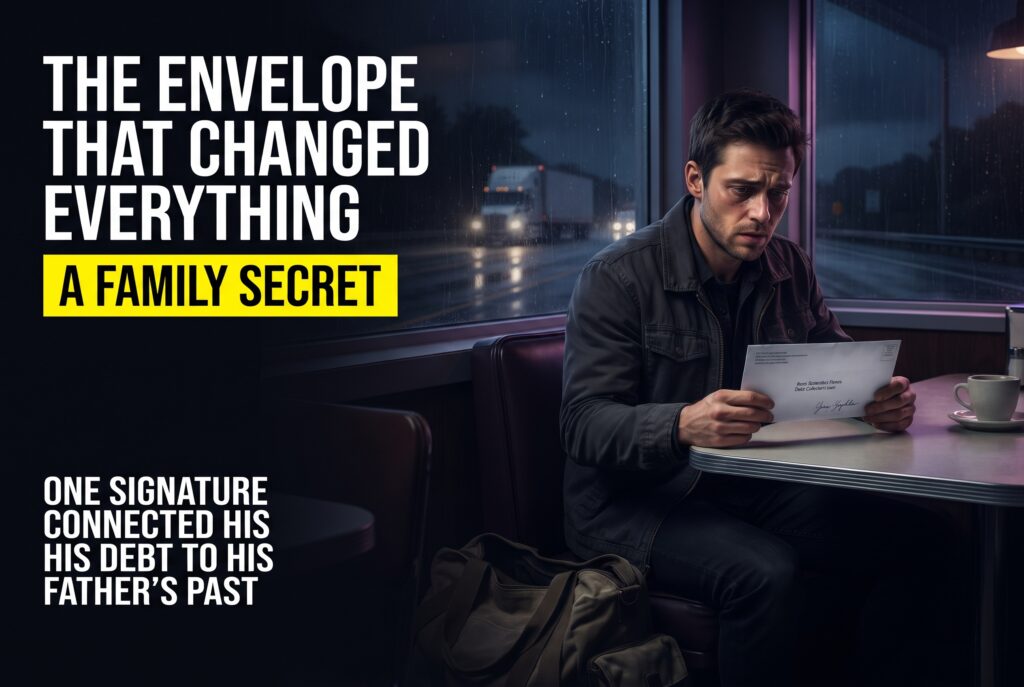
The first time I understood how quickly a life could become unfamiliar, I was sitting alone in a highway diner with seventeen dollars in my wallet and a phone that would not stop reminding me about the rent.
Outside, rain streaked the windows. Trucks moved through the darkness, their headlights sweeping across the parking lot before disappearing down the highway. Inside, an old refrigerator hummed behind the counter, and the smell of coffee clung to the air.
I had ordered the cheapest meal on the menu.
The waitress, a woman with silver hair and tired eyes, placed a plate of eggs and toast in front of me.
“Long night?” she asked.
“Something like that.”
She glanced at the two canvas bags beside my chair.
“Moving?”
“Trying to figure out where to go.”
She nodded without asking another question. Perhaps she had seen enough people passing through that diner to recognize when someone needed privacy more than conversation.
My brother Daniel had called me irresponsible that afternoon.
He had used the word as though it explained everything: the unpaid bills, the breakup, the money I had borrowed, and the fact that I had nowhere permanent to sleep.
“You keep making promises you can’t keep,” he had told me over the phone. “At some point, Isaac, you have to accept that you’re the reason things go wrong.”
I had wanted to remind him how many times I had helped him when he was in trouble. I had wanted to tell him about the extra shifts I had worked, the things I had sold, and the money I had given him when he said he needed it urgently.
Instead, I had listened.
I was too exhausted to defend myself against someone who had already decided what kind of person I was.
My former partner, Claire, had left three weeks earlier. She said she could not keep building a future around promises that never became reality. I understood why she was tired. I was tired too.
What I could not understand was why our financial problems had become so much worse in the final months of our relationship.
I had worked consistently. Claire had contributed what she could. We had cut unnecessary expenses, stopped eating out, and postponed plans that once seemed important.
Yet the money disappeared.
Whenever I asked about it, there was always another explanation.
A payment had been delayed. An unexpected bill had arrived. Someone needed help. A transaction had to be corrected.
I believed those explanations because I wanted to believe that we were still a team.
Now I was sitting in a diner, trying to decide whether I could afford another night in a cheap motel.
My phone vibrated.
Daniel had sent a message.
I left your things with the rest. Pick them up when you can. I’m not getting involved anymore.
I stared at the screen.
Daniel had been holding some of my belongings since I moved out of the apartment I had shared with Claire. He had offered to keep them in his storage room, saying it would give me time to find somewhere else.
Apparently, he had changed his mind.
I typed a reply, deleted it, and put the phone away.
I finished my meal slowly, unwilling to return to the cold outside.
When the waitress came to clear the plate, she noticed a folded piece of paper beside my bags.
“Is that yours?”
I looked down.
It was a sealed envelope with a printed address and the words Final Notice near the top.
I had never seen it before.
The envelope was addressed to Daniel, not me. A debt collection company had sent it, and the return address suggested that the matter had been referred to a specialist office.
I turned it over.
The seal was still intact.
I should have put it aside. It belonged to my brother, and I had no right to open his private mail.
But something caught my attention.
At the bottom of the envelope, beneath the printed account reference, someone had written a name in blue ink.
My name.
Isaac.
I sat motionless.
Why would a debt collector send my brother a letter with my name written on it?
I examined the envelope again. There was no explanation, only a reference number and a signature beside a handwritten note.
The signature looked familiar.
I could not immediately place it, but I knew I had seen those letters before.
I took a photograph and sent it to Daniel.
Why is my name on a debt collection letter addressed to you?
He called less than a minute later.
“What are you doing with that?” he demanded.
“It was in the things you left for me.”
“You shouldn’t be looking at it.”
“I’m not looking for trouble. I’m asking why my name is on it.”
“Put it back.”
“I don’t have anywhere to put it back. You left it with my belongings.”
“Isaac, listen to me. This has nothing to do with you.”
“Then explain the signature.”
The silence that followed was different from anything I had heard from Daniel before.
It was not irritation. It was fear.
“Where are you?” he asked.
“In a diner.”
“Stay there.”
“Why?”
“Because I need to talk to you.”
The call ended.
I looked through the window at the rain.
For the first time that evening, I forgot about the rent, the food, and the motel I could not afford.
My brother had spent years telling me that I was the one who made irresponsible decisions.
Now he was frightened of a letter that carried my name.
And I had a feeling that whatever was written inside it had been waiting for me long before I found it.
Part 2
Daniel arrived forty minutes later.
He entered the diner wearing a dark jacket that was wet across the shoulders. His hair was disheveled, and he looked as though he had driven too quickly.
He spotted me near the window and walked straight toward the table.
“Give me the envelope.”
I kept my hand on it.
“Not until you tell me what it is.”
His jaw tightened.
“You have no idea what you’re getting into.”
“Then help me understand.”
He looked around the diner, apparently checking whether anyone was paying attention.
“Not here.”
“Why not?”
“Because this isn’t the place.”
I almost laughed. A few hours earlier, he had told me he wanted nothing more to do with my problems. Now he was standing beside my table as though I had deliberately created a crisis by asking one question.
“You called me irresponsible,” I said. “You told me to stop expecting other people to fix my life. But now you’re asking me to hand over a letter addressed to you because my name is written on it.”
Daniel rubbed his forehead.
“I was angry.”
“That doesn’t answer my question.”
He pulled out the chair opposite me but did not sit.
“The letter concerns an old financial arrangement.”
“What arrangement?”
“Something from years ago.”
“How many years?”
He looked at the envelope.
“Before you and Claire separated.”
I felt a cold sensation move through my chest.
“Does it have anything to do with our money?”
“Not directly.”
“Then why is my name there?”
“I don’t know.”
I watched his face.
Daniel had always been easy to read. When we were children, he could never hide the fact that he had broken something or taken something that did not belong to him. As adults, he had become better at controlling his expressions, but he still had a habit of looking away when he was frightened.
He was looking away now.
“You know more than you’re telling me.”
He finally sat down.
“I know that the situation is complicated. I know someone made a promise, and I know that promise was never properly resolved.”
“Who made the promise?”
“I can’t tell you that.”
“Can’t or won’t?”
He looked at me sharply.
“Don’t turn this into an accusation.”
“I’m not accusing you. I’m asking you to explain a letter that carries my name.”
Daniel leaned closer.
“Whatever you think you’ve found, don’t assume it means someone stole from you.”
The words struck harder than they should have.
“I didn’t say anyone stole anything.”
“You were about to.”
“No, Daniel. I was about to ask why I have been struggling to pay rent while everyone around me seems to know something I don’t.”
His expression changed.
For a moment, he looked almost ashamed.
Then he reached for the envelope again.
I pulled it toward me.
“Not yet.”
He sat back.
“You have always believed the worst of people when things go wrong.”
“And you’ve always told me to trust people who refuse to explain themselves.”
The waitress approached with a pot of coffee, sensed the tension, and quietly moved away.
Daniel lowered his voice.
“Listen carefully. That letter was not supposed to reach you.”
“Why?”
“Because the matter was already being handled.”
“By whom?”
He did not answer.
I looked at the handwritten signature again.
The first letter was broad and rounded. The final letters slanted downward in a way I remembered from old birthday cards and documents I had signed years earlier.
Suddenly, I recognized it.
The signature belonged to Claire.
I stared at the envelope.
Daniel followed my gaze.
“Now you understand why I didn’t want you opening it.”
“No,” I whispered. “I understand even less.”
Claire had left me with unpaid bills and unanswered questions. She had said she could not continue living with uncertainty. I had accepted that she was exhausted and that our relationship had reached its end.
But why would her signature appear on a debt collection notice sent to my brother?
I looked up.
“Did Claire borrow money from you?”
Daniel said nothing.
“Did she borrow money in my name?”
His face drained of color.
“Isaac, I need you to listen to me.”
“Answer the question.”
“I never agreed to anything that was supposed to hurt you.”
That was not an answer.
I picked up my bags.
Daniel stood.
“Where are you going?”
“To find Claire.”
“You can’t just turn up at her place.”
“Then tell me where she is.”
He hesitated.
That hesitation told me more than his words had.
“You know where she is,” I said.
Daniel’s eyes dropped to the envelope.
“I know where she was supposed to be.”
I waited.
He swallowed.
“Claire wasn’t the only person who signed that agreement.”
I slowly put my bags down.
“Who else signed it?”
Daniel looked directly at me.
Then he said the words that made the diner seem suddenly colder.
“Your father.”
Part 3
My father had been dead for four years.
For a moment, I thought I had misunderstood Daniel.
“What did you say?”
He pulled the envelope closer but still did not open it.
“Your father signed the original agreement.”
“My father never borrowed money from Claire.”
“I didn’t say he did.”
“Then what are you saying?”
Daniel glanced toward the counter. The diner was becoming quieter as the hour grew late, and a man in a work uniform was paying his bill near the door.
“I think we should leave,” he said.
I shook my head.
“No. You have spent the last twenty minutes telling me what I should do. Now you’re going to explain what you know.”
He sat down again.
“When Dad died, there were financial records we never found. You remember how Mom kept saying the paperwork was incomplete?”
I did remember.
After our father died, the family had spent months dealing with his estate. There had been ordinary expenses, insurance forms, and documents that seemed to contradict one another. My mother had been overwhelmed, and Daniel had taken responsibility for organizing most of the paperwork.
I had been living with Claire then, working long hours and trying to help whenever I could.
Daniel had told me there was nothing unusual about the estate.
“Everything was settled,” he had said. “Dad didn’t leave any debts we need to worry about.”
I had believed him.
Now he was telling me that our father had signed an agreement connected to a debt collector.
“Why didn’t you tell me?”
“Because I didn’t understand it at the time.”
“You handled the paperwork.”
“I handled what I could find.”
“Daniel, you told me everything was settled.”
He looked down.
“I believed it was.”
I wanted to shout at him, but the words would not come.
I remembered our father’s desk, the old filing cabinet in his study, and the stack of envelopes Daniel had carried out after the funeral. I remembered asking whether I could help sort through the documents.
He had said there was no need.
I remembered being relieved.
At the time, I had been struggling to keep my relationship with Claire together. I had not wanted another responsibility.
Now I wondered whether my relief had made it easier for everyone else to keep me in the dark.
“What was the agreement for?” I asked.
Daniel shook his head.
“I don’t know all the details.”
“Then who does?”
He looked at the envelope.
“Someone who was involved when Dad was alive.”
“Who?”
“I think Claire knows.”
The name hurt to hear.
I had spent weeks trying to understand why Claire had left. I had replayed our last conversations, searched old messages, and wondered whether she had stopped loving me long before she admitted it.
Now the questions were changing.
Had she left because our relationship was failing, or because she knew something about my family that I did not?
Had the financial problems been the reason she could no longer stay, or had they been connected to a secret that neither of us understood?
I took a photograph of the envelope and sent it to myself.
Daniel watched me.
“What are you doing?”
“Keeping a record.”
“You don’t need to do that.”
“I think I do.”
He stood abruptly.
“Isaac, please. I am trying to protect you.”
I looked up at him.
“From what?”
He opened his mouth, then closed it again.
Finally, he said, “From finding out that Dad wasn’t the man you think he was.”
The words landed between us.
My father had not been perfect. He had made mistakes, argued with our mother, and spent years working jobs that never paid enough. But he had been the person who taught me to repair a broken chair rather than throw it away, to pay back money even when no one expected it, and to tell the truth when a lie would be easier.
He had also taught Daniel those things.
I could not reconcile the man I remembered with the person Daniel seemed to be describing.
“What did he do?”
Daniel looked away.
“I don’t know whether he did anything wrong.”
“Then why say that?”
“Because there are records that suggest he promised something he couldn’t deliver.”
I sat back slowly.
The rain had stopped, leaving the parking lot shining beneath the lights.
I wanted to go home, but there was no home waiting for me. I wanted to call my mother, but I did not know whether she had ever seen the agreement. I wanted to believe Daniel would finally tell me everything, but each answer seemed to create another secret.
I folded the envelope carefully and placed it inside my jacket.
Daniel did not stop me.
At the door, he called my name.
“Isaac.”
I turned.
“If you speak to Claire, don’t ask her about the money first.”
“What should I ask her?”
He looked as though he regretted having spoken at all.
“Ask her what Dad promised.”
I stepped into the night.
For the first time, I understood that the breakup might not have been the beginning of my financial trouble.
It might have been the moment when a much older problem finally reached me.
And somewhere in the records my brother had hidden, there was a promise my father had made that could change everything I believed about our family.
Part 4
I found Claire’s number in an old message thread.
For several days, I had resisted contacting her. Every time I opened our conversation, I remembered the last night we had spent together and the way she had stood beside the door, unable to look at me.
She had told me that she loved me but could not keep living with uncertainty.
I had asked her to give us another month.
She had said she had already given us too many.
After that, we had exchanged only a few practical messages about belongings and bills.
Now I sent her a single sentence.
We need to talk about the agreement Dad signed.
She called immediately.
“Where did you hear about that?”
Her voice was so sharp that I almost dropped the phone.
“Daniel showed me a debt collection letter.”
A pause.
“Did you open it?”
“No.”
“Did he?”
“I don’t know.”
I heard her take a shaky breath.
“Isaac, I need to see you.”
“Then tell me where.”
We arranged to meet the following afternoon at a café several miles from the highway diner.
I arrived early and sat near the window. I ordered coffee I did not drink and watched people crossing the street, wondering whether I had made a mistake by contacting her.
When Claire entered, she looked older than I remembered. Her hair was tied back, and she wore a dark coat I had never seen before.
She stopped when she saw me.
For a moment, neither of us moved.
Then she sat down.
“You look tired,” she said.
“So do you.”
She looked at my hands.
“Have you been sleeping?”
“Not much.”
“I’m sorry.”
I almost asked her why she was sorry, but I already knew that the apology would not answer the questions I had brought.
I placed the photograph of the envelope on the table.
“Tell me what my father promised.”
Claire stared at the image.
Her eyes filled with tears.
“I didn’t want you to find out this way.”
“Then how did you want me to find out?”
She looked toward the window.
“I thought I could resolve everything before it reached you.”
“Everyone seems to have thought that.”
She closed her eyes.
“I know.”
For several seconds, she said nothing.
Then she began to explain.
Years earlier, my father had become involved in a financial arrangement with a man he knew through his work. The details had been recorded in documents that were supposed to be kept privately until certain conditions were met.
Claire had learned about the arrangement through a connection of her own. She had not been involved when it began, but she had eventually discovered that some of the records were incomplete.
She had tried to establish whether the obligation had been fulfilled.
At first, she believed the matter could be resolved with a few phone calls and copies of the original documents.
Instead, she found conflicting information.
Some records indicated that payments had been made. Others suggested that a final condition remained outstanding. The debt collector’s notice was connected to that unresolved matter.
“Why was your signature on the letter?” I asked.
“Because I signed a document agreeing to help trace the records.”
“Did you borrow money?”
“Yes.”
“From whom?”
She looked at me.
“From the account we shared.”
I felt the old anger rise.
“Without telling me?”
“Yes.”
“How much?”
“I need to give you the complete records before I answer that. I don’t want to give you a number that turns out to be wrong.”
I stood up.
“Do you understand what that sounds like?”
She flinched.
“I do.”
“You left me struggling to pay rent. You let me believe we were simply running out of money. And now you’re telling me you were investigating a debt connected to my dead father?”
“I know how it looks.”
“How it looks?”
My voice rose, and the people at the next table turned to look.
I lowered it again.
“How could you do this to me?”
Claire’s eyes filled with tears.
“I was trying to protect you.”
I laughed bitterly.
“That’s what Daniel said.”
She looked startled.
Then she reached into her bag and placed a small folder on the table.
“I should have told you. I know that now. But when I discovered the original records were missing, I became afraid that the people involved would blame you for something you hadn’t done.”
I stared at the folder.
“Why would they blame me?”
“Because your name appears on a later document.”
I sat down slowly.
“What document?”
She opened the folder and showed me a photocopy of a page.
My name was written near the bottom.
Beside it was a signature that looked almost exactly like mine.
Almost.
I examined the letters.
The handwriting was familiar, but something was wrong with the final stroke.
I had never signed that document.
I looked at Claire.
“Who wrote this?”
She shook her head.
“I don’t know.”
“Then why did you sign anything connected to it?”
“Because I thought the original would prove what had happened. I thought if I could find it, I could show that the later document was not what it appeared to be.”
I looked at the page again.
My name had been placed beneath a promise I had never made.
For the first time, the debt collector’s letter seemed less like a demand for money and more like a warning.
Someone had created a record connecting me to an agreement I did not remember.
And Claire had known about it before she walked out of our apartment.
Part 5
I took the photocopy to a lawyer the following morning.
I wanted someone who had no connection to my family to explain what the document could mean and what I should do next.
The lawyer examined the page without making any assumptions.
“Do you recognize this signature?” he asked.
“It resembles mine, but I didn’t sign it.”
“Do you have examples of your genuine signature from around the same period?”
I did.
I brought copies of employment forms, bank documents, and an old rental agreement. The lawyer explained that the signature could not be conclusively assessed from photocopies alone, but the differences justified further examination if the original became available.
He also advised me not to acknowledge the debt or agree to any payment until the underlying agreement had been verified.
I was grateful for the advice.
For weeks, I had been reacting emotionally to every new discovery. Now I finally had a plan that did not depend on guessing what other people had done.
I would preserve the evidence.
I would request the original records.
I would separate my own financial obligations from anything that belonged to my father, my brother, or Claire.
And I would stop allowing other people to tell me what I was entitled to know.
When I left the lawyer’s office, Daniel was waiting outside.
He stood beside his car, hands in his pockets.
“I thought you might come here,” he said.
“Why?”
“Because Claire told me you had contacted her.”
I stopped walking.
“You knew she was involved.”
“I knew she was trying to find the original.”
“You knew about the document with my name on it?”
He looked away.
“Not until recently.”
“Then explain the debt collector’s letter.”
Daniel opened his car door and took out a folder.
“I found this in Dad’s old filing cabinet after he died. I didn’t know what it meant, so I kept it.”
“Why didn’t you show me?”
“Because I thought it would be resolved.”
“By whom?”
“By the people who were handling the arrangement.”
I stared at him.
“Daniel, you told me everything was settled.”
“I thought it was.”
He handed me the folder.
Inside were copies of old correspondence, a partial account statement, and a handwritten note from our father.
I recognized his handwriting immediately.
The note was brief.
It referred to a promise made in good faith and warned that the original documents needed to be preserved until the final conditions had been confirmed.
At the bottom, our father had written a name and an address.
I looked at Daniel.
“Why didn’t you tell me about this note?”
“I didn’t understand it.”
“You could have asked me to help.”
“I know.”
He looked genuinely ashamed.
“I was afraid you would think Dad had done something wrong. I was afraid you would start asking questions I couldn’t answer. And after Claire began investigating, I thought the best thing I could do was keep the papers safe.”
“You kept them from me.”
“Yes.”
I folded the note carefully.
“That isn’t the same as protecting me.”
Daniel nodded.
“I know that now.”
We stood beside the car in silence.
I had imagined confronting him many times since finding the envelope. In those imagined conversations, I had shouted until he admitted everything, or he had confessed to deliberately ruining my life.
The real conversation was quieter.
He looked frightened, but not in the way I had first assumed. He seemed afraid of what our father’s records might reveal and ashamed of how long he had kept them hidden.
I did not forgive him.
But I began to understand that fear had been guiding his decisions just as it had guided Claire’s.
That did not make their choices harmless.
It made the consequences more complicated.
I asked Daniel whether he knew the person named in the note.
He shook his head.
“No. But Dad mentioned him once. He said that if anything happened to him before the agreement was resolved, we should contact the man directly.”
“Why didn’t you?”
“Because I thought the matter had been settled.”
I looked down at the address.
It belonged to a small town several hours away.
The lawyer had advised me not to contact anyone connected to the agreement until the documents were reviewed, but he had also explained that establishing the identity of the people involved would be important.
I called his office and described what I had found.
He agreed to send a formal request for the relevant records.
For the first time, I felt that the investigation was moving forward without relying on secrets or accusations.
Then Daniel said something that stopped me.
“There’s another reason I didn’t want you to see that letter.”
I looked at him.
“What reason?”
He opened the folder again and pointed to a page I had overlooked.
It was an old document dated several months before our father died.
My name appeared in the middle.
Beneath it was a handwritten note.
If Isaac ever asks about the arrangement, do not tell him the debt was his.
I read the sentence twice.
Then I looked at my brother.
“Who wrote this?”
Daniel’s face had gone pale.
“I don’t know,” he said. “But Dad kept it hidden for a reason.”
Part 6
The lawyer’s request for the original records took several weeks.
During that time, I moved into a small rented room above a repair shop. The room was clean, but the walls were thin, and I could hear the owner opening the shop every morning before sunrise.
I found work wherever I could.
I repaired equipment, took extra shifts, and learned to stretch a limited amount of money across an entire week. I stopped telling people that everything was fine.
When my sister asked whether I needed help, I finally admitted that I did.
She sent enough money to cover the deposit on the room and told me to pay her back when I could.
There was no lecture.
No accusation.
No demand that I explain every decision I had made.
Her kindness made me realize how much energy I had spent trying to convince everyone that I was not a burden.
Meanwhile, the documents continued to arrive.
The lawyer obtained additional copies of the agreement and several payment records. They confirmed that the arrangement had involved money and an item placed in safekeeping, but the records did not establish whether the final conditions had been completed.
The debt collector’s notice appeared to refer to an unresolved balance.
However, the amount was disputed, and the identity of the person responsible remained unclear.
I was advised not to pay anything until the evidence could be examined properly.
One afternoon, the lawyer called.
“We have located someone who may be able to explain the original arrangement,” he said.
“Who?”
“Robert Hale. He witnessed part of the agreement.”
I remembered the name from the documents.
“Can I speak to him?”
“Not yet. He has agreed to provide a statement, but he wants the relevant records reviewed first.”
I understood.
I had spent too long demanding immediate answers from people who were frightened or uncertain. I could not expect a careful investigation to move at the speed of my anger.
Still, waiting was difficult.
Every night, I thought about the signature on the document with my name.
If someone had used my name without permission, I needed to know why.
If the debt was not mine, I needed to protect myself from being held responsible for it.
And if my father had made a promise that affected our family, I needed to understand what that promise meant.
I called Claire.
We had spoken only twice since our meeting. Both conversations had been brief and focused on the records.
This time, I asked whether she would be willing to meet again.
She agreed.
We met in a public park on a clear afternoon. The rain had finally stopped, and sunlight fell across the benches.
Claire looked nervous.
“I’ve been thinking about what you said,” she began. “About how I kept making decisions for you instead of speaking to you.”
I waited.
“I thought I was protecting you from something that would hurt you. But I didn’t consider what it would do to you not knowing.”
“Why did you leave instead of telling me?”
She looked at her hands.
“Because I was frightened that if I told you, you would try to fix everything immediately. You would borrow money, work yourself into exhaustion, and take responsibility for something that might not even be yours.”
“That was my decision to make.”
“I know.”
She swallowed.
“I also knew that I had already used money from our account without your permission. I was ashamed. Every day I waited made it harder to tell you.”
I looked across the park.
“I wish you had trusted me enough to let me be angry.”
She nodded.
“So do I.”
For a moment, we sat in silence.
Then Claire asked whether I had found out who wrote the note about the debt.
“Not yet.”
She looked relieved, then immediately ashamed of her relief.
I noticed.
“Claire, is there something else you know?”
She hesitated.
“When I first discovered the original agreement, I spoke to someone who told me your father had already settled the matter. They said the remaining documents were only administrative.”
“Who?”
She shook her head.
“I don’t want to give you a name until I can prove what they told me.”
“Did they know about the document with my signature?”
“I believe they did.”
My stomach tightened.
“Why?”
“Because they referred to a later record that I had never mentioned.”
I looked at her.
“Did you tell Daniel?”
“No.”
“Did you tell the debt collector?”
“No.”
“Then how did they know?”
Claire stared toward the path.
“I don’t know.”
We ended the conversation without an answer.
As I walked back to my room, my phone rang.
It was the lawyer.
He had received Robert Hale’s statement.
The statement confirmed that my father had signed the original agreement, but it also raised a new question about the later document bearing my name.
According to Robert, the document had been prepared after my father became seriously ill.
And the person who requested it had not been my father.
Part 7
The lawyer arranged a meeting with Robert Hale.
He was an elderly man with careful speech and a habit of pausing before answering questions. He met us in a quiet office and brought a folder of his own.
“I knew your father for many years,” he told me. “He was not a wealthy man, but he took his promises seriously.”
“Then why did this agreement become a debt?”
Robert opened his folder.
“Because the arrangement involved several people, and the records were not handled properly. Your father believed that the matter had been resolved. Another person believed that a final condition had not been met.”
“Which person was right?”
“That is what the documents must establish.”
He showed us a copy of the original agreement.
The document described the financial arrangement and the item that had been placed in safekeeping. It also included a condition that required written confirmation before the obligation could be considered complete.
The confirmation was missing.
Robert explained that my father had believed the confirmation had been issued. However, he had never personally seen the final record.
“Why not?” I asked.
“Because the person responsible for maintaining the file told him it had been completed.”
“Who was responsible?”
Robert gave the name to the lawyer.
I recognized it from the envelope.
It was the name of a person who had been involved in our family’s finances after my father died.
Someone Daniel had trusted.
Someone Claire had contacted.
Someone who had told her that the original record no longer existed.
The lawyer wrote down the information and asked Robert whether he had ever seen the document bearing my signature.
Robert shook his head.
“I saw a draft of a later agreement, but I never witnessed Isaac signing anything.”
“Who prepared it?”
“I don’t know.”
“Did your father know about it?” I asked.
Robert considered the question.
“He may have known that another document was being prepared. I cannot say whether he approved its contents.”
The meeting continued for another hour.
By the end, we had a clearer understanding of the original arrangement, but the most important question remained unanswered: why had someone created a later document connecting me to an obligation I did not remember accepting?
The lawyer explained that the next step would be to obtain the original document and verify its provenance.
I agreed.
Outside the office, Robert stopped me.
“There is something I should tell you,” he said.
I turned.
“Your father asked me to keep a copy of the original agreement. He said he was worried that one day someone might claim it had never existed.”
“Why would he worry about that?”
Robert looked at the pavement.
“Because he had already been told that the records could not be found.”
I thought about the sealed envelope, the debt collector’s notice, and the missing confirmation.
My father had known that the documents were vulnerable to being lost or disputed.
He had tried to preserve them.
But somewhere between his promise and the present, the records had become fragmented, and the people who knew the truth had begun keeping different pieces of it to themselves.
I thanked Robert and returned to the lawyer’s office.
Before leaving, I asked one final question.
“Do you think my father intended me to inherit this debt?”
The lawyer shook his head.
“There is no evidence establishing that. The note you found explicitly raises doubt about whether the obligation was yours. We need the original documents before drawing conclusions.”
That answer should have comforted me.
Instead, it made me realize how close I had come to accepting responsibility for something simply because everyone around me seemed to believe I should.
I had called myself irresponsible.
I had apologized for failing to provide enough money.
I had accepted Claire’s departure as proof that I could not build a stable life.
But the records suggested that at least part of the financial trouble might have been connected to an agreement made long before my relationship began.
I returned to my room and placed every document in a new folder.
Then I wrote a list of the questions that still needed answers.
Who had prepared the later agreement?
Who had written the note saying the debt was not mine?
Why had the confirmation of the original arrangement disappeared?
And who had decided that I should be held responsible for a promise I had never made?
I had barely finished writing when Daniel called.
“I found something,” he said.
“What?”
“A letter from Dad. It was inside the lining of his old briefcase.”
“What’s in it?”
“I haven’t read all of it yet.”
“Daniel, you need to tell the lawyer.”
“I know. But there’s something you should see first.”
I hesitated.
Then he said, “Isaac, the letter names the person who told everyone the original agreement had been settled.”
My heart began to race.
“Who?”
Daniel took a breath.
“It’s the same person who told Claire the records had been destroyed.”
Part 8
I met Daniel at his house that evening.
He had placed our father’s old briefcase on the dining table. The leather was cracked at the corners, and the metal clasp had rusted slightly.
I remembered the briefcase from my childhood. Our father used to carry it to work, returning home with papers tucked beneath his arm and stories about the people he had met during the day.
Seeing it again made the situation feel painfully real.
Daniel removed a folded letter from the briefcase.
“I found it behind the lining,” he said. “It must have slipped inside when Dad was organizing his papers.”
The letter was dated several months before our father’s death.
I recognized the handwriting immediately.
Our father had written that the original agreement needed to be preserved and that no further obligation should be accepted without independent confirmation of the outstanding balance.
He also named the person responsible for maintaining the records.
It was the same person Daniel had mentioned.
The same person Claire had contacted.
The same person who had told her that the original record no longer existed.
I read the letter twice.
“Why would Dad write this if he believed everything was settled?”
Daniel shook his head.
“I don’t know.”
The letter continued.
Our father explained that he had been assured that the final confirmation had been issued, but he had never received a copy. He asked that the documents be checked before anyone accepted responsibility for the remaining amount.
At the bottom, he had added a sentence.
If Isaac is ever asked to sign anything connected to this matter, make sure he sees the original agreement first.
I looked at Daniel.
“Did I ever sign anything?”
“Not that I know of.”
“Then why does the later document carry my name?”
He shook his head again.
“I don’t know.”
We contacted the lawyer and arranged for the letter to be examined alongside the other records.
The lawyer cautioned us that the letter was important evidence of our father’s intentions, but it did not establish who had prepared the later document or whether the signature was genuine.
We would need the original.
The following week, the debt collection company provided additional information through the lawyer. The notice had been issued because the account remained unresolved in its records. The company agreed to review the dispute and requested copies of the documents supporting our position.
For the first time, I felt that the situation might be manageable.
The debt was no longer an invisible threat hanging over my life. It was a disputed matter with records that could be examined and questions that could be answered.
But one thing still bothered me.
The person who had maintained the original records had known that the final confirmation was missing. My father’s letter suggested that he had been concerned about it before his death.
Why had no one told us?
I called Claire.
She agreed to meet me again.
When I showed her the letter, she covered her mouth with her hand.
“I never saw this.”
“Did the person you spoke to know about it?”
“I don’t know.”
“Did they tell you the original agreement was settled?”
“Yes.”
“Did they tell you the record had been destroyed?”
“Yes.”
I waited.
Claire looked at the letter again.
“I believed them because they had access to the documents. I thought they knew what they were talking about.”
“Why didn’t you ask for proof?”
“I did. They said the paperwork had been archived and could no longer be retrieved.”
“And you accepted that?”
She lowered her eyes.
“Yes.”
I sat back.
We had both trusted someone because we wanted the problem to be over. We had both accepted explanations that were convenient because challenging them seemed exhausting.
That did not make us equally responsible for every decision.
But it explained how the secret had survived.
Before we left, Claire asked whether I would ever be able to forgive her for using our money without telling me.
“I don’t know,” I said honestly.
She nodded.
“I understand.”
“I need you to understand something too. Even if the debt turns out not to be mine, what happened between us still matters. I can’t pretend the secrecy didn’t hurt me.”
“I know.”
We parted without making promises.
That night, Daniel called again.
The lawyer had received confirmation that the original document might be available for inspection.
There was one condition.
The person who maintained the records wanted to meet us before releasing it.
And they had requested that I come alone.
Part 9
I did not agree to the meeting immediately.
I sent the request to the lawyer and asked him to contact the person on my behalf. He advised me not to attend an informal meeting alone when the matter involved disputed financial records and a document bearing my signature.
For once, I listened without arguing.
The lawyer arranged a formal meeting at his office, with the relevant documents present and everyone given an opportunity to explain their role.
The person who had maintained the records arrived carrying a thick folder.
They were older than I expected, with neatly pressed clothes and a controlled expression. They greeted Daniel politely and acknowledged Claire with a brief nod.
When they looked at me, their expression changed.
“I understand you’ve been asking questions,” they said.
“I have.”
“Your father would have been upset to see the family divided over this.”
I felt anger rise in my chest.
“My father asked for the original documents to be preserved. Someone told us they had been destroyed.”
The person opened the folder.
“The matter was complicated. There were several versions of the agreement, and not all of them were finalized.”
“Then why was a debt collection notice issued?”
“Because the account was never formally closed.”
“Why did Claire believe it was settled?”
“She was given information based on the records available at the time.”
“Why did she use our money to investigate it?”
They glanced at Claire.
“That was her decision.”
Claire lowered her eyes.
I looked back at the person.
“And why does a later document carry my name?”
They did not answer immediately.
The lawyer asked them to produce the original.
They removed several papers from the folder and placed them on the desk.
The first document was a copy of the original agreement.
The second was a payment record.
The third was the later document bearing my name.
I examined the signature.
It looked like mine, but I knew I had never signed it.
The lawyer asked whether the person could explain how the document had been prepared.
They said it had been created to clarify the outstanding obligation and that the signature had been included as part of the administrative process.
The lawyer asked who had witnessed me signing it.
There was no answer.
He asked whether the original was available.
The person said they had only a copy.
The lawyer requested the source file and the associated correspondence.
After a long pause, the person agreed to provide them for review.
The meeting ended without a confession or a clear explanation.
But it changed the direction of the investigation.
The lawyer now had enough information to request an independent examination of the signature and a complete accounting of the disputed payments.
As we left, Daniel walked beside me.
“I wish I’d told you everything sooner,” he said.
“So do I.”
“I thought keeping the papers safe was enough.”
“It wasn’t.”
He nodded.
“I know.”
I looked at my brother and saw how tired he had become.
We had both spent months trying to protect ourselves from a truth we did not understand. He had hidden documents because he feared what they might reveal. Claire had used money because she believed she could resolve the problem before it reached me. I had blamed myself because I could not make our finances work.
None of those choices had solved anything.
They had only delayed the moment when we would have to face the records together.
A few days later, the lawyer called with an update.
The signature on the later document could not be authenticated from the copy alone. The original file and supporting correspondence were still required.
The financial review also identified discrepancies between the recorded payments and the balance claimed by the debt collector.
The amount remained disputed.
The lawyer advised us to continue the formal review and avoid making assumptions about who was responsible until the evidence was complete.
I thanked him and ended the call.
For the first time, I felt that I could breathe without waiting for the next accusation.
Then an email arrived from the lawyer’s office.
It contained a scanned copy of a letter found among the original records.
The letter had been written shortly before my father died.
It was addressed to the person who had maintained the agreement.
At the bottom was a sentence that explained why my father had been so concerned about the missing confirmation.
Please do not transfer this obligation to Isaac. He has never agreed to accept it.
I read the sentence again.
Then I looked at the date.
My father had written it before the document bearing my name was created.
The letter did not prove who had later used my name, but it made one thing clear.
My father had not intended me to inherit the obligation without my consent.
I forwarded the letter to the lawyer.
Then I called Daniel and Claire.
We agreed to let the review continue and to stop treating our suspicions as established facts.
For the first time since the breakup, I was no longer asking which person I should blame.
I was waiting for the evidence to tell us what had happened.
And I knew that whatever it revealed, I would never again accept responsibility for a promise I had never made.
Part 10
The final review took longer than any of us wanted.
There were old records to verify, payments to reconcile, and questions about how the later document had been prepared. The debt collection company agreed to keep the matter under review while the disputed balance was examined.
No one could promise an immediate resolution.
But the investigation had established something important: my father’s original agreement existed, the confirmation of settlement was missing, and the later document bearing my name could not be treated as proof that I had accepted the obligation.
The lawyer advised me to keep copies of every record and to continue responding through the formal process.
I followed his advice.
For the first time in months, I stopped checking my phone every few minutes, expecting another demand for money or another accusation from someone who believed I should have known more than I did.
I found a small apartment closer to work.
It had one bedroom, a narrow kitchen, and a window overlooking a row of old trees. The rent was still difficult, but I could manage it with careful budgeting and the additional shifts I had taken.
I bought a secondhand table and two chairs.
I did not buy a television.
The quiet no longer frightened me as much as it had in the diner.
Daniel and I began speaking again, though our conversations were different. We no longer pretended that family loyalty meant keeping uncomfortable information hidden.
He admitted that he had been afraid of what the documents might reveal about our father and about his own handling of the estate.
I told him that fear did not excuse keeping me uninformed.
He agreed.
It was not a perfect reconciliation, but it was honest.
Claire and I continued to communicate about the financial records. We did not immediately return to our relationship, and I stopped asking whether the breakup had been a mistake.
For a long time, I had believed that if I could understand why she left, I would know whether our love had been real.
Now I understood that the answer was more complicated.
We had loved each other.
We had also made decisions that damaged our trust.
Her fear had not made it right to use our shared money without my permission. My financial struggles had not made me responsible for a debt I had never agreed to accept. And the fact that we had both been frightened did not mean we could simply return to the life we had shared.
One afternoon, Claire called to tell me that she had finished organizing the records connected to the money she had taken from our account.
She had separated the documented expenses from the unexplained transactions and sent everything to the lawyer.
“I should have done this months ago,” she said.
“Yes.”
“I know that doesn’t repair what happened.”
“No,” I said. “But it’s a start.”
She was quiet for a moment.
“Do you hate me?”
I looked through the apartment window at the trees moving in the wind.
“No. I’m hurt. I’m still angry about some of your choices. But I don’t want to spend the rest of my life hating you.”
She began to cry.
“I never wanted you to lose everything.”
“I know.”
“I thought I could fix the problem before you had to worry about it.”
“That’s what made it worse, Claire. You decided what I could handle without giving me the chance to decide for myself.”
She did not argue.
When the call ended, I sat at the kitchen table for a long time.
I thought about the envelope from the debt collector and how frightened Daniel had looked when I asked him about it. I thought about my father’s letter, the missing confirmation, and the signature that had placed my name on an obligation I had never accepted.
I also thought about the man I had become while trying to keep my life together.
I had spent months believing that every financial problem was proof of my failure. I had apologized for not earning enough, blamed myself for the breakup, and accepted other people’s explanations because I was too exhausted to challenge them.
The records had not made my life easy.
They had not erased the bills, returned the money, or restored the relationship I had lost.
But they had helped me understand that being responsible did not mean accepting every burden someone placed in front of me.
Sometimes responsibility meant asking questions.
Sometimes it meant admitting that I had made mistakes.
And sometimes it meant refusing to carry a debt simply because someone had written my name beside it.
The debt review continued, and I remained prepared for whatever the final findings might establish. I would deal with the facts when they arrived, rather than letting fear decide the outcome in advance.
Daniel and I agreed to preserve our father’s papers properly.
We would not throw away the original letters or allow another important document to disappear into a forgotten drawer. Whatever the agreement eventually proved to mean, the records would remain available for anyone who needed to understand them.
That decision brought me a kind of peace I had not expected.
My father had left behind an unresolved promise, but he had also left a warning: no one should accept responsibility without understanding what they were agreeing to.
I had finally learned why that warning mattered.
One evening, several weeks after the meeting, I returned to the highway diner.
The waitress recognized me.
“Found somewhere to live?” she asked.
“I have.”
“Good.”
She brought me a cup of coffee without asking what I wanted.
I sat beside the same window and watched the trucks move through the darkness. The parking lot was wet from a recent shower, and the lights reflected across the pavement.
I remembered the envelope lying beside my bags, the signature I could not place, and the fear that had settled over me when Daniel said our father had signed an agreement.
At the time, I had thought the envelope contained proof that I had failed.
Instead, it had become the beginning of a search for the truth.
I took out my phone and opened the folder containing the photographs of the documents. I no longer looked at them every night. They were simply records now, evidence to be preserved and reviewed, not reminders that I was somehow less worthy because my life had become difficult.
I closed the folder.
Outside, another truck pulled onto the highway.
I finished my coffee, paid the bill, and stood.
For the first time in a long while, I did not feel that I was running away from something.
I was going somewhere.
I still had questions about my father, my brother, and the person I had loved. I still had financial problems to resolve, and I knew that rebuilding my life would take time.
But I had stopped confusing uncertainty with guilt.
I had stopped believing that love required me to ignore what did not make sense.
And I had stopped accepting silence as the price of belonging to a family.
The sealed envelope had not given me a simple ending. It had given me something more useful: a reason to question the story I had been told and the courage to seek an answer for myself.
I walked out of the diner and into the cool night air.
The highway stretched ahead, its lights disappearing into the distance.
I had no guarantee that the next chapter would be easier.
For the first time, I understood that I did not need one.
I only needed to keep moving forward with my eyes open, my records intact, and the knowledge that my future would not be decided by a promise I had never made.