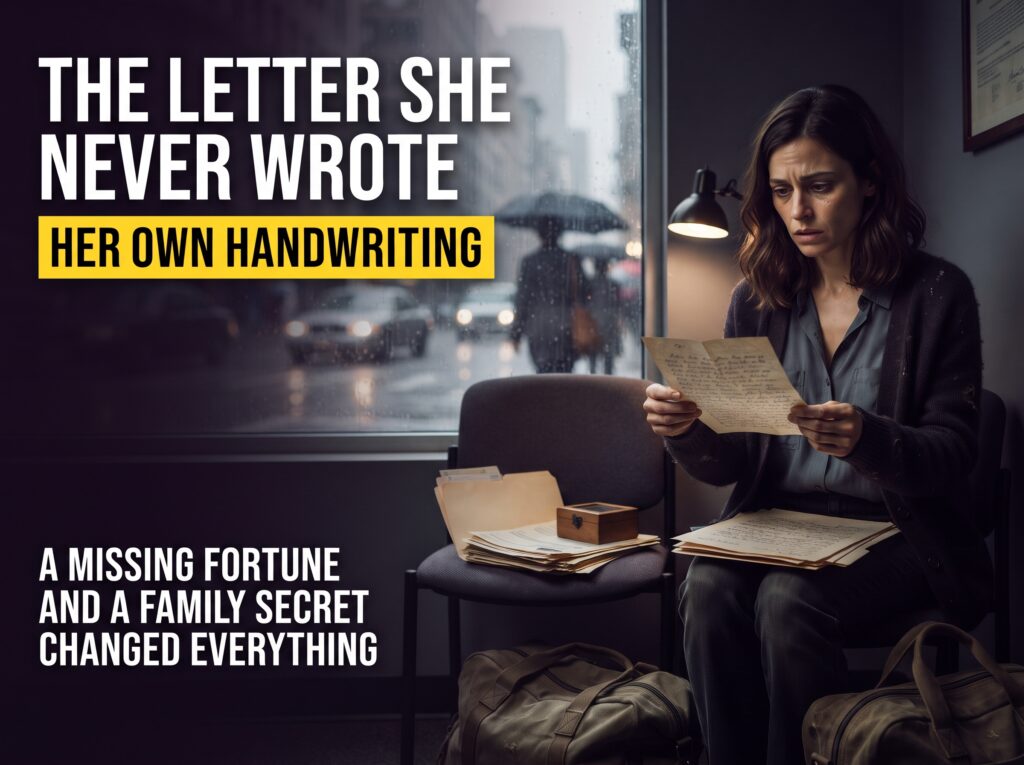
The rain had been falling since morning, turning the streets outside the shelter into long ribbons of gray water. Maya sat near a fogged window with two bags resting against her legs, watching strangers hurry past beneath umbrellas while she tried to convince herself that her life had not ended.
She had repeated the same sentence so many times that it had begun to sound like a prayer.
One bad month would not define the future.
She had said it when the electricity bill arrived. She had said it when her bank balance dropped lower than she had ever seen it. She had said it when the landlord gave her a final warning and when the person she had planned to marry told her that love could not keep them afloat forever.
Now she whispered it again.
“One bad month,” she murmured. “That’s all this is.”
A woman sitting across the waiting room looked up from her phone. She was perhaps sixty, with silver hair tucked beneath a woolen hat and a paper cup held between both hands.
“Sometimes,” the woman said gently, “one bad month feels like a whole lifetime.”
Maya offered a weak smile.
“I suppose it does.”
The woman returned to her phone, leaving Maya alone with the sound of rain against the glass.
She had been in the shelter for two nights. The first night, she had barely slept. Every sound in the corridor made her open her eyes, and every time someone walked past the door, she imagined that the person might be coming to tell her that she had to leave.
On the second night, exhaustion finally defeated fear.
She slept for four hours in a narrow bed with a thin blanket pulled to her chin. When she woke, she felt embarrassed by how grateful she was for a pillow, a locked door, and a place where nobody asked her to explain why she had nowhere else to go.
Her bags contained almost everything she owned.
A few changes of clothes. Her old laptop. A framed photograph she had not been able to throw away. A folder of financial documents. And a small wooden box containing the birthday cards, receipts, and handwritten notes she had collected during her relationship.
She had packed the box last.
For several minutes, she had stood in the apartment she once shared with Daniel, holding it against her chest.
She could have left it behind.
Perhaps she should have.
But the thought of abandoning the last physical evidence of the life they had planned together had hurt more than carrying it.
Daniel had once told her that they would never need much as long as they had each other.
They had said it while sitting on the floor of their first apartment, eating takeaway noodles because they could not afford a proper dining table. They had laughed about their cheap furniture and promised that one day they would look back on those early struggles with pride.
Maya had believed him.
For a long time, she had believed that love meant choosing the same future even when the present became difficult.
She had worked extra hours. She had postponed buying new clothes. She had stopped visiting friends because every unnecessary expense seemed to push them further away from stability.
When Daniel’s income became irregular, she took on more responsibility without complaining.
When unexpected bills arrived, she paid what she could and promised herself that the next month would be easier.
But the next month was never easier.
The money disappeared faster than either of them could explain.
At first, the amounts were small enough to dismiss. A missing payment here, an unfamiliar transaction there. Daniel said the bank had made a mistake. Later, he said an old debt had resurfaced. When Maya asked to see the paperwork, he told her that he was handling it.
She wanted to trust him.
Trust had always been the easiest part of their relationship, and she had never imagined that it could become the most expensive.
The final argument happened on a Thursday evening.
Maya remembered the kitchen light flickering above the sink. She remembered the two unpaid bills on the table and the way Daniel stood with his hands pressed against the edge of the counter.
“We can’t keep doing this,” he said.
“Doing what?”
“Living as if everything will somehow work itself out.”
Maya stared at him.
“I’ve been working every extra shift I can get. I’ve cut everything I can cut. What else do you want me to do?”
“I want you to stop pretending that effort fixes everything.”
The words struck her because she had spent months believing that effort was precisely what would save them.
“Then tell me what’s happening,” she said. “Show me the statements. Let me understand the debt.”
Daniel looked away.
“Not tonight.”
“Then when?”
He did not answer.
She waited until the silence became unbearable.
“Daniel, are we in trouble because we don’t have enough money, or because there’s something you’re not telling me?”
He looked at her then, and she saw something in his expression she had never seen before.
Fear.
Not fear of losing the apartment. Not fear of another bill.
Fear of being asked a question he could not answer.
“I can’t do this anymore, Maya.”
She felt the room tilt.
“What does that mean?”
“It means I need to leave.”
“Leave for tonight?”
He shook his head.
She remembered the way she reached for his hand, and how he moved it before she could touch him.
“Please,” she whispered. “Whatever this is, we can face it together.”
He looked at the unpaid bills.
Then he said the sentence that ended the life she thought she knew.
“Maybe we should have stopped trying a long time ago.”
Three weeks later, Maya found herself in the shelter, wondering whether she had misunderstood every promise he had ever made.
She had lost the apartment, most of their savings, and the future she had imagined.
But the most painful part was not knowing why.
She had no explanation for the missing money. No clear account of the debts. No honest answer about whether Daniel had been protecting her, using her, or hiding something he was too ashamed to confess.
She took the folder from her bag and opened it.
Bank statements. Old receipts. A copy of the lease. A list of payments she had made during the final months of the relationship.
She had checked them dozens of times.
Still, she believed there was something she had overlooked.
A date. A name. A signature.
Something that would make the last few months finally make sense.
Her phone vibrated.
An unknown number had sent a message.
We need to talk about what happened before Daniel left.
Maya read it twice.
Then another message appeared.
Don’t throw away anything you find among your old papers.
She looked toward the shelter’s entrance.
Outside, the rain continued falling.
For the first time since Daniel walked away, Maya felt that someone else knew how her life had fallen apart.
And that person was afraid she might discover the reason.
<h2>Part 2</h2>
Maya replied to the unknown number.
Who is this?
The message showed as delivered, but no answer came.
She waited five minutes, then ten. Eventually, she called the number. It rang several times before a recorded voice told her that the subscriber was unavailable.
She put the phone down and tried to concentrate on the documents spread across her lap.
The shelter had become busier as the afternoon progressed. A young father arrived carrying a sleeping child. Two women spoke quietly near the reception desk. Somewhere down the corridor, a door closed, followed by the muffled sound of someone crying.
Maya felt guilty for being absorbed in her own problems when everyone around her was fighting battles of their own.
But the message had unsettled her.
Someone knew about Daniel’s departure.
Someone believed there were old papers she needed to examine.
And someone had chosen to contact her without revealing their identity.
She returned to the folder.
At the bottom was a small envelope containing receipts she had collected while organizing their finances. Most were ordinary: grocery purchases, electricity payments, rent transfers, and a receipt for a repair Daniel had arranged shortly before their breakup.
She sorted them by date.
The unfamiliar transactions began in late autumn, several months before Daniel left. Some were payments to a company she did not recognize. Others were transfers to an account identified only by a reference number.
She had asked Daniel about those payments at the time.
He told her they were related to an old financial problem that he was trying to resolve.
When she asked what the original problem had been, he said that explaining it would only make her worry.
She remembered believing him because she wanted to be the kind of partner who did not turn every difficult conversation into an interrogation.
Now she wondered whether her silence had allowed the problem to grow.
She picked up her phone and opened their old messages.
The first unfamiliar transfer had occurred on October 14.
Two days earlier, Daniel had sent her a message saying that he had finally found a way to settle a debt that had been troubling him for years.
She searched the conversation for the word debt.
There were more messages than she expected.
Some referred to money he owed before they met. Others mentioned an agreement with a person he called only the contact. One message said that everything would be resolved if the final paperwork could be found.
Maya read it again.
If we can find the original, none of this should have happened.
She felt a chill.
The message was dated six weeks before the breakup.
She searched the conversation further, but there were no details about the original document. Whenever she had asked for an explanation, Daniel had changed the subject.
She had interpreted that behavior as embarrassment.
Now she suspected it might have been fear.
At four o’clock, a shelter worker approached her.
“Maya? There’s a phone call for you at reception.”
She stood so quickly that the folder slid to the floor.
“Who is it?”
“The caller didn’t give a name. They asked whether you were staying here.”
Maya’s stomach tightened.
“Did you tell them?”
“No. We don’t share residents’ information without permission. I told them you could return the call if you wanted.”
Maya thanked her and walked to reception.
The worker handed her a small slip of paper with the number written on it.
“This person sounded worried,” she said. “Not angry. Just worried.”
Maya stared at the number.
It was different from the one that had sent the messages.
She called.
A man answered almost immediately.
“Maya?”
“Who are you?”
“My name is Robert. I knew Daniel’s family a long time ago.”
“How did you get my number?”
“Daniel gave it to me several months ago. He said that if anything happened and you started asking questions about the old agreement, I should contact you.”
Maya gripped the phone.
“What old agreement?”
There was a pause.
“Have you found a letter?”
“No.”
“Any documents with a signature?”
She thought of the bank statements and receipts.
“Not yet.”
“Then listen carefully. Don’t sign anything anyone gives you until you’ve had it checked.”
“Why would I sign anything?”
“Because someone may tell you that you owe money you never agreed to borrow.”
Maya felt her knees weaken.
“Who is telling me that?”
“I don’t know what you’ve been told. I only know that the original records were never properly resolved.”
“Robert, what does this have to do with Daniel?”
He exhaled slowly.
“More than he wanted you to know.”
Maya looked at the reception desk, where a shelter worker was helping the young father fill out a form.
“Can you tell me what happened?”
“Not over the phone. I need to see the documents first.”
“What documents?”
“The ones you may find among your old belongings. There should be a record connected to a promise made before your relationship began.”
Maya closed her eyes.
She had believed their financial troubles began when Daniel lost work and their expenses increased.
Now a stranger was telling her that the problem might have existed long before they had met.
“Where can I find you?” she asked.
Robert gave her an address and promised to meet her the following afternoon.
Before ending the call, he said one more thing.
“If you find a letter written in your own handwriting, don’t assume that you wrote it.”
Maya went completely still.
“What did you say?”
But the line had already disconnected.
She stood at reception with the phone pressed against her ear.
She had not told Robert about any letter.
She had not told anyone about the wooden box, the old birthday cards, or the handwritten notes she had kept from her relationship.
Yet he had described something so specific that it felt as though he had been standing beside her while she packed her bags.
She returned to the waiting room and gathered her documents.
For the first time, she was no longer searching only for an explanation of the breakup.
She was searching for a letter that might not have existed until someone decided she needed to find it.
And she was beginning to fear that the person who had written it knew far more about her life than she did.
<h2>Part 3</h2>
The following morning, Maya asked the shelter worker whether she could leave her bags in a secure storage room while she went to meet Robert.
The worker agreed.
Maya packed the financial documents into a smaller folder and kept her phone, identification, and money in her handbag. She had learned quickly that losing a home made every ordinary object feel important. A misplaced document could mean hours of searching. A dead phone could mean losing contact with the few people willing to help.
Robert had given her the address of a small office above a bookkeeping business.
The building stood on a quiet street lined with old shops. Rainwater dripped from the awning, and the windows were clouded with dust.
Maya arrived ten minutes early.
A man in his late sixties opened the door when she knocked. He wore a brown cardigan and reading glasses, and he studied her face with an expression that was difficult to interpret.
“You look like your mother,” he said.
Maya stiffened.
“You knew my mother?”
“Not well. I knew your father better.”
“My father?”
Robert stepped aside.
“Come in. We should talk.”
The office contained two desks, a filing cabinet, and shelves filled with old folders. A kettle stood beside a stack of paper cups. On the wall hung a faded photograph of a group of men standing outside a warehouse.
Robert followed her gaze.
“Your father worked there for a while,” he said. “Before you were old enough to remember.”
Maya sat down.
“I don’t understand why you contacted me.”
Robert placed a folder on the desk.
“Because I believe the financial problem you and Daniel experienced is connected to something that happened long before you met him.”
He opened the folder and showed her a copy of a document.
It was a record of a financial arrangement involving several people. The language was formal, and some of the figures had faded, but one name was clear.
Her father’s.
Maya read the page carefully.
“Why would my father have anything to do with Daniel’s debt?”
“Your father and Daniel’s father knew each other. They worked together for a period, and they became involved in an agreement that was supposed to protect money belonging to several families.”
“What kind of agreement?”
“One that depended on accurate records and a final confirmation. The confirmation was supposed to be signed after the money had been accounted for.”
“Was it signed?”
Robert shook his head.
“That is the problem. Some records suggest it was. Others suggest it was never completed.”
Maya looked at the document again.
“Then why did Daniel keep paying money?”
“Because someone told him that the debt remained outstanding.”
“Who?”
Robert hesitated.
“I don’t want to accuse anyone without evidence.”
“Everyone keeps saying that to me. Nobody wants to accuse anyone, but somehow I’m the one sitting in a shelter with two bags.”
Her voice broke on the last word.
Robert lowered his eyes.
“You’re right to be angry.”
“No, I want an answer.”
“I know.”
He turned another page.
“Daniel contacted me several months before he left you. He believed he had found a way to resolve the problem. But he discovered that the original agreement was missing.”
Maya remembered the message about finding the original document.
“What did he do?”
“He began searching for it. He asked people who had worked with your father. He checked old accounts and requested copies of documents. He also began making payments because he believed that failing to pay would create even more trouble.”
“Did he tell me?”
“Not everything.”
“Why?”
Robert folded his hands.
“Because he thought he could resolve it before you became involved. And because he was ashamed of how much money he had already lost.”
Maya stared at the desk.
She could understand shame. She knew what it felt like to avoid opening a bill because the number at the bottom might be worse than the one she expected.
But Daniel had not simply hidden his fear.
He had allowed her to build a life around incomplete information.
“Was he trying to protect me?”
Robert did not answer immediately.
“I believe he wanted to protect you. But wanting to protect someone does not mean every decision you make for them is right.”
Maya looked up.
For the first time, someone had acknowledged the difference between intention and consequence.
Robert reached into the folder and removed a photograph.
It showed a small wooden box sitting on a desk. Beside it was a stack of papers held together by a rubber band.
Maya recognized the box.
It was the same box she had packed into her bag before leaving the apartment.
Her mouth went dry.
“Where did you get that photograph?”
“Your father gave it to me years ago. He told me that if the original records could not be found, I should look for a box containing his personal papers.”
Maya leaned forward.
“That box is mine now.”
Robert’s expression changed.
“You have it?”
“Yes.”
“Have you opened it?”
“Not completely.”
“Then you should.”
She stood.
“I brought the documents I found.”
She opened her folder and placed the receipts and bank statements on the desk.
Robert examined them carefully. He stopped at a payment record and looked at the date.
“Where did you find this?”
“In our old apartment.”
He placed it beside the copy of the original agreement.
“This payment corresponds to the period when Daniel began looking for the missing confirmation.”
Maya felt her heart begin to race.
“Does it mean he was paying a debt that wasn’t his?”
“It means we need to establish what the payment was for.”
Robert returned the receipt to her.
“Bring the wooden box tomorrow. Bring every letter, even the ones you think are unimportant.”
Maya gathered her papers.
At the door, she turned back.
“Robert, why did you tell me not to assume I wrote a letter in my own handwriting?”
He looked at her for a long moment.
“Because your father once told me that someone had copied your handwriting from a letter you sent him when you were a child.”
Maya felt the blood drain from her face.
“Who copied it?”
“I don’t know.”
“Why would anyone do that?”
Robert shook his head.
“That is the question we’ve been trying to answer.”
Maya left the office with the photograph of the wooden box in her mind.
She had thought the box contained memories.
Now she wondered whether it contained evidence.
And if someone had copied her handwriting years earlier, the mystery might not have begun with Daniel’s debt at all.
It might have begun when she was still a child.
<h2>Part 4</h2>
Maya returned to the shelter and collected her bags.
She waited until evening, when the common room had quieted, before opening the wooden box.
The lid creaked as she lifted it.
Inside were birthday cards, old photographs, a few receipts, and handwritten notes from Daniel. Beneath them lay a bundle of letters tied with a faded blue ribbon.
Most were addressed to her father.
Some were written in his handwriting. Others came from people whose names she did not recognize.
She spread them across the bed.
The first letter described an ordinary family matter. The second referred to a payment that had been delayed. The third mentioned an agreement and asked whether the original documents had been secured.
Maya read each one slowly.
The letters seemed to tell a story that had been interrupted before anyone could finish it.
One person believed the money had been accounted for. Another believed an obligation remained outstanding. A third warned that the original records needed to be preserved.
The same uncertainty appeared repeatedly.
Then Maya found a small envelope at the bottom of the box.
Her name was written across the front.
The handwriting was hers.
She recognized the rounded letters, the narrow spacing, and the way she crossed the final line of the letter M.
But she had never seen the envelope before.
Her hands began to shake.
She turned it over.
There was no return address and no date.
The seal had already been broken.
Inside was a single page.
The first sentence read:
I know what happened to the money, and I know why nobody has told you.
Maya sat down hard on the bed.
She read the sentence again.
The letter continued for several paragraphs, describing a financial arrangement, a missing document, and a promise that had been made before she understood what any of those things meant.
The writer claimed that the truth had been hidden to protect the family from a scandal.
But the letter did not name the person responsible.
Instead, it ended with a warning.
If you have found this letter, do not trust the first person who offers to explain it.
Maya placed the paper on the blanket.
She wanted to call Robert immediately, but she remembered his warning.
Bring every letter.
Don’t assume you wrote it.
She examined the page more carefully.
The handwriting looked like hers, but the language did not sound like her. The sentences were formal and distant, unlike the short, emotional notes she usually wrote.
She checked the paper.
It was older than the receipts she had collected during her relationship, but she could not tell how old.
She searched the box for another letter with a similar style.
At the very bottom, beneath a photograph of her father, she found a second envelope.
This one had been sealed.
Her name appeared on the front again, written in the same handwriting.
Maya hesitated.
Then she opened it.
Inside was a photocopy of a document bearing her signature.
The signature matched the one on the first page.
She stared at it, unable to understand what she was seeing.
The document appeared to acknowledge responsibility for a financial obligation. It contained her name, an account reference, and a date from a period when she had been too young to have any involvement in such an agreement.
She looked at the date again.
She had been a child.
The document could not possibly have been a genuine agreement signed by her as an adult.
Someone had used her name.
Someone had copied her handwriting.
And someone had kept the evidence hidden inside a box that had passed from her father’s possession into hers.
Her phone rang.
It was Daniel.
“Maya, where are you?”
“At the shelter.”
“Have you opened the box?”
She froze.
“How do you know about the box?”
He was silent.
“Daniel?”
“I need you to listen to me. Don’t show those papers to anyone until I get there.”
“Why?”
“Because I think I know what they are.”
“Then tell me.”
“I can’t explain it over the phone.”
Maya felt anger rising beneath her fear.
“That’s what you always say.”
“I know.”
“Everyone has been telling me to wait, to trust them, to stop asking questions. I’m finished with that.”
Daniel’s voice broke.
“Maya, please. I think someone used your name to keep an old debt alive. If that’s true, we need to be careful about what we do next.”
She looked at the document on her bed.
“Someone used my name when I was a child.”
The silence on the other end lasted several seconds.
Then Daniel whispered, “You found the second envelope.”
Maya gripped the phone.
“What second envelope?”
He took a shaky breath.
“The one your father said must never be opened unless the original agreement was found.”
Maya looked down at the papers.
She had already opened it.
And somewhere in the history of her family, a secret had been waiting for the moment she finally did.
<h2>Part 5</h2>
Daniel arrived at the shelter shortly after eight.
He looked exhausted, with dark circles beneath his eyes and rainwater on his jacket. Maya met him in the reception area rather than allowing him into the room where she kept her belongings.
“Tell me everything,” she said.
Daniel looked at the papers in her hand.
“I don’t know everything.”
“Then tell me what you do know.”
He sat down.
“When we first started having money problems, I thought the debt was mine. Someone showed me a statement and said the original agreement had never been closed. They told me that if I paid the remaining balance, the matter would finally disappear.”
“Who showed you the statement?”
“A person who had handled the records for our families.”
“Robert?”
“No. Robert was the one who tried to help me find the original agreement.”
Maya waited.
Daniel continued.
“I made the first payment because I thought it was the responsible thing to do. Then another amount appeared. When I questioned it, they told me the earlier payment had covered only part of the obligation.”
“How much did you pay?”
He gave her a figure.
Maya closed her eyes.
The amount was far greater than she had imagined.
“Why didn’t you tell me?”
“Because I thought I could fix it before it affected you.”
“It affected me anyway.”
“I know.”
“You let me pay the bills while you were sending money to someone else. You let me believe we were simply struggling.”
Daniel lowered his head.
“I was ashamed.”
“Of what?”
“Of being unable to solve it. Of losing the money. Of admitting that I had trusted someone who might have been lying to me.”
Maya looked at the papers again.
“Did you know someone had used my name?”
“Not at first.”
“When did you find out?”
“Three months before I left.”
She stared at him.
“You knew for three months?”
“I found a copy of the document. I thought it was a mistake. Then I realized the date was wrong.”
“And you still didn’t tell me?”
“I wanted to find the original before I said anything. I was afraid that if I confronted the person too soon, they would destroy whatever evidence remained.”
Maya felt the old hurt return.
“You made that decision for both of us.”
Daniel nodded.
“Yes.”
For several seconds, neither of them spoke.
Maya had imagined this conversation many times. In her imagination, Daniel would deny everything or accuse her of being unreasonable. She had expected anger.
She had not expected him to look so ashamed.
But his shame did not repair the damage.
“You left me without a home,” she said quietly.
“I know.”
“You let me believe that I had failed to build a life with you.”
“I know.”
“And you knew there was a document with my name on it that I had never signed.”
Daniel covered his face with both hands.
“I was wrong.”
Maya looked away.
She wanted him to understand that admitting his mistake was not the same as undoing it.
She had spent weeks in a shelter, wondering how she would pay for food and whether she could afford a room of her own. She had carried her belongings from place to place while trying to understand why the person she loved had left without explaining the truth.
Now he was asking her to trust him again.
She did not know whether she could.
“What does the letter mean?” she asked.
Daniel looked up.
“I think your father wrote it after he discovered that someone had copied your handwriting. He wanted to preserve evidence, but he didn’t know how to prove what had happened.”
“Why did he keep it hidden?”
“Because he was afraid that accusing the wrong person would destroy the family.”
Maya gave a bitter laugh.
“So everyone stayed silent to protect the family, and the silence destroyed it anyway.”
Daniel had no answer.
He looked at the documents.
“The original agreement is still missing. Without it, we can’t establish what the payments were meant to cover or whether the claimed debt is valid.”
“Robert said the original might still exist.”
“Then we need to find it.”
Maya shook her head.
“We need to let the lawyer handle it. I’m not going to confront anyone without proper evidence.”
Daniel seemed surprised.
Then he nodded.
“You’re right.”
It was the first time he had agreed with her without trying to change her mind.
Maya placed the letters back in their envelope.
“I’ll give the lawyer copies tomorrow. You can provide whatever records you have. But I’m not promising that things between us will return to the way they were.”
“I understand.”
He stood.
Before he left, he turned toward her.
“There is one more thing.”
Maya felt her stomach tighten.
“What now?”
“The person who showed me the debt statement said the original agreement had been signed by your father, but they also claimed that your mother had witnessed it.”
Maya stared at him.
“My mother never mentioned any agreement.”
“I know.”
“Did you ask her?”
“Yes. She said she had never seen the document.”
Maya looked down at the envelope.
Her mother’s name had appeared in none of the papers she had examined.
If Daniel was telling the truth, someone had not only copied Maya’s handwriting but had also claimed that her mother had witnessed an agreement she denied knowing about.
The mystery was no longer limited to the missing money.
It involved the people who had shaped Maya’s childhood, the promises they had made, and the truths they had chosen to hide.
And the next person she needed to speak to was her mother.
<h2>Part 6</h2>
Maya called her mother the next morning.
She had not told her everything about the shelter. She had said only that she and Daniel had separated and that she was staying somewhere temporary while she looked for a room.
Her mother had offered to send money, but Maya had refused because she did not want to worry her.
Now she regretted keeping so much to herself.
“Mom, I need to ask you something about Dad.”
There was a pause.
“What about him?”
“Did he ever sign a financial agreement involving another family?”
Her mother did not answer immediately.
Maya heard the faint sound of a television in the background, followed by a door closing.
“Why are you asking?”
“Because I found some documents. They suggest that someone used my name in connection with an old debt.”
Her mother inhaled sharply.
“Where did you find them?”
“In the wooden box Dad left behind.”
Another silence followed.
Maya felt her heart pounding.
“Mom, what do you know?”
Her mother spoke carefully.
“Your father had a financial problem years ago. He was helping someone he believed had been treated unfairly. He thought he could resolve it quietly, but the matter became more complicated than he expected.”
“Was it a debt?”
“At first, it wasn’t described that way.”
“What was it?”
Her mother hesitated.
“Money was placed in safekeeping while several people tried to settle a dispute. Your father believed the money would be returned once the paperwork was completed.”
“Was the paperwork completed?”
“I don’t know.”
“Did you witness the agreement?”
“No.”
“Then why would someone claim that you did?”
Her mother began to cry softly.
“I was afraid of this.”
Maya sat down on the edge of her bed.
“Afraid of what?”
“That one day the old matter would come back and hurt you.”
“Mom, someone has already hurt me. I’ve lost my relationship, my home, and most of my savings. I need the truth.”
Her mother took a shaky breath.
“Your father kept some of the records in his office. After he became ill, he asked me to help him organize them. I found letters that suggested the money had not been accounted for properly.”
“Why didn’t you tell anyone?”
“Because your father believed the matter could still be resolved. He asked me not to involve the family until he knew what had happened.”
Maya closed her eyes.
“Did he know someone had copied my handwriting?”
“I found a letter that suggested it, but I never understood what it meant. You were young. You used to write notes to your father and leave them on his desk. He kept every one of them.”
Maya remembered writing little messages when she was a child.
I love you, Dad.
Don’t forget to bring bread.
I’m sorry I broke the cup.
She had never imagined that something so ordinary could become part of a financial dispute.
“Who had access to those letters?” she asked.
“Several people. Your father kept them in his office. After he died, Daniel helped organize the papers.”
“Did Daniel take them?”
“I don’t know.”
Maya rubbed her forehead.
Every answer seemed to open another door.
“Mom, did Dad ever tell you who he believed was responsible for the missing money?”
Her mother was quiet for so long that Maya thought the call had disconnected.
Then she said a name.
It was the same name that appeared in Robert’s records.
Maya felt a cold sensation move through her body.
“Why didn’t you tell me before?”
“Because I had no proof. Your father trusted that person for years. I didn’t want to accuse someone based on incomplete information.”
Maya understood the fear, but she could no longer accept silence as a solution.
“Mom, I need you to tell the lawyer everything you remember. Even if you’re uncertain. We can separate what you know from what you suspect.”
Her mother agreed.
After the call, Maya sat quietly with her phone in her hand.
She had spent so long believing that the breakup had exposed her personal failure. She had blamed herself for not earning enough, for not asking the right questions, and for not recognizing that Daniel was frightened.
Now she could see that the financial trouble had a history.
The missing money was connected to an arrangement made before her relationship began. The records had been incomplete for years. Her father’s letters suggested that he had tried to protect the family, while the person maintaining the records had allowed the dispute to remain unresolved.
But the most disturbing detail was still the document bearing Maya’s name.
Someone had copied her handwriting from childhood letters and used it on a paper connected to an agreement she had never signed.
The lawyer needed the original document to determine what had happened.
Until then, Maya would not accuse anyone.
She would preserve the evidence and let the records speak.
That afternoon, her mother sent her a photograph of an old letter.
It was written by Maya’s father shortly before his death.
The message was brief.
If the original is ever found, the person who has been paying the debt will finally understand why it should never have been transferred.
Maya read the sentence several times.
The letter did not explain who had been paying the debt or why the obligation had been transferred.
But it suggested that her father had known something the rest of them had never understood.
And somewhere, hidden among the missing records, was the original agreement that could finally explain it.
<h2>Part 7</h2>
The lawyer arranged a formal meeting with Robert, Daniel, and Maya’s mother.
Everyone brought the documents they had found.
For the first time, the separate pieces of the mystery were placed on the same table.
Robert began by explaining the original financial arrangement. He had helped maintain records for the people involved, but he had not controlled every payment or witnessed every signature.
Maya’s father had believed that money held in safekeeping would be returned once a dispute was resolved. Another person had maintained the account and handled the paperwork.
When the final confirmation failed to appear, the parties disagreed about whether the obligation had been completed.
Some believed the balance remained outstanding.
Others believed the money had already been accounted for.
The missing original document prevented anyone from proving which version was correct.
Daniel explained the payments he had made. He had believed that paying the claimed balance would protect Maya and allow them to move forward.
Instead, each payment had led to another demand.
The lawyer recorded the amounts and asked for supporting statements.
Maya’s mother provided the letter she had found after her husband’s death. She explained that her husband had warned her not to allow anyone to transfer the disputed obligation to Maya without showing her the original agreement.
Robert read the letter carefully.
“I remember your father saying something similar,” he said. “He was worried that the records would be used to make someone else responsible for a problem they hadn’t created.”
Maya looked at him.
“Did he know who would be blamed?”
Robert shook his head.
“Not with certainty.”
The lawyer asked whether anyone had seen the original agreement after the disputed payments began.
Robert said that he had seen a copy, but not the original.
Daniel said he had been told the original was missing.
Maya’s mother said her husband had believed it was being kept in a secure file.
Each account contradicted part of another.
The lawyer asked everyone to stop speculating and focus on what could be verified.
He requested the complete financial statements, the original document, and the source records for the later paper bearing Maya’s name.
The person who had maintained the account was formally asked to provide the relevant files.
For several days, there was no response.
Then the lawyer received a message.
The original agreement had been located.
It was stored in an archive belonging to the business that had handled the account years earlier.
The lawyer arranged to inspect it.
Maya was not allowed to take the document home, but she was present when it was examined.
The paper was old and slightly discolored. Several signatures appeared at the bottom, including her father’s.
Maya studied the clauses.
The agreement described the money placed in safekeeping and the conditions under which the arrangement would be closed. It did not assign the debt to Maya.
The lawyer compared it with the later document.
There were differences in wording, formatting, and dates.
Most importantly, the original agreement contained no provision transferring the obligation to Maya simply because she was related to her father.
The lawyer explained that the original document did not resolve every question about the outstanding balance, but it provided important evidence that the later document had changed the terms of the arrangement.
The source of that change still needed to be established.
Maya looked at the signature on the original agreement.
Her father’s handwriting was familiar.
She remembered the way he signed birthday cards, the way he wrote shopping lists, and the way he labeled the boxes he kept in his office.
For the first time, she could examine one of his old documents without wondering whether he had deliberately left her with a debt.
He had made a promise.
He had tried to preserve the records.
And he had warned others not to transfer the obligation to her without her consent.
The lawyer placed the later document beside the original.
“These papers need to be examined independently,” he said. “We cannot conclude who created the later document from appearance alone.”
Maya agreed.
She had spent enough time living with uncertainty to know how damaging an unsupported conclusion could be.
When the meeting ended, Daniel walked with her toward the exit.
“I wish I had found the original before everything fell apart,” he said.
“So do I.”
He looked at her.
“Do you think we could have stayed together?”
Maya considered the question.
“Maybe. But we can’t know that now.”
Daniel nodded.
“I should have trusted you.”
“Yes.”
He looked away.
“I thought I was protecting you.”
“I know. But protecting me would have meant letting me understand what was happening.”
He accepted that without argument.
Outside, the sky was beginning to clear.
Maya returned to the shelter with a copy of the lawyer’s notes and a list of the remaining questions.
The original agreement had been found.
But the later document still carried her name, and the handwriting on the mysterious letter remained unexplained.
The investigation had reached the point where someone would have to account for the changes made to the records.
And Maya was finally ready to hear the answer, even if it meant discovering that the person who had hidden the truth was someone she had trusted for years.
<h2>Part 8</h2>
The independent review began two weeks later.
The lawyer submitted the original agreement, the disputed document, the handwritten letter, and examples of Maya’s genuine handwriting from different periods of her life.
The reviewer explained that no single feature could establish authorship with certainty. The age of the documents, the available originals, and the circumstances in which they had been created all mattered.
Maya waited.
She returned to work when she could and continued searching for a permanent place to live. She no longer carried the wooden box everywhere. Instead, she kept the documents in a secure folder and made sure that the lawyer had copies of everything important.
Daniel sent her updates about the financial records.
He had stopped making payments while the disputed balance was under review, following the advice he had received. He also provided the statements showing how much money he had transferred and when.
For the first time, Maya could see the full extent of the financial damage.
The payments had begun long before the breakup. Some were made directly from Daniel’s account. Others had come from the money they had saved together.
The records did not prove that every transaction was improper, but they showed that the total had grown while the underlying agreement remained unresolved.
Maya felt grief more than anger.
She had spent months believing that she and Daniel had failed because they could not earn enough money. In reality, they had been making decisions under the influence of information neither of them fully understood.
That did not excuse Daniel’s secrecy.
It did explain why their relationship had become trapped in a cycle of fear and mistrust.
One evening, Maya met her mother for dinner.
They chose a small restaurant near the bus station. The food was simple, and neither of them spoke much at first.
Eventually, her mother reached across the table.
“I should have told you about the old agreement,” she said.
Maya looked at her.
“Why didn’t you?”
“I was afraid that you would blame your father. I was afraid that people would accuse him of something he hadn’t done. And after he died, I wanted to believe the problem had disappeared.”
Maya held her mother’s hand.
“I understand why you were afraid. But I needed to know.”
Her mother nodded.
“I know that now.”
They talked about Maya’s childhood, the letters her father had kept, and the small things he used to write on scraps of paper. Her mother remembered how he would leave notes on the kitchen table when he worked late.
Maya remembered those notes too.
They were usually brief and ordinary.
Back soon.
Don’t forget your lunch.
Love you both.
She had never thought of handwriting as evidence. To her, it had always been a way of making ordinary feelings visible.
Now she understood that someone could copy the shape of a person’s words without understanding the person who had written them.
After dinner, her mother gave her a small envelope she had found among her own belongings.
It contained another childhood letter.
Maya recognized the writing immediately.
At the bottom was a tiny drawing she had made when she was eight years old.
She smiled despite herself.
For the first time in weeks, the sight of her own handwriting did not frighten her.
She placed the letter safely in her bag.
When she returned to the shelter, the lawyer called.
The preliminary review had identified significant differences between Maya’s genuine signature and the signature on the disputed document. The reviewer could not yet make a final determination because some of the source records were incomplete, but the differences required further investigation.
The lawyer also confirmed that the original agreement did not contain the transfer provision that appeared in the later document.
Maya sat on her bed and listened carefully.
“What does that mean for the debt?”
“It means the claim must continue to be examined. The evidence raises serious questions about the later document and whether it can support the obligation being claimed against you.”
“Could I still be held responsible?”
“That depends on the full evidence and the applicable legal process. We should not assume the outcome before the review is complete.”
Maya thanked him.
She had wanted a clear answer, but she understood that certainty could not be manufactured simply because she needed relief.
After the call, she took out the mysterious letter again.
The handwriting looked exactly like hers.
Yet the words seemed to belong to someone who knew her life from the outside, someone who had assembled pieces of her history and arranged them into a message she had never chosen to write.
She read the final sentence.
If you have found this letter, do not trust the first person who offers to explain it.
Maya had originally interpreted the warning as a threat.
Now she wondered whether it had been written by someone trying to protect her from being misled again.
But the letter still did not reveal who had written it.
And until the handwriting and the documents were fully examined, Maya could not know whether the message had been intended as a warning, a confession, or another attempt to control what she believed.
<h2>Part 9</h2>
The final report arrived on a Monday morning.
Maya was sitting in the shelter’s common room when her phone rang. The lawyer explained that the review had been completed and asked her to come to his office that afternoon.
She spent the hours waiting by organizing her belongings and preparing herself for the meeting.
She tried not to imagine a particular outcome.
For months, she had allowed hope to rise every time a new document appeared, only to have it collapse when another question remained unanswered.
This time, she decided to listen first.
At the office, the lawyer placed the report on the table.
The review found that the signature on the later document could not be reliably attributed to Maya based on the available evidence. The handwriting analysis identified differences that supported her account that she had not signed the document, although the report did not identify who had written it.
The original agreement also contained no provision automatically transferring the obligation to Maya.
The lawyer explained that the findings would be submitted as part of the formal dispute over the debt.
The outstanding balance still required reconciliation, and the records did not establish that every payment had been properly credited.
Maya listened carefully.
“So the report doesn’t tell us who created the document?”
“No,” the lawyer said. “It establishes what can and cannot be supported by the evidence we have.”
She nodded.
For the first time, she understood that an investigation did not always end with a single person admitting everything. Sometimes it established boundaries around what could be proven.
She knew that the disputed debt was not automatically hers simply because her name appeared on a page. She knew that the original agreement did not contain the transfer clause described in the later document. She also knew that the missing records and unexplained payments still needed to be addressed.
That was enough to change how she approached the problem.
She would not accept the debt without proper evidence.
She would not make payments simply because someone insisted that she was responsible.
And she would not allow the uncertainty to become another reason to blame herself for everything that had gone wrong.
Daniel arrived shortly afterward.
The lawyer gave him a copy of the report and explained the findings.
Daniel read the pages slowly.
When he finished, he looked at Maya.
“I’m sorry.”
She waited.
“I kept telling myself that if I could pay the money, everything would return to normal. I thought I was fixing the problem. But I was making decisions without knowing whether the debt was even valid.”
Maya felt the old pain stir.
“You were also making those decisions with our money.”
“I know.”
“You let me believe we were failing because we weren’t working hard enough.”
Daniel lowered his eyes.
“I know.”
For a moment, she wanted to ask whether he had ever considered telling her the truth before she lost the apartment.
But she already knew the answer.
He had been afraid.
She had been afraid.
Their fear had not been identical, and their choices had not caused equal harm. But both of them had spent too long avoiding conversations that might have changed the outcome.
“I can’t promise that I’ll forgive everything,” she said.
Daniel nodded.
“I understand.”
“But I don’t want to keep living inside what happened.”
He looked at her.
“What does that mean?”
“It means I’m going to rebuild my life. I’m going to deal with the debt through the proper process. I’m going to stop treating every unanswered question as proof that I’ve done something wrong.”
Daniel’s eyes filled with tears.
“I hope you can be happy.”
“So do I.”
They left the office separately.
Maya walked to the bus stop and sat beneath the shelter while the afternoon traffic passed.
She thought about the person who had created the later document and the letter in her own handwriting. The investigation had not established who had written either one, and she refused to invent an answer simply to make the story feel complete.
There were still questions.
There might always be questions.
But she no longer needed to solve every mystery before she could take the next step.
She had spent months believing that peace would arrive only when someone confessed, apologized, or explained everything.
Now she understood that peace could begin when she stopped allowing other people’s silence to determine what she believed about herself.
Her phone vibrated.
It was a message from her mother.
I’m proud of you for asking questions, even when the answers were difficult.
Maya read it twice.
Then she put the phone away and watched the buses move through the rain.
She had not recovered everything she had lost.
She had not restored her relationship with Daniel.
She had not learned who had written the letter.
But she had reclaimed the right to ask questions, to protect herself, and to build a future that did not depend on pretending the past had been simple.
For the first time, that felt like enough.
<h2>Part 10</h2>
Maya found a small apartment near the place where she worked.
It was not the home she had once imagined sharing with Daniel. The kitchen was narrow, the windows rattled when the wind grew strong, and the bedroom was barely large enough for her bed and a secondhand dresser.
But the rent was manageable.
The landlord gave her the keys on a Friday afternoon, and Maya stood in the empty living room for several minutes before setting down her bags.
There was no one to congratulate her.
No one to tell her that everything would be fine.
For a moment, the silence felt enormous.
Then she opened the window and let the cool air move through the room.
She unpacked slowly.
Her clothes went into the dresser. Her laptop went on the small table beside the kitchen. The financial documents went into a folder that she placed in a drawer, separate from the letters and photographs she had kept for sentimental reasons.
She did not want every memory of her old life to remain mixed with the evidence of what had happened.
Some things deserved to be remembered as love.
Other things needed to be understood as mistakes.
And some things had to remain unresolved until the truth could be established.
The debt dispute continued through the proper channels. Maya kept copies of the reports, answered requests for information, and refused to accept responsibility for an obligation she had never agreed to undertake.
She did not pretend that the process was easy. There were still forms to complete, records to check, and days when the uncertainty returned.
But she no longer faced those days alone.
Her mother called every Sunday.
Daniel sent occasional updates about the financial review. Their conversations remained careful, but they were more honest than they had been during the final months of the relationship.
Claire was no longer part of Maya’s daily life, and Maya stopped waiting for an explanation that would somehow restore what they had lost.
She had once believed that love required her to keep trying until the other person was ready to tell the truth.
Now she understood that love could not survive on one person’s patience alone.
It needed honesty, shared responsibility, and the willingness to let another person make informed decisions about their own life.
Several weeks after moving, Maya returned to the shelter to donate the blankets and clothes she no longer needed.
The woman with silver hair was sitting near the same window.
She recognized Maya immediately.
“You found somewhere to stay,” she said.
Maya smiled.
“I did.”
“How is it?”
“Small. A little cold. But it’s mine.”
The woman laughed softly.
“That sounds like a good beginning.”
Maya sat beside her for a few minutes and told her about the apartment. She did not describe every detail of the debt or the missing documents. She simply said that she had discovered some difficult truths and was learning to move forward.
The woman listened.
“Sometimes,” she said, “we spend so much time trying to understand why someone hurt us that we forget to ask what we need next.”
Maya looked toward the window.
She thought about the sealed envelope, the old agreement, the signature that did not belong to her, and the letter written in her own handwriting.
For months, those things had seemed to hold the key to her entire future.
Now they were part of her history.
Important, yes.
Unresolved in some ways, yes.
But no longer the only things that defined her.
That evening, Maya sat at the small kitchen table in her new apartment and opened the wooden box one final time.
She removed the childhood letters and arranged them neatly inside. She placed her father’s photograph on top.
Then she took out the mysterious letter.
She had considered throwing it away.
She had also considered keeping it somewhere she would never have to see it again.
Instead, she placed it in a separate envelope marked Unverified — Keep for Records.
She did not know who had written it.
She did not know why someone had copied her handwriting or why the message had been hidden among her father’s papers.
She refused to invent an explanation merely because uncertainty was uncomfortable.
The letter would remain evidence of a mystery that had not been fully resolved, not a verdict on who she was.
Maya closed the wooden box.
For the first time since leaving the apartment she had shared with Daniel, she felt that she could remember the past without being trapped inside it.
She remembered the good moments too: the cheap dinners, the laughter over broken furniture, and the promises they had made when the future seemed wide open.
Those memories had not become meaningless simply because the relationship had ended.
They were real.
So was the hurt.
She could carry both without allowing either to dictate what happened next.
Before going to bed, Maya checked the lock on her front door and placed her phone on the table.
The room was quiet.
There were no unpaid bills scattered across the kitchen counter. There was no one waiting for her to apologize for asking a question. There was no conversation she needed to postpone because she was afraid of what the answer might be.
She still had financial challenges ahead.
She still had questions about the missing money and the people who had handled the old agreement.
But she had learned to separate what she knew from what she feared, and what she was responsible for from what others wanted her to carry.
That distinction had changed everything.
Maya turned off the light.
Outside, rain began to fall again, tapping softly against the window.
She remembered the shelter waiting room, the two bags at her feet, and the belief that one terrible month had somehow erased every good thing she had ever done.
She wished she could return to that frightened version of herself and explain that losing a home did not mean she had lost her worth. That a relationship ending did not prove she had failed. That an unanswered question was not the same as an accusation.
Most of all, she wished she could tell herself that she did not have to solve every secret before she was allowed to begin again.
She could begin with what she knew.
She could protect the truth she had found.
And she could build a future that did not depend on someone else finally giving her permission to believe in herself.
The letter remained in the wooden box.
Its author remained unknown.
But Maya no longer needed to let those unanswered questions decide whether she deserved peace.
She had spent months searching for the person who had hidden the truth.
Now she was learning something more important.
She did not have to become the person who hid from it.