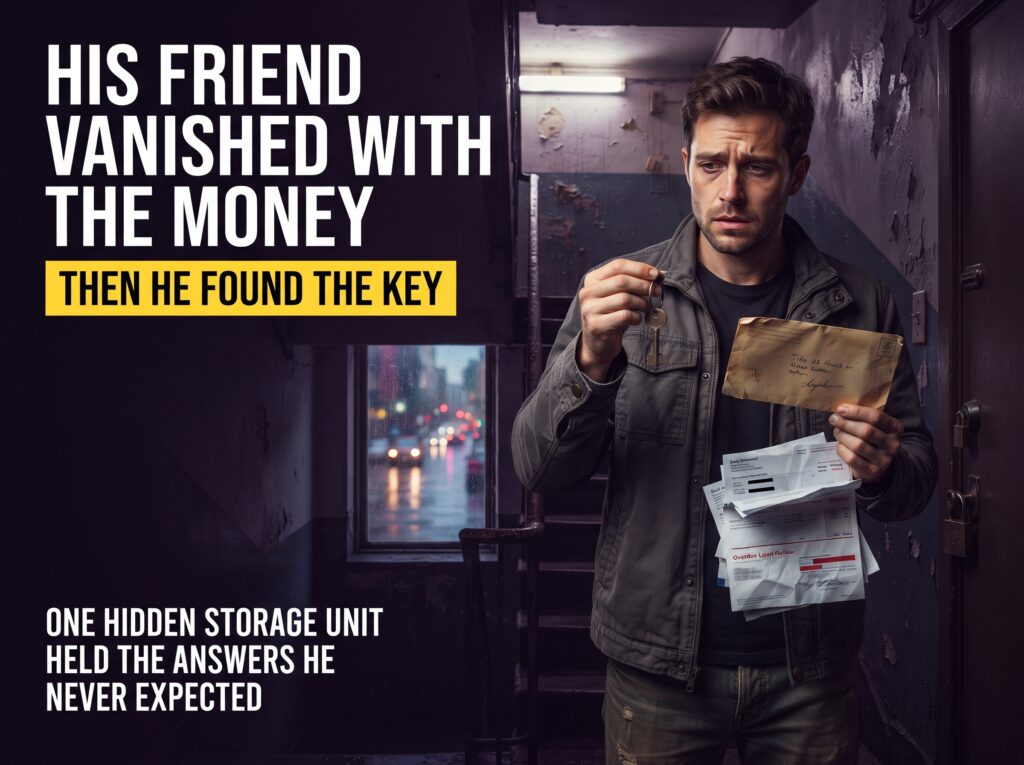
The stairwell smelled of damp concrete, old paint, and the faint metallic odor that seemed to cling to every building where people had lived too long without fixing anything. A weak ceiling light flickered above me, throwing my shadow across the locked apartment door.
I stood there with a folded piece of paper in my hand and a key in my pocket.
For nearly three months, I had imagined what I would say if I ever found Ben’s friend again.
Sometimes I imagined shouting until every unanswered question finally had a voice. Sometimes I pictured myself standing perfectly calm, asking why someone who had promised to repay a loan could disappear without even sending a message. On the worst nights, I imagined saying nothing at all. I would simply hand over the debt records and let the silence communicate everything I no longer had the strength to explain.
But standing outside that apartment, I realized I had prepared for every possibility except the one that frightened me most.
The person I had trusted might have disappeared because they were hiding something far worse than an unpaid debt.
I had met Ben several years earlier, when our lives were simpler and neither of us had much to lose.
We were not the sort of people who dreamed about becoming wealthy. We wanted ordinary things: rent paid on time, enough groceries to last until payday, a place where we could invite friends without apologizing for the broken furniture.
Ben could make almost anything feel manageable. When my car broke down, he spent an entire Saturday helping me repair it. When I lost work for several weeks, he brought groceries without making me feel indebted. When I told him that I was embarrassed about struggling financially, he laughed and said that money was only a problem if people allowed it to turn them against one another.
I believed him because he had lived that belief.
Our friendship grew through small acts of kindness rather than grand promises. We shared meals, helped each other move apartments, and spent long evenings talking about the futures we hoped to build.
Then Ben needed money.
He called me one evening, his voice unusually quiet.
“Can I ask you something?”
“That depends. Are you about to ask me to help you move again?”
He laughed, but the sound faded quickly.
“No. It’s serious.”
I sat down at my kitchen table.
“Tell me.”
He explained that an unexpected financial problem had left him short of money. He needed help covering several urgent expenses before the end of the week. He said he had already arranged to receive money that would allow him to repay me.
“How much do you need?” I asked.
He told me.
It was more than I could comfortably spare, but I had enough savings to help if I postponed a few plans and watched my spending for the next month.
“When will you be able to pay me back?”
“Three weeks. Maybe four, at the absolute latest.”
I hesitated.
Ben heard the silence.
“I wouldn’t ask if I had another option,” he said. “You know that.”
I did know him. Or at least, I believed I did.
We met the following day, and I transferred the money to him. He thanked me repeatedly, promising that he would never forget what I had done.
“You don’t owe me gratitude forever,” I told him. “Just keep your word.”
“I will.”
For the first few weeks, everything seemed normal.
Ben sent occasional messages, asked how I was doing, and told me that the problem was almost resolved. When the promised repayment date arrived, he said the money had been delayed.
I tried to be understanding.
Another week passed.
Then another.
Each time I asked, he offered a slightly different explanation. A bank transfer was taking longer than expected. A person who owed him money had failed to pay. Some paperwork had to be corrected.
I noticed the changes, but I did not want to believe they meant anything.
People could struggle. People could become embarrassed. People could avoid difficult conversations because they feared disappointing someone who had helped them.
I knew all of that.
What I did not understand was why Ben had begun avoiding me altogether.
His messages became shorter. Calls went unanswered. When I visited his apartment, he was never home, even though his lights were sometimes on.
Eventually, he stopped replying.
The silence was worse than anger.
Anger would have meant there was still a conversation to be had. Silence made me feel as though the friendship had been erased without my permission.
I continued paying my bills, but the missing money changed everything. I canceled a weekend trip, delayed replacing my shoes, and began checking my bank balance before buying even inexpensive groceries.
I told myself that I was being foolish for worrying so much.
The money might return tomorrow.
Ben might call tonight.
Everything might still be explained by an ordinary mistake.
But every passing day made those possibilities harder to believe.
The last time I saw him, we were standing in the corridor outside his apartment. He looked tired, and his eyes kept moving toward the stairwell as if he expected someone to arrive.
“Just tell me what’s happening,” I said.
“I’m dealing with it.”
“You’ve been dealing with it for weeks.”
“I said I’ll pay you back.”
“I know what you said. I’m asking why you won’t talk to me.”
He rubbed his face.
“Please. Not here.”
“Then where?”
He looked at me, and for a moment I thought he was about to confess everything.
Instead, he stepped backward through the doorway.
“I need some time.”
The door closed.
A week later, I learned that he had left the apartment.
Nobody seemed to know where he had gone.
His landlord said that he had removed most of his belongings. His phone was disconnected, and the few people who had heard from him offered contradictory explanations.
I told myself that I wanted the money back.
That was true, but it was not the whole truth.
I wanted to know whether the person who had once helped me through my worst days had ever considered what his disappearance would do to me.
Three months later, I found the key.
It was hidden inside an old envelope at the bottom of a drawer, beneath receipts and papers I had been meaning to organize. There was no label, only a small metal tag bearing a number.
I nearly threw it away.
Then I noticed the writing on the envelope.
It was Ben’s handwriting.
And beneath the key, in a sentence so brief that it made my heart begin to race, were the words:
If I disappear, look where nobody thinks to look.
<h2>Part 2</h2>
I read the sentence until the words seemed to lose their meaning.
If I disappear.
Ben had not written that he might move away or that he needed time. He had chosen a phrase that suggested he expected to become unreachable.
I sat at the kitchen table with the envelope beside my phone, trying to decide whether I should contact someone.
The police? His landlord? A mutual friend?
I had no evidence that Ben was in danger. I had no reason to believe that he had been harmed. He might simply have left because he could not face the consequences of borrowing money and failing to repay it.
But the note made that explanation feel incomplete.
I turned the key over in my fingers.
A number had been stamped onto the metal tag. There was no address, no business name, and no indication of what the key opened.
I searched through the papers in the drawer again.
The envelope had been hidden among old bills, a repair estimate, and a folded receipt from a hardware store. I recognized the date on the receipt. It was from the week before Ben disappeared.
The purchase was ordinary: a padlock, a small flashlight, and a box of storage labels.
I wondered why he would need those things.
Perhaps he had been preparing to move. Perhaps he had rented somewhere to keep belongings he could not fit into his apartment.
Or perhaps the key had nothing to do with his disappearance.
I could not know.
I opened our old message conversation and searched for references to storage, moving, or the number stamped on the tag.
Most of our exchanges were ordinary.
There were jokes, questions about work, and photographs of meals we had shared. There were also the messages about the loan.
I’ll have it sorted soon.
I’m waiting for confirmation.
I know I owe you an explanation.
The final message I had received from him was dated the night before he disappeared.
I’m sorry. I should have told you sooner.
At the time, I thought he meant the repayment delay.
Now I wondered whether he had been trying to tell me something else.
I called the number I had for him, even though I knew it was disconnected.
The recorded message played again.
I hung up and opened a search engine on my phone. I entered the number from the key tag alongside the words storage unit.
Nothing useful appeared.
I tried several variations, then checked the addresses of storage facilities near Ben’s old apartment.
There were more than I expected.
One was a large commercial facility beside a highway. Another stood behind a row of warehouses. A third occupied a converted industrial building in a neighborhood Ben had visited regularly.
I called the first two. Neither could identify a unit from the number alone.
The third facility had recently changed management, and the person who answered could not provide information without an address, account reference, or proof that I was authorized to access a unit.
I understood.
A key was not permission to open someone else’s property.
I was not going to break into a unit simply because I was worried about a friend who owed me money.
Still, I could not stop thinking about the note.
If I disappear, look where nobody thinks to look.
I examined the envelope again, hoping to find an address written faintly on the back.
There was nothing.
Then I noticed a small impression beneath the paper’s surface, as though someone had written on a sheet placed above it.
I angled the envelope toward the kitchen light.
The marks were faint, but a few letters became visible.
A street name.
I wrote it down and searched for it.
The street belonged to an industrial district on the other side of town. Several storage businesses operated nearby, including one that had been open for more than twenty years.
I called the facility.
A woman answered.
“Good afternoon. How can I help you?”
“I found a key with a unit number. I’m trying to identify the storage facility it belongs to.”
She asked for the number.
I gave it to her.
There was a pause.
“Do you have the account holder’s name?”
“Ben.”
“Ben what?”
I gave her his full name.
She asked me to hold.
For the first time in months, I felt a fragile sense of hope. Perhaps Ben had left something that would explain where he had gone. Perhaps there was a letter, a forwarding address, or a contact number.
The woman returned.
“I’m sorry. I can’t confirm account information to someone who isn’t authorized.”
“I understand. I’m not asking you to give me private details. I just need to know whether this key belongs to your facility.”
“I can tell you that the number format is consistent with our older units, but I can’t confirm the specific unit.”
“Could I speak to the manager?”
“The manager is available tomorrow morning. Bring identification and any documentation you have. They can explain what options are available.”
I thanked her and ended the call.
The key had led me somewhere.
That was enough for one evening.
I placed it in my wallet and gathered the documents related to the loan. If the manager could not confirm anything, I would leave. I would not make accusations or demand access to property that might not belong to me.
Before going to bed, I reread Ben’s final message.
I’m sorry. I should have told you sooner.
For months, I had interpreted it as an apology for the money.
Now I wondered what he had meant by sooner.
Sooner than the missed repayment?
Sooner than his disappearance?
Or sooner than something neither of us had ever discussed?
I put the phone down.
The next morning, I would visit the storage facility.
And for the first time since Ben vanished, I would be following a clue he had deliberately left behind.
<h2>Part 3</h2>
The storage facility stood behind a row of warehouses, surrounded by a high fence topped with coils of wire. The entrance was marked by a faded blue sign, and the office windows reflected the gray morning sky.
I arrived shortly after opening.
A man in a green work jacket sat behind the counter, sorting through a stack of folders. He introduced himself as Martin, the facility manager, and asked how he could help.
I placed the key on the counter.
“I found this among some old papers. I believe it belonged to a friend who disappeared several months ago.”
Martin looked at the metal tag.
“What was your friend’s name?”
I told him.
He examined the key again, then looked at me.
“Do you have anything that establishes your connection to the account?”
I showed him the envelope and the receipt from the hardware store. I also explained that Ben had borrowed money from me before disappearing, although I made it clear that I had no proof the storage unit was connected to the loan.
Martin listened without interrupting.
“I can’t give you access to a unit based only on a key and a story,” he said. “But I can explain how we handle abandoned or disputed property. If you believe someone may be missing, you should also consider contacting the appropriate authorities.”
“I understand.”
He asked me to leave copies of the documents, which he would review according to the facility’s procedures. He would not tell me whether the unit existed, but he agreed to contact me if there was a lawful way to establish whether the key belonged there.
I left disappointed, but not angry.
The rules were reasonable. If someone had rented a storage unit, the fact that I knew them did not automatically give me the right to enter it.
Outside, I called the local police station’s non-emergency number and explained that I had found a note suggesting that Ben expected to disappear.
The officer asked whether I had reported him missing.
“No. I assumed he left because he owed me money.”
“Do you have reason to believe he’s in immediate danger?”
“I don’t know.”
“Has anyone threatened him? Has he mentioned being afraid of someone?”
I thought about the final weeks before he vanished.
He had looked over his shoulder in the corridor. He had avoided certain questions. But I had interpreted those behaviors as shame.
“I can’t say for certain,” I replied.
The officer explained what information would be useful if I decided to make a formal report. He also advised me to preserve the note and messages, avoid confronting anyone based on assumptions, and let the facility handle the storage inquiry through proper channels.
I thanked him.
For the rest of the day, I tried to work.
I answered emails, attended a meeting, and pretended that the key in my wallet was no more important than any other object I carried.
But my mind kept returning to Ben.
There was a time when I would have called him simply to tell him about an irritating day. He would have listened, made a joke, and reminded me not to take everything so seriously.
Now I could not even ask him why he had left.
That evening, I examined the loan records again.
I had transferred the money in two payments. The first went directly to Ben’s account. The second was made after he said that a payment he expected had been delayed.
The second transfer was different.
Instead of going to Ben, it had gone to an account belonging to a company I did not recognize.
At the time, he had told me that the company was handling an urgent expense on his behalf.
I had not questioned it.
Now I searched the company name.
The business had once operated in the industrial district where the storage facility was located. Its public records showed that it had been dissolved several years earlier.
I read the information twice.
Why would Ben have directed money to a dissolved company?
Perhaps the account had been transferred to another business. Perhaps the record was outdated. Perhaps the payment had been unrelated to his disappearance.
I needed evidence before drawing any conclusion.
I saved the public record and placed it with the other documents.
The following morning, Martin called.
“We’ve reviewed the information you provided,” he said. “I can’t discuss a tenant’s account, but there may be a way to resolve the ownership question. You’ll need to provide proof of your identity and a written statement explaining why you believe the property may be relevant.”
I asked what would happen next.
“That depends on the account status and the applicable procedure. We may need authorization from the account holder or a lawful request from the authorities.”
“Can I at least leave a message for Ben?”
“If we have a valid contact method, we can forward a message without disclosing his information.”
I thanked him.
I wrote a short note.
Ben, I found the key. I’m not trying to hurt you or take anything that belongs to you. I need to understand what happened to the money and why you disappeared. If you’re safe, please contact me.
I handed it to Martin.
He accepted it without promising that Ben would ever receive it.
For the first time, I had taken a step that did not depend on forcing an answer.
I could preserve the evidence, follow the proper process, and leave Ben the opportunity to speak for himself.
But as I walked away, I noticed something written on the reverse side of the receipt I had brought to the office.
A second number.
It was not the storage unit number.
It was an account reference.
And beside it, in Ben’s handwriting, were two words that made me stop in the middle of the pavement.
Not mine.
<h2>Part 4</h2>
I spent the next hour trying to understand the words.
Not mine.
The phrase was written in the same blue ink as the number on the receipt. I could not remember seeing it before, although I had examined the paper several times.
I photographed both sides and enlarged the image on my phone.
The account reference was incomplete. Several digits were hidden beneath a fold, but enough remained to identify the format as something more formal than a personal bank account.
I called the company that had handled the original transfer.
The number listed in the public record was disconnected.
I searched for directors and archived business information, but the records were fragmented. The company had ceased trading years earlier, and its former address now belonged to another business.
The more I learned, the less certain I became that Ben had borrowed the money for the reason he gave me.
I returned to our old messages and searched for the company name.
There was only one mention.
Ben had sent it the day before I made the second transfer.
The payment needs to go through the account I gave you. Don’t put the company name in the transfer note.
I remembered thinking the request was odd.
When I asked why, he said the payment would be delayed if the reference was incorrect.
I had accepted the explanation because I trusted him.
Now the message seemed like a warning I had failed to recognize.
I called a mutual friend named David.
David had known Ben longer than I had, although they had not been especially close in recent years.
“Have you heard from him?” I asked.
“No. Why?”
“I found a storage key and some documents. I think he may have been dealing with something serious before he disappeared.”
David was quiet.
“What kind of serious?”
I explained the loan, the company, and the note.
He listened carefully.
“Ben told me once that he was trying to help someone get their money back,” David said. “I thought he meant a friend.”
“Did he say who?”
“No. He said it was complicated and that he had made a promise he couldn’t easily break.”
“When was this?”
“A few months before he vanished.”
My grip tightened around the phone.
“Did he say anything about a storage unit?”
“No. But he asked me whether I still had the number of an old accountant we used years ago.”
I asked for the accountant’s name.
David gave it to me.
I searched for the number and called the office. The accountant had retired, but the receptionist agreed to pass along my message.
Later that afternoon, a man called me back.
He introduced himself as Edward and asked why I was looking for him.
I explained that I had found a key and documents connected to Ben.
Edward sighed.
“I wondered whether this would come up again.”
“What do you mean?”
“Ben contacted me several times. He believed that money had been moved through an account that should have been closed. He wanted to understand where it had gone.”
“Did you help him?”
“I reviewed some records he provided, but I couldn’t verify the full history. The company involved had already been dissolved, and several documents were missing.”
“Did he owe the money?”
“I can’t answer that from the information I saw. Some records suggested that he had received money. Others suggested that he had been trying to return it.”
I sat down.
“Return it to whom?”
Edward hesitated.
“That is the part he never explained clearly.”
I asked whether he knew about the storage unit.
“No. But he mentioned that he had kept copies of the documents somewhere safe.”
I looked at the key on the table.
“Would you be willing to examine the records I found?”
“If they’re copies and you have the right to share them, yes. But I can’t investigate a private account without authorization.”
I agreed.
We arranged to meet later in the week.
After the call, I felt a mixture of relief and dread.
Ben might not have disappeared simply because he had borrowed money and failed to repay it. He might have been trying to untangle a financial arrangement that had become impossible to explain.
But that did not answer why he had used my money or why he had refused to tell me the truth.
I remembered the last conversation in the corridor.
“Please. Not here.”
At the time, I had heard only another excuse.
Now I wondered whether he had been afraid that someone would overhear us.
The thought did not erase the damage he had caused, but it changed the questions I needed to ask.
Instead of demanding that Ben explain every missing dollar, I needed to establish where the money had gone and what obligation he believed he was trying to resolve.
I placed the receipt in a clear folder.
Then my phone vibrated.
Martin had sent a brief message.
We have forwarded your note according to our procedures. There has been a response, but we cannot share the tenant’s information. Please contact the person who sent the message directly if they reach out to you.
A response.
Someone had answered.
I called the facility immediately, but Martin could not tell me anything more.
I sat at the table and waited for my phone to ring.
For months, I had wanted Ben to acknowledge that I existed.
Now I was afraid of what he might say if he finally did.
<h2>Part 5</h2>
The message arrived shortly after midnight.
It came from an unfamiliar number.
I received your note. Please don’t come to the storage unit alone. We need to talk first.
There was no signature.
I read it several times before replying.
Who is this?
The answer came almost immediately.
Someone who knows what Ben was trying to fix.
I wanted to demand a name, an address, and an explanation. Instead, I remembered the officer’s advice.
Do not confront anyone based on assumptions.
I asked whether Ben was safe.
The response took several minutes.
As far as I know.
It was not the reassurance I needed.
I asked for a meeting in a public place. The person agreed to meet at a café near the industrial district the following afternoon.
I sent the details to David and told him where I would be. I also kept the messages and took screenshots.
The next day, I arrived early.
A woman sat near the back window, holding a paper cup between both hands. She looked to be in her late forties, with short dark hair and a gray coat. When she saw me, she stood.
“My name is Laura,” she said.
I did not recognize her.
“How do you know Ben?”
“We worked together for a while. Before he borrowed money from you.”
“Why did he disappear?”
Laura looked toward the window.
“He believed someone was using his name to keep a financial claim alive.”
“Who?”
“I don’t know everything. That’s why I contacted you.”
I sat down.
Laura explained that Ben had discovered discrepancies in records connected to the dissolved company. He believed that money had been collected more than once for the same obligation, but he could not establish who had authorized the later payments.
He had begun searching for the original documents.
When he discovered that some of the records were missing, he became frightened.
“Frightened of whom?” I asked.
Laura hesitated.
“Of being blamed for something he didn’t do.”
“Then why did he take my money?”
“Because he thought he could stop the problem from getting worse. He believed the money would help him recover the missing records and settle the dispute.”
“That doesn’t make sense. If he was trying to resolve the debt, why did he send my money to a dissolved company?”
Laura folded her hands.
“I don’t know the exact route of the payment. But Ben believed the account was connected to the original arrangement. He was trying to determine whether the money had been credited properly.”
“Did he know he was putting me at risk?”
She looked down.
“I think he knew there was a risk. I don’t think he understood how serious it would become.”
I felt anger rise in my chest.
“Then he should have told me.”
“Yes.”
Her agreement surprised me.
I had expected her to defend him.
Instead, she continued.
“He thought that if he could fix the problem quickly, he could return your money before you ever needed to know what had happened. When the records didn’t match, he became convinced that he had made everything worse.”
“That still doesn’t explain disappearing.”
“No,” Laura said quietly. “It doesn’t.”
For several moments, neither of us spoke.
Then she reached into her bag and removed a folded sheet of paper.
“I was given this after Ben left. I was told to keep it until someone found the key.”
I stared at the paper.
“What is it?”
“A list of documents that were supposed to be inside the storage unit.”
She placed it on the table.
The list included bank statements, company correspondence, a copy of the original agreement, and a set of messages printed from an old email account.
At the bottom was a note.
Do not release the records until the person who borrowed the money understands what they are agreeing to.
I read it twice.
“The person who borrowed the money? Ben?”
Laura shook her head.
“That’s what I thought at first. But Ben said the wording mattered. He believed the records would explain why several people had been asked to make payments.”
I looked up.
“Who wrote this?”
“I don’t know. Ben gave me the list, but he said it had been copied from an older document.”
“Why didn’t you contact me sooner?”
“Because I didn’t know you existed until Ben mentioned your name. By then, he had already disappeared. I thought contacting you without evidence would only make things worse.”
I looked at the list again.
The storage unit might contain the original documents. It might also contain nothing more than old papers that proved less than Ben believed.
Either way, the key had become important enough that someone had contacted me after I left a message.
“Can you help me get access?” I asked.
“Only through the proper process. If Ben is the account holder, he or an authorized representative may need to provide permission. If there is a legitimate concern that he is missing, the authorities can advise us.”
I nodded.
I was tired of shortcuts and half-truths.
We agreed to provide the documents to the storage facility and cooperate with any lawful inquiry.
As we stood to leave, Laura touched my arm.
“There is one thing you should understand.”
I waited.
“Ben didn’t believe you would forgive him simply because he explained himself. He believed that if you knew the whole story, you might think he had deliberately used you.”
I thought about the money, the unanswered calls, and the weeks I had spent wondering whether our friendship had ever meant what I thought it meant.
“Maybe I would be angry,” I said. “But I deserved the chance to decide for myself.”
Laura nodded.
“That’s what I told him.”
She looked away.
“And that’s why I think he left the key where you could find it.”
<h2>Part 6</h2>
The storage facility requested additional documentation before it would consider releasing any information about the unit.
I provided the original note, the key, the receipt, and the messages from Laura. I also gave the police a copy of the information and explained that I was concerned about Ben’s disappearance.
The officer took the report seriously but made no promises about the investigation. Without evidence of a crime or immediate danger, there were limits to what could be done.
I understood.
For the first time, I was learning to distinguish between having a reason to worry and having proof of what had happened.
Edward, the retired accountant, reviewed the documents I could lawfully share.
He confirmed that the dissolved company had once handled payments associated with a financial arrangement involving several parties. He also found inconsistencies between the surviving statements and the amounts recorded in the correspondence.
The records did not establish who had caused the discrepancies.
They did, however, show why Ben might have believed that the account had not been properly resolved.
“These documents are incomplete,” Edward told me. “We can identify questions, but we cannot answer all of them without the original records.”
“Could Ben have been trying to return money that wasn’t his?”
“Possibly. Or he may have believed he was responsible for money that had been wrongly attributed to him. We need to see the original agreement and the account history.”
I thought of the words on the receipt.
Not mine.
Perhaps Ben had written them after realizing that a financial claim had been placed against him.
Perhaps he had written them about money he had received but believed belonged to someone else.
The phrase was too short to tell me which interpretation was correct.
A week later, the storage facility contacted me again.
The manager explained that a formal process had established a basis for reviewing the unit’s status. I was not being given unrestricted access, but the relevant authorities and authorized parties could arrange an inventory if necessary.
I was relieved.
I was also afraid.
For months, I had imagined opening a door and discovering the answer to everything. I had pictured a box of documents, a letter explaining Ben’s disappearance, or a message telling me where he had gone.
But real evidence was rarely so convenient.
The unit might contain nothing useful. The documents might contradict each other. Even if we found the original agreement, we might still not know why Ben had chosen silence over honesty.
I reminded myself that the purpose was not to prove the story I wanted to believe.
It was to discover what had actually happened.
The inventory took place on a cloudy Thursday afternoon.
Martin was present, along with an authorized representative and a person responsible for recording the contents. I stood outside the unit until I was told I could approach.
The metal door rolled upward with a rough scraping sound.
Inside were several plastic storage containers, two cardboard boxes, an old office chair, and a small filing cabinet.
Nothing looked extraordinary.
The first box contained clothing and household items. The second held old computer cables, notebooks, and folders.
The filing cabinet was locked.
Martin examined the key I had found, but it did not fit the cabinet.
A second key was attached to a label inside one of the folders.
The authorized representative opened the cabinet.
Inside were financial statements, company letters, copies of bank transfers, and several envelopes arranged by date.
I recognized Ben’s handwriting on the labels.
For the first time, the story began to take shape.
The documents showed that Ben had been searching for records connected to the disputed account. He had collected statements from several sources and marked the entries that did not match.
Some payments appeared twice in different records.
Others were listed without an explanation.
There were also letters in which Ben asked for confirmation that money he had transferred had been credited against the claimed balance.
The replies were vague.
One promised that the account would be reconciled later. Another instructed him to continue making payments while the paperwork was reviewed.
Ben had followed those instructions.
And the money he borrowed from me appeared among the transfers.
I felt sick.
He had not simply spent the money and forgotten his promise. At least part of it had gone into the disputed account.
But he had also failed to tell me what he was doing.
I could understand his fear without pretending that his decision had been fair.
The representative continued the inventory.
At the bottom of the cabinet lay a sealed envelope bearing Ben’s name.
It contained a short handwritten note.
If someone finds these records, make sure they see the original agreement before they accept any claim about the debt.
Beneath it was a second sheet with a name and a telephone number.
The name belonged to the person who had maintained the account after the original company closed.
For the first time, we had a specific person who could potentially explain the missing records.
The representative photographed the page and recorded it with the other documents.
I stood beside the open cabinet, staring at the empty space where the envelope had been.
Ben had not left behind a simple explanation.
He had left behind a trail of evidence.
And the next step would depend on whether the person named in that note was willing to explain why the records had never been reconciled.
<h2>Part 7</h2>
The person named in Ben’s note was called Richard.
The authorized representative contacted him through the available business records and requested his cooperation in the review.
At first, Richard did not respond.
A formal request followed.
Several days later, he agreed to attend a meeting with the lawyer and provide copies of the records in his possession.
I was not present for every part of the discussion, but I received updates as the documents were examined.
Richard had helped maintain the financial account after the original company closed. He said that he had inherited incomplete records and believed the outstanding balance had been carried forward correctly.
The surviving documents told a more complicated story.
Some payments had been credited to the account, while others appeared in separate records without clear explanations. There were differences in the dates and amounts, and the original agreement had not been attached to the later statements.
Richard said that he had relied on the information available to him.
The lawyer asked him to identify the source of each figure.
For some entries, he could.
For others, he could not.
The investigation did not immediately establish whether the discrepancies resulted from administrative errors, deliberate changes, or a combination of problems.
But it established that the claimed balance could not simply be accepted without reconciliation.
The original agreement was eventually located among archived files held by a former business associate.
It was an ordinary-looking document, several pages long, with faded signatures and a list of conditions governing the financial arrangement.
The lawyer compared it with the later records.
The original agreement did not contain several of the terms that appeared in the later statements. It also specified a procedure for closing the account that had not been clearly documented.
That did not prove who had altered the later records.
It did mean that the financial claim required further examination.
When I learned that the original agreement had been found, I sat down and cried.
Not because everything was solved.
It wasn’t.
I cried because, for months, I had been told that the missing money was an unavoidable debt and that the only way forward was to keep paying. Now there was finally a document against which those claims could be measured.
The numbers were no longer just numbers on a statement.
They were part of a history that could be examined.
I contacted David and told him the original agreement had been located.
He listened, then asked the question I had been avoiding.
“Have you heard from Ben?”
“No.”
“Do you think he knows what you’ve found?”
“I don’t know.”
David was quiet.
“You know, he used to talk about you all the time. He said you were the one person who would tell him when he was being foolish.”
I gave a sad laugh.
“I wish he had listened.”
“He might have been afraid that you would tell him he had made a mistake he couldn’t fix.”
“Then he should have let me decide whether it was fixable.”
David agreed.
I thought about that conversation long after we ended the call.
Ben had once trusted me with his ordinary worries. He had asked for advice, accepted help, and shared the details of his life.
When the problem became frightening, he had decided that I could no longer be trusted with the truth.
Perhaps he believed he was protecting our friendship from the shame of failure.
Instead, he had made it impossible for me to know whether the friendship still existed.
The financial review continued.
The lawyer explained that the original agreement was important, but it was not the final answer. The account history still needed to be reconciled, and the parties involved would have to establish which payments had been received, which had been credited, and whether any amount remained legitimately outstanding.
I accepted that.
I was no longer looking for a dramatic confession.
I wanted an accurate account of what had happened.
Then, late one evening, my phone rang.
The number was unfamiliar.
I answered cautiously.
“Hello?”
A man spoke.
“Is this the person who lent Ben money?”
My heart began to race.
“Who is this?”
“My name is Richard. I was told you might have information relevant to the financial review.”
I gripped the phone.
“What do you want?”
“I need to clarify something about the account. I have a document that may explain why Ben stopped responding to you.”
I sat very still.
“Why didn’t he tell me himself?”
Richard did not answer immediately.
Then he said, “Because the last message he received from you was not the one he believed you had sent.”
I felt the room go cold.
“What does that mean?”
“I think someone else was communicating with him using information from your account.”
<h2>Part 8</h2>
I asked Richard to explain, but he refused to discuss the matter without the lawyer present.
I could understand his caution. The financial review had already revealed incomplete records and unexplained transactions. An accusation made over the phone would not help anyone establish the truth.
We arranged a meeting.
The lawyer attended, along with the authorized representative overseeing the document review. Richard brought a folder containing copies of emails and messages he had retained from the period before Ben disappeared.
Some were routine business communications. Others concerned the disputed account.
One message, dated shortly before Ben left, appeared to have been sent from an address associated with me.
It instructed Ben not to contact the sender again until the financial matter had been resolved.
The wording was cold and formal.
It did not sound like anything I would have written to a friend.
I read it twice.
“I didn’t send this.”
The lawyer asked Richard whether he could establish where the message originated.
“Not from this copy alone,” he said. “The original electronic records would need to be examined, if they still exist.”
I looked at the date.
It was the same evening Ben had sent me his final apology.
For months, I had believed that he had chosen to stop speaking to me.
Now there was a possibility that he had received a message that made him believe I wanted nothing more to do with him.
But a possibility was not proof.
I had to remind myself of that.
“Did Ben show you this message?” I asked.
Richard nodded.
“He said it confirmed what he had feared.”
“What had he feared?”
“That you believed he had deliberately taken your money and that you would never listen to his explanation.”
I stared at the paper.
I had been angry with Ben. I had told him that he needed to explain what was happening. I had asked him to stop avoiding me.
But I had never told him that I wanted him to disappear.
If someone had sent a message in my name, it might have deepened the silence between us.
The lawyer asked Richard to provide the original records, if available, and to explain how he had received the message.
Richard agreed.
He also provided a document showing that Ben had requested a temporary hold on further payments while the account was reconciled.
The request had not been processed immediately.
By the time the hold was acknowledged, additional money had already been transferred.
The records did not establish whether the delay was intentional. They did establish that Ben had tried to challenge the claimed balance before disappearing.
I felt anger, but it was different from the anger I had carried for months.
I was no longer angry only because Ben had failed to repay me.
I was angry that the truth had become so tangled in incomplete records, unanswered questions, and messages that might not have been genuine.
I wanted to know who had sent the message.
I wanted to know why.
And I wanted to understand whether Ben had disappeared because he feared the financial consequences, because he believed I had rejected him, or because something else had happened that none of us yet understood.
The lawyer cautioned me against treating the message as proof of impersonation.
“We have a copy,” he said. “We do not yet have reliable evidence establishing who sent it.”
I nodded.
The original electronic records would be needed.
For now, the message became another item in the investigation.
When the meeting ended, I walked outside and stood beneath the awning.
The rain had stopped, but the pavement remained wet.
I remembered Ben standing outside his apartment, looking frightened and asking me not to speak there.
At the time, I had thought he was embarrassed.
Perhaps he was.
Perhaps he had also been afraid that the wrong person would hear us.
I could not rewrite that memory into something more comforting simply because I had learned new information.
I could only recognize how little I had understood.
That evening, I returned home and opened our old conversation.
I read the messages I had sent during the weeks after his disappearance.
Some were angry.
Some were desperate.
Others were ordinary questions that I had never expected to become part of a mystery.
Please call me.
I need to know what happened.
I’m not trying to ruin your life. I just need an answer.
The messages remained unanswered.
I wondered whether Ben had ever seen them.
Then my phone vibrated.
A new message appeared from the unknown number that had contacted me before.
The original records are not the only things you need to examine. Look at the night you and Ben separated.
I stared at the screen.
The person who sent it had not explained who they were.
They had not said what I was supposed to find.
But they knew about the final night.
And they seemed certain that I had forgotten something important.
<h2>Part 9</h2>
I returned to the messages from the night Ben disappeared.
I had read them so many times that I could almost remember their position on the screen without looking.
The last conversation began with a missed call.
Then Ben sent a short message.
I’m sorry. I should have told you sooner.
I replied that I needed an explanation.
He did not answer.
Later, I sent another message asking whether he was safe.
That message had been marked as delivered.
The next morning, his phone was disconnected.
I had always believed that he had read my messages and chosen not to respond.
But the message from the unknown number had made me question the sequence of events.
I checked the timestamps.
There was a gap between my final message and the point when Ben’s number became unreachable.
I searched my email account for notifications from that evening. Most were routine, but one caught my attention.
A security alert.
It showed that someone had attempted to access an account linked to an old device I no longer used.
The attempt had occurred on the same night Ben disappeared.
I had ignored the notification at the time because I assumed it was a routine error.
Now I downloaded a copy and sent it to the lawyer.
The alert did not identify the person responsible. It did not prove that anyone had accessed my messages or impersonated me.
But it established another detail that could be checked against the timeline.
I contacted the service provider and asked whether the original security records were still available.
They explained that some information could be provided through the proper account-recovery and legal processes, while other records might no longer be retained.
I submitted the request.
For several days, I waited.
Meanwhile, the financial review continued. The account statements were being compared with the original agreement, and the parties involved were asked to explain the discrepancies.
Some entries could be reconciled.
Others remained uncertain.
The lawyer told me that I should prepare for a process that might take time.
I accepted that.
I had stopped expecting the truth to arrive all at once.
Then Richard called again.
He had found an older email from Ben, written shortly before the disputed message appeared.
Ben had attached a document and asked whether it was possible that someone had transferred a financial obligation without the required authorization.
Richard had replied that the document needed to be compared with the original agreement.
The email showed that Ben had been investigating the problem before he borrowed the second amount from me.
It did not show that he had told me what he was doing.
That remained his responsibility.
I was not going to erase the harm simply because I had begun to understand its context.
But I could see why he might have become frightened.
If he believed the financial claim was based on inaccurate records, he might have feared that he would be blamed for money he had never intended to keep. If he also believed that I had rejected him, he might have felt there was nowhere left to turn.
Understanding those possibilities did not mean I knew where he was.
It did not mean I could forgive him without a conversation.
It meant only that the story was more complicated than the one I had told myself during the lonely months after he disappeared.
A week later, the service provider responded to my request.
The available records confirmed an unusual access attempt on the night Ben and I separated. They did not establish who had made it or whether any messages had been changed.
The lawyer added the information to the file.
We now had a possible connection between the financial dispute, the disputed message, and the unusual account activity.
But there was still no conclusive proof that one person had caused all three.
I sat at my kitchen table and looked at the key.
For months, I had treated it as a promise that the storage unit would provide an answer.
Instead, it had opened a series of questions that reached far beyond the missing money.
The key had led to documents showing that Ben was investigating a disputed account. Those documents had led to a person who maintained the records. The records had revealed a message that I had not sent, or at least did not remember sending. And the message had led to an access alert from the same night Ben disappeared.
I could not tell whether someone had deliberately created the confusion or whether several ordinary mistakes had combined into something destructive.
I could not know whether Ben had left to protect himself, to protect me, or simply because he could no longer face the consequences of his choices.
But I knew that the unanswered questions had been hurting both of us.
That evening, I received a final message from the unknown number.
You deserve to hear the truth directly. Tomorrow, meet me at the place where you last saw Ben.
There was an address beneath it.
I recognized it immediately.
The apartment building.
The dim stairwell.
The locked door.
I read the message twice.
Then I looked at the phone number.
I had seen it before.
It belonged to the person sitting across from me in the café—the person who had first contacted me after Ben disappeared.
Laura.
<h2>Part 10</h2>
I met Laura the following afternoon.
She was waiting outside the apartment building when I arrived. She looked as though she had not slept properly in days.
“Why did you send me that message?” I asked.
“Because I should have told you more when we first met.”
“Then tell me now.”
Laura looked toward the entrance.
“Not here. Let’s go somewhere we can talk without being interrupted.”
We walked to a small café around the corner. It was nearly empty, and rain tapped softly against the front windows.
Laura ordered tea. I asked for coffee, although I barely touched it.
For several minutes, she stared at the table.
Then she said, “Ben asked me to help him find the original agreement. He believed the later records were wrong, and he was afraid that if he made another payment, he would make the situation worse.”
“Why didn’t he tell me?”
“He thought he could resolve it before you became involved.”
“He had already involved me. He used my money.”
“I know.”
“Did you know he was going to disappear?”
Laura hesitated.
“He told me he needed to leave for a while. He said he had to get away from the people involved in the account until he understood what was happening.”
“Did he tell you where he was going?”
“No.”
I looked at her.
“Then why did you contact me?”
“Because I found the note he left behind. It said that if someone found the key, they should be given access to the records through the proper process. He wanted the documents preserved.”
“Did he say anything about me?”
Laura’s eyes filled with tears.
“He said that he had hurt you. He knew that you deserved an explanation, but he believed you would never trust him again.”
I felt anger rising.
“He could have given me the chance to decide.”
“Yes,” she whispered. “He could have.”
For a moment, neither of us spoke.
Then Laura reached into her bag and removed a folded sheet of paper.
“This was the last message he asked me to keep.”
I took it carefully.
It was not a letter. It was a printed copy of a message that appeared to have been drafted but never sent.
The first line read:
I know you think I took your money and disappeared because I didn’t care what happened to you.
I continued reading.
Ben wrote that he had borrowed the money because he believed he could resolve the disputed account. He admitted that he had not explained the situation properly. He had been ashamed of the risk he had taken and frightened that telling me the truth would destroy our friendship.
He also wrote that he had received a message that seemed to come from me, telling him not to contact me again until the financial problem was settled.
He had believed it.
The message had arrived at the same time that the account dispute appeared to be worsening. He thought I had finally decided that he was not worth the trouble.
The letter ended before he explained where he had gone.
There was no address.
No promise of repayment.
No request that I forgive him.
Only one final sentence:
I should have trusted you enough to let you be angry with me.
I put the paper down.
For months, I had wanted an apology.
Now I had one, but it did not arrive in the form I had imagined. It was not a dramatic confession that repaired everything or a clear explanation that made every unanswered question disappear.
It was evidence of a person who had made a serious mistake, become frightened by its consequences, and chosen silence when honesty was needed most.
I looked at Laura.
“Do you know where he is?”
“No.”
“Do you think he’s safe?”
“I hope so.”
I folded the paper carefully.
“I need you to give this to the lawyer.”
“I will.”
“And if you hear from him, tell him I want him to contact me directly. Not through another person. Not through a hidden message. Directly.”
Laura nodded.
“I will.”
I left the café and walked toward the apartment building.
The stairwell looked exactly as I remembered it. The same flickering light. The same damp smell. The same locked door behind which Ben had once stood, unable to tell me what was happening.
I had come there looking for a reason.
I had found part of one.
The financial dispute still needed to be resolved. The disputed account still required reconciliation. The person responsible for the unexplained messages had not been identified, and Ben’s location remained unknown.
But I no longer believed that the missing money was the only thing that had disappeared between us.
We had lost the ability to speak honestly when it mattered most.
I had assumed that Ben’s silence meant he did not care.
He had assumed that my anger meant I would never listen.
Neither of us had given the other the chance to choose what came next.
That did not make our mistakes equal. It did not erase the money I had lost or the months I had spent worrying about someone who refused to answer.
But it allowed me to stop confusing unanswered questions with proof that our friendship had never been real.
I took out my phone and opened our old conversation.
For a long time, I stared at the empty message field.
Then I wrote:
I received your message. I don’t know where you are, and I don’t know everything that happened. I’m still angry about the money and the silence. But if you want to explain, I’m willing to hear the truth. You don’t have to make everything right before you speak to me.
I read it twice.
Then I sent it to the number I had kept, even after it was disconnected.
I did not expect a reply.
I did not tell myself that Ben would return or that our friendship would become what it had been.
I simply sent the message because I no longer wanted fear to make my decisions for me.
The stairwell was quiet.
I put the phone away and stepped outside.
The rain had stopped, and a pale strip of sunlight rested between the buildings. I walked toward the bus stop, carrying the key in my pocket and the documents safely stored in my bag.
I still wanted my money returned.
I still wanted the people responsible for the financial confusion to account for their decisions.
And I still wanted to know where Ben had gone.
But I had learned that understanding someone was not the same as excusing them, and that forgiveness did not require pretending that nothing had happened.
I could acknowledge the good years without denying the hurt.
I could preserve the evidence without deciding who was guilty before the facts were established.
And I could leave a door open to the truth without leaving my entire life waiting outside it.
That evening, I returned home and placed the key beside the folder containing the original documents.
For months, the key had represented everything I did not know.
Now it represented something different.
The truth might take time. It might arrive in fragments. It might never answer every question.
But I no longer needed to invent an ending simply to escape the uncertainty.
I had done what I could.
I had searched. I had asked questions. I had followed the evidence, and I had refused to let shame or fear decide what I was allowed to know.
The rest belonged to the people who still had answers to give.
I turned off the kitchen light and went to bed.
For the first time in months, I did not check my phone before closing my eyes.
I did not know whether Ben would ever call.
I did not know whether the missing money would be fully recovered or whether the investigation would establish who had sent the message that separated us.
But I knew that I had finally stopped treating his silence as the final verdict on our friendship.
Sometimes, the hardest truth is not that someone has betrayed you.
It is that you may never understand every reason they chose to leave.
And sometimes, moving forward begins when you stop waiting for the missing person to return before allowing yourself to live again.