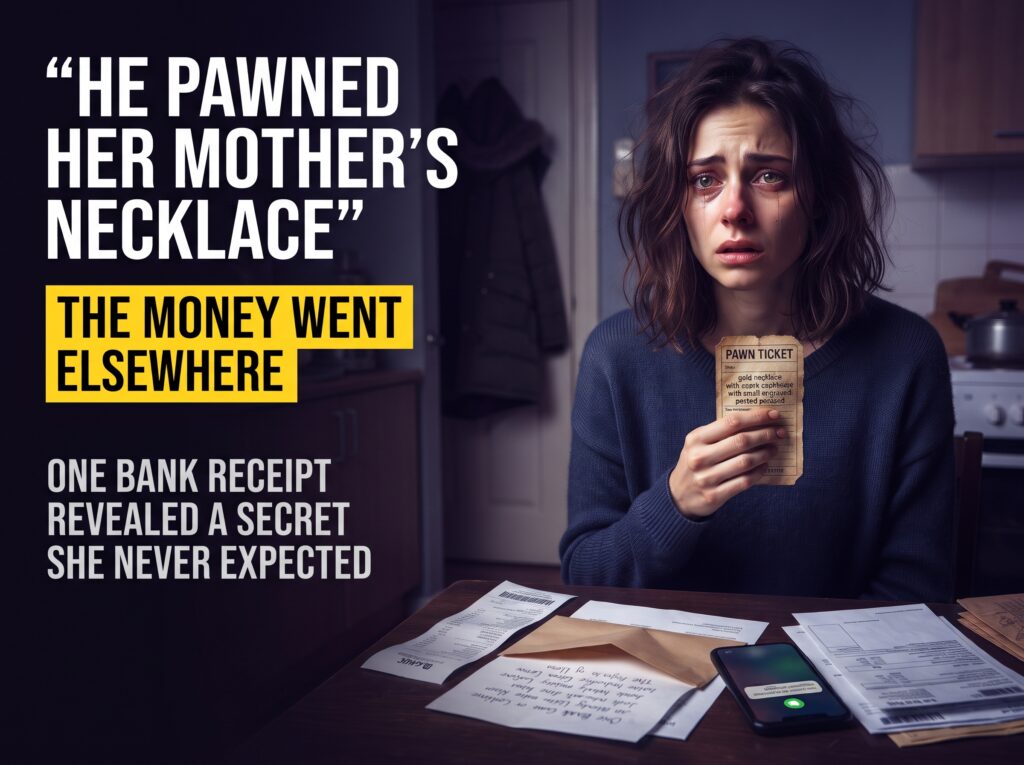
The bills were still on the kitchen table when I realized that losing him had not been the hardest part.
The hardest part was waking up every morning in the same tiny apartment, looking at the empty chair across from me, and pretending that the life we had planned together had not disappeared overnight.
Rent was due in six days. The electricity bill was folded beneath a grocery receipt, and the envelope containing my last paycheck sat beside a jar where I kept spare coins. Every morning, I counted what remained and divided it into imaginary portions: rent, food, transportation, and the unexpected expense I knew would eventually arrive.
I had become very good at making small amounts of money appear sufficient.
When my sister called, I told her I was doing fine.
When my mother asked whether I needed anything, I told her I had everything under control.
And when our mutual friends asked whether I had heard from him, I smiled as if his silence were simply a temporary inconvenience.
I could not bear to admit how frightened I was.
For three years, I had believed that my boyfriend and I were building something permanent. We had started with secondhand furniture, mismatched plates, and a mattress that creaked whenever either of us moved. We had celebrated our first anniversary with homemade pasta because neither of us could afford a restaurant.
He used to joke that one day we would laugh about those difficult months.
“We’ll have a house,” he would say, leaning against our kitchen counter. “A proper kitchen, a sofa that doesn’t swallow people, and a refrigerator full of food.”
“And a washing machine that doesn’t sound like an airplane taking off.”
“Definitely that.”
I would laugh, and he would pull me into his arms.
Those conversations had become the foundation of my future. We did not have much, but I believed we had the one thing money could never buy: someone who would stay when life became difficult.
Then he left.
There was no dramatic argument, no broken window, and no final declaration that we had stopped loving each other. There were only a few tense conversations, several nights when he returned home later than usual, and a growing distance between us that neither of us seemed willing to name.
One evening, he stood beside the bedroom door with a bag in his hand.
“I need some time,” he said.
I stared at him.
“Time for what?”
“To figure things out.”
“What things? We can talk about whatever is bothering you.”
He looked exhausted.
“It’s not that simple.”
“Then explain it to me.”
He opened his mouth, but nothing came out.
I waited.
Finally, he looked away.
“I’m sorry.”
That was all he gave me.
He left the apartment, and the door closed behind him with a quiet click.
I stood in the hallway for several minutes, waiting for him to return and tell me that he had made a mistake. When he didn’t, I went into the kitchen and sat at the table until the room became dark.
For the first few days, I kept expecting his key to turn in the lock.
It never did.
I sent messages. I called. I asked whether he was safe and whether we could meet to talk.
His replies became shorter until they stopped altogether.
I told myself I needed to respect his decision, even though I did not understand it. I could not force someone to remain in a relationship, and I refused to become the kind of person who begged another person to love her.
But understanding that he had the right to leave did not make it easier to understand why he had left without explaining anything.
The financial consequences arrived before I had time to recover emotionally.
We had divided our expenses according to our incomes. He paid certain bills, while I handled others. Some payments were automatic, and a few accounts still carried both our names.
When his contributions stopped, the balance in my bank account began to fall.
I canceled subscriptions, stopped buying coffee on my way to work, and planned meals around whatever remained in the cupboards.
I told my family that we had simply grown apart.
I did not tell them that I was afraid of losing the apartment.
I did not tell them that I had begun calculating how much money I could earn by selling my belongings.
And I certainly did not tell them that I sometimes woke in the middle of the night wondering whether I had misunderstood the entire relationship.
One rainy afternoon, I decided to clean the apartment.
It was something I could control, unlike the silence that had settled between us.
I collected old receipts, folded his remaining clothes into a cardboard box, and opened the wardrobe to remove the winter coat he had forgotten.
I nearly put it away without checking the pockets.
Then I felt something stiff inside the right pocket.
It was a small paper ticket, creased down the middle.
At first, I thought it was an ordinary receipt. I unfolded it beneath the kitchen light and read the name of the business printed across the top.
A pawnshop.
Below it was a description of a necklace.
My necklace.
The gold necklace my mother had given me on my twenty-first birthday.
I read the description again, hoping I had misunderstood it.
But there was no mistaking the small pendant, the distinctive chain, or the identification number printed beside the item.
The ticket showed that the necklace had been pawned several weeks before our breakup.
I sat down slowly.
He had always sworn that he had never touched it.
And suddenly, I had a reason to question everything.
<h2>Part 2</h2>
I remembered the day my mother gave me the necklace.
She had saved for months to buy it. It was not extravagant, but it was beautiful in the way that meaningful things often are. The chain was delicate, and the small pendant had a tiny engraving on the back that only became visible when the light struck it at the right angle.
When she fastened it around my neck, she held my shoulders and looked at me through the mirror.
“I want you to keep this,” she said. “Not because it is expensive, but because I want you to remember that you have people who love you, even when life becomes difficult.”
I had worn it to family celebrations, important interviews, and ordinary days when I needed a little confidence.
When my boyfriend and I began struggling financially, I considered selling some of my belongings. He had been the one to stop me.
“Don’t sell that necklace,” he told me. “Your mother gave it to you. We’ll find another way.”
I believed him.
Months later, when I noticed that the necklace was missing from my jewelry box, I asked whether he had seen it.
He barely looked up from his phone.
“Maybe you left it somewhere.”
“I always keep it in that box.”
“Then look around. It has to be somewhere.”
I searched the bedroom, the bathroom, and the small drawer where I kept my earrings. I checked the pockets of my bags and even looked beneath the bed.
Nothing.
When I asked him again, he became irritated.
“I told you I haven’t touched it.”
I apologized for suggesting otherwise.
Now I was holding a pawn ticket that contradicted everything he had said.
I checked the date.
The necklace had been pawned on a Thursday, the same day he told me he would be working late.
I remembered that evening clearly. I had cooked dinner for two, but he arrived home after ten o’clock and said he had been dealing with an unexpected problem at work.
He had kissed my forehead, eaten a few bites, and gone straight to bed.
I had accepted his explanation because I trusted him.
I wanted to believe that trust had not been misplaced.
The ticket listed the pawnshop’s address. It was only a short bus ride from my apartment.
I decided to go there the following morning.
That night, I barely slept.
Every time I closed my eyes, I imagined him walking into the shop with my necklace in his hand. I wondered whether he had hesitated before handing it over, whether he had thought about my mother, and whether he had told himself that he would redeem it before I discovered what he had done.
I also wondered what had happened to the money.
If he had needed money for rent or food, why had he not told me?
We had struggled together before. I had never expected him to be perfect. I would have understood a mistake, even an expensive one, if he had trusted me enough to explain it.
But he had denied touching the necklace.
That denial hurt more than the loss itself.
The following morning, I arrived at the pawnshop shortly after opening.
A bell rang above the door as I entered. Behind the counter, a middle-aged clerk was arranging several pieces of jewelry beneath a glass display.
“Good morning,” he said.
I placed the ticket on the counter.
“I’m trying to find out what happened to this necklace.”
He examined the paper.
“Do you have identification?”
I showed him my identification and explained that the necklace belonged to me. I told him that I had only recently discovered the ticket and wanted to know whether the item could still be recovered.
He typed something into the computer.
I watched his expression carefully.
At first, he looked ordinary and professional. Then his eyes narrowed slightly as he read the screen.
He clicked through several records.
Finally, he turned the monitor a little toward me.
“The necklace was sold several weeks ago,” he said.
My stomach tightened.
“Sold?”
“Yes. The redemption period expired, and the item was sold according to our records.”
I gripped the edge of the counter.
“Who brought it here?”
“I’m sorry. I can’t disclose private customer information without the appropriate authorization.”
“But it was my necklace.”
“I understand. I can explain the transaction recorded against the ticket, but there are limits to what I can provide.”
I looked at the date again.
“Was it sold before or after the breakup?”
“Before.”
I already knew the answer, but hearing it aloud made my knees feel weak.
I had spent weeks believing that the worst part of our relationship had happened when he left.
Now I understood that something had been happening long before that final evening.
“Can you tell me how much it was sold for?”
The clerk checked the record.
He gave me the amount.
It was less than I had expected, but that was not what frightened me.
I had been prepared to discover that he had pawned the necklace because we were struggling financially.
What I had not expected was the next detail.
I asked whether the proceeds had been paid directly to the person who pawned it.
The clerk studied the screen again.
“Not all of the money was paid to the customer,” he said carefully. “The transaction record indicates that a portion was applied to an outstanding debt.”
“What debt?”
He looked at me.
“A debt recorded under another person’s name.”
I stared at him.
“Whose name?”
He turned the screen away, checked something, and then quietly wrote down a name he was permitted to provide in connection with the transaction documentation I had presented.
I recognized it immediately.
It belonged to a woman who had comforted me after my boyfriend left.
A woman who had told me I deserved better.
A woman who had listened while I cried about the bills and assured me that everything would eventually make sense.
I stepped away from the counter.
The person I trusted most had been hiding a truth that reached far beyond our broken relationship.
And I had no idea why.
<h2>Part 3</h2>
I walked out of the pawnshop without remembering the journey back to the bus stop.
The name on the paper seemed to follow me.
I had known her for years. She had been present at birthdays, family dinners, and several of the happiest moments of my relationship. When my boyfriend and I first moved into the apartment, she had helped us carry boxes upstairs.
She knew about our financial difficulties.
She knew about the necklace.
And after he left, she had been one of the first people to call me.
I remembered sitting on my kitchen floor with my back against the cupboard while she listened to me cry.
“You can’t keep blaming yourself,” she had said. “Sometimes people leave because they don’t know how to face their own problems.”
I had believed her.
She had brought groceries when I could barely afford them. She had encouraged me to speak to my family. She had even helped me sort through the bills he had left behind.
Now I wondered whether those acts of kindness had been genuine or whether she had been trying to quiet a conscience that would not let her rest.
I arrived home and placed the pawn ticket on the kitchen table.
For nearly an hour, I did nothing.
I wanted to call her immediately, but I knew I was too upset to have a useful conversation. I needed to understand what I had learned before I confronted anyone.
I searched the coat again.
This time, I checked every pocket carefully.
Inside the left pocket, beneath a loose piece of lining, I found another small receipt.
It was from a bank.
The transaction date matched the date on the pawn ticket.
The amount was close to the money the necklace had generated, although the figures did not match exactly.
Beneath the amount was a reference number and the name of the person who had received the payment.
It was her name again.
I sat down.
The money had not gone into his account.
It had been used to pay a debt under her name.
Why?
Had she borrowed money from him? Had he borrowed money from her? Had someone threatened to collect a debt, forcing them to use the necklace as a last resort?
I tried to think of an explanation that did not make either of them look deliberately cruel.
Perhaps she had been in trouble and he had panicked.
Perhaps he had promised to help her, then realized too late that he could not afford to do so.
Perhaps the debt was connected to something that had happened before I met either of them.
But none of those possibilities explained why he had lied to me.
I took out my phone and opened our old message conversation.
I searched for the date printed on the pawn ticket.
That evening, he had sent me a message shortly before six.
Working late. Don’t wait for dinner.
I had replied that I would save him a plate.
At 9:47 p.m., he had sent another message.
I’m sorry. Everything is taking longer than expected.
I had told him not to worry.
I remembered sitting at the table, looking at the empty chair, and wondering whether his job was becoming more demanding.
Now I could not stop thinking about where he had really been.
I searched further.
Two days before the necklace disappeared, he had asked whether I still had the small envelope containing my mother’s original gift receipt.
I had told him I thought it was in the bedroom drawer.
He had replied with a thumbs-up symbol.
At the time, I had thought nothing of it.
Now the exchange felt sinister.
Why would he need the receipt if he had never touched the necklace?
I took screenshots of the messages and saved them with the pawn ticket and bank receipt.
Then I called my sister.
I did not tell her everything immediately. I asked whether she remembered the necklace and whether she had ever heard the woman mention a financial problem.
My sister paused.
“Why are you asking?”
“I found something.”
“What kind of something?”
I explained that the necklace had been pawned and that the money appeared to have gone toward a debt in the woman’s name.
My sister was silent for several seconds.
“That doesn’t make sense,” she said. “She told me she had paid off all her debts last year.”
“When?”
“After she changed jobs. She said she wanted a fresh start.”
I looked at the bank receipt.
“Did she say how she paid them?”
“No. Why?”
“I don’t know yet.”
My sister offered to come over, but I told her I needed time to think.
After we hung up, I searched my own messages with the woman.
Most of our conversations were ordinary. She had asked how I was coping after the breakup and reminded me to eat when I was too upset to cook.
But one message stood out.
It had arrived three days after he left.
Please don’t let anyone convince you that everything he did was your fault. There are things you don’t know yet.
I had interpreted it as an attempt to comfort me.
Now I wondered whether she had been preparing me for the truth.
I called her.
She answered after the third ring.
“Hey,” she said. “How are you holding up?”
I almost laughed at the question.
“I found the pawn ticket.”
Silence.
“What pawn ticket?”
“The one for my mother’s necklace.”
I heard a small movement on the other end of the line.
“What are you talking about?”
“It was pawned before the breakup. The money was used to pay a debt under your name.”
Another silence followed.
Then she said, very quietly, “Where did you find that?”
“In his coat.”
I waited for an explanation.
Instead, she asked, “Did you find anything else?”
My hand tightened around the phone.
“Why would I need to find anything else?”
She breathed out slowly.
“Please don’t make any decisions until we talk.”
“Then let’s talk.”
“Not tonight.”
“Why not?”
“Because there are things I need to explain, and I don’t want to do it over the phone.”
I looked at the envelope on the table.
“Tomorrow,” I said. “Somewhere public.”
She agreed.
Before ending the call, she said something that frightened me more than any denial could have.
“You need to understand that the necklace wasn’t the beginning.”
<h2>Part 4</h2>
I chose a small café near the bus station.
It was busy enough that I would not feel trapped, but quiet enough for a conversation. I arrived twenty minutes early and sat at a table beside the window.
I brought copies of the pawn ticket and bank receipt. The originals remained in a folder inside my bag.
When she arrived, she looked as though she had not slept.
She sat across from me without taking off her coat.
“You look tired,” she said.
I stared at her.
“You told me the necklace wasn’t the beginning. What did you mean?”
She looked down at her hands.
“I meant that the financial problem started before the necklace was pawned.”
“Whose financial problem?”
“Mine.”
The answer was so direct that I did not know what to say.
She explained that she had borrowed money several months earlier after an unexpected expense left her unable to meet several payments. At first, she believed she could repay everything quickly.
Then another expense arrived.
She borrowed again.
The interest and fees accumulated, and the situation became harder to manage.
She had been ashamed to tell her family. She had not wanted anyone to know how badly she had misjudged her finances.
Eventually, she asked my boyfriend for help.
“How much?” I asked.
She told me.
It was a substantial amount, far more than I would have imagined her borrowing.
“Why didn’t you tell me?”
“Because I was embarrassed.”
“So you told him instead?”
“He offered to help.”
I looked at the receipt.
“Did he use my necklace to pay your debt?”
She closed her eyes.
“Yes.”
The word landed between us.
I felt as if the air had been pushed out of my lungs.
“Did you know it belonged to my mother?”
“Yes.”
“And you let him take it?”
“I didn’t know he was going to pawn it at first.”
“But you knew before it was sold.”
She did not answer.
I leaned back in my chair.
For years, I had believed that she was someone I could trust with my most private fears. I had told her about my childhood, my mother’s sacrifices, and the way I worried that financial hardship would eventually destroy the life I was trying to build.
She had known exactly what that necklace meant to me.
And still, she had allowed it to become part of her debt.
“I need you to explain what happened,” I said. “All of it. No more partial answers.”
She nodded.
She told me that my boyfriend had initially offered to lend her money from his savings. When that proved insufficient, he began looking for other ways to help.
She claimed she had urged him to tell me.
“He said he would explain everything once he had fixed it.”
“Fixed what?”
“The debt. He thought he could pay it off and replace the money before you found out.”
I shook my head.
“He couldn’t even keep up with our rent.”
“I know.”
“Then why would he think he could solve your financial problems?”
She looked away.
“Because he believed he had caused part of them.”
I frowned.
“What does that mean?”
She hesitated.
Then she explained that several months earlier, she had asked him to help her understand a financial agreement she had signed. She had been confused by the repayment schedule and worried that she was being charged more than she owed.
He had tried to help.
During that process, he had made a payment on her behalf, believing it would temporarily prevent further fees while they reviewed the account.
But the payment had not resolved the problem.
Instead, it had become part of a complicated dispute involving a debt collector and an account that neither of them fully understood.
“He thought if he could clear the balance, the problem would disappear,” she said. “He didn’t want you to worry.”
I stared at her.
“That is the same excuse he used for everything. He didn’t want me to worry, so he lied. He didn’t want me to be upset, so he took something that wasn’t his. He didn’t want me to lose trust in him, so he gave me every reason to lose it.”
She began to cry.
“I know.”
“No, I don’t think you do.”
I stood, then forced myself to sit down again.
I had come to the café for answers, not to create a scene.
“Did he give you the money from the necklace?”
“Not directly. The pawnshop applied part of the proceeds to the debt. The rest went toward an account connected to the repayment arrangement.”
“Whose account?”
She looked at me.
“Mine.”
I felt the room tilt.
“So you benefited from the sale of my necklace.”
“Yes.”
“And you let me believe you were helping me recover from him.”
“I was trying to help you.”
“By hiding what you had done?”
She covered her face.
I looked at the person sitting across from me and struggled to reconcile her with the woman who had brought groceries to my apartment and told me I was not alone.
Perhaps her kindness had been genuine.
Perhaps her shame had been genuine, too.
But neither could undo what had happened.
“There’s something else,” she said.
I waited.
“The debt collector contacted me after the breakup. They said the account had been paid, but they needed confirmation of the original agreement. When I asked your boyfriend about it, he told me he had left you a message explaining everything.”
“He left me no such message.”
She looked frightened.
“Then someone may have sent it to the wrong number.”
I thought of the bank receipt and the envelope I had found behind the drawer.
“What envelope?”
Her expression changed.
“What?”
“You said he left me a message. How do you know?”
She looked down.
“Because he told me he had written one.”
I reached into my bag and removed the envelope.
“Then perhaps this is it.”
She stared at the handwriting.
For the first time since she had arrived, she looked genuinely afraid.
“Where did you find that?”
“Behind the drawer where we kept our photographs.”
She did not touch it.
“Please,” she whispered. “Don’t open it until you understand who it’s from.”
<h2>Part 5</h2>
I opened the envelope in front of her.
Inside was a handwritten apology and a bank receipt dated the same day the necklace disappeared.
I recognized his handwriting immediately.
The apology was short. He admitted that he had made a decision without asking my permission and that he had allowed his fear to become an excuse for dishonesty.
He wrote that he had believed the debt could be resolved quickly, but the arrangement had become more complicated than he expected.
He had intended to replace the necklace.
He had intended to explain everything.
He had intended to come home.
But intentions, he wrote, had become the easiest way to postpone the truth.
I read the final paragraph twice.
If you ever discover where the money went, please ask her why she needed it.
I stared at the woman across from me.
“Why would he write this if you have already explained the debt?”
She shook her head.
“I haven’t told you everything.”
I felt a familiar exhaustion settle over me.
“Then tell me now.”
She explained that the original debt was not entirely hers.
Several years earlier, she had agreed to help a family member secure a loan. She believed the loan would be repaid quickly, and she signed documents without fully understanding the consequences.
When the payments stopped, the creditor pursued her because her name appeared on the agreement.
She tried to resolve the matter privately.
She borrowed money, negotiated repayment dates, and accepted additional obligations because she believed she could keep the situation from reaching her family.
Eventually, she could no longer keep up.
My boyfriend had learned about the problem when she asked him to review the documents. He had discovered that some of the figures did not match the original paperwork.
Instead of telling her to seek independent advice, he had tried to solve the problem himself.
He believed that paying the debt would end the dispute.
But the money he transferred had not been properly credited against the claimed balance.
That was why the bank receipt mattered.
It showed that money had moved, but it did not prove that the underlying obligation had been resolved.
“Who was the family member?” I asked.
She looked at me for a long time.
Then she whispered a name.
It was someone I knew.
Someone who had been present at our family gatherings.
Someone who had once told me that money problems were always easier to solve when people stopped hiding from one another.
I felt sick.
“Why didn’t you tell me?”
“Because I promised I wouldn’t.”
“To whom?”
She looked away.
“The person who took the loan.”
I asked whether that person knew my necklace had been pawned.
She nodded.
“Yes.”
The answer frightened me.
Three people had known about the necklace: my boyfriend, the woman across from me, and the person who had originally borrowed the money.
I had trusted all three.
All three had allowed me to believe that the missing necklace was an unfortunate accident rather than the result of a decision made behind my back.
“Did he know the person had borrowed the money?” I asked.
“Yes. He thought he could protect everyone by settling the debt quietly.”
“And you agreed?”
“I was desperate.”
I looked at the bank receipt again.
The payment had been made to an account with a reference number that matched the debt collector’s documents.
But another name appeared in the transaction notes.
It was not the name of the woman who sat across from me.
It was the name of the person who had borrowed the original money.
I pushed the receipt toward her.
“Why is this name here?”
She read it and began to cry again.
“Because that was the account they told us to pay.”
“Who told you?”
“The person who handled the repayment.”
“Who?”
She shook her head.
“I don’t know if I should say.”
I stared at her.
“You have already told me that someone in our lives took out a loan using your name. You have told me that my boyfriend pawned my necklace to pay a debt. You have told me that the money may not have gone where he believed it went. What could possibly be worse than that?”
She wiped her face.
“The person who received the money may not have been the person who owned the debt.”
For a moment, I could not speak.
The bank receipt no longer looked like proof that the debt had been paid.
It looked like evidence that someone might have directed money away from the account it was supposed to settle.
And if that was true, my boyfriend might have left believing he had failed to solve a problem when the real problem had been hidden from all of us.
<h2>Part 6</h2>
I did not go home immediately.
I walked around the block until the café was out of sight, then sat on a bench beneath a bare tree.
The wind was cold, and my hands shook as I opened the photograph I had taken of the bank receipt.
I enlarged the transaction details.
The reference number was visible, along with the date and the amount. The recipient’s name was printed beneath the transfer information.
I searched my messages for that name.
There was nothing.
I checked my emails, old documents, and photographs from the period before the breakup. The name appeared only once, in a message forwarded to my boyfriend by the woman who had borrowed the money.
The message contained a payment instruction.
It told him where to send the money and included a warning that the account details should not be shared with anyone outside the arrangement.
I felt my stomach tighten.
Why would a legitimate repayment instruction need to be kept secret?
I saved a copy.
I knew I could not establish whether the payment had been fraudulent simply by examining a receipt. The recipient might have been an authorized intermediary. The account might have been used for a valid reason.
But I had enough questions to justify seeking professional advice.
That evening, I contacted the bank through its official customer service channel and asked how a person could dispute a payment made using funds obtained from the sale of personal property.
The representative explained that the process would depend on who owned the account, who authorized the transfer, and whether the transaction involved a genuine dispute or suspected fraud.
I explained that the necklace belonged to me but had been pawned without my permission.
The representative advised me to preserve the ticket, receipt, and messages, and to make a formal report if I believed my property had been used unlawfully.
I followed the advice.
I also contacted the pawnshop to request copies of the records I was entitled to obtain.
The clerk explained that the shop would cooperate with an appropriate investigation but could not disclose protected customer information without authorization.
I understood.
I had spent too long trying to force answers from people who were frightened of what the truth might reveal. I needed evidence that could be checked independently.
The next morning, I spoke with a lawyer.
I showed her the pawn ticket, the bank receipt, and the envelope.
She listened carefully, then explained that there were several separate issues: the unauthorized use of my necklace, the loan arrangement, the destination of the money, and the possibility that someone had provided misleading payment instructions.
“These matters may be connected,” she said, “but we should not assume they are all part of the same wrongdoing until the records establish that.”
I nodded.
“How do I find out what happened?”
“Start with what can be verified. Obtain the transaction records, identify the parties to the agreement, and preserve the original documents. If the money was transferred under suspicious circumstances, the relevant authorities can investigate.”
She also advised me not to confront the person named on the receipt alone.
I left her office with a list of steps to follow.
For the first time since discovering the pawn ticket, I felt that I was doing something more useful than imagining the worst.
I contacted my sister and told her that I needed help organizing the documents. She came over that evening, bringing a folder and several clear sleeves.
We arranged the evidence by date.
First came the message about his late shift.
Then the pawn ticket.
Then the bank receipt.
Then the forwarded payment instructions.
Finally, the envelope containing his apology.
When we laid everything out on the table, the timeline became clearer.
He had obtained the payment instructions before pawning the necklace. The bank transfer had followed shortly afterward. The breakup occurred weeks later.
That meant the financial arrangement had existed before our relationship ended.
It had not been a desperate decision made in the final days of our relationship.
It had been a secret he had carried for weeks.
My sister looked at the documents.
“Do you think he knew the money was going to the wrong person?”
“I don’t know.”
“Do you think she knew?”
“I don’t know that either.”
I stared at the receipt.
The truth was that I had no idea which of the people involved had been honest, which had been mistaken, and which had deliberately hidden information.
But I was beginning to understand why the apology had not felt like a complete explanation.
He had admitted to making a decision without my permission.
He had not explained who had instructed him to make the payment.
And he had not told me why he believed that paying the debt would protect everyone involved.
My sister closed the folder.
“Whatever happened, you don’t have to solve it tonight.”
I nodded.
But as I prepared for bed, my phone vibrated.
An unknown number had sent me a message.
I heard you found the pawn ticket.
A second message followed.
Before you accuse him, ask who gave him the account details.
I stared at the screen.
The sender knew about the pawn ticket.
And they knew that I had begun looking into the payment.
<h2>Part 7</h2>
I did not reply to the unknown number.
Instead, I took screenshots and forwarded them to my lawyer.
She advised me to preserve the messages, avoid sending personal information, and allow the source to identify themselves before arranging any meeting.
For the rest of the day, I tried to concentrate on work.
I failed.
Every time my phone vibrated, I looked at it. Every unfamiliar vehicle outside the apartment made me wonder whether someone had come to speak to me.
I knew that fear could turn uncertainty into imagined danger, and I did not want to let it control my decisions.
Still, the message had changed the situation.
Someone knew that I had discovered the necklace had been pawned. Someone also knew about the account details.
That suggested the person had been involved in the financial arrangement or had access to information about it.
I asked the lawyer whether there was a safe way to respond.
She suggested that I send a neutral message asking the person to identify themselves and explain how they knew about the transaction.
I did so.
Several hours passed before an answer arrived.
My name is Daniel. I worked with the person who arranged the original loan.
I searched the name in my old messages.
Nothing appeared.
I asked what he wanted.
His response was brief.
I think you deserve to know that the payment instruction may have been changed after it was issued.
I read the sentence twice.
Changed by whom?
I asked.
He replied that he could not establish that from the documents he had seen, but he knew that the recipient details on one copy differed from those on another.
I immediately sent the information to my lawyer.
She asked Daniel to provide the documents through a formal channel so they could be reviewed and authenticated.
He agreed.
Two days later, a packet of records arrived at her office.
The first document was a copy of the original loan agreement. The second was a payment instruction issued several months later. The third was a bank transfer record showing the payment made with money from the necklace.
The recipient information did not match exactly.
Some differences could have been explained by an intermediary account or an administrative change. Other details required clarification.
The lawyer cautioned me against assuming that the discrepancy proved wrongdoing.
But she agreed that it justified asking the people involved to explain the payment route.
We contacted the debt collector and requested written confirmation of the amount owed, the payments received, and the remaining balance.
The response took several days.
When it arrived, it confirmed that the account had not been fully settled on the date shown in the bank receipt.
Part of the money had been credited to the account.
The remainder had been recorded separately.
The explanation for that separate amount was incomplete.
I felt anger rise again.
My necklace had been sold. My boyfriend had lied. The woman I trusted had concealed the debt. And now the records suggested that even the payment intended to resolve the problem had not been handled as expected.
I wanted to call everyone involved and demand that they explain themselves.
Instead, I gave the documents to my lawyer.
She explained that the next step would be to reconcile the records with the original agreement and determine who had authorized the separate payment.
It was slow work.
There were no dramatic confessions, no instant answers, and no single document that explained everything.
There were dates, account references, and signatures that needed to be checked.
But gradually, the story became less mysterious.
The original borrower had fallen behind on payments. The woman had agreed to help, believing that the debt would be resolved quickly. My boyfriend had stepped in when the arrangement began to unravel.
He had then made the decision to use my necklace to raise money without asking me.
The payment had been sent according to instructions he believed were valid.
The remaining question was whether those instructions had been altered and whether anyone had knowingly directed the money away from the debt.
The lawyer arranged a meeting with the parties involved.
I was not required to attend, but I chose to be present.
The woman came first. She sat at the far end of the conference table, looking pale and exhausted.
Daniel arrived with a folder.
The original borrower joined the meeting by video.
For several minutes, everyone spoke cautiously about the loan, the payment records, and the disputed balance.
Then the lawyer placed the bank receipt in front of them.
“Who authorized this account to receive the payment?”
No one answered immediately.
The woman looked at the screen.
Daniel opened his folder.
And the person on the video call suddenly asked for the meeting to be stopped.
<h2>Part 8</h2>
The lawyer did not end the meeting immediately.
She asked why the person on the screen wanted to stop.
“I need to speak to someone privately,” the person replied.
“That is your choice,” the lawyer said. “But the documents will remain part of the record, and we will need an explanation for the discrepancy.”
The call ended.
For several seconds, no one spoke.
I looked at the woman across the table.
“Did you know the account details were different?”
She shook her head.
“No.”
“Did he tell you?”
“No.”
Daniel examined the documents again.
“I received two versions of the payment instruction,” he said. “I assumed the second one was an updated account. I didn’t know the original borrower had not approved the change.”
The lawyer asked whether he could establish who had sent the updated instruction.
Daniel said that the original email might still exist.
He agreed to provide it.
I sat back in my chair.
I had expected the meeting to produce a clear confession or a definitive answer.
Instead, it had created another question.
Someone had apparently changed the payment details, but we did not yet know whether the change was authorized, mistaken, or deliberate.
I could not tell whether my boyfriend had been deceived or whether he had ignored warnings because he wanted to solve the problem quickly.
The woman had helped conceal the debt, but she might not have known where the money ultimately went.
The original borrower had asked to stop the meeting, but that alone did not prove guilt.
I was learning that suspicion was not the same as evidence.
After the meeting, the lawyer contacted the bank and requested clarification of the transaction records through the appropriate process.
Daniel searched his archived emails.
The woman agreed to provide her own messages concerning the debt.
I went home and waited.
For several days, nothing happened.
Then Daniel found the original email.
It had been sent from an address associated with the original borrower. The message instructed the recipients to use a revised account number because the previous account was supposedly being closed.
The message included a document with a signature at the bottom.
The signature looked familiar.
I had seen it on the pawn ticket.
It was not my boyfriend’s signature.
It belonged to the person who had comforted me after the breakup.
I stared at the document.
The lawyer examined the copy and explained that a signature on a scanned document could not establish authenticity by itself. The original file and related records would need to be checked.
Still, the discovery changed the direction of the inquiry.
The woman had previously said that she did not know where the money went.
Now there was a document bearing her signature on the payment instruction.
When the lawyer asked her about it, she became visibly distressed.
“I didn’t write that,” she said.
“Do you recognize the document?”
“I remember receiving a payment instruction. I didn’t authorize that account.”
“Did you sign anything related to the loan?”
“I signed the original agreement. I did not sign this.”
The lawyer asked her to provide examples of her signature from the same period.
She agreed.
The original borrower was contacted again and asked to explain the email.
This time, the response was different.
The person said that the account details had been changed by an intermediary who was supposed to manage the repayments.
They claimed that the intermediary had acted without their knowledge.
The lawyer asked for the intermediary’s identity and supporting documents.
The person promised to provide them.
I returned home feeling exhausted.
For weeks, I had believed that I was investigating a betrayal by my boyfriend and the woman I trusted.
Now the evidence suggested that the financial arrangement involved another person who might have been acting behind their backs.
That did not absolve anyone of responsibility.
My boyfriend had still pawned my necklace without permission. The woman had still concealed her debt. Both had allowed me to believe that I was safe from the consequences of decisions they were making in secret.
But the person who had received the payment might have played a more important role than either of them understood.
That evening, I received another message from the unknown number.
The original borrower is not the person who changed the account.
I read it slowly.
Then a second message arrived.
Ask who had access to the repayment records before the necklace was sold.
I forwarded both messages to my lawyer.
For the first time, I wondered whether the person contacting me was trying to help us uncover the truth—or trying to direct the investigation away from themselves.
<h2>Part 9</h2>
The lawyer arranged for the payment records and email copies to be reviewed by an independent financial specialist.
The review took time because the records came from different sources. Some were original documents, while others were screenshots or scanned copies.
The specialist compared the dates, account references, and transaction amounts.
The findings were cautious but important.
The payment instruction had been changed after the original agreement was signed. The revised account details did not match the account listed in the original repayment documents.
The records also showed that the intermediary had received correspondence about the change before the money from the necklace was transferred.
That did not establish who had made the alteration or whether the intermediary had acted deliberately.
But it gave the investigation a concrete path to follow.
The lawyer asked the intermediary to provide the original instructions and explain why the account details had changed.
The intermediary did not respond immediately.
During that time, I received a message from my former boyfriend.
It came from an unfamiliar number.
I heard you found the receipts. I know I owe you an explanation.
I stared at the screen.
For months, I had imagined what I would say if he ever contacted me again.
I had rehearsed angry speeches, questions, and accusations. I had imagined asking him whether he had ever loved me or whether our relationship had simply been another responsibility he wanted to escape.
Now that the message had arrived, I could barely move.
I replied with one question.
Why did you pawn my mother’s necklace?
His answer came several minutes later.
I thought I could pay the debt and replace it before you knew.
I closed my eyes.
You lied when I asked you about it.
I know.
You left without telling me what happened.
I was ashamed. And I thought you would hate me if you knew.
I stared at the phone.
I was angry because you lied to me. You made the decision for me. You decided that I could not be trusted with the truth.
There was no response for several minutes.
Then he wrote:
You’re right.
I had expected him to defend himself.
His agreement left me with nothing to argue against.
I asked whether he knew the payment details had been changed.
He said he had not known at the time. He believed that the account he used was connected to the original loan and that the payment would be credited against the outstanding balance.
He explained that he had discovered the discrepancy only after the debt collector contacted him about the remaining amount.
By then, the necklace had already been sold.
He had tried to obtain the original agreement, but he could not get a clear answer from the people managing the repayment.
He said he had become frightened that he would be blamed for the missing money.
“Why didn’t you tell me?” I asked.
Because I had already lied about the necklace. I thought that if I admitted everything, I would lose you.
I read the message twice.
He had tried to avoid the consequences of one decision by making another.
Then another.
Until the truth had become so difficult to explain that he chose to disappear.
I asked him where he was.
He said he was staying with a relative in another town.
I asked whether he was willing to speak to the lawyer and provide the documents he had kept.
He agreed.
I did not tell him that I forgave him.
I did not tell him that we could start again.
I told him that I wanted the facts established and that he needed to accept responsibility for what he had done.
He agreed to cooperate.
The next day, he sent copies of his messages with the intermediary. They showed that he had requested confirmation that the payment would be credited against the debt.
The intermediary had assured him that everything was in order.
When he later questioned the remaining balance, the intermediary told him that the records were still being reconciled.
The messages supported his account, but they did not answer every question.
The lawyer added them to the file.
A few days later, the intermediary finally responded to the formal request.
The explanation was brief.
The revised account had been used to collect payments temporarily while the original account was being reviewed. The intermediary claimed that the money had been moved according to an internal arrangement.
But the supporting documents did not establish that all the parties had agreed to the change.
The lawyer asked for the full accounting history.
The response revealed that part of the money had been applied to an unrelated balance.
The intermediary disputed the interpretation.
The investigation continued.
I sat at home with the latest documents spread across the table.
My necklace was gone. My relationship had ended. The woman I trusted had concealed a debt, and my boyfriend had lied about his actions.
Yet the financial records suggested that neither of them had fully understood where the money had gone.
The mystery was no longer simply about betrayal.
It was about the cost of allowing shame, fear, and incomplete information to govern decisions that affected other people’s lives.
I wanted justice.
I wanted accountability.
And I wanted to stop carrying the consequences of secrets that other people had chosen to keep.
<h2>Part 10</h2>
The financial review did not end with a dramatic confession.
There was no single moment when everyone admitted everything and the years of confusion disappeared.
Instead, the lawyer helped establish which payments had been made, which had been credited, and which amounts remained disputed.
The original borrower was required to provide additional records. The intermediary was asked to explain the movement of the funds. The bank and debt collector supplied information through the appropriate channels.
The review confirmed that the payment instructions had changed and that part of the money had been allocated differently from what my boyfriend believed.
It did not establish that every person involved had acted dishonestly.
Some had made decisions without understanding the consequences. Others had relied on information that turned out to be incomplete. The question of responsibility had to be assessed against the evidence, not against the anger I felt.
My boyfriend cooperated with the review.
He provided the messages he had kept and acknowledged that he had pawned the necklace without my permission.
He did not ask me to excuse him.
When we finally met in person, it was in the same café where I had spoken to the woman about the debt.
He looked thinner than I remembered. His hands trembled slightly as he placed a folder on the table.
“I don’t expect you to forgive me,” he said.
I looked at him.
“Why did you think disappearing would help?”
He lowered his eyes.
“Because every time I tried to fix something, I made it worse. I thought if I could resolve the debt, replace your necklace, and put the money back, I could tell you the truth without hurting you.”
“You were already hurting me.”
“I know.”
“You let me believe I had lost everything because our relationship had failed. You let me struggle with the bills while you knew there was a financial problem connected to the necklace.”
He nodded.
“I was ashamed.”
“Shame isn’t an explanation for everything.”
“No,” he said. “It isn’t.”
For a while, we sat without speaking.
I remembered the good years: the cheap meals, the broken washing machine, the laughter in our tiny kitchen. I remembered the promises we had made about a future that seemed ordinary and beautiful.
Those memories were still real.
But they did not erase the decisions he had made.
“I loved you,” I said finally. “That is why I trusted you. And that is why what you did hurt so much.”
He looked at me with tears in his eyes.
“I know.”
“I don’t know whether I can ever trust you again.”
“I understand.”
I took a breath.
“But I don’t want to spend the rest of my life trying to understand your silence. If you have something to tell me, tell me directly. If you made a mistake, admit it. If you don’t know the answer, say you don’t know.”
He nodded.
“I should have done that from the beginning.”
We did not leave the café together.
We did not promise to rebuild the relationship.
We agreed only that the remaining financial questions should be resolved honestly and that neither of us would hide information that affected the other.
It was not the ending I once imagined.
But it was the first conversation we had held without pretending that everything was fine.
In the weeks that followed, I began rebuilding my life.
I moved the bills into a folder and arranged a payment plan that I could manage. I stopped checking my phone every few minutes. I accepted help from my family instead of insisting that I was fine.
The woman apologized for concealing the debt and for allowing my necklace to become part of a problem she had been afraid to confront.
I listened.
I did not immediately restore the friendship.
Some wounds needed time, and some relationships could not return to what they had been before trust was broken.
But I no longer needed to decide everything in one conversation.
The necklace was never recovered.
My mother was heartbroken when I finally told her what had happened. She sat beside me at the kitchen table and held my hand.
“I’m sorry I didn’t tell you sooner,” I said.
She shook her head.
“You were trying to protect me.”
“I should have trusted you with the truth.”
She squeezed my fingers.
“Then let this be the last time you carry something difficult alone.”
I cried against her shoulder.
For months, I had been ashamed of how close I had come to losing my apartment, how little money remained in my account, and how badly I had misjudged the people around me.
I had mistaken silence for strength.
I had thought that if I kept my problems private, I could protect the people I loved from worrying about me.
But secrecy had not protected anyone.
It had allowed fear to grow until ordinary conversations became impossible.
The financial review eventually established a clearer account of the disputed payments, although some questions about the intermediary’s decisions remained unresolved. The people involved were left to address their respective obligations through the appropriate channels.
I could not control the outcome of every dispute.
I could only make sure that my own decisions were based on what I knew rather than what I feared.
One evening, several months after finding the pawn ticket, I sat at my kitchen table and opened the envelope containing the apology.
I had kept it because it reminded me of the difference between an explanation and an excuse.
He had written that he was sorry.
He had admitted that he had made a decision without my permission.
But the apology had not returned my necklace, paid my bills, or erased the weeks I had spent wondering whether our relationship had ever meant anything.
Those things could not be repaired by words alone.
Still, I no longer felt the same need to search every message for a hidden meaning.
I had asked the questions I needed to ask. I had preserved the evidence, sought advice, and allowed the facts to emerge at their own pace.
I had learned that loving someone did not mean accepting every decision they made.
And losing someone did not mean I had to lose myself trying to understand why they left.
The apartment was still small. The bills still arrived. I still had to be careful with money.
But I no longer woke every morning feeling that my entire future had been decided by someone else’s secret.
I began making plans again.
Small ones at first: buying fresh flowers for the kitchen, inviting my sister for dinner, saving a little money each week.
Eventually, I stopped thinking of those things as signs that I was recovering from him.
They were simply parts of my life.
One afternoon, I found an old photograph of us tucked inside a book. We were standing in front of our first apartment, laughing because the camera had slipped just as the picture was taken.
For a moment, I missed the person I thought he was.
Then I put the photograph away.
I could remember the good without pretending the bad had never happened.
I could care about someone without allowing their choices to determine my worth.
And I could accept that some questions might never receive complete answers without letting those questions consume the life I still had.
The necklace my mother gave me was gone, but the meaning behind her gift remained.
She had wanted me to remember that I was loved, even when life became difficult.
For a long time, I had believed that remembering meant holding on to the people who had hurt me.
Now I understood that it could also mean holding on to myself.
I turned off the kitchen light and walked toward the bedroom.
The bills were organized. The documents were safe. My phone was silent.
And for the first time in months, the silence did not feel like a threat.
It felt like space.
Space to heal, to begin again, and to build a future that did not depend on someone else’s willingness to tell the truth.
I had lost a necklace, a relationship, and the certainty that the people closest to me would always make the right choices.
But I had not lost the ability to choose what happened next.
That was enough to begin again.