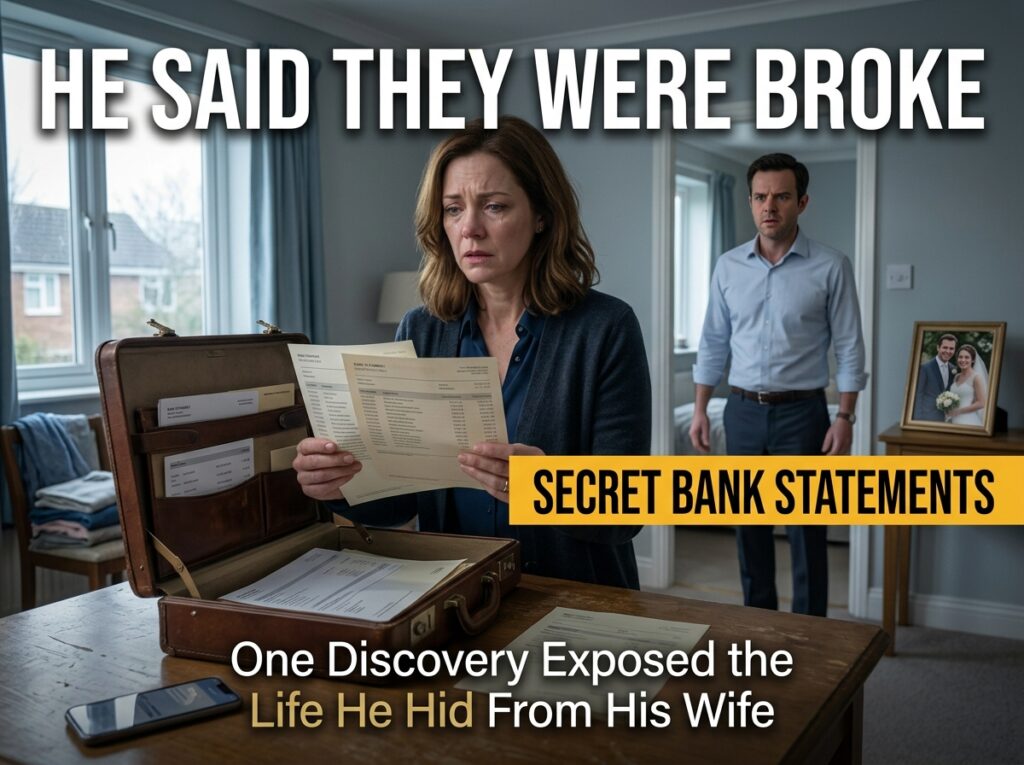
The first time my husband told me we couldn’t afford milk, I believed him.
We had been married for eleven years, and I trusted Michael Bennett more than I trusted my own judgment. He was an accountant, a careful man who checked receipts, compared electricity rates, and could calculate the cost of a grocery basket without looking at the prices.
When he told me money was tight, I believed him.
When he said we needed to cut back, I agreed.
And when he explained that our savings had almost disappeared, I sat beside him at the kitchen table and promised we would get through it together.
I had no idea that the man asking me to sacrifice everything was hiding a financial life I knew nothing about.
It began gradually.
Michael stopped buying his usual coffee on the way to work and started making it at home. Then he suggested we cancel our weekend dinners at restaurants. A few months later, he told me we should postpone our vacation because an unexpected tax bill had consumed most of our savings.
I understood. Everyone faced difficult periods.
I started bringing lunch to work instead of buying it. I stopped visiting the hairdresser. When my winter coat developed a tear beneath the arm, I repaired it myself rather than replacing it.
Michael praised me for being sensible.
“That’s why I love you, Anna,” he said one evening, kissing my forehead as I sat at the kitchen table sorting grocery coupons. “You understand what it means to be a team.”
Those words made me feel proud.
I believed that every sacrifice brought us closer to the future we wanted.
We had a modest house outside town, a mortgage that seemed manageable, and no children. We had talked about starting a family for years, but Michael always said we needed to be financially secure first.
“Let’s get the savings back where they should be,” he would tell me. “Then we can think about everything else.”
So I waited.
I waited when my friends invited me on weekend trips. I waited when my sister suggested we take a short holiday together. I even waited when my dentist told me I needed a procedure that would become more expensive if I delayed it.
Michael said we couldn’t afford it.
I believed him.
By the third year, our financial situation had become a shadow hanging over every decision.
I kept a notebook in the kitchen drawer where I recorded our spending. Every week, Michael reviewed it with me.
“Why did you spend twelve dollars at the pharmacy?”
“Your allergy medication.”
“Couldn’t you have bought the generic version?”
“I did.”
He studied the receipt.
“Then why was it so expensive?”
“I don’t know, Michael. The price has gone up.”
He sighed and rubbed his forehead.
“I’m not blaming you, Anna. I’m trying to help us survive.”
The word survive frightened me.
We were not starving. We had a roof over our heads and jobs that paid our bills. But Michael spoke about money as though one unexpected expense would send us into ruin.
I began to feel guilty whenever I wanted something for myself.
If I bought a new blouse, I imagined him opening the bank statement and discovering the expense. If I ordered lunch with a colleague, I wondered whether the money should have gone toward the mortgage.
Eventually, I stopped asking.
One Saturday morning, I found Michael standing beside the kitchen counter, examining a loaf of bread.
“Did you buy this from the discount store?” he asked.
“Yes. It was cheaper.”
He turned the package over.
“It’s nearly expired.”
“It was marked down. We’ll finish it today.”
He placed it on the counter.
“Anna, we can’t keep buying things just because they’re cheap.”
I stared at him.
“You told me to save money.”
“I told you to be careful. There’s a difference.”
I wanted to argue, but his expression made me feel foolish.
That afternoon, I sat alone in the garden and wondered how I had become someone who needed permission to buy bread.
I remembered the early years of our marriage, when Michael and I had dreamed about the future. We had planned to repaint the kitchen, travel through Europe, and eventually have a child.
We had laughed about growing old together in the little house we had bought after our wedding.
Now every conversation seemed to end with a number we could not afford.
And yet Michael continued going to work in pressed shirts, buying expensive lunches whenever he traveled for business, and occasionally disappearing for entire weekends to visit what he described as struggling clients.
When I asked whether his company was doing well, he always gave the same answer.
“Not as well as it used to.”
I accepted that explanation because I trusted him.
Then, one Thursday evening, I asked him a question I had been afraid to ask for months.
“Michael, how much money do we actually have left?”
He looked up from his laptop.
“What do you mean?”
“Our savings. Our accounts. Everything. I want to know where we stand.”
His expression hardened.
“We’ve been through this.”
“I know, but I want to see the numbers myself.”
He closed the laptop.
“Why?”
“Because I’m frightened. I don’t know whether we can afford the mortgage next year. I don’t know whether we should sell the house. I don’t know whether we’ll ever be able to start a family.”
He stared at me.
Then he said something that made my stomach drop.
“If you trusted me, you wouldn’t need to see the accounts.”
I sat motionless.
He stood, kissed the top of my head, and went upstairs.
I remained at the kitchen table long after the house had fallen silent.
For the first time in eleven years, I wondered whether trust meant believing my husband—or whether it meant being allowed to ask him a question without feeling ashamed.
The following morning, Michael left early for work.
As I gathered the laundry from our bedroom, I noticed his old leather briefcase lying beneath the desk. He had not used it in months, and I wanted to move it into the cupboard to make room for the vacuum cleaner.
The clasp was stiff.
When I opened it, I found a collection of old invoices, business cards, and papers he had forgotten to throw away.
Then I noticed a thick brown envelope tucked into the inside pocket.
My name was not on it.
Neither was his employer’s.
But the bank logo was familiar.
I pulled out the envelope and opened it.
Inside were several bank statements.
The first showed a balance of $186,420.
The second showed $193,870.
The third showed $201,115.
I stared at the figures, unable to understand what I was seeing.
These were not statements from our household account.
They were from a separate account held solely in Michael’s name.
And the oldest statement was dated three years earlier—the very month he had first told me we were running out of money.
I turned the page.
There were regular deposits, substantial withdrawals, and transfers to an account with a name I had never heard before.
At the bottom of the statement was a transaction that made my hands go cold.
A transfer of $45,000.
The recipient was a woman named Rebecca Shaw.
I read the name again.
Then I heard the front door open.
Michael was supposed to be at work.
His footsteps moved through the hallway.
“Anna?” he called. “Have you seen my briefcase?”
I stood in the bedroom, holding the statements.
For the first time in three years, I was no longer wondering how we could survive on so little.
I was wondering why my husband had made me believe we had nothing at all.
<h2>Part 2</h2>
Michael appeared in the bedroom doorway before I could put the statements back.
His eyes went immediately to the papers in my hands.
For one second, neither of us moved.
Then he closed the door behind him.
“What are you doing?”
His voice was quiet, but I heard something beneath it that I had never heard before.
Fear.
“I was putting your briefcase away,” I said. “These were inside.”
He crossed the room and reached for the statements.
I stepped back.
“What is this account?”
“Give me the papers, Anna.”
“Why do you have nearly two hundred thousand dollars in a separate account?”
His jaw tightened.
“Those are business funds.”
“Then why is the account in your name?”
“It’s complicated.”
“Explain it.”
He held out his hand.
“Please.”
I looked at the statements again.
Three years of deposits. Three years of withdrawals. Three years of telling me we could not afford new shoes, medical appointments, or a simple holiday.
“Michael, you told me we had almost no savings.”
“We don’t.”
“Then what is this?”
He rubbed his forehead.
“That money isn’t available for household expenses.”
“Why not?”
“Because it’s tied up in something.”
“What something?”
He looked away.
I had spent eleven years learning his expressions. I knew the difference between his ordinary irritation and the silence he used when he was trying to avoid an uncomfortable conversation.
This was something else.
He was calculating.
“Anna, I need you to understand that I was trying to protect us.”
“From what?”
“From losing everything.”
I lifted the statement.
“You have more than two hundred thousand dollars in this account.”
“It’s not that simple.”
“It looks very simple to me.”
He reached for the papers again, and this time I let him take them.
He gathered them into a neat stack, tapping the edges against his palm.
“I’ll explain everything when the time is right.”
“When is that?”
“Soon.”
“You said that about our savings. You said that about the mortgage. You said that about having a child.”
His expression changed.
“Don’t bring that into this.”
“Why not? Every time I ask about our future, you tell me we’re broke. Every time I need something, you say we can’t afford it. And now I find out you’ve been keeping a separate account with hundreds of thousands of dollars.”
“Lower your voice.”
“No.”
The word surprised both of us.
I stood straighter.
“I have spent three years believing that I was helping you save our marriage. I’ve postponed medical treatment, stopped seeing friends, and convinced myself that wanting anything was selfish. If this money is yours, then I deserve to know why you hid it from me.”
Michael stared at me.
Then he said, “The account isn’t what you think.”
“Then tell me what it is.”
He opened his mouth but said nothing.
I pointed toward the envelope.
“Who is Rebecca Shaw?”
His face changed so quickly that I almost missed it.
“Where did you see that name?”
“On a transfer. Forty-five thousand dollars.”
He turned away.
“She’s a business associate.”
“Why are you sending her money?”
“Because she helped me with an investment.”
“What investment?”
He pressed his fingers against his temples.
“I can’t do this right now.”
He placed the statements inside the envelope, slipped it into his briefcase, and lifted the case from the floor.
“Where are you going?” I asked.
“To work.”
“You came home to get your briefcase?”
“I forgot something.”
He walked toward the door.
“Michael.”
He stopped.
I wanted him to turn around and tell me that I had misunderstood. I wanted him to explain that there was a reasonable answer for everything and that the life I had been living was not built on a lie.
Instead, he looked at me and said, “Don’t make this worse than it needs to be.”
Then he left.
I stood in the bedroom, listening to his car disappear down the street.
For several minutes, I could not move.
I called my sister, Rachel, but ended the call before she answered. I did not know what to say. I had spent years telling her that Michael and I were doing fine, that we were simply saving for the future.
How could I explain that I no longer knew what our future was supposed to look like?
That evening, Michael returned home with flowers.
It was such an ordinary gesture that, for a moment, I almost cried.
He placed them in a vase, poured two glasses of water, and sat opposite me at the kitchen table.
“I know I upset you,” he said.
I waited.
“The account is connected to an investment I made before our financial situation became difficult. Some of the money is reserved for taxes and future obligations.”
“Then why didn’t you tell me?”
“Because I didn’t want you to worry.”
I stared at him.
“You made me worry for three years.”
“I know.”
“You let me believe we might lose the house.”
“I was under pressure.”
“From what?”
He looked down at his hands.
“Work. The economy. Things I couldn’t control.”
“Then why did you send Rebecca Shaw forty-five thousand dollars?”
His expression tightened.
“I told you. She’s a business associate.”
“What business?”
He took a breath.
“Anna, I love you. You know that.”
It was not an answer.
He reached across the table and took my hand.
“I have made mistakes. I should have explained the account. But I need you to trust me while I sort everything out.”
I looked at his wedding ring.
I remembered him slipping it onto my finger eleven years earlier and promising that we would face every difficulty together.
I wanted to believe those words still meant something.
But love was no longer enough to silence the questions.
“Show me the complete bank records,” I said.
His hand tightened around mine.
“Why?”
“Because I need to know the truth.”
For a moment, I thought he would refuse.
Then he nodded.
“Tomorrow.”
I released his hand.
“Promise me.”
He looked directly into my eyes.
“I promise.”
That night, I lay awake beside him, listening to the slow rhythm of his breathing.
I remembered every sacrifice I had made because he said we were struggling. I remembered the medical appointment I had postponed, the holidays I had declined, and the nights I had lain awake worrying about the mortgage.
I had believed that we were two people facing the same problem.
Now I wondered whether I had been the only one living inside it.
Just before dawn, I heard Michael’s phone vibrate on the bedside table.
He reached for it immediately.
The screen illuminated his face.
I saw a message preview before he turned away.
Rebecca: We need to talk before Anna sees the rest.
He switched off the screen.
Then he slipped out of bed and walked into the bathroom.
I lay perfectly still.
The words repeated in my mind.
Before Anna sees the rest.
There were more statements.
More money.
And a secret my husband was desperate to keep from me.
<h2>Part 3</h2>
I waited until Michael left for work before calling Rachel.
My sister answered with her usual cheerful greeting, asking whether I wanted to meet her for lunch.
“I need to talk to you about something,” I said.
She immediately became serious.
“What’s wrong?”
I told her about the statements, the separate account, and the transfer to Rebecca Shaw.
Rachel listened without interrupting.
When I finished, she was silent for several seconds.
“Anna, do you remember what you told me last Christmas?”
I frowned.
“What?”
“You said Michael had become obsessed with money. You said he checked every receipt and got upset whenever you bought something that wasn’t on the shopping list.”
“I thought he was worried about our finances.”
“Maybe he was. But you also said he refused to let you see the mortgage statements.”
I remembered that conversation. Rachel had asked whether we were having problems, and I had laughed it off.
I had told her Michael was simply being careful.
“I thought it was temporary,” I said.
“Have you seen the mortgage statements now?”
“No.”
“Then that’s where you should start.”
Her words stayed with me after we ended the call.
That afternoon, I went through the filing cabinet in our study. Michael usually handled the household paperwork, insisting that he understood financial documents better than I did.
I found electricity bills, insurance renewals, and several receipts for repairs to the house.
But there were no mortgage statements for the past three years.
I searched the desk drawers and the cupboard where we kept old tax returns.
Nothing.
Then I found a small notebook tucked behind a row of reference books.
It contained a list of dates, amounts, and account numbers written in Michael’s handwriting.
At first, I thought it was a record of business expenses.
Then I noticed that the dates matched the transfers I had seen on the bank statements.
Beside each amount was a short note.
R.S. — property.
R.S. — deposit.
R.S. — monthly.
I copied the entries into my own notebook.
The total was far larger than the money I had seen in the envelope.
I was still trying to make sense of the figures when my phone rang.
It was Michael.
“Have you been looking through my papers?”
I froze.
“What?”
“Someone from the office called. They said you contacted the bank.”
I had not contacted the bank.
“I haven’t called anyone.”
“Then why are you going through my files?”
“Because you promised to show me the records.”
He sighed.
“I said I would explain the account. I didn’t say you should start searching through everything.”
“Michael, why are there notes about monthly transfers to Rebecca?”
Silence.
Then he said, “We will discuss this tonight.”
He ended the call.
I sat at the desk, staring at the notebook.
For the first time, I considered the possibility that the secret account was not simply money he had saved without telling me.
It might be connected to another life.
That evening, Michael arrived home later than usual. He did not bring flowers or offer an explanation for his behavior.
He went straight to the study and closed the door.
I followed him.
“We need to talk.”
He remained seated at the desk.
“I know.”
“Who is Rebecca?”
He looked exhausted.
“She’s someone I met through work.”
“Is she your business partner?”
“Something like that.”
“Are you having an affair?”
His head snapped up.
“No.”
The answer came so quickly that I almost believed him.
Then I remembered the message on his phone.
We need to talk before Anna sees the rest.
“Then why is she receiving money every month?”
Michael rubbed his face.
“Because I made a financial commitment.”
“What commitment?”
He stood.
“Anna, I cannot explain everything in one conversation.”
“Then explain one thing. Are you sending her our money?”
“No.”
“Are you using money that belongs to our household?”
He hesitated.
That hesitation frightened me more than a confession.
“I have to make sure something is resolved first,” he said.
“What?”
He picked up his keys.
“I need to go out.”
I stared at him.
“You’re leaving?”
“I’ll be back later.”
He walked past me.
I followed him to the front door.
“Michael, if there is a problem, we can face it together. But I cannot do that if you keep shutting me out.”
He paused with his hand on the doorknob.
For one brief moment, I thought he might finally tell me the truth.
Instead, he said, “You wouldn’t understand.”
Then he left.
I stood in the hallway, feeling the familiar shame that had followed every argument about money.
But something inside me had changed.
I no longer believed that the problem was my inability to understand our finances.
I believed that someone was preventing me from understanding them.
And until I knew why, I could no longer trust the explanations Michael gave me.
<h2>Part 4</h2>
The following morning, I called our bank.
I did not ask for access to Michael’s private account. I knew that being married did not automatically give me the right to inspect every account in his name.
Instead, I asked about the household account we had opened together when we bought the house.
The customer service representative verified my identity and explained that I could request statements for our joint account.
“Is there anything unusual I should know about?” I asked.
The representative paused.
“I can provide information about transactions on the account, but I cannot speculate about their purpose.”
I requested the records for the previous three years.
When I opened the statements, I discovered that Michael had been transferring money from our joint account almost every month.
The amounts varied, but they were rarely small.
Some transfers were listed as payments to a financial services company. Others went to an account I did not recognize.
I added the figures on a calculator.
By the time I finished, my hands were shaking.
More than $80,000 had left our joint account over three years.
I checked the mortgage payments.
They were still being made, but several payments had been delayed. There were also fees for late payments and charges I could not identify.
The money Michael had told me we did not have had been leaving our household in a steady stream.
I printed the statements and placed them in a folder.
Then I called Rachel.
“I think he’s been moving money out of our joint account.”
She did not sound surprised.
“Do you know where it’s going?”
“Not yet.”
“Anna, you need independent financial and legal advice. Don’t confront him with everything until you understand your position.”
“I don’t want to destroy my marriage.”
“You didn’t create this situation by asking questions.”
I closed my eyes.
For three years, I had been afraid that a single careless purchase might destroy our financial future.
Now I was afraid that the truth would destroy my marriage.
Rachel continued gently.
“Whatever happens, you need to know what belongs to you, what you owe, and what you can afford. You can’t make those decisions based on what Michael tells you anymore.”
That afternoon, I contacted an independent financial adviser named Helen Morris, whose office was near the town center.
I explained that I was married, that my husband managed most of our finances, and that I had discovered unexplained transfers from our joint account.
Helen listened carefully.
“I can’t tell you what those transfers mean without reviewing the records,” she said. “But I can help you organize the information and identify what questions need answering.”
She asked me to bring copies of the statements, mortgage documents, tax records, and any information I had about the separate account.
“I don’t want you to assume the worst,” she added. “But you should not assume everything is fine simply because your husband says it is.”
I left her office feeling frightened but steadier than I had felt in months.
For the first time, someone was treating my questions as reasonable.
When I returned home, Michael was sitting at the kitchen table.
The folder of bank statements lay in front of him.
“Why did you contact the bank?” he asked.
“Because I have a right to understand our joint finances.”
“You went behind my back.”
“I asked for statements from an account we both own.”
He pushed the folder toward me.
“Those transfers were necessary.”
“Necessary for what?”
He looked at me with an expression I could not read.
“I was trying to protect the house.”
“From what?”
He took a long breath.
“Rebecca invested money in a property project. I guaranteed part of the arrangement. When the project ran into trouble, I had to make payments.”
I stared at him.
“You guaranteed someone else’s investment?”
“I thought it was a good opportunity.”
“With our money?”
“I intended to repay it.”
“That doesn’t answer my question.”
He stood and walked to the window.
“I didn’t want you to worry about something you couldn’t control.”
I felt tears rising in my eyes.
“You made me worry about everything.”
He turned around.
“Anna, I was trying to fix it.”
“Then why did you tell me we were broke?”
He said nothing.
I waited.
Finally, he whispered, “Because I didn’t know how bad it would become.”
For the first time, I heard something that sounded like honesty.
But it was not enough.
“How much do we owe?”
He looked at the folder.
“I don’t know the final amount.”
“How much?”
He rubbed his forehead.
“Possibly more than the savings in that account.”
I sat down.
The room seemed to grow very quiet.
I thought about the mortgage, the years of sacrifice, and the money that had disappeared from our joint account.
Then I asked the question that had been building inside me since I opened the briefcase.
“Michael, is Rebecca simply a business associate?”
He looked at me.
“Yes.”
I wanted to believe him.
But when he reached for his phone, a message appeared on the screen.
Rebecca: You promised you would tell her about the apartment.
Michael turned the phone face down.
And I understood that the money was connected to something he had not yet admitted.
<h2>Part 5</h2>
The word apartment followed me through the night.
I lay awake beside Michael, wondering what kind of property required monthly payments, large transfers, and a secret agreement.
The next morning, I decided not to confront him immediately.
I needed facts, not another argument that ended with him telling me to trust him.
I searched the financial services company listed on our joint account statements. It was a legitimate business that managed property investments and private loans.
I also found an address associated with Rebecca Shaw.
It was not the address of Michael’s workplace.
It was an apartment building across town.
I did not go there.
Instead, I took the information to Helen, the financial adviser, and asked her to help me understand the records.
She explained that some of the transfers appeared consistent with loan repayments, while others needed clarification. The mortgage account also required immediate attention because of the late payments.
“You should request a full statement from the mortgage lender,” she advised. “You also need to understand whether any guarantees or loans have been taken out in your name.”
I felt sick.
“Could he have borrowed money without telling me?”
“It depends on the agreements and the accounts involved. We should not assume that he has. But it is important to check.”
That afternoon, I contacted the mortgage lender and requested a statement for the loan held jointly in our names.
The representative told me that several payments had been late and that the account had recently received a notice regarding an outstanding amount.
I wrote down every detail.
Then she mentioned a separate credit facility secured against the property.
I stopped writing.
“What credit facility?”
She explained that a secured loan had been established several years earlier. She could provide only limited information over the telephone and advised me to request the full documentation through the appropriate process.
I ended the call feeling as though the floor had opened beneath me.
Our home was not simply at risk because we had too little money.
It might have been at risk because someone had borrowed against it.
When Michael returned that evening, I placed the mortgage statement on the kitchen table.
“What is this loan?”
He stared at the page.
For several seconds, he did not speak.
“Michael?”
He pulled out a chair and sat down.
“I was going to tell you.”
“When?”
“When I knew how I was going to resolve it.”
“How much?”
He gave me a figure.
It was more than I had ever imagined we would owe.
I covered my mouth.
“You borrowed against our house?”
“I needed the money to cover the investment.”
“Did you use my signature?”
“No.”
“Did you tell the lender that I knew about it?”
He looked away.
“I don’t remember exactly what was written in every document.”
My stomach tightened.
“Michael, did you put my name on anything?”
“I said I don’t remember.”
I stared at him.
He was an accountant. He made his living reading documents, checking figures, and explaining financial obligations to other people.
Yet he was asking me to accept that he could not remember whether he had involved me in a loan secured against our home.
I stood.
“I need copies of every document.”
He nodded slowly.
“I’ll get them.”
“And I need you to stop moving money until we understand what is happening.”
“I can’t simply stop.”
“Why not?”
“Because there are obligations.”
“Then we need to know what they are.”
He looked exhausted.
“Anna, if I tell you everything, you may never look at me the same way again.”
I felt tears burning behind my eyes.
“You should have thought about that before you started hiding things.”
He flinched.
For a moment, I felt sorry for him. I remembered the man who had stood beside me at our wedding, promising that we would face life together.
But pity could not replace the truth.
“Who is Rebecca?” I asked again.
He closed his eyes.
“She was my business partner.”
“Was?”
He nodded.
“She invested in the property project. I handled the finances. We thought we could renovate several apartments and sell them at a profit.”
“And the apartment in her message?”
Michael remained silent.
I waited.
Finally, he said, “I bought a small apartment.”
I stared at him.
“You bought another property while telling me we couldn’t afford groceries?”
“It’s an investment.”
“Whose name is on it?”
He did not answer.
I felt my heart beating faster.
“Michael, whose name is on the apartment?”
He looked at me with tears in his eyes.
“Mine and Rebecca’s.”
The words seemed to drain all the warmth from the room.
I had spent three years believing that we were working toward a shared future.
My husband had been buying property with another woman while telling me that we could not afford to repair the house we already owned.
I sat down slowly.
“Are you having an affair with her?”
Michael stared at the table.
“I never intended for things to become complicated.”
That was not an answer.
And in the silence that followed, I realized that the truth was finally approaching—but it might be more painful than anything I had imagined.
<h2>Part 6</h2>
I did not throw Michael out that night.
I did not scream or break anything. I did not call Rebecca or demand that she explain herself.
I simply asked Michael to sleep in the spare room while I tried to understand what he had done.
He agreed without argument.
The following morning, I met with a solicitor to discuss the mortgage, the secured loan, and the financial documents I had discovered. I explained that I did not yet know whether Michael had misused any money or made representations on my behalf.
The solicitor advised me to obtain copies of all relevant agreements, protect my own financial records, and avoid signing anything until I understood its implications.
I followed that advice.
For the next several days, I gathered every document I could lawfully access. I copied our joint account statements, mortgage records, tax returns, and insurance papers.
I also made a list of the questions I needed answered.
How much money had been transferred to Rebecca?
What obligations were attached to the apartment?
Had Michael used our joint funds to pay expenses connected with the property?
Had he borrowed money against our home without properly involving me?
And why had he made me believe we were on the verge of financial ruin while continuing to invest in property?
When I returned home one evening, Michael was waiting at the kitchen table.
“I’ve gathered the documents,” he said.
He placed a folder in front of me.
Inside were copies of the loan agreement, the apartment purchase documents, and a spreadsheet showing the money he had transferred over the previous three years.
I read through the pages slowly.
The apartment had been purchased using a combination of borrowed money, investment funds, and transfers from Michael’s separate account. Some of the transfers from our joint account had been used to cover expenses connected with the project.
The records did not answer every question, but they confirmed that our household finances had been used to support an investment I had never been told about.
I looked up.
“You said we had no money.”
“I thought the investment would make us secure.”
“You used our money to buy an apartment with Rebecca.”
“I thought I could repay everything before you needed to know.”
“Before I needed to know?”
He rubbed his face.
“I know how that sounds.”
“Then explain it.”
Michael sat back.
He told me that he had met Rebecca through work several years earlier. She was a property investor who had persuaded him to join a renovation project. He believed the project would generate enough profit to clear the loan and restore our savings.
At first, things had gone well.
Then renovation costs increased, a contractor withdrew, and the properties took longer to sell than expected. The project began losing money.
Rather than admit the failure, Michael borrowed more.
He told himself that one successful sale would solve everything.
When that did not happen, he transferred money from our joint account to cover the growing expenses.
“I kept thinking I could fix it,” he said. “Every month, I believed I was one step away from getting us back on track.”
“And every month, you told me we were broke.”
He nodded.
“I was ashamed.”
I stared at him.
“You could have told me.”
“I was afraid you would leave.”
The words stopped me.
For years, I had believed Michael’s secrecy came from a desire to control our finances. Now I could see that fear and shame had also played a part.
But understanding why he had lied did not make the lies acceptable.
“Did you have an affair with Rebecca?”
He looked away.
“Anna—”
“Please don’t make me ask again.”
He swallowed.
“Yes.”
I felt the room grow distant.
“How long?”
“About a year.”
I stared at him, unable to speak.
For a year, I had been cutting coupons, postponing appointments, and worrying about whether we could afford to have a child.
For a year, he had been sharing an apartment and a secret life with another woman.
“Did you use our money to pay for things for her?”
He shook his head.
“Not deliberately.”
“What does that mean?”
“Some of the expenses were connected to the apartment. Some of the money went toward the project. I didn’t think of it as spending money on her.”
I closed the folder.
“You were living a life with her while asking me to live without things I needed.”
He began to cry.
“I know.”
“No, Michael. You know the words. I don’t think you understand what it felt like to believe I was failing you because I couldn’t save enough money.”
He reached toward me.
I moved my hand away.
“I need time.”
He nodded.
“I understand.”
I stood and went upstairs.
In the bedroom, I sat on the edge of the bed and looked at the photograph from our wedding. We were smiling beneath a canopy of white flowers, young enough to believe that love would make every difficult decision easier.
I had not expected our marriage to be perfect.
I had expected honesty.
And as I looked at the photograph, I realized that the most painful part of the betrayal was not the apartment or the money.
It was that Michael had made me question my own judgment until I could no longer tell the difference between a reasonable concern and an unreasonable demand.
I had trusted him with our future.
He had used that trust to keep me in the dark.
<h2>Part 7</h2>
For several weeks, Michael and I lived in separate rooms.
We spoke about practical matters, but the easy familiarity that had once defined our marriage was gone.
I continued working with Helen and my solicitor to understand the financial position. The mortgage and secured loan required careful attention, and I needed to establish which obligations were legally mine.
Michael agreed to cooperate with the review.
He provided additional records and stopped making unexplained transfers from our joint account while we worked to clarify the outstanding obligations.
That was a necessary step, but it did not restore my trust.
One Saturday, I returned home from the supermarket and found him sitting at the kitchen table with a small stack of letters.
“These came for us,” he said.
I recognized the bank’s logo on the top envelope.
It contained a notice about the secured loan.
I opened it and read the details carefully. The account required action within a specified period, and the consequences of failing to address the outstanding amount could be serious.
I placed the letter on the table.
“We need a plan.”
Michael nodded.
“I’ve spoken to the lender and my adviser. There may be a way to restructure the payments, but it will depend on the full financial review.”
“What about the apartment?”
“The property is worth less than we expected. Selling it now might not cover everything.”
“Then we need to look at every option.”
He stared at the table.
“I never wanted to put you in this position.”
“But you did.”
“I know.”
I waited for him to defend himself, but he did not.
Instead, he said, “I thought I was protecting you from my failure.”
I sat opposite him.
“You weren’t protecting me. You were protecting yourself from having to admit you had failed.”
He nodded slowly.
“I think you’re right.”
For the first time, he seemed to understand the difference.
A few days later, Rebecca contacted me.
I had expected an angry message or an attempt to justify what had happened. Instead, she asked whether I would meet her in a public place.
I considered refusing.
Then I decided that I wanted to hear what she had to say, although I knew I did not owe her a conversation.
We met at a café during the afternoon.
Rebecca was younger than I had imagined, perhaps in her late thirties. She wore a simple black coat and looked uncomfortable.
“I know you have every reason to hate me,” she began.
“I don’t know you well enough to hate you.”
She looked surprised.
“I wanted to explain what happened.”
“Then tell me the truth.”
Rebecca admitted that she and Michael had become involved while working on the property project. She said she had known he was married, and she accepted responsibility for continuing the relationship.
She also explained that the apartment had been purchased as part of their investment arrangement. Both their names appeared on the documents, and both had financial exposure.
“Did you know he was telling me we were broke?” I asked.
She lowered her eyes.
“He told me you knew the investment was struggling.”
I felt a bitter laugh rise in my throat.
“Of course he did.”
“He said you were helping him manage the household budget while he tried to recover the losses.”
“I was helping him by going without things I needed. I was not helping him buy an apartment with you.”
Rebecca looked stricken.
“I didn’t know that.”
I studied her face.
Perhaps she was telling the truth. Perhaps Michael had lied to her too.
But whatever his explanations had been, he had made decisions that affected our marriage and our finances without giving me the opportunity to agree.
“Why did you send the message about telling me about the apartment?”
Rebecca hesitated.
“Because I had decided to end the relationship. The project was failing, and I didn’t want to continue being part of something built on secrecy.”
I looked out the window.
“Did you love him?”
She was quiet for a moment.
“I thought I did.”
“And now?”
“Now I think I loved the person he told me he was.”
I understood that feeling more than I wanted to.
When we parted, Rebecca gave me copies of several documents relating to the apartment and the investment. I passed them to my solicitor for review.
I did not thank her for the pain she had helped cause.
But I did appreciate having more information.
That evening, I told Michael about the meeting.
He looked ashamed.
“She shouldn’t have involved you.”
I stared at him.
“She didn’t create the problem. You did.”
He lowered his head.
“I know.”
I took a long breath.
“I need you to understand something. Even if we manage to save the house, even if the debt is resolved, that doesn’t mean our marriage will return to what it was.”
He looked at me with fear in his eyes.
“Is there any chance we can rebuild it?”
I thought about the question.
“I don’t know.”
For once, I did not soften the answer to protect his feelings.
“I need to see whether you can be honest when the truth costs you something. Not just when you have no other choice.”
He nodded.
“I understand.”
I hoped he did.
Because the next decision would not be about money.
It would be about whether the woman who had spent three years believing her husband could be trusted was willing to discover who he had become—and whether the man who had lied for so long could learn to live without hiding.
<h2>Part 8</h2>
The financial review took several months.
During that time, Michael and I attended separate appointments with our advisers, reviewed the outstanding obligations, and worked through the documents associated with the property investment.
The process was exhausting.
There were forms to sign, questions to answer, and difficult conversations about decisions we should have made together years earlier.
Eventually, we established a clearer picture of the situation.
The investment had lost money. The apartment could not be sold for the price Michael had expected, and the secured loan placed pressure on our household finances.
But the situation was not beyond repair.
With professional advice, we developed a plan to address the debts, protect the mortgage arrangements where possible, and determine the most appropriate way to handle the property.
It required sacrifices, but they were finally sacrifices based on facts rather than fear.
For the first time in three years, I knew what we owed.
I knew which accounts held our money.
I knew what payments were due and when they had to be made.
That knowledge did not make me happy, but it gave me back something I had lost.
My independence.
Michael began attending counseling and working with a financial professional to understand why he had continued hiding losses long after the investment had begun to fail.
He told me that he had become convinced that admitting the truth would destroy our marriage. Each time he concealed a payment or transferred money to cover another expense, he told himself it would be the last time.
But every lie created a new problem.
And every new problem made the original truth more frightening to reveal.
“I thought I was buying time,” he told me one evening. “I was really making everything worse.”
I listened without interrupting.
“Why didn’t you tell me when the first investment failed?”
He looked down.
“Because I couldn’t bear the thought of you seeing me as a failure.”
I felt a deep sadness.
“I married you because I loved you, Michael. Not because I thought you would always make the right financial decisions.”
“I know that now.”
“Do you? Because you treated me as if my love depended on your success.”
He closed his eyes.
“I am sorry.”
I believed that he felt remorse.
But remorse was not the same as repair.
I told him that I needed to see consistent honesty over time. I would not agree to rebuild our marriage simply because he had finally confessed when the evidence was impossible to ignore.
He accepted that.
Meanwhile, I began reclaiming parts of my life.
I made the dental appointment I had postponed for years. I bought a new pair of shoes without feeling the need to justify the expense. I met Rachel for lunch and told her the truth about our financial situation.
She listened, then hugged me.
“You don’t have to solve everything today,” she said.
I realized how long it had been since someone had said those words to me.
One afternoon, I returned to the house and found Michael sorting the papers in the study.
He had created separate folders for the mortgage, household accounts, tax records, and investment obligations.
Every document was labeled.
Every transaction had an explanation.
He handed me a copy of the financial summary.
“I want you to have your own records,” he said. “And I want you to be able to verify everything independently.”
I looked through the pages.
It was a small gesture, but it mattered.
“Thank you.”
He nodded.
“I should have done this years ago.”
“Yes.”
He did not argue.
That evening, we sat in the garden.
The sun was setting behind the houses, and the air smelled of damp soil and freshly cut grass.
Michael looked toward me.
“Do you think you’ll ever trust me again?”
I took my time answering.
“I think trust can sometimes be rebuilt. But it cannot be demanded, and it cannot be rushed.”
He nodded.
“I understand.”
“I need to see that you can tell the truth when it’s uncomfortable. I need to know that I can ask questions without being made to feel guilty. And I need to know that our future will belong to both of us.”
He listened carefully.
“I want to become that person,” he said.
I looked at him.
“Then start by being that person today.”
He reached for my hand, but stopped before touching it.
I appreciated that he had finally learned to ask rather than assume.
I placed my hand in his.
It was not forgiveness.
Not yet.
But it was the first time in months that I had chosen to reach toward him without feeling that I was betraying myself.
<h2>Part 9</h2>
A year after I found the bank statements, the financial situation had become more stable.
The debts were being handled according to the plan we had agreed upon with our advisers. The apartment had been sold, and the proceeds were applied as part of the settlement of the investment obligations.
We had lost money.
We had lost time.
And we had lost the easy trust that had once made our marriage feel safe.
But we were no longer living inside a financial mystery.
Michael had become more transparent about our accounts. We reviewed the household budget together, and both of us had access to the records. Decisions about significant expenses were discussed openly.
He also stopped using the word broke as a way to end conversations.
If we could not afford something, we looked at the numbers and discussed the options.
Sometimes the answer was still no.
But it was an honest no.
I began to understand that financial security was not the same as having a large balance in the bank. It was knowing what you had, understanding what you owed, and being able to make decisions without fear of hidden consequences.
One evening, Michael asked whether I would consider taking a holiday.
I stared at him.
“A holiday?”
He smiled sadly.
“I know. It’s been a long time.”
I wanted to say yes immediately. I wanted to reclaim the years I had spent watching other people travel while I worried about our savings.
But I also wanted to be certain that the decision was real.
“Can we afford it?”
He opened the budget and showed me the figures.
“We can afford a modest trip without affecting the repayment plan. But I want you to review everything yourself.”
I studied the numbers.
For the first time in years, I did not feel guilty for wanting something.
“Let’s do it,” I said.
We chose a small coastal town a few hours away. We booked a modest room, planned our meals, and agreed on a spending limit.
The holiday was not extravagant.
We walked along the beach, ate fish and chips from a paper wrapper, and watched the sun disappear into the sea.
At one point, Michael reached for my hand.
“I wish I could go back and change everything.”
I looked at the water.
“So do I.”
“I know I hurt you.”
“Yes.”
He swallowed.
“Do you think what we had is gone?”
I considered the question.
“The marriage we had before the lies is gone. We can’t return to it as if nothing happened.”
His shoulders sagged.
“But that doesn’t necessarily mean nothing can exist after it,” I continued. “If we stay together, it has to be something different. Something honest.”
He nodded slowly.
“I want that.”
I believed he wanted it.
Whether he could sustain it was something only time would reveal.
When we returned home, I found an envelope in the mailbox addressed to me.
It was from the dentist.
Inside was a reminder for a follow-up appointment.
I laughed softly.
For years, I had postponed that appointment because Michael said we could not afford it. Now the cost was included in our budget, and I had no reason to delay it.
I placed the reminder on the refrigerator.
Michael noticed it that evening.
“Your appointment?”
“Yes.”
“Good. Let me know if you need help arranging anything.”
I looked at him.
“I can manage it.”
He nodded.
“Of course.”
It was a small exchange, but it reminded me that I was no longer the frightened woman who needed permission to spend money on herself.
I had learned to ask questions, seek advice, and make decisions based on facts.
I had also learned that loving someone did not require me to surrender my judgment.
One night, as we prepared for bed, Michael stopped beside the dresser.
“I found something in my old briefcase,” he said.
My heart tightened.
“What?”
He brought me a small envelope.
Inside was the original bank statement I had discovered a year earlier.
He had written a note on the back.
This was the moment I could have told you the truth. I chose another lie instead. I am sorry.
I read the words several times.
Then I placed the statement back in the envelope.
“I don’t need you to remind me that you are sorry,” I said. “I need you to keep showing me that you understand.”
He nodded.
“I will.”
I put the envelope in the drawer beside my own financial records.
I did not keep it as a weapon.
I kept it as a reminder of how easily trust can be damaged when one person decides the other cannot handle the truth.
And I kept it to remind myself that the woman I had become was no longer willing to live that way.
<h2>Part 10</h2>
Two years after I discovered the secret bank statements, Michael and I sat together at the kitchen table reviewing our finances.
The table was the same one where he had once questioned every grocery receipt and made me feel ashamed for spending money on necessities.
Now two mugs of tea sat beside the laptop, and the household budget was open on the screen.
We reviewed the mortgage, savings, insurance, and remaining financial obligations.
When we finished, Michael turned the laptop toward me.
“Everything is there,” he said. “You can check any transaction you want.”
I looked through the records.
For a moment, I remembered the woman who had stood in the bedroom holding those first bank statements, convinced that she was about to discover a simple explanation.
I had thought the truth would either save my marriage or destroy it.
Instead, it had forced me to confront a more difficult question.
What kind of marriage was I willing to live in?
I had learned that love without honesty could become a place where one person slowly disappeared. I had learned that sacrifice was not always proof of devotion, especially when only one person was making it. And I had learned that trust was not blind belief.
Trust was the freedom to ask a question and receive an honest answer.
Michael reached for his tea.
“Are you all right?”
I smiled faintly.
“Yes.”
He studied my face.
“Sometimes I still think about what I did. I wonder whether you’ll ever stop remembering it.”
I looked at him.
“I will probably always remember it.”
His expression fell.
“But remembering isn’t the same as living in the past,” I continued. “I don’t think about Rebecca every day anymore. I don’t check every account because I’m afraid of what I might find. I don’t wake up wondering whether we can afford groceries.”
He nodded.
“I am grateful for that.”
“So am I.”
I paused.
“But I need you to understand that the lesson wasn’t simply that you should never hide money again. It was that you decided what I was allowed to know about our own life.”
He looked down.
“I understand.”
“I hope you do. Because I will never go back to being the person who was afraid to ask her husband a question.”
He reached across the table.
This time, I took his hand.
We had not erased what happened. The financial losses were real, the betrayal had been painful, and there were days when the memory returned unexpectedly.
But we had built new habits.
We discussed difficult decisions before acting. We kept clear records. We sought professional advice when we needed it. And we no longer treated financial information as something one spouse could use to control the other.
Whether our marriage would last for the rest of our lives was not something I could promise.
What I could promise was that I would never again confuse silence with peace.
Later that afternoon, I went into the garden and sat beneath the tree near the fence.
Rachel had recently asked whether I regretted staying with Michael through the financial crisis.
I had not known how to answer.
There were things I regretted. I regretted the time I had spent blaming myself. I regretted postponing medical care and allowing fear to shrink my life. I regretted believing that asking for the truth was somehow an act of disloyalty.
But I did not regret learning how to stand up for myself.
The experience had changed me.
I was no longer willing to accept vague promises when clear answers were possible. I no longer believed that being a good wife meant carrying every burden quietly. And I no longer measured the success of my marriage by how much I was willing to sacrifice.
I measured it by whether we could face reality together.
That evening, Michael came outside and sat beside me.
He did not bring an explanation or ask for reassurance.
He simply sat with me as the light faded.
After a while, he said, “Thank you for giving me the chance to change.”
I looked at him.
“Change is something you have to keep choosing.”
“I know.”
We sat in silence.
I thought about the brown envelope, the hidden account, the apartment, and the message that had first revealed the truth.
For three years, Michael had told me we were broke.
I had believed him because I loved him.
But the most expensive thing I had lost during those years was not money.
It was the confidence to trust my own questions.
Recovering that confidence had taken time, professional help, difficult conversations, and a willingness to accept that love could not guarantee a particular ending.
It had also taught me something I wished I had understood sooner.
A healthy relationship should never require one person to remain uninformed so the other can remain comfortable.
Love can survive financial hardship. It can sometimes survive betrayal. It can even grow after two people acknowledge the damage they have caused.
But it cannot be rebuilt through secrecy.
It needs honesty, accountability, and the freedom for both people to make informed choices about their own lives.
I looked at Michael and then toward the house we had spent years trying to protect.
We had not become wealthy.
We had not recovered every dollar.
We had not returned to the innocent confidence of our early marriage.
But I no longer lived in fear of an account I was forbidden to see.
I no longer apologized for needing things.
And I no longer believed that the person who controlled the money automatically controlled the truth.
When I went inside that night, I placed the old bank statement in a folder with the financial records.
It no longer frightened me.
It reminded me of the moment I stopped accepting a story that did not make sense and began asking the questions I had been afraid to ask.
I had opened an envelope and discovered a secret.
But what I ultimately found was something far more important than money.
I found the courage to reclaim my voice.