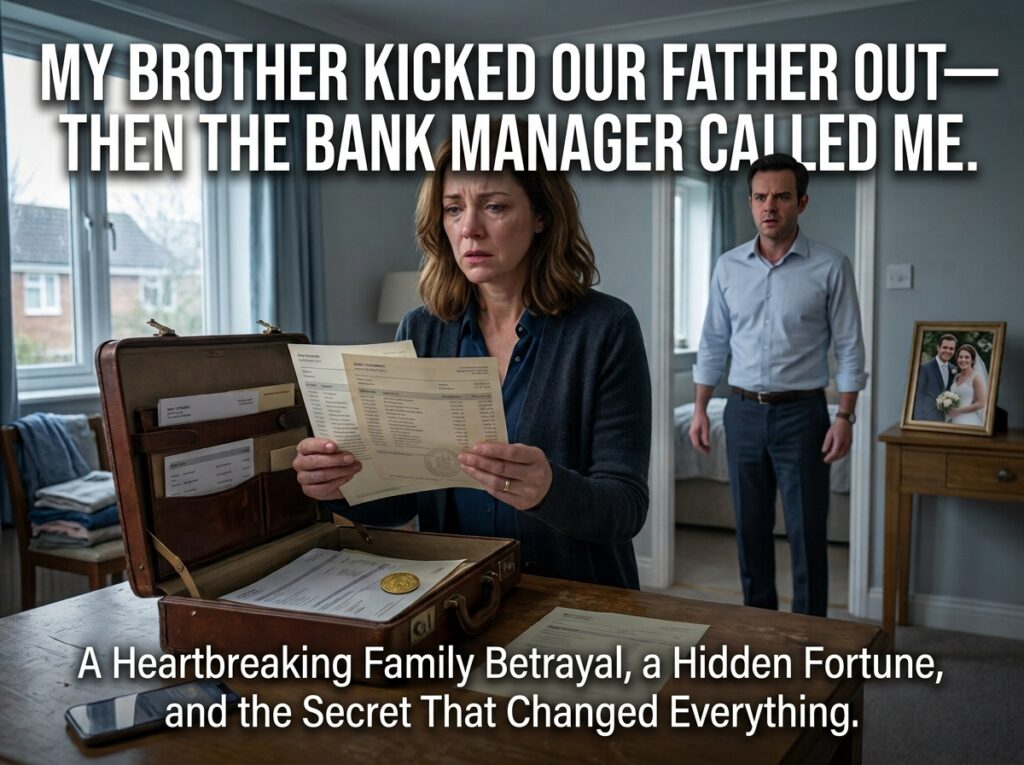
When my older brother threw our seventy-eight-year-old father out of the home he had spent his life building, I took Dad in without asking questions. Then a bank manager called about a secret account—and the name attached to it threatened to tear our family apart forever.
The night my brother threw our father out of his own home, it was raining so hard that the gutters overflowed and the streetlights disappeared behind silver curtains of water.
I remember the sound of Dad’s old suitcase scraping across the front porch. I remember my brother Daniel standing in the doorway with his arms folded, watching our seventy-eight-year-old father struggle to lift the bag over the threshold.
Most of all, I remember what Daniel said.
“You’re not my responsibility anymore, Dad.”
Our father, Robert Mitchell, stood beneath the porch light wearing his faded brown coat, the same one he had worn every winter since I was a child. His gray hair clung to his forehead. One hand gripped the suitcase handle, while the other held a small photograph of our mother.
He didn’t argue.
He didn’t beg.
He simply looked at Daniel and asked, “Have I really become such a burden to you?”
Daniel glanced toward the living room, where his wife, Vanessa, stood watching through the open doorway.
“We’ve talked about this a hundred times,” Daniel replied. “You need constant attention. The bills are getting higher, and Vanessa and I have our own lives. We can’t keep sacrificing everything for you.”
Dad lowered his eyes.
“I never asked you to sacrifice anything.”
“That’s exactly the problem,” Daniel snapped. “You don’t have to ask. Everything falls on us. The groceries, the appointments, the electricity. Even after Mom died, you just expected us to keep taking care of you.”
My father’s fingers tightened around the photograph.
Our mother had been dead for eleven months.
During those eleven months, Dad had learned how to cook simple meals, wash his own clothes, and sleep in a house where every room reminded him of the woman he had loved for fifty-two years. He had never demanded that Daniel visit. He had never complained when his grandchildren stopped coming around.
And now my brother was treating him like an unpaid bill.
I stepped out of my car and ran through the rain.
“What are you doing?” I demanded.
Daniel turned toward me, irritated rather than embarrassed.
“James, stay out of this.”
“You’re throwing Dad out in the middle of a storm.”
“I’m asking him to make other arrangements.”
“With what money? Where is he supposed to go?”
Daniel shrugged.
“That’s not my problem anymore.”
I stared at him, searching for the brother I had grown up with. The boy who used to hold my hand when our father took us fishing. The teenager who cried when Mom was hospitalized for the first time. The man who had stood beside me at her funeral and promised that we would never abandon Dad.
That promise had lasted less than a year.
I turned to our father.
“Dad, come with me.”
He shook his head gently.
“James, you don’t need to get involved.”
“I’m already involved.”
“I don’t want to cause trouble between you and your brother.”
I took the suitcase from his hand.
“You’re not causing anything. We’re doing this together.”
For the first time that evening, Dad looked as though he might cry.
Daniel stepped aside, making room for us to leave.
“Fine,” he said. “Take him. But don’t come back asking me to help when you discover how expensive it is to look after an old man.”
I wanted to tell him that our father had worked double shifts for years so Daniel could attend college. I wanted to remind him who had paid the down payment on his first house when the bank refused his loan.
Instead, I carried Dad’s suitcase to my car.
As I helped him into the passenger seat, I noticed that he was holding something beneath his coat.
It was a small, dark-blue notebook secured with an elastic band.
“What’s that, Dad?”
He looked down at it.
“Just something I’ve kept for a long time.”
I waited for him to explain, but he slipped it into his pocket.
The drive to my house took twenty minutes. Dad sat quietly, watching the rain slide down the window. Once, he lifted his hand toward the glass as we passed the road leading to his old workplace.
He had retired twelve years earlier from a local manufacturing plant, where he had worked as a maintenance supervisor. His salary had never been impressive, but he had always managed to pay the bills, maintain the house, and put food on the table.
When I was young, I thought my father knew how to fix everything.
Broken bicycles. Leaking roofs. Cracked windows. Even the small problems that seemed enormous to a child.
I had never considered what might happen when he needed someone to fix things for him.
At my house, I made him a cup of tea and prepared the spare bedroom. It wasn’t much, just a small room beside the kitchen with a narrow bed and a window overlooking the backyard.
Dad stood in the doorway for a long time.
“You don’t have to do all this,” he said.
“Yes, I do.”
“I can manage on my own.”
“I know you can. But you don’t have to.”
He looked at me with an expression I couldn’t understand.
Then he placed the blue notebook on the bedside table.
“James,” he said quietly, “if anyone ever calls you about a bank account, promise me you’ll listen carefully before you make any decisions.”
I frowned.
“What bank account?”
Dad looked toward the dark window.
“Not tonight.”
Before I could ask another question, he turned off the bedside lamp.
I stood in the hallway, listening to the rain.
My father had just lost his home, and somehow he was worrying about a bank account I had never heard of.
I thought he was exhausted.
I thought grief had made him speak strangely.
I had no idea that, somewhere in a bank’s records, a secret connected to our family had been waiting for decades.
And the next morning, someone would finally come looking for us.
The first week Dad lived with me, I discovered how little I knew about his life.
I knew his favorite breakfast was toast with butter and a little honey. I knew he hated television programs with too much shouting and that he always checked the weather before deciding whether to water the garden.
But I didn’t know that he woke at four thirty every morning because he had spent thirty-eight years getting up before sunrise for work.
I didn’t know that he still folded his socks into neat pairs because my mother had once told him she couldn’t stand finding mismatched laundry.
And I didn’t know that he sometimes stood in front of the kitchen window with his hands resting on the counter, staring at nothing for so long that I had to ask whether he was feeling unwell.
“Are you thinking about Mom?” I asked him one morning.
He nodded.
“Your mother always said that a house becomes a home when somebody remembers you are there.”
I poured coffee into his cup.
“Then this is your home now.”
He smiled, but the expression faded quickly.
“Thank you, son.”
I was a forty-four-year-old divorced man with a modest salary, a mortgage, and a daughter who visited every other weekend. I wasn’t wealthy, and I wasn’t particularly good at expressing my feelings.
But I knew how it felt to be abandoned.
When my marriage ended three years earlier, I had spent months eating dinner alone, pretending I preferred the silence. Dad had never asked me to explain what had happened. He simply called every Sunday and invited me over for lunch.
Sometimes he sent me home with leftovers.
Sometimes he repaired something in my house without telling me.
And sometimes he sat beside me in the garage while I pretended to work, saying nothing until I was ready to talk.
I owed him more than I could ever repay.
So when Daniel texted me that I should keep receipts for every expense involving Dad, I deleted the message without answering.
Three days later, my brother called.
“How’s Dad settling in?”
The question sounded almost friendly, which made me suspicious.
“He’s doing fine.”
“Good. Listen, I want to make sure we’re being realistic about this arrangement.”
“What arrangement?”
“You taking care of him. We need to establish boundaries. I don’t want this becoming a permanent situation where you expect me to contribute financially.”
I leaned against the kitchen counter.
“You threw him out, Daniel. I didn’t ask you to pay anything.”
“I’m just being practical.”
“No. You’re being cruel and calling it practical.”
He sighed.
“You always did make me the villain.”
“I don’t have to make you anything. You managed that yourself.”
He hung up.
That evening, Dad noticed I was upset.
“Daniel called?” he asked.
I nodded.
“He’s worried about money.”
Dad was silent for a moment.
“Money has a way of making people reveal things they didn’t know they were hiding.”
I sat across from him.
“Why do you keep saying things like that?”
He studied my face.
“Because I’m old enough to know that people rarely fight over what they claim to be fighting over.”
Before I could respond, he rose and carried his plate to the sink.
I watched him wash it, carefully wiping each drop of water from the counter afterward.
He had always been like that. Even when he was exhausted from work, he refused to leave a mess for someone else.
The following morning, at precisely 9:17, my phone rang.
The caller identified himself as Michael Harris, a senior manager at a bank in the city.
“Am I speaking with Mr. James Mitchell?”
“Yes.”
“Thank you. I’m calling regarding your father, Mr. Robert Mitchell. Is he available to speak?”
I looked through the kitchen doorway. Dad was sitting at the table, reading the newspaper.
“He’s here. Is something wrong?”
“I’d prefer to discuss the matter with both of you present. It’s important that we verify a few details concerning an account held at our institution.”
I felt my stomach tighten.
“What account?”
There was a pause.
“Your father has maintained a private account with our bank for many years. We’ve recently received instructions that require us to contact him directly. There are also some matters concerning the account’s designated beneficiary that need to be reviewed.”
I stared at the phone.
“How much money are we talking about?”
“I’m afraid I can’t disclose account details until we’ve completed the necessary identity checks. However, I would strongly recommend that your father arrange a meeting with us as soon as possible.”
“Why?”
“Because the account contains a substantial balance, Mr. Mitchell, and the instructions attached to it are unusually specific.”
I glanced toward Dad.
He had lowered his newspaper.
He was watching me.
Not with surprise.
With recognition.
I covered the phone.
“Dad, a bank manager wants to speak with you about an account.”
Dad closed his eyes.
For several seconds, he didn’t move.
Then he reached into his pocket, removed the little blue notebook, and placed it on the table.
“I was hoping they wouldn’t need to call you so soon,” he whispered.
I ended the call after arranging a meeting for the following afternoon.
Then I sat down across from him.
“Dad, what have you been hiding?”
He ran his thumb along the notebook’s worn cover.
“Nothing that belongs to you, James.”
“That’s not an answer.”
“No,” he agreed. “It isn’t.”
He opened the notebook to a page marked with a faded paper clip.
Inside were dates, handwritten figures, and the names of several banks. Some entries went back more than thirty years.
At the bottom of the page, written in my mother’s familiar handwriting, was a sentence that made my heart pound.
If either of our sons ever asks why we saved this money, tell them the truth about the house.
I read it twice.
“What house?”
Dad shut the notebook.
“The one your mother and I bought before you were born.”
I shook my head.
“Our family home?”
“No.”
He looked toward the hallway, checking that nobody else was listening.
“There’s another property, James. And before we visit that bank, you need to understand something about your brother.”
He paused.
“Daniel has no idea what your mother and I promised each other all those years ago.”
I barely slept that night.
Every time I closed my eyes, I saw my father’s handwriting in the blue notebook and my mother’s sentence about a house I had never known existed.
Our family home had been the center of our childhood. It was a modest two-story property with a brick exterior, a creaking staircase, and a backyard where Dad grew tomatoes every summer.
Daniel and I had shared a bedroom until he left for college. Mom had painted the walls herself, and Dad had spent nearly every weekend repairing something.
I had always believed that house was the most valuable thing our parents owned.
Apparently, I had been wrong.
At breakfast, I found Dad sitting at the table with the blue notebook open in front of him.
“Are you going to tell me everything today?”
He folded his hands.
“After we speak to the bank.”
“Why not now?”
“Because some things need to be confirmed before they’re discussed. I spent my life repairing machinery, James. You never replace a part just because you think you understand what’s broken. You examine it first.”
I wanted to argue, but I recognized the stubborn expression on his face.
It was the same one he had worn whenever Daniel and I tried to convince him to throw away an old tool.
So I waited.
The bank occupied the ground floor of a tall office building downtown. Its lobby smelled of polished wood and coffee, and the receptionist greeted us with the practiced warmth of someone who spoke to nervous customers every day.
Michael Harris met us near the elevators.
He was in his early fifties, with silver hair, a navy suit, and the careful manner of a man who understood that money could turn ordinary conversations into life-changing events.
“Mr. Mitchell,” he said, shaking Dad’s hand. “It’s good to see you again.”
I stopped walking.
“You know my father?”
Michael glanced at Dad, who nodded.
“Your father has been a client here for a very long time,” the manager explained.
Dad didn’t respond.
We entered a private office and sat around a polished table. Michael closed the door, then asked Dad to confirm his identity.
After checking the documents, he opened a thick file.
“Mr. Mitchell, before we proceed, I need to make sure you understand why we’ve requested this meeting.”
“I understand,” Dad said.
“The account has been active for several decades. Its balance has grown through regular deposits, interest, and long-term investments. Under the instructions you established, we’ve maintained restricted access to certain information until the account holder confirms his wishes.”
I stared at him.
“How much is in it?”
Michael turned a page.
“As of our latest statement, the total value is approximately two million, four hundred and eighty thousand dollars.”
For a moment, I thought I had misheard him.
“Two million?”
“Four hundred and eighty thousand,” Michael confirmed.
I looked at Dad.
He was examining the edge of the table as if the figure meant very little to him.
“Where did that money come from?” I asked.
“From decades of saving,” Dad replied.
“Your salary was never that high.”
“No,” he said. “It wasn’t.”
Michael continued.
“The account also contains documentation related to a property held through a separate legal arrangement. That property has increased considerably in value over the years.”
I leaned forward.
“What property?”
Michael removed a document from the file.
“An undeveloped parcel of land on the eastern edge of the city, purchased by your parents in the early 1980s.”
I remembered Dad mentioning land once, years ago. He had said that he and Mom had considered buying a small piece of property, but he never explained what became of the idea.
“Why didn’t you tell us?” I asked.
Dad looked at me.
“Because I wanted you to grow up believing that work, kindness, and responsibility mattered more than what a person owned.”
I felt a strange mixture of admiration and anger.
“You could have trusted us.”
“Could I?”
The question landed harder than I expected.
Before I could answer, Michael placed another document on the table.
“This is the current beneficiary designation. Your father has asked us to review it with him today.”
He turned the page toward us.
I expected to see Daniel’s name.
Perhaps mine.
Perhaps both of us.
Instead, there was a name I recognized from childhood but hadn’t heard in more than twenty years.
Eleanor Mitchell.
My mother’s name.
I stared at the document.
“That’s impossible. Mom is dead.”
Michael nodded sympathetically.
“Yes. Mrs. Mitchell was listed as the primary beneficiary. However, the account also contains a separate contingent designation, which becomes relevant under the circumstances.”
Dad’s hands tightened around the arms of his chair.
Michael reached into the file and removed a sealed envelope.
“Your mother left specific instructions regarding what should happen if she was no longer living when the account was reviewed.”
He slid the envelope across the table.
The handwriting on the front was unmistakable.
It was my mother’s.
To be opened only when our family is ready to learn the truth.
Dad stared at the envelope.
Then he turned to me.
“Before you read that, James, I need you to answer one question.”
“What question?”
“If Daniel came here tomorrow and asked for his share of the money, would you give it to him?”
I hesitated.
He noticed.
And for the first time since the bank manager had called, my father looked genuinely disappointed.
I didn’t answer Dad’s question immediately.
It wasn’t because I wanted the money. I hadn’t even known it existed until the previous morning.
It was because I knew Daniel.
My brother had always believed that whatever our parents possessed would eventually become ours. When we were children, he used to joke about inheriting Dad’s tools, Mom’s jewelry, and the family house.
As adults, he became more careful about expressing those thoughts, but the expectation never disappeared.
When Dad needed help paying for a new washing machine, Daniel suggested that he sell some of his belongings. When Mom became ill, Daniel complained about the time required to drive her to medical appointments.
Yet when their house was valued by an estate agent several years earlier, he had suddenly become interested in property prices.
I had never connected those things before.
Now I wondered how much of my brother’s kindness had depended on the belief that our parents would eventually leave him something.
“I don’t know,” I finally told Dad. “I’d want to understand why the money exists and what Mom wanted us to do with it.”
He studied me for several seconds.
“That’s a better answer than simply saying yes.”
Michael cleared his throat.
“Mr. Mitchell, would you like to open the envelope?”
Dad nodded.
The manager carefully broke the seal and removed three sheets of paper. The first was a letter written by our mother. The second was a copy of a property deed. The third contained instructions prepared with a lawyer.
Dad passed the letter to me.
“Read it aloud,” he said.
My hands trembled as I unfolded the paper.
My dear Robert,
If you are reading this without me beside you, then I hope you have found the strength to continue living, even though the house will feel emptier than you ever imagined.
I stopped.
I could hear Mom’s voice in every line.
She had written letters for birthdays and anniversaries, but this one felt different. The handwriting was slightly uneven, as if she had been tired when she wrote it.
I continued.
We spent our lives worrying about our children. We worried when they were sick, when they were lonely, when they made mistakes. We gave them what we could, sometimes more than we could afford, because we believed that raising children meant giving them the chance to build better lives than our own.
But we also made a promise to each other.
We promised that we would never allow money to become the reason our sons stopped loving us.
My throat tightened.
Dad stared at his hands.
The account was created to protect our future. We saved a little from every paycheck, every bonus, every unexpected payment. Sometimes we went without things we wanted. Sometimes we argued about whether we could afford a holiday. But we never regretted putting something aside.
The land was bought because Robert believed the city would eventually grow toward the east. I thought he was being foolish, but I trusted him. We agreed that the property would remain untouched until we understood what it could mean for our family.
I paused.
Michael nodded for me to continue.
If our children are reading this, I want them to understand that this money is not a prize for being born into our family. It is not payment for visiting us, calling us, or helping us when we are old.
Love cannot be measured by the amount of time someone spends in a room, nor by the money someone gives.
But when a person is vulnerable, their actions reveal what their words have hidden.
I couldn’t continue for several seconds.
Then I read the final paragraph.
Robert, you will know what to do when the time comes. Remember our agreement. Protect the person who needs protection, even if the rest of the world tells you that doing so is foolish.
And if our sons ever learn about the account, make sure they understand that the greatest inheritance is not the money we leave behind. It is the kind of people we teach them to become.
With all my love,
Eleanor.
The office was silent.
I folded the letter carefully.
“What does she mean by protecting the person who needs protection?”
Dad didn’t answer.
Instead, he turned toward Michael.
“Please show James the property documents.”
The bank manager laid the deed on the table. It described a large parcel of land on the eastern side of the city, including an old farmhouse and several acres of unused ground.
I recognized the location immediately.
A major commercial development had transformed that area over the previous decade. Shopping centers, apartment buildings, and office complexes had appeared where empty fields once stretched toward the horizon.
“How much is the land worth now?” I asked.
Michael consulted the file.
“The most recent independent valuation places it at approximately three million dollars, although the actual sale price would depend on planning permissions, access, and negotiations with prospective buyers.”
I leaned back.
Nearly five and a half million dollars in assets, perhaps more.
Our parents had lived modestly while quietly building a fortune.
But the money wasn’t what frightened me.
It was the fact that Mom had anticipated a moment when one of her sons might need protection from the other.
Michael opened the final document.
“This is the contingent beneficiary designation. Your father has requested that we verify it and review the legal instructions today.”
He turned the page.
The name was not Daniel’s.
It was not mine.
It belonged to someone whose existence, according to everything I had been told about our family, should have been impossible.
Michael looked at Dad.
“Mr. Mitchell, before I read the accompanying instructions, I need to ask whether you still intend to honor your late wife’s wishes.”
Dad took a long breath.
“Yes.”
“Even if doing so causes a permanent division within your family?”
Dad looked at the photograph of Mom he had brought in his coat pocket.
“Especially then.”
On the drive home, I asked Dad the same question three different ways.
He answered none of them.
“Who is the beneficiary?”
He watched the traffic ahead.
“Someone your mother believed deserved the truth.”
“Someone in our family?”
He nodded.
“Then why have I never heard the name?”
“Because we made a mistake a long time ago, James. And sometimes the people who make mistakes spend the rest of their lives trying to protect everyone from the consequences.”
I gripped the steering wheel.
“That’s not fair. You can’t tell me there is a secret person connected to our family and expect me to pretend everything is normal.”
“I’m not asking you to pretend.”
“Then tell me.”
Dad looked exhausted.
“I will. But I want you to understand something first. Whatever you discover, don’t punish someone for a decision they never had the power to make.”
His words stayed with me long after we arrived home.
That afternoon, I called Daniel.
I hadn’t planned to tell him about the account yet, but I couldn’t keep pretending nothing had happened.
“We need to talk about Dad.”
“What about him?”
“The bank called. There’s an account in his name.”
The silence on the other end lasted only a second, but I heard the change in Daniel’s breathing.
“What kind of account?”
“A private account Mom and Dad opened decades ago.”
“How much?”
I closed my eyes.
There it was.
Not Is Dad all right?
Not What does this mean for him?
Not Why didn’t they tell us?
Just one question.
“About two and a half million dollars,” I said.
Daniel didn’t speak.
Then he laughed.
It was a short, disbelieving sound.
“You’re joking.”
“I’m not.”
“Where did they get that kind of money?”
“They saved it.”
“That’s impossible. Dad’s pension barely covers his expenses.”
“That’s why they saved for decades. They also own land.”
“What land?”
I told him about the property.
By the time I finished, Daniel’s voice had changed completely.
“We need to meet with Dad immediately.”
“We already met with the bank.”
“Without me?”
“It was Dad’s account. The bank contacted him.”
“I’m his son too!”
“Then perhaps you should have remembered that before throwing him out.”
He went quiet.
When he spoke again, his voice was cold.
“Listen to me, James. This could become legally complicated. Dad is elderly. He might not understand what he owns or what people are telling him to do. We need to make sure nobody takes advantage of him.”
I nearly laughed.
“Nobody is taking advantage of him.”
“How do you know? You’re living with him. You’re the one who stands to benefit if he changes his will.”
The accusation stunned me.
“You think I’m after his money?”
“I think people change when millions of dollars appear.”
“You’re right about one thing,” I said. “People do change.”
I ended the call.
That evening, Dad sat in the living room with the blue notebook open on his knees. He seemed to know that I had spoken to Daniel.
“Your brother will come here,” he said.
“Probably.”
“He’ll be angry.”
“He already is.”
Dad nodded slowly.
“Then we must be careful.”
“Careful about what?”
He looked at me.
“About letting him turn his anger into another person’s punishment.”
I sat beside him.
“Dad, I need you to tell me the truth. Who is the beneficiary?”
He opened the notebook to a page near the back.
There were several names written in his careful handwriting. Some had dates beside them. Others had short notes that I couldn’t understand.
One name had been underlined twice.
David Mitchell.
I stared at it.
“Who is David?”
Dad’s face changed.
It was subtle, but I saw it: a tightening around the eyes, a slight tremor in his lower lip.
“Your brother.”
I frowned.
“I only have one brother.”
Dad closed the notebook.
“You have one brother who grew up in our home.”
My heart began to pound.
“Are you saying you had another son?”
Dad looked away.
“Yes.”
The room seemed to tilt around me.
“Where is he?”
“I don’t know.”
“How can you not know where your own son is?”
Dad pressed his palms together.
“Because I failed him before he was old enough to understand what I was doing.”
He told me that David had been born before Daniel and me, from a relationship my father had never discussed. The woman who gave birth to him had been young, unmarried, and struggling to support herself. Dad had been involved in her life briefly, but fear, pressure, and the circumstances of the time had led to a decision that separated him from his child.
David had been raised by another family.
Dad had continued sending money through an arrangement he believed would protect the boy’s future, but contact had gradually disappeared. Later, he and Mom had learned that the family who raised David had moved away.
They never found him.
“Did Mom know?” I whispered.
“She knew everything.”
“Why did she keep it from us?”
“Because we believed we could find him first. We wanted to explain everything properly. Then years passed. Your mother became ill, and we ran out of time.”
I thought of the letter.
Protect the person who needs protection.
“Does Daniel know?”
Dad shook his head.
“Daniel was too young when we first discussed the matter. By the time he was old enough, your mother and I had made the terrible mistake of believing silence could repair what we had done.”
I looked at the notebook again.
David Mitchell.
A name that had been written in our family records for decades, yet erased from our family conversations.
“Why is he the beneficiary?”
Dad’s eyes filled with tears.
“Because your mother never stopped believing that one day he would come home.”
The following morning, Daniel arrived without calling.
He stepped into my house carrying a folder of documents and wearing the expression he usually reserved for business negotiations.
Vanessa followed him.
Neither of them greeted Dad warmly.
“James,” Daniel said, “we need to discuss the account.”
Dad was sitting beside the window, reading a newspaper.
“Good morning, Daniel.”
My brother ignored the greeting.
“I spoke to a lawyer last night. Given your age and the amount of money involved, we need to make sure your financial affairs are handled properly.”
Dad folded the newspaper.
“My affairs are being handled properly.”
“With respect, Dad, you have been keeping secrets from us.”
“That is true.”
Daniel seemed surprised by the admission.
He placed the folder on the table.
“We should establish a family trust. Something that protects the assets and makes sure everything is distributed fairly.”
“Fairly according to whom?” Dad asked.
“According to the law.”
“The law doesn’t decide what is fair between a father and his children.”
Daniel’s jaw tightened.
“You’re not thinking clearly.”
I stepped forward.
“Don’t speak to him like that.”
“I’m trying to protect him!”
“From what? His own money?”
“From people who might manipulate him.”
Dad rose slowly from his chair.
“Daniel, I spent thirty-eight years maintaining machinery in a factory. I understand what it means when something stops working. I also understand the difference between a broken part and a part someone simply wants to replace.”
My brother stared at him.
“What does that even mean?”
“It means I am still capable of deciding who I trust.”
Daniel’s face reddened.
“And you trust James?”
Dad looked at me.
“Yes.”
The answer seemed to hurt Daniel more than any insult could have.
“Of course you do,” he said. “James has always been the favorite. He gets to play the good son while I carry the responsibility of keeping this family afloat.”
I couldn’t believe what I was hearing.
“You carried no responsibility when Dad needed somewhere to sleep.”
“I had my reasons!”
“Then explain them.”
Daniel opened his mouth, then glanced at Vanessa.
She placed a hand on his arm.
“Let’s not do this here,” she said.
But Dad spoke before either of them could leave.
“No. Let’s do it here. We have spent too many years allowing uncomfortable truths to remain hidden.”
He walked to the table and opened the blue notebook.
“Daniel, do you remember the money I gave you when you bought your first house?”
Daniel crossed his arms.
“Of course.”
“Do you remember how much it was?”
“Twenty thousand dollars.”
“Thirty-five thousand,” Dad corrected gently. “Your mother and I withdrew it from our savings because the bank wouldn’t approve your full mortgage.”
Daniel looked uncomfortable.
Dad turned a page.
“And the business loan you needed seven years later? Your mother and I guaranteed it. When your business struggled, we paid the outstanding amount so you wouldn’t lose everything.”
I had never heard about that.
Daniel’s face hardened.
“That was different.”
“How?”
“I was trying to build something!”
“And we wanted you to succeed.”
Dad closed the notebook.
“James never asked us for money when his marriage ended. He was struggling, but he didn’t ask. We helped him anyway because he was our son.”
I felt a sudden ache in my chest.
I had believed my parents’ help was simply love, offered quietly without keeping score. I hadn’t known how much they had done for Daniel, either.
Dad looked at both of us.
“We helped you because we loved you. We didn’t keep a record so we could demand gratitude later.”
Daniel pointed at the notebook.
“Then why are you keeping records now?”
Dad’s expression became very sad.
“Because I needed to remember what happened when people believed money gave them the right to decide who deserved a place in this family.”
Nobody spoke.
Then Daniel turned toward me.
“He’s filling your head with nonsense. You’ve been here for a few days, and suddenly you’re acting like you understand everything.”
“I understand that you put Dad out in the rain.”
“Because I couldn’t keep supporting him!”
“You didn’t even ask where he would go.”
Daniel slammed his hand against the table.
“Because I was drowning! Do you know what it’s like to have an elderly parent depending on you? To worry about every expense? To wonder whether your own children will suffer because you’re constantly paying for someone else?”
For the first time, his anger sounded less like greed and more like fear.
I looked at him carefully.
“Then why didn’t you tell us you were struggling?”
He laughed bitterly.
“Because nobody wants to hear that the successful son is having problems.”
Vanessa lowered her eyes.
Dad remained quiet.
Then Daniel said something that changed the atmosphere in the room.
“I didn’t throw him out because I stopped loving him. I threw him out because I couldn’t bear watching him become weaker while pretending everything was fine.”
I wanted to believe him.
But he had not finished.
“And now I find out he’s been sitting on millions of dollars while I worried about bills. Tell me how that makes any sense.”
Dad’s shoulders sagged.
“I should have told you about the money.”
“Yes, you should have!”
“But the money was never the real problem.”
Daniel shook his head.
“Don’t start with your riddles.”
Dad looked directly at him.
“The real problem is what you did when you believed there was nothing left for you to gain.”
Daniel’s face turned pale.
Before he could respond, Dad reached into the notebook and removed a folded piece of paper.
“I want you both to hear something your mother wrote shortly before she died.”
He unfolded it.
Then he began to read.
If our sons ever discover the account, let them know that the money was never intended to reward the person who asked for it first.
Dad stopped.
His voice trembled.
It was intended to protect the child we failed.
Daniel stared at him.
“What child?”
Dad lowered the paper.
“David.”
The name fell into the room like a stone into still water.
Daniel looked from Dad to me.
Then he laughed once, sharply.
“Who the hell is David Mitchell?”
Dad closed his eyes.
And for the first time, I saw my older brother look truly afraid.
Daniel refused to believe the story.
He paced around my living room, demanding dates, names, documents, and explanations. Every answer seemed to create another question.
“You’re telling me Dad had another son before us?” he asked.
“Yes,” I said.
“And Mom knew?”
“Yes.”
“And you expect me to accept that they hid an entire person from us for our whole lives?”
“I didn’t know either.”
He turned toward Dad.
“Why now? Why tell us now?”
Dad sat with his hands clasped between his knees.
“Because I am seventy-eight years old, and I don’t know how much time I have left to make things right.”
Daniel’s anger faltered.
For a moment, I thought he might sit beside him.
Instead, he asked, “How much of the money belongs to David?”
Dad answered carefully.
“The account was created to secure his future and support certain family obligations. The documents specify how it is to be used. The land is a separate asset.”
“That’s not what I asked.”
“I know.”
Daniel looked at me.
“He’s giving it all away.”
“No one said that.”
“He’s going to hand millions of dollars to a stranger while his own sons get nothing.”
Dad rose.
“David is not a stranger to me.”
“He’s a stranger to us!”
“That is not his fault.”
Daniel’s voice rose.
“Neither is it mine!”
The words stopped us.
Dad looked at him for a long time.
“No,” he said softly. “It isn’t.”
The anger drained from Daniel’s face, leaving something raw beneath it.
For a moment, he looked like the little boy who had cried when our dog died, insisting that if he had stayed awake the previous night, he could have prevented it.
Then Vanessa spoke.
“We should leave.”
Daniel nodded, but before he reached the door, Dad called his name.
“Daniel.”
My brother stopped.
“I need you to understand something. I did not tell you about David because I was ashamed. Not of him, but of myself. I made decisions when I was young that I spent the rest of my life trying to justify.”
Daniel said nothing.
“I thought I was protecting everyone by keeping the secret. Your mother believed that we could still make things right. We were wrong to wait so long.”
Dad’s eyes shone.
“If you are angry, be angry with me. But don’t punish David for being the child we failed to protect.”
Daniel turned away.
“Don’t expect me to welcome him into my life.”
Dad nodded.
“I won’t force you to love someone you have never met.”
Daniel left.
Vanessa followed him, closing the door quietly behind her.
That afternoon, Michael Harris called again.
He explained that the bank had received a request from a legal representative seeking information about the old account. The request had not yet been approved, but the documents suggested that someone connected to the family had begun searching for the assets.
“Could it be David?” I asked.
“Possibly,” Michael replied. “However, we cannot confirm the identity of the person who submitted the inquiry until the relevant checks are completed.”
I looked at Dad.
He was sitting in the garden, watching a bird hop along the fence.
“Is there anything else you can tell us?”
“The account documents include a contact address that was updated several years ago. Your father has authorized us to release the information necessary to begin locating the designated beneficiary.”
After the call, Dad asked me to help him retrieve an old box from his suitcase.
Inside were photographs, letters, and several documents tied together with string.
One photograph showed a young woman standing beside my father in front of a small brick building. She was holding a baby wrapped in a white blanket.
On the back, Dad had written a date.
Forty-nine years earlier.
“Is that David’s mother?” I asked.
“Yes. Her name was Margaret.”
I examined the photograph.
“Did Mom ever meet her?”
“Once.”
“What happened?”
Dad took a long breath.
“Your mother went to see her after we learned Margaret was moving away. She wanted to make sure David would be cared for. She also wanted Margaret to know that our family would never deny him what we could provide.”
“Why didn’t Mom tell us?”
“Because she believed the truth should come with a chance to repair the harm. She never wanted David to be treated as a mistake or a threat to your place in the family.”
I put the photograph down.
“What happened to Margaret?”
Dad’s expression darkened.
“She died when David was still young. The people who raised him moved, and the letters stopped coming. We searched, but every lead eventually disappeared.”
He handed me a small envelope.
“This was the last letter we received.”
The paper was fragile and yellowed. The handwriting was not my mother’s.
Robert,
David is growing into a good boy. He asks questions about you, and I have told him that you are a complicated man who made a mistake when he was young. I hope one day he will understand that people can regret what they have done without knowing how to repair it.
Please don’t stop looking for him.
Margaret.
I sat very still.
Then I noticed something written in pencil beneath the final line.
A telephone number.
Beside it, in Dad’s handwriting, were three words.
Last known guardian.
I read the number aloud.
Dad’s face went white.
“That number belonged to David’s foster family,” he whispered. “I thought it had been disconnected years ago.”
I took out my phone.
“Dad, we can try calling it.”
He nodded, but his hands were shaking.
The number rang once.
Twice.
Three times.
Then a woman’s voice answered.
“Hello?”
I introduced myself and explained that I was looking for David Mitchell.
The woman was silent.
When she finally spoke, her voice had changed.
“Who gave you this number?”
“My father. Robert Mitchell.”
I heard a sharp intake of breath.
Then she said something I would never forget.
“Mr. Mitchell has been trying to find David for nearly twenty years.”
I looked at Dad.
“Who is this?”
“My name is Susan Carter,” she replied. “I was David’s legal guardian for a time, after Margaret died.”
My heart began to race.
“Do you know where he is?”
“I do.”
Dad reached for my arm.
Susan paused.
“But before I give you his address, I need to tell you something about the man your father believes he has been searching for.”
Susan Carter agreed to meet us at a small café the following afternoon.
Dad insisted on wearing his best suit, the charcoal one Mom had bought him for their last wedding anniversary. He stood in front of the mirror for nearly ten minutes, adjusting his collar and smoothing his hair.
“Do I look all right?” he asked.
“You look like Dad.”
He smiled faintly.
“Your mother used to say that was both a compliment and a warning.”
I helped him into the car.
During the drive, he spoke very little. Once, he reached into his pocket and touched the photograph of the woman holding the baby.
I wondered what he would say if David agreed to meet him.
Would he apologize first?
Would he explain the money?
Would he try to justify the years of silence?
Or would he simply look at the son he had lost and discover that no words could restore what time had taken away?
Susan was waiting beside a window when we arrived.
She was a woman in her late sixties with short white hair and kind, watchful eyes. When Dad approached, she stood and took both his hands.
“Robert,” she whispered.
Dad looked at her as though he were afraid to speak.
“Thank you for meeting us.”
Susan gestured toward the table.
We sat down, and she ordered tea before opening her handbag.
“I have kept copies of some old records,” she explained. “Margaret asked me to hold on to them in case David ever wanted to know where he came from.”
She placed a folder on the table.
Inside were birth records, school photographs, and copies of letters.
I saw the baby from the photograph grow into a toddler, then a schoolboy, then a teenager with dark hair and a serious expression.
He looked like Dad.
The same straight nose. The same deep-set eyes. The same slight crease between his eyebrows.
I felt a strange tenderness toward someone I had never met.
“Where is he now?” I asked.
Susan hesitated.
“David is alive. He lives several hours away and works as a nurse in a residential care facility.”
Dad covered his mouth.
“A nurse?”
Susan nodded.
“He has spent most of his adult life caring for elderly people. He says he learned early what it means to need help from someone who doesn’t owe you anything.”
Dad bowed his head.
I could see the words hurting him.
Susan continued.
“David knows that Robert is his biological father. Margaret told him when he was young. But he was also told that you had chosen to stay away.”
Dad’s face crumpled.
“I never chose that.”
“I know,” Susan said gently. “But a child doesn’t always have the information needed to understand an adult’s decisions.”
She reached into the folder and removed a letter.
“David wrote this several years ago. He asked me to keep it with the other documents.”
Dad unfolded it with trembling fingers.
To the man whose name appears on my birth certificate,
I don’t know whether you are alive or whether you ever think about me. I have spent years wondering whether I did something wrong, whether I was born at the wrong time, or whether you simply decided that I wasn’t worth the trouble.
I have a good life now. I have people who love me, and I have work that matters to me. I am not writing because I want money.
I am writing because I want to stop wondering.
If you ever decide to look for me, I hope you will come prepared to tell the truth.
David.
Dad pressed the letter against his chest.
“I should have found him sooner.”
Susan nodded.
“Yes, you should have.”
There was no cruelty in her voice, but there was no attempt to excuse him either.
I respected her for that.
After a long silence, she explained that David had recently contacted a solicitor to review some family records. He had learned that his biological father might have maintained a substantial account connected to his name.
“He didn’t know how much money was involved,” Susan said. “He simply wanted to understand whether his mother had been telling him the truth about the arrangements Robert made.”
Dad looked up.
“Did he ask for money?”
“No.”
“Did he ask about the property?”
“Not directly.”
I remembered the bank manager’s warning about the account inquiry.
“Then why did someone contact the bank?”
Susan opened another document.
“David’s solicitor requested confirmation that the old account existed. The solicitor was trying to establish whether David had been deliberately excluded from information about his inheritance rights.”
Dad closed his eyes.
“I never intended to exclude him.”
Susan placed a hand over his.
“Intentions matter, Robert. But they don’t erase consequences.”
We sat quietly for several minutes.
Then I asked the question that had been haunting me.
“Would David agree to meet us?”
Susan looked at Dad.
“I can ask. But you must be prepared for the possibility that he won’t.”
Dad nodded.
“I understand.”
She took out her phone and stepped away from the table.
I watched Dad stare at the photographs.
When Susan returned, she looked troubled.
“David has agreed to speak with you,” she said. “But there is something else you need to know.”
Dad lifted his head.
“What is it?”
Susan glanced at me, then back at him.
“David has already seen a copy of the beneficiary designation.”
I felt the blood drain from my face.
“How?”
“Through his solicitor. The designation identifies him as the contingent beneficiary, but there is an additional document that explains why your mother chose him.”
Dad stood so quickly that his chair scraped against the floor.
“What document?”
Susan’s eyes filled with tears.
“The letter your wife wrote to David before she died.”
Dad stared at her.
“She wrote to him?”
“Yes.”
“Why didn’t I know about this?”
Susan opened the folder again.
At the bottom lay a sealed envelope addressed to David.
And on the back, in my mother’s handwriting, were the words:
Read this before you decide whether you want to meet your father.
David agreed to meet us two days later.
He chose a quiet room at the residential care facility where he worked, a place filled with the smell of disinfectant, fresh coffee, and the faint sweetness of flowers arranged near the reception desk.
Dad arrived early.
He sat with his hands folded, staring at the door.
I had never seen him so frightened.
When the door finally opened, a man in his late forties stepped inside.
He was tall and lean, with dark hair beginning to gray at the temples. His face was calm, but his eyes were guarded.
He looked at Dad for several seconds.
Then he said, “Robert.”
Dad rose slowly.
“David.”
Neither man moved.
I had imagined the meeting countless times since learning about my brother. I had expected tears, perhaps anger, maybe an embrace.
Instead, there was silence.
David finally pulled out a chair.
“Please sit down.”
Dad obeyed.
I remained near the window, unsure whether I should leave them alone.
David noticed.
“You can stay, James. I’ve heard about you.”
I sat opposite him.
“From whom?”
“From your mother.”
My breath caught.
David reached into a folder and removed the letter Susan had shown us.
“She wrote to me shortly before she died. She told me that she had spent years trying to persuade Robert to find me.”
Dad stared at the letter.
“I didn’t know she had written to you.”
“Apparently, there were many things you didn’t know.”
Dad accepted the accusation without defending himself.
David opened the letter.
“Would you like me to read it?”
Dad nodded.
David began.
Dear David,
You do not know me, but I have known about you for most of my adult life. I am Eleanor, the woman Robert married after you were born.
I will not ask you to forgive us. Forgiveness is not something anyone should demand from a person they have hurt.
I only want you to understand that you were never unwanted by me.
When I first learned about you, I was angry. I was angry with Robert, with the circumstances that brought us together, and with the knowledge that a child had been left to grow up without answers.
But I came to understand that my anger could not change what had happened. I could only decide what to do with the years that remained.
Robert and I created an account for your future. We hoped that one day we would find you and give you what should have been yours all along: the truth, the choice to know your family, and the security to build your own life.
If you never wish to meet us, I will understand.
If you do, I hope you will meet Robert not as the man he wishes he had been, but as the man who must take responsibility for what he did.
And if you meet our other sons, remember that they are not responsible for the decisions we made before they were born.
You deserved better than silence, David.
I am sorry that we allowed it to continue for so long.
With sincerity,
Eleanor Mitchell.
David folded the letter.
For a moment, nobody spoke.
Then Dad began to cry.
Not the quiet tears I had seen after Mom’s funeral, nor the restrained sadness he had shown when Daniel put him out.
These were the tears of a man who had finally heard the truth spoken aloud and could no longer hide behind the years he had lost.
“I’m sorry,” he whispered. “I know those words cannot give you back your childhood. I know they cannot make up for every birthday I missed or every question you asked without an answer.”
David looked at him.
“Why didn’t you come looking for me?”
Dad’s shoulders shook.
“I was afraid.”
“Of what?”
“Of discovering that you hated me.”
David laughed bitterly.
“So you decided it was better to let me believe you didn’t care.”
Dad lowered his head.
“Yes.”
The honesty seemed to surprise David more than any excuse could have.
“I grew up wondering what was wrong with me,” David said. “I wondered whether I wasn’t good enough for the people who brought me into the world. I spent years telling myself that I didn’t need answers.”
He leaned forward.
“And now I learn that you had the means to help me, that you knew where I came from, and that you were saving money for a future you never explained.”
Dad wiped his face.
“I cannot defend what I did.”
“No,” David replied. “You cannot.”
I watched my father accept each sentence as if he understood that he had no right to interrupt.
Finally, David turned toward me.
“James, I want you to know that I don’t blame you for any of this.”
“Thank you.”
“But I need to ask you something.”
“Anything.”
“When you learned about the money, did you think about what you might receive?”
I considered lying.
Instead, I told him the truth.
“Yes. For a moment, I wondered what it meant for our family. But I was more concerned about why Dad had kept it secret and why Mom believed someone needed protection.”
David nodded.
“That’s honest.”
He looked back at Dad.
“My solicitor explained the account. I understand that I am named as the contingent beneficiary, and that the final arrangements depend on the account’s terms and the applicable legal requirements.”
Dad nodded.
“Your mother wanted you protected.”
“I know.”
“I want you to have the opportunity to decide what happens next.”
David was quiet for a long time.
Then he said, “I don’t want the money to buy a relationship that should have existed without it.”
Dad looked stricken.
“I know.”
“But I won’t pretend the money doesn’t matter. My mother struggled. The family who raised me struggled. There were times when we needed help, and I grew up believing that the people who could have helped us had chosen not to.”
He paused.
“I need time to understand what this means.”
Dad nodded.
“You have all the time you need.”
David rose, signaling that the meeting was over.
At the door, he stopped and looked back.
“There’s one more thing.”
He took a document from his folder and placed it on the table.
It was a letter from a solicitor representing Daniel.
The letter requested a formal review of the account, questioned Dad’s capacity to make financial decisions, and sought information about the ownership of the eastern property.
I stared at it.
“Daniel is challenging Dad’s decisions?”
David’s expression was grim.
“His solicitor contacted mine this morning. Your brother believes that the money and land should be treated as assets intended for the immediate family.”
Dad slowly sat down again.
“He wants to take me to court.”
David shook his head.
“I don’t know what he intends to do. But I do know this: the account’s documents include a clause that could affect the distribution of the property if a family member contests the arrangement.”
My stomach tightened.
“What clause?”
David placed his finger on the final paragraph.
“If the beneficiary designation is challenged, the matter must be referred to the independent trustees, who will determine whether the original purpose of the account remains valid.”
He looked at Dad.
“And if they decide it doesn’t?”
Dad closed his eyes.
“Then we may lose the only opportunity we have left to make this right.”
For three days, our family lived beneath the shadow of a letter.
Daniel stopped answering my calls. Dad spent long hours in the garden, pruning branches that didn’t need pruning and watering plants that had already been watered.
David returned to work.
He had agreed to remain in contact, but he wasn’t ready to become part of our family overnight. I couldn’t blame him. Blood could establish a relationship, but it couldn’t manufacture trust.
On the fourth morning, Daniel called.
“I want to meet with Dad,” he said.
I looked toward the kitchen, where Dad was making tea.
“Why?”
“Because I need to apologize.”
I didn’t answer immediately.
“James, I know what I did was wrong.”
“Do you?”
“Yes.”
“Then tell Dad. Don’t tell me.”
He arrived that afternoon without Vanessa and without his folder of documents.
For the first time since Dad had moved in, Daniel looked uncertain.
He stood in the doorway, holding his hands together.
“Dad, can we talk?”
Dad nodded toward the living room.
We sat around the same table where Daniel had accused him of hiding money and where Dad had revealed the existence of a son none of us had known.
My brother stared at his hands.
“I’ve been thinking about what happened,” he began. “I keep telling myself that I was under pressure, that I was worried about money, that I didn’t know how to handle everything after Mom died.”
Dad listened quietly.
“But those are excuses,” Daniel continued. “I was angry, and I took it out on you. I treated you like a problem I needed to get rid of instead of the man who raised me.”
His voice broke.
“I’m sorry.”
Dad looked at him for a long time.
“Why did you really want me to leave?”
Daniel swallowed.
“Because I was afraid.”
Dad waited.
Daniel finally explained that his business had been struggling for more than a year. Several clients had failed to pay, and a loan he had taken to expand his company had become difficult to manage.
He had been hiding the problems from Vanessa and his children, terrified that the successful life he had built would collapse.
Caring for Dad had become one more responsibility he couldn’t control.
“I convinced myself that you were costing me money,” Daniel said. “I kept thinking about what I needed to do for my own family, and I stopped thinking about what you had done for us.”
Dad’s eyes filled with tears.
“I wish you had told me.”
“I know.”
“I might not have been able to solve your problems. But I would have listened.”
Daniel nodded.
“That’s what makes it worse.”
He reached into his pocket and removed a small object.
It was the old brass key to our parents’ house.
“I took this when I asked you to leave,” he said. “I don’t know why. Maybe I wanted to feel like I was in control of something.”
He placed the key on the table.
“I don’t deserve to ask you to forgive me.”
Dad picked it up.
“No,” he said. “You don’t get to demand forgiveness. But you can begin by changing what you do next.”
Daniel looked up.
“What do you want me to do?”
“Tell the truth.”
Daniel nodded slowly.
Then he turned toward me.
“I’ve instructed my solicitor to withdraw the challenge to the account. I won’t contest the beneficiary designation or the property arrangement.”
I felt the tension leave my shoulders.
“Are you sure?”
“Yes.”
He looked at Dad.
“I don’t want to spend the rest of my life fighting over money our parents saved. And I don’t want my children to remember me as the man who threw their grandfather out because he thought an old man was too expensive to love.”
Dad reached across the table.
For several seconds, Daniel stared at his father’s hand.
Then he took it.
They didn’t embrace. There were no dramatic promises that everything would be different from that moment onward.
But they sat together for a long time, speaking quietly about Mom, the old house, and the years we had wasted pretending that family problems disappeared when nobody mentioned them.
A week later, David came to my house for dinner.
He brought a photograph of Margaret, the woman who had raised him during his earliest years, and placed it beside Mom’s photograph on the mantel.
Dad stood looking at the two pictures.
“I wish Eleanor could have met you properly,” he said.
David considered this.
“She did meet me in the way that mattered. She thought about me when she didn’t have to.”
Dad lowered his head.
David placed a hand on his shoulder.
“That doesn’t erase what happened. But it means something.”
Over the following months, we worked with the bank and the independent trustees to settle the account according to its legal terms and our mother’s written instructions. David received independent legal advice and made his own decisions about the inheritance. The land was retained while the family reviewed its future, rather than sold in a rush to satisfy anyone’s demands.
The money did not repair every wound.
Daniel still struggled with his business. David still needed time to understand his relationship with Dad. And I still remembered the sight of my father standing alone in the rain, holding a photograph of the woman he had loved.
Some memories don’t disappear simply because people apologize.
But something changed.
Daniel began visiting Dad every Sunday. At first, their conversations were awkward. They talked about the weather, the garden, and the repairs needed at the old house.
Eventually, they began talking about Mom.
One Sunday, I arrived to find Daniel helping Dad repair a loose hinge on the garden gate.
They were arguing about which screwdriver to use.
For a moment, I saw the two of them as they had been when I was a child: my father patiently explaining something, my brother insisting he already knew how to do it.
I stood in the doorway, smiling.
Dad noticed me.
“James, tell your brother that the smaller screwdriver is the right one.”
Daniel shook his head.
“Don’t listen to him. He’s been using the wrong tools for forty years.”
We laughed.
It was an ordinary moment, but I understood how precious it was.
Months later, Dad asked me to drive him to the cemetery.
We stood beside Mom’s grave while the wind moved gently through the trees. Dad placed a small bouquet of white flowers on the stone.
“I found him,” he whispered.
I knew he wasn’t speaking to me.
He stood silently for a while, then turned toward me.
“Your mother would have been happy.”
“She would have been proud of you for trying.”
Dad shook his head.
“I should have tried sooner.”
“Yes,” I said. “You should have.”
He looked surprised that I hadn’t softened the truth.
Then he smiled sadly.
“You’re becoming wiser than your father.”
On the drive home, he asked me to stop outside the old family house.
Daniel had returned the keys, and Dad had decided to visit the place where he and Mom had spent most of their married lives.
The garden was overgrown. Leaves had gathered along the front path, and the porch needed repainting.
Dad stood outside for a long time.
“I used to think this house was the most important thing I could leave you boys,” he said.
“What do you think now?”
He looked at me.
“I think I was wrong.”
He explained that he had spent much of his life saving money because he believed financial security would protect the people he loved. He had watched friends lose their homes, families struggle with medical bills, and children grow up believing that poverty was a personal failure.
He wanted his sons to have choices.
But in trying to protect us from hardship, he had also protected us from the truth.
“I thought I could wait until the right time to explain everything,” he said. “But there is no perfect time to tell someone you have hurt them. The longer you wait, the more the silence becomes another kind of injury.”
I thought about David’s letter, Daniel’s anger, and the rainy night when Dad had stood outside with his suitcase.
“Do you regret keeping the money secret?”
“I regret believing the money could solve things that only honesty could repair.”
He slipped his hand into his coat pocket and removed the small blue notebook.
“I want you to keep this.”
I hesitated.
“Dad, I don’t need it.”
“I know. That’s why I’m giving it to you.”
He pressed the notebook into my hand.
Inside, the pages contained decades of deposits, careful calculations, property records, and notes about the people our parents had helped along the way.
Near the back, I found a final entry in Mom’s handwriting.
If we have done anything right, let it be this: may our children learn that a person’s worth is never determined by what they can give us.
Below it, Dad had written a sentence in his own hand.
And may we never again confuse being needed with being loved.
I closed the notebook.
When we returned home, David was waiting on the porch. Daniel had come with him, carrying a bag of groceries for dinner.
Dad looked at his three sons.
For a moment, none of us knew what to say.
Then Daniel stepped forward.
“Dad, I made too much food. I thought we could all eat together.”
Dad smiled.
“Then we’d better not waste it.”
We went inside.
There was no grand celebration, no sudden transformation that erased decades of mistakes. We were still imperfect people carrying complicated histories.
But that evening, the table was full.
David told us stories about Margaret. Daniel spoke about his children. I listened while Dad asked questions, sometimes laughing, sometimes wiping his eyes.
At one point, David reached across the table and passed Dad the serving dish.
It was such a small gesture that nobody else seemed to notice.
But I did.
For years, Dad had believed that the greatest thing he could give his children was money enough to protect them from life’s difficulties.
In the end, his greatest gift was the truth.
The bank manager’s call had revealed a fortune, a forgotten son, and a betrayal that could have destroyed what remained of our family.
But it had also forced us to face a question none of us had wanted to answer.
What do we owe the people who raised us when they can no longer give us anything in return?
I learned that love is not proven by inheritance, expensive gifts, or promises made when life is easy.
It is proven in the ordinary moments when someone becomes inconvenient, when helping costs time, when patience runs thin, and when walking away would be easier than staying.
My brother had thrown our father out because he believed Dad had become a burden.
I had taken him in because I remembered what Dad had given me.
David had agreed to meet him because, despite everything, he wanted the truth.
And Dad, at seventy-eight, had finally learned that a family cannot be protected by silence.
Sometimes the people we love hurt us.
Sometimes they fail us so badly that forgiveness feels impossible.
But the first step toward repairing a family is not pretending that the hurt never happened.
It is telling the truth, accepting responsibility, and choosing what kind of person we want to become afterward.
That night, as I watched my father laugh with his sons, I understood something my mother had tried to teach us all along.
The real inheritance was never the money in the bank.
It was the chance to become a family again before time took that chance away.
And I knew that if the bank manager had never called, we might have spent the rest of our lives believing we had nothing left to learn from our father.
After his brother throws their elderly father out, James discovers a hidden fortune, a forgotten brother, and a family secret that changes everything.